







Capital Budgeting
Amrita Prem Gharti
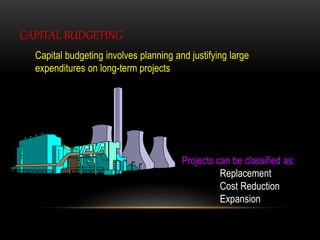
Should we
build this
plant?
Capital Budgeting
Capital budgeting involves planning and justifying large
expenditures on long-term projects
CAPITAL BUDGETING
Projects can be classified as:
Replacement
Cost Reduction
Expansion
What is Capital Budgeting?
Is it WORTH it to put money or
“capital” into this project?
Is it WORTH it to use money to buy
this Machine?
Is it WORTH it to put money in
this business?
OBJECTIVES OF CAPITAL BUDGETING:
 To find out the profitable capital expenditure.
 To know whether the replacement of any existing
fixed assets gives more return than earlier.
 To decide whether a specified project is to be
selected or not.
 To find out the quantum of finance required for the
capital expenditure.
 To assess the various sources of finance for capital
expenditure.
 To evaluate the merits of each proposal to decide
which project is best.
IMPORTANCE OF CAPITAL BUDGETING:
 Develop and formulate long-term strategic goals .
 Seek out new investment projects.
 Estimate and forecast future cash flows .
 Facilitate the transfer of information and Control of
Expenditures .
 Creation of Decision .
ADVANTAGES OF CAPITAL BUDGETING:
 Capital budgeting helps a company to understand various risks
involved in an investment opportunity and how these risks affect
the returns of the company.
 It helps the company to estimate which investment option would
yield the best possible return.
 A company can choose a technique/method from various
techniques of capital budgeting to estimate whether it is financially
beneficial to take on a project or not.
 It helps the company to make long-term strategic investments.
 It helps to make an informed decision about an investment taking
into consideration all possible options.
 It offers adequate control on expenditure for projects.
 Also, it allows management to abstain from over investing and
under investing.
DISADVANTAGES OF CAPITAL BUDGETING.
 Most of the times, these techniques are based on the
estimations and assumptions as the future would always
remain uncertain.
 Capital budgeting still remains introspective as the risk factor
and the discounting factor. remains subjective to the
manager’s perception.
 A wrong capital budgeting decision taken can affect the long
term durability of the company and hence it needs to be done
judiciously by professionals who understands the project
well.
 Capital budgeting decisions are for long term and are majorly
irreversible in nature.
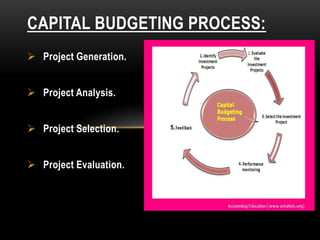
CAPITAL BUDGETING PROCESS:
 Project Generation.
 Project Analysis.
 Project Selection.
 Project Evaluation.
CAPITAL
BUDGETING
TECHNIQUES
PAYBACK PERIOD
In Payback method, no discounting principle is
taken into consideration, only on the basis of
returns the decision is taken. Mostly the project
in which the fastest recovery is observed is
chosen.
Payback Period = years before full recovery + unrecorded amount
at the start of the period
cash flow during the period
FORMULA:-
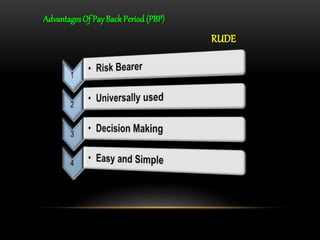
Advantages Of PayBack Period (PBP)
RUDE
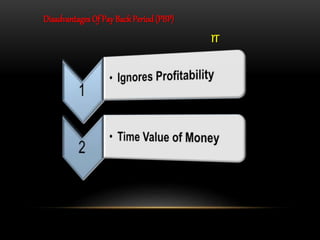
Disadvantages Of PayBack Period (PBP)
IT
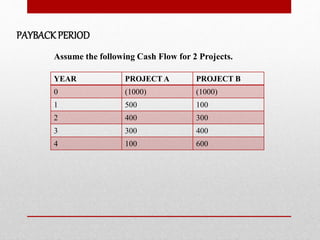
YEAR PROJECT A PROJECT B
0 (1000) (1000)
1 500 100
2 400 300
3 300 400
4 100 600
PAYBACKPERIOD
Assume the following Cash Flow for 2 Projects.
YEAR Cash Inflow
(Project A)
Cumulative
Cash Inflow
(Project A)
Cash Inflow
(Project B)
Cumulative
Cash Inflow
(Project B)
0 (1000) (1000)
1 500 100
2 400 300
3 300 400
4 100 600
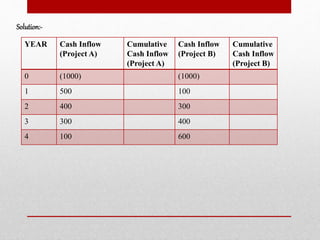
Solution:-
YEAR Cash Inflow
(Project A)
Cumulative
Cash Inflow
(Project A)
Cash Inflow
(Project B)
Cumulative
Cash Inflow
(Project B)
0 (1000) (2000)
1 500 500 100 100
2 400 900 300 400
3 300 1200 400 800
4 100 1300 600 1400
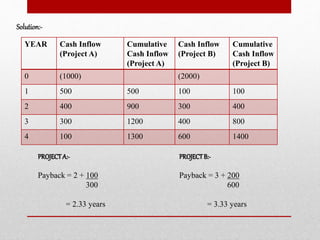
Solution:-
PROJECTA:-
Payback = 2 + 100
300
= 2.33 years
PROJECTB:-
Payback = 3 + 200
600
= 3.33 years
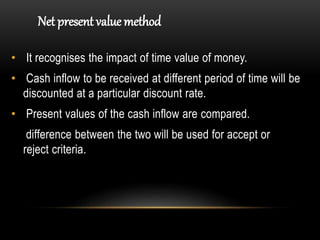
• It recognises the impact of time value of money.
• Cash inflow to be received at different period of time will be
discounted at a particular discount rate.
• Present values of the cash inflow are compared.
difference between the two will be used for accept or
reject criteria.
Net present value method
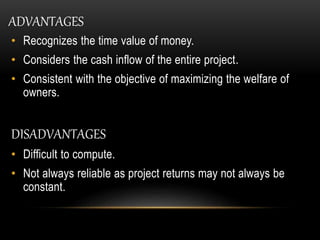
• Recognizes the time value of money.
• Considers the cash inflow of the entire project.
• Consistent with the objective of maximizing the welfare of
owners.
DISADVANTAGES
• Difficult to compute.
• Not always reliable as project returns may not always be
constant.
ADVANTAGES
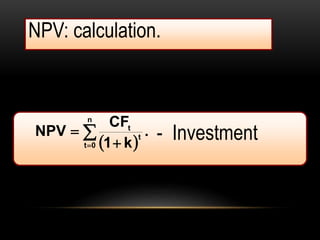
 
.
k1
CF
NPV t
t
n
0t 
 
NPV: calculation.
- Investment
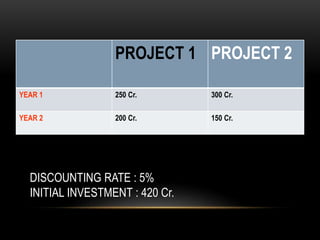
PROJECT 1 PROJECT 2
YEAR 1 250 Cr. 300 Cr.
YEAR 2 200 Cr. 150 Cr.
DISCOUNTING RATE : 5%
INITIAL INVESTMENT : 420 Cr.
Internal Rate of Return
• Rate at which the sum of discounted cash inflows equals the sum of discounted cash outflows.
• Rate at which the net present value of the investment is zero.
• Called internal rate because it depends mainly on the layout and proceeds associated with the
project and not on any rate determined outside the investment.
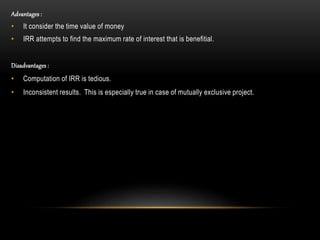
Advantages :
• It consider the time value of money
• IRR attempts to find the maximum rate of interest that is benefitial.
Disadvantages :
• Computation of IRR is tedious.
• Inconsistent results. This is especially true in case of mutually exclusive project.
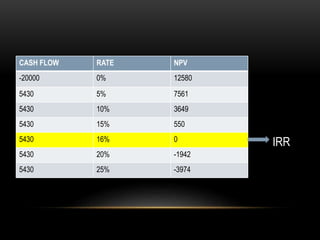
CASH FLOW RATE NPV
-20000 0% 12580
5430 5% 7561
5430 10% 3649
5430 15% 550
5430 16% 0
5430 20% -1942
5430 25% -3974
IRR
THANK
YOU 

Capital Budgeting

  • 1.
  • 2.
  • 3.
    Capital budgeting involvesplanning and justifying large expenditures on long-term projects CAPITAL BUDGETING Projects can be classified as: Replacement Cost Reduction Expansion
  • 4.
    What is CapitalBudgeting? Is it WORTH it to put money or “capital” into this project? Is it WORTH it to use money to buy this Machine? Is it WORTH it to put money in this business?
  • 5.
    OBJECTIVES OF CAPITALBUDGETING:  To find out the profitable capital expenditure.  To know whether the replacement of any existing fixed assets gives more return than earlier.  To decide whether a specified project is to be selected or not.  To find out the quantum of finance required for the capital expenditure.  To assess the various sources of finance for capital expenditure.  To evaluate the merits of each proposal to decide which project is best.
  • 6.
    IMPORTANCE OF CAPITALBUDGETING:  Develop and formulate long-term strategic goals .  Seek out new investment projects.  Estimate and forecast future cash flows .  Facilitate the transfer of information and Control of Expenditures .  Creation of Decision .
  • 7.
    ADVANTAGES OF CAPITALBUDGETING:  Capital budgeting helps a company to understand various risks involved in an investment opportunity and how these risks affect the returns of the company.  It helps the company to estimate which investment option would yield the best possible return.  A company can choose a technique/method from various techniques of capital budgeting to estimate whether it is financially beneficial to take on a project or not.  It helps the company to make long-term strategic investments.  It helps to make an informed decision about an investment taking into consideration all possible options.  It offers adequate control on expenditure for projects.  Also, it allows management to abstain from over investing and under investing.
  • 8.
    DISADVANTAGES OF CAPITALBUDGETING.  Most of the times, these techniques are based on the estimations and assumptions as the future would always remain uncertain.  Capital budgeting still remains introspective as the risk factor and the discounting factor. remains subjective to the manager’s perception.  A wrong capital budgeting decision taken can affect the long term durability of the company and hence it needs to be done judiciously by professionals who understands the project well.  Capital budgeting decisions are for long term and are majorly irreversible in nature.
  • 9.
    CAPITAL BUDGETING PROCESS: Project Generation.  Project Analysis.  Project Selection.  Project Evaluation.
  • 10.
  • 11.
    PAYBACK PERIOD In Paybackmethod, no discounting principle is taken into consideration, only on the basis of returns the decision is taken. Mostly the project in which the fastest recovery is observed is chosen. Payback Period = years before full recovery + unrecorded amount at the start of the period cash flow during the period FORMULA:-
  • 12.
    Advantages Of PayBackPeriod (PBP) RUDE
  • 13.
    Disadvantages Of PayBackPeriod (PBP) IT
  • 14.
    YEAR PROJECT APROJECT B 0 (1000) (1000) 1 500 100 2 400 300 3 300 400 4 100 600 PAYBACKPERIOD Assume the following Cash Flow for 2 Projects.
  • 15.
    YEAR Cash Inflow (ProjectA) Cumulative Cash Inflow (Project A) Cash Inflow (Project B) Cumulative Cash Inflow (Project B) 0 (1000) (1000) 1 500 100 2 400 300 3 300 400 4 100 600 Solution:-
  • 16.
    YEAR Cash Inflow (ProjectA) Cumulative Cash Inflow (Project A) Cash Inflow (Project B) Cumulative Cash Inflow (Project B) 0 (1000) (2000) 1 500 500 100 100 2 400 900 300 400 3 300 1200 400 800 4 100 1300 600 1400 Solution:- PROJECTA:- Payback = 2 + 100 300 = 2.33 years PROJECTB:- Payback = 3 + 200 600 = 3.33 years
  • 17.
    • It recognisesthe impact of time value of money. • Cash inflow to be received at different period of time will be discounted at a particular discount rate. • Present values of the cash inflow are compared. difference between the two will be used for accept or reject criteria. Net present value method
  • 18.
    • Recognizes thetime value of money. • Considers the cash inflow of the entire project. • Consistent with the objective of maximizing the welfare of owners. DISADVANTAGES • Difficult to compute. • Not always reliable as project returns may not always be constant. ADVANTAGES
  • 19.
      . k1 CF NPV t t n 0t   NPV: calculation. - Investment
  • 20.
    PROJECT 1 PROJECT2 YEAR 1 250 Cr. 300 Cr. YEAR 2 200 Cr. 150 Cr. DISCOUNTING RATE : 5% INITIAL INVESTMENT : 420 Cr.
  • 21.
    Internal Rate ofReturn • Rate at which the sum of discounted cash inflows equals the sum of discounted cash outflows. • Rate at which the net present value of the investment is zero. • Called internal rate because it depends mainly on the layout and proceeds associated with the project and not on any rate determined outside the investment.
  • 22.
    Advantages : • Itconsider the time value of money • IRR attempts to find the maximum rate of interest that is benefitial. Disadvantages : • Computation of IRR is tedious. • Inconsistent results. This is especially true in case of mutually exclusive project.
  • 23.
    CASH FLOW RATENPV -20000 0% 12580 5430 5% 7561 5430 10% 3649 5430 15% 550 5430 16% 0 5430 20% -1942 5430 25% -3974 IRR
  • 24.