02Elements of Marketing Strategy and PlanningCopyright © 2010 by The McGraw-Hill Companies, Inc. All rights reservedMcGraw-Hill/Irwin
LEARNING OBJECTIVESExamine the concept of value and the elements and role of the value chainUnderstand the conditions required for successful marketing planning, that marketing planning is focused on the value proposition, and that marketing planning is a dynamic processIdentify various types of organizational strategiesConduct a situation analysis Use the framework provided for marketing planning, along with the content in future chapters, to build a marketing plan
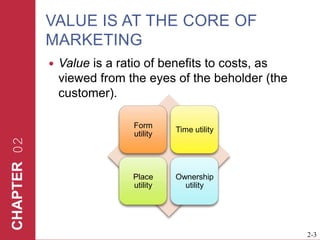
VALUE IS AT THE CORE OF MARKETINGValue is a ratio of benefits to costs, as viewed from the eyes of the beholder (the customer).
VALUE IS AT THE CORE OF MARKETINGValue proposition is the firm’s communication of the unique value of its products to its customers. The value message may include the whole bundle of benefits the company promises to deliver – not just the benefits of the product itself.
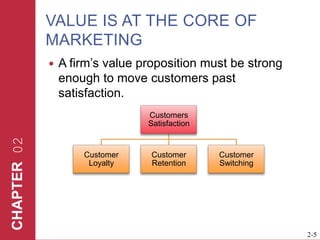
VALUE IS AT THE CORE OF MARKETINGA firm’s value proposition must be strong enough to move customers past satisfaction.
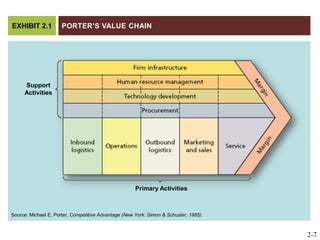
VALUE IS AT THE CORE OF MARKETINGThe Value Chain serves as a means for firms to identify ways to create, communicate, and deliver more customer value within a firm.
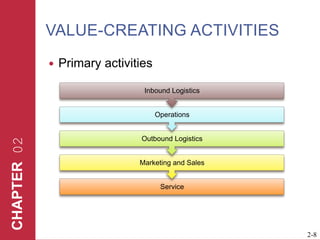
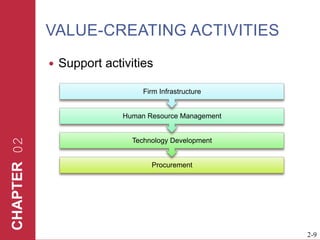
Porter’s Value ChainEXHIBIT 2.1SupportActivitiesPrimary ActivitiesSource: Michael E. Porter, Competitive Advantage (New York: Simon & Schuster, 1985).2-7
Value-creating activitiesPrimary activities
Value-creating activitiesSupport activities
Marketing PlanningMarketing planning is the ongoing process of developing and implementing market-driven strategies for an organization.  The resulting document that records the marketing planning process in a useful framework is the marketing plan.
MARKETING PLANNING IS BOTH STRATEGIC AND TACTICALMarketing (Big M) serves as a core driver of business strategy.marketing (little m) represents the specific programs and tactics aimed at customers and other stakeholder groups.
For effective marketing planningEveryone in an organization must understand and support the concept of customer orientation.All internal organizational processes and systems must be aligned around the customer.
Framework for Marketing PlanningMarketing plan is connected to the firm’s business planPerform any needed market researchEstablish marketing goals and objectivesDevelop marketing strategiesMarketing mix strategiesDevelop implementation plans
Connecting the Marketing Plan to the Firm’s Business PlanMarket-driven strategic planning is often used to describe the process at the corporate or strategic business unit (SBU) level of marshaling the various resource and functional areas of the firm toward a central purpose around the customer.
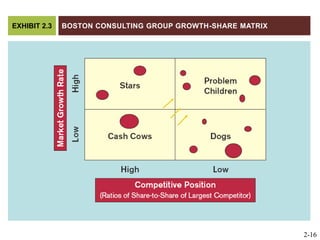
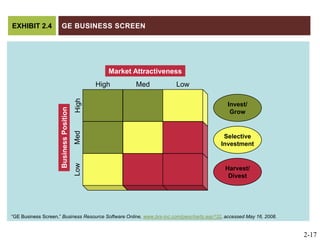
ELEMENTS OF MARKETING PLANNINGPortfolio analysis views SBUs and sometimes even product lines as a series of investments from which it expects maximization of returns. Boston Consulting Group (BCG) Growth-Share Matrix GE Business Screen
Boston Consulting Group Growth-Share MatrixEXHIBIT 2.32-16
GE Business ScreenEXHIBIT 2.4Market AttractivenessHighMedLowInvest/GrowHighSelectiveInvestmentBusiness PositionMedHarvest/DivestLow“GE Business Screen,” Business Resource Software Online, www.brs-inc.com/pwxcharts.asp?32, accessed May 16, 2008.2-17
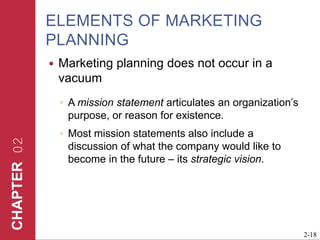
ELEMENTS OF MARKETING PLANNINGMarketing planning does not occur in a vacuum A mission statement articulates an organization’s purpose, or reason for existence. Most mission statements also include a discussion of what the company would like to become in the future – its strategic vision.
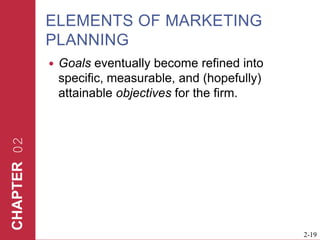
ELEMENTS OF MARKETING PLANNINGGoals eventually become refined into specific, measurable, and (hopefully) attainable objectives for the firm.
ELEMENTS OF MARKETING PLANNINGOrganizational StrategiesA strategy is a comprehensive plan stating how the organization will achieve its mission and objectives.A firm’s generic strategy is its overall directional strategy at the business level.
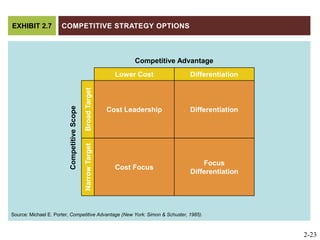
ELEMENTS OF MARKETING PLANNINGThree primary categories of competitive strategy: Low CostDifferentiationFocus (or Niche)
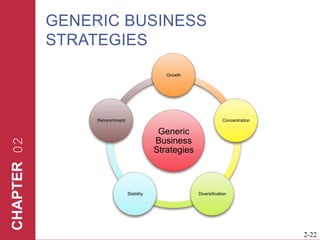
Generic Business Strategies
Competitive Strategy OptionsEXHIBIT 2.7Competitive AdvantageLower CostDifferentiationCost LeadershipDifferentiationBroad TargetCompetitive ScopeCost FocusFocus DifferentiationNarrow TargetSource: Michael E. Porter, Competitive Advantage (New York: Simon & Schuster, 1985).2-23
ELEMENTS OF MARKETING PLANNINGCore competenciesDistinctive competencies Sustainable competitive advantage
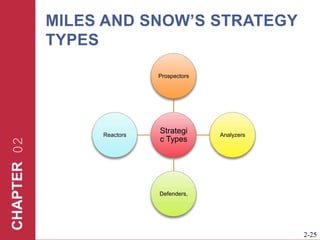
Miles and Snow’s Strategy Types
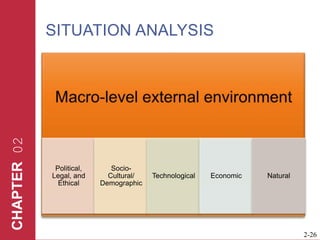
Situation analysis
Situation analysis
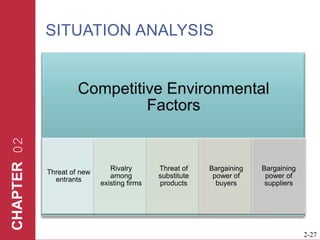
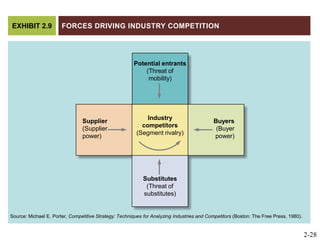
Forces Driving Industry CompetitionEXHIBIT 2.9Potential entrants(Threat ofmobility)Supplier(Supplierpower)Industrycompetitors(Segment rivalry)Buyers(Buyerpower)Substitutes(Threat ofsubstitutes)Source: Michael E. Porter, Competitive Strategy: Techniques for Analyzing Industries and Competitors (Boston: The Free Press, 1980).2-28
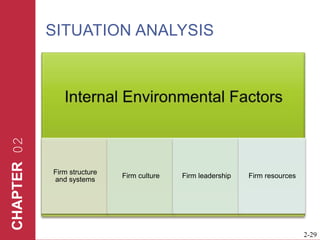
Situation analysis
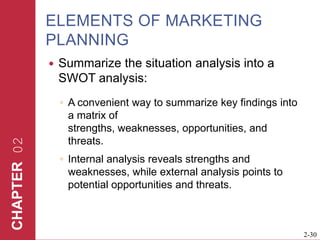
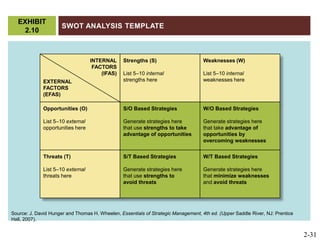
ELEMENTS OF MARKETING PLANNINGSummarize the situation analysis into a SWOT analysis:A convenient way to summarize key findings into a matrix of strengths, weaknesses, opportunities, and threats.Internal analysis reveals strengths and weaknesses, while external analysis points to potential opportunities and threats.
SWOT Analysis TemplateEXHIBIT 2.10Strengths (S)List 5–10 internalstrengths hereWeaknesses (W)List 5–10 internalweaknesses hereINTERNALFACTORS(IFAS)EXTERNALFACTORS(EFAS)S/O BasedStrategiesGenerate strategies herethat use strengths to takeadvantage of opportunitiesW/O Based StrategiesGenerate strategies herethat take advantage ofopportunities byovercoming weaknessesOpportunities (O)List 5–10 externalopportunities hereThreats (T)List 5–10 externalthreats hereS/T Based StrategiesGenerate strategies herethat use strengths toavoid threatsW/T Based StrategiesGenerate strategies herethat minimize weaknessesand avoid threatsSource: J. David Hunger and Thomas H. Wheelen, Essentials of Strategic Management, 4th ed. (Upper Saddle River, NJ: Prentice Hall, 2007).2-31
ELEMENTS OF MARKETING PLANNINGAdditional Aspects of Marketing PlanningPerform Any Needed Market ResearchEstablish Marketing Goals and Objectives
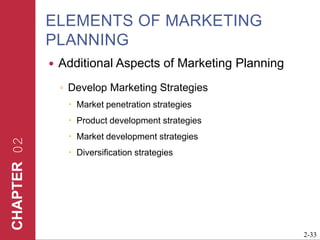
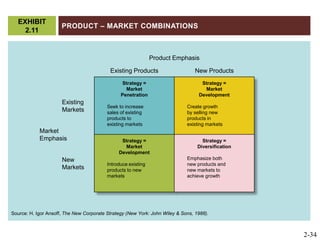
ELEMENTS OF MARKETING PLANNINGAdditional Aspects of Marketing PlanningDevelop Marketing StrategiesMarket penetration strategiesProduct development strategiesMarket development strategiesDiversification strategies
Product – Market CombinationsEXHIBIT 2.11Product EmphasisExisting ProductsNew ProductsStrategy =MarketPenetrationSeek to increasesales of existingproducts toexisting marketsStrategy =MarketDevelopmentCreate growthby selling newproducts inexisting marketsMarketEmphasisExistingMarketsStrategy =MarketDevelopmentIntroduce existingproducts to newmarketsStrategy =DiversificationEmphasize bothnew products andnew markets toachieve growthNewMarketsSource: H. Igor Ansoff, The New Corporate Strategy (New York: John Wiley & Sons, 1988).2-34
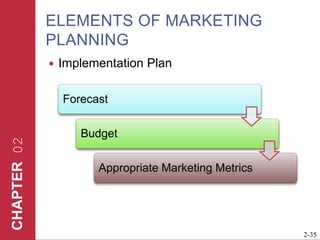
ELEMENTS OF MARKETING PLANNINGImplementation Plan
ELEMENTS OF MARKETING PLANNINGMarketing ControlProcess of measuring marketing results and adjusting the marketing plan as needed.
ELEMENTS OF MARKETING PLANNINGDevelop Contingency PlansPlans that can be implemented should something happen that negates the viability of the marketing plan.
TIPS FOR SUCCESSFUL MARKETING PLANNINGStay flexibleUtilize input, but don’t become paralyzed by information and analysisDon’t underestimate the implementation part of the planStay strategic, but also stay on top of the tacticalGive yourself and your people room to fail and try again
39Thank You, Please Visit Us At :http://wanbk.page.tl

Chap002

  • 1.
    02Elements of MarketingStrategy and PlanningCopyright © 2010 by The McGraw-Hill Companies, Inc. All rights reservedMcGraw-Hill/Irwin
  • 2.
    LEARNING OBJECTIVESExamine theconcept of value and the elements and role of the value chainUnderstand the conditions required for successful marketing planning, that marketing planning is focused on the value proposition, and that marketing planning is a dynamic processIdentify various types of organizational strategiesConduct a situation analysis Use the framework provided for marketing planning, along with the content in future chapters, to build a marketing plan
  • 3.
    VALUE IS ATTHE CORE OF MARKETINGValue is a ratio of benefits to costs, as viewed from the eyes of the beholder (the customer).
  • 4.
    VALUE IS ATTHE CORE OF MARKETINGValue proposition is the firm’s communication of the unique value of its products to its customers. The value message may include the whole bundle of benefits the company promises to deliver – not just the benefits of the product itself.
  • 5.
    VALUE IS ATTHE CORE OF MARKETINGA firm’s value proposition must be strong enough to move customers past satisfaction.
  • 6.
    VALUE IS ATTHE CORE OF MARKETINGThe Value Chain serves as a means for firms to identify ways to create, communicate, and deliver more customer value within a firm.
  • 7.
    Porter’s Value ChainEXHIBIT2.1SupportActivitiesPrimary ActivitiesSource: Michael E. Porter, Competitive Advantage (New York: Simon & Schuster, 1985).2-7
  • 8.
  • 9.
  • 10.
    Marketing PlanningMarketing planningis the ongoing process of developing and implementing market-driven strategies for an organization. The resulting document that records the marketing planning process in a useful framework is the marketing plan.
  • 11.
    MARKETING PLANNING ISBOTH STRATEGIC AND TACTICALMarketing (Big M) serves as a core driver of business strategy.marketing (little m) represents the specific programs and tactics aimed at customers and other stakeholder groups.
  • 12.
    For effective marketingplanningEveryone in an organization must understand and support the concept of customer orientation.All internal organizational processes and systems must be aligned around the customer.
  • 13.
    Framework for MarketingPlanningMarketing plan is connected to the firm’s business planPerform any needed market researchEstablish marketing goals and objectivesDevelop marketing strategiesMarketing mix strategiesDevelop implementation plans
  • 14.
    Connecting the MarketingPlan to the Firm’s Business PlanMarket-driven strategic planning is often used to describe the process at the corporate or strategic business unit (SBU) level of marshaling the various resource and functional areas of the firm toward a central purpose around the customer.
  • 15.
    ELEMENTS OF MARKETINGPLANNINGPortfolio analysis views SBUs and sometimes even product lines as a series of investments from which it expects maximization of returns. Boston Consulting Group (BCG) Growth-Share Matrix GE Business Screen
  • 16.
    Boston Consulting GroupGrowth-Share MatrixEXHIBIT 2.32-16
  • 17.
    GE Business ScreenEXHIBIT2.4Market AttractivenessHighMedLowInvest/GrowHighSelectiveInvestmentBusiness PositionMedHarvest/DivestLow“GE Business Screen,” Business Resource Software Online, www.brs-inc.com/pwxcharts.asp?32, accessed May 16, 2008.2-17
  • 18.
    ELEMENTS OF MARKETINGPLANNINGMarketing planning does not occur in a vacuum A mission statement articulates an organization’s purpose, or reason for existence. Most mission statements also include a discussion of what the company would like to become in the future – its strategic vision.
  • 19.
    ELEMENTS OF MARKETINGPLANNINGGoals eventually become refined into specific, measurable, and (hopefully) attainable objectives for the firm.
  • 20.
    ELEMENTS OF MARKETINGPLANNINGOrganizational StrategiesA strategy is a comprehensive plan stating how the organization will achieve its mission and objectives.A firm’s generic strategy is its overall directional strategy at the business level.
  • 21.
    ELEMENTS OF MARKETINGPLANNINGThree primary categories of competitive strategy: Low CostDifferentiationFocus (or Niche)
  • 22.
  • 23.
    Competitive Strategy OptionsEXHIBIT2.7Competitive AdvantageLower CostDifferentiationCost LeadershipDifferentiationBroad TargetCompetitive ScopeCost FocusFocus DifferentiationNarrow TargetSource: Michael E. Porter, Competitive Advantage (New York: Simon & Schuster, 1985).2-23
  • 24.
    ELEMENTS OF MARKETINGPLANNINGCore competenciesDistinctive competencies Sustainable competitive advantage
  • 25.
    Miles and Snow’sStrategy Types
  • 26.
  • 27.
  • 28.
    Forces Driving IndustryCompetitionEXHIBIT 2.9Potential entrants(Threat ofmobility)Supplier(Supplierpower)Industrycompetitors(Segment rivalry)Buyers(Buyerpower)Substitutes(Threat ofsubstitutes)Source: Michael E. Porter, Competitive Strategy: Techniques for Analyzing Industries and Competitors (Boston: The Free Press, 1980).2-28
  • 29.
  • 30.
    ELEMENTS OF MARKETINGPLANNINGSummarize the situation analysis into a SWOT analysis:A convenient way to summarize key findings into a matrix of strengths, weaknesses, opportunities, and threats.Internal analysis reveals strengths and weaknesses, while external analysis points to potential opportunities and threats.
  • 31.
    SWOT Analysis TemplateEXHIBIT2.10Strengths (S)List 5–10 internalstrengths hereWeaknesses (W)List 5–10 internalweaknesses hereINTERNALFACTORS(IFAS)EXTERNALFACTORS(EFAS)S/O BasedStrategiesGenerate strategies herethat use strengths to takeadvantage of opportunitiesW/O Based StrategiesGenerate strategies herethat take advantage ofopportunities byovercoming weaknessesOpportunities (O)List 5–10 externalopportunities hereThreats (T)List 5–10 externalthreats hereS/T Based StrategiesGenerate strategies herethat use strengths toavoid threatsW/T Based StrategiesGenerate strategies herethat minimize weaknessesand avoid threatsSource: J. David Hunger and Thomas H. Wheelen, Essentials of Strategic Management, 4th ed. (Upper Saddle River, NJ: Prentice Hall, 2007).2-31
  • 32.
    ELEMENTS OF MARKETINGPLANNINGAdditional Aspects of Marketing PlanningPerform Any Needed Market ResearchEstablish Marketing Goals and Objectives
  • 33.
    ELEMENTS OF MARKETINGPLANNINGAdditional Aspects of Marketing PlanningDevelop Marketing StrategiesMarket penetration strategiesProduct development strategiesMarket development strategiesDiversification strategies
  • 34.
    Product – MarketCombinationsEXHIBIT 2.11Product EmphasisExisting ProductsNew ProductsStrategy =MarketPenetrationSeek to increasesales of existingproducts toexisting marketsStrategy =MarketDevelopmentCreate growthby selling newproducts inexisting marketsMarketEmphasisExistingMarketsStrategy =MarketDevelopmentIntroduce existingproducts to newmarketsStrategy =DiversificationEmphasize bothnew products andnew markets toachieve growthNewMarketsSource: H. Igor Ansoff, The New Corporate Strategy (New York: John Wiley & Sons, 1988).2-34
  • 35.
    ELEMENTS OF MARKETINGPLANNINGImplementation Plan
  • 36.
    ELEMENTS OF MARKETINGPLANNINGMarketing ControlProcess of measuring marketing results and adjusting the marketing plan as needed.
  • 37.
    ELEMENTS OF MARKETINGPLANNINGDevelop Contingency PlansPlans that can be implemented should something happen that negates the viability of the marketing plan.
  • 38.
    TIPS FOR SUCCESSFULMARKETING PLANNINGStay flexibleUtilize input, but don’t become paralyzed by information and analysisDon’t underestimate the implementation part of the planStay strategic, but also stay on top of the tacticalGive yourself and your people room to fail and try again
  • 39.
    39Thank You, PleaseVisit Us At :http://wanbk.page.tl