Marketing Management
         By Philip, Kevin Lane Keller, Abraham Koshy, Mithileshwar Jha

           logo copy.tif
                                  SUMMARY by


                  Chapter      2
      Developing Marketing
      Strategies And Plans
                           In this chapter, mainly the following points have been discussed
                              •    How does marketing affect customer value?
                              •    How is strategic planning carried out at different levels of the organization?
                              •    What does a marketing plan include?


                           Developing the right marketing strategy over time, through discipline and a creative
Supply                     thought process can go a long way in the marketing management process. Firms must
                           constantly strive to improve every aspect of their strategy and the plans to guide the
Chain                      marketing process.

Many companies
today outsource less
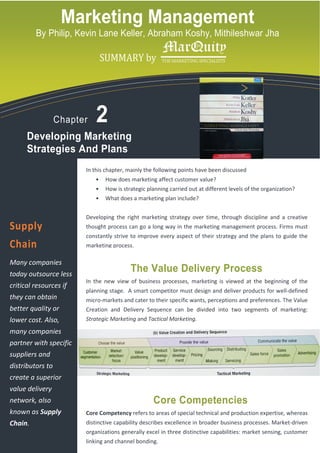
                                             The Value Delivery Process
                           In the new view of business processes, marketing is viewed at the beginning of the
critical resources if
                           planning stage. A smart competitor must design and deliver products for well-defined
they can obtain            micro-markets and cater to their specific wants, perceptions and preferences. The Value
better quality or          Creation and Delivery Sequence can be divided into two segments of marketing:
lower cost. Also,          Strategic Marketing and Tactical Marketing.

many companies
partner with specific
suppliers and
distributors to
create a superior
value delivery
network, also                                         Core Competencies
known as Supply            Core Competency refers to areas of special technical and production expertise, whereas
Chain.                     distinctive capability describes excellence in broader business processes. Market-driven
                           organizations generally excel in three distinctive capabilities: market sensing, customer
                           linking and channel bonding.
Chapter 2 - Developing Marketing Strategies And Plans
                      A firm must coordinate all the department activities to conduct its core business
                      processes, through cross-functional teams
                      •     Market-sensing process
                      •     New-offering realization process
Holistic              •     Customer Acquisition process
                      •     Customer Relationship Management Process
Marketing             •     Fulfillment Management Process
Holistic marketing
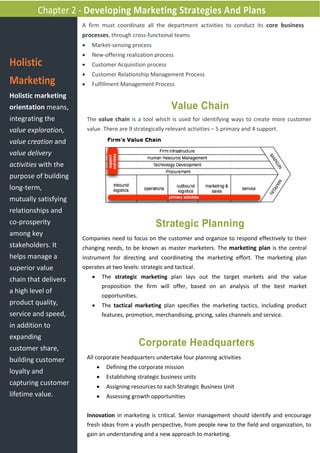
orientation means,                                             Value Chain
integrating the           The value chain is a tool which is used for identifying ways to create more customer
value exploration,        value. There are 9 strategically relevant activities – 5 primary and 4 support.

value creation and
value delivery
activities with the
purpose of building
long-term,
mutually satisfying
relationships and
co-prosperity                                            Strategic Planning
among key
                      Companies need to focus on the customer and organize to respond effectively to their
stakeholders. It      changing needs, to be known as master marketers. The marketing plan is the central
helps manage a        instrument for directing and coordinating the marketing effort. The marketing plan
superior value        operates at two levels: strategic and tactical.

chain that delivers         •       The strategic marketing plan lays out the target markets and the value
                                    proposition the firm will offer, based on an analysis of the best market
a high level of
                                    opportunities.
product quality,            •       The tactical marketing plan specifies the marketing tactics, including product
service and speed,                  features, promotion, merchandising, pricing, sales channels and service.
in addition to
expanding
customer share,
                                                     Corporate Headquarters
building customer         All corporate headquarters undertake four planning activities
                                •    Defining the corporate mission
loyalty and
                                •    Establishing strategic business units
capturing customer              •    Assigning resources to each Strategic Business Unit
lifetime value.                 •    Assessing growth opportunities


                          Innovation in marketing is critical. Senior management should identify and encourage
                          fresh ideas from a youth perspective, from people new to the field and organization, to
                          gain an understanding and a new approach to marketing.
Chapter 2 - Developing Marketing Strategies And Plans

                                                      Mission Statement
                        The best Mission Statement reflects a vision, an almost impossible dream that provides
                        a direction for the company for the next 10 or 20 years. A good mission statement
                        focuses on limited number of goals, links the company’s policies and values and gives a
Strategic               long term view. It is as short, relevant and meaningful as possible.


Business Unit
A Strategic                           Business Unit Strategic Planning
Business Unit is a
                        The Business Unit Strategic Planning process consists of the following steps
single business (or
a collection of            1. The Business Mission: Each business unit needs to define its specific mission
similar businesses)            within the broader company mission.
that can be                2. SWOT Analysis: The overall analysis of a company’s Strengths, Weaknesses,
                               Opportunities and Threats is called SWOT analysis. It is a way of monitoring the
planned
                               external and internal marketing environment.
separately from
                               To evaluate opportunities, companies can use Market Opportunity Analysis.
the rest of the            3. Goal Formulation: Developing specific goals for a short term is known as Goal
company. By                    Formulation. They are specific with respect to magnitude and time. Goals must
identifying the                be consistent and realistic and could be a mix of various objectives.
                           4. Strategy Formulation: Strategy is a game plan for achieving the goals. It consists
company’s SBUs, it
                               of a Marketing Strategy, Technology Strategy and a Sourcing Strategy.
is easy to develop         5. Program Formulation: The unit must plan programs in accordance with its goals
separate strategies            and strategy and thus work upon the various departments, to strengthen them
and assign                     and integrate all of them together.
                           6. Implementation: Even a great marketing strategy can be sabotaged by a poor
appropriate
                               implementation. It must coordinate its tasks to implement its plan properly.
funding.
                               These tasks must be in line with the interests of the stakeholders as well.
                           7. Feedback and Control: The key to organizational health is willingness to
                               examine the changing environment and adopt new goals and behaviors. In the
                               rapidly changing market environment, even large organizations which are
                               subject to inertia can be changed through strong leadership.

Developing marketing strategies and plans 02

  • 1.
    Marketing Management By Philip, Kevin Lane Keller, Abraham Koshy, Mithileshwar Jha logo copy.tif SUMMARY by Chapter 2 Developing Marketing Strategies And Plans In this chapter, mainly the following points have been discussed • How does marketing affect customer value? • How is strategic planning carried out at different levels of the organization? • What does a marketing plan include? Developing the right marketing strategy over time, through discipline and a creative Supply thought process can go a long way in the marketing management process. Firms must constantly strive to improve every aspect of their strategy and the plans to guide the Chain marketing process. Many companies today outsource less The Value Delivery Process In the new view of business processes, marketing is viewed at the beginning of the critical resources if planning stage. A smart competitor must design and deliver products for well-defined they can obtain micro-markets and cater to their specific wants, perceptions and preferences. The Value better quality or Creation and Delivery Sequence can be divided into two segments of marketing: lower cost. Also, Strategic Marketing and Tactical Marketing. many companies partner with specific suppliers and distributors to create a superior value delivery network, also Core Competencies known as Supply Core Competency refers to areas of special technical and production expertise, whereas Chain. distinctive capability describes excellence in broader business processes. Market-driven organizations generally excel in three distinctive capabilities: market sensing, customer linking and channel bonding.
  • 2.
    Chapter 2 -Developing Marketing Strategies And Plans A firm must coordinate all the department activities to conduct its core business processes, through cross-functional teams • Market-sensing process • New-offering realization process Holistic • Customer Acquisition process • Customer Relationship Management Process Marketing • Fulfillment Management Process Holistic marketing orientation means, Value Chain integrating the The value chain is a tool which is used for identifying ways to create more customer value exploration, value. There are 9 strategically relevant activities – 5 primary and 4 support. value creation and value delivery activities with the purpose of building long-term, mutually satisfying relationships and co-prosperity Strategic Planning among key Companies need to focus on the customer and organize to respond effectively to their stakeholders. It changing needs, to be known as master marketers. The marketing plan is the central helps manage a instrument for directing and coordinating the marketing effort. The marketing plan superior value operates at two levels: strategic and tactical. chain that delivers • The strategic marketing plan lays out the target markets and the value proposition the firm will offer, based on an analysis of the best market a high level of opportunities. product quality, • The tactical marketing plan specifies the marketing tactics, including product service and speed, features, promotion, merchandising, pricing, sales channels and service. in addition to expanding customer share, Corporate Headquarters building customer All corporate headquarters undertake four planning activities • Defining the corporate mission loyalty and • Establishing strategic business units capturing customer • Assigning resources to each Strategic Business Unit lifetime value. • Assessing growth opportunities Innovation in marketing is critical. Senior management should identify and encourage fresh ideas from a youth perspective, from people new to the field and organization, to gain an understanding and a new approach to marketing.
  • 3.
    Chapter 2 -Developing Marketing Strategies And Plans Mission Statement The best Mission Statement reflects a vision, an almost impossible dream that provides a direction for the company for the next 10 or 20 years. A good mission statement focuses on limited number of goals, links the company’s policies and values and gives a Strategic long term view. It is as short, relevant and meaningful as possible. Business Unit A Strategic Business Unit Strategic Planning Business Unit is a The Business Unit Strategic Planning process consists of the following steps single business (or a collection of 1. The Business Mission: Each business unit needs to define its specific mission similar businesses) within the broader company mission. that can be 2. SWOT Analysis: The overall analysis of a company’s Strengths, Weaknesses, Opportunities and Threats is called SWOT analysis. It is a way of monitoring the planned external and internal marketing environment. separately from To evaluate opportunities, companies can use Market Opportunity Analysis. the rest of the 3. Goal Formulation: Developing specific goals for a short term is known as Goal company. By Formulation. They are specific with respect to magnitude and time. Goals must identifying the be consistent and realistic and could be a mix of various objectives. 4. Strategy Formulation: Strategy is a game plan for achieving the goals. It consists company’s SBUs, it of a Marketing Strategy, Technology Strategy and a Sourcing Strategy. is easy to develop 5. Program Formulation: The unit must plan programs in accordance with its goals separate strategies and strategy and thus work upon the various departments, to strengthen them and assign and integrate all of them together. 6. Implementation: Even a great marketing strategy can be sabotaged by a poor appropriate implementation. It must coordinate its tasks to implement its plan properly. funding. These tasks must be in line with the interests of the stakeholders as well. 7. Feedback and Control: The key to organizational health is willingness to examine the changing environment and adopt new goals and behaviors. In the rapidly changing market environment, even large organizations which are subject to inertia can be changed through strong leadership.