STRATEGY
FORMULATION
PRESENTED BY: AUSHMAN HALDER
CHANDAN BHAGAT
DEEPAK VISHWAS
What is strategy ?
 Strategy is a general plan to achieve one or
more goals under conditions of uncertainty
What is strategy formulation ??
 Strategy formulation is the process of using available knowledge to
document the intended direction of a business and the actionable
steps to reach its goals
 This process is used for resource allocation, prioritization,
organization-wide alignment, and validation of business goals
Strategic alternatives evolve and revolve around the question of
whether a company must continue or change the business which it is
currently doing. According to GLUECK, there are 4 grand alternatives
which are-
 Stability strategy
 Expansion strategy
 Retrenchment strategy and
 Combination strategy
 Stability strategy: It involves incremental improvement in
functional performance in terms of customer groups in order to remain
successful in business.
Ex. a photocopier machine company provides better after sales service
to its existing customer groups to Improve its company and product image
and increase sales of accessories and consumables.
 Expansion strategy: When a company substantially broadens
the scope of its customer groups in order to improve its performance
either singly or jointly with another firm.
Ex. a printing firm changes from the traditional letter press printing to
desktop publishing in order to increase its production and efficiency.
 Retrenchment strategy: When a company substantially
reduces the scope of its customer groups in order to improve its
performance either singly or jointly.
Ex. a corporate hospital decides to focus only on specialty treatment
and realize higher revenues by reducing its commitment to general cases
which are typically less profitable to deal with.
 Combination strategy: When a company adopts a mixture of
stability, expansion and retrenchment either at the same time in Its
different business or at different times in the same business with the aim
of improving its performance.
Ex. a paint company continues to offer decorative paints to provide a
wider variety to its customers and expands its product range to include
industrial and automotive points simultaneously it decides to close down
the division which undertakes large scale painting jobs.
COMBINATION STRAREGIES
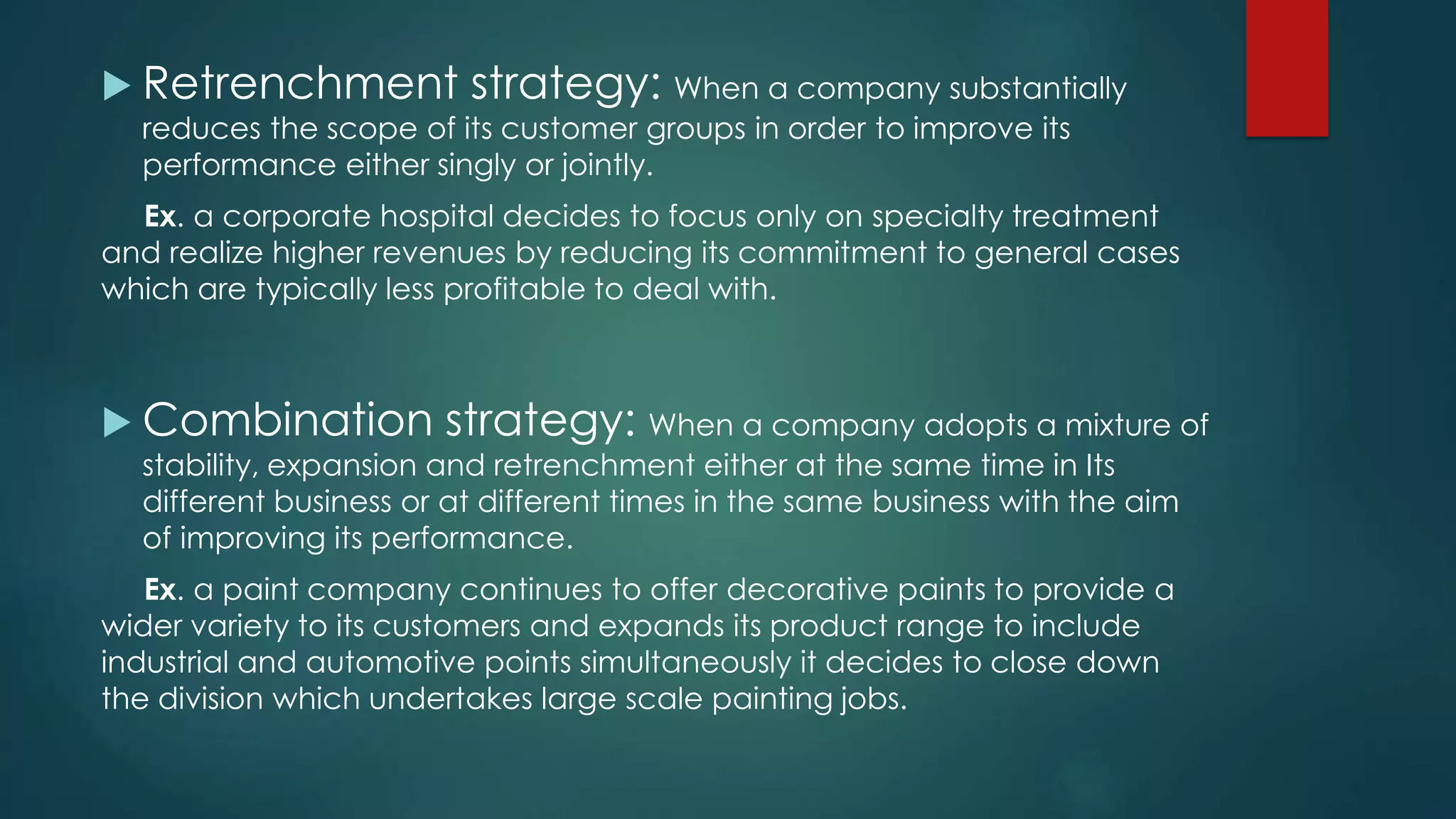
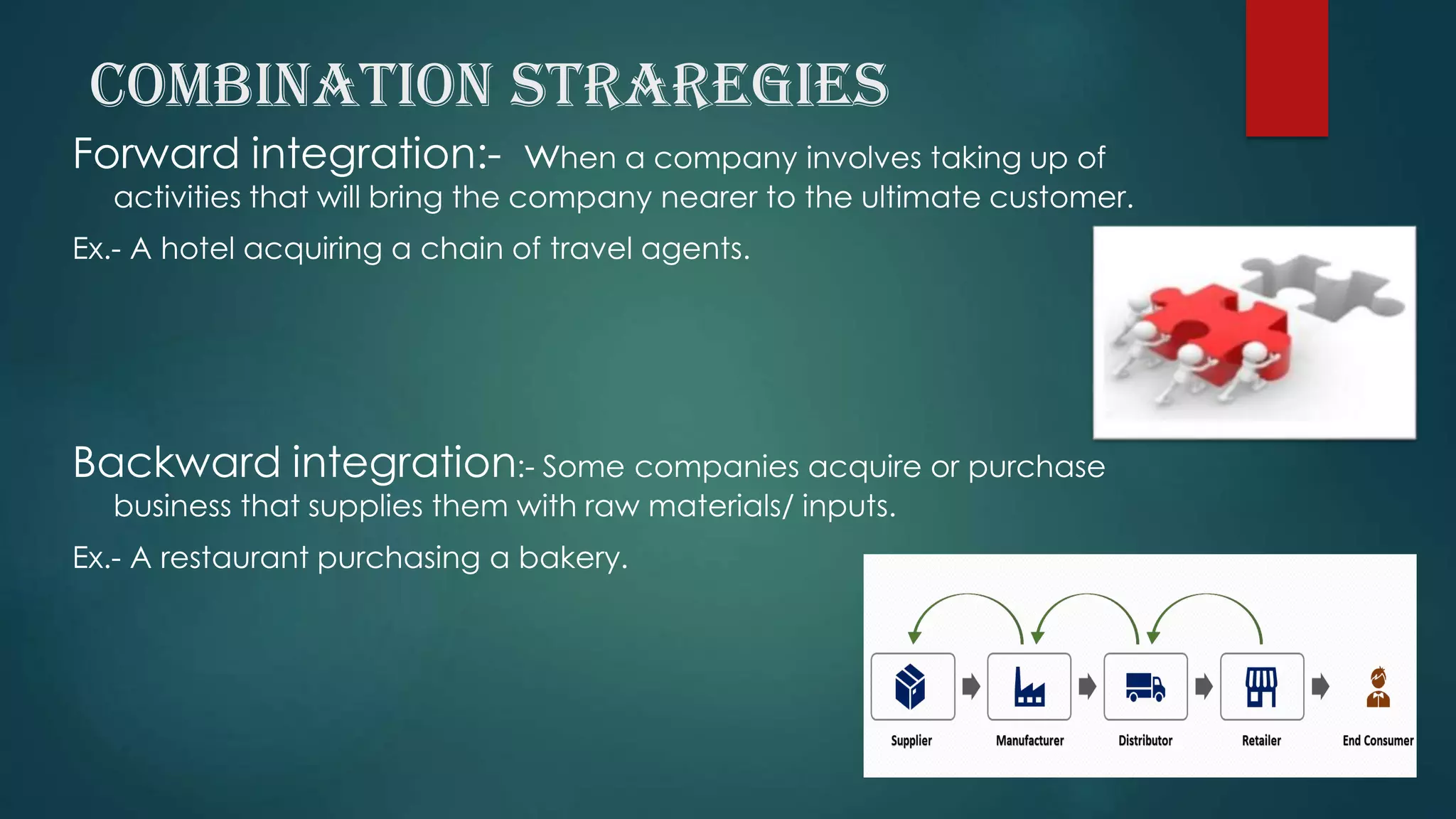
Forward integration:- when a company involves taking up of
activities that will bring the company nearer to the ultimate customer.
Ex.- A hotel acquiring a chain of travel agents.
Backward integration:- Some companies acquire or purchase
business that supplies them with raw materials/ inputs.
Ex.- A restaurant purchasing a bakery.
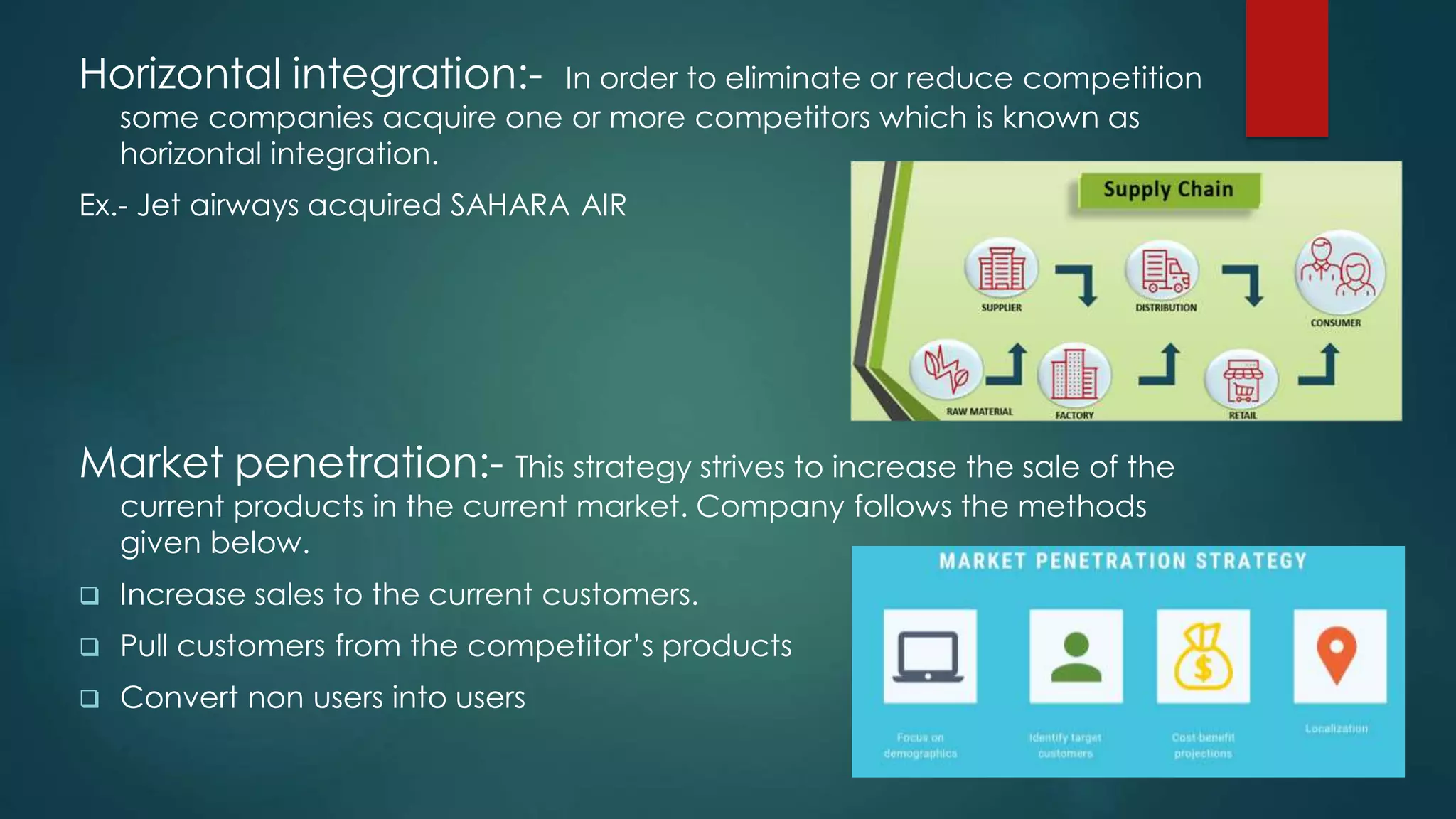
Horizontal integration:- In order to eliminate or reduce competition
some companies acquire one or more competitors which is known as
horizontal integration.
Ex.- Jet airways acquired SAHARA AIR
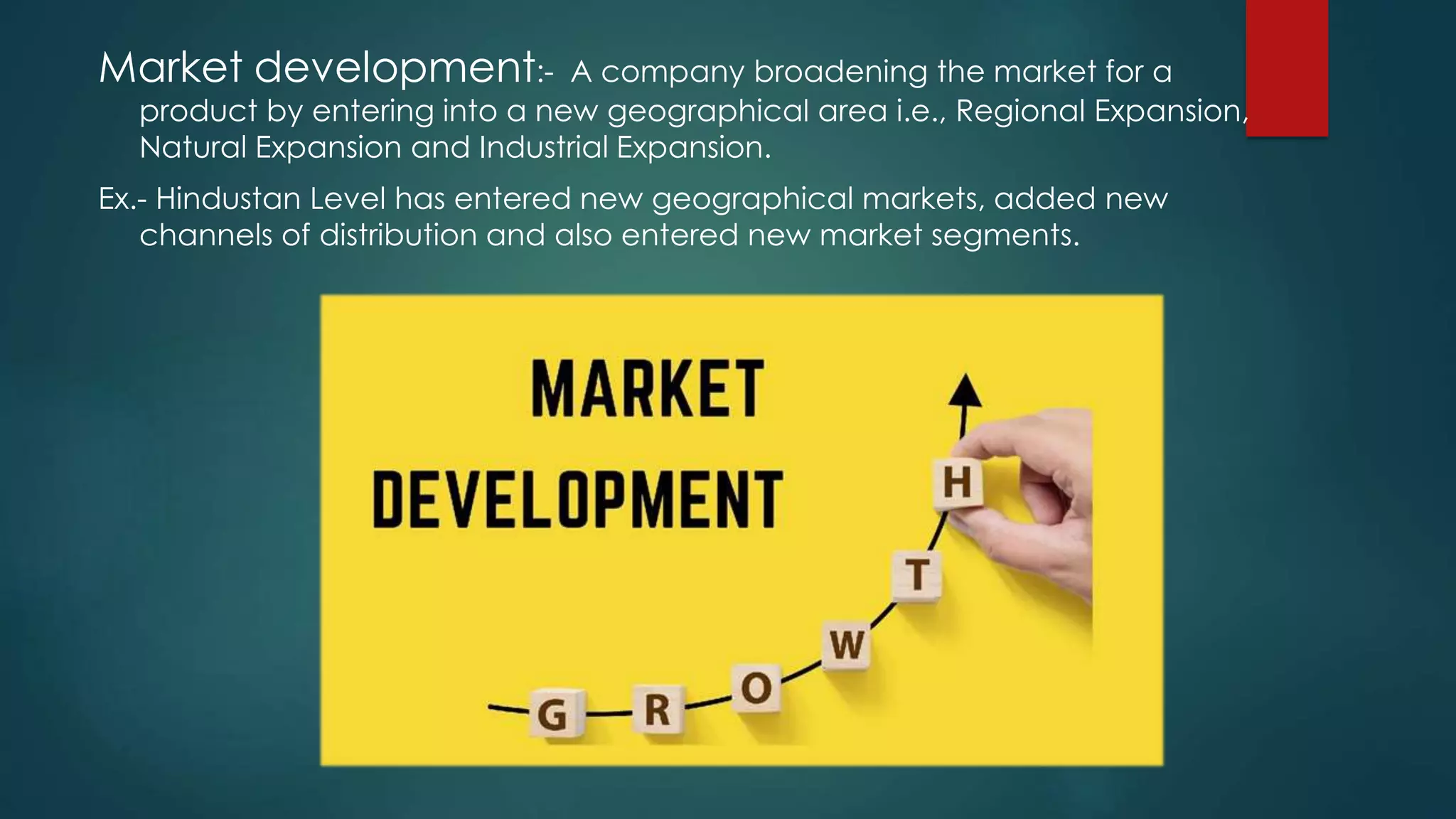
Market penetration:- This strategy strives to increase the sale of the
current products in the current market. Company follows the methods
given below.
 Increase sales to the current customers.
 Pull customers from the competitor’s products
 Convert non users into users
Market development:- A company broadening the market for a
product by entering into a new geographical area i.e., Regional Expansion,
Natural Expansion and Industrial Expansion.
Ex.- Hindustan Level has entered new geographical markets, added new
channels of distribution and also entered new market segments.
PRODUCT DEVELOPMENT :-
A Company may be able to increase its current
business by product improvement or
introducing products with new features.
E.g. Japan Company SONY keeps up the sale
of their consumer goods through continuous
feature improvements.
CONCENTRIC DIVERSIFICTION :-
When a company takes up an activity in such
a manner that it is related to its existing
business then it is called concentric
diversification.
E.g. Rain coat manufacturer makes other
rubber based products like water proof
shoes.Rubber gloves and selling the same
through the same retail outlets.
CONGLOMERATE DIVERSIFICATION :-
When a company adopts a strategy by taking up those activities
which are unrelated to its existing business then it’s called as
Conglomerate diversification.
E.g. ITC a cigarette company diversifying into a hotel industry.
HORIZONTAL DIVERSIFICATION :-
When a company introduces a new product which is
technologically unrelated to the current product line but which
has appeal to its current customers then it’s called horizontal
diversification.
E.g. Camlin which is famous for stationary products has come
out with stitching and fabric painting materials.
JOINT VENTURE :-
When two or more independent firms mutually decide to participate
in a business in a venture contribute to total equity capital and establish
a new organization. It’s known as a joint venture.
E.g. (a) Haldia petrochemicals(West Bengal govt and R.P.
Goenka group)
(b) Nagarjuna fertilizers (AP GOVT & Nagarjuna group)
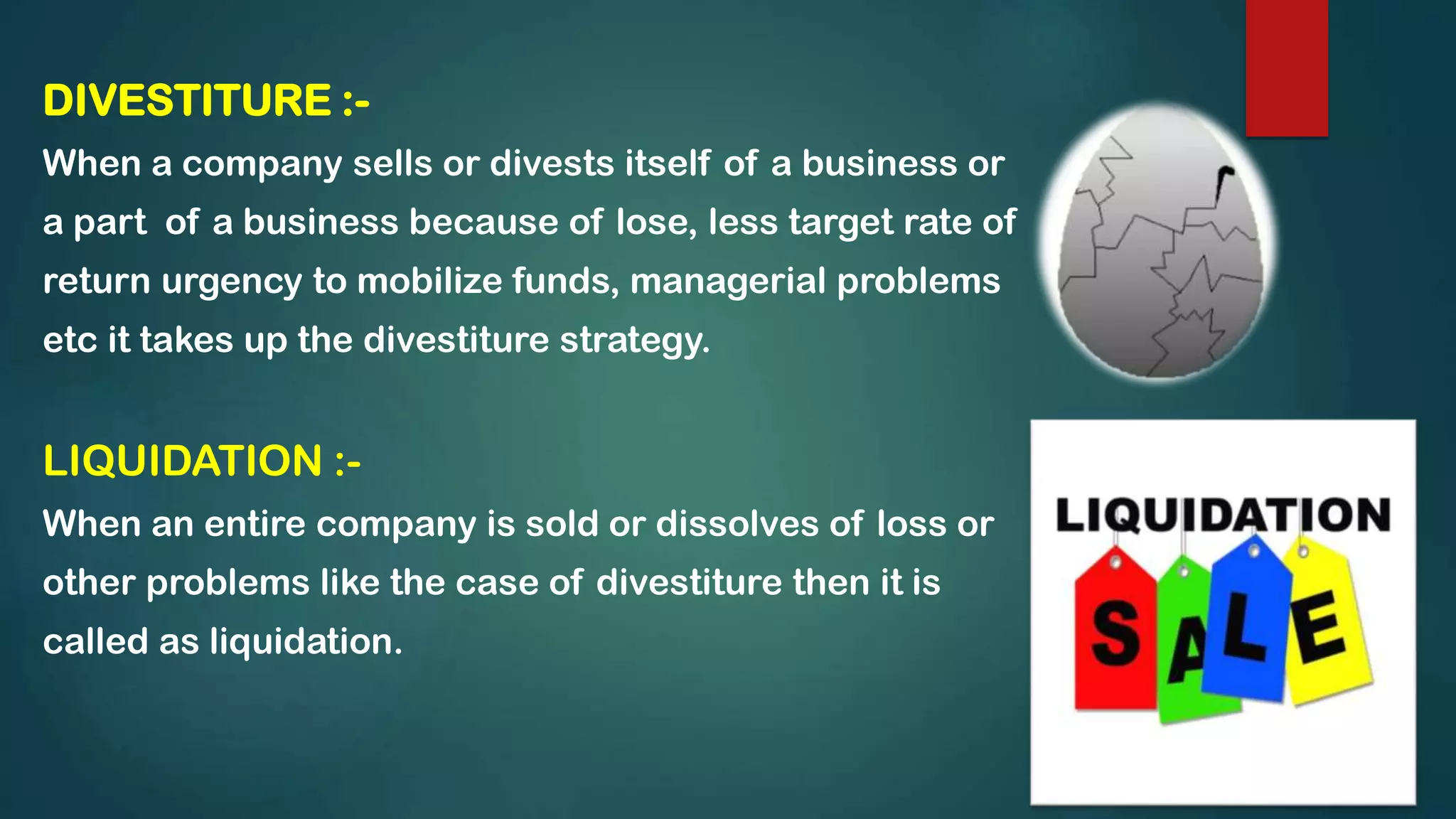
DIVESTITURE :-
When a company sells or divests itself of a business or
a part of a business because of lose, less target rate of
return urgency to mobilize funds, managerial problems
etc it takes up the divestiture strategy.
LIQUIDATION :-
When an entire company is sold or dissolves of loss or
other problems like the case of divestiture then it is
called as liquidation.
THANK YOU...

Strategy formulation

  • 1.
    STRATEGY FORMULATION PRESENTED BY: AUSHMANHALDER CHANDAN BHAGAT DEEPAK VISHWAS
  • 2.
    What is strategy?  Strategy is a general plan to achieve one or more goals under conditions of uncertainty What is strategy formulation ??  Strategy formulation is the process of using available knowledge to document the intended direction of a business and the actionable steps to reach its goals  This process is used for resource allocation, prioritization, organization-wide alignment, and validation of business goals
  • 3.
    Strategic alternatives evolveand revolve around the question of whether a company must continue or change the business which it is currently doing. According to GLUECK, there are 4 grand alternatives which are-  Stability strategy  Expansion strategy  Retrenchment strategy and  Combination strategy
  • 4.
     Stability strategy:It involves incremental improvement in functional performance in terms of customer groups in order to remain successful in business. Ex. a photocopier machine company provides better after sales service to its existing customer groups to Improve its company and product image and increase sales of accessories and consumables.  Expansion strategy: When a company substantially broadens the scope of its customer groups in order to improve its performance either singly or jointly with another firm. Ex. a printing firm changes from the traditional letter press printing to desktop publishing in order to increase its production and efficiency.
  • 5.
     Retrenchment strategy:When a company substantially reduces the scope of its customer groups in order to improve its performance either singly or jointly. Ex. a corporate hospital decides to focus only on specialty treatment and realize higher revenues by reducing its commitment to general cases which are typically less profitable to deal with.  Combination strategy: When a company adopts a mixture of stability, expansion and retrenchment either at the same time in Its different business or at different times in the same business with the aim of improving its performance. Ex. a paint company continues to offer decorative paints to provide a wider variety to its customers and expands its product range to include industrial and automotive points simultaneously it decides to close down the division which undertakes large scale painting jobs.
  • 6.
    COMBINATION STRAREGIES Forward integration:-when a company involves taking up of activities that will bring the company nearer to the ultimate customer. Ex.- A hotel acquiring a chain of travel agents. Backward integration:- Some companies acquire or purchase business that supplies them with raw materials/ inputs. Ex.- A restaurant purchasing a bakery.
  • 7.
    Horizontal integration:- Inorder to eliminate or reduce competition some companies acquire one or more competitors which is known as horizontal integration. Ex.- Jet airways acquired SAHARA AIR Market penetration:- This strategy strives to increase the sale of the current products in the current market. Company follows the methods given below.  Increase sales to the current customers.  Pull customers from the competitor’s products  Convert non users into users
  • 8.
    Market development:- Acompany broadening the market for a product by entering into a new geographical area i.e., Regional Expansion, Natural Expansion and Industrial Expansion. Ex.- Hindustan Level has entered new geographical markets, added new channels of distribution and also entered new market segments.
  • 9.
    PRODUCT DEVELOPMENT :- ACompany may be able to increase its current business by product improvement or introducing products with new features. E.g. Japan Company SONY keeps up the sale of their consumer goods through continuous feature improvements.
  • 10.
    CONCENTRIC DIVERSIFICTION :- Whena company takes up an activity in such a manner that it is related to its existing business then it is called concentric diversification. E.g. Rain coat manufacturer makes other rubber based products like water proof shoes.Rubber gloves and selling the same through the same retail outlets.
  • 11.
    CONGLOMERATE DIVERSIFICATION :- Whena company adopts a strategy by taking up those activities which are unrelated to its existing business then it’s called as Conglomerate diversification. E.g. ITC a cigarette company diversifying into a hotel industry.
  • 12.
    HORIZONTAL DIVERSIFICATION :- Whena company introduces a new product which is technologically unrelated to the current product line but which has appeal to its current customers then it’s called horizontal diversification. E.g. Camlin which is famous for stationary products has come out with stitching and fabric painting materials.
  • 13.
    JOINT VENTURE :- Whentwo or more independent firms mutually decide to participate in a business in a venture contribute to total equity capital and establish a new organization. It’s known as a joint venture. E.g. (a) Haldia petrochemicals(West Bengal govt and R.P. Goenka group) (b) Nagarjuna fertilizers (AP GOVT & Nagarjuna group)
  • 14.
    DIVESTITURE :- When acompany sells or divests itself of a business or a part of a business because of lose, less target rate of return urgency to mobilize funds, managerial problems etc it takes up the divestiture strategy. LIQUIDATION :- When an entire company is sold or dissolves of loss or other problems like the case of divestiture then it is called as liquidation.
  • 15.