ESTIMATION
TECHNIQUES
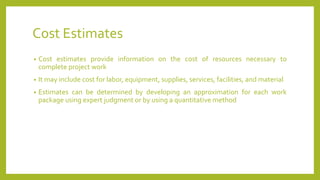
Cost Estimates
• Cost estimates provide information on the cost of resources necessary to
complete project work
• It may include cost for labor, equipment, supplies, services, facilities, and material
• Estimates can be determined by developing an approximation for each work
package using expert judgment or by using a quantitative method
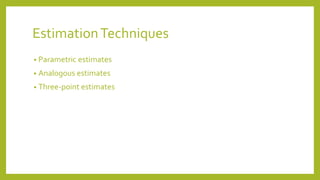
EstimationTechniques
• Parametric estimates
• Analogous estimates
• Three-point estimates
Parametric estimates
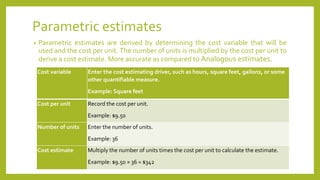
• Parametric estimates are derived by determining the cost variable that will be
used and the cost per unit. The number of units is multiplied by the cost per unit to
derive a cost estimate. More accurate as compared to Analogous estimates.
Cost variable Enter the cost estimating driver, such as hours, square feet, gallons, or some
other quantifiable measure.
Example: Square feet
Cost per unit Record the cost per unit.
Example: $9.50
Number of units Enter the number of units.
Example: 36
Cost estimate Multiply the number of units times the cost per unit to calculate the estimate.
Example: $9.50 × 36 = $342
Analogous estimates
• Analogous estimates are derived by comparing current work to previous similar
work. This type of estimate is generally used when detailed information is not
available. It is low on accuracy.
Previous activity Enter a description of the previous activity.
Example: Build a 160 square foot deck.
Previous cost Document the cost of the previous activity.
Example: $5,000
Current activity Describe how the current activity is different.
Example: Build a 200 square foot deck.
Multiplier Divide the current activity by the previous activity to get a multiplier.
Example: 200/160 = 1.25
Cost Estimate Multiply the cost for the previous activity by the multiplier to calculate the Cost
Estimate for the current activity.
Example: $5,000 × 1.25 = $6,250
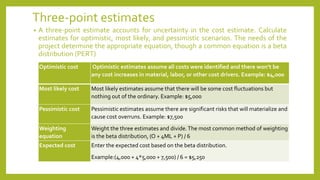
Three-point estimates
• A three-point estimate accounts for uncertainty in the cost estimate. Calculate
estimates for optimistic, most likely, and pessimistic scenarios. The needs of the
project determine the appropriate equation, though a common equation is a beta
distribution (PERT)
Optimistic cost Optimistic estimates assume all costs were identified and there won’t be
any cost increases in material, labor, or other cost drivers. Example: $4,000
Most likely cost Most likely estimates assume that there will be some cost fluctuations but
nothing out of the ordinary. Example: $5,000
Pessimistic cost Pessimistic estimates assume there are significant risks that will materialize and
cause cost overruns. Example: $7,500
Weighting
equation
Weight the three estimates and divide.The most common method of weighting
is the beta distribution, (O + 4ML + P) / 6
Expected cost Enter the expected cost based on the beta distribution.
Example:(4,000 + 4*5,000 + 7,500) / 6 = $5,250
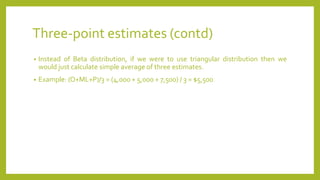
Three-point estimates (c0ntd)
• Instead of Beta distribution, if we were to use triangular distribution then we
would just calculate simple average of three estimates.
• Example: (O+ML+P)/3 = (4,000 + 5,000 + 7,500) / 3 = $5,500
Bottom-up estimates
• Bottom-up estimates are detailed estimates done at the work package level. The
most accurate estimate possible.
Labor hours Enter the estimated effort hours.
Labor rate Enter the hourly or daily rate.
Total labor Multiply the labor hours times the labor rate.
Material Enter quotes for material, either from vendors or multiply the amount of
material times the cost per unit.
Supplies Enter quotes for supplies, either from vendors or multiply the amount of
supplies times the cost per unit.
Equipment Enter quotes to rent, lease, or purchase equipment.
Travel Enter quotes for travel.
Other direct costs Enter any other direct costs and document the type of cost.
Indirect costs Enter any indirect costs, such as overhead.
Reserve Enter any contingency reserve cost for the work package.
Estimate Sum the labor, materials, supplies, equipment, travel, other direct costs,
indirect costs, and any contingency reserve.
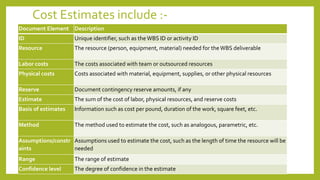
Cost Estimates include :-
Document Element Description
ID Unique identifier, such as the WBS ID or activity ID
Resource The resource (person, equipment, material) needed for theWBS deliverable
Labor costs The costs associated with team or outsourced resources
Physical costs Costs associated with material, equipment, supplies, or other physical resources
Reserve Document contingency reserve amounts, if any
Estimate The sum of the cost of labor, physical resources, and reserve costs
Basis of estimates Information such as cost per pound, duration of the work, square feet, etc.
Method The method used to estimate the cost, such as analogous, parametric, etc.
Assumptions/constr
aints
Assumptions used to estimate the cost, such as the length of time the resource will be
needed
Range The range of estimate
Confidence level The degree of confidence in the estimate

Cost+Estimation+Techniques (1).pptx

  • 1.
  • 2.
    Cost Estimates • Costestimates provide information on the cost of resources necessary to complete project work • It may include cost for labor, equipment, supplies, services, facilities, and material • Estimates can be determined by developing an approximation for each work package using expert judgment or by using a quantitative method
  • 3.
    EstimationTechniques • Parametric estimates •Analogous estimates • Three-point estimates
  • 4.
    Parametric estimates • Parametricestimates are derived by determining the cost variable that will be used and the cost per unit. The number of units is multiplied by the cost per unit to derive a cost estimate. More accurate as compared to Analogous estimates. Cost variable Enter the cost estimating driver, such as hours, square feet, gallons, or some other quantifiable measure. Example: Square feet Cost per unit Record the cost per unit. Example: $9.50 Number of units Enter the number of units. Example: 36 Cost estimate Multiply the number of units times the cost per unit to calculate the estimate. Example: $9.50 × 36 = $342
  • 5.
    Analogous estimates • Analogousestimates are derived by comparing current work to previous similar work. This type of estimate is generally used when detailed information is not available. It is low on accuracy. Previous activity Enter a description of the previous activity. Example: Build a 160 square foot deck. Previous cost Document the cost of the previous activity. Example: $5,000 Current activity Describe how the current activity is different. Example: Build a 200 square foot deck. Multiplier Divide the current activity by the previous activity to get a multiplier. Example: 200/160 = 1.25 Cost Estimate Multiply the cost for the previous activity by the multiplier to calculate the Cost Estimate for the current activity. Example: $5,000 × 1.25 = $6,250
  • 6.
    Three-point estimates • Athree-point estimate accounts for uncertainty in the cost estimate. Calculate estimates for optimistic, most likely, and pessimistic scenarios. The needs of the project determine the appropriate equation, though a common equation is a beta distribution (PERT) Optimistic cost Optimistic estimates assume all costs were identified and there won’t be any cost increases in material, labor, or other cost drivers. Example: $4,000 Most likely cost Most likely estimates assume that there will be some cost fluctuations but nothing out of the ordinary. Example: $5,000 Pessimistic cost Pessimistic estimates assume there are significant risks that will materialize and cause cost overruns. Example: $7,500 Weighting equation Weight the three estimates and divide.The most common method of weighting is the beta distribution, (O + 4ML + P) / 6 Expected cost Enter the expected cost based on the beta distribution. Example:(4,000 + 4*5,000 + 7,500) / 6 = $5,250
  • 7.
    Three-point estimates (c0ntd) •Instead of Beta distribution, if we were to use triangular distribution then we would just calculate simple average of three estimates. • Example: (O+ML+P)/3 = (4,000 + 5,000 + 7,500) / 3 = $5,500
  • 8.
    Bottom-up estimates • Bottom-upestimates are detailed estimates done at the work package level. The most accurate estimate possible. Labor hours Enter the estimated effort hours. Labor rate Enter the hourly or daily rate. Total labor Multiply the labor hours times the labor rate. Material Enter quotes for material, either from vendors or multiply the amount of material times the cost per unit. Supplies Enter quotes for supplies, either from vendors or multiply the amount of supplies times the cost per unit. Equipment Enter quotes to rent, lease, or purchase equipment. Travel Enter quotes for travel. Other direct costs Enter any other direct costs and document the type of cost. Indirect costs Enter any indirect costs, such as overhead. Reserve Enter any contingency reserve cost for the work package. Estimate Sum the labor, materials, supplies, equipment, travel, other direct costs, indirect costs, and any contingency reserve.
  • 9.
    Cost Estimates include:- Document Element Description ID Unique identifier, such as the WBS ID or activity ID Resource The resource (person, equipment, material) needed for theWBS deliverable Labor costs The costs associated with team or outsourced resources Physical costs Costs associated with material, equipment, supplies, or other physical resources Reserve Document contingency reserve amounts, if any Estimate The sum of the cost of labor, physical resources, and reserve costs Basis of estimates Information such as cost per pound, duration of the work, square feet, etc. Method The method used to estimate the cost, such as analogous, parametric, etc. Assumptions/constr aints Assumptions used to estimate the cost, such as the length of time the resource will be needed Range The range of estimate Confidence level The degree of confidence in the estimate