CHANGING FARM STRUCTURE AND RURAL TRANSFORMATION IN
AFRICA
ARE MEDIUM-SCALE FARMS DRIVING RURAL TRANSFORMATION?
T. S. Jayne, Milu Muyanga, A. Aromolaran, Ayala Wineman,
Hosaena Ghebru, Caleb Stevens, Mercedes Stickler, Antony
Chapoto, Ward Anseeuw, D. van der Westhuizen and D. Nyange
IFPRI Seminar / PIM Webinar
IFPRI, Washington, DC
October 24, 2019
Conventional views of African agriculture
• Traditional ways of farming
• Dominated by semi-subsistence small-scale farming
• Weak market access conditions
2
These conventional views of African agriculture are in many
respects changing → changing farm size distributions
• It is no longer true that the vast majority of farmland in Africa is
small-scale
• Aggregate area under medium-scale farms exceeds the area acquired
by large-scale investors (foreign and local) since 2000
• Emerging transformation of rural Africa
Outline:
1. Summarize key findings from several studies since 2016 regarding
• trends in the importance of MS farms
• causes of the rise of MS farms
• characteristics of MS farmers
• productivity differences between SS and MS farms
• evidence of whether MS farms improve or impede the livelihoods of SS
households
2. Conclusions
3. Implications for policy
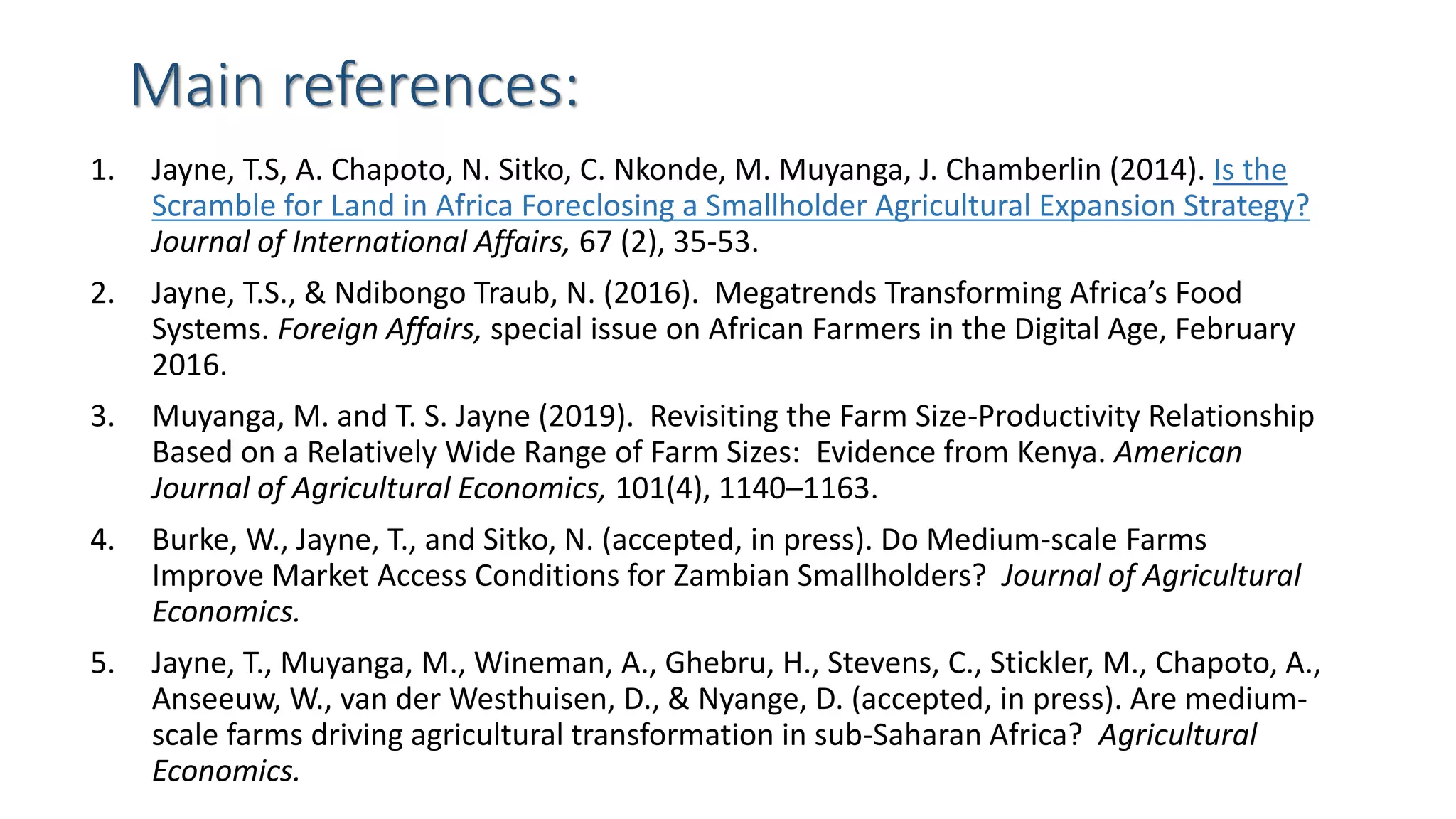
Main references:
1. Jayne, T.S, A. Chapoto, N. Sitko, C. Nkonde, M. Muyanga, J. Chamberlin (2014). Is the
Scramble for Land in Africa Foreclosing a Smallholder Agricultural Expansion Strategy?
Journal of International Affairs, 67 (2), 35-53.
2. Jayne, T.S., & Ndibongo Traub, N. (2016). Megatrends Transforming Africa’s Food
Systems. Foreign Affairs, special issue on African Farmers in the Digital Age, February
2016.
3. Muyanga, M. and T. S. Jayne (2019). Revisiting the Farm Size-Productivity Relationship
Based on a Relatively Wide Range of Farm Sizes: Evidence from Kenya. American
Journal of Agricultural Economics, 101(4), 1140–1163.
4. Burke, W., Jayne, T., and Sitko, N. (accepted, in press). Do Medium-scale Farms
Improve Market Access Conditions for Zambian Smallholders? Journal of Agricultural
Economics.
5. Jayne, T., Muyanga, M., Wineman, A., Ghebru, H., Stevens, C., Stickler, M., Chapoto, A.,
Anseeuw, W., van der Westhuisen, D., & Nyange, D. (accepted, in press). Are medium-
scale farms driving agricultural transformation in sub-Saharan Africa? Agricultural
Economics.
Key findings
1. Rapid rise of medium-scale farms
• Mainly in areas with substantial potential for area
expansion (Ghana, Tanzania, Zambia, Nigeria)
• Much less so in densely populated areas (Kenya, Rwanda,
Uganda)
Source: Ghana Living Standards Surveys, 1992, 2013
Changes in farm structure in Ghana (1992-2013)
Ghana
Number of farms
% growth in
number of
farms
% of total cultivated
area
1992 2013 1992 2013
0-2 ha 1,458,540 1,582,034 8.5 25.1 14.2
2-5 ha 578,890 998,651 72.5 35.6 31.3
5-10 ha 116,800 320,411 174.3 17.2 22.8
10-20 ha 38,690 117,722 204.3 11.0 16.1
20-100 ha 18,980 37,421 97.2 11.1 12.2
>100 ha -- 1,740 - -- 3.5
Total 2,211,900 3,057,978 38.3 100 100
51% of
total farm-
land
Distribution of national cultivated area by farm size category, Tanzania
NPS, 2008, 2010, 2012, 2014
0%
10%
20%
30%
40%
Small, on-farm
focus, not com
Small, on-farm
focus, com
Small, off-farm
focus, not com
Small, off-farm
focus, com
Medium Large
2008 2010 2012 2014
Rise of Medium Sized Farms in Africa1
20%
38%
21%
28%
7%
13%
3%
11%
18%
14%
7%
13%
1% 0% 0%
5%
39%
44%
50%
53%
19% 19% 18%
14%
36%
26%
10%
40%
5%
1% 2%
4%
Grains/roots/tubers
Industrialcashcrops
Horticuture
Legumes/oilseeds
Grains/roots/tubers
Industrialcashcrops
Horticuture
Legumes/oilseeds
Grains/roots/tubers
Industrialcashcrops
Horticuture
Legumes/oilseeds
Grains/roots/tubers
Industrialcashcrops
Horticuture
Legumes/oilseeds
Ghana [1992-2013] Nigeria [2011-2016] Tanzania [2008-2014] Rwanda [2006-2014]
Period 1
Period 2
Share of total marketed output supplied by medium-scale farms
Farm land controlled Land under operation
LSMS
Ag Sample
Census Survey
%
difference
LSMS
Ag Sample
Census
Survey
%
difference
By holdings of: Million hectares Million hectares
0-5 ha 8.246 8.595 +4.2 8.117 8.130 +0.002
5-100 ha 3.872 5.861 +51.4 3.816 5.181 +35.8
Over 100 ha 0.809 1.294 +60.0 0.809 0.942 +16.5
Comparison of farmland owned and land under cultivation in Tanzania:
2009 Agricultural Sample Census Survey vs. 2009 LSMS/NPS Survey
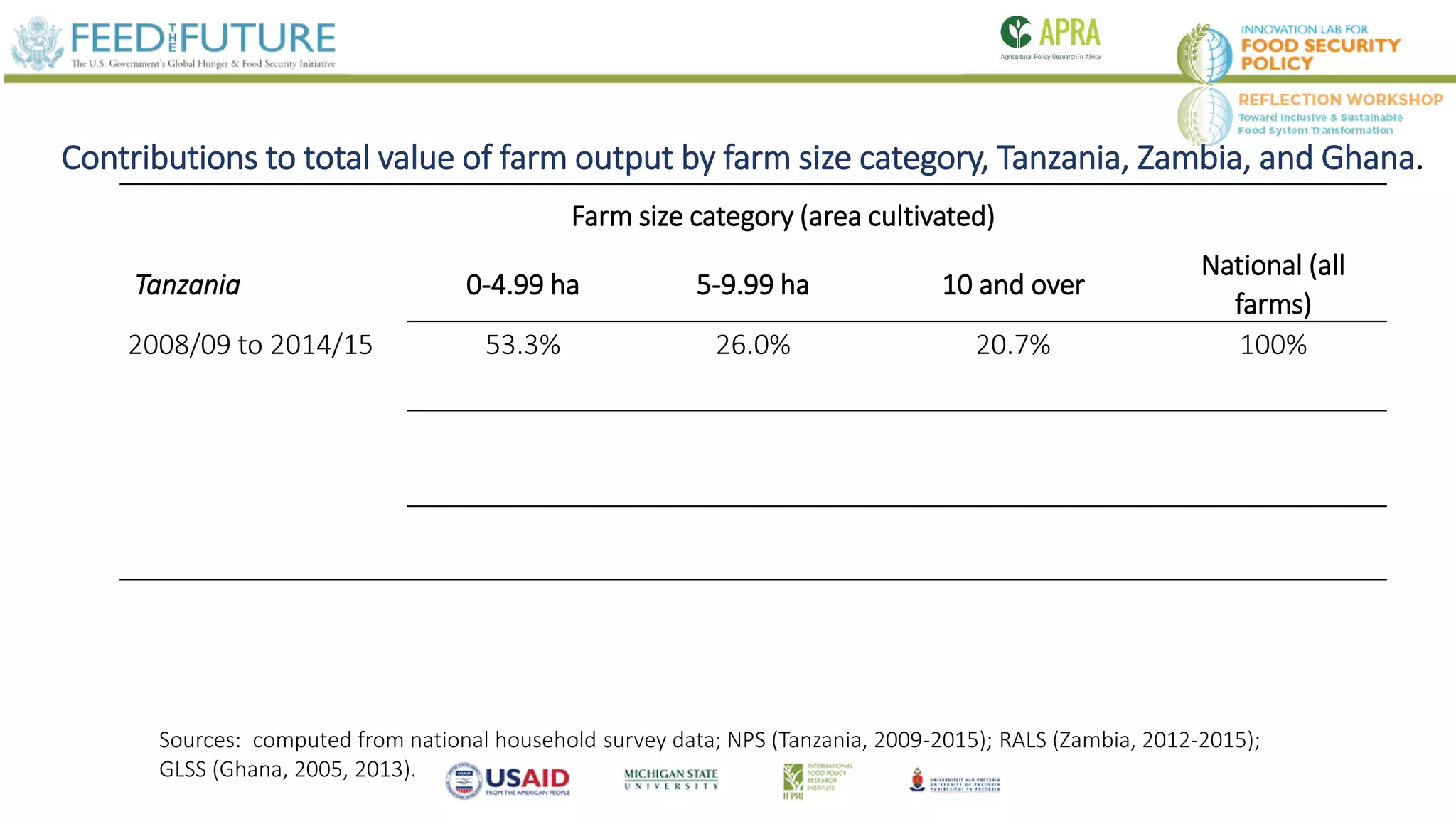
Farm size category (area cultivated)
Tanzania 0-4.99 ha 5-9.99 ha 10 and over
National (all
farms)
2008/09 to 2014/15 53.3% 26.0% 20.7% 100%
Contributions to total value of farm output by farm size category, Tanzania, Zambia, and Ghana.
Sources: computed from national household survey data; NPS (Tanzania, 2009-2015); RALS (Zambia, 2012-2015);
GLSS (Ghana, 2005, 2013).
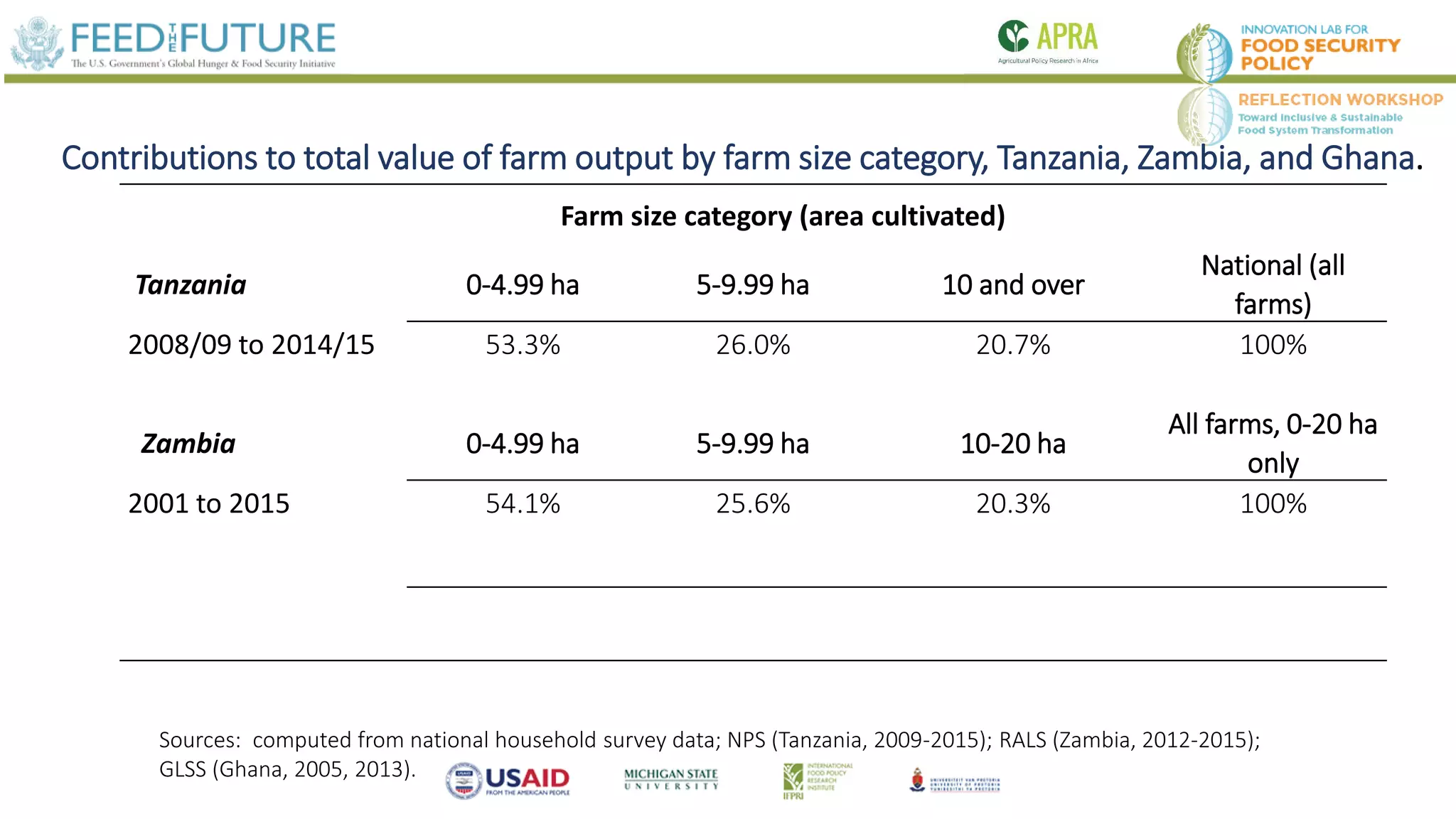
Farm size category (area cultivated)
Tanzania 0-4.99 ha 5-9.99 ha 10 and over
National (all
farms)
2008/09 to 2014/15 53.3% 26.0% 20.7% 100%
Zambia 0-4.99 ha 5-9.99 ha 10-20 ha
All farms, 0-20 ha
only
2001 to 2015 54.1% 25.6% 20.3% 100%
Contributions to total value of farm output by farm size category, Tanzania, Zambia, and Ghana.
Sources: computed from national household survey data; NPS (Tanzania, 2009-2015); RALS (Zambia, 2012-2015);
GLSS (Ghana, 2005, 2013).
Farm size category (area cultivated)
Tanzania 0-4.99 ha 5-9.99 ha 10 and over
National (all
farms)
2008/09 to 2014/15 53.3% 26.0% 20.7% 100%
Zambia 0-4.99 ha 5-9.99 ha 10-20 ha
All farms, 0-20 ha
only
2001 to 2015 54.1% 25.6% 20.3% 100%
Ghana 0-4.99 ha 5-9.99 ha 10 and over
National (all
farms)
2005 to 2013 39.7% 51.6% 8.7% 100%
Contributions to total value of farm output by farm size category, Tanzania, Zambia, and Ghana.
Sources: computed from national household survey data; NPS (Tanzania, 2009-2015); RALS (Zambia, 2012-2015);
GLSS (Ghana, 2005, 2013).
Causes of changing farm size distributions
1. Rise in world food prices – heightened investor interest in
farmland
2. Urban farmer capture of land policy / farm lobbies
3. Rapid population growth
• Fragmentation/subdivision in areas of favorable mkt access
• Land inheritance declining
• rising land scarcity → land markets → rising land prices
• Rising challenges of youth access to land → migration
13
Key findings (continued)
2. Diverse pathways into MS farming:
• Small-scale farms successfully growing and commercializing (25 to
50%) – especially high in Nigeria and northern Ghana
• Relatively wealthy rural people using non-farm income to invest in
farmland (20% to 40%)
• Urban people investing in farmland (20 to 35%) – esp. high in E/S
Africa
• The relative shares of these three groups varies across countries
Key findings (continued)
3. Rural transformation involves the transfer of land –
allowing entrepreneurial people with access to
capital to develop the land
• Customary land is being allocated to investors
• Land sales markets increasingly active / accepted
• Governments are passing new land laws to allow these
transfers to happen
Key findings (continued)
4. MS farms in Africa appear to be a source of rural dynamism –
but evidence is thin and not all consistent
• MS farms attracts LS traders into the area, improving market access
conditions for smallholders (Burke et al., 2019)
• MS farms attract mechanization rental markets for SS farms (van der
Westhuizen et al. 2019)
• MS farms attracts agro-input and service providers (Wineman et al., 2019)
• MS farms in Tanzania promotes growth in rural NF employment and
p.c. incomes (Chamberlin and Jayne, 2017)
Key findings (continued)
5. Sources of productivity advantage for farms cultivating > 10
ha, which contributes to higher net output values per
hectare (Muyanga and Jayne, 2019)
• Mechanization → reducing labor costs, which are rising in much of Africa
• Greater intensity of cash inputs (fertilizers, improved seed, herbicides, etc)
18
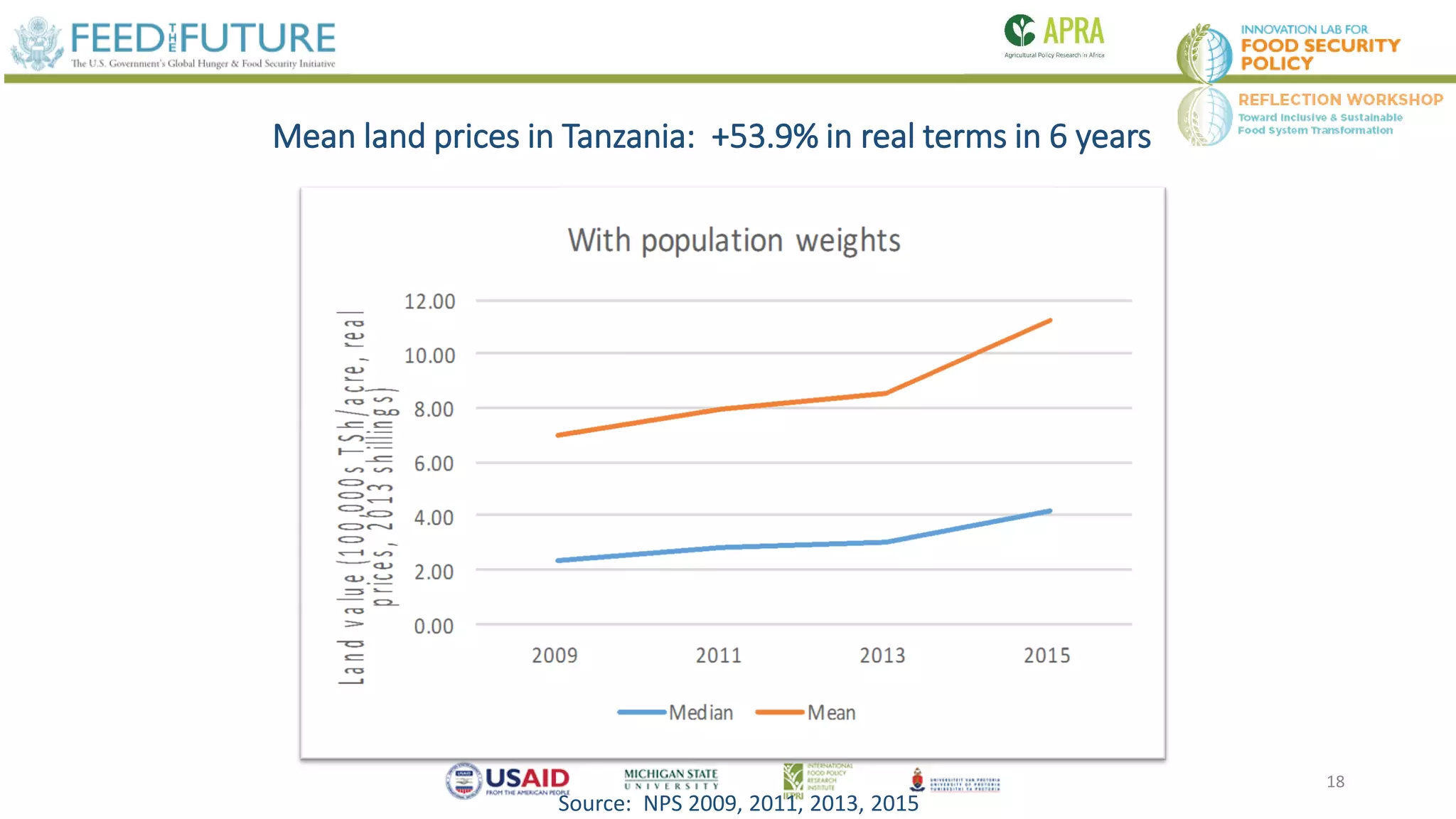
Mean land prices in Tanzania: +53.9% in real terms in 6 years
Source: NPS 2009, 2011, 2013, 2015
Implications for agricultural policy
1. The rise of MS farms does not invalidate the viability of a smallholder-led
agricultural strategy
2. But most governments support MS/commercialized farms (land bills, ISPs
channeled to them, price supports, etc).
3. Maintain focus on supporting productivity of smallholder farming →
which will facilitate equitable transformation process
4. Except in densely populated areas, MS farms appear to be a source of
productivity growth for smallholder farming
5. Sustainable intensification strategies will be highly location-specific,
according to economic dynamism and population density
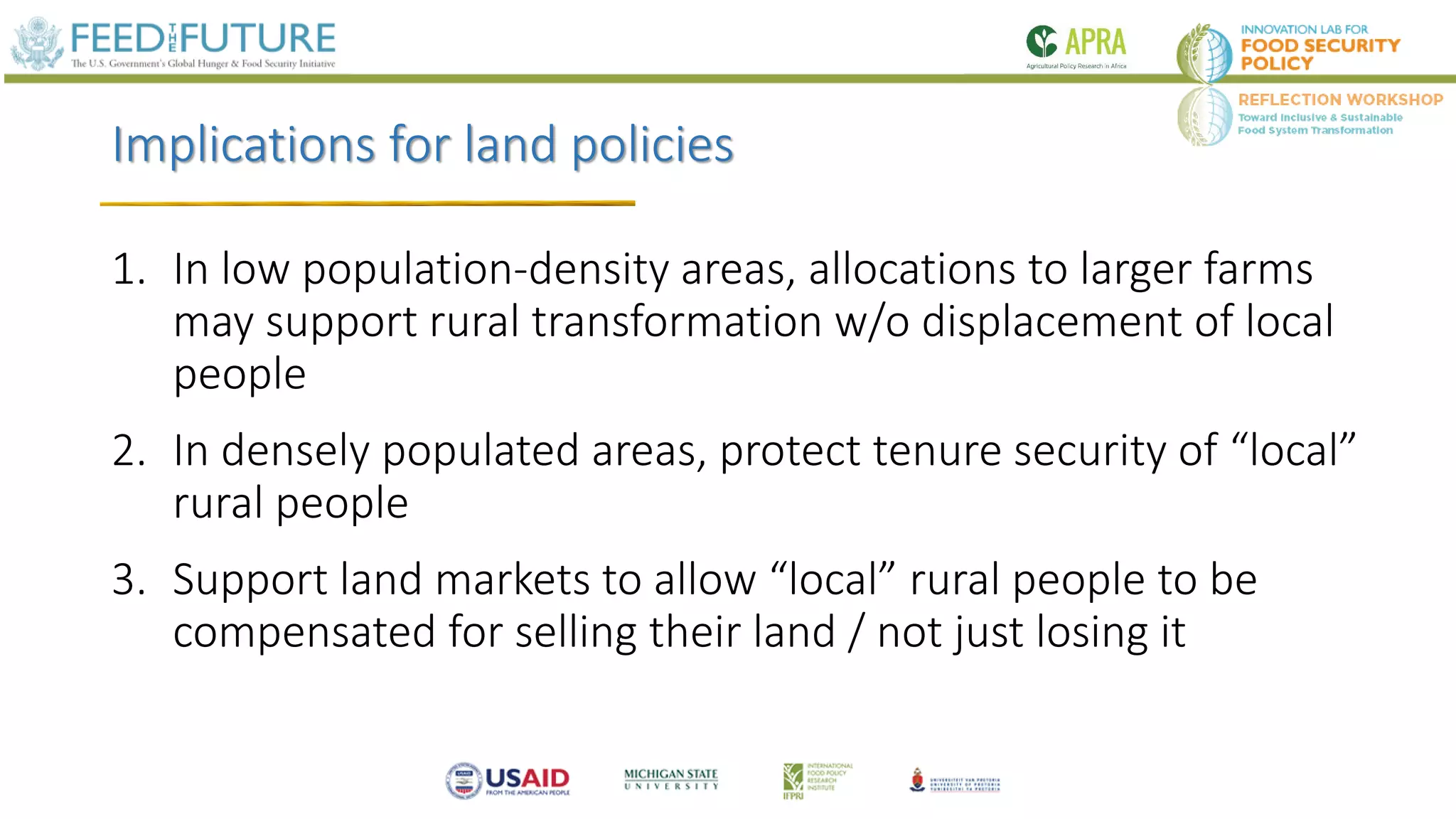
Implications for land policies
1. In low population-density areas, allocations to larger farms
may support rural transformation w/o displacement of local
people
2. In densely populated areas, protect tenure security of “local”
rural people
3. Support land markets to allow “local” rural people to be
compensated for selling their land / not just losing it
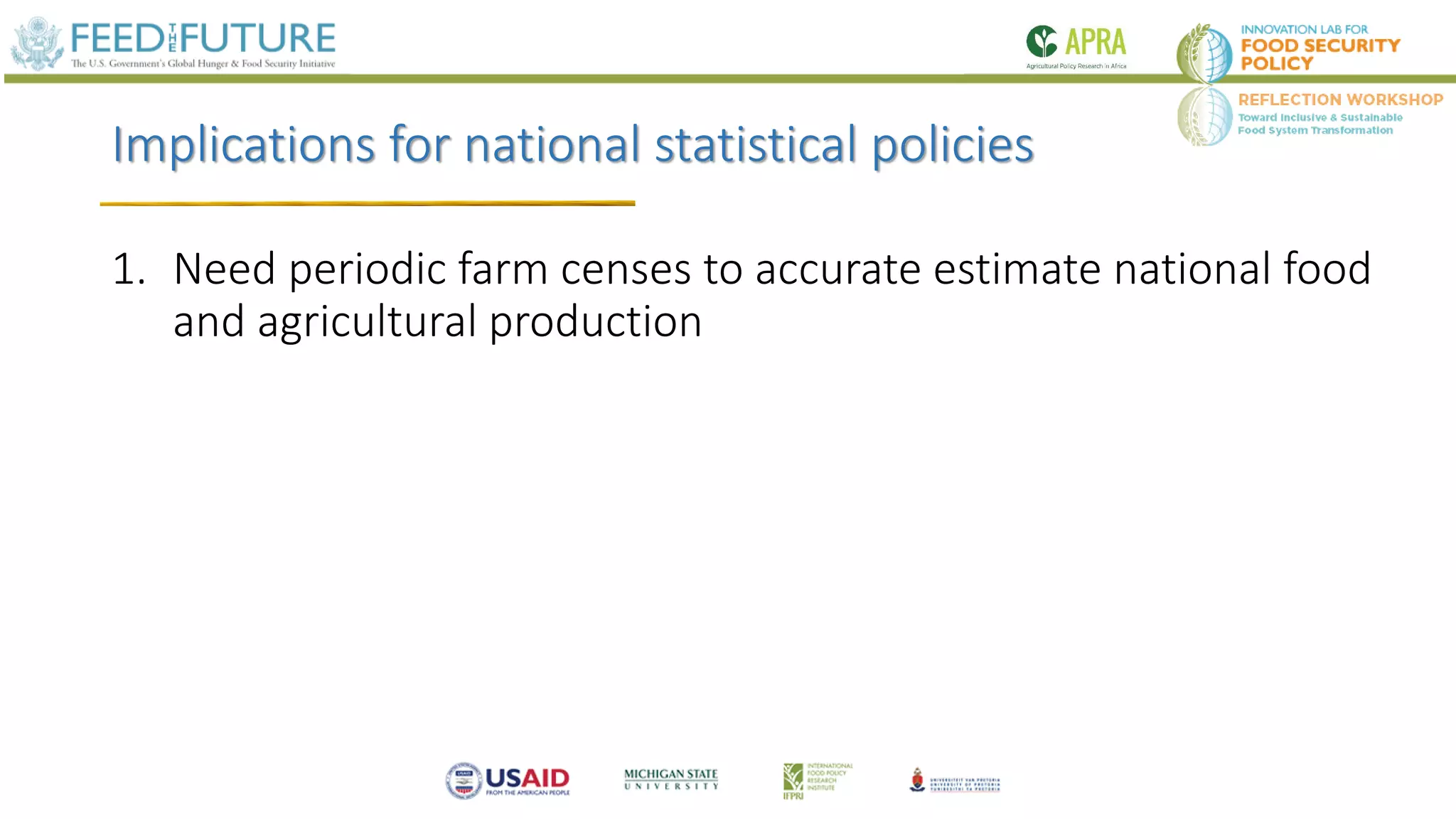
Implications for national statistical policies
1. Need periodic farm censes to accurate estimate national food
and agricultural production
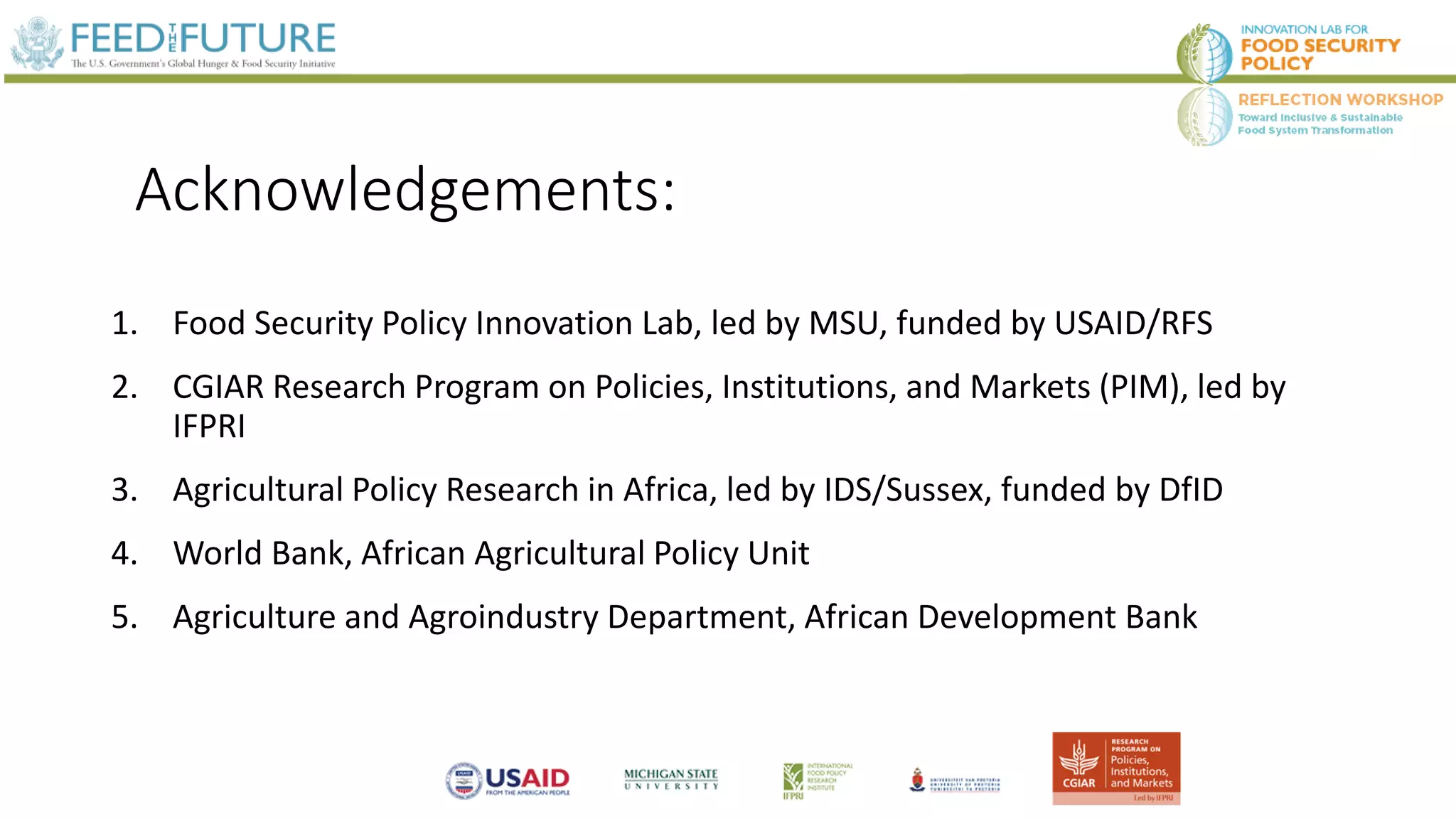
Acknowledgements:
1. Food Security Policy Innovation Lab, led by MSU, funded by USAID/RFS
2. CGIAR Research Program on Policies, Institutions, and Markets (PIM), led by
IFPRI
3. Agricultural Policy Research in Africa, led by IDS/Sussex, funded by DfID
4. World Bank, African Agricultural Policy Unit
5. Agriculture and Agroindustry Department, African Development Bank
Thank You
23
The PIM Webinars aim to share findings of research undertaken as part of the CGIAR Research Program on Policies, Institutions, and
Markets (PIM), discuss their application, and get feedback and suggestions from participants. Webinars are conducted by PIM
researchers in the form of research seminars. Each webinar is a live event consisting of a presentation (30 min) and a facilitated
Q&A session (30 min). Recordings and presentations of the webinars are freely available on the PIM website: http://bit.ly/PIM-
Webinars
Subscribe to alerts about future webinars: https://pim.cgiar.org/subscribe/

Changing farm structure and rural transformation in Africa

  • 1.
    CHANGING FARM STRUCTUREAND RURAL TRANSFORMATION IN AFRICA ARE MEDIUM-SCALE FARMS DRIVING RURAL TRANSFORMATION? T. S. Jayne, Milu Muyanga, A. Aromolaran, Ayala Wineman, Hosaena Ghebru, Caleb Stevens, Mercedes Stickler, Antony Chapoto, Ward Anseeuw, D. van der Westhuizen and D. Nyange IFPRI Seminar / PIM Webinar IFPRI, Washington, DC October 24, 2019
  • 2.
    Conventional views ofAfrican agriculture • Traditional ways of farming • Dominated by semi-subsistence small-scale farming • Weak market access conditions 2 These conventional views of African agriculture are in many respects changing → changing farm size distributions • It is no longer true that the vast majority of farmland in Africa is small-scale • Aggregate area under medium-scale farms exceeds the area acquired by large-scale investors (foreign and local) since 2000 • Emerging transformation of rural Africa
  • 3.
    Outline: 1. Summarize keyfindings from several studies since 2016 regarding • trends in the importance of MS farms • causes of the rise of MS farms • characteristics of MS farmers • productivity differences between SS and MS farms • evidence of whether MS farms improve or impede the livelihoods of SS households 2. Conclusions 3. Implications for policy
  • 4.
    Main references: 1. Jayne,T.S, A. Chapoto, N. Sitko, C. Nkonde, M. Muyanga, J. Chamberlin (2014). Is the Scramble for Land in Africa Foreclosing a Smallholder Agricultural Expansion Strategy? Journal of International Affairs, 67 (2), 35-53. 2. Jayne, T.S., & Ndibongo Traub, N. (2016). Megatrends Transforming Africa’s Food Systems. Foreign Affairs, special issue on African Farmers in the Digital Age, February 2016. 3. Muyanga, M. and T. S. Jayne (2019). Revisiting the Farm Size-Productivity Relationship Based on a Relatively Wide Range of Farm Sizes: Evidence from Kenya. American Journal of Agricultural Economics, 101(4), 1140–1163. 4. Burke, W., Jayne, T., and Sitko, N. (accepted, in press). Do Medium-scale Farms Improve Market Access Conditions for Zambian Smallholders? Journal of Agricultural Economics. 5. Jayne, T., Muyanga, M., Wineman, A., Ghebru, H., Stevens, C., Stickler, M., Chapoto, A., Anseeuw, W., van der Westhuisen, D., & Nyange, D. (accepted, in press). Are medium- scale farms driving agricultural transformation in sub-Saharan Africa? Agricultural Economics.
  • 5.
    Key findings 1. Rapidrise of medium-scale farms • Mainly in areas with substantial potential for area expansion (Ghana, Tanzania, Zambia, Nigeria) • Much less so in densely populated areas (Kenya, Rwanda, Uganda)
  • 6.
    Source: Ghana LivingStandards Surveys, 1992, 2013 Changes in farm structure in Ghana (1992-2013) Ghana Number of farms % growth in number of farms % of total cultivated area 1992 2013 1992 2013 0-2 ha 1,458,540 1,582,034 8.5 25.1 14.2 2-5 ha 578,890 998,651 72.5 35.6 31.3 5-10 ha 116,800 320,411 174.3 17.2 22.8 10-20 ha 38,690 117,722 204.3 11.0 16.1 20-100 ha 18,980 37,421 97.2 11.1 12.2 >100 ha -- 1,740 - -- 3.5 Total 2,211,900 3,057,978 38.3 100 100 51% of total farm- land
  • 7.
    Distribution of nationalcultivated area by farm size category, Tanzania NPS, 2008, 2010, 2012, 2014 0% 10% 20% 30% 40% Small, on-farm focus, not com Small, on-farm focus, com Small, off-farm focus, not com Small, off-farm focus, com Medium Large 2008 2010 2012 2014
  • 8.
    Rise of MediumSized Farms in Africa1 20% 38% 21% 28% 7% 13% 3% 11% 18% 14% 7% 13% 1% 0% 0% 5% 39% 44% 50% 53% 19% 19% 18% 14% 36% 26% 10% 40% 5% 1% 2% 4% Grains/roots/tubers Industrialcashcrops Horticuture Legumes/oilseeds Grains/roots/tubers Industrialcashcrops Horticuture Legumes/oilseeds Grains/roots/tubers Industrialcashcrops Horticuture Legumes/oilseeds Grains/roots/tubers Industrialcashcrops Horticuture Legumes/oilseeds Ghana [1992-2013] Nigeria [2011-2016] Tanzania [2008-2014] Rwanda [2006-2014] Period 1 Period 2 Share of total marketed output supplied by medium-scale farms
  • 9.
    Farm land controlledLand under operation LSMS Ag Sample Census Survey % difference LSMS Ag Sample Census Survey % difference By holdings of: Million hectares Million hectares 0-5 ha 8.246 8.595 +4.2 8.117 8.130 +0.002 5-100 ha 3.872 5.861 +51.4 3.816 5.181 +35.8 Over 100 ha 0.809 1.294 +60.0 0.809 0.942 +16.5 Comparison of farmland owned and land under cultivation in Tanzania: 2009 Agricultural Sample Census Survey vs. 2009 LSMS/NPS Survey
  • 10.
    Farm size category(area cultivated) Tanzania 0-4.99 ha 5-9.99 ha 10 and over National (all farms) 2008/09 to 2014/15 53.3% 26.0% 20.7% 100% Contributions to total value of farm output by farm size category, Tanzania, Zambia, and Ghana. Sources: computed from national household survey data; NPS (Tanzania, 2009-2015); RALS (Zambia, 2012-2015); GLSS (Ghana, 2005, 2013).
  • 11.
    Farm size category(area cultivated) Tanzania 0-4.99 ha 5-9.99 ha 10 and over National (all farms) 2008/09 to 2014/15 53.3% 26.0% 20.7% 100% Zambia 0-4.99 ha 5-9.99 ha 10-20 ha All farms, 0-20 ha only 2001 to 2015 54.1% 25.6% 20.3% 100% Contributions to total value of farm output by farm size category, Tanzania, Zambia, and Ghana. Sources: computed from national household survey data; NPS (Tanzania, 2009-2015); RALS (Zambia, 2012-2015); GLSS (Ghana, 2005, 2013).
  • 12.
    Farm size category(area cultivated) Tanzania 0-4.99 ha 5-9.99 ha 10 and over National (all farms) 2008/09 to 2014/15 53.3% 26.0% 20.7% 100% Zambia 0-4.99 ha 5-9.99 ha 10-20 ha All farms, 0-20 ha only 2001 to 2015 54.1% 25.6% 20.3% 100% Ghana 0-4.99 ha 5-9.99 ha 10 and over National (all farms) 2005 to 2013 39.7% 51.6% 8.7% 100% Contributions to total value of farm output by farm size category, Tanzania, Zambia, and Ghana. Sources: computed from national household survey data; NPS (Tanzania, 2009-2015); RALS (Zambia, 2012-2015); GLSS (Ghana, 2005, 2013).
  • 13.
    Causes of changingfarm size distributions 1. Rise in world food prices – heightened investor interest in farmland 2. Urban farmer capture of land policy / farm lobbies 3. Rapid population growth • Fragmentation/subdivision in areas of favorable mkt access • Land inheritance declining • rising land scarcity → land markets → rising land prices • Rising challenges of youth access to land → migration 13
  • 14.
    Key findings (continued) 2.Diverse pathways into MS farming: • Small-scale farms successfully growing and commercializing (25 to 50%) – especially high in Nigeria and northern Ghana • Relatively wealthy rural people using non-farm income to invest in farmland (20% to 40%) • Urban people investing in farmland (20 to 35%) – esp. high in E/S Africa • The relative shares of these three groups varies across countries
  • 15.
    Key findings (continued) 3.Rural transformation involves the transfer of land – allowing entrepreneurial people with access to capital to develop the land • Customary land is being allocated to investors • Land sales markets increasingly active / accepted • Governments are passing new land laws to allow these transfers to happen
  • 16.
    Key findings (continued) 4.MS farms in Africa appear to be a source of rural dynamism – but evidence is thin and not all consistent • MS farms attracts LS traders into the area, improving market access conditions for smallholders (Burke et al., 2019) • MS farms attract mechanization rental markets for SS farms (van der Westhuizen et al. 2019) • MS farms attracts agro-input and service providers (Wineman et al., 2019) • MS farms in Tanzania promotes growth in rural NF employment and p.c. incomes (Chamberlin and Jayne, 2017)
  • 17.
    Key findings (continued) 5.Sources of productivity advantage for farms cultivating > 10 ha, which contributes to higher net output values per hectare (Muyanga and Jayne, 2019) • Mechanization → reducing labor costs, which are rising in much of Africa • Greater intensity of cash inputs (fertilizers, improved seed, herbicides, etc)
  • 18.
    18 Mean land pricesin Tanzania: +53.9% in real terms in 6 years Source: NPS 2009, 2011, 2013, 2015
  • 19.
    Implications for agriculturalpolicy 1. The rise of MS farms does not invalidate the viability of a smallholder-led agricultural strategy 2. But most governments support MS/commercialized farms (land bills, ISPs channeled to them, price supports, etc). 3. Maintain focus on supporting productivity of smallholder farming → which will facilitate equitable transformation process 4. Except in densely populated areas, MS farms appear to be a source of productivity growth for smallholder farming 5. Sustainable intensification strategies will be highly location-specific, according to economic dynamism and population density
  • 20.
    Implications for landpolicies 1. In low population-density areas, allocations to larger farms may support rural transformation w/o displacement of local people 2. In densely populated areas, protect tenure security of “local” rural people 3. Support land markets to allow “local” rural people to be compensated for selling their land / not just losing it
  • 21.
    Implications for nationalstatistical policies 1. Need periodic farm censes to accurate estimate national food and agricultural production
  • 22.
    Acknowledgements: 1. Food SecurityPolicy Innovation Lab, led by MSU, funded by USAID/RFS 2. CGIAR Research Program on Policies, Institutions, and Markets (PIM), led by IFPRI 3. Agricultural Policy Research in Africa, led by IDS/Sussex, funded by DfID 4. World Bank, African Agricultural Policy Unit 5. Agriculture and Agroindustry Department, African Development Bank
  • 23.
    Thank You 23 The PIMWebinars aim to share findings of research undertaken as part of the CGIAR Research Program on Policies, Institutions, and Markets (PIM), discuss their application, and get feedback and suggestions from participants. Webinars are conducted by PIM researchers in the form of research seminars. Each webinar is a live event consisting of a presentation (30 min) and a facilitated Q&A session (30 min). Recordings and presentations of the webinars are freely available on the PIM website: http://bit.ly/PIM- Webinars Subscribe to alerts about future webinars: https://pim.cgiar.org/subscribe/