Understanding the Pathways Linking SELEVER
Participation and Women’s Increased
Participation in Poultry Value Chains in
Burkina Faso
Jessica Heckert, Jessica Leight, Aulo Gelli, Josué Awonon
International Food Policy Research Institute
Rasmané Ganaba
AfricSanté
Research question
• The objective of this paper is to analyze the relative contributions of
multiple dimensions of SELEVER (producer group membership, poultry
training, business-related training, interaction with village vaccination
volunteers, nutrition- and gender-sensitive trainings) to women’s
ownership, revenue and profits in the poultry value chain.
• Motivation: integrated value chain interventions generally rely on multiple
program elements rolled out simultaneously, but relatively little is known
about their relative effectiveness.
• Identifying and prioritizing the most effective elements, as well as
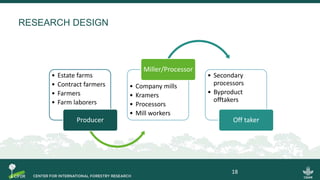
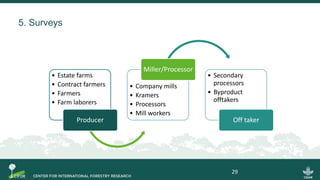
understanding how they interact with one another, can have meaningful
implications for program implementation and cost-effectiveness.
Unpacking program pathways using SEM
• The primary methodology employed is casual mediation analysis
drawing on structural equation modeling.
• Although the use of causal mediation is well established in cross-
sectional and longitudinal data, it has not been widely used with RCT
designs.
• In the context of an RCT, the method tests the plausibility of potential
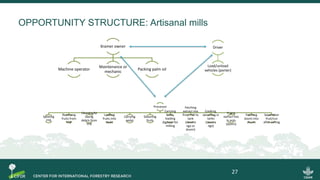
impact pathways. Thus, we focus on outcomes where we find
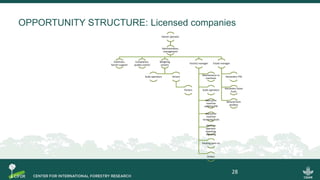
program impacts.
• Our application of the method is relatively novel.
Methods
• SELEVER is a theory-based, mixed-methods evaluation
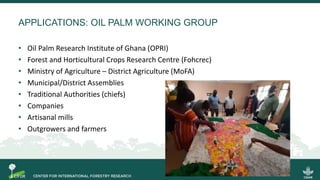
• It is a cluster randomized controlled trial of 120 villages.
• The sample of villages are randomly assigned to be included in
SELEVER programming, or to serve as the control group.
• Households from both arms are tracked over time to analyze the
effects of the intervention.
• We observe that the SELEVER treatment leads to a significant increase
in the number of poultry owned and revenue and profits from poultry
for women, in particular.
Unpacking causal mediation with SEM
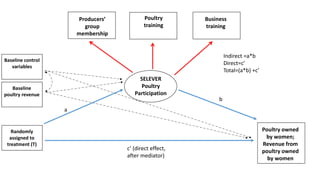
• The hypothesized mediator is regressed on the independent variable (treatment)
to estimate the value of path a.
• The dependent variable at endline is regressed on the hypothesized mediator and
the treatment variable to estimate paths b and c’, respectively.
Change in
outcome
Program c
Program Change in
outcome
c’
Mediator
a b
Program impact without mediation Program impact with mediation
Total effect = c
c = effect of the program on outcome
Indirect effect = a x b
Direct effect = c’
Total effect = Direct + Indirect
a = effect of the program on the mediator
b = effect of the mediator on outcome (controlling for program)
c‘ = effect of the program on outcome (controlling for mediator)
Key intuition
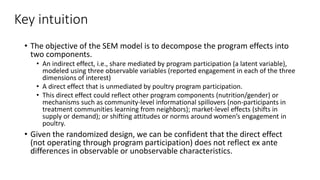
• The objective of the SEM model is to decompose the program effects into
two components.
• An indirect effect, i.e., share mediated by program participation (a latent variable),
modeled using three observable variables (reported engagement in each of the three
dimensions of interest)
• A direct effect that is unmediated by poultry program participation.
• This direct effect could reflect other program components (nutrition/gender) or
mechanisms such as community-level informational spillovers (non-participants in
treatment communities learning from neighbors); market-level effects (shifts in
supply or demand); or shifting attitudes or norms around women’s engagement in
poultry.
• Given the randomized design, we can be confident that the direct effect
(not operating through program participation) does not reflect ex ante
differences in observable or unobservable characteristics.
c’ (direct effect,
after mediator)
SELEVER
Poultry
Participation
b
Baseline control
variables
Indirect =a*b
Direct=c’
Total=(a*b) +c’
Poultry
training
Business
training
Producers’
group
membership
Poultry owned
by women;
Revenue from
poultry owned
by women
Baseline
poultry revenue
Randomly
assigned to
treatment (T)
a
Preview of results
• We observe that about 50% of the total effect of random assignment
of SELEVER on poultry owned by women is mediated by our latent
variable of program participation.
• This remaining share can be attributable other program components
in this multisectoral program and interactions among the
components, which we will continue to explore.
• This methodology thus allows us to illuminate further how this
intervention is shifting households’ outcomes.
From oil palm mamas to market queens:
Emily J. Gallagher, Markus Ihalainen, George Schoneveld, Lydiah
Gatere
Measuring the gender footprint of informal and formal
market value chains in Eastern Region, Ghana
PIM Webinar, 28 October 2021
10
Conceptual framework and research objective
Project background and research questions
Research design
Methodology
Preliminary results
Applications: Research to impact
Recommendations for gender footprinting
11
SOCIAL FOOTPRINTING
• Derived from Environmental Life Cycle Assessment (eLCA) and
Social Life Cycle Assessment (sLCA) (UNEP/SETAC 2009);
and Corporate Performance wrt the Triple Bottom Line (TBL)
• A quantitative measurement of the social sustainability
performance of a company, organization, or value chain actors.
• Describes both positive (social opportunities) and negative (social
risks) externalities of value chain participation.
12
SOCIAL FOOTPRINTING and GENDER
• Indicators or composite indicators that can be used to measure
sustainability …usually over unit area (Cucek et al. 2012).
• No common guideline from academic perspective.
• Standardized for corporations through Global Reporting Initiative
(GRI) or sustainability standards (i.e., Fairtrade).
• Gender indicators related to non-discrimination and
equal opportunities (UNEP/SETAC; GRI Disclosures).
• Gender representation
• Gender equality
• Measures to support women, younger employees, older employees,
minorities, foreign workers, etc.
13
RESEARCH OBJECTIVES
• Contribute to Social Footprinting/sLCA
with gender lens = Gender Footprinting
• Develop diagnostic tool for intervention at the
enterprise level, and for inter-sectoral
analysis and development planning
14
PROJECT BACKGROUND
• Ghana is a major producer and consumer of palm oil.
• Oil palm is indigenous to West Africa and palm oil production has
traditionally been in the domain of women.
• Ghana is a net importer of palm oil.
• ISI initiatives supported 4 large-scale estates geographically
distributed across Ghana. Estate farms and factories have
dominated the domestic commercial market;
• Artisanal mills have persisted and proliferated around estate farms
and outgrower plantations;
• Formal and informal sectors each perform functional niche in the
localized oil palm/palm oil economies;
• High degree of market segregation,
but high competition for FFB
15
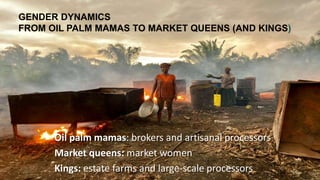
GENDER DYNAMICS
FROM OIL PALM MAMAS TO MARKET QUEENS (AND KINGS)
Oil palm mamas: brokers and artisanal processors
Market queens: market women
Kings: estate farms and large-scale processors 16
RESEARCH QUESTIONS
• Gender value chain analysis:
In what ways are different groups of women and men participating in mid-
stream activities across different value chain segments and business models?
• Gender footprinting:
In what ways do gendered livelihood impacts and socio-economic outcomes differ
across midstream value chain segments in the formal and informal spheres?
17
RESEARCH DESIGN
• Estate farms
• Contract farmers
• Farmers
• Farm laborers
Producer
• Company mills
• Kramers
• Processors
• Mill workers
Miller/Processor
• Secondary
processors
• Byproduct
offtakers
Off taker
18
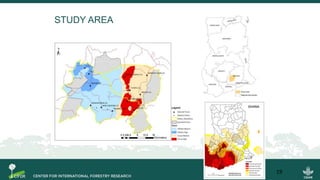
STUDY AREA
19
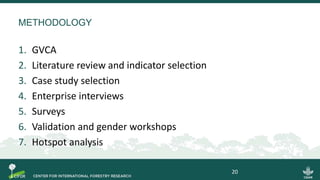
METHODOLOGY
1. GVCA
2. Literature review and indicator selection
3. Case study selection
4. Enterprise interviews
5. Surveys
6. Validation and gender workshops
7. Hotspot analysis
20
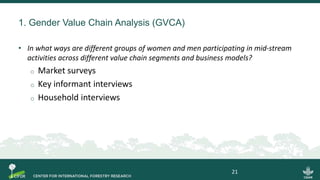
1. Gender Value Chain Analysis (GVCA)
• In what ways are different groups of women and men participating in mid-stream
activities across different value chain segments and business models?
o Market surveys
o Key informant interviews
o Household interviews
21
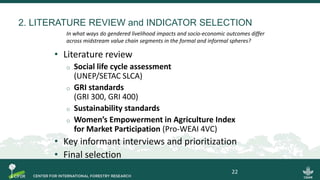
2. LITERATURE REVIEW and INDICATOR SELECTION
• Literature review
o Social life cycle assessment
(UNEP/SETAC SLCA)
o GRI standards
(GRI 300, GRI 400)
o Sustainability standards
o Women’s Empowerment in Agriculture Index
for Market Participation (Pro-WEAI 4VC)
• Key informant interviews and prioritization
• Final selection
22
In what ways do gendered livelihood impacts and socio-economic outcomes differ
across midstream value chain segments in the formal and informal spheres?
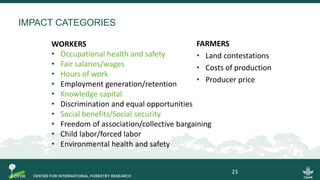
IMPACT CATEGORIES
WORKERS
• Occupational health and safety
• Fair salaries/wages
• Hours of work
• Employment generation/retention
• Knowledge capital
• Discrimination and equal opportunities
• Social benefits/Social security
• Freedom of association/collective bargaining
• Child labor/forced labor
• Environmental health and safety
FARMERS
• Land contestations
• Costs of production
• Producer price
23
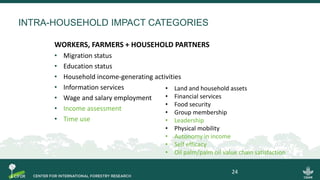
INTRA-HOUSEHOLD IMPACT CATEGORIES
WORKERS, FARMERS + HOUSEHOLD PARTNERS
• Migration status
• Education status
• Household income-generating activities
• Information services
• Wage and salary employment
• Income assessment
• Time use
24
• Land and household assets
• Financial services
• Food security
• Group membership
• Leadership
• Physical mobility
• Autonomy in income
• Self efficacy
• Oil palm/palm oil value chain satisfaction
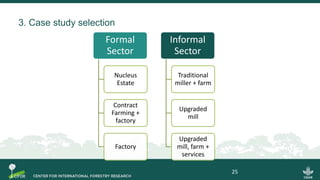
3. Case study selection
Formal
Sector
Nucleus
Estate
Contract
Farming +
factory
Factory
Informal
Sector
Traditional
miller + farm
Upgraded
mill
Upgraded
mill, farm +
services
25
4. Enterprise interviews
• Opportunity structure
• Labor roles
• Demographics
• Business practices and social risks
26
OPPORTUNITY STRUCTURE: Artisanal mills
Processor
Splitting
FFB
Removing
fruits from
FFB
Cleaning/bl
owing
debris from
FFB
Loading
fruits into
tanks
Carrying
water
Steaming
fruits
Carrying
fruits,
loading
digester for
milling
Fetching
extract mix
from mill to
tank
(samina
ngo or
dzomi)
Cooking,
skimming in
tanks
(samina
ngo)
Frying
extract mix
in pots
(dzomi)
Fetching
dzomi into
drums
Separation
fruit/nut
after milling
Kramer owner
Machine operator
Maintenance or
mechanic
Packing palm oil
Driver
Load/unload
vehicles (porter)
27
OPPORTUNITY STRUCTURE: Licensed companies
Owner operator
Administration,
management
Extension,
farmer support
Compliance,
quality control
Weighing
centers
Scale operators Drivers
Porters
Factory manager
Maintenance or
mechanic
Scale operators
Manual or
machine
splitting FFB
Manual or
machine
removing fruits
Machine
operator:
steaming,
digesting
Packing palm oil
Drivers
Estate manager
Harvesters FFB
Harvesters loose
fruits
General farm
workers
28
5. Surveys
• Estate farms
• Contract farmers
• Farmers
• Farm laborers
Producer
• Company mills
• Kramers
• Processors
• Mill workers
Miller/Processor
• Secondary
processors
• Byproduct
offtakers
Off taker
29
6. Validation and gender workshop
• Opportunity structure validation
• Social risks and opportunities (validate survey results)
• Gendered labor roles within opportunity structure
• Gendered impacts: focus on time use, autonomy in income, self efficacy, income
assessment, leadership
• Satisfaction with value chain role
30
7. HOTSPOT ANALYSIS (SPATIAL FOOTPRINTING)
• GPS points: Farmer hh; Miller
• Sourcing area geographic boundaries
• Aggregate at the level of sourcing area for data
sharing/monitoring areas
• Hotspot analysis: identifies non-random clusters
of high social risk or social opportunities
31
APPLICATIONS: OIL PALM WORKING GROUP
• Oil Palm Research Institute of Ghana (OPRI)
• Forest and Horticultural Crops Research Centre (Fohcrec)
• Ministry of Agriculture – District Agriculture (MoFA)
• Municipal/District Assemblies
• Traditional Authorities (chiefs)
• Companies
• Artisanal mills
• Outgrowers and farmers
32
cifor.org
blog.cifor.org
ForestsTreesAgroforestry.org
e.gallagher@cgiar.org
gatere@gmail.com
Agricultural value chain financing for
marginalized women
Presented by:
Kate Ambler: IFPRI
With:
Alan de Brauw: IFPRI
Sylvan Herskowitz: IFPRI
Background
 Large project designed to study financial access in the value chain in
Vietnam and Indonesia, with focus on marginalized women
 (Delayed) culmination of project are impact studies of financing programs to
be implemented next year
 Current focus has been on learning from existing data
Gender and start-up capital
 Employ three sources of data to study the financial constraints affecting
MSMEs in the agri-food system, with a focus on gender
oWorld Bank Enterprise Surveys, Indonesian Family Life Survey, Viet
Nam Access to Resources Household Survey
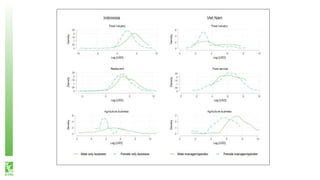
 Start-up capital for women owned businesses is five times lower
oWomen more likely to own lower cost businesses
oBut pattern persists within business type
Gender and start-up capital
 Employ three sources of data to study the financial constraints affecting
MSMEs in the agri-food system, with a focus on gender
oWorld Bank Enterprise Surveys, Indonesian Family Life Survey, Viet
Nam Access to Resources Household Survey
 Start-up capital for women owned businesses is five times lower
oWomen more likely to own lower cost businesses
oBut pattern persists within business type
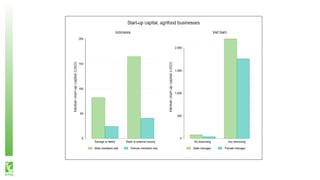
 Source of capital also differs
oWomen far less likely to access formal credit
Gender and finance in the midstream
 This work has extended to other projects examining finance and the
agricultural midstream
 Use World Bank Enterprise survey to identify midstream firms and study
access to finance in the agricultural sector in seven African countries
 Firms with female managers: fewer employees, lower sales, fewer bank
accounts and loans/credit
Methodological challenges
 Identifying businesses
oSorting firms by sector and value chain node challenging in survey data
oDifficult to sample micro, small, medium, and large businesses
consistently
 Understanding women’s roles
oRecent work suggests surveys prone to underestimating women’s
activities
oWomen’s contributions in household businesses difficult to measure
 Existing surveys not focused on finance
Next steps
 Implement impact evaluations of finance projects in Viet Nam and
Indonesia
 Develop surveys to study midstream finance directly in two countries
 In both cases, special attention to gender and known biases
Recoding of this webinar will be available
on the PIM website shortly after the live
event. All registrants will receive a follow-
up email with the link to the webinar
materials.
This webinar series: https://bit.ly/GDVCweb
Previous PIM Webinars: http://bit.ly/PIMwebinars
If you want to receive alerts about future PIM
Webinars, sign up here:
https://pim.cgiar.org/subscribe/
…and follow us on:
@PIM_CGIAR
@PIM.CGIAR
Q&A

Methods for studying gender dynamics in value chains beyond the production node and single commodity analysis

  • 2.
    Understanding the PathwaysLinking SELEVER Participation and Women’s Increased Participation in Poultry Value Chains in Burkina Faso Jessica Heckert, Jessica Leight, Aulo Gelli, Josué Awonon International Food Policy Research Institute Rasmané Ganaba AfricSanté
  • 3.
    Research question • Theobjective of this paper is to analyze the relative contributions of multiple dimensions of SELEVER (producer group membership, poultry training, business-related training, interaction with village vaccination volunteers, nutrition- and gender-sensitive trainings) to women’s ownership, revenue and profits in the poultry value chain. • Motivation: integrated value chain interventions generally rely on multiple program elements rolled out simultaneously, but relatively little is known about their relative effectiveness. • Identifying and prioritizing the most effective elements, as well as understanding how they interact with one another, can have meaningful implications for program implementation and cost-effectiveness.
  • 4.
    Unpacking program pathwaysusing SEM • The primary methodology employed is casual mediation analysis drawing on structural equation modeling. • Although the use of causal mediation is well established in cross- sectional and longitudinal data, it has not been widely used with RCT designs. • In the context of an RCT, the method tests the plausibility of potential impact pathways. Thus, we focus on outcomes where we find program impacts. • Our application of the method is relatively novel.
  • 5.
    Methods • SELEVER isa theory-based, mixed-methods evaluation • It is a cluster randomized controlled trial of 120 villages. • The sample of villages are randomly assigned to be included in SELEVER programming, or to serve as the control group. • Households from both arms are tracked over time to analyze the effects of the intervention. • We observe that the SELEVER treatment leads to a significant increase in the number of poultry owned and revenue and profits from poultry for women, in particular.
  • 6.
    Unpacking causal mediationwith SEM • The hypothesized mediator is regressed on the independent variable (treatment) to estimate the value of path a. • The dependent variable at endline is regressed on the hypothesized mediator and the treatment variable to estimate paths b and c’, respectively. Change in outcome Program c Program Change in outcome c’ Mediator a b Program impact without mediation Program impact with mediation Total effect = c c = effect of the program on outcome Indirect effect = a x b Direct effect = c’ Total effect = Direct + Indirect a = effect of the program on the mediator b = effect of the mediator on outcome (controlling for program) c‘ = effect of the program on outcome (controlling for mediator)
  • 7.
    Key intuition • Theobjective of the SEM model is to decompose the program effects into two components. • An indirect effect, i.e., share mediated by program participation (a latent variable), modeled using three observable variables (reported engagement in each of the three dimensions of interest) • A direct effect that is unmediated by poultry program participation. • This direct effect could reflect other program components (nutrition/gender) or mechanisms such as community-level informational spillovers (non-participants in treatment communities learning from neighbors); market-level effects (shifts in supply or demand); or shifting attitudes or norms around women’s engagement in poultry. • Given the randomized design, we can be confident that the direct effect (not operating through program participation) does not reflect ex ante differences in observable or unobservable characteristics.
  • 8.
    c’ (direct effect, aftermediator) SELEVER Poultry Participation b Baseline control variables Indirect =a*b Direct=c’ Total=(a*b) +c’ Poultry training Business training Producers’ group membership Poultry owned by women; Revenue from poultry owned by women Baseline poultry revenue Randomly assigned to treatment (T) a
  • 9.
    Preview of results •We observe that about 50% of the total effect of random assignment of SELEVER on poultry owned by women is mediated by our latent variable of program participation. • This remaining share can be attributable other program components in this multisectoral program and interactions among the components, which we will continue to explore. • This methodology thus allows us to illuminate further how this intervention is shifting households’ outcomes.
  • 10.
    From oil palmmamas to market queens: Emily J. Gallagher, Markus Ihalainen, George Schoneveld, Lydiah Gatere Measuring the gender footprint of informal and formal market value chains in Eastern Region, Ghana PIM Webinar, 28 October 2021 10
  • 11.
    Conceptual framework andresearch objective Project background and research questions Research design Methodology Preliminary results Applications: Research to impact Recommendations for gender footprinting 11
  • 12.
    SOCIAL FOOTPRINTING • Derivedfrom Environmental Life Cycle Assessment (eLCA) and Social Life Cycle Assessment (sLCA) (UNEP/SETAC 2009); and Corporate Performance wrt the Triple Bottom Line (TBL) • A quantitative measurement of the social sustainability performance of a company, organization, or value chain actors. • Describes both positive (social opportunities) and negative (social risks) externalities of value chain participation. 12
  • 13.
    SOCIAL FOOTPRINTING andGENDER • Indicators or composite indicators that can be used to measure sustainability …usually over unit area (Cucek et al. 2012). • No common guideline from academic perspective. • Standardized for corporations through Global Reporting Initiative (GRI) or sustainability standards (i.e., Fairtrade). • Gender indicators related to non-discrimination and equal opportunities (UNEP/SETAC; GRI Disclosures). • Gender representation • Gender equality • Measures to support women, younger employees, older employees, minorities, foreign workers, etc. 13
  • 14.
    RESEARCH OBJECTIVES • Contributeto Social Footprinting/sLCA with gender lens = Gender Footprinting • Develop diagnostic tool for intervention at the enterprise level, and for inter-sectoral analysis and development planning 14
  • 15.
    PROJECT BACKGROUND • Ghanais a major producer and consumer of palm oil. • Oil palm is indigenous to West Africa and palm oil production has traditionally been in the domain of women. • Ghana is a net importer of palm oil. • ISI initiatives supported 4 large-scale estates geographically distributed across Ghana. Estate farms and factories have dominated the domestic commercial market; • Artisanal mills have persisted and proliferated around estate farms and outgrower plantations; • Formal and informal sectors each perform functional niche in the localized oil palm/palm oil economies; • High degree of market segregation, but high competition for FFB 15
  • 16.
    GENDER DYNAMICS FROM OILPALM MAMAS TO MARKET QUEENS (AND KINGS) Oil palm mamas: brokers and artisanal processors Market queens: market women Kings: estate farms and large-scale processors 16
  • 17.
    RESEARCH QUESTIONS • Gendervalue chain analysis: In what ways are different groups of women and men participating in mid- stream activities across different value chain segments and business models? • Gender footprinting: In what ways do gendered livelihood impacts and socio-economic outcomes differ across midstream value chain segments in the formal and informal spheres? 17
  • 18.
    RESEARCH DESIGN • Estatefarms • Contract farmers • Farmers • Farm laborers Producer • Company mills • Kramers • Processors • Mill workers Miller/Processor • Secondary processors • Byproduct offtakers Off taker 18
  • 19.
  • 20.
    METHODOLOGY 1. GVCA 2. Literaturereview and indicator selection 3. Case study selection 4. Enterprise interviews 5. Surveys 6. Validation and gender workshops 7. Hotspot analysis 20
  • 21.
    1. Gender ValueChain Analysis (GVCA) • In what ways are different groups of women and men participating in mid-stream activities across different value chain segments and business models? o Market surveys o Key informant interviews o Household interviews 21
  • 22.
    2. LITERATURE REVIEWand INDICATOR SELECTION • Literature review o Social life cycle assessment (UNEP/SETAC SLCA) o GRI standards (GRI 300, GRI 400) o Sustainability standards o Women’s Empowerment in Agriculture Index for Market Participation (Pro-WEAI 4VC) • Key informant interviews and prioritization • Final selection 22 In what ways do gendered livelihood impacts and socio-economic outcomes differ across midstream value chain segments in the formal and informal spheres?
  • 23.
    IMPACT CATEGORIES WORKERS • Occupationalhealth and safety • Fair salaries/wages • Hours of work • Employment generation/retention • Knowledge capital • Discrimination and equal opportunities • Social benefits/Social security • Freedom of association/collective bargaining • Child labor/forced labor • Environmental health and safety FARMERS • Land contestations • Costs of production • Producer price 23
  • 24.
    INTRA-HOUSEHOLD IMPACT CATEGORIES WORKERS,FARMERS + HOUSEHOLD PARTNERS • Migration status • Education status • Household income-generating activities • Information services • Wage and salary employment • Income assessment • Time use 24 • Land and household assets • Financial services • Food security • Group membership • Leadership • Physical mobility • Autonomy in income • Self efficacy • Oil palm/palm oil value chain satisfaction
  • 25.
    3. Case studyselection Formal Sector Nucleus Estate Contract Farming + factory Factory Informal Sector Traditional miller + farm Upgraded mill Upgraded mill, farm + services 25
  • 26.
    4. Enterprise interviews •Opportunity structure • Labor roles • Demographics • Business practices and social risks 26
  • 27.
    OPPORTUNITY STRUCTURE: Artisanalmills Processor Splitting FFB Removing fruits from FFB Cleaning/bl owing debris from FFB Loading fruits into tanks Carrying water Steaming fruits Carrying fruits, loading digester for milling Fetching extract mix from mill to tank (samina ngo or dzomi) Cooking, skimming in tanks (samina ngo) Frying extract mix in pots (dzomi) Fetching dzomi into drums Separation fruit/nut after milling Kramer owner Machine operator Maintenance or mechanic Packing palm oil Driver Load/unload vehicles (porter) 27
  • 28.
    OPPORTUNITY STRUCTURE: Licensedcompanies Owner operator Administration, management Extension, farmer support Compliance, quality control Weighing centers Scale operators Drivers Porters Factory manager Maintenance or mechanic Scale operators Manual or machine splitting FFB Manual or machine removing fruits Machine operator: steaming, digesting Packing palm oil Drivers Estate manager Harvesters FFB Harvesters loose fruits General farm workers 28
  • 29.
    5. Surveys • Estatefarms • Contract farmers • Farmers • Farm laborers Producer • Company mills • Kramers • Processors • Mill workers Miller/Processor • Secondary processors • Byproduct offtakers Off taker 29
  • 30.
    6. Validation andgender workshop • Opportunity structure validation • Social risks and opportunities (validate survey results) • Gendered labor roles within opportunity structure • Gendered impacts: focus on time use, autonomy in income, self efficacy, income assessment, leadership • Satisfaction with value chain role 30
  • 31.
    7. HOTSPOT ANALYSIS(SPATIAL FOOTPRINTING) • GPS points: Farmer hh; Miller • Sourcing area geographic boundaries • Aggregate at the level of sourcing area for data sharing/monitoring areas • Hotspot analysis: identifies non-random clusters of high social risk or social opportunities 31
  • 32.
    APPLICATIONS: OIL PALMWORKING GROUP • Oil Palm Research Institute of Ghana (OPRI) • Forest and Horticultural Crops Research Centre (Fohcrec) • Ministry of Agriculture – District Agriculture (MoFA) • Municipal/District Assemblies • Traditional Authorities (chiefs) • Companies • Artisanal mills • Outgrowers and farmers 32
  • 33.
  • 34.
    Agricultural value chainfinancing for marginalized women Presented by: Kate Ambler: IFPRI With: Alan de Brauw: IFPRI Sylvan Herskowitz: IFPRI
  • 35.
    Background  Large projectdesigned to study financial access in the value chain in Vietnam and Indonesia, with focus on marginalized women  (Delayed) culmination of project are impact studies of financing programs to be implemented next year  Current focus has been on learning from existing data
  • 36.
    Gender and start-upcapital  Employ three sources of data to study the financial constraints affecting MSMEs in the agri-food system, with a focus on gender oWorld Bank Enterprise Surveys, Indonesian Family Life Survey, Viet Nam Access to Resources Household Survey  Start-up capital for women owned businesses is five times lower oWomen more likely to own lower cost businesses oBut pattern persists within business type
  • 38.
    Gender and start-upcapital  Employ three sources of data to study the financial constraints affecting MSMEs in the agri-food system, with a focus on gender oWorld Bank Enterprise Surveys, Indonesian Family Life Survey, Viet Nam Access to Resources Household Survey  Start-up capital for women owned businesses is five times lower oWomen more likely to own lower cost businesses oBut pattern persists within business type  Source of capital also differs oWomen far less likely to access formal credit
  • 40.
    Gender and financein the midstream  This work has extended to other projects examining finance and the agricultural midstream  Use World Bank Enterprise survey to identify midstream firms and study access to finance in the agricultural sector in seven African countries  Firms with female managers: fewer employees, lower sales, fewer bank accounts and loans/credit
  • 41.
    Methodological challenges  Identifyingbusinesses oSorting firms by sector and value chain node challenging in survey data oDifficult to sample micro, small, medium, and large businesses consistently  Understanding women’s roles oRecent work suggests surveys prone to underestimating women’s activities oWomen’s contributions in household businesses difficult to measure  Existing surveys not focused on finance
  • 42.
    Next steps  Implementimpact evaluations of finance projects in Viet Nam and Indonesia  Develop surveys to study midstream finance directly in two countries  In both cases, special attention to gender and known biases
  • 43.
    Recoding of thiswebinar will be available on the PIM website shortly after the live event. All registrants will receive a follow- up email with the link to the webinar materials. This webinar series: https://bit.ly/GDVCweb Previous PIM Webinars: http://bit.ly/PIMwebinars If you want to receive alerts about future PIM Webinars, sign up here: https://pim.cgiar.org/subscribe/ …and follow us on: @PIM_CGIAR @PIM.CGIAR Q&A

Editor's Notes

  • #4 Background
  • #5 Background
  • #6 Background
  • #7 Background
  • #8 Background
  • #10 Background
  • #25 Migration status Education status Household income-generating activities Focus on oil palm production and palm oil processing at hh, Kramer, or company Other crop sectors aligned with hh survey Information services Wage and salary employment Income assessment Time use Focus on any time conflict with oil palm/palm oil income generating activities Land and household assets Financial services Food security Group membership Leadership Physical mobility Autonomy in income Self efficacy Oil palm/palm oil value chain satisfaction