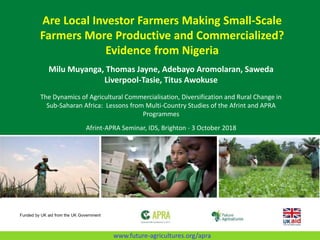
Are Local Investor Farmers Making Small-Scale
Farmers More Productive and Commercialized?
Evidence from Nigeria
Milu Muyanga, Thomas Jayne, Adebayo Aromolaran, Saweda
Liverpool-Tasie, Titus Awokuse
The Dynamics of Agricultural Commercialisation, Diversification and Rural Change in
Sub-Saharan Africa: Lessons from Multi-Country Studies of the Afrint and APRA
Programmes
Afrint-APRA Seminar, IDS, Brighton - 3 October 2018
Funded by UK aid from the UK Government
www.future-agricultures.org/apra
Introduction
• Recent evidence documents changing structure of land
ownership in sub-Saharan Africa
• Data from national survey data and farm listings show rapid
investment by medium-scale investor farmers in the region
• Objectives of WS1/Nigeria are to understand:
1. the characteristics of these investor farmers
2. how they are influencing the behaviour and welfare of the
millions of small-scale farm households around them
3. Whether MS farms are more or less productive than SS farms
4. whether MS investor farms should be promoted as a policy tool
to promote ag commercialisation and transformation
www.future-agricultures.org/apra
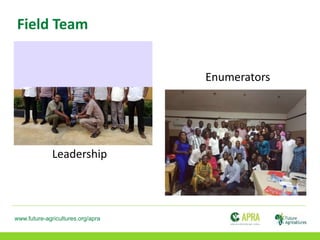
Field Team
Leadership
Enumerators
www.future-agricultures.org/apra
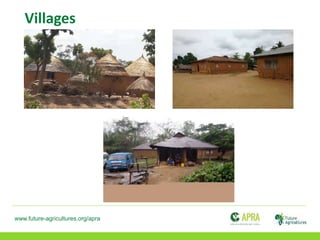
Villages
www.future-agricultures.org/apra
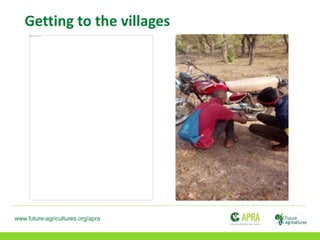
Getting to the villages
www.future-agricultures.org/apra
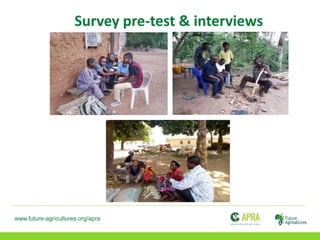
Survey pre-test & interviews
www.future-agricultures.org/apra
Findings
Preliminary
www.future-agricultures.org/apra
Changing farm structure
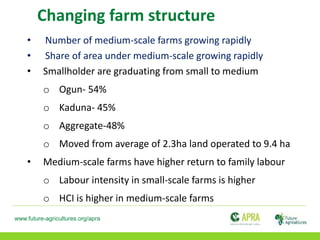
• Number of medium-scale farms growing rapidly
• Share of area under medium-scale growing rapidly
• Smallholder are graduating from small to medium
o Ogun- 54%
o Kaduna- 45%
o Aggregate-48%
o Moved from average of 2.3ha land operated to 9.4 ha
• Medium-scale farms have higher return to family labour
o Labour intensity in small-scale farms is higher
o HCI is higher in medium-scale farms
www.future-agricultures.org/apra
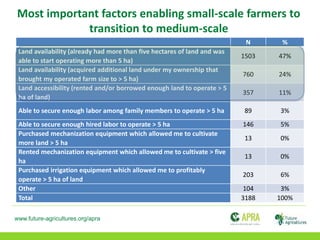
Most important factors enabling small-scale farmers to
transition to medium-scale
N %
Land availability (already had more than five hectares of land and was
able to start operating more than 5 ha)
1503 47%
Land availability (acquired additional land under my ownership that
brought my operated farm size to > 5 ha)
760 24%
Land accessibility (rented and/or borrowed enough land to operate > 5
ha of land)
357 11%
Able to secure enough labor among family members to operate > 5 ha 89 3%
Able to secure enough hired labor to operate > 5 ha 146 5%
Purchased mechanization equipment which allowed me to cultivate
more land > 5 ha
13 0%
Rented mechanization equipment which allowed me to cultivate > five
ha
13 0%
Purchased irrigation equipment which allowed me to profitably
operate > 5 ha of land
203 6%
Other 104 3%
Total 3188 100%
www.future-agricultures.org/apra
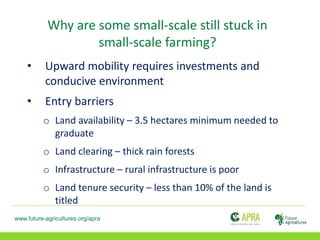
Why are some small-scale still stuck in
small-scale farming?
• Upward mobility requires investments and
conducive environment
• Entry barriers
o Land availability – 3.5 hectares minimum needed to
graduate
o Land clearing – thick rain forests
o Infrastructure – rural infrastructure is poor
o Land tenure security – less than 10% of the land is
titled
www.future-agricultures.org/apra
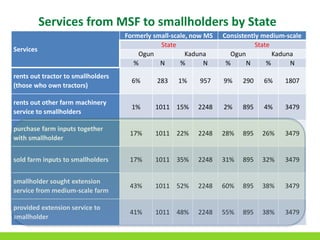
Services from MSF to smallholders by State
Services
Formerly small-scale, now MS Consistently medium-scale
State State
Ogun Kaduna Ogun Kaduna
% N % N % N % N
rents out tractor to smallholders
(those who own tractors)
6% 283 1% 957 9% 290 6% 1807
rents out other farm machinery
service to smallholders
1% 1011 15% 2248 2% 895 4% 3479
purchase farm inputs together
with smallholder
17% 1011 22% 2248 28% 895 26% 3479
sold farm inputs to smallholders 17% 1011 35% 2248 31% 895 32% 3479
smallholder sought extension
service from medium-scale farm
43% 1011 52% 2248 60% 895 38% 3479
provided extension service to
smallholder
41% 1011 48% 2248 55% 895 38% 3479
www.future-agricultures.org/apra
1. What are the causes of the observed changing farm
structure?
2. How does increased acquisition of farmland by local
investor farmers contribute to land scarcity and
accelerate out-migration from densely populated rural
areas? -Negative spillovers ?
o Displacement, inequality, rising land prices?
3. How does increased land acquisition by medium- and
large-scale farms affect off-farm employment through
agricultural growth multipliers? -Positive Spillovers ?
www.future-agricultures.org/apra
4. Is the rise of commercialised medium-scale farms –
with greater surplus production – attracting new
investment in input and output markets that influence
market access for local smallholders? –Positive
spillovers ?
5. How does increased land acquisition by medium- and
large-scale farms expand/contract mechanization by
small-scale farms? – Positive spillovers
6. Are there productivity differences between small and
medium-scale farms?
www.future-agricultures.org/apra
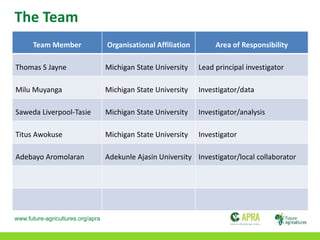
The Team
Team Member Organisational Affiliation Area of Responsibility
Thomas S Jayne Michigan State University Lead principal investigator
Milu Muyanga Michigan State University Investigator/data
Saweda Liverpool-Tasie Michigan State University Investigator/analysis
Titus Awokuse Michigan State University Investigator
Adebayo Aromolaran Adekunle Ajasin University Investigator/local collaborator

APRA Nigeria Work Stream 1 Update

  • 1.
    Are Local InvestorFarmers Making Small-Scale Farmers More Productive and Commercialized? Evidence from Nigeria Milu Muyanga, Thomas Jayne, Adebayo Aromolaran, Saweda Liverpool-Tasie, Titus Awokuse The Dynamics of Agricultural Commercialisation, Diversification and Rural Change in Sub-Saharan Africa: Lessons from Multi-Country Studies of the Afrint and APRA Programmes Afrint-APRA Seminar, IDS, Brighton - 3 October 2018 Funded by UK aid from the UK Government www.future-agricultures.org/apra
  • 2.
    www.future-agricultures.org/apra Introduction • Recent evidencedocuments changing structure of land ownership in sub-Saharan Africa • Data from national survey data and farm listings show rapid investment by medium-scale investor farmers in the region • Objectives of WS1/Nigeria are to understand: 1. the characteristics of these investor farmers 2. how they are influencing the behaviour and welfare of the millions of small-scale farm households around them 3. Whether MS farms are more or less productive than SS farms 4. whether MS investor farms should be promoted as a policy tool to promote ag commercialisation and transformation
  • 3.
  • 4.
  • 5.
  • 6.
  • 7.
  • 8.
  • 9.
    www.future-agricultures.org/apra Changing farm structure •Number of medium-scale farms growing rapidly • Share of area under medium-scale growing rapidly • Smallholder are graduating from small to medium o Ogun- 54% o Kaduna- 45% o Aggregate-48% o Moved from average of 2.3ha land operated to 9.4 ha • Medium-scale farms have higher return to family labour o Labour intensity in small-scale farms is higher o HCI is higher in medium-scale farms
  • 10.
    www.future-agricultures.org/apra Most important factorsenabling small-scale farmers to transition to medium-scale N % Land availability (already had more than five hectares of land and was able to start operating more than 5 ha) 1503 47% Land availability (acquired additional land under my ownership that brought my operated farm size to > 5 ha) 760 24% Land accessibility (rented and/or borrowed enough land to operate > 5 ha of land) 357 11% Able to secure enough labor among family members to operate > 5 ha 89 3% Able to secure enough hired labor to operate > 5 ha 146 5% Purchased mechanization equipment which allowed me to cultivate more land > 5 ha 13 0% Rented mechanization equipment which allowed me to cultivate > five ha 13 0% Purchased irrigation equipment which allowed me to profitably operate > 5 ha of land 203 6% Other 104 3% Total 3188 100%
  • 11.
    www.future-agricultures.org/apra Why are somesmall-scale still stuck in small-scale farming? • Upward mobility requires investments and conducive environment • Entry barriers o Land availability – 3.5 hectares minimum needed to graduate o Land clearing – thick rain forests o Infrastructure – rural infrastructure is poor o Land tenure security – less than 10% of the land is titled
  • 12.
    www.future-agricultures.org/apra Services from MSFto smallholders by State Services Formerly small-scale, now MS Consistently medium-scale State State Ogun Kaduna Ogun Kaduna % N % N % N % N rents out tractor to smallholders (those who own tractors) 6% 283 1% 957 9% 290 6% 1807 rents out other farm machinery service to smallholders 1% 1011 15% 2248 2% 895 4% 3479 purchase farm inputs together with smallholder 17% 1011 22% 2248 28% 895 26% 3479 sold farm inputs to smallholders 17% 1011 35% 2248 31% 895 32% 3479 smallholder sought extension service from medium-scale farm 43% 1011 52% 2248 60% 895 38% 3479 provided extension service to smallholder 41% 1011 48% 2248 55% 895 38% 3479
  • 13.
    www.future-agricultures.org/apra 1. What arethe causes of the observed changing farm structure? 2. How does increased acquisition of farmland by local investor farmers contribute to land scarcity and accelerate out-migration from densely populated rural areas? -Negative spillovers ? o Displacement, inequality, rising land prices? 3. How does increased land acquisition by medium- and large-scale farms affect off-farm employment through agricultural growth multipliers? -Positive Spillovers ?
  • 14.
    www.future-agricultures.org/apra 4. Is therise of commercialised medium-scale farms – with greater surplus production – attracting new investment in input and output markets that influence market access for local smallholders? –Positive spillovers ? 5. How does increased land acquisition by medium- and large-scale farms expand/contract mechanization by small-scale farms? – Positive spillovers 6. Are there productivity differences between small and medium-scale farms?
  • 15.
    www.future-agricultures.org/apra The Team Team MemberOrganisational Affiliation Area of Responsibility Thomas S Jayne Michigan State University Lead principal investigator Milu Muyanga Michigan State University Investigator/data Saweda Liverpool-Tasie Michigan State University Investigator/analysis Titus Awokuse Michigan State University Investigator Adebayo Aromolaran Adekunle Ajasin University Investigator/local collaborator

Editor's Notes

  • #2 Please prepare a fairly detailed presentation of your study design, methodology, descriptive statistics, emerging findings and next steps.
  • #3 Two quantitative panel surveys will be undertaken in each APRA Work Stream 1 country. These will be complemented by qualitative and historical studies. The first panel has been carried out during the first year of the programme and will serve as a benchmark survey for comparing impacts of commercialisation on the key APRA outcome indicators. It is expected that there will be changes in commercialisation and outcome indicators between the first round and second round surveys to establish the impact of different commercialisation options. Use this slide to: Introduce your study briefly Summarise the main objective of the study
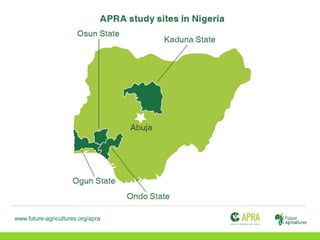
  • #4 Include a map of your field sites Please add one or two photos from your first round fieldwork and/or team training and planning. These could be added to other slides, if space allows.
  • #5 Include a map of your field sites Please add one or two photos from your first round fieldwork and/or team training and planning. These could be added to other slides, if space allows.
  • #6 Include a map of your field sites Please add one or two photos from your first round fieldwork and/or team training and planning. These could be added to other slides, if space allows.
  • #7 Include a map of your field sites Please add one or two photos from your first round fieldwork and/or team training and planning. These could be added to other slides, if space allows.
  • #8 Include a map of your field sites Please add one or two photos from your first round fieldwork and/or team training and planning. These could be added to other slides, if space allows.
  • #9 Presentation of basic descriptive statistics: Examples include sample numbers by control/ treatment groups, mean household characteristics by control and treatment groups etc.
  • #10 Use this slide to: Outline key hypothesis briefly Summarise the main hypothesis of the study Please explain the specific hypotheses you plan to test in your WS1 study. Generally speaking, using the APRA panel data the following hypotheses will be tested across the country studies to assess the links between commercialisation and household outcome indicators: -Higher the degree of commercialisation of rural households will lead to agricultural productivity and increased incomes resulting in poverty reduction and increase in food security. -Smallholder farmers with contractual arrangements (such as out-grower models) with large farms or commercial entities will witness better outcomes than independent smallholder farmers in terms of poverty reduction and increase in food security. -Large scale agricultural investments or agro-investments that engage small and medium scale farmers in contractual arrangements are more effective in generating employment and quality jobs. -The impacts of commercialisation will be highly differentiated in terms of gender, class and other social dimensions. -Higher level of commercialisation of rural households will lead to increase in labour and changes time use for men and women, consequently leading to the empowerment of women and girls. -Smallholder farming households with land and access to financial resources will benefit disproportionately from market opportunities arising from commercialisation while poorer households are likely to benefit through the employment channel.
  • #11 Presentation of basic descriptive statistics: Examples include sample numbers by control/ treatment groups, mean household characteristics by control and treatment groups etc.
  • #12 Use this slide to: Outline key hypothesis briefly Summarise the main hypothesis of the study Please explain the specific hypotheses you plan to test in your WS1 study. Generally speaking, using the APRA panel data the following hypotheses will be tested across the country studies to assess the links between commercialisation and household outcome indicators: -Higher the degree of commercialisation of rural households will lead to agricultural productivity and increased incomes resulting in poverty reduction and increase in food security. -Smallholder farmers with contractual arrangements (such as out-grower models) with large farms or commercial entities will witness better outcomes than independent smallholder farmers in terms of poverty reduction and increase in food security. -Large scale agricultural investments or agro-investments that engage small and medium scale farmers in contractual arrangements are more effective in generating employment and quality jobs. -The impacts of commercialisation will be highly differentiated in terms of gender, class and other social dimensions. -Higher level of commercialisation of rural households will lead to increase in labour and changes time use for men and women, consequently leading to the empowerment of women and girls. -Smallholder farming households with land and access to financial resources will benefit disproportionately from market opportunities arising from commercialisation while poorer households are likely to benefit through the employment channel.
  • #13 Presentation of basic descriptive statistics: Examples include sample numbers by control/ treatment groups, mean household characteristics by control and treatment groups etc.
  • #14 Summarise your next steps in terms of data analysis, planned events and outputs etc. Indicate if there are opportunities for other APRA partners to get involved in these activities and/or if you will require support from the APRA Regional Hub, Directorate or ICE Team.
  • #15 Summarise your next steps in terms of data analysis, planned events and outputs etc. Indicate if there are opportunities for other APRA partners to get involved in these activities and/or if you will require support from the APRA Regional Hub, Directorate or ICE Team.
  • #16 List key team members Explain who is doing what – the roles and responsibilities