Changes in ICP following response checking and suctioning in Neurosurgical intensive care unit (NSICU)Anjusha T ,Deepak AgrawalDepartment of NeurosurgeryJPN Apex Trauma Centre, AIIMS, New Delhi
BACKGROUND OF THE STUDYPresence of intracranial hypertension after traumatic brain injury (TBI) affects patient’s outcomePatients with head injury require elective ventilation and sedation to decrease ICP and any increase in ICP (even for brief period) may be detrimental
BACKGROUND Cont….ICP cannot be reliably estimated from any specific clinical features or CT findings and must actually be measured. So ICP data from electronic monitoring equipment are usually calculated and recorded hourly in the clinical chart by trained nursesNormal ICP ranges from 1-15mm Hg
     ICP MONITORING METHODSThere are mainly three ways for measuring ICPBy using intraventricular catheterSubarachnoid screw or boltEpidural sensorCODMAN Parenchymal Monitoring system (Electronic)
     ICP MONITORING DEVICESCodman monitor
RATIONALE FOR STUDYNursing care activities and environmental stimuli have the potential to challenge the cerebrovascular system and capacity to increase the ICP
RATIONALE FOR STUDYpositioning, coughing, straining, valsalva maneuver, response checking and invasive procedures like venipuncture and suctioning may result in sustained increase in ICP.Among these endotracheal suctioning plays a major role in a significant increase in ICP
AIMS & OBJECTIVESTo monitor the variations in ICP during GCS response checkingTo monitor the variations in ICP during suctioningTo assess the time duration to return to the baseline ICP, in both the casesTo compare the variation in ICP during response checking and suctioning
METHODOLOGY Study Design          : Prospective observational StudySampling Technique : Convenience SamplingSetting                   : NSICU,JPNA Trauma CentreInclusion Criteria     : Ventilated severe head injury patients                                  with ICP monitoring in NSICUMonitoring         : Using intraparenchymal Codman catheter
PROCEDUREAt first the baseline ICP was recorded.
It was followed by response checking using supra orbital pain stimuli & peak ICP as well as time to return to the baseline was noted.
In the same way the  ICP was assessed while doing oro-tracheal suctioning.
The variation in ICP in both cases as well as the duration of change was notedOBSERVATIONSThe total no. of patients taken  -  12The total no. of readings – 54Mean  GCS – 6.87
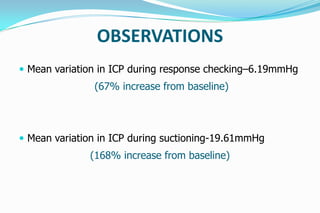
Mean variation in ICP during response checking–6.19mmHg(67% increase from baseline)Mean variation in ICP during suctioning-19.61mmHg(168% increase from baseline)OBSERVATIONS
Mean duration of raised ICP with response checking9.76 secondsMean duration of raised ICP with suctioning26.56 secondsOBSERVATIONS
Patient 1Graph showing change in ICP with time during response checking
Patient 1Graph showing change in ICP with time during suctioning
                     STATISTICAL ANALYSISA paired T test was doneChange in ICP during response checking was highly significant   [p<0.001]Change in ICP during suctioning was also very highly significant [p<0.001]
CONCLUSIONSThere is a wide fluctuation of ICP following response checking and suctioning.Significant rise in ICP occurs with GCS response checking as well as suctioning

Changes in icp following response checking in icu

  • 1.
    Changes in ICPfollowing response checking and suctioning in Neurosurgical intensive care unit (NSICU)Anjusha T ,Deepak AgrawalDepartment of NeurosurgeryJPN Apex Trauma Centre, AIIMS, New Delhi
  • 2.
    BACKGROUND OF THESTUDYPresence of intracranial hypertension after traumatic brain injury (TBI) affects patient’s outcomePatients with head injury require elective ventilation and sedation to decrease ICP and any increase in ICP (even for brief period) may be detrimental
  • 3.
    BACKGROUND Cont….ICP cannotbe reliably estimated from any specific clinical features or CT findings and must actually be measured. So ICP data from electronic monitoring equipment are usually calculated and recorded hourly in the clinical chart by trained nursesNormal ICP ranges from 1-15mm Hg
  • 4.
    ICP MONITORING METHODSThere are mainly three ways for measuring ICPBy using intraventricular catheterSubarachnoid screw or boltEpidural sensorCODMAN Parenchymal Monitoring system (Electronic)
  • 5.
    ICP MONITORING DEVICESCodman monitor
  • 6.
    RATIONALE FOR STUDYNursingcare activities and environmental stimuli have the potential to challenge the cerebrovascular system and capacity to increase the ICP
  • 7.
    RATIONALE FOR STUDYpositioning,coughing, straining, valsalva maneuver, response checking and invasive procedures like venipuncture and suctioning may result in sustained increase in ICP.Among these endotracheal suctioning plays a major role in a significant increase in ICP
  • 8.
    AIMS & OBJECTIVESTomonitor the variations in ICP during GCS response checkingTo monitor the variations in ICP during suctioningTo assess the time duration to return to the baseline ICP, in both the casesTo compare the variation in ICP during response checking and suctioning
  • 9.
    METHODOLOGY Study Design : Prospective observational StudySampling Technique : Convenience SamplingSetting : NSICU,JPNA Trauma CentreInclusion Criteria : Ventilated severe head injury patients with ICP monitoring in NSICUMonitoring : Using intraparenchymal Codman catheter
  • 10.
    PROCEDUREAt first thebaseline ICP was recorded.
  • 11.
    It was followedby response checking using supra orbital pain stimuli & peak ICP as well as time to return to the baseline was noted.
  • 12.
    In the sameway the ICP was assessed while doing oro-tracheal suctioning.
  • 13.
    The variation inICP in both cases as well as the duration of change was notedOBSERVATIONSThe total no. of patients taken - 12The total no. of readings – 54Mean GCS – 6.87
  • 14.
    Mean variation inICP during response checking–6.19mmHg(67% increase from baseline)Mean variation in ICP during suctioning-19.61mmHg(168% increase from baseline)OBSERVATIONS
  • 15.
    Mean duration ofraised ICP with response checking9.76 secondsMean duration of raised ICP with suctioning26.56 secondsOBSERVATIONS
  • 16.
    Patient 1Graph showingchange in ICP with time during response checking
  • 17.
    Patient 1Graph showingchange in ICP with time during suctioning
  • 18.
    STATISTICAL ANALYSISA paired T test was doneChange in ICP during response checking was highly significant [p<0.001]Change in ICP during suctioning was also very highly significant [p<0.001]
  • 19.
    CONCLUSIONSThere is awide fluctuation of ICP following response checking and suctioning.Significant rise in ICP occurs with GCS response checking as well as suctioning