MONITORING OF RAISED INTRA
CRANIAL PRESSURE AND
MANAGEMENT OF RAISED INTRA
CRANIAL PRESSURE
Presented By : Pankaj Singh
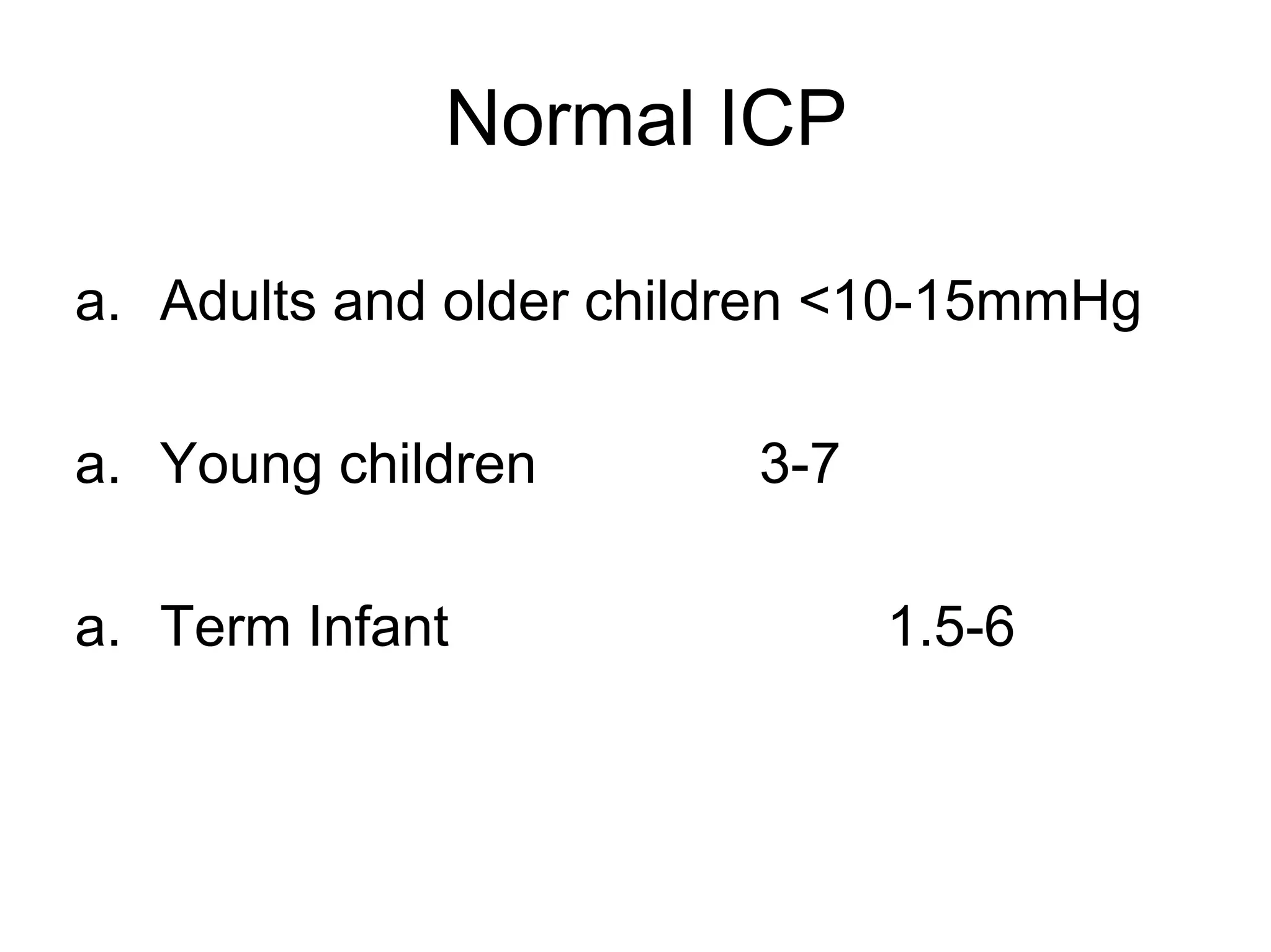
Normal ICP
a. Adults and older children <10-15mmHg
a. Young children 3-7
a. Term Infant 1.5-6
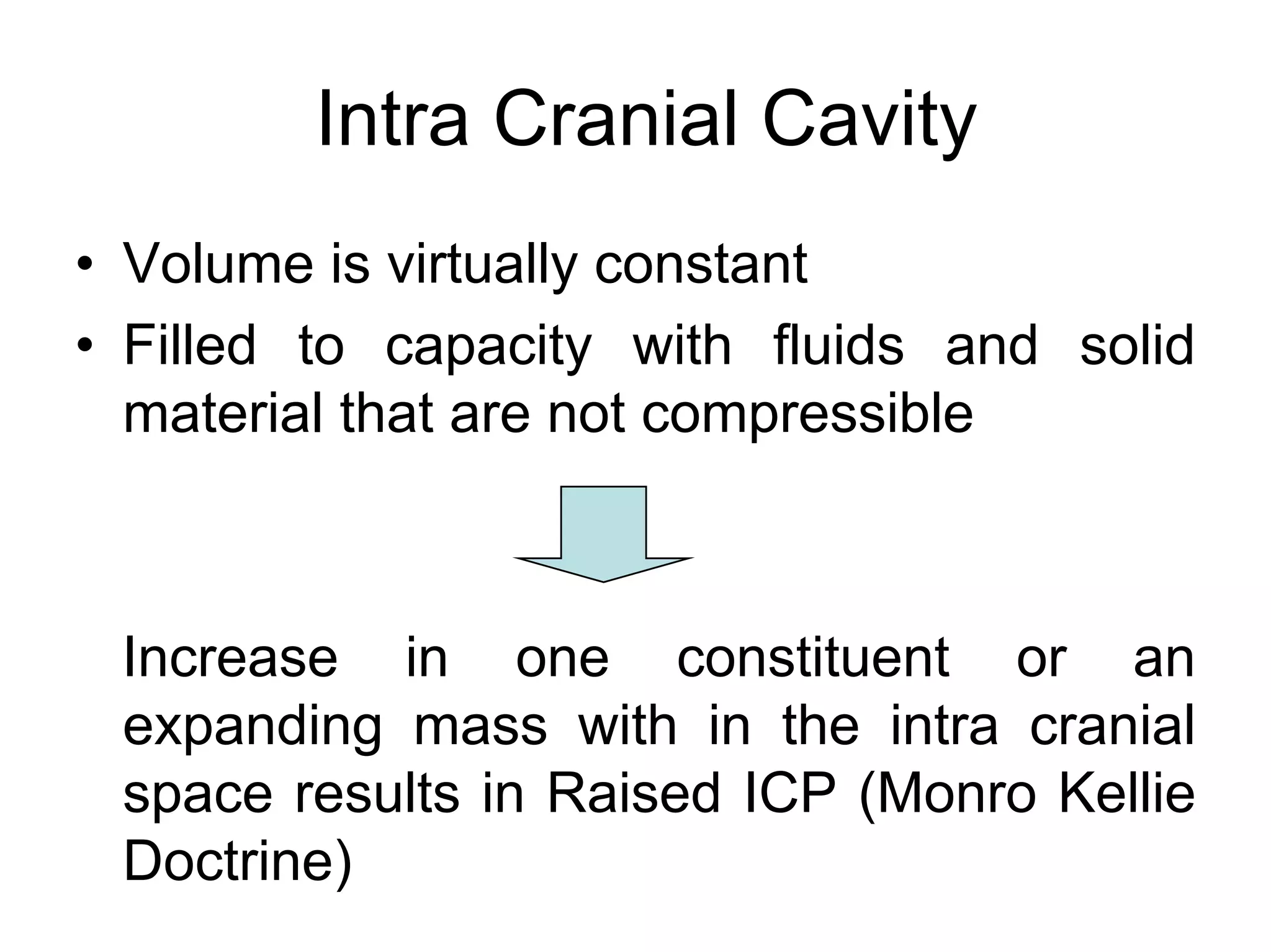
Intra Cranial Cavity
• Volume is virtually constant
• Filled to capacity with fluids and solid
material that are not compressible
Increase in one constituent or an
expanding mass with in the intra cranial
space results in Raised ICP (Monro Kellie
Doctrine)
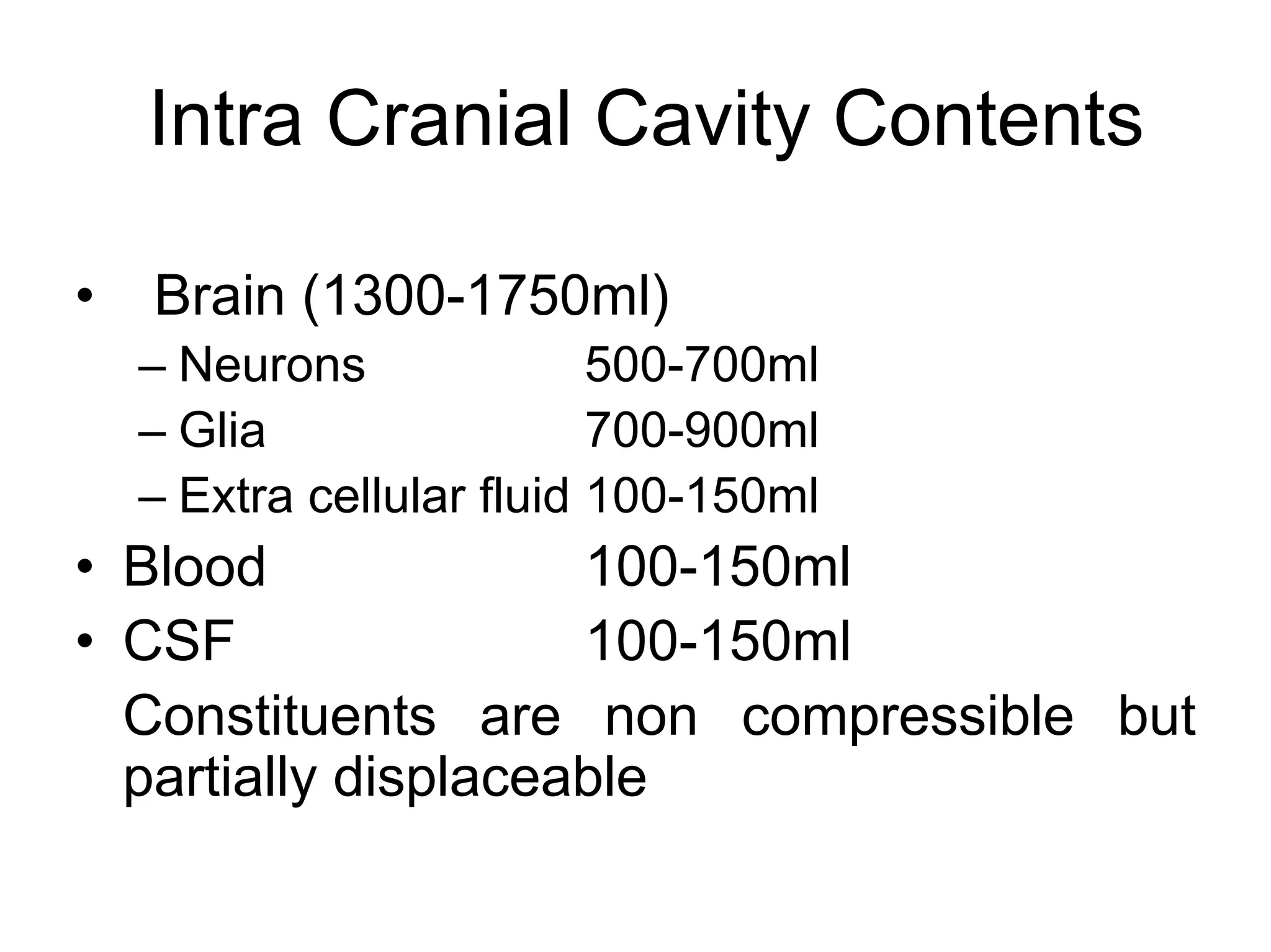
Intra Cranial Cavity Contents
• Brain (1300-1750ml)
– Neurons 500-700ml
– Glia 700-900ml
– Extra cellular fluid 100-150ml
• Blood 100-150ml
• CSF 100-150ml
Constituents are non compressible but
partially displaceable
ICP Wave
Clinical Symptoms and Signs of
Raised ICP
• Headache
• Nausea and vomiting
• Impairment of consciousness
• Papilloedema
• 6th C N Palsy – False localizing sign
• Herniation signs (late)
Causes of Increased ICP
• Increased volume of normal intra
cranial constituents
– Brain – Cerebral oedema
– CSF – Hydrocephalous
– Blood volume – Vasodilatation secondary
to increased Co2
• Space occupying lesion – Tumour,
Hematoma, Abscess,
• Idiopathic – Pseudotumour Cerebri
Cerebral Perfusion Pressure
and Auto Regulation
CPP = MAP-ICP
Cerebral auto regulation is a
mechanism were by over a wide large
changes in systemic BP produces only
small changes in CBF
ICP
• Cerebral oedema
• Hyperemia
• Intra cranial Mass
• HCP
• Hypoventilation
• Systemic Hypertension
• Venous sinus thrombosis
• Increased Muscle tone and valsalva maneuver
• Sustained Post traumatic seizure
Secondary Increase in ICP (3-
10 Days Following trauma)
• Delayed hematoma formation
• Cerebral vasospasm
• ARDS with Hypoventilation
• Delayed Oedema formation
• Hyponatremia
Cushing Triad
• Hypertension
• Bradycardia
• Respiratory Irregularity
ICP Monitoring
• Indication
– Severe Head injury (GCS< 8 after CPR) and
either
• Abnormal admitting CT
Or
• Normal CT with > 2 of risk factors (Age >40yr, SBP
<90mm Hg, Decerebrate or decorticate posturing
– Multiple System Injured with altered level of
consciousness
– Traumatic Intra cranial mass
• A physician may choose to monitor ICP in some the
patients
• Post op subsequent to removal
Contra indications
• Awake Patient
• Coagulopathy
Duration of monitoring
• Till ICP is normal for 48-72 Hours
after withdrawal of therapy
Types of Monitor
• Intra ventricular catheter (Standard) –
– Advantages –
• Low cost
• Therapeutic CSF Drainage
• May be recalibrated to minimize measurement drift
– Disadvantages –
• Difficult to insert
• Obstruction of fluid column
• Some effort is required to check any monitoring function
• Transducer must be consistently maintain at a fixed
reference point
– Intra parenchymal monitor – Similar to IVC
usually not subjected to measurement drift
– Less Accurate-
• Subarachnoid screw- At high ICP brain may
block Lumen
• Subdural
• Epidural
• Infants-
– Aplanation Principle
– Fontometry
Intra Ventricular Catheter
• Right side frontal horn
• EAC is external land mark for Zeroing
Type of Wave Form
• Normal wave form
– Small pulsation transmitted from the systolic BP to
intra cranial cavity
• Large 1-2mm Hg Peak corresponding to altered systolic
Pressure wave with small dicrotic notch.
• The Peak is followed by smaller and less distinct peak
• Followed by peaks corresponding to central venous A
wave from right atrium.
– Blood pressure pulsation are superimposed on
slower respiratory variation
During expiration – SVC Pressure Increases so ICP
increase
Pathological Wave Form
As ICP rises cerebral compliance decreased
the venous component disappears and
arterial pulsation become more pronounced
a. Lundberg A- (Plateau wave)
b. Lundberg B- amplitude 10-20mmHg, last
30 second to 2 minutes. Respiratory
variation present.
c. Lundberg C- frequency 4-8 per Minutes.
Also called as Traube Hering Waves
Normal Function of IVC System
• Wave form
• Pulsation
• Output
• Lowering of Head of Bed increases ICP.
Bilateral JV pressure increases ICP
IVC Problems
• Block
• Improper connection
• Change of position of head of bed
• Drip chamber fall
IVC Trouble Shooting
• IVC no longer works
• ICP wave form dampened
Adjuncts to ICP Monitoring
• Evoked potential
• SJO2
• TCD
• PET & SPECT
ICP Treatment Measures
• Guidelines
– ICP treatment should be initiated for ICP >20-
25mm Hg
• Options
– Interpretation and treatment of ICP based on
any threshold should be corroborated by
frequent clinical examination and CPP data
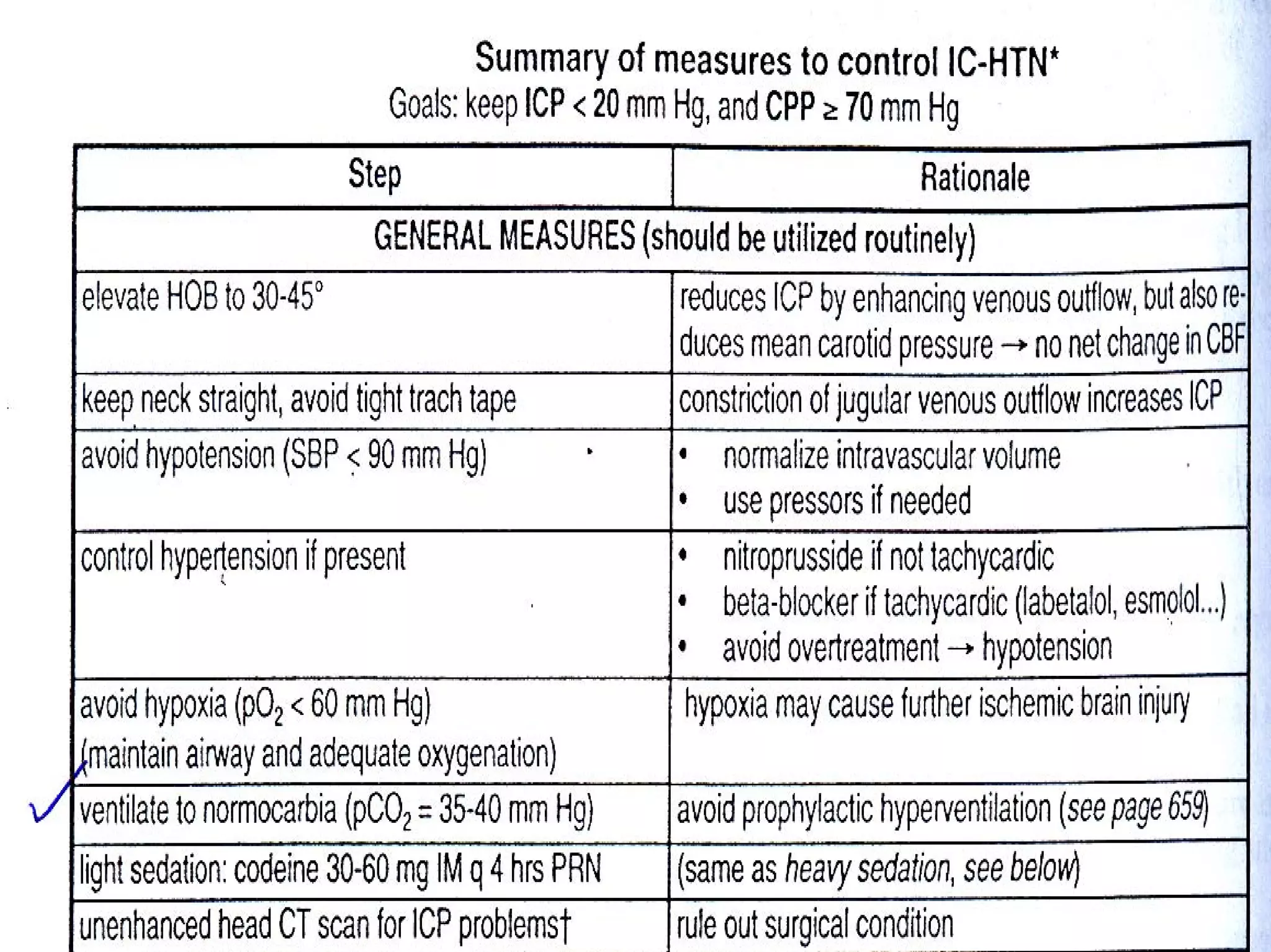
– CPP should be maintain ≥70mm Hg
ICP Management Protocol
• Goals of therapy
– Keep ICP <20mmHg (Prevents plateau waves
from compromising CBF and causing cerebral
ischemia and or brain death
– CPP >70mmHg (avoid hypotension)
• Surgical treatment
– Any subdural or epidural hematoma larger
than 1cm maximal thickness should be
removed
– Patient with contused brain with
progressive deterioration should be
removed.
– De-compressive craniectomy should be
considered for ICP not controlled
medically.
• General care
– Avoid Hypoxia PaO2<60mmHg
– Avoid Hypo tension SBP ≤90mmHg
Specific Treatment
• Prophylaxis against stress ulcer
• Control fever
• Arterial line
• CVP line
• IV fluid –
– NS +20Meqkcl/let.
– Avoid hypotonic solution
– Normalize intra vascular volume
– Concept of running patient dry is obsolete
– If injury to other system present they may dictate
Fluid management
– Pressors or preferable to IV fluid bolus in head
injury
Measures to Lower ICP
• General Measure
• Specific measures
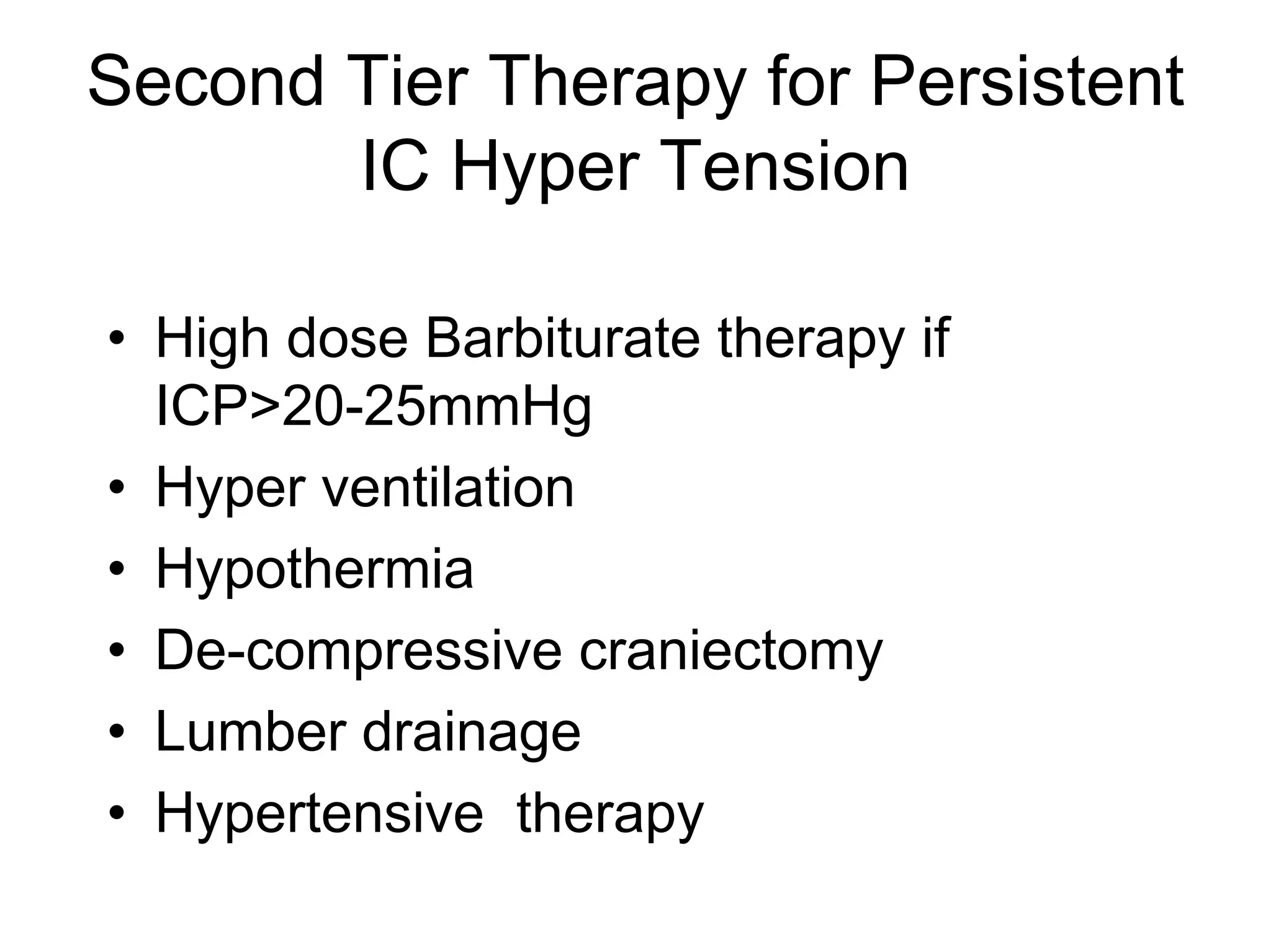
Second Tier Therapy for Persistent
IC Hyper Tension
• High dose Barbiturate therapy if
ICP>20-25mmHg
• Hyper ventilation
• Hypothermia
• De-compressive craniectomy
• Lumber drainage
• Hypertensive therapy
Adjunctive Measures
• Lidocaine – 1.5 mg/kg IVP
• High frequency (Jet) ventilation
High Dose Barbiturate Therapy
• Guidelines
– May be considered in hemodynamically stable
salvageable severe TBI patient with Intra cranial Hyper
tension refractory to maximal Medical and surgical ICP
lowering therapy
– Theoretical benefits of barbiturates in head injury is
derived from
1. vasoconstriction in normal areas (shunting blood to
ischemic brain tissue)
2. Decreased metabolic demand for oxygen (CMRO2)
with accompanying reduction of CBF.
3. Free radical scavenging
4. Reduced intra cellular calcium
5. Lysosomal stabilization
• Pentobarbitol is choice
Load 10mg/kg/hr for 4 hrs.
1hr. 2.5mg/kg every 15 min.
four doses
Next 3hrs. 10mg/kg /hr infusion
Maintain 1.5mg/kg/hr infusion
BSAER early. Repeat if Pentobarbitol
level >6mg%
Goal ICP <24mmHg level 3-5mg%
If ICP <20 mmHg continue treatment for
48hrs. And then Taper dose
THANK YOU

Raised ICP_.pdf

  • 1.
    MONITORING OF RAISEDINTRA CRANIAL PRESSURE AND MANAGEMENT OF RAISED INTRA CRANIAL PRESSURE Presented By : Pankaj Singh
  • 2.
    Normal ICP a. Adultsand older children <10-15mmHg a. Young children 3-7 a. Term Infant 1.5-6
  • 3.
    Intra Cranial Cavity •Volume is virtually constant • Filled to capacity with fluids and solid material that are not compressible Increase in one constituent or an expanding mass with in the intra cranial space results in Raised ICP (Monro Kellie Doctrine)
  • 4.
    Intra Cranial CavityContents • Brain (1300-1750ml) – Neurons 500-700ml – Glia 700-900ml – Extra cellular fluid 100-150ml • Blood 100-150ml • CSF 100-150ml Constituents are non compressible but partially displaceable
  • 6.
  • 8.
    Clinical Symptoms andSigns of Raised ICP • Headache • Nausea and vomiting • Impairment of consciousness • Papilloedema • 6th C N Palsy – False localizing sign • Herniation signs (late)
  • 9.
    Causes of IncreasedICP • Increased volume of normal intra cranial constituents – Brain – Cerebral oedema – CSF – Hydrocephalous – Blood volume – Vasodilatation secondary to increased Co2 • Space occupying lesion – Tumour, Hematoma, Abscess, • Idiopathic – Pseudotumour Cerebri
  • 10.
    Cerebral Perfusion Pressure andAuto Regulation CPP = MAP-ICP Cerebral auto regulation is a mechanism were by over a wide large changes in systemic BP produces only small changes in CBF
  • 11.
    ICP • Cerebral oedema •Hyperemia • Intra cranial Mass • HCP • Hypoventilation • Systemic Hypertension • Venous sinus thrombosis • Increased Muscle tone and valsalva maneuver • Sustained Post traumatic seizure
  • 12.
    Secondary Increase inICP (3- 10 Days Following trauma) • Delayed hematoma formation • Cerebral vasospasm • ARDS with Hypoventilation • Delayed Oedema formation • Hyponatremia
  • 13.
    Cushing Triad • Hypertension •Bradycardia • Respiratory Irregularity
  • 14.
    ICP Monitoring • Indication –Severe Head injury (GCS< 8 after CPR) and either • Abnormal admitting CT Or • Normal CT with > 2 of risk factors (Age >40yr, SBP <90mm Hg, Decerebrate or decorticate posturing – Multiple System Injured with altered level of consciousness – Traumatic Intra cranial mass • A physician may choose to monitor ICP in some the patients • Post op subsequent to removal
  • 15.
    Contra indications • AwakePatient • Coagulopathy
  • 16.
    Duration of monitoring •Till ICP is normal for 48-72 Hours after withdrawal of therapy
  • 17.
    Types of Monitor •Intra ventricular catheter (Standard) – – Advantages – • Low cost • Therapeutic CSF Drainage • May be recalibrated to minimize measurement drift – Disadvantages – • Difficult to insert • Obstruction of fluid column • Some effort is required to check any monitoring function • Transducer must be consistently maintain at a fixed reference point
  • 18.
    – Intra parenchymalmonitor – Similar to IVC usually not subjected to measurement drift – Less Accurate- • Subarachnoid screw- At high ICP brain may block Lumen • Subdural • Epidural • Infants- – Aplanation Principle – Fontometry
  • 19.
    Intra Ventricular Catheter •Right side frontal horn • EAC is external land mark for Zeroing
  • 21.
    Type of WaveForm • Normal wave form – Small pulsation transmitted from the systolic BP to intra cranial cavity • Large 1-2mm Hg Peak corresponding to altered systolic Pressure wave with small dicrotic notch. • The Peak is followed by smaller and less distinct peak • Followed by peaks corresponding to central venous A wave from right atrium. – Blood pressure pulsation are superimposed on slower respiratory variation During expiration – SVC Pressure Increases so ICP increase
  • 22.
    Pathological Wave Form AsICP rises cerebral compliance decreased the venous component disappears and arterial pulsation become more pronounced a. Lundberg A- (Plateau wave) b. Lundberg B- amplitude 10-20mmHg, last 30 second to 2 minutes. Respiratory variation present. c. Lundberg C- frequency 4-8 per Minutes. Also called as Traube Hering Waves
  • 24.
    Normal Function ofIVC System • Wave form • Pulsation • Output • Lowering of Head of Bed increases ICP. Bilateral JV pressure increases ICP
  • 25.
    IVC Problems • Block •Improper connection • Change of position of head of bed • Drip chamber fall
  • 26.
    IVC Trouble Shooting •IVC no longer works • ICP wave form dampened
  • 27.
    Adjuncts to ICPMonitoring • Evoked potential • SJO2 • TCD • PET & SPECT
  • 28.
    ICP Treatment Measures •Guidelines – ICP treatment should be initiated for ICP >20- 25mm Hg • Options – Interpretation and treatment of ICP based on any threshold should be corroborated by frequent clinical examination and CPP data – CPP should be maintain ≥70mm Hg
  • 29.
    ICP Management Protocol •Goals of therapy – Keep ICP <20mmHg (Prevents plateau waves from compromising CBF and causing cerebral ischemia and or brain death – CPP >70mmHg (avoid hypotension)
  • 31.
    • Surgical treatment –Any subdural or epidural hematoma larger than 1cm maximal thickness should be removed – Patient with contused brain with progressive deterioration should be removed. – De-compressive craniectomy should be considered for ICP not controlled medically. • General care – Avoid Hypoxia PaO2<60mmHg – Avoid Hypo tension SBP ≤90mmHg
  • 32.
    Specific Treatment • Prophylaxisagainst stress ulcer • Control fever • Arterial line • CVP line • IV fluid – – NS +20Meqkcl/let. – Avoid hypotonic solution – Normalize intra vascular volume – Concept of running patient dry is obsolete – If injury to other system present they may dictate Fluid management – Pressors or preferable to IV fluid bolus in head injury
  • 33.
    Measures to LowerICP • General Measure • Specific measures
  • 34.
    Second Tier Therapyfor Persistent IC Hyper Tension • High dose Barbiturate therapy if ICP>20-25mmHg • Hyper ventilation • Hypothermia • De-compressive craniectomy • Lumber drainage • Hypertensive therapy
  • 35.
    Adjunctive Measures • Lidocaine– 1.5 mg/kg IVP • High frequency (Jet) ventilation
  • 36.
    High Dose BarbiturateTherapy • Guidelines – May be considered in hemodynamically stable salvageable severe TBI patient with Intra cranial Hyper tension refractory to maximal Medical and surgical ICP lowering therapy – Theoretical benefits of barbiturates in head injury is derived from 1. vasoconstriction in normal areas (shunting blood to ischemic brain tissue) 2. Decreased metabolic demand for oxygen (CMRO2) with accompanying reduction of CBF. 3. Free radical scavenging 4. Reduced intra cellular calcium 5. Lysosomal stabilization
  • 37.
    • Pentobarbitol ischoice Load 10mg/kg/hr for 4 hrs. 1hr. 2.5mg/kg every 15 min. four doses Next 3hrs. 10mg/kg /hr infusion Maintain 1.5mg/kg/hr infusion BSAER early. Repeat if Pentobarbitol level >6mg% Goal ICP <24mmHg level 3-5mg% If ICP <20 mmHg continue treatment for 48hrs. And then Taper dose
  • 38.