CHANGE MANAGEMENT
MANAGEMENT PRESENTATION
OUR GROUP

TALHA MAHMOOD
MAHWISH KASHIF
MUHAMMAD YUSUF
Contents:
 What Is Change Management?
 Why Organizations Change?
 Objective Of Change.
 Some normal reactions to change.
 Success Rate
 Internal and External Aspects.
 Change Impact

 Models Of Change (Kurt Lewin , Mckinsey , Kotter)
 Kurt Lewin’s Change Model.
 Why people resist change?
 Why Change Management Fails?
 Quotes.
 Conclusion
What is Change Management?
Change management is an approach to shifting/ transitioning individuals, teams, and - in
general – organizations from a current state to a desired future state.
Why Organizations Change?

Simple Answer
World is faster than organizations

Globalization

Technology

Information
Objectives
• Maximize the collective benefits for all people
involved in the change.
• Minimize the risk of failure of implementing the
change .
• The discipline of Change Management deals with
Human Aspect of Change (Psychological)
Normal Reactions To Change
“ This is a waste of time”
“Why Change if it was working just fine
before”
“If it isn’t broke , don’t fix it!”
“Our current system isn’t great , but what’s
so wonderful about the new one ? How will
that will be any better?”

“How soon will this happen?”
“How will this impact me?”
“Will I receive new training?”

“What’s in it for me?”
“I doubt they are really serious about this”
Changes aren’t difficult ,
transitions are..
Change:
• Change is situational New

Polices , New Boss , Team Roles)
•External

Transitions:
•Psychological Process people
got through to come to terms
with new situation.
•Internal
9%
Very
Successful

27%
Not very
Successful

27%
Too soon
to tell

4%
Moderate
Successful

33%
Unsure

Rate of
success in
making change
Acceptance
•Commitment
•Focused
•High Productivity

Exploration
•Chaos
•Lack of Direction
•Test new Possibilities

Denial
•Avoidance
•Not here,Not me
•Living in Past

Resistance
• Isolation
•Make it Worse
•Low productivity

External Aspects of Change

Negative Side of Change

Positive Side of Change

Internal Aspects of Change
Change Impact
Organizational
Impact
First Individual
Impact

Changes starts with an individual and causes a rippling effect
in an organization.
Models Of Change Management
1) Kurt Lewin’s Change Model.
2) Mckinsey 7-S Model.
3) Kotter’s 8 step Change Model.
The Three models of change
•
•
•
•
•
•
•
•

Increase the urgency for change.
Build a team dedicated to change
Create the vision for change.
Communicate the need for
change.
Empower staff with the ability to
change.
Create short term goals.
Stay persistent.
Make the change permanent.

Kotter

•
•
•
•
•
•

Structure
System
Style
Staff
Skills
Strategy

Mckinsey

• Unfreeze
• Change
• Refreeze

Kurt
Lewin
Understanding
Change
If you have large cubes of
ice but realize that what
you want is a sculpture
of ice, what will you do?
Kurt Lewin’s change model
Stage 1: Unfreeze
Prepare the organization to
accept that change is
necessary

Involves breaking down the
existing quo before building
up a new way of operating
(creates uncertainty)
STAGE 2 : CHANGE
Resolving Uncertainty
Looking for new ways to do things
People start to believe and act in
ways that support the new
direction

(Time and Communication are the
two keys.)
STAGE 3 : REFREEZE
When the changes are taking shape and people have
embraced the new ways of thinking , the organization is
ready to REFREEZE.

With a new sense of stability , employees feel confident
and comfortable with the new ways of working.
(Celebrate Success)
Why people resist change?
• Feel they will suffer.
• Organization does not communicate clearly.
• Perceive more work with few opportunities.
• Change has poor introduction.
• Loss of job security
• The concept that “Change means more work”.
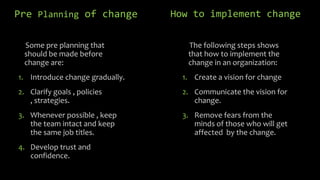
Pre Planning of change
Some pre planning that
should be made before
change are:

How to implement change
The following steps shows
that how to implement the
change in an organization:

1. Introduce change gradually.

1. Create a vision for change

2. Clarify goals , policies
, strategies.

2. Communicate the vision for
change.

3. Whenever possible , keep
the team intact and keep
the same job titles.

3. Remove fears from the
minds of those who will get
affected by the change.

4. Develop trust and
confidence.
Conclusion

• In conclusion it can be said that “change” is
highly needed to break the routine
continuing for a long period of time.
• Pakistani business houses must give special
importance to this issue.
• It makes the organization better equipped to
face the future challenges.
Change management
Change management

Change management

  • 1.
  • 2.
    OUR GROUP TALHA MAHMOOD MAHWISHKASHIF MUHAMMAD YUSUF
  • 4.
    Contents:  What IsChange Management?  Why Organizations Change?  Objective Of Change.  Some normal reactions to change.  Success Rate  Internal and External Aspects.  Change Impact  Models Of Change (Kurt Lewin , Mckinsey , Kotter)  Kurt Lewin’s Change Model.  Why people resist change?  Why Change Management Fails?  Quotes.  Conclusion
  • 5.
    What is ChangeManagement? Change management is an approach to shifting/ transitioning individuals, teams, and - in general – organizations from a current state to a desired future state.
  • 6.
    Why Organizations Change? SimpleAnswer World is faster than organizations Globalization Technology Information
  • 7.
    Objectives • Maximize thecollective benefits for all people involved in the change. • Minimize the risk of failure of implementing the change . • The discipline of Change Management deals with Human Aspect of Change (Psychological)
  • 8.
    Normal Reactions ToChange “ This is a waste of time” “Why Change if it was working just fine before” “If it isn’t broke , don’t fix it!” “Our current system isn’t great , but what’s so wonderful about the new one ? How will that will be any better?” “How soon will this happen?” “How will this impact me?” “Will I receive new training?” “What’s in it for me?” “I doubt they are really serious about this”
  • 9.
    Changes aren’t difficult, transitions are.. Change: • Change is situational New Polices , New Boss , Team Roles) •External Transitions: •Psychological Process people got through to come to terms with new situation. •Internal
  • 10.
    9% Very Successful 27% Not very Successful 27% Too soon totell 4% Moderate Successful 33% Unsure Rate of success in making change
  • 11.
    Acceptance •Commitment •Focused •High Productivity Exploration •Chaos •Lack ofDirection •Test new Possibilities Denial •Avoidance •Not here,Not me •Living in Past Resistance • Isolation •Make it Worse •Low productivity External Aspects of Change Negative Side of Change Positive Side of Change Internal Aspects of Change
  • 12.
    Change Impact Organizational Impact First Individual Impact Changesstarts with an individual and causes a rippling effect in an organization.
  • 13.
    Models Of ChangeManagement 1) Kurt Lewin’s Change Model. 2) Mckinsey 7-S Model. 3) Kotter’s 8 step Change Model.
  • 14.
    The Three modelsof change • • • • • • • • Increase the urgency for change. Build a team dedicated to change Create the vision for change. Communicate the need for change. Empower staff with the ability to change. Create short term goals. Stay persistent. Make the change permanent. Kotter • • • • • • Structure System Style Staff Skills Strategy Mckinsey • Unfreeze • Change • Refreeze Kurt Lewin
  • 15.
    Understanding Change If you havelarge cubes of ice but realize that what you want is a sculpture of ice, what will you do? Kurt Lewin’s change model
  • 16.
    Stage 1: Unfreeze Preparethe organization to accept that change is necessary Involves breaking down the existing quo before building up a new way of operating (creates uncertainty)
  • 17.
    STAGE 2 :CHANGE Resolving Uncertainty Looking for new ways to do things People start to believe and act in ways that support the new direction (Time and Communication are the two keys.)
  • 18.
    STAGE 3 :REFREEZE When the changes are taking shape and people have embraced the new ways of thinking , the organization is ready to REFREEZE. With a new sense of stability , employees feel confident and comfortable with the new ways of working. (Celebrate Success)
  • 19.
    Why people resistchange? • Feel they will suffer. • Organization does not communicate clearly. • Perceive more work with few opportunities. • Change has poor introduction. • Loss of job security • The concept that “Change means more work”.
  • 20.
    Pre Planning ofchange Some pre planning that should be made before change are: How to implement change The following steps shows that how to implement the change in an organization: 1. Introduce change gradually. 1. Create a vision for change 2. Clarify goals , policies , strategies. 2. Communicate the vision for change. 3. Whenever possible , keep the team intact and keep the same job titles. 3. Remove fears from the minds of those who will get affected by the change. 4. Develop trust and confidence.
  • 25.
    Conclusion • In conclusionit can be said that “change” is highly needed to break the routine continuing for a long period of time. • Pakistani business houses must give special importance to this issue. • It makes the organization better equipped to face the future challenges.