GUIDELINES AND STANDARDS
Recommendations for Cardiac Chamber
Quantification by Echocardiography in Adults:
An Update from the American Society
of Echocardiography and the European Association
of Cardiovascular Imaging
Roberto M. Lang, MD, FASE, FESC, Luigi P. Badano, MD, PhD, FESC, Victor Mor-Avi, PhD, FASE,
Jonathan Afilalo, MD, MSc, Anderson Armstrong, MD, MSc, Laura Ernande, MD, PhD,
Frank A. Flachskampf, MD, FESC, Elyse Foster, MD, FASE, Steven A. Goldstein, MD,
Tatiana Kuznetsova, MD, PhD, Patrizio Lancellotti, MD, PhD, FESC, Denisa Muraru, MD, PhD,
Michael H. Picard, MD, FASE, Ernst R. Rietzschel, MD, PhD, Lawrence Rudski, MD, FASE, Kirk T. Spencer,MD,
FASE, Wendy Tsang, MD, and Jens-Uwe Voigt, MD, PhD, FESC, Chicago, Illinois; Padua, Italy; Montreal, Quebec
and Toronto, Ontario, Canada; Baltimore, Maryland; Creteil, France; Uppsala, Sweden; San Francisco, California;
Washington, District of Columbia; Leuven, Liege, and Ghent, Belgium; Boston, Massachusetts
The rapid technological developments of the past decade and the changes in echocardiographic practice
brought about by these developments have resulted in the need for updated recommendations to the previ-
ously published guidelines for cardiac chamber quantification, which was the goal of the joint writing group
assembled by the American Society of Echocardiography and the European Association of Cardiovascular
Imaging. This document provides updated normal values for all four cardiac chambers, including three-
dimensional echocardiography and myocardial deformation, when possible, on the basis of considerably
larger numbers of normal subjects, compiled from multiple databases. In addition, this document attempts
to eliminate several minor discrepancies that existed between previously published guidelines. (J Am Soc
Echocardiogr 2015;28:1-39.)
Keywords: Adult echocardiography, Transthoracic echocardiography, Ventricular function, Normal values
From the University of Chicago Medical Center, Chicago, Illinois (R.M.L., V.M.-A.,
K.T.S.); the University of Padua, Padua, Italy (L.P.B., D.M.); Jewish General
Hospital, McGill University, Montreal, Quebec, Canada (J.A., L.R.); Johns
Hopkins University, Baltimore, Maryland (A.A.); INSERM U955 and H^opital Henri
Mondor, Creteil, France (L.E.); Uppsala University, Uppsala, Sweden (F.A.F.); the
University of California, San Francisco, San Francisco, California (E.F.); Medstar
Washington Hospital Center, Washington, District of Columbia (S.A.G.);
University Hospital Leuven, Leuven, Belgium (T.K., J.-U.V.); the University of
Liege Hospital, Liege, Belgium (P.L.); Massachusetts General Hospital and
Harvard Medical School, Boston, Massachusetts (M.H.P.); Ghent University
Hospital, Ghent, Belgium (E.R.R.); and the University of Toronto, Toronto,
Ontario, Canada (W.T.).
The following authors reported no actual or potential conflicts of interest in relation
to this document: Jonathan Afilalo, MD, MSc, Anderson Armstrong, MD, MSc,
Laura Ernande, MD, PhD, Frank A. Flachskampf, MD, FESC, Steven A. Goldstein,
MD, Tatiana Kuznetsova, MD, PhD, Patrizio Lancellotti, MD, PhD, FESC, Victor
Mor-Avi, PhD, FASE, Michael H. Picard, MD, FASE, Ernst R. Rietzschel, MD,
PhD, Kirk T. Spencer, MD, FASE, Wendy Tsang, MD, and Jens-Uwe Voigt, MD,
PhD, FESC. The following authors reported relationships with one or more com-
mercial interests: Luigi P. Badano, MD, PhD, FESC, received grants from GE
Healthcare, Siemens, and Esaote and serves on the speakers’ bureau for GE
Healthcare. Elyse Foster, MD, FASE, received grant support from Abbott Vascular
Structural Heart. Roberto M. Lang, MD, FASE, FESC, received grants from and
serves on the speakers’ bureau and advisory board for Philips Medical Systems.
Denisa Muraru, MD, received research equipment from and served as a consultant
for GE Healthcare. Lawrence Rudski, MD, FASE, holds stock in GE.
Attention ASE Members:
The ASE has gone green! Visit www.aseuniversity.org to earn free continuing
medical education credit through an online activity related to this article.
Certificates are available for immediate access upon successful completion
of the activity. Nonmembers will need to join the ASE to access this great
member benefit!
Drs Lang and Badano co-chaired the Writing Group.
Reprint requests: American Society of Echocardiography, 2100 Gateway Centre
Boulevard, Suite 310, Morrisville, NC 27560 (E-mail: ase@asecho.org).
0894-7317/$36.00
Copyright 2015 by the American Society of Echocardiography.
http://dx.doi.org/10.1016/j.echo.2014.10.003
1
TABLE OF CONTENTS
I. The Left Ventricle 3
1. Measurement of LV
Size 3
1.1. Linear Measure-
ments 3
1.2. Volumetric Measure-
ments 3
1.3. Normal Reference
Values for 2DE 6
1.4. Normal Reference
Values for 3DE 6
Recommendation 6
2. LV Global Systolic Func-
tion 6
2.1. Fractional Short-
ening 6
2.2. EF 7
2.3. Global Longitudinal
Strain (GLS) 7
2.4. Normal Reference
Values 7
Recommendations 10
3. LV Regional Func-
tion 10
3.1. Segmentation of the
Left Ventricle 10
3.2. Visual Assess-
ment 11
3.3. Regional Wall Motion
during Infarction and
Ischemia 11
3.4. Regional Abnormalities
in the Absence of Cor-
onary Artery Dis-
ease 11
3.5. Quantification of
Regional Wall Motion
Using Doppler and
STE 11
Recommendations 12
4. LV Mass 13
Recommendations 16
II. The Right Ventricle 16
5. General Recommenda-
tions for RV Quantifica-
tion 16
6. Essential Imaging Win-
dows and Views 16
7. RV Measurements 17
7.1. Linear Measure-
ments 17
7.2. Volumetric Measure-
ments 17
Recommendations 17
8. RV Systolic Func-
tion 19
8.1. RIMP 19
8.2. TAPSE 19
8.3. RV 2D FAC 19
8.4. DTI-Derived Tricuspid
Lateral Annular Systolic
Velocity 20
8.5. RV Strain and Strain Rate 20
Recommendations 20
8.6. RV 3D EF 20
Recommendation 20
III. The Left and Right Atria 20
9. LA Measurements 24
9.1. General Considerations for LA Size 24
9.2. Linear Dimensions and Area Measurements 25
9.3. Volume Measurements 25
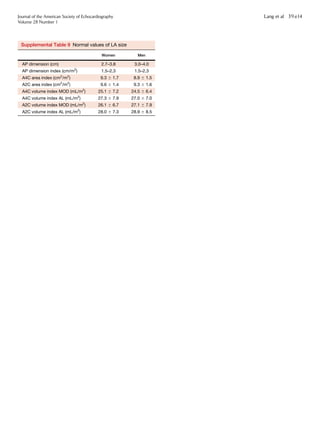
9.4. Normal Values of LA Measurements 25
Recommendations 28
10. Right Atrial measurements 28
Recommendations 28
IV. The Aortic Annulus and Aortic Root 28
11. The Aortic Annulus 28
12. The Aortic Root 30
13. Identification of Aortic Root Dilatation 32
Recommendations 32
V. The Inferior Vena Cava 32
Notice and Disclaimer 33
References 33
Appendix 39.e1
Methods 39.e1
Echocardiographic Measurements 39.e1
Statistical Analysis 39.e1
The quantification of cardiac chamber size and function is the corner-
stone of cardiac imaging, with echocardiography being the most
commonly used noninvasive modality because of its unique ability
to provide real-time images of the beating heart, combined with its
availability and portability. Standardization of the methodology
used to quantify cardiac chambers is maintained by creating and
disseminating official recommendations, which when followed by
practitioners provides uniformity and facilitates communication.
Recommendations for echocardiographic chamber quantification
were last published in 2005 by the American Society of
Echocardiography (ASE) and the European Association of
Echocardiography (renamed the European Association of
Cardiovascular Imaging [EACVI]).1,2
Since then, echocardiographic technology has continued
evolving, with two major developments being real-time three-
dimensional (3D) echocardiography (3DE) and myocardial defor-
mation imaging. The goal of this document is to provide an update
to the previously published guidelines, as well as recommendations
and reference values, while eliminating the minor discrepancies that
existed between previous guidelines. The normal values in this up-
date include 3DE and myocardial deformation, when possible.
Importantly, compared with the previous guidelines, this update is
based on considerably larger numbers of normal subjects, compiled
from multiple databases, to improve the reliability of the reference
values.
Although most issues covered in this document reflect a broad
consensus among the members of the writing group, one important
issue the group debated was partition values for severity of abnormal-
ities. Most often, in addition to describing a parameter as normal or
abnormal (reference values), clinical echocardiographers qualify the
degree of abnormality with terms such as mildly, moderately, and
Abbreviations
AP = Anteroposterior
ASE = American Society of
Echocardiography
BSA = Body surface area
CMR = Cardiac magnetic
resonance
DTI = Doppler tissue imaging
EACVI = European
Association of Cardiovascular
Imaging
EDV = End-diastolic volume
EF = Ejection fraction
ESV = End-systolic volume
FAC = Fractional area change
GLS = Global longitudinal
strain
I-I = Inner edge–to–inner edge
IVC = Inferior vena cava
LA = Left atrial
L-L = Leading edge–to–
leading edge
LV = Left ventricular
MDCT = Multidetector
computed tomography
PW = Pulsed-wave
RA = Right atrial
RIMP = Right ventricular index
of myocardial performance
RV = Right ventricular
RWT = Relative wall thickness
STE = Speckle-tracking
echocardiography
TAPSE = Tricuspid annular
plane systolic excursion
TAVI = Transcatheter aortic
valve implantation
TAVR = Transcatheter aortic
valve replacement
TEE = Transesophageal
echocardiography
3D = Three-dimensional
3DE = Three-dimensional
echocardiography
TTE = Transthoracic
echocardiography
2D = Two-dimensional
2DE = Two-dimensional
echocardiography
2 Lang et al Journal of the American Society of Echocardiography
January 2015
severely abnormal, which reflect the degree to which measurements
deviate from normal. In addition to providing normative data, it
would be beneficial to standardize cutoffs for severity of abnormality
for all parameters across echocardiography laboratories, such that the
term moderately abnormal, for example, would have the same mean-
ing universally. However, different approaches may be used for deter-
mining cutoff values for the different degrees of abnormality, all of
which have significant limitations.
The first approach would be to empirically define cutoffs for
mild, moderate, and severe abnormalities on the basis of SDs above
or below the reference limit derived from a group of healthy people.
The advantage of this method is that these data readily exist for
most echocardiographic parameters. However, this approach is
fundamentally flawed. First, not all echocardiographic parameters
are normally distributed (or Gaussian), even in a normal population.
Second, even if a particular parameter is normally distributed in
normal subjects, most echocardiographic parameters, when
measured in the general population, have a significant asymmetric
distribution in one direction (abnormally large for size or abnormally
low for function parameters). An alternative method would be to
define abnormalities on the basis of percentile values (e.g., 95th,
99th) of measurements derived from a population that includes
both healthy people and those with disease. Although these data
would still not be normally distributed, they would account for
the asymmetric distribution and the range of abnormality present
within the general population. The major limitation of this approach
is that such population data sets simply do not exist for most echo-
cardiographic variables.
Ideally, an approach that predicts outcomes or prognosis would be
preferred. That is, defining a variable as moderately deviated from
normal would imply that there is a moderate risk for a particular
adverse outcome for a patient. Although sufficient data linking risk
and cardiac chamber sizes exist for several parameters (e.g., left ven-
tricular [LV] size and ejection fraction [EF], left atrial [LA] volume),
outcomes data are lacking for many other parameters.
Unfortunately, this approach also has limitations. The first obstacle
is how to best define risk. The cutoffs suggested for the same param-
eter vary broadly for different risks in different patient populations
and disease states.
Last, cutoff values may be determined by experience-based
consensus of expert opinions. An extensive debate arose among
the members of the writing group, some of whom felt that
providing partition values on the basis of this scientifically less-
than-rigorous approach would be a disservice to the echocardiog-
raphy community and that a disease-specific approach might be
required to achieve meaningful clinical categorization of the
severity of abnormality. Others felt that such cutoffs would pro-
vide a uniform reference for echocardiographic reporting, which
would be easier to interpret by referring clinicians. The compro-
mise was to provide experience-based partition values only for
LV EF and LA volume, while suggested partition values for addi-
tional parameters of LV size and mass are listed in the
Appendix. All partition values should interpreted with caution
in this perspective.
For parameters other than LV size, function, and mass as well as
LA volume, only the mean value and the SD of gender-, age-, and
body surface area (BSA)–normalized cutoffs or upper and lower
limits are reported in the appropriate sections of this document.
For these parameters, measurements exceeding 61.96 SDs (i.e.,
the 95% confidence interval) should be classified as abnormal.
Any description of the degree of deviation from normality in the
echocardiographic report should remain at the discretion of the in-
dividual laboratory, and the writing group does not recommend spe-
cific partition values.
Quantification using transesophageal echocardiography (TEE)
has advantages and disadvantages compared with transthoracic
echocardiography (TTE). Although visualization of many cardiac
structures is improved with TEE, some differences in measure-
ments have been found between TEE and TTE, particularly for
chamber dimensions and thickness. These differences are primarily
attributable to the inability to obtain from the transesophageal
approach the standardized imaging planes and views used when
quantifying chamber dimensions transthoracically. It is the recom-
mendation of this writing group that the same range of normal
values for LV and right ventricular (RV) chamber dimensions and
volumes apply for both TEE and TTE. For details on specific views
for optimal measurements, please refer to the recently published
TEE guidelines.3
All measurements described in this document should be per-
formed on more than one cardiac cycle to account for interbeat
variability. The committee suggests the average of three beats for
patients in normal sinus rhythm and a minimum of five beats in
patients with atrial fibrillation. Because the committee acknowl-
edges that the implementation of this recommendation is time
consuming, the use of representative beats is acceptable in the clin-
ical setting.
I. THE LEFT VENTRICLE
1. Measurement of LV Size
The most commonly used parameters to describe LV cavity size
include linear internal dimensions and volumes. Measurements are
commonly reported for end-diastole and end-systole, which are
then used to derive parameters of global LV function. To allow com-
parison among individuals with different body sizes, chamber mea-
surements should be reported indexed to BSA.
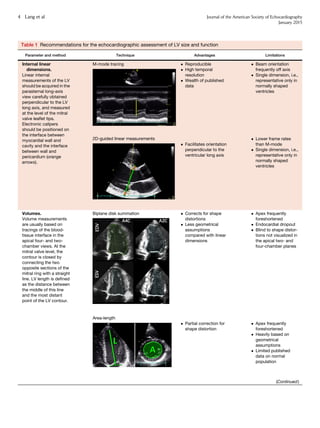
1.1. Linear Measurements. It is recommended that linear internal
measurements of the left ventricle and its walls be performed in the
parasternal long-axis view. Values should be carefully obtained
perpendicular to the LV long axis and measured at or immediately
below the level of the mitral valve leaflet tips. In this regard, the elec-
tronic calipers should be positioned on the interface between the
myocardial wall and cavity and the interface between the wall and
the pericardium. Internal dimensions can be obtained with a two-
dimensional (2D) echocardiography (2DE)–guided M-mode
approach, although linear measurements obtained from 2D echocar-
diographic images are preferred to avoid oblique sections of the
ventricle (Table 1).
1.2. Volumetric Measurements. LV volumes are measured using
2DE or 3DE. Volume calculations derived from linear measurements
may be inaccurate, because they rely on the assumption of a fixed
geometric LV shape such as a prolate ellipsoid, which does not apply
in a variety of cardiac pathologies. Accordingly, the Teichholz and
Quinones methods for calculating LV volumes from LV linear dimen-
sions are no longer recommended for clinical use.
Volumetric measurements are usually based on tracings of the
interface between the compacted myocardium and the LV cavity.
Journal of the American Society of Echocardiography
Volume 28 Number 1
Lang et al 3
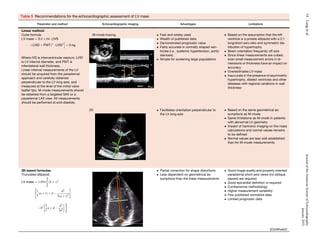
Table 1 Recommendations for the echocardiographic assessment of LV size and function
Parameter and method Technique Advantages Limitations
Internal linear
dimensions.
Linear internal
measurements of the LV
should be acquired in the
parasternal long-axis
view carefully obtained
perpendicular to the LV
long axis, and measured
at the level of the mitral
valve leaflet tips.
Electronic calipers
should be positioned on
the interface between
myocardial wall and
cavity and the interface
between wall and
pericardium (orange
arrows).
M-mode tracing
2D-guided linear measurements
 Reproducible
 High temporal
resolution
 Wealth of published
data
 Facilitates orientation
perpendicular to the
ventricular long axis
 Beam orientation
frequently off axis
 Single dimension, i.e.,
representative only in
normally shaped
ventricles
 Lower frame rates
than M-mode
 Single dimension, i.e.,
representative only in
normally shaped
ventricles
Volumes.
Volume measurements
are usually based on
tracings of the blood-
tissue interface in the
apical four- and two-
chamber views. At the
mitral valve level, the
contour is closed by
connecting the two
opposite sections of the
mitral ring with a straight
line. LV length is defined
as the distance between
the middle of this line
and the most distant
point of the LV contour.
Biplane disk summation  Corrects for shape
distortions
 Less geometrical
assumptions
compared with linear
dimensions
 Apex frequently
foreshortened
 Endocardial dropout
 Blind to shape distor-
tions not visualized in
the apical two- and
four-chamber planes
Area-length
 Partial correction for
shape distortion
 Apex frequently
foreshortened
 Heavily based on
geometrical
assumptions
 Limited published
data on normal
population
(Continued)
4 Lang et al Journal of the American Society of Echocardiography
January 2015
At the mitral valve level, the contour is closed by connecting the two
opposite sections of the mitral ring with a straight line. LV length is
defined as the distance between the bisector of this line and the apical
point of the LV contour, which is most distant to it. The use of the
longer LV length between the apical two- and four-chamber views
is recommended.
LV volumes should be measured from the apical four- and
two-chamber views. Two-dimensional echocardiographic image
acquisition should aim to maximize LV areas, while avoiding fore-
shortening of the left ventricle, which results in volume underes-
timation. Acquiring LV views at a reduced depth to focus on
the LV cavity will reduce the likelihood of foreshortening and
minimize errors in endocardial border tracings (Table 1).
Because the issue of foreshortening is less relevant in 3D data
sets, 3D image acquisition should focus primarily on including
the entire left ventricle within the pyramidal data set. To ensure
reasonably accurate identification of end-systole, the temporal res-
olution of 3D imaging should be maximized without compro-
mising spatial resolution.
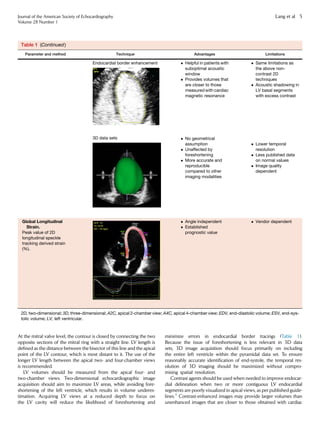
Contrast agents should be used when needed to improve endocar-
dial delineation when two or more contiguous LV endocardial
segments are poorly visualized in apical views, as per published guide-
lines.4
Contrast-enhanced images may provide larger volumes than
unenhanced images that are closer to those obtained with cardiac
Table 1 (Continued)
Parameter and method Technique Advantages Limitations
Endocardial border enhancement
3D data sets
 Helpful in patients with
suboptimal acoustic
window
 Provides volumes that
are closer to those
measured with cardiac
magnetic resonance
 No geometrical
assumption
 Unaffected by
foreshortening
 More accurate and
reproducible
compared to other
imaging modalities
 Same limitations as
the above non-
contrast 2D
techniques
 Acoustic shadowing in
LV basal segments
with excess contrast
 Lower temporal
resolution
 Less published data
on normal values
 Image quality
dependent
Global Longitudinal
Strain.
Peak value of 2D
longitudinal speckle
tracking derived strain
(%).
 Angle independent
 Established
prognostic value
 Vendor dependent
2D, two-dimensional; 3D, three-dimensional; A2C, apical 2-chamber view; A4C, apical 4-chamber view; EDV, end-diastolic volume; ESV, end-sys-
tolic volume; LV, left ventricular.
Journal of the American Society of Echocardiography
Volume 28 Number 1
Lang et al 5
magnetic resonance (CMR) in head-to-head comparison.5
Care
should be taken to avoid acoustic shadowing, which may occur in
LV basal segments in the presence of high concentrations of contrast.
Normal reference values for LV volumes with contrast enhancement
are not well established.
The most commonly used method for 2D echocardiographic
volume calculations is the biplane method of disks summation
(modified Simpson’s rule), which is the recommended 2D echocar-
diographic method by consensus of this committee (Table 1). An
alternative method to calculate LV volumes when apical endocardial
definition precludes accurate tracing is the area-length method, in
which the LV is assumed to be bullet shaped. The mid-LV cross-
sectional area is computed by planimetry in the parasternal short-
axis view and the length of the ventricle taken from the midpoint
of the annular plane to the apex in the apical four-chamber view
(Table 1). The shortcoming of this method is that the bullet-shape
assumption does not always hold true. One of the advantages of
3D echocardiographic volume measurements is that they do not
rely on geometric assumptions. In patients with good image quality,
3D echocardiographic measurements are accurate and reproducible
and should therefore be used when available and feasible.6
The ad-
vantages and disadvantages of the various methods are summarized
in Table 1.
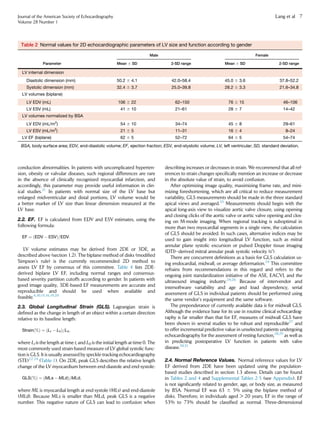
1.3. Normal Reference Values for 2DE. Data were extracted
from seven databases, including Asklepios (year 0 and year 10),7
Flemengho,8
CARDIA5 and CARDIA25,9
Padua 3D Echo
Normal,10
and the Normal Reference Ranges for
Echocardiography study,11,12
to obtain reference values in normal
subjects for the left ventricle and the left atrium (see section 10).
All data were obtained without the use of contrast agents. Data
sets for all patients included age, gender, ethnicity, height, and
weight. To ensure a normal population, subjects in these studies
were excluded if any of the following criteria were met: systolic
blood pressure  140 mm Hg, diastolic blood pressure  80 mm
Hg, history of drug-treated hypertension, diagnosis of diabetes,
impaired fasting glucose  100 mg/dL, body mass index  30 kg/
m2
, creatinine  1.3 mg/dL, estimated glomerular filtration rate
60mL/min/1.73 m2
,totalcholesterol 240mg/dL,low-densitylipo-
protein cholesterol  130 mg/dL, and total triglycerides  150 mg/dL.
Details of the statistical analysis are described in the Appendix. Because
of varied study aims, not all echocardiographic measurements were
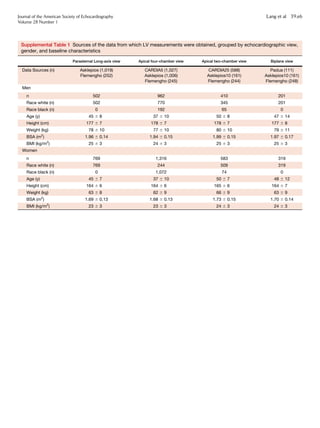
available for each database. Supplemental Table 1 summarizes the sour-
ces of the data for each measurement group and their baseline charac-
teristics.
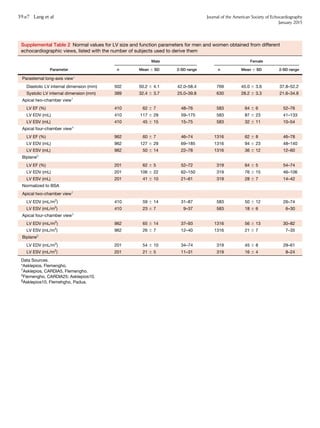
Table 2 shows the normal values for 2D echocardiographic param-
eters of LV size and function according to gender, while Supplemental
Table 2 provides expanded data for the same parameters, obtained
from different echocardiographic views, and also includes the
corresponding number of subjects used to obtain these data.
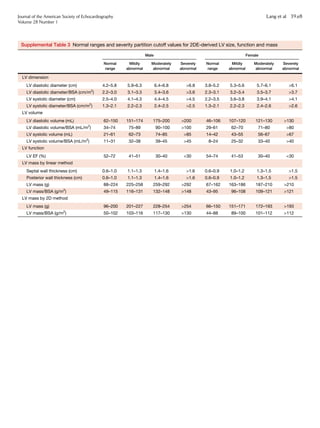
Supplemental Table 3 lists normal ranges and consensus-based parti-
tion cutoffs for LV dimensions, volumes, EF, and mass. On multivar-
iate analysis, age, gender, and BSA were found to have a significant
independent influence on LV end-diastolic volume (EDV) and LV
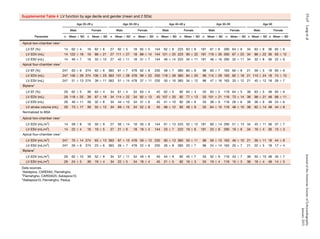
end-systolic volume (ESV). The results across genders and age deciles
subdivided into absolute and BSA-normalized values are shown in
Supplemental Table 4 (see Appendix).
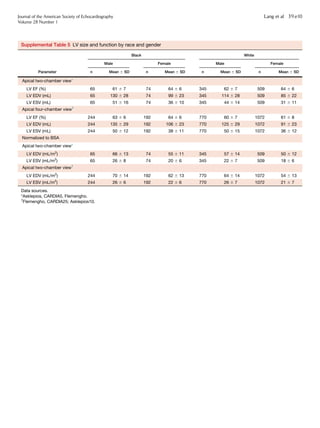
Because ethnicity is an important factor, results of analysis by race
and gender are presented in Supplemental Table 5. From the regres-
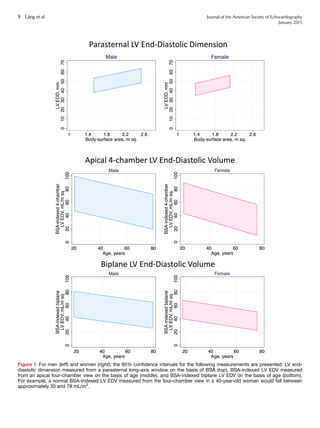
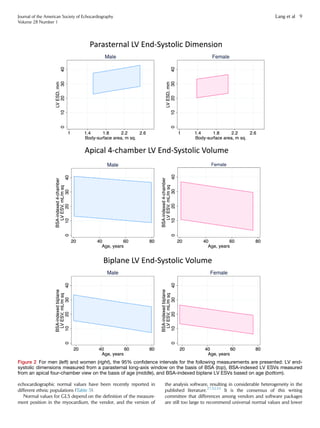
sion analysis, nomograms are provided for plotting observed LV
dimensions versus BSA or BSA-indexed LV volumes versus age
(Figures 1 and 2). Nomograms for absolute LV measurements
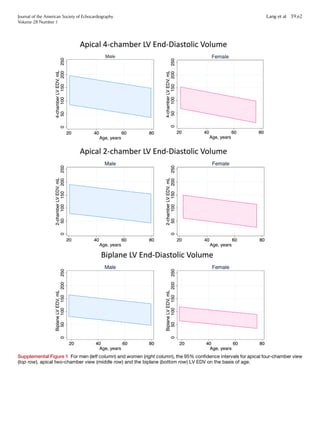
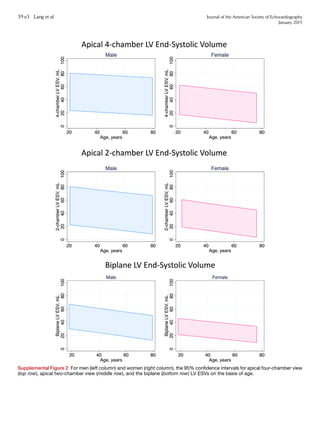
against age (Supplemental Figures 1 and 2) and BSA (Supplemental
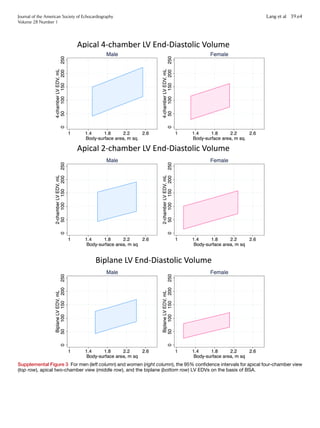
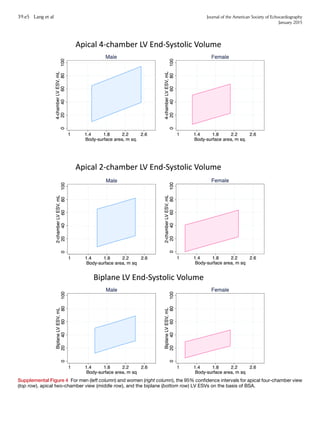
Figures 3 and 4) are also provided (see Appendix).
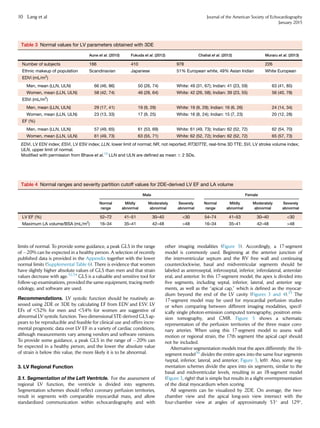
1.4. Normal Reference Values for 3DE. Several studies have
published 3D echocardiographic reference values for healthy normo-
tensive subjects, which are summarized in Table 3.13
The reported
variations in the normal ranges from study to study are likely due to
differences in populations, echocardiographic equipment, and anal-
ysis software, as well as variability in measurement techniques. In
patients with good image quality, the accuracy of 3DE is comparable
with that of CMR, although volumes tend to be lower on echocardi-
ography.6
The effects of ethnicity on 3D echocardiographic LV volumes were
investigated in one study, which reported that LV volumes were smaller
among Asian Indians than white Europeans, but EF did not differ
among ethnic groups.14
In most 3D echocardiographic studies, the rela-
tionship between age and 3D echocardiographic LV volumes was
examined, and weak to moderate negative correlations were seen be-
tween age and LV volumes, while EF did not change significantly with
age.10,15,16
This finding is similar to those described in the CMR
literature.17,18
On the basis of weighted averages of three
studies,16,19,20
3D echocardiographic LV volumes were larger than
2D echocardiographic values, and corresponding upper limits of the
normal range were EDVs of 79 mL/m2
for men and 71 mL/m2
for
women and ESVs of 32 mL/m2
for men and 28 mL/m2
for women.
Ultimately, a large study in a diverse population will be needed to
establish normal reference ranges for 3DE for different ethnic groups.
Recommendation. LV size should be routinely assessed on 2DE
by calculating volumes using the biplane method of disks summa-
tion technique. In laboratories with experience in 3DE, 3D
measurement and reporting of LV volumes is recommended
when feasible depending on image quality. When reporting LV
linear dimensions, the recommended method is 2D-guided
measurements. LV size and volume measurements should be
reported indexed to BSA. For general reference, 2D echocardio-
graphic LV EDVs of 74 mL/m2
for men and 61 mL/m2
for
women and LV ESVs of 31 mL/m2
for men and 24 mL/m2
for
women should be used as the upper limits of the corresponding
normal range.
2. LV Global Systolic Function
Global LV function is usually assessed by measuring the difference be-
tween the end-diastolic and end-systolic value of a one-dimensional,
2D, or 3D parameter divided by its end-diastolic value. For this, end-
diastole is preferably defined as the first frame after mitral valve
closure or the frame in the cardiac cycle in which the respective LV
dimension or volume measurement is the largest. End-systole is best
defined as the frame after aortic valve closure or the frame in which
the cardiac dimension or volume is smallest. In patients with regular
heart rhythm, measurements of the timing of valve openings and clo-
sures derived from M-mode echocardiography, pulsed-wave (PW) or
continuous-wave Doppler may be used for accurate definitions of
ventricular time intervals.
2.1. Fractional Shortening. Fractional shortening can be derived
from 2D-guided M-mode imaging or preferably from linear mea-
surements obtained from 2D images. Deriving global LV function
parameters from linear measurements is problematic when there
are regional wall motion abnormalities due to coronary disease or
6 Lang et al Journal of the American Society of Echocardiography
January 2015
conduction abnormalities. In patients with uncomplicated hyperten-
sion, obesity or valvular diseases, such regional differences are rare
in the absence of clinically recognized myocardial infarction, and
accordingly, this parameter may provide useful information in clin-
ical studies.21
In patients with normal size of the LV base but
enlarged midventricular and distal portions, LV volume would be
a better marker of LV size than linear dimension measured at the
LV base.
2.2. EF. EF is calculated from EDV and ESV estimates, using the
following formula:
EF ¼ ðEDV À ESVÞ=EDV:
LV volume estimates may be derived from 2DE or 3DE, as
described above (section 1.2). The biplane method of disks (modified
Simpson’s rule) is the currently recommended 2D method to
assess LV EF by consensus of this committee. Table 4 lists 2DE-
derived biplane LV EF, including normal ranges and consensus-
based severity partition cutoffs according to gender. In patients with
good image quality, 3DE-based EF measurements are accurate and
reproducible and should be used when available and
feasible.6,10,15,16,19,20
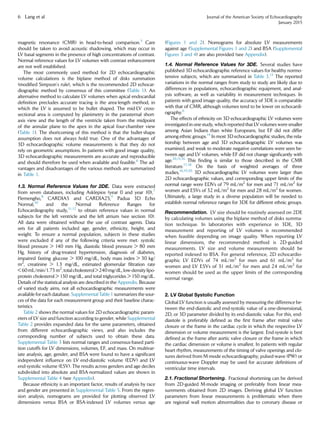
2.3. Global Longitudinal Strain (GLS). Lagrangian strain is
defined as the change in length of an object within a certain direction
relative to its baseline length:
Strainð%Þ ¼ ðLt À L0Þ=L0;
where Lt is the length at time t, and L0 is the initial length at time 0. The
most commonly used strain-based measure of LV global systolic func-
tion is GLS. It is usually assessed by speckle-tracking echocardiography
(STE)22-24
(Table 1). On 2DE, peak GLS describes the relative length
change of the LV myocardium between end-diastole and end-systole:
GLSð%Þ ¼ ðMLs À MLdÞ=MLd;
where ML is myocardial length at end-systole (MLs) and end-diastole
(MLd). Because MLs is smaller than MLd, peak GLS is a negative
number. This negative nature of GLS can lead to confusion when
describing increases or decreases in strain. We recommend that all ref-
erences to strain changes specifically mention an increase or decrease
in the absolute value of strain, to avoid confusion.
After optimizing image quality, maximizing frame rate, and mini-
mizing foreshortening, which are all critical to reduce measurement
variability, GLS measurements should be made in the three standard
apical views and averaged.25
Measurements should begin with the
apical long-axis view to visualize aortic valve closure, using opening
and closing clicks of the aortic valve or aortic valve opening and clos-
ing on M-mode imaging. When regional tracking is suboptimal in
more than two myocardial segments in a single view, the calculation
of GLS should be avoided. In such cases, alternative indices may be
used to gain insight into longitudinal LV function, such as mitral
annular plane systolic excursion or pulsed Doppler tissue imaging
(DTI)–derived mitral annular peak systolic velocity (s0
).
There are concurrent definitions as a basis for GLS calculation us-
ing endocardial, midwall, or average deformation.24
This committee
refrains from recommendations in this regard and refers to the
ongoing joint standardization initiative of the ASE, EACVI, and the
ultrasound imaging industry.24,26
Because of intervendor and
intersoftware variability and age and load dependency, serial
assessment of GLS in individual patients should be performed using
the same vendor’s equipment and the same software.
The preponderance of currently available data is for midwall GLS.
Although the evidence base for its use in routine clinical echocardiog-
raphy is far smaller than that for EF, measures of midwall GLS have
been shown in several studies to be robust and reproducible27
and
to offer incremental predictive value in unselected patients undergoing
echocardiography for the assessment of resting function,28,29
as well as
in predicting postoperative LV function in patients with valve
disease.30,31
2.4. Normal Reference Values. Normal reference values for LV
EF derived from 2DE have been updated using the population-
based studies described in section 1.3 above. Details can be found
in Tables 2 and 4 and Supplemental Tables 2-5 (see Appendix). EF
is not significantly related to gender, age, or body size, as measured
by BSA. Normal EF was 63 6 5% using the biplane method of
disks. Therefore, in individuals aged  20 years, EF in the range of
53% to 73% should be classified as normal. Three-dimensional
Table 2 Normal values for 2D echocardiographic parameters of LV size and function according to gender
Parameter
Male Female
Mean 6 SD 2-SD range Mean 6 SD 2-SD range
LV internal dimension
Diastolic dimension (mm) 50.2 6 4.1 42.0–58.4 45.0 6 3.6 37.8–52.2
Systolic dimension (mm) 32.4 6 3.7 25.0–39.8 28.2 6 3.3 21.6–34.8
LV volumes (biplane)
LV EDV (mL) 106 6 22 62–150 76 6 15 46–106
LV ESV (mL) 41 6 10 21–61 28 6 7 14–42
LV volumes normalized by BSA
LV EDV (mL/m2
) 54 6 10 34–74 45 6 8 29–61
LV ESV (mL/m2
) 21 6 5 11–31 16 6 4 8–24
LV EF (biplane) 62 6 5 52–72 64 6 5 54–74
BSA, body surface area; EDV, end-diastolic volume; EF, ejection fraction; ESV, end-stystolic volume; LV, left ventricular; SD, standard deviation.
Journal of the American Society of Echocardiography
Volume 28 Number 1
Lang et al 7
Figure 1 For men (left) and women (right), the 95% confidence intervals for the following measurements are presented: LV end-
diastolic dimension measured from a parasternal long-axis window on the basis of BSA (top), BSA-indexed LV EDV measured
from an apical four-chamber view on the basis of age (middle), and BSA-indexed biplane LV EDV on the basis of age (bottom).
For example, a normal BSA-indexed LV EDV measured from the four-chamber view in a 40-year-old woman would fall between
approximately 30 and 78 mL/m2
.
8 Lang et al Journal of the American Society of Echocardiography
January 2015
echocardiographic normal values have been recently reported in
different ethnic populations (Table 3).
Normal values for GLS depend on the definition of the measure-
ment position in the myocardium, the vendor, and the version of
the analysis software, resulting in considerable heterogeneity in the
published literature.27,32,33
It is the consensus of this writing
committee that differences among vendors and software packages
are still too large to recommend universal normal values and lower
Figure 2 For men (left) and women (right), the 95% confidence intervals for the following measurements are presented: LV end-
systolic dimensions measured from a parasternal long-axis window on the basis of BSA (top), BSA-indexed LV ESVs measured
from an apical four-chamber view on the basis of age (middle), and BSA-indexed biplane LV ESVs based on age (bottom).
Journal of the American Society of Echocardiography
Volume 28 Number 1
Lang et al 9
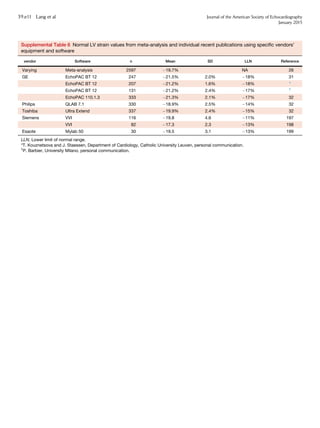
limits of normal. To provide some guidance, a peak GLS in the range
of À20% can be expected in a healthy person. A selection of recently
published data is provided in the Appendix together with the lower
normal limits (Supplemental Table 6). There is evidence that women
have slightly higher absolute values of GLS than men and that strain
values decrease with age.32,34
GLS is a valuable and sensitive tool for
follow-up examinations, provided the same equipment, tracing meth-
odology, and software are used.
Recommendations. LV systolic function should be routinely as-
sessed using 2DE or 3DE by calculating EF from EDV and ESV. LV
EFs of 52% for men and 54% for women are suggestive of
abnormal LV systolic function. Two-dimensional STE-derived GLS ap-
pears to be reproducible and feasible for clinical use and offers incre-
mental prognostic data over LV EF in a variety of cardiac conditions,
although measurements vary among vendors and software versions.
To provide some guidance, a peak GLS in the range of À20% can
be expected in a healthy person, and the lower the absolute value
of strain is below this value, the more likely it is to be abnormal.
3. LV Regional Function
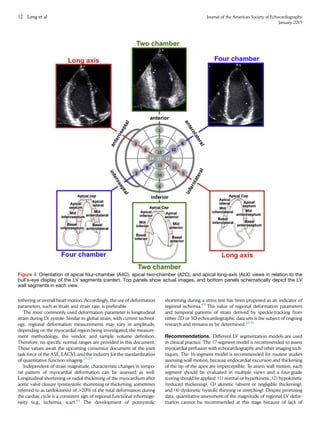
3.1. Segmentation of the Left Ventricle. For the assessment of
regional LV function, the ventricle is divided into segments.
Segmentation schemes should reflect coronary perfusion territories,
result in segments with comparable myocardial mass, and allow
standardized communication within echocardiography and with
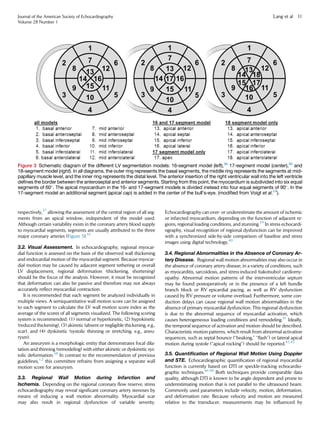
other imaging modalities (Figure 3). Accordingly, a 17-segment
model is commonly used. Beginning at the anterior junction of
the interventricular septum and the RV free wall and continuing
counterclockwise, basal and midventricular segments should be
labeled as anteroseptal, inferoseptal, inferior, inferolateral, anterolat-
eral, and anterior. In this 17-segment model, the apex is divided into
five segments, including septal, inferior, lateral, and anterior seg-
ments, as well as the ‘‘apical cap,’’ which is defined as the myocar-
dium beyond the end of the LV cavity (Figures 3 and 4).35
The
17-segment model may be used for myocardial perfusion studies
or when comparing between different imaging modalities, specif-
ically single photon-emission computed tomography, positron emis-
sion tomography, and CMR. Figure 5 shows a schematic
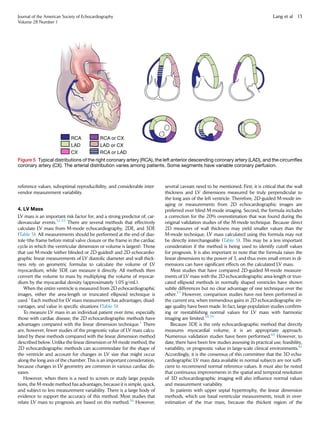
representation of the perfusion territories of the three major coro-
nary arteries. When using this 17-segment model to assess wall
motion or regional strain, the 17th segment (the apical cap) should
not be included.
Alternative segmentation models treat the apex differently: the 16-
segment model36
divides the entire apex into the same four segments
(septal, inferior, lateral, and anterior; Figure 3, left). Also, some seg-
mentation schemes divide the apex into six segments, similar to the
basal and midventricular levels, resulting in an 18-segment model
(Figure 3, right) that is simple but results in a slight overrepresentation
of the distal myocardium when scoring.
All segments can be visualized by 2DE. On average, the two-
chamber view and the apical long-axis view intersect with the
four-chamber view at angles of approximately 53
and 129
,
Table 3 Normal values for LV parameters obtained with 3DE
Aune et al. (2010) Fukuda et al. (2012) Chahal et al. (2012) Muraru et al. (2013)
Number of subjects 166 410 978 226
Ethnic makeup of population Scandinavian Japanese 51% European white, 49% Asian Indian White European
EDVi (mL/m2
)
Men, mean (LLN, ULN) 66 (46, 86) 50 (26, 74) White: 49 (31, 67); Indian: 41 (23, 59) 63 (41, 85)
Women, mean (LLN, ULN) 58 (42, 74) 46 (28, 64) White: 42 (26, 58); Indian: 39 (23, 55) 56 (40, 78)
ESVi (mL/m2
)
Men, mean (LLN, ULN) 29 (17, 41) 19 (9, 29) White: 19 (9, 29); Indian: 16 (6, 26) 24 (14, 34)
Women, mean (LLN, ULN) 23 (13, 33) 17 (9, 25) White: 16 (8, 24); Indian: 15 (7, 23) 20 (12, 28)
EF (%)
Men, mean (LLN, ULN) 57 (49, 65) 61 (53, 69) White: 61 (49, 73); Indian: 62 (52, 72) 62 (54, 70)
Women, mean (LLN, ULN) 61 (49, 73) 63 (55, 71) White: 62 (52, 72); Indian: 62 (52, 72) 65 (57, 73)
EDVi, LV EDV index; ESVi, LV ESV index; LLN, lower limit of normal; NR, not reported; RT3DTTE, real-time 3D TTE; SVi, LV stroke volume index;
ULN, upper limit of normal.
Modified with permission from Bhave et al.13
LLN and ULN are defined as mean 6 2 SDs.
Table 4 Normal ranges and severity partition cutoff values for 2DE-derived LV EF and LA volume
Male Female
Normal
range
Mildly
abnormal
Moderately
abnormal
Severely
abnormal
Normal
range
Mildly
abnormal
Moderately
abnormal
Severely
abnormal
LV EF (%) 52–72 41–51 30–40 30 54–74 41–53 30–40 30
Maximum LA volume/BSA (mL/m2
) 16–34 35–41 42–48 48 16–34 35–41 42–48 48
10 Lang et al Journal of the American Society of Echocardiography
January 2015
respectively,37
allowing the assessment of the central region of all seg-
ments from an apical window, independent of the model used.
Although certain variability exists in the coronary artery blood supply
to myocardial segments, segments are usually attributed to the three
major coronary arteries (Figure 5).35
3.2. Visual Assessment. In echocardiography, regional myocar-
dial function is assessed on the basis of the observed wall thickening
and endocardial motion of the myocardial segment. Because myocar-
dial motion may be caused by adjacent segment tethering or overall
LV displacement, regional deformation (thickening, shortening)
should be the focus of the analysis. However, it must be recognized
that deformation can also be passive and therefore may not always
accurately reflect myocardial contraction.
It is recommended that each segment be analyzed individually in
multiple views. A semiquantitative wall motion score can be assigned
to each segment to calculate the LV wall motion score index as the
average of the scores of all segments visualized. The following scoring
system is recommended: (1) normal or hyperkinetic, (2) hypokinetic
(reduced thickening), (3) akinetic (absent or negligible thickening, e.g.,
scar), and (4) dyskinetic (systolic thinning or stretching, e.g., aneu-
rysm).
An aneurysm is a morphologic entity that demonstrates focal dila-
tation and thinning (remodeling) with either akinetic or dyskinetic sys-
tolic deformation.38
In contrast to the recommendation of previous
guidelines,1,2
this committee refrains from assigning a separate wall
motion score for aneurysm.
3.3. Regional Wall Motion during Infarction and
Ischemia. Depending on the regional coronary flow reserve, stress
echocardiography may reveal significant coronary artery stenoses by
means of inducing a wall motion abnormality. Myocardial scar
may also result in regional dysfunction of variable severity.
Echocardiography can over- or underestimate the amount of ischemic
or infarcted myocardium, depending on the function of adjacent re-
gions, regional loading conditions, and stunning.39
In stress echocardi-
ography, visual recognition of regional dysfunction can be improved
with a synchronized side-by-side comparison of baseline and stress
images using digital technology.40
3.4. Regional Abnormalities in the Absence of Coronary Ar-
tery Disease. Regional wall motion abnormalities may also occur in
the absence of coronary artery disease, in a variety of conditions, such
as myocarditis, sarcoidosis, and stress-induced (takotsubo) cardiomy-
opathy. Abnormal motion patterns of the interventricular septum
may be found postoperatively or in the presence of a left bundle
branch block or RV epicardial pacing, as well as RV dysfunction
caused by RV pressure or volume overload. Furthermore, some con-
duction delays can cause regional wall motion abnormalities in the
absence of primary myocardial dysfunction. This regional dysfunction
is due to the abnormal sequence of myocardial activation, which
causes heterogeneous loading conditions and remodeling.41
Ideally,
the temporal sequence of activation and motion should be described.
Characteristic motion patterns, which result from abnormal activation
sequences, such as septal bounce (‘‘beaking,’’ ‘‘flash’’) or lateral apical
motion during systole (‘‘apical rocking’’) should be reported.42-45
3.5. Quantification of Regional Wall Motion Using Doppler
and STE. Echocardiographic quantification of regional myocardial
function is currently based on DTI or speckle-tracking echocardio-
graphic techniques.46-48
Both techniques provide comparable data
quality, although DTI is known to be angle dependent and prone to
underestimating motion that is not parallel to the ultrasound beam.
Commonly used parameters include velocity, motion, deformation,
and deformation rate. Because velocity and motion are measured
relative to the transducer, measurements may be influenced by
Figure 3 Schematic diagram of the different LV segmentation models: 16-segment model (left),36
17-segment model (center),35
and
18-segment model (right). In all diagrams, the outer ring represents the basal segments, the middle ring represents the segments at mid-
papillary muscle level, and the inner ring represents the distal level. The anterior insertion of the right ventricular wall into the left ventricle
defines the border between the anteroseptal and anterior segments. Starting from this point, the myocardium is subdivided into six equal
segments of 60
. The apical myocardium in the 16- and 17-segment models is divided instead into four equal segments of 90
. In the
17-segment model an additional segment (apical cap) is added in the center of the bull’s-eye. (modified from Voigt et al.24
).
Journal of the American Society of Echocardiography
Volume 28 Number 1
Lang et al 11
tethering or overall heart motion. Accordingly, the use of deformation
parameters, such as strain and strain rate, is preferable.
The most commonly used deformation parameter is longitudinal
strain during LV systole. Similar to global strain, with current technol-
ogy, regional deformation measurements may vary in amplitude,
depending on the myocardial region being investigated, the measure-
ment methodology, the vendor, and sample volume definition.
Therefore, no specific normal ranges are provided in this document.
These values await the upcoming consensus document of the joint
task force of the ASE, EACVI, and the industry for the standardization
of quantitative function imaging.23,25
Independent of strain magnitude, characteristic changes in tempo-
ral pattern of myocardial deformation can be assessed as well.
Longitudinal shortening or radial thickening of the myocardium after
aortic valve closure (postsystolic shortening or thickening, sometimes
referred to as tardokinesis) of 20% of the total deformation during
the cardiac cycle is a consistent sign of regional functional inhomoge-
neity (e.g., ischemia, scar).44
The development of postsystolic
shortening during a stress test has been proposed as an indicator of
regional ischemia.49
The value of regional deformation parameters
and temporal patterns of strain derived by speckle-tracking from
either 2D or 3D echocardiographic data sets is the subject of ongoing
research and remains to be determined.50,51
Recommendations. Different LV segmentation models are used
in clinical practice. The 17-segment model is recommended to assess
myocardial perfusion with echocardiography and other imaging tech-
niques. The 16-segment model is recommended for routine studies
assessing wall motion, because endocardial excursion and thickening
of the tip of the apex are imperceptible. To assess wall motion, each
segment should be evaluated in multiple views and a four-grade
scoring should be applied: (1) normal or hyperkinetic, (2) hypokinetic
(reduced thickening), (3) akinetic (absent or negligible thickening),
and (4) dyskinetic (systolic thinning or stretching). Despite promising
data, quantitative assessment of the magnitude of regional LV defor-
mation cannot be recommended at this stage because of lack of
Figure 4 Orientation of apical four-chamber (A4C), apical two-chamber (A2C), and apical long-axis (ALX) views in relation to the
bull’s-eye display of the LV segments (center). Top panels show actual images, and bottom panels schematically depict the LV
wall segments in each view.
12 Lang et al Journal of the American Society of Echocardiography
January 2015
reference values, suboptimal reproducibility, and considerable inter-
vendor measurement variability.
4. LV Mass
LV mass is an important risk factor for, and a strong predictor of, car-
diovascular events.52-55
There are several methods that effectively
calculate LV mass from M-mode echocardiography, 2DE, and 3DE
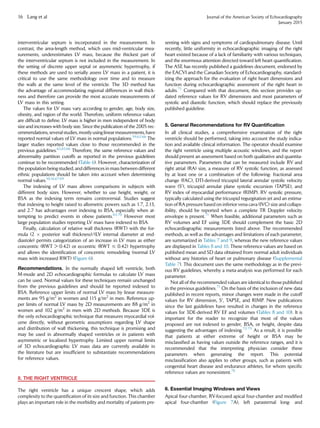
(Table 5). All measurements should be performed at the end of dias-
tole (the frame before mitral valve closure or the frame in the cardiac
cycle in which the ventricular dimension or volume is largest). Those
that use M-mode (either blinded or 2D-guided) and 2D echocardio-
graphic linear measurements of LV diastolic diameter and wall thick-
ness rely on geometric formulas to calculate the volume of LV
myocardium, while 3DE can measure it directly. All methods then
convert the volume to mass by multiplying the volume of myocar-
dium by the myocardial density (approximately 1.05 g/mL).
When the entire ventricle is measured from 2D echocardiographic
images, either the area-length or truncated ellipsoid technique is
used.1
Each method for LV mass measurement has advantages, disad-
vantages, and value in specific situations (Table 5).
To measure LV mass in an individual patient over time, especially
those with cardiac disease, the 2D echocardiographic methods have
advantages compared with the linear dimension technique.1
There
are, however, fewer studies of the prognostic value of LV mass calcu-
lated by these methods compared with the linear dimension method
described below. Unlike the linear dimension or M-mode method, the
2D echocardiographic methods can accommodate for the shape of
the ventricle and account for changes in LV size that might occur
along the long axis of the chamber. This is an important consideration,
because changes in LV geometry are common in various cardiac dis-
eases.
However, when there is a need to screen or study large popula-
tions, the M-mode method has advantages, because it is simple, quick,
and subject to less measurement variability. There is a large body of
evidence to support the accuracy of this method. Most studies that
relate LV mass to prognosis are based on this method.56
However,
several caveats need to be mentioned. First, it is critical that the wall
thickness and LV dimensions measured be truly perpendicular to
the long axis of the left ventricle. Therefore, 2D-guided M-mode im-
aging or measurements from 2D echocardiographic images are
preferred over blind M-mode imaging. Second, the formula includes
a correction for the 20% overestimation that was found during the
original validation studies of the M-mode technique. Because direct
2D measures of wall thickness may yield smaller values than the
M-mode technique, LV mass calculated using this formula may not
be directly interchangeable (Table 5). This may be a less important
consideration if the method is being used to identify cutoff values
for prognosis. It is also important to note that the formula raises the
linear dimensions to the power of 3, and thus even small errors in di-
mensions can have significant effects on the calculated LV mass.
Most studies that have compared 2D-guided M-mode measure-
ments of LV mass with the 2D echocardiographic area-length or trun-
cated ellipsoid methods in normally shaped ventricles have shown
subtle differences but no clear advantage of one technique over the
other.57
However, comparison studies have not been performed in
the current era, when tremendous gains in 2D echocardiographic im-
age quality have been made. In fact, large population studies confirm-
ing or reestablishing normal values for LV mass with harmonic
imaging are limited.58,59
Because 3DE is the only echocardiographic method that directly
measures myocardial volume, it is an appropriate approach.
Numerous validation studies have been performed.60
However, to
date, there have been few studies assessing its practical use, feasibility,
variability, or prognostic value in large-scale clinical environments.61
Accordingly, it is the consensus of this committee that the 3D echo-
cardiographic LV mass data available in normal subjects are not suffi-
cient to recommend normal reference values. It must also be noted
that continuous improvements in the spatial and temporal resolution
of 3D echocardiographic imaging will also influence normal values
and measurement variability.
In patients with upper septal hypertrophy, the linear dimension
methods, which use basal ventricular measurements, result in over-
estimation of the true mass, because the thickest region of the
Figure 5 Typical distributions of the right coronary artery (RCA), the left anterior descending coronary artery (LAD), and the circumflex
coronary artery (CX). The arterial distribution varies among patients. Some segments have variable coronary perfusion.
Journal of the American Society of Echocardiography
Volume 28 Number 1
Lang et al 13
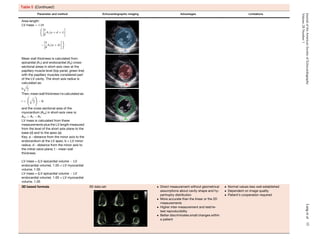
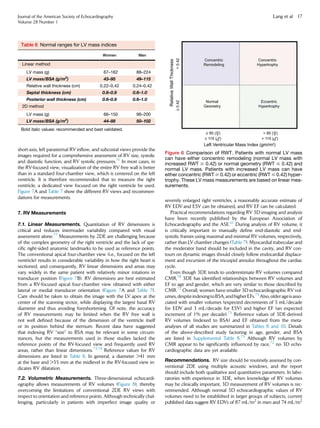
Table 5 Recommendations for the echocardiographic assessment of LV mass
Parameter and method Echocardiographic imaging Advantages Limitations
Linear method:
Cube formula
LV mass ¼ 0:8$1:04$½ðIVS
þLVID þ PWTÞ3
ÀLVID3
i
þ 0:6g
Where IVS is interventricular septum; LVID
is LV internal diameter, and PWT is
inferolateral wall thickness.
Linear internal measurements of the LV
should be acquired from the parasternal
approach and carefully obtained
perpendicular to the LV long axis, and
measured at the level of the mitral valve
leaflet tips. M-mode measurements should
be obtained from a targeted SAX or a
parasternal LAX view. All measurements
should be performed at end-diastole.
M-mode tracing
2D
 Fast and widely used
 Wealth of published data
 Demonstrated prognostic value
 Fairly accurate in normally shaped ven-
tricles (i.e., systemic hypertension, aortic
stenosis)
 Simple for screening large populations
 Facilitates orientation perpendicular to
the LV long axis
 Based on the assumption that the left
ventricle is a prolate ellipsoid with a 2:1
long/short axis ratio and symmetric dis-
tribution of hypertrophy
 Beam orientation frequently off axis
 Since linear measurements are cubed,
even small measurement errors in di-
mensions or thickness have an impact on
accuracy
 Overestimates LV mass
 Inaccurate in the presence of asymmetric
hypertrophy, dilated ventricles and other
diseases with regional variations in wall
thickness
 Based on the same geometrical as-
sumptions as M-mode
 Same limitations as M-mode in patients
with abnormal LV geometry
 Impact of harmonic imaging on the mass
calculations and normal values remains
to be defined
 Normal values are less well established
than for M-mode measurements
2D based formulas.
Truncated ellipsoid:
LV mass ¼ 1:05p
(
ðb þ tÞ2

2
3
ða þ tÞ þ d À
d3
3ða þ tÞ2
#
Àb2

2
3
a þ d À
d3
3a2
)
 Partial correction for shape distortions
 Less dependent on geometrical as-
sumptions than the linear measurements
 Good image quality and properly oriented
parasternal short-axis views (no oblique
planes) are required
 Good epicardial definition is required
 Cumbersome methodology
 Higher measurement variability
 Few published normative data
 Limited prognostic data
(Continued)
14LangetalJournaloftheAmericanSocietyofEchocardiography
January2015
Table 5 (Continued)
Parameter and method Echocardiographic imaging Advantages Limitations
Area-length:
LV mass ¼ 1:05

5
6
A1ða þ d þ tÞ

À

5
6
A2ða þ dÞ

Mean wall thickness is calculated from
epicardial (A1) and endocardial (A2) cross-
sectional areas in short-axis view at the
papillary muscle level (top panel, green line)
with the papillary muscles considered part
of the LV cavity. The short axis radius is
calculated as:
b
ffiffiffiffi
A2
p
q
Then, mean wall thickness t is calculated as:
t ¼
ffiffiffiffi
A1
p
q
!
À b
and the cross sectional area of the
myocardium (Am) in short-axis view is:
Am ¼ A1 À A2
LV mass is calculated from these
measurements plus the LV length measured
from the level of the short axis plane to the
base (d) and to the apex (a).
Key: a - distance from the minor axis to the
endocardium at the LV apex; b = LV minor
radius; d - distance from the minor axis to
the mitral valve plane; t - mean wall
thickness.
LV mass = (LV epicardial volume À LV
endocardial volume). 1.05 = LV myocardial
volume. 1.05
LV mass = (LV epicardial volume À LV
endocardial volume). 1.05 = LV myocardial
volume. 1.05
3D based formula. 3D data set  Direct measurement without geometrical
assumptions about cavity shape and hy-
pertrophy distribution
 More accurate than the linear or the 2D
measurements
 Higher inter-measurement and test/re-
test reproducibility
 Better discriminates small changes within
a patient
 Normal values less well established
 Dependent on image quality
 Patient’s cooperation required
JournaloftheAmericanSocietyofEchocardiography
Volume28Number1
Langetal15
interventricular septum is incorporated in the measurement. In
contrast, the area-length method, which uses mid-ventricular mea-
surements, underestimates LV mass, because the thickest part of
the interventricular septum is not included in the measurement. In
the setting of discrete upper septal or asymmetric hypertrophy, if
these methods are used to serially assess LV mass in a patient, it is
critical to use the same methodology over time and to measure
the walls at the same level of the ventricle. The 3D method has
the advantage of accommodating regional differences in wall thick-
ness and therefore can provide the most accurate measurements of
LV mass in this setting.
The values for LV mass vary according to gender, age, body size,
obesity, and region of the world. Therefore, uniform reference values
are difficult to define. LV mass is higher in men independent of body
size and increases with body size. Since the publication of the 2005 rec-
ommendations, severalstudies, mostlyusinglinearmeasurements, have
reported normal values of LV mass in normal populations.59,62-66
The
larger studies reported values close to those recommended in the
previous guidelines.62,65,66
Therefore, the same reference values and
abnormality partition cutoffs as reported in the previous guidelines
continue to be recommended (Table 6). However, characterization of
the population being studied, and differences in mass between different
ethnic populations should be taken into account when determining
normal values.10,16,67-69
The indexing of LV mass allows comparisons in subjects with
different body sizes. However, whether to use height, weight, or
BSA as the indexing term remains controversial. Studies suggest
that indexing to height raised to allometric powers such as 1.7, 2.13,
and 2.7 has advantages over indexing to BSA, especially when at-
tempting to predict events in obese patients.65,70
However most
large population studies reporting LV mass have indexed to BSA.
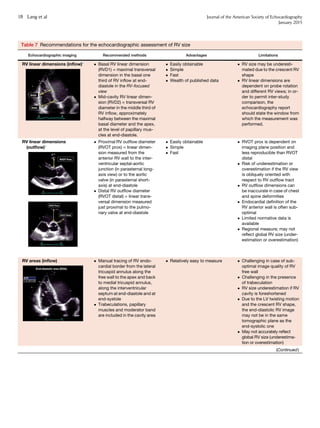
Finally, calculation of relative wall thickness (RWT) with the for-
mula (2 Â posterior wall thickness)/(LV internal diameter at end-
diastole) permits categorization of an increase in LV mass as either
concentric (RWT  0.42) or eccentric (RWT # 0.42) hypertrophy
and allows the identification of concentric remodeling (normal LV
mass with increased RWT) (Figure 6).
Recommendations. In the normally shaped left ventricle, both
M-mode and 2D echocardiographic formulas to calculate LV mass
can be used. Normal values for these techniques remain unchanged
from the previous guidelines and should be reported indexed to
BSA. Reference upper limits of normal LV mass by linear measure-
ments are 95 g/m2
in women and 115 g/m2
in men. Reference up-
per limits of normal LV mass by 2D measurements are 88 g/m2
in
women and 102 g/m2
in men with 2D methods. Because 3DE is
the only echocardiographic technique that measures myocardial vol-
ume directly, without geometric assumptions regarding LV shape
and distribution of wall thickening, this technique is promising and
may be used in abnormally shaped ventricles or in patients with
asymmetric or localized hypertrophy. Limited upper normal limits
of 3D echocardiographic LV mass data are currently available in
the literature but are insufficient to substantiate recommendations
for reference values.
II. THE RIGHT VENTRICLE
The right ventricle has a unique crescent shape, which adds
complexity to the quantification of its size and function. This chamber
plays an important role in the morbidity and mortality of patients pre-
senting with signs and symptoms of cardiopulmonary disease. Until
recently, little uniformity in echocardiographic imaging of the right
heart existed because of a lack of familiarity with various techniques,
and the enormous attention directed toward left heart quantification.
The ASE has recently published a guidelines document, endorsed by
the EACVI and the Canadian Society of Echocardiography, standard-
izing the approach for the evaluation of right heart dimensions and
function during echocardiographic assessment of the right heart in
adults.71
Compared with that document, this section provides up-
dated reference values for RV dimensions and most parameters of
systolic and diastolic function, which should replace the previously
published guideline.
5. General Recommendations for RV Quantification
In all clinical studies, a comprehensive examination of the right
ventricle should be performed, taking into account the study indica-
tion and available clinical information. The operator should examine
the right ventricle using multiple acoustic windows, and the report
should present an assessment based on both qualitative and quantita-
tive parameters. Parameters that can be measured include RV and
right atrial (RA) size, a measure of RV systolic function, as assessed
by at least one or a combination of the following: fractional area
change (FAC), DTI-derived tricuspid lateral annular systolic velocity
wave (S0
), tricuspid annular plane systolic excursion (TAPSE), and
RV index of myocardial performance (RIMP). RV systolic pressure,
typically calculated using the tricuspid regurgitation jet and an estima-
tion of RA pressure based on inferior vena cava (IVC) size and collaps-
ibility, should be reported when a complete TR Doppler velocity
envelope is present.71
When feasible, additional parameters such as
RV volumes and EF using 3DE should complement the basic 2D
echocardiographic measurements listed above. The recommended
methods, as well as the advantages and limitations of each parameter,
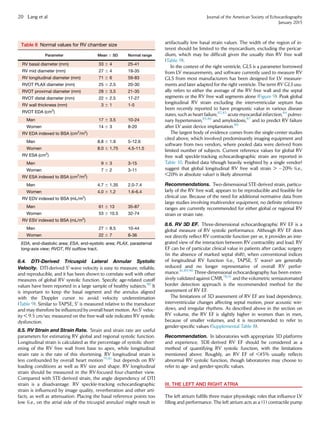
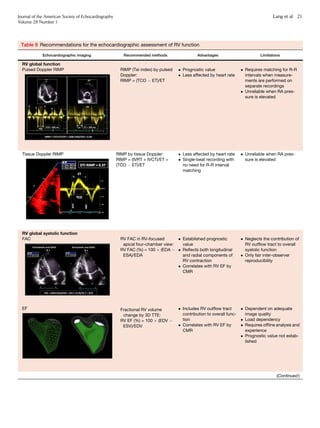
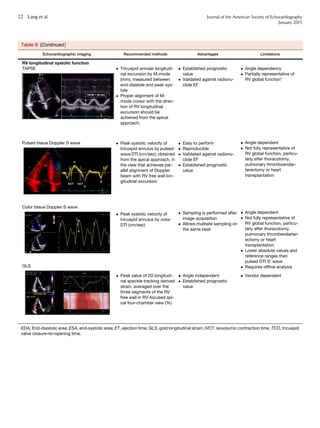
are summarized in Tables 7 and 9, whereas the new reference values
are displayed in Tables 8 and 10. These reference values are based on
published mean and SD data obtained from normal adult individuals
without any histories of heart or pulmonary disease (Supplemental
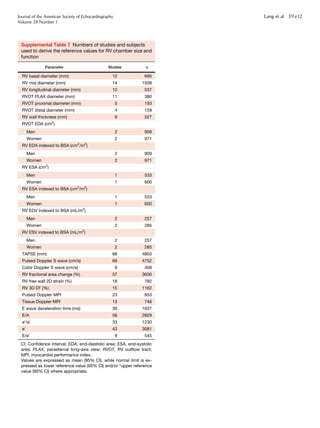
Table 7). This document uses the same methodology as in the previ-
ous RV guidelines, whereby a meta-analysis was performed for each
parameter.
Not all of the recommended values are identical to those published
in the previous guidelines.71
On the basis of the inclusion of new data
published in recent reports, minor changes were made in the cutoff
values for RV dimension, S0
, TAPSE, and RIMP. New publications
since the last guidelines have resulted in changes in the reference
values for 3DE-derived RV EF and volumes (Tables 8 and 10). It is
important for the reader to recognize that most of the values
proposed are not indexed to gender, BSA, or height, despite data
suggesting the advantages of indexing.72-75
As a result, it is possible
that patients at either extreme of height or BSA may be
misclassified as having values outside the reference ranges, and it is
recommended that the interpreting physician consider these
parameters when generating the report. This potential
misclassification also applies to other groups, such as patients with
congenital heart disease and endurance athletes, for whom specific
reference values are nonexistent.76
6. Essential Imaging Windows and Views
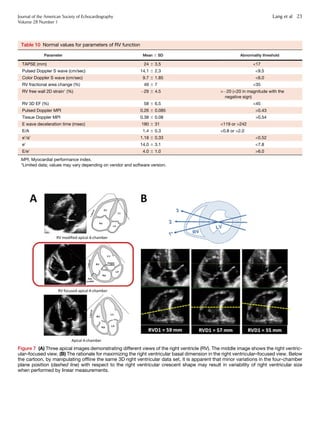
Apical four-chamber, RV-focused apical four-chamber and modified
apical four-chamber (Figure 7A), left parasternal long- and
16 Lang et al Journal of the American Society of Echocardiography
January 2015
short-axis, left parasternal RV inflow, and subcostal views provide the
images required for a comprehensive assessment of RV size, systolic
and diastolic function, and RV systolic pressures.71
In most cases, in
the RV-focused view, visualization of the entire RV free wall is better
than in a standard four-chamber view, which is centered on the left
ventricle. It is therefore recommended that to measure the right
ventricle, a dedicated view focused on the right ventricle be used.
Figure 7A and Table 7 show the different RV views and recommen-
dations for measurements.
7. RV Measurements
7.1. Linear Measurements. Quantitation of RV dimensions is
critical and reduces interreader variability compared with visual
assessment alone.77
Measurements by 2DE are challenging because
of the complex geometry of the right ventricle and the lack of spe-
cific right-sided anatomic landmarks to be used as reference points.
The conventional apical four-chamber view (i.e., focused on the left
ventricle) results in considerable variability in how the right heart is
sectioned, and consequently, RV linear dimensions and areas may
vary widely in the same patient with relatively minor rotations in
transducer position (Figure 7B). RV dimensions are best estimated
from a RV-focused apical four-chamber view obtained with either
lateral or medial transducer orientation (Figure 7A and Table 7).
Care should be taken to obtain the image with the LV apex at the
center of the scanning sector, while displaying the largest basal RV
diameter and thus avoiding foreshortening. Of note, the accuracy
of RV measurements may be limited when the RV free wall is
not well defined because of the dimension of the ventricle itself
or its position behind the sternum. Recent data have suggested
that indexing RV ‘‘size’’ to BSA may be relevant in some circum-
stances, but the measurements used in those studies lacked the
reference points of the RV-focused view and frequently used RV
areas, rather than linear dimensions.73,74
Reference values for RV
dimensions are listed in Table 8. In general, a diameter 41 mm
at the base and 35 mm at the midlevel in the RV-focused view in-
dicates RV dilatation.
7.2. Volumetric Measurements. Three-dimensional echocardi-
ography allows measurements of RV volumes (Figure 8), thereby
overcoming the limitations of conventional 2DE RV views with
respect to orientation and reference points. Although technically chal-
lenging, particularly in patients with imperfect image quality or
severely enlarged right ventricles, a reasonably accurate estimate of
RV EDV and ESV can be obtained, and RV EF can be calculated.
Practical recommendations regarding RV 3D imaging and analysis
have been recently published by the European Association of
Echocardiography and the ASE.61
During analysis of RV volume, it
is critically important to manually define end-diastolic and end-
systolic frames using maximal and minimal RV volumes, respectively,
rather than LV chamber changes (Table 7). Myocardial trabeculae and
the moderator band should be included in the cavity, and RV con-
tours on dynamic images should closely follow endocardial displace-
ment and excursion of the tricuspid annulus throughout the cardiac
cycle.
Even though 3DE tends to underestimate RV volumes compared
CMR,78
3DE has identified relationships between RV volumes and
EF to age and gender, which are very similar to those described by
CMR.72
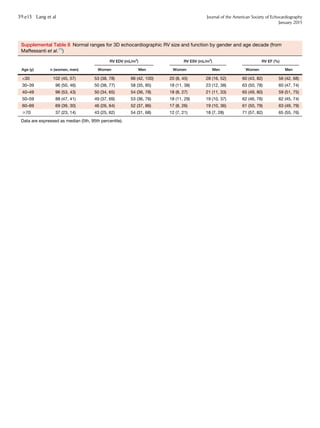
Overall, women have smaller 3D echocardiographic RV vol-
umes,despiteindexingtoBSA,andhigherEFs.75
Also,olderageisasso-
ciated with smaller volumes (expected decrements of 5 mL/decade
for EDV and 3 mL/decade for ESV) and higher EF (an expected
increment of 1% per decade).75
Reference values of 3DE-derived
RV volumes (indexed to BSA) and EF obtained from the meta-
analyses of all studies are summarized in Tables 8 and 10. Details
of the above-described study factoring in age, gender, and BSA
are listed in Supplemental Table 8.75
Although RV volumes by
CMR appear to be significantly influenced by race,72
no 3D echo-
cardiographic data are yet available.
Recommendations. RV size should be routinely assessed by con-
ventional 2DE using multiple acoustic windows, and the report
should include both qualitative and quantitative parameters. In labo-
ratories with experience in 3DE, when knowledge of RV volumes
may be clinically important, 3D measurement of RV volumes is rec-
ommended. Although normal 3D echocardiographic values of RV
volumes need to be established in larger groups of subjects, current
published data suggest RV EDVs of 87 mL/m2
in men and 74 mL/m2
Table 6 Normal ranges for LV mass indices
Women Men
Linear method
LV mass (g) 67–162 88–224
LV mass/BSA (g/m2
) 43–95 49–115
Relative wall thickness (cm) 0.22–0.42 0.24–0.42
Septal thickness (cm) 0.6–0.9 0.6–1.0
Posterior wall thickness (cm) 0.6–0.9 0.6–1.0
2D method
LV mass (g) 66–150 96–200
LV mass/BSA (g/m2
) 44–88 50–102
Bold italic values: recommended and best validated.
Figure 6 Comparison of RWT. Patients with normal LV mass
can have either concentric remodeling (normal LV mass with
increased RWT $ 0.42) or normal geometry (RWT # 0.42) and
normal LV mass. Patients with increased LV mass can have
either concentric (RWT $ 0.42) or eccentric (RWT # 0.42) hyper-
trophy. These LV mass measurements are based on linear mea-
surements.
Journal of the American Society of Echocardiography
Volume 28 Number 1
Lang et al 17
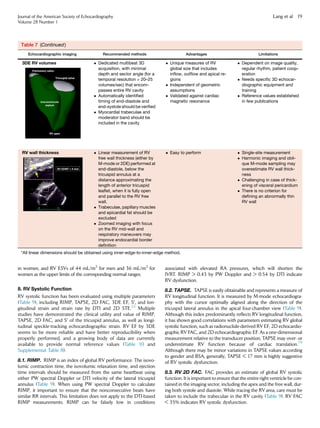
Table 7 Recommendations for the echocardiographic assessment of RV size
Echocardiographic imaging Recommended methods Advantages Limitations
RV linear dimensions (inflow)*  Basal RV linear dimension
(RVD1) = maximal transversal
dimension in the basal one
third of RV inflow at end-
diastole in the RV-focused
view
 Mid-cavity RV linear dimen-
sion (RVD2) = transversal RV
diameter in the middle third of
RV inflow, approximately
halfway between the maximal
basal diameter and the apex,
at the level of papillary mus-
cles at end-diastole.
 Easily obtainable
 Simple
 Fast
 Wealth of published data
 RV size may be underesti-
mated due to the crescent RV
shape
 RV linear dimensions are
dependent on probe rotation
and different RV views; in or-
der to permit inter-study
comparison, the
echocardiography report
should state the window from
which the measurement was
performed.
RV linear dimensions
(outflow)*
 Proximal RV outflow diameter
(RVOT prox) = linear dimen-
sion measured from the
anterior RV wall to the inter-
ventricular septal-aortic
junction (in parasternal long-
axis view) or to the aortic
valve (in parasternal short-
axis) at end-diastole
 Distal RV outflow diameter
(RVOT distal) = linear trans-
versal dimension measured
just proximal to the pulmo-
nary valve at end-diastole
 Easily obtainable
 Simple
 Fast
 RVOT prox is dependent on
imaging plane position and
less reproducible than RVOT
distal
 Risk of underestimation or
overestimation if the RV view
is obliquely oriented with
respect to RV outflow tract
 RV outflow dimensions can
be inaccurate in case of chest
and spine deformities
 Endocardial definition of the
RV anterior wall is often sub-
optimal
 Limited normative data is
available
 Regional measure; may not
reflect global RV size (under-
estimation or overestimation)
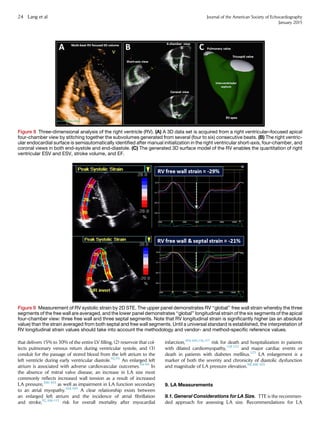
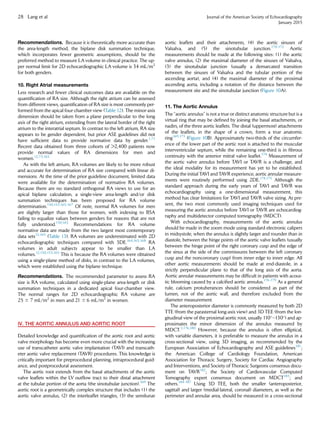
RV areas (inflow)  Manual tracing of RV endo-
cardial border from the lateral
tricuspid annulus along the
free wall to the apex and back
to medial tricuspid annulus,
along the interventricular
septum at end-diastole and at
end-systole
 Trabeculations, papillary
muscles and moderator band
are included in the cavity area
 Relatively easy to measure  Challenging in case of sub-
optimal image quality of RV
free wall
 Challenging in the presence
of trabeculation
 RV size underestimation if RV
cavity is foreshortened
 Due to the LV twisting motion
and the crescent RV shape,
the end-diastolic RV image
may not be in the same
tomographic plane as the
end-systolic one
 May not accurately reflect
global RV size (underestima-
tion or overestimation)
(Continued)
18 Lang et al Journal of the American Society of Echocardiography
January 2015
in women, and RV ESVs of 44 mL/m2
for men and 36 mL/m2
for
women as the upper limits of the corresponding normal ranges.
8. RV Systolic Function
RV systolic function has been evaluated using multiple parameters
(Table 9), including RIMP, TAPSE, 2D FAC, 3DE EF, S0
, and lon-
gitudinal strain and strain rate by DTI and 2D STE.25
Multiple
studies have demonstrated the clinical utility and value of RIMP,
TAPSE, 2D FAC, and S0
of the tricuspid annulus, as well as longi-
tudinal speckle-tracking echocardiographic strain. RV EF by 3DE
seems to be more reliable and have better reproducibility when
properly performed, and a growing body of data are currently
available to provide normal reference values (Table 10 and
Supplemental Table 8).
8.1. RIMP. RIMP is an index of global RV performance. The isovo-
lumic contraction time, the isovolumic relaxation time, and ejection
time intervals should be measured from the same heartbeat using
either PW spectral Doppler or DTI velocity of the lateral tricuspid
annulus (Table 9). When using PW spectral Doppler to calculate
RIMP, it important to ensure that the nonconsecutive beats have
similar RR intervals. This limitation does not apply to the DTI-based
RIMP measurements. RIMP can be falsely low in conditions
associated with elevated RA pressures, which will shorten the
IVRT. RIMP  0.43 by PW Doppler and  0.54 by DTI indicate
RV dysfunction.
8.2. TAPSE. TAPSE is easily obtainable and represents a measure of
RV longitudinal function. It is measured by M-mode echocardiogra-
phy with the cursor optimally aligned along the direction of the
tricuspid lateral annulus in the apical four-chamber view (Table 9).
Although this index predominantly reflects RV longitudinal function,
it has shown good correlations with parameters estimating RV global
systolic function, such as radionuclide-derived RV EF, 2D echocardio-
graphic RV FAC, and 2D echocardiographic EF. As a one-dimensional
measurement relative to the transducer position, TAPSE may over- or
underestimate RV function because of cardiac translation.79
Although there may be minor variations in TAPSE values according
to gender and BSA, generally, TAPSE  17 mm is highly suggestive
of RV systolic dysfunction.
8.3. RV 2D FAC. FAC provides an estimate of global RV systolic
function. It is important to ensure that the entire right ventricle be con-
tained in the imaging sector, including the apex and the free wall, dur-
ing both systole and diastole. While tracing the RV area, care must be
taken to include the trabeculae in the RV cavity (Table 9). RV FAC
 35% indicates RV systolic dysfunction.
Table 7 (Continued)
Echocardiographic imaging Recommended methods Advantages Limitations
3DE RV volumes  Dedicated multibeat 3D
acquisition, with minimal
depth and sector angle (for a
temporal resolution  20–25
volumes/sec) that encom-
passes entire RV cavity
 Automatically identified
timing of end-diastole and
end-systole should be verified
 Myocardial trabeculae and
moderator band should be
included in the cavity
 Unique measures of RV
global size that includes
inflow, outflow and apical re-
gions
 Independent of geometric
assumptions
 Validated against cardiac
magnetic resonance
 Dependent on image quality,
regular rhythm, patient coop-
eration
 Needs specific 3D echocar-
diographic equipment and
training
 Reference values established
in few publications
RV wall thickness  Linear measurement of RV
free wall thickness (either by
M-mode or 2DE) performed at
end-diastole, below the
tricuspid annulus at a
distance approximating the
length of anterior tricuspid
leaflet, when it is fully open
and parallel to the RV free
wall.
 Trabeculae, papillary muscles
and epicardial fat should be
excluded
 Zoomed imaging with focus
on the RV mid-wall and
respiratory maneuvers may
improve endocardial border
definition
 Easy to perform  Single-site measurement
 Harmonic imaging and obli-
que M-mode sampling may
overestimate RV wall thick-
ness
 Challenging in case of thick-
ening of visceral pericardium
 There is no criterion for
defining an abnormally thin
RV wall
*All linear dimensions should be obtained using inner-edge-to-inner-edge method.
Journal of the American Society of Echocardiography
Volume 28 Number 1
Lang et al 19
8.4. DTI-Derived Tricuspid Lateral Annular Systolic
Velocity. DTI-derived S0
-wave velocity is easy to measure, reliable,
and reproducible, and it has been shown to correlate well with other
measures of global RV systolic function. Specific age-related cutoff
values have been reported in a large sample of healthy subjects.80
It
is important to keep the basal segment and the annulus aligned
with the Doppler cursor to avoid velocity underestimation
(Table 9). Similar to TAPSE, S0
is measured relative to the transducer
and may therefore be influenced by overall heart motion. An S0
veloc-
ity  9.5 cm/sec measured on the free-wall side indicates RV systolic
dysfunction.
8.5. RV Strain and Strain Rate. Strain and strain rate are useful
parameters for estimating RV global and regional systolic function.
Longitudinal strain is calculated as the percentage of systolic short-
ening of the RV free wall from base to apex, while longitudinal
strain rate is the rate of this shortening. RV longitudinal strain is
less confounded by overall heart motion79,81
but depends on RV
loading conditions as well as RV size and shape. RV longitudinal
strain should be measured in the RV-focused four-chamber view.
Compared with STE-derived strain, the angle dependency of DTI
strain is a disadvantage. RV speckle-tracking echocardiographic
strain is influenced by image quality, reverberation and other arti-
facts, as well as attenuation. Placing the basal reference points too
low (i.e., on the atrial side of the tricuspid annulus) might result in
artifactually low basal strain values. The width of the region of in-
terest should be limited to the myocardium, excluding the pericar-
dium, which may be difficult given the usually thin RV free wall
(Table 9).
In the context of the right ventricle, GLS is a parameter borrowed
from LV measurements, and software currently used to measure RV
GLS from most manufacturers has been designed for LV measure-
ments and later adapted for the right ventricle. The term RV GLS usu-
ally refers to either the average of the RV free wall and the septal
segments or the RV free wall segments alone (Figure 9). Peak global
longitudinal RV strain excluding the interventricular septum has
been recently reported to have prognostic value in various disease
states, such as heart failure,82,83
acute myocardial infarction,84
pulmo-
nary hypertension,85,86
and amyloidosis,87
and to predict RV failure
after LV assist device implantation.88
The largest body of evidence comes from the single-center studies
cited above, which involved predominantly imaging equipment and
software from two vendors, where pooled data were derived from
limited number of subjects. Current reference values for global RV
free wall speckle-tracking echocardiographic strain are reported in
Table 10. Pooled data (though heavily weighted by a single vendor)
suggest that global longitudinal RV free wall strain  À20% (i.e.,
20% in absolute value) is likely abnormal.
Recommendations. Two-dimensional STE-derived strain, particu-
larly of the RV free wall, appears to be reproducible and feasible for
clinical use. Because of the need for additional normative data from
large studies involving multivendor equipment, no definite reference
ranges are currently recommended for either global or regional RV
strain or strain rate.
8.6. RV 3D EF. Three-dimensional echocardiographic RV EF is a
global measure of RV systolic performance. Although RV EF does
not directly reflect RV contractile function per se, it provides an inte-
grated view of the interaction between RV contractility and load. RV
EF can be of particular clinical value in patients after cardiac surgery
(in the absence of marked septal shift), when conventional indices
of longitudinal RV function (i.e., TAPSE, S0
wave) are generally
reduced and no longer representative of overall RV perfor-
mance.81,89,90
Three-dimensional echocardiography has been exten-
sively validated against CMR,78,91
and the volumetric semiautomated
border detection approach is the recommended method for the
assessment of RV EF.
The limitations of 3D assessment of RV EF are load dependency,
interventricular changes affecting septal motion, poor acoustic win-
dows, and irregular rhythms. As described above in the section on
RV volume, the RV EF is slightly higher in women than in men,
because of smaller volumes, and it is recommended to refer to
gender-specific values (Supplemental Table 8).
Recommendation. In laboratories with appropriate 3D platforms
and experience, 3DE-derived RV EF should be considered as a
method of quantifying RV systolic function, with the limitations
mentioned above. Roughly, an RV EF of 45% usually reflects
abnormal RV systolic function, though laboratories may choose to
refer to age- and gender-specific values.
III. THE LEFT AND RIGHT ATRIA
The left atrium fulfills three major physiologic roles that influence LV
filling and performance. The left atrium acts as a (1) contractile pump
Table 8 Normal values for RV chamber size
Parameter Mean 6 SD Normal range
RV basal diameter (mm) 33 6 4 25-41
RV mid diameter (mm) 27 6 4 19-35
RV longitudinal diameter (mm) 71 6 6 59-83
RVOT PLAX diameter (mm) 25 6 2.5 20-30
RVOT proximal diameter (mm) 28 6 3.5 21-35
RVOT distal diameter (mm) 22 6 2.5 17-27
RV wall thickness (mm) 3 6 1 1-5
RVOT EDA (cm2
)
Men 17 6 3.5 10-24
Women 14 6 3 8-20
RV EDA indexed to BSA (cm2
/m2
)
Men 8.8 6 1.9 5-12.6
Women 8.0 6 1.75 4.5-11.5
RV ESA (cm2
)
Men 9 6 3 3-15
Women 7 6 2 3-11
RV ESA indexed to BSA (cm2
/m2
)
Men 4.7 6 1.35 2.0-7.4
Women 4.0 6 1.2 1.6-6.4
RV EDV indexed to BSA (mL/m2
)
Men 61 6 13 35-87
Women 53 6 10.5 32-74
RV ESV indexed to BSA (mL/m2
)
Men 27 6 8.5 10-44
Women 22 6 7 8-36
EDA, end-diastolic area; ESA, end-systolic area; PLAX, parasternal
long-axis view; RVOT, RV outflow tract.
20 Lang et al Journal of the American Society of Echocardiography
January 2015
Table 9 Recommendations for the echocardiographic assessment of RV function
Echocardiographic imaging Recommended methods Advantages Limitations
RV global function
Pulsed Doppler RIMP RIMP (Tei index) by pulsed
Doppler:
RIMP = (TCO À ET)/ET
 Prognostic value
 Less affected by heart rate
 Requires matching for R-R
intervals when measure-
ments are performed on
separate recordings
 Unreliable when RA pres-
sure is elevated
Tissue Doppler RIMP RIMP by tissue Doppler:
RIMP = (IVRT + IVCT)/ET =
(TCO À ET)/ET
 Less affected by heart rate
 Single-beat recording with
no need for R-R interval
matching
 Unreliable when RA pres-
sure is elevated
RV global systolic function
FAC
EF
RV FAC in RV-focused
apical four-chamber view:
RV FAC (%) = 100 Â (EDA À
ESA)/EDA
Fractional RV volume
change by 3D TTE:
RV EF (%) = 100 Â (EDV À
ESV)/EDV
 Established prognostic
value
 Reflects both longitudinal
and radial components of
RV contraction
 Correlates with RV EF by
CMR
 Includes RV outflow tract
contribution to overall func-
tion
 Correlates with RV EF by
CMR
 Neglects the contribution of
RV outflow tract to overall
systolic function
 Only fair inter-observer
reproducibility
 Dependent on adequate
image quality
 Load dependency
 Requires offline analysis and
experience
 Prognostic value not estab-
lished
(Continued)
Journal of the American Society of Echocardiography
Volume 28 Number 1
Lang et al 21
Table 9 (Continued)
Echocardiographic imaging Recommended methods Advantages Limitations
RV longitudinal systolic function
TAPSE
Pulsed tissue Doppler S wave
Color tissue Doppler S wave
GLS
 Tricuspid annular longitudi-
nal excursion by M-mode
(mm), measured between
end-diastole and peak sys-
tole
 Proper alignment of M-
mode cursor with the direc-
tion of RV longitudinal
excursion should be
achieved from the apical
approach.
 Peak systolic velocity of
tricuspid annulus by pulsed-
wave DTI (cm/sec), obtained
from the apical approach, in
the view that achieves par-
allel alignment of Doppler
beam with RV free wall lon-
gitudinal excursion
 Peak systolic velocity of
tricuspid annulus by color
DTI (cm/sec)
 Peak value of 2D longitudi-
nal speckle tracking derived
strain, averaged over the
three segments of the RV
free wall in RV-focused api-
cal four-chamber view (%)
 Established prognostic
value
 Validated against radionu-
clide EF
 Easy to perform
 Reproducible
 Validated against radionu-
clide EF
 Established prognostic
value
 Sampling is performed after
image acquisition
 Allows multisite sampling on
the same beat
 Angle independent
 Established prognostic
value
 Angle dependency
 Partially representative of
RV global function*
 Angle dependent
 Not fully representative of
RV global function, particu-
larly after thoracotomy,
pulmonary thromboendar-
terectomy or heart
transplantation
 Angle dependent
 Not fully representative of
RV global function, particu-
larly after thoracotomy,
pulmonary thrombendarter-
ectomy or heart
transplantation
 Lower absolute values and
reference ranges than
pulsed DTI S0
wave
 Requires offline analysis
 Vendor dependent
EDA, End-diastolic area; ESA, end-systolic area; ET, ejection time; GLS, gold longitudinal strain; IVCT, isovolumic contraction time; TCO, tricuspid
valve closure–to–opening time.
22 Lang et al Journal of the American Society of Echocardiography
January 2015
Table 10 Normal values for parameters of RV function
Parameter Mean 6 SD Abnormality threshold
TAPSE (mm) 24 6 3.5 17
Pulsed Doppler S wave (cm/sec) 14.1 6 2.3 9.5
Color Doppler S wave (cm/sec) 9.7 6 1.85 6.0
RV fractional area change (%) 49 6 7 35
RV free wall 2D strain* (%) À29 6 4.5 À20 (20 in magnitude with the
negative sign)
RV 3D EF (%) 58 6 6.5 45
Pulsed Doppler MPI 0.26 6 0.085 0.43
Tissue Doppler MPI 0.38 6 0.08 0.54
E wave deceleration time (msec) 180 6 31 119 or 242
E/A 1.4 6 0.3 0.8 or 2.0
e0
/a0
1.18 6 0.33 0.52
e0
14.0 6 3.1 7.8
E/e0
4.0 6 1.0 6.0
MPI, Myocardial performance index.
*Limited data; values may vary depending on vendor and software version.
Figure 7 (A) Three apical images demonstrating different views of the right ventricle (RV). The middle image shows the right ventric-
ular–focused view. (B) The rationale for maximizing the right ventricular basal dimension in the right ventricular–focused view. Below
the cartoon, by manipulating offline the same 3D right ventricular data set, it is apparent that minor variations in the four-chamber
plane position (dashed line) with respect to the right ventricular crescent shape may result in variability of right ventricular size
when performed by linear measurements.
Journal of the American Society of Echocardiography
Volume 28 Number 1
Lang et al 23
that delivers 15% to 30% of the entire LV filling, (2) reservoir that col-
lects pulmonary venous return during ventricular systole, and (3)
conduit for the passage of stored blood from the left atrium to the
left ventricle during early ventricular diastole.92,93
An enlarged left
atrium is associated with adverse cardiovascular outcomes.94-99
In
the absence of mitral valve disease, an increase in LA size most
commonly reflects increased wall tension as a result of increased
LA pressure,100-103
as well as impairment in LA function secondary
to an atrial myopathy.104,105
A clear relationship exists between
an enlarged left atrium and the incidence of atrial fibrillation
and stroke,92,106-115
risk for overall mortality after myocardial
infarction,104,105,116,117
risk for death and hospitalization in patients
with dilated cardiomyopathy,118-122
and major cardiac events or
death in patients with diabetes mellitus.123
LA enlargement is a
marker of both the severity and chronicity of diastolic dysfunction
and magnitude of LA pressure elevation.98,100-103
9. LA Measurements
9.1. General Considerations for LA Size. TTE is the recommen-
ded approach for assessing LA size. Recommendations for LA
Figure 9 Measurement of RV systolic strain by 2D STE. The upper panel demonstrates RV ‘‘global’’ free wall strain whereby the three
segments of the free wall are averaged, and the lower panel demonstrates ‘‘global’’ longitudinal strain of the six segments of the apical
four-chamber view: three free wall and three septal segments. Note that RV longitudinal strain is significantly higher (as an absolute
value) than the strain averaged from both septal and free wall segments. Until a universal standard is established, the interpretation of
RV longitudinal strain values should take into account the methodology and vendor- and method-specific reference values.
Figure 8 Three-dimensional analysis of the right ventricle (RV). (A) A 3D data set is acquired from a right ventricular–focused apical
four-chamber view by stitching together the subvolumes generated from several (four to six) consecutive beats. (B) The right ventric-
ular endocardial surface is semiautomatically identified after manual initialization in the right ventricular short-axis, four-chamber, and
coronal views in both end-systole and end-diastole. (C) The generated 3D surface model of the RV enables the quantitation of right
ventricular ESV and ESV, stroke volume, and EF.
24 Lang et al Journal of the American Society of Echocardiography
January 2015
quantification are summarized in Table 11. With TEE, the entire left
atrium frequently cannot be fit in the image sector. Accordingly,
TEE should not be used to assess LA size. LA size should be measured
at the end of LV systole, when the LA chamber is at its greatest dimen-
sion. While acquiring images to measure LA size and volumes, care
should be taken to avoid foreshortening of the left atrium. Because
the longitudinal axes of the left ventricle and left atrium frequently
lie in different planes, dedicated acquisitions of the left atrium from
the apical approach should be obtained for optimal LA volume mea-
surements. The base of the left atrium should be at its largest size, indi-
cating that the imaging plane passes through the maximal short-axis
area. LA length should also be maximized to ensure alignment along
the true long axis of the left atrium. When using the biplane disk sum-
mation method to calculate LA volumes, the lengths of the long axes
measured in the two- and four-chamber views should be similar.
When tracing the borders of the left atrium, the confluences of the
pulmonary veins and the LA appendage should be excluded. The
atrioventricular interface should be represented by the mitral annulus
plane, not by the tip of the mitral leaflets.
9.2. Linear Dimensions and Area Measurements. The most
widely used linear dimension is the LA anteroposterior (AP) measure-
ment in the parasternal long-axis view using M-mode echocardiogra-
phy or, preferably, 2DE.92,107,109,110,114,118,120,121,124,125
Although this
measurement has been used extensively in clinical practice and
research, it has become clear that frequently it may not represent an
accurate picture of LA size.126,127
Traditionally, the AP dimension
was widely used because it was known to be the most reproducible
measurement. However, assessment of LA size using only the AP
diameter assumes that when the left atrium enlarges, all its
dimensions change similarly, which is often not the case during LA
remodeling.128-130
Therefore, AP linear dimension should not be
used as the sole measure of LA size. LA area can be planimetered in
the apical four- and two-chamber views and normal values for these
parameters have been reported.12
Optimal contours should be ob-
tained orthogonally around the long axis of the left atrium from
good quality images while avoiding foreshortening.1
The ease with
which LA volumes can be obtained in clinical practice in conjunction
with the existing robust literature on normal values and the prognostic
value of LA volumes renders reporting of LA area unnecessary.
9.3. Volume Measurements. When assessing the LA size and re-
modeling, the measurement of LA volume is recommended.
Evaluation of volume takes into account alterations in LA chamber
size in all directions. LA volume has been shown to be a powerful
prognostic variable in a variety of cardiac disease
states.99,106,112,113,115-117,122,131-136
Compared with AP diameter, LA
volume has a stronger association with outcomes in cardiac
patients.113,137
Two-dimensional echocardiographic LA volumes are
typically smaller than those reported from computed tomography
or CMR.138-142
Measurements of LA volumes are important,
because they reflect the burden and chronicity of elevated LV filling
pressures and are a strong predictor of outcomes.
Different methods exist for measuring LA volumes. Although the
three linear measurements have been used to calculate LAvolume us-
ing an ellipsoid model,131,137,143
the relative inaccuracy of these linear
measurements limits this method. LA volume should be measured
using the disk summation algorithm, similar to that used to measure
LV volume (Table 11).144,145
The LA endocardial borders should be traced in both the apical
four- and two-chamber views. A single-plane approach can also be
used, but this method is based on the geometric assumption that
the left atrium is circular in the short-axis cut plane, which may not
be always accurate.146
Although not recommended for routine use,
this approach could be used in cases when planimetry in both views
is difficult. Single-plane apical four-chamber indexed LA volumes are
typically 1 to 2 mL/m2
smaller than apical two-chamber vol-
umes.12,146
Alternatively, a biplane calculation could also be performed using
the LA areas and lengths measured from both the apical four- and
two-chamber views (Table 11). Although the area-length method still
assumes an ellipsoidal LA shape, it has the advantage of reducing
linear dimensions to only two measurements of atrial length, of which
the shorter one is selected.98,147
9.4. Normal Values of LA Measurements. Since the publication
of the 2005 chamber quantification guidelines, two articles have re-
ported normal values for LA linear measurements.12,143
These
values were in keeping with prior recommendations, and
accordingly, no modifications have been made to the normal values
of LA AP diameters (Supplemental Table 9). Although not recom-
mended for routine clinical use, normal values for apical four- and
two-chamber linear measurements and nonindexed LA area and vol-
ume measurements have been reported.12
LA size is dependent on gender. However the gender differences in
LA size are generally accounted for when adjusting for body size.12
Several indexing methods have been proposed,137,148
but indexing
to BSA has yielded the most available data and is recommended by
the writing group. Indexing by BSA accounts for the gender
differences in LA size, such that only the indexed value should be
reported.93,137,149,150
In the prior chamber quantification guideline document, the re-
ported BSA-indexed LA volume normal values were based on two
studies performed in a small number of subjects.98,144
Since the
publication of that document, eight additional studies (1,234
patients) describing normal values of LA volumes using the area-
length ellipsoid or the disk summation techniques have been
reported.11,12,145,147,151-155
This has resulted in a change in the
recommended upper normal indexed LA volume to 34 mL/m2
(previously 28 mL/m2
). In addition, LA volume data became
available in 1,331 patients from the five databases described earlier
in this document, wherein the mean calculated LA volume was
25 mL/m2
. This upper normal revised value of 34 mL/m2
also
seems to fit in well with a risk-based approachfor determination of cut-
offs between a normal and an enlarged left atrium.106,123,134,136
This
cutoff value is also consistent with the ASE and European
Association of Echocardiography guideline document on evaluation
of diastolic function.156
The 2DE-derived biplane LA volumes are
listed in Table 4, including normal ranges and severity partition cutoffs.
Of note, LA volume can be increased in elite athletes, which needs to
be taken into account to avoid misinterpretation as abnormal.146
Three-dimensional echocardiography holds promise for assessing
LA volume and correlates with cardiac computed tomogra-
phy157,158
and magnetic resonance imaging.159,160
Compared with
2D assessment of LA volume, 3DE is more accurate compared
with CMR159,160
and has superior prognostic ability.161,162
Three-
dimensional echocardiographic LA volumes are typically larger
than 2D echocardiographic volumes in most studies.160,163
Despite these advantages, the lack of a standardized methodology
and limited normative data164
prevent this committee from recom-
mending the use of 3D echocardiographic normal values at this
time.
Journal of the American Society of Echocardiography
Volume 28 Number 1
Lang et al 25
Table 11 Recommendations for the echocardiographic assessment of LA size
Parameter and method Echocardiographic imaging Advantages Limitations
Internal linear
dimensions.
The anteroposterior
diameter of the left atrium
can be measured in the
parasternal long-axis view
perpendicular to the aortic
root long axis, and
measured at the level of the
aortic sinuses by using the
leading-edge to leading-
edge convention.
M-mode tracing
2D-guided linear measurements
 Reproducible
 High temporal resolution
 Wealth of published data
 Facilitates orientation
perpendicular to LA
posterior wall
Single dimension not rep-
resentative of actual LA
size (particularly in dilated
atria)
 Lower frame rates than in
M-mode
 Single dimension only
Area.
Measured in four-chamber
apical view, at end-systole,
on the frame just prior to
mitral valve opening by
tracing the LA inner border,
excluding the area under
the mitral valve annulus
and the inlet of the
pulmonary veins.
2D images  More representative of
actual LA size than ante-
roposterior diameter only
 Need for a dedicated
view to avoid LA fore-
shortening
 Assumes a symmetric
shape of the atrium
(Continued)
26 Lang et al Journal of the American Society of Echocardiography
January 2015
Table 11 (Continued)
Parameter and method Echocardiographic imaging Advantages Limitations
Volume.
2D volumetric
measurements are based
on tracings of the blood-
tissue interface on apical
four- and two-chamber
views. At the mitral valve
level, the contour is closed
by connecting the two
opposite sections of the
mitral annulus with a
straight line. Endocardial
tracing should exclude
atrial appendage and
pulmonary veins. LA length
L is defined as the shortest
of the two long axes
measured in the apical
two- and four-chamber
views (to provide reliable
calculations the two
lengths should not differ
more than 5 mm). Volumes
can be computed by using
the area-length
approximation:
8
3p

ðA1$A2Þ
L

where A1 and A2 are the
corresponding LA areas.
Alternatively LA volume
can be calculated using the
disk summation technique
by adding the volume of a
stack of cylinders of height
h and area calculated by
orthogonal minor and
major transverse axes (D1
and D2) assuming an oval
shape:
p=4ðhÞ
P
ðD1ÞðD2Þ
3D data sets are usually
obtained from the apical
approach using a multibeat
full-volume acquisition
2DE
Area-length technique
Biplane method of disks
3D data sets
 Enables accurate
assessment of the
asymmetric remodeling
of the left atrium
 More robust predictor of
cardiovascular events
than linear or area mea-
surements
 No geometrical assump-
tion about LA shape
 More accurate when
compared to 2D mea-
surements
 Geometric assumptions
about LA shape
 Few accumulated data
on normal population
 Single plane volume cal-
culations are inaccurate
since they are based on
the assumption that A1 =
A2
 Dependent on adequate
image quality
 Lower temporal resolu-
tion
 Limited data on normal
values
 Patient’s cooperation
required
Journal of the American Society of Echocardiography
Volume 28 Number 1
Lang et al 27
Recommendations. Because it is theoretically more accurate than
the area-length method, the biplane disk summation technique,
which incorporates fewer geometric assumptions, should be the
preferred method to measure LA volume in clinical practice. The up-
per normal limit for 2D echocardiographic LA volume is 34 mL/m2
for both genders.
10. Right Atrial measurements
Less research and fewer clinical outcomes data are available on the
quantification of RA size. Although the right atrium can be assessed
from different views, quantification of RA size is most commonly per-
formed from the apical four-chamber view (Table 12). The minor-axis
dimension should be taken from a plane perpendicular to the long
axis of the right atrium, extending from the lateral border of the right
atrium to the interatrial septum. In contrast to the left atrium, RA size
appears to be gender dependent, but prior ASE guidelines did not
have sufficient data to provide normative data by gender.1,71
Recent data obtained from three cohorts of 2,400 patients now
provide normal values of RA dimensions for men and
women.12,73,165
As with the left atrium, RA volumes are likely to be more robust
and accurate for determination of RA size compared with linear di-
mensions. At the time of the prior guideline document, limited data
were available for the determination of normative RA volumes.
Because there are no standard orthogonal RA views to use for an
apical biplane calculation, a single-view area-length and/or disk
summation techniques has been proposed for RA volume
determination.150,153,165-167
Of note, normal RA volumes for men
are slightly larger than those for women, with indexing to BSA
failing to equalize values between genders for reasons that are not
fully understood.150,165
Recommendations for RA volume
normative data are made from the two largest most contemporary
data sets12,165
(Table 13). RA volumes are underestimated with 2D
echocardiographic techniques compared with 3DE.164,165,168
RA
volumes in adult subjects appear to be smaller than LA
volumes.12,150,153,165
This is because the RA volumes were obtained
using a single-plane method of disks, in contrast to the LA volumes,
which were established using the biplane technique.
Recommendations. The recommended parameter to assess RA
size is RA volume, calculated using single-plane area-length or disk
summation techniques in a dedicated apical four-chamber view.
The normal ranges for 2D echocardiographic RA volume are
25 6 7 mL/m2
in men and 21 6 6 mL/m2
in women.
IV. THE AORTIC ANNULUS AND AORTIC ROOT
Detailed knowledge and quantification of the aortic root and aortic
valve morphology has become even more crucial with the increasing
use of transcatheter aortic valve implantation (TAVI) and transcath-
eter aortic valve replacement (TAVR) procedures. This knowledge is
critically important for preprocedural planning, intraprocedural guid-
ance, and postprocedural assessment.
The aortic root extends from the basal attachments of the aortic
valve leaflets within the LV outflow tract to their distal attachment
at the tubular portion of the aorta (the sinotubular junction).169
The
aortic root is a geometrically complex structure that includes (1) the
aortic valve annulus, (2) the interleaflet triangles, (3) the semilunar
aortic leaflets and their attachments, (4) the aortic sinuses of
Valsalva, and (5) the sinotubular junction.170-172
Aortic
measurements should be made at the following sites: (1) the aortic
valve annulus, (2) the maximal diameter of the sinuses of Valsalva,
(3) the sinotubular junction (usually a demarcated transition
between the sinuses of Valsalva and the tubular portion of the
ascending aorta), and (4) the maximal diameter of the proximal
ascending aorta, including a notation of the distance between the
measurement site and the sinotubular junction (Figure 10A).
11. The Aortic Annulus
The ‘‘aortic annulus’’ is not a true or distinct anatomic structure but is a
virtual ring that may be defined by joining the basal attachments, or
nadirs, of the three aortic leaflets. The distal (uppermost) attachments
of the leaflets, in the shape of a crown, form a true anatomic
ring169,173
(Figure 10B). Approximately two-thirds of the circumfer-
ence of the lower part of the aortic root is attached to the muscular
interventricular septum, while the remaining one-third is in fibrous
continuity with the anterior mitral valve leaflet.174
Measurement of
the aortic valve annulus before TAVI or TAVR is a challenge, and
the ideal modality for its measurement has yet to be established.
During the initial TAVI and TAVR experience, aortic annular measure-
ments were routinely performed using 2DE.174,175
Although the
standard approach during the early years of TAVI and TAVR was
echocardiography using a one-dimensional measurement, this
method has clear limitations for TAVI and TAVR valve sizing. At pre-
sent, the two most commonly used imaging techniques used for
measuring the aortic annulus before TAVI or TAVR are echocardiog-
raphy and multidetector computed tomography (MDCT).
With echocardiography, measurements of the aortic annulus
should be made in the zoom mode using standard electronic calipers
in midsystole, when the annulus is slightly larger and rounder than in
diastole, between the hinge points of the aortic valve leaflets (usually
between the hinge point of the right coronary cusp and the edge of
the sinus at the side of the commissures between the left coronary
cusp and the noncoronary cusp) from inner edge to inner edge. All
other aortic measurements should be made at end-diastole, in a
strictly perpendicular plane to that of the long axis of the aorta.
Aortic annular measurements may be difficult in patients with acous-
tic blooming caused by a calcified aortic annulus.176-179
As a general
rule, calcium protuberances should be considered as part of the
lumen, not of the aortic wall, and therefore excluded from the
diameter measurement.
The anteroposterior diameter is commonly measured by both 2D
TTE (from the parasternal long-axis view) and 3D TEE (from the lon-
gitudinal view of the proximal aortic root, usually 110
–130
) and ap-
proximates the minor dimension of the annulus measured by
MDCT.3,176,180
However, because the annulus is often elliptical,
with variable diameters, it is preferable to measure the annulus in a
cross-sectional view, using 3D imaging, as recommended by the
European Association of Echocardiography and ASE guidelines181
;
the American College of Cardiology Foundation, American
Association for Thoracic Surgery, Society for Cardiac Angiography
and Interventions, and Society of Thoracic Surgeons consensus docu-
ment on TAVR182
; the Society of Cardiovascular Computed
Tomography expert consensus document on MDCT183
; and
others.184-187
Using 3D TEE, both the smaller (anteroposterior,
sagittal) and larger (medial-lateral, coronal) diameters, as well as the
perimeter and annular area, should be measured in a cross-sectional
28 Lang et al Journal of the American Society of Echocardiography
January 2015
Table 12 Recommendations for the echocardiographic assessment of RA size
Parameter and method Echocardiographic imaging Advantages Limitations
Linear dimensions.
The minor axis of the right atrium
should be measured in the apical
four-chamber view as the
distance between the lateral RA
wall and interatrial septum, at the
midatrial level defined by half of
RA long axis
2D-guided linear measurements  Easy to obtain
 Established normal values
 Single dimension only
 Assumes that RA enlargement
is symmetrical
 View dependent
Area.
Measured in the apical four-
chamber view at end-systole, on
the frame just prior to tricuspid
valve opening, by tracing the RA
blood-tissue interface, excluding
the area under the tricuspid valve
annulus.
2D view  More representative of actual
RA size than linear dimensions
 Established normal values
 Need of a dedicated view to
avoid RA foreshortening
 Assumes a symmetrical shape
of the cavity
 View dependent
Volume.
2D volumetric measurements are
usually based on tracings of the
blood-tissue interface on the
apical four-chamber view. At the
tricuspid valve level, the contour is
closed by connecting the two
opposite sections of the tricuspid
ring with a straight line. Volumes
can be computed by using either
the single plane area-length:
8
3p

ðAÞ2
L
#
or the disks summation technique.
3D data sets are usually obtained
from the apical approach using a
full-volume acquisition
2D view
3D data sets
 More representative of actual
RA size than linear dimensions
 No geometrical assumption
 Established normal values
 Assumes a symmetrical shape
of the cavity
 Single plane volume calculation
may be inaccurate since it as-
sumes that RA enlargement is
symmetrical
 Normal values not well estab-
lished
 Dependent on image quality
 Lower temporal resolution
 Patient’s cooperation required
Journal of the American Society of Echocardiography
Volume 28 Number 1
Lang et al 29
view in midsystole (Figure 11). It should be noted that the difference
between major and minor diameters may be up to 6 mm.173,188-193
For a detailed, step-by-step approach to making these measurements
using 3D TEE, which is beyond the scope of this document, the reader
is referred to four recent publications.184-187
By using these
techniques, close agreement with MDCT can be achieved.184,185
It should be noted that proponents of each of the two modalities
(3D TEE and MDCT) tout advantages. In fact, each of these
methods has certain strengths and limitations. Limitations of
MDCT include the need for contrast media, radiation exposure,
inability to obtain real-time measurements during the procedure,
and the need to control the heart rate for suitable gating. Three-
dimensional TEE also has limitations. First, the software required
to use the methodology described by Kasel et al.184
and Pershad
et al.185
is not currently available on all echocardiographic platforms.
Second, visualization of the anterior portion of the annulus can be
obscured by echo ‘‘dropout’’ due to annular calcification. In addition,
calcification at the level of the annulus may hinder the ability to
determine boundary definition and may make its shape irregular.
Third, the plane formed by the nadirs of the three cusps is often
not orthogonal to the LV outflow tract or aortic root; frequently
the insertion of the right coronary cusp is inferior to that of the
left and noncoronary cusps.183
Fourth, both the spatial and temporal
resolution of 3D echocardiography is currently limited. Last, this
technique is operator dependent and may be difficult at times,
even in experienced hands.173,174
Because of these potential
limitations, it is desirable to use a multimodality approach for
aortic annular measurement.
12. The Aortic Root
With 2D TTE, the diameter of the aortic root (at the maximal diam-
eter of the sinuses of Valsalva) should be obtained from the paraster-
nal long-axis view, which depicts the aortic root and the proximal
ascending aorta. This plane is slightly different from that of the long
axis of the left ventricle (Figure 10A). Acquisition of this LV long-
axis view may be performed from different intercostal spaces and
at various distances from the left sternal border. Use of simultaneous
biplane orthogonal images provided by matrix transducers may be
helpful. The tubular ascending aorta is often not adequately visualized
from a standard parasternal window. In these instances, moving the
transducer closer to the sternum may allow visualization of a longer
portion of the ascending aorta. In addition, the ascending aorta may
sometimes be well visualized from right parasternal windows in the
second or third intercostal space, especially when the aorta is dilated.
Measurements should be made in the view that depicts the
maximum aortic diameter perpendicular to the long axis of the aorta.
In patients with tricuspid aortic valves, the closure line of the leaflets
(typically the right coronary cusp and the noncoronary cusp) is in the
center of the aortic root lumen, and the closed leaflets are seen on the
aortic side of a line connecting the hinge points of the two visualized
leaflets. An asymmetric closure line, in which the tips of the closed
leaflets are closer to one of the hinge points, is an indication that
the cross-section is not encompassing the largest root diameter
(Figure 12).
Unfortunately, there is no uniform method of measurement of the
aortic root and aorta. Echocardiography uses the leading edge–to–
leading edge (L-L) convention, but other techniques, such as
MDCT and CMR, use the inner edge–to–inner edge (I-I) or outer
edge–to–outer edge convention. In the consensus document,194
the ASE and EACVI writing committee took the initiative to provide
a common standard for measurement of the aortic root and aorta by
recommending a switch to the I-I convention for echocardiography.
However, this goal of achieving uniformity among modalities was ul-
timately abandoned for several reasons. First, currently used long-
standing reference values for the aorta were obtained using the L-L
convention.195,196
Second, the L-L convention provides statistically
Table 13 Normal RA size obtained from 2D
echocardiographic studies
Women Men
RA minor axis dimension (cm/m2
) 1.9 6 0.3 1.9 6 0.3
RA major axis dimension (cm/m2
) 2.5 6 0.3 2.4 6 0.3
2D echocardiographic RA volume (mL/m2
) 21 6 6 25 6 7
Data are expressed as mean 6 SD.
Figure 10 (A) Sites for measurements of the aortic root and
ascending aorta. This diagram illustrates the four sites at which
measurements are recommended (light blue arrows): (1) the aortic
valve annulus (hinge point of aortic leaflets), (2) the sinuses of
Valsalva (maximal diameter, usually the midpoint), (3) the sinotub-
ular junction, and (4) the proximal ascending aorta (the distance
between the measurement site and the annular plane [purple ar-
rowheads] should always be reported). The aortic annulus should
be measured at peak systole, in contrast to the other dimensions,
which are measured at end-diastole. The dashed lines, depicting
the longitudinal axis of the left ventricle (LV) and that of the aortic
root and proximal ascending aorta, are different. Note that the
angle between these two axes varies from individual to individual
and with age and pathology. (B) Normal anatomy of the aortic
annulus. The aortic annulus accounts for the tightest part of the
aortic root and is defined as a virtual ring (shaded) with three
anatomic anchor points at the nadir of each of the attachments
of the three aortic leaflets. Reproduced with permission from
Kasel et al.184
Ao, Aorta; LA, left atrium.
30 Lang et al Journal of the American Society of Echocardiography
January 2015
larger diameters than the I-I convention (by 2–4 mm), and switching
to the I-I convention raised a concern that patients at potential risk for
developing life-threatening complications such as aortic dissection
and/or rupture would fall below a threshold for intervention recom-
mendation by current guidelines. Accordingly, the aortic annulus
should be measured using the I-I convention, but we continue to
recommend the L-L convention for measurements of the aortic
root and aorta.
Two-dimensional echocardiographic aortic diameter measure-
ments are preferable to M-mode measurements, because cardiac mo-
tion may result in changes in the position of the M-mode cursor
relative to the maximum diameter of the sinuses of Valsalva. This
Figure 11 The smaller (antero-posterior, sagittal) aortic root diameter is measured using CT (A) or 3D TEE (C, zoomed cross sectional
view) between the inner edges of the left (L) and non-coronary (NC) commissure to the opposite right (R) coronary sinus (A and C,
yellow double arrows). The larger diameter (medial-lateral) is measured from the middle of the right sinus to the most distal point
of the NC sinus (A and C, purple double arrows). Panel B shows zoomed cross-sectional CT views of aortic root at the sinus of
Valsalva level using a double oblique image for orientation. Panel D shows a long-axis view of the aorta in obtained by multiplanar
reconstruction. The red lines in (B) and (D) represent the planes from which the diameter of the aortic root should be measured at
the level of the sinuses of Valsalva.
Figure 12 Correct (A) and incorrect (B, C) measurements of the aortic annulus (double arrows). (A) Centrally positioned diameter and
central closure of leaflets. Thin lines correspond to the long axis of the ascending aorta and, orthogonally, to correct orientation of the
annular diameter. (B) Incorrect, eccentric annular measurement. The hinge points are slightly displaced upward and do not corre-
spond to the nadir of the cusp attachments, with incomplete opening and closing of leaflets. (C) Incorrect, oblique annular measure-
ment. The annulus is ‘‘virtual’’ and only defined by the hinge-points of the three aortic valve leaflets. As such, much of the ring is
without a visible anatomic structure. However, its location on any long-axis two-dimensional view can be approximated since the
plane of the virtual annulus is approximately perpendicular to the long-axis of the aorta. When bisecting the maximum dimension
of the annulus in the sagittal plane, one will image the right coronary cusp anteriorly and the fibrous trigone between the left and
noncoronary cusps posteriorly. Because only one anatomic marker (the RCC hinge-point) is seen, the opposing annulus must be
approximated with a measurement that is perpendicular to the long axis of the aorta. Attempting to measure what you believe to
be 2 hinge-points (B and C) typically will measure within the sinuses of Valsalva and overestimate the annulus.
Journal of the American Society of Echocardiography
Volume 28 Number 1
Lang et al 31
translational motion may result in systematic underestimation (by
approximately 2 mm) of the aortic diameter by M-mode imaging in
comparison with 2D echocardiographic measurements.195
The
thoracic aorta can be better imaged using TEE compared with the
TTE approach, because that aortic segment is in the near field of
the transesophageal echocardiographic transducer. The aortic root
and ascending aorta can be best seen in the midesophageal aortic
valve long-axis view (three-chamber view at about 120
–140
).3
The short-axis view of the ascending aorta is best obtained using
the midesophageal views at about 45
. For measurements of the de-
scending aorta, short-axis views at about 0
and long-axis views at
about 90
should be obtained from the level of the diaphragm up
to the aortic arch. The biplane imaging function on current 3D echo-
cardiographic imaging systems allows simultaneous visualization of
both short- and long-axis views.
13. Identification of Aortic Root Dilatation
Aortic root dilatation is associated with the presence and progression
of aortic regurgitation197
and with the occurrence of aortic dissection.
The presence of hypertension appears to have minimal impact on
aortic root diameter at the level of the sinuses of Valsalva level197
but is associated with enlargement of more distal aortic segments.
Aortic root diameter measurements at the level of the sinuses of
Valsalva is closely related to BSA and age. Therefore, BSA may be
used to predict aortic root diameter in three age strata, 20, 20 to
40, and 40 years, by using published equations.195
Aortic root dila-
tation at the sinuses of Valsalva is defined as an aortic root diameter
above the upper limit of the 95% confidence interval of the distribu-
tion in a large reference population. Aortic dilatation can be easily de-
tected by plotting observed aortic root diameter versus BSA on
previously published nomograms (Figure 13).195
Equations to deter-
mine the expected aortic diameter at the sinuses of Valsalva in relation
to BSA for each of the three age strata are also shown in Table 14 and
Figure 13. The aortic root index or ratio of observed to expected
aortic root diameters can be calculated by dividing the observed by
the expected diameter.
Recommendations. The aortic annulus should be measured at
midsystole from inner edge to inner edge. All other aortic root mea-
surements (i.e., maximal diameter of the sinuses of Valsalva, the sino-
tubular junction, and the proximal ascending aorta) should be made
at end-diastole, in a strictly perpendicular plane to that of the long axis
of the aorta using the L-L convention. Measurements of maximal
diameter of the aortic root at the sinuses of Valsalva should be
compared with age- and BSA-related nomograms or to values calcu-
lated from specific allometric equations. Accurate measurement of
the aortic annulus before TAVI or TAVR is crucial. To date, there is
no established gold-standard technique for measuring the aortic
annulus before TAVI or TAVR. Three-dimensional TEE and MDCT
are emerging as reliable and possibly preferred methods for aortic
annulus measurements.
V. THE INFERIOR VENA CAVA
Examination of the IVC from the subcostal view should be included
as part of the routine transthoracic echocardiographic examination. It
Figure 13 The 95% confidence intervals for aortic root diameter at sinuses of Valsalva on the basis of BSA in children and adoles-
cents (A), adults aged 20 to 39 years (B), and adults aged $40 years (C). Reprinted with permission from Roman et al.195
Table 14 Aortic root dimensions in normal adults
Aortic Root
Absolute values (cm) Indexed values (cm/m2
)
Men Women Men Women
Annulus 2.6 6 0.3 2.3 6 0.2 1.3 6 0.1 1.3 6 0.1
Sinuses of Valsalva 3.4 6 0.3 3.0 6 0.3 1.7 6 0.2 1.8 6 0.2
Sinotubular junction 2.9 6 0.3 2.6 6 0.3 1.5 6 0.2 1.5 6 0.2
Proximal ascending aorta 3.0 6 0.4 2.7 6 0.4 1.5 6 0.2 1.6 6 0.3
Adapted from Roman et al.195
and Hiratzka et al.204
32 Lang et al Journal of the American Society of Echocardiography
January 2015
is generally agreed that the diameter of the IVC should be measured
in the subcostal view with the patient in the supine position at 1.0 to
2.0 cm from the junction with the right atrium, using the long-axis
view. For accuracy, this measurement should be made perpendicular
to the IVC long axis. The diameter of the IVC decreases in response to
inspiration when the negative intrathoracic pressure leads to an
increase in RV filling from the systemic veins. The diameter of the
IVC and the percentage decrease in the diameter during inspiration
correlate with RA pressure. The relationship may be quantified as
the collapsibility index.198
Evaluation of the inspiratory response
often requires a brief sniff, as normal inspiration may not elicit this
response.
For simplicity and uniformity of reporting, specific values of RA
pressure, rather than ranges, should be used in the determination of
systolic pulmonary artery pressure. IVC diameter  2.1 cm that col-
lapses 50% with a sniff suggests normal RA pressure of 3 mm Hg
(range, 0–5 mm Hg), whereas IVC diameter  2.1 cm that col-
lapses  50% with a sniff suggests high RA pressure of 15 mm Hg
(range, 10–20 mm Hg).199
In scenarios in which IVC diameter and
collapse do not fit this paradigm, an intermediate value of 8 mm
Hg (range, 5–10 mm Hg) may be used, or, preferably, other indices
of RA pressure should be integrated to downgrade or upgrade to
the normal or high values of RA pressure. It should be noted that in
normal young athletes, the IVC may be dilated in the presence of
normal pressure.200,201
In addition, the IVC is commonly dilated
and may not collapse in patients on ventilators, so it should not be
routinely used in such cases to estimate RA pressure.202
However,
IVC diameter measured on TEE at the cavoatrial junction has been
successfully used to derive central venous pressure in anesthetized
mechanically ventilated patients.203
The use of the IVC size and dy-
namics is encouraged for estimation of RA pressure. This estimate
should be used in estimation of the pulmonary artery pressure on
the basis of the tricuspid regurgitant jet velocity, rather than assuming
a constant RA pressure for all patients.
NOTICE AND DISCLAIMER
This report is made available by the ASE and EACVI as a courtesy
reference source for members. This report contains recommenda-
tions only and should not be used as the sole basis to make medical
practice decisions or for disciplinary action against any employee.
The statements and recommendations contained in this report are
based primarily on the opinions of experts, rather than on scientifi-
cally verified data. The ASE and EACVI make no express or implied
warranties regarding the completeness or accuracy of the information
in this report, including the warranty of merchantability or fitness for a
particular purpose. In no event shall the ASE and EACVI be liable to
you, your patients, or any other third parties for any decision made or
action taken by you or such other parties in reliance on this informa-
tion. Nor does your use of this information constitute the offering of
medical advice by the ASE and EACVI or create any physician-patient
relationship between the ASE and EACVI and your patients or
anyone else.
REFERENCES
1. Lang RM, Bierig M, Devereux RB, Flachskampf FA, Foster E, Pellikka PA,
et al. Recommendations for chamber quantification: a report from the
American Society of Echocardiography’s Guidelines and Standards Com-
mittee and the Chamber Quantification Writing Group, developed in
conjunction with the European Association of Echocardiography, a
branch of the European Society of Cardiology. J Am Soc Echocardiogr
2005;18:1440-63.
2. Lang RM, Bierig M, Devereux RB, Flachskampf FA, Foster E, Pellikka PA,
et al. Recommendations for chamber quantification. Eur J Echocardiogr
2006;7:79-108.
3. Hahn RT, Abraham T, Adams MS, Bruce CJ, Glas KE, Lang RM, et al.
Guidelines for performing a comprehensive transesophageal echocardio-
graphic examination: recommendations from the American Society of
Echocardiography and the Society of Cardiovascular Anesthesiologists.
J Am Soc Echocardiogr 2013;26:921-64.
4. Mulvagh SL, Rakowski H, Vannan MA, Abdelmoneim SS, Becher H,
Bierig SM, et al. American Society of Echocardiography Consensus State-
ment on the Clinical Applications of Ultrasonic Contrast Agents in Echo-
cardiography. J Am Soc Echocardiogr 2008;21:1179-201. quiz 281.
5. Hoffmann R, von Bardeleben S, Kasprzak JD, Borges AC, ten Cate F,
Firschke C, et al. Analysis of regional left ventricular function by cineven-
triculography, cardiac magnetic resonance imaging, and unenhanced and
contrast-enhanced echocardiography: a multicenter comparison of
methods. J Am Coll Cardiol 2006;47:121-8.
6. Dorosz JL, Lezotte DC, Weitzenkamp DA, Allen LA, Salcedo EE. Perfor-
mance of 3-dimensional echocardiography in measuring left ventricular
volumes and ejection fraction: a systematic review and meta-analysis. J
Am Coll Cardiol 2012;59:1799-808.
7. Rietzschel ER, De Buyzere ML, Bekaert S, Segers P, De Bacquer D,
Cooman L, et al. Rationale, design, methods and baseline characteristics
of the Asklepios Study. Eur J Cardiovasc Prev Rehabil 2007;14:179-91.
8. Kuznetsova T, Herbots L, Lopez B, Jin Y, Richart T, Thijs L, et al. Preva-
lence of left ventricular diastolic dysfunction in a general population.
Circ Heart Fail 2009;2:105-12.
9. Friedman GD, Cutter GR, Donahue RP, Hughes GH, Hulley SB,
Jacobs DR Jr, et al. CARDIA: study design, recruitment, and some
characteristics of the examined subjects. J Clin Epidemiol 1988;41:
1105-16.
10. Muraru D, Badano LP, Peluso D, Dal Bianco L, Casablanca S, Kocabay G,
et al. Comprehensive analysis of left ventricular geometry and function
by three-dimensional echocardiography in healthy adults. J Am Soc Echo-
cardiogr 2013;26:618-28.
11. Lancellotti P, Badano LP, Lang RM, Akhaladze N, Athanassopoulos GD,
Barone D, et al. Normal Reference Ranges for Echocardiography: ratio-
nale, study design, and methodology (NORRE Study). Eur Heart J Cardi-
ovasc Imaging 2013;14:303-8.
12. Kou S, Caballero L, Dulgheru R, Voilliot D, De Sousa C, Kacharava G,
et al. Echocardiographic reference ranges for normal cardiac chamber
size: results from the NORRE study. Eur Heart J Cardiovasc Imaging
2014;15:680-90.
13. Bhave NM, Lang RM. Evaluation of left ventricular structure and func-
tion by three-dimensional echocardiography. Curr Opin Crit Care
2013;19:387-96.
14. Chahal NS, Lim TK, Jain P, Chambers JC, Kooner JS, Senior R. Popula-
tion-based reference values for 3D echocardiographic LV volumes and
ejection fraction. JACC Cardiovasc Imaging 2012;5:1191-7.
15. Kaku K, Takeuchi M, Otani K, Sugeng L, Nakai H, Haruki N, et al. Age-
and gender-dependency of left ventricular geometry assessed with
real-time three-dimensional transthoracic echocardiography. J Am Soc
Echocardiogr 2011;24:541-7.
16. Fukuda S, Watanabe H, Daimon M, Abe Y, Hirashiki A, Hirata K, et al.
Normal values of real-time 3-dimensional echocardiographic parameters
in a healthy Japanese population: the JAMP-3D Study. Circ J 2012;76:
1177-81.
17. Germans T, Gotte MJ, Nijveldt R, Spreeuwenberg MD, Beek AM,
Bronzwaer JG, et al. Effects of aging on left atrioventricular coupling
and left ventricular filling assessed using cardiac magnetic resonance im-
aging in healthy subjects. Am J Cardiol 2007;100:122-7.
18. Sandstede J, Lipke C, Beer M, Hofmann S, Pabst T, Kenn W, et al.
Age- and gender-specific differences in left and right ventricular cardiac
Journal of the American Society of Echocardiography
Volume 28 Number 1
Lang et al 33
function and mass determined by cine magnetic resonance imaging. Eur
Radiol 2000;10:438-42.
19. Muraru D, Badano LP, Piccoli G, Gianfagna P, Del Mestre L, Ermacora D,
et al. Validation of a novel automated border-detection algorithm for
rapid and accurate quantitation of left ventricular volumes based on
three-dimensional echocardiography. Eur J Echocardiogr 2010;11:
359-68.
20. Aune E, Baekkevar M, Rodevand O, Otterstad JE. Reference values for
left ventricular volumes with real-time 3-dimensional echocardiography.
Scand Cardiovasc J 2010;44:24-30.
21. Lang RM, Borow KM, Neumann A, Janzen D. Systemic vascular resis-
tance: an unreliable index of left ventricular afterload. Circulation
1986;74:1114-23.
22. Reisner SA, Lysyansky P, Agmon Y, Mutlak D, Lessick J, Friedman Z.
Global longitudinal strain: a novel index of left ventricular systolic func-
tion. J Am Soc Echocardiogr 2004;17:630-3.
23. Dalen H, Thorstensen A, Aase SA, Ingul CB, Torp H, Vatten LJ, et al.
Segmental and global longitudinal strain and strain rate based on echo-
cardiography of 1266 healthy individuals: the HUNT study in Norway.
Eur J Echocardiogr 2010;11:176-83.
24. Voigt JU, Pedrizzetti G, Lysyansky P, Marwick TH, Houle HC,
Baumann R, et al. Definitions for a Common Standard for 2D Speckle
Tracking Echocardiography. Consensus document of the EACVI/ASE/
Industry Task Force to Standardize Deformation Imaging. Eur Heart J
Cardiovasc Imaging 2014 (in press).
25. Mor-Avi V, Lang RM, Badano LP, Belohlavek M, Cardim NM,
Derumeaux G, et al. Current and evolving echocardiographic techniques
for the quantitative evaluation of cardiac mechanics: ASE/EAE
consensus statement on methodology and indications endorsed by the
Japanese Society of Echocardiography. J Am Soc Echocardiogr 2011;
24:277-313.
26. Thomas JD, Badano LP. EACVI-ASE-industry initiative to standardize
deformation imaging: a brief update from the co-chairs. Eur Heart J Car-
diovasc Imaging 2013;14:1039-40.
27. Yingchoncharoen T, Agarwal S, Popovic ZB, Marwick TH. Normal
ranges of left ventricular strain: a meta-analysis. J Am Soc Echocardiogr
2013;26:185-91.
28. Mignot A, Donal E, Zaroui A, Reant P, Salem A, Hamon C, et al. Global
longitudinal strain as a major predictor of cardiac events in patients with
depressed left ventricular function: a multicenter study. J Am Soc Echo-
cardiogr 2010;23:1019-24.
29. Stanton T, Leano R, Marwick TH. Prediction of all-cause mortality
from global longitudinal speckle strain: comparison with ejection frac-
tion and wall motion scoring. Circ Cardiovasc Imaging 2009;2:
356-64.
30. Di Salvo G, Rea A, Mormile A, Limongelli G, D’Andrea A, Pergola V,
et al. Usefulness of bidimensional strain imaging for predicting outcome
in asymptomatic patients aged /= 16 years with isolated moderate to
severe aortic regurgitation. Am J Cardiol 2012;110:1051-5.
31. Witkowski TG, Thomas JD, Debonnaire PJ, Delgado V, Hoke U,
Ewe SH, et al. Global longitudinal strain predicts left ventricular
dysfunction after mitral valve repair. Eur Heart J Cardiovasc Imaging
2013;14:69-76.
32. Kocabay G, Muraru D, Peluso D, Cucchini U, Mihaila S, Padayattil-Jose S,
et al. Normal left ventricular mechanics by two-dimensional speckle
tracking echocardiography. Rev Esp Cardiol 2014;67:651-8.
33. Takigiku K, Takeuchi M, Izumi C, Yuda S, Sakata K, Ohte N, et al. Normal
range of left ventricular 2-dimensional strain: Japanese Ultrasound
Speckle Tracking of the Left Ventricle (JUSTICE) study. Circ J 2012;76:
2623-32.
34. Kuznetsova T, Herbots L, Richart T, D’Hooge J, Thijs L, Fagard RH, et al.
Left ventricular strain and strain rate in a general population. Eur Heart J
2008;29:2014-23.
35. Cerqueira MD, Weissman NJ, Dilsizian V, Jacobs AK, Kaul S, Laskey WK,
et al. Standardized myocardial segmentation and nomenclature for
tomographic imaging of the heart. A statement for healthcare profes-
sionals from the Cardiac Imaging Committee of the Council on Clinical
Cardiology of the American Heart Association. Circulation 2002;105:
539-42.
36. Schiller NB, Shah PM, Crawford M, DeMaria A, Devereux R,
Feigenbaum H, et al. Recommendations for quantitation of the left
ventricle by two-dimensional echocardiography. American Society of
Echocardiography Committee on Standards, Subcommittee on Quanti-
tation of Two-Dimensional Echocardiograms. J Am Soc Echocardiogr
1989;2:358-67.
37. Amzulescu MS, Slavich M, Florian A, Goetschalckx K, Voigt JU. Does
two-dimensional image reconstruction from three-dimensional full vol-
ume echocardiography improve the assessment of left ventricular
morphology and function? Echocardiography 2013;30:55-63.
38. Voigt JU, Lindenmeier G, Exner B, Regenfus M, Werner D, Reulbach U,
et al. Incidence and characteristics of segmental postsystolic longitudinal
shortening in normal, acutely ischemic, and scarred myocardium. J Am
Soc Echocardiogr 2003;16:415-23.
39. Lieberman AN, Weiss JL, Jugdutt BI, Becker LC, Bulkley BH, Garrison JG,
et al. Two-dimensional echocardiography and infarct size: relationship of
regional wall motion and thickening to the extent of myocardial infarc-
tion in the dog. Circulation 1981;63:739-46.
40. Takeuchi M, Sonoda S, Miura Y, Kuroiwa A. Reproducibility of dobut-
amine digital stress echocardiography. J Am Soc Echocardiogr 1997;
10:344-51.
41. Lumens J, Leenders GE, Cramer MJ, De Boeck BW, Doevendans PA,
Prinzen FW, et al. Mechanistic evaluation of echocardiographic dyssyn-
chrony indices: patient data combined with multiscale computer simula-
tions. Circ Cardiovasc Imaging 2012;5:491-9.
42. Little WC, Reeves RC, Arciniegas J, Katholi RE, Rogers EW. Mechanism
of abnormal interventricular septal motion during delayed left ventricular
activation. Circulation 1982;65:1486-91.
43. Parsai C, Bijnens B, Sutherland GR, Baltabaeva A, Claus P, Marciniak M,
et al. Toward understanding response to cardiac resynchronization ther-
apy: left ventricular dyssynchrony is only one of multiple mechanisms.
Eur Heart J 2009;30:940-9.
44. Voigt JU, Schneider TM, Korder S, Szulik M, Gurel E, Daniel WG, et al.
Apical transverse motion as surrogate parameter to determine regional
left ventricular function inhomogeneities: a new, integrative approach
to left ventricular asynchrony assessment. Eur Heart J 2009;30:
959-68.
45. Stankovic I, Aarones M, Smith HJ, Voros G, Kongsgaard E, Neskovic AN,
et al. Dynamic relationship of left-ventricular dyssynchrony and contrac-
tile reserve in patients undergoing cardiac resynchronization therapy. Eur
Heart J 2014;35:48-55.
46. Heimdal A, Stoylen A, Torp H, Skjaerpe T. Real-time strain rate imaging
of the left ventricle by ultrasound. J Am Soc Echocardiogr 1998;11:
1013-9.
47. Leitman M, Lysyansky P, Sidenko S, Shir V, Peleg E, Binenbaum M, et al.
Two-dimensional strain-a novel software for real-time quantitative echo-
cardiographic assessment of myocardial function. J Am Soc Echocardiogr
2004;17:1021-9.
48. Stefani L, Toncelli L, Gianassi M, Manetti P, Di Tante V, Vono MR, et al.
Two-dimensional tracking and TDI are consistent methods for evaluating
myocardial longitudinal peak strain in left and right ventricle basal seg-
ments in athletes. Cardiovasc Ultrasound 2007;5:7.
49. Voigt JU, Exner B, Schmiedehausen K, Huchzermeyer C, Reulbach U,
Nixdorff U, et al. Strain-rate imaging during dobutamine stress echocar-
diography provides objective evidence of inducible ischemia. Circulation
2003;107:2120-6.
50. Maffessanti F, Nesser HJ, Weinert L, Steringer-Mascherbauer R, Niel J,
Gorissen W, et al. Quantitative evaluation of regional left ventricular
function using three-dimensional speckle tracking echocardiography in
patients with and without heart disease. Am J Cardiol 2009;104:
1755-62.
51. Badano LP, Cucchini U, Muraru D, Al Nono O, Sarais C, Iliceto S. Use of
three-dimensional speckle tracking to assess left ventricular myocardial
mechanics: inter-vendor consistency and reproducibility of strain mea-
surements. Eur Heart J Cardiovasc Imaging 2013;14:285-93.
34 Lang et al Journal of the American Society of Echocardiography
January 2015
52. Verdecchia P, Carini G, Circo A, Dovellini E, Giovannini E, Lombardo M,
et al. Left ventricular mass and cardiovascular morbidity in essential hy-
pertension: the MAVI study. J Am Coll Cardiol 2001;38:1829-35.
53. Schillaci G, Verdecchia P, Porcellati C, Cuccurullo O, Cosco C,
Perticone F. Continuous relation between left ventricular mass and
cardiovascular risk in essential hypertension. Hypertension 2000;35:
580-6.
54. Ghali JK, Liao Y, Simmons B, Castaner A, Cao G, Cooper RS. The prog-
nostic role of left ventricular hypertrophy in patients with or without cor-
onary artery disease. Ann Intern Med 1992;117:831-6.
55. Verma A, Meris A, Skali H, Ghali JK, Arnold JM, Bourgoun M, et al. Prog-
nostic implications of left ventricular mass and geometry following
myocardial infarction: the VALIANT (VALsartan In Acute myocardial
iNfarcTion) Echocardiographic Study. JACC Cardiovasc Imaging 2008;
1:582-91.
56. Armstrong AC, Gidding S, Gjesdal O, Wu C, Bluemke DA, Lima JA. LV
mass assessed by echocardiography and CMR, cardiovascular outcomes,
and medical practice. JACC Cardiovasc Imaging 2012;5:837-48.
57. Park SH, Shub C, Nobrega TP, Bailey KR, Seward JB. Two-dimensional
echocardiographic calculation of left ventricular mass as recommended
by the American Society of Echocardiography: correlation with autopsy
and M-mode echocardiography. J Am Soc Echocardiogr 1996;9:119-28.
58. McGavigan AD, Dunn FG, Goodfield NE. Secondary harmonic imaging
overestimates left ventricular mass compared to fundamental echocardi-
ography. Eur J Echocardiogr 2003;4:178-81.
59. de Las Fuentes L, Spence KE, Davila-Roman VG, Waggoner AD. Are
normative values for LV geometry and mass based on fundamental im-
aging valid with use of harmonic imaging? J Am Soc Echocardiogr
2010;23:1317-22.
60. Mor-Avi V, Sugeng L, Weinert L, MacEneaney P, Caiani EG, Koch R, et al.
Fast measurement of left ventricular mass with real-time three-dimen-
sional echocardiography: comparison with magnetic resonance imaging.
Circulation 2004;110:1814-8.
61. Lang RM, Badano LP, Tsang W, Adams DH, Agricola E, Buck T, et al.
EAE/ASE recommendations for image acquisition and display using
three-dimensional echocardiography. J Am Soc Echocardiogr 2012;25:
3-46.
62. Lam CS, Roger VL, Rodeheffer RJ, Bursi F, Borlaug BA, Ommen SR, et al.
Cardiac structure and ventricular-vascular function in persons with heart
failure and preserved ejection fraction from Olmsted County, Minne-
sota. Circulation 2007;115:1982-90.
63. Ng AC, Tran da T, Newman M, Allman C, Vidaic J, Lo ST, et al. Left ven-
tricular longitudinal and radial synchrony and their determinants in
healthy subjects. J Am Soc Echocardiogr 2008;21:1042-8.
64. Chahal NS, Lim TK, Jain P, Chambers JC, Kooner JS, Senior R. Ethnicity-
related differences in left ventricular function, structure and geometry: a
population study of UK Indian Asian and European white subjects. Heart
2010;96:466-71.
65. Chirinos JA, Segers P, De Buyzere ML, Kronmal RA, Raja MW, De
Bacquer D, et al. Left ventricular mass: allometric scaling, normative
values, effect of obesity, and prognostic performance. Hypertension
2010;56:91-8.
66. Cuspidi C, Facchetti R, Sala C, Bombelli M, Negri F, Carugo S, et al.
Normal values of left-ventricular mass: echocardiographic findings
from the PAMELA study. J Hypertens 2012;30:997-1003.
67. Kizer JR, Arnett DK, Bella JN, Paranicas M, Rao DC, Province MA, et al.
Differences in left ventricular structure between black and white hyper-
tensive adults: the Hypertension Genetic Epidemiology Network study.
Hypertension 2004;43:1182-8.
68. Rodriguez CJ, Diez-Roux AV, Moran A, Jin Z, Kronmal RA, Lima J,
et al. Left ventricular mass and ventricular remodeling among Hispan-
ic subgroups compared with non-Hispanic blacks and whites: MESA
(Multi-ethnic Study of Atherosclerosis). J Am Coll Cardiol 2010;55:
234-42.
69. Park CM, March K, Ghosh AK, Jones S, Coady E, Tuson C, et al. Left-ven-
tricular structure in the Southall And Brent REvisited (SABRE) study: ex-
plaining ethnic differences. Hypertension 2013;61:1014-20.
70. de Simone G, Kizer JR, Chinali M, Roman MJ, Bella JN, Best LG, et al.
Normalization for body size and population-attributable risk of left ven-
tricular hypertrophy: the Strong Heart Study. Am J Hypertens 2005;18:
191-6.
71. Rudski LG, Lai WW, Afilalo J, Hua L, Handschumacher MD,
Chandrasekaran K, et al. Guidelines for the echocardiographic assess-
ment of the right heart in adults: a report from the American Society
of Echocardiography endorsed by the European Association of Echocar-
diography, a registered branch of the European Society of Cardiology,
and the Canadian Society of Echocardiography. J Am Soc Echocardiogr
2010;23:685-713. quiz 86-8.
72. Kawut SM, Lima JA, Barr RG, Chahal H, Jain A, Tandri H, et al. Sex and
race differences in right ventricular structure and function: the multi-
ethnic study of atherosclerosis-right ventricle study. Circulation 2011;
123:2542-51.
73. D’Oronzio U, Senn O, Biaggi P, Gruner C, Jenni R, Tanner FC, et al. Right
heart assessment by echocardiography: gender and body size matters. J
Am Soc Echocardiogr 2012;25:1251-8.
74. Willis J, Augustine D, Shah R, Stevens C, Easaw J. Right ventricular
normal measurements: time to index? J Am Soc Echocardiogr 2012;
25:1259-67.
75. Maffessanti F, Muraru D, Esposito R, Gripari P, Ermacora D, Santoro C,
et al. Age-, body size-, and sex-specific reference values for right ventric-
ular volumes and ejection fraction by three-dimensional echocardiogra-
phy: a multicenter echocardiographic study in 507 healthy volunteers.
Circ Cardiovasc Imaging 2013;6:700-10.
76. D’Andrea A, Cocchia R, Caso P, Riegler L, Scarafile R, Salerno G, et al.
Global longitudinal speckle-tracking strain is predictive of left ventricular
remodeling after coronary angioplasty in patients with recent non-ST
elevation myocardial infarction. Int J Cardiol 2011;153:185-91.
77. Ling LF, Obuchowski NA, Rodriguez L, Popovic Z, Kwon D,
Marwick TH. Accuracy and interobserver concordance of echocardio-
graphic assessment of right ventricular size and systolic function: a quality
control exercise. J Am Soc Echocardiogr 2012;25:709-13.
78. Shimada YJ, Shiota M, Siegel RJ, Shiota T. Accuracy of right ventricular
volumes and function determined by three-dimensional echocardiogra-
phy in comparison with magnetic resonance imaging: a meta-analysis
study. J Am Soc Echocardiogr 2010;23:943-53.
79. Giusca S, Dambrauskaite V, Scheurwegs C, D’Hooge J, Claus P,
Herbots L, et al. Deformation imaging describes right ventricular function
better than longitudinal displacement of the tricuspid ring. Heart 2010;
96:281-8.
80. Innelli P, Esposito R, Olibet M, Nistri S, Galderisi M. The impact of ageing
on right ventricular longitudinal function in healthy subjects: a pulsed tis-
sue Doppler study. Eur J Echocardiogr 2009;10:491-8.
81. Maffessanti F, Gripari P, Tamborini G, Muratori M, Fusini L, Alamanni F,
et al. Evaluation of right ventricular systolic function after mitral valve
repair: a two-dimensional Doppler, speckle-tracking, and three-
dimensional echocardiographic study. J Am Soc Echocardiogr 2012;25:
701-8.
82. Verhaert D, Mullens W, Borowski A, Popovic ZB, Curtin RJ, Thomas JD,
et al. Right ventricular response to intensive medical therapy in advanced
decompensated heart failure. Circ Heart Fail 2010;3:340-6.
83. Guendouz S, Rappeneau S, Nahum J, Dubois-Rande JL, Gueret P,
Monin JL, et al. Prognostic significance and normal values of 2D strain
to assess right ventricular systolic function in chronic heart failure. Circ
J 2012;76:127-36.
84. Antoni ML, Scherptong RW, Atary JZ, Boersma E, Holman ER, van der
Wall EE, et al. Prognostic value of right ventricular function in patients af-
ter acute myocardial infarction treated with primary percutaneous coro-
nary intervention. Circ Cardiovasc Imaging 2010;3:264-71.
85. Hardegree EL, Sachdev A, Villarraga HR, Frantz RP, McGoon MD,
Kushwaha SS, et al. Role of serial quantitative assessment of right ventric-
ular function by strain in pulmonary arterial hypertension. Am J Cardiol
2013;111:143-8.
86. Haeck ML, Scherptong RW, Marsan NA, Holman ER, Schalij MJ, Bax JJ,
et al. Prognostic value of right ventricular longitudinal peak systolic strain
Journal of the American Society of Echocardiography
Volume 28 Number 1
Lang et al 35
in patients with pulmonary hypertension. Circ Cardiovasc Imaging 2012;
5:628-36.
87. Cappelli F, Porciani MC, Bergesio F, Perlini S, Attana P, Moggi
Pignone A, et al. Right ventricular function in AL amyloidosis: char-
acteristics and prognostic implication. Eur Heart J Cardiovasc Imaging
2012;13:416-22.
88. Grant AD, Smedira NG, Starling RC, Marwick TH. Independent and in-
cremental role of quantitative right ventricular evaluation for the predic-
tion of right ventricular failure after left ventricular assist device
implantation. J Am Coll Cardiol 2012;60:521-8.
89. Unsworth B, Casula RP, Kyriacou AA, Yadav H, Chukwuemeka A,
Cherian A, et al. The right ventricular annular velocity reduction caused
by coronary artery bypass graft surgery occurs at the moment of pericar-
dial incision. Am Heart J 2010;159:314-22.
90. Lindqvist P, Holmgren A, Zhao Y, Henein MY. Effect of pericardial repair
after aortic valve replacement on septal and right ventricular function. Int
J Cardiol 2012;155:388-93.
91. Sugeng L, Mor-Avi V, Weinert L, Niel J, Ebner C, Steringer-Mascherbauer R,
et al. Multimodality comparison of quantitative volumetric analysis of the
right ventricle. JACC Cardiovasc Imaging 2010;3:10-8.
92. Rosca M, Lancellotti P, Popescu BA, Pierard LA. Left atrial function: path-
ophysiology, echocardiographic assessment, and clinical applications.
Heart 2011;97:1982-9.
93. Spencer KT, Mor-Avi V, Gorcsan J, DeMaria AN, Kimball TR,
Monaghan MJ, et al. Effects of aging on left atrial reservoir, conduit,
and booster pump function: a multi-institution acoustic quantification
study. Heart 2001;85:272-7.
94. Bouzas-Mosquera A, Broullon FJ, Alvarez-Garcia N, Mendez E, Peteiro J,
Gandara-Sambade T, et al. Left atrial size and risk for all-cause mortality
and ischemic stroke. Can Med Assoc J 2011;183:E657-64.
95. Kizer JR, Bella JN, Palmieri V, Liu JE, Best LG, Lee ET, et al. Left atrial
diameter as an independent predictor of first clinical cardiovascular
events in middle-aged and elderly adults: The Strong Heart Study
(SHS). Am Heart J 2006;151:412-8.
96. Lancellotti P, Donal E, Magne J, Moonen M, O’Connor K, Daubert JC,
et al. Risk stratification in asymptomatic moderate to severe aortic steno-
sis: the importance of the valvular, arterial and ventricular interplay.
Heart 2010;96:1364-71.
97. Le Tourneau T, Messika-Zeitoun D, Russo A, Detaint D, Topilsky Y,
Mahoney DW, et al. Impact of Left Atrial Volume on Clinical Outcome
in Organic Mitral Regurgitation. J Am Coll Cardiol 2010;56:570-8.
98. Tsang TSM, Barnes ME, Gersh BJ, Bailey KR, Seward JB. Left atrial vol-
ume as a morphophysiologic expression of left ventricular diastolic
dysfunction and relation to cardiovascular risk burden. Am J Cardiol
2002;90:1284-9.
99. Tsang TSM, Barnes ME, Gersh BJ, Takemoto Y, Rosales AG, Bailey KR,
et al. Prediction of risk for first age-related cardiovascular events in an
elderly population: The incremental value of echocardiography. J Am
Coll Cardiol 2003;42:1199-205.
100. Appleton CP, Galloway JM, Gonzalez MS, Gaballa M, Basnight MA. Esti-
mation of left ventricular filling pressures using two-dimensional and
Doppler echocardiography in adult patients with cardiac disease. Addi-
tional value of analyzing left atrial size, left atrial ejection fraction and
the difference in duration of pulmonary venous and mitral flow velocity
at atrial contraction. J Am Coll Cardiol 1993;22:1972-82.
101. Geske JB, Sorajja P, Nishimura RA, Ommen SR. The Relationship of Left
Atrial Volume and Left Atrial Pressure in Patients With Hypertrophic Car-
diomyopathy: An Echocardiographic and Cardiac Catheterization Study.
J Am Soc Echocardiogr 2009;22:961-6.
102. Guron CW, Hartford M, Rosengren A, Thelle D, Wallentin I, Caidahl K.
Usefulness of atrial size inequality as an indicator of abnormal left ventric-
ular filling. Am J Cardiol 2005;95:1448-52.
103. Simek CL, Feldman MD, Haber HL, Wu CC, Jayaweera AR, Kaul S. Rela-
tionship between left ventricular wall thickness and left atrial size: com-
parison with other measures of diastolic function. J Am Soc Echocardiogr
1995;8:37-47.
104. Ersboll M, Anderson MJ, Valeur N, Mogensen UM, Waziri H,
Moller JE, et al. The prognostic value of left atrial peak reservoir strain
in acute myocardial infarction is dependent on left ventricular longitu-
dinal function and left atrial size. Circ Cardiovasc Imaging 2013;6:
26-33.
105. Lonborg JT, Engstrom T, Moller JE, Ahtarovski KA, Kelbaek H,
Holmvang L, et al. Left atrial volume and function in patients following
ST elevation myocardial infarction and the association with clinical
outcome: a cardiovascular magnetic resonance study. Eur Heart J Cardi-
ovasc Imaging 2013;14:118-26.
106. Barnes ME, Miyasaka Y, Seward JB, Gersh BJ, Rosales AG, Bailey KR, et al.
Left atrial volume in the prediction of first ischemic stroke in an elderly
cohort without atrial fibrillation. Mayo Clin Proc 2004;79:1008-14.
107. Benjamin EJ, Dagostino RB, Belanger AJ, Wolf PA, Levy D. Left Atrial Size
and the Risk of Stroke and Death - the Framingham Heart-Study. Circu-
lation 1995;92:835-41.
108. Bolca O, Akdemir O, Eren M, Dagdeviren B, Yildirim A, Tezel T. Left
atrial maximum volume is a recurrence predictor in lone-atrial fibrillation
- An acoustic quantification study. Jpn Heart J 2002;43:241-8.
109. Di Tullio MR, Sacco RL, Sciacca RR, Homma S. Left atrial size and the
risk of ischemic stroke in an ethnically mixed population. Stroke 1999;
30:2019-24.
110. Flaker GC, Fletcher KA, Rothbart RM, Halperin JL, Hart RG. Clinical and
Echocardiographic Features of Intermittent Atrial-Fibrillation That Predict
Recurrent Atrial-Fibrillation. Am J Cardiol 1995;76:355-8.
111. Kottkamp H. Fibrotic Atrial Cardiomyopathy: A Specific Disease/Syn-
drome Supplying Substrates for Atrial Fibrillation, Atrial Tachycardia, Si-
nus Node Disease, AV Node Disease, and Thromboembolic
Complications. J Cardiovasc Electrophysiol 2012;23:797-9.
112. Tsang TS, Gersh BJ, Appleton CP, Tajik AJ, Barnes ME, Bailey KR, et al.
Left ventricular diastolic dysfunction as a predictor of the first diagnosed
nonvalvular atrial fibrillation in 840 elderly men and women. J Am Coll
Cardiol 2002;40:1636-44.
113. Tsang TS, Barnes ME, Bailey KR, Leibson CL, Montgomery SC,
Takemoto Y, et al. Left trial volume: Important risk marker of incident
atrial fibrillation in 1655 older men and women. Mayo Clin Proc 2001;
76:467-75.
114. Vaziri SM, Larson MG, Benjamin EJ, Levy D. Echocardiographic predic-
tors of nonrheumatic atrial fibrillation. The Framingham Heart Study. Cir-
culation 1994;89:724-30.
115. Tsang TS, Barnes ME, Gersh BJ, Bailey KR, Seward JB. Risks for atrial fibril-
lation and congestive heart failure in patients = 65 years of age with
abnormal left ventricular diastolic relaxation. Am J Cardiol 2004;93:
54-8.
116. Beinart R, Boyko V, Schwammenthal E, Kuperstein R, Sagie A, Hod H,
et al. Long-term prognostic significance of left atrial volume in acute
myocardial infarction. J Am Coll Cardiol 2004;44:327-34.
117. Moller JE, Hillis GS, Oh JK, Seward JB, Reeder GS, Wright RS, et al. Left
atrial volume - A powerful predictor of survival after acute myocardial
infarction. Circulation 2003;107:2207-12.
118. Dini FL, Cortigiani L, Baldini U, Boni A, Nuti R, Barsotti L, et al.
Prognostic value of left atrial enlargement in patients with idiopathic
dilated cardiomyopathy and ischemic cardiomyopathy. Am J Cardiol
2002;89:518-23.
119. Kim H, Cho YK, Jun DH, Nam CW, Han SW, Hur SH, et al. Prognostic
implications of the NT-ProBNP level and left atrial size in non-ischemic
dilated cardiomyopathy. Circ J 2008;72:1658-65.
120. Modena MG, Muia N, Sgura FA, Molinari R, Castelli A, Rossi R. Left atrial
size is the major predictor of cardiac death and overall clinical outcome in
patients with dilated cardiomyopathy: A long-term follow-up study. Clin
Cardiol 1997;20:553-60.
121. Quinones MA, Greenberg BH, Kopelen HA, Koilpillai C, Limacher MC,
Shindler DM, et al. Echocardiographic predictors of clinical outcome in
patients with Left Ventricular Dysfunction enrolled in the SOLVD Regis-
try and Trials: Significance of left ventricular hypertrophy. J Am Coll Car-
diol 2000;35:1237-44.
36 Lang et al Journal of the American Society of Echocardiography
January 2015
122. Sabharwal N, Cemin R, Rajan K, Hickman M, Lahiri A, Senior R. Useful-
ness of left atrial volume as a predictor of mortality in patients with
ischemic cardiomyopathy. Am J Cardiol 2004;94:760-3.
123. Poulsen MK, Dahl JS, Henriksen JE, Hey TM, Hoilund-Carlsen PF, Beck-
Nielsen H, et al. Left atrial volume index: relation to long-term clinical
outcome in type 2 diabetes. J Am Coll Cardiol 2013;62:2416-21.
124. Olshansky B, Heller EN, Mitchell LB, Chandler M, Slater W, Green M,
et al. Are transthoracic echocardlographic parameters associated with
atrial fibrillation recurrence or stroke? - Results from the atrial fibrillation
follow-up investigation of rhythm management (AFFIRM) study. J Am
Coll Cardiol 2005;45:2026-33.
125. Rusinaru D, Tribouilloy C, Grigioni F, Avierinos JF, Suri RM, Barbieri A,
et al. Left Atrial Size Is a Potent Predictor of Mortality in Mitral Regurgi-
tation Due to Flail Leaflets Results From a Large International Multi-
center Study. Circ Cardiovasc Imaging 2011;4:473-81.
126. Schabelman S, Schiller NB, Silverman NH, Ports TA. Left Atrial Volume
Estimation by Two-Dimensional Echocardiography. Cathet Cardiovasc
Diagn 1981;7:165-78.
127. Wade MR, Chandraratna PAN, Reid CL, Lin SL, Rahimtoola SH. Accu-
racy of Nondirected and Directed M-Mode Echocardiography as an Es-
timate of Left Atrial Size. Am J Cardiol 1987;60:1208-11.
128. Lester SJ, Ryan EW, Schiller NB, Foster E. Best method in clinical practice
and in research studies to determine left atrial size. Am J Cardiol 1999;
84:829-32.
129. Loperfido F, Pennestri F, Digaetano A, Scabbia E, Santarelli P,
Mongiardo R, et al. Assessment of left atrial dimensions by cross sectional
echocardiography in patients with mitral valve disease. Br Heart J 1983;
50:570-8.
130. Vyas H, Jackson K, Chenzbraun A. Switching to volumetric left atrial
measurements: impact on routine echocardiographic practice. Eur J
Echocardiogr 2011;12.
131. Gottdiener JS, Kitzman DW, Aurigemma GP, Arnold AM, Manolio TA.
Left atrial volume, geometry, and function in systolic and diastolic heart
failure of persons = 65 years of age (The Cardiovascular Health Study).
Am J Cardiol 2006;97:83-9.
132. Losi Ma, Betocchi S, Aversa M, Lombardi R, Miranda M, Ciampi Q, et al.
Determinants of the development of atrial fibrillation in hypertrophic
cardiomyopathy. Circulation 2002;106:710.
133. Rossi A, Cicoira M, Zanolla L, Sandrini R, Golia G, Zardini P, et al. De-
terminants and prognostic value of left atrial volume in patients with
dilated cardiomyopathy. J Am Coll Cardiol 2002;40:1425-30.
134. Takemoto Y, Barnes ME, Seward JB, Lester SJ, Appleton CA, Gersh BJ,
et al. Usefulness of left atrial volume in predicting first congestive heart
failure in patients = 65 years of age with well-preserved left ventricular
systolic function. Am J Cardiol 2005;96:832-6.
135. Tani T, Tanabe K, Ono M, Yamaguchi K, Okada M, Sumida T, et al.
Left atrial volume and the risk of paroxysmal atrial fibrillation in pa-
tients with hypertrophic cardiomyopathy. J Am Soc Echocardiogr
2004;17:644-8.
136. Tsang TS, Abhayaratna WP, Barnes ME, Miyasaka Y, Gersh BJ, Bailey KR,
et al. Prediction of cardiovascular outcomes with left atrial size - Is volume
superior to area or diameter? J Am Coll Cardiol 2006;47:1018-23.
137. Pritchett AM, Jacobsen SJ, Mahoney DW, Rodeheffer RJ, Bailey KR,
Redfield MM. Left atrial volume as an index of left atrial size: a
population-based study. J Am Coll Cardiol 2003;41:1036-43.
138. Jenkins C, Bricknell K, Marwick TH. Use of real-time three-dimensional
echocardiography to measure left atrial volume: Comparison with other
echocardiographic techniques. J Am Soc Echocardiogr 2005;18:991-7.
139. Maceira AM, Cosin-Sales J, Roughton M, Prasad SK, Pennell DJ. Refer-
ence left atrial dimensions and volumes by steady state free precession
cardiovascular magnetic resonance. J Cardiovasc Magn Reson 2010;12:
65.
140. Rodevand O, Bjornerheim R, Ljosland M, Maehle J, Smith HJ, Ihlen H.
Left atrial volumes assessed by three- and two-dimensional echocardiog-
raphy compared to MRI estimates. Int J Cardiovasc Imaging 1999;15:
397-410.
141. Stojanovska J, Cronin P, Patel S, Gross BH, Oral H, Chughtai K, et al.
Reference Normal Absolute and Indexed Values From ECG-Gated
MDCT: Left Atrial Volume, Function, and Diameter. Am J Roentgenol
2011;197:631-7.
142. Ujino K, Barnes ME, Cha SS, Langins AP, Bailey KR, Seward JB, et al.
Two-dimensional echocardiographic methods for assessment of left atrial
volume. Am J Cardiol 2006;98:1185-8.
143. Aurigemma GP, Gottdiener JS, Arnold AM, Chinali M, Hill JC,
Kitzman D. Left Atrial Volume and Geometry in Healthy Aging The Car-
diovascular Health Study. Circ Cardiovasc Imaging 2009;2:282-9.
144. Thomas L, Levett K, Boyd A, Leung DYC, Schiller NB, Ross DL.
Compensatory changes in atrial volumes with normal aging: Is atrial
enlargement inevitable? J Am Coll Cardiol 2002;40:1630-5.
145. Yamaguchi K, Tanabe K, Tani T, Yagi T, Fujii Y, Konda T, et al. Left atrial
volume in normal Japanese adults. Circ J 2006;70:285-8.
146. Russo C, Hahn RT, Jin ZZ, Homma S, Sacco RL, Di Tullio MR. Compar-
ison of Echocardiographic Single-Plane versus Biplane Method in the
Assessment of Left Atrial Volume and Validation by Real Time Three-
Dimensional Echocardiography. J Am Soc Echocardiogr 2010;23:
954-60.
147. Nistri S, Galderisi M, Ballo P, Olivotto I, D’Andrea A, Pagliani L, et al. De-
terminants of echocardiographic left atrial volume: implications for
normalcy. Eur J Echocardiogr 2011;12:826-33.
148. Vasan RS, Levy D, Larson MG, Benjamin EJ. Interpretation of echocar-
diographic measurements: a call for standardization. Am Heart J 2000;
139:412-22.
149. Knutsen KM, Stugaard M, Michelsen S, Otterstad JE. M-mode echocar-
diographic findings in apparently healthy, non-athletic Norwegians
aged 20-70 years. Influence of age, sex and body surface area. J Intern
Med 1989;225:111-5.
150. Wang Y, Gutman JM, Heilbron D, Wahr D, Schiller NB. Atrial volume in a
normal adult population by two-dimensional echocardiography. Chest
1984;86:595-601.
151. Cacciapuoti F, Scognamiglio A, Paoli VD, Romano C, Cacciaputo F. Left
Atrial Volume Index as Indicator of Left Venticular Diastolic Dysfunction.
J Cardiovasc Ultrasound 2012;20:25-9.
152. Orban M, Bruce CJ, Pressman GS, Leinveber P, Romero-Corral A,
Korinek J, et al. Dynamic Changes of Left Ventricular Performance and
Left Atrial Volume Induced by the Mueller Maneuver in Healthy Young
Adults and Implications for Obstructive Sleep Apnea, Atrial Fibrillation,
and Heart Failure. Am J Cardiol 2008;102:1557-61.
153. Whitlock M, Garg A, Gelow J, Jacobson T, Broberg C. Comparison of Left
and Right Atrial Volume by Echocardiography Versus Cardiac Magnetic
Resonance Imaging Using the Area-Length Method. Am J Cardiol 2010;
106:1345-50.
154. Yoshida C, Nakao S, Goda A, Naito Y, Matsumoto M, Otsuka M, et al.
Value of assessment of left atrial volume and diameter in patients with
heart failure but with normal left ventricular ejection fraction and mitral
flow velocity pattern. Eur J Echocardiogr 2009;10:278-81.
155. Iwataki M, Takeuchi M, Otani K, Kuwaki H, Haruki N, Yoshitani H, et al.
Measurement of left atrial volume from transthoracic three-dimensional
echocardiographic datasets using the biplane Simpson’s technique. J Am
Soc Echocardiogr 2012;25:1319-26.
156. Nagueh SF, Appleton CP, Gillebert TC, Marino PN, Oh JK, Smiseth OA,
et al. Recommendations for the evaluation of left ventricular
diastolic function by echocardiography. J Am Soc Echocardiogr 2009;
22:107-33.
157. Miyasaka Y, Tsujimoto S, Maeba H, Yuasa F, Takehana K, Dote K, et al.
Left atrial volume by real-time three-dimensional echocardiography: vali-
dation by 64-slice multidetector computed tomography. J Am Soc Echo-
cardiogr 2011;24:680-6.
158. Rohner A, Brinkert M, Kawel N, Buechel RR, Leibundgut G, Grize L,
et al. Functional assessment of the left atrium by real-time three-dimen-
sional echocardiography using a novel dedicated analysis tool: initial vali-
dation studies in comparison with computed tomography. Eur J
Echocardiogr 2011;12:497-505.
Journal of the American Society of Echocardiography
Volume 28 Number 1
Lang et al 37
159. Artang R, Migrino RQ, Harmann L, Bowers M, Woods TD. Left atrial vol-
ume measurement with automated border detection by 3-dimensional
echocardiography: comparison with Magnetic Resonance Imaging. Car-
diovasc Ultrasound 2009;7:16.
160. Mor-Avi V, Yodwut C, Jenkins C, Kuhl H, Nesser HJ, Marwick TH, et al.
Real-time 3D echocardiographic quantification of left atrial volume:
multicenter study for validation with CMR. JACC Cardiovasc Imaging
2012;5:769-77.
161. Caselli S, Canali E, Foschi ML, Santini D, Di Angelantonio E, Pandian NG,
et al. Long-term prognostic significance of three-dimensional echocardio-
graphic parameters of the left ventricle and left atrium. Eur J Echocardiogr
2010;11:250-6.
162. Suh IW, Song JM, Lee EY, Kang SH, Kim MJ, Kim JJ, et al. Left atrial vol-
ume measured by real-time 3-dimensional echocardiography predicts
clinical outcomes in patients with severe left ventricular dysfunction
and in sinus rhythm. J Am Soc Echocardiogr 2008;21:439-45.
163. Maddukuri PV, Vieira ML, DeCastro S, Maron MS, Kuvin JT, Patel AR,
et al. What is the best approach for the assessment of left atrial size? Com-
parison of various unidimensional and two-dimensional parameters with
three-dimensional echocardiographically determined left atrial volume. J
Am Soc Echocardiogr 2006;19:1026-32.
164. Aune E, Baekkevar M, Roislien J, Rodevand O, Otterstad JE. Normal
reference ranges for left and right atrial volume indexes and ejection frac-
tions obtained with real-time three-dimensional echocardiography. Eur J
Echocardiogr 2009;10:738-44.
165. Peluso D, Badano LP, Muraru D, Dianco LD, Cucchini U, Kocabay G,
et al. Right Atrial Size and FUnction assessed with three-dimensional
and speckle-tracking echocardiography in 200 healthy volunteers. Eur
Heart J Cardiovasc Imaging 2013;14:1106-14.
166. DePace NL, Ren JF, Kotler MN, Mintz GS, Kimbiris D, Kalman P. Two-
dimensional echocardiographic determination of right atrial emptying
volume: a noninvasive index in quantifying the degree of tricuspid regur-
gitation. Am J Cardiol 1983;52:525-9.
167. Kaplan JD, Evans GT, Foster E, Lim D, Schiller NB. Evaluation of Electro-
cardiographic Criteria for Right Atrial Enlargement by Quantitative 2-
Dimensional Echocardiography. J Am Coll Cardiol 1994;23:747-52.
168. Quraini D, Pandian NG, Patel AR. Three-Dimensional Echocardio-
graphic Analysis of Right Atrial Volume in Normal and Abnormal Hearts:
Comparison of Biplane and Multiplane Methods. Echocardiogr J Cardi-
ovasc Ultrasound Allied Tech 2012;29:608-13.
169. Anderson RH. Clinical anatomy of the aortic root. Heart 2000;84:670-3.
170. Anderson RH. Further anatomical insights regarding the Ross procedure.
Ann Thorac Surg 2006;81:411-2.
171. Piazza N, de Jaegere P, Schultz C, Becker AE, Serruys PW, Anderson RH.
Anatomy of the aortic valvar complex and its implications for transcath-
eter implantation of the aortic valve. Circ Cardiovasc Interv 2008;1:
74-81.
172. Ho SY. Structure and anatomy of the aortic root. Eur J Echocardiogr
2009;10:i3-10.
173. Messika-Zeitoun D, Serfaty JM, Brochet E, Ducrocq G, Lepage L,
Detaint D, et al. Multimodal assessment of the aortic annulus diameter:
implications for transcatheter aortic valve implantation. J Am Coll Car-
diol 2010;55:186-94.
174. Moss RR, Ivens E, Pasupati S, Humphries K, Thompson CR, Munt B, et al.
Role of echocardiography in percutaneous aortic valve implantation.
JACC Cardiovasc Imaging 2008;1:15-24.
175. Walther T, Dewey T, Borger MA, Kempfert J, Linke A, Becht R, et al.
Transapical aortic valve implantation: step by step. Ann Thorac Surg
2009;87:276-83.
176. Tops LF, Wood DA, Delgado V, Schuijf JD, Mayo JR, Pasupati S, et al.
Noninvasive evaluation of the aortic root with multislice computed to-
mography implications for transcatheter aortic valve replacement.
JACC Cardiovasc Imaging 2008;1:321-30.
177. Kazui T, Izumoto H, Yoshioka K, Kawazoe K. Dynamic morphologic
changes in the normal aortic annulus during systole and diastole. J Heart
Valve Dis 2006;15:617-21.
178. Shiran A, Adawi S, Ganaeem M, Asmer E. Accuracy and reproducibility
of left ventricular outflow tract diameter measurement using transtho-
racic when compared with transesophageal echocardiography in systole
and diastole. Eur J Echocardiogr 2009;10:319-24.
179. Hamdan A, Guetta V, Konen E, Goitein O, Segev A, Raanani E, et al.
Deformation dynamics and mechanical properties of the aortic annulus
by 4-dimensional computed tomography: insights into the functional
anatomy of the aortic valve complex and implications for transcatheter
aortic valve therapy. J Am Coll Cardiol 2012;59:119-27.
180. Chin D. Echocardiography for transcatheter aortic valve implantation.
Eur J Echocardiogr 2009;10:i21-9.
181. Zamorano JL, Badano LP, Bruce C, Chan KL, Goncalves A, Hahn RT,
et al. EAE/ASE recommendations for the use of echocardiography in
new transcatheter interventions for valvular heart disease. J Am Soc Echo-
cardiogr 2011;24:937-65.
182. Holmes DR Jr., Mack MJ, Kaul S, Agnihotri A, Alexander KP, Bailey SR,
et al. 2012 ACCF/AATS/SCAI/STS expert consensus document on
transcatheter aortic valve replacement. J Am Coll Cardiol 2012;59:
1200-54.
183. Achenbach S, Delgado V, Hausleiter J, Schoenhagen P, Min JK,
Leipsic JA. SCCTexpert consensus document on computed tomography
imaging before transcatheter aortic valve implantation (TAVI)/transcath-
eter aortic valve replacement (TAVR). J Cardiovasc Comput Tomogr
2012;6:366-80.
184. Kasel AM, Cassese S, Bleiziffer S, Amaki M, Hahn RT, Kastrati A, et al.
Standardized imaging for aortic annular sizing: implications for transcath-
eter valve selection. JACC Cardiovasc Imaging 2013;6:249-62.
185. Pershad A, Stone D, Morris MF, Fang K, Gellert G. Aortic annulus
measurement and relevance to successful transcatheter aortic valve
replacement: a new technique using 3D TEE. J Interv Cardiol
2013;26:302-9.
186. Hahn RT, Khalique O, Williams MR, Koss E, Paradis JM, Daneault B, et al.
Predicting paravalvular regurgitation following transcatheter valve
replacement: utility of a novel method for three-dimensional echocardio-
graphic measurements of the aortic annulus. J Am Soc Echocardiogr
2013;26:1043-52.
187. Flachskampf FA, Wouters PF, Edvardsen T, Evangelista A, Habib G,
Hoffman P, et al. Recommendations for transoesophageal echocardiog-
raphy: EACVI update 2014. Eur Heart J Cardiovasc Imaging 2014;15:
353-65.
188. Hutter A, Opitz A, Bleiziffer S, Ruge H, Hettich I, Mazzitelli D, et al. Aortic
annulus evaluation in transcatheter aortic valve implantation. Catheter
Cardiovasc Interv 2010;76:1009-19.
189. Leipsic J, Gurvitch R, Labounty TM, Min JK, Wood D, Johnson M, et al.
Multidetector computed tomography in transcatheter aortic valve im-
plantation. JACC Cardiovasc Imaging 2011;4:416-29.
190. Delgado V, Ng AC, van de Veire NR, van der Kley F, Schuijf JD,
Tops LF, et al. Transcatheter aortic valve implantation: role of multi-
detector row computed tomography to evaluate prosthesis positioning
and deployment in relation to valve function. Eur Heart J 2010;31:
1114-23.
191. Willson AB, Webb JG, Freeman M, Wood DA, Gurvitch R,
Thompson CR, et al. Computed tomography-based sizing recommenda-
tions for transcatheter aortic valve replacement with balloon-expandable
valves: Comparison with transesophageal echocardiography and ratio-
nale for implementation in a prospective trial. J Cardiovasc Comput To-
mogr 2012;6:406-14.
192. Utsunomiya H, Yamamoto H, Horiguchi J, Kunita E, Okada T,
Yamazato R, et al. Underestimation of aortic valve area in calcified aortic
valve disease: effects of left ventricular outflow tract ellipticity. Int J Car-
diol 2012;157:347-53.
193. Gurvitch R, Webb JG, Yuan R, Johnson M, Hague C, Willson AB,
et al. Aortic annulus diameter determination by multidetector
computed tomography: reproducibility, applicability, and implications
for transcatheter aortic valve implantation. JACC Cardiovasc Interv
2011;4:1235-45.
38 Lang et al Journal of the American Society of Echocardiography
January 2015
194. Goldstein SA, Evangelista A, Abbara S, Arai A, Acsh F, Badano LP, et al.
ASE/EAE recommendations for multimodality imaging techniques for
diseases of the aorta: Expert consensus statement. J Am Soc Echocardiogr
2014 (in press).
195. Roman MJ, Devereux RB, Kramer-Fox R, O’Loughlin J. Two-dimensional
echocardiographic aortic root dimensions in normal children and adults.
Am J Cardiol 1989;64:507-12.
196. Vasan RS, Larson MG, Benjamin EJ, Levy D. Echocardiographic refer-
ence values for aortic root size: the Framingham Heart Study. J Am
Soc Echocardiogr 1995;8:793-800.
197. Roman MJ, Devereux RB, Niles NW,Hochreiter C,Kligfield P, Sato N, et al.
Aortic rootdilatation as a cause of isolated, severe aortic regurgitation. Prev-
alence, clinical and echocardiographic patterns, and relation to left ventric-
ular hypertrophy and function. Ann Intern Med 1987;106:800-7.
198. Moreno FL, Hagan AD, Holmen JR, Pryor TA, Strickland RD, Castle CH.
Evaluation of size and dynamics of the inferior vena cava as an index of
right-sided cardiac function. Am J Cardiol 1984;53:579-85.
199. Brennan JM, Blair JE, Goonewardena S, Ronan A, Shah D, Vasaiwala S,
et al. Reappraisal of the use of inferior vena cava for estimating right atrial
pressure. J Am Soc Echocardiogr 2007;20:857-61.
200. Kircher BJ, Himelman RB, Schiller NB. Noninvasive estimation of right
atrial pressure from the inspiratory collapse of the inferior vena cava.
Am J Cardiol 1990;66:493-6.
201. Goldhammer E, Mesnick N, Abinader EG, Sagiv M. Dilated inferior vena
cava: a common echocardiographic finding in highly trained elite ath-
letes. J Am Soc Echocardiogr 1999;12:988-93.
202. Jue J, Chung W, Schiller NB. Does inferior vena cava size predict right
atrial pressures in patients receiving mechanical ventilation? J Am Soc
Echocardiogr 1992;5:613-9.
203. Arthur ME, Landolfo C, Wade M, Castresana MR. Inferior vena cava
diameter (IVCD) measured with transesophageal echocardiography
(TEE) can be used to derive the central venous pressure (CVP) in anes-
thetized mechanically ventilated patients. Echocardiography 2009;26:
140-9.
204. Hiratzka LF, Bakris GL, Beckman JA, Bersin RM, Carr VF, Casey DE Jr,
et al. 2010 ACCF/AHA/AATS/ACR/ASA/SCA/SCAI/SIR/STS/SVM
guidelines for the diagnosis and management of patients with Thoracic
Aortic Disease: a report of the American College of Cardiology Founda-
tion/American Heart Association Task Force on Practice Guidelines,
American Association for Thoracic Surgery, American College of Radi-
ology, American Stroke Association, Society of Cardiovascular Anesthe-
siologists, Society for Cardiovascular Angiography and Interventions,
Society of Interventional Radiology, Society of Thoracic Surgeons, and
Society for Vascular Medicine. Circulation 2010;121:e266-369.
205. Mosteller RD. Simplified calculation of body-surface area. N Engl J Med
1987;317:1098.
Journal of the American Society of Echocardiography
Volume 28 Number 1
Lang et al 39
APPENDIX
Methods
When possible, data on systolic blood pressure, diastolic blood pres-
sure, diagnosis of hypertension, treatment of hypertension, diagnosis
of diabetes, fasting glucose levels, creatinine levels, total cholesterol
level, low-density lipoprotein cholesterol levels, and triglyceride levels
were obtained. BSA was calculated using the Mosteller formula.205
Body mass index was calculated by dividing the weight in kilograms
by the height in meters squared.
Echocardiographic Measurements
Transthoracic echocardiographic measurements were performed for
each of the studies as per available published guidelines.1
Values for
the following measurements were provided from the following 2D
transthoracic echocardiographic views: LV end-diastolic diameter
and LV end-systolic diameter from the parasternal long-axis view;
LV EDV, LV ESV, and LV EF from the apical four- and two-
chamber views; and LV EDV, LV ESV, LV stroke volume, and LV
EF from the biplane view.
Statistical Analysis
All studied parameters were found to satisfy a normal distribution us-
ing the Kolmogorov-Smirnov test, and summary data for these vari-
ables are expressed as mean 6 SD. Multivariate analysis was used
to determine the dependence of the measured parameters on age,
gender, and BSA. Simple univariate linear regression against age
was then used to construct the presented nomograms normalized
for BSA and divided by gender as mean and 95% confidence inter-
vals. P values  .05 were considered significant.
39.e1 Lang et al Journal of the American Society of Echocardiography
January 2015
Supplemental Figure 1 For men (left column) and women (right column), the 95% confidence intervals for apical four-chamber view
(top row), apical two-chamber view (middle row) and the biplane (bottom row) LV EDV on the basis of age.
Journal of the American Society of Echocardiography
Volume 28 Number 1
Lang et al 39.e2
Supplemental Figure 2 For men (left column) and women (right column), the 95% confidence intervals for apical four-chamber view
(top row), apical two-chamber view (middle row), and the biplane (bottom row) LV ESVs on the basis of age.
39.e3 Lang et al Journal of the American Society of Echocardiography
January 2015
Supplemental Figure 3 For men (left column) and women (right column), the 95% confidence intervals for apical four-chamber view
(top row), apical two-chamber view (middle row), and the biplane (bottom row) LV EDVs on the basis of BSA.
Journal of the American Society of Echocardiography
Volume 28 Number 1
Lang et al 39.e4
Supplemental Figure 4 For men (left column) and women (right column), the 95% confidence intervals for apical four-chamber view
(top row), apical two-chamber view (middle row), and the biplane (bottom row) LV ESVs on the basis of BSA.
39.e5 Lang et al Journal of the American Society of Echocardiography
January 2015
Supplemental Table 1 Sources of the data from which LV measurements were obtained, grouped by echocardiographic view,
gender, and baseline characteristics
Parasternal Long-axis view Apical four-chamber view Apical two-chamber view Biplane view
Data Sources (n) Asklepios (1,019)
Flemengho (252)
CARDIA5 (1,027)
Asklepios (1,006)
Flemengho (245)
CARDIA25 (588)
Asklepios10 (161)
Flemengho (244)
Padua (111)
Asklepios10 (161)
Flemengho (248)
Men
n 502 962 410 201
Race white (n) 502 770 345 201
Race black (n) 0 192 65 0
Age (y) 45 6 8 37 6 10 50 6 8 47 6 14
Height (cm) 177 6 7 178 6 7 178 6 7 177 6 8
Weight (kg) 78 6 10 77 6 10 80 6 10 79 6 11
BSA (m2
) 1.96 6 0.14 1.94 6 0.15 1.99 6 0.15 1.97 6 0.17
BMI (kg/m2
) 25 6 3 24 6 3 25 6 3 25 6 3
Women
n 769 1,316 583 319
Race white (n) 769 244 509 319
Race black (n) 0 1,072 74 0
Age (y) 45 6 7 37 6 10 50 6 7 48 6 12
Height (cm) 164 6 6 164 6 6 165 6 6 164 6 7
Weight (kg) 63 6 8 62 6 9 66 6 9 63 6 9
BSA (m2
) 1.69 6 0.13 1.68 6 0.13 1.73 6 0.15 1.70 6 0.14
BMI (kg/m2
) 23 6 3 23 6 3 24 6 3 24 6 3
Journal of the American Society of Echocardiography
Volume 28 Number 1
Lang et al 39.e6
Supplemental Table 2 Normal values for LV size and function parameters for men and women obtained from different
echocardiographic views, listed with the number of subjects used to derive them
Parameter
Male Female
n Mean 6 SD 2-SD range n Mean 6 SD 2-SD range
Parasternal long-axis view*
Diastolic LV internal dimension (mm) 502 50.2 6 4.1 42.0–58.4 769 45.0 6 3.6 37.8–52.2
Systolic LV internal dimension (mm) 389 32.4 6 3.7 25.0–39.8 630 28.2 6 3.3 21.6–34.8
Apical two-chamber view†
LV EF (%) 410 62 6 7 48–76 583 64 6 6 52–76
LV EDV (mL) 410 117 6 29 59–175 583 87 6 23 41–133
LV ESV (mL) 410 45 6 15 15–75 583 32 6 11 10–54
Apical four-chamber view‡
LV EF (%) 962 60 6 7 46–74 1316 62 6 8 46–78
LV EDV (mL) 962 127 6 29 69–185 1316 94 6 23 48–140
LV ESV (mL) 962 50 6 14 22–78 1316 36 6 12 12–60
Biplane§
LV EF (%) 201 62 6 5 52–72 319 64 6 5 54–74
LV EDV (mL) 201 106 6 22 62–150 319 76 6 15 46–106
LV ESV (mL) 201 41 6 10 21–61 319 28 6 7 14–42
Normalized to BSA
Apical two-chamber view†
LV EDV (mL/m2
) 410 59 6 14 31–87 583 50 6 12 26–74
LV ESV (mL/m2
) 410 23 6 7 9–37 583 18 6 6 6–30
Apical four-chamber view‡
LV EDV (mL/m2
) 962 65 6 14 37–93 1316 56 6 13 30–82
LV ESV (mL/m2
) 962 26 6 7 12–40 1316 21 6 7 7–35
Biplane§
LV EDV (mL/m2
) 201 54 6 10 34–74 319 45 6 8 29–61
LV ESV (mL/m2
) 201 21 6 5 11–31 319 16 6 4 8–24
Data Sources.
*Asklepios, Flemengho.
†
Asklepios, CARDIA5, Flemengho.
‡
Flemengho, CARDIA25; Asklepios10.
§
Asklepios10, Flemehgho, Padua.
39.e7 Lang et al Journal of the American Society of Echocardiography
January 2015
Supplemental Table 3 Normal ranges and severity partition cutoff values for 2DE-derived LV size, function and mass
Male Female
Normal
range
Mildly
abnormal
Moderately
abnormal
Severely
abnormal
Normal
range
Mildly
abnormal
Moderately
abnormal
Severely
abnormal
LV dimension
LV diastolic diameter (cm) 4.2–5.8 5.9–6.3 6.4–6.8 6.8 3.8–5.2 5.3–5.6 5.7–6.1 6.1
LV diastolic diameter/BSA (cm/m2
) 2.2–3.0 3.1–3.3 3.4–3.6 3.6 2.3–3.1 3.2–3.4 3.5–3.7 3.7
LV systolic diameter (cm) 2.5–4.0 4.1–4.3 4.4–4.5 4.5 2.2–3.5 3.6–3.8 3.9–4.1 4.1
LV systolic diameter/BSA (cm/m2
) 1.3–2.1 2.2–2.3 2.4–2.5 2.5 1.3–2.1 2.2–2.3 2.4–2.6 2.6
LV volume
LV diastolic volume (mL) 62–150 151–174 175–200 200 46–106 107–120 121–130 130
LV diastolic volume/BSA (mL/m2
) 34–74 75–89 90–100 100 29–61 62–70 71–80 80
LV systolic volume (mL) 21–61 62–73 74–85 85 14–42 43–55 56–67 67
LV systolic volume/BSA (mL/m2
) 11–31 32–38 39–45 45 8–24 25–32 33–40 40
LV function
LV EF (%) 52–72 41–51 30–40 30 54–74 41–53 30–40 30
LV mass by linear method
Septal wall thickness (cm) 0.6–1.0 1.1–1.3 1.4–1.6 1.6 0.6–0.9 1.0–1.2 1.3–1.5 1.5
Posterior wall thickness (cm) 0.6–1.0 1.1–1.3 1.4–1.6 1.6 0.6–0.9 1.0–1.2 1.3–1.5 1.5
LV mass (g) 88–224 225–258 259–292 292 67–162 163–186 187–210 210
LV mass/BSA (g/m2
) 49–115 116–131 132–148 148 43–95 96–108 109–121 121
LV mass by 2D method
LV mass (g) 96–200 201–227 228–254 254 66–150 151–171 172–193 193
LV mass/BSA (g/m2
) 50–102 103–116 117–130 130 44–88 89–100 101–112 112
Journal of the American Society of Echocardiography
Volume 28 Number 1
Lang et al 39.e8
Supplemental Table 4 LV function by age decile and gender (mean and 2 SDs)
Parameter
Age 20–29 y Age 30–39 y Age 40–49 y Age 30–59 Age 60
Male Female Male Female Male Female Male Female Male Female
n Mean 6 SD n Mean 6 SD n Mean 6 SD n Mean 6 SD n Mean 6 SD n Mean 6 SD n Mean 6 SD n Mean 6 SD n Mean 6 SD n Mean 6 SD
Apical two-chamber view*
LV EF (%) 14 62 6 4 16 62 6 6 27 62 6 5 18 65 6 5 144 62 6 6 223 63 6 6 191 61 6 8 290 64 6 6 34 63 6 6 36 65 6 6
LV EDV (mL) 14 122 6 18 16 88 6 21 27 111 6 27 18 88 6 14 144 121 6 25 223 90 6 22 191 119 6 30 290 87 6 23 34 88 6 22 36 63 6 12
LV ESV (mL) 14 46 6 7 16 33 6 10 27 42 6 11 18 31 6 7 144 46 6 14 223 34 6 11 191 46 6 16 290 32 6 11 34 32 6 8 36 22 6 6
Apical four-chamber view†
LV EF (%) 247 63 6 6 274 63 6 6 363 61 6 7 478 62 6 8 235 58 6 7 383 60 6 9 96 60 6 7 163 60 6 8 21 59 6 5 18 60 6 6
LV EDV (mL) 247 136 6 29 274 106 6 23 363 131 6 28 478 99 6 23 235 118 6 28 383 84 6 20 96 115 6 29 163 82 6 18 21 110 6 24 18 74 6 15
LV ESV (mL) 247 51 6 13 274 39 6 11 363 51 6 14 478 37 6 11 235 50 6 16 383 34 6 12 96 47 6 16 163 33 6 12 21 45 6 12 18 29 6 7
Biplane‡
LV EF (%) 29 62 6 5 39 63 6 4 34 61 6 4 34 63 6 4 45 62 6 5 82 64 6 4 55 63 6 5 116 64 6 5 38 63 6 5 48 65 6 6
LV EDV (mL) 29 118 6 25 39 87 6 18 34 114 6 22 34 82 6 13 45 107 6 20 82 77 6 13 55 101 6 21 116 73 6 14 38 98 6 21 48 68 6 11
LV ESV (mL) 29 46 6 11 39 32 6 8 34 44 6 10 34 31 6 6 45 41 6 10 82 28 6 6 55 38 6 9 116 26 6 6 38 36 6 9 48 24 6 6
LV stroke volume (mL) 29 73 6 17 39 55 6 12 34 69 6 15 34 52 6 8 45 66 6 12 82 49 6 9 55 64 6 15 116 46 6 10 38 62 6 14 48 44 6 8
Normalized to BSA
Apical two-chamber view*
LV EDV (mL/m2
) 14 59 6 8 16 50 6 9 27 56 6 14 18 50 6 8 144 61 6 13 223 52 6 12 191 60 6 14 290 51 6 13 34 45 6 11 36 37 6 7
LV ESV (mL/m2
) 14 22 6 4 16 19 6 5 27 21 6 6 18 18 6 4 144 23 6 7 223 19 6 6 191 23 6 8 290 19 6 6 34 16 6 4 36 13 6 3
Apical four-chamber view†
LV EDV (mL/m2
) 247 70 6 14 274 63 6 13 363 67 6 13 478 59 6 13 235 60 6 13 383 50 6 11 96 59 6 13 163 49 6 10 21 56 6 11 18 44 6 8
LV ESV (mL/m2
) 247 26 6 6 274 23 6 6 363 26 6 7 478 22 6 6 235 26 6 8 383 20 6 7 96 24 6 14 163 20 6 7 21 22 6 5 18 17 6 4
Biplane‡
LV EDV (mL/m2
) 29 62 6 10 39 52 6 9 34 57 6 11 34 49 6 6 45 54 6 9 82 45 6 7 55 52 6 9 116 43 6 7 38 50 6 10 48 40 6 7
LV ESV (mL/m2
) 29 24 6 5 39 19 6 4 34 22 6 5 34 18 6 4 45 21 6 5 82 16 6 3 55 19 6 4 116 15 6 3 38 18 6 4 48 14 6 3
Data sources.
*Asklepios, CARDIA5, Flemehgho.
†
Flemehgho, CARDIA25; Asklepios10.
‡
Asklepios10, Flemehgho, Padua.
39.e9LangetalJournaloftheAmericanSocietyofEchocardiography
January2015
Supplemental Table 5 LV size and function by race and gender
Parameter
Black White
Male Female Male Female
n Mean 6 SD n Mean 6 SD n Mean 6 SD n Mean 6 SD
Apical two-chamber view*
LV EF (%) 65 61 6 7 74 64 6 6 345 62 6 7 509 64 6 6
LV EDV (mL) 65 130 6 28 74 99 6 23 345 114 6 28 509 85 6 22
LV ESV (mL) 65 51 6 16 74 36 6 10 345 44 6 14 509 31 6 11
Apical four-chamber view†
LV EF (%) 244 63 6 6 192 64 6 6 770 60 6 7 1072 61 6 8
LV EDV (mL) 244 135 6 29 192 106 6 23 770 125 6 29 1072 91 6 23
LV ESV (mL) 244 50 6 12 192 38 6 11 770 50 6 15 1072 36 6 12
Normalized to BSA
Apical two-chamber view*
LV EDV (mL/m2
) 65 66 6 13 74 55 6 11 345 57 6 14 509 50 6 12
LV ESV (mL/m2
) 65 26 6 8 74 20 6 6 345 22 6 7 509 18 6 6
Apical two-chamber view†
LV EDV (mL/m2
) 244 70 6 14 192 62 6 13 770 64 6 14 1072 54 6 13
LV ESV (mL/m2
) 244 26 6 6 192 22 6 6 770 26 6 7 1072 21 6 7
Data sources.
*Asklepios, CARDIA5, Flemengho.
†
Flemengho, CARDIA25; Asklepios10.
Journal of the American Society of Echocardiography
Volume 28 Number 1
Lang et al 39.e10
Supplemental Table 6 Normal LV strain values from meta-analysis and individual recent publications using specific vendors’
equipment and software
vendor Software n Mean SD LLN Reference
Varying Meta-analysis 2597 À19.7% NA 26
GE EchoPAC BT 12 247 À21.5% 2.0% À18% 31
EchoPAC BT 12 207 À21.2% 1.6% À18% *
EchoPAC BT 12 131 À21.2% 2.4% À17% †
EchoPAC 110.1.3 333 À21.3% 2.1% À17% 32
Philips QLAB 7.1 330 À18.9% 2.5% À14% 32
Toshiba Ultra Extend 337 À19.9% 2.4% À15% 32
Siemens VVI 116 À19.8 4.6 À11% 197
VVI 82 À17.3 2.3 À13% 198
Esaote Mylab 50 30 À19.5 3.1 À13% 199
LLN, Lower limit of normal range.
*T. Kouznetsova and J. Staessen, Department of Cardiology, Catholic University Leuven, personal communication.
†
P. Barbier, University Milano, personal communication.
39.e11 Lang et al Journal of the American Society of Echocardiography
January 2015
Supplemental Table 7 Numbers of studies and subjects
used to derive the reference values for RV chamber size and
function
Parameter Studies n
RV basal diameter (mm) 12 695
RV mid diameter (mm) 14 1938
RV longitudinal diameter (mm) 10 537
RVOT PLAX diameter (mm) 11 380
RVOT proximal diameter (mm) 5 193
RVOT distal diameter (mm) 4 159
RV wall thickness (mm) 9 527
RVOT EDA (cm2
)
Men 2 909
Women 2 971
RV EDA indexed to BSA (cm2
/m2
)
Men 2 909
Women 2 971
RV ESA (cm2
)
Men 1 533
Women 1 600
RV ESA indexed to BSA (cm2
/m2
)
Men 1 533
Women 1 600
RV EDV indexed to BSA (mL/m2
)
Men 2 257
Women 2 285
RV ESV indexed to BSA (mL/m2
)
Men 2 257
Women 2 285
TAPSE (mm) 68 4803
Pulsed Doppler S wave (cm/s) 69 4752
Color Doppler S wave (cm/s) 9 409
RV fractional area change (%) 57 3606
RV free wall 2D strain (%) 18 782
RV 3D EF (%) 15 1162
Pulsed Doppler MPI 23 853
Tissue Doppler MPI 13 746
E wave deceleration time (ms) 30 1637
E/A 56 2829
e0
/a0
33 1230
e0
43 3081
E/e0
8 545
CI, Confidence interval; EDA, end-diastolic area; ESA, end-systolic
area; PLAX, parasternal long-axis view; RVOT, RV outflow tract;
MPI, myocardial performance index.
Values are expressed as mean (95% CI), while normal limit is ex-
pressed as lower reference value (95% CI) and/or *upper reference
value (95% CI) where appropriate.
Journal of the American Society of Echocardiography
Volume 28 Number 1
Lang et al 39.e12
Supplemental Table 8 Normal ranges for 3D echocardiographic RV size and function by gender and age decade (from
Maffessanti et al.75
)
Age (y) n (women, men)
RV EDV (mL/m2
) RV ESV (mL/m2
) RV EF (%)
Women Men Women Men Women Men
30 102 (45, 57) 53 (38, 78) 66 (42, 100) 20 (8, 45) 28 (16, 52) 60 (43, 82) 56 (42, 68)
30–39 96 (50, 46) 50 (38, 77) 58 (35, 85) 18 (11, 38) 23 (12, 38) 63 (50, 78) 60 (47, 74)
40–49 96 (53, 43) 50 (34, 65) 54 (36, 78) 18 (8, 27) 21 (11, 33) 65 (49, 80) 59 (51, 75)
50–59 88 (47, 41) 49 (37, 69) 53 (36, 76) 18 (11, 29) 19 (10, 37) 62 (46, 76) 62 (45, 74)
60–69 69 (39, 30) 46 (26, 64) 52 (37, 86) 17 (8, 26) 19 (10, 36) 61 (50, 79) 63 (49, 79)
$70 37 (23, 14) 43 (25, 62) 54 (31, 68) 12 (7, 21) 18 (7, 28) 71 (57, 82) 65 (55, 76)
Data are expressed as median (5th, 95th percentile).
39.e13 Lang et al Journal of the American Society of Echocardiography
January 2015
Supplemental Table 9 Normal values of LA size
Women Men
AP dimension (cm) 2.7–3.8 3.0–4.0
AP dimension index (cm/m2
) 1.5–2.3 1.5–2.3
A4C area index (cm2
/m2
) 9.3 6 1.7 8.9 6 1.5
A2C area index (cm2
/m2
) 9.6 6 1.4 9.3 6 1.6
A4C volume index MOD (mL/m2
) 25.1 6 7.2 24.5 6 6.4
A4C volume index AL (mL/m2
) 27.3 6 7.9 27.0 6 7.0
A2C volume index MOD (mL/m2
) 26.1 6 6.7 27.1 6 7.9
A2C volume index AL (mL/m2
) 28.0 6 7.3 28.9 6 8.5
Journal of the American Society of Echocardiography
Volume 28 Number 1
Lang et al 39.e14

Chamber Quantification 2015

  • 1.
    GUIDELINES AND STANDARDS Recommendationsfor Cardiac Chamber Quantification by Echocardiography in Adults: An Update from the American Society of Echocardiography and the European Association of Cardiovascular Imaging Roberto M. Lang, MD, FASE, FESC, Luigi P. Badano, MD, PhD, FESC, Victor Mor-Avi, PhD, FASE, Jonathan Afilalo, MD, MSc, Anderson Armstrong, MD, MSc, Laura Ernande, MD, PhD, Frank A. Flachskampf, MD, FESC, Elyse Foster, MD, FASE, Steven A. Goldstein, MD, Tatiana Kuznetsova, MD, PhD, Patrizio Lancellotti, MD, PhD, FESC, Denisa Muraru, MD, PhD, Michael H. Picard, MD, FASE, Ernst R. Rietzschel, MD, PhD, Lawrence Rudski, MD, FASE, Kirk T. Spencer,MD, FASE, Wendy Tsang, MD, and Jens-Uwe Voigt, MD, PhD, FESC, Chicago, Illinois; Padua, Italy; Montreal, Quebec and Toronto, Ontario, Canada; Baltimore, Maryland; Creteil, France; Uppsala, Sweden; San Francisco, California; Washington, District of Columbia; Leuven, Liege, and Ghent, Belgium; Boston, Massachusetts The rapid technological developments of the past decade and the changes in echocardiographic practice brought about by these developments have resulted in the need for updated recommendations to the previ- ously published guidelines for cardiac chamber quantification, which was the goal of the joint writing group assembled by the American Society of Echocardiography and the European Association of Cardiovascular Imaging. This document provides updated normal values for all four cardiac chambers, including three- dimensional echocardiography and myocardial deformation, when possible, on the basis of considerably larger numbers of normal subjects, compiled from multiple databases. In addition, this document attempts to eliminate several minor discrepancies that existed between previously published guidelines. (J Am Soc Echocardiogr 2015;28:1-39.) Keywords: Adult echocardiography, Transthoracic echocardiography, Ventricular function, Normal values From the University of Chicago Medical Center, Chicago, Illinois (R.M.L., V.M.-A., K.T.S.); the University of Padua, Padua, Italy (L.P.B., D.M.); Jewish General Hospital, McGill University, Montreal, Quebec, Canada (J.A., L.R.); Johns Hopkins University, Baltimore, Maryland (A.A.); INSERM U955 and H^opital Henri Mondor, Creteil, France (L.E.); Uppsala University, Uppsala, Sweden (F.A.F.); the University of California, San Francisco, San Francisco, California (E.F.); Medstar Washington Hospital Center, Washington, District of Columbia (S.A.G.); University Hospital Leuven, Leuven, Belgium (T.K., J.-U.V.); the University of Liege Hospital, Liege, Belgium (P.L.); Massachusetts General Hospital and Harvard Medical School, Boston, Massachusetts (M.H.P.); Ghent University Hospital, Ghent, Belgium (E.R.R.); and the University of Toronto, Toronto, Ontario, Canada (W.T.). The following authors reported no actual or potential conflicts of interest in relation to this document: Jonathan Afilalo, MD, MSc, Anderson Armstrong, MD, MSc, Laura Ernande, MD, PhD, Frank A. Flachskampf, MD, FESC, Steven A. Goldstein, MD, Tatiana Kuznetsova, MD, PhD, Patrizio Lancellotti, MD, PhD, FESC, Victor Mor-Avi, PhD, FASE, Michael H. Picard, MD, FASE, Ernst R. Rietzschel, MD, PhD, Kirk T. Spencer, MD, FASE, Wendy Tsang, MD, and Jens-Uwe Voigt, MD, PhD, FESC. The following authors reported relationships with one or more com- mercial interests: Luigi P. Badano, MD, PhD, FESC, received grants from GE Healthcare, Siemens, and Esaote and serves on the speakers’ bureau for GE Healthcare. Elyse Foster, MD, FASE, received grant support from Abbott Vascular Structural Heart. Roberto M. Lang, MD, FASE, FESC, received grants from and serves on the speakers’ bureau and advisory board for Philips Medical Systems. Denisa Muraru, MD, received research equipment from and served as a consultant for GE Healthcare. Lawrence Rudski, MD, FASE, holds stock in GE. Attention ASE Members: The ASE has gone green! Visit www.aseuniversity.org to earn free continuing medical education credit through an online activity related to this article. Certificates are available for immediate access upon successful completion of the activity. Nonmembers will need to join the ASE to access this great member benefit! Drs Lang and Badano co-chaired the Writing Group. Reprint requests: American Society of Echocardiography, 2100 Gateway Centre Boulevard, Suite 310, Morrisville, NC 27560 (E-mail: ase@asecho.org). 0894-7317/$36.00 Copyright 2015 by the American Society of Echocardiography. http://dx.doi.org/10.1016/j.echo.2014.10.003 1
  • 2.
    TABLE OF CONTENTS I.The Left Ventricle 3 1. Measurement of LV Size 3 1.1. Linear Measure- ments 3 1.2. Volumetric Measure- ments 3 1.3. Normal Reference Values for 2DE 6 1.4. Normal Reference Values for 3DE 6 Recommendation 6 2. LV Global Systolic Func- tion 6 2.1. Fractional Short- ening 6 2.2. EF 7 2.3. Global Longitudinal Strain (GLS) 7 2.4. Normal Reference Values 7 Recommendations 10 3. LV Regional Func- tion 10 3.1. Segmentation of the Left Ventricle 10 3.2. Visual Assess- ment 11 3.3. Regional Wall Motion during Infarction and Ischemia 11 3.4. Regional Abnormalities in the Absence of Cor- onary Artery Dis- ease 11 3.5. Quantification of Regional Wall Motion Using Doppler and STE 11 Recommendations 12 4. LV Mass 13 Recommendations 16 II. The Right Ventricle 16 5. General Recommenda- tions for RV Quantifica- tion 16 6. Essential Imaging Win- dows and Views 16 7. RV Measurements 17 7.1. Linear Measure- ments 17 7.2. Volumetric Measure- ments 17 Recommendations 17 8. RV Systolic Func- tion 19 8.1. RIMP 19 8.2. TAPSE 19 8.3. RV 2D FAC 19 8.4. DTI-Derived Tricuspid Lateral Annular Systolic Velocity 20 8.5. RV Strain and Strain Rate 20 Recommendations 20 8.6. RV 3D EF 20 Recommendation 20 III. The Left and Right Atria 20 9. LA Measurements 24 9.1. General Considerations for LA Size 24 9.2. Linear Dimensions and Area Measurements 25 9.3. Volume Measurements 25 9.4. Normal Values of LA Measurements 25 Recommendations 28 10. Right Atrial measurements 28 Recommendations 28 IV. The Aortic Annulus and Aortic Root 28 11. The Aortic Annulus 28 12. The Aortic Root 30 13. Identification of Aortic Root Dilatation 32 Recommendations 32 V. The Inferior Vena Cava 32 Notice and Disclaimer 33 References 33 Appendix 39.e1 Methods 39.e1 Echocardiographic Measurements 39.e1 Statistical Analysis 39.e1 The quantification of cardiac chamber size and function is the corner- stone of cardiac imaging, with echocardiography being the most commonly used noninvasive modality because of its unique ability to provide real-time images of the beating heart, combined with its availability and portability. Standardization of the methodology used to quantify cardiac chambers is maintained by creating and disseminating official recommendations, which when followed by practitioners provides uniformity and facilitates communication. Recommendations for echocardiographic chamber quantification were last published in 2005 by the American Society of Echocardiography (ASE) and the European Association of Echocardiography (renamed the European Association of Cardiovascular Imaging [EACVI]).1,2 Since then, echocardiographic technology has continued evolving, with two major developments being real-time three- dimensional (3D) echocardiography (3DE) and myocardial defor- mation imaging. The goal of this document is to provide an update to the previously published guidelines, as well as recommendations and reference values, while eliminating the minor discrepancies that existed between previous guidelines. The normal values in this up- date include 3DE and myocardial deformation, when possible. Importantly, compared with the previous guidelines, this update is based on considerably larger numbers of normal subjects, compiled from multiple databases, to improve the reliability of the reference values. Although most issues covered in this document reflect a broad consensus among the members of the writing group, one important issue the group debated was partition values for severity of abnormal- ities. Most often, in addition to describing a parameter as normal or abnormal (reference values), clinical echocardiographers qualify the degree of abnormality with terms such as mildly, moderately, and Abbreviations AP = Anteroposterior ASE = American Society of Echocardiography BSA = Body surface area CMR = Cardiac magnetic resonance DTI = Doppler tissue imaging EACVI = European Association of Cardiovascular Imaging EDV = End-diastolic volume EF = Ejection fraction ESV = End-systolic volume FAC = Fractional area change GLS = Global longitudinal strain I-I = Inner edge–to–inner edge IVC = Inferior vena cava LA = Left atrial L-L = Leading edge–to– leading edge LV = Left ventricular MDCT = Multidetector computed tomography PW = Pulsed-wave RA = Right atrial RIMP = Right ventricular index of myocardial performance RV = Right ventricular RWT = Relative wall thickness STE = Speckle-tracking echocardiography TAPSE = Tricuspid annular plane systolic excursion TAVI = Transcatheter aortic valve implantation TAVR = Transcatheter aortic valve replacement TEE = Transesophageal echocardiography 3D = Three-dimensional 3DE = Three-dimensional echocardiography TTE = Transthoracic echocardiography 2D = Two-dimensional 2DE = Two-dimensional echocardiography 2 Lang et al Journal of the American Society of Echocardiography January 2015
  • 3.
    severely abnormal, whichreflect the degree to which measurements deviate from normal. In addition to providing normative data, it would be beneficial to standardize cutoffs for severity of abnormality for all parameters across echocardiography laboratories, such that the term moderately abnormal, for example, would have the same mean- ing universally. However, different approaches may be used for deter- mining cutoff values for the different degrees of abnormality, all of which have significant limitations. The first approach would be to empirically define cutoffs for mild, moderate, and severe abnormalities on the basis of SDs above or below the reference limit derived from a group of healthy people. The advantage of this method is that these data readily exist for most echocardiographic parameters. However, this approach is fundamentally flawed. First, not all echocardiographic parameters are normally distributed (or Gaussian), even in a normal population. Second, even if a particular parameter is normally distributed in normal subjects, most echocardiographic parameters, when measured in the general population, have a significant asymmetric distribution in one direction (abnormally large for size or abnormally low for function parameters). An alternative method would be to define abnormalities on the basis of percentile values (e.g., 95th, 99th) of measurements derived from a population that includes both healthy people and those with disease. Although these data would still not be normally distributed, they would account for the asymmetric distribution and the range of abnormality present within the general population. The major limitation of this approach is that such population data sets simply do not exist for most echo- cardiographic variables. Ideally, an approach that predicts outcomes or prognosis would be preferred. That is, defining a variable as moderately deviated from normal would imply that there is a moderate risk for a particular adverse outcome for a patient. Although sufficient data linking risk and cardiac chamber sizes exist for several parameters (e.g., left ven- tricular [LV] size and ejection fraction [EF], left atrial [LA] volume), outcomes data are lacking for many other parameters. Unfortunately, this approach also has limitations. The first obstacle is how to best define risk. The cutoffs suggested for the same param- eter vary broadly for different risks in different patient populations and disease states. Last, cutoff values may be determined by experience-based consensus of expert opinions. An extensive debate arose among the members of the writing group, some of whom felt that providing partition values on the basis of this scientifically less- than-rigorous approach would be a disservice to the echocardiog- raphy community and that a disease-specific approach might be required to achieve meaningful clinical categorization of the severity of abnormality. Others felt that such cutoffs would pro- vide a uniform reference for echocardiographic reporting, which would be easier to interpret by referring clinicians. The compro- mise was to provide experience-based partition values only for LV EF and LA volume, while suggested partition values for addi- tional parameters of LV size and mass are listed in the Appendix. All partition values should interpreted with caution in this perspective. For parameters other than LV size, function, and mass as well as LA volume, only the mean value and the SD of gender-, age-, and body surface area (BSA)–normalized cutoffs or upper and lower limits are reported in the appropriate sections of this document. For these parameters, measurements exceeding 61.96 SDs (i.e., the 95% confidence interval) should be classified as abnormal. Any description of the degree of deviation from normality in the echocardiographic report should remain at the discretion of the in- dividual laboratory, and the writing group does not recommend spe- cific partition values. Quantification using transesophageal echocardiography (TEE) has advantages and disadvantages compared with transthoracic echocardiography (TTE). Although visualization of many cardiac structures is improved with TEE, some differences in measure- ments have been found between TEE and TTE, particularly for chamber dimensions and thickness. These differences are primarily attributable to the inability to obtain from the transesophageal approach the standardized imaging planes and views used when quantifying chamber dimensions transthoracically. It is the recom- mendation of this writing group that the same range of normal values for LV and right ventricular (RV) chamber dimensions and volumes apply for both TEE and TTE. For details on specific views for optimal measurements, please refer to the recently published TEE guidelines.3 All measurements described in this document should be per- formed on more than one cardiac cycle to account for interbeat variability. The committee suggests the average of three beats for patients in normal sinus rhythm and a minimum of five beats in patients with atrial fibrillation. Because the committee acknowl- edges that the implementation of this recommendation is time consuming, the use of representative beats is acceptable in the clin- ical setting. I. THE LEFT VENTRICLE 1. Measurement of LV Size The most commonly used parameters to describe LV cavity size include linear internal dimensions and volumes. Measurements are commonly reported for end-diastole and end-systole, which are then used to derive parameters of global LV function. To allow com- parison among individuals with different body sizes, chamber mea- surements should be reported indexed to BSA. 1.1. Linear Measurements. It is recommended that linear internal measurements of the left ventricle and its walls be performed in the parasternal long-axis view. Values should be carefully obtained perpendicular to the LV long axis and measured at or immediately below the level of the mitral valve leaflet tips. In this regard, the elec- tronic calipers should be positioned on the interface between the myocardial wall and cavity and the interface between the wall and the pericardium. Internal dimensions can be obtained with a two- dimensional (2D) echocardiography (2DE)–guided M-mode approach, although linear measurements obtained from 2D echocar- diographic images are preferred to avoid oblique sections of the ventricle (Table 1). 1.2. Volumetric Measurements. LV volumes are measured using 2DE or 3DE. Volume calculations derived from linear measurements may be inaccurate, because they rely on the assumption of a fixed geometric LV shape such as a prolate ellipsoid, which does not apply in a variety of cardiac pathologies. Accordingly, the Teichholz and Quinones methods for calculating LV volumes from LV linear dimen- sions are no longer recommended for clinical use. Volumetric measurements are usually based on tracings of the interface between the compacted myocardium and the LV cavity. Journal of the American Society of Echocardiography Volume 28 Number 1 Lang et al 3
  • 4.
    Table 1 Recommendationsfor the echocardiographic assessment of LV size and function Parameter and method Technique Advantages Limitations Internal linear dimensions. Linear internal measurements of the LV should be acquired in the parasternal long-axis view carefully obtained perpendicular to the LV long axis, and measured at the level of the mitral valve leaflet tips. Electronic calipers should be positioned on the interface between myocardial wall and cavity and the interface between wall and pericardium (orange arrows). M-mode tracing 2D-guided linear measurements Reproducible High temporal resolution Wealth of published data Facilitates orientation perpendicular to the ventricular long axis Beam orientation frequently off axis Single dimension, i.e., representative only in normally shaped ventricles Lower frame rates than M-mode Single dimension, i.e., representative only in normally shaped ventricles Volumes. Volume measurements are usually based on tracings of the blood- tissue interface in the apical four- and two- chamber views. At the mitral valve level, the contour is closed by connecting the two opposite sections of the mitral ring with a straight line. LV length is defined as the distance between the middle of this line and the most distant point of the LV contour. Biplane disk summation Corrects for shape distortions Less geometrical assumptions compared with linear dimensions Apex frequently foreshortened Endocardial dropout Blind to shape distor- tions not visualized in the apical two- and four-chamber planes Area-length Partial correction for shape distortion Apex frequently foreshortened Heavily based on geometrical assumptions Limited published data on normal population (Continued) 4 Lang et al Journal of the American Society of Echocardiography January 2015
  • 5.
    At the mitralvalve level, the contour is closed by connecting the two opposite sections of the mitral ring with a straight line. LV length is defined as the distance between the bisector of this line and the apical point of the LV contour, which is most distant to it. The use of the longer LV length between the apical two- and four-chamber views is recommended. LV volumes should be measured from the apical four- and two-chamber views. Two-dimensional echocardiographic image acquisition should aim to maximize LV areas, while avoiding fore- shortening of the left ventricle, which results in volume underes- timation. Acquiring LV views at a reduced depth to focus on the LV cavity will reduce the likelihood of foreshortening and minimize errors in endocardial border tracings (Table 1). Because the issue of foreshortening is less relevant in 3D data sets, 3D image acquisition should focus primarily on including the entire left ventricle within the pyramidal data set. To ensure reasonably accurate identification of end-systole, the temporal res- olution of 3D imaging should be maximized without compro- mising spatial resolution. Contrast agents should be used when needed to improve endocar- dial delineation when two or more contiguous LV endocardial segments are poorly visualized in apical views, as per published guide- lines.4 Contrast-enhanced images may provide larger volumes than unenhanced images that are closer to those obtained with cardiac Table 1 (Continued) Parameter and method Technique Advantages Limitations Endocardial border enhancement 3D data sets Helpful in patients with suboptimal acoustic window Provides volumes that are closer to those measured with cardiac magnetic resonance No geometrical assumption Unaffected by foreshortening More accurate and reproducible compared to other imaging modalities Same limitations as the above non- contrast 2D techniques Acoustic shadowing in LV basal segments with excess contrast Lower temporal resolution Less published data on normal values Image quality dependent Global Longitudinal Strain. Peak value of 2D longitudinal speckle tracking derived strain (%). Angle independent Established prognostic value Vendor dependent 2D, two-dimensional; 3D, three-dimensional; A2C, apical 2-chamber view; A4C, apical 4-chamber view; EDV, end-diastolic volume; ESV, end-sys- tolic volume; LV, left ventricular. Journal of the American Society of Echocardiography Volume 28 Number 1 Lang et al 5
  • 6.
    magnetic resonance (CMR)in head-to-head comparison.5 Care should be taken to avoid acoustic shadowing, which may occur in LV basal segments in the presence of high concentrations of contrast. Normal reference values for LV volumes with contrast enhancement are not well established. The most commonly used method for 2D echocardiographic volume calculations is the biplane method of disks summation (modified Simpson’s rule), which is the recommended 2D echocar- diographic method by consensus of this committee (Table 1). An alternative method to calculate LV volumes when apical endocardial definition precludes accurate tracing is the area-length method, in which the LV is assumed to be bullet shaped. The mid-LV cross- sectional area is computed by planimetry in the parasternal short- axis view and the length of the ventricle taken from the midpoint of the annular plane to the apex in the apical four-chamber view (Table 1). The shortcoming of this method is that the bullet-shape assumption does not always hold true. One of the advantages of 3D echocardiographic volume measurements is that they do not rely on geometric assumptions. In patients with good image quality, 3D echocardiographic measurements are accurate and reproducible and should therefore be used when available and feasible.6 The ad- vantages and disadvantages of the various methods are summarized in Table 1. 1.3. Normal Reference Values for 2DE. Data were extracted from seven databases, including Asklepios (year 0 and year 10),7 Flemengho,8 CARDIA5 and CARDIA25,9 Padua 3D Echo Normal,10 and the Normal Reference Ranges for Echocardiography study,11,12 to obtain reference values in normal subjects for the left ventricle and the left atrium (see section 10). All data were obtained without the use of contrast agents. Data sets for all patients included age, gender, ethnicity, height, and weight. To ensure a normal population, subjects in these studies were excluded if any of the following criteria were met: systolic blood pressure 140 mm Hg, diastolic blood pressure 80 mm Hg, history of drug-treated hypertension, diagnosis of diabetes, impaired fasting glucose 100 mg/dL, body mass index 30 kg/ m2 , creatinine 1.3 mg/dL, estimated glomerular filtration rate 60mL/min/1.73 m2 ,totalcholesterol 240mg/dL,low-densitylipo- protein cholesterol 130 mg/dL, and total triglycerides 150 mg/dL. Details of the statistical analysis are described in the Appendix. Because of varied study aims, not all echocardiographic measurements were available for each database. Supplemental Table 1 summarizes the sour- ces of the data for each measurement group and their baseline charac- teristics. Table 2 shows the normal values for 2D echocardiographic param- eters of LV size and function according to gender, while Supplemental Table 2 provides expanded data for the same parameters, obtained from different echocardiographic views, and also includes the corresponding number of subjects used to obtain these data. Supplemental Table 3 lists normal ranges and consensus-based parti- tion cutoffs for LV dimensions, volumes, EF, and mass. On multivar- iate analysis, age, gender, and BSA were found to have a significant independent influence on LV end-diastolic volume (EDV) and LV end-systolic volume (ESV). The results across genders and age deciles subdivided into absolute and BSA-normalized values are shown in Supplemental Table 4 (see Appendix). Because ethnicity is an important factor, results of analysis by race and gender are presented in Supplemental Table 5. From the regres- sion analysis, nomograms are provided for plotting observed LV dimensions versus BSA or BSA-indexed LV volumes versus age (Figures 1 and 2). Nomograms for absolute LV measurements against age (Supplemental Figures 1 and 2) and BSA (Supplemental Figures 3 and 4) are also provided (see Appendix). 1.4. Normal Reference Values for 3DE. Several studies have published 3D echocardiographic reference values for healthy normo- tensive subjects, which are summarized in Table 3.13 The reported variations in the normal ranges from study to study are likely due to differences in populations, echocardiographic equipment, and anal- ysis software, as well as variability in measurement techniques. In patients with good image quality, the accuracy of 3DE is comparable with that of CMR, although volumes tend to be lower on echocardi- ography.6 The effects of ethnicity on 3D echocardiographic LV volumes were investigated in one study, which reported that LV volumes were smaller among Asian Indians than white Europeans, but EF did not differ among ethnic groups.14 In most 3D echocardiographic studies, the rela- tionship between age and 3D echocardiographic LV volumes was examined, and weak to moderate negative correlations were seen be- tween age and LV volumes, while EF did not change significantly with age.10,15,16 This finding is similar to those described in the CMR literature.17,18 On the basis of weighted averages of three studies,16,19,20 3D echocardiographic LV volumes were larger than 2D echocardiographic values, and corresponding upper limits of the normal range were EDVs of 79 mL/m2 for men and 71 mL/m2 for women and ESVs of 32 mL/m2 for men and 28 mL/m2 for women. Ultimately, a large study in a diverse population will be needed to establish normal reference ranges for 3DE for different ethnic groups. Recommendation. LV size should be routinely assessed on 2DE by calculating volumes using the biplane method of disks summa- tion technique. In laboratories with experience in 3DE, 3D measurement and reporting of LV volumes is recommended when feasible depending on image quality. When reporting LV linear dimensions, the recommended method is 2D-guided measurements. LV size and volume measurements should be reported indexed to BSA. For general reference, 2D echocardio- graphic LV EDVs of 74 mL/m2 for men and 61 mL/m2 for women and LV ESVs of 31 mL/m2 for men and 24 mL/m2 for women should be used as the upper limits of the corresponding normal range. 2. LV Global Systolic Function Global LV function is usually assessed by measuring the difference be- tween the end-diastolic and end-systolic value of a one-dimensional, 2D, or 3D parameter divided by its end-diastolic value. For this, end- diastole is preferably defined as the first frame after mitral valve closure or the frame in the cardiac cycle in which the respective LV dimension or volume measurement is the largest. End-systole is best defined as the frame after aortic valve closure or the frame in which the cardiac dimension or volume is smallest. In patients with regular heart rhythm, measurements of the timing of valve openings and clo- sures derived from M-mode echocardiography, pulsed-wave (PW) or continuous-wave Doppler may be used for accurate definitions of ventricular time intervals. 2.1. Fractional Shortening. Fractional shortening can be derived from 2D-guided M-mode imaging or preferably from linear mea- surements obtained from 2D images. Deriving global LV function parameters from linear measurements is problematic when there are regional wall motion abnormalities due to coronary disease or 6 Lang et al Journal of the American Society of Echocardiography January 2015
  • 7.
    conduction abnormalities. Inpatients with uncomplicated hyperten- sion, obesity or valvular diseases, such regional differences are rare in the absence of clinically recognized myocardial infarction, and accordingly, this parameter may provide useful information in clin- ical studies.21 In patients with normal size of the LV base but enlarged midventricular and distal portions, LV volume would be a better marker of LV size than linear dimension measured at the LV base. 2.2. EF. EF is calculated from EDV and ESV estimates, using the following formula: EF ¼ ðEDV À ESVÞ=EDV: LV volume estimates may be derived from 2DE or 3DE, as described above (section 1.2). The biplane method of disks (modified Simpson’s rule) is the currently recommended 2D method to assess LV EF by consensus of this committee. Table 4 lists 2DE- derived biplane LV EF, including normal ranges and consensus- based severity partition cutoffs according to gender. In patients with good image quality, 3DE-based EF measurements are accurate and reproducible and should be used when available and feasible.6,10,15,16,19,20 2.3. Global Longitudinal Strain (GLS). Lagrangian strain is defined as the change in length of an object within a certain direction relative to its baseline length: Strainð%Þ ¼ ðLt À L0Þ=L0; where Lt is the length at time t, and L0 is the initial length at time 0. The most commonly used strain-based measure of LV global systolic func- tion is GLS. It is usually assessed by speckle-tracking echocardiography (STE)22-24 (Table 1). On 2DE, peak GLS describes the relative length change of the LV myocardium between end-diastole and end-systole: GLSð%Þ ¼ ðMLs À MLdÞ=MLd; where ML is myocardial length at end-systole (MLs) and end-diastole (MLd). Because MLs is smaller than MLd, peak GLS is a negative number. This negative nature of GLS can lead to confusion when describing increases or decreases in strain. We recommend that all ref- erences to strain changes specifically mention an increase or decrease in the absolute value of strain, to avoid confusion. After optimizing image quality, maximizing frame rate, and mini- mizing foreshortening, which are all critical to reduce measurement variability, GLS measurements should be made in the three standard apical views and averaged.25 Measurements should begin with the apical long-axis view to visualize aortic valve closure, using opening and closing clicks of the aortic valve or aortic valve opening and clos- ing on M-mode imaging. When regional tracking is suboptimal in more than two myocardial segments in a single view, the calculation of GLS should be avoided. In such cases, alternative indices may be used to gain insight into longitudinal LV function, such as mitral annular plane systolic excursion or pulsed Doppler tissue imaging (DTI)–derived mitral annular peak systolic velocity (s0 ). There are concurrent definitions as a basis for GLS calculation us- ing endocardial, midwall, or average deformation.24 This committee refrains from recommendations in this regard and refers to the ongoing joint standardization initiative of the ASE, EACVI, and the ultrasound imaging industry.24,26 Because of intervendor and intersoftware variability and age and load dependency, serial assessment of GLS in individual patients should be performed using the same vendor’s equipment and the same software. The preponderance of currently available data is for midwall GLS. Although the evidence base for its use in routine clinical echocardiog- raphy is far smaller than that for EF, measures of midwall GLS have been shown in several studies to be robust and reproducible27 and to offer incremental predictive value in unselected patients undergoing echocardiography for the assessment of resting function,28,29 as well as in predicting postoperative LV function in patients with valve disease.30,31 2.4. Normal Reference Values. Normal reference values for LV EF derived from 2DE have been updated using the population- based studies described in section 1.3 above. Details can be found in Tables 2 and 4 and Supplemental Tables 2-5 (see Appendix). EF is not significantly related to gender, age, or body size, as measured by BSA. Normal EF was 63 6 5% using the biplane method of disks. Therefore, in individuals aged 20 years, EF in the range of 53% to 73% should be classified as normal. Three-dimensional Table 2 Normal values for 2D echocardiographic parameters of LV size and function according to gender Parameter Male Female Mean 6 SD 2-SD range Mean 6 SD 2-SD range LV internal dimension Diastolic dimension (mm) 50.2 6 4.1 42.0–58.4 45.0 6 3.6 37.8–52.2 Systolic dimension (mm) 32.4 6 3.7 25.0–39.8 28.2 6 3.3 21.6–34.8 LV volumes (biplane) LV EDV (mL) 106 6 22 62–150 76 6 15 46–106 LV ESV (mL) 41 6 10 21–61 28 6 7 14–42 LV volumes normalized by BSA LV EDV (mL/m2 ) 54 6 10 34–74 45 6 8 29–61 LV ESV (mL/m2 ) 21 6 5 11–31 16 6 4 8–24 LV EF (biplane) 62 6 5 52–72 64 6 5 54–74 BSA, body surface area; EDV, end-diastolic volume; EF, ejection fraction; ESV, end-stystolic volume; LV, left ventricular; SD, standard deviation. Journal of the American Society of Echocardiography Volume 28 Number 1 Lang et al 7
  • 8.
    Figure 1 Formen (left) and women (right), the 95% confidence intervals for the following measurements are presented: LV end- diastolic dimension measured from a parasternal long-axis window on the basis of BSA (top), BSA-indexed LV EDV measured from an apical four-chamber view on the basis of age (middle), and BSA-indexed biplane LV EDV on the basis of age (bottom). For example, a normal BSA-indexed LV EDV measured from the four-chamber view in a 40-year-old woman would fall between approximately 30 and 78 mL/m2 . 8 Lang et al Journal of the American Society of Echocardiography January 2015
  • 9.
    echocardiographic normal valueshave been recently reported in different ethnic populations (Table 3). Normal values for GLS depend on the definition of the measure- ment position in the myocardium, the vendor, and the version of the analysis software, resulting in considerable heterogeneity in the published literature.27,32,33 It is the consensus of this writing committee that differences among vendors and software packages are still too large to recommend universal normal values and lower Figure 2 For men (left) and women (right), the 95% confidence intervals for the following measurements are presented: LV end- systolic dimensions measured from a parasternal long-axis window on the basis of BSA (top), BSA-indexed LV ESVs measured from an apical four-chamber view on the basis of age (middle), and BSA-indexed biplane LV ESVs based on age (bottom). Journal of the American Society of Echocardiography Volume 28 Number 1 Lang et al 9
  • 10.
    limits of normal.To provide some guidance, a peak GLS in the range of À20% can be expected in a healthy person. A selection of recently published data is provided in the Appendix together with the lower normal limits (Supplemental Table 6). There is evidence that women have slightly higher absolute values of GLS than men and that strain values decrease with age.32,34 GLS is a valuable and sensitive tool for follow-up examinations, provided the same equipment, tracing meth- odology, and software are used. Recommendations. LV systolic function should be routinely as- sessed using 2DE or 3DE by calculating EF from EDV and ESV. LV EFs of 52% for men and 54% for women are suggestive of abnormal LV systolic function. Two-dimensional STE-derived GLS ap- pears to be reproducible and feasible for clinical use and offers incre- mental prognostic data over LV EF in a variety of cardiac conditions, although measurements vary among vendors and software versions. To provide some guidance, a peak GLS in the range of À20% can be expected in a healthy person, and the lower the absolute value of strain is below this value, the more likely it is to be abnormal. 3. LV Regional Function 3.1. Segmentation of the Left Ventricle. For the assessment of regional LV function, the ventricle is divided into segments. Segmentation schemes should reflect coronary perfusion territories, result in segments with comparable myocardial mass, and allow standardized communication within echocardiography and with other imaging modalities (Figure 3). Accordingly, a 17-segment model is commonly used. Beginning at the anterior junction of the interventricular septum and the RV free wall and continuing counterclockwise, basal and midventricular segments should be labeled as anteroseptal, inferoseptal, inferior, inferolateral, anterolat- eral, and anterior. In this 17-segment model, the apex is divided into five segments, including septal, inferior, lateral, and anterior seg- ments, as well as the ‘‘apical cap,’’ which is defined as the myocar- dium beyond the end of the LV cavity (Figures 3 and 4).35 The 17-segment model may be used for myocardial perfusion studies or when comparing between different imaging modalities, specif- ically single photon-emission computed tomography, positron emis- sion tomography, and CMR. Figure 5 shows a schematic representation of the perfusion territories of the three major coro- nary arteries. When using this 17-segment model to assess wall motion or regional strain, the 17th segment (the apical cap) should not be included. Alternative segmentation models treat the apex differently: the 16- segment model36 divides the entire apex into the same four segments (septal, inferior, lateral, and anterior; Figure 3, left). Also, some seg- mentation schemes divide the apex into six segments, similar to the basal and midventricular levels, resulting in an 18-segment model (Figure 3, right) that is simple but results in a slight overrepresentation of the distal myocardium when scoring. All segments can be visualized by 2DE. On average, the two- chamber view and the apical long-axis view intersect with the four-chamber view at angles of approximately 53 and 129 , Table 3 Normal values for LV parameters obtained with 3DE Aune et al. (2010) Fukuda et al. (2012) Chahal et al. (2012) Muraru et al. (2013) Number of subjects 166 410 978 226 Ethnic makeup of population Scandinavian Japanese 51% European white, 49% Asian Indian White European EDVi (mL/m2 ) Men, mean (LLN, ULN) 66 (46, 86) 50 (26, 74) White: 49 (31, 67); Indian: 41 (23, 59) 63 (41, 85) Women, mean (LLN, ULN) 58 (42, 74) 46 (28, 64) White: 42 (26, 58); Indian: 39 (23, 55) 56 (40, 78) ESVi (mL/m2 ) Men, mean (LLN, ULN) 29 (17, 41) 19 (9, 29) White: 19 (9, 29); Indian: 16 (6, 26) 24 (14, 34) Women, mean (LLN, ULN) 23 (13, 33) 17 (9, 25) White: 16 (8, 24); Indian: 15 (7, 23) 20 (12, 28) EF (%) Men, mean (LLN, ULN) 57 (49, 65) 61 (53, 69) White: 61 (49, 73); Indian: 62 (52, 72) 62 (54, 70) Women, mean (LLN, ULN) 61 (49, 73) 63 (55, 71) White: 62 (52, 72); Indian: 62 (52, 72) 65 (57, 73) EDVi, LV EDV index; ESVi, LV ESV index; LLN, lower limit of normal; NR, not reported; RT3DTTE, real-time 3D TTE; SVi, LV stroke volume index; ULN, upper limit of normal. Modified with permission from Bhave et al.13 LLN and ULN are defined as mean 6 2 SDs. Table 4 Normal ranges and severity partition cutoff values for 2DE-derived LV EF and LA volume Male Female Normal range Mildly abnormal Moderately abnormal Severely abnormal Normal range Mildly abnormal Moderately abnormal Severely abnormal LV EF (%) 52–72 41–51 30–40 30 54–74 41–53 30–40 30 Maximum LA volume/BSA (mL/m2 ) 16–34 35–41 42–48 48 16–34 35–41 42–48 48 10 Lang et al Journal of the American Society of Echocardiography January 2015
  • 11.
    respectively,37 allowing the assessmentof the central region of all seg- ments from an apical window, independent of the model used. Although certain variability exists in the coronary artery blood supply to myocardial segments, segments are usually attributed to the three major coronary arteries (Figure 5).35 3.2. Visual Assessment. In echocardiography, regional myocar- dial function is assessed on the basis of the observed wall thickening and endocardial motion of the myocardial segment. Because myocar- dial motion may be caused by adjacent segment tethering or overall LV displacement, regional deformation (thickening, shortening) should be the focus of the analysis. However, it must be recognized that deformation can also be passive and therefore may not always accurately reflect myocardial contraction. It is recommended that each segment be analyzed individually in multiple views. A semiquantitative wall motion score can be assigned to each segment to calculate the LV wall motion score index as the average of the scores of all segments visualized. The following scoring system is recommended: (1) normal or hyperkinetic, (2) hypokinetic (reduced thickening), (3) akinetic (absent or negligible thickening, e.g., scar), and (4) dyskinetic (systolic thinning or stretching, e.g., aneu- rysm). An aneurysm is a morphologic entity that demonstrates focal dila- tation and thinning (remodeling) with either akinetic or dyskinetic sys- tolic deformation.38 In contrast to the recommendation of previous guidelines,1,2 this committee refrains from assigning a separate wall motion score for aneurysm. 3.3. Regional Wall Motion during Infarction and Ischemia. Depending on the regional coronary flow reserve, stress echocardiography may reveal significant coronary artery stenoses by means of inducing a wall motion abnormality. Myocardial scar may also result in regional dysfunction of variable severity. Echocardiography can over- or underestimate the amount of ischemic or infarcted myocardium, depending on the function of adjacent re- gions, regional loading conditions, and stunning.39 In stress echocardi- ography, visual recognition of regional dysfunction can be improved with a synchronized side-by-side comparison of baseline and stress images using digital technology.40 3.4. Regional Abnormalities in the Absence of Coronary Ar- tery Disease. Regional wall motion abnormalities may also occur in the absence of coronary artery disease, in a variety of conditions, such as myocarditis, sarcoidosis, and stress-induced (takotsubo) cardiomy- opathy. Abnormal motion patterns of the interventricular septum may be found postoperatively or in the presence of a left bundle branch block or RV epicardial pacing, as well as RV dysfunction caused by RV pressure or volume overload. Furthermore, some con- duction delays can cause regional wall motion abnormalities in the absence of primary myocardial dysfunction. This regional dysfunction is due to the abnormal sequence of myocardial activation, which causes heterogeneous loading conditions and remodeling.41 Ideally, the temporal sequence of activation and motion should be described. Characteristic motion patterns, which result from abnormal activation sequences, such as septal bounce (‘‘beaking,’’ ‘‘flash’’) or lateral apical motion during systole (‘‘apical rocking’’) should be reported.42-45 3.5. Quantification of Regional Wall Motion Using Doppler and STE. Echocardiographic quantification of regional myocardial function is currently based on DTI or speckle-tracking echocardio- graphic techniques.46-48 Both techniques provide comparable data quality, although DTI is known to be angle dependent and prone to underestimating motion that is not parallel to the ultrasound beam. Commonly used parameters include velocity, motion, deformation, and deformation rate. Because velocity and motion are measured relative to the transducer, measurements may be influenced by Figure 3 Schematic diagram of the different LV segmentation models: 16-segment model (left),36 17-segment model (center),35 and 18-segment model (right). In all diagrams, the outer ring represents the basal segments, the middle ring represents the segments at mid- papillary muscle level, and the inner ring represents the distal level. The anterior insertion of the right ventricular wall into the left ventricle defines the border between the anteroseptal and anterior segments. Starting from this point, the myocardium is subdivided into six equal segments of 60 . The apical myocardium in the 16- and 17-segment models is divided instead into four equal segments of 90 . In the 17-segment model an additional segment (apical cap) is added in the center of the bull’s-eye. (modified from Voigt et al.24 ). Journal of the American Society of Echocardiography Volume 28 Number 1 Lang et al 11
  • 12.
    tethering or overallheart motion. Accordingly, the use of deformation parameters, such as strain and strain rate, is preferable. The most commonly used deformation parameter is longitudinal strain during LV systole. Similar to global strain, with current technol- ogy, regional deformation measurements may vary in amplitude, depending on the myocardial region being investigated, the measure- ment methodology, the vendor, and sample volume definition. Therefore, no specific normal ranges are provided in this document. These values await the upcoming consensus document of the joint task force of the ASE, EACVI, and the industry for the standardization of quantitative function imaging.23,25 Independent of strain magnitude, characteristic changes in tempo- ral pattern of myocardial deformation can be assessed as well. Longitudinal shortening or radial thickening of the myocardium after aortic valve closure (postsystolic shortening or thickening, sometimes referred to as tardokinesis) of 20% of the total deformation during the cardiac cycle is a consistent sign of regional functional inhomoge- neity (e.g., ischemia, scar).44 The development of postsystolic shortening during a stress test has been proposed as an indicator of regional ischemia.49 The value of regional deformation parameters and temporal patterns of strain derived by speckle-tracking from either 2D or 3D echocardiographic data sets is the subject of ongoing research and remains to be determined.50,51 Recommendations. Different LV segmentation models are used in clinical practice. The 17-segment model is recommended to assess myocardial perfusion with echocardiography and other imaging tech- niques. The 16-segment model is recommended for routine studies assessing wall motion, because endocardial excursion and thickening of the tip of the apex are imperceptible. To assess wall motion, each segment should be evaluated in multiple views and a four-grade scoring should be applied: (1) normal or hyperkinetic, (2) hypokinetic (reduced thickening), (3) akinetic (absent or negligible thickening), and (4) dyskinetic (systolic thinning or stretching). Despite promising data, quantitative assessment of the magnitude of regional LV defor- mation cannot be recommended at this stage because of lack of Figure 4 Orientation of apical four-chamber (A4C), apical two-chamber (A2C), and apical long-axis (ALX) views in relation to the bull’s-eye display of the LV segments (center). Top panels show actual images, and bottom panels schematically depict the LV wall segments in each view. 12 Lang et al Journal of the American Society of Echocardiography January 2015
  • 13.
    reference values, suboptimalreproducibility, and considerable inter- vendor measurement variability. 4. LV Mass LV mass is an important risk factor for, and a strong predictor of, car- diovascular events.52-55 There are several methods that effectively calculate LV mass from M-mode echocardiography, 2DE, and 3DE (Table 5). All measurements should be performed at the end of dias- tole (the frame before mitral valve closure or the frame in the cardiac cycle in which the ventricular dimension or volume is largest). Those that use M-mode (either blinded or 2D-guided) and 2D echocardio- graphic linear measurements of LV diastolic diameter and wall thick- ness rely on geometric formulas to calculate the volume of LV myocardium, while 3DE can measure it directly. All methods then convert the volume to mass by multiplying the volume of myocar- dium by the myocardial density (approximately 1.05 g/mL). When the entire ventricle is measured from 2D echocardiographic images, either the area-length or truncated ellipsoid technique is used.1 Each method for LV mass measurement has advantages, disad- vantages, and value in specific situations (Table 5). To measure LV mass in an individual patient over time, especially those with cardiac disease, the 2D echocardiographic methods have advantages compared with the linear dimension technique.1 There are, however, fewer studies of the prognostic value of LV mass calcu- lated by these methods compared with the linear dimension method described below. Unlike the linear dimension or M-mode method, the 2D echocardiographic methods can accommodate for the shape of the ventricle and account for changes in LV size that might occur along the long axis of the chamber. This is an important consideration, because changes in LV geometry are common in various cardiac dis- eases. However, when there is a need to screen or study large popula- tions, the M-mode method has advantages, because it is simple, quick, and subject to less measurement variability. There is a large body of evidence to support the accuracy of this method. Most studies that relate LV mass to prognosis are based on this method.56 However, several caveats need to be mentioned. First, it is critical that the wall thickness and LV dimensions measured be truly perpendicular to the long axis of the left ventricle. Therefore, 2D-guided M-mode im- aging or measurements from 2D echocardiographic images are preferred over blind M-mode imaging. Second, the formula includes a correction for the 20% overestimation that was found during the original validation studies of the M-mode technique. Because direct 2D measures of wall thickness may yield smaller values than the M-mode technique, LV mass calculated using this formula may not be directly interchangeable (Table 5). This may be a less important consideration if the method is being used to identify cutoff values for prognosis. It is also important to note that the formula raises the linear dimensions to the power of 3, and thus even small errors in di- mensions can have significant effects on the calculated LV mass. Most studies that have compared 2D-guided M-mode measure- ments of LV mass with the 2D echocardiographic area-length or trun- cated ellipsoid methods in normally shaped ventricles have shown subtle differences but no clear advantage of one technique over the other.57 However, comparison studies have not been performed in the current era, when tremendous gains in 2D echocardiographic im- age quality have been made. In fact, large population studies confirm- ing or reestablishing normal values for LV mass with harmonic imaging are limited.58,59 Because 3DE is the only echocardiographic method that directly measures myocardial volume, it is an appropriate approach. Numerous validation studies have been performed.60 However, to date, there have been few studies assessing its practical use, feasibility, variability, or prognostic value in large-scale clinical environments.61 Accordingly, it is the consensus of this committee that the 3D echo- cardiographic LV mass data available in normal subjects are not suffi- cient to recommend normal reference values. It must also be noted that continuous improvements in the spatial and temporal resolution of 3D echocardiographic imaging will also influence normal values and measurement variability. In patients with upper septal hypertrophy, the linear dimension methods, which use basal ventricular measurements, result in over- estimation of the true mass, because the thickest region of the Figure 5 Typical distributions of the right coronary artery (RCA), the left anterior descending coronary artery (LAD), and the circumflex coronary artery (CX). The arterial distribution varies among patients. Some segments have variable coronary perfusion. Journal of the American Society of Echocardiography Volume 28 Number 1 Lang et al 13
  • 14.
    Table 5 Recommendationsfor the echocardiographic assessment of LV mass Parameter and method Echocardiographic imaging Advantages Limitations Linear method: Cube formula LV mass ¼ 0:8$1:04$½ðIVS þLVID þ PWTÞ3 ÀLVID3 i þ 0:6g Where IVS is interventricular septum; LVID is LV internal diameter, and PWT is inferolateral wall thickness. Linear internal measurements of the LV should be acquired from the parasternal approach and carefully obtained perpendicular to the LV long axis, and measured at the level of the mitral valve leaflet tips. M-mode measurements should be obtained from a targeted SAX or a parasternal LAX view. All measurements should be performed at end-diastole. M-mode tracing 2D Fast and widely used Wealth of published data Demonstrated prognostic value Fairly accurate in normally shaped ven- tricles (i.e., systemic hypertension, aortic stenosis) Simple for screening large populations Facilitates orientation perpendicular to the LV long axis Based on the assumption that the left ventricle is a prolate ellipsoid with a 2:1 long/short axis ratio and symmetric dis- tribution of hypertrophy Beam orientation frequently off axis Since linear measurements are cubed, even small measurement errors in di- mensions or thickness have an impact on accuracy Overestimates LV mass Inaccurate in the presence of asymmetric hypertrophy, dilated ventricles and other diseases with regional variations in wall thickness Based on the same geometrical as- sumptions as M-mode Same limitations as M-mode in patients with abnormal LV geometry Impact of harmonic imaging on the mass calculations and normal values remains to be defined Normal values are less well established than for M-mode measurements 2D based formulas. Truncated ellipsoid: LV mass ¼ 1:05p ( ðb þ tÞ2 2 3 ða þ tÞ þ d À d3 3ða þ tÞ2 # Àb2 2 3 a þ d À d3 3a2 ) Partial correction for shape distortions Less dependent on geometrical as- sumptions than the linear measurements Good image quality and properly oriented parasternal short-axis views (no oblique planes) are required Good epicardial definition is required Cumbersome methodology Higher measurement variability Few published normative data Limited prognostic data (Continued) 14LangetalJournaloftheAmericanSocietyofEchocardiography January2015
  • 15.
    Table 5 (Continued) Parameterand method Echocardiographic imaging Advantages Limitations Area-length: LV mass ¼ 1:05 5 6 A1ða þ d þ tÞ À 5 6 A2ða þ dÞ Mean wall thickness is calculated from epicardial (A1) and endocardial (A2) cross- sectional areas in short-axis view at the papillary muscle level (top panel, green line) with the papillary muscles considered part of the LV cavity. The short axis radius is calculated as: b ffiffiffiffi A2 p q Then, mean wall thickness t is calculated as: t ¼ ffiffiffiffi A1 p q ! À b and the cross sectional area of the myocardium (Am) in short-axis view is: Am ¼ A1 À A2 LV mass is calculated from these measurements plus the LV length measured from the level of the short axis plane to the base (d) and to the apex (a). Key: a - distance from the minor axis to the endocardium at the LV apex; b = LV minor radius; d - distance from the minor axis to the mitral valve plane; t - mean wall thickness. LV mass = (LV epicardial volume À LV endocardial volume). 1.05 = LV myocardial volume. 1.05 LV mass = (LV epicardial volume À LV endocardial volume). 1.05 = LV myocardial volume. 1.05 3D based formula. 3D data set Direct measurement without geometrical assumptions about cavity shape and hy- pertrophy distribution More accurate than the linear or the 2D measurements Higher inter-measurement and test/re- test reproducibility Better discriminates small changes within a patient Normal values less well established Dependent on image quality Patient’s cooperation required JournaloftheAmericanSocietyofEchocardiography Volume28Number1 Langetal15
  • 16.
    interventricular septum isincorporated in the measurement. In contrast, the area-length method, which uses mid-ventricular mea- surements, underestimates LV mass, because the thickest part of the interventricular septum is not included in the measurement. In the setting of discrete upper septal or asymmetric hypertrophy, if these methods are used to serially assess LV mass in a patient, it is critical to use the same methodology over time and to measure the walls at the same level of the ventricle. The 3D method has the advantage of accommodating regional differences in wall thick- ness and therefore can provide the most accurate measurements of LV mass in this setting. The values for LV mass vary according to gender, age, body size, obesity, and region of the world. Therefore, uniform reference values are difficult to define. LV mass is higher in men independent of body size and increases with body size. Since the publication of the 2005 rec- ommendations, severalstudies, mostlyusinglinearmeasurements, have reported normal values of LV mass in normal populations.59,62-66 The larger studies reported values close to those recommended in the previous guidelines.62,65,66 Therefore, the same reference values and abnormality partition cutoffs as reported in the previous guidelines continue to be recommended (Table 6). However, characterization of the population being studied, and differences in mass between different ethnic populations should be taken into account when determining normal values.10,16,67-69 The indexing of LV mass allows comparisons in subjects with different body sizes. However, whether to use height, weight, or BSA as the indexing term remains controversial. Studies suggest that indexing to height raised to allometric powers such as 1.7, 2.13, and 2.7 has advantages over indexing to BSA, especially when at- tempting to predict events in obese patients.65,70 However most large population studies reporting LV mass have indexed to BSA. Finally, calculation of relative wall thickness (RWT) with the for- mula (2 Â posterior wall thickness)/(LV internal diameter at end- diastole) permits categorization of an increase in LV mass as either concentric (RWT 0.42) or eccentric (RWT # 0.42) hypertrophy and allows the identification of concentric remodeling (normal LV mass with increased RWT) (Figure 6). Recommendations. In the normally shaped left ventricle, both M-mode and 2D echocardiographic formulas to calculate LV mass can be used. Normal values for these techniques remain unchanged from the previous guidelines and should be reported indexed to BSA. Reference upper limits of normal LV mass by linear measure- ments are 95 g/m2 in women and 115 g/m2 in men. Reference up- per limits of normal LV mass by 2D measurements are 88 g/m2 in women and 102 g/m2 in men with 2D methods. Because 3DE is the only echocardiographic technique that measures myocardial vol- ume directly, without geometric assumptions regarding LV shape and distribution of wall thickening, this technique is promising and may be used in abnormally shaped ventricles or in patients with asymmetric or localized hypertrophy. Limited upper normal limits of 3D echocardiographic LV mass data are currently available in the literature but are insufficient to substantiate recommendations for reference values. II. THE RIGHT VENTRICLE The right ventricle has a unique crescent shape, which adds complexity to the quantification of its size and function. This chamber plays an important role in the morbidity and mortality of patients pre- senting with signs and symptoms of cardiopulmonary disease. Until recently, little uniformity in echocardiographic imaging of the right heart existed because of a lack of familiarity with various techniques, and the enormous attention directed toward left heart quantification. The ASE has recently published a guidelines document, endorsed by the EACVI and the Canadian Society of Echocardiography, standard- izing the approach for the evaluation of right heart dimensions and function during echocardiographic assessment of the right heart in adults.71 Compared with that document, this section provides up- dated reference values for RV dimensions and most parameters of systolic and diastolic function, which should replace the previously published guideline. 5. General Recommendations for RV Quantification In all clinical studies, a comprehensive examination of the right ventricle should be performed, taking into account the study indica- tion and available clinical information. The operator should examine the right ventricle using multiple acoustic windows, and the report should present an assessment based on both qualitative and quantita- tive parameters. Parameters that can be measured include RV and right atrial (RA) size, a measure of RV systolic function, as assessed by at least one or a combination of the following: fractional area change (FAC), DTI-derived tricuspid lateral annular systolic velocity wave (S0 ), tricuspid annular plane systolic excursion (TAPSE), and RV index of myocardial performance (RIMP). RV systolic pressure, typically calculated using the tricuspid regurgitation jet and an estima- tion of RA pressure based on inferior vena cava (IVC) size and collaps- ibility, should be reported when a complete TR Doppler velocity envelope is present.71 When feasible, additional parameters such as RV volumes and EF using 3DE should complement the basic 2D echocardiographic measurements listed above. The recommended methods, as well as the advantages and limitations of each parameter, are summarized in Tables 7 and 9, whereas the new reference values are displayed in Tables 8 and 10. These reference values are based on published mean and SD data obtained from normal adult individuals without any histories of heart or pulmonary disease (Supplemental Table 7). This document uses the same methodology as in the previ- ous RV guidelines, whereby a meta-analysis was performed for each parameter. Not all of the recommended values are identical to those published in the previous guidelines.71 On the basis of the inclusion of new data published in recent reports, minor changes were made in the cutoff values for RV dimension, S0 , TAPSE, and RIMP. New publications since the last guidelines have resulted in changes in the reference values for 3DE-derived RV EF and volumes (Tables 8 and 10). It is important for the reader to recognize that most of the values proposed are not indexed to gender, BSA, or height, despite data suggesting the advantages of indexing.72-75 As a result, it is possible that patients at either extreme of height or BSA may be misclassified as having values outside the reference ranges, and it is recommended that the interpreting physician consider these parameters when generating the report. This potential misclassification also applies to other groups, such as patients with congenital heart disease and endurance athletes, for whom specific reference values are nonexistent.76 6. Essential Imaging Windows and Views Apical four-chamber, RV-focused apical four-chamber and modified apical four-chamber (Figure 7A), left parasternal long- and 16 Lang et al Journal of the American Society of Echocardiography January 2015
  • 17.
    short-axis, left parasternalRV inflow, and subcostal views provide the images required for a comprehensive assessment of RV size, systolic and diastolic function, and RV systolic pressures.71 In most cases, in the RV-focused view, visualization of the entire RV free wall is better than in a standard four-chamber view, which is centered on the left ventricle. It is therefore recommended that to measure the right ventricle, a dedicated view focused on the right ventricle be used. Figure 7A and Table 7 show the different RV views and recommen- dations for measurements. 7. RV Measurements 7.1. Linear Measurements. Quantitation of RV dimensions is critical and reduces interreader variability compared with visual assessment alone.77 Measurements by 2DE are challenging because of the complex geometry of the right ventricle and the lack of spe- cific right-sided anatomic landmarks to be used as reference points. The conventional apical four-chamber view (i.e., focused on the left ventricle) results in considerable variability in how the right heart is sectioned, and consequently, RV linear dimensions and areas may vary widely in the same patient with relatively minor rotations in transducer position (Figure 7B). RV dimensions are best estimated from a RV-focused apical four-chamber view obtained with either lateral or medial transducer orientation (Figure 7A and Table 7). Care should be taken to obtain the image with the LV apex at the center of the scanning sector, while displaying the largest basal RV diameter and thus avoiding foreshortening. Of note, the accuracy of RV measurements may be limited when the RV free wall is not well defined because of the dimension of the ventricle itself or its position behind the sternum. Recent data have suggested that indexing RV ‘‘size’’ to BSA may be relevant in some circum- stances, but the measurements used in those studies lacked the reference points of the RV-focused view and frequently used RV areas, rather than linear dimensions.73,74 Reference values for RV dimensions are listed in Table 8. In general, a diameter 41 mm at the base and 35 mm at the midlevel in the RV-focused view in- dicates RV dilatation. 7.2. Volumetric Measurements. Three-dimensional echocardi- ography allows measurements of RV volumes (Figure 8), thereby overcoming the limitations of conventional 2DE RV views with respect to orientation and reference points. Although technically chal- lenging, particularly in patients with imperfect image quality or severely enlarged right ventricles, a reasonably accurate estimate of RV EDV and ESV can be obtained, and RV EF can be calculated. Practical recommendations regarding RV 3D imaging and analysis have been recently published by the European Association of Echocardiography and the ASE.61 During analysis of RV volume, it is critically important to manually define end-diastolic and end- systolic frames using maximal and minimal RV volumes, respectively, rather than LV chamber changes (Table 7). Myocardial trabeculae and the moderator band should be included in the cavity, and RV con- tours on dynamic images should closely follow endocardial displace- ment and excursion of the tricuspid annulus throughout the cardiac cycle. Even though 3DE tends to underestimate RV volumes compared CMR,78 3DE has identified relationships between RV volumes and EF to age and gender, which are very similar to those described by CMR.72 Overall, women have smaller 3D echocardiographic RV vol- umes,despiteindexingtoBSA,andhigherEFs.75 Also,olderageisasso- ciated with smaller volumes (expected decrements of 5 mL/decade for EDV and 3 mL/decade for ESV) and higher EF (an expected increment of 1% per decade).75 Reference values of 3DE-derived RV volumes (indexed to BSA) and EF obtained from the meta- analyses of all studies are summarized in Tables 8 and 10. Details of the above-described study factoring in age, gender, and BSA are listed in Supplemental Table 8.75 Although RV volumes by CMR appear to be significantly influenced by race,72 no 3D echo- cardiographic data are yet available. Recommendations. RV size should be routinely assessed by con- ventional 2DE using multiple acoustic windows, and the report should include both qualitative and quantitative parameters. In labo- ratories with experience in 3DE, when knowledge of RV volumes may be clinically important, 3D measurement of RV volumes is rec- ommended. Although normal 3D echocardiographic values of RV volumes need to be established in larger groups of subjects, current published data suggest RV EDVs of 87 mL/m2 in men and 74 mL/m2 Table 6 Normal ranges for LV mass indices Women Men Linear method LV mass (g) 67–162 88–224 LV mass/BSA (g/m2 ) 43–95 49–115 Relative wall thickness (cm) 0.22–0.42 0.24–0.42 Septal thickness (cm) 0.6–0.9 0.6–1.0 Posterior wall thickness (cm) 0.6–0.9 0.6–1.0 2D method LV mass (g) 66–150 96–200 LV mass/BSA (g/m2 ) 44–88 50–102 Bold italic values: recommended and best validated. Figure 6 Comparison of RWT. Patients with normal LV mass can have either concentric remodeling (normal LV mass with increased RWT $ 0.42) or normal geometry (RWT # 0.42) and normal LV mass. Patients with increased LV mass can have either concentric (RWT $ 0.42) or eccentric (RWT # 0.42) hyper- trophy. These LV mass measurements are based on linear mea- surements. Journal of the American Society of Echocardiography Volume 28 Number 1 Lang et al 17
  • 18.
    Table 7 Recommendationsfor the echocardiographic assessment of RV size Echocardiographic imaging Recommended methods Advantages Limitations RV linear dimensions (inflow)* Basal RV linear dimension (RVD1) = maximal transversal dimension in the basal one third of RV inflow at end- diastole in the RV-focused view Mid-cavity RV linear dimen- sion (RVD2) = transversal RV diameter in the middle third of RV inflow, approximately halfway between the maximal basal diameter and the apex, at the level of papillary mus- cles at end-diastole. Easily obtainable Simple Fast Wealth of published data RV size may be underesti- mated due to the crescent RV shape RV linear dimensions are dependent on probe rotation and different RV views; in or- der to permit inter-study comparison, the echocardiography report should state the window from which the measurement was performed. RV linear dimensions (outflow)* Proximal RV outflow diameter (RVOT prox) = linear dimen- sion measured from the anterior RV wall to the inter- ventricular septal-aortic junction (in parasternal long- axis view) or to the aortic valve (in parasternal short- axis) at end-diastole Distal RV outflow diameter (RVOT distal) = linear trans- versal dimension measured just proximal to the pulmo- nary valve at end-diastole Easily obtainable Simple Fast RVOT prox is dependent on imaging plane position and less reproducible than RVOT distal Risk of underestimation or overestimation if the RV view is obliquely oriented with respect to RV outflow tract RV outflow dimensions can be inaccurate in case of chest and spine deformities Endocardial definition of the RV anterior wall is often sub- optimal Limited normative data is available Regional measure; may not reflect global RV size (under- estimation or overestimation) RV areas (inflow) Manual tracing of RV endo- cardial border from the lateral tricuspid annulus along the free wall to the apex and back to medial tricuspid annulus, along the interventricular septum at end-diastole and at end-systole Trabeculations, papillary muscles and moderator band are included in the cavity area Relatively easy to measure Challenging in case of sub- optimal image quality of RV free wall Challenging in the presence of trabeculation RV size underestimation if RV cavity is foreshortened Due to the LV twisting motion and the crescent RV shape, the end-diastolic RV image may not be in the same tomographic plane as the end-systolic one May not accurately reflect global RV size (underestima- tion or overestimation) (Continued) 18 Lang et al Journal of the American Society of Echocardiography January 2015
  • 19.
    in women, andRV ESVs of 44 mL/m2 for men and 36 mL/m2 for women as the upper limits of the corresponding normal ranges. 8. RV Systolic Function RV systolic function has been evaluated using multiple parameters (Table 9), including RIMP, TAPSE, 2D FAC, 3DE EF, S0 , and lon- gitudinal strain and strain rate by DTI and 2D STE.25 Multiple studies have demonstrated the clinical utility and value of RIMP, TAPSE, 2D FAC, and S0 of the tricuspid annulus, as well as longi- tudinal speckle-tracking echocardiographic strain. RV EF by 3DE seems to be more reliable and have better reproducibility when properly performed, and a growing body of data are currently available to provide normal reference values (Table 10 and Supplemental Table 8). 8.1. RIMP. RIMP is an index of global RV performance. The isovo- lumic contraction time, the isovolumic relaxation time, and ejection time intervals should be measured from the same heartbeat using either PW spectral Doppler or DTI velocity of the lateral tricuspid annulus (Table 9). When using PW spectral Doppler to calculate RIMP, it important to ensure that the nonconsecutive beats have similar RR intervals. This limitation does not apply to the DTI-based RIMP measurements. RIMP can be falsely low in conditions associated with elevated RA pressures, which will shorten the IVRT. RIMP 0.43 by PW Doppler and 0.54 by DTI indicate RV dysfunction. 8.2. TAPSE. TAPSE is easily obtainable and represents a measure of RV longitudinal function. It is measured by M-mode echocardiogra- phy with the cursor optimally aligned along the direction of the tricuspid lateral annulus in the apical four-chamber view (Table 9). Although this index predominantly reflects RV longitudinal function, it has shown good correlations with parameters estimating RV global systolic function, such as radionuclide-derived RV EF, 2D echocardio- graphic RV FAC, and 2D echocardiographic EF. As a one-dimensional measurement relative to the transducer position, TAPSE may over- or underestimate RV function because of cardiac translation.79 Although there may be minor variations in TAPSE values according to gender and BSA, generally, TAPSE 17 mm is highly suggestive of RV systolic dysfunction. 8.3. RV 2D FAC. FAC provides an estimate of global RV systolic function. It is important to ensure that the entire right ventricle be con- tained in the imaging sector, including the apex and the free wall, dur- ing both systole and diastole. While tracing the RV area, care must be taken to include the trabeculae in the RV cavity (Table 9). RV FAC 35% indicates RV systolic dysfunction. Table 7 (Continued) Echocardiographic imaging Recommended methods Advantages Limitations 3DE RV volumes Dedicated multibeat 3D acquisition, with minimal depth and sector angle (for a temporal resolution 20–25 volumes/sec) that encom- passes entire RV cavity Automatically identified timing of end-diastole and end-systole should be verified Myocardial trabeculae and moderator band should be included in the cavity Unique measures of RV global size that includes inflow, outflow and apical re- gions Independent of geometric assumptions Validated against cardiac magnetic resonance Dependent on image quality, regular rhythm, patient coop- eration Needs specific 3D echocar- diographic equipment and training Reference values established in few publications RV wall thickness Linear measurement of RV free wall thickness (either by M-mode or 2DE) performed at end-diastole, below the tricuspid annulus at a distance approximating the length of anterior tricuspid leaflet, when it is fully open and parallel to the RV free wall. Trabeculae, papillary muscles and epicardial fat should be excluded Zoomed imaging with focus on the RV mid-wall and respiratory maneuvers may improve endocardial border definition Easy to perform Single-site measurement Harmonic imaging and obli- que M-mode sampling may overestimate RV wall thick- ness Challenging in case of thick- ening of visceral pericardium There is no criterion for defining an abnormally thin RV wall *All linear dimensions should be obtained using inner-edge-to-inner-edge method. Journal of the American Society of Echocardiography Volume 28 Number 1 Lang et al 19
  • 20.
    8.4. DTI-Derived TricuspidLateral Annular Systolic Velocity. DTI-derived S0 -wave velocity is easy to measure, reliable, and reproducible, and it has been shown to correlate well with other measures of global RV systolic function. Specific age-related cutoff values have been reported in a large sample of healthy subjects.80 It is important to keep the basal segment and the annulus aligned with the Doppler cursor to avoid velocity underestimation (Table 9). Similar to TAPSE, S0 is measured relative to the transducer and may therefore be influenced by overall heart motion. An S0 veloc- ity 9.5 cm/sec measured on the free-wall side indicates RV systolic dysfunction. 8.5. RV Strain and Strain Rate. Strain and strain rate are useful parameters for estimating RV global and regional systolic function. Longitudinal strain is calculated as the percentage of systolic short- ening of the RV free wall from base to apex, while longitudinal strain rate is the rate of this shortening. RV longitudinal strain is less confounded by overall heart motion79,81 but depends on RV loading conditions as well as RV size and shape. RV longitudinal strain should be measured in the RV-focused four-chamber view. Compared with STE-derived strain, the angle dependency of DTI strain is a disadvantage. RV speckle-tracking echocardiographic strain is influenced by image quality, reverberation and other arti- facts, as well as attenuation. Placing the basal reference points too low (i.e., on the atrial side of the tricuspid annulus) might result in artifactually low basal strain values. The width of the region of in- terest should be limited to the myocardium, excluding the pericar- dium, which may be difficult given the usually thin RV free wall (Table 9). In the context of the right ventricle, GLS is a parameter borrowed from LV measurements, and software currently used to measure RV GLS from most manufacturers has been designed for LV measure- ments and later adapted for the right ventricle. The term RV GLS usu- ally refers to either the average of the RV free wall and the septal segments or the RV free wall segments alone (Figure 9). Peak global longitudinal RV strain excluding the interventricular septum has been recently reported to have prognostic value in various disease states, such as heart failure,82,83 acute myocardial infarction,84 pulmo- nary hypertension,85,86 and amyloidosis,87 and to predict RV failure after LV assist device implantation.88 The largest body of evidence comes from the single-center studies cited above, which involved predominantly imaging equipment and software from two vendors, where pooled data were derived from limited number of subjects. Current reference values for global RV free wall speckle-tracking echocardiographic strain are reported in Table 10. Pooled data (though heavily weighted by a single vendor) suggest that global longitudinal RV free wall strain À20% (i.e., 20% in absolute value) is likely abnormal. Recommendations. Two-dimensional STE-derived strain, particu- larly of the RV free wall, appears to be reproducible and feasible for clinical use. Because of the need for additional normative data from large studies involving multivendor equipment, no definite reference ranges are currently recommended for either global or regional RV strain or strain rate. 8.6. RV 3D EF. Three-dimensional echocardiographic RV EF is a global measure of RV systolic performance. Although RV EF does not directly reflect RV contractile function per se, it provides an inte- grated view of the interaction between RV contractility and load. RV EF can be of particular clinical value in patients after cardiac surgery (in the absence of marked septal shift), when conventional indices of longitudinal RV function (i.e., TAPSE, S0 wave) are generally reduced and no longer representative of overall RV perfor- mance.81,89,90 Three-dimensional echocardiography has been exten- sively validated against CMR,78,91 and the volumetric semiautomated border detection approach is the recommended method for the assessment of RV EF. The limitations of 3D assessment of RV EF are load dependency, interventricular changes affecting septal motion, poor acoustic win- dows, and irregular rhythms. As described above in the section on RV volume, the RV EF is slightly higher in women than in men, because of smaller volumes, and it is recommended to refer to gender-specific values (Supplemental Table 8). Recommendation. In laboratories with appropriate 3D platforms and experience, 3DE-derived RV EF should be considered as a method of quantifying RV systolic function, with the limitations mentioned above. Roughly, an RV EF of 45% usually reflects abnormal RV systolic function, though laboratories may choose to refer to age- and gender-specific values. III. THE LEFT AND RIGHT ATRIA The left atrium fulfills three major physiologic roles that influence LV filling and performance. The left atrium acts as a (1) contractile pump Table 8 Normal values for RV chamber size Parameter Mean 6 SD Normal range RV basal diameter (mm) 33 6 4 25-41 RV mid diameter (mm) 27 6 4 19-35 RV longitudinal diameter (mm) 71 6 6 59-83 RVOT PLAX diameter (mm) 25 6 2.5 20-30 RVOT proximal diameter (mm) 28 6 3.5 21-35 RVOT distal diameter (mm) 22 6 2.5 17-27 RV wall thickness (mm) 3 6 1 1-5 RVOT EDA (cm2 ) Men 17 6 3.5 10-24 Women 14 6 3 8-20 RV EDA indexed to BSA (cm2 /m2 ) Men 8.8 6 1.9 5-12.6 Women 8.0 6 1.75 4.5-11.5 RV ESA (cm2 ) Men 9 6 3 3-15 Women 7 6 2 3-11 RV ESA indexed to BSA (cm2 /m2 ) Men 4.7 6 1.35 2.0-7.4 Women 4.0 6 1.2 1.6-6.4 RV EDV indexed to BSA (mL/m2 ) Men 61 6 13 35-87 Women 53 6 10.5 32-74 RV ESV indexed to BSA (mL/m2 ) Men 27 6 8.5 10-44 Women 22 6 7 8-36 EDA, end-diastolic area; ESA, end-systolic area; PLAX, parasternal long-axis view; RVOT, RV outflow tract. 20 Lang et al Journal of the American Society of Echocardiography January 2015
  • 21.
    Table 9 Recommendationsfor the echocardiographic assessment of RV function Echocardiographic imaging Recommended methods Advantages Limitations RV global function Pulsed Doppler RIMP RIMP (Tei index) by pulsed Doppler: RIMP = (TCO À ET)/ET Prognostic value Less affected by heart rate Requires matching for R-R intervals when measure- ments are performed on separate recordings Unreliable when RA pres- sure is elevated Tissue Doppler RIMP RIMP by tissue Doppler: RIMP = (IVRT + IVCT)/ET = (TCO À ET)/ET Less affected by heart rate Single-beat recording with no need for R-R interval matching Unreliable when RA pres- sure is elevated RV global systolic function FAC EF RV FAC in RV-focused apical four-chamber view: RV FAC (%) = 100 Â (EDA À ESA)/EDA Fractional RV volume change by 3D TTE: RV EF (%) = 100 Â (EDV À ESV)/EDV Established prognostic value Reflects both longitudinal and radial components of RV contraction Correlates with RV EF by CMR Includes RV outflow tract contribution to overall func- tion Correlates with RV EF by CMR Neglects the contribution of RV outflow tract to overall systolic function Only fair inter-observer reproducibility Dependent on adequate image quality Load dependency Requires offline analysis and experience Prognostic value not estab- lished (Continued) Journal of the American Society of Echocardiography Volume 28 Number 1 Lang et al 21
  • 22.
    Table 9 (Continued) Echocardiographicimaging Recommended methods Advantages Limitations RV longitudinal systolic function TAPSE Pulsed tissue Doppler S wave Color tissue Doppler S wave GLS Tricuspid annular longitudi- nal excursion by M-mode (mm), measured between end-diastole and peak sys- tole Proper alignment of M- mode cursor with the direc- tion of RV longitudinal excursion should be achieved from the apical approach. Peak systolic velocity of tricuspid annulus by pulsed- wave DTI (cm/sec), obtained from the apical approach, in the view that achieves par- allel alignment of Doppler beam with RV free wall lon- gitudinal excursion Peak systolic velocity of tricuspid annulus by color DTI (cm/sec) Peak value of 2D longitudi- nal speckle tracking derived strain, averaged over the three segments of the RV free wall in RV-focused api- cal four-chamber view (%) Established prognostic value Validated against radionu- clide EF Easy to perform Reproducible Validated against radionu- clide EF Established prognostic value Sampling is performed after image acquisition Allows multisite sampling on the same beat Angle independent Established prognostic value Angle dependency Partially representative of RV global function* Angle dependent Not fully representative of RV global function, particu- larly after thoracotomy, pulmonary thromboendar- terectomy or heart transplantation Angle dependent Not fully representative of RV global function, particu- larly after thoracotomy, pulmonary thrombendarter- ectomy or heart transplantation Lower absolute values and reference ranges than pulsed DTI S0 wave Requires offline analysis Vendor dependent EDA, End-diastolic area; ESA, end-systolic area; ET, ejection time; GLS, gold longitudinal strain; IVCT, isovolumic contraction time; TCO, tricuspid valve closure–to–opening time. 22 Lang et al Journal of the American Society of Echocardiography January 2015
  • 23.
    Table 10 Normalvalues for parameters of RV function Parameter Mean 6 SD Abnormality threshold TAPSE (mm) 24 6 3.5 17 Pulsed Doppler S wave (cm/sec) 14.1 6 2.3 9.5 Color Doppler S wave (cm/sec) 9.7 6 1.85 6.0 RV fractional area change (%) 49 6 7 35 RV free wall 2D strain* (%) À29 6 4.5 À20 (20 in magnitude with the negative sign) RV 3D EF (%) 58 6 6.5 45 Pulsed Doppler MPI 0.26 6 0.085 0.43 Tissue Doppler MPI 0.38 6 0.08 0.54 E wave deceleration time (msec) 180 6 31 119 or 242 E/A 1.4 6 0.3 0.8 or 2.0 e0 /a0 1.18 6 0.33 0.52 e0 14.0 6 3.1 7.8 E/e0 4.0 6 1.0 6.0 MPI, Myocardial performance index. *Limited data; values may vary depending on vendor and software version. Figure 7 (A) Three apical images demonstrating different views of the right ventricle (RV). The middle image shows the right ventric- ular–focused view. (B) The rationale for maximizing the right ventricular basal dimension in the right ventricular–focused view. Below the cartoon, by manipulating offline the same 3D right ventricular data set, it is apparent that minor variations in the four-chamber plane position (dashed line) with respect to the right ventricular crescent shape may result in variability of right ventricular size when performed by linear measurements. Journal of the American Society of Echocardiography Volume 28 Number 1 Lang et al 23
  • 24.
    that delivers 15%to 30% of the entire LV filling, (2) reservoir that col- lects pulmonary venous return during ventricular systole, and (3) conduit for the passage of stored blood from the left atrium to the left ventricle during early ventricular diastole.92,93 An enlarged left atrium is associated with adverse cardiovascular outcomes.94-99 In the absence of mitral valve disease, an increase in LA size most commonly reflects increased wall tension as a result of increased LA pressure,100-103 as well as impairment in LA function secondary to an atrial myopathy.104,105 A clear relationship exists between an enlarged left atrium and the incidence of atrial fibrillation and stroke,92,106-115 risk for overall mortality after myocardial infarction,104,105,116,117 risk for death and hospitalization in patients with dilated cardiomyopathy,118-122 and major cardiac events or death in patients with diabetes mellitus.123 LA enlargement is a marker of both the severity and chronicity of diastolic dysfunction and magnitude of LA pressure elevation.98,100-103 9. LA Measurements 9.1. General Considerations for LA Size. TTE is the recommen- ded approach for assessing LA size. Recommendations for LA Figure 9 Measurement of RV systolic strain by 2D STE. The upper panel demonstrates RV ‘‘global’’ free wall strain whereby the three segments of the free wall are averaged, and the lower panel demonstrates ‘‘global’’ longitudinal strain of the six segments of the apical four-chamber view: three free wall and three septal segments. Note that RV longitudinal strain is significantly higher (as an absolute value) than the strain averaged from both septal and free wall segments. Until a universal standard is established, the interpretation of RV longitudinal strain values should take into account the methodology and vendor- and method-specific reference values. Figure 8 Three-dimensional analysis of the right ventricle (RV). (A) A 3D data set is acquired from a right ventricular–focused apical four-chamber view by stitching together the subvolumes generated from several (four to six) consecutive beats. (B) The right ventric- ular endocardial surface is semiautomatically identified after manual initialization in the right ventricular short-axis, four-chamber, and coronal views in both end-systole and end-diastole. (C) The generated 3D surface model of the RV enables the quantitation of right ventricular ESV and ESV, stroke volume, and EF. 24 Lang et al Journal of the American Society of Echocardiography January 2015
  • 25.
    quantification are summarizedin Table 11. With TEE, the entire left atrium frequently cannot be fit in the image sector. Accordingly, TEE should not be used to assess LA size. LA size should be measured at the end of LV systole, when the LA chamber is at its greatest dimen- sion. While acquiring images to measure LA size and volumes, care should be taken to avoid foreshortening of the left atrium. Because the longitudinal axes of the left ventricle and left atrium frequently lie in different planes, dedicated acquisitions of the left atrium from the apical approach should be obtained for optimal LA volume mea- surements. The base of the left atrium should be at its largest size, indi- cating that the imaging plane passes through the maximal short-axis area. LA length should also be maximized to ensure alignment along the true long axis of the left atrium. When using the biplane disk sum- mation method to calculate LA volumes, the lengths of the long axes measured in the two- and four-chamber views should be similar. When tracing the borders of the left atrium, the confluences of the pulmonary veins and the LA appendage should be excluded. The atrioventricular interface should be represented by the mitral annulus plane, not by the tip of the mitral leaflets. 9.2. Linear Dimensions and Area Measurements. The most widely used linear dimension is the LA anteroposterior (AP) measure- ment in the parasternal long-axis view using M-mode echocardiogra- phy or, preferably, 2DE.92,107,109,110,114,118,120,121,124,125 Although this measurement has been used extensively in clinical practice and research, it has become clear that frequently it may not represent an accurate picture of LA size.126,127 Traditionally, the AP dimension was widely used because it was known to be the most reproducible measurement. However, assessment of LA size using only the AP diameter assumes that when the left atrium enlarges, all its dimensions change similarly, which is often not the case during LA remodeling.128-130 Therefore, AP linear dimension should not be used as the sole measure of LA size. LA area can be planimetered in the apical four- and two-chamber views and normal values for these parameters have been reported.12 Optimal contours should be ob- tained orthogonally around the long axis of the left atrium from good quality images while avoiding foreshortening.1 The ease with which LA volumes can be obtained in clinical practice in conjunction with the existing robust literature on normal values and the prognostic value of LA volumes renders reporting of LA area unnecessary. 9.3. Volume Measurements. When assessing the LA size and re- modeling, the measurement of LA volume is recommended. Evaluation of volume takes into account alterations in LA chamber size in all directions. LA volume has been shown to be a powerful prognostic variable in a variety of cardiac disease states.99,106,112,113,115-117,122,131-136 Compared with AP diameter, LA volume has a stronger association with outcomes in cardiac patients.113,137 Two-dimensional echocardiographic LA volumes are typically smaller than those reported from computed tomography or CMR.138-142 Measurements of LA volumes are important, because they reflect the burden and chronicity of elevated LV filling pressures and are a strong predictor of outcomes. Different methods exist for measuring LA volumes. Although the three linear measurements have been used to calculate LAvolume us- ing an ellipsoid model,131,137,143 the relative inaccuracy of these linear measurements limits this method. LA volume should be measured using the disk summation algorithm, similar to that used to measure LV volume (Table 11).144,145 The LA endocardial borders should be traced in both the apical four- and two-chamber views. A single-plane approach can also be used, but this method is based on the geometric assumption that the left atrium is circular in the short-axis cut plane, which may not be always accurate.146 Although not recommended for routine use, this approach could be used in cases when planimetry in both views is difficult. Single-plane apical four-chamber indexed LA volumes are typically 1 to 2 mL/m2 smaller than apical two-chamber vol- umes.12,146 Alternatively, a biplane calculation could also be performed using the LA areas and lengths measured from both the apical four- and two-chamber views (Table 11). Although the area-length method still assumes an ellipsoidal LA shape, it has the advantage of reducing linear dimensions to only two measurements of atrial length, of which the shorter one is selected.98,147 9.4. Normal Values of LA Measurements. Since the publication of the 2005 chamber quantification guidelines, two articles have re- ported normal values for LA linear measurements.12,143 These values were in keeping with prior recommendations, and accordingly, no modifications have been made to the normal values of LA AP diameters (Supplemental Table 9). Although not recom- mended for routine clinical use, normal values for apical four- and two-chamber linear measurements and nonindexed LA area and vol- ume measurements have been reported.12 LA size is dependent on gender. However the gender differences in LA size are generally accounted for when adjusting for body size.12 Several indexing methods have been proposed,137,148 but indexing to BSA has yielded the most available data and is recommended by the writing group. Indexing by BSA accounts for the gender differences in LA size, such that only the indexed value should be reported.93,137,149,150 In the prior chamber quantification guideline document, the re- ported BSA-indexed LA volume normal values were based on two studies performed in a small number of subjects.98,144 Since the publication of that document, eight additional studies (1,234 patients) describing normal values of LA volumes using the area- length ellipsoid or the disk summation techniques have been reported.11,12,145,147,151-155 This has resulted in a change in the recommended upper normal indexed LA volume to 34 mL/m2 (previously 28 mL/m2 ). In addition, LA volume data became available in 1,331 patients from the five databases described earlier in this document, wherein the mean calculated LA volume was 25 mL/m2 . This upper normal revised value of 34 mL/m2 also seems to fit in well with a risk-based approachfor determination of cut- offs between a normal and an enlarged left atrium.106,123,134,136 This cutoff value is also consistent with the ASE and European Association of Echocardiography guideline document on evaluation of diastolic function.156 The 2DE-derived biplane LA volumes are listed in Table 4, including normal ranges and severity partition cutoffs. Of note, LA volume can be increased in elite athletes, which needs to be taken into account to avoid misinterpretation as abnormal.146 Three-dimensional echocardiography holds promise for assessing LA volume and correlates with cardiac computed tomogra- phy157,158 and magnetic resonance imaging.159,160 Compared with 2D assessment of LA volume, 3DE is more accurate compared with CMR159,160 and has superior prognostic ability.161,162 Three- dimensional echocardiographic LA volumes are typically larger than 2D echocardiographic volumes in most studies.160,163 Despite these advantages, the lack of a standardized methodology and limited normative data164 prevent this committee from recom- mending the use of 3D echocardiographic normal values at this time. Journal of the American Society of Echocardiography Volume 28 Number 1 Lang et al 25
  • 26.
    Table 11 Recommendationsfor the echocardiographic assessment of LA size Parameter and method Echocardiographic imaging Advantages Limitations Internal linear dimensions. The anteroposterior diameter of the left atrium can be measured in the parasternal long-axis view perpendicular to the aortic root long axis, and measured at the level of the aortic sinuses by using the leading-edge to leading- edge convention. M-mode tracing 2D-guided linear measurements Reproducible High temporal resolution Wealth of published data Facilitates orientation perpendicular to LA posterior wall Single dimension not rep- resentative of actual LA size (particularly in dilated atria) Lower frame rates than in M-mode Single dimension only Area. Measured in four-chamber apical view, at end-systole, on the frame just prior to mitral valve opening by tracing the LA inner border, excluding the area under the mitral valve annulus and the inlet of the pulmonary veins. 2D images More representative of actual LA size than ante- roposterior diameter only Need for a dedicated view to avoid LA fore- shortening Assumes a symmetric shape of the atrium (Continued) 26 Lang et al Journal of the American Society of Echocardiography January 2015
  • 27.
    Table 11 (Continued) Parameterand method Echocardiographic imaging Advantages Limitations Volume. 2D volumetric measurements are based on tracings of the blood- tissue interface on apical four- and two-chamber views. At the mitral valve level, the contour is closed by connecting the two opposite sections of the mitral annulus with a straight line. Endocardial tracing should exclude atrial appendage and pulmonary veins. LA length L is defined as the shortest of the two long axes measured in the apical two- and four-chamber views (to provide reliable calculations the two lengths should not differ more than 5 mm). Volumes can be computed by using the area-length approximation: 8 3p ðA1$A2Þ L where A1 and A2 are the corresponding LA areas. Alternatively LA volume can be calculated using the disk summation technique by adding the volume of a stack of cylinders of height h and area calculated by orthogonal minor and major transverse axes (D1 and D2) assuming an oval shape: p=4ðhÞ P ðD1ÞðD2Þ 3D data sets are usually obtained from the apical approach using a multibeat full-volume acquisition 2DE Area-length technique Biplane method of disks 3D data sets Enables accurate assessment of the asymmetric remodeling of the left atrium More robust predictor of cardiovascular events than linear or area mea- surements No geometrical assump- tion about LA shape More accurate when compared to 2D mea- surements Geometric assumptions about LA shape Few accumulated data on normal population Single plane volume cal- culations are inaccurate since they are based on the assumption that A1 = A2 Dependent on adequate image quality Lower temporal resolu- tion Limited data on normal values Patient’s cooperation required Journal of the American Society of Echocardiography Volume 28 Number 1 Lang et al 27
  • 28.
    Recommendations. Because itis theoretically more accurate than the area-length method, the biplane disk summation technique, which incorporates fewer geometric assumptions, should be the preferred method to measure LA volume in clinical practice. The up- per normal limit for 2D echocardiographic LA volume is 34 mL/m2 for both genders. 10. Right Atrial measurements Less research and fewer clinical outcomes data are available on the quantification of RA size. Although the right atrium can be assessed from different views, quantification of RA size is most commonly per- formed from the apical four-chamber view (Table 12). The minor-axis dimension should be taken from a plane perpendicular to the long axis of the right atrium, extending from the lateral border of the right atrium to the interatrial septum. In contrast to the left atrium, RA size appears to be gender dependent, but prior ASE guidelines did not have sufficient data to provide normative data by gender.1,71 Recent data obtained from three cohorts of 2,400 patients now provide normal values of RA dimensions for men and women.12,73,165 As with the left atrium, RA volumes are likely to be more robust and accurate for determination of RA size compared with linear di- mensions. At the time of the prior guideline document, limited data were available for the determination of normative RA volumes. Because there are no standard orthogonal RA views to use for an apical biplane calculation, a single-view area-length and/or disk summation techniques has been proposed for RA volume determination.150,153,165-167 Of note, normal RA volumes for men are slightly larger than those for women, with indexing to BSA failing to equalize values between genders for reasons that are not fully understood.150,165 Recommendations for RA volume normative data are made from the two largest most contemporary data sets12,165 (Table 13). RA volumes are underestimated with 2D echocardiographic techniques compared with 3DE.164,165,168 RA volumes in adult subjects appear to be smaller than LA volumes.12,150,153,165 This is because the RA volumes were obtained using a single-plane method of disks, in contrast to the LA volumes, which were established using the biplane technique. Recommendations. The recommended parameter to assess RA size is RA volume, calculated using single-plane area-length or disk summation techniques in a dedicated apical four-chamber view. The normal ranges for 2D echocardiographic RA volume are 25 6 7 mL/m2 in men and 21 6 6 mL/m2 in women. IV. THE AORTIC ANNULUS AND AORTIC ROOT Detailed knowledge and quantification of the aortic root and aortic valve morphology has become even more crucial with the increasing use of transcatheter aortic valve implantation (TAVI) and transcath- eter aortic valve replacement (TAVR) procedures. This knowledge is critically important for preprocedural planning, intraprocedural guid- ance, and postprocedural assessment. The aortic root extends from the basal attachments of the aortic valve leaflets within the LV outflow tract to their distal attachment at the tubular portion of the aorta (the sinotubular junction).169 The aortic root is a geometrically complex structure that includes (1) the aortic valve annulus, (2) the interleaflet triangles, (3) the semilunar aortic leaflets and their attachments, (4) the aortic sinuses of Valsalva, and (5) the sinotubular junction.170-172 Aortic measurements should be made at the following sites: (1) the aortic valve annulus, (2) the maximal diameter of the sinuses of Valsalva, (3) the sinotubular junction (usually a demarcated transition between the sinuses of Valsalva and the tubular portion of the ascending aorta), and (4) the maximal diameter of the proximal ascending aorta, including a notation of the distance between the measurement site and the sinotubular junction (Figure 10A). 11. The Aortic Annulus The ‘‘aortic annulus’’ is not a true or distinct anatomic structure but is a virtual ring that may be defined by joining the basal attachments, or nadirs, of the three aortic leaflets. The distal (uppermost) attachments of the leaflets, in the shape of a crown, form a true anatomic ring169,173 (Figure 10B). Approximately two-thirds of the circumfer- ence of the lower part of the aortic root is attached to the muscular interventricular septum, while the remaining one-third is in fibrous continuity with the anterior mitral valve leaflet.174 Measurement of the aortic valve annulus before TAVI or TAVR is a challenge, and the ideal modality for its measurement has yet to be established. During the initial TAVI and TAVR experience, aortic annular measure- ments were routinely performed using 2DE.174,175 Although the standard approach during the early years of TAVI and TAVR was echocardiography using a one-dimensional measurement, this method has clear limitations for TAVI and TAVR valve sizing. At pre- sent, the two most commonly used imaging techniques used for measuring the aortic annulus before TAVI or TAVR are echocardiog- raphy and multidetector computed tomography (MDCT). With echocardiography, measurements of the aortic annulus should be made in the zoom mode using standard electronic calipers in midsystole, when the annulus is slightly larger and rounder than in diastole, between the hinge points of the aortic valve leaflets (usually between the hinge point of the right coronary cusp and the edge of the sinus at the side of the commissures between the left coronary cusp and the noncoronary cusp) from inner edge to inner edge. All other aortic measurements should be made at end-diastole, in a strictly perpendicular plane to that of the long axis of the aorta. Aortic annular measurements may be difficult in patients with acous- tic blooming caused by a calcified aortic annulus.176-179 As a general rule, calcium protuberances should be considered as part of the lumen, not of the aortic wall, and therefore excluded from the diameter measurement. The anteroposterior diameter is commonly measured by both 2D TTE (from the parasternal long-axis view) and 3D TEE (from the lon- gitudinal view of the proximal aortic root, usually 110 –130 ) and ap- proximates the minor dimension of the annulus measured by MDCT.3,176,180 However, because the annulus is often elliptical, with variable diameters, it is preferable to measure the annulus in a cross-sectional view, using 3D imaging, as recommended by the European Association of Echocardiography and ASE guidelines181 ; the American College of Cardiology Foundation, American Association for Thoracic Surgery, Society for Cardiac Angiography and Interventions, and Society of Thoracic Surgeons consensus docu- ment on TAVR182 ; the Society of Cardiovascular Computed Tomography expert consensus document on MDCT183 ; and others.184-187 Using 3D TEE, both the smaller (anteroposterior, sagittal) and larger (medial-lateral, coronal) diameters, as well as the perimeter and annular area, should be measured in a cross-sectional 28 Lang et al Journal of the American Society of Echocardiography January 2015
  • 29.
    Table 12 Recommendationsfor the echocardiographic assessment of RA size Parameter and method Echocardiographic imaging Advantages Limitations Linear dimensions. The minor axis of the right atrium should be measured in the apical four-chamber view as the distance between the lateral RA wall and interatrial septum, at the midatrial level defined by half of RA long axis 2D-guided linear measurements Easy to obtain Established normal values Single dimension only Assumes that RA enlargement is symmetrical View dependent Area. Measured in the apical four- chamber view at end-systole, on the frame just prior to tricuspid valve opening, by tracing the RA blood-tissue interface, excluding the area under the tricuspid valve annulus. 2D view More representative of actual RA size than linear dimensions Established normal values Need of a dedicated view to avoid RA foreshortening Assumes a symmetrical shape of the cavity View dependent Volume. 2D volumetric measurements are usually based on tracings of the blood-tissue interface on the apical four-chamber view. At the tricuspid valve level, the contour is closed by connecting the two opposite sections of the tricuspid ring with a straight line. Volumes can be computed by using either the single plane area-length: 8 3p ðAÞ2 L # or the disks summation technique. 3D data sets are usually obtained from the apical approach using a full-volume acquisition 2D view 3D data sets More representative of actual RA size than linear dimensions No geometrical assumption Established normal values Assumes a symmetrical shape of the cavity Single plane volume calculation may be inaccurate since it as- sumes that RA enlargement is symmetrical Normal values not well estab- lished Dependent on image quality Lower temporal resolution Patient’s cooperation required Journal of the American Society of Echocardiography Volume 28 Number 1 Lang et al 29
  • 30.
    view in midsystole(Figure 11). It should be noted that the difference between major and minor diameters may be up to 6 mm.173,188-193 For a detailed, step-by-step approach to making these measurements using 3D TEE, which is beyond the scope of this document, the reader is referred to four recent publications.184-187 By using these techniques, close agreement with MDCT can be achieved.184,185 It should be noted that proponents of each of the two modalities (3D TEE and MDCT) tout advantages. In fact, each of these methods has certain strengths and limitations. Limitations of MDCT include the need for contrast media, radiation exposure, inability to obtain real-time measurements during the procedure, and the need to control the heart rate for suitable gating. Three- dimensional TEE also has limitations. First, the software required to use the methodology described by Kasel et al.184 and Pershad et al.185 is not currently available on all echocardiographic platforms. Second, visualization of the anterior portion of the annulus can be obscured by echo ‘‘dropout’’ due to annular calcification. In addition, calcification at the level of the annulus may hinder the ability to determine boundary definition and may make its shape irregular. Third, the plane formed by the nadirs of the three cusps is often not orthogonal to the LV outflow tract or aortic root; frequently the insertion of the right coronary cusp is inferior to that of the left and noncoronary cusps.183 Fourth, both the spatial and temporal resolution of 3D echocardiography is currently limited. Last, this technique is operator dependent and may be difficult at times, even in experienced hands.173,174 Because of these potential limitations, it is desirable to use a multimodality approach for aortic annular measurement. 12. The Aortic Root With 2D TTE, the diameter of the aortic root (at the maximal diam- eter of the sinuses of Valsalva) should be obtained from the paraster- nal long-axis view, which depicts the aortic root and the proximal ascending aorta. This plane is slightly different from that of the long axis of the left ventricle (Figure 10A). Acquisition of this LV long- axis view may be performed from different intercostal spaces and at various distances from the left sternal border. Use of simultaneous biplane orthogonal images provided by matrix transducers may be helpful. The tubular ascending aorta is often not adequately visualized from a standard parasternal window. In these instances, moving the transducer closer to the sternum may allow visualization of a longer portion of the ascending aorta. In addition, the ascending aorta may sometimes be well visualized from right parasternal windows in the second or third intercostal space, especially when the aorta is dilated. Measurements should be made in the view that depicts the maximum aortic diameter perpendicular to the long axis of the aorta. In patients with tricuspid aortic valves, the closure line of the leaflets (typically the right coronary cusp and the noncoronary cusp) is in the center of the aortic root lumen, and the closed leaflets are seen on the aortic side of a line connecting the hinge points of the two visualized leaflets. An asymmetric closure line, in which the tips of the closed leaflets are closer to one of the hinge points, is an indication that the cross-section is not encompassing the largest root diameter (Figure 12). Unfortunately, there is no uniform method of measurement of the aortic root and aorta. Echocardiography uses the leading edge–to– leading edge (L-L) convention, but other techniques, such as MDCT and CMR, use the inner edge–to–inner edge (I-I) or outer edge–to–outer edge convention. In the consensus document,194 the ASE and EACVI writing committee took the initiative to provide a common standard for measurement of the aortic root and aorta by recommending a switch to the I-I convention for echocardiography. However, this goal of achieving uniformity among modalities was ul- timately abandoned for several reasons. First, currently used long- standing reference values for the aorta were obtained using the L-L convention.195,196 Second, the L-L convention provides statistically Table 13 Normal RA size obtained from 2D echocardiographic studies Women Men RA minor axis dimension (cm/m2 ) 1.9 6 0.3 1.9 6 0.3 RA major axis dimension (cm/m2 ) 2.5 6 0.3 2.4 6 0.3 2D echocardiographic RA volume (mL/m2 ) 21 6 6 25 6 7 Data are expressed as mean 6 SD. Figure 10 (A) Sites for measurements of the aortic root and ascending aorta. This diagram illustrates the four sites at which measurements are recommended (light blue arrows): (1) the aortic valve annulus (hinge point of aortic leaflets), (2) the sinuses of Valsalva (maximal diameter, usually the midpoint), (3) the sinotub- ular junction, and (4) the proximal ascending aorta (the distance between the measurement site and the annular plane [purple ar- rowheads] should always be reported). The aortic annulus should be measured at peak systole, in contrast to the other dimensions, which are measured at end-diastole. The dashed lines, depicting the longitudinal axis of the left ventricle (LV) and that of the aortic root and proximal ascending aorta, are different. Note that the angle between these two axes varies from individual to individual and with age and pathology. (B) Normal anatomy of the aortic annulus. The aortic annulus accounts for the tightest part of the aortic root and is defined as a virtual ring (shaded) with three anatomic anchor points at the nadir of each of the attachments of the three aortic leaflets. Reproduced with permission from Kasel et al.184 Ao, Aorta; LA, left atrium. 30 Lang et al Journal of the American Society of Echocardiography January 2015
  • 31.
    larger diameters thanthe I-I convention (by 2–4 mm), and switching to the I-I convention raised a concern that patients at potential risk for developing life-threatening complications such as aortic dissection and/or rupture would fall below a threshold for intervention recom- mendation by current guidelines. Accordingly, the aortic annulus should be measured using the I-I convention, but we continue to recommend the L-L convention for measurements of the aortic root and aorta. Two-dimensional echocardiographic aortic diameter measure- ments are preferable to M-mode measurements, because cardiac mo- tion may result in changes in the position of the M-mode cursor relative to the maximum diameter of the sinuses of Valsalva. This Figure 11 The smaller (antero-posterior, sagittal) aortic root diameter is measured using CT (A) or 3D TEE (C, zoomed cross sectional view) between the inner edges of the left (L) and non-coronary (NC) commissure to the opposite right (R) coronary sinus (A and C, yellow double arrows). The larger diameter (medial-lateral) is measured from the middle of the right sinus to the most distal point of the NC sinus (A and C, purple double arrows). Panel B shows zoomed cross-sectional CT views of aortic root at the sinus of Valsalva level using a double oblique image for orientation. Panel D shows a long-axis view of the aorta in obtained by multiplanar reconstruction. The red lines in (B) and (D) represent the planes from which the diameter of the aortic root should be measured at the level of the sinuses of Valsalva. Figure 12 Correct (A) and incorrect (B, C) measurements of the aortic annulus (double arrows). (A) Centrally positioned diameter and central closure of leaflets. Thin lines correspond to the long axis of the ascending aorta and, orthogonally, to correct orientation of the annular diameter. (B) Incorrect, eccentric annular measurement. The hinge points are slightly displaced upward and do not corre- spond to the nadir of the cusp attachments, with incomplete opening and closing of leaflets. (C) Incorrect, oblique annular measure- ment. The annulus is ‘‘virtual’’ and only defined by the hinge-points of the three aortic valve leaflets. As such, much of the ring is without a visible anatomic structure. However, its location on any long-axis two-dimensional view can be approximated since the plane of the virtual annulus is approximately perpendicular to the long-axis of the aorta. When bisecting the maximum dimension of the annulus in the sagittal plane, one will image the right coronary cusp anteriorly and the fibrous trigone between the left and noncoronary cusps posteriorly. Because only one anatomic marker (the RCC hinge-point) is seen, the opposing annulus must be approximated with a measurement that is perpendicular to the long axis of the aorta. Attempting to measure what you believe to be 2 hinge-points (B and C) typically will measure within the sinuses of Valsalva and overestimate the annulus. Journal of the American Society of Echocardiography Volume 28 Number 1 Lang et al 31
  • 32.
    translational motion mayresult in systematic underestimation (by approximately 2 mm) of the aortic diameter by M-mode imaging in comparison with 2D echocardiographic measurements.195 The thoracic aorta can be better imaged using TEE compared with the TTE approach, because that aortic segment is in the near field of the transesophageal echocardiographic transducer. The aortic root and ascending aorta can be best seen in the midesophageal aortic valve long-axis view (three-chamber view at about 120 –140 ).3 The short-axis view of the ascending aorta is best obtained using the midesophageal views at about 45 . For measurements of the de- scending aorta, short-axis views at about 0 and long-axis views at about 90 should be obtained from the level of the diaphragm up to the aortic arch. The biplane imaging function on current 3D echo- cardiographic imaging systems allows simultaneous visualization of both short- and long-axis views. 13. Identification of Aortic Root Dilatation Aortic root dilatation is associated with the presence and progression of aortic regurgitation197 and with the occurrence of aortic dissection. The presence of hypertension appears to have minimal impact on aortic root diameter at the level of the sinuses of Valsalva level197 but is associated with enlargement of more distal aortic segments. Aortic root diameter measurements at the level of the sinuses of Valsalva is closely related to BSA and age. Therefore, BSA may be used to predict aortic root diameter in three age strata, 20, 20 to 40, and 40 years, by using published equations.195 Aortic root dila- tation at the sinuses of Valsalva is defined as an aortic root diameter above the upper limit of the 95% confidence interval of the distribu- tion in a large reference population. Aortic dilatation can be easily de- tected by plotting observed aortic root diameter versus BSA on previously published nomograms (Figure 13).195 Equations to deter- mine the expected aortic diameter at the sinuses of Valsalva in relation to BSA for each of the three age strata are also shown in Table 14 and Figure 13. The aortic root index or ratio of observed to expected aortic root diameters can be calculated by dividing the observed by the expected diameter. Recommendations. The aortic annulus should be measured at midsystole from inner edge to inner edge. All other aortic root mea- surements (i.e., maximal diameter of the sinuses of Valsalva, the sino- tubular junction, and the proximal ascending aorta) should be made at end-diastole, in a strictly perpendicular plane to that of the long axis of the aorta using the L-L convention. Measurements of maximal diameter of the aortic root at the sinuses of Valsalva should be compared with age- and BSA-related nomograms or to values calcu- lated from specific allometric equations. Accurate measurement of the aortic annulus before TAVI or TAVR is crucial. To date, there is no established gold-standard technique for measuring the aortic annulus before TAVI or TAVR. Three-dimensional TEE and MDCT are emerging as reliable and possibly preferred methods for aortic annulus measurements. V. THE INFERIOR VENA CAVA Examination of the IVC from the subcostal view should be included as part of the routine transthoracic echocardiographic examination. It Figure 13 The 95% confidence intervals for aortic root diameter at sinuses of Valsalva on the basis of BSA in children and adoles- cents (A), adults aged 20 to 39 years (B), and adults aged $40 years (C). Reprinted with permission from Roman et al.195 Table 14 Aortic root dimensions in normal adults Aortic Root Absolute values (cm) Indexed values (cm/m2 ) Men Women Men Women Annulus 2.6 6 0.3 2.3 6 0.2 1.3 6 0.1 1.3 6 0.1 Sinuses of Valsalva 3.4 6 0.3 3.0 6 0.3 1.7 6 0.2 1.8 6 0.2 Sinotubular junction 2.9 6 0.3 2.6 6 0.3 1.5 6 0.2 1.5 6 0.2 Proximal ascending aorta 3.0 6 0.4 2.7 6 0.4 1.5 6 0.2 1.6 6 0.3 Adapted from Roman et al.195 and Hiratzka et al.204 32 Lang et al Journal of the American Society of Echocardiography January 2015
  • 33.
    is generally agreedthat the diameter of the IVC should be measured in the subcostal view with the patient in the supine position at 1.0 to 2.0 cm from the junction with the right atrium, using the long-axis view. For accuracy, this measurement should be made perpendicular to the IVC long axis. The diameter of the IVC decreases in response to inspiration when the negative intrathoracic pressure leads to an increase in RV filling from the systemic veins. The diameter of the IVC and the percentage decrease in the diameter during inspiration correlate with RA pressure. The relationship may be quantified as the collapsibility index.198 Evaluation of the inspiratory response often requires a brief sniff, as normal inspiration may not elicit this response. For simplicity and uniformity of reporting, specific values of RA pressure, rather than ranges, should be used in the determination of systolic pulmonary artery pressure. IVC diameter 2.1 cm that col- lapses 50% with a sniff suggests normal RA pressure of 3 mm Hg (range, 0–5 mm Hg), whereas IVC diameter 2.1 cm that col- lapses 50% with a sniff suggests high RA pressure of 15 mm Hg (range, 10–20 mm Hg).199 In scenarios in which IVC diameter and collapse do not fit this paradigm, an intermediate value of 8 mm Hg (range, 5–10 mm Hg) may be used, or, preferably, other indices of RA pressure should be integrated to downgrade or upgrade to the normal or high values of RA pressure. It should be noted that in normal young athletes, the IVC may be dilated in the presence of normal pressure.200,201 In addition, the IVC is commonly dilated and may not collapse in patients on ventilators, so it should not be routinely used in such cases to estimate RA pressure.202 However, IVC diameter measured on TEE at the cavoatrial junction has been successfully used to derive central venous pressure in anesthetized mechanically ventilated patients.203 The use of the IVC size and dy- namics is encouraged for estimation of RA pressure. This estimate should be used in estimation of the pulmonary artery pressure on the basis of the tricuspid regurgitant jet velocity, rather than assuming a constant RA pressure for all patients. NOTICE AND DISCLAIMER This report is made available by the ASE and EACVI as a courtesy reference source for members. This report contains recommenda- tions only and should not be used as the sole basis to make medical practice decisions or for disciplinary action against any employee. The statements and recommendations contained in this report are based primarily on the opinions of experts, rather than on scientifi- cally verified data. The ASE and EACVI make no express or implied warranties regarding the completeness or accuracy of the information in this report, including the warranty of merchantability or fitness for a particular purpose. In no event shall the ASE and EACVI be liable to you, your patients, or any other third parties for any decision made or action taken by you or such other parties in reliance on this informa- tion. Nor does your use of this information constitute the offering of medical advice by the ASE and EACVI or create any physician-patient relationship between the ASE and EACVI and your patients or anyone else. REFERENCES 1. Lang RM, Bierig M, Devereux RB, Flachskampf FA, Foster E, Pellikka PA, et al. Recommendations for chamber quantification: a report from the American Society of Echocardiography’s Guidelines and Standards Com- mittee and the Chamber Quantification Writing Group, developed in conjunction with the European Association of Echocardiography, a branch of the European Society of Cardiology. J Am Soc Echocardiogr 2005;18:1440-63. 2. Lang RM, Bierig M, Devereux RB, Flachskampf FA, Foster E, Pellikka PA, et al. Recommendations for chamber quantification. Eur J Echocardiogr 2006;7:79-108. 3. Hahn RT, Abraham T, Adams MS, Bruce CJ, Glas KE, Lang RM, et al. Guidelines for performing a comprehensive transesophageal echocardio- graphic examination: recommendations from the American Society of Echocardiography and the Society of Cardiovascular Anesthesiologists. J Am Soc Echocardiogr 2013;26:921-64. 4. Mulvagh SL, Rakowski H, Vannan MA, Abdelmoneim SS, Becher H, Bierig SM, et al. American Society of Echocardiography Consensus State- ment on the Clinical Applications of Ultrasonic Contrast Agents in Echo- cardiography. J Am Soc Echocardiogr 2008;21:1179-201. quiz 281. 5. Hoffmann R, von Bardeleben S, Kasprzak JD, Borges AC, ten Cate F, Firschke C, et al. Analysis of regional left ventricular function by cineven- triculography, cardiac magnetic resonance imaging, and unenhanced and contrast-enhanced echocardiography: a multicenter comparison of methods. J Am Coll Cardiol 2006;47:121-8. 6. Dorosz JL, Lezotte DC, Weitzenkamp DA, Allen LA, Salcedo EE. Perfor- mance of 3-dimensional echocardiography in measuring left ventricular volumes and ejection fraction: a systematic review and meta-analysis. J Am Coll Cardiol 2012;59:1799-808. 7. Rietzschel ER, De Buyzere ML, Bekaert S, Segers P, De Bacquer D, Cooman L, et al. Rationale, design, methods and baseline characteristics of the Asklepios Study. Eur J Cardiovasc Prev Rehabil 2007;14:179-91. 8. Kuznetsova T, Herbots L, Lopez B, Jin Y, Richart T, Thijs L, et al. Preva- lence of left ventricular diastolic dysfunction in a general population. Circ Heart Fail 2009;2:105-12. 9. Friedman GD, Cutter GR, Donahue RP, Hughes GH, Hulley SB, Jacobs DR Jr, et al. CARDIA: study design, recruitment, and some characteristics of the examined subjects. J Clin Epidemiol 1988;41: 1105-16. 10. Muraru D, Badano LP, Peluso D, Dal Bianco L, Casablanca S, Kocabay G, et al. Comprehensive analysis of left ventricular geometry and function by three-dimensional echocardiography in healthy adults. J Am Soc Echo- cardiogr 2013;26:618-28. 11. Lancellotti P, Badano LP, Lang RM, Akhaladze N, Athanassopoulos GD, Barone D, et al. Normal Reference Ranges for Echocardiography: ratio- nale, study design, and methodology (NORRE Study). Eur Heart J Cardi- ovasc Imaging 2013;14:303-8. 12. Kou S, Caballero L, Dulgheru R, Voilliot D, De Sousa C, Kacharava G, et al. Echocardiographic reference ranges for normal cardiac chamber size: results from the NORRE study. Eur Heart J Cardiovasc Imaging 2014;15:680-90. 13. Bhave NM, Lang RM. Evaluation of left ventricular structure and func- tion by three-dimensional echocardiography. Curr Opin Crit Care 2013;19:387-96. 14. Chahal NS, Lim TK, Jain P, Chambers JC, Kooner JS, Senior R. Popula- tion-based reference values for 3D echocardiographic LV volumes and ejection fraction. JACC Cardiovasc Imaging 2012;5:1191-7. 15. Kaku K, Takeuchi M, Otani K, Sugeng L, Nakai H, Haruki N, et al. Age- and gender-dependency of left ventricular geometry assessed with real-time three-dimensional transthoracic echocardiography. J Am Soc Echocardiogr 2011;24:541-7. 16. Fukuda S, Watanabe H, Daimon M, Abe Y, Hirashiki A, Hirata K, et al. Normal values of real-time 3-dimensional echocardiographic parameters in a healthy Japanese population: the JAMP-3D Study. Circ J 2012;76: 1177-81. 17. Germans T, Gotte MJ, Nijveldt R, Spreeuwenberg MD, Beek AM, Bronzwaer JG, et al. Effects of aging on left atrioventricular coupling and left ventricular filling assessed using cardiac magnetic resonance im- aging in healthy subjects. Am J Cardiol 2007;100:122-7. 18. Sandstede J, Lipke C, Beer M, Hofmann S, Pabst T, Kenn W, et al. Age- and gender-specific differences in left and right ventricular cardiac Journal of the American Society of Echocardiography Volume 28 Number 1 Lang et al 33
  • 34.
    function and massdetermined by cine magnetic resonance imaging. Eur Radiol 2000;10:438-42. 19. Muraru D, Badano LP, Piccoli G, Gianfagna P, Del Mestre L, Ermacora D, et al. Validation of a novel automated border-detection algorithm for rapid and accurate quantitation of left ventricular volumes based on three-dimensional echocardiography. Eur J Echocardiogr 2010;11: 359-68. 20. Aune E, Baekkevar M, Rodevand O, Otterstad JE. Reference values for left ventricular volumes with real-time 3-dimensional echocardiography. Scand Cardiovasc J 2010;44:24-30. 21. Lang RM, Borow KM, Neumann A, Janzen D. Systemic vascular resis- tance: an unreliable index of left ventricular afterload. Circulation 1986;74:1114-23. 22. Reisner SA, Lysyansky P, Agmon Y, Mutlak D, Lessick J, Friedman Z. Global longitudinal strain: a novel index of left ventricular systolic func- tion. J Am Soc Echocardiogr 2004;17:630-3. 23. Dalen H, Thorstensen A, Aase SA, Ingul CB, Torp H, Vatten LJ, et al. Segmental and global longitudinal strain and strain rate based on echo- cardiography of 1266 healthy individuals: the HUNT study in Norway. Eur J Echocardiogr 2010;11:176-83. 24. Voigt JU, Pedrizzetti G, Lysyansky P, Marwick TH, Houle HC, Baumann R, et al. Definitions for a Common Standard for 2D Speckle Tracking Echocardiography. Consensus document of the EACVI/ASE/ Industry Task Force to Standardize Deformation Imaging. Eur Heart J Cardiovasc Imaging 2014 (in press). 25. Mor-Avi V, Lang RM, Badano LP, Belohlavek M, Cardim NM, Derumeaux G, et al. Current and evolving echocardiographic techniques for the quantitative evaluation of cardiac mechanics: ASE/EAE consensus statement on methodology and indications endorsed by the Japanese Society of Echocardiography. J Am Soc Echocardiogr 2011; 24:277-313. 26. Thomas JD, Badano LP. EACVI-ASE-industry initiative to standardize deformation imaging: a brief update from the co-chairs. Eur Heart J Car- diovasc Imaging 2013;14:1039-40. 27. Yingchoncharoen T, Agarwal S, Popovic ZB, Marwick TH. Normal ranges of left ventricular strain: a meta-analysis. J Am Soc Echocardiogr 2013;26:185-91. 28. Mignot A, Donal E, Zaroui A, Reant P, Salem A, Hamon C, et al. Global longitudinal strain as a major predictor of cardiac events in patients with depressed left ventricular function: a multicenter study. J Am Soc Echo- cardiogr 2010;23:1019-24. 29. Stanton T, Leano R, Marwick TH. Prediction of all-cause mortality from global longitudinal speckle strain: comparison with ejection frac- tion and wall motion scoring. Circ Cardiovasc Imaging 2009;2: 356-64. 30. Di Salvo G, Rea A, Mormile A, Limongelli G, D’Andrea A, Pergola V, et al. Usefulness of bidimensional strain imaging for predicting outcome in asymptomatic patients aged /= 16 years with isolated moderate to severe aortic regurgitation. Am J Cardiol 2012;110:1051-5. 31. Witkowski TG, Thomas JD, Debonnaire PJ, Delgado V, Hoke U, Ewe SH, et al. Global longitudinal strain predicts left ventricular dysfunction after mitral valve repair. Eur Heart J Cardiovasc Imaging 2013;14:69-76. 32. Kocabay G, Muraru D, Peluso D, Cucchini U, Mihaila S, Padayattil-Jose S, et al. Normal left ventricular mechanics by two-dimensional speckle tracking echocardiography. Rev Esp Cardiol 2014;67:651-8. 33. Takigiku K, Takeuchi M, Izumi C, Yuda S, Sakata K, Ohte N, et al. Normal range of left ventricular 2-dimensional strain: Japanese Ultrasound Speckle Tracking of the Left Ventricle (JUSTICE) study. Circ J 2012;76: 2623-32. 34. Kuznetsova T, Herbots L, Richart T, D’Hooge J, Thijs L, Fagard RH, et al. Left ventricular strain and strain rate in a general population. Eur Heart J 2008;29:2014-23. 35. Cerqueira MD, Weissman NJ, Dilsizian V, Jacobs AK, Kaul S, Laskey WK, et al. Standardized myocardial segmentation and nomenclature for tomographic imaging of the heart. A statement for healthcare profes- sionals from the Cardiac Imaging Committee of the Council on Clinical Cardiology of the American Heart Association. Circulation 2002;105: 539-42. 36. Schiller NB, Shah PM, Crawford M, DeMaria A, Devereux R, Feigenbaum H, et al. Recommendations for quantitation of the left ventricle by two-dimensional echocardiography. American Society of Echocardiography Committee on Standards, Subcommittee on Quanti- tation of Two-Dimensional Echocardiograms. J Am Soc Echocardiogr 1989;2:358-67. 37. Amzulescu MS, Slavich M, Florian A, Goetschalckx K, Voigt JU. Does two-dimensional image reconstruction from three-dimensional full vol- ume echocardiography improve the assessment of left ventricular morphology and function? Echocardiography 2013;30:55-63. 38. Voigt JU, Lindenmeier G, Exner B, Regenfus M, Werner D, Reulbach U, et al. Incidence and characteristics of segmental postsystolic longitudinal shortening in normal, acutely ischemic, and scarred myocardium. J Am Soc Echocardiogr 2003;16:415-23. 39. Lieberman AN, Weiss JL, Jugdutt BI, Becker LC, Bulkley BH, Garrison JG, et al. Two-dimensional echocardiography and infarct size: relationship of regional wall motion and thickening to the extent of myocardial infarc- tion in the dog. Circulation 1981;63:739-46. 40. Takeuchi M, Sonoda S, Miura Y, Kuroiwa A. Reproducibility of dobut- amine digital stress echocardiography. J Am Soc Echocardiogr 1997; 10:344-51. 41. Lumens J, Leenders GE, Cramer MJ, De Boeck BW, Doevendans PA, Prinzen FW, et al. Mechanistic evaluation of echocardiographic dyssyn- chrony indices: patient data combined with multiscale computer simula- tions. Circ Cardiovasc Imaging 2012;5:491-9. 42. Little WC, Reeves RC, Arciniegas J, Katholi RE, Rogers EW. Mechanism of abnormal interventricular septal motion during delayed left ventricular activation. Circulation 1982;65:1486-91. 43. Parsai C, Bijnens B, Sutherland GR, Baltabaeva A, Claus P, Marciniak M, et al. Toward understanding response to cardiac resynchronization ther- apy: left ventricular dyssynchrony is only one of multiple mechanisms. Eur Heart J 2009;30:940-9. 44. Voigt JU, Schneider TM, Korder S, Szulik M, Gurel E, Daniel WG, et al. Apical transverse motion as surrogate parameter to determine regional left ventricular function inhomogeneities: a new, integrative approach to left ventricular asynchrony assessment. Eur Heart J 2009;30: 959-68. 45. Stankovic I, Aarones M, Smith HJ, Voros G, Kongsgaard E, Neskovic AN, et al. Dynamic relationship of left-ventricular dyssynchrony and contrac- tile reserve in patients undergoing cardiac resynchronization therapy. Eur Heart J 2014;35:48-55. 46. Heimdal A, Stoylen A, Torp H, Skjaerpe T. Real-time strain rate imaging of the left ventricle by ultrasound. J Am Soc Echocardiogr 1998;11: 1013-9. 47. Leitman M, Lysyansky P, Sidenko S, Shir V, Peleg E, Binenbaum M, et al. Two-dimensional strain-a novel software for real-time quantitative echo- cardiographic assessment of myocardial function. J Am Soc Echocardiogr 2004;17:1021-9. 48. Stefani L, Toncelli L, Gianassi M, Manetti P, Di Tante V, Vono MR, et al. Two-dimensional tracking and TDI are consistent methods for evaluating myocardial longitudinal peak strain in left and right ventricle basal seg- ments in athletes. Cardiovasc Ultrasound 2007;5:7. 49. Voigt JU, Exner B, Schmiedehausen K, Huchzermeyer C, Reulbach U, Nixdorff U, et al. Strain-rate imaging during dobutamine stress echocar- diography provides objective evidence of inducible ischemia. Circulation 2003;107:2120-6. 50. Maffessanti F, Nesser HJ, Weinert L, Steringer-Mascherbauer R, Niel J, Gorissen W, et al. Quantitative evaluation of regional left ventricular function using three-dimensional speckle tracking echocardiography in patients with and without heart disease. Am J Cardiol 2009;104: 1755-62. 51. Badano LP, Cucchini U, Muraru D, Al Nono O, Sarais C, Iliceto S. Use of three-dimensional speckle tracking to assess left ventricular myocardial mechanics: inter-vendor consistency and reproducibility of strain mea- surements. Eur Heart J Cardiovasc Imaging 2013;14:285-93. 34 Lang et al Journal of the American Society of Echocardiography January 2015
  • 35.
    52. Verdecchia P,Carini G, Circo A, Dovellini E, Giovannini E, Lombardo M, et al. Left ventricular mass and cardiovascular morbidity in essential hy- pertension: the MAVI study. J Am Coll Cardiol 2001;38:1829-35. 53. Schillaci G, Verdecchia P, Porcellati C, Cuccurullo O, Cosco C, Perticone F. Continuous relation between left ventricular mass and cardiovascular risk in essential hypertension. Hypertension 2000;35: 580-6. 54. Ghali JK, Liao Y, Simmons B, Castaner A, Cao G, Cooper RS. The prog- nostic role of left ventricular hypertrophy in patients with or without cor- onary artery disease. Ann Intern Med 1992;117:831-6. 55. Verma A, Meris A, Skali H, Ghali JK, Arnold JM, Bourgoun M, et al. Prog- nostic implications of left ventricular mass and geometry following myocardial infarction: the VALIANT (VALsartan In Acute myocardial iNfarcTion) Echocardiographic Study. JACC Cardiovasc Imaging 2008; 1:582-91. 56. Armstrong AC, Gidding S, Gjesdal O, Wu C, Bluemke DA, Lima JA. LV mass assessed by echocardiography and CMR, cardiovascular outcomes, and medical practice. JACC Cardiovasc Imaging 2012;5:837-48. 57. Park SH, Shub C, Nobrega TP, Bailey KR, Seward JB. Two-dimensional echocardiographic calculation of left ventricular mass as recommended by the American Society of Echocardiography: correlation with autopsy and M-mode echocardiography. J Am Soc Echocardiogr 1996;9:119-28. 58. McGavigan AD, Dunn FG, Goodfield NE. Secondary harmonic imaging overestimates left ventricular mass compared to fundamental echocardi- ography. Eur J Echocardiogr 2003;4:178-81. 59. de Las Fuentes L, Spence KE, Davila-Roman VG, Waggoner AD. Are normative values for LV geometry and mass based on fundamental im- aging valid with use of harmonic imaging? J Am Soc Echocardiogr 2010;23:1317-22. 60. Mor-Avi V, Sugeng L, Weinert L, MacEneaney P, Caiani EG, Koch R, et al. Fast measurement of left ventricular mass with real-time three-dimen- sional echocardiography: comparison with magnetic resonance imaging. Circulation 2004;110:1814-8. 61. Lang RM, Badano LP, Tsang W, Adams DH, Agricola E, Buck T, et al. EAE/ASE recommendations for image acquisition and display using three-dimensional echocardiography. J Am Soc Echocardiogr 2012;25: 3-46. 62. Lam CS, Roger VL, Rodeheffer RJ, Bursi F, Borlaug BA, Ommen SR, et al. Cardiac structure and ventricular-vascular function in persons with heart failure and preserved ejection fraction from Olmsted County, Minne- sota. Circulation 2007;115:1982-90. 63. Ng AC, Tran da T, Newman M, Allman C, Vidaic J, Lo ST, et al. Left ven- tricular longitudinal and radial synchrony and their determinants in healthy subjects. J Am Soc Echocardiogr 2008;21:1042-8. 64. Chahal NS, Lim TK, Jain P, Chambers JC, Kooner JS, Senior R. Ethnicity- related differences in left ventricular function, structure and geometry: a population study of UK Indian Asian and European white subjects. Heart 2010;96:466-71. 65. Chirinos JA, Segers P, De Buyzere ML, Kronmal RA, Raja MW, De Bacquer D, et al. Left ventricular mass: allometric scaling, normative values, effect of obesity, and prognostic performance. Hypertension 2010;56:91-8. 66. Cuspidi C, Facchetti R, Sala C, Bombelli M, Negri F, Carugo S, et al. Normal values of left-ventricular mass: echocardiographic findings from the PAMELA study. J Hypertens 2012;30:997-1003. 67. Kizer JR, Arnett DK, Bella JN, Paranicas M, Rao DC, Province MA, et al. Differences in left ventricular structure between black and white hyper- tensive adults: the Hypertension Genetic Epidemiology Network study. Hypertension 2004;43:1182-8. 68. Rodriguez CJ, Diez-Roux AV, Moran A, Jin Z, Kronmal RA, Lima J, et al. Left ventricular mass and ventricular remodeling among Hispan- ic subgroups compared with non-Hispanic blacks and whites: MESA (Multi-ethnic Study of Atherosclerosis). J Am Coll Cardiol 2010;55: 234-42. 69. Park CM, March K, Ghosh AK, Jones S, Coady E, Tuson C, et al. Left-ven- tricular structure in the Southall And Brent REvisited (SABRE) study: ex- plaining ethnic differences. Hypertension 2013;61:1014-20. 70. de Simone G, Kizer JR, Chinali M, Roman MJ, Bella JN, Best LG, et al. Normalization for body size and population-attributable risk of left ven- tricular hypertrophy: the Strong Heart Study. Am J Hypertens 2005;18: 191-6. 71. Rudski LG, Lai WW, Afilalo J, Hua L, Handschumacher MD, Chandrasekaran K, et al. Guidelines for the echocardiographic assess- ment of the right heart in adults: a report from the American Society of Echocardiography endorsed by the European Association of Echocar- diography, a registered branch of the European Society of Cardiology, and the Canadian Society of Echocardiography. J Am Soc Echocardiogr 2010;23:685-713. quiz 86-8. 72. Kawut SM, Lima JA, Barr RG, Chahal H, Jain A, Tandri H, et al. Sex and race differences in right ventricular structure and function: the multi- ethnic study of atherosclerosis-right ventricle study. Circulation 2011; 123:2542-51. 73. D’Oronzio U, Senn O, Biaggi P, Gruner C, Jenni R, Tanner FC, et al. Right heart assessment by echocardiography: gender and body size matters. J Am Soc Echocardiogr 2012;25:1251-8. 74. Willis J, Augustine D, Shah R, Stevens C, Easaw J. Right ventricular normal measurements: time to index? J Am Soc Echocardiogr 2012; 25:1259-67. 75. Maffessanti F, Muraru D, Esposito R, Gripari P, Ermacora D, Santoro C, et al. Age-, body size-, and sex-specific reference values for right ventric- ular volumes and ejection fraction by three-dimensional echocardiogra- phy: a multicenter echocardiographic study in 507 healthy volunteers. Circ Cardiovasc Imaging 2013;6:700-10. 76. D’Andrea A, Cocchia R, Caso P, Riegler L, Scarafile R, Salerno G, et al. Global longitudinal speckle-tracking strain is predictive of left ventricular remodeling after coronary angioplasty in patients with recent non-ST elevation myocardial infarction. Int J Cardiol 2011;153:185-91. 77. Ling LF, Obuchowski NA, Rodriguez L, Popovic Z, Kwon D, Marwick TH. Accuracy and interobserver concordance of echocardio- graphic assessment of right ventricular size and systolic function: a quality control exercise. J Am Soc Echocardiogr 2012;25:709-13. 78. Shimada YJ, Shiota M, Siegel RJ, Shiota T. Accuracy of right ventricular volumes and function determined by three-dimensional echocardiogra- phy in comparison with magnetic resonance imaging: a meta-analysis study. J Am Soc Echocardiogr 2010;23:943-53. 79. Giusca S, Dambrauskaite V, Scheurwegs C, D’Hooge J, Claus P, Herbots L, et al. Deformation imaging describes right ventricular function better than longitudinal displacement of the tricuspid ring. Heart 2010; 96:281-8. 80. Innelli P, Esposito R, Olibet M, Nistri S, Galderisi M. The impact of ageing on right ventricular longitudinal function in healthy subjects: a pulsed tis- sue Doppler study. Eur J Echocardiogr 2009;10:491-8. 81. Maffessanti F, Gripari P, Tamborini G, Muratori M, Fusini L, Alamanni F, et al. Evaluation of right ventricular systolic function after mitral valve repair: a two-dimensional Doppler, speckle-tracking, and three- dimensional echocardiographic study. J Am Soc Echocardiogr 2012;25: 701-8. 82. Verhaert D, Mullens W, Borowski A, Popovic ZB, Curtin RJ, Thomas JD, et al. Right ventricular response to intensive medical therapy in advanced decompensated heart failure. Circ Heart Fail 2010;3:340-6. 83. Guendouz S, Rappeneau S, Nahum J, Dubois-Rande JL, Gueret P, Monin JL, et al. Prognostic significance and normal values of 2D strain to assess right ventricular systolic function in chronic heart failure. Circ J 2012;76:127-36. 84. Antoni ML, Scherptong RW, Atary JZ, Boersma E, Holman ER, van der Wall EE, et al. Prognostic value of right ventricular function in patients af- ter acute myocardial infarction treated with primary percutaneous coro- nary intervention. Circ Cardiovasc Imaging 2010;3:264-71. 85. Hardegree EL, Sachdev A, Villarraga HR, Frantz RP, McGoon MD, Kushwaha SS, et al. Role of serial quantitative assessment of right ventric- ular function by strain in pulmonary arterial hypertension. Am J Cardiol 2013;111:143-8. 86. Haeck ML, Scherptong RW, Marsan NA, Holman ER, Schalij MJ, Bax JJ, et al. Prognostic value of right ventricular longitudinal peak systolic strain Journal of the American Society of Echocardiography Volume 28 Number 1 Lang et al 35
  • 36.
    in patients withpulmonary hypertension. Circ Cardiovasc Imaging 2012; 5:628-36. 87. Cappelli F, Porciani MC, Bergesio F, Perlini S, Attana P, Moggi Pignone A, et al. Right ventricular function in AL amyloidosis: char- acteristics and prognostic implication. Eur Heart J Cardiovasc Imaging 2012;13:416-22. 88. Grant AD, Smedira NG, Starling RC, Marwick TH. Independent and in- cremental role of quantitative right ventricular evaluation for the predic- tion of right ventricular failure after left ventricular assist device implantation. J Am Coll Cardiol 2012;60:521-8. 89. Unsworth B, Casula RP, Kyriacou AA, Yadav H, Chukwuemeka A, Cherian A, et al. The right ventricular annular velocity reduction caused by coronary artery bypass graft surgery occurs at the moment of pericar- dial incision. Am Heart J 2010;159:314-22. 90. Lindqvist P, Holmgren A, Zhao Y, Henein MY. Effect of pericardial repair after aortic valve replacement on septal and right ventricular function. Int J Cardiol 2012;155:388-93. 91. Sugeng L, Mor-Avi V, Weinert L, Niel J, Ebner C, Steringer-Mascherbauer R, et al. Multimodality comparison of quantitative volumetric analysis of the right ventricle. JACC Cardiovasc Imaging 2010;3:10-8. 92. Rosca M, Lancellotti P, Popescu BA, Pierard LA. Left atrial function: path- ophysiology, echocardiographic assessment, and clinical applications. Heart 2011;97:1982-9. 93. Spencer KT, Mor-Avi V, Gorcsan J, DeMaria AN, Kimball TR, Monaghan MJ, et al. Effects of aging on left atrial reservoir, conduit, and booster pump function: a multi-institution acoustic quantification study. Heart 2001;85:272-7. 94. Bouzas-Mosquera A, Broullon FJ, Alvarez-Garcia N, Mendez E, Peteiro J, Gandara-Sambade T, et al. Left atrial size and risk for all-cause mortality and ischemic stroke. Can Med Assoc J 2011;183:E657-64. 95. Kizer JR, Bella JN, Palmieri V, Liu JE, Best LG, Lee ET, et al. Left atrial diameter as an independent predictor of first clinical cardiovascular events in middle-aged and elderly adults: The Strong Heart Study (SHS). Am Heart J 2006;151:412-8. 96. Lancellotti P, Donal E, Magne J, Moonen M, O’Connor K, Daubert JC, et al. Risk stratification in asymptomatic moderate to severe aortic steno- sis: the importance of the valvular, arterial and ventricular interplay. Heart 2010;96:1364-71. 97. Le Tourneau T, Messika-Zeitoun D, Russo A, Detaint D, Topilsky Y, Mahoney DW, et al. Impact of Left Atrial Volume on Clinical Outcome in Organic Mitral Regurgitation. J Am Coll Cardiol 2010;56:570-8. 98. Tsang TSM, Barnes ME, Gersh BJ, Bailey KR, Seward JB. Left atrial vol- ume as a morphophysiologic expression of left ventricular diastolic dysfunction and relation to cardiovascular risk burden. Am J Cardiol 2002;90:1284-9. 99. Tsang TSM, Barnes ME, Gersh BJ, Takemoto Y, Rosales AG, Bailey KR, et al. Prediction of risk for first age-related cardiovascular events in an elderly population: The incremental value of echocardiography. J Am Coll Cardiol 2003;42:1199-205. 100. Appleton CP, Galloway JM, Gonzalez MS, Gaballa M, Basnight MA. Esti- mation of left ventricular filling pressures using two-dimensional and Doppler echocardiography in adult patients with cardiac disease. Addi- tional value of analyzing left atrial size, left atrial ejection fraction and the difference in duration of pulmonary venous and mitral flow velocity at atrial contraction. J Am Coll Cardiol 1993;22:1972-82. 101. Geske JB, Sorajja P, Nishimura RA, Ommen SR. The Relationship of Left Atrial Volume and Left Atrial Pressure in Patients With Hypertrophic Car- diomyopathy: An Echocardiographic and Cardiac Catheterization Study. J Am Soc Echocardiogr 2009;22:961-6. 102. Guron CW, Hartford M, Rosengren A, Thelle D, Wallentin I, Caidahl K. Usefulness of atrial size inequality as an indicator of abnormal left ventric- ular filling. Am J Cardiol 2005;95:1448-52. 103. Simek CL, Feldman MD, Haber HL, Wu CC, Jayaweera AR, Kaul S. Rela- tionship between left ventricular wall thickness and left atrial size: com- parison with other measures of diastolic function. J Am Soc Echocardiogr 1995;8:37-47. 104. Ersboll M, Anderson MJ, Valeur N, Mogensen UM, Waziri H, Moller JE, et al. The prognostic value of left atrial peak reservoir strain in acute myocardial infarction is dependent on left ventricular longitu- dinal function and left atrial size. Circ Cardiovasc Imaging 2013;6: 26-33. 105. Lonborg JT, Engstrom T, Moller JE, Ahtarovski KA, Kelbaek H, Holmvang L, et al. Left atrial volume and function in patients following ST elevation myocardial infarction and the association with clinical outcome: a cardiovascular magnetic resonance study. Eur Heart J Cardi- ovasc Imaging 2013;14:118-26. 106. Barnes ME, Miyasaka Y, Seward JB, Gersh BJ, Rosales AG, Bailey KR, et al. Left atrial volume in the prediction of first ischemic stroke in an elderly cohort without atrial fibrillation. Mayo Clin Proc 2004;79:1008-14. 107. Benjamin EJ, Dagostino RB, Belanger AJ, Wolf PA, Levy D. Left Atrial Size and the Risk of Stroke and Death - the Framingham Heart-Study. Circu- lation 1995;92:835-41. 108. Bolca O, Akdemir O, Eren M, Dagdeviren B, Yildirim A, Tezel T. Left atrial maximum volume is a recurrence predictor in lone-atrial fibrillation - An acoustic quantification study. Jpn Heart J 2002;43:241-8. 109. Di Tullio MR, Sacco RL, Sciacca RR, Homma S. Left atrial size and the risk of ischemic stroke in an ethnically mixed population. Stroke 1999; 30:2019-24. 110. Flaker GC, Fletcher KA, Rothbart RM, Halperin JL, Hart RG. Clinical and Echocardiographic Features of Intermittent Atrial-Fibrillation That Predict Recurrent Atrial-Fibrillation. Am J Cardiol 1995;76:355-8. 111. Kottkamp H. Fibrotic Atrial Cardiomyopathy: A Specific Disease/Syn- drome Supplying Substrates for Atrial Fibrillation, Atrial Tachycardia, Si- nus Node Disease, AV Node Disease, and Thromboembolic Complications. J Cardiovasc Electrophysiol 2012;23:797-9. 112. Tsang TS, Gersh BJ, Appleton CP, Tajik AJ, Barnes ME, Bailey KR, et al. Left ventricular diastolic dysfunction as a predictor of the first diagnosed nonvalvular atrial fibrillation in 840 elderly men and women. J Am Coll Cardiol 2002;40:1636-44. 113. Tsang TS, Barnes ME, Bailey KR, Leibson CL, Montgomery SC, Takemoto Y, et al. Left trial volume: Important risk marker of incident atrial fibrillation in 1655 older men and women. Mayo Clin Proc 2001; 76:467-75. 114. Vaziri SM, Larson MG, Benjamin EJ, Levy D. Echocardiographic predic- tors of nonrheumatic atrial fibrillation. The Framingham Heart Study. Cir- culation 1994;89:724-30. 115. Tsang TS, Barnes ME, Gersh BJ, Bailey KR, Seward JB. Risks for atrial fibril- lation and congestive heart failure in patients = 65 years of age with abnormal left ventricular diastolic relaxation. Am J Cardiol 2004;93: 54-8. 116. Beinart R, Boyko V, Schwammenthal E, Kuperstein R, Sagie A, Hod H, et al. Long-term prognostic significance of left atrial volume in acute myocardial infarction. J Am Coll Cardiol 2004;44:327-34. 117. Moller JE, Hillis GS, Oh JK, Seward JB, Reeder GS, Wright RS, et al. Left atrial volume - A powerful predictor of survival after acute myocardial infarction. Circulation 2003;107:2207-12. 118. Dini FL, Cortigiani L, Baldini U, Boni A, Nuti R, Barsotti L, et al. Prognostic value of left atrial enlargement in patients with idiopathic dilated cardiomyopathy and ischemic cardiomyopathy. Am J Cardiol 2002;89:518-23. 119. Kim H, Cho YK, Jun DH, Nam CW, Han SW, Hur SH, et al. Prognostic implications of the NT-ProBNP level and left atrial size in non-ischemic dilated cardiomyopathy. Circ J 2008;72:1658-65. 120. Modena MG, Muia N, Sgura FA, Molinari R, Castelli A, Rossi R. Left atrial size is the major predictor of cardiac death and overall clinical outcome in patients with dilated cardiomyopathy: A long-term follow-up study. Clin Cardiol 1997;20:553-60. 121. Quinones MA, Greenberg BH, Kopelen HA, Koilpillai C, Limacher MC, Shindler DM, et al. Echocardiographic predictors of clinical outcome in patients with Left Ventricular Dysfunction enrolled in the SOLVD Regis- try and Trials: Significance of left ventricular hypertrophy. J Am Coll Car- diol 2000;35:1237-44. 36 Lang et al Journal of the American Society of Echocardiography January 2015
  • 37.
    122. Sabharwal N,Cemin R, Rajan K, Hickman M, Lahiri A, Senior R. Useful- ness of left atrial volume as a predictor of mortality in patients with ischemic cardiomyopathy. Am J Cardiol 2004;94:760-3. 123. Poulsen MK, Dahl JS, Henriksen JE, Hey TM, Hoilund-Carlsen PF, Beck- Nielsen H, et al. Left atrial volume index: relation to long-term clinical outcome in type 2 diabetes. J Am Coll Cardiol 2013;62:2416-21. 124. Olshansky B, Heller EN, Mitchell LB, Chandler M, Slater W, Green M, et al. Are transthoracic echocardlographic parameters associated with atrial fibrillation recurrence or stroke? - Results from the atrial fibrillation follow-up investigation of rhythm management (AFFIRM) study. J Am Coll Cardiol 2005;45:2026-33. 125. Rusinaru D, Tribouilloy C, Grigioni F, Avierinos JF, Suri RM, Barbieri A, et al. Left Atrial Size Is a Potent Predictor of Mortality in Mitral Regurgi- tation Due to Flail Leaflets Results From a Large International Multi- center Study. Circ Cardiovasc Imaging 2011;4:473-81. 126. Schabelman S, Schiller NB, Silverman NH, Ports TA. Left Atrial Volume Estimation by Two-Dimensional Echocardiography. Cathet Cardiovasc Diagn 1981;7:165-78. 127. Wade MR, Chandraratna PAN, Reid CL, Lin SL, Rahimtoola SH. Accu- racy of Nondirected and Directed M-Mode Echocardiography as an Es- timate of Left Atrial Size. Am J Cardiol 1987;60:1208-11. 128. Lester SJ, Ryan EW, Schiller NB, Foster E. Best method in clinical practice and in research studies to determine left atrial size. Am J Cardiol 1999; 84:829-32. 129. Loperfido F, Pennestri F, Digaetano A, Scabbia E, Santarelli P, Mongiardo R, et al. Assessment of left atrial dimensions by cross sectional echocardiography in patients with mitral valve disease. Br Heart J 1983; 50:570-8. 130. Vyas H, Jackson K, Chenzbraun A. Switching to volumetric left atrial measurements: impact on routine echocardiographic practice. Eur J Echocardiogr 2011;12. 131. Gottdiener JS, Kitzman DW, Aurigemma GP, Arnold AM, Manolio TA. Left atrial volume, geometry, and function in systolic and diastolic heart failure of persons = 65 years of age (The Cardiovascular Health Study). Am J Cardiol 2006;97:83-9. 132. Losi Ma, Betocchi S, Aversa M, Lombardi R, Miranda M, Ciampi Q, et al. Determinants of the development of atrial fibrillation in hypertrophic cardiomyopathy. Circulation 2002;106:710. 133. Rossi A, Cicoira M, Zanolla L, Sandrini R, Golia G, Zardini P, et al. De- terminants and prognostic value of left atrial volume in patients with dilated cardiomyopathy. J Am Coll Cardiol 2002;40:1425-30. 134. Takemoto Y, Barnes ME, Seward JB, Lester SJ, Appleton CA, Gersh BJ, et al. Usefulness of left atrial volume in predicting first congestive heart failure in patients = 65 years of age with well-preserved left ventricular systolic function. Am J Cardiol 2005;96:832-6. 135. Tani T, Tanabe K, Ono M, Yamaguchi K, Okada M, Sumida T, et al. Left atrial volume and the risk of paroxysmal atrial fibrillation in pa- tients with hypertrophic cardiomyopathy. J Am Soc Echocardiogr 2004;17:644-8. 136. Tsang TS, Abhayaratna WP, Barnes ME, Miyasaka Y, Gersh BJ, Bailey KR, et al. Prediction of cardiovascular outcomes with left atrial size - Is volume superior to area or diameter? J Am Coll Cardiol 2006;47:1018-23. 137. Pritchett AM, Jacobsen SJ, Mahoney DW, Rodeheffer RJ, Bailey KR, Redfield MM. Left atrial volume as an index of left atrial size: a population-based study. J Am Coll Cardiol 2003;41:1036-43. 138. Jenkins C, Bricknell K, Marwick TH. Use of real-time three-dimensional echocardiography to measure left atrial volume: Comparison with other echocardiographic techniques. J Am Soc Echocardiogr 2005;18:991-7. 139. Maceira AM, Cosin-Sales J, Roughton M, Prasad SK, Pennell DJ. Refer- ence left atrial dimensions and volumes by steady state free precession cardiovascular magnetic resonance. J Cardiovasc Magn Reson 2010;12: 65. 140. Rodevand O, Bjornerheim R, Ljosland M, Maehle J, Smith HJ, Ihlen H. Left atrial volumes assessed by three- and two-dimensional echocardiog- raphy compared to MRI estimates. Int J Cardiovasc Imaging 1999;15: 397-410. 141. Stojanovska J, Cronin P, Patel S, Gross BH, Oral H, Chughtai K, et al. Reference Normal Absolute and Indexed Values From ECG-Gated MDCT: Left Atrial Volume, Function, and Diameter. Am J Roentgenol 2011;197:631-7. 142. Ujino K, Barnes ME, Cha SS, Langins AP, Bailey KR, Seward JB, et al. Two-dimensional echocardiographic methods for assessment of left atrial volume. Am J Cardiol 2006;98:1185-8. 143. Aurigemma GP, Gottdiener JS, Arnold AM, Chinali M, Hill JC, Kitzman D. Left Atrial Volume and Geometry in Healthy Aging The Car- diovascular Health Study. Circ Cardiovasc Imaging 2009;2:282-9. 144. Thomas L, Levett K, Boyd A, Leung DYC, Schiller NB, Ross DL. Compensatory changes in atrial volumes with normal aging: Is atrial enlargement inevitable? J Am Coll Cardiol 2002;40:1630-5. 145. Yamaguchi K, Tanabe K, Tani T, Yagi T, Fujii Y, Konda T, et al. Left atrial volume in normal Japanese adults. Circ J 2006;70:285-8. 146. Russo C, Hahn RT, Jin ZZ, Homma S, Sacco RL, Di Tullio MR. Compar- ison of Echocardiographic Single-Plane versus Biplane Method in the Assessment of Left Atrial Volume and Validation by Real Time Three- Dimensional Echocardiography. J Am Soc Echocardiogr 2010;23: 954-60. 147. Nistri S, Galderisi M, Ballo P, Olivotto I, D’Andrea A, Pagliani L, et al. De- terminants of echocardiographic left atrial volume: implications for normalcy. Eur J Echocardiogr 2011;12:826-33. 148. Vasan RS, Levy D, Larson MG, Benjamin EJ. Interpretation of echocar- diographic measurements: a call for standardization. Am Heart J 2000; 139:412-22. 149. Knutsen KM, Stugaard M, Michelsen S, Otterstad JE. M-mode echocar- diographic findings in apparently healthy, non-athletic Norwegians aged 20-70 years. Influence of age, sex and body surface area. J Intern Med 1989;225:111-5. 150. Wang Y, Gutman JM, Heilbron D, Wahr D, Schiller NB. Atrial volume in a normal adult population by two-dimensional echocardiography. Chest 1984;86:595-601. 151. Cacciapuoti F, Scognamiglio A, Paoli VD, Romano C, Cacciaputo F. Left Atrial Volume Index as Indicator of Left Venticular Diastolic Dysfunction. J Cardiovasc Ultrasound 2012;20:25-9. 152. Orban M, Bruce CJ, Pressman GS, Leinveber P, Romero-Corral A, Korinek J, et al. Dynamic Changes of Left Ventricular Performance and Left Atrial Volume Induced by the Mueller Maneuver in Healthy Young Adults and Implications for Obstructive Sleep Apnea, Atrial Fibrillation, and Heart Failure. Am J Cardiol 2008;102:1557-61. 153. Whitlock M, Garg A, Gelow J, Jacobson T, Broberg C. Comparison of Left and Right Atrial Volume by Echocardiography Versus Cardiac Magnetic Resonance Imaging Using the Area-Length Method. Am J Cardiol 2010; 106:1345-50. 154. Yoshida C, Nakao S, Goda A, Naito Y, Matsumoto M, Otsuka M, et al. Value of assessment of left atrial volume and diameter in patients with heart failure but with normal left ventricular ejection fraction and mitral flow velocity pattern. Eur J Echocardiogr 2009;10:278-81. 155. Iwataki M, Takeuchi M, Otani K, Kuwaki H, Haruki N, Yoshitani H, et al. Measurement of left atrial volume from transthoracic three-dimensional echocardiographic datasets using the biplane Simpson’s technique. J Am Soc Echocardiogr 2012;25:1319-26. 156. Nagueh SF, Appleton CP, Gillebert TC, Marino PN, Oh JK, Smiseth OA, et al. Recommendations for the evaluation of left ventricular diastolic function by echocardiography. J Am Soc Echocardiogr 2009; 22:107-33. 157. Miyasaka Y, Tsujimoto S, Maeba H, Yuasa F, Takehana K, Dote K, et al. Left atrial volume by real-time three-dimensional echocardiography: vali- dation by 64-slice multidetector computed tomography. J Am Soc Echo- cardiogr 2011;24:680-6. 158. Rohner A, Brinkert M, Kawel N, Buechel RR, Leibundgut G, Grize L, et al. Functional assessment of the left atrium by real-time three-dimen- sional echocardiography using a novel dedicated analysis tool: initial vali- dation studies in comparison with computed tomography. Eur J Echocardiogr 2011;12:497-505. Journal of the American Society of Echocardiography Volume 28 Number 1 Lang et al 37
  • 38.
    159. Artang R,Migrino RQ, Harmann L, Bowers M, Woods TD. Left atrial vol- ume measurement with automated border detection by 3-dimensional echocardiography: comparison with Magnetic Resonance Imaging. Car- diovasc Ultrasound 2009;7:16. 160. Mor-Avi V, Yodwut C, Jenkins C, Kuhl H, Nesser HJ, Marwick TH, et al. Real-time 3D echocardiographic quantification of left atrial volume: multicenter study for validation with CMR. JACC Cardiovasc Imaging 2012;5:769-77. 161. Caselli S, Canali E, Foschi ML, Santini D, Di Angelantonio E, Pandian NG, et al. Long-term prognostic significance of three-dimensional echocardio- graphic parameters of the left ventricle and left atrium. Eur J Echocardiogr 2010;11:250-6. 162. Suh IW, Song JM, Lee EY, Kang SH, Kim MJ, Kim JJ, et al. Left atrial vol- ume measured by real-time 3-dimensional echocardiography predicts clinical outcomes in patients with severe left ventricular dysfunction and in sinus rhythm. J Am Soc Echocardiogr 2008;21:439-45. 163. Maddukuri PV, Vieira ML, DeCastro S, Maron MS, Kuvin JT, Patel AR, et al. What is the best approach for the assessment of left atrial size? Com- parison of various unidimensional and two-dimensional parameters with three-dimensional echocardiographically determined left atrial volume. J Am Soc Echocardiogr 2006;19:1026-32. 164. Aune E, Baekkevar M, Roislien J, Rodevand O, Otterstad JE. Normal reference ranges for left and right atrial volume indexes and ejection frac- tions obtained with real-time three-dimensional echocardiography. Eur J Echocardiogr 2009;10:738-44. 165. Peluso D, Badano LP, Muraru D, Dianco LD, Cucchini U, Kocabay G, et al. Right Atrial Size and FUnction assessed with three-dimensional and speckle-tracking echocardiography in 200 healthy volunteers. Eur Heart J Cardiovasc Imaging 2013;14:1106-14. 166. DePace NL, Ren JF, Kotler MN, Mintz GS, Kimbiris D, Kalman P. Two- dimensional echocardiographic determination of right atrial emptying volume: a noninvasive index in quantifying the degree of tricuspid regur- gitation. Am J Cardiol 1983;52:525-9. 167. Kaplan JD, Evans GT, Foster E, Lim D, Schiller NB. Evaluation of Electro- cardiographic Criteria for Right Atrial Enlargement by Quantitative 2- Dimensional Echocardiography. J Am Coll Cardiol 1994;23:747-52. 168. Quraini D, Pandian NG, Patel AR. Three-Dimensional Echocardio- graphic Analysis of Right Atrial Volume in Normal and Abnormal Hearts: Comparison of Biplane and Multiplane Methods. Echocardiogr J Cardi- ovasc Ultrasound Allied Tech 2012;29:608-13. 169. Anderson RH. Clinical anatomy of the aortic root. Heart 2000;84:670-3. 170. Anderson RH. Further anatomical insights regarding the Ross procedure. Ann Thorac Surg 2006;81:411-2. 171. Piazza N, de Jaegere P, Schultz C, Becker AE, Serruys PW, Anderson RH. Anatomy of the aortic valvar complex and its implications for transcath- eter implantation of the aortic valve. Circ Cardiovasc Interv 2008;1: 74-81. 172. Ho SY. Structure and anatomy of the aortic root. Eur J Echocardiogr 2009;10:i3-10. 173. Messika-Zeitoun D, Serfaty JM, Brochet E, Ducrocq G, Lepage L, Detaint D, et al. Multimodal assessment of the aortic annulus diameter: implications for transcatheter aortic valve implantation. J Am Coll Car- diol 2010;55:186-94. 174. Moss RR, Ivens E, Pasupati S, Humphries K, Thompson CR, Munt B, et al. Role of echocardiography in percutaneous aortic valve implantation. JACC Cardiovasc Imaging 2008;1:15-24. 175. Walther T, Dewey T, Borger MA, Kempfert J, Linke A, Becht R, et al. Transapical aortic valve implantation: step by step. Ann Thorac Surg 2009;87:276-83. 176. Tops LF, Wood DA, Delgado V, Schuijf JD, Mayo JR, Pasupati S, et al. Noninvasive evaluation of the aortic root with multislice computed to- mography implications for transcatheter aortic valve replacement. JACC Cardiovasc Imaging 2008;1:321-30. 177. Kazui T, Izumoto H, Yoshioka K, Kawazoe K. Dynamic morphologic changes in the normal aortic annulus during systole and diastole. J Heart Valve Dis 2006;15:617-21. 178. Shiran A, Adawi S, Ganaeem M, Asmer E. Accuracy and reproducibility of left ventricular outflow tract diameter measurement using transtho- racic when compared with transesophageal echocardiography in systole and diastole. Eur J Echocardiogr 2009;10:319-24. 179. Hamdan A, Guetta V, Konen E, Goitein O, Segev A, Raanani E, et al. Deformation dynamics and mechanical properties of the aortic annulus by 4-dimensional computed tomography: insights into the functional anatomy of the aortic valve complex and implications for transcatheter aortic valve therapy. J Am Coll Cardiol 2012;59:119-27. 180. Chin D. Echocardiography for transcatheter aortic valve implantation. Eur J Echocardiogr 2009;10:i21-9. 181. Zamorano JL, Badano LP, Bruce C, Chan KL, Goncalves A, Hahn RT, et al. EAE/ASE recommendations for the use of echocardiography in new transcatheter interventions for valvular heart disease. J Am Soc Echo- cardiogr 2011;24:937-65. 182. Holmes DR Jr., Mack MJ, Kaul S, Agnihotri A, Alexander KP, Bailey SR, et al. 2012 ACCF/AATS/SCAI/STS expert consensus document on transcatheter aortic valve replacement. J Am Coll Cardiol 2012;59: 1200-54. 183. Achenbach S, Delgado V, Hausleiter J, Schoenhagen P, Min JK, Leipsic JA. SCCTexpert consensus document on computed tomography imaging before transcatheter aortic valve implantation (TAVI)/transcath- eter aortic valve replacement (TAVR). J Cardiovasc Comput Tomogr 2012;6:366-80. 184. Kasel AM, Cassese S, Bleiziffer S, Amaki M, Hahn RT, Kastrati A, et al. Standardized imaging for aortic annular sizing: implications for transcath- eter valve selection. JACC Cardiovasc Imaging 2013;6:249-62. 185. Pershad A, Stone D, Morris MF, Fang K, Gellert G. Aortic annulus measurement and relevance to successful transcatheter aortic valve replacement: a new technique using 3D TEE. J Interv Cardiol 2013;26:302-9. 186. Hahn RT, Khalique O, Williams MR, Koss E, Paradis JM, Daneault B, et al. Predicting paravalvular regurgitation following transcatheter valve replacement: utility of a novel method for three-dimensional echocardio- graphic measurements of the aortic annulus. J Am Soc Echocardiogr 2013;26:1043-52. 187. Flachskampf FA, Wouters PF, Edvardsen T, Evangelista A, Habib G, Hoffman P, et al. Recommendations for transoesophageal echocardiog- raphy: EACVI update 2014. Eur Heart J Cardiovasc Imaging 2014;15: 353-65. 188. Hutter A, Opitz A, Bleiziffer S, Ruge H, Hettich I, Mazzitelli D, et al. Aortic annulus evaluation in transcatheter aortic valve implantation. Catheter Cardiovasc Interv 2010;76:1009-19. 189. Leipsic J, Gurvitch R, Labounty TM, Min JK, Wood D, Johnson M, et al. Multidetector computed tomography in transcatheter aortic valve im- plantation. JACC Cardiovasc Imaging 2011;4:416-29. 190. Delgado V, Ng AC, van de Veire NR, van der Kley F, Schuijf JD, Tops LF, et al. Transcatheter aortic valve implantation: role of multi- detector row computed tomography to evaluate prosthesis positioning and deployment in relation to valve function. Eur Heart J 2010;31: 1114-23. 191. Willson AB, Webb JG, Freeman M, Wood DA, Gurvitch R, Thompson CR, et al. Computed tomography-based sizing recommenda- tions for transcatheter aortic valve replacement with balloon-expandable valves: Comparison with transesophageal echocardiography and ratio- nale for implementation in a prospective trial. J Cardiovasc Comput To- mogr 2012;6:406-14. 192. Utsunomiya H, Yamamoto H, Horiguchi J, Kunita E, Okada T, Yamazato R, et al. Underestimation of aortic valve area in calcified aortic valve disease: effects of left ventricular outflow tract ellipticity. Int J Car- diol 2012;157:347-53. 193. Gurvitch R, Webb JG, Yuan R, Johnson M, Hague C, Willson AB, et al. Aortic annulus diameter determination by multidetector computed tomography: reproducibility, applicability, and implications for transcatheter aortic valve implantation. JACC Cardiovasc Interv 2011;4:1235-45. 38 Lang et al Journal of the American Society of Echocardiography January 2015
  • 39.
    194. Goldstein SA,Evangelista A, Abbara S, Arai A, Acsh F, Badano LP, et al. ASE/EAE recommendations for multimodality imaging techniques for diseases of the aorta: Expert consensus statement. J Am Soc Echocardiogr 2014 (in press). 195. Roman MJ, Devereux RB, Kramer-Fox R, O’Loughlin J. Two-dimensional echocardiographic aortic root dimensions in normal children and adults. Am J Cardiol 1989;64:507-12. 196. Vasan RS, Larson MG, Benjamin EJ, Levy D. Echocardiographic refer- ence values for aortic root size: the Framingham Heart Study. J Am Soc Echocardiogr 1995;8:793-800. 197. Roman MJ, Devereux RB, Niles NW,Hochreiter C,Kligfield P, Sato N, et al. Aortic rootdilatation as a cause of isolated, severe aortic regurgitation. Prev- alence, clinical and echocardiographic patterns, and relation to left ventric- ular hypertrophy and function. Ann Intern Med 1987;106:800-7. 198. Moreno FL, Hagan AD, Holmen JR, Pryor TA, Strickland RD, Castle CH. Evaluation of size and dynamics of the inferior vena cava as an index of right-sided cardiac function. Am J Cardiol 1984;53:579-85. 199. Brennan JM, Blair JE, Goonewardena S, Ronan A, Shah D, Vasaiwala S, et al. Reappraisal of the use of inferior vena cava for estimating right atrial pressure. J Am Soc Echocardiogr 2007;20:857-61. 200. Kircher BJ, Himelman RB, Schiller NB. Noninvasive estimation of right atrial pressure from the inspiratory collapse of the inferior vena cava. Am J Cardiol 1990;66:493-6. 201. Goldhammer E, Mesnick N, Abinader EG, Sagiv M. Dilated inferior vena cava: a common echocardiographic finding in highly trained elite ath- letes. J Am Soc Echocardiogr 1999;12:988-93. 202. Jue J, Chung W, Schiller NB. Does inferior vena cava size predict right atrial pressures in patients receiving mechanical ventilation? J Am Soc Echocardiogr 1992;5:613-9. 203. Arthur ME, Landolfo C, Wade M, Castresana MR. Inferior vena cava diameter (IVCD) measured with transesophageal echocardiography (TEE) can be used to derive the central venous pressure (CVP) in anes- thetized mechanically ventilated patients. Echocardiography 2009;26: 140-9. 204. Hiratzka LF, Bakris GL, Beckman JA, Bersin RM, Carr VF, Casey DE Jr, et al. 2010 ACCF/AHA/AATS/ACR/ASA/SCA/SCAI/SIR/STS/SVM guidelines for the diagnosis and management of patients with Thoracic Aortic Disease: a report of the American College of Cardiology Founda- tion/American Heart Association Task Force on Practice Guidelines, American Association for Thoracic Surgery, American College of Radi- ology, American Stroke Association, Society of Cardiovascular Anesthe- siologists, Society for Cardiovascular Angiography and Interventions, Society of Interventional Radiology, Society of Thoracic Surgeons, and Society for Vascular Medicine. Circulation 2010;121:e266-369. 205. Mosteller RD. Simplified calculation of body-surface area. N Engl J Med 1987;317:1098. Journal of the American Society of Echocardiography Volume 28 Number 1 Lang et al 39
  • 40.
    APPENDIX Methods When possible, dataon systolic blood pressure, diastolic blood pres- sure, diagnosis of hypertension, treatment of hypertension, diagnosis of diabetes, fasting glucose levels, creatinine levels, total cholesterol level, low-density lipoprotein cholesterol levels, and triglyceride levels were obtained. BSA was calculated using the Mosteller formula.205 Body mass index was calculated by dividing the weight in kilograms by the height in meters squared. Echocardiographic Measurements Transthoracic echocardiographic measurements were performed for each of the studies as per available published guidelines.1 Values for the following measurements were provided from the following 2D transthoracic echocardiographic views: LV end-diastolic diameter and LV end-systolic diameter from the parasternal long-axis view; LV EDV, LV ESV, and LV EF from the apical four- and two- chamber views; and LV EDV, LV ESV, LV stroke volume, and LV EF from the biplane view. Statistical Analysis All studied parameters were found to satisfy a normal distribution us- ing the Kolmogorov-Smirnov test, and summary data for these vari- ables are expressed as mean 6 SD. Multivariate analysis was used to determine the dependence of the measured parameters on age, gender, and BSA. Simple univariate linear regression against age was then used to construct the presented nomograms normalized for BSA and divided by gender as mean and 95% confidence inter- vals. P values .05 were considered significant. 39.e1 Lang et al Journal of the American Society of Echocardiography January 2015
  • 41.
    Supplemental Figure 1For men (left column) and women (right column), the 95% confidence intervals for apical four-chamber view (top row), apical two-chamber view (middle row) and the biplane (bottom row) LV EDV on the basis of age. Journal of the American Society of Echocardiography Volume 28 Number 1 Lang et al 39.e2
  • 42.
    Supplemental Figure 2For men (left column) and women (right column), the 95% confidence intervals for apical four-chamber view (top row), apical two-chamber view (middle row), and the biplane (bottom row) LV ESVs on the basis of age. 39.e3 Lang et al Journal of the American Society of Echocardiography January 2015
  • 43.
    Supplemental Figure 3For men (left column) and women (right column), the 95% confidence intervals for apical four-chamber view (top row), apical two-chamber view (middle row), and the biplane (bottom row) LV EDVs on the basis of BSA. Journal of the American Society of Echocardiography Volume 28 Number 1 Lang et al 39.e4
  • 44.
    Supplemental Figure 4For men (left column) and women (right column), the 95% confidence intervals for apical four-chamber view (top row), apical two-chamber view (middle row), and the biplane (bottom row) LV ESVs on the basis of BSA. 39.e5 Lang et al Journal of the American Society of Echocardiography January 2015
  • 45.
    Supplemental Table 1Sources of the data from which LV measurements were obtained, grouped by echocardiographic view, gender, and baseline characteristics Parasternal Long-axis view Apical four-chamber view Apical two-chamber view Biplane view Data Sources (n) Asklepios (1,019) Flemengho (252) CARDIA5 (1,027) Asklepios (1,006) Flemengho (245) CARDIA25 (588) Asklepios10 (161) Flemengho (244) Padua (111) Asklepios10 (161) Flemengho (248) Men n 502 962 410 201 Race white (n) 502 770 345 201 Race black (n) 0 192 65 0 Age (y) 45 6 8 37 6 10 50 6 8 47 6 14 Height (cm) 177 6 7 178 6 7 178 6 7 177 6 8 Weight (kg) 78 6 10 77 6 10 80 6 10 79 6 11 BSA (m2 ) 1.96 6 0.14 1.94 6 0.15 1.99 6 0.15 1.97 6 0.17 BMI (kg/m2 ) 25 6 3 24 6 3 25 6 3 25 6 3 Women n 769 1,316 583 319 Race white (n) 769 244 509 319 Race black (n) 0 1,072 74 0 Age (y) 45 6 7 37 6 10 50 6 7 48 6 12 Height (cm) 164 6 6 164 6 6 165 6 6 164 6 7 Weight (kg) 63 6 8 62 6 9 66 6 9 63 6 9 BSA (m2 ) 1.69 6 0.13 1.68 6 0.13 1.73 6 0.15 1.70 6 0.14 BMI (kg/m2 ) 23 6 3 23 6 3 24 6 3 24 6 3 Journal of the American Society of Echocardiography Volume 28 Number 1 Lang et al 39.e6
  • 46.
    Supplemental Table 2Normal values for LV size and function parameters for men and women obtained from different echocardiographic views, listed with the number of subjects used to derive them Parameter Male Female n Mean 6 SD 2-SD range n Mean 6 SD 2-SD range Parasternal long-axis view* Diastolic LV internal dimension (mm) 502 50.2 6 4.1 42.0–58.4 769 45.0 6 3.6 37.8–52.2 Systolic LV internal dimension (mm) 389 32.4 6 3.7 25.0–39.8 630 28.2 6 3.3 21.6–34.8 Apical two-chamber view† LV EF (%) 410 62 6 7 48–76 583 64 6 6 52–76 LV EDV (mL) 410 117 6 29 59–175 583 87 6 23 41–133 LV ESV (mL) 410 45 6 15 15–75 583 32 6 11 10–54 Apical four-chamber view‡ LV EF (%) 962 60 6 7 46–74 1316 62 6 8 46–78 LV EDV (mL) 962 127 6 29 69–185 1316 94 6 23 48–140 LV ESV (mL) 962 50 6 14 22–78 1316 36 6 12 12–60 Biplane§ LV EF (%) 201 62 6 5 52–72 319 64 6 5 54–74 LV EDV (mL) 201 106 6 22 62–150 319 76 6 15 46–106 LV ESV (mL) 201 41 6 10 21–61 319 28 6 7 14–42 Normalized to BSA Apical two-chamber view† LV EDV (mL/m2 ) 410 59 6 14 31–87 583 50 6 12 26–74 LV ESV (mL/m2 ) 410 23 6 7 9–37 583 18 6 6 6–30 Apical four-chamber view‡ LV EDV (mL/m2 ) 962 65 6 14 37–93 1316 56 6 13 30–82 LV ESV (mL/m2 ) 962 26 6 7 12–40 1316 21 6 7 7–35 Biplane§ LV EDV (mL/m2 ) 201 54 6 10 34–74 319 45 6 8 29–61 LV ESV (mL/m2 ) 201 21 6 5 11–31 319 16 6 4 8–24 Data Sources. *Asklepios, Flemengho. † Asklepios, CARDIA5, Flemengho. ‡ Flemengho, CARDIA25; Asklepios10. § Asklepios10, Flemehgho, Padua. 39.e7 Lang et al Journal of the American Society of Echocardiography January 2015
  • 47.
    Supplemental Table 3Normal ranges and severity partition cutoff values for 2DE-derived LV size, function and mass Male Female Normal range Mildly abnormal Moderately abnormal Severely abnormal Normal range Mildly abnormal Moderately abnormal Severely abnormal LV dimension LV diastolic diameter (cm) 4.2–5.8 5.9–6.3 6.4–6.8 6.8 3.8–5.2 5.3–5.6 5.7–6.1 6.1 LV diastolic diameter/BSA (cm/m2 ) 2.2–3.0 3.1–3.3 3.4–3.6 3.6 2.3–3.1 3.2–3.4 3.5–3.7 3.7 LV systolic diameter (cm) 2.5–4.0 4.1–4.3 4.4–4.5 4.5 2.2–3.5 3.6–3.8 3.9–4.1 4.1 LV systolic diameter/BSA (cm/m2 ) 1.3–2.1 2.2–2.3 2.4–2.5 2.5 1.3–2.1 2.2–2.3 2.4–2.6 2.6 LV volume LV diastolic volume (mL) 62–150 151–174 175–200 200 46–106 107–120 121–130 130 LV diastolic volume/BSA (mL/m2 ) 34–74 75–89 90–100 100 29–61 62–70 71–80 80 LV systolic volume (mL) 21–61 62–73 74–85 85 14–42 43–55 56–67 67 LV systolic volume/BSA (mL/m2 ) 11–31 32–38 39–45 45 8–24 25–32 33–40 40 LV function LV EF (%) 52–72 41–51 30–40 30 54–74 41–53 30–40 30 LV mass by linear method Septal wall thickness (cm) 0.6–1.0 1.1–1.3 1.4–1.6 1.6 0.6–0.9 1.0–1.2 1.3–1.5 1.5 Posterior wall thickness (cm) 0.6–1.0 1.1–1.3 1.4–1.6 1.6 0.6–0.9 1.0–1.2 1.3–1.5 1.5 LV mass (g) 88–224 225–258 259–292 292 67–162 163–186 187–210 210 LV mass/BSA (g/m2 ) 49–115 116–131 132–148 148 43–95 96–108 109–121 121 LV mass by 2D method LV mass (g) 96–200 201–227 228–254 254 66–150 151–171 172–193 193 LV mass/BSA (g/m2 ) 50–102 103–116 117–130 130 44–88 89–100 101–112 112 Journal of the American Society of Echocardiography Volume 28 Number 1 Lang et al 39.e8
  • 48.
    Supplemental Table 4LV function by age decile and gender (mean and 2 SDs) Parameter Age 20–29 y Age 30–39 y Age 40–49 y Age 30–59 Age 60 Male Female Male Female Male Female Male Female Male Female n Mean 6 SD n Mean 6 SD n Mean 6 SD n Mean 6 SD n Mean 6 SD n Mean 6 SD n Mean 6 SD n Mean 6 SD n Mean 6 SD n Mean 6 SD Apical two-chamber view* LV EF (%) 14 62 6 4 16 62 6 6 27 62 6 5 18 65 6 5 144 62 6 6 223 63 6 6 191 61 6 8 290 64 6 6 34 63 6 6 36 65 6 6 LV EDV (mL) 14 122 6 18 16 88 6 21 27 111 6 27 18 88 6 14 144 121 6 25 223 90 6 22 191 119 6 30 290 87 6 23 34 88 6 22 36 63 6 12 LV ESV (mL) 14 46 6 7 16 33 6 10 27 42 6 11 18 31 6 7 144 46 6 14 223 34 6 11 191 46 6 16 290 32 6 11 34 32 6 8 36 22 6 6 Apical four-chamber view† LV EF (%) 247 63 6 6 274 63 6 6 363 61 6 7 478 62 6 8 235 58 6 7 383 60 6 9 96 60 6 7 163 60 6 8 21 59 6 5 18 60 6 6 LV EDV (mL) 247 136 6 29 274 106 6 23 363 131 6 28 478 99 6 23 235 118 6 28 383 84 6 20 96 115 6 29 163 82 6 18 21 110 6 24 18 74 6 15 LV ESV (mL) 247 51 6 13 274 39 6 11 363 51 6 14 478 37 6 11 235 50 6 16 383 34 6 12 96 47 6 16 163 33 6 12 21 45 6 12 18 29 6 7 Biplane‡ LV EF (%) 29 62 6 5 39 63 6 4 34 61 6 4 34 63 6 4 45 62 6 5 82 64 6 4 55 63 6 5 116 64 6 5 38 63 6 5 48 65 6 6 LV EDV (mL) 29 118 6 25 39 87 6 18 34 114 6 22 34 82 6 13 45 107 6 20 82 77 6 13 55 101 6 21 116 73 6 14 38 98 6 21 48 68 6 11 LV ESV (mL) 29 46 6 11 39 32 6 8 34 44 6 10 34 31 6 6 45 41 6 10 82 28 6 6 55 38 6 9 116 26 6 6 38 36 6 9 48 24 6 6 LV stroke volume (mL) 29 73 6 17 39 55 6 12 34 69 6 15 34 52 6 8 45 66 6 12 82 49 6 9 55 64 6 15 116 46 6 10 38 62 6 14 48 44 6 8 Normalized to BSA Apical two-chamber view* LV EDV (mL/m2 ) 14 59 6 8 16 50 6 9 27 56 6 14 18 50 6 8 144 61 6 13 223 52 6 12 191 60 6 14 290 51 6 13 34 45 6 11 36 37 6 7 LV ESV (mL/m2 ) 14 22 6 4 16 19 6 5 27 21 6 6 18 18 6 4 144 23 6 7 223 19 6 6 191 23 6 8 290 19 6 6 34 16 6 4 36 13 6 3 Apical four-chamber view† LV EDV (mL/m2 ) 247 70 6 14 274 63 6 13 363 67 6 13 478 59 6 13 235 60 6 13 383 50 6 11 96 59 6 13 163 49 6 10 21 56 6 11 18 44 6 8 LV ESV (mL/m2 ) 247 26 6 6 274 23 6 6 363 26 6 7 478 22 6 6 235 26 6 8 383 20 6 7 96 24 6 14 163 20 6 7 21 22 6 5 18 17 6 4 Biplane‡ LV EDV (mL/m2 ) 29 62 6 10 39 52 6 9 34 57 6 11 34 49 6 6 45 54 6 9 82 45 6 7 55 52 6 9 116 43 6 7 38 50 6 10 48 40 6 7 LV ESV (mL/m2 ) 29 24 6 5 39 19 6 4 34 22 6 5 34 18 6 4 45 21 6 5 82 16 6 3 55 19 6 4 116 15 6 3 38 18 6 4 48 14 6 3 Data sources. *Asklepios, CARDIA5, Flemehgho. † Flemehgho, CARDIA25; Asklepios10. ‡ Asklepios10, Flemehgho, Padua. 39.e9LangetalJournaloftheAmericanSocietyofEchocardiography January2015
  • 49.
    Supplemental Table 5LV size and function by race and gender Parameter Black White Male Female Male Female n Mean 6 SD n Mean 6 SD n Mean 6 SD n Mean 6 SD Apical two-chamber view* LV EF (%) 65 61 6 7 74 64 6 6 345 62 6 7 509 64 6 6 LV EDV (mL) 65 130 6 28 74 99 6 23 345 114 6 28 509 85 6 22 LV ESV (mL) 65 51 6 16 74 36 6 10 345 44 6 14 509 31 6 11 Apical four-chamber view† LV EF (%) 244 63 6 6 192 64 6 6 770 60 6 7 1072 61 6 8 LV EDV (mL) 244 135 6 29 192 106 6 23 770 125 6 29 1072 91 6 23 LV ESV (mL) 244 50 6 12 192 38 6 11 770 50 6 15 1072 36 6 12 Normalized to BSA Apical two-chamber view* LV EDV (mL/m2 ) 65 66 6 13 74 55 6 11 345 57 6 14 509 50 6 12 LV ESV (mL/m2 ) 65 26 6 8 74 20 6 6 345 22 6 7 509 18 6 6 Apical two-chamber view† LV EDV (mL/m2 ) 244 70 6 14 192 62 6 13 770 64 6 14 1072 54 6 13 LV ESV (mL/m2 ) 244 26 6 6 192 22 6 6 770 26 6 7 1072 21 6 7 Data sources. *Asklepios, CARDIA5, Flemengho. † Flemengho, CARDIA25; Asklepios10. Journal of the American Society of Echocardiography Volume 28 Number 1 Lang et al 39.e10
  • 50.
    Supplemental Table 6Normal LV strain values from meta-analysis and individual recent publications using specific vendors’ equipment and software vendor Software n Mean SD LLN Reference Varying Meta-analysis 2597 À19.7% NA 26 GE EchoPAC BT 12 247 À21.5% 2.0% À18% 31 EchoPAC BT 12 207 À21.2% 1.6% À18% * EchoPAC BT 12 131 À21.2% 2.4% À17% † EchoPAC 110.1.3 333 À21.3% 2.1% À17% 32 Philips QLAB 7.1 330 À18.9% 2.5% À14% 32 Toshiba Ultra Extend 337 À19.9% 2.4% À15% 32 Siemens VVI 116 À19.8 4.6 À11% 197 VVI 82 À17.3 2.3 À13% 198 Esaote Mylab 50 30 À19.5 3.1 À13% 199 LLN, Lower limit of normal range. *T. Kouznetsova and J. Staessen, Department of Cardiology, Catholic University Leuven, personal communication. † P. Barbier, University Milano, personal communication. 39.e11 Lang et al Journal of the American Society of Echocardiography January 2015
  • 51.
    Supplemental Table 7Numbers of studies and subjects used to derive the reference values for RV chamber size and function Parameter Studies n RV basal diameter (mm) 12 695 RV mid diameter (mm) 14 1938 RV longitudinal diameter (mm) 10 537 RVOT PLAX diameter (mm) 11 380 RVOT proximal diameter (mm) 5 193 RVOT distal diameter (mm) 4 159 RV wall thickness (mm) 9 527 RVOT EDA (cm2 ) Men 2 909 Women 2 971 RV EDA indexed to BSA (cm2 /m2 ) Men 2 909 Women 2 971 RV ESA (cm2 ) Men 1 533 Women 1 600 RV ESA indexed to BSA (cm2 /m2 ) Men 1 533 Women 1 600 RV EDV indexed to BSA (mL/m2 ) Men 2 257 Women 2 285 RV ESV indexed to BSA (mL/m2 ) Men 2 257 Women 2 285 TAPSE (mm) 68 4803 Pulsed Doppler S wave (cm/s) 69 4752 Color Doppler S wave (cm/s) 9 409 RV fractional area change (%) 57 3606 RV free wall 2D strain (%) 18 782 RV 3D EF (%) 15 1162 Pulsed Doppler MPI 23 853 Tissue Doppler MPI 13 746 E wave deceleration time (ms) 30 1637 E/A 56 2829 e0 /a0 33 1230 e0 43 3081 E/e0 8 545 CI, Confidence interval; EDA, end-diastolic area; ESA, end-systolic area; PLAX, parasternal long-axis view; RVOT, RV outflow tract; MPI, myocardial performance index. Values are expressed as mean (95% CI), while normal limit is ex- pressed as lower reference value (95% CI) and/or *upper reference value (95% CI) where appropriate. Journal of the American Society of Echocardiography Volume 28 Number 1 Lang et al 39.e12
  • 52.
    Supplemental Table 8Normal ranges for 3D echocardiographic RV size and function by gender and age decade (from Maffessanti et al.75 ) Age (y) n (women, men) RV EDV (mL/m2 ) RV ESV (mL/m2 ) RV EF (%) Women Men Women Men Women Men 30 102 (45, 57) 53 (38, 78) 66 (42, 100) 20 (8, 45) 28 (16, 52) 60 (43, 82) 56 (42, 68) 30–39 96 (50, 46) 50 (38, 77) 58 (35, 85) 18 (11, 38) 23 (12, 38) 63 (50, 78) 60 (47, 74) 40–49 96 (53, 43) 50 (34, 65) 54 (36, 78) 18 (8, 27) 21 (11, 33) 65 (49, 80) 59 (51, 75) 50–59 88 (47, 41) 49 (37, 69) 53 (36, 76) 18 (11, 29) 19 (10, 37) 62 (46, 76) 62 (45, 74) 60–69 69 (39, 30) 46 (26, 64) 52 (37, 86) 17 (8, 26) 19 (10, 36) 61 (50, 79) 63 (49, 79) $70 37 (23, 14) 43 (25, 62) 54 (31, 68) 12 (7, 21) 18 (7, 28) 71 (57, 82) 65 (55, 76) Data are expressed as median (5th, 95th percentile). 39.e13 Lang et al Journal of the American Society of Echocardiography January 2015
  • 53.
    Supplemental Table 9Normal values of LA size Women Men AP dimension (cm) 2.7–3.8 3.0–4.0 AP dimension index (cm/m2 ) 1.5–2.3 1.5–2.3 A4C area index (cm2 /m2 ) 9.3 6 1.7 8.9 6 1.5 A2C area index (cm2 /m2 ) 9.6 6 1.4 9.3 6 1.6 A4C volume index MOD (mL/m2 ) 25.1 6 7.2 24.5 6 6.4 A4C volume index AL (mL/m2 ) 27.3 6 7.9 27.0 6 7.0 A2C volume index MOD (mL/m2 ) 26.1 6 6.7 27.1 6 7.9 A2C volume index AL (mL/m2 ) 28.0 6 7.3 28.9 6 8.5 Journal of the American Society of Echocardiography Volume 28 Number 1 Lang et al 39.e14