
Finding A Safe Space: Domestic Violence &  Post Traumatic Stress Disorder Andrea Schmidt, LMSW October 22, 2008
What is PTSD? Post Traumatic Stress Disorder  a psychological disorder that follows an individual’s personal experience with or witnessing of life-threatening events.
How does PTSD Affect the Population? An estimated 7.8% of Americans will experience PTSD at some point in their lives. 23 million adults will have PTSD during the course of a given year. Women are twice as likely to develop PTSD as men. Lifetime prevalence of PTSD for women has been estimated to be as high as 18%. About 60% of those who develop PTSD recover (even without treatment.)
Trauma occurs when one loses the sense of having a safe place to retreat within or outside oneself to deal with frightening emotions or experiences. -Bessel van der Kolk, 1987
Symptoms of PTSD There are three main symptoms of PTSD: HYPERAROUSAL INTRUSION CONSTRICTION
Her stillness was fueled by a million times the energy that thundered in Freddie.  That was the most still I’ve ever seen anything or anybody in my life.  A table moves more.  Momma sat there motionless, eyes on her newspaper, frozen, not even turning a page, as if  she had vanished deep within herself to prevent herself from responding—because she knew that if she said anything, if she turned a page, flicked an eyelash, breathed, he would hit her.  Her stillness defeated his storm. Chris Gardner The Pursuit of Happyness
The Brain Responds to Threat Preparing the human for survival Freeze Flight Fight Tend or befriend
Signs & Symptoms of PTSD Physical Cognitive Emotional
Associated Features of a  Trauma Client Self Recrimination-shame/guilt  Shattered Assumptions Mood Disturbances Addictions Impulsive behaviors Somatic (physical) complaints Overcompensation Death anxiety Repetition compulsion Self-mutilation Other addictions and self-destructive behavior Alexithymia-general shutting down of feelings Changes in personality
The Difference Between Stress, Crisis and Trauma The effects, that surround a stressful event are alleviated when the stressor is removed. A crisis is an event of limited duration. When the event passes normal functioning returns. Traumatic events are more extreme versions of stressful events.
Emotional impact lasts long after the traumatic event is over. Memory of the traumatic event lingers on not allowing the body to recover.
Simple and Complex PTSD Simple/Acute PTSD Short lived trauma (i.e.: car accidents, natural disasters, rape) Complex/Chronic PTSD Long term trauma that can continue for months or years Victim’s is held in a state of captivity
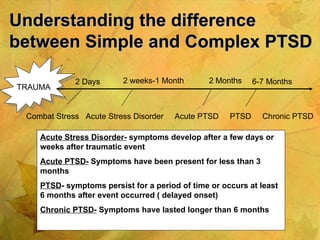
Understanding the difference between Simple and Complex PTSD Combat Stress  Acute Stress Disorder  Acute PTSD  PTSD  Chronic PTSD TRAUMA 2 Days 2 weeks-1 Month 2 Months Acute Stress Disorder-  symptoms develop after a few days or weeks after traumatic event Acute PTSD-  Symptoms have been present for less than 3 months PTSD - symptoms persist for a period of time or occurs at least 6 months after event occurred ( delayed onset) Chronic PTSD-  Symptoms have lasted longer than 6 months 6-7 Months
What is Domestic Violence? A  pattern  of behavior where one partner coerces, dominates, or isolates the other partner.  It is the exertion of any form of power that is used to maintain control in a relationship.
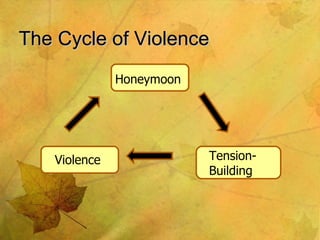
The Cycle of Violence Honeymoon Tension- Building Violence
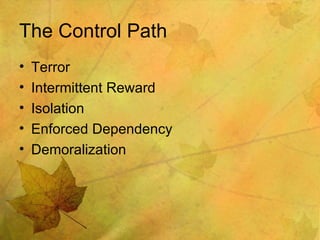
The Control Path Terror Intermittent Reward Isolation Enforced Dependency Demoralization
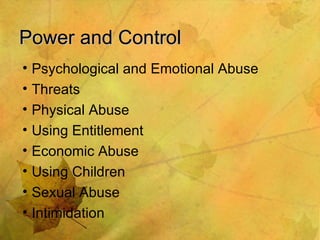
Power and Control Psychological and Emotional Abuse Threats Physical Abuse Using Entitlement Economic Abuse Using Children Sexual Abuse Intimidation
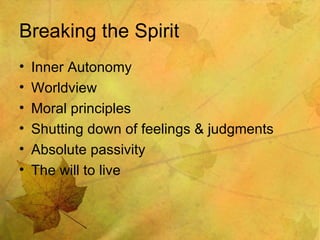
Breaking the Spirit Inner Autonomy Worldview Moral principles Shutting down of feelings & judgments Absolute passivity The will to live
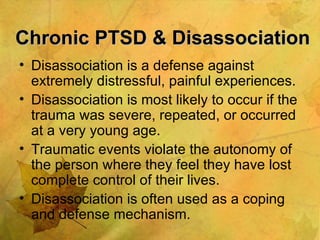
Chronic PTSD & Disassociation Disassociation is a defense against extremely distressful, painful experiences. Disassociation is most likely to occur if the trauma was severe, repeated, or occurred at a very young age. Traumatic events violate the autonomy of the person where they feel they have lost complete control of their lives. Disassociation is often used as a coping and defense mechanism.
Varieties of Disassociation HARMLESS STATE Tuning out your surroundings Day-dreaming HARMFUL STATE Depersonalization Amnesia Fugue Disasociative flashbacks MOST SEVERE STATE Dissociative Identity Disorder (DID) A person forms two different personality states, in order to cope with the trauma. Alternate identities may differ in age, may conflict or deny knowing each other, or may hold different fragment of memories DID often forms as the result of horrific childhood trauma
Symptoms of chronic PTSD in Relation to DV No normal baseline Somatic complaints Intrusion Thoughts/visions Flashbacks/nightmares Constriction Disassociation Trance States Time sense altered
Constricted Initiative & Planning Active Engagement in the world is altered Total submission Failure Insubordination Expect retaliation
“ Traumatic Bonding” Victims view the perpetrator as their savior and to fear and hate their rescuers. Live in terror, but view them as a source of strength and guidance.
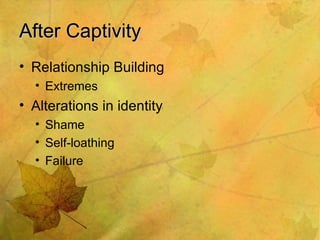
After Captivity Relationship Building Extremes Alterations in identity Shame Self-loathing Failure
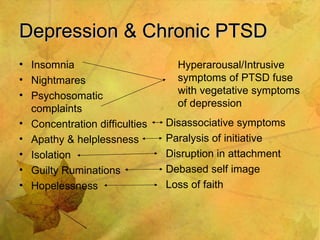
Depression & Chronic PTSD  Insomnia Nightmares Psychosomatic complaints Concentration difficulties Apathy & helplessness Isolation Guilty Ruminations Hopelessness Hyperarousal/Intrusive symptoms of PTSD fuse with vegetative symptoms of depression Disassociative symptoms Paralysis of initiative Disruption in attachment Debased self image Loss of faith
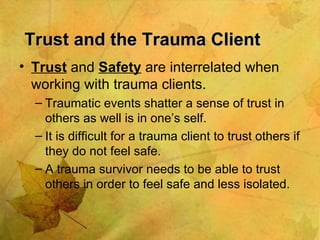
Trust and the Trauma Client Trust  and  Safety  are interrelated when working with trauma clients. Traumatic events shatter a sense of trust in others as well is in one’s self. It is difficult for a trauma client to trust others if they do not feel safe. A trauma survivor needs to be able to trust others in order to feel safe and less isolated.
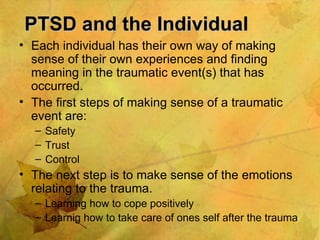
PTSD and the Individual Each individual has their own way of making sense of their own experiences and finding meaning in the traumatic event(s) that has occurred. The first steps of making sense of a traumatic event are: Safety Trust Control The next step is to make sense of the emotions relating to the trauma. Learning how to cope positively Learnig how to take care of ones self after the trauma
Understanding Trust and the Trauma Client Many traumatized individuals blame themselves for the trauma. They begin to mistrust themselves and their own decision-making capabilities. They begin to second guess themselves and begin to ignore their internal alarms. Ignoring these messages makes it difficult to protect and care for ones self.
Understanding Trust and the Trauma Client Many trauma survivors are mistrustful of others in the following areas: Giving information about themselves and the trauma Believing in what others say  Being able to depend or rely on others Fear of losing control
Personal Control and the Trauma Client Trauma survivors have often had their environments or bodies invaded by either events or other people. During traumatic events trauma survivors often feel that they have lost control or personal power over themselves and their situations. Control seems as if it belongs to others and any measure taken to regain it may feel impossible.
Taking Back Personal Control The fear of talking about a traumatic event causes a person to feel a loss of control. This fear creates silence which leads to feelings of powerlessness. This feeling of powerlessness stops the release of feelings and emotions.
Taking Back Personal Control  (continued) Learning to be assertive is the first step to taking back personal control. A true sense of control and power begins with self-acceptance. Being able to focus on what is possible to control leads to personal power. Possession of a skill or ability empowers an individual.
Working with Trauma Clients Communication Let the client speak at their own pace Give them the control to reduce anxiety Use clear messages
Working with Trauma Clients Active Listening Be open Keep eye contact Maintain safe physical boundaries Paraphrase Clarify information Receive feedback Client Strengths Empathize
Healing and Recovery Healing starts by applying skills to manage PTSD symptoms of: Arousal Disassociation Intrusion Healing occurs when: Traumatic memory is processed Confronting replaces avoidance In a climate of safety and pacing When boundaries are intact Healing is aided by kind awareness and acceptance. Healing is work and requires balance in life.
Secondary Trauma A trauma survivor is exposed to the primary trauma while the worker is exposed to the trauma through the survivor.  This is called  secondary  traumatization. Secondary trauma is caused when the worker experiences the terror, rage, and pain from a client first hand through repeated stories/descriptions of violent events.
Secondary Stress and the Worker   Workers are impacted by secondary exposure through: World view Become more aware of their surroundings Anticipation of danger Become better prepared Heightened sense of arousal Distorted perspective Avoidance At this point these symptoms produce secondary traumatization.
The Emotional Impact of Trauma Work Working with trauma survivors can be emotionally draining especially if the worker can relate through their own experiences. Workers can experience a heightened sense of arousal as well as feeling emotionally drained, but are not able to slow down because of the rush of adrenaline. This secondary stress can lead to the development of full PTSD symptoms. This element of compassion fatigue leads to burnout of the worker.
The Trauma Worker and Burnout Many jobs cause worker stress and to maintain a high level of physiological arousal. Workers are unable to find time to unwind from these stressors. Trauma workers are vulnerable to living out the traumatic experiences of those they help. Burnout is caused by the building of emotional stress without a healthy release.
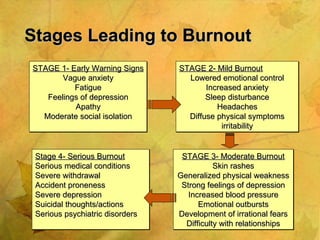
Stages Leading to Burnout STAGE 1- Early Warning Signs Vague anxiety Fatigue Feelings of depression Apathy Moderate social isolation STAGE 2- Mild Burnout Lowered emotional control Increased anxiety Sleep disturbance Headaches Diffuse physical symptoms irritability STAGE 3- Moderate Burnout Skin rashes Generalized physical weakness Strong feelings of depression Increased blood pressure Emotional outbursts Development of irrational fears Difficulty with relationships Stage 4- Serious Burnout Serious medical conditions Severe withdrawal Accident proneness Severe depression Suicidal thoughts/actions Serious psychiatric disorders
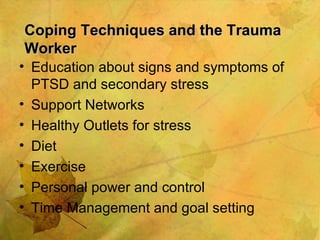
Coping Techniques and the Trauma Worker Education about signs and symptoms of PTSD and secondary stress  Support Networks Healthy Outlets for stress Diet Exercise Personal power and control Time Management and goal setting
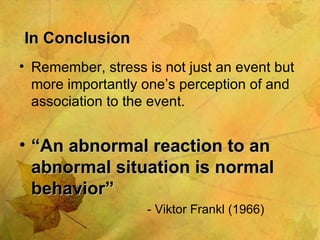
In Conclusion Remember, stress is not just an event but more importantly one’s perception of and association to the event. “ An abnormal reaction to an abnormal situation is normal behavior” - Viktor Frankl (1966)
QUESTIONS?
Bibliography B. Hudnall Stamm, 1997-2005.  Professional Quality of Life: Compassion Satisfaction and Fatigue Subscales, R-IV (ProQOL)  retrieved on July 9, 2007 from  http:// www.isu.edu/~bhstamm . Freedy, J. & Hobfoll, S. (1995).  Traumatic stress: Theory to practice.  New York:   Plenum Press. Herman, J. (1992).  Trauma and recovery . New York: BasicBooks A Division of HarperCollins Publishers. Kellerman, P. F. &  Hudgins, M. K. (2000).  Psychodrama with trauma survivors: Acting out your pain . Pennsylvania: Jessica Kingsley Publishers. Lewis, G. (1994).  Critical incident stress and trauma in the workplace: Recognition…response…recovery . Florida: CRC Press, Inc. Monson, C.& Taft, C. (2005).  PTSD and intimate relationships .  PTSD Research Quarterly, v16:14. National Center for Post Traumatic Stress Disorder. (2006).  Seeking help for Posttraumatic Stress Disorder .  Retreived April 18, 2006, from National Center for Post-Traumatic Stress Disroder Web site: http://www.ncptsd.va.gov Rosenbloom, D. & Williams, M. (1999).  Life after trauma: A workbook for healing . New York: The Guilford Press. Schiraldi, G. (2000).  The post-traumatic stress sourcebook: A guide to healing, recovery, and growth . California: Lowell House. Stamm, B.H., Varra, E.M., Pearlman, L.A. & Gillar, E. (2002).  The helper’s power to heal and to be hurt- or helped- by trying . National Register of Health Service Providers in Psychology. Washington D.C. Understanding and coping with traumatic stress .  www.headington-insitute.org .  Retrieved January 25, 2007. Williams, M. & Poijula, S. (2002).  The PTSD workbook: Simple, effective techniques for overcoming traumatic stress symptoms . California: New Harbinger Publications, Inc. Williams, M. & Sommer, J. (1999).  Simple and complex post-traumatic stress disorder: Strategies for comprehensive treatment in clinical practice . New York: The Haworth Maltreatment and Trauma Press.

Dv & Ptsd

  • 1.
    Finding A SafeSpace: Domestic Violence & Post Traumatic Stress Disorder Andrea Schmidt, LMSW October 22, 2008
  • 2.
    What is PTSD?Post Traumatic Stress Disorder a psychological disorder that follows an individual’s personal experience with or witnessing of life-threatening events.
  • 3.
    How does PTSDAffect the Population? An estimated 7.8% of Americans will experience PTSD at some point in their lives. 23 million adults will have PTSD during the course of a given year. Women are twice as likely to develop PTSD as men. Lifetime prevalence of PTSD for women has been estimated to be as high as 18%. About 60% of those who develop PTSD recover (even without treatment.)
  • 4.
    Trauma occurs whenone loses the sense of having a safe place to retreat within or outside oneself to deal with frightening emotions or experiences. -Bessel van der Kolk, 1987
  • 5.
    Symptoms of PTSDThere are three main symptoms of PTSD: HYPERAROUSAL INTRUSION CONSTRICTION
  • 6.
    Her stillness wasfueled by a million times the energy that thundered in Freddie. That was the most still I’ve ever seen anything or anybody in my life. A table moves more. Momma sat there motionless, eyes on her newspaper, frozen, not even turning a page, as if she had vanished deep within herself to prevent herself from responding—because she knew that if she said anything, if she turned a page, flicked an eyelash, breathed, he would hit her. Her stillness defeated his storm. Chris Gardner The Pursuit of Happyness
  • 7.
    The Brain Respondsto Threat Preparing the human for survival Freeze Flight Fight Tend or befriend
  • 8.
    Signs & Symptomsof PTSD Physical Cognitive Emotional
  • 9.
    Associated Features ofa Trauma Client Self Recrimination-shame/guilt Shattered Assumptions Mood Disturbances Addictions Impulsive behaviors Somatic (physical) complaints Overcompensation Death anxiety Repetition compulsion Self-mutilation Other addictions and self-destructive behavior Alexithymia-general shutting down of feelings Changes in personality
  • 10.
    The Difference BetweenStress, Crisis and Trauma The effects, that surround a stressful event are alleviated when the stressor is removed. A crisis is an event of limited duration. When the event passes normal functioning returns. Traumatic events are more extreme versions of stressful events.
  • 11.
    Emotional impact lastslong after the traumatic event is over. Memory of the traumatic event lingers on not allowing the body to recover.
  • 12.
    Simple and ComplexPTSD Simple/Acute PTSD Short lived trauma (i.e.: car accidents, natural disasters, rape) Complex/Chronic PTSD Long term trauma that can continue for months or years Victim’s is held in a state of captivity
  • 13.
    Understanding the differencebetween Simple and Complex PTSD Combat Stress Acute Stress Disorder Acute PTSD PTSD Chronic PTSD TRAUMA 2 Days 2 weeks-1 Month 2 Months Acute Stress Disorder- symptoms develop after a few days or weeks after traumatic event Acute PTSD- Symptoms have been present for less than 3 months PTSD - symptoms persist for a period of time or occurs at least 6 months after event occurred ( delayed onset) Chronic PTSD- Symptoms have lasted longer than 6 months 6-7 Months
  • 14.
    What is DomesticViolence? A pattern of behavior where one partner coerces, dominates, or isolates the other partner. It is the exertion of any form of power that is used to maintain control in a relationship.
  • 15.
    The Cycle ofViolence Honeymoon Tension- Building Violence
  • 16.
    The Control PathTerror Intermittent Reward Isolation Enforced Dependency Demoralization
  • 17.
    Power and ControlPsychological and Emotional Abuse Threats Physical Abuse Using Entitlement Economic Abuse Using Children Sexual Abuse Intimidation
  • 18.
    Breaking the SpiritInner Autonomy Worldview Moral principles Shutting down of feelings & judgments Absolute passivity The will to live
  • 19.
    Chronic PTSD &Disassociation Disassociation is a defense against extremely distressful, painful experiences. Disassociation is most likely to occur if the trauma was severe, repeated, or occurred at a very young age. Traumatic events violate the autonomy of the person where they feel they have lost complete control of their lives. Disassociation is often used as a coping and defense mechanism.
  • 20.
    Varieties of DisassociationHARMLESS STATE Tuning out your surroundings Day-dreaming HARMFUL STATE Depersonalization Amnesia Fugue Disasociative flashbacks MOST SEVERE STATE Dissociative Identity Disorder (DID) A person forms two different personality states, in order to cope with the trauma. Alternate identities may differ in age, may conflict or deny knowing each other, or may hold different fragment of memories DID often forms as the result of horrific childhood trauma
  • 21.
    Symptoms of chronicPTSD in Relation to DV No normal baseline Somatic complaints Intrusion Thoughts/visions Flashbacks/nightmares Constriction Disassociation Trance States Time sense altered
  • 22.
    Constricted Initiative &Planning Active Engagement in the world is altered Total submission Failure Insubordination Expect retaliation
  • 23.
    “ Traumatic Bonding”Victims view the perpetrator as their savior and to fear and hate their rescuers. Live in terror, but view them as a source of strength and guidance.
  • 24.
    After Captivity RelationshipBuilding Extremes Alterations in identity Shame Self-loathing Failure
  • 25.
    Depression & ChronicPTSD Insomnia Nightmares Psychosomatic complaints Concentration difficulties Apathy & helplessness Isolation Guilty Ruminations Hopelessness Hyperarousal/Intrusive symptoms of PTSD fuse with vegetative symptoms of depression Disassociative symptoms Paralysis of initiative Disruption in attachment Debased self image Loss of faith
  • 26.
    Trust and theTrauma Client Trust and Safety are interrelated when working with trauma clients. Traumatic events shatter a sense of trust in others as well is in one’s self. It is difficult for a trauma client to trust others if they do not feel safe. A trauma survivor needs to be able to trust others in order to feel safe and less isolated.
  • 27.
    PTSD and theIndividual Each individual has their own way of making sense of their own experiences and finding meaning in the traumatic event(s) that has occurred. The first steps of making sense of a traumatic event are: Safety Trust Control The next step is to make sense of the emotions relating to the trauma. Learning how to cope positively Learnig how to take care of ones self after the trauma
  • 28.
    Understanding Trust andthe Trauma Client Many traumatized individuals blame themselves for the trauma. They begin to mistrust themselves and their own decision-making capabilities. They begin to second guess themselves and begin to ignore their internal alarms. Ignoring these messages makes it difficult to protect and care for ones self.
  • 29.
    Understanding Trust andthe Trauma Client Many trauma survivors are mistrustful of others in the following areas: Giving information about themselves and the trauma Believing in what others say Being able to depend or rely on others Fear of losing control
  • 30.
    Personal Control andthe Trauma Client Trauma survivors have often had their environments or bodies invaded by either events or other people. During traumatic events trauma survivors often feel that they have lost control or personal power over themselves and their situations. Control seems as if it belongs to others and any measure taken to regain it may feel impossible.
  • 31.
    Taking Back PersonalControl The fear of talking about a traumatic event causes a person to feel a loss of control. This fear creates silence which leads to feelings of powerlessness. This feeling of powerlessness stops the release of feelings and emotions.
  • 32.
    Taking Back PersonalControl (continued) Learning to be assertive is the first step to taking back personal control. A true sense of control and power begins with self-acceptance. Being able to focus on what is possible to control leads to personal power. Possession of a skill or ability empowers an individual.
  • 33.
    Working with TraumaClients Communication Let the client speak at their own pace Give them the control to reduce anxiety Use clear messages
  • 34.
    Working with TraumaClients Active Listening Be open Keep eye contact Maintain safe physical boundaries Paraphrase Clarify information Receive feedback Client Strengths Empathize
  • 35.
    Healing and RecoveryHealing starts by applying skills to manage PTSD symptoms of: Arousal Disassociation Intrusion Healing occurs when: Traumatic memory is processed Confronting replaces avoidance In a climate of safety and pacing When boundaries are intact Healing is aided by kind awareness and acceptance. Healing is work and requires balance in life.
  • 36.
    Secondary Trauma Atrauma survivor is exposed to the primary trauma while the worker is exposed to the trauma through the survivor. This is called secondary traumatization. Secondary trauma is caused when the worker experiences the terror, rage, and pain from a client first hand through repeated stories/descriptions of violent events.
  • 37.
    Secondary Stress andthe Worker Workers are impacted by secondary exposure through: World view Become more aware of their surroundings Anticipation of danger Become better prepared Heightened sense of arousal Distorted perspective Avoidance At this point these symptoms produce secondary traumatization.
  • 38.
    The Emotional Impactof Trauma Work Working with trauma survivors can be emotionally draining especially if the worker can relate through their own experiences. Workers can experience a heightened sense of arousal as well as feeling emotionally drained, but are not able to slow down because of the rush of adrenaline. This secondary stress can lead to the development of full PTSD symptoms. This element of compassion fatigue leads to burnout of the worker.
  • 39.
    The Trauma Workerand Burnout Many jobs cause worker stress and to maintain a high level of physiological arousal. Workers are unable to find time to unwind from these stressors. Trauma workers are vulnerable to living out the traumatic experiences of those they help. Burnout is caused by the building of emotional stress without a healthy release.
  • 40.
    Stages Leading toBurnout STAGE 1- Early Warning Signs Vague anxiety Fatigue Feelings of depression Apathy Moderate social isolation STAGE 2- Mild Burnout Lowered emotional control Increased anxiety Sleep disturbance Headaches Diffuse physical symptoms irritability STAGE 3- Moderate Burnout Skin rashes Generalized physical weakness Strong feelings of depression Increased blood pressure Emotional outbursts Development of irrational fears Difficulty with relationships Stage 4- Serious Burnout Serious medical conditions Severe withdrawal Accident proneness Severe depression Suicidal thoughts/actions Serious psychiatric disorders
  • 41.
    Coping Techniques andthe Trauma Worker Education about signs and symptoms of PTSD and secondary stress Support Networks Healthy Outlets for stress Diet Exercise Personal power and control Time Management and goal setting
  • 42.
    In Conclusion Remember,stress is not just an event but more importantly one’s perception of and association to the event. “ An abnormal reaction to an abnormal situation is normal behavior” - Viktor Frankl (1966)
  • 43.
  • 44.
    Bibliography B. HudnallStamm, 1997-2005. Professional Quality of Life: Compassion Satisfaction and Fatigue Subscales, R-IV (ProQOL) retrieved on July 9, 2007 from http:// www.isu.edu/~bhstamm . Freedy, J. & Hobfoll, S. (1995). Traumatic stress: Theory to practice. New York: Plenum Press. Herman, J. (1992). Trauma and recovery . New York: BasicBooks A Division of HarperCollins Publishers. Kellerman, P. F. & Hudgins, M. K. (2000). Psychodrama with trauma survivors: Acting out your pain . Pennsylvania: Jessica Kingsley Publishers. Lewis, G. (1994). Critical incident stress and trauma in the workplace: Recognition…response…recovery . Florida: CRC Press, Inc. Monson, C.& Taft, C. (2005). PTSD and intimate relationships . PTSD Research Quarterly, v16:14. National Center for Post Traumatic Stress Disorder. (2006). Seeking help for Posttraumatic Stress Disorder . Retreived April 18, 2006, from National Center for Post-Traumatic Stress Disroder Web site: http://www.ncptsd.va.gov Rosenbloom, D. & Williams, M. (1999). Life after trauma: A workbook for healing . New York: The Guilford Press. Schiraldi, G. (2000). The post-traumatic stress sourcebook: A guide to healing, recovery, and growth . California: Lowell House. Stamm, B.H., Varra, E.M., Pearlman, L.A. & Gillar, E. (2002). The helper’s power to heal and to be hurt- or helped- by trying . National Register of Health Service Providers in Psychology. Washington D.C. Understanding and coping with traumatic stress . www.headington-insitute.org . Retrieved January 25, 2007. Williams, M. & Poijula, S. (2002). The PTSD workbook: Simple, effective techniques for overcoming traumatic stress symptoms . California: New Harbinger Publications, Inc. Williams, M. & Sommer, J. (1999). Simple and complex post-traumatic stress disorder: Strategies for comprehensive treatment in clinical practice . New York: The Haworth Maltreatment and Trauma Press.