EYE LIDS
DIVYA
BHARGAVI
THE EYE LIDS
• An eyelid is a fold of skin that closes over the eye to protect it. There are
upper and lower eyelids
• The Levator palpebrae superioris muscle retracts the eyelid, exposing the
cornea to the outside, giving vision.
• Its key function is to regularly spread the tears and other secretions on the
eye surface to keep it moist, since the cornea must be continuously moist.
• They keep the eyes from drying out when asleep. Moreover, the blink reflex
protects the eye from foreign bodies
CHALAZION
• Chalazion (also known as Meibomian cyst) is a cyst in the eyelid usually
due to a blocked meibomian gland, typically in the middle of the eyelid, red,
and not painful.
• They tend to come on gradually over a few weeks.
• A chalazion may occur following a stye or from hardened oils blocking the
gland. The blocked gland is usually the meibomian gland, but can also be
the gland of Zeis.
• A stye, however, is usually more sudden in onset, painful, and occurs at the
edge of the eyelid
CHALAZION
 Risk Factors:
• Inflammation or viruses affecting the meibomian glands are the
underlying causes of chalaza
• Chalaza are more common in people with inflammatory conditions
like seborrhea, acne, rosacea, chronic blepharitis, or long-
term inflammation of the eyelid.
• They’re also more common in people with viral conjunctivitis or
an infection covering the inside of the eyes and eyelids.
CHALAZION
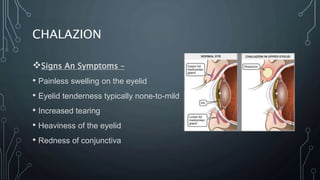
Signs An Symptoms –
• Painless swelling on the eyelid
• Eyelid tenderness typically none-to-mild
• Increased tearing
• Heaviness of the eyelid
• Redness of conjunctiva
CHALAZION
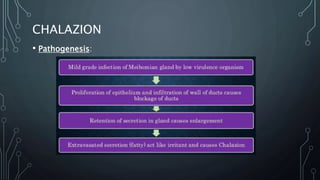
• Pathogenesis:
CHALAZION
 Complications :
• A large chalazion can cause astigmatism due to pressure on
the cornea
• As laser eye surgery involves shaping the cornea by burning parts of it
away, weakening its structure, post-operation people can be left
predisposed to deformation of the cornea from small chalazia
• A chalazion that reoccurs in the same area may rarely be a symptom
of sebaceous cell carcinoma
CHALAZION
Treatment:
• General treatment:
• Chalazia will often disappear without further treatment within a few months,
and virtually all will resorb within two years
• Healing can be facilitated by applying a moist warm compress to the
affected eye for approximately 10-15 minutes, 4 times per day.
• If they continue to enlarge or fail to settle within a few months, smaller
lesions may be injected with a corticosteroid
CHALAZION
Treatment:
• Larger ones may be surgically removed using local anesthesia
• The excision of larger chalazia may result in visible hematoma around the
lid, which will wear off within three or four days, whereas the swelling may
persist for longer
• Chalazion excision is an ambulant treatment and normally does not take
longer than fifteen minutes
• Chalazion excision using CO2 laser is also a safer procedure with minimal
bleeding. Eye patching also not required.
CHALAZION
Prevention:
• Cleansing the eye area every day can help prevent a chalazion from developing or recurring
• Using eyelid scrubs or premoistened cleansing wipes to keep the oil glands from becoming
blocked.
• not rubbing the eyes
• ensuring that the hands are clean before touching the eyes
• protecting the eyes from dust and air pollution, for example by wearing sunglasses when outdoors
or safety goggles when using machinery, such as power tools
• replacing eye makeup every 6 months to prevent bacterial growth
OTHER ABNORMALITIES OF LASHES
• Other abnormalities of lashes include the following:
Trichiasis:
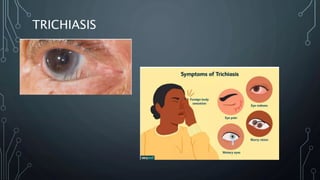
• Trichiasis is defined as normal lashes growing inward. In trichiasis, the lash follicle is normal, but
the direction of lash growth is abnormal
• Causes:
• Chronic blepharitis, Vernal keratoconjunctivitis, , Chemical burns, Thermal injury, Eczema,
Herpes zoster, Atopic diseases, Ocular cicatricial pemphigoid disease, Cicatrizing conjunctival
disease, Eyelid trauma , Eyelid surgery , Meibomitis, Stevens-Johnson syndrome, Leprosy, Eyelid
tumors, Trachoma
TRICHIASIS
OTHER ABNORMALITIES OF LASHES
Distichiasis:
• Distichiasis is defined as a separate row of lashes that are present behind the
normal row of lashes. These lashes are fine with little pigmentation but will
cause corneal irritation
Tristichia/Tetrastichiasis
• The presence of a third row of lashes. Tetrastichiasis is the presence of a
fourth row of lashes. These are rare conditions.
OTHER ABNORMALITIES OF LASHES
Pseudocilium:
• Sometimes, an eyelash will be seen in a meibomian gland orifice or the
punctum. We have termed this "Pseudocilium" because the lash does not have
root but is loose in the meibomian gland or the punctum.
• Such an isolated lash can find its way into a meibomian gland or
punctum still and may have the tip of the lash on the outside or the root on
the outside (upside down lash). Either way, the lash can still cause corneal
and conjunctival irritation.
OTHER ABNORMALITIES OF LASHES
Hypotrichosis:
• Hypotrichosis, which is defined as reduced hair density anywhere in the body may
also affect eyelashes.
• The only effective treatment is the use of topical bimatoprost ophthalmic solution
0.03%
Alopecia Adnata:
• It has been used to describe under-developed eyelashes. Alopecia areata, which is
thought to be an autoimmune process, can also affect eyelashes.
OTHER ABNORMALITIES OF LASHES
Madarosis:
• Madarosis is the loss of lashes (ciliary madarosis) or eyebrows (superciliary madarosis).
• Milphosis means eyelash loss. Madarosis and milphosis are often used interchangeably
• Trichotillomania is the self-induced pulling of hair from anywhere in the body but is also
applied to eyelash-pulling. In most cases, psychiatric evaluation and treatment are needed.
OTHER ABNORMALITIES OF LASHES
Hypertrichosis is an increase in hair in any area of the body taking the patient’s age, gender, and ethnicity into
consideration. Eyelash hypertrichosis is known as trichomegaly.
• Eyebrow Hypertrichosis is seen in:
• Coffin-Siris syndrome, Gingival fibromatosis with hypertrichosis, Hermansky-Pudiak syndrome, Mannosidosis, Nevoid
hypertrichosis (isolated area of hypertrichosis), Stiff skin syndrome, Langer-Giedion syndrome, Duplication supercilia (two
distinct brows), Mucopolysaccharidoses, Rubenstein- Tayebi syndrome, Cornelia de Lange syndrome
• Acquired Hypertrichosis (Hypertrichosis lanuginosa acquisita [HLA])
• Drugs, Metabolic diseases, Endocrine diseases
• Paraneoplastic processes: patients may develop increased lanugo develop lanugo hairs in the periocular, ear, forehead and
nose areas. In paraneoplastic processes, hypertrichosis may develop before malignancy is recognized.
• Lawrence-Sein syndrome consists of lipoatrophy resulting hypertrichosis of the head with the involvement of the forehead,
eyebrows, eyelashes, and cheeks.
OTHER ABNORMALITIES OF LASHES
Benign Tumors of Hair Follicle:
• Pilomatrixoma presents as a firm lesion with whitish nodules usually away from the eyelid margin
Trichoblastoma:
• Trichilemmoma rarely affect the lid margin or canthus
Trichoepithelioma:
• Trichofolliculoma presents as a nodule with fine, white hair in the middle.
Inverted Follicular Keratosis
Malignant Tumors of Hair Follicle:
• Primary mucinous carcinoma arises from eccrine sweat glands and presents as a nodule or ulcer.
Eyelids and its Abnormalities

Eyelids and its Abnormalities

  • 1.
  • 2.
    THE EYE LIDS •An eyelid is a fold of skin that closes over the eye to protect it. There are upper and lower eyelids • The Levator palpebrae superioris muscle retracts the eyelid, exposing the cornea to the outside, giving vision. • Its key function is to regularly spread the tears and other secretions on the eye surface to keep it moist, since the cornea must be continuously moist. • They keep the eyes from drying out when asleep. Moreover, the blink reflex protects the eye from foreign bodies
  • 3.
    CHALAZION • Chalazion (alsoknown as Meibomian cyst) is a cyst in the eyelid usually due to a blocked meibomian gland, typically in the middle of the eyelid, red, and not painful. • They tend to come on gradually over a few weeks. • A chalazion may occur following a stye or from hardened oils blocking the gland. The blocked gland is usually the meibomian gland, but can also be the gland of Zeis. • A stye, however, is usually more sudden in onset, painful, and occurs at the edge of the eyelid
  • 4.
    CHALAZION  Risk Factors: •Inflammation or viruses affecting the meibomian glands are the underlying causes of chalaza • Chalaza are more common in people with inflammatory conditions like seborrhea, acne, rosacea, chronic blepharitis, or long- term inflammation of the eyelid. • They’re also more common in people with viral conjunctivitis or an infection covering the inside of the eyes and eyelids.
  • 5.
    CHALAZION Signs An Symptoms– • Painless swelling on the eyelid • Eyelid tenderness typically none-to-mild • Increased tearing • Heaviness of the eyelid • Redness of conjunctiva
  • 6.
  • 7.
    CHALAZION  Complications : •A large chalazion can cause astigmatism due to pressure on the cornea • As laser eye surgery involves shaping the cornea by burning parts of it away, weakening its structure, post-operation people can be left predisposed to deformation of the cornea from small chalazia • A chalazion that reoccurs in the same area may rarely be a symptom of sebaceous cell carcinoma
  • 8.
    CHALAZION Treatment: • General treatment: •Chalazia will often disappear without further treatment within a few months, and virtually all will resorb within two years • Healing can be facilitated by applying a moist warm compress to the affected eye for approximately 10-15 minutes, 4 times per day. • If they continue to enlarge or fail to settle within a few months, smaller lesions may be injected with a corticosteroid
  • 9.
    CHALAZION Treatment: • Larger onesmay be surgically removed using local anesthesia • The excision of larger chalazia may result in visible hematoma around the lid, which will wear off within three or four days, whereas the swelling may persist for longer • Chalazion excision is an ambulant treatment and normally does not take longer than fifteen minutes • Chalazion excision using CO2 laser is also a safer procedure with minimal bleeding. Eye patching also not required.
  • 10.
    CHALAZION Prevention: • Cleansing theeye area every day can help prevent a chalazion from developing or recurring • Using eyelid scrubs or premoistened cleansing wipes to keep the oil glands from becoming blocked. • not rubbing the eyes • ensuring that the hands are clean before touching the eyes • protecting the eyes from dust and air pollution, for example by wearing sunglasses when outdoors or safety goggles when using machinery, such as power tools • replacing eye makeup every 6 months to prevent bacterial growth
  • 11.
    OTHER ABNORMALITIES OFLASHES • Other abnormalities of lashes include the following: Trichiasis: • Trichiasis is defined as normal lashes growing inward. In trichiasis, the lash follicle is normal, but the direction of lash growth is abnormal • Causes: • Chronic blepharitis, Vernal keratoconjunctivitis, , Chemical burns, Thermal injury, Eczema, Herpes zoster, Atopic diseases, Ocular cicatricial pemphigoid disease, Cicatrizing conjunctival disease, Eyelid trauma , Eyelid surgery , Meibomitis, Stevens-Johnson syndrome, Leprosy, Eyelid tumors, Trachoma
  • 12.
  • 13.
    OTHER ABNORMALITIES OFLASHES Distichiasis: • Distichiasis is defined as a separate row of lashes that are present behind the normal row of lashes. These lashes are fine with little pigmentation but will cause corneal irritation Tristichia/Tetrastichiasis • The presence of a third row of lashes. Tetrastichiasis is the presence of a fourth row of lashes. These are rare conditions.
  • 14.
    OTHER ABNORMALITIES OFLASHES Pseudocilium: • Sometimes, an eyelash will be seen in a meibomian gland orifice or the punctum. We have termed this "Pseudocilium" because the lash does not have root but is loose in the meibomian gland or the punctum. • Such an isolated lash can find its way into a meibomian gland or punctum still and may have the tip of the lash on the outside or the root on the outside (upside down lash). Either way, the lash can still cause corneal and conjunctival irritation.
  • 15.
    OTHER ABNORMALITIES OFLASHES Hypotrichosis: • Hypotrichosis, which is defined as reduced hair density anywhere in the body may also affect eyelashes. • The only effective treatment is the use of topical bimatoprost ophthalmic solution 0.03% Alopecia Adnata: • It has been used to describe under-developed eyelashes. Alopecia areata, which is thought to be an autoimmune process, can also affect eyelashes.
  • 16.
    OTHER ABNORMALITIES OFLASHES Madarosis: • Madarosis is the loss of lashes (ciliary madarosis) or eyebrows (superciliary madarosis). • Milphosis means eyelash loss. Madarosis and milphosis are often used interchangeably • Trichotillomania is the self-induced pulling of hair from anywhere in the body but is also applied to eyelash-pulling. In most cases, psychiatric evaluation and treatment are needed.
  • 17.
    OTHER ABNORMALITIES OFLASHES Hypertrichosis is an increase in hair in any area of the body taking the patient’s age, gender, and ethnicity into consideration. Eyelash hypertrichosis is known as trichomegaly. • Eyebrow Hypertrichosis is seen in: • Coffin-Siris syndrome, Gingival fibromatosis with hypertrichosis, Hermansky-Pudiak syndrome, Mannosidosis, Nevoid hypertrichosis (isolated area of hypertrichosis), Stiff skin syndrome, Langer-Giedion syndrome, Duplication supercilia (two distinct brows), Mucopolysaccharidoses, Rubenstein- Tayebi syndrome, Cornelia de Lange syndrome • Acquired Hypertrichosis (Hypertrichosis lanuginosa acquisita [HLA]) • Drugs, Metabolic diseases, Endocrine diseases • Paraneoplastic processes: patients may develop increased lanugo develop lanugo hairs in the periocular, ear, forehead and nose areas. In paraneoplastic processes, hypertrichosis may develop before malignancy is recognized. • Lawrence-Sein syndrome consists of lipoatrophy resulting hypertrichosis of the head with the involvement of the forehead, eyebrows, eyelashes, and cheeks.
  • 18.
    OTHER ABNORMALITIES OFLASHES Benign Tumors of Hair Follicle: • Pilomatrixoma presents as a firm lesion with whitish nodules usually away from the eyelid margin Trichoblastoma: • Trichilemmoma rarely affect the lid margin or canthus Trichoepithelioma: • Trichofolliculoma presents as a nodule with fine, white hair in the middle. Inverted Follicular Keratosis Malignant Tumors of Hair Follicle: • Primary mucinous carcinoma arises from eccrine sweat glands and presents as a nodule or ulcer.