Next 
World History: Ancient Civilizations Through the Renaissance 
Chapter 6 
Geography and Early China 
The Big Idea 
Chinese civilization began with the Shang dynasty along the Huang He. 
Main Ideas 
•China’s physical geography made farming possible but travel and communication difficult. 
•Civilization began in China along the Huang He and Chang Jiang rivers. 
•China’s first dynasties helped Chinese society develop and made many other achievements. 
Copyright © by Houghton Mifflin Harcourt Publishing Company
World History: Ancient Civilizations Through the Renaissance 
Chapter 6 
Physical Geography 
Varied Landscape 
Copyright © by Houghton Mifflin Harcourt Publishing Company 
Next 
Previous 
• China covers an area of almost 4 million square miles. 
• The Gobi desert lies in the north. 
• Low-lying plains in the east make up one of the world’s 
largest farming areas. 
• Mountain ranges lie in the west. 
• The weather and temperature vary from cold and dry to wet 
and humid, and monsoons can bring up to 250 inches of rain 
each year.
World History: Ancient Civilizations Through the Renaissance 
Chapter 6 
Copyright © by Houghton Mifflin Harcourt Publishing Company 
Next 
Previous 
Huang He 
•Also called the Yellow 
River 
•Nearly 3,000 miles long 
across northern China 
•Often floods, and has 
been referred to as 
“China’s sorrow” because 
of the destruction 
Chang Jiang 
•The longest river in Asia; also 
called the Yangzi River 
•Flows across central China from 
Tibet to the Pacific Ocean 
Two Rivers of China
World History: Ancient Civilizations Through the Renaissance 
Chapter 6 
Civilization Begins 
Farming 
Copyright © by Houghton Mifflin Harcourt Publishing Company 
Next 
Previous 
• Frequent flooding made the land fertile around the Chang 
Jiang and Huang He rivers. 
• Along with farming, the Chinese people hunted, fished, and 
domesticated animals. 
Early Settlements 
• Some small villages along the rivers grew into larger cities. 
• Separate cultures developed in the north and the south 
• Findings at burial sites suggest that the ancient Chinese believed 
in an afterlife and had a complex social order.
World History: Ancient Civilizations Through the Renaissance 
Chapter 6 
Xia dynasty 
Copyright © by Houghton Mifflin Harcourt Publishing Company 
Next 
Previous 
• The Xia dynasty might have been founded around 
2200 BC, by Yu the Great. 
• Tales say that Yu dug channels to drain 
floodwaters and created the major waterways of 
North China. 
• Archaeologists have no firm evidence that tales 
about the Xia dynasty are true.
World History: Ancient Civilizations Through the Renaissance 
Chapter 6 
Shang dynasty 
Copyright © by Houghton Mifflin Harcourt Publishing Company 
Next 
Previous 
• Established by 1500 BC, the Shang was the first 
dynasty that there is clear evidence to support. 
• The Shang reorganized the social order in China: 
the top ranking was the royals, then nobles, 
warriors, artisans, farmers, and slaves. 
• Most citizens lived within the city walls. 
• Many cultural advances were made, including 
China’s first writing system, complex tools, metal 
pots, and ornaments.
World History: Ancient Civilizations Through the Renaissance 
Chapter 6 
The Zhou Dynasty and New Ideas 
The Big Idea 
Confucius and other philosophers taught ways to deal with social and political problems 
in ancient China. 
Main Ideas 
•The Zhou dynasty expanded China but then declined. 
•Confucius offered ideas to bring order to Chinese society. 
•Daoism and Legalism also gained followers. 
Copyright © by Houghton Mifflin Harcourt Publishing Company 
Next 
Previous
World History: Ancient Civilizations Through the Renaissance 
Chapter 6 
The Zhou Political System 
Copyright © by Houghton Mifflin Harcourt Publishing Company 
Next 
Previous 
• The Zhou people worked with other tribes to 
overthrow the Shang dynasty in the 1100s BC. 
• Zhou leaders believed that their rulers were 
mandated by heaven 
• A new political order was established: the king 
granted plots of land to lords, who in turn 
provided soldiers and paid taxes to the king. 
• The lords helped Zhou rulers keep control of the 
dynasty.
World History: Ancient Civilizations Through the Renaissance 
Chapter 6 
Decline of the Zhou Dynasty 
Copyright © by Houghton Mifflin Harcourt Publishing Company 
Next 
Previous 
• As the lords’ power grew, they became uninterested in 
serving Zhou rulers 
• In 771 BC, the Zhou suffered a loss to invaders. Zhou began 
to fight among themselves. 
• The Warring States Period marked power struggles between 
the ruling-class families.
World History: Ancient Civilizations Through the Renaissance 
Chapter 6 
Confucianism 
Moral Values 
The Analects 
Copyright © by Houghton Mifflin Harcourt Publishing Company 
Next 
Previous 
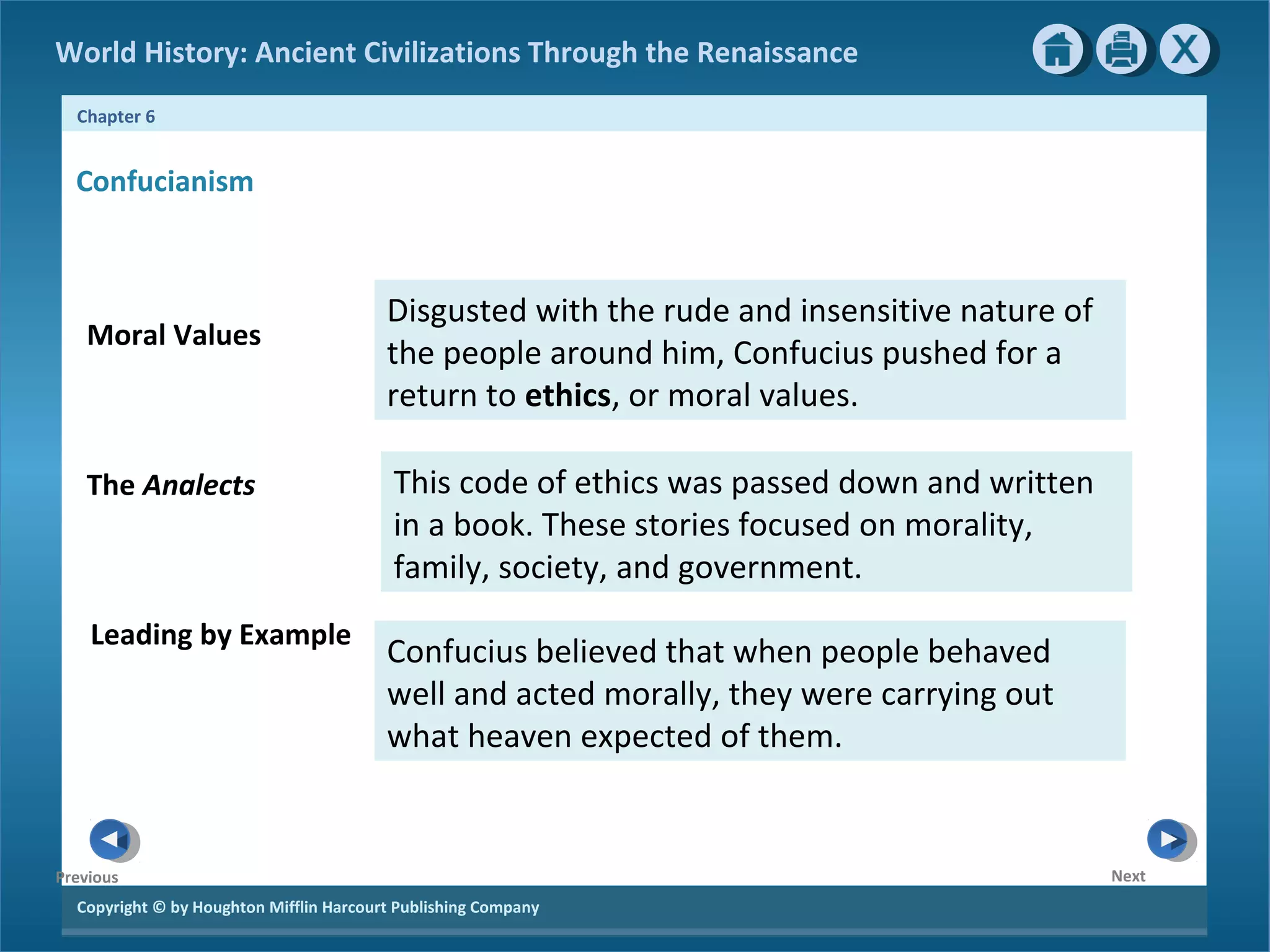
This code of ethics was passed down and written 
in a book. These stories focused on morality, 
family, society, and government. 
Confucius believed that when people behaved 
well and acted morally, they were carrying out 
what heaven expected of them. 
Leading by Example 
Disgusted with the rude and insensitive nature of 
the people around him, Confucius pushed for a 
return to ethics, or moral values.
World History: Ancient Civilizations Through the Renaissance 
Chapter 6 
Copyright © by Houghton Mifflin Harcourt Publishing Company 
Next 
Previous 
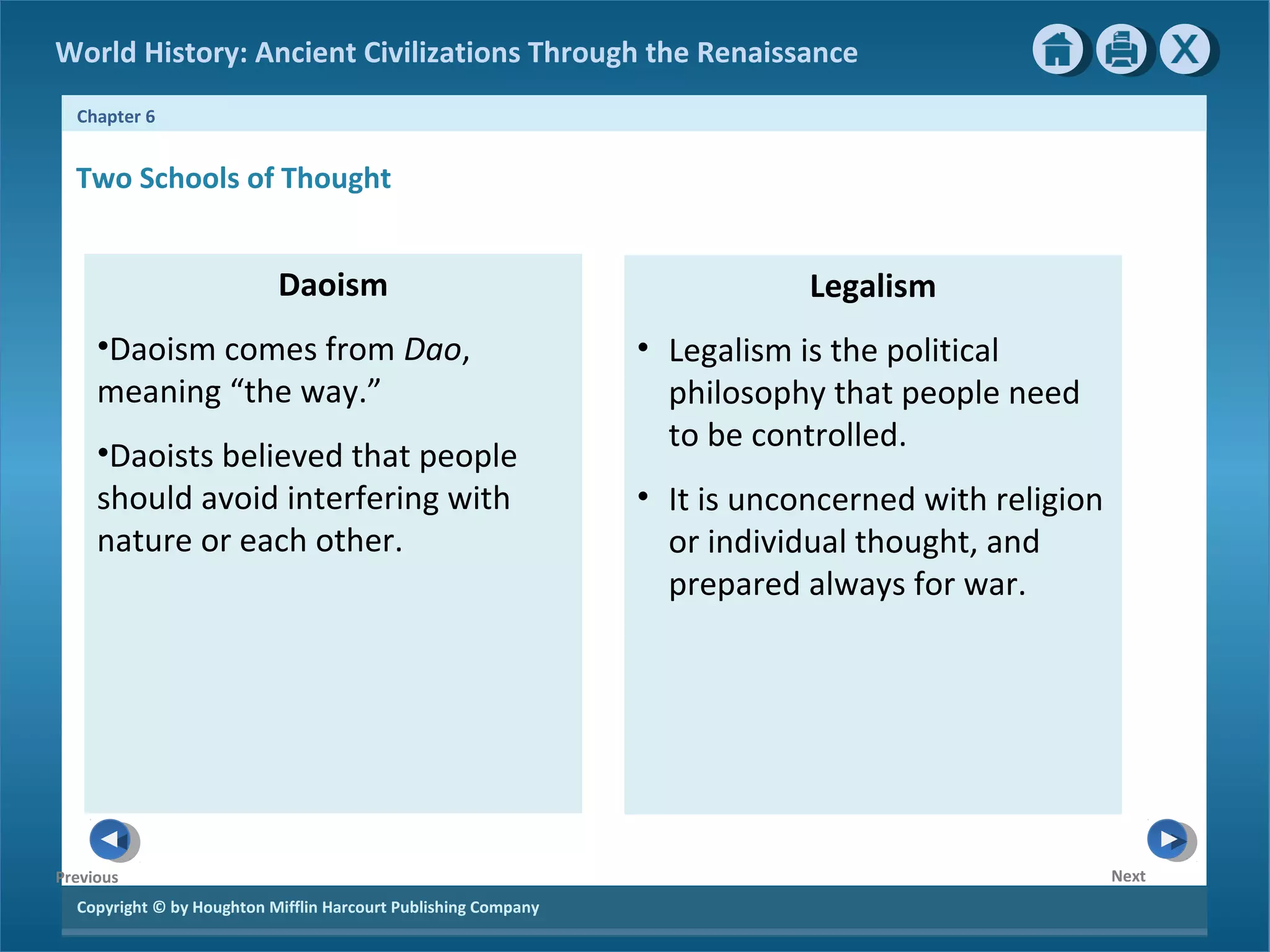
Daoism 
•Daoism comes from Dao, 
meaning “the way.” 
•Daoists believed that people 
should avoid interfering with 
nature or each other. 
Legalism 
• Legalism is the political 
philosophy that people need 
to be controlled. 
• It is unconcerned with religion 
or individual thought, and 
prepared always for war. 
Two Schools of Thought
World History: Ancient Civilizations Through the Renaissance 
Chapter 6 
The Qin Dynasty 
The Big Idea 
The Qin dynasty unified China with a strong government and a system of 
standardization. 
Main Ideas 
•The first Qin emperor created a strong but strict government. 
•A unified China was created through Qin policies and achievements. 
Copyright © by Houghton Mifflin Harcourt Publishing Company 
Next 
Previous
World History: Ancient Civilizations Through the Renaissance 
Chapter 6 
Shi Huangdi 
Copyright © by Houghton Mifflin Harcourt Publishing Company 
Next 
Previous 
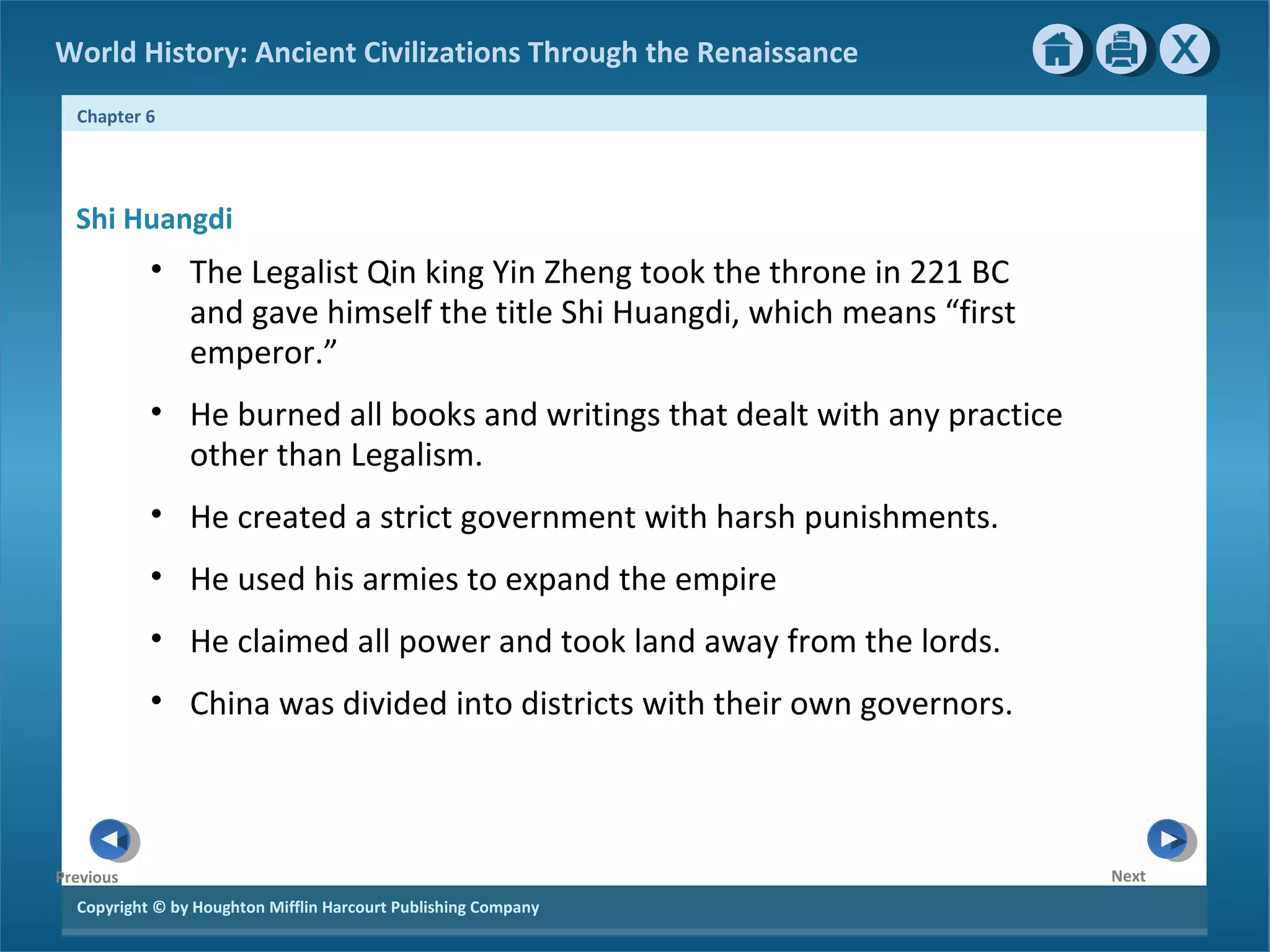
• The Legalist Qin king Yin Zheng took the throne in 221 BC 
and gave himself the title Shi Huangdi, which means “first 
emperor.” 
• He burned all books and writings that dealt with any practice 
other than Legalism. 
• He created a strict government with harsh punishments. 
• He used his armies to expand the empire 
• He claimed all power and took land away from the lords. 
• China was divided into districts with their own governors.
World History: Ancient Civilizations Through the Renaissance 
Chapter 6 
Qin Achievements 
Building Projects 
Copyright © by Houghton Mifflin Harcourt Publishing Company 
Next 
Previous 
• Massive government building projects gave jobs to many poor 
workers. 
• New roads were built and maintained to provide easy access 
to and from these buildings. 
Water Systems 
• Canals were built to connect rivers and keep trade fast and 
efficient. 
• Irrigation systems that are still in use today watered the fields 
and made more land good for farming.
World History: Ancient Civilizations Through the Renaissance 
Chapter 6 
The Great Wall of China 
Copyright © by Houghton Mifflin Harcourt Publishing Company 
Next 
Previous 
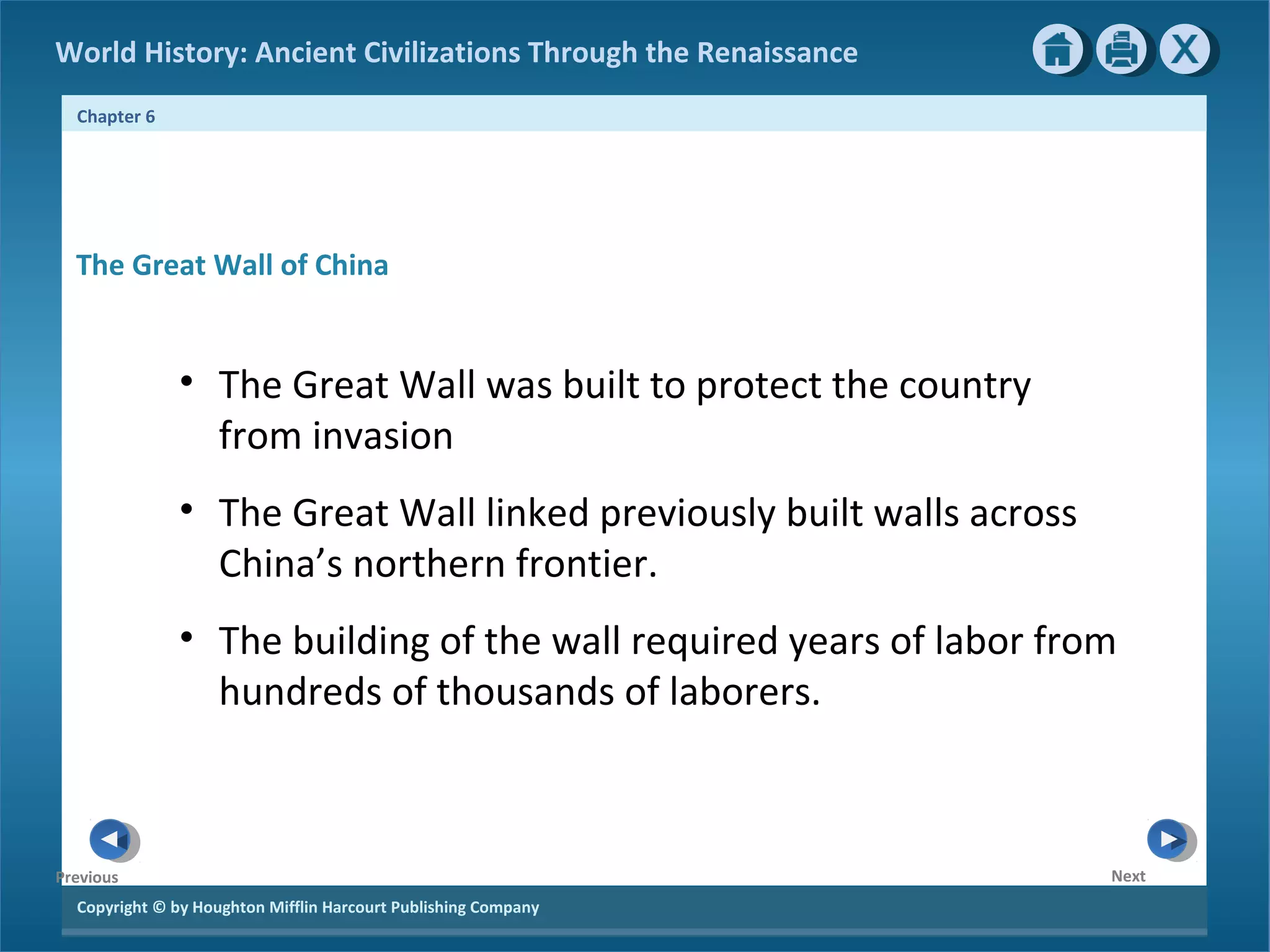
• The Great Wall was built to protect the country 
from invasion 
• The Great Wall linked previously built walls across 
China’s northern frontier. 
• The building of the wall required years of labor from 
hundreds of thousands of laborers.
World History: Ancient Civilizations Through the Renaissance 
Chapter 6 
Copyright © by Houghton Mifflin Harcourt Publishing Company 
Next 
Previous
World History: Ancient Civilizations Through the Renaissance 
Chapter 6 
The Fall of the Qin: The Oppressed Rise Up 
Copyright © by Houghton Mifflin Harcourt Publishing Company 
Next 
Previous 
• Many scholars, peasants, and nobles grew resentful of 
Shi Huangdi’s harsh policies and complete control. 
• Upon the death of Shi Huangdi, the country began to 
unravel. 
• With no authority present, the country fell into civil war.
World History: Ancient Civilizations Through the Renaissance 
Chapter 6 
The Han Dynasty 
The Big Idea 
The Han dynasty created a new form of government that valued family, art, and 
learning. 
Main Ideas 
•Han dynasty government was based on the ideas of Confucius. 
•Family life was supported and strengthened in Han China. 
•The Han made many achievements in art, literature, and learning. 
Copyright © by Houghton Mifflin Harcourt Publishing Company 
Next 
Previous
World History: Ancient Civilizations Through the Renaissance 
Chapter 6 
The Rise of a New Dynasty 
Copyright © by Houghton Mifflin Harcourt Publishing Company 
Next 
Previous 
• Liu Bang, a peasant fighting in a rebel army, became 
emperor due to the Chinese belief in the mandate of 
heaven. 
• He was the first emperor of the Han dynasty. 
• Well liked by both warriors and peasants 
• Liu Bang lowered taxes, gave large plots of land to 
supporters, and set up a government that expanded on 
the ideas of the Qin.
World History: Ancient Civilizations Through the Renaissance 
Chapter 6 
Wudi’s New Government 
Copyright © by Houghton Mifflin Harcourt Publishing Company 
Next 
Previous 
• In 140 BC, Emperor Wudi took the throne and 
shifted the country’s focus back to a strong central 
government. 
• Confucianism became the official government 
philosophy. 
• Wudi built a university that taught Confucian ideals
World History: Ancient Civilizations Through the Renaissance 
Chapter 6 
Four Social Classes under the Confucian System 
Copyright © by Houghton Mifflin Harcourt Publishing Company 
Next 
Previous 
•Upper Class: The Emperor 
•Second Class: The peasants 
•Third Class: The artisans 
•Fourth Class: The merchants
World History: Ancient Civilizations Through the Renaissance 
Chapter 6 
Family Life 
Social Classes and 
Copyright © by Houghton Mifflin Harcourt Publishing Company 
Next 
Previous 
Wealth 
•Social rank did not 
reflect prosperity. 
•Hard work and heavy 
labor did not reflect 
prosperity. 
•A strong family was 
stressed so that 
people would obey 
the emperor 
Men 
•Men were the head 
of the household. 
•Rulers had to obey 
their elders too; it 
was a crime to 
disobey. 
•Some men gained 
jobs based on the 
respect they showed 
to elders. 
Women 
•Women were 
taught to obey their 
husbands. 
•Girls were not 
valued as highly as 
boys. 
•Women could 
influence their sons’ 
families.
World History: Ancient Civilizations Through the Renaissance 
Chapter 6 
Han Achievements 
Art 
Literature 
Copyright © by Houghton Mifflin Harcourt Publishing Company 
Next 
Previous 
Fu style: combination of prose and poetry Shi 
style: short lines of verse that could be sung 
The Han Chinese made paper by grinding plant 
fibers into a paste and then setting the paste out 
to dry in sheets. Later they rolled the dried pulp 
into scrolls. 
Invention of Paper 
The Han created realistic scenes from everyday 
life, advanced figure painting, and depictions of 
religious figures and Confucian scholars.
World History: Ancient Civilizations Through the Renaissance 
Chapter 6 
Han Achievements 
Sundial 
Seismograph 
Copyright © by Houghton Mifflin Harcourt Publishing Company 
Next 
Previous 
This device measures the strength of an 
earthquake. Chinese scientists believed that the 
movement of the earth was a sign of evil times. 
Acupuncture is the practice of inserting needles 
into the skin to cure disease or relieve pain 
Acupuncture 
A device for telling time, the sundial uses the 
position of the shadows cast by the sun to tell the 
time of day.
World History: Ancient Civilizations Through the Renaissance 
Chapter 6 
Han Contacts with Other Cultures 
The Big Idea 
Trade routes led to the exchange of new products and ideas among China, Rome, and 
other peoples. 
Main Ideas 
•Farming and manufacturing grew during the Han dynasty. 
•Trade routes linked China with the Middle East and Rome. 
•Buddhism came to China from India and gained many followers. 
Copyright © by Houghton Mifflin Harcourt Publishing Company 
Next 
Previous
World History: Ancient Civilizations Through the Renaissance 
Chapter 6 
Technological Advances during the Han Dynasty 
Copyright © by Houghton Mifflin Harcourt Publishing Company 
Next 
Previous 
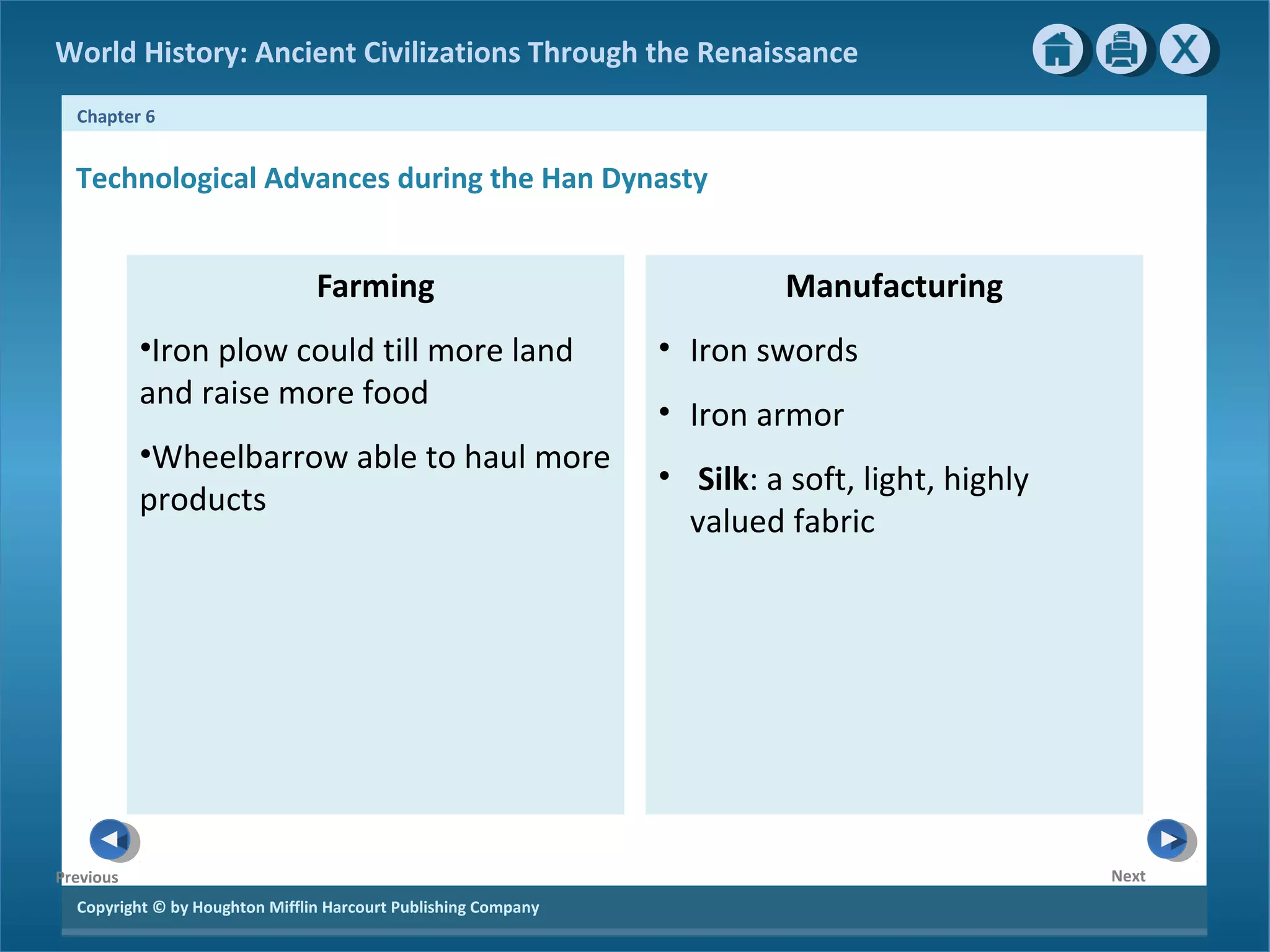
Farming 
•Iron plow could till more land 
and raise more food 
•Wheelbarrow able to haul more 
products 
Manufacturing 
• Iron swords 
• Iron armor 
• Silk: a soft, light, highly 
valued fabric
World History: Ancient Civilizations Through the Renaissance 
Chapter 6 
Trade Routes 
Copyright © by Houghton Mifflin Harcourt Publishing Company 
Next 
Previous 
• Chinese goods became highly valued in other lands, so trade 
routes began opening up. 
• Trading Chinese silk for strong Central Asian horses became a 
primary goal under the rule of Emperor Wudi.
World History: Ancient Civilizations Through the Renaissance 
Chapter 6 
The Silk Road 
Chinese traders only used the road until they reached Central Asia, 
and then gave their goods to local traders. 
Copyright © by Houghton Mifflin Harcourt Publishing Company 
Next 
Previous 
The Silk Road was a network of routes stretching more than 4,000 
miles across Asia’s deserts and mountain ranges, through the 
Middle East and stopping at the Mediterranean Seas. 
Travelers banded together for protection along the many miles of 
difficult terrain. 
China grew rich from trading silk with other lands.
World History: Ancient Civilizations Through the Renaissance 
Chapter 6 
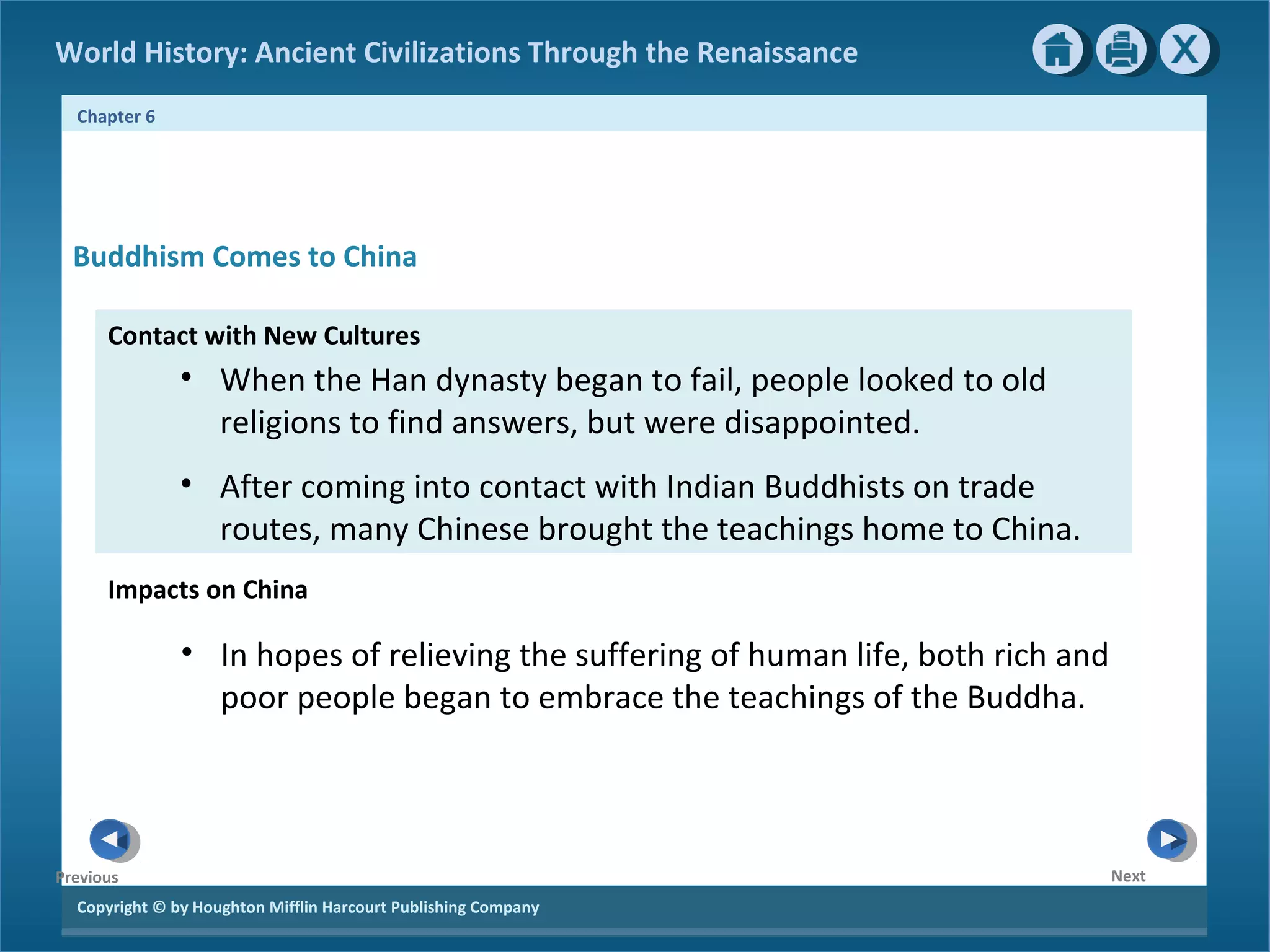
Buddhism Comes to China 
Contact with New Cultures 
Copyright © by Houghton Mifflin Harcourt Publishing Company 
Next 
Previous 
• When the Han dynasty began to fail, people looked to old 
religions to find answers, but were disappointed. 
• After coming into contact with Indian Buddhists on trade 
routes, many Chinese brought the teachings home to China. 
Impacts on China 
• In hopes of relieving the suffering of human life, both rich and 
poor people began to embrace the teachings of the Buddha.

Ch.6 ancient china-2003

  • 1.
    Next World History:Ancient Civilizations Through the Renaissance Chapter 6 Geography and Early China The Big Idea Chinese civilization began with the Shang dynasty along the Huang He. Main Ideas •China’s physical geography made farming possible but travel and communication difficult. •Civilization began in China along the Huang He and Chang Jiang rivers. •China’s first dynasties helped Chinese society develop and made many other achievements. Copyright © by Houghton Mifflin Harcourt Publishing Company
  • 2.
    World History: AncientCivilizations Through the Renaissance Chapter 6 Physical Geography Varied Landscape Copyright © by Houghton Mifflin Harcourt Publishing Company Next Previous • China covers an area of almost 4 million square miles. • The Gobi desert lies in the north. • Low-lying plains in the east make up one of the world’s largest farming areas. • Mountain ranges lie in the west. • The weather and temperature vary from cold and dry to wet and humid, and monsoons can bring up to 250 inches of rain each year.
  • 3.
    World History: AncientCivilizations Through the Renaissance Chapter 6 Copyright © by Houghton Mifflin Harcourt Publishing Company Next Previous Huang He •Also called the Yellow River •Nearly 3,000 miles long across northern China •Often floods, and has been referred to as “China’s sorrow” because of the destruction Chang Jiang •The longest river in Asia; also called the Yangzi River •Flows across central China from Tibet to the Pacific Ocean Two Rivers of China
  • 4.
    World History: AncientCivilizations Through the Renaissance Chapter 6 Civilization Begins Farming Copyright © by Houghton Mifflin Harcourt Publishing Company Next Previous • Frequent flooding made the land fertile around the Chang Jiang and Huang He rivers. • Along with farming, the Chinese people hunted, fished, and domesticated animals. Early Settlements • Some small villages along the rivers grew into larger cities. • Separate cultures developed in the north and the south • Findings at burial sites suggest that the ancient Chinese believed in an afterlife and had a complex social order.
  • 5.
    World History: AncientCivilizations Through the Renaissance Chapter 6 Xia dynasty Copyright © by Houghton Mifflin Harcourt Publishing Company Next Previous • The Xia dynasty might have been founded around 2200 BC, by Yu the Great. • Tales say that Yu dug channels to drain floodwaters and created the major waterways of North China. • Archaeologists have no firm evidence that tales about the Xia dynasty are true.
  • 6.
    World History: AncientCivilizations Through the Renaissance Chapter 6 Shang dynasty Copyright © by Houghton Mifflin Harcourt Publishing Company Next Previous • Established by 1500 BC, the Shang was the first dynasty that there is clear evidence to support. • The Shang reorganized the social order in China: the top ranking was the royals, then nobles, warriors, artisans, farmers, and slaves. • Most citizens lived within the city walls. • Many cultural advances were made, including China’s first writing system, complex tools, metal pots, and ornaments.
  • 7.
    World History: AncientCivilizations Through the Renaissance Chapter 6 The Zhou Dynasty and New Ideas The Big Idea Confucius and other philosophers taught ways to deal with social and political problems in ancient China. Main Ideas •The Zhou dynasty expanded China but then declined. •Confucius offered ideas to bring order to Chinese society. •Daoism and Legalism also gained followers. Copyright © by Houghton Mifflin Harcourt Publishing Company Next Previous
  • 8.
    World History: AncientCivilizations Through the Renaissance Chapter 6 The Zhou Political System Copyright © by Houghton Mifflin Harcourt Publishing Company Next Previous • The Zhou people worked with other tribes to overthrow the Shang dynasty in the 1100s BC. • Zhou leaders believed that their rulers were mandated by heaven • A new political order was established: the king granted plots of land to lords, who in turn provided soldiers and paid taxes to the king. • The lords helped Zhou rulers keep control of the dynasty.
  • 9.
    World History: AncientCivilizations Through the Renaissance Chapter 6 Decline of the Zhou Dynasty Copyright © by Houghton Mifflin Harcourt Publishing Company Next Previous • As the lords’ power grew, they became uninterested in serving Zhou rulers • In 771 BC, the Zhou suffered a loss to invaders. Zhou began to fight among themselves. • The Warring States Period marked power struggles between the ruling-class families.
  • 10.
    World History: AncientCivilizations Through the Renaissance Chapter 6 Confucianism Moral Values The Analects Copyright © by Houghton Mifflin Harcourt Publishing Company Next Previous This code of ethics was passed down and written in a book. These stories focused on morality, family, society, and government. Confucius believed that when people behaved well and acted morally, they were carrying out what heaven expected of them. Leading by Example Disgusted with the rude and insensitive nature of the people around him, Confucius pushed for a return to ethics, or moral values.
  • 11.
    World History: AncientCivilizations Through the Renaissance Chapter 6 Copyright © by Houghton Mifflin Harcourt Publishing Company Next Previous Daoism •Daoism comes from Dao, meaning “the way.” •Daoists believed that people should avoid interfering with nature or each other. Legalism • Legalism is the political philosophy that people need to be controlled. • It is unconcerned with religion or individual thought, and prepared always for war. Two Schools of Thought
  • 12.
    World History: AncientCivilizations Through the Renaissance Chapter 6 The Qin Dynasty The Big Idea The Qin dynasty unified China with a strong government and a system of standardization. Main Ideas •The first Qin emperor created a strong but strict government. •A unified China was created through Qin policies and achievements. Copyright © by Houghton Mifflin Harcourt Publishing Company Next Previous
  • 13.
    World History: AncientCivilizations Through the Renaissance Chapter 6 Shi Huangdi Copyright © by Houghton Mifflin Harcourt Publishing Company Next Previous • The Legalist Qin king Yin Zheng took the throne in 221 BC and gave himself the title Shi Huangdi, which means “first emperor.” • He burned all books and writings that dealt with any practice other than Legalism. • He created a strict government with harsh punishments. • He used his armies to expand the empire • He claimed all power and took land away from the lords. • China was divided into districts with their own governors.
  • 14.
    World History: AncientCivilizations Through the Renaissance Chapter 6 Qin Achievements Building Projects Copyright © by Houghton Mifflin Harcourt Publishing Company Next Previous • Massive government building projects gave jobs to many poor workers. • New roads were built and maintained to provide easy access to and from these buildings. Water Systems • Canals were built to connect rivers and keep trade fast and efficient. • Irrigation systems that are still in use today watered the fields and made more land good for farming.
  • 15.
    World History: AncientCivilizations Through the Renaissance Chapter 6 The Great Wall of China Copyright © by Houghton Mifflin Harcourt Publishing Company Next Previous • The Great Wall was built to protect the country from invasion • The Great Wall linked previously built walls across China’s northern frontier. • The building of the wall required years of labor from hundreds of thousands of laborers.
  • 16.
    World History: AncientCivilizations Through the Renaissance Chapter 6 Copyright © by Houghton Mifflin Harcourt Publishing Company Next Previous
  • 17.
    World History: AncientCivilizations Through the Renaissance Chapter 6 The Fall of the Qin: The Oppressed Rise Up Copyright © by Houghton Mifflin Harcourt Publishing Company Next Previous • Many scholars, peasants, and nobles grew resentful of Shi Huangdi’s harsh policies and complete control. • Upon the death of Shi Huangdi, the country began to unravel. • With no authority present, the country fell into civil war.
  • 18.
    World History: AncientCivilizations Through the Renaissance Chapter 6 The Han Dynasty The Big Idea The Han dynasty created a new form of government that valued family, art, and learning. Main Ideas •Han dynasty government was based on the ideas of Confucius. •Family life was supported and strengthened in Han China. •The Han made many achievements in art, literature, and learning. Copyright © by Houghton Mifflin Harcourt Publishing Company Next Previous
  • 19.
    World History: AncientCivilizations Through the Renaissance Chapter 6 The Rise of a New Dynasty Copyright © by Houghton Mifflin Harcourt Publishing Company Next Previous • Liu Bang, a peasant fighting in a rebel army, became emperor due to the Chinese belief in the mandate of heaven. • He was the first emperor of the Han dynasty. • Well liked by both warriors and peasants • Liu Bang lowered taxes, gave large plots of land to supporters, and set up a government that expanded on the ideas of the Qin.
  • 20.
    World History: AncientCivilizations Through the Renaissance Chapter 6 Wudi’s New Government Copyright © by Houghton Mifflin Harcourt Publishing Company Next Previous • In 140 BC, Emperor Wudi took the throne and shifted the country’s focus back to a strong central government. • Confucianism became the official government philosophy. • Wudi built a university that taught Confucian ideals
  • 21.
    World History: AncientCivilizations Through the Renaissance Chapter 6 Four Social Classes under the Confucian System Copyright © by Houghton Mifflin Harcourt Publishing Company Next Previous •Upper Class: The Emperor •Second Class: The peasants •Third Class: The artisans •Fourth Class: The merchants
  • 22.
    World History: AncientCivilizations Through the Renaissance Chapter 6 Family Life Social Classes and Copyright © by Houghton Mifflin Harcourt Publishing Company Next Previous Wealth •Social rank did not reflect prosperity. •Hard work and heavy labor did not reflect prosperity. •A strong family was stressed so that people would obey the emperor Men •Men were the head of the household. •Rulers had to obey their elders too; it was a crime to disobey. •Some men gained jobs based on the respect they showed to elders. Women •Women were taught to obey their husbands. •Girls were not valued as highly as boys. •Women could influence their sons’ families.
  • 23.
    World History: AncientCivilizations Through the Renaissance Chapter 6 Han Achievements Art Literature Copyright © by Houghton Mifflin Harcourt Publishing Company Next Previous Fu style: combination of prose and poetry Shi style: short lines of verse that could be sung The Han Chinese made paper by grinding plant fibers into a paste and then setting the paste out to dry in sheets. Later they rolled the dried pulp into scrolls. Invention of Paper The Han created realistic scenes from everyday life, advanced figure painting, and depictions of religious figures and Confucian scholars.
  • 24.
    World History: AncientCivilizations Through the Renaissance Chapter 6 Han Achievements Sundial Seismograph Copyright © by Houghton Mifflin Harcourt Publishing Company Next Previous This device measures the strength of an earthquake. Chinese scientists believed that the movement of the earth was a sign of evil times. Acupuncture is the practice of inserting needles into the skin to cure disease or relieve pain Acupuncture A device for telling time, the sundial uses the position of the shadows cast by the sun to tell the time of day.
  • 25.
    World History: AncientCivilizations Through the Renaissance Chapter 6 Han Contacts with Other Cultures The Big Idea Trade routes led to the exchange of new products and ideas among China, Rome, and other peoples. Main Ideas •Farming and manufacturing grew during the Han dynasty. •Trade routes linked China with the Middle East and Rome. •Buddhism came to China from India and gained many followers. Copyright © by Houghton Mifflin Harcourt Publishing Company Next Previous
  • 26.
    World History: AncientCivilizations Through the Renaissance Chapter 6 Technological Advances during the Han Dynasty Copyright © by Houghton Mifflin Harcourt Publishing Company Next Previous Farming •Iron plow could till more land and raise more food •Wheelbarrow able to haul more products Manufacturing • Iron swords • Iron armor • Silk: a soft, light, highly valued fabric
  • 27.
    World History: AncientCivilizations Through the Renaissance Chapter 6 Trade Routes Copyright © by Houghton Mifflin Harcourt Publishing Company Next Previous • Chinese goods became highly valued in other lands, so trade routes began opening up. • Trading Chinese silk for strong Central Asian horses became a primary goal under the rule of Emperor Wudi.
  • 28.
    World History: AncientCivilizations Through the Renaissance Chapter 6 The Silk Road Chinese traders only used the road until they reached Central Asia, and then gave their goods to local traders. Copyright © by Houghton Mifflin Harcourt Publishing Company Next Previous The Silk Road was a network of routes stretching more than 4,000 miles across Asia’s deserts and mountain ranges, through the Middle East and stopping at the Mediterranean Seas. Travelers banded together for protection along the many miles of difficult terrain. China grew rich from trading silk with other lands.
  • 29.
    World History: AncientCivilizations Through the Renaissance Chapter 6 Buddhism Comes to China Contact with New Cultures Copyright © by Houghton Mifflin Harcourt Publishing Company Next Previous • When the Han dynasty began to fail, people looked to old religions to find answers, but were disappointed. • After coming into contact with Indian Buddhists on trade routes, many Chinese brought the teachings home to China. Impacts on China • In hopes of relieving the suffering of human life, both rich and poor people began to embrace the teachings of the Buddha.