Chapter 5: Personnel Planning &
Recruitment
1) Decide what positions you’ll have to fill through
   personnel planning and forecasting.
2) Build a pool of candidates for these jobs by recruiting
    internal or external candidates.
3) Have candidates complete application forms and
   perhaps undergo an initial screening interview.
4) Use selection techniques like tests, background
   investigations, and physical exams to identify viable
   candidates.
5) Decide who to make an offer to, by having the
   supervisor and perhaps others on the team interview
   the candidates.
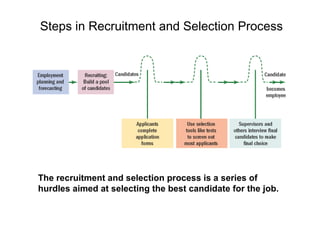
Steps in Recruitment and Selection Process


The recruitment and selection process is a series of
hurdles aimed at selecting the best candidate for the job.
Planning and Forecasting
 Employment or personnel planning
  – The process of deciding what positions the firm
    will have to fill, and how to fill them.
 Succession planning
  – The process of deciding how to fill the company’s
    most important executive jobs.
 What to forecast?
  – Overall personnel needs
  – The supply of inside candidates
  – The supply of outside candidates
Determining the Relationship Between
 Hospital Size and Number of Nurses


       How many nurses should we hire?
Forecasting the Supply of Inside
Candidates
 Qualifications inventories
 Human Resource Information System (HRIS)
  – Manual or computerized records listing
    employees’:
     •   Education level
     •   Career & development interests
     •   Experience
     •   Product/Service knowledge
     •   Languages
     •   Special skills

     To be used in selecting inside candidates for promotion.
Forecasting the Supply of Outside
Candidates
 Factors impacting the supply of outside
  candidates
  – General economic conditions
  – Expected unemployment rate
 Sources of information
  – Periodic forecasts in business publications
  – Online economic projections
     •   U.S. Congressional Budget Office (CBO)
     •   Bureau of Labor Statistics
     •   U.S. Department of Labor: O*Net
     •   Other federal agencies
Effective Recruiting
 External factors affecting recruiting:
   – Looming undersupply of workers
   – Lessening of the trend in outsourcing of jobs
   – Increasingly fewer “qualified” candidates
 Internal factors affecting recruiting:
   – The consistency of the firm’s recruitment efforts
     with its strategic goals
   – The available resources, types of jobs to be
     recruited and choice of recruiting methods
   – Nonrecruitment HR issues and policies
   – Line and staff coordination and cooperation
Effective Recruiting (cont’d)
 Centralizing recruitment

      Advantages:
  –   Strengthens employment brand
  –   Ease in applying strategic principles
  –   Reduces duplication of HR activiites
  –   Reduces the cost of new HR technologies
  –   Builds teams of HR experts
  –   Provides for better measurement of HR
      performance
  –   Allows for the sharing of applicant pools
Measuring Recruiting Effectiveness
 What to measure and how to measure
  – How many qualified applicants were attracted from
    each recruitment source?
     • Assessing both the quantity and the quality of the
       applicants produced by a source.
 High performance recruiting
  – Applying best-practices management techniques
    to recruiting.
     • Using a benchmarks-oriented approach to analyzing and
       measuring the effectiveness of recruiting efforts such as
       employee referrals.
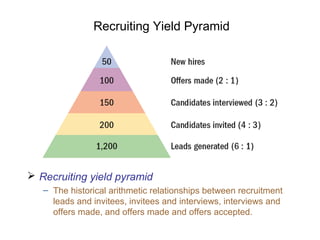
Recruiting Yield Pyramid


 Recruiting yield pyramid
   – The historical arithmetic relationships between recruitment
     leads and invitees, invitees and interviews, interviews and
     offers made, and offers made and offers accepted.
Internal Sources of Candidates:
     Hiring from Within
 Advantages                  Disadvantages
  – Foreknowledge of           – Failed applicants
    candidates’ strengths        become discontented
    and weaknesses             – Time wasted
  – More accurate view of        interviewing inside
    candidate’s skills           candidates who will not
  – Candidates have a            be considered
    stronger commitment to     – Inbreeding of the status
    the company                  quo
  – Increases employee
    morale
  – Less training and
    orientation required
Finding Internal Candidates
 Job postings (e.g., web, newsletters, bulletin
  boards)
 Rehiring former employees (pros and cons)
 Succession planning (for higher levels in the
  organization)
Outside Sources of Candidates
 Advertising
  – The Media: selection of the best medium depends
    on the positions for which the firm is recruiting.
     •   Newspapers (local and specific labor markets)
     •   Trade and professional journals
     •   Internet job sites
     •   Marketing programs
 Constructing an effective ad
  – Wording related to job interest factors should
    evoke the applicant’s attention, interest, desire,
    and action (AIDA) and create a positive
    impression of the firm.
Outside Sources of Candidates (cont’d)
 Employment agencies (public, private)
 Temporary agencies….
 Benefits of Temps:
   – Paid only when working
   – More productive
   – No recruitment, screening, and payroll administration costs
 Costs of Temps
   – Fees paid to temp agencies
   – Lack of commitment to firm
Temp Agencies and Alternative Staffing
 Benefits of Temps            Costs of Temps
   – Paid only when             – Fees paid to temp
     working                      agencies
   – More productive            – Lack of commitment to
   – No recruitment,              firm
     screening, and payroll
     administration costs
Offshoring/Outsourcing
White-Collar and Other Jobs
 Specific issues in outsourcing jobs abroad
  – Political and military instability
  – Likelihood of cultural misunderstandings
  – Customers’ security and privacy concerns
  – Foreign contracts, liability, and legal concerns
  – Special training of foreign employees
  – Costs associated with companies supplying
    foreign workers
Outside Sources of Candidates (cont’d)
 Executive recruiters (headhunters)
  – Special employment agencies retained by
    employers to seek out top-management talent for
    their clients.
     • Contingent-based recruiters collect a fee for their
       services when a successful hire is completed.
     • Retained executive searchers are paid regardless of the
       outcome of the recruitment process.

  – Internet technology and specialization trends are
    changing how candidates are attracted and how
    searches are conducted.
Outside Sources of Candidates (cont’d)
 College recruiting
  – Recruiting goals
     • To determine if the candidate is worthy of further
       consideration
     • To attract good candidates
  – On-site visits
     •   Invitation letters
     •   Assigned hosts
     •   Information package
     •   Planned interviews
     •   Timely employment offer
     •   Follow-up
  – Internships
Outside Sources of Candidates (cont’d)
 Employee referrals
  – Applicants who are referred to the organization by
    current employees
     • Referring employees become stakeholders.
     • Referral is a cost-effective recruitment program.
     • Referral can speed up diversifying the workforce
 Walk-ins
  – Direct applicants who seek employment with or
    without encouragement from other sources.
  – Courteous treatment of any applicant is a good
    business practice.
Outside Sources of Candidates (cont’d)
 Recruiting via the Internet
   – More firms and applicants are utilizing the Internet
     in the job search process.
 Advantages of Internet recruiting
   –   Cost-effective way to publicize job openings
   –   More applicants attracted over a longer period
   –   Immediate applicant responses
   –   Online prescreening of applicants
   –   Links to other job search sites
   –   Automation of applicant tracking and evaluation
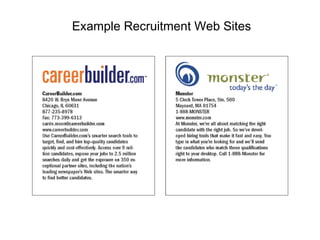
Example Recruitment Web Sites
Issues in Recruiting a More Diverse
Workforce
 Single parents
  – Providing work schedule flexibility.
 Older workers
  – Revising polices that make it difficult or
    unattractive for older workers to remain employed.
 Recruiting minorities and women
  – Understanding recruitment barriers.
  – Formulating recruitment plans.
  – Instituting specific day-to-day programs.
Issues in Recruiting a More Diverse
Workforce (cont’d)
 Welfare-to-work
  – Developing pre-training programs to overcome
    difficulties in hiring and assimilating persons
    previously on welfare.
 The disabled
  – Developing resources and policies to recruit and
    integrate disable persons into the workforce.

Ch5 obe153

  • 1.
    Chapter 5: PersonnelPlanning & Recruitment 1) Decide what positions you’ll have to fill through personnel planning and forecasting. 2) Build a pool of candidates for these jobs by recruiting internal or external candidates. 3) Have candidates complete application forms and perhaps undergo an initial screening interview. 4) Use selection techniques like tests, background investigations, and physical exams to identify viable candidates. 5) Decide who to make an offer to, by having the supervisor and perhaps others on the team interview the candidates.
  • 2.
    Steps in Recruitmentand Selection Process The recruitment and selection process is a series of hurdles aimed at selecting the best candidate for the job.
  • 3.
    Planning and Forecasting Employment or personnel planning – The process of deciding what positions the firm will have to fill, and how to fill them.  Succession planning – The process of deciding how to fill the company’s most important executive jobs.  What to forecast? – Overall personnel needs – The supply of inside candidates – The supply of outside candidates
  • 4.
    Determining the RelationshipBetween Hospital Size and Number of Nurses How many nurses should we hire?
  • 5.
    Forecasting the Supplyof Inside Candidates  Qualifications inventories  Human Resource Information System (HRIS) – Manual or computerized records listing employees’: • Education level • Career & development interests • Experience • Product/Service knowledge • Languages • Special skills To be used in selecting inside candidates for promotion.
  • 6.
    Forecasting the Supplyof Outside Candidates  Factors impacting the supply of outside candidates – General economic conditions – Expected unemployment rate  Sources of information – Periodic forecasts in business publications – Online economic projections • U.S. Congressional Budget Office (CBO) • Bureau of Labor Statistics • U.S. Department of Labor: O*Net • Other federal agencies
  • 7.
    Effective Recruiting  Externalfactors affecting recruiting: – Looming undersupply of workers – Lessening of the trend in outsourcing of jobs – Increasingly fewer “qualified” candidates  Internal factors affecting recruiting: – The consistency of the firm’s recruitment efforts with its strategic goals – The available resources, types of jobs to be recruited and choice of recruiting methods – Nonrecruitment HR issues and policies – Line and staff coordination and cooperation
  • 8.
    Effective Recruiting (cont’d) Centralizing recruitment Advantages: – Strengthens employment brand – Ease in applying strategic principles – Reduces duplication of HR activiites – Reduces the cost of new HR technologies – Builds teams of HR experts – Provides for better measurement of HR performance – Allows for the sharing of applicant pools
  • 9.
    Measuring Recruiting Effectiveness What to measure and how to measure – How many qualified applicants were attracted from each recruitment source? • Assessing both the quantity and the quality of the applicants produced by a source.  High performance recruiting – Applying best-practices management techniques to recruiting. • Using a benchmarks-oriented approach to analyzing and measuring the effectiveness of recruiting efforts such as employee referrals.
  • 10.
    Recruiting Yield Pyramid Recruiting yield pyramid – The historical arithmetic relationships between recruitment leads and invitees, invitees and interviews, interviews and offers made, and offers made and offers accepted.
  • 11.
    Internal Sources ofCandidates: Hiring from Within  Advantages  Disadvantages – Foreknowledge of – Failed applicants candidates’ strengths become discontented and weaknesses – Time wasted – More accurate view of interviewing inside candidate’s skills candidates who will not – Candidates have a be considered stronger commitment to – Inbreeding of the status the company quo – Increases employee morale – Less training and orientation required
  • 12.
    Finding Internal Candidates Job postings (e.g., web, newsletters, bulletin boards)  Rehiring former employees (pros and cons)  Succession planning (for higher levels in the organization)
  • 13.
    Outside Sources ofCandidates  Advertising – The Media: selection of the best medium depends on the positions for which the firm is recruiting. • Newspapers (local and specific labor markets) • Trade and professional journals • Internet job sites • Marketing programs  Constructing an effective ad – Wording related to job interest factors should evoke the applicant’s attention, interest, desire, and action (AIDA) and create a positive impression of the firm.
  • 14.
    Outside Sources ofCandidates (cont’d)  Employment agencies (public, private)  Temporary agencies….  Benefits of Temps: – Paid only when working – More productive – No recruitment, screening, and payroll administration costs  Costs of Temps – Fees paid to temp agencies – Lack of commitment to firm
  • 15.
    Temp Agencies andAlternative Staffing  Benefits of Temps  Costs of Temps – Paid only when – Fees paid to temp working agencies – More productive – Lack of commitment to – No recruitment, firm screening, and payroll administration costs
  • 16.
    Offshoring/Outsourcing White-Collar and OtherJobs  Specific issues in outsourcing jobs abroad – Political and military instability – Likelihood of cultural misunderstandings – Customers’ security and privacy concerns – Foreign contracts, liability, and legal concerns – Special training of foreign employees – Costs associated with companies supplying foreign workers
  • 17.
    Outside Sources ofCandidates (cont’d)  Executive recruiters (headhunters) – Special employment agencies retained by employers to seek out top-management talent for their clients. • Contingent-based recruiters collect a fee for their services when a successful hire is completed. • Retained executive searchers are paid regardless of the outcome of the recruitment process. – Internet technology and specialization trends are changing how candidates are attracted and how searches are conducted.
  • 18.
    Outside Sources ofCandidates (cont’d)  College recruiting – Recruiting goals • To determine if the candidate is worthy of further consideration • To attract good candidates – On-site visits • Invitation letters • Assigned hosts • Information package • Planned interviews • Timely employment offer • Follow-up – Internships
  • 19.
    Outside Sources ofCandidates (cont’d)  Employee referrals – Applicants who are referred to the organization by current employees • Referring employees become stakeholders. • Referral is a cost-effective recruitment program. • Referral can speed up diversifying the workforce  Walk-ins – Direct applicants who seek employment with or without encouragement from other sources. – Courteous treatment of any applicant is a good business practice.
  • 20.
    Outside Sources ofCandidates (cont’d)  Recruiting via the Internet – More firms and applicants are utilizing the Internet in the job search process.  Advantages of Internet recruiting – Cost-effective way to publicize job openings – More applicants attracted over a longer period – Immediate applicant responses – Online prescreening of applicants – Links to other job search sites – Automation of applicant tracking and evaluation
  • 21.
  • 22.
    Issues in Recruitinga More Diverse Workforce  Single parents – Providing work schedule flexibility.  Older workers – Revising polices that make it difficult or unattractive for older workers to remain employed.  Recruiting minorities and women – Understanding recruitment barriers. – Formulating recruitment plans. – Instituting specific day-to-day programs.
  • 23.
    Issues in Recruitinga More Diverse Workforce (cont’d)  Welfare-to-work – Developing pre-training programs to overcome difficulties in hiring and assimilating persons previously on welfare.  The disabled – Developing resources and policies to recruit and integrate disable persons into the workforce.