Recruitment
• Recruitment isthe process of searching for prospective employees and
stimulating them to apply for jobs in the organization.
• Recruitment termed as “positive” because its objective is to increase
selection ration i.e. the number of applicant per job opening.
• In recruitment, organization itself sells it to the prospective employees.
3.
Effecting Recruiting
• Itrefers to the process of bringing together prospective
employers and employees. The purpose of recruitment is to
prepare an inventory of people who meet the criteria in job
specifications so that the organization may choose those who
are found most suitable for the vacant positions.
3
4.
Effecting Recruiting
• Effectiverecruitment is increasingly important in a globalized competitive
business world and to achieve organization’s strategies.
• Recruiting employees is a complex process like:
– Must be consistent with organization’s strategic plans
– Different types of job require different methods of recruitment
– Recruiting success depends on compensation package and other policies
– Require effective pre-screening of employees,
– Image of the organization
– Compliance with employment laws.
4
5.
Recruiting a DiverseWorkforce
• Recruiting a more diverse workforce is a social responsibility.
• You may need to recruit from different geographical areas, ethnic groups,
gender, age groups.
• May need different recruitment techniques for recruiting diverse workforce-
– May need to introduce affirmative action like quota for disadvantage
groups.
6.
PURPOSE AND IMPORTANCE
Thegeneral purpose of recruitment is to provide a pool of potentially qualified
job candidates. Specifically, the purposes are to:
1. Determine the present and future requirement of the organization in
conjunction with its personnel planning and job analysis activities;
2. Increase the job pool of job candidates at minimum cost;
3. Help increase the success rate of the selection process by reducing the
number visibly under qualified or job application;
7.
PURPOSE AND IMPORTANCE
4.Help reduce the probability that job applicants, once recruited selected,
will leave the organization only after a short period of time;
5. Meet the organizations legal and social obligation regarding the
composition of its workforce;
6. Being identifying and preparing potential job applicants who will be
appropriate candidates;
7. Increase organization individual effectiveness in the short term and long
term;
8. Evaluate the effectiveness of various recruiting technique and sources for
all types of job applicants.
Alternatives to Recruitment
Companiessearch for alternatives to recruitment because of the cost of
recruiting. Three such alternatives to recruitment are :
1. Overtime
2. Employee Leasing
3. Temporary Employment
10.
PHILOSOPHIES OF RECRUITMENT
Thetraditional philosophy of recruiting has been to get as many
people to apply for a job as possible. A large number of jobseekers
waiting in queues would make the final selection difficult, often
resulting in wrong selection.
Job dissatisfaction and employee turnover are the consequence of this. A
persuasive agreement can be made that matching the needs of the
organization to the needs of the applicants will enhance the effectiveness
of the recruitment process.
11.
PHILOSOPHIES OF RECRUITMENT
Theresult will be a workforce which is likely to stay with the organization
longer and performs at a higher level of effectiveness. Two approaches
are available to bring about match. They are:
• Realistic Job Preview (RJP)
• Job Compatibility Questionnaire (JCQ)
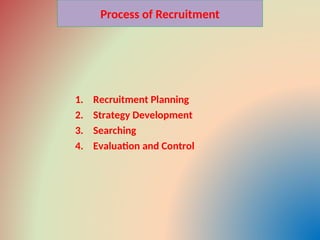
Process of Recruitment
1.Recruitment Planning
2. Strategy Development
3. Searching
4. Evaluation and Control
14.
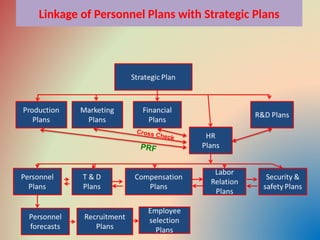
The first stagein the Recruitment Process is planning. Planning
involves the translation of likely job vacancies and information
about the nature of these jobs into a set of objectives is targets
that specify the number and type of applicants to be planned.
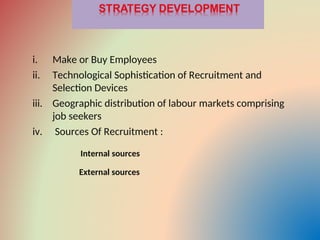
15.
i. Make orBuy Employees
ii. Technological Sophistication of Recruitment and
Selection Devices
iii. Geographic distribution of labour markets comprising
job seekers
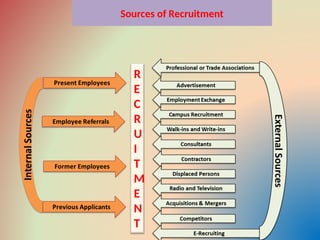
iv. Sources Of Recruitment :
Internal sources
External sources
16.
i. Source Activation:Source Activation takes place when a job vacancy exists in
the organization. If the organization has planned and well and done a good job
of developing its source and search methods, activation soon results in a flood
of application.
ii. Selling: In selling the, both the Message and Media deserve attention in the
organization. Message refers to the employment advertisements. Media refers
to the source of any recruiting message. For example, Employment Exchanges,
Advertises in Business magazines
17.
The purpose ofscreening is to remove from the recruitment
process at an early stage, those applicants who are visibly
unqualified for the job. Effective screening can save a great
deal of time and money. Care must be exercised to assure
that potentially good employees are not lost.
18.
It is necessaryas considerable costs are incurred in the
recruitment process.Statiscal information should be gathered
and evaluated to know the suitability of the recruitment
process.
19.
Recruiting Yield Pyramid
•Recruiting Yield Pyramid: It is used to calculate the number
of applicants the organization must generate to hire the
required number of employees.
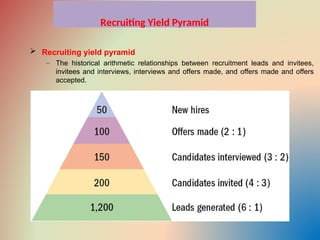
For example an organization should receive 1200 applications to be able to
invite 200 viable candidates for hiring 50 new employees.
20.
Recruiting Yield Pyramid
Recruiting yield pyramid
– The historical arithmetic relationships between recruitment leads and invitees,
invitees and interviews, interviews and offers made, and offers made and offers
accepted.
21.
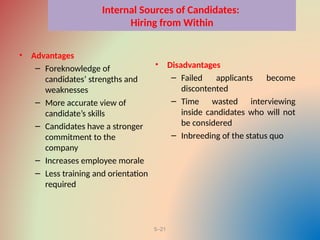
5–21
Internal Sources ofCandidates:
Hiring from Within
• Advantages
– Foreknowledge of
candidates’ strengths and
weaknesses
– More accurate view of
candidate’s skills
– Candidates have a stronger
commitment to the
company
– Increases employee morale
– Less training and orientation
required
• Disadvantages
– Failed applicants become
discontented
– Time wasted interviewing
inside candidates who will not
be considered
– Inbreeding of the status quo
22.
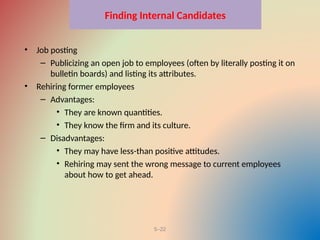
5–22
Finding Internal Candidates
•Job posting
– Publicizing an open job to employees (often by literally posting it on
bulletin boards) and listing its attributes.
• Rehiring former employees
– Advantages:
• They are known quantities.
• They know the firm and its culture.
– Disadvantages:
• They may have less-than positive attitudes.
• Rehiring may sent the wrong message to current employees
about how to get ahead.
5–24
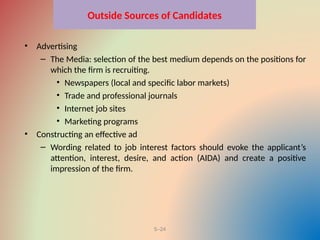
Outside Sources ofCandidates
• Advertising
– The Media: selection of the best medium depends on the positions for
which the firm is recruiting.
• Newspapers (local and specific labor markets)
• Trade and professional journals
• Internet job sites
• Marketing programs
• Constructing an effective ad
– Wording related to job interest factors should evoke the applicant’s
attention, interest, desire, and action (AIDA) and create a positive
impression of the firm.
25.
5–25
Outside Sources ofCandidates (cont’d)
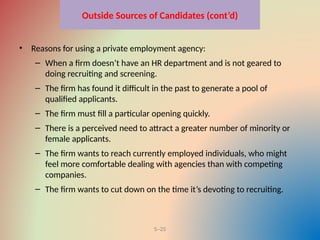
• Reasons for using a private employment agency:
– When a firm doesn’t have an HR department and is not geared to
doing recruiting and screening.
– The firm has found it difficult in the past to generate a pool of
qualified applicants.
– The firm must fill a particular opening quickly.
– There is a perceived need to attract a greater number of minority or
female applicants.
– The firm wants to reach currently employed individuals, who might
feel more comfortable dealing with agencies than with competing
companies.
– The firm wants to cut down on the time it’s devoting to recruiting.
26.
5–26
Outside Sources ofCandidates (cont’d)
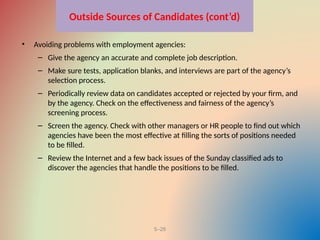
• Avoiding problems with employment agencies:
– Give the agency an accurate and complete job description.
– Make sure tests, application blanks, and interviews are part of the agency’s
selection process.
– Periodically review data on candidates accepted or rejected by your firm, and
by the agency. Check on the effectiveness and fairness of the agency’s
screening process.
– Screen the agency. Check with other managers or HR people to find out which
agencies have been the most effective at filling the sorts of positions needed
to be filled.
– Review the Internet and a few back issues of the Sunday classified ads to
discover the agencies that handle the positions to be filled.
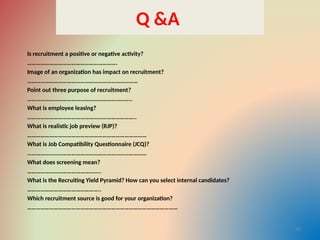
Q &A
Is recruitmenta positive or negative activity?
…………………………………………………….
Image of an organization has impact on recruitment?
…………………………………………………………………
Point out three purpose of recruitment?
……………………………………………………………..
What is employee leasing?
………………………………………………………………..
What is realistic job preview (RJP)?
………………………………………………………………………
What is Job Compatibility Questionnaire (JCQ)?
………………………………………………………………………
What does screening mean?
…………………………………………..
What is the Recruiting Yield Pyramid? How can you select internal candidates?
…………………………………………..
Which recruitment source is good for your organization?
…………………………………………………………………………………………
30
31.
Selection has beenregarded as the most important function of HR department.
It ensures the organization that; it has right number, right kind of people at
the right place and at the right time.
Meaning and Definitions:
“It is the process of differentiating between applicants in order
to identify (and hire) those with the greater likelihood of success in a job.”
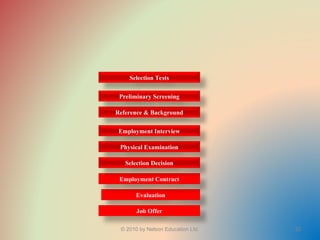
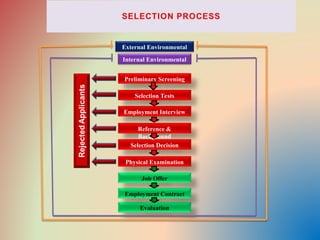
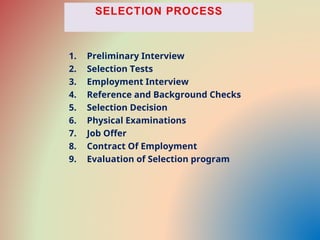
1. Preliminary Interview
2.Selection Tests
3. Employment Interview
4. Reference and Background Checks
5. Selection Decision
6. Physical Examinations
7. Job Offer
8. Contract Of Employment
9. Evaluation of Selection program
35.
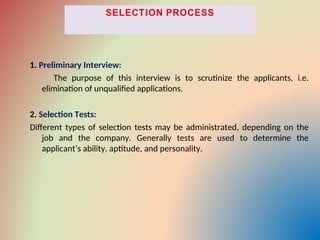
1. Preliminary Interview:
Thepurpose of this interview is to scrutinize the applicants, i.e.
elimination of unqualified applications.
2. Selection Tests:
Different types of selection tests may be administrated, depending on the
job and the company. Generally tests are used to determine the
applicant’s ability, aptitude, and personality.
36.
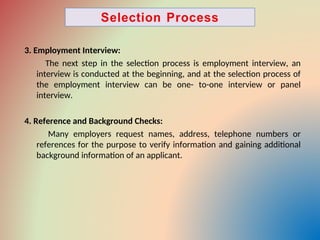
3. Employment Interview:
Thenext step in the selection process is employment interview, an
interview is conducted at the beginning, and at the selection process of
the employment interview can be one- to-one interview or panel
interview.
4. Reference and Background Checks:
Many employers request names, address, telephone numbers or
references for the purpose to verify information and gaining additional
background information of an applicant.
37.
5. Selection Decision:
Selectiondecision is the most critical of all steps in selection
process. The final decision has to be made from the pool of individuals who
pass the tests, interviews and references checks.
6. Physical Examinations:
After selection decision and before the job offer is made, the
candidate is required to undergo a physical fitness test. A job offer is often;
contingent upon the candidate being declared fit after the physical
examinations.
38.
7. Job Offer:
Thenext step in selection process is job offer. Job offer is made through a
letter of appointment. Such a letter generally contains a date by which the
appointee must report on duty
8. Contract of Employment:
Basic information is written in Contract of employment that varies according to
the levels of job. After the offer and acceptance of the job certain document is
the attestation form.
9 Evaluation of Selection program:
The broad test of effectiveness of the selection process is a systematic
evaluation .A periodic audit is conducted in the HR department that outlines
and highlights the areas which need to be evaluated in the selection process
39.
39
The Interview Method
StructuredInterview:
This is also known as a formal interview (like a job interview).The questions are asked in a
set / standardized order and the interviewer will not deviate from the interview schedule or
probe beyond the answers received (so they are not flexible).These are based on
structured, closed-ended questions.
Strengths
1. Structured interviews are easy to replicate as a fixed set of closed questions are used, which are
easy to quantify – this means it is easy to test for reliability.
2. Structured interviews are fairly quick to conduct which means that many interviews can take place
within a short amount of time. This means a large sample can be obtained resulting in the findings
being representative and having the ability to be generalized to a large population.
Limitations
1. Structure interviews are not flexible. This means new questions cannot be asked impromptu (i.e.
during the interview) as an interview schedule must be followed.
2. The answers from structured interviews lack detail as only closed questions are asked which
generates quantitative data. This means a research will won't know why a person behaves in a
certain way.
40.
40
The Interview Method
UnstructuredInterview
These are sometimes referred to as ‘discovery interviews’ & are more like a ‘guided conservation’ than a
strict structured interview. They are sometimes called informal interviews.An interview schedule might not
be used, and even if one is used, they will contain open-ended questions that can be asked in any order.
Some questions might be added / missed as the Interview progresses.
Strengths
1. Unstructured interviews are more flexible as questions can be adapted and changed depending on the
respondents’ answers. The interview can deviate from the interview schedule.
2. Unstructured interviews generate qualitative data through the use of open questions. This allows the
respondent to talk in some depth, choosing their own words. This helps the researcher develop a real
sense of a person’s understanding of a situation.
3. They also have increased validity because it gives the interviewer the opportunity to probe for a deeper
understanding, ask for clarification & allow the interviewee to steer the direction of the interview etc.
Limitations
1. It can be time consuming to conduct an unstructured interview and analyze the qualitative data (using
methods such as thematic analysis).
2. Employing and training interviewers is expensive, and not as cheap as collecting data via questionnaires.
For example, certain skills may be needed by the interviewer. These include the ability to establish rapport
& knowing when to probe.
41.
41
Group Interview
This refersto interviews where a dozen or so respondents are interviewed together – also known as a ‘focus group’. This
role of the interviewer is to make sure the group interact with each other and do not drift off topic.
A researcher must be highly skilled to conduct a group interview. For example, certain skills may be needed by the
interviewer including the ability to establish rapport and knowing when to probe.
Strengths
1. Group interviews generate qualitative data through the use of open questions. This allows the respondents to talk in some
depth, choosing their own words. This helps the researcher develop a real sense of a person’s understanding of a situation.
2. They also have increased validity because some participants may feel more comfortable being with others as they are
used to talking in groups in real life (i.e. it's more natural).
Limitations
1. The researcher must ensure that they keep all the interviewees details confidential and respect their privacy. This is
difficult when using a group interview. For example, the researcher cannot guarantee that the other people in the group will
keep information private.
2. Group interviews are less reliable as they use open questions and may deviate from the interview schedule making them
difficult to repeat.
2. Group interviews may sometimes lack validity as participants may lie to impress the other group members. They may
conform to peer pressure and give false answers.
The Interview Method
42.
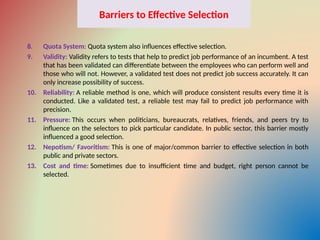
Barriers to EffectiveSelection
• Ineffective Recruitment
• Perception
• Stereotyping
• Gender Issue
• Age/Race Issue
• Halo Effect
• Fairness
• Quota System
• Validity
• Reliability
• Pressure
• Nepotism/ Favoritism
• Cost and time
43.
Barriers to EffectiveSelection
The impediments or barriers to effective selection of people at work can be
explained as under:
1. Ineffective Recruitment: Sometimes selection process gets affected due to
ineffective recruitment initiatives. If the recruiter fails to attract qualified
candidates (in recruitment process) then it is obvious that right candidate will
not be selected (in selection process).
2. Perception: Our inability to understand others accurately is probably the most
fundamental barrier to select right candidate.
3. Stereotyping: This is one of the most common barrier to selection. In
stereotyping, we generally categorize the candidates such as:
• All professors and teachers are absent minded
• All females are basically sincere and honest
• All civil servants are boring
• Candidates with Science background are intelligent etc.
44.
Barriers to EffectiveSelection
4. Gender Issue: Gender issue also hampers effective selection. In early days, men
predominately held managerial jobs and if those jobs are viewed as being primarily
masculine in nature, such stereotyping may produce negative reaction in selecting right
candidates.
5. Age/Race Issue: In many selections, age and race of the candidates are considered rather
than their skills, abilities or experiences. This leads to bias selection.
6. Halo Effect: Another barrier to selection is halo effect, which can be negative or positive. In
hallo effect the personal characteristics influence or overwhelms the interviewers and this
lead to wrong selection.
7. Fairness: Selection requires that no individual should be discriminated based on religion,
region, race or gender. But the less number of women and other less privileged sections of
society in the middle and senior management positions and open discrimination in job
advertisements and in the selection process would suggest that all the efforts to minimize
inequity have not been very effective
45.
Barriers to EffectiveSelection
8. Quota System: Quota system also influences effective selection.
9. Validity: Validity refers to tests that help to predict job performance of an incumbent. A test
that has been validated can differentiate between the employees who can perform well and
those who will not. However, a validated test does not predict job success accurately. It can
only increase possibility of success.
10. Reliability: A reliable method is one, which will produce consistent results every time it is
conducted. Like a validated test, a reliable test may fail to predict job performance with
precision.
11. Pressure: This occurs when politicians, bureaucrats, relatives, friends, and peers try to
influence on the selectors to pick particular candidate. In public sector, this barrier mostly
influenced a good selection.
12. Nepotism/ Favoritism: This is one of major/common barrier to effective selection in both
public and private sectors.
13. Cost and time: Sometimes due to insufficient time and budget, right person cannot be
selected.
INDUCTION
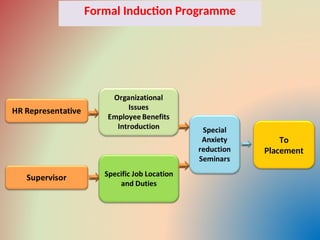
Induction also calledorientation is designed to provide a new employee with
the information he or she needs to function comfortably and effectively in the
organization.
Induction or orientation is a systematic and planned introduction of employees
to their jobs, their co-workers and the organization.
The orientation is meant to educate new employees about the goals and
responsibilities of the position and company, as well as to answer any
questions they may have about HR, benefits and payroll information.
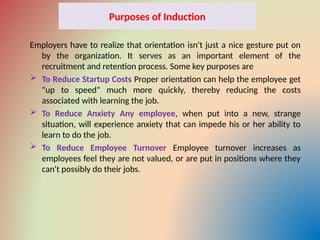
Purposes of Induction
Employershave to realize that orientation isn't just a nice gesture put on
by the organization. It serves as an important element of the
recruitment and retention process. Some key purposes are
To Reduce Startup Costs Proper orientation can help the employee get
"up to speed" much more quickly, thereby reducing the costs
associated with learning the job.
To Reduce Anxiety Any employee, when put into a new, strange
situation, will experience anxiety that can impede his or her ability to
learn to do the job.
To Reduce Employee Turnover Employee turnover increases as
employees feel they are not valued, or are put in positions where they
can't possibly do their jobs.
53.
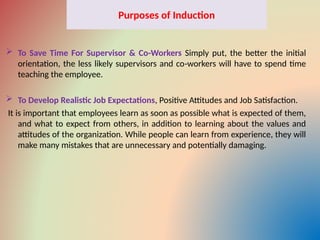
Purposes of Induction
To Save Time For Supervisor & Co-Workers Simply put, the better the initial
orientation, the less likely supervisors and co workers will have to spend time
‑
teaching the employee.
To Develop Realistic Job Expectations, Positive Attitudes and Job Satisfaction.
It is important that employees learn as soon as possible what is expected of them,
and what to expect from others, in addition to learning about the values and
attitudes of the organization. While people can learn from experience, they will
make many mistakes that are unnecessary and potentially damaging.
54.
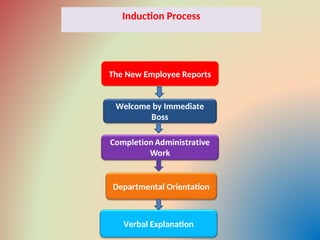
Verbal Explanation
The NewEmployee Reports
Departmental Orientation
Welcome by Immediate
Boss
Induction Process