Recruitment & Selection
Do you agree? 
Great companies “first got the right people on the 
bus, the wrong people off the bus, and the right 
people in the right seats – and then they figured 
out where to drive it.” 
Good to Great: Why Some Companies Make the Leap and Others Don’t – 
Jim Collins
Recruitment and Selection 
Recruitment 
is the process of generating a pool of capable people to apply 
for employment to an organization. 
Selection 
is the process by which managers and others use specific 
instruments to choose from a pool of applicants a person 
or persons most likely to succeed in the job(s), given 
management goals and legal requirements.
Manpower Planning 
• Manpower Planning is a Process by which an 
organization ensures that 
– Right number of people 
– Right kind of people 
– At the Right time 
– At the Right place 
– Doing the Right things for which they are suited 
for achieving the goals of the organization.
Factors affecting Manpower Planning 
• Sales and production forecasts 
• The effects of technological change on task needs 
• Variations in the efficiency, productivity, flexibility 
of labor as a result of training, work study, 
organizational change, new motivations, etc. 
• Changes in employment practices (e.g. use of 
subcontractors or agency staffs, hiving-off tasks, 
buying in, substitution, etc.)
Factors affecting Manpower Planning 
• Variations, which respond to new legislation, 
e.g. payroll taxes or their abolition, new health 
and safety requirements 
• Changes in Government policies (investment 
incentives, regional or trade grants, etc.)
Manpower Planning 
• Two Steps 
– Demand Forecasting 
– Supply Forecasting
Demand Forecasting 
• Bottom Up Technique 
• Delphi Technique 
• Nominal Group Technique 
• Ratio Analysis 
• Regression Analysis
Supply Forecasting 
• Internal Supply 
• External Supply
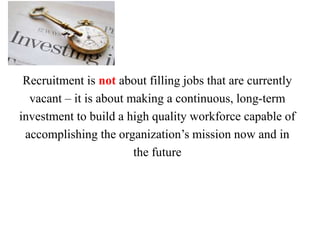
Recruitment is not about filling jobs that are currently 
vacant – it is about making a continuous, long-term 
investment to build a high quality workforce capable of 
accomplishing the organization’s mission now and in 
the future
Recruitment is a critical management function 
that all levels of the organization need to be 
involved in planning and implementation
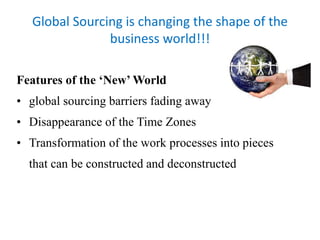
Global Sourcing is changing the shape of the 
business world!!! 
Features of the ‘New’ World 
• global sourcing barriers fading away 
• Disappearance of the Time Zones 
• Transformation of the work processes into pieces 
that can be constructed and deconstructed
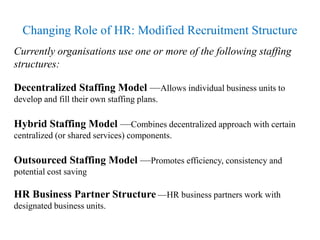
Changing Role of HR: Modified Recruitment Structure 
Currently organisations use one or more of the following staffing 
structures: 
Decentralized Staffing Model —Allows individual business units to 
develop and fill their own staffing plans. 
Hybrid Staffing Model —Combines decentralized approach with certain 
centralized (or shared services) components. 
Outsourced Staffing Model —Promotes efficiency, consistency and 
potential cost saving 
HR Business Partner Structure —HR business partners work with 
designated business units.
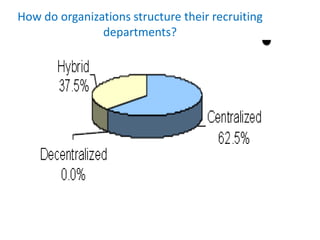
How do organizations structure their recruiting 
departments?
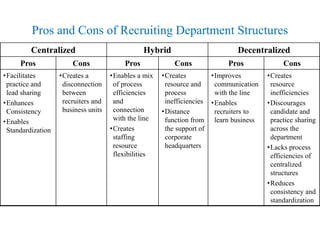
Pros and Cons of Recruiting Department Structures 
Centralized Hybrid Decentralized 
Pros Cons Pros Cons Pros Cons 
•Facilitates 
practice and 
lead sharing 
•Enhances 
Consistency 
•Enables 
Standardization 
•Creates a 
disconnection 
between 
recruiters and 
business units 
•Enables a mix 
of process 
efficiencies 
and 
connection 
with the line 
•Creates 
staffing 
resource 
flexibilities 
•Creates 
resource and 
process 
inefficiencies 
•Distance 
function from 
the support of 
corporate 
headquarters 
•Improves 
communication 
with the line 
•Enables 
recruiters to 
learn business 
•Creates 
resource 
inefficiencies 
•Discourages 
candidate and 
practice sharing 
across the 
department 
•Lacks process 
efficiencies of 
centralized 
structures 
•Reduces 
consistency and 
standardization
• Three Main Functions of Recruitment Process 
are: 
– Attract a pool of suitable candidates 
– Deter unsuitable candidates from applying 
– Create a positive image of the organization
Internal Recruitment 
External Recruitment 
Vs.
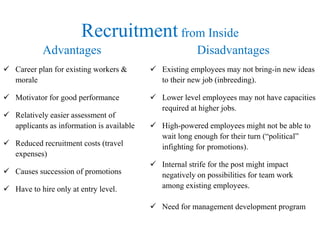
Recruitment from Inside 
Advantages 
 Career plan for existing workers & 
morale 
 Motivator for good performance 
 Relatively easier assessment of 
applicants as information is available 
 Reduced recruitment costs (travel 
expenses) 
 Causes succession of promotions 
 Have to hire only at entry level. 
Disadvantages 
 Existing employees may not bring-in new ideas 
to their new job (inbreeding). 
 Lower level employees may not have capacities 
required at higher jobs. 
 High-powered employees might not be able to 
wait long enough for their turn (“political” 
infighting for promotions). 
 Internal strife for the post might impact 
negatively on possibilities for team work 
among existing employees. 
 Need for management development program
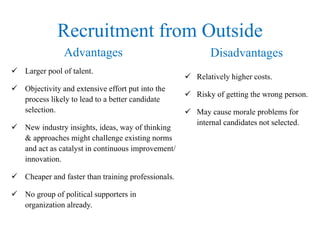
Recruitment from Outside 
Disadvantages 
 Relatively higher costs. 
 Risky of getting the wrong person. 
 May cause morale problems for 
internal candidates not selected. 
Advantages 
 Larger pool of talent. 
 Objectivity and extensive effort put into the 
process likely to lead to a better candidate 
selection. 
 New industry insights, ideas, way of thinking 
& approaches might challenge existing norms 
and act as catalyst in continuous improvement/ 
innovation. 
 Cheaper and faster than training professionals. 
 No group of political supporters in 
organization already.
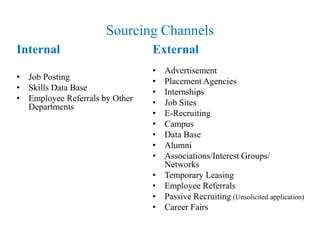
Sourcing Channels 
Internal 
• Job Posting 
• Skills Data Base 
• Employee Referrals by Other 
Recruitment methods 
Departments 
External 
• Advertisement 
• Placement Agencies 
• Internships 
• Job Sites 
• E-Recruiting 
• Campus 
• Data Base 
• Alumni 
• Associations/Interest Groups/ 
Networks 
• Temporary Leasing 
• Employee Referrals 
• Passive Recruiting (Unsolicited application) 
• Career Fairs
 Despite the importance of strategic workforce planning, most HR 
departments have not yet developed a formal plan to participate 
in their companies’ business cycles. 
 Ninety percent of HR departments have no independent planning 
and forecasting function, and many HR departments have no 
formal staffing strategy of any kind. 
 Rather, they tend to operate independently of the business cycle, 
developing reactive staffing solutions instead of proactive 
strategies that anticipate movements in the business cycle.
Recruitment Strategy: A Six Step Approach 
Recruitment strategy should answer the following 
questions related to their target populations: 
1. Who is being targeted through the recruitment? 
2. Where is the appropriate place to recruit clients? 
3. When should recruitment be done? 
4. What messages should be delivered during recruitment? 
5. How should the messages be delivered? 
6. Who is the most appropriate person to do recruitment?
Talent Forecasting 
1. Business strategy —Integrates projected company growth in 
terms of activity, output and revenue. 
2. Human capital need —Translates business strategy into staffing 
requirements. 
3. Projection of future vacancies — Based on difference between 
staffing requirements and current capacity.
Strategic Recruiting Stages 
Human Resource Planning 
• How many employees are needed? 
• When employees will be needed? 
• What specific KSA’s are needed? 
Organizational Responsibilities 
• HR staff & operating managers 
• Recruiting presence and image 
• Training of recruiters
Strategic Recruiting Decisions 
• Organizational-based Vs. outsourcing 
• Regular Vs. flexible staffing 
• Recruiting source choices 
Recruiting Methods 
• Internal methods 
• Internet/ web-based 
• External methods
Selection 
• The process of assessing candidates and appointing a 
post holder 
• Applicants short listed – most suitable candidates 
selected 
• Selection process – varies according to organisation.
Selection Tools 
• Interview – most common method 
• Psychometric testing – assessing the personality of the applicants – 
• Measures of personality 
• Honesty test (substitute to polygraph) 
• Aptitude testing – assessing the skills of applicants 
• Measures of proficiency, achievement, or knowledge 
• Measures of mental ability or intelligence 
• In-tray exercise – activity based around what the applicant will be 
doing 
• Presentation – looking for different skills as well as the ideas of the 
candidate 
• Assessment Centres – battery of tests
Choice of Selection Methods 
• Number of applicants 
• Criticality of position 
• Cost/effort involved 
• Predictive validity 
• Extent of preparation required
When using psychological tests.. 
• Clearly identify the objectives 
• Uses a battery of test that can give range of information 
• Have trained psychologists conduct and interpret tests 
• Use personality testing as an adjunct to the recruitment or 
career planning process and exploit its developmental 
power 
• Adapt tests to Indian situations
Determining Selection Standards 
Sources of Information about Applicants 
• Application Forms 
• Reference Checks 
• Physical Examination 
Selection Tests (Reliability & Validity) 
The Selection Interview
Recruitment: Return on Investment (ROI) 
• Recruitment return on investment (ROI) 
understands and compares the elements, costs 
and risks of a recruitment related project to the 
expected benefits

Recruitment & selection

  • 1.
  • 2.
    Do you agree? Great companies “first got the right people on the bus, the wrong people off the bus, and the right people in the right seats – and then they figured out where to drive it.” Good to Great: Why Some Companies Make the Leap and Others Don’t – Jim Collins
  • 3.
    Recruitment and Selection Recruitment is the process of generating a pool of capable people to apply for employment to an organization. Selection is the process by which managers and others use specific instruments to choose from a pool of applicants a person or persons most likely to succeed in the job(s), given management goals and legal requirements.
  • 4.
    Manpower Planning •Manpower Planning is a Process by which an organization ensures that – Right number of people – Right kind of people – At the Right time – At the Right place – Doing the Right things for which they are suited for achieving the goals of the organization.
  • 5.
    Factors affecting ManpowerPlanning • Sales and production forecasts • The effects of technological change on task needs • Variations in the efficiency, productivity, flexibility of labor as a result of training, work study, organizational change, new motivations, etc. • Changes in employment practices (e.g. use of subcontractors or agency staffs, hiving-off tasks, buying in, substitution, etc.)
  • 6.
    Factors affecting ManpowerPlanning • Variations, which respond to new legislation, e.g. payroll taxes or their abolition, new health and safety requirements • Changes in Government policies (investment incentives, regional or trade grants, etc.)
  • 7.
    Manpower Planning •Two Steps – Demand Forecasting – Supply Forecasting
  • 8.
    Demand Forecasting •Bottom Up Technique • Delphi Technique • Nominal Group Technique • Ratio Analysis • Regression Analysis
  • 9.
    Supply Forecasting •Internal Supply • External Supply
  • 10.
    Recruitment is notabout filling jobs that are currently vacant – it is about making a continuous, long-term investment to build a high quality workforce capable of accomplishing the organization’s mission now and in the future
  • 11.
    Recruitment is acritical management function that all levels of the organization need to be involved in planning and implementation
  • 12.
    Global Sourcing ischanging the shape of the business world!!! Features of the ‘New’ World • global sourcing barriers fading away • Disappearance of the Time Zones • Transformation of the work processes into pieces that can be constructed and deconstructed
  • 13.
    Changing Role ofHR: Modified Recruitment Structure Currently organisations use one or more of the following staffing structures: Decentralized Staffing Model —Allows individual business units to develop and fill their own staffing plans. Hybrid Staffing Model —Combines decentralized approach with certain centralized (or shared services) components. Outsourced Staffing Model —Promotes efficiency, consistency and potential cost saving HR Business Partner Structure —HR business partners work with designated business units.
  • 14.
    How do organizationsstructure their recruiting departments?
  • 15.
    Pros and Consof Recruiting Department Structures Centralized Hybrid Decentralized Pros Cons Pros Cons Pros Cons •Facilitates practice and lead sharing •Enhances Consistency •Enables Standardization •Creates a disconnection between recruiters and business units •Enables a mix of process efficiencies and connection with the line •Creates staffing resource flexibilities •Creates resource and process inefficiencies •Distance function from the support of corporate headquarters •Improves communication with the line •Enables recruiters to learn business •Creates resource inefficiencies •Discourages candidate and practice sharing across the department •Lacks process efficiencies of centralized structures •Reduces consistency and standardization
  • 16.
    • Three MainFunctions of Recruitment Process are: – Attract a pool of suitable candidates – Deter unsuitable candidates from applying – Create a positive image of the organization
  • 17.
  • 18.
    Recruitment from Inside Advantages  Career plan for existing workers & morale  Motivator for good performance  Relatively easier assessment of applicants as information is available  Reduced recruitment costs (travel expenses)  Causes succession of promotions  Have to hire only at entry level. Disadvantages  Existing employees may not bring-in new ideas to their new job (inbreeding).  Lower level employees may not have capacities required at higher jobs.  High-powered employees might not be able to wait long enough for their turn (“political” infighting for promotions).  Internal strife for the post might impact negatively on possibilities for team work among existing employees.  Need for management development program
  • 19.
    Recruitment from Outside Disadvantages  Relatively higher costs.  Risky of getting the wrong person.  May cause morale problems for internal candidates not selected. Advantages  Larger pool of talent.  Objectivity and extensive effort put into the process likely to lead to a better candidate selection.  New industry insights, ideas, way of thinking & approaches might challenge existing norms and act as catalyst in continuous improvement/ innovation.  Cheaper and faster than training professionals.  No group of political supporters in organization already.
  • 20.
    Sourcing Channels Internal • Job Posting • Skills Data Base • Employee Referrals by Other Recruitment methods Departments External • Advertisement • Placement Agencies • Internships • Job Sites • E-Recruiting • Campus • Data Base • Alumni • Associations/Interest Groups/ Networks • Temporary Leasing • Employee Referrals • Passive Recruiting (Unsolicited application) • Career Fairs
  • 21.
     Despite theimportance of strategic workforce planning, most HR departments have not yet developed a formal plan to participate in their companies’ business cycles.  Ninety percent of HR departments have no independent planning and forecasting function, and many HR departments have no formal staffing strategy of any kind.  Rather, they tend to operate independently of the business cycle, developing reactive staffing solutions instead of proactive strategies that anticipate movements in the business cycle.
  • 22.
    Recruitment Strategy: ASix Step Approach Recruitment strategy should answer the following questions related to their target populations: 1. Who is being targeted through the recruitment? 2. Where is the appropriate place to recruit clients? 3. When should recruitment be done? 4. What messages should be delivered during recruitment? 5. How should the messages be delivered? 6. Who is the most appropriate person to do recruitment?
  • 23.
    Talent Forecasting 1.Business strategy —Integrates projected company growth in terms of activity, output and revenue. 2. Human capital need —Translates business strategy into staffing requirements. 3. Projection of future vacancies — Based on difference between staffing requirements and current capacity.
  • 24.
    Strategic Recruiting Stages Human Resource Planning • How many employees are needed? • When employees will be needed? • What specific KSA’s are needed? Organizational Responsibilities • HR staff & operating managers • Recruiting presence and image • Training of recruiters
  • 25.
    Strategic Recruiting Decisions • Organizational-based Vs. outsourcing • Regular Vs. flexible staffing • Recruiting source choices Recruiting Methods • Internal methods • Internet/ web-based • External methods
  • 26.
    Selection • Theprocess of assessing candidates and appointing a post holder • Applicants short listed – most suitable candidates selected • Selection process – varies according to organisation.
  • 27.
    Selection Tools •Interview – most common method • Psychometric testing – assessing the personality of the applicants – • Measures of personality • Honesty test (substitute to polygraph) • Aptitude testing – assessing the skills of applicants • Measures of proficiency, achievement, or knowledge • Measures of mental ability or intelligence • In-tray exercise – activity based around what the applicant will be doing • Presentation – looking for different skills as well as the ideas of the candidate • Assessment Centres – battery of tests
  • 28.
    Choice of SelectionMethods • Number of applicants • Criticality of position • Cost/effort involved • Predictive validity • Extent of preparation required
  • 29.
    When using psychologicaltests.. • Clearly identify the objectives • Uses a battery of test that can give range of information • Have trained psychologists conduct and interpret tests • Use personality testing as an adjunct to the recruitment or career planning process and exploit its developmental power • Adapt tests to Indian situations
  • 30.
    Determining Selection Standards Sources of Information about Applicants • Application Forms • Reference Checks • Physical Examination Selection Tests (Reliability & Validity) The Selection Interview
  • 31.
    Recruitment: Return onInvestment (ROI) • Recruitment return on investment (ROI) understands and compares the elements, costs and risks of a recruitment related project to the expected benefits