RECRUITMENT AND
SELECTION
MEANING OF RECRUITMENT
 According to Edwin Flippo: “Recruitment is the
process of searching the candidates for
employment and stimulating them to apply for
jobs in the organisation “
 Recruitment is the activity that links the
employers and the job seekers
OTHER DEFINITIONS
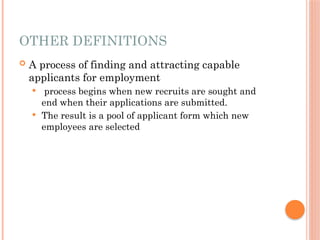
 A process of finding and attracting capable
applicants for employment
 process begins when new recruits are sought and
end when their applications are submitted.
 The result is a pool of applicant form which new
employees are selected
OTHER DEFINITIONS CONT…
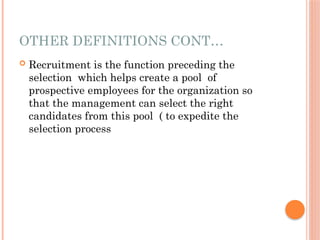
 Recruitment is the function preceding the
selection which helps create a pool of
prospective employees for the organization so
that the management can select the right
candidates from this pool ( to expedite the
selection process
SELECTION
 Selection on the other hand is a process whereby
out of the many job applicants the best are taken
to fill the vacancy. Selection means whittling
down the application pool by using the screening
tools such as test, assessment centers,
background and reference checks.
DIFFERENCE BETWEEN
RECRUITMENT AND SELECTION
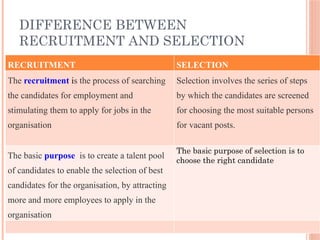
RECRUITMENT SELECTION
The recruitment is the process of searching
the candidates for employment and
stimulating them to apply for jobs in the
organisation
Selection involves the series of steps
by which the candidates are screened
for choosing the most suitable persons
for vacant posts.
The basic purpose is to create a talent pool
of candidates to enable the selection of best
candidates for the organisation, by attracting
more and more employees to apply in the
organisation
The basic purpose of selection is to
choose the right candidate
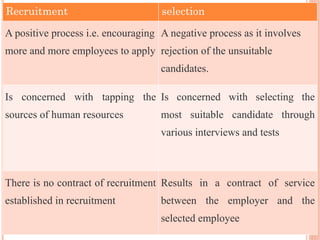
Recruitment selection
A positive process i.e. encouraging
more and more employees to apply
A negative process as it involves
rejection of the unsuitable
candidates.
Is concerned with tapping the
sources of human resources
Is concerned with selecting the
most suitable candidate through
various interviews and tests
There is no contract of recruitment
established in recruitment
Results in a contract of service
between the employer and the
selected employee
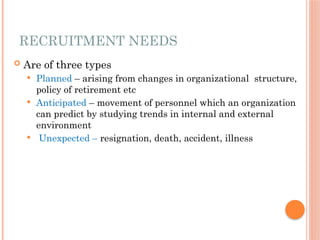
RECRUITMENT NEEDS
 Are of three types
 Planned – arising from changes in organizational structure,
policy of retirement etc
 Anticipated – movement of personnel which an organization
can predict by studying trends in internal and external
environment
 Unexpected – resignation, death, accident, illness
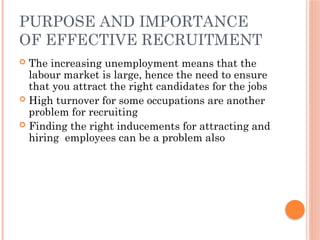
PURPOSE AND IMPORTANCE
OF EFFECTIVE RECRUITMENT
 The increasing unemployment means that the
labour market is large, hence the need to ensure
that you attract the right candidates for the jobs
 High turnover for some occupations are another
problem for recruiting
 Finding the right inducements for attracting and
hiring employees can be a problem also
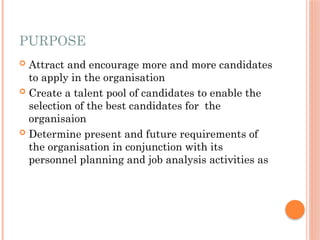
PURPOSE
 Attract and encourage more and more candidates
to apply in the organisation
 Create a talent pool of candidates to enable the
selection of the best candidates for the
organisaion
 Determine present and future requirements of
the organisation in conjunction with its
personnel planning and job analysis activities as
 Minimize unwarranted cost of selection
 Help increase the success rate of selection
process by decreasing the number visibly under
qualified or overqualified job applicants
 Help reduce probability that job applicants once
recruited and selected will leave the organization
after a short period of time
 Meet the organisaion legal and social obligation
regarding composition of workforce
 Increase organization and individual
effectiveness of various recruitment techniques
and sources for all types of applicants
RECRUITMENT PROCESS
 Identifying the vacancy : - post to be filled,
number of persons, duties to be performed,
qualifications required
 Preparing the JD and JS
 Locating and developing the sources of required
number and type of employees
 Short listing
FACTORS AFFECTING
RECRUITMENT
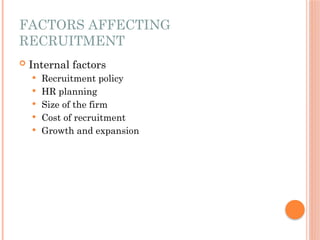
 Internal factors
 Recruitment policy
 HR planning
 Size of the firm
 Cost of recruitment
 Growth and expansion
FACTORS AFFECTING
RECRUITMENT
 External factors
 Supply and demand
 Labour market
 Image/goodwill
 Political-social-legal environment
 Unemployment rates
 Competitors
SOURCES OF RECRUITMENT:
INTERNAL AND EXTERNAL
Internal:
 seeks to fill positions from among the rank of
those currently employed
 Best suitable in succession planning – the
process of ensuring a suitable supply of
successors for current and future senior or key
jobs
 Advantages:
 1. It is less costly than external recruiting
 2. Organisations have a better knowledge of
internal applicants skills and abilities than that
which can be acquired of candidates in an
external recruiting effort
 3. Through performance appraisal and other
sources of information about current personnel,
decision makers typically will have much more
extensive knowledge on internal candidates and
thus make more valid selection decisions
 4. An organisation policy of promotion from
within can enhance organizational commitment
and job satisfaction, leading to lower employee
turnover and productivity
 5. Best used for succession planning
Disadvantages:
 1. If the organisation has decided to change its
business strategy, entrenched managers are
problem not the best “change masters”” since the
internal recruitment approach simply propagate
the old way of doing things
 2. Complaints of unit poaching good employees
from another unit
 3. Politics have a greater impact on internal
recruitment. Personal biased decisions towards
specific candidates not necessarily based on
performance or job requirements
 4. Employees who apply for jobs and do not get
them may become discontented,: telling
unsuccessful applicants why they were rejected
and what remedial action might take to be more
successful in future is thus crucial
 5. Although many times managers post job
opening and interviews to all candidates, the
manager often knows ahead of time exactly
whom he or she wants to hire . Requiring the
person to interview a stream of unsuspecting
candidates can be a waste of time for all
concerned
SOURCES OF INTERNAL
RECRUITMENT
 Job posting/advertising
 The most efficient way to do it is to have a job-posting
system where announcement for positions is made
available to all employees through newsletters, bulletin
boards and so on.
 When properly done, job posting can substantially
improve quality of job placement that are made within
the organisations
 Personnel records
 Another way is to examine personnel records which may
reveal employees who are working in job below their
education or skill levels, or/and have potential for
further training or who already have the right
background for the opening
EXTERNAL RECRUITMENT
 Can be important when:
 A firm cannot get all the employees they need from
the current staff
 When the firm wants to inject a new perspective into
running the organisation
EXTERNAL SOURCES
 External sources
 Advertising
 Colleges
 Agencies
 Agency Search and Selection
 Head Hunting
 Open Evening
 Referrals and walk –ins
 Recruitment on the internet
ADVERTISING
 For this to be successful the firm must address
two issues:
 The advertising media
 The advert construction
ADVERTISING MEDIA
 The selection to the media depends on the
positions which the firm is recruiting for
 Local newspapers – for blue collar jobs and jobs
whose labour is in plenty supply
 Specialized jobs will be adverted in trade and
professional journals like the economists , etc
 Jobs with an international focus will be
advertised in international dailies or magazines
CONSTRUCTING AN AD
 Should have the following four point guide
(AIDA):
 Attention – must attract attention to the Ad or readers may
just miss it or ignore it
 Interest – you can create interest by the nature of the job
itself, or with lines such as “will thrive on challenging
work”, or use other aspects such as location
 Desire – by spotlighting the job interest factors with words
such as travel or challenge
 Action - Make sure the ad prompts action with statements
such as “call today”
 Should contain the following information:
 Job content ( primary task and responsibilities)
 A realistic description of the work conditions
 The location of the job
 The compensation including fringe benefits
 Job specification (e.g. education and experience)
 To whom one should apply
EMPLOYMENT AGENCIES
 Agencies that charge employees or employers for
the placement services
 Major functions:
 To increase the pool of possible applicants and to
do preliminary screening
WHY TURN TO EMPLOYMENT
AGENCIES
 Your firm doesn’t have its own HR department
and is not geared to doing recruitment and
screening
 Your firm has found it difficult in the past to
generate a pool if qualified applicants
 You must fill a particular opening quickly
 You want to reach currently employed individual
who might feel more comfortable dealing with
agencies than with competing companies
 You want to cut down on time you are devoting to
interviewing
EXECUTIVE RECRUITERS
( HEADHUNTERS)
 Are special employment agencies retained by
employers to seek out top management talent for
their clients
 Usually for crucial execute and technical
positions
 Executive recruiters are becoming more and
more specialized to recruit for specific functions
or industries
 advantages
 The recruiters may have many contacts and are
especially experts and skilled at contacting
qualified, currently employed candidates who
aren't actively looking for a change in jobs
 They can also keep the firms name confidential
until late into the search processes
 The recruiters save top management's time of
advertising and screening
 Pitfalls
as an employer, you must explain completely
what sort of candidate is required and why,
 Some recruiters are also sales people than
professionals – they may be more interested in
persuading you to hire a candidate than finding
one who will really do the job
 Recruiters also claim that what their clients say
they want is often not accurate, therefore be
prepared for some in-depth dissecting of your
request.
COLLEGE RECRUITING
 Sending an employers representative to college
campuses to prescreen applicants and create an
applicant, pool from that college graduating class
is an important source of management trainees,
promotable candidates, and professional and
technical employees
 Problems with on campus recruiting:
 Its expensive and time consuming – schedules
must be set well in advance, company brochures
printed, record of interview kept, and much time
spent on campus
 Some recruiters are ineffective and/or show little
interest in the candidates and act as superiors
REFERRALS AND WALK-INS
 The firm posts announcements of openings and request
for referral's in its bulleting and on its wall boards and
intranet.
 Pros:
 Current employees can and usually provide accurate
information about the job applicants they are referring,
especially since their are putting their own reputation at
risk
 The new employee may come with more realistic
picture of what working in the firm is like after
speaking with friends there
 Cons: employees bringing their friends who are not
necessity qualified
RECRUITING ON THE INTERNET
 Firms post job description and vacancies on their
websites
DEVELOPING AND USING
APPLICATION FORMS
 Once you have a pool of applicants, the selection
process can begin, and the application form is
usually the first step in this process
 A filled application form provides four types of
information:
 1. You can make judgment on substantive
maters, such as whether the applicant has the
education and experience to do the job.
 2. you can draw conclusion about the applicants
previous progress and growth, a trait that is
especially important for management candidates
 3. you can draw tentative conclusion regarding
the applicants stability on previous work record
(here, however, be careful not to assume that an
unusual number of job changes necessarily
reflects on the applicants stability
 4. you may be able to use the data in the
application form to predict which candidates will
succeed on the job and which will not
EMPLOYEE SELECTION
 With a pool of applicants, the next step is to
select the best candidate for the job.
 This means whittling down the application pool
by using the screening tools such as test,
assessment centers, background and reference
checks
WHY CAREFUL SELECTION IS
IMPORTANT
 Selecting the right employee is important for
three main reasons:
 1. Performance:
 Your own performance always depends in part on
your subordinates. Employees with the right
skills and attributes will do a better job for you
and the company. Employees without these skills
or who are uncompromising or obstructionist
wont perform effectively and your won
performance and the firm will suffer. The time to
screen out undesirables is before they are in the
door, not after
 2. it is costly to recruit and hire employees in
terms of interviewing time, reference checking,
traveling etc
 3. legal implication of incompetent hiring can be
costly and lead to court redress. If you hire a
criminal who swindles customers, you will be
liable
BASIC TESTS FOR SELECTION
 For effective recruiting, therefore, the selection
test must be valid and reliable
 Validity:
 The test should measure what is supposed to
measure. The evidence that is being tested
should be job related, in other words, the
performance on the test is a valid predictor of
subsequent performance on the job
 There are two ways to demonstrate test validity:
criterion validity and content validity
 Criterion validity – shows that those who do well
in the test also do well on the job and vise versa
 Content validity – show that the test constitutes
a fair sample of the content of the job
RELIABILITY
 Reliability refers to its consistency.
 It is “the consistency of scores obtained by the
same person when retested with the identical
test or with an equivalent form of test”
 If a person score 90% on Monday, then they
should score the same on Tuesday for the same
test
TYPES OF TESTS
 We can classify test according to whether they
measure:
 Cognitive (mental) abilities.
 Or psychomotor (motor and physical)
 Personality
 Interest or achievements
TEST FOR COGNITIVE ABILITIES
 These includes:
 Test of general reasoning ability (intelligence)
 Test of specific mental abilities like memory and
reasoning, verbal comprehension, numerical ability
 ( these are normally referred to as aptitude tests
)
 Test for motor and physical abilities
 These includes test such as manual dexterity,
reaction time, speed of hands, arms, mechanical
ability, weight lifting, body coordination etc
 Measuring personality and interest
 These includes persons motivation and interpersonal
skills , attitudes, temperaments etc
 It will measure basic aspects of a applicants
personality such as introversion, stability and
motivation. These test are done in a projective
manner – for example being presented with a picture
and asked what you see, picking two statements from
one etc
ACHIEVEMENT TESTS
 Measure what a person has learned
 Measure your “job knowledge” in areas like
marketing, human resources. E.g. giving people a
problem in human resources to solve
MANAGEMENT ASSESSMENT
CENTRE
 Is a 2 to 3 days simulation in which 10 – 12
candidates perform realistic tasks (like making
presentations, meetings, case study analysis –
each under watchful eye of experts. Also included
are interviews, leadership group discussions,
management games,
OTHER SELECTION TECHNIQUES
 Background investigation and reference check
 Polygraph (lie detector) and honesty testing
 Graphology (handrighting pattern test)
 Physical examination
 Substance abuse screening (usage of drug,
alcohol etc
BACKGROUND INVESTIGATION AND
REFERENCE CHECKS
 Purpose is to verifying job applicants background
information and references:
 These include making telephone enquiries,
credit rating, use of reference letters
 Commonly verified data include legal eligibility
for employment, dates of prior employment,
education and identification (dates of birth,
address to confirm identity)
REASONS TO CONDUCT
BACKGROUND CHECK
 Two main reasons to conduct employment
background investigation and/or reference check:
 To verify factual information previously provided by
the applicants
 To uncover damaging information such as criminal
records
PHYSICAL/MEDICAL EXAMINATION
 Takes place once the person is hired or
sometimes after the person is hired
 Reasons:
 To verify that the applicant meets the physical
requirements for the
 Discover any medical limitations you should take into
account in placing the applicants
 To establish a record and baseline of the applicants
health for future insurance or compensation claims
 By identifying health problems, the examination can
reduce absenteeism and accidents and, of course
determine communicable diseases that may be
unknown to the applicant
INTERVIEWING CANDIDATES
 An interview is a procedure designed to obtain
information from a person through oral responses
to oral enquires. On the basis of these responses
the interviewer is able to predict future job
performance
 Interview is by far the most widely used
personnel selection method
TYPES OF INTERVIEWS
 Selection interview
 Appraisal interview
 Exit interview
 We can classify selection interviews according to:
 How they are structured
 Their content – type of questions they contain
 How the firm administers the interview
HOW THEY ARE STRUCTURED
 Interviews can be :
 Structured or unstructured
 Unstructured or nondirective
 There is generally no set format to follow so the
interview can take various direction
 Lack of structures allow the interviewer to ask follow
up questions and pursue points of interest as they
develop
STRUCTURED OR DIRECTIVE INTERVIEWS
 The questions and acceptable responses are
specified in advance and the responses rated for
appropriateness of content
 All interviewers generally ask all applicants the
same questions, and hence:
 Tend to be more reliable and valid
 It increases consistency across candidates
 Enhances job relatedness
 Reduces overall subjectivity ( and thus the potential
for bias)
 May enhance ability to withstand legal challenges
 On the other hand structured interviews do not
provide opportunity to pursue points of interest
as they develop
INTERVIEW CONTENT – TYPE OF
QUESTIONS
 These could be situational interview
questions - asking candidates how they would
behavior in a given hypothetical situation and
evaluating the applicant based on the choice
made
 Behavior interview questions asks interviewees
to describe how they would reacted to an actual
situation in the pasts
 Job related interviews – the interviewer tries to
deduce what the applicant on the job
performance will be base on his or her answers to
questions about past behavior. The question here
do not revolve around hypothetical questions but
ask job related questions e.g. what does human
resources recruitment and selection involve
 Stress interview – seeks to make the applicant
uncomfortable with occasionally rude questions
 Aims is supposedly to spot sensitive applicants
and those with low or high level of stress
tolerance
 Stress interviews may help unearth hypertensive
applicants who might overreact to mild criticism
with anger and abuse
 Puzzle questions - meant to see how a
candidates reacts under pressure. Used mainly
for technical and finance related areas
ADMINISTERING THE INTERVIEW
 Interviews can be administered in several ways:
 One on one
 A panel interview
 Sequentially or all at once
 Computerized or personally
ADMINISTERING INTERVIEWS
(CONT..
 Personal interviews (one on one) - two
people meet alone and one interviews the other
by seeking oral responses to oral inquires
 Sequential – several persons interview the
applicant in sequence, before a decision is made.
This can be structured or unstructured
 Panel – a group of interviewers question the
candidate. This may have advantage over the
others because in sequential candidates may
cover the same ground over and over again with
each interviewer. But panel format lets the
interviewers ask follow up questions based on the
candidates answer. This may elicit more
responses
 Computerized interview - in this case a job
candidate’s oral and/visual responses are
obtained in response to computerized oral or
visual or written questions and/situation
 A candidate is presented with a series of specific
questions regarding his/her background,,
experience, education, skills, knowledge and
work attitudes that relate to the job for which the
person has applied
 The questions are presented in a multiple choice
and questions come in rapid sequence
 After the computerized interview there is usually
a one on one
WHAT CAN UNDERMINE AN INTERVIEWS
USEFULNESS –PITFALLS/ERRORS
 First impression – which one gets from the
interviewees application form and personal
appearance
 Misunderstanding of the job - interviewers who do
not know precisely what the job entails and what sort
of candidate is best suited for it usually make their
decisions based on incorrect stereotype of what a good
applicant is
 Candidates-order (contrast) error and pressure
to hire - The order in which you see applicants affect
how you rate them. After first evaluating unfavorable
candidates, an average candidate can score quite high
 Non verbal behavior and impressions management -
- eye contact, energy levels , low voice etc can influence the
interviewers decision
 Body language, smile, posture may interfere with the
interviewers judgment
 Effect on personal characteristics stereotyping :
 Involves categorizing groups according to general traits
then attributing those traits to a particular individual
once the group membership is known
 attractiveness, gender, race - in general, individuals
ascribe more favorable traits and more successful life
outcomes to attractive people
 Some see men or women as more suitable or a certain race
as more suitable
 Interviewer’s behavior - some interviewers
talk so much that the applicant have no time to
answer questions. On the other extreme, some
interviewers let the applicant dominate the
interview and so don’t ask questions. Neither is
good situation
 Others play the role of a judge or psychologist
DESIGNING AND CONDUCTING AN
EFFECTIVE INTERVIEW – STEPS
1. The structured situational interview –procedure:
1. Job analysis -write a job description and list of duties,
knowledge, skills and abilities
2. Rate the job duties
3. Create the interview questions –situational questions,
job knowledge questions etc
4. Create benchmark answers with a five point rating
scale
5. Appoint an interview panel and conduct interview – 3
– 6 members preferably the same employees who
wrote the questions , also include job supervisor
and/or incumbent, and an HR representative
CONDUCTING AN INTERVIEW -
STEPS
 The questions:
Structure your interview questions so that it is
standardized, consistent and relevant. This will
include ensuring that :
 You base your questions on action job
 Use knowledge, situational and behavior oriented
questions and an objective criteria to assess the
interviewees response
 Train your interviewers
 Use the same questions for all candidates
 Use rating scales to rate answers
 Use multiple interviewers for panel interviews to
reduce bias
 Control the interview – limit the interviews follow up
questions
 2. Prepare for the interview
 The interview should take place in a private
room with minimum interruptions
 Prior to the interview, review the candidates
application and resume and not areas that are
vague or that may indicate strengths or
weaknesses
 Remember the duties of the job and the specific
skills and traits that you are looking for – review
the job specifications
 Start the interview with an accurate picture of
the traits for the ideal candidate.
 3. Establish rapport – put the person at ease –
greet the applicant, drop in some courtesy words
and start interview with non related question,
e.g.. About the whether
 Be aware of peoples background and make
additional efforts to make such people relax

 4. Ask questions – follow your list of questions.
 Don’t ask questions which can be answered with
yes or no, don’t push words into the applicants
mount, don’t interrogate the applicant as if the
person is a criminal , don’t be patronizing,
sarcastic – ask open ended questions, listen to the
candidate, , encourage them
 5. Close the interview – leave time to answer
any questions the candidates may have
 End the interview with a positive not, tell the
applicant the next steps, make any rejections
diplomatically
 6. Review the interview – review notes and fill
in the structured interview guide
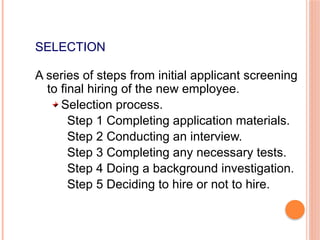
SELECTION
A series of steps from initial applicant screening
to final hiring of the new employee.
Selection process.
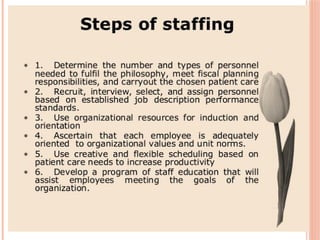
Step 1 Completing application materials.
Step 2 Conducting an interview.
Step 3 Completing any necessary tests.
Step 4 Doing a background investigation.
Step 5 Deciding to hire or not to hire.
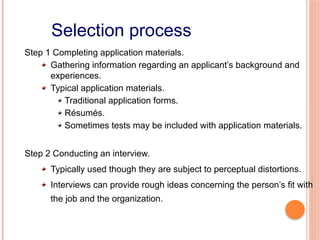
Selection process
Step 1 Completing application materials.
Gathering information regarding an applicant’s background and
experiences.
Typical application materials.
Traditional application forms.
Résumés.
Sometimes tests may be included with application materials.
Step 2 Conducting an interview.
Typically used though they are subject to perceptual distortions.
Interviews can provide rough ideas concerning the person’s fit with
the job and the organization.
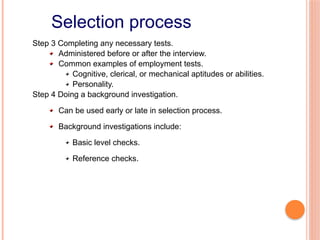
Selection process
Step 3 Completing any necessary tests.
Administered before or after the interview.
Common examples of employment tests.
Cognitive, clerical, or mechanical aptitudes or abilities.
Personality.
Step 4 Doing a background investigation.
Can be used early or late in selection process.
Background investigations include:
Basic level checks.
Reference checks.
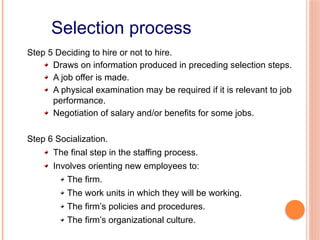
Selection process
Step 5 Deciding to hire or not to hire.
Draws on information produced in preceding selection steps.
A job offer is made.
A physical examination may be required if it is relevant to job
performance.
Negotiation of salary and/or benefits for some jobs.
Step 6 Socialization.
The final step in the staffing process.
Involves orienting new employees to:
The firm.
The work units in which they will be working.
The firm’s policies and procedures.
The firm’s organizational culture.
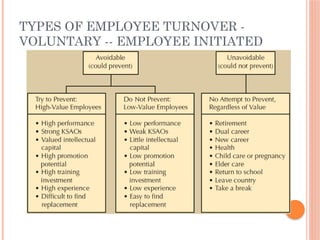
TYPES OF EMPLOYEE TURNOVER -
VOLUNTARY -- EMPLOYEE INITIATED
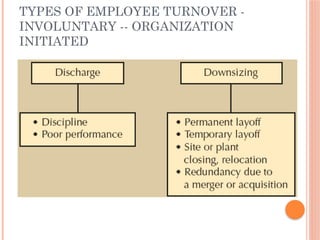
TYPES OF EMPLOYEE TURNOVER -
INVOLUNTARY -- ORGANIZATION
INITIATED
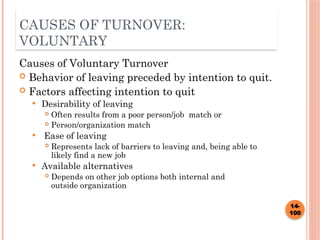
CAUSES OF TURNOVER:
VOLUNTARY
Causes of Voluntary Turnover
 Behavior of leaving preceded by intention to quit.
 Factors affecting intention to quit
 Desirability of leaving
 Often results from a poor person/job match or
 Person/organization match
 Ease of leaving
 Represents lack of barriers to leaving and, being able to
likely find a new job
 Available alternatives
 Depends on other job options both internal and
outside organization
14-
100
CAUSES OF TURNOVER: INVOLUNTARY
 Discharge turnover
 Mismatch between job requirements and
KSAOs
 Employee fails to follow rules and procedures
 Unacceptable job performance
 Downsizing turnover
 Mismatch in staffing levels which leads to an
overstaffing situation
 Factors related to overstaffing
 Lack of forecasting and planning
 Inaccuracies in forecasting and planning
 Unanticipated changes in labor demand and/or
supply
14-
101
MEASUREMENT OF TURNOVER:
REASONS FOR LEAVING
 Important to determine, record, and track
reasons why employees leave
 Tools
 Exit interviews
 Formal, planned interviews with departing employees
 Post exit surveys
 Surveys sent to employees soon after their last day
 Employee satisfaction surveys
 Surveys of current employees to discover sources of
dissatisfaction which may become reasons for leaving
 Results can provide information to pre-empt turnover
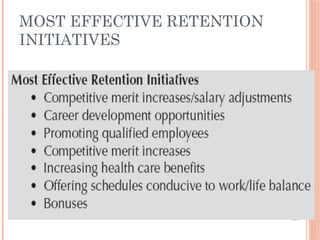
MOST EFFECTIVE RETENTION
INITIATIVES
GUIDELINES FOR INCREASING JOB
SATISFACTION AND RETENTION
 Rewards must be
meaningful and unique
 Rewards must match
individual preferences
 Link rewards to
retention behaviors
 Link rewards to
performance
 Assign employees to jobs
that meet their needs
 Provide clear
communication
 Design fair reward
allocation systems
 Ensure supervisors
provide a positive
environment
 Provide programs to
enhance work-life
balance
 Extrinsic rewards  Intrinsic rewards
OTHER GUIDELINES FOR INCREASING JOB
SATISFACTION AND RETENTION
 Provide organization-specific training
 Combine training strategy with a selection
strategy focused on assessing and selecting
general KSAOs
 Approaches to make internal alternatives
more desirable than outside alternatives:
 Internal staffing
 Encourage employees to seek internal job
opportunities
 Provide attractive internal options
staffing.pptx presentation 1233455677777

staffing.pptx presentation 1233455677777

  • 20.
  • 21.
    MEANING OF RECRUITMENT According to Edwin Flippo: “Recruitment is the process of searching the candidates for employment and stimulating them to apply for jobs in the organisation “  Recruitment is the activity that links the employers and the job seekers
  • 22.
    OTHER DEFINITIONS  Aprocess of finding and attracting capable applicants for employment  process begins when new recruits are sought and end when their applications are submitted.  The result is a pool of applicant form which new employees are selected
  • 23.
    OTHER DEFINITIONS CONT… Recruitment is the function preceding the selection which helps create a pool of prospective employees for the organization so that the management can select the right candidates from this pool ( to expedite the selection process
  • 24.
    SELECTION  Selection onthe other hand is a process whereby out of the many job applicants the best are taken to fill the vacancy. Selection means whittling down the application pool by using the screening tools such as test, assessment centers, background and reference checks.
  • 25.
    DIFFERENCE BETWEEN RECRUITMENT ANDSELECTION RECRUITMENT SELECTION The recruitment is the process of searching the candidates for employment and stimulating them to apply for jobs in the organisation Selection involves the series of steps by which the candidates are screened for choosing the most suitable persons for vacant posts. The basic purpose is to create a talent pool of candidates to enable the selection of best candidates for the organisation, by attracting more and more employees to apply in the organisation The basic purpose of selection is to choose the right candidate
  • 26.
    Recruitment selection A positiveprocess i.e. encouraging more and more employees to apply A negative process as it involves rejection of the unsuitable candidates. Is concerned with tapping the sources of human resources Is concerned with selecting the most suitable candidate through various interviews and tests There is no contract of recruitment established in recruitment Results in a contract of service between the employer and the selected employee
  • 27.
    RECRUITMENT NEEDS  Areof three types  Planned – arising from changes in organizational structure, policy of retirement etc  Anticipated – movement of personnel which an organization can predict by studying trends in internal and external environment  Unexpected – resignation, death, accident, illness
  • 28.
    PURPOSE AND IMPORTANCE OFEFFECTIVE RECRUITMENT  The increasing unemployment means that the labour market is large, hence the need to ensure that you attract the right candidates for the jobs  High turnover for some occupations are another problem for recruiting  Finding the right inducements for attracting and hiring employees can be a problem also
  • 29.
    PURPOSE  Attract andencourage more and more candidates to apply in the organisation  Create a talent pool of candidates to enable the selection of the best candidates for the organisaion  Determine present and future requirements of the organisation in conjunction with its personnel planning and job analysis activities as
  • 30.
     Minimize unwarrantedcost of selection  Help increase the success rate of selection process by decreasing the number visibly under qualified or overqualified job applicants  Help reduce probability that job applicants once recruited and selected will leave the organization after a short period of time  Meet the organisaion legal and social obligation regarding composition of workforce  Increase organization and individual effectiveness of various recruitment techniques and sources for all types of applicants
  • 31.
    RECRUITMENT PROCESS  Identifyingthe vacancy : - post to be filled, number of persons, duties to be performed, qualifications required  Preparing the JD and JS  Locating and developing the sources of required number and type of employees  Short listing
  • 32.
    FACTORS AFFECTING RECRUITMENT  Internalfactors  Recruitment policy  HR planning  Size of the firm  Cost of recruitment  Growth and expansion
  • 33.
    FACTORS AFFECTING RECRUITMENT  Externalfactors  Supply and demand  Labour market  Image/goodwill  Political-social-legal environment  Unemployment rates  Competitors
  • 34.
    SOURCES OF RECRUITMENT: INTERNALAND EXTERNAL Internal:  seeks to fill positions from among the rank of those currently employed  Best suitable in succession planning – the process of ensuring a suitable supply of successors for current and future senior or key jobs
  • 35.
     Advantages:  1.It is less costly than external recruiting  2. Organisations have a better knowledge of internal applicants skills and abilities than that which can be acquired of candidates in an external recruiting effort
  • 36.
     3. Throughperformance appraisal and other sources of information about current personnel, decision makers typically will have much more extensive knowledge on internal candidates and thus make more valid selection decisions  4. An organisation policy of promotion from within can enhance organizational commitment and job satisfaction, leading to lower employee turnover and productivity  5. Best used for succession planning
  • 37.
    Disadvantages:  1. Ifthe organisation has decided to change its business strategy, entrenched managers are problem not the best “change masters”” since the internal recruitment approach simply propagate the old way of doing things  2. Complaints of unit poaching good employees from another unit  3. Politics have a greater impact on internal recruitment. Personal biased decisions towards specific candidates not necessarily based on performance or job requirements
  • 38.
     4. Employeeswho apply for jobs and do not get them may become discontented,: telling unsuccessful applicants why they were rejected and what remedial action might take to be more successful in future is thus crucial  5. Although many times managers post job opening and interviews to all candidates, the manager often knows ahead of time exactly whom he or she wants to hire . Requiring the person to interview a stream of unsuspecting candidates can be a waste of time for all concerned
  • 39.
    SOURCES OF INTERNAL RECRUITMENT Job posting/advertising  The most efficient way to do it is to have a job-posting system where announcement for positions is made available to all employees through newsletters, bulletin boards and so on.  When properly done, job posting can substantially improve quality of job placement that are made within the organisations  Personnel records  Another way is to examine personnel records which may reveal employees who are working in job below their education or skill levels, or/and have potential for further training or who already have the right background for the opening
  • 40.
    EXTERNAL RECRUITMENT  Canbe important when:  A firm cannot get all the employees they need from the current staff  When the firm wants to inject a new perspective into running the organisation
  • 41.
    EXTERNAL SOURCES  Externalsources  Advertising  Colleges  Agencies  Agency Search and Selection  Head Hunting  Open Evening  Referrals and walk –ins  Recruitment on the internet
  • 42.
    ADVERTISING  For thisto be successful the firm must address two issues:  The advertising media  The advert construction
  • 43.
    ADVERTISING MEDIA  Theselection to the media depends on the positions which the firm is recruiting for  Local newspapers – for blue collar jobs and jobs whose labour is in plenty supply  Specialized jobs will be adverted in trade and professional journals like the economists , etc  Jobs with an international focus will be advertised in international dailies or magazines
  • 44.
    CONSTRUCTING AN AD Should have the following four point guide (AIDA):  Attention – must attract attention to the Ad or readers may just miss it or ignore it  Interest – you can create interest by the nature of the job itself, or with lines such as “will thrive on challenging work”, or use other aspects such as location  Desire – by spotlighting the job interest factors with words such as travel or challenge  Action - Make sure the ad prompts action with statements such as “call today”
  • 45.
     Should containthe following information:  Job content ( primary task and responsibilities)  A realistic description of the work conditions  The location of the job  The compensation including fringe benefits  Job specification (e.g. education and experience)  To whom one should apply
  • 46.
    EMPLOYMENT AGENCIES  Agenciesthat charge employees or employers for the placement services  Major functions:  To increase the pool of possible applicants and to do preliminary screening
  • 47.
    WHY TURN TOEMPLOYMENT AGENCIES  Your firm doesn’t have its own HR department and is not geared to doing recruitment and screening  Your firm has found it difficult in the past to generate a pool if qualified applicants  You must fill a particular opening quickly  You want to reach currently employed individual who might feel more comfortable dealing with agencies than with competing companies  You want to cut down on time you are devoting to interviewing
  • 48.
    EXECUTIVE RECRUITERS ( HEADHUNTERS) Are special employment agencies retained by employers to seek out top management talent for their clients  Usually for crucial execute and technical positions  Executive recruiters are becoming more and more specialized to recruit for specific functions or industries
  • 49.
     advantages  Therecruiters may have many contacts and are especially experts and skilled at contacting qualified, currently employed candidates who aren't actively looking for a change in jobs  They can also keep the firms name confidential until late into the search processes  The recruiters save top management's time of advertising and screening
  • 50.
     Pitfalls as anemployer, you must explain completely what sort of candidate is required and why,  Some recruiters are also sales people than professionals – they may be more interested in persuading you to hire a candidate than finding one who will really do the job  Recruiters also claim that what their clients say they want is often not accurate, therefore be prepared for some in-depth dissecting of your request.
  • 51.
    COLLEGE RECRUITING  Sendingan employers representative to college campuses to prescreen applicants and create an applicant, pool from that college graduating class is an important source of management trainees, promotable candidates, and professional and technical employees
  • 52.
     Problems withon campus recruiting:  Its expensive and time consuming – schedules must be set well in advance, company brochures printed, record of interview kept, and much time spent on campus  Some recruiters are ineffective and/or show little interest in the candidates and act as superiors
  • 53.
    REFERRALS AND WALK-INS The firm posts announcements of openings and request for referral's in its bulleting and on its wall boards and intranet.  Pros:  Current employees can and usually provide accurate information about the job applicants they are referring, especially since their are putting their own reputation at risk  The new employee may come with more realistic picture of what working in the firm is like after speaking with friends there  Cons: employees bringing their friends who are not necessity qualified
  • 54.
    RECRUITING ON THEINTERNET  Firms post job description and vacancies on their websites
  • 55.
    DEVELOPING AND USING APPLICATIONFORMS  Once you have a pool of applicants, the selection process can begin, and the application form is usually the first step in this process  A filled application form provides four types of information:  1. You can make judgment on substantive maters, such as whether the applicant has the education and experience to do the job.  2. you can draw conclusion about the applicants previous progress and growth, a trait that is especially important for management candidates
  • 56.
     3. youcan draw tentative conclusion regarding the applicants stability on previous work record (here, however, be careful not to assume that an unusual number of job changes necessarily reflects on the applicants stability  4. you may be able to use the data in the application form to predict which candidates will succeed on the job and which will not
  • 57.
    EMPLOYEE SELECTION  Witha pool of applicants, the next step is to select the best candidate for the job.  This means whittling down the application pool by using the screening tools such as test, assessment centers, background and reference checks
  • 58.
    WHY CAREFUL SELECTIONIS IMPORTANT  Selecting the right employee is important for three main reasons:  1. Performance:  Your own performance always depends in part on your subordinates. Employees with the right skills and attributes will do a better job for you and the company. Employees without these skills or who are uncompromising or obstructionist wont perform effectively and your won performance and the firm will suffer. The time to screen out undesirables is before they are in the door, not after
  • 59.
     2. itis costly to recruit and hire employees in terms of interviewing time, reference checking, traveling etc  3. legal implication of incompetent hiring can be costly and lead to court redress. If you hire a criminal who swindles customers, you will be liable
  • 60.
    BASIC TESTS FORSELECTION  For effective recruiting, therefore, the selection test must be valid and reliable  Validity:  The test should measure what is supposed to measure. The evidence that is being tested should be job related, in other words, the performance on the test is a valid predictor of subsequent performance on the job
  • 61.
     There aretwo ways to demonstrate test validity: criterion validity and content validity  Criterion validity – shows that those who do well in the test also do well on the job and vise versa  Content validity – show that the test constitutes a fair sample of the content of the job
  • 62.
    RELIABILITY  Reliability refersto its consistency.  It is “the consistency of scores obtained by the same person when retested with the identical test or with an equivalent form of test”  If a person score 90% on Monday, then they should score the same on Tuesday for the same test
  • 63.
    TYPES OF TESTS We can classify test according to whether they measure:  Cognitive (mental) abilities.  Or psychomotor (motor and physical)  Personality  Interest or achievements
  • 64.
    TEST FOR COGNITIVEABILITIES  These includes:  Test of general reasoning ability (intelligence)  Test of specific mental abilities like memory and reasoning, verbal comprehension, numerical ability  ( these are normally referred to as aptitude tests )
  • 65.
     Test formotor and physical abilities  These includes test such as manual dexterity, reaction time, speed of hands, arms, mechanical ability, weight lifting, body coordination etc  Measuring personality and interest  These includes persons motivation and interpersonal skills , attitudes, temperaments etc  It will measure basic aspects of a applicants personality such as introversion, stability and motivation. These test are done in a projective manner – for example being presented with a picture and asked what you see, picking two statements from one etc
  • 66.
    ACHIEVEMENT TESTS  Measurewhat a person has learned  Measure your “job knowledge” in areas like marketing, human resources. E.g. giving people a problem in human resources to solve
  • 67.
    MANAGEMENT ASSESSMENT CENTRE  Isa 2 to 3 days simulation in which 10 – 12 candidates perform realistic tasks (like making presentations, meetings, case study analysis – each under watchful eye of experts. Also included are interviews, leadership group discussions, management games,
  • 68.
    OTHER SELECTION TECHNIQUES Background investigation and reference check  Polygraph (lie detector) and honesty testing  Graphology (handrighting pattern test)  Physical examination  Substance abuse screening (usage of drug, alcohol etc
  • 69.
    BACKGROUND INVESTIGATION AND REFERENCECHECKS  Purpose is to verifying job applicants background information and references:  These include making telephone enquiries, credit rating, use of reference letters  Commonly verified data include legal eligibility for employment, dates of prior employment, education and identification (dates of birth, address to confirm identity)
  • 70.
    REASONS TO CONDUCT BACKGROUNDCHECK  Two main reasons to conduct employment background investigation and/or reference check:  To verify factual information previously provided by the applicants  To uncover damaging information such as criminal records
  • 71.
    PHYSICAL/MEDICAL EXAMINATION  Takesplace once the person is hired or sometimes after the person is hired  Reasons:  To verify that the applicant meets the physical requirements for the  Discover any medical limitations you should take into account in placing the applicants  To establish a record and baseline of the applicants health for future insurance or compensation claims  By identifying health problems, the examination can reduce absenteeism and accidents and, of course determine communicable diseases that may be unknown to the applicant
  • 72.
    INTERVIEWING CANDIDATES  Aninterview is a procedure designed to obtain information from a person through oral responses to oral enquires. On the basis of these responses the interviewer is able to predict future job performance  Interview is by far the most widely used personnel selection method
  • 73.
    TYPES OF INTERVIEWS Selection interview  Appraisal interview  Exit interview  We can classify selection interviews according to:  How they are structured  Their content – type of questions they contain  How the firm administers the interview
  • 74.
    HOW THEY ARESTRUCTURED  Interviews can be :  Structured or unstructured  Unstructured or nondirective  There is generally no set format to follow so the interview can take various direction  Lack of structures allow the interviewer to ask follow up questions and pursue points of interest as they develop
  • 75.
    STRUCTURED OR DIRECTIVEINTERVIEWS  The questions and acceptable responses are specified in advance and the responses rated for appropriateness of content  All interviewers generally ask all applicants the same questions, and hence:  Tend to be more reliable and valid  It increases consistency across candidates  Enhances job relatedness  Reduces overall subjectivity ( and thus the potential for bias)  May enhance ability to withstand legal challenges  On the other hand structured interviews do not provide opportunity to pursue points of interest as they develop
  • 76.
    INTERVIEW CONTENT –TYPE OF QUESTIONS  These could be situational interview questions - asking candidates how they would behavior in a given hypothetical situation and evaluating the applicant based on the choice made  Behavior interview questions asks interviewees to describe how they would reacted to an actual situation in the pasts
  • 77.
     Job relatedinterviews – the interviewer tries to deduce what the applicant on the job performance will be base on his or her answers to questions about past behavior. The question here do not revolve around hypothetical questions but ask job related questions e.g. what does human resources recruitment and selection involve
  • 78.
     Stress interview– seeks to make the applicant uncomfortable with occasionally rude questions  Aims is supposedly to spot sensitive applicants and those with low or high level of stress tolerance  Stress interviews may help unearth hypertensive applicants who might overreact to mild criticism with anger and abuse
  • 79.
     Puzzle questions- meant to see how a candidates reacts under pressure. Used mainly for technical and finance related areas
  • 80.
    ADMINISTERING THE INTERVIEW Interviews can be administered in several ways:  One on one  A panel interview  Sequentially or all at once  Computerized or personally
  • 81.
    ADMINISTERING INTERVIEWS (CONT..  Personalinterviews (one on one) - two people meet alone and one interviews the other by seeking oral responses to oral inquires  Sequential – several persons interview the applicant in sequence, before a decision is made. This can be structured or unstructured  Panel – a group of interviewers question the candidate. This may have advantage over the others because in sequential candidates may cover the same ground over and over again with each interviewer. But panel format lets the interviewers ask follow up questions based on the candidates answer. This may elicit more responses
  • 82.
     Computerized interview- in this case a job candidate’s oral and/visual responses are obtained in response to computerized oral or visual or written questions and/situation  A candidate is presented with a series of specific questions regarding his/her background,, experience, education, skills, knowledge and work attitudes that relate to the job for which the person has applied  The questions are presented in a multiple choice and questions come in rapid sequence  After the computerized interview there is usually a one on one
  • 83.
    WHAT CAN UNDERMINEAN INTERVIEWS USEFULNESS –PITFALLS/ERRORS  First impression – which one gets from the interviewees application form and personal appearance  Misunderstanding of the job - interviewers who do not know precisely what the job entails and what sort of candidate is best suited for it usually make their decisions based on incorrect stereotype of what a good applicant is  Candidates-order (contrast) error and pressure to hire - The order in which you see applicants affect how you rate them. After first evaluating unfavorable candidates, an average candidate can score quite high
  • 84.
     Non verbalbehavior and impressions management - - eye contact, energy levels , low voice etc can influence the interviewers decision  Body language, smile, posture may interfere with the interviewers judgment  Effect on personal characteristics stereotyping :  Involves categorizing groups according to general traits then attributing those traits to a particular individual once the group membership is known  attractiveness, gender, race - in general, individuals ascribe more favorable traits and more successful life outcomes to attractive people  Some see men or women as more suitable or a certain race as more suitable
  • 85.
     Interviewer’s behavior- some interviewers talk so much that the applicant have no time to answer questions. On the other extreme, some interviewers let the applicant dominate the interview and so don’t ask questions. Neither is good situation  Others play the role of a judge or psychologist
  • 86.
    DESIGNING AND CONDUCTINGAN EFFECTIVE INTERVIEW – STEPS 1. The structured situational interview –procedure: 1. Job analysis -write a job description and list of duties, knowledge, skills and abilities 2. Rate the job duties 3. Create the interview questions –situational questions, job knowledge questions etc 4. Create benchmark answers with a five point rating scale 5. Appoint an interview panel and conduct interview – 3 – 6 members preferably the same employees who wrote the questions , also include job supervisor and/or incumbent, and an HR representative
  • 87.
    CONDUCTING AN INTERVIEW- STEPS  The questions: Structure your interview questions so that it is standardized, consistent and relevant. This will include ensuring that :  You base your questions on action job  Use knowledge, situational and behavior oriented questions and an objective criteria to assess the interviewees response  Train your interviewers  Use the same questions for all candidates  Use rating scales to rate answers  Use multiple interviewers for panel interviews to reduce bias  Control the interview – limit the interviews follow up questions
  • 88.
     2. Preparefor the interview  The interview should take place in a private room with minimum interruptions  Prior to the interview, review the candidates application and resume and not areas that are vague or that may indicate strengths or weaknesses  Remember the duties of the job and the specific skills and traits that you are looking for – review the job specifications  Start the interview with an accurate picture of the traits for the ideal candidate.
  • 89.
     3. Establishrapport – put the person at ease – greet the applicant, drop in some courtesy words and start interview with non related question, e.g.. About the whether  Be aware of peoples background and make additional efforts to make such people relax 
  • 90.
     4. Askquestions – follow your list of questions.  Don’t ask questions which can be answered with yes or no, don’t push words into the applicants mount, don’t interrogate the applicant as if the person is a criminal , don’t be patronizing, sarcastic – ask open ended questions, listen to the candidate, , encourage them  5. Close the interview – leave time to answer any questions the candidates may have  End the interview with a positive not, tell the applicant the next steps, make any rejections diplomatically  6. Review the interview – review notes and fill in the structured interview guide
  • 91.
    SELECTION A series ofsteps from initial applicant screening to final hiring of the new employee. Selection process. Step 1 Completing application materials. Step 2 Conducting an interview. Step 3 Completing any necessary tests. Step 4 Doing a background investigation. Step 5 Deciding to hire or not to hire.
  • 92.
    Selection process Step 1Completing application materials. Gathering information regarding an applicant’s background and experiences. Typical application materials. Traditional application forms. Résumés. Sometimes tests may be included with application materials. Step 2 Conducting an interview. Typically used though they are subject to perceptual distortions. Interviews can provide rough ideas concerning the person’s fit with the job and the organization.
  • 93.
    Selection process Step 3Completing any necessary tests. Administered before or after the interview. Common examples of employment tests. Cognitive, clerical, or mechanical aptitudes or abilities. Personality. Step 4 Doing a background investigation. Can be used early or late in selection process. Background investigations include: Basic level checks. Reference checks.
  • 94.
    Selection process Step 5Deciding to hire or not to hire. Draws on information produced in preceding selection steps. A job offer is made. A physical examination may be required if it is relevant to job performance. Negotiation of salary and/or benefits for some jobs. Step 6 Socialization. The final step in the staffing process. Involves orienting new employees to: The firm. The work units in which they will be working. The firm’s policies and procedures. The firm’s organizational culture.
  • 98.
    TYPES OF EMPLOYEETURNOVER - VOLUNTARY -- EMPLOYEE INITIATED
  • 99.
    TYPES OF EMPLOYEETURNOVER - INVOLUNTARY -- ORGANIZATION INITIATED
  • 100.
    CAUSES OF TURNOVER: VOLUNTARY Causesof Voluntary Turnover  Behavior of leaving preceded by intention to quit.  Factors affecting intention to quit  Desirability of leaving  Often results from a poor person/job match or  Person/organization match  Ease of leaving  Represents lack of barriers to leaving and, being able to likely find a new job  Available alternatives  Depends on other job options both internal and outside organization 14- 100
  • 101.
    CAUSES OF TURNOVER:INVOLUNTARY  Discharge turnover  Mismatch between job requirements and KSAOs  Employee fails to follow rules and procedures  Unacceptable job performance  Downsizing turnover  Mismatch in staffing levels which leads to an overstaffing situation  Factors related to overstaffing  Lack of forecasting and planning  Inaccuracies in forecasting and planning  Unanticipated changes in labor demand and/or supply 14- 101
  • 102.
    MEASUREMENT OF TURNOVER: REASONSFOR LEAVING  Important to determine, record, and track reasons why employees leave  Tools  Exit interviews  Formal, planned interviews with departing employees  Post exit surveys  Surveys sent to employees soon after their last day  Employee satisfaction surveys  Surveys of current employees to discover sources of dissatisfaction which may become reasons for leaving  Results can provide information to pre-empt turnover
  • 103.
  • 104.
    GUIDELINES FOR INCREASINGJOB SATISFACTION AND RETENTION  Rewards must be meaningful and unique  Rewards must match individual preferences  Link rewards to retention behaviors  Link rewards to performance  Assign employees to jobs that meet their needs  Provide clear communication  Design fair reward allocation systems  Ensure supervisors provide a positive environment  Provide programs to enhance work-life balance  Extrinsic rewards  Intrinsic rewards
  • 105.
    OTHER GUIDELINES FORINCREASING JOB SATISFACTION AND RETENTION  Provide organization-specific training  Combine training strategy with a selection strategy focused on assessing and selecting general KSAOs  Approaches to make internal alternatives more desirable than outside alternatives:  Internal staffing  Encourage employees to seek internal job opportunities  Provide attractive internal options