GARY DESSLER
HUMAN RESOURCE MANAGEMENT
Chapter 5
Personnel Planning
and Recruiting
PowerPoint Presentation by Charlie Cook
The University of West Alabama
Part 2 Recruitment and Placement
5–2
1. List the steps in the recruitment and selection
process.
2. Explain the main techniques used in employment
planning and forecasting.
3. Explain and give examples for the need for
effective recruiting.
4. Name and describe the main internal sources of
candidates.
5. List and discuss the main outside sources of
candidates.
6. Develop a help wanted ad.
7. Explain how to recruit a more diverse workforce.
Learning Outcomes
5–3
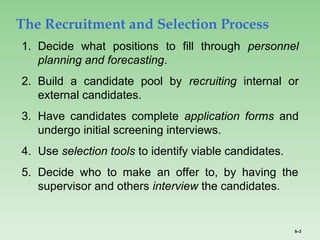
The Recruitment and Selection Process
1. Decide what positions to fill through personnel
planning and forecasting.
2. Build a candidate pool by recruiting internal or
external candidates.
3. Have candidates complete application forms and
undergo initial screening interviews.
4. Use selection tools to identify viable candidates.
5. Decide who to make an offer to, by having the
supervisor and others interview the candidates.
5–4
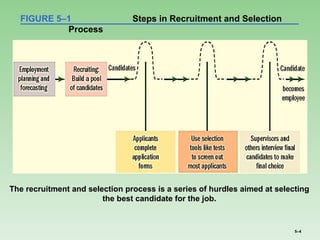
FIGURE 5–1 Steps in Recruitment and Selection
Process
The recruitment and selection process is a series of hurdles aimed at selecting
the best candidate for the job.
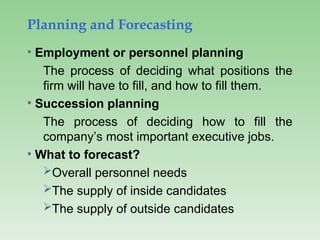
Planning and Forecasting
• Employment or personnel planning
The process of deciding what positions the
firm will have to fill, and how to fill them.
• Succession planning
The process of deciding how to fill the
company’s most important executive jobs.
• What to forecast?
Overall personnel needs
The supply of inside candidates
The supply of outside candidates
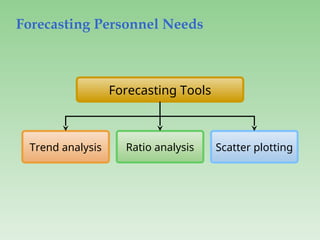
Forecasting Personnel Needs
Trend analysis Ratio analysis
Forecasting Tools
Scatter plotting
Forecasting Personnel Needs
• Trend analysis
The study of a firm’s past employment needs
over a period of years to predict future needs.
• Ratio analysis
A forecasting technique for determining future
staff needs by using ratios between a causal
factor and the number of employees needed.
Assumes that the relationship between the
causal factor and staffing needs is constant.
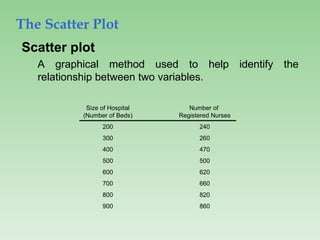
The Scatter Plot
Scatter plot
A graphical method used to help identify the
relationship between two variables.
Size of Hospital Number of
(Number of Beds) Registered Nurses
200 240
300 260
400 470
500 500
600 620
700 660
800 820
900 860
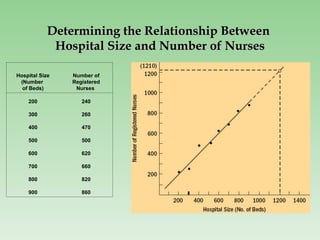
Determining the Relationship Between
Hospital Size and Number of Nurses
Hospital Size
(Number
of Beds)
Number of
Registered
Nurses
200 240
300 260
400 470
500 500
600 620
700 660
800 820
900 860
Drawbacks to Traditional Forecasting Techniques
• They focus on projections and historical
relationships.
• They do not consider the impact of strategic
initiatives on future staffing levels.
• They support compensation plans that reward
managers for managing ever-larger staffs.
• They “bake in” the idea that staff increases are
inevitable.
• They validate and institutionalize present planning
processes and the usual ways of doing things.
Using Computers to Forecast Personnel
Requirements
Computerized Forecasts
The use software packages to determine of
future staff needs by projecting sales, volume
of production, and personnel required to
maintain a volume of output.
Forecasting the Supply of Inside
Candidates
Qualifications inventories
Manual or computerized records listing
employees’ education, career and
development interests, languages,
special skills, and so on, to be used in
selecting inside candidates for
promotion.
5–13
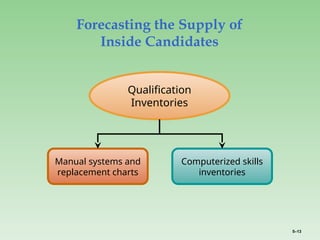
Forecasting the Supply of
Inside Candidates
Manual systems and
replacement charts
Computerized skills
inventories
Qualification
Inventories
5–14
Manual Systems and Replacement Charts
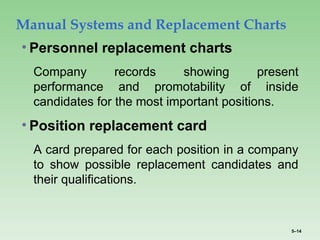
• Personnel replacement charts
Company records showing present
performance and promotability of inside
candidates for the most important positions.
• Position replacement card
A card prepared for each position in a company
to show possible replacement candidates and
their qualifications.
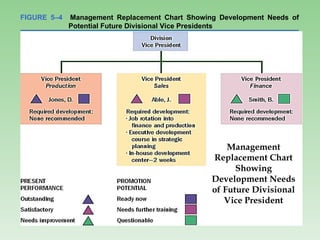
FIGURE 5–4 Management Replacement Chart Showing Development Needs of
Potential Future Divisional Vice Presidents
Management
Replacement Chart
Showing
Development Needs
of Future Divisional
Vice President
© 2005 Prentice Hall Inc. All rights reserved. 5–16
Computerized Information Systems
• Human Resource Information System
(HRIS)
Computerized inventory of information that
can be accessed to determine employees’
background, experience, and skills that may
include:
 Work experience codes
 Product or service knowledge
 Industry experience
 Formal education
The Matter of Privacy
• Ensuring the Security of HR Information
 Control of HR information through access matrices
 Access to records and employee privacy
• Legal Considerations
 The Federal Privacy Act of 1974
 New York Personal Privacy Act of 1985
 Americans with Disabilities Act
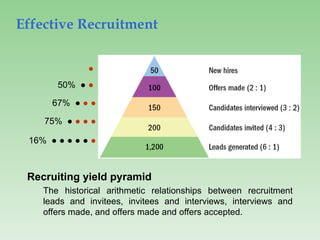
16% ● ● ● ● ● ●
75% ● ● ● ●
67% ● ● ●
50% ● ●
●
Recruiting yield pyramid
The historical arithmetic relationships between recruitment
leads and invitees, invitees and interviews, interviews and
offers made, and offers made and offers accepted.
Effective Recruitment
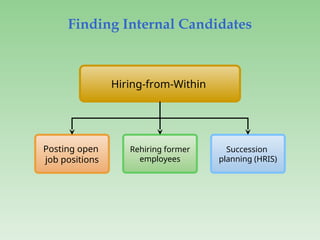
Finding Internal Candidates
Posting open
job positions
Rehiring former
employees
Hiring-from-Within
Succession
planning (HRIS)
Finding Internal Candidates
• Job posting
 Publicizing an open job to employees (often by literally
posting it on bulletin boards) and listing its attributes.
• Rehiring former employees
 Advantages:
 They are known quantities.
 They know the firm and its culture.
 Disadvantages:
 They may have less-than positive attitudes.
 Rehiring may sent the wrong message to current
employees about how to get ahead.
Finding Internal Candidates (cont’d)
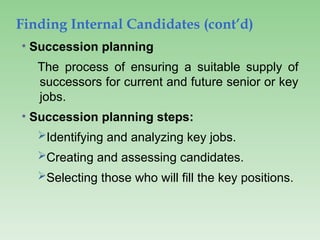
• Succession planning
The process of ensuring a suitable supply of
successors for current and future senior or key
jobs.
• Succession planning steps:
Identifying and analyzing key jobs.
Creating and assessing candidates.
Selecting those who will fill the key positions.
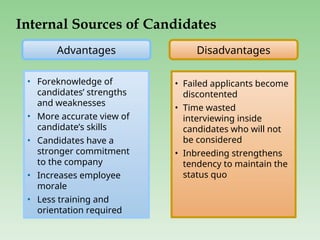
Internal Sources of Candidates
• Foreknowledge of
candidates’ strengths
and weaknesses
• More accurate view of
candidate’s skills
• Candidates have a
stronger commitment
to the company
• Increases employee
morale
• Less training and
orientation required
• Failed applicants become
discontented
• Time wasted
interviewing inside
candidates who will not
be considered
• Inbreeding strengthens
tendency to maintain the
status quo
Advantages Disadvantages
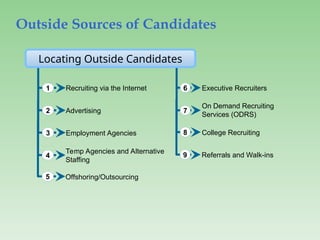
Outside Sources of Candidates
1
2
3
4
5
Advertising
Recruiting via the Internet
Employment Agencies
Temp Agencies and Alternative
Staffing
Offshoring/Outsourcing
6
7
8
9
On Demand Recruiting
Services (ODRS)
Executive Recruiters
College Recruiting
Referrals and Walk-ins
Locating Outside Candidates
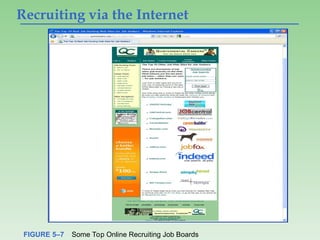
FIGURE 5–7 Some Top Online Recruiting Job Boards
Recruiting via the Internet
• Advantages
 Cost-effective way to publicize job openings
 More applicants attracted over a longer period
 Immediate applicant responses
 Online prescreening of applicants
 Links to other job search sites
 Automation of applicant tracking and evaluation
• Disadvantages
 Exclusion of older and minority workers
 Unqualified applicants overload the system
 Personal information privacy concerns of applicants
Advertising for Outside Candidates
• The Media Choice
 Selection of the best medium depends on the
positions for which the firm is recruiting.
 Newspapers: local and specific labor markets
 Trade and professional journals: specialized
employees
 Internet job sites: global labor markets
• Constructing (Writing) Effective Ads
 Create attention, interest, desire, and action (AIDA).
 Create a positive impression (image) of the firm.
FIGURE 5–9 Help Wanted Ad that Draws Attention
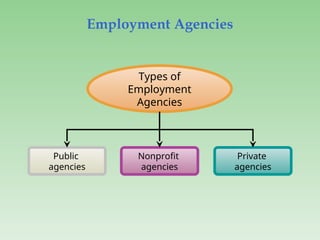
Employment Agencies
Public
agencies
Private
agencies
Types of
Employment
Agencies
Nonprofit
agencies
Why Use a Private Employment Agency?
• No HR department: firm lacks recruiting and
screening capabilities to attract a pool of
qualified applicants.
• To fill a particular opening quickly.
• To attract more minority or female applicants.
• To reach currently employed individuals who are
more comfortable dealing with agencies than
competing companies.
• To reduce internal time devoted to recruiting.
Avoiding Problems with Employment Agencies
• Give agency an accurate and complete job description.
• Make sure tests, application blanks, and interviews are
part of the agency’s selection process.
• Review candidates accepted or rejected by your firm or
the agency for effectiveness and fairness of agency’s
screening process.
• Screen agency for effectiveness in filling positions.
• Supplement the agency’s reference checking by
checking the final candidate’s references yourself.
Temp / Offshoring / Outsourcing
Jobs
Means having outside vendors supply services
(such as benefits management, market
research, or manufacturing) that the firm’s own
employees previously did in-house.
Temp / Offshoring / Outsourcing Jobs
• Advantages of Temps
 Increased productivity. Paid only when working
 Allows “trial run” for prospective employees
 No recruitment, screening, and payroll administration
costs
• Disadvantages of Temps
 Increased labor costs due to fees paid to temp
agencies
 Temp employees’ lack of commitment to the firm
Temp / Offshoring / Outsourcing Jobs
• Dehumanizing, impersonal, and discouraging treatment by
employers.
• Insecurity about employment and pessimism about the
future.
• Worry about the lack of insurance and pension benefits.
• Being misled about job assignments and whether temporary
assignments are likely to become full-time positions.
• Being “underemployed” while trying to return to the full-time
labor market.
• Anger toward the corporate world and its values; expressed
as alienation and disenchantment.
Ten Things Managers Should Avoid When Supervising Temporary Employees
1. Train your contingent workers. Ask their staffing agency to handle training.
2. Negotiate the pay rate of your contingent workers. The agency should set pay.
3. Coach or counsel a contingent worker on his/her job performance. Instead, call
the person’s agency and request that it do so.
4. Negotiate a contingent worker’s vacations or personal time off. Direct the worker
to his or her agency.
5. Routinely include contingent workers in your company’s employee functions.
6. Allow contingent workers to utilize facilities intended for employees.
7. Let managers issue company business cards, nameplates, or employee badges
to contingent workers without HR and legal approval.
8. Let managers discuss harassment or discrimination issues with contingent
workers.
9. Discuss job opportunities and the contingent worker’s suitability for them
directly. Instead, refer the worker to publicly available job postings.
10. Terminate a contingent worker directly. Contact the agency to do so.
Do Not:
Executive Recruitment
• Executive recruiters (also known as
headhunters) are special employment agencies
retained by employers to seek out top-
management talent for their clients.
• For executive positions, headhunters may be
your only source of candidates.
• The employer always pays the fees.
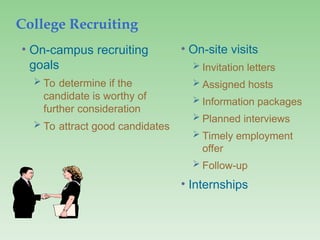
College Recruiting
• On-campus recruiting
goals
 To determine if the
candidate is worthy of
further consideration
 To attract good candidates
• On-site visits
 Invitation letters
 Assigned hosts
 Information packages
 Planned interviews
 Timely employment
offer
 Follow-up
• Internships
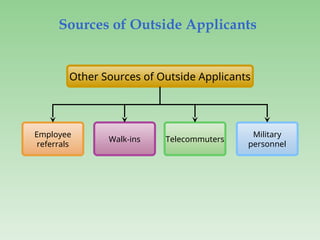
Sources of Outside Applicants
Employee
referrals
Walk-ins Telecommuters
Other Sources of Outside Applicants
Military
personnel
Employee Referrals and Walk-ins
• Employee Referrals
 Referring employees become stakeholders.
 Referral is a cost-effective recruitment program.
 Referral can speed up diversifying the workforce.
 Relying on referrals may be discriminatory.
• Walk-ins
 Seek employment through a personal direct approach
to the employer.
 Courteous treatment of any applicant is a good
business practice.
Copyright © 2011 Pearson Education 5–39
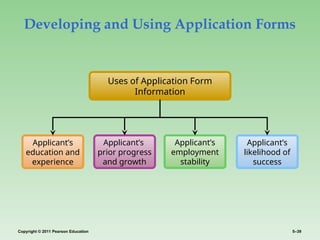
Developing and Using Application Forms
Applicant’s
education and
experience
Applicant’s
prior progress
and growth
Applicant’s
employment
stability
Uses of Application Form
Information
Applicant’s
likelihood of
success
Copyright © 2011 Pearson Education 5–40
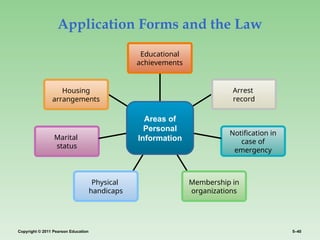
Application Forms and the Law
Educational
achievements
Arrest
record
Notification in
case of
emergency
Membership in
organizations
Physical
handicaps
Marital
status
Housing
arrangements
Areas of
Personal
Information
Copyright © 2011 Pearson Education 5–41
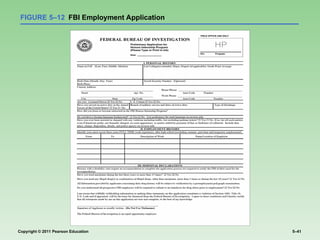
FIGURE 5–12 FBI Employment Application
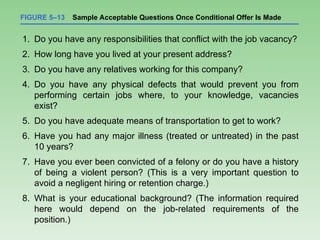
FIGURE 5–13 Sample Acceptable Questions Once Conditional Offer Is Made
1. Do you have any responsibilities that conflict with the job vacancy?
2. How long have you lived at your present address?
3. Do you have any relatives working for this company?
4. Do you have any physical defects that would prevent you from
performing certain jobs where, to your knowledge, vacancies
exist?
5. Do you have adequate means of transportation to get to work?
6. Have you had any major illness (treated or untreated) in the past
10 years?
7. Have you ever been convicted of a felony or do you have a history
of being a violent person? (This is a very important question to
avoid a negligent hiring or retention charge.)
8. What is your educational background? (The information required
here would depend on the job-related requirements of the
position.)
43
43

Chapter - 5 Recruitment and Selection.ppt

  • 1.
    GARY DESSLER HUMAN RESOURCEMANAGEMENT Chapter 5 Personnel Planning and Recruiting PowerPoint Presentation by Charlie Cook The University of West Alabama Part 2 Recruitment and Placement
  • 2.
    5–2 1. List thesteps in the recruitment and selection process. 2. Explain the main techniques used in employment planning and forecasting. 3. Explain and give examples for the need for effective recruiting. 4. Name and describe the main internal sources of candidates. 5. List and discuss the main outside sources of candidates. 6. Develop a help wanted ad. 7. Explain how to recruit a more diverse workforce. Learning Outcomes
  • 3.
    5–3 The Recruitment andSelection Process 1. Decide what positions to fill through personnel planning and forecasting. 2. Build a candidate pool by recruiting internal or external candidates. 3. Have candidates complete application forms and undergo initial screening interviews. 4. Use selection tools to identify viable candidates. 5. Decide who to make an offer to, by having the supervisor and others interview the candidates.
  • 4.
    5–4 FIGURE 5–1 Stepsin Recruitment and Selection Process The recruitment and selection process is a series of hurdles aimed at selecting the best candidate for the job.
  • 5.
    Planning and Forecasting •Employment or personnel planning The process of deciding what positions the firm will have to fill, and how to fill them. • Succession planning The process of deciding how to fill the company’s most important executive jobs. • What to forecast? Overall personnel needs The supply of inside candidates The supply of outside candidates
  • 6.
    Forecasting Personnel Needs Trendanalysis Ratio analysis Forecasting Tools Scatter plotting
  • 7.
    Forecasting Personnel Needs •Trend analysis The study of a firm’s past employment needs over a period of years to predict future needs. • Ratio analysis A forecasting technique for determining future staff needs by using ratios between a causal factor and the number of employees needed. Assumes that the relationship between the causal factor and staffing needs is constant.
  • 8.
    The Scatter Plot Scatterplot A graphical method used to help identify the relationship between two variables. Size of Hospital Number of (Number of Beds) Registered Nurses 200 240 300 260 400 470 500 500 600 620 700 660 800 820 900 860
  • 9.
    Determining the RelationshipBetween Determining the Relationship Between Hospital Size and Number of Nurses Hospital Size and Number of Nurses Hospital Size (Number of Beds) Number of Registered Nurses 200 240 300 260 400 470 500 500 600 620 700 660 800 820 900 860
  • 10.
    Drawbacks to TraditionalForecasting Techniques • They focus on projections and historical relationships. • They do not consider the impact of strategic initiatives on future staffing levels. • They support compensation plans that reward managers for managing ever-larger staffs. • They “bake in” the idea that staff increases are inevitable. • They validate and institutionalize present planning processes and the usual ways of doing things.
  • 11.
    Using Computers toForecast Personnel Requirements Computerized Forecasts The use software packages to determine of future staff needs by projecting sales, volume of production, and personnel required to maintain a volume of output.
  • 12.
    Forecasting the Supplyof Inside Candidates Qualifications inventories Manual or computerized records listing employees’ education, career and development interests, languages, special skills, and so on, to be used in selecting inside candidates for promotion.
  • 13.
    5–13 Forecasting the Supplyof Inside Candidates Manual systems and replacement charts Computerized skills inventories Qualification Inventories
  • 14.
    5–14 Manual Systems andReplacement Charts • Personnel replacement charts Company records showing present performance and promotability of inside candidates for the most important positions. • Position replacement card A card prepared for each position in a company to show possible replacement candidates and their qualifications.
  • 15.
    FIGURE 5–4 ManagementReplacement Chart Showing Development Needs of Potential Future Divisional Vice Presidents Management Replacement Chart Showing Development Needs of Future Divisional Vice President
  • 16.
    © 2005 PrenticeHall Inc. All rights reserved. 5–16 Computerized Information Systems • Human Resource Information System (HRIS) Computerized inventory of information that can be accessed to determine employees’ background, experience, and skills that may include:  Work experience codes  Product or service knowledge  Industry experience  Formal education
  • 17.
    The Matter ofPrivacy • Ensuring the Security of HR Information  Control of HR information through access matrices  Access to records and employee privacy • Legal Considerations  The Federal Privacy Act of 1974  New York Personal Privacy Act of 1985  Americans with Disabilities Act
  • 18.
    16% ● ●● ● ● ● 75% ● ● ● ● 67% ● ● ● 50% ● ● ● Recruiting yield pyramid The historical arithmetic relationships between recruitment leads and invitees, invitees and interviews, interviews and offers made, and offers made and offers accepted. Effective Recruitment
  • 19.
    Finding Internal Candidates Postingopen job positions Rehiring former employees Hiring-from-Within Succession planning (HRIS)
  • 20.
    Finding Internal Candidates •Job posting  Publicizing an open job to employees (often by literally posting it on bulletin boards) and listing its attributes. • Rehiring former employees  Advantages:  They are known quantities.  They know the firm and its culture.  Disadvantages:  They may have less-than positive attitudes.  Rehiring may sent the wrong message to current employees about how to get ahead.
  • 21.
    Finding Internal Candidates(cont’d) • Succession planning The process of ensuring a suitable supply of successors for current and future senior or key jobs. • Succession planning steps: Identifying and analyzing key jobs. Creating and assessing candidates. Selecting those who will fill the key positions.
  • 22.
    Internal Sources ofCandidates • Foreknowledge of candidates’ strengths and weaknesses • More accurate view of candidate’s skills • Candidates have a stronger commitment to the company • Increases employee morale • Less training and orientation required • Failed applicants become discontented • Time wasted interviewing inside candidates who will not be considered • Inbreeding strengthens tendency to maintain the status quo Advantages Disadvantages
  • 23.
    Outside Sources ofCandidates 1 2 3 4 5 Advertising Recruiting via the Internet Employment Agencies Temp Agencies and Alternative Staffing Offshoring/Outsourcing 6 7 8 9 On Demand Recruiting Services (ODRS) Executive Recruiters College Recruiting Referrals and Walk-ins Locating Outside Candidates
  • 24.
    FIGURE 5–7 SomeTop Online Recruiting Job Boards Recruiting via the Internet
  • 25.
    Recruiting via theInternet • Advantages  Cost-effective way to publicize job openings  More applicants attracted over a longer period  Immediate applicant responses  Online prescreening of applicants  Links to other job search sites  Automation of applicant tracking and evaluation • Disadvantages  Exclusion of older and minority workers  Unqualified applicants overload the system  Personal information privacy concerns of applicants
  • 26.
    Advertising for OutsideCandidates • The Media Choice  Selection of the best medium depends on the positions for which the firm is recruiting.  Newspapers: local and specific labor markets  Trade and professional journals: specialized employees  Internet job sites: global labor markets • Constructing (Writing) Effective Ads  Create attention, interest, desire, and action (AIDA).  Create a positive impression (image) of the firm.
  • 27.
    FIGURE 5–9 HelpWanted Ad that Draws Attention
  • 28.
  • 29.
    Why Use aPrivate Employment Agency? • No HR department: firm lacks recruiting and screening capabilities to attract a pool of qualified applicants. • To fill a particular opening quickly. • To attract more minority or female applicants. • To reach currently employed individuals who are more comfortable dealing with agencies than competing companies. • To reduce internal time devoted to recruiting.
  • 30.
    Avoiding Problems withEmployment Agencies • Give agency an accurate and complete job description. • Make sure tests, application blanks, and interviews are part of the agency’s selection process. • Review candidates accepted or rejected by your firm or the agency for effectiveness and fairness of agency’s screening process. • Screen agency for effectiveness in filling positions. • Supplement the agency’s reference checking by checking the final candidate’s references yourself.
  • 31.
    Temp / Offshoring/ Outsourcing Jobs Means having outside vendors supply services (such as benefits management, market research, or manufacturing) that the firm’s own employees previously did in-house.
  • 32.
    Temp / Offshoring/ Outsourcing Jobs • Advantages of Temps  Increased productivity. Paid only when working  Allows “trial run” for prospective employees  No recruitment, screening, and payroll administration costs • Disadvantages of Temps  Increased labor costs due to fees paid to temp agencies  Temp employees’ lack of commitment to the firm
  • 33.
    Temp / Offshoring/ Outsourcing Jobs • Dehumanizing, impersonal, and discouraging treatment by employers. • Insecurity about employment and pessimism about the future. • Worry about the lack of insurance and pension benefits. • Being misled about job assignments and whether temporary assignments are likely to become full-time positions. • Being “underemployed” while trying to return to the full-time labor market. • Anger toward the corporate world and its values; expressed as alienation and disenchantment.
  • 34.
    Ten Things ManagersShould Avoid When Supervising Temporary Employees 1. Train your contingent workers. Ask their staffing agency to handle training. 2. Negotiate the pay rate of your contingent workers. The agency should set pay. 3. Coach or counsel a contingent worker on his/her job performance. Instead, call the person’s agency and request that it do so. 4. Negotiate a contingent worker’s vacations or personal time off. Direct the worker to his or her agency. 5. Routinely include contingent workers in your company’s employee functions. 6. Allow contingent workers to utilize facilities intended for employees. 7. Let managers issue company business cards, nameplates, or employee badges to contingent workers without HR and legal approval. 8. Let managers discuss harassment or discrimination issues with contingent workers. 9. Discuss job opportunities and the contingent worker’s suitability for them directly. Instead, refer the worker to publicly available job postings. 10. Terminate a contingent worker directly. Contact the agency to do so. Do Not:
  • 35.
    Executive Recruitment • Executiverecruiters (also known as headhunters) are special employment agencies retained by employers to seek out top- management talent for their clients. • For executive positions, headhunters may be your only source of candidates. • The employer always pays the fees.
  • 36.
    College Recruiting • On-campusrecruiting goals  To determine if the candidate is worthy of further consideration  To attract good candidates • On-site visits  Invitation letters  Assigned hosts  Information packages  Planned interviews  Timely employment offer  Follow-up • Internships
  • 37.
    Sources of OutsideApplicants Employee referrals Walk-ins Telecommuters Other Sources of Outside Applicants Military personnel
  • 38.
    Employee Referrals andWalk-ins • Employee Referrals  Referring employees become stakeholders.  Referral is a cost-effective recruitment program.  Referral can speed up diversifying the workforce.  Relying on referrals may be discriminatory. • Walk-ins  Seek employment through a personal direct approach to the employer.  Courteous treatment of any applicant is a good business practice.
  • 39.
    Copyright © 2011Pearson Education 5–39 Developing and Using Application Forms Applicant’s education and experience Applicant’s prior progress and growth Applicant’s employment stability Uses of Application Form Information Applicant’s likelihood of success
  • 40.
    Copyright © 2011Pearson Education 5–40 Application Forms and the Law Educational achievements Arrest record Notification in case of emergency Membership in organizations Physical handicaps Marital status Housing arrangements Areas of Personal Information
  • 41.
    Copyright © 2011Pearson Education 5–41 FIGURE 5–12 FBI Employment Application
  • 42.
    FIGURE 5–13 SampleAcceptable Questions Once Conditional Offer Is Made 1. Do you have any responsibilities that conflict with the job vacancy? 2. How long have you lived at your present address? 3. Do you have any relatives working for this company? 4. Do you have any physical defects that would prevent you from performing certain jobs where, to your knowledge, vacancies exist? 5. Do you have adequate means of transportation to get to work? 6. Have you had any major illness (treated or untreated) in the past 10 years? 7. Have you ever been convicted of a felony or do you have a history of being a violent person? (This is a very important question to avoid a negligent hiring or retention charge.) 8. What is your educational background? (The information required here would depend on the job-related requirements of the position.)
  • 43.

Editor's Notes

  • #3 Job analysis identifies the duties and human requirements for each of the company’s jobs. The next step is to decide how many of these jobs you need to fill, and to recruit and select employees for them.
  • #4 The best way to envision recruitment and selection is as a series of hurdles as shown in Figure 5-1.
  • #5 Employment (or personnel) planning is the process of deciding what positions the firm will have to fill, and how to fill them. It embraces all future positions, from maintenance clerk to CEO. However, most firms call the process of deciding how to fill executive jobs succession planning. Like all good plans, personnel plans require some forecasts or estimates, in this case, of three things: personnel needs, the supply of inside candidates, and the likely supply of outside candidates.
  • #6 Trend analysis can provide an initial estimate of future staffing needs, but employment levels rarely depend just on the passage of time. Other factors (like changes in sales volume and productivity) also affect staffing needs. Ratio analysis provides forecasts based on the historical ratio between (1) some causal factor (like sales volume) and (2) the number of employees required (such as number of salespeople). A scatter plot shows graphically how two variables—such as sales and your firm’s staffing levels—are related. If they are, and then if you can forecast the business activity (like sales), you should also be able to estimate your personnel needs.
  • #9 Figure 5-3 shows hospital size on the horizontal axis. It shows number of nurses on the vertical axis. If these two factors are related, then the points will tend to fall along a straight line, as they do here. If you carefully draw in a line to minimize the distances between the line and each one of the plotted points, you will be able to estimate the number of nurses needed for each hospital size. Thus, for a 1,200-bed hospital, the human resource director would assume she needs about 1,210 nurses.
  • #10 Managers obviously need to consider other factors too. These include projected turnover, decisions to upgrade (or downgrade) products or services, productivity changes, and financial resources.
  • #11 Computerized forecasts enable the manager to build more variables into his or her personnel projections. Newer systems particularly rely on mathematically setting clear goals. Whichever forecasting tool you use, managerial judgment should play a big role. It’s rare that any historical trend, ratio, or relationship will simply continue. You will therefore have to modify the forecast based on subjective factors—such as the feeling that more employees will be quitting—you believe will be important.
  • #13 Knowing your staffing needs satisfies only half the staffing equation. Next, you have to estimate the likely supply of both inside and outside candidates. Most firms start with the inside candidates. Department managers or owners of smaller firms often use manual devices to track employee qualifications. Thus a personnel inventory and development record form compiles qualifications information on each employee. Computerized skills inventory data typically include items like work experience codes, product knowledge, the employee’s level of familiarity with the employer’s product lines or services, the person’s industry experience, and formal education.
  • #15 Figure 5-4 is a personnel replacement chart for some of a firm’s top positions. It shows the present performance and promotability for each position’s potential replacement.
  • #17 The employer should secure all its employee data. Much of the data is personal (such as Social Security numbers and illnesses). Legislation gives employees legal rights regarding who has access to information about them.
  • #18 Figure 5-6 illustrates an example of an employer’s use of a recruiting yield pyramid to calculate the number of applicants they must generate to hire the required number of new employees.
  • #19 Hiring from within ideally relies on job posting and the firm’s skills inventories. Job posting means publicizing the open job to employees (usually by literally posting it on company intranets or bulletin boards). These postings list the job’s attributes, like qualifications, supervisor, work schedule, and pay rate. Qualifications skills banks also play a role. For example, the database may reveal persons who have potential for further training or who have the right background for the open job.
  • #22 Recruiting of current employees, or “hiring from within,” is often the best source of candidates. However, there are advantages and disadvantages to using internal candidates.
  • #23 Firms can’t always get all the employees they need from their current staff, and sometimes they just don’t want to. This slide lists some of the sources that firms use to find outside candidates.
  • #24 Most people today go online to look for jobs. For most employers and for most jobs, Internet-based recruiting is by far the recruiting source of choice. Most employers recruit through their own Web sites, or use job boards. Figure 5-7 highlights some top online recruiting job boards.
  • #25 Internet recruiting is a cost-effective way to publicize openings; it generates more responses quicker and for a longer time at less cost than just about any other method. However, Internet recruiting can present problems such as discrimination, application overload, and privacy.
  • #26 While Web-based recruiting is rapidly replacing help wanted ads, a glance at almost any paper or business or professional magazine will confirm that print ads are still popular. To use help wanted ads successfully, employers have to address two issues: the advertising medium and the ad’s construction.
  • #27 Figure 5-9 shows an ad from one classified section. Why does this ad attract attention? The phrase “next key player” certainly helps. Employers usually advertise key positions in display ads like this.
  • #28 There are three main types of employment agencies: (1) public agencies operated by federal, state, or local governments; (2) agencies associated with nonprofit organizations; and (3) privately owned agencies.
  • #29 Private employment agencies are important sources of clerical, white-collar, and managerial personnel. They charge fees (set by state law and posted in their offices) for each applicant they place. Most are “fee-paid” jobs, in which the employer pays the fee.
  • #30 Using employment agencies requires avoiding potential pitfalls. For example, the employment agency’s screening may let poor applicants go directly to the supervisors responsible for hiring, who may in turn naively hire them. Conversely, improper screening at the agency could block potentially successful applicants.
  • #31 Outsourcing and offshoring are perhaps the most extreme examples of alternative staffing. Rather than bringing people in to do the firm’s jobs, outsourcing and offshoring send the jobs out. Outsourcing means having outside vendors supply services (such as benefits management, market research, or manufacturing) that the firm’s own employees previously did in-house. Offshoring is a narrower term. It means having outside vendors abroad supply services that the firm’s own employees previously did in-house.
  • #32 Employers have long used “temps” to fill in for permanent employees who were out sick or on vacation. But the desire for ever-higher productivity also contributes to temp workers’ growing popularity. Productivity is measured in terms of output per hour paid. Many firms also use temporary hiring to give prospective employees a trial run before hiring them as regular employees.
  • #33 To make temporary relationships as successful as possible, managers supervising temps should understand these employees’ main concerns.
  • #34 Figure 5-10 summarizes some of the legal guidelines for dealing with temporary workers.
  • #35 Executive recruiters (also known as headhunters) are special employment agencies retained by employers to seek out top-management talent for their clients. For executive positions, headhunters may be your only source of candidates. The employer always pays the fees.
  • #36 College recruiting—sending an employer’s representatives to college campuses to prescreen applicants and create an applicant pool from the graduating class—is an important source of management trainees and professional and technical employees.
  • #37 Employee referral campaigns are an important recruiting option. A firm may post announcements of openings and requests for referrals on its Web site, bulletin, and/or wallboards.
  • #38 Employee referrals and walk-ins are both viable sources of applicants.
  • #39 With a pool of applicants, the prescreening process can begin. The application form is usually the first step in this process (some firms first require a brief, prescreening interview or online test). A filled-in application provides four types of information listed in the slide.
  • #40 Carefully review application forms to ensure that they comply with equal employment opportunity laws in the proper use of questions that the applicant is asked to answer.
  • #41 Figure 5-12 presents one employer’s approach to collecting application form information—the employment application for the FBI. In practice, most employers encourage online applications.
  • #42 You may ask acceptable conditional job offer questions like those in Figure 5-13 once the candidate has passed the “second stage” conditions of the conditional job offer.