Discovering Computers
& Microsoft Office
2010
Discovering Computers
Chapter 4
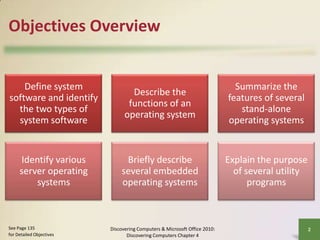
Objectives Overview

Define system
software and identify
the two types of
system software

Describe the
functions of an
operating system

Summarize the
features of several
stand-alone
operating systems

Identify various
server operating
systems

Briefly describe
several embedded
operating systems

Explain the purpose
of several utility
programs

See Page 135
for Detailed Objectives

Discovering Computers & Microsoft Office 2010:
Discovering Computers Chapter 4

2
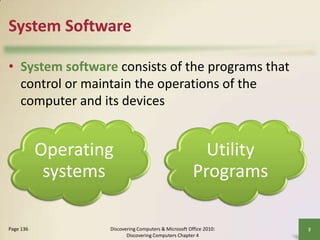
System Software
• System software consists of the programs that
control or maintain the operations of the
computer and its devices

Operating
systems
Page 136

Utility
Programs

Discovering Computers & Microsoft Office 2010:
Discovering Computers Chapter 4

3
Operating Systems
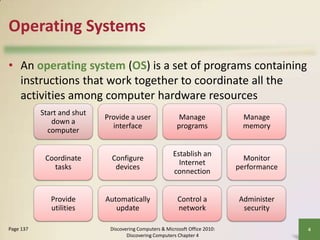
• An operating system (OS) is a set of programs containing
instructions that work together to coordinate all the
activities among computer hardware resources
Start and shut
down a
computer

Manage
programs

Manage
memory

Coordinate
tasks

Configure
devices

Establish an
Internet
connection

Monitor
performance

Provide
utilities
Page 137

Provide a user
interface

Automatically
update

Control a
network

Administer
security

Discovering Computers & Microsoft Office 2010:
Discovering Computers Chapter 4

4
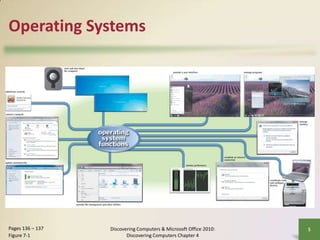
Operating Systems

Pages 136 – 137
Figure 7-1

Discovering Computers & Microsoft Office 2010:
Discovering Computers Chapter 4

5
Operating System Functions
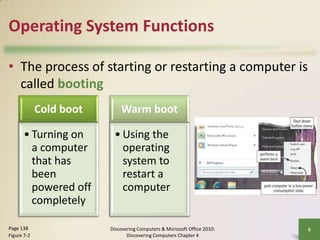
• The process of starting or restarting a computer is
called booting
Cold boot
• Turning on
a computer
that has
been
powered off
completely
Page 138
Figure 7-2

Warm boot
• Using the
operating
system to
restart a
computer

Discovering Computers & Microsoft Office 2010:
Discovering Computers Chapter 4

6
Operating System Functions
• An operating system includes various shut down
options
Sleep mode saves any open
documents and programs to
RAM, turns off all unneeded
functions, and then places
the computer in a lowpower state

Page 138

Hibernate saves any open
documents and programs to
a hard disk before removing
power from the computer

Discovering Computers & Microsoft Office 2010:
Discovering Computers Chapter 4

7
Operating System Functions
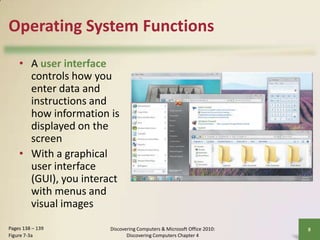
• A user interface
controls how you
enter data and
instructions and
how information is
displayed on the
screen
• With a graphical
user interface
(GUI), you interact
with menus and
visual images
Pages 138 – 139
Figure 7-3a

Discovering Computers & Microsoft Office 2010:
Discovering Computers Chapter 4

8
Operating System Functions
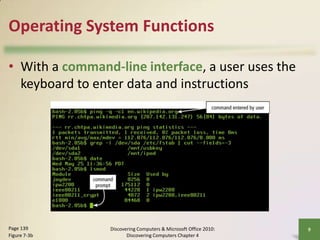
• With a command-line interface, a user uses the
keyboard to enter data and instructions

Page 139
Figure 7-3b

Discovering Computers & Microsoft Office 2010:
Discovering Computers Chapter 4

9
Operating System Functions
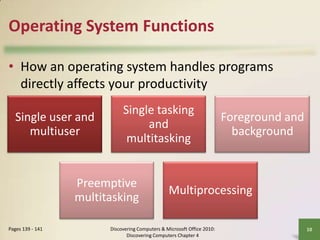
• How an operating system handles programs
directly affects your productivity
Single user and
multiuser

Single tasking
and
multitasking

Preemptive
multitasking
Pages 139 - 141

Foreground and
background

Multiprocessing

Discovering Computers & Microsoft Office 2010:
Discovering Computers Chapter 4

10
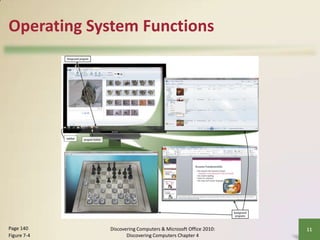
Operating System Functions

Page 140
Figure 7-4

Discovering Computers & Microsoft Office 2010:
Discovering Computers Chapter 4

11
Operating System Functions
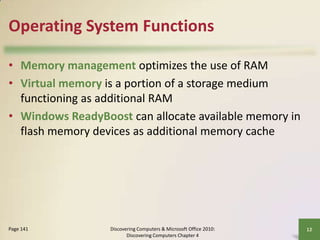
• Memory management optimizes the use of RAM
• Virtual memory is a portion of a storage medium
functioning as additional RAM
• Windows ReadyBoost can allocate available memory in
flash memory devices as additional memory cache

Page 141

Discovering Computers & Microsoft Office 2010:
Discovering Computers Chapter 4

12
Operating System Functions
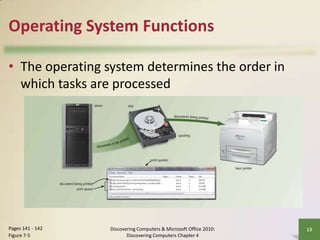
• The operating system determines the order in
which tasks are processed

Pages 141 - 142
Figure 7-5

Discovering Computers & Microsoft Office 2010:
Discovering Computers Chapter 4

13
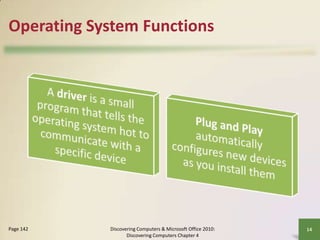
Operating System Functions

Page 142

Discovering Computers & Microsoft Office 2010:
Discovering Computers Chapter 4

14
Operating System Functions
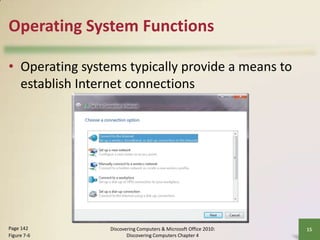
• Operating systems typically provide a means to
establish Internet connections

Page 142
Figure 7-6

Discovering Computers & Microsoft Office 2010:
Discovering Computers Chapter 4

15
Operating System Functions
• A performance monitor is a program that
assesses and reports information about various
computer resources and devices

Page 143

Discovering Computers & Microsoft Office 2010:
Discovering Computers Chapter 4

16
Operating System Functions
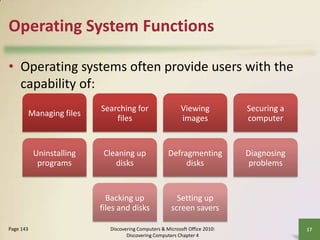
• Operating systems often provide users with the
capability of:
Managing files

Searching for
files

Viewing
images

Securing a
computer

Uninstalling
programs

Cleaning up
disks

Defragmenting
disks

Diagnosing
problems

Backing up
files and disks

Setting up
screen savers

Page 143

Discovering Computers & Microsoft Office 2010:
Discovering Computers Chapter 4

17
Operating System Functions
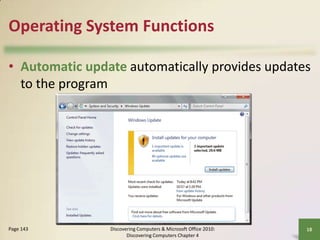
• Automatic update automatically provides updates
to the program

Page 143

Discovering Computers & Microsoft Office 2010:
Discovering Computers Chapter 4

18
Operating System Functions
• Some operating systems • A network
are designed to work
administrator uses the
with a server on a
server operating system
network
to:
– Add and remove users,
• A server operating
computers, and other
system organizes and
devices
coordinates how
– Install software and
multiple users access
administer network
and share resources on
security
a network
Pages 143 - 144

Discovering Computers & Microsoft Office 2010:
Discovering Computers Chapter 4

19
Operating System Functions
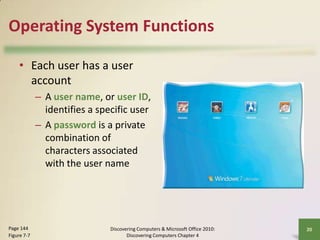
• Each user has a user
account
– A user name, or user ID,
identifies a specific user
– A password is a private
combination of
characters associated
with the user name

Page 144
Figure 7-7

Discovering Computers & Microsoft Office 2010:
Discovering Computers Chapter 4

20
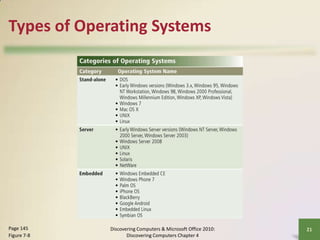
Types of Operating Systems

Page 145
Figure 7-8

Discovering Computers & Microsoft Office 2010:
Discovering Computers Chapter 4

21
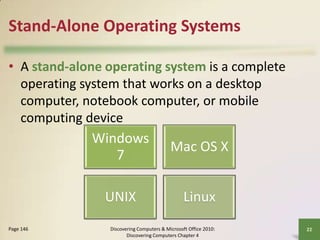
Stand-Alone Operating Systems
• A stand-alone operating system is a complete
operating system that works on a desktop
computer, notebook computer, or mobile
computing device

Windows
7
UNIX
Page 146

Mac OS X
Linux

Discovering Computers & Microsoft Office 2010:
Discovering Computers Chapter 4

22
Stand-Alone Operating Systems
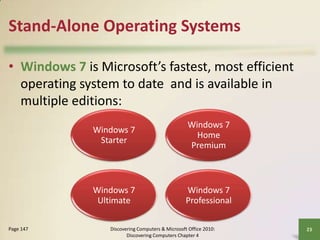
• Windows 7 is Microsoft’s fastest, most efficient
operating system to date and is available in
multiple editions:
Windows 7
Starter

Windows 7
Ultimate
Page 147

Windows 7
Home
Premium

Windows 7
Professional

Discovering Computers & Microsoft Office 2010:
Discovering Computers Chapter 4

23
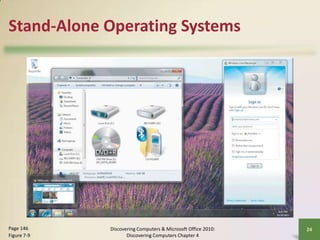
Stand-Alone Operating Systems

Page 146
Figure 7-9

Discovering Computers & Microsoft Office 2010:
Discovering Computers Chapter 4

24
Stand-Alone Operating Systems
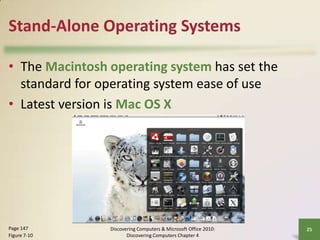
• The Macintosh operating system has set the
standard for operating system ease of use
• Latest version is Mac OS X

Page 147
Figure 7-10

Discovering Computers & Microsoft Office 2010:
Discovering Computers Chapter 4

25
Stand-Alone Operating Systems
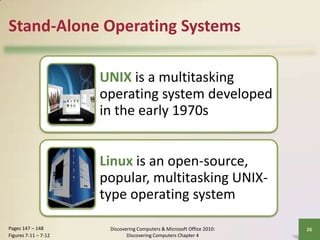
UNIX is a multitasking
operating system developed
in the early 1970s
Linux is an open-source,
popular, multitasking UNIXtype operating system
Pages 147 – 148
Figures 7-11 – 7-12

Discovering Computers & Microsoft Office 2010:
Discovering Computers Chapter 4

26
Server Operating Systems

Windows
Server 2008

UNIX

Linux

Solaris

Pages 148 - 149

Discovering Computers & Microsoft Office 2010:
Discovering Computers Chapter 4

27
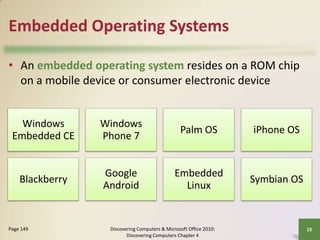
Embedded Operating Systems
• An embedded operating system resides on a ROM chip
on a mobile device or consumer electronic device

Windows
Embedded CE

Windows
Phone 7

Palm OS

iPhone OS

Blackberry

Google
Android

Embedded
Linux

Symbian OS

Page 149

Discovering Computers & Microsoft Office 2010:
Discovering Computers Chapter 4

28
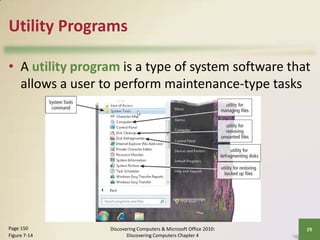
Utility Programs
• A utility program is a type of system software that
allows a user to perform maintenance-type tasks

Page 150
Figure 7-14

Discovering Computers & Microsoft Office 2010:
Discovering Computers Chapter 4

29
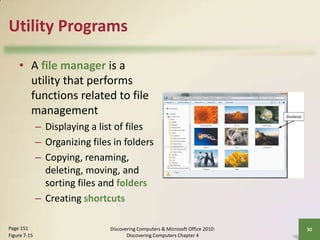
Utility Programs
• A file manager is a
utility that performs
functions related to file
management
– Displaying a list of files
– Organizing files in folders
– Copying, renaming,
deleting, moving, and
sorting files and folders
– Creating shortcuts
Page 151
Figure 7-15

Discovering Computers & Microsoft Office 2010:
Discovering Computers Chapter 4

30
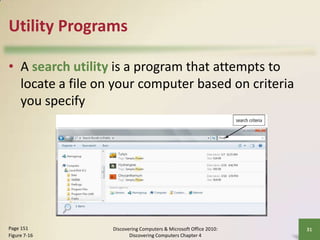
Utility Programs
• A search utility is a program that attempts to
locate a file on your computer based on criteria
you specify

Page 151
Figure 7-16

Discovering Computers & Microsoft Office 2010:
Discovering Computers Chapter 4

31
Utility Programs
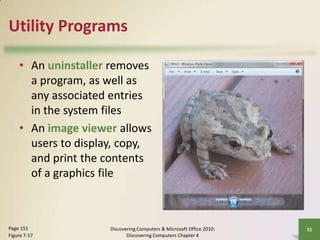
• An uninstaller removes
a program, as well as
any associated entries
in the system files
• An image viewer allows
users to display, copy,
and print the contents
of a graphics file

Page 151
Figure 7-17

Discovering Computers & Microsoft Office 2010:
Discovering Computers Chapter 4

32
Utility Programs
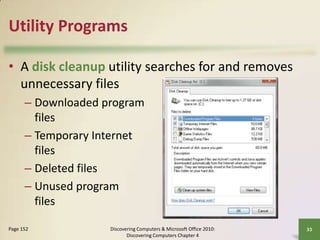
• A disk cleanup utility searches for and removes
unnecessary files
– Downloaded program
files
– Temporary Internet
files
– Deleted files
– Unused program
files
Page 152

Discovering Computers & Microsoft Office 2010:
Discovering Computers Chapter 4

33
Utility Programs
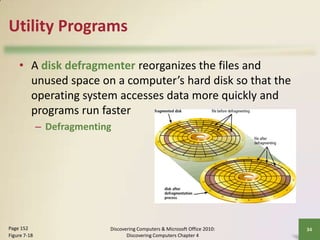
• A disk defragmenter reorganizes the files and
unused space on a computer’s hard disk so that the
operating system accesses data more quickly and
programs run faster
– Defragmenting

Page 152
Figure 7-18

Discovering Computers & Microsoft Office 2010:
Discovering Computers Chapter 4

34
Utility Programs
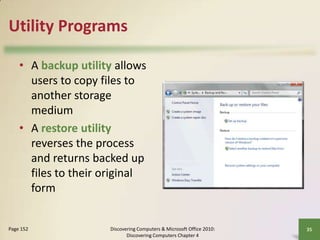
• A backup utility allows
users to copy files to
another storage
medium
• A restore utility
reverses the process
and returns backed up
files to their original
form

Page 152

Discovering Computers & Microsoft Office 2010:
Discovering Computers Chapter 4

35
Utility Programs
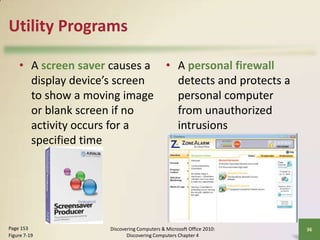
• A screen saver causes a • A personal firewall
display device’s screen
detects and protects a
to show a moving image
personal computer
or blank screen if no
from unauthorized
activity occurs for a
intrusions
specified time

Page 153
Figure 7-19

Discovering Computers & Microsoft Office 2010:
Discovering Computers Chapter 4

36
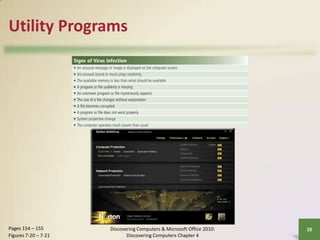
Utility Programs
A virus describes a potentially damaging computer
program that affects a computer negatively

A worm copies A Trojan horse An antivirus
itself
hides within or
program
repeatedly in
looks like a
protects a
memory or
legitimate
computer
over a network
program
against viruses
Page 154

Discovering Computers & Microsoft Office 2010:
Discovering Computers Chapter 4

37
Utility Programs

Pages 154 – 155
Figures 7-20 – 7-21

Discovering Computers & Microsoft Office 2010:
Discovering Computers Chapter 4

38
Utility Programs

Spyware is a program placed on
a computer without the user’s
knowledge that secretly collects
information about the user
• A spyware remover detects
and deletes spyware and
other similar programs

Page 155

Adware displays an online
advertisement in a banner or
pop-up window
• An adware remover is a
program that detects and
deletes adware

Discovering Computers & Microsoft Office 2010:
Discovering Computers Chapter 4

39
Utility Programs
• Filters are programs that remove or block certain
items from being displayed

Anti-spam
programs

Phishing
filters
Pages 155 - 156

Web
filters

Pop-up
blockers

Discovering Computers & Microsoft Office 2010:
Discovering Computers Chapter 4

40
Utility Programs
• A file compression utility shrinks the size of a file(s)
– Compressing files frees up room on the storage media

• Compressed files sometimes are called zipped files
– Can be uncompressed

Page 156

Discovering Computers & Microsoft Office 2010:
Discovering Computers Chapter 4

41
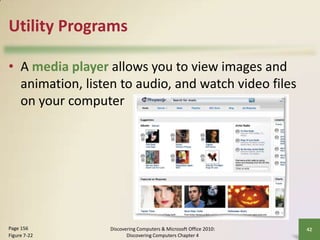
Utility Programs
• A media player allows you to view images and
animation, listen to audio, and watch video files
on your computer

Page 156
Figure 7-22

Discovering Computers & Microsoft Office 2010:
Discovering Computers Chapter 4

42
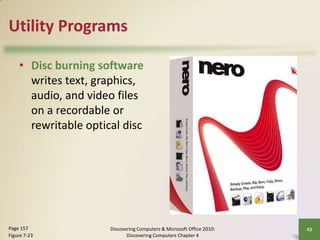
Utility Programs
• Disc burning software
writes text, graphics,
audio, and video files
on a recordable or
rewritable optical disc

Page 157
Figure 7-23

Discovering Computers & Microsoft Office 2010:
Discovering Computers Chapter 4

43
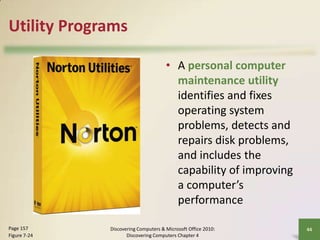
Utility Programs
• A personal computer
maintenance utility
identifies and fixes
operating system
problems, detects and
repairs disk problems,
and includes the
capability of improving
a computer’s
performance
Page 157
Figure 7-24

Discovering Computers & Microsoft Office 2010:
Discovering Computers Chapter 4

44
Summary

Definition of an
operating system

Variety of stand-alone
operating systems,
server operating
systems, and embedded
operating systems
Page 158

Functions common to
most operating systems

Several utility programs

Discovering Computers & Microsoft Office 2010:
Discovering Computers Chapter 4

45
Discovering Computers
& Microsoft Office
2010
Discovering Computers
Chapter 4

Complete

CH. 4 Operating Systems and Utility Programs
  • 1.
    Discovering Computers & MicrosoftOffice 2010 Discovering Computers Chapter 4
  • 2.
    Objectives Overview Define system softwareand identify the two types of system software Describe the functions of an operating system Summarize the features of several stand-alone operating systems Identify various server operating systems Briefly describe several embedded operating systems Explain the purpose of several utility programs See Page 135 for Detailed Objectives Discovering Computers & Microsoft Office 2010: Discovering Computers Chapter 4 2
  • 3.
    System Software • Systemsoftware consists of the programs that control or maintain the operations of the computer and its devices Operating systems Page 136 Utility Programs Discovering Computers & Microsoft Office 2010: Discovering Computers Chapter 4 3
  • 4.
    Operating Systems • Anoperating system (OS) is a set of programs containing instructions that work together to coordinate all the activities among computer hardware resources Start and shut down a computer Manage programs Manage memory Coordinate tasks Configure devices Establish an Internet connection Monitor performance Provide utilities Page 137 Provide a user interface Automatically update Control a network Administer security Discovering Computers & Microsoft Office 2010: Discovering Computers Chapter 4 4
  • 5.
    Operating Systems Pages 136– 137 Figure 7-1 Discovering Computers & Microsoft Office 2010: Discovering Computers Chapter 4 5
  • 6.
    Operating System Functions •The process of starting or restarting a computer is called booting Cold boot • Turning on a computer that has been powered off completely Page 138 Figure 7-2 Warm boot • Using the operating system to restart a computer Discovering Computers & Microsoft Office 2010: Discovering Computers Chapter 4 6
  • 7.
    Operating System Functions •An operating system includes various shut down options Sleep mode saves any open documents and programs to RAM, turns off all unneeded functions, and then places the computer in a lowpower state Page 138 Hibernate saves any open documents and programs to a hard disk before removing power from the computer Discovering Computers & Microsoft Office 2010: Discovering Computers Chapter 4 7
  • 8.
    Operating System Functions •A user interface controls how you enter data and instructions and how information is displayed on the screen • With a graphical user interface (GUI), you interact with menus and visual images Pages 138 – 139 Figure 7-3a Discovering Computers & Microsoft Office 2010: Discovering Computers Chapter 4 8
  • 9.
    Operating System Functions •With a command-line interface, a user uses the keyboard to enter data and instructions Page 139 Figure 7-3b Discovering Computers & Microsoft Office 2010: Discovering Computers Chapter 4 9
  • 10.
    Operating System Functions •How an operating system handles programs directly affects your productivity Single user and multiuser Single tasking and multitasking Preemptive multitasking Pages 139 - 141 Foreground and background Multiprocessing Discovering Computers & Microsoft Office 2010: Discovering Computers Chapter 4 10
  • 11.
    Operating System Functions Page140 Figure 7-4 Discovering Computers & Microsoft Office 2010: Discovering Computers Chapter 4 11
  • 12.
    Operating System Functions •Memory management optimizes the use of RAM • Virtual memory is a portion of a storage medium functioning as additional RAM • Windows ReadyBoost can allocate available memory in flash memory devices as additional memory cache Page 141 Discovering Computers & Microsoft Office 2010: Discovering Computers Chapter 4 12
  • 13.
    Operating System Functions •The operating system determines the order in which tasks are processed Pages 141 - 142 Figure 7-5 Discovering Computers & Microsoft Office 2010: Discovering Computers Chapter 4 13
  • 14.
    Operating System Functions Page142 Discovering Computers & Microsoft Office 2010: Discovering Computers Chapter 4 14
  • 15.
    Operating System Functions •Operating systems typically provide a means to establish Internet connections Page 142 Figure 7-6 Discovering Computers & Microsoft Office 2010: Discovering Computers Chapter 4 15
  • 16.
    Operating System Functions •A performance monitor is a program that assesses and reports information about various computer resources and devices Page 143 Discovering Computers & Microsoft Office 2010: Discovering Computers Chapter 4 16
  • 17.
    Operating System Functions •Operating systems often provide users with the capability of: Managing files Searching for files Viewing images Securing a computer Uninstalling programs Cleaning up disks Defragmenting disks Diagnosing problems Backing up files and disks Setting up screen savers Page 143 Discovering Computers & Microsoft Office 2010: Discovering Computers Chapter 4 17
  • 18.
    Operating System Functions •Automatic update automatically provides updates to the program Page 143 Discovering Computers & Microsoft Office 2010: Discovering Computers Chapter 4 18
  • 19.
    Operating System Functions •Some operating systems • A network are designed to work administrator uses the with a server on a server operating system network to: – Add and remove users, • A server operating computers, and other system organizes and devices coordinates how – Install software and multiple users access administer network and share resources on security a network Pages 143 - 144 Discovering Computers & Microsoft Office 2010: Discovering Computers Chapter 4 19
  • 20.
    Operating System Functions •Each user has a user account – A user name, or user ID, identifies a specific user – A password is a private combination of characters associated with the user name Page 144 Figure 7-7 Discovering Computers & Microsoft Office 2010: Discovering Computers Chapter 4 20
  • 21.
    Types of OperatingSystems Page 145 Figure 7-8 Discovering Computers & Microsoft Office 2010: Discovering Computers Chapter 4 21
  • 22.
    Stand-Alone Operating Systems •A stand-alone operating system is a complete operating system that works on a desktop computer, notebook computer, or mobile computing device Windows 7 UNIX Page 146 Mac OS X Linux Discovering Computers & Microsoft Office 2010: Discovering Computers Chapter 4 22
  • 23.
    Stand-Alone Operating Systems •Windows 7 is Microsoft’s fastest, most efficient operating system to date and is available in multiple editions: Windows 7 Starter Windows 7 Ultimate Page 147 Windows 7 Home Premium Windows 7 Professional Discovering Computers & Microsoft Office 2010: Discovering Computers Chapter 4 23
  • 24.
    Stand-Alone Operating Systems Page146 Figure 7-9 Discovering Computers & Microsoft Office 2010: Discovering Computers Chapter 4 24
  • 25.
    Stand-Alone Operating Systems •The Macintosh operating system has set the standard for operating system ease of use • Latest version is Mac OS X Page 147 Figure 7-10 Discovering Computers & Microsoft Office 2010: Discovering Computers Chapter 4 25
  • 26.
    Stand-Alone Operating Systems UNIXis a multitasking operating system developed in the early 1970s Linux is an open-source, popular, multitasking UNIXtype operating system Pages 147 – 148 Figures 7-11 – 7-12 Discovering Computers & Microsoft Office 2010: Discovering Computers Chapter 4 26
  • 27.
    Server Operating Systems Windows Server2008 UNIX Linux Solaris Pages 148 - 149 Discovering Computers & Microsoft Office 2010: Discovering Computers Chapter 4 27
  • 28.
    Embedded Operating Systems •An embedded operating system resides on a ROM chip on a mobile device or consumer electronic device Windows Embedded CE Windows Phone 7 Palm OS iPhone OS Blackberry Google Android Embedded Linux Symbian OS Page 149 Discovering Computers & Microsoft Office 2010: Discovering Computers Chapter 4 28
  • 29.
    Utility Programs • Autility program is a type of system software that allows a user to perform maintenance-type tasks Page 150 Figure 7-14 Discovering Computers & Microsoft Office 2010: Discovering Computers Chapter 4 29
  • 30.
    Utility Programs • Afile manager is a utility that performs functions related to file management – Displaying a list of files – Organizing files in folders – Copying, renaming, deleting, moving, and sorting files and folders – Creating shortcuts Page 151 Figure 7-15 Discovering Computers & Microsoft Office 2010: Discovering Computers Chapter 4 30
  • 31.
    Utility Programs • Asearch utility is a program that attempts to locate a file on your computer based on criteria you specify Page 151 Figure 7-16 Discovering Computers & Microsoft Office 2010: Discovering Computers Chapter 4 31
  • 32.
    Utility Programs • Anuninstaller removes a program, as well as any associated entries in the system files • An image viewer allows users to display, copy, and print the contents of a graphics file Page 151 Figure 7-17 Discovering Computers & Microsoft Office 2010: Discovering Computers Chapter 4 32
  • 33.
    Utility Programs • Adisk cleanup utility searches for and removes unnecessary files – Downloaded program files – Temporary Internet files – Deleted files – Unused program files Page 152 Discovering Computers & Microsoft Office 2010: Discovering Computers Chapter 4 33
  • 34.
    Utility Programs • Adisk defragmenter reorganizes the files and unused space on a computer’s hard disk so that the operating system accesses data more quickly and programs run faster – Defragmenting Page 152 Figure 7-18 Discovering Computers & Microsoft Office 2010: Discovering Computers Chapter 4 34
  • 35.
    Utility Programs • Abackup utility allows users to copy files to another storage medium • A restore utility reverses the process and returns backed up files to their original form Page 152 Discovering Computers & Microsoft Office 2010: Discovering Computers Chapter 4 35
  • 36.
    Utility Programs • Ascreen saver causes a • A personal firewall display device’s screen detects and protects a to show a moving image personal computer or blank screen if no from unauthorized activity occurs for a intrusions specified time Page 153 Figure 7-19 Discovering Computers & Microsoft Office 2010: Discovering Computers Chapter 4 36
  • 37.
    Utility Programs A virusdescribes a potentially damaging computer program that affects a computer negatively A worm copies A Trojan horse An antivirus itself hides within or program repeatedly in looks like a protects a memory or legitimate computer over a network program against viruses Page 154 Discovering Computers & Microsoft Office 2010: Discovering Computers Chapter 4 37
  • 38.
    Utility Programs Pages 154– 155 Figures 7-20 – 7-21 Discovering Computers & Microsoft Office 2010: Discovering Computers Chapter 4 38
  • 39.
    Utility Programs Spyware isa program placed on a computer without the user’s knowledge that secretly collects information about the user • A spyware remover detects and deletes spyware and other similar programs Page 155 Adware displays an online advertisement in a banner or pop-up window • An adware remover is a program that detects and deletes adware Discovering Computers & Microsoft Office 2010: Discovering Computers Chapter 4 39
  • 40.
    Utility Programs • Filtersare programs that remove or block certain items from being displayed Anti-spam programs Phishing filters Pages 155 - 156 Web filters Pop-up blockers Discovering Computers & Microsoft Office 2010: Discovering Computers Chapter 4 40
  • 41.
    Utility Programs • Afile compression utility shrinks the size of a file(s) – Compressing files frees up room on the storage media • Compressed files sometimes are called zipped files – Can be uncompressed Page 156 Discovering Computers & Microsoft Office 2010: Discovering Computers Chapter 4 41
  • 42.
    Utility Programs • Amedia player allows you to view images and animation, listen to audio, and watch video files on your computer Page 156 Figure 7-22 Discovering Computers & Microsoft Office 2010: Discovering Computers Chapter 4 42
  • 43.
    Utility Programs • Discburning software writes text, graphics, audio, and video files on a recordable or rewritable optical disc Page 157 Figure 7-23 Discovering Computers & Microsoft Office 2010: Discovering Computers Chapter 4 43
  • 44.
    Utility Programs • Apersonal computer maintenance utility identifies and fixes operating system problems, detects and repairs disk problems, and includes the capability of improving a computer’s performance Page 157 Figure 7-24 Discovering Computers & Microsoft Office 2010: Discovering Computers Chapter 4 44
  • 45.
    Summary Definition of an operatingsystem Variety of stand-alone operating systems, server operating systems, and embedded operating systems Page 158 Functions common to most operating systems Several utility programs Discovering Computers & Microsoft Office 2010: Discovering Computers Chapter 4 45
  • 46.
    Discovering Computers & MicrosoftOffice 2010 Discovering Computers Chapter 4 Complete