786
Introduction to information and communication technology
Main topic of presentation
1. System software
Submitted to mam UMMUL-BANEEN
submitted by group 5
Group members
IQRA SARWAR
AHMAD MUJTABA
NAVEED HUSSAIN
SABA UMAR
SABA HANEEF
MAIDA
PERVISHA
software
Software is the set of instruction that tells
computer what to do.
Types of software
Two types
of software
application
software
System
software
Application software
Software that allows users to do
things like create text, documents,
play games, listen to music or surf the
web is called application software.
System
software
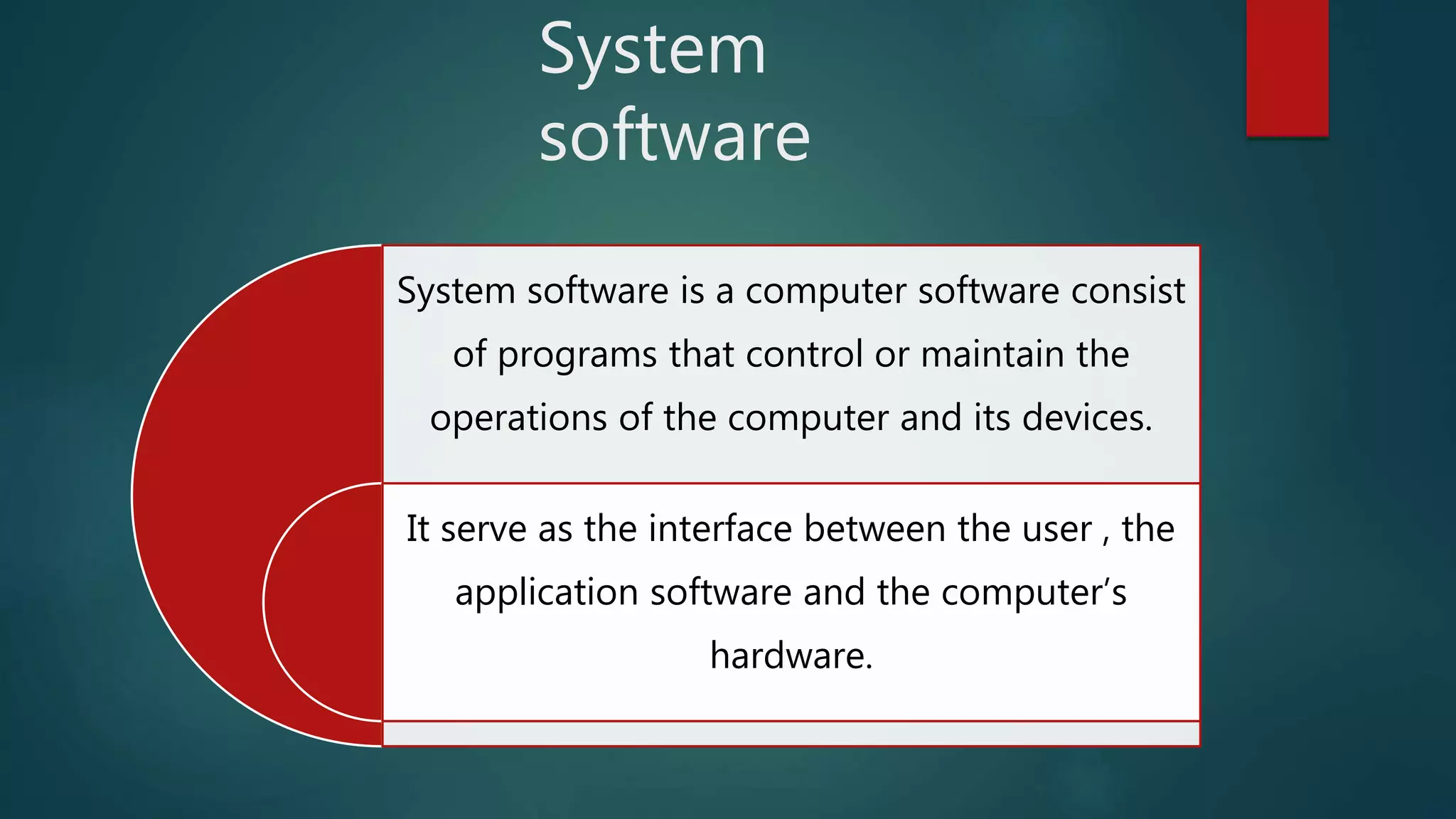
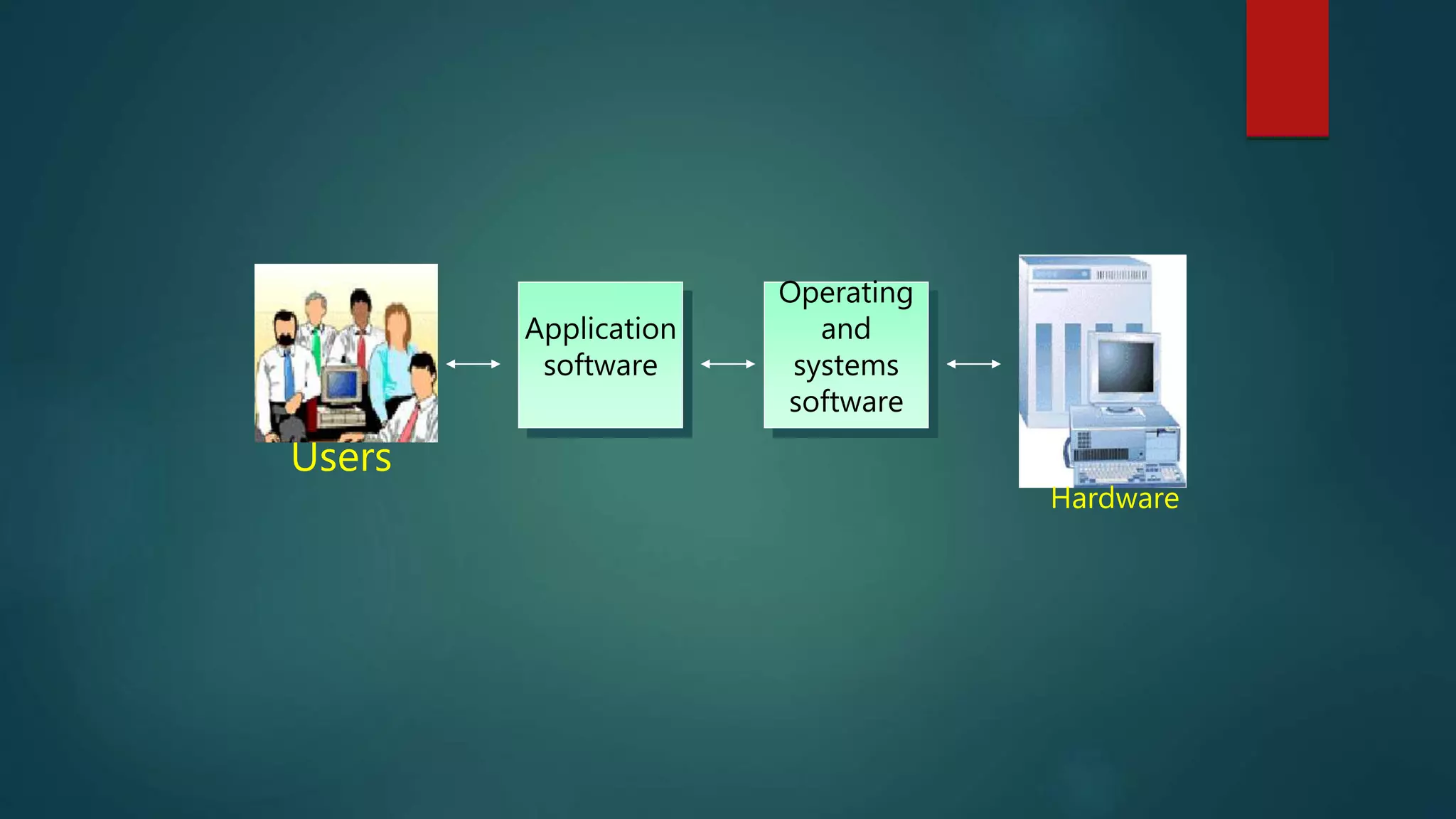
System software is a computer software consist
of programs that control or maintain the
operations of the computer and its devices.
It serve as the interface between the user , the
application software and the computer’s
hardware.
Users
Application
software
Operating
and
systems
software
Hardware
The Role of System Software
9
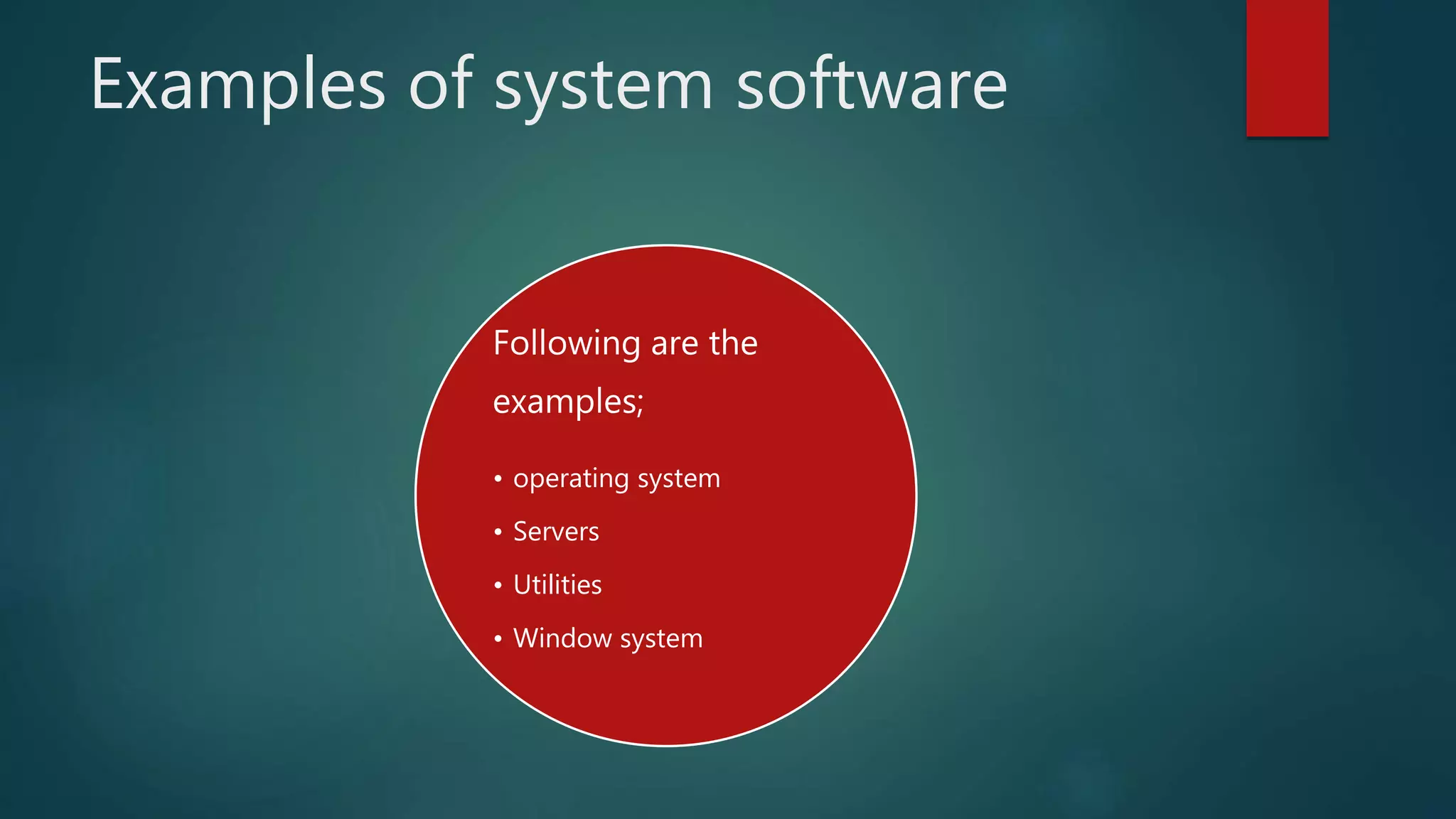
Examples of system software
Following are the
examples;
• operating system
• Servers
• Utilities
• Window system
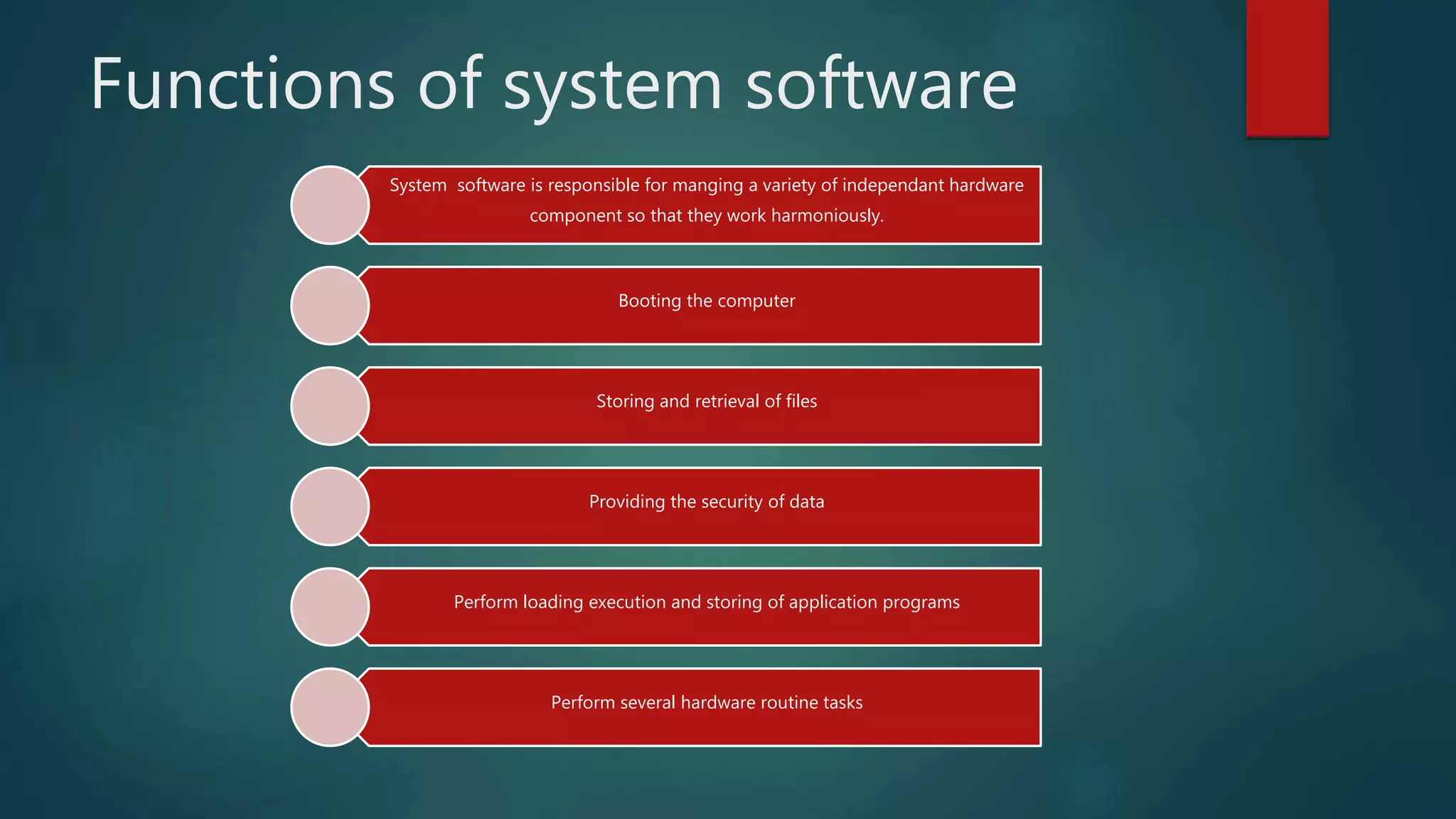
Functions of system software
System software is responsible for manging a variety of independant hardware
component so that they work harmoniously.
Booting the computer
Storing and retrieval of files
Providing the security of data
Perform loading execution and storing of application programs
Perform several hardware routine tasks
Types of system software
There are five types of system software all
designed to control and coordinate the
procedure and functions of computer
hardware.they also enable functional interaction
between hardware software and user.
Following are the types of system software;
operating system;
harnesses
communication
between hardware
system programs and
other application.
Device driver;
inable device
communication
with os and
other programs.
Firmware; inable device
control and
identification.
Translator;
translate high
level languages
to low level
machine codes.
Utility; ensure optimum
functionality of devices
and application.
1. Operating system
The operating system is a type of system software kernel that sits between computer
hardware and end user.
It is installed first on a computer to allow devices and application to be identified and
therefore functional.
System software is the first layer of software to be loaded into memory every time a
computer is powered up.
It provides mean for user to communicate with computer and other software.
Examples of operating system
Microsoft windows Mac op Linux op Apple’s op
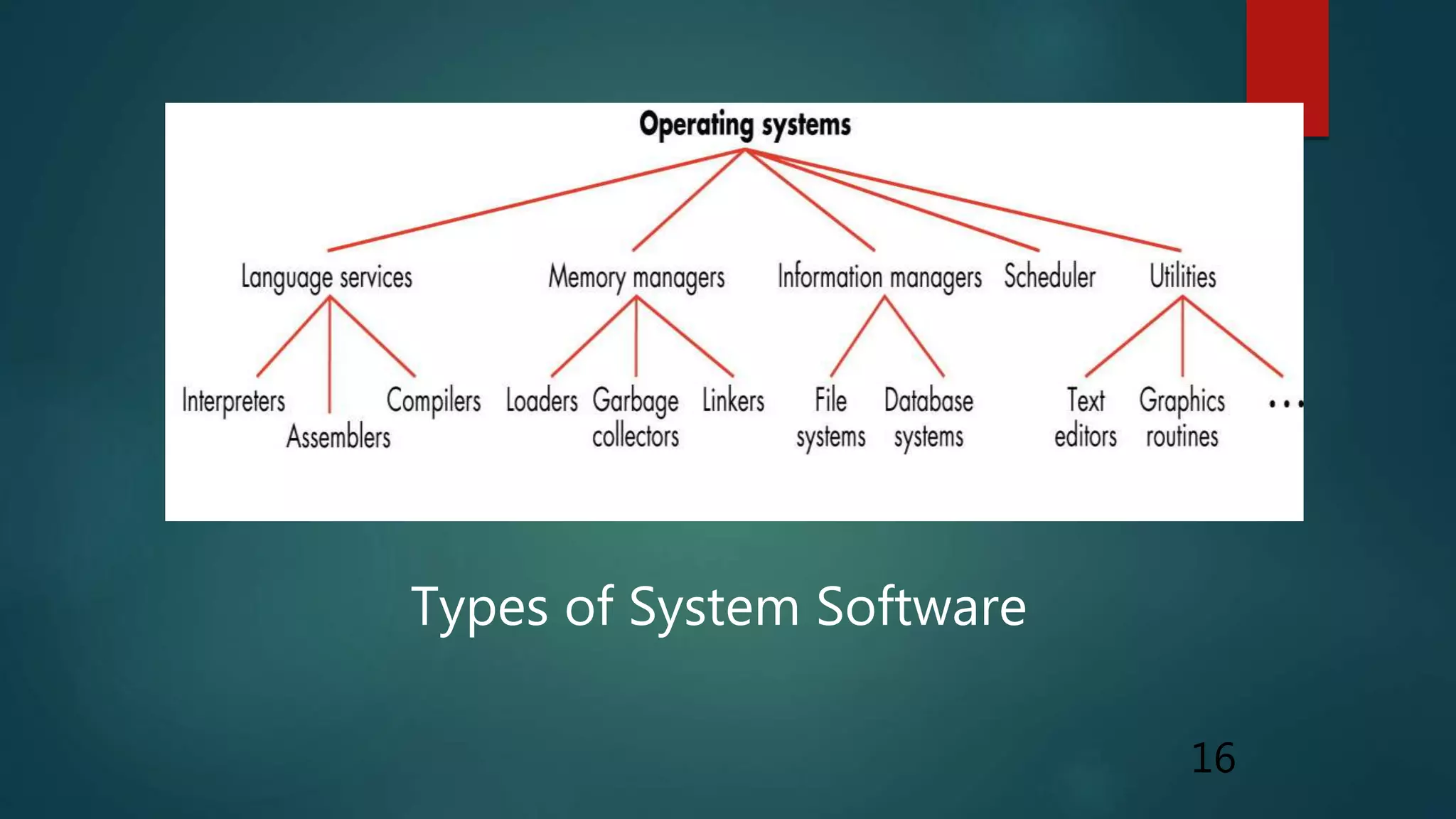
Types of System Software
16
System software and the OS
Application Software
Application Programming Interface
Other System Software
Operating System Interface
Operating System
Software - Hardware Interface
Hardware
ResourceAbstraction
Resource
Sharing
Programs
and other
software
Program 1 (a few pages)
Program 2 (a few pages)
Program 3 (a few pages)
Program 4 (a few pages)
Program 5 (a few pages)
Program 6 (a few pages)
Other memory requirements
Operating
system and
system
software
Memory Disk
Functions of operating system
They provide interface between the user and hardware through gui.
Manages and allocates memory space for applications
Starting and shutting down a computer
Manages input and out put devices
Process the management of application and input output devices and instructioins
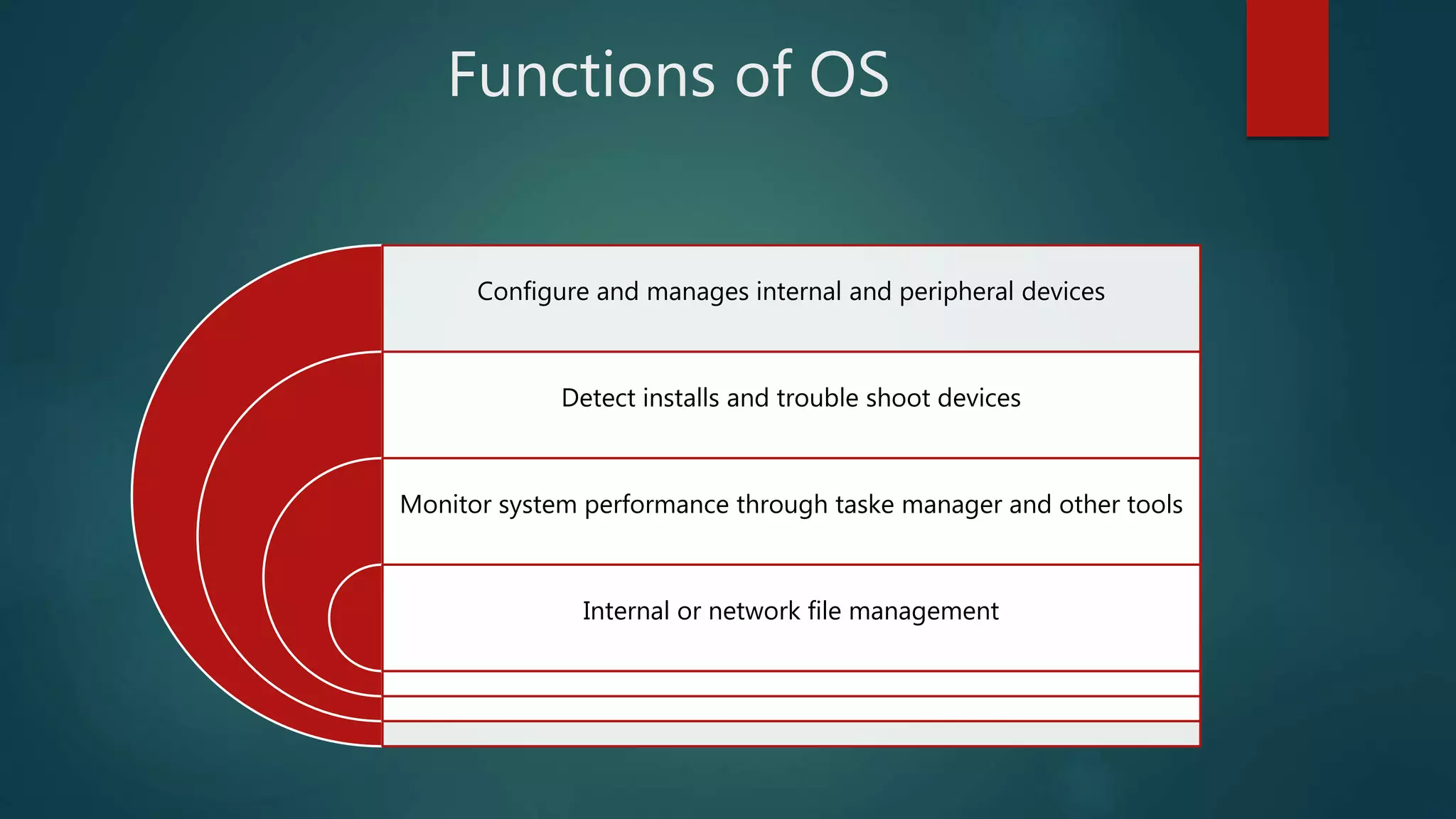
Functions of OS
Configure and manages internal and peripheral devices
Detect installs and trouble shoot devices
Monitor system performance through taske manager and other tools
Internal or network file management
Types of operating system
Real time operating system
Single user and single task operating system
Singla user and multitask os
Multi user os
Network os
Mobile os
2. Device
drivers
Driver software is a type of
software which bring computer
devices and peripheral to life
Deriver make it possible for all
connected components and
external add-ons performs their
intended tasks and as directed
by the os .
Without drivers the os would not
assign any duties .
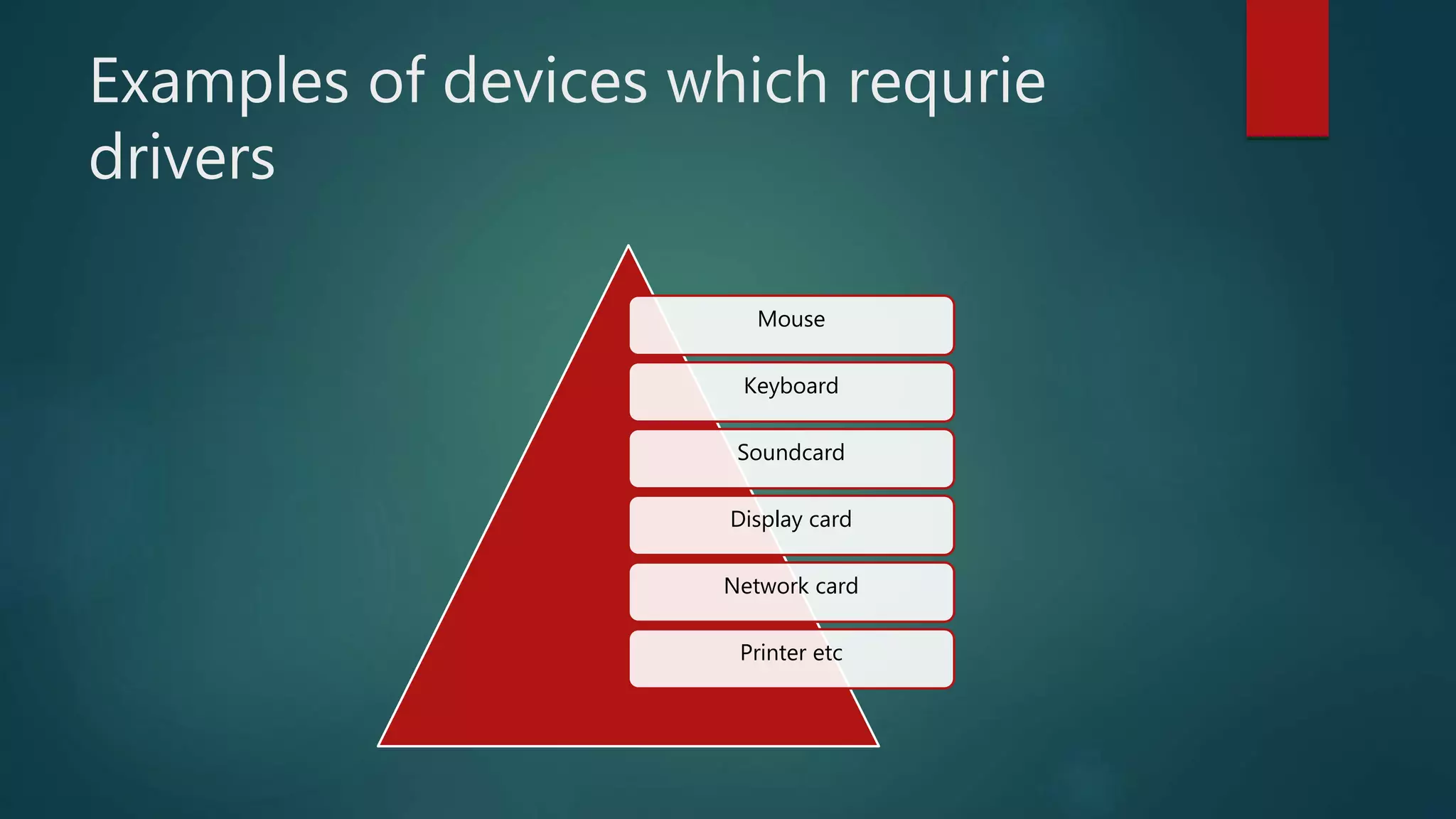
Examples of devices which requrie
drivers
Mouse
Keyboard
Soundcard
Display card
Network card
Printer etc
Devices drivers
By default input devices such as mouse and keyboard will
have their driver installed .
If a device is newer thenn the operating system the user may
have the download drivers from manufacture websites or
alternative sources
3. firmware
Firmware is the operational
software embedded within a
flash rom or eprom memory
chip for the os to ideentifyit.
It directly manages and
control all activities of any
single hardware .
Triditionary firmware used to
mean fixed software as
denoted by the word firm .
Today firmware is stored in
flash chips which can be
upgraded without swapping
semiconductor chips.
BIOS and UEFI
The most important firmware in
computer today is installed by
the manufacturer on the
motherboard and can be
accessed through the old bios
(basic input output system)or
the new uefi(unified extended
firmware interface )platforms.
It is the configuration interface which
load first when the computer is
power up and is going through post.
4. Programming language translators
These are intermediate
programs relied on by
software programers to
translate high level
language source code to
machine language code .
The former is a collection
of programming
languages that are easy for
humans to comprehend
and code .
The later is a
complex code only
understand by
processor.
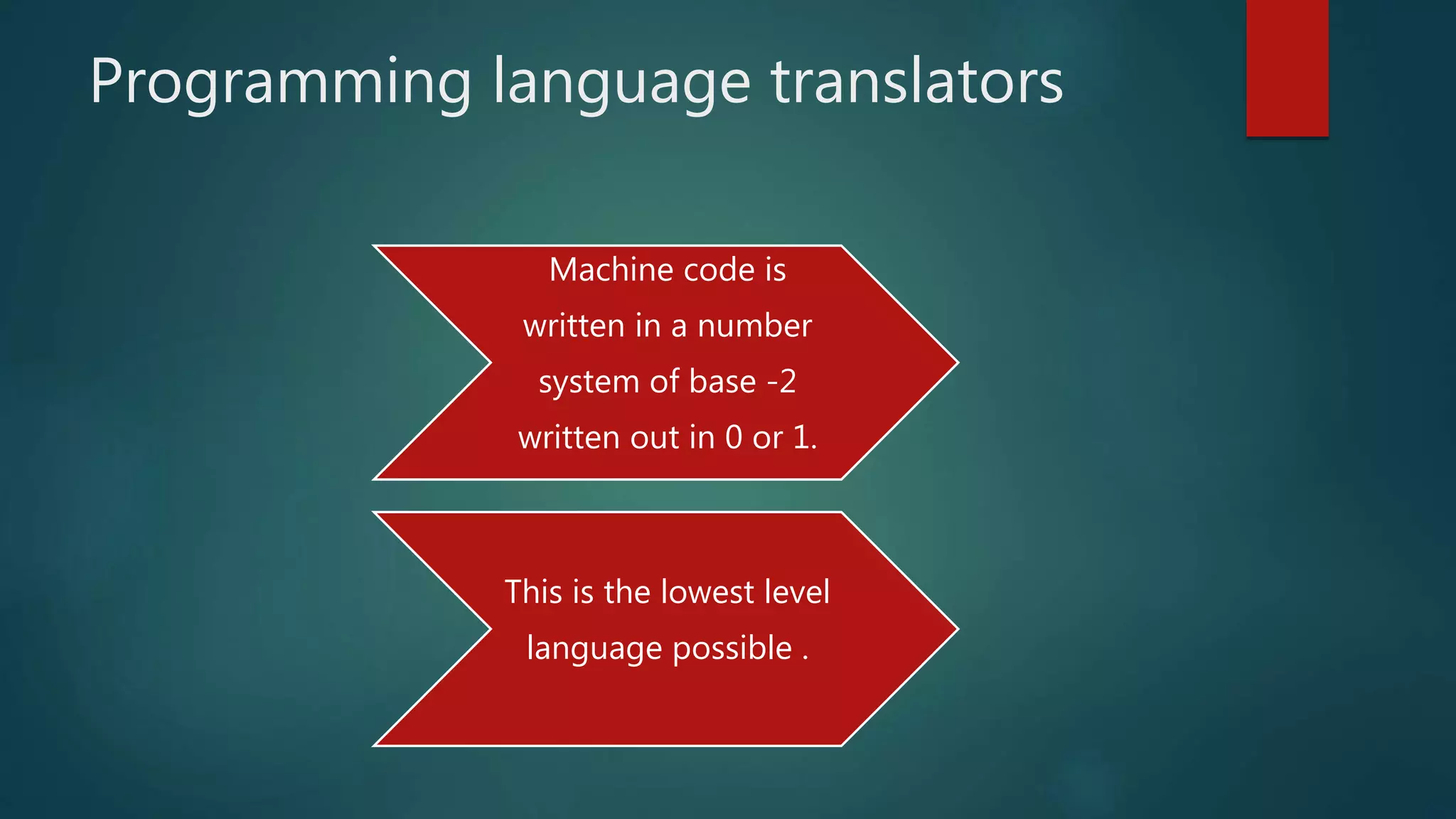
Programming language translators
Machine code is
written in a number
system of base -2
written out in 0 or 1.
This is the lowest level
language possible .
Tasks perform by translators
Identify syntax errors
during translation thus
allowing changes to be
made to the code .
Provide diagnostic
reports whenever the
code rules are not
followed .
Allocate data storage
for the program.
List both source code
and program details.
5. Utilities
Utilities are type of
system software which
sites between system and
application software .
These are programs
intendded for diagnostic
and maintenance tasks
for the computer.
They come in handy to
ensure the computer
functions optimally.
Their tasks vary from
crucial data security to
disk drive
defragmentation.
utilities
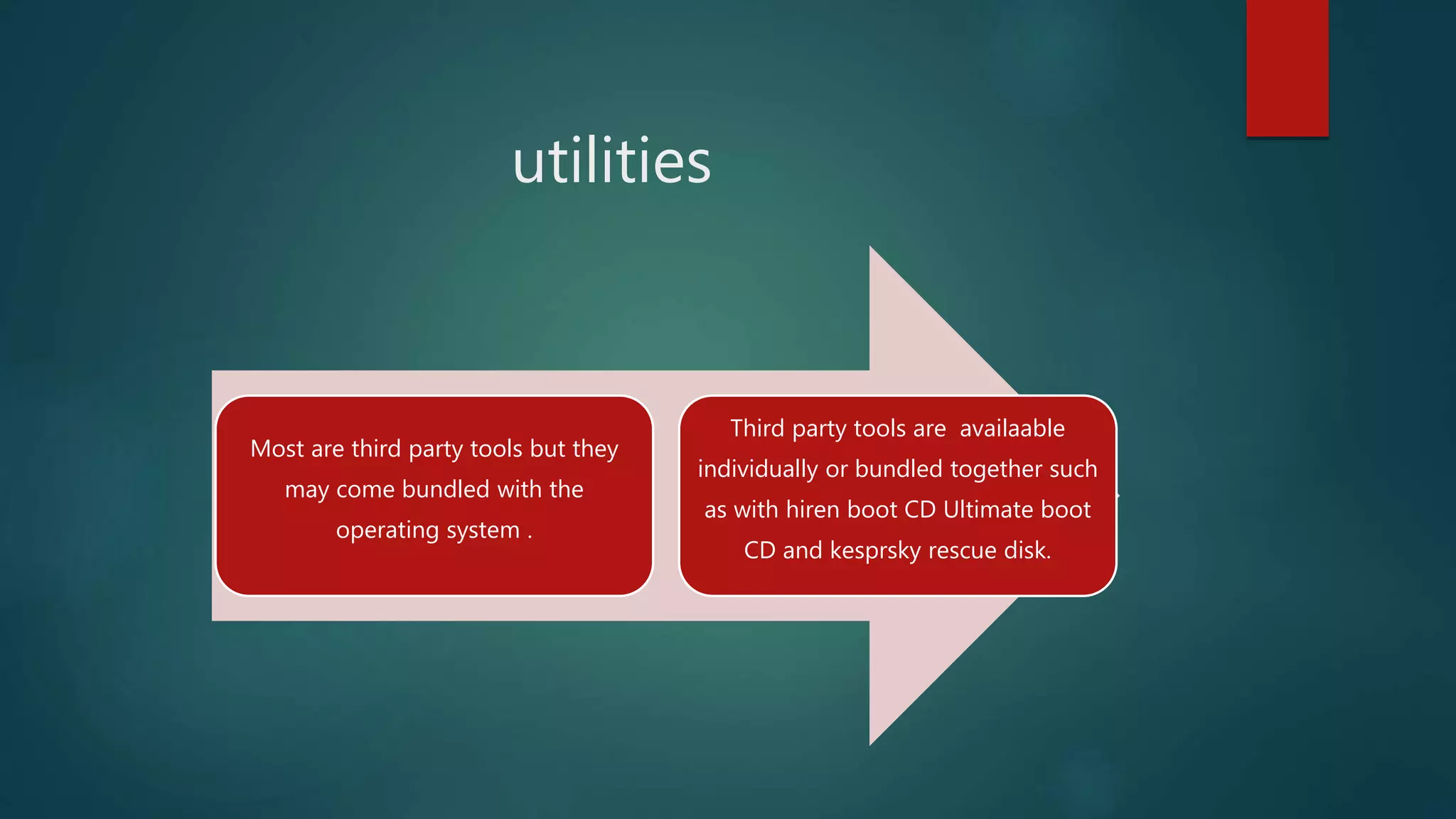
Most are third party tools but they
may come bundled with the
operating system .
Third party tools are availaable
individually or bundled together such
as with hiren boot CD Ultimate boot
CD and kesprsky rescue disk.
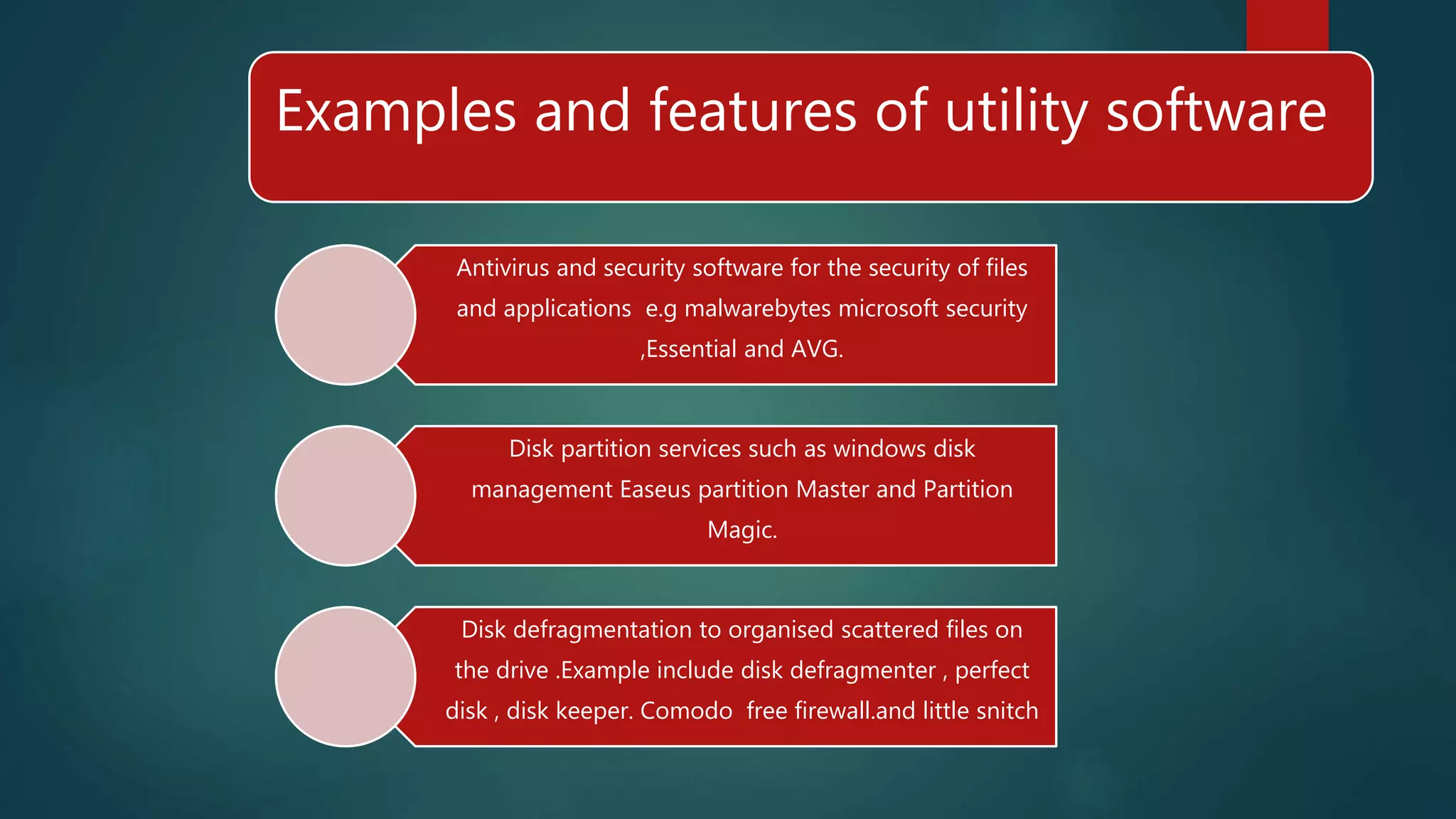
Examples and features of utility software
Antivirus and security software for the security of files
and applications e.g malwarebytes microsoft security
,Essential and AVG.
Disk partition services such as windows disk
management Easeus partition Master and Partition
Magic.
Disk defragmentation to organised scattered files on
the drive .Example include disk defragmenter , perfect
disk , disk keeper. Comodo free firewall.and little snitch
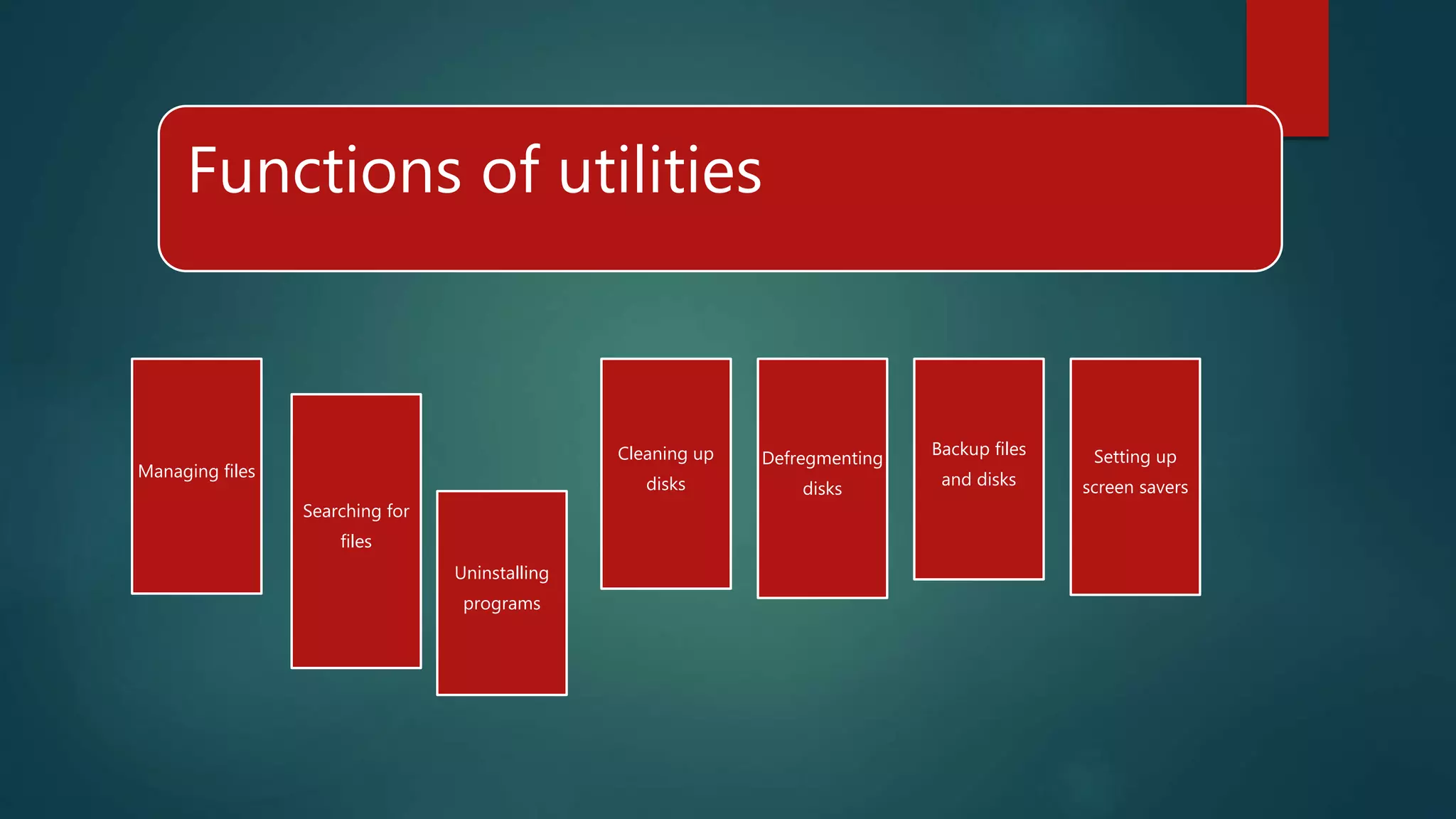
Functions of utilities
Managing files
Searching for
files
Uninstalling
programs
Cleaning up
disks
Defregmenting
disks
Backup files
and disks
Setting up
screen savers
Funnctions system software
The three major functions of
system software are ;
1.Allocating system resources
2.Monitoring system activities
3.And disk and file management
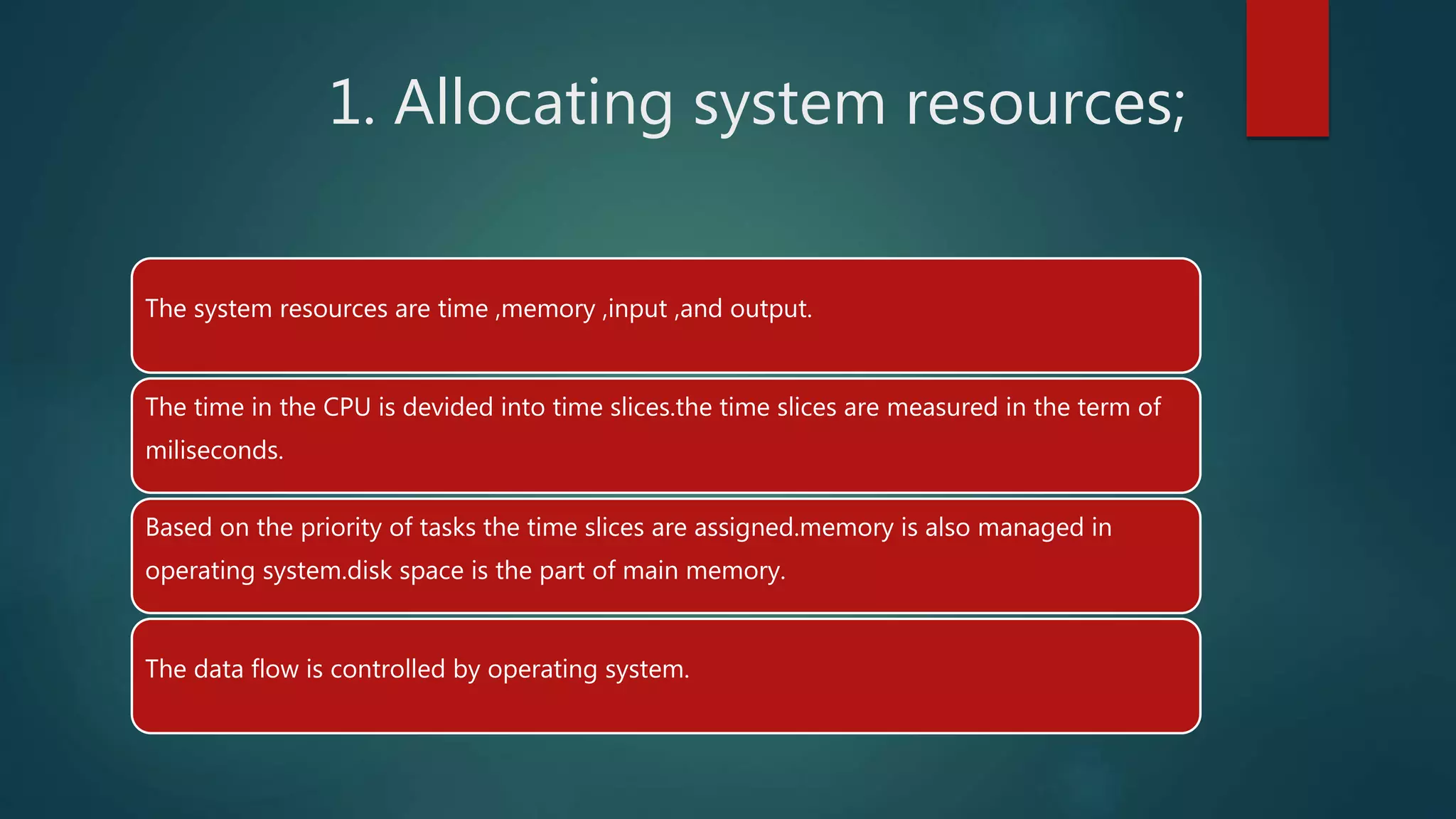
1. Allocating system resources;
The system resources are time ,memory ,input ,and output.
The time in the CPU is devided into time slices.the time slices are measured in the term of
miliseconds.
Based on the priority of tasks the time slices are assigned.memory is also managed in
operating system.disk space is the part of main memory.
The data flow is controlled by operating system.
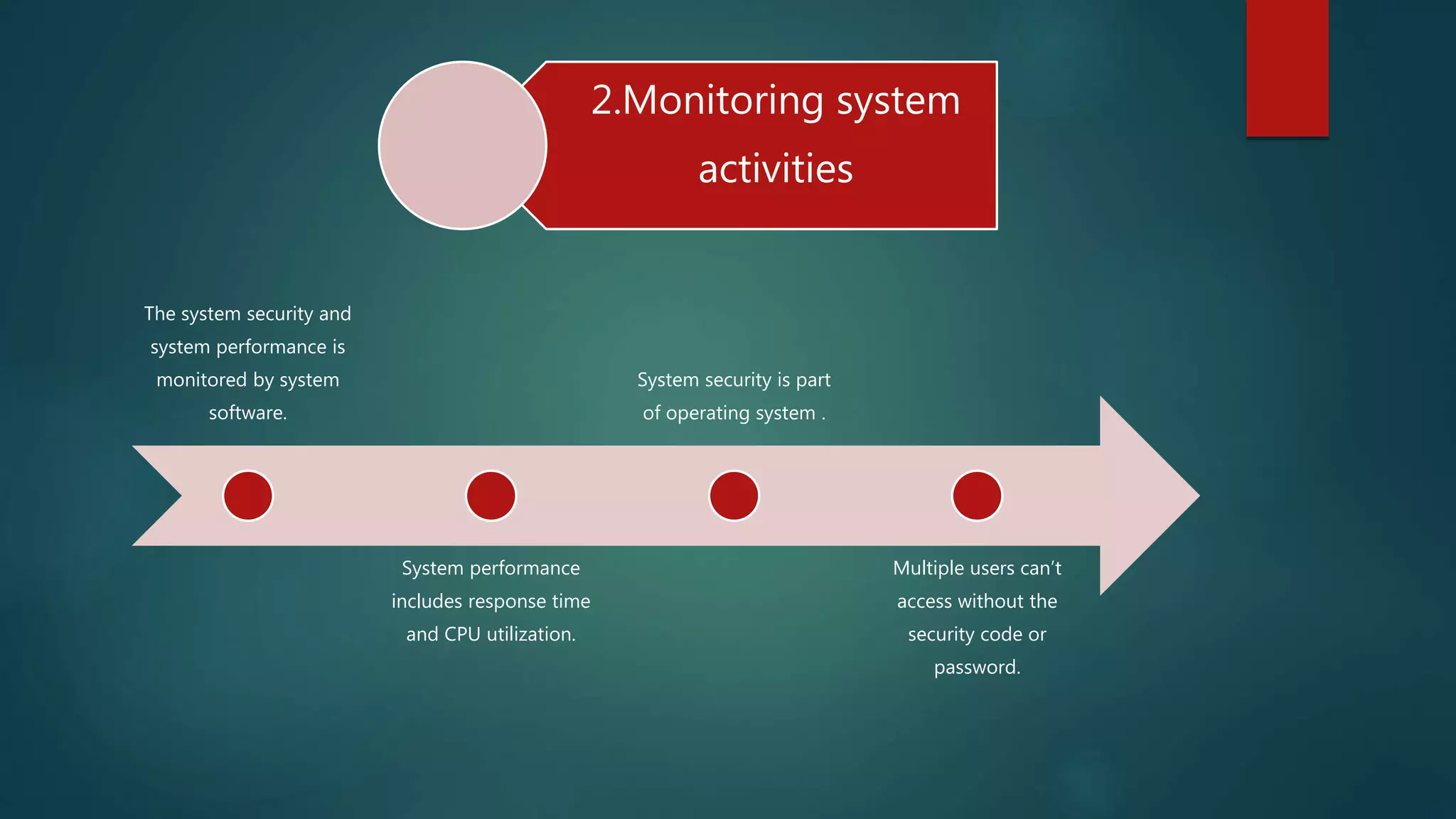
2.Monitoring system
activities
The system security and
system performance is
monitored by system
software.
System performance
includes response time
and CPU utilization.
System security is part
of operating system .
Multiple users can’t
access without the
security code or
password.
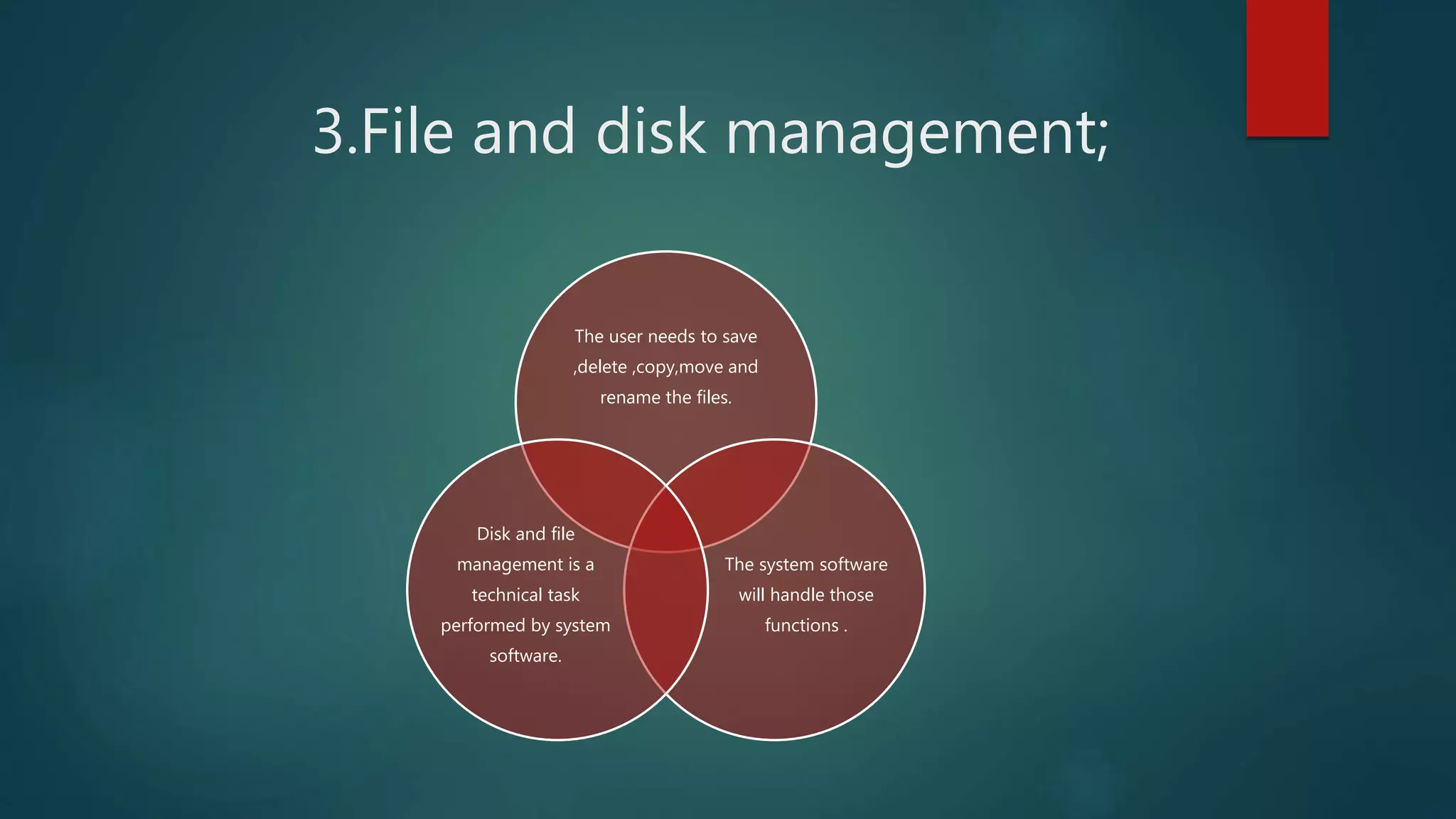
3.File and disk management;
The user needs to save
,delete ,copy,move and
rename the files.
The system software
will handle those
functions .
Disk and file
management is a
technical task
performed by system
software.
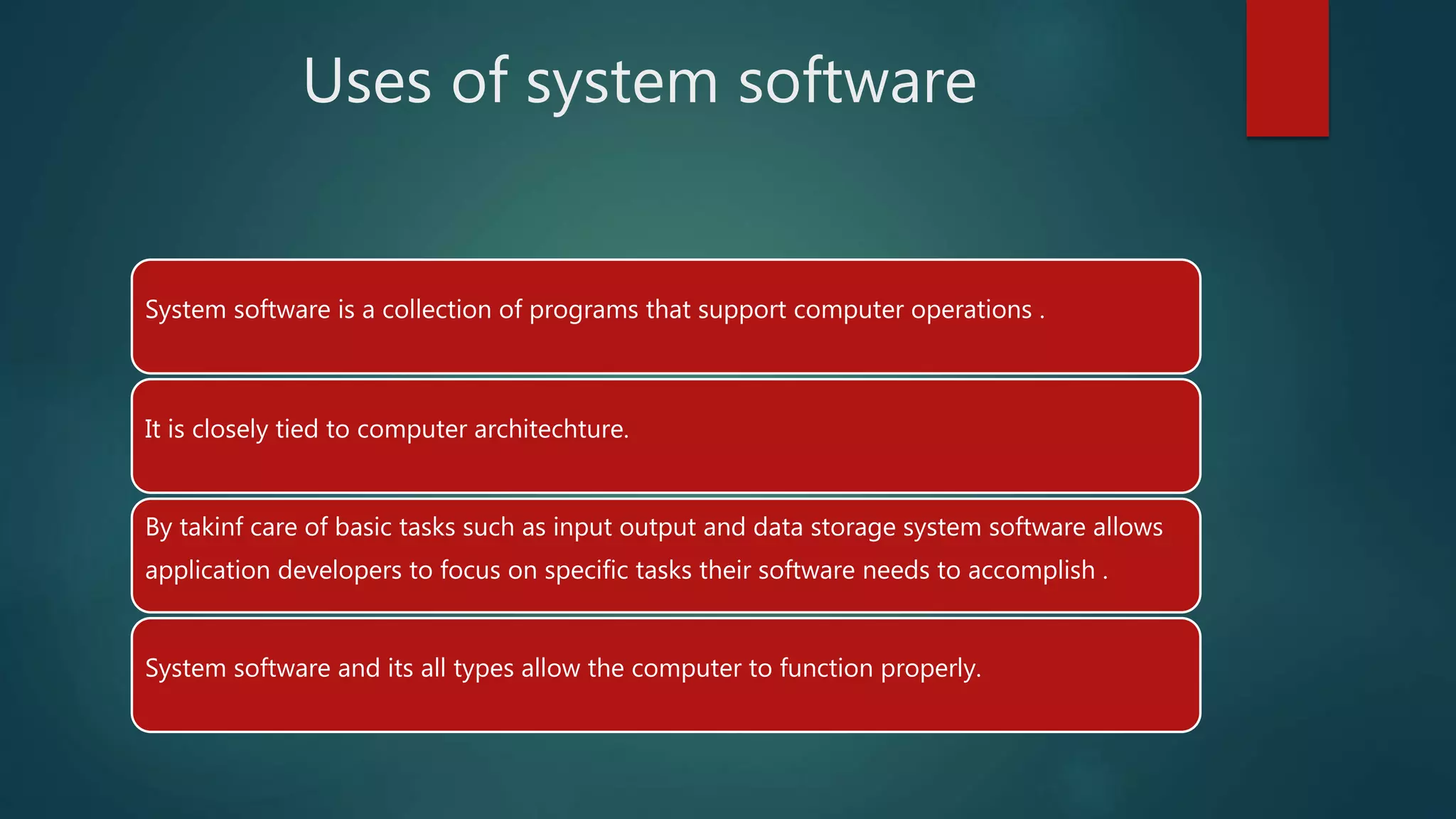
Uses of system software
System software is a collection of programs that support computer operations .
It is closely tied to computer architechture.
By takinf care of basic tasks such as input output and data storage system software allows
application developers to focus on specific tasks their software needs to accomplish .
System software and its all types allow the computer to function properly.
uses
You interact with software through its user interface .that is a user interface can control and
inter the data and instructions and how information displayed on the screen.
Two user interface graphical and command line .
System software is used to determine how user can interact with these interfaces.
System software is used to perform many important functions and without system software
it is impossible to accomplish that specific tasks.
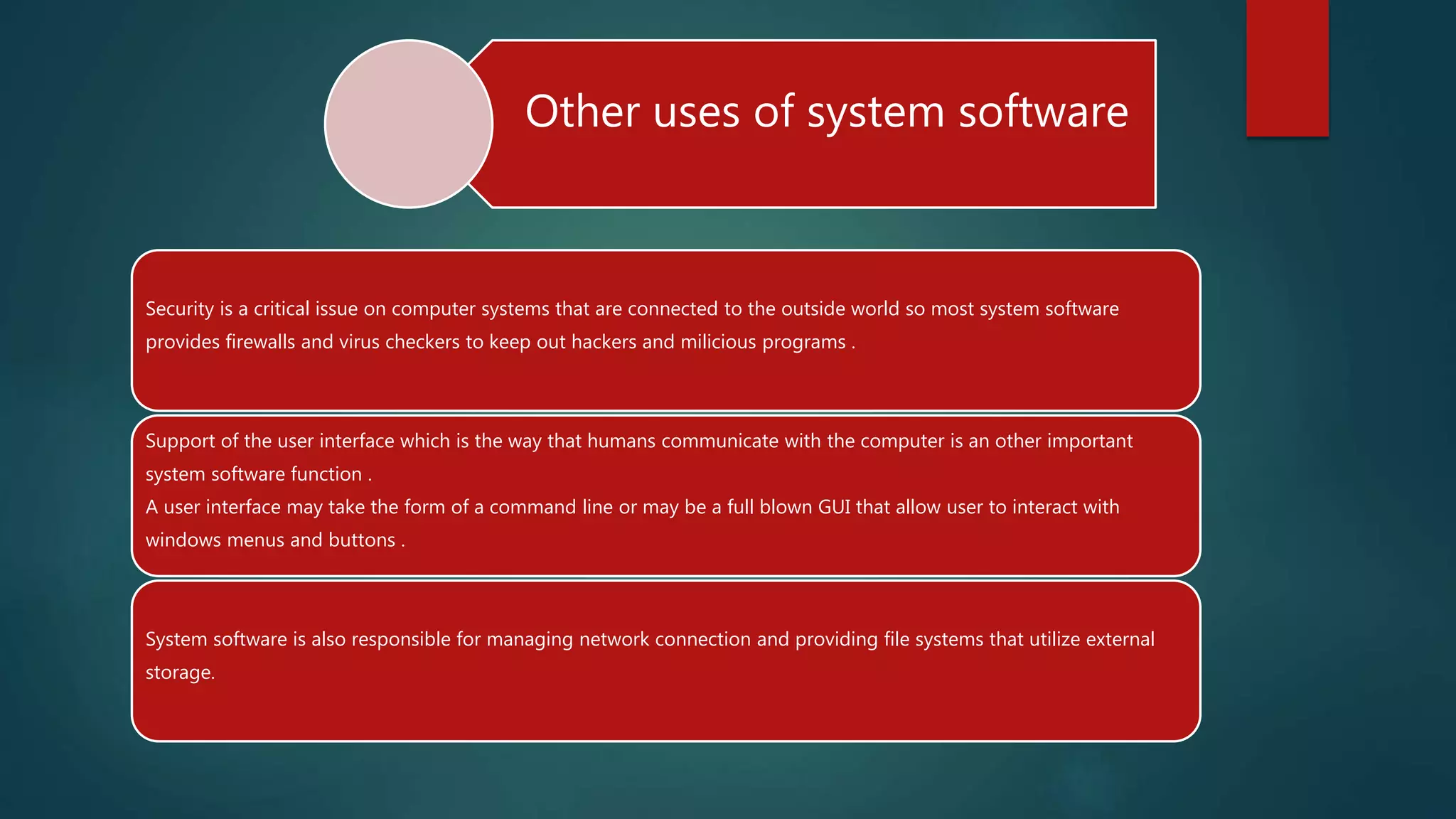
Other uses of system software
Security is a critical issue on computer systems that are connected to the outside world so most system software
provides firewalls and virus checkers to keep out hackers and milicious programs .
Support of the user interface which is the way that humans communicate with the computer is an other important
system software function .
A user interface may take the form of a command line or may be a full blown GUI that allow user to interact with
windows menus and buttons .
System software is also responsible for managing network connection and providing file systems that utilize external
storage.
Specific functions of different types of system software
1 . Operating system functions
•Starting and shutting down a
computer
booting is a process of
starting and restarting a
computer.when turning on
a computer you are
performing a cold boot .
A warm boot is a process
of using the operating
system to restart a
computer.
With windows we can
perform a warm boot by
clicking a menu command .
2. Managing programs
Some operating system and only
running a one program at a time
and some operating system
support thousands of users and
running multiple programs
A single user only run single
program and multiole user run
many programs at a time
In this way operating system can
effect directly your productivity
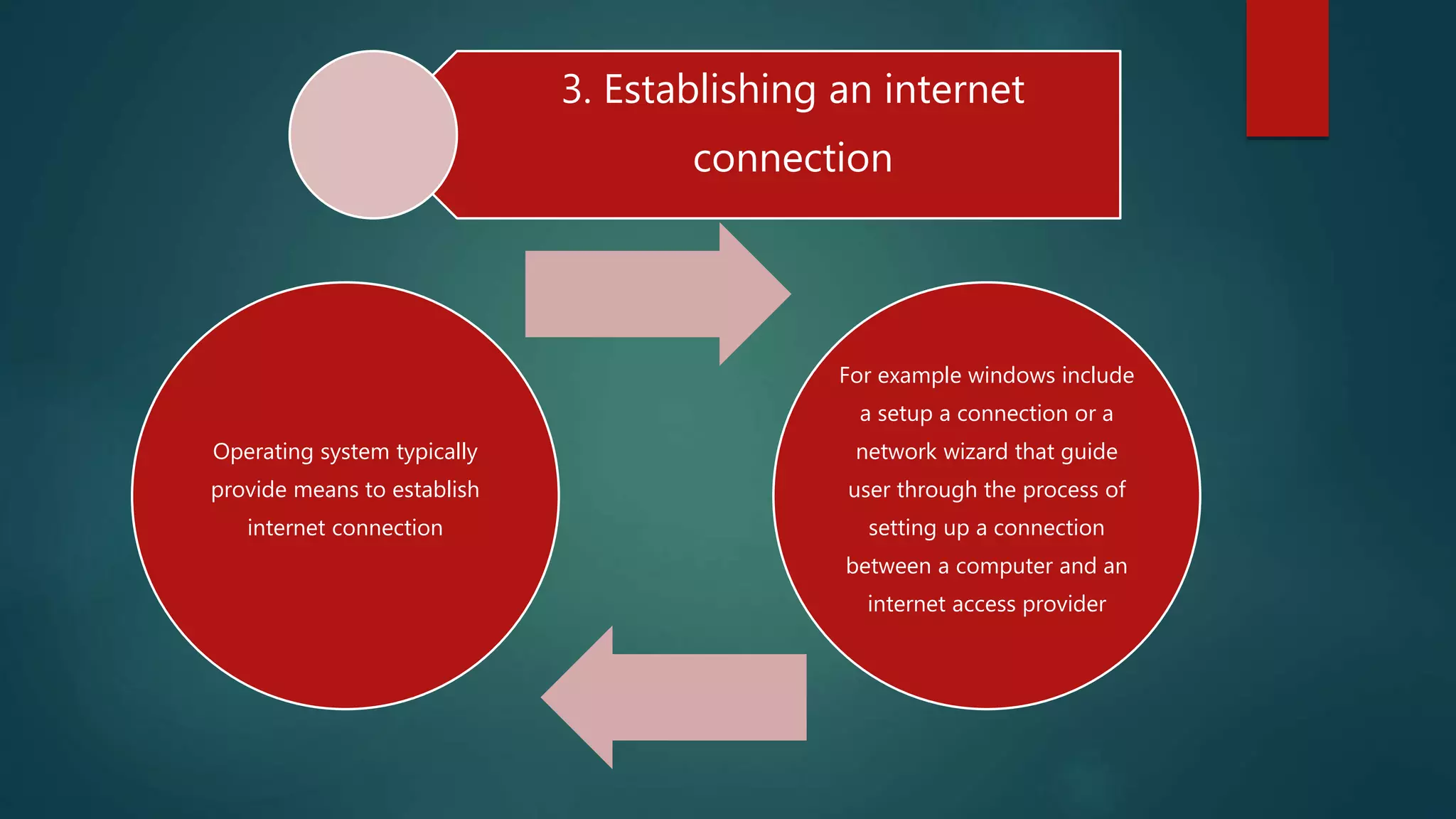
3. Establishing an internet
connection
Operating system typically
provide means to establish
internet connection
For example windows include
a setup a connection or a
network wizard that guide
user through the process of
setting up a connection
between a computer and an
internet access provider
Functions of device
driver
1. configuring devices
A driver is a small program that tyells
the computer how to configure a
device .
Each device on a computer such as
mouse the keyboard motherboard
has its own specialised set of
commands and thus require its own
special device in computer
The operating system loads each
device driver
2.Establishing an internet connection
Operating system typically provide an internet
connection for example window is a connection or
network wizard that perform the process of setting
up a connection through internet access provider .
Some operating system also include e-mail
program enabling you to communicate with
others as soon as you wanrt.
Utilities programs and its types
and their functions
1. backup and restore utilities
A backup utility allows user to copy or backup selected files or an
entire hard disks to another storage medium such as another hard
disks optical disc USB flash derive or tape
During the back up process the back up utility monitors progress and
alerts you if it needs additional media such as another disc.
2. Search utility
A search utility is a program that attempts to locate a file on your computerbased on criteria
you specif.
The criteria could be a word or words contain in a file date the file was created or modified ,
size of the file and location of the file ,file name auther name or other similar peoperties
search utilities can look through documents photos music and other files .
Operating system typically include a built in search utility
3. uninstaller
An uninstaller is a utility that remove a program as well as any associated interies in the system files.
When you install a program the operating system records the information its uses to run the software in the system files .
The uninstaller delete the files from the hard disk as well as remove program interies from system files .
4. image viewer
An image viewer is a utility that allow the user to display copy and print the contents of a graphic files .
With the image viewer the user can see the images without opening them in files .
Importance of
system software
The
system
software
has great
importan
ce
With the
help of
system
software
we can
With
system
software
we can
interact
directly
with the
other
parts of
computer
It help us
to
recoganiz
e the
different
We can
see
images
open files
easily
using
system
software
In
industries
it has
great
importan
runing by
using
different
software
such as
,applicati
on and
system
software
middlewa
re and
tools etc
Thank you
Q/A

System Software

  • 1.
    786 Introduction to informationand communication technology
  • 2.
    Main topic ofpresentation 1. System software
  • 3.
    Submitted to mamUMMUL-BANEEN submitted by group 5 Group members IQRA SARWAR AHMAD MUJTABA NAVEED HUSSAIN SABA UMAR SABA HANEEF MAIDA PERVISHA
  • 4.
    software Software is theset of instruction that tells computer what to do.
  • 5.
    Types of software Twotypes of software application software System software
  • 6.
    Application software Software thatallows users to do things like create text, documents, play games, listen to music or surf the web is called application software.
  • 7.
    System software System software isa computer software consist of programs that control or maintain the operations of the computer and its devices. It serve as the interface between the user , the application software and the computer’s hardware.
  • 8.
  • 9.
    The Role ofSystem Software 9
  • 10.
    Examples of systemsoftware Following are the examples; • operating system • Servers • Utilities • Window system
  • 11.
    Functions of systemsoftware System software is responsible for manging a variety of independant hardware component so that they work harmoniously. Booting the computer Storing and retrieval of files Providing the security of data Perform loading execution and storing of application programs Perform several hardware routine tasks
  • 12.
    Types of systemsoftware There are five types of system software all designed to control and coordinate the procedure and functions of computer hardware.they also enable functional interaction between hardware software and user.
  • 13.
    Following are thetypes of system software; operating system; harnesses communication between hardware system programs and other application. Device driver; inable device communication with os and other programs. Firmware; inable device control and identification. Translator; translate high level languages to low level machine codes. Utility; ensure optimum functionality of devices and application.
  • 14.
    1. Operating system Theoperating system is a type of system software kernel that sits between computer hardware and end user. It is installed first on a computer to allow devices and application to be identified and therefore functional. System software is the first layer of software to be loaded into memory every time a computer is powered up. It provides mean for user to communicate with computer and other software.
  • 15.
    Examples of operatingsystem Microsoft windows Mac op Linux op Apple’s op
  • 16.
    Types of SystemSoftware 16
  • 17.
    System software andthe OS Application Software Application Programming Interface Other System Software Operating System Interface Operating System Software - Hardware Interface Hardware ResourceAbstraction Resource Sharing
  • 18.
    Programs and other software Program 1(a few pages) Program 2 (a few pages) Program 3 (a few pages) Program 4 (a few pages) Program 5 (a few pages) Program 6 (a few pages) Other memory requirements Operating system and system software Memory Disk
  • 19.
    Functions of operatingsystem They provide interface between the user and hardware through gui. Manages and allocates memory space for applications Starting and shutting down a computer Manages input and out put devices Process the management of application and input output devices and instructioins
  • 20.
    Functions of OS Configureand manages internal and peripheral devices Detect installs and trouble shoot devices Monitor system performance through taske manager and other tools Internal or network file management
  • 21.
    Types of operatingsystem Real time operating system Single user and single task operating system Singla user and multitask os Multi user os Network os Mobile os
  • 22.
    2. Device drivers Driver softwareis a type of software which bring computer devices and peripheral to life Deriver make it possible for all connected components and external add-ons performs their intended tasks and as directed by the os . Without drivers the os would not assign any duties .
  • 23.
    Examples of deviceswhich requrie drivers Mouse Keyboard Soundcard Display card Network card Printer etc
  • 24.
    Devices drivers By defaultinput devices such as mouse and keyboard will have their driver installed . If a device is newer thenn the operating system the user may have the download drivers from manufacture websites or alternative sources
  • 25.
    3. firmware Firmware isthe operational software embedded within a flash rom or eprom memory chip for the os to ideentifyit. It directly manages and control all activities of any single hardware . Triditionary firmware used to mean fixed software as denoted by the word firm . Today firmware is stored in flash chips which can be upgraded without swapping semiconductor chips.
  • 26.
    BIOS and UEFI Themost important firmware in computer today is installed by the manufacturer on the motherboard and can be accessed through the old bios (basic input output system)or the new uefi(unified extended firmware interface )platforms. It is the configuration interface which load first when the computer is power up and is going through post.
  • 27.
    4. Programming languagetranslators These are intermediate programs relied on by software programers to translate high level language source code to machine language code . The former is a collection of programming languages that are easy for humans to comprehend and code . The later is a complex code only understand by processor.
  • 28.
    Programming language translators Machinecode is written in a number system of base -2 written out in 0 or 1. This is the lowest level language possible .
  • 29.
    Tasks perform bytranslators Identify syntax errors during translation thus allowing changes to be made to the code . Provide diagnostic reports whenever the code rules are not followed . Allocate data storage for the program. List both source code and program details.
  • 30.
    5. Utilities Utilities aretype of system software which sites between system and application software . These are programs intendded for diagnostic and maintenance tasks for the computer. They come in handy to ensure the computer functions optimally. Their tasks vary from crucial data security to disk drive defragmentation.
  • 31.
    utilities Most are thirdparty tools but they may come bundled with the operating system . Third party tools are availaable individually or bundled together such as with hiren boot CD Ultimate boot CD and kesprsky rescue disk.
  • 32.
    Examples and featuresof utility software Antivirus and security software for the security of files and applications e.g malwarebytes microsoft security ,Essential and AVG. Disk partition services such as windows disk management Easeus partition Master and Partition Magic. Disk defragmentation to organised scattered files on the drive .Example include disk defragmenter , perfect disk , disk keeper. Comodo free firewall.and little snitch
  • 33.
    Functions of utilities Managingfiles Searching for files Uninstalling programs Cleaning up disks Defregmenting disks Backup files and disks Setting up screen savers
  • 34.
    Funnctions system software Thethree major functions of system software are ; 1.Allocating system resources 2.Monitoring system activities 3.And disk and file management
  • 35.
    1. Allocating systemresources; The system resources are time ,memory ,input ,and output. The time in the CPU is devided into time slices.the time slices are measured in the term of miliseconds. Based on the priority of tasks the time slices are assigned.memory is also managed in operating system.disk space is the part of main memory. The data flow is controlled by operating system.
  • 36.
    2.Monitoring system activities The systemsecurity and system performance is monitored by system software. System performance includes response time and CPU utilization. System security is part of operating system . Multiple users can’t access without the security code or password.
  • 37.
    3.File and diskmanagement; The user needs to save ,delete ,copy,move and rename the files. The system software will handle those functions . Disk and file management is a technical task performed by system software.
  • 38.
    Uses of systemsoftware System software is a collection of programs that support computer operations . It is closely tied to computer architechture. By takinf care of basic tasks such as input output and data storage system software allows application developers to focus on specific tasks their software needs to accomplish . System software and its all types allow the computer to function properly.
  • 39.
    uses You interact withsoftware through its user interface .that is a user interface can control and inter the data and instructions and how information displayed on the screen. Two user interface graphical and command line . System software is used to determine how user can interact with these interfaces. System software is used to perform many important functions and without system software it is impossible to accomplish that specific tasks.
  • 40.
    Other uses ofsystem software Security is a critical issue on computer systems that are connected to the outside world so most system software provides firewalls and virus checkers to keep out hackers and milicious programs . Support of the user interface which is the way that humans communicate with the computer is an other important system software function . A user interface may take the form of a command line or may be a full blown GUI that allow user to interact with windows menus and buttons . System software is also responsible for managing network connection and providing file systems that utilize external storage.
  • 41.
    Specific functions ofdifferent types of system software 1 . Operating system functions •Starting and shutting down a computer booting is a process of starting and restarting a computer.when turning on a computer you are performing a cold boot . A warm boot is a process of using the operating system to restart a computer. With windows we can perform a warm boot by clicking a menu command .
  • 42.
    2. Managing programs Someoperating system and only running a one program at a time and some operating system support thousands of users and running multiple programs A single user only run single program and multiole user run many programs at a time In this way operating system can effect directly your productivity
  • 43.
    3. Establishing aninternet connection Operating system typically provide means to establish internet connection For example windows include a setup a connection or a network wizard that guide user through the process of setting up a connection between a computer and an internet access provider
  • 44.
    Functions of device driver 1.configuring devices A driver is a small program that tyells the computer how to configure a device . Each device on a computer such as mouse the keyboard motherboard has its own specialised set of commands and thus require its own special device in computer The operating system loads each device driver
  • 45.
    2.Establishing an internetconnection Operating system typically provide an internet connection for example window is a connection or network wizard that perform the process of setting up a connection through internet access provider . Some operating system also include e-mail program enabling you to communicate with others as soon as you wanrt.
  • 46.
    Utilities programs andits types and their functions 1. backup and restore utilities A backup utility allows user to copy or backup selected files or an entire hard disks to another storage medium such as another hard disks optical disc USB flash derive or tape During the back up process the back up utility monitors progress and alerts you if it needs additional media such as another disc.
  • 47.
    2. Search utility Asearch utility is a program that attempts to locate a file on your computerbased on criteria you specif. The criteria could be a word or words contain in a file date the file was created or modified , size of the file and location of the file ,file name auther name or other similar peoperties search utilities can look through documents photos music and other files . Operating system typically include a built in search utility
  • 48.
    3. uninstaller An uninstalleris a utility that remove a program as well as any associated interies in the system files. When you install a program the operating system records the information its uses to run the software in the system files . The uninstaller delete the files from the hard disk as well as remove program interies from system files . 4. image viewer An image viewer is a utility that allow the user to display copy and print the contents of a graphic files . With the image viewer the user can see the images without opening them in files .
  • 49.
    Importance of system software The system software hasgreat importan ce With the help of system software we can With system software we can interact directly with the other parts of computer It help us to recoganiz e the different We can see images open files easily using system software In industries it has great importan runing by using different software such as ,applicati on and system software middlewa re and tools etc
  • 50.