Building A Metric
Management
An alternative to Balanced Scorecard

ARRIFFIN MANSOR
Introduction
 Metric management provide a framework
  for management measurements and
  targets.
 Strategies are defined in metric terms for
  proper communication and execution.
 When asked about strategy, managers
  reach for their metric charts and maps.


                                                      2
                                               04/01/12
Agenda
 This slide presentation will outline the
  major steps for building a metric
  management plans.
 How you execute these steps will depend
  upon many factors: Company culture,
  tolerance for change, leadership, etc.
 However, please try to follow the same
  sequence, focusing on the strategic maps.

                                                     3
                                              04/01/12
Overview
 Metrics are used in management from
  planning to controls
 Link these metrics into strategic maps
 Throughout the process, we will refer back
  to these maps, making sure everything is
  linked. This is very important since we
  want to capture a “cause and effect”
  relationship in building metrics.

                                                      4
                                               04/01/12
Why metric management?
 Improves how you communicate strategy
 Superimposes a discipline whereby you
  capture cause-effect; otherwise you create
  pockets of under-performance.
 Also forces you to think about strategic
  measurement as opposed to tactical or
  operating type measurements


                                                      5
                                               04/01/12
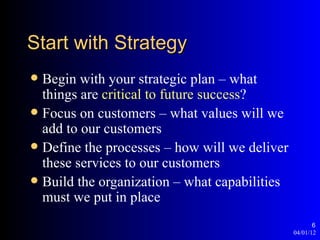
Start with Strategy
 Begin with your strategic plan – what
  things are critical to future success?
 Focus on customers – what values will we
  add to our customers
 Define the processes – how will we deliver
  these services to our customers
 Build the organization – what capabilities
  must we put in place
                                                      6
                                               04/01/12
Strategies
 Once we establish our first anchor (goals),
  we can develop a set of strategies.
 Strategies define what actions must be
  taken to reach the goals.
 Strategies are critical to future success. For
  example, in order to grow revenues, we
  must introduce new products and expand
  our market share.

                                                          7
                                                   04/01/12
Goals
 The first components of your strategy are
  goals.
 Goals establish direction in concrete terms.
 Goals anchor the rest of the process.
 Goals should fit with the vision and
  mission of the organization.


                                                        8
                                                 04/01/12
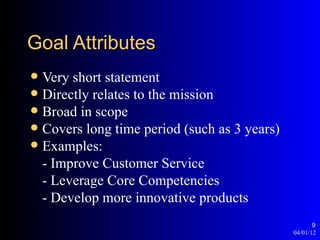
Goal Attributes
 Very short statement
 Directly relates to the mission
 Broad in scope
 Covers long time period (such as 3 years)
 Examples:
  - Improve Customer Service
  - Leverage Core Competencies
  - Develop more innovative products
                                                     9
                                              04/01/12
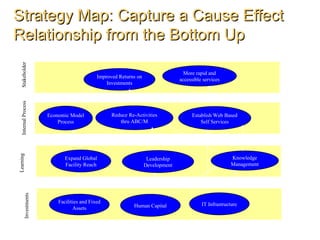
Strategy Map: Capture a Cause Effect
Relationship from the Bottom Up
 Stakeholder


                                                                                  More rapid and
                                            Improved Returns on
                                                                                accessible services
                                                Investments
 Internal Process


                      Economic Model              Reduce Re-Activities               Establish Web Based
                          Process                    thru ABC/M                          Self Services
& Growth
Learning


                             Expand Global                         Leadership                           Knowledge
                             Facility Reach                       Development                           Management
        Investments


                          Facilities and Fixed                                            IT Infrastructure
                                 Assets                    Human Capital
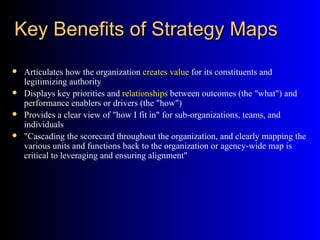
Key Benefits of Strategy Maps
   Articulates how the organization creates value for its constituents and
    legitimizing authority
   Displays key priorities and relationships between outcomes (the "what") and
    performance enablers or drivers (the "how")
   Provides a clear view of "how I fit in" for sub-organizations, teams, and
    individuals
   "Cascading the scorecard throughout the organization, and clearly mapping the
    various units and functions back to the organization or agency-wide map is
    critical to leveraging and ensuring alignment"
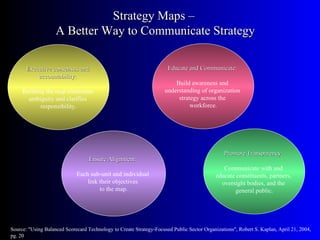
Strategy Maps –
                    A Better Way to Communicate Strategy

       Executive consensus and                                        Educate and Communicate:
           accountability:
                                                                         Build awareness and
     Building the map eliminates                                     understanding of organization
       ambiguity and clarifies                                            strategy across the
            responsibility.                                                    workforce.


                                                                                                Promote Transparency:
                                   Ensure Alignment:
                                                                                               Communicate with and
                             Each sub-unit and individual                                   educate constituents, partners,
                                 link their objectives                                        oversight bodies, and the
                                      to the map.                                                   general public.


Source: "Using Balanced Scorecard Technology to Create Strategy-Focused Public Sector Organizations", Robert S. Kaplan, April 21, 2004,
pg. 20
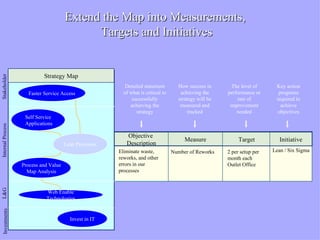
Extend the Map into Measurements,
                                             Targets and Initiatives


                            Strategy Map
Stakeholder


                                                           Detailed statement        How success in       The level of     Key action
                     Faster Service Access                of what is critical to      achieving the     performance or      programs
                                                              successfully           strategy will be       rate of        required to
                                                             achieving the            measured and       improvement         achieve
                                                                strategy                  tracked           needed         objectives
                    Self Service
                    Applications
Internal Process


                                                           Objective
                                                                                        Measure              Target          Initiative
                                       Lean Processes      Description
                                                        Eliminate waste,           Number of Reworks    2 per setup per   Lean / Six Sigma
                                                        reworks, and other                              month each
                   Process and Value                    errors in our                                   Outlet Office
                     Map Analysis                       processes
L&G


                             Web Enable
                             Technologies
  Investments


                                         Invest in IT
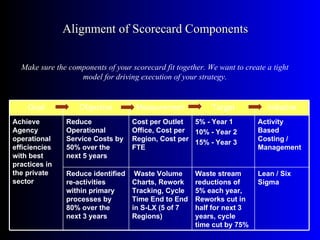
Alignment of Scorecard Components

  Make sure the components of your scorecard fit together. We want to create a tight
                   model for driving execution of your strategy.


    Goal           Objective         Measurement            Target           Initiative
Achieve        Reduce               Cost per Outlet  5% - Year 1          Activity
Agency         Operational          Office, Cost per 10% - Year 2         Based
operational    Service Costs by     Region, Cost per 15% - Year 3         Costing /
efficiencies   50% over the         FTE                                   Management
with best      next 5 years
practices in
the private    Reduce identified     Waste Volume      Waste stream       Lean / Six
sector         re-activities        Charts, Rework     reductions of      Sigma
               within primary       Tracking, Cycle    5% each year,
               processes by         Time End to End    Reworks cut in
               80% over the         in S-LX (5 of 7    half for next 3
               next 3 years         Regions)           years, cycle
                                                       time cut by 75%
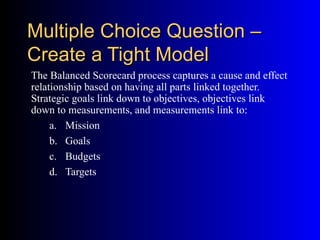
Multiple Choice Question –
Create a Tight Model
The Balanced Scorecard process captures a cause and effect
relationship based on having all parts linked together.
Strategic goals link down to objectives, objectives link
down to measurements, and measurements link to:
     a. Mission
     b. Goals
     c. Budgets
     d. Targets
Multiple Choice Question –
and the answer is . . .
d – Measurements should be linked to
   targets. We want a one-to-one relationship
   so that measurements are actionable to the
   Agency.
Key Result Areas
 A concentrated or focused minimum area
  of work that would give you the maximum
  intended outcome.
 A major component of the outcome
 A pareto activity that gives 20:80 outcome.
 The most sensitive inputs that give
  maximum outputs.

                                                     17
                                                04/01/12
Strategy Attributes
 Longer statement than goal statement
 More specific than goal statement
 Indirect relationship to mission
 Covers shorter time period than goal (such
  as 6 months or 1 year)
 Example:
  - We will expand call center services to
  include technical support
                                                    18
                                               04/01/12
Programs (initiatives)
 Based on the goals, three to five programs
  should emerge.
 From these programs, we will develop a
  strategic map.
 Four common programs are: Operating
  Efficiencies, Customer Relations, Product
  Innovation, and Growing the Business.


                                                    19
                                               04/01/12
Strategic Model
 Strategic Models can emerge from four
  principles:
1. Translate strategies into operating terms.
2. Link strategies throughout the entire
  organization.
3. Commit everyone to implementing
  strategy.
4. Make strategizing a continuous process of
  learning and adjusting to change.
                                                     20
                                                04/01/12
Four Perspectives
Before we build strategic maps, we need to define
  four perspectives:
 Financial: Top layer in the map, represents
  financial outcomes (profits, revenues, etc.)
 Customer: Next layer down, enables financial
  results (service, image, price, quality, etc.)
 Internal Processes: The values added to
  customers, such as delivery, production,
  distribution, etc.
 Learning & Growth: The people, systems, and
  organization that enable processes.

                                                         21
                                                    04/01/12
Before we can map your
strategy . . .
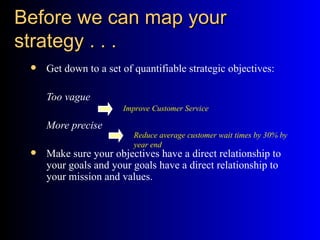
    Get down to a set of quantifiable strategic objectives:

     Too vague
                       Improve Customer Service

     More precise
                          Reduce average customer wait times by 30% by
                          year end
    Make sure your objectives have a direct relationship to
     your goals and your goals have a direct relationship to
     your mission and values.
Strategic Mapping
 Strategic Maps are the foundation of the
  Balanced Scorecard.
 You will need one strategic map for each
  programs (initiatives)
 Maps are constructed over four
  perspectives.
 Strategies are mapped over the four
  perspectives, linked together.
                                                  23
                                             04/01/12
Linking
 Strategies need to be placed in the
  Strategic Map according to which
  perspective fits with the objective.
 Objectives may cross over more than one
  perspective.
 We usually start at the top with outcomes
  and work our way down, looking at what
  enables (drives) the outcome.

                                                   24
                                              04/01/12
Approval
 Once you have completed the strategic
  maps, you will need to get approval from
  executive management. Does this map
  accurately tell the “story” of our strategy?
 If management disagrees with the map, go
  back and redo the maps. We need to get
  this step right since it represents the
  foundation for the entire scorecard.

                                                      25
                                                 04/01/12
Measurements
 For each you need one measurement.
  (KPI)
 Measurement provides us with feedback
  on meeting the strategic objective.
 Most organizations will use many of their
  existing measurements.
 Organizations requiring major change
  should include driver type measurements.
                                                   26
                                              04/01/12
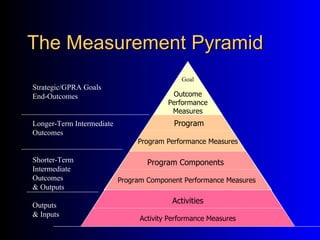
The Measurement Pyramid
                                             Goal
Strategic/GPRA Goals
End-Outcomes                              Outcome
                                         Performance
                                          Measures
Longer-Term Intermediate                   Program
Outcomes
                                Program Performance Measures

Shorter-Term                       Program Components
Intermediate
Outcomes                   Program Component Performance Measures
& Outputs
                                          Activities
Outputs
& Inputs
                                 Activity Performance Measures
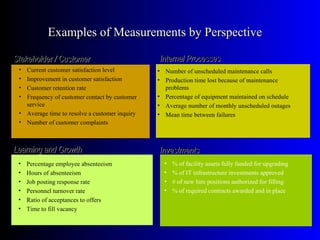
Examples of Measurements by Perspective

Stakeholder / Customer                          Internal Processes
 • Current customer satisfaction level          • Number of unscheduled maintenance calls
 • Improvement in customer satisfaction         • Production time lost because of maintenance
 • Customer retention rate                        problems
 • Frequency of customer contact by customer    • Percentage of equipment maintained on schedule
   service                                      • Average number of monthly unscheduled outages
 • Average time to resolve a customer inquiry   • Mean time between failures
 • Number of customer complaints


Learning and Growth                             Investments
 •   Percentage employee absenteeism              •   % of facility assets fully funded for upgrading
 •   Hours of absenteeism                         •   % of IT infrastructure investments approved
 •   Job posting response rate                    •   # of new hire positions authorized for filling
 •   Personnel turnover rate                      •   % of required contracts awarded and in place
 •   Ratio of acceptances to offers
 •   Time to fill vacancy
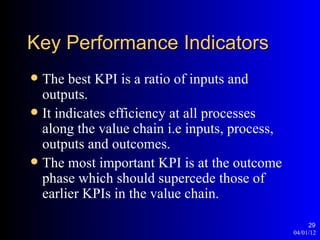
Key Performance Indicators
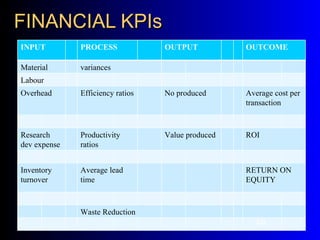
 The best KPI is a ratio of inputs and
  outputs.
 It indicates efficiency at all processes
  along the value chain i.e inputs, process,
  outputs and outcomes.
 The most important KPI is at the outcome
  phase which should supercede those of
  earlier KPIs in the value chain.

                                                    29
                                               04/01/12
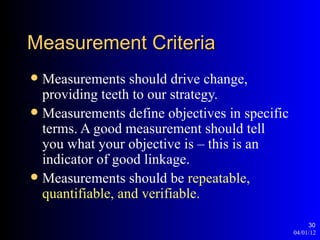
Measurement Criteria
 Measurements should drive change,
  providing teeth to our strategy.
 Measurements define objectives in specific
  terms. A good measurement should tell
  you what your objective is – this is an
  indicator of good linkage.
 Measurements should be repeatable,
  quantifiable, and verifiable.

                                                    30
                                               04/01/12
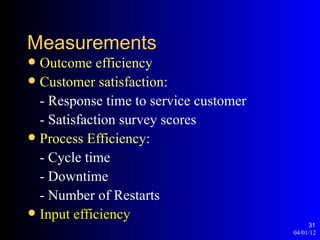
Measurements
 Outcome efficiency
 Customer satisfaction:
  - Response time to service customer
  - Satisfaction survey scores
 Process Efficiency:
  - Cycle time
  - Downtime
  - Number of Restarts
 Input efficiency
                                             31
                                        04/01/12
Lead and Lag Measurements
 Leading measurements are drivers behind
  performance and provide some
  predictability (forward looking)
 Lagging measurements are usually final
  outcomes that look back, such as customer
  satisfaction or return on investment
 Metrics should include both leading and
  lagging type measurements

                                                   32
                                              04/01/12
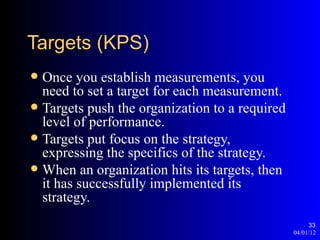
Targets (KPS)
 Once you establish measurements, you
  need to set a target for each measurement.
 Targets push the organization to a required
  level of performance.
 Targets put focus on the strategy,
  expressing the specifics of the strategy.
 When an organization hits its targets, then
  it has successfully implemented its
  strategy.
                                                     33
                                                04/01/12
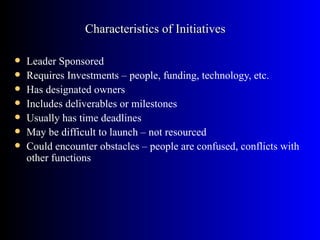
Characteristics of Initiatives

   Leader Sponsored
   Requires Investments – people, funding, technology, etc.
   Has designated owners
   Includes deliverables or milestones
   Usually has time deadlines
   May be difficult to launch – not resourced
   Could encounter obstacles – people are confused, conflicts with
    other functions
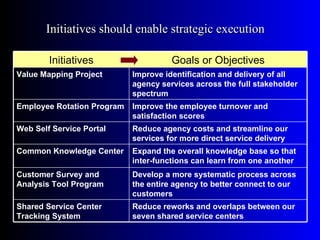
Initiatives should enable strategic execution

        Initiatives                   Goals or Objectives
Value Mapping Project       Improve identification and delivery of all
                            agency services across the full stakeholder
                            spectrum
Employee Rotation Program   Improve the employee turnover and
                            satisfaction scores
Web Self Service Portal     Reduce agency costs and streamline our
                            services for more direct service delivery
Common Knowledge Center     Expand the overall knowledge base so that
                            inter-functions can learn from one another
Customer Survey and         Develop a more systematic process across
Analysis Tool Program       the entire agency to better connect to our
                            customers
Shared Service Center       Reduce reworks and overlaps between our
Tracking System             seven shared service centers
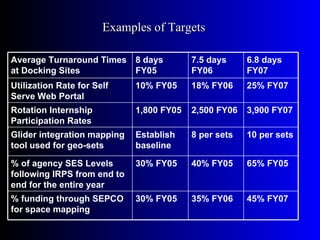
Examples of Targets

Average Turnaround Times 8 days           7.5 days     6.8 days
at Docking Sites         FY05             FY06         FY07
Utilization Rate for Self    10% FY05     18% FY06     25% FY07
Serve Web Portal
Rotation Internship          1,800 FY05   2,500 FY06   3,900 FY07
Participation Rates
Glider integration mapping   Establish    8 per sets   10 per sets
tool used for geo-sets       baseline

% of agency SES Levels       30% FY05     40% FY05     65% FY05
following IRPS from end to
end for the entire year
% funding through SEPCO      30% FY05     35% FY06     45% FY07
for space mapping
Examples of Targets
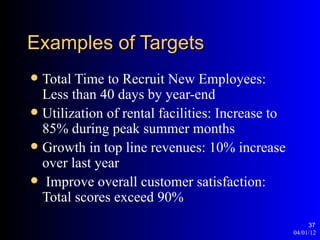
 Total Time to Recruit New Employees:
  Less than 40 days by year-end
 Utilization of rental facilities: Increase to
  85% during peak summer months
 Growth in top line revenues: 10% increase
  over last year
 Improve overall customer satisfaction:
  Total scores exceed 90%
                                                       37
                                                  04/01/12
Initiatives (programs)
 In order for things to happen in an
  organization, you must initiate major
  projects or programs. For example,
  improving customer service may require a
  new customer management system.
 Once you launch appropriate initiatives,
  you should be able to meet your
  objectives. This closes the loop, everything
  is now linked and away we go!

                                                      38
                                                 04/01/12
Initiative Attributes
 Sponsored by senior management
 Designated owners manage project(s)
 Includes deliverables or milestones
 Usually has some time deadlines
 Could be difficult to launch – lack of
  support, no funding, poorly defined, etc.


                                                   39
                                              04/01/12
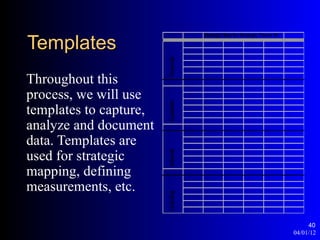
Templates
                                    Strategic Map for Strategic Theme #1:


                        Financial
Throughout this
process, we will use


                        Customer
templates to capture,
analyze and document
data. Templates are
used for strategic
mapping, defining       Internal


measurements, etc.
                        Learning


                                                                                 40
                                                                            04/01/12
Other Important Steps
 Metrics are built around three teams:
  Leadership Team (upper level
  management), Core Team (middle level
  management) and Measurement Team
  (lower level functional personnel).
 Metrics are built around at least four group
  meetings: Kick Off Meeting followed by at
  least one meeting for each of the three
  teams.
 Metrics are cascaded to the individual
  level at performance planning meeting               41
                                                 04/01/12
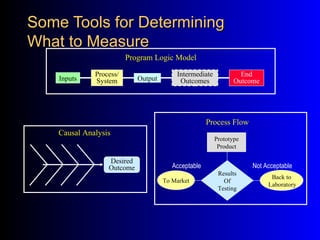
Some Tools for Determining
What to Measure
                         Program Logic Model

              Process/                   Intermediate            End
    Inputs    System        Output        Outcomes             Outcome


                                                     Process Flow
    Causal Analysis
                                                        Prototype
                                                         Product

                  Desired
                  Outcome               Acceptable                  Not Acceptable
                                                         Results
                                                                          Back to
                                     To Market             Of
                                                                         Laboratory
                                                         Testing
Implementation
 The minimum time for developing a
  metric management is three months.
 Full deployment of metrics throughout the
  entire organization can take more than one
  year.
 The best place to start building a metric
  managemnt is where all components of the
  value chain are in place: Customer,
  Innovation, Production, Delivery, Services,
  etc.
                                                     43
                                                04/01/12
Summary
 Metrics are the best framework of
  management today.
 It communicates strategies.
 A fully integrated approach: Goals,
  Objectives, Mapping, Measurements,
  Targets, and Initiatives.
 Metrics can be experimental, whereby you
  test your strategies, refine, and make
  changes as you get feedback and learn
  what works.
                                                  44
                                             04/01/12
Components of Metric
Management
 Goals and objectives definition
 Key result areas (Strategies) – cause effect
  relationship
 Strategic Programs (initiatives)
 Strategic Mapping
 Key Performance Indicators – lead and lag
  indicators
 Key Performance Standards &
  Benchmarkings                                       45
                                                 04/01/12
Installing corporate metrics
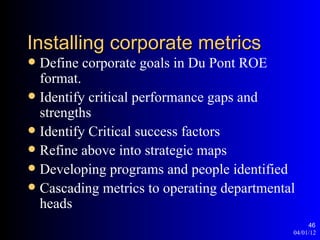
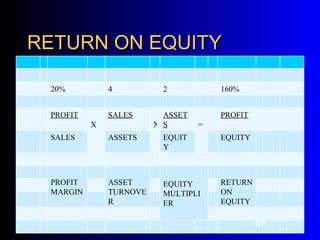
 Define corporate goals in Du Pont ROE
  format.
 Identify critical performance gaps and
  strengths
 Identify Critical success factors
 Refine above into strategic maps
 Developing programs and people identified
 Cascading metrics to operating departmental
  heads
                                                 46
                                            04/01/12
Performance improvement framework
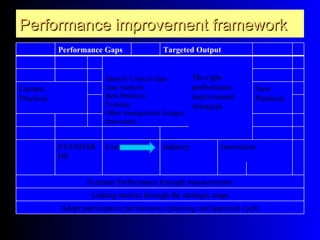
            Performance Gaps              Targeted Output


                         Identify Critical Gaps      The right
Current                  Gap Analysis                performance         New
Practices                Best Practices              improvement         Practices
                         Training                    strategies
                         Other management changes
                         Innovation


            STANDAR      Company          Industry          Innovation
            DS


                   Evaluate Performance through measurements
                     Linking metrics through the strategic maps
            Adopt participative performance planning and appraisal cycle
RETURN ON EQUITY

 20%          4           2           160%


 PROFIT       SALES       ASSET       PROFIT
          X             X S       =
 SALES        ASSETS      EQUIT       EQUITY
                          Y


 PROFIT       ASSET       EQUITY      RETURN
 MARGIN       TURNOVE     MULTIPLI    ON
              R           ER          EQUITY

                                               48
FINANCIAL KPIs
INPUT         PROCESS             OUTPUT           OUTCOME

Material      variances
Labour
Overhead      Efficiency ratios   No produced      Average cost per
                                                   transaction


Research      Productivity        Value produced   ROI
dev expense   ratios


Inventory     Average lead                         RETURN ON
turnover      time                                 EQUITY


              Waste Reduction
                                                     49
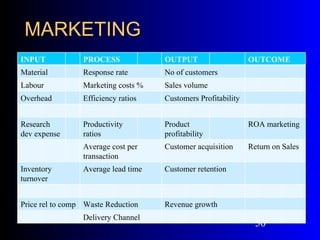
MARKETING
INPUT            PROCESS             OUTPUT                    OUTCOME
Material         Response rate       No of customers
Labour           Marketing costs %   Sales volume
Overhead         Efficiency ratios   Customers Profitability


Research         Productivity        Product                   ROA marketing
dev expense      ratios              profitability
                 Average cost per    Customer acquisition      Return on Sales
                 transaction
Inventory        Average lead time   Customer retention
turnover


Price rel to comp Waste Reduction    Revenue growth
                 Delivery Channel
                                                                 50
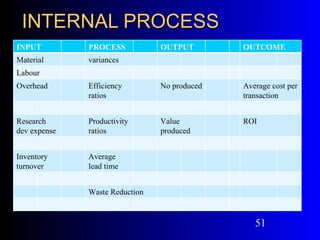
INTERNAL PROCESS
INPUT         PROCESS           OUTPUT        OUTCOME
Material      variances
Labour
Overhead      Efficiency        No produced   Average cost per
              ratios                          transaction


Research      Productivity      Value         ROI
dev expense   ratios            produced


Inventory     Average
turnover      lead time


              Waste Reduction


                                                 51
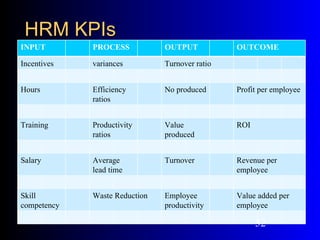
HRM KPIs
INPUT        PROCESS           OUTPUT           OUTCOME

Incentives   variances         Turnover ratio


Hours        Efficiency        No produced      Profit per employee
             ratios


Training     Productivity      Value            ROI
             ratios            produced


Salary       Average           Turnover         Revenue per
             lead time                          employee


Skill        Waste Reduction   Employee         Value added per
competency                     productivity     employee

                                                      52
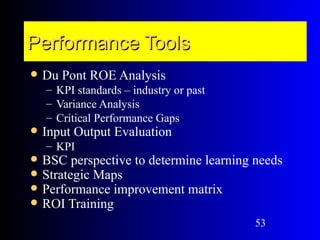
Performance Tools
   Du Pont ROE Analysis
    – KPI standards – industry or past
    – Variance Analysis
    – Critical Performance Gaps
   Input Output Evaluation
    – KPI
   BSC perspective to determine learning needs
   Strategic Maps
   Performance improvement matrix
   ROI Training
                                          53
Thank you
 QUESTION PLEASE


                        54
                   04/01/12

Building a Strategic Framework

  • 1.
    Building A Metric Management Analternative to Balanced Scorecard ARRIFFIN MANSOR
  • 2.
    Introduction  Metric managementprovide a framework for management measurements and targets.  Strategies are defined in metric terms for proper communication and execution.  When asked about strategy, managers reach for their metric charts and maps. 2 04/01/12
  • 3.
    Agenda  This slidepresentation will outline the major steps for building a metric management plans.  How you execute these steps will depend upon many factors: Company culture, tolerance for change, leadership, etc.  However, please try to follow the same sequence, focusing on the strategic maps. 3 04/01/12
  • 4.
    Overview  Metrics areused in management from planning to controls  Link these metrics into strategic maps  Throughout the process, we will refer back to these maps, making sure everything is linked. This is very important since we want to capture a “cause and effect” relationship in building metrics. 4 04/01/12
  • 5.
    Why metric management? Improves how you communicate strategy  Superimposes a discipline whereby you capture cause-effect; otherwise you create pockets of under-performance.  Also forces you to think about strategic measurement as opposed to tactical or operating type measurements 5 04/01/12
  • 6.
    Start with Strategy Begin with your strategic plan – what things are critical to future success?  Focus on customers – what values will we add to our customers  Define the processes – how will we deliver these services to our customers  Build the organization – what capabilities must we put in place 6 04/01/12
  • 7.
    Strategies  Once weestablish our first anchor (goals), we can develop a set of strategies.  Strategies define what actions must be taken to reach the goals.  Strategies are critical to future success. For example, in order to grow revenues, we must introduce new products and expand our market share. 7 04/01/12
  • 8.
    Goals  The firstcomponents of your strategy are goals.  Goals establish direction in concrete terms.  Goals anchor the rest of the process.  Goals should fit with the vision and mission of the organization. 8 04/01/12
  • 9.
    Goal Attributes  Veryshort statement  Directly relates to the mission  Broad in scope  Covers long time period (such as 3 years)  Examples: - Improve Customer Service - Leverage Core Competencies - Develop more innovative products 9 04/01/12
  • 10.
    Strategy Map: Capturea Cause Effect Relationship from the Bottom Up Stakeholder More rapid and Improved Returns on accessible services Investments Internal Process Economic Model Reduce Re-Activities Establish Web Based Process thru ABC/M Self Services & Growth Learning Expand Global Leadership Knowledge Facility Reach Development Management Investments Facilities and Fixed IT Infrastructure Assets Human Capital
  • 11.
    Key Benefits ofStrategy Maps  Articulates how the organization creates value for its constituents and legitimizing authority  Displays key priorities and relationships between outcomes (the "what") and performance enablers or drivers (the "how")  Provides a clear view of "how I fit in" for sub-organizations, teams, and individuals  "Cascading the scorecard throughout the organization, and clearly mapping the various units and functions back to the organization or agency-wide map is critical to leveraging and ensuring alignment"
  • 12.
    Strategy Maps – A Better Way to Communicate Strategy Executive consensus and Educate and Communicate: accountability: Build awareness and Building the map eliminates understanding of organization ambiguity and clarifies strategy across the responsibility. workforce. Promote Transparency: Ensure Alignment: Communicate with and Each sub-unit and individual educate constituents, partners, link their objectives oversight bodies, and the to the map. general public. Source: "Using Balanced Scorecard Technology to Create Strategy-Focused Public Sector Organizations", Robert S. Kaplan, April 21, 2004, pg. 20
  • 13.
    Extend the Mapinto Measurements, Targets and Initiatives Strategy Map Stakeholder Detailed statement How success in The level of Key action Faster Service Access of what is critical to achieving the performance or programs successfully strategy will be rate of required to achieving the measured and improvement achieve strategy tracked needed objectives Self Service Applications Internal Process Objective Measure Target Initiative Lean Processes Description Eliminate waste, Number of Reworks 2 per setup per Lean / Six Sigma reworks, and other month each Process and Value errors in our Outlet Office Map Analysis processes L&G Web Enable Technologies Investments Invest in IT
  • 14.
    Alignment of ScorecardComponents Make sure the components of your scorecard fit together. We want to create a tight model for driving execution of your strategy. Goal Objective Measurement Target Initiative Achieve Reduce Cost per Outlet 5% - Year 1 Activity Agency Operational Office, Cost per 10% - Year 2 Based operational Service Costs by Region, Cost per 15% - Year 3 Costing / efficiencies 50% over the FTE Management with best next 5 years practices in the private Reduce identified Waste Volume Waste stream Lean / Six sector re-activities Charts, Rework reductions of Sigma within primary Tracking, Cycle 5% each year, processes by Time End to End Reworks cut in 80% over the in S-LX (5 of 7 half for next 3 next 3 years Regions) years, cycle time cut by 75%
  • 15.
    Multiple Choice Question– Create a Tight Model The Balanced Scorecard process captures a cause and effect relationship based on having all parts linked together. Strategic goals link down to objectives, objectives link down to measurements, and measurements link to: a. Mission b. Goals c. Budgets d. Targets
  • 16.
    Multiple Choice Question– and the answer is . . . d – Measurements should be linked to targets. We want a one-to-one relationship so that measurements are actionable to the Agency.
  • 17.
    Key Result Areas A concentrated or focused minimum area of work that would give you the maximum intended outcome.  A major component of the outcome  A pareto activity that gives 20:80 outcome.  The most sensitive inputs that give maximum outputs. 17 04/01/12
  • 18.
    Strategy Attributes  Longerstatement than goal statement  More specific than goal statement  Indirect relationship to mission  Covers shorter time period than goal (such as 6 months or 1 year)  Example: - We will expand call center services to include technical support 18 04/01/12
  • 19.
    Programs (initiatives)  Basedon the goals, three to five programs should emerge.  From these programs, we will develop a strategic map.  Four common programs are: Operating Efficiencies, Customer Relations, Product Innovation, and Growing the Business. 19 04/01/12
  • 20.
    Strategic Model  StrategicModels can emerge from four principles: 1. Translate strategies into operating terms. 2. Link strategies throughout the entire organization. 3. Commit everyone to implementing strategy. 4. Make strategizing a continuous process of learning and adjusting to change. 20 04/01/12
  • 21.
    Four Perspectives Before webuild strategic maps, we need to define four perspectives:  Financial: Top layer in the map, represents financial outcomes (profits, revenues, etc.)  Customer: Next layer down, enables financial results (service, image, price, quality, etc.)  Internal Processes: The values added to customers, such as delivery, production, distribution, etc.  Learning & Growth: The people, systems, and organization that enable processes. 21 04/01/12
  • 22.
    Before we canmap your strategy . . .  Get down to a set of quantifiable strategic objectives: Too vague Improve Customer Service More precise Reduce average customer wait times by 30% by year end  Make sure your objectives have a direct relationship to your goals and your goals have a direct relationship to your mission and values.
  • 23.
    Strategic Mapping  StrategicMaps are the foundation of the Balanced Scorecard.  You will need one strategic map for each programs (initiatives)  Maps are constructed over four perspectives.  Strategies are mapped over the four perspectives, linked together. 23 04/01/12
  • 24.
    Linking  Strategies needto be placed in the Strategic Map according to which perspective fits with the objective.  Objectives may cross over more than one perspective.  We usually start at the top with outcomes and work our way down, looking at what enables (drives) the outcome. 24 04/01/12
  • 25.
    Approval  Once youhave completed the strategic maps, you will need to get approval from executive management. Does this map accurately tell the “story” of our strategy?  If management disagrees with the map, go back and redo the maps. We need to get this step right since it represents the foundation for the entire scorecard. 25 04/01/12
  • 26.
    Measurements  For eachyou need one measurement. (KPI)  Measurement provides us with feedback on meeting the strategic objective.  Most organizations will use many of their existing measurements.  Organizations requiring major change should include driver type measurements. 26 04/01/12
  • 27.
    The Measurement Pyramid Goal Strategic/GPRA Goals End-Outcomes Outcome Performance Measures Longer-Term Intermediate Program Outcomes Program Performance Measures Shorter-Term Program Components Intermediate Outcomes Program Component Performance Measures & Outputs Activities Outputs & Inputs Activity Performance Measures
  • 28.
    Examples of Measurementsby Perspective Stakeholder / Customer Internal Processes • Current customer satisfaction level • Number of unscheduled maintenance calls • Improvement in customer satisfaction • Production time lost because of maintenance • Customer retention rate problems • Frequency of customer contact by customer • Percentage of equipment maintained on schedule service • Average number of monthly unscheduled outages • Average time to resolve a customer inquiry • Mean time between failures • Number of customer complaints Learning and Growth Investments • Percentage employee absenteeism • % of facility assets fully funded for upgrading • Hours of absenteeism • % of IT infrastructure investments approved • Job posting response rate • # of new hire positions authorized for filling • Personnel turnover rate • % of required contracts awarded and in place • Ratio of acceptances to offers • Time to fill vacancy
  • 29.
    Key Performance Indicators The best KPI is a ratio of inputs and outputs.  It indicates efficiency at all processes along the value chain i.e inputs, process, outputs and outcomes.  The most important KPI is at the outcome phase which should supercede those of earlier KPIs in the value chain. 29 04/01/12
  • 30.
    Measurement Criteria  Measurementsshould drive change, providing teeth to our strategy.  Measurements define objectives in specific terms. A good measurement should tell you what your objective is – this is an indicator of good linkage.  Measurements should be repeatable, quantifiable, and verifiable. 30 04/01/12
  • 31.
    Measurements  Outcome efficiency Customer satisfaction: - Response time to service customer - Satisfaction survey scores  Process Efficiency: - Cycle time - Downtime - Number of Restarts  Input efficiency 31 04/01/12
  • 32.
    Lead and LagMeasurements  Leading measurements are drivers behind performance and provide some predictability (forward looking)  Lagging measurements are usually final outcomes that look back, such as customer satisfaction or return on investment  Metrics should include both leading and lagging type measurements 32 04/01/12
  • 33.
    Targets (KPS)  Onceyou establish measurements, you need to set a target for each measurement.  Targets push the organization to a required level of performance.  Targets put focus on the strategy, expressing the specifics of the strategy.  When an organization hits its targets, then it has successfully implemented its strategy. 33 04/01/12
  • 34.
    Characteristics of Initiatives  Leader Sponsored  Requires Investments – people, funding, technology, etc.  Has designated owners  Includes deliverables or milestones  Usually has time deadlines  May be difficult to launch – not resourced  Could encounter obstacles – people are confused, conflicts with other functions
  • 35.
    Initiatives should enablestrategic execution Initiatives Goals or Objectives Value Mapping Project Improve identification and delivery of all agency services across the full stakeholder spectrum Employee Rotation Program Improve the employee turnover and satisfaction scores Web Self Service Portal Reduce agency costs and streamline our services for more direct service delivery Common Knowledge Center Expand the overall knowledge base so that inter-functions can learn from one another Customer Survey and Develop a more systematic process across Analysis Tool Program the entire agency to better connect to our customers Shared Service Center Reduce reworks and overlaps between our Tracking System seven shared service centers
  • 36.
    Examples of Targets AverageTurnaround Times 8 days 7.5 days 6.8 days at Docking Sites FY05 FY06 FY07 Utilization Rate for Self 10% FY05 18% FY06 25% FY07 Serve Web Portal Rotation Internship 1,800 FY05 2,500 FY06 3,900 FY07 Participation Rates Glider integration mapping Establish 8 per sets 10 per sets tool used for geo-sets baseline % of agency SES Levels 30% FY05 40% FY05 65% FY05 following IRPS from end to end for the entire year % funding through SEPCO 30% FY05 35% FY06 45% FY07 for space mapping
  • 37.
    Examples of Targets Total Time to Recruit New Employees: Less than 40 days by year-end  Utilization of rental facilities: Increase to 85% during peak summer months  Growth in top line revenues: 10% increase over last year  Improve overall customer satisfaction: Total scores exceed 90% 37 04/01/12
  • 38.
    Initiatives (programs)  Inorder for things to happen in an organization, you must initiate major projects or programs. For example, improving customer service may require a new customer management system.  Once you launch appropriate initiatives, you should be able to meet your objectives. This closes the loop, everything is now linked and away we go! 38 04/01/12
  • 39.
    Initiative Attributes  Sponsoredby senior management  Designated owners manage project(s)  Includes deliverables or milestones  Usually has some time deadlines  Could be difficult to launch – lack of support, no funding, poorly defined, etc. 39 04/01/12
  • 40.
    Templates Strategic Map for Strategic Theme #1: Financial Throughout this process, we will use Customer templates to capture, analyze and document data. Templates are used for strategic mapping, defining Internal measurements, etc. Learning 40 04/01/12
  • 41.
    Other Important Steps Metrics are built around three teams: Leadership Team (upper level management), Core Team (middle level management) and Measurement Team (lower level functional personnel).  Metrics are built around at least four group meetings: Kick Off Meeting followed by at least one meeting for each of the three teams.  Metrics are cascaded to the individual level at performance planning meeting 41 04/01/12
  • 42.
    Some Tools forDetermining What to Measure Program Logic Model Process/ Intermediate End Inputs System Output Outcomes Outcome Process Flow Causal Analysis Prototype Product Desired Outcome Acceptable Not Acceptable Results Back to To Market Of Laboratory Testing
  • 43.
    Implementation  The minimumtime for developing a metric management is three months.  Full deployment of metrics throughout the entire organization can take more than one year.  The best place to start building a metric managemnt is where all components of the value chain are in place: Customer, Innovation, Production, Delivery, Services, etc. 43 04/01/12
  • 44.
    Summary  Metrics arethe best framework of management today.  It communicates strategies.  A fully integrated approach: Goals, Objectives, Mapping, Measurements, Targets, and Initiatives.  Metrics can be experimental, whereby you test your strategies, refine, and make changes as you get feedback and learn what works. 44 04/01/12
  • 45.
    Components of Metric Management Goals and objectives definition  Key result areas (Strategies) – cause effect relationship  Strategic Programs (initiatives)  Strategic Mapping  Key Performance Indicators – lead and lag indicators  Key Performance Standards & Benchmarkings 45 04/01/12
  • 46.
    Installing corporate metrics Define corporate goals in Du Pont ROE format.  Identify critical performance gaps and strengths  Identify Critical success factors  Refine above into strategic maps  Developing programs and people identified  Cascading metrics to operating departmental heads 46 04/01/12
  • 47.
    Performance improvement framework Performance Gaps Targeted Output Identify Critical Gaps The right Current Gap Analysis performance New Practices Best Practices improvement Practices Training strategies Other management changes Innovation STANDAR Company Industry Innovation DS Evaluate Performance through measurements Linking metrics through the strategic maps Adopt participative performance planning and appraisal cycle
  • 48.
    RETURN ON EQUITY 20% 4 2 160% PROFIT SALES ASSET PROFIT X X S = SALES ASSETS EQUIT EQUITY Y PROFIT ASSET EQUITY RETURN MARGIN TURNOVE MULTIPLI ON R ER EQUITY 48
  • 49.
    FINANCIAL KPIs INPUT PROCESS OUTPUT OUTCOME Material variances Labour Overhead Efficiency ratios No produced Average cost per transaction Research Productivity Value produced ROI dev expense ratios Inventory Average lead RETURN ON turnover time EQUITY Waste Reduction 49
  • 50.
    MARKETING INPUT PROCESS OUTPUT OUTCOME Material Response rate No of customers Labour Marketing costs % Sales volume Overhead Efficiency ratios Customers Profitability Research Productivity Product ROA marketing dev expense ratios profitability Average cost per Customer acquisition Return on Sales transaction Inventory Average lead time Customer retention turnover Price rel to comp Waste Reduction Revenue growth Delivery Channel 50
  • 51.
    INTERNAL PROCESS INPUT PROCESS OUTPUT OUTCOME Material variances Labour Overhead Efficiency No produced Average cost per ratios transaction Research Productivity Value ROI dev expense ratios produced Inventory Average turnover lead time Waste Reduction 51
  • 52.
    HRM KPIs INPUT PROCESS OUTPUT OUTCOME Incentives variances Turnover ratio Hours Efficiency No produced Profit per employee ratios Training Productivity Value ROI ratios produced Salary Average Turnover Revenue per lead time employee Skill Waste Reduction Employee Value added per competency productivity employee 52
  • 53.
    Performance Tools  Du Pont ROE Analysis – KPI standards – industry or past – Variance Analysis – Critical Performance Gaps  Input Output Evaluation – KPI  BSC perspective to determine learning needs  Strategic Maps  Performance improvement matrix  ROI Training 53
  • 54.
    Thank you QUESTIONPLEASE 54 04/01/12

Editor's Notes

  • #12 Just to recap some important points about the strategy map: Summarizes the critical values we want to provide for our stakeholders. This gives us good strategic focus. Shows how one outcome leads to another, depicting the cause-effect relationship between the four major views of organizational performance. As we cascade the scorecard down into the organization, balanced scorecards link all components together.
  • #13 Research by Harvard Business School suggests four major benefits to using a Strategy Map within the Public Sector: Helps build consensus on what the agency must do strategically. Effectively communicates strategy across the agency. Helps ensure that all components in the agency are aligned around strategy. Promotes strategy outside the agency to others who have a vested interest in the agency’s strategy.
  • #15 Here is a basic example of how everything should connect and link up from goal to objective, objective to measurement, measurement to target, and finally, close the loop with an initiative to drive strategic execution upstream. We want a good solid, tight model where everything is aligned together.
  • #16 And now for another multiple choice question.
  • #17 And the answer is d: Our measurements should link directly to targets.
  • #29 Here are some examples of performance measurements by balanced scorecard perspective.