Maria Subert
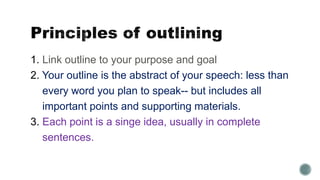
1. Link outline to your purpose and goal
2. Your outline is the abstract of your speech: less than
every word you plan to speak-- but includes all
important points and supporting materials.
3. Each point is a singe idea, usually in complete
sentences.
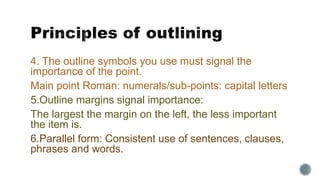
4. The outline symbols you use must signal the
importance of the point.
Main point Roman: numerals/sub-points: capital letters
5.Outline margins signal importance:
The largest the margin on the left, the less important
the item is.
6.Parallel form: Consistent use of sentences, clauses,
phrases and words.
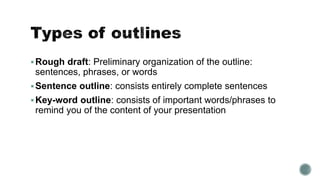
Rough draft: Preliminary organization of the outline:
sentences, phrases, or words
Sentence outline: consists entirely complete sentences
Key-word outline: consists of important words/phrases to
remind you of the content of your presentation
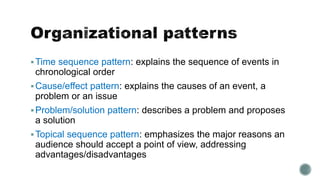
Time sequence pattern: explains the sequence of events in
chronological order
Cause/effect pattern: explains the causes of an event, a
problem or an issue
Problem/solution pattern: describes a problem and proposes
a solution
Topical sequence pattern: emphasizes the major reasons an
audience should accept a point of view, addressing
advantages/disadvantages
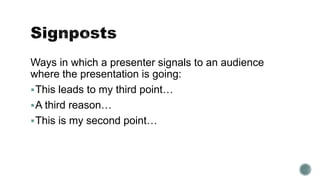
Ways in which a presenter signals to an audience
where the presentation is going:
This leads to my third point…
A third reason…
This is my second point…
List of the sources you used in your presentation
APA style
Chicago style
MLA style
The presentation of your speech using your
voice and body to communicate your message
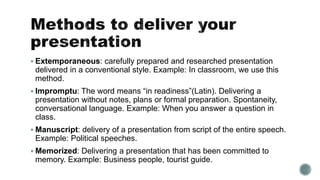
 Extemporaneous: carefully prepared and researched presentation
delivered in a conventional style. Example: In classroom, we use this
method.
 Impromptu: The word means “in readiness”(Latin). Delivering a
presentation without notes, plans or formal preparation. Spontaneity,
conversational language. Example: When you answer a question in
class.
 Manuscript: delivery of a presentation from script of the entire speech.
Example: Political speeches.
 Memorized: Delivering a presentation that has been committed to
memory. Example: Business people, tourist guide.
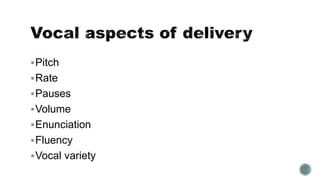
Pitch
Rate
Pauses
Volume
Enunciation
Fluency
Vocal variety
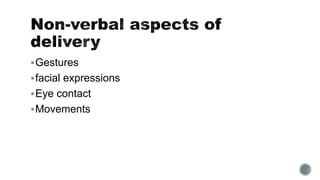
Gestures
facial expressions
Eye contact
Movements

Ch12 ch13 organization and delivery

  • 1.
  • 2.
    1. Link outlineto your purpose and goal 2. Your outline is the abstract of your speech: less than every word you plan to speak-- but includes all important points and supporting materials. 3. Each point is a singe idea, usually in complete sentences.
  • 3.
    4. The outlinesymbols you use must signal the importance of the point. Main point Roman: numerals/sub-points: capital letters 5.Outline margins signal importance: The largest the margin on the left, the less important the item is. 6.Parallel form: Consistent use of sentences, clauses, phrases and words.
  • 4.
    Rough draft: Preliminaryorganization of the outline: sentences, phrases, or words Sentence outline: consists entirely complete sentences Key-word outline: consists of important words/phrases to remind you of the content of your presentation
  • 5.
    Time sequence pattern:explains the sequence of events in chronological order Cause/effect pattern: explains the causes of an event, a problem or an issue Problem/solution pattern: describes a problem and proposes a solution Topical sequence pattern: emphasizes the major reasons an audience should accept a point of view, addressing advantages/disadvantages
  • 6.
    Ways in whicha presenter signals to an audience where the presentation is going: This leads to my third point… A third reason… This is my second point…
  • 7.
    List of thesources you used in your presentation APA style Chicago style MLA style
  • 8.
    The presentation ofyour speech using your voice and body to communicate your message
  • 9.
     Extemporaneous: carefullyprepared and researched presentation delivered in a conventional style. Example: In classroom, we use this method.  Impromptu: The word means “in readiness”(Latin). Delivering a presentation without notes, plans or formal preparation. Spontaneity, conversational language. Example: When you answer a question in class.  Manuscript: delivery of a presentation from script of the entire speech. Example: Political speeches.  Memorized: Delivering a presentation that has been committed to memory. Example: Business people, tourist guide.
  • 10.
  • 11.