Chapter 13
Organizing, Writing,
and Outlining
Presentations
• Organize and support your main
points
• Choose an appropriate
organizational pattern for your
speech
• Move smoothly from point to point
• Choose appropriate and powerful
language
Chapter Outcomes
Chapter Outcomes
(cont.)
• Develop a strong introduction, a
crucial part of all speeches
• Conclude with the same strength as
in the introduction
• Prepare an effective outline
Organizing Your
Speech Points
• Main points are…
– The central claims that support your
specific purpose and thesis statement
– Ideas that will lead the audience to
accept or consider what you are asking
them to do, believe, or consider
Organizing Your
Speech Points (cont.)
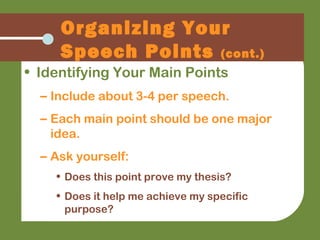
• Identifying Your Main Points
– Include about 3-4 per speech.
– Each main point should be one major
idea.
– Ask yourself:
• Does this point prove my thesis?
• Does it help me achieve my specific
purpose?
Organizing Your
Speech Points (cont.)
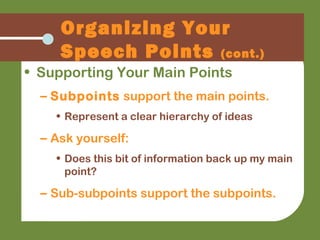
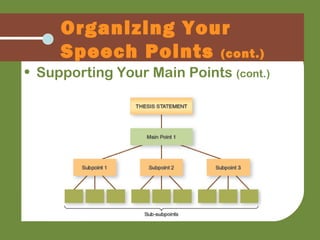
• Supporting Your Main Points
– Subpoints support the main points.
• Represent a clear hierarchy of ideas
– Ask yourself:
• Does this bit of information back up my main
point?
– Sub-subpoints support the subpoints.
Organizing Your
Speech Points (cont.)
• Supporting Your Main Points (cont.)
Organizing Your
Speech Points (cont.)
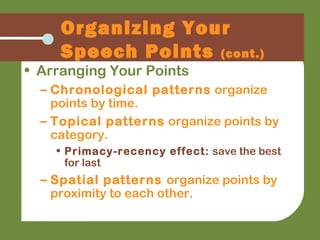
• Arranging Your Points
– Chronological patterns organize
points by time.
– Topical patterns organize points by
category.
• Primacy-recency effect: save the best
for last
– Spatial patterns organize points by
proximity to each other.
Organizing Your
Speech Points (cont.)
• Arranging Your Points (cont.)
– Problem-solution patterns arrange
three key points:
• problem, possible solutions, best solution
– Cause-effect patterns follow cause-to-
effect or effect-to-cause relationships.
– Narrative patterns arrange points
using stories.
Organizing Your
Speech Points (cont.)
• Arranging Your Points (cont.)
– Motivated sequence patterns follow
five phases:
• Attention
• Need
• Satisfaction
• Visualization
• Action
Organizing Your
Speech Points (cont.)
• Connecting Your Points
– Use transitions such as “in addition
to” or “next, let me describe.”
– Use signposts such as “next,” “once,”
“on the other hand.”
– Use internal previews to show
what’s coming.
– Use internal summaries to remind
the audience of what’s been covered.
Using Language That
Works
• Respect your audience.
• Keep it simple.
• Use vivid language.
• Use language to make a
lasting impression through
– Repetition
– Allusion
– Comparisons (similes, metaphors)
Writing a Strong
Introduction
• Capture your audience’s attention
by...
– Using surprise
– Telling a story
– Starting with a quote
– Asking a question
– Making them laugh
Writing a Strong
Introduction (cont.)
• Introduce Your Purpose and Topic
– Incorporate your thesis statement.
• Preview Your Main Points
– Tell listeners the points you will discuss in
the order in which you will discuss them.
• Connect with Your Audience
– Show them why they should care.
– Appeal to their personal needs.
Writing a Strong
Conclusion
• Signal the End
– Use a transitional phrase.
• Reinforce Your Topic, Purpose, and
Main Points
– Give listeners a mental check-list.
Writing a Strong
Conclusion (cont.)
• Make an Impact
– Use quotes, statements, questions, or a
final story.
• Challenge the Audience to Respond
– Encourage them to use their “new”
information.
– Encourage a call to action where
appropriate.
Outlining Your Speech
• An outline is a structured form of
your speech content that...
– Confirms your points are arranged
clearly
– Ensures you’ve cited your research
– Assists you in your delivery
Outlining Your Speech
(cont.)
• Outlining Essentials
– Use standard symbols.
– Use subdivisions properly.
– Separate the parts of your speech.
– Call out your specific purpose and thesis.
– Cite your sources.
– Give your speech a title.
Outlining Your Speech
(cont.)
• Styles of Outlines
– Sentence outlines use the full text of
your speech.
– Phrase outlines use key phrases.
• Key-word outlines use key words to jog
your memory.
• Phrase / Key-word are best for speaking
outlines
Outlining Your Speech
(cont.)
• From Preparation Outline to
Speaking Outline
– Preparation (working) outline:
• Firms up thesis, creates main points and
supporting points
– Speaking (delivery) outline:
• Final speech plan; includes delivery cues,
oral citations

Real comm2e ch13

  • 1.
    Chapter 13 Organizing, Writing, andOutlining Presentations
  • 2.
    • Organize andsupport your main points • Choose an appropriate organizational pattern for your speech • Move smoothly from point to point • Choose appropriate and powerful language Chapter Outcomes
  • 3.
    Chapter Outcomes (cont.) • Developa strong introduction, a crucial part of all speeches • Conclude with the same strength as in the introduction • Prepare an effective outline
  • 4.
    Organizing Your Speech Points •Main points are… – The central claims that support your specific purpose and thesis statement – Ideas that will lead the audience to accept or consider what you are asking them to do, believe, or consider
  • 5.
    Organizing Your Speech Points(cont.) • Identifying Your Main Points – Include about 3-4 per speech. – Each main point should be one major idea. – Ask yourself: • Does this point prove my thesis? • Does it help me achieve my specific purpose?
  • 6.
    Organizing Your Speech Points(cont.) • Supporting Your Main Points – Subpoints support the main points. • Represent a clear hierarchy of ideas – Ask yourself: • Does this bit of information back up my main point? – Sub-subpoints support the subpoints.
  • 7.
    Organizing Your Speech Points(cont.) • Supporting Your Main Points (cont.)
  • 8.
    Organizing Your Speech Points(cont.) • Arranging Your Points – Chronological patterns organize points by time. – Topical patterns organize points by category. • Primacy-recency effect: save the best for last – Spatial patterns organize points by proximity to each other.
  • 9.
    Organizing Your Speech Points(cont.) • Arranging Your Points (cont.) – Problem-solution patterns arrange three key points: • problem, possible solutions, best solution – Cause-effect patterns follow cause-to- effect or effect-to-cause relationships. – Narrative patterns arrange points using stories.
  • 10.
    Organizing Your Speech Points(cont.) • Arranging Your Points (cont.) – Motivated sequence patterns follow five phases: • Attention • Need • Satisfaction • Visualization • Action
  • 11.
    Organizing Your Speech Points(cont.) • Connecting Your Points – Use transitions such as “in addition to” or “next, let me describe.” – Use signposts such as “next,” “once,” “on the other hand.” – Use internal previews to show what’s coming. – Use internal summaries to remind the audience of what’s been covered.
  • 12.
    Using Language That Works •Respect your audience. • Keep it simple. • Use vivid language. • Use language to make a lasting impression through – Repetition – Allusion – Comparisons (similes, metaphors)
  • 13.
    Writing a Strong Introduction •Capture your audience’s attention by... – Using surprise – Telling a story – Starting with a quote – Asking a question – Making them laugh
  • 14.
    Writing a Strong Introduction(cont.) • Introduce Your Purpose and Topic – Incorporate your thesis statement. • Preview Your Main Points – Tell listeners the points you will discuss in the order in which you will discuss them. • Connect with Your Audience – Show them why they should care. – Appeal to their personal needs.
  • 15.
    Writing a Strong Conclusion •Signal the End – Use a transitional phrase. • Reinforce Your Topic, Purpose, and Main Points – Give listeners a mental check-list.
  • 16.
    Writing a Strong Conclusion(cont.) • Make an Impact – Use quotes, statements, questions, or a final story. • Challenge the Audience to Respond – Encourage them to use their “new” information. – Encourage a call to action where appropriate.
  • 17.
    Outlining Your Speech •An outline is a structured form of your speech content that... – Confirms your points are arranged clearly – Ensures you’ve cited your research – Assists you in your delivery
  • 18.
    Outlining Your Speech (cont.) •Outlining Essentials – Use standard symbols. – Use subdivisions properly. – Separate the parts of your speech. – Call out your specific purpose and thesis. – Cite your sources. – Give your speech a title.
  • 19.
    Outlining Your Speech (cont.) •Styles of Outlines – Sentence outlines use the full text of your speech. – Phrase outlines use key phrases. • Key-word outlines use key words to jog your memory. • Phrase / Key-word are best for speaking outlines
  • 20.
    Outlining Your Speech (cont.) •From Preparation Outline to Speaking Outline – Preparation (working) outline: • Firms up thesis, creates main points and supporting points – Speaking (delivery) outline: • Final speech plan; includes delivery cues, oral citations