Objectives: To understand how to write to argue effectively  To be able to understand and then use some key features of this writing purpose
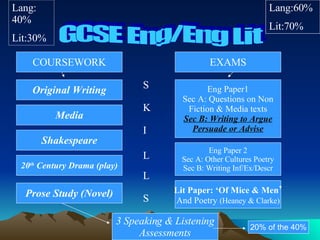
GCSE Eng/Eng Lit COURSEWORK EXAMS Original Writing Media Shakespeare 20 th  Century Drama (play) Prose Study (Novel) 3 Speaking & Listening Assessments Eng Paper1 Sec A: Questions on Non Fiction & Media texts Sec B: Writing to Argue Persuade or Advise Eng Paper 2 Sec A: Other Cultures Poetry Sec B: Writing Inf/Ex/Descr Lit Paper: ‘Of Mice & Men ’ And Poetry  (Heaney & Clarke) Lang: 40% Lit:30% Lang:60% Lit:70% S K I L L S 20% of the 40%
Assessment Objectives: Communicate clearly and imaginatively, adapting your writing for different audiences and purposes Organise ideas into sentences, paragraphs and whole texts using a variety of language choices and structural features Use a range of sentence structures effectively, with accurate spelling and punctuation
AQA Advice: Aim to write no more than 2 sides Clearly identify Audience & Purpose Write a clear plan Identify Form of writing Create a palette of key words/phrases Sequence ideas incorporating discourse markers Write for no more than 35 of the 45 minutes Check your writing in light of AO3 (iii)
First Brainstorm: TECHNIQUES USED IN AND FEATURES OF WRITING TO ARGUE
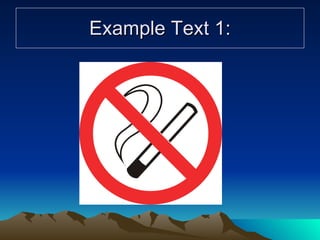
Example Text 1:
Task: Highlight/ underline any techniques and features you notice.  Try and explain the  effect…
Techniques/features: Use of ‘I’ and present tense adds to believability and immediacy of argument States opinion clearly Alternate views considered Criticisms polite but convincing Connectives used to help structure argument Rhetorical questions: to involve reader; to discredit other opinion Powers of 3 Imperatives used to emphasise point Conclusion sums up key points Metaphor adds strength to the argument
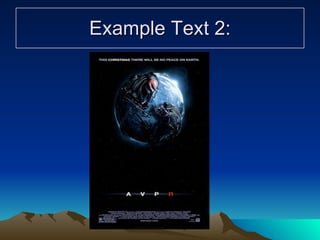
Example Text 2:
Task: Any other techniques/ features to identify?  Remember the  effect…
Techniques/ features: Technical/ specialist vocabulary Comparisons with original movie(s) Some informal language (colloquialisms) are appropriate here Rhetorical question stresses superiority of original ‘Alien’ Use of humour (sarcasm; dry wit) Strong adjectives and verbs convey negativity
 
PLANNING!!!
Let’s look at a sample question… …  then try some effective planning…
Sample Question: WRITE A LETTER TO YOUR LOCAL MP, WHERE YOU ARGUE IN FAVOUR OF A NEW YOUTH CENTRE BEING BUILT IN YOUR NEIGHBOURHOOD.
Stage One: Show you clearly understand your audience, purpose and form Make some brief notes on these…
Stage Two: A palette of useful words and phrases These will be technical terms, connectives, descriptive words, etc… Start to devise your palette – refer to the example…
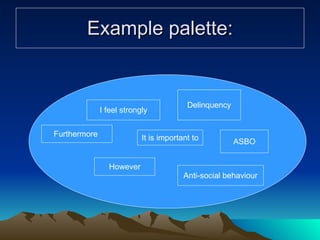
Example palette: I feel strongly However It is important to Delinquency Anti-social behaviour Furthermore  ASBO
Stage Three: Structural planning This can be a flow diagram Or, it could be similar to a mind map or brainstorm (with numbers added to show the order) This will show the flow of your paragraphs…
Stage Four: The actual writing! I want the first 2 paragraphs Remember the features we identified Use the model texts to help you 10 minutes…
FEEDBACK!

yr11 revision 13/3/08

  • 1.
    Objectives: To understandhow to write to argue effectively To be able to understand and then use some key features of this writing purpose
  • 2.
    GCSE Eng/Eng LitCOURSEWORK EXAMS Original Writing Media Shakespeare 20 th Century Drama (play) Prose Study (Novel) 3 Speaking & Listening Assessments Eng Paper1 Sec A: Questions on Non Fiction & Media texts Sec B: Writing to Argue Persuade or Advise Eng Paper 2 Sec A: Other Cultures Poetry Sec B: Writing Inf/Ex/Descr Lit Paper: ‘Of Mice & Men ’ And Poetry (Heaney & Clarke) Lang: 40% Lit:30% Lang:60% Lit:70% S K I L L S 20% of the 40%
  • 3.
    Assessment Objectives: Communicateclearly and imaginatively, adapting your writing for different audiences and purposes Organise ideas into sentences, paragraphs and whole texts using a variety of language choices and structural features Use a range of sentence structures effectively, with accurate spelling and punctuation
  • 4.
    AQA Advice: Aimto write no more than 2 sides Clearly identify Audience & Purpose Write a clear plan Identify Form of writing Create a palette of key words/phrases Sequence ideas incorporating discourse markers Write for no more than 35 of the 45 minutes Check your writing in light of AO3 (iii)
  • 5.
    First Brainstorm: TECHNIQUESUSED IN AND FEATURES OF WRITING TO ARGUE
  • 6.
  • 7.
    Task: Highlight/ underlineany techniques and features you notice. Try and explain the effect…
  • 8.
    Techniques/features: Use of‘I’ and present tense adds to believability and immediacy of argument States opinion clearly Alternate views considered Criticisms polite but convincing Connectives used to help structure argument Rhetorical questions: to involve reader; to discredit other opinion Powers of 3 Imperatives used to emphasise point Conclusion sums up key points Metaphor adds strength to the argument
  • 9.
  • 10.
    Task: Any othertechniques/ features to identify? Remember the effect…
  • 11.
    Techniques/ features: Technical/specialist vocabulary Comparisons with original movie(s) Some informal language (colloquialisms) are appropriate here Rhetorical question stresses superiority of original ‘Alien’ Use of humour (sarcasm; dry wit) Strong adjectives and verbs convey negativity
  • 12.
  • 13.
  • 14.
    Let’s look ata sample question… … then try some effective planning…
  • 15.
    Sample Question: WRITEA LETTER TO YOUR LOCAL MP, WHERE YOU ARGUE IN FAVOUR OF A NEW YOUTH CENTRE BEING BUILT IN YOUR NEIGHBOURHOOD.
  • 16.
    Stage One: Showyou clearly understand your audience, purpose and form Make some brief notes on these…
  • 17.
    Stage Two: Apalette of useful words and phrases These will be technical terms, connectives, descriptive words, etc… Start to devise your palette – refer to the example…
  • 18.
    Example palette: Ifeel strongly However It is important to Delinquency Anti-social behaviour Furthermore ASBO
  • 19.
    Stage Three: Structuralplanning This can be a flow diagram Or, it could be similar to a mind map or brainstorm (with numbers added to show the order) This will show the flow of your paragraphs…
  • 20.
    Stage Four: Theactual writing! I want the first 2 paragraphs Remember the features we identified Use the model texts to help you 10 minutes…
  • 21.