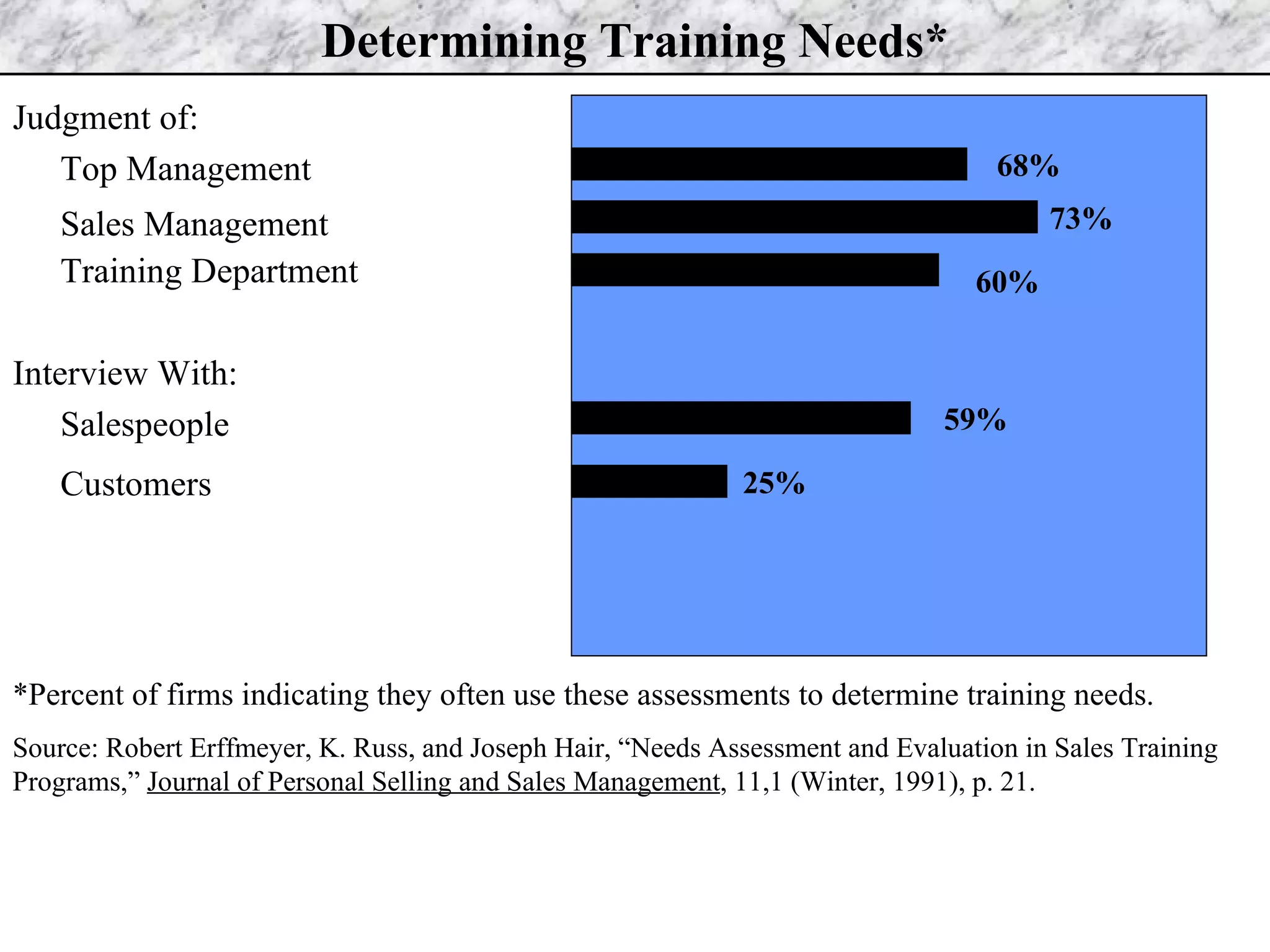
Determining Training Needs* Judgment of: Top Management Sales Management Training Department Interview With: Salespeople Customers 68% 73% 60% 59% 25% *Percent of firms indicating they often use these assessments to determine training needs. Source: Robert Erffmeyer, K. Russ, and Joseph Hair, “Needs Assessment and Evaluation in Sales Training Programs,”  Journal of Personal Selling and Sales Management , 11,1 (Winter, 1991), p. 21.
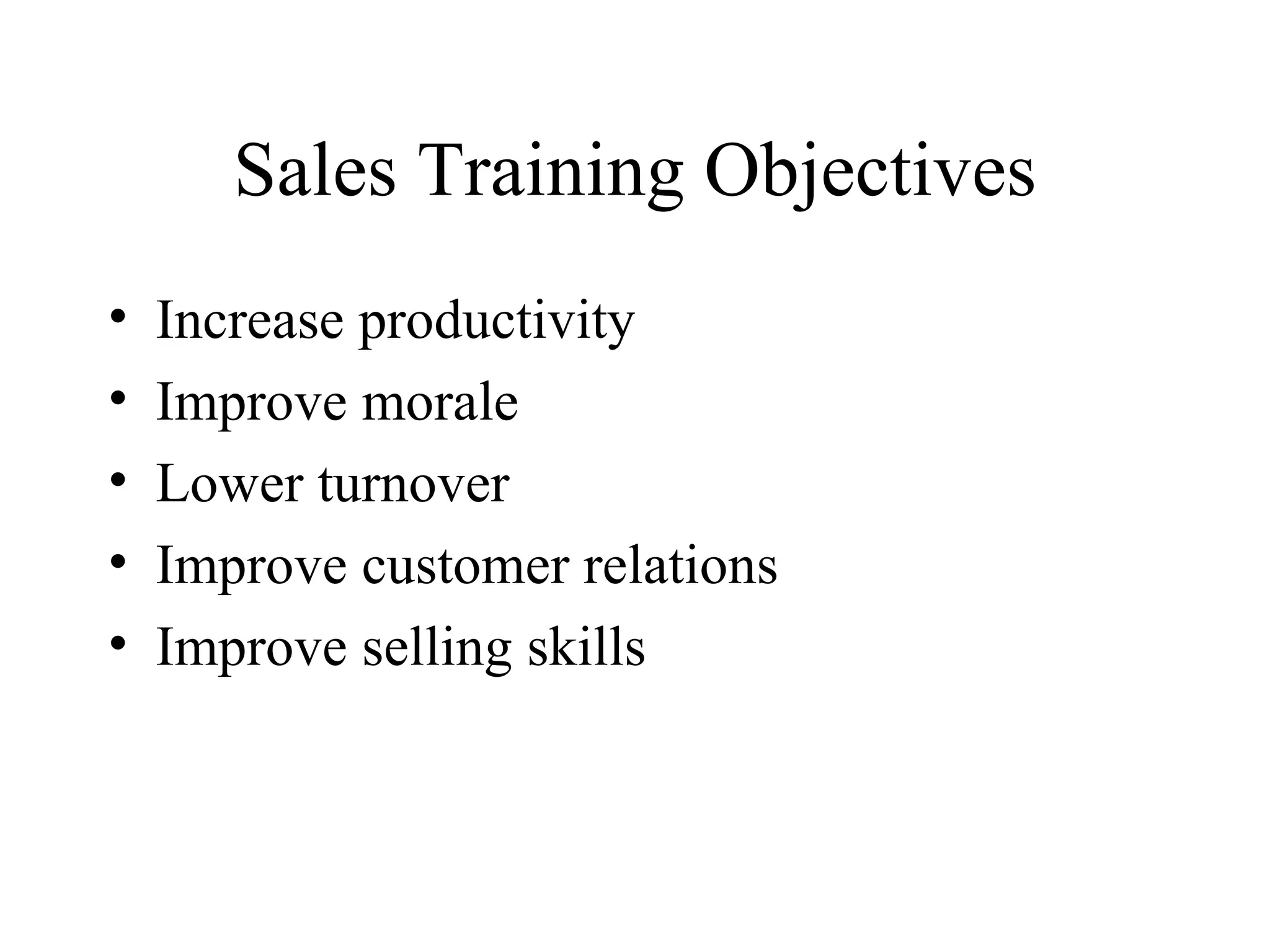
Sales Training Objectives Increase productivity  Improve morale Lower turnover Improve customer relations Improve selling skills
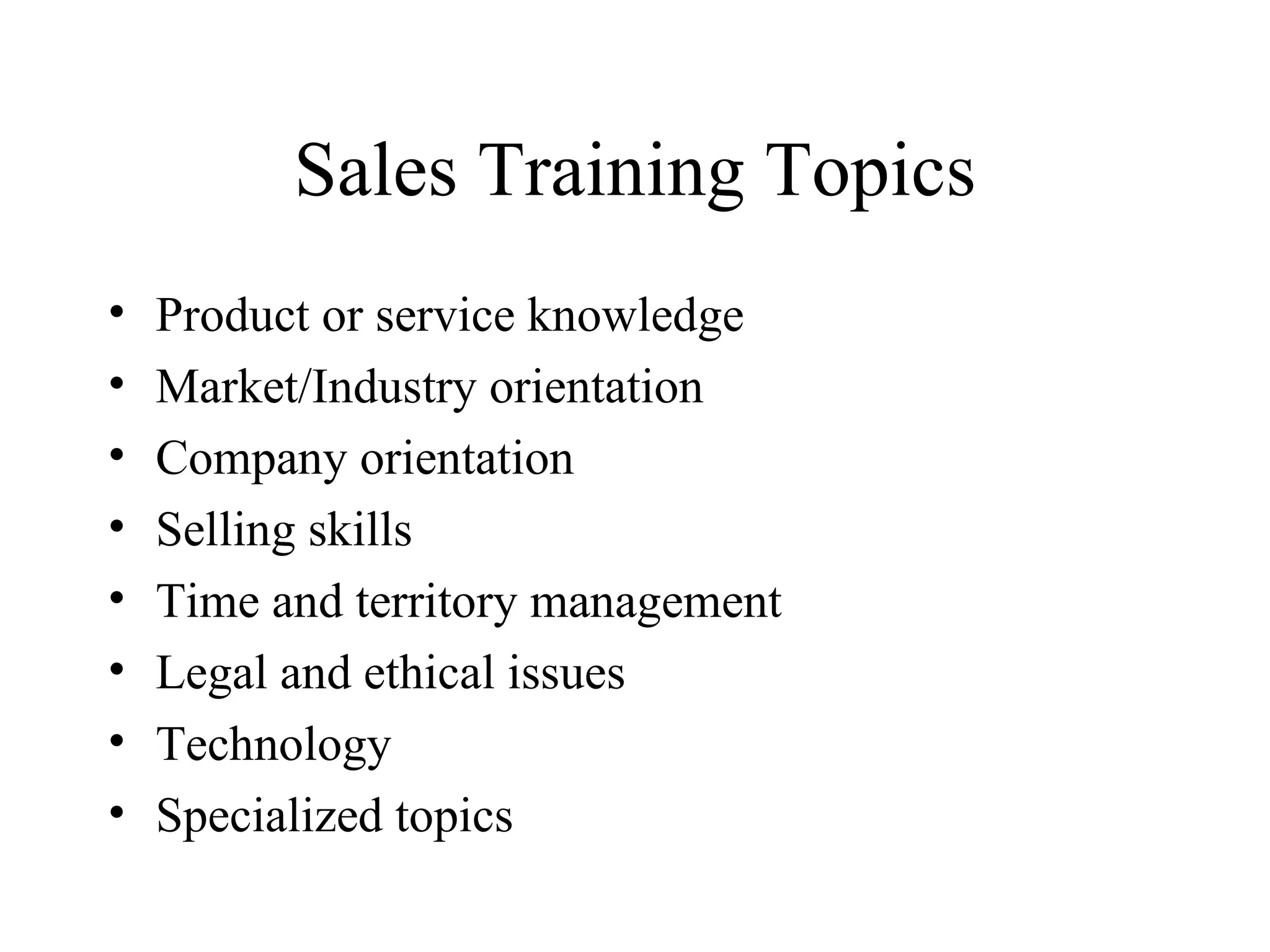
Sales Training Topics Product or service knowledge Market/Industry orientation  Company orientation Selling skills Time and territory management Legal and ethical issues Technology Specialized topics
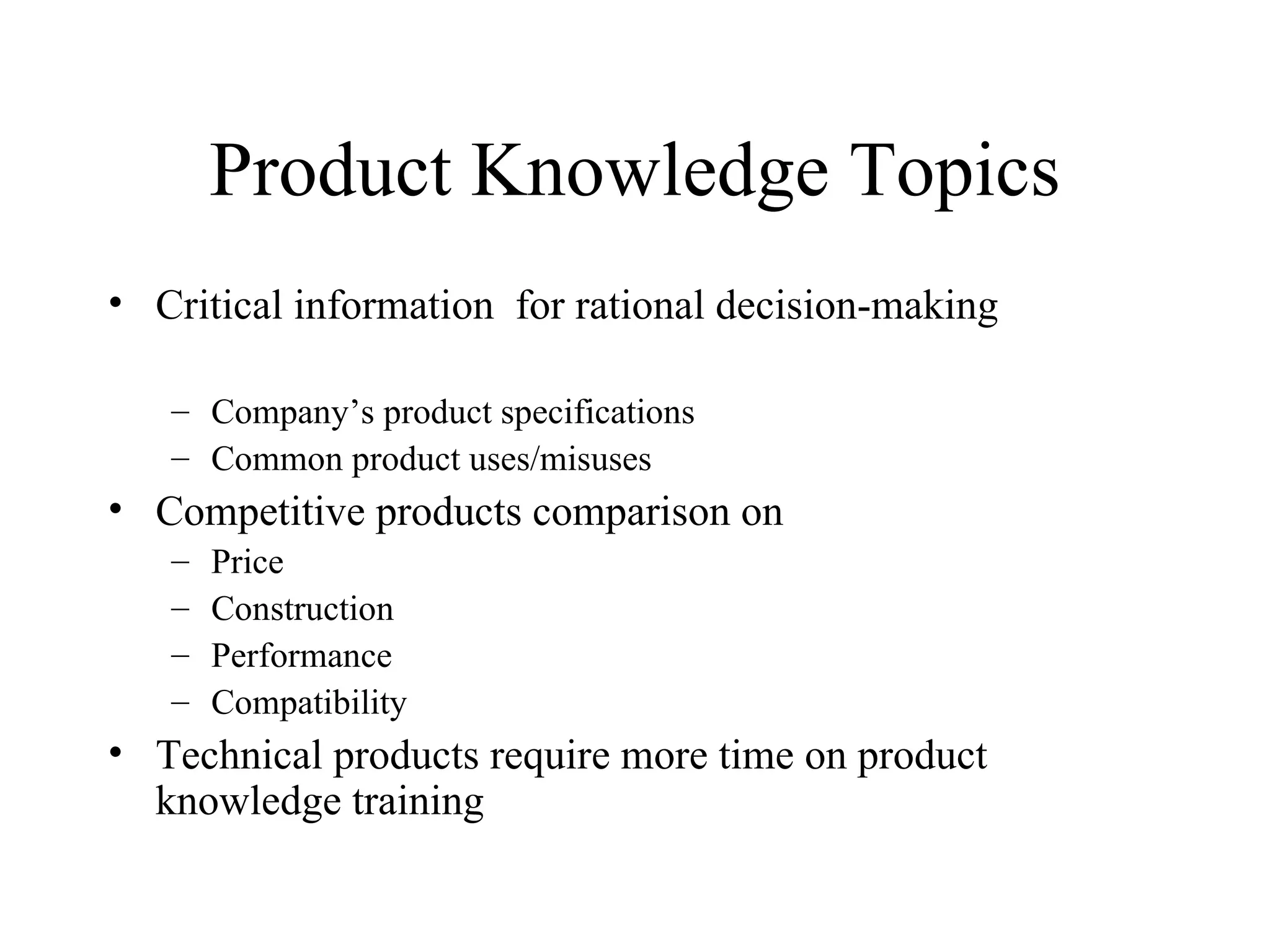
Product Knowledge Topics Critical information  for rational decision-making  Company’s product specifications Common product uses/misuses Competitive products comparison on  Price Construction Performance Compatibility Technical products require more time on product knowledge training
Market/Industry Orientation Topics Industry fit into overall economy Knowledge of industry and economy Economic fluctuations that affect buying behavior and require adaptive selling techniques Customers' buying policies, patterns and preferences in light of competition Customers' customers needs Wholesaler and retailer needs
Company Orientation Topics Company polices that affect their selling activities Personnel Structure Benefits Handling customer requests for price adjustments, product modifications, faster delivery, different credit terms Sales manuals Hard copy, online Product information Company policy information
Time and Territory Management Sales trainees need to learn to manage time and territories Time spent training out of the field is costly 80/20 rule applies: 20% of the customers account for  80% of the business and Require the same proportion of time and attention
Legal/Ethical Issues Federal law dictates corporate action or avoidance of action in areas of marketing, sales and pricing Sales personnel need to understand the federal, state and local laws that constrain their selling activities Statements made by salespeople carry both legal and ethical implications Lapses in ethical conduct often lead to legal problems
10.3 Ethics Training Part of  Sales Training Insurance industry suffers bad reputation of unethical behavior Insurance Marketplace Standards Association  (IMSA) created in response IMSA certification requires Ensuring salespeople pursue ethical practices Ethical practices training for all agents and staff Administering an exam for all sales professionals Source: IMSA,  www.imsaethics.org , Fall 2007.
Technology Notebook computers Presentations Connecting to company intranet or extranet  Delivering documentation quickly and accurately Home offices eliminate the need to go to another office Salesperson can be almost totally self-sufficient with  High-speed network connection Computer  Printer  Cell phone Effective computer use affords sales personnel more face-to-face customer contact time Effective use requires training
10.4 Internet Training Increased control over content Less costly Comprises 15-20% of all training today Expected to be 50% within 5 years
Specialized Training Topics Specialized, job-tailored training most effective Sample topics Price negotiations Trade show effectiveness Reading body language Addressing SCA
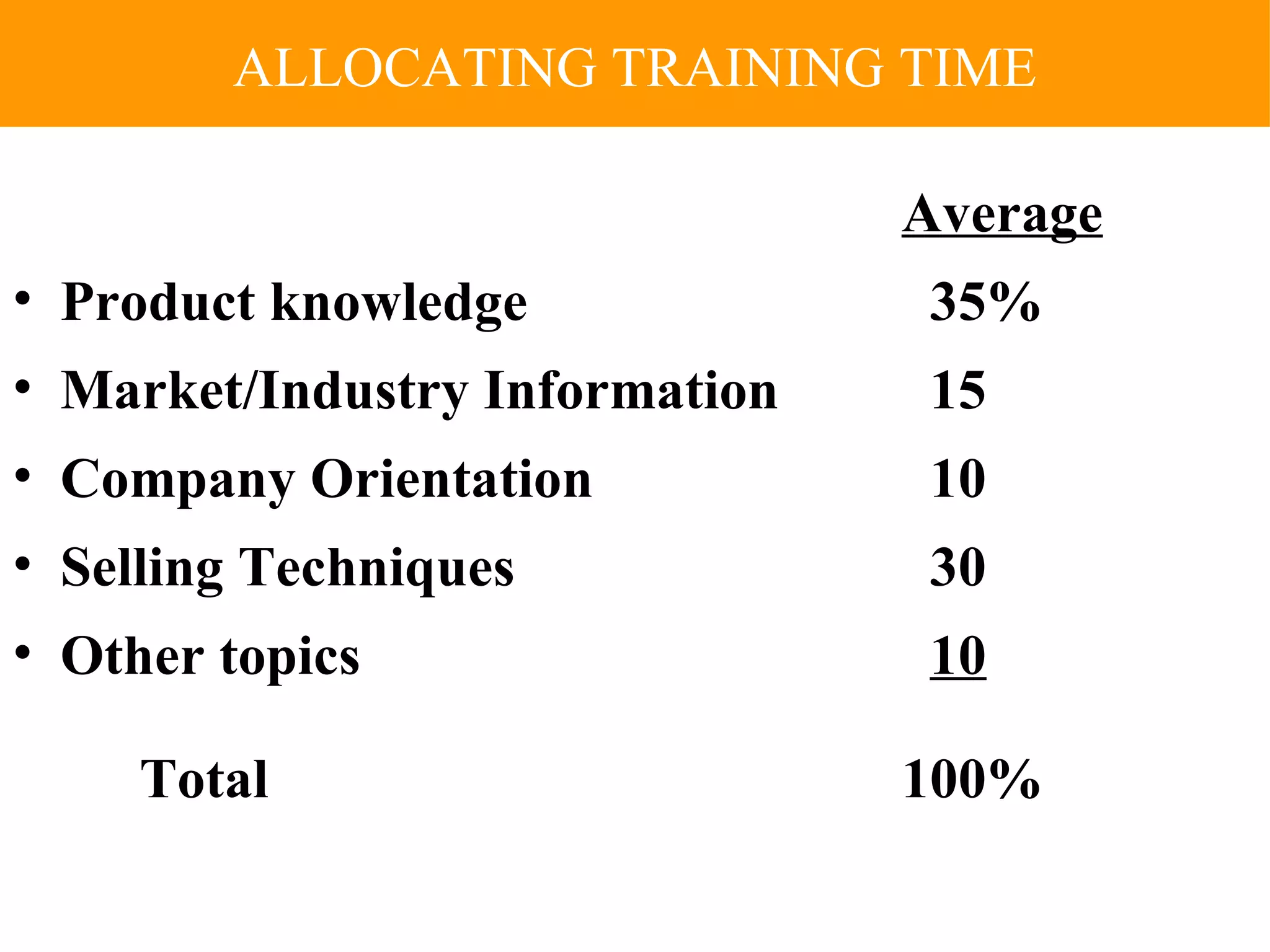
ALLOCATING TRAINING TIME Average Product knowledge   35% Market/Industry Information   15 Company Orientation   10 Selling Techniques   30 Other topics     10   Total 100%
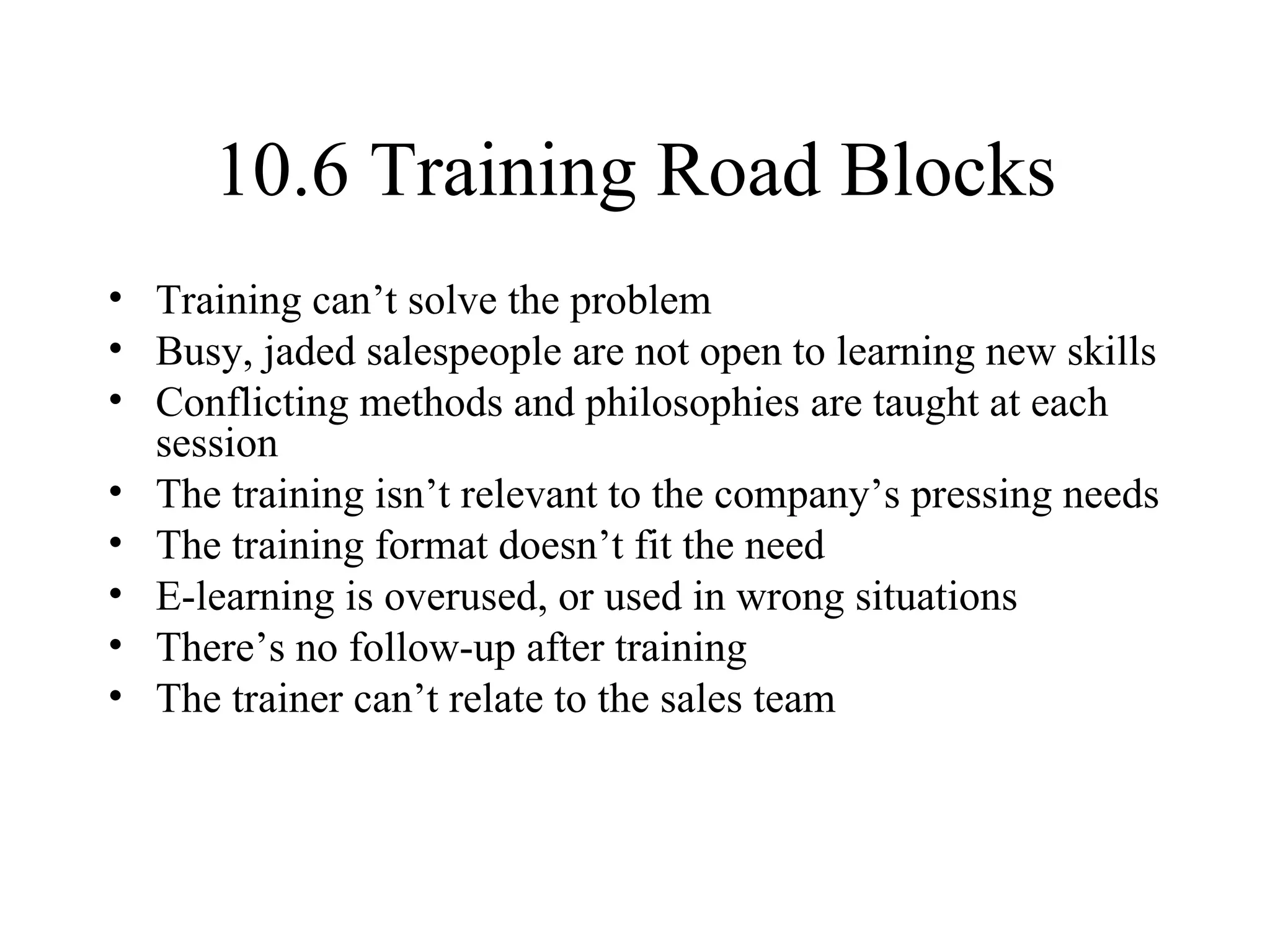
10.6 Training Road Blocks Training can’t solve the problem Busy, jaded salespeople are not open to learning new skills Conflicting methods and philosophies are taught at each session The training isn’t relevant to the company’s pressing needs The training format doesn’t fit the need E-learning is overused, or used in wrong situations There’s no follow-up after training The trainer can’t relate to the sales team
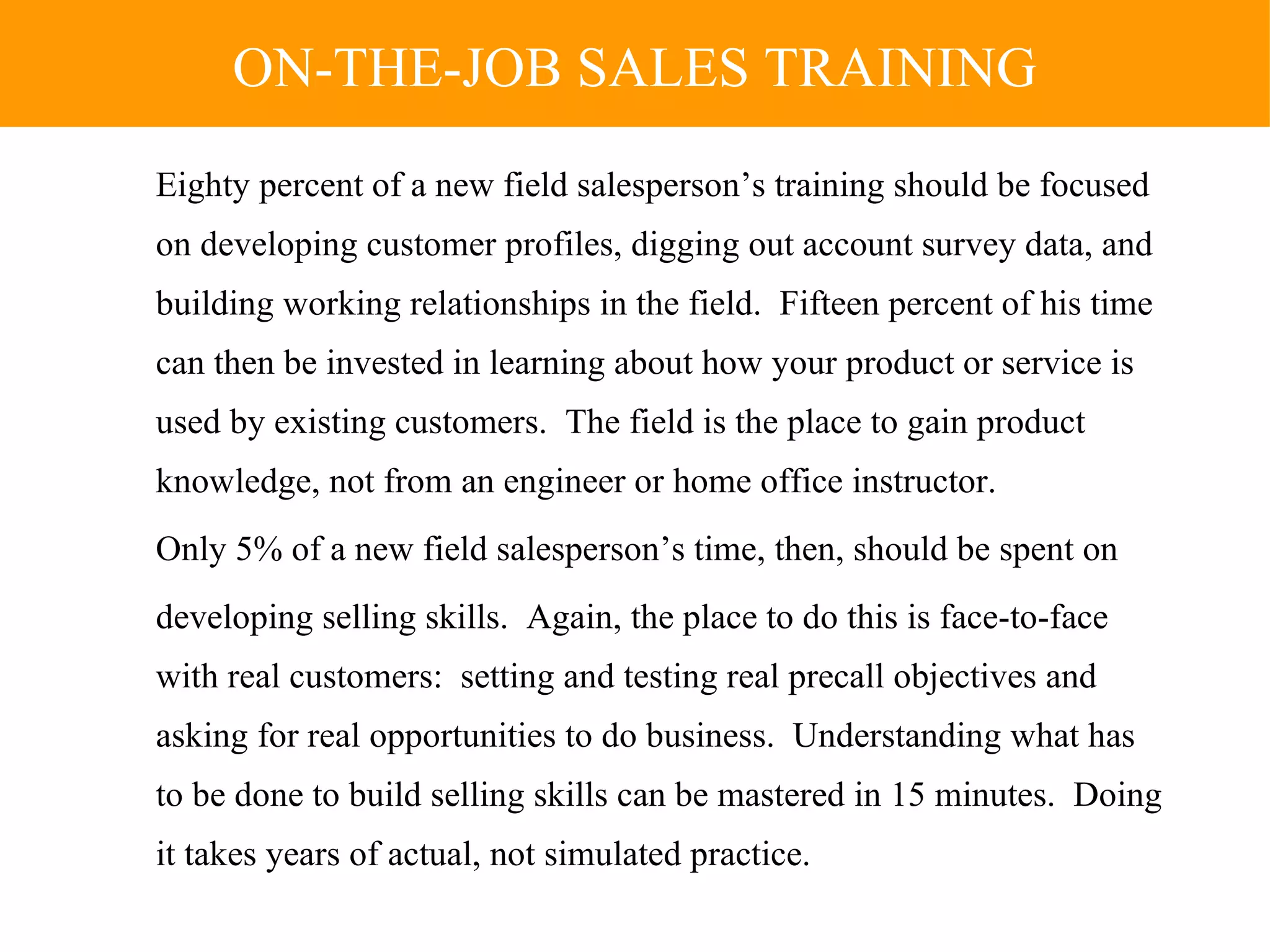
Eighty percent of a new field salesperson’s training should be focused on developing customer profiles, digging out account survey data, and building working relationships in the field.  Fifteen percent of his time can then be invested in learning about how your product or service is used by existing customers.  The field is the place to gain product knowledge, not from an engineer or home office instructor. Only 5% of a new field salesperson’s time, then, should be spent on  developing selling skills.  Again, the place to do this is face-to-face with real customers:  setting and testing real precall objectives and asking for real opportunities to do business.  Understanding what has to be done to build selling skills can be mastered in 15 minutes.  Doing it takes years of actual, not simulated practice. ON-THE-JOB SALES TRAINING
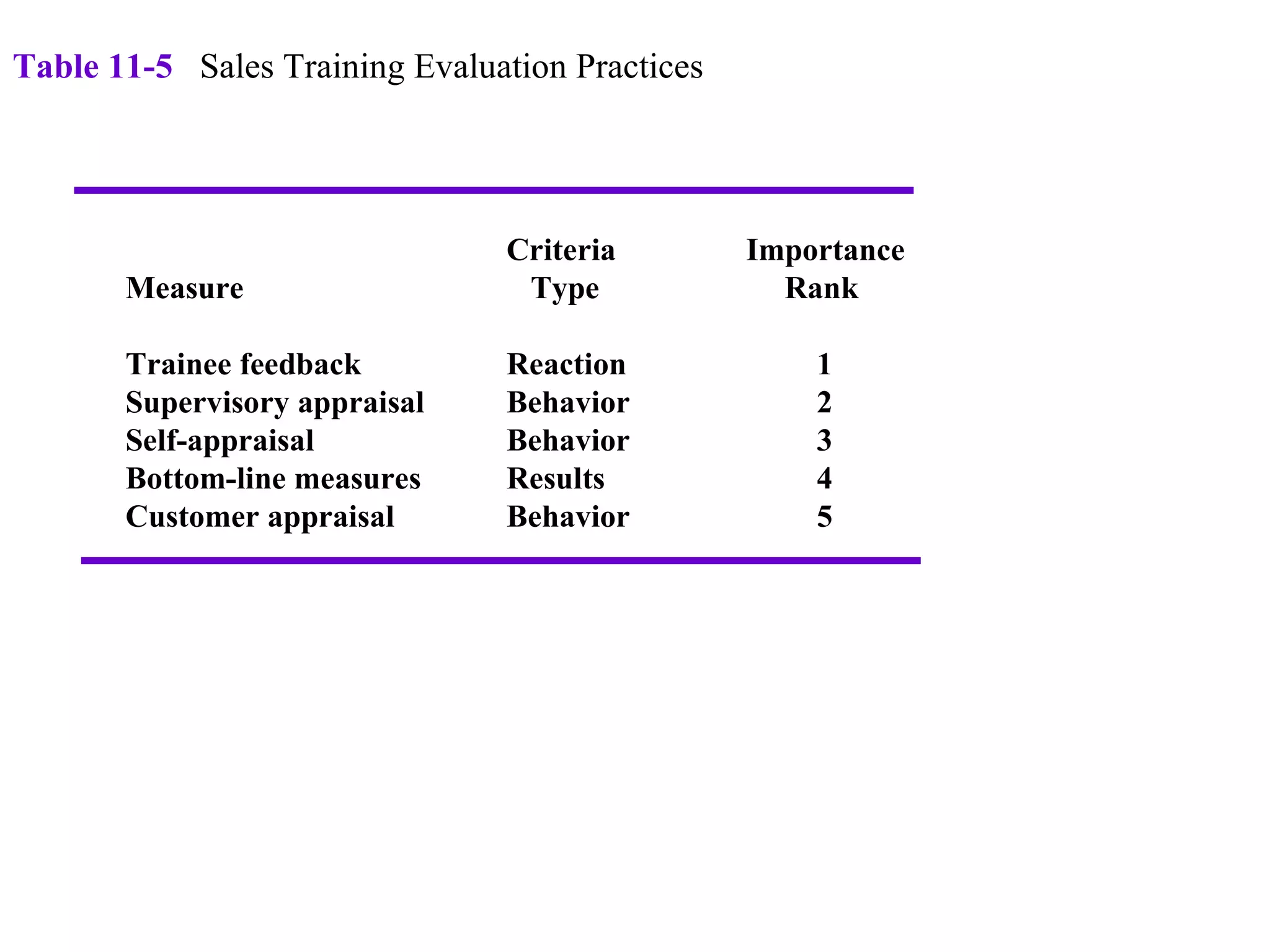
Table 11-5   Sales Training Evaluation Practices Criteria   Importance Measure   Type   Rank Trainee feedback Reaction     1 Supervisory appraisal  Behavior   2 Self-appraisal Behavior   3 Bottom-line measures  Results   4 Customer appraisal Behavior   5
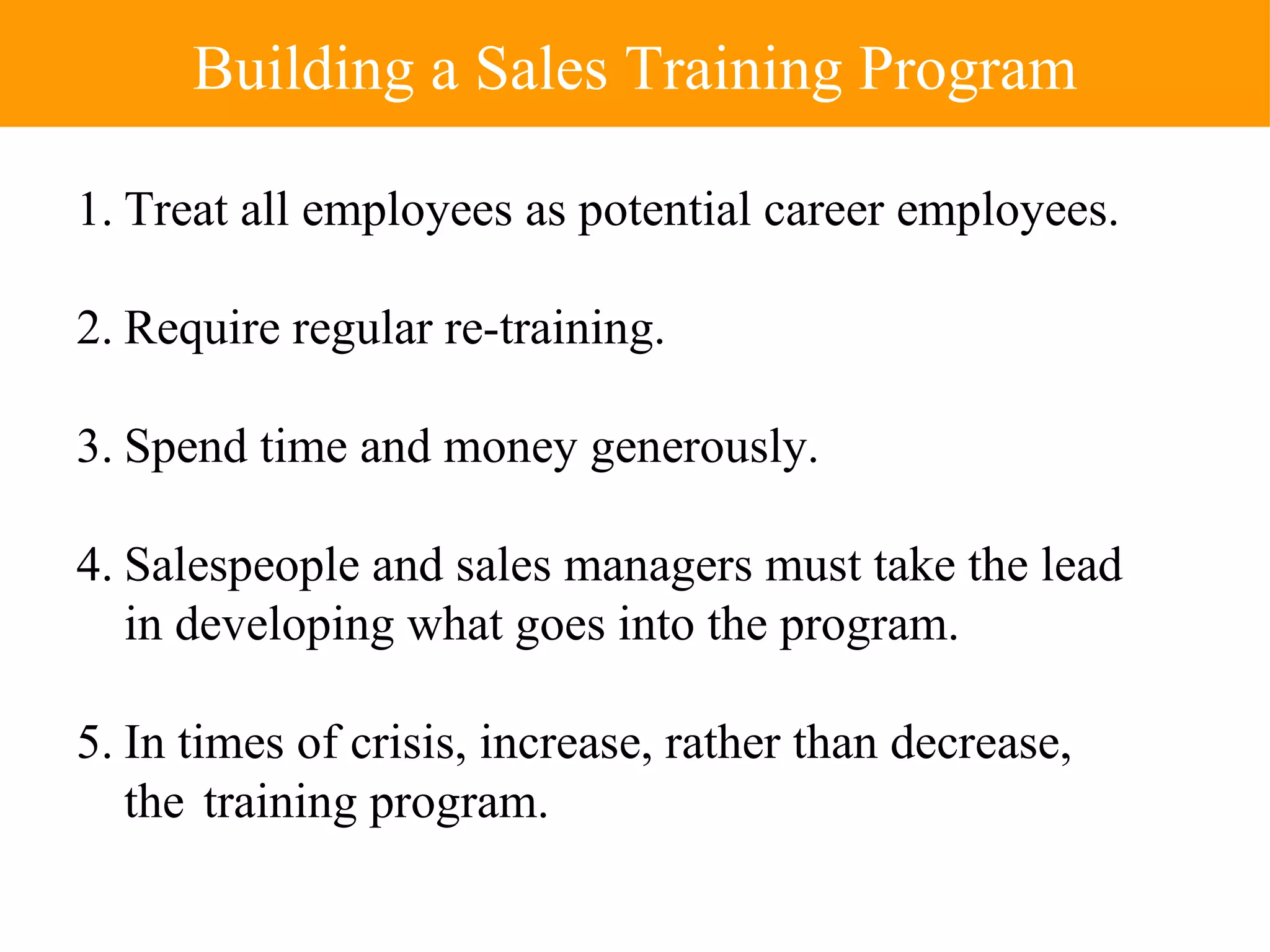
1. Treat all employees as potential career employees. 2. Require regular re-training. 3. Spend time and money generously. 4. Salespeople and sales managers must take the lead in developing what goes into the program. 5. In times of crisis, increase, rather than decrease, the  training program. Building a Sales Training Program
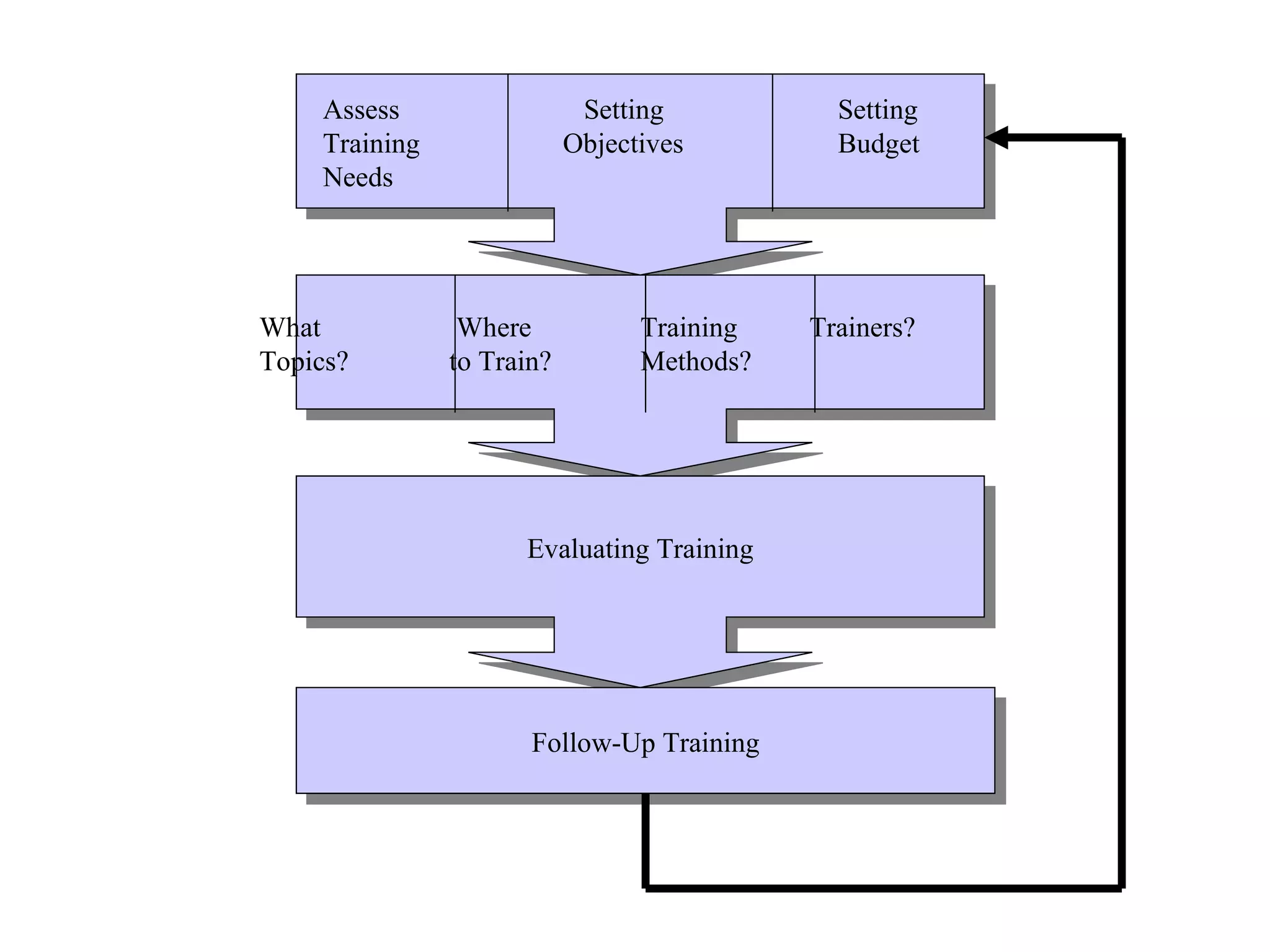
Assess   Setting   Setting Training Objectives   Budget Needs What   Where Training   Trainers? Topics?   to Train? Methods? Evaluating Training Follow-Up Training
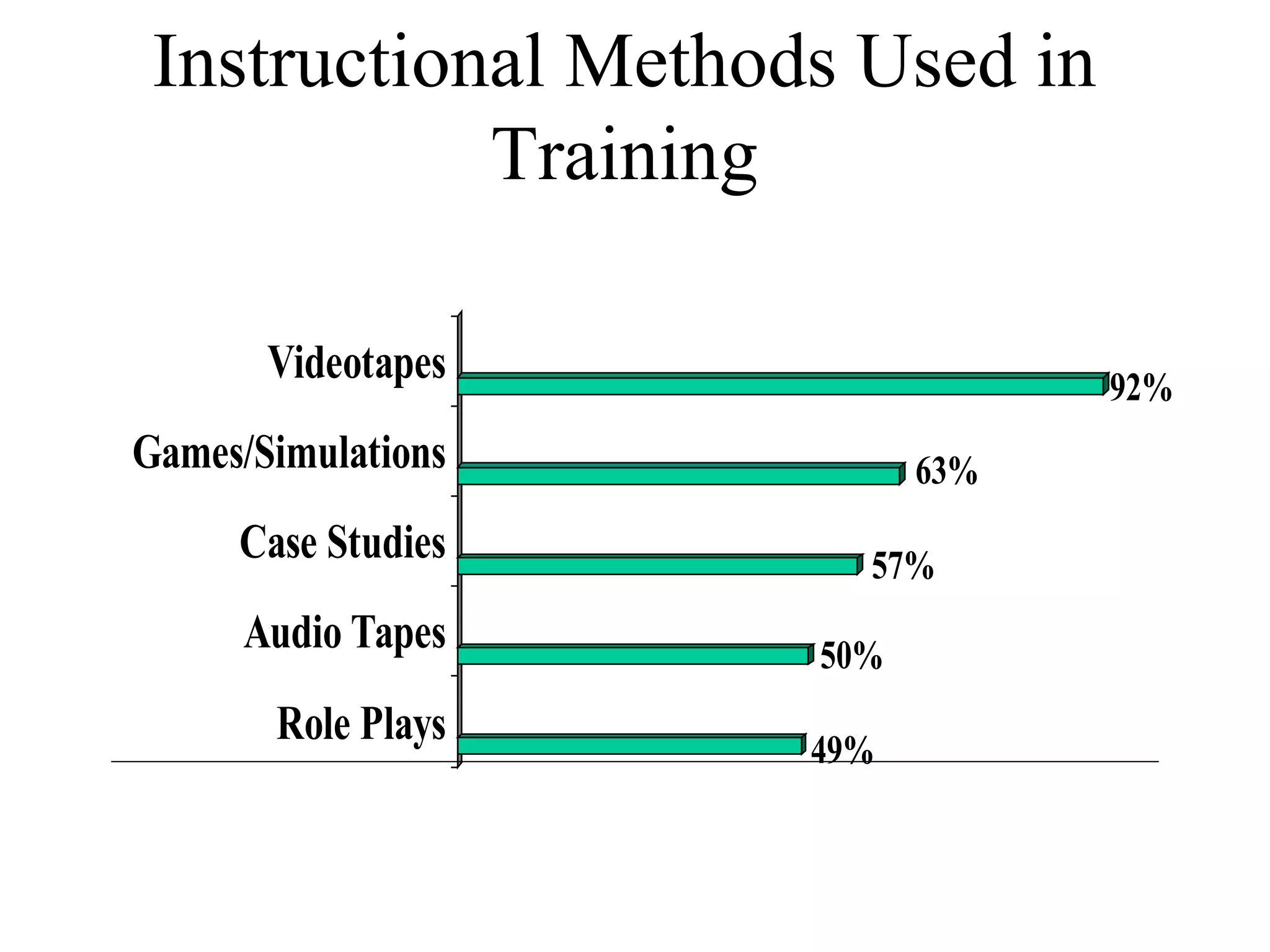
Instructional Methods Used in Training
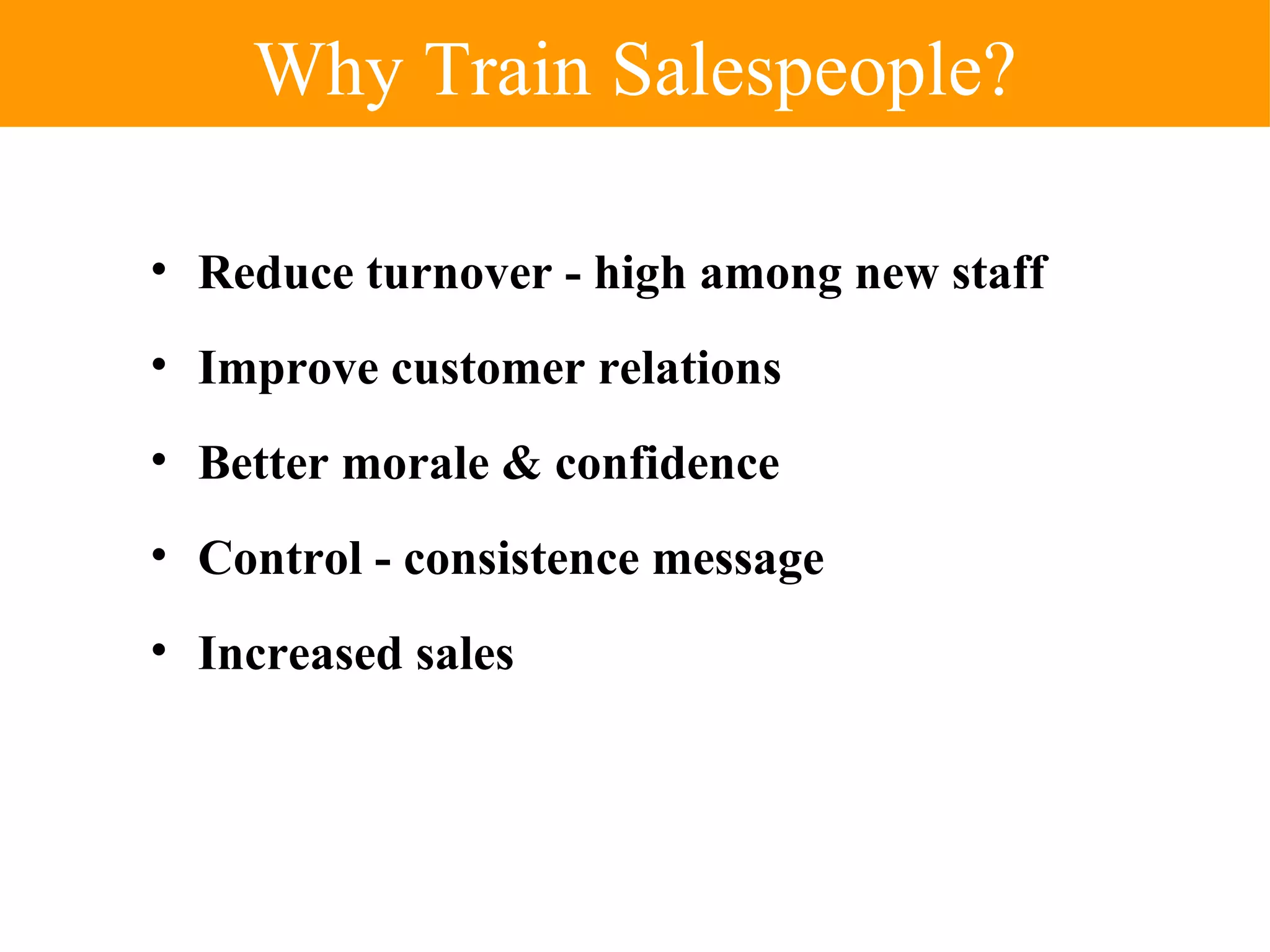
Why Train Salespeople? Reduce turnover - high among new staff Improve customer relations Better morale & confidence Control - consistence message Increased sales

Ch11

  • 1.
    Determining Training Needs*Judgment of: Top Management Sales Management Training Department Interview With: Salespeople Customers 68% 73% 60% 59% 25% *Percent of firms indicating they often use these assessments to determine training needs. Source: Robert Erffmeyer, K. Russ, and Joseph Hair, “Needs Assessment and Evaluation in Sales Training Programs,” Journal of Personal Selling and Sales Management , 11,1 (Winter, 1991), p. 21.
  • 2.
    Sales Training ObjectivesIncrease productivity Improve morale Lower turnover Improve customer relations Improve selling skills
  • 3.
    Sales Training TopicsProduct or service knowledge Market/Industry orientation Company orientation Selling skills Time and territory management Legal and ethical issues Technology Specialized topics
  • 4.
    Product Knowledge TopicsCritical information for rational decision-making Company’s product specifications Common product uses/misuses Competitive products comparison on Price Construction Performance Compatibility Technical products require more time on product knowledge training
  • 5.
    Market/Industry Orientation TopicsIndustry fit into overall economy Knowledge of industry and economy Economic fluctuations that affect buying behavior and require adaptive selling techniques Customers' buying policies, patterns and preferences in light of competition Customers' customers needs Wholesaler and retailer needs
  • 6.
    Company Orientation TopicsCompany polices that affect their selling activities Personnel Structure Benefits Handling customer requests for price adjustments, product modifications, faster delivery, different credit terms Sales manuals Hard copy, online Product information Company policy information
  • 7.
    Time and TerritoryManagement Sales trainees need to learn to manage time and territories Time spent training out of the field is costly 80/20 rule applies: 20% of the customers account for 80% of the business and Require the same proportion of time and attention
  • 8.
    Legal/Ethical Issues Federallaw dictates corporate action or avoidance of action in areas of marketing, sales and pricing Sales personnel need to understand the federal, state and local laws that constrain their selling activities Statements made by salespeople carry both legal and ethical implications Lapses in ethical conduct often lead to legal problems
  • 9.
    10.3 Ethics TrainingPart of Sales Training Insurance industry suffers bad reputation of unethical behavior Insurance Marketplace Standards Association (IMSA) created in response IMSA certification requires Ensuring salespeople pursue ethical practices Ethical practices training for all agents and staff Administering an exam for all sales professionals Source: IMSA, www.imsaethics.org , Fall 2007.
  • 10.
    Technology Notebook computersPresentations Connecting to company intranet or extranet Delivering documentation quickly and accurately Home offices eliminate the need to go to another office Salesperson can be almost totally self-sufficient with High-speed network connection Computer Printer Cell phone Effective computer use affords sales personnel more face-to-face customer contact time Effective use requires training
  • 11.
    10.4 Internet TrainingIncreased control over content Less costly Comprises 15-20% of all training today Expected to be 50% within 5 years
  • 12.
    Specialized Training TopicsSpecialized, job-tailored training most effective Sample topics Price negotiations Trade show effectiveness Reading body language Addressing SCA
  • 13.
    ALLOCATING TRAINING TIMEAverage Product knowledge 35% Market/Industry Information 15 Company Orientation 10 Selling Techniques 30 Other topics 10 Total 100%
  • 14.
    10.6 Training RoadBlocks Training can’t solve the problem Busy, jaded salespeople are not open to learning new skills Conflicting methods and philosophies are taught at each session The training isn’t relevant to the company’s pressing needs The training format doesn’t fit the need E-learning is overused, or used in wrong situations There’s no follow-up after training The trainer can’t relate to the sales team
  • 15.
    Eighty percent ofa new field salesperson’s training should be focused on developing customer profiles, digging out account survey data, and building working relationships in the field. Fifteen percent of his time can then be invested in learning about how your product or service is used by existing customers. The field is the place to gain product knowledge, not from an engineer or home office instructor. Only 5% of a new field salesperson’s time, then, should be spent on developing selling skills. Again, the place to do this is face-to-face with real customers: setting and testing real precall objectives and asking for real opportunities to do business. Understanding what has to be done to build selling skills can be mastered in 15 minutes. Doing it takes years of actual, not simulated practice. ON-THE-JOB SALES TRAINING
  • 16.
    Table 11-5 Sales Training Evaluation Practices Criteria Importance Measure Type Rank Trainee feedback Reaction 1 Supervisory appraisal Behavior 2 Self-appraisal Behavior 3 Bottom-line measures Results 4 Customer appraisal Behavior 5
  • 17.
    1. Treat allemployees as potential career employees. 2. Require regular re-training. 3. Spend time and money generously. 4. Salespeople and sales managers must take the lead in developing what goes into the program. 5. In times of crisis, increase, rather than decrease, the training program. Building a Sales Training Program
  • 18.
    Assess Setting Setting Training Objectives Budget Needs What Where Training Trainers? Topics? to Train? Methods? Evaluating Training Follow-Up Training
  • 19.
  • 20.
    Why Train Salespeople?Reduce turnover - high among new staff Improve customer relations Better morale & confidence Control - consistence message Increased sales