SALES FORCE
TRAINING AND
DEVELOPMENT.
TRAINING
 DEFINITION : According to Edward B. Flippo,
Training is the act of increasing the knowledge and
skill of an employee for doing a particular job.
 MEANING : Training is a process of learning
sequence of programmed behaviour. It is application
of knowledge. It attempts to improve employees
performance on the current job ofr prepare them for
intended job.
DEVELOPMENT
MEANING:
Development is a broad, on going, multi-faceted set of
activities to bring some one or an organization upto
another threshold of performance, often to perform
some job or new role in future.
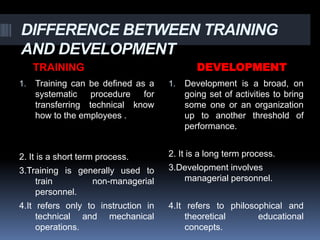
DIFFERENCE BETWEEN TRAINING
AND DEVELOPMENT
DEVELOPMENT
1. Training can be defined as a
systematic procedure for
transferring technical know
how to the employees .
2. It is a short term process.
3.Training is generally used to
train non-managerial
personnel.
4.It refers only to instruction in
technical and mechanical
operations.
1. Development is a broad, on
going set of activities to bring
some one or an organization
up to another threshold of
performance.
2. It is a long term process.
3.Development involves
managerial personnel.
4.It refers to philosophical and
theoretical educational
concepts.
TRAINING
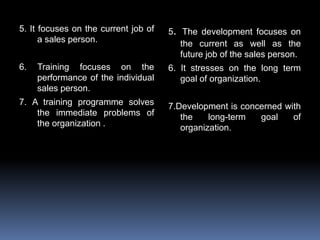
5. It focuses on the current job of
a sales person.
6. Training focuses on the
performance of the individual
sales person.
7. A training programme solves
the immediate problems of
the organization .
5. The development focuses on
the current as well as the
future job of the sales person.
6. It stresses on the long term
goal of organization.
7.Development is concerned with
the long-term goal of
organization.
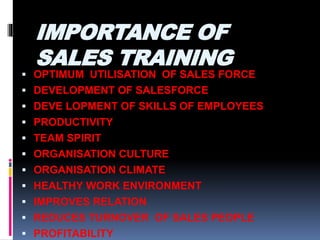
IMPORTANCE OF
SALES TRAINING
 OPTIMUM UTILISATION OF SALES FORCE
 DEVELOPMENT OF SALESFORCE
 DEVE LOPMENT OF SKILLS OF EMPLOYEES
 PRODUCTIVITY
 TEAM SPIRIT
 ORGANISATION CULTURE
 ORGANISATION CLIMATE
 HEALTHY WORK ENVIRONMENT
 IMPROVES RELATION
 REDUCES TURNOVER OF SALES PEOPLE
 PROFITABILITY
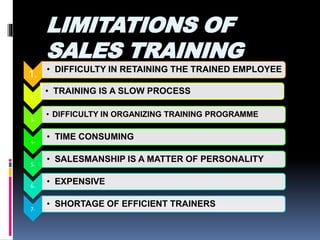
LIMITATIONS OF
SALES TRAINING
1. • DIFFICULTY IN RETAINING THE TRAINED EMPLOYEE
2.
• TRAINING IS A SLOW PROCESS
3.
• DIFFICULTY IN ORGANIZING TRAINING PROGRAMME
4.
• TIME CONSUMING
5.
• SALESMANSHIP IS A MATTER OF PERSONALITY
6.
• EXPENSIVE
7.
• SHORTAGE OF EFFICIENT TRAINERS
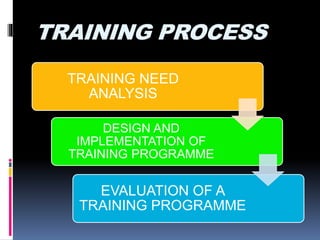
TRAINING PROCESS
TRAINING NEED
ANALYSIS
DESIGN AND
IMPLEMENTATION OF
TRAINING PROGRAMME
EVALUATION OF A
TRAINING PROGRAMME
A. TRAINING NEED
ANALYSIS
 The purpose of training needs is to determine
whether there is a gap between what is required for
effective performance and present level of
performance of sales people.
 It helps to plan the budget of the company, areas
where training is needed and also highlights the
occasions where training might not be appropriate.
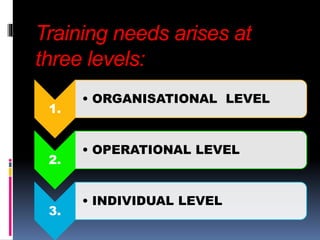
Training needs arises at
three levels:
1.
• ORGANISATIONAL LEVEL
2.
• OPERATIONAL LEVEL
3.
• INDIVIDUAL LEVEL
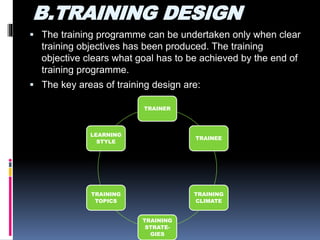
B.TRAINING DESIGN
 The training programme can be undertaken only when clear
training objectives has been produced. The training
objective clears what goal has to be achieved by the end of
training programme.
 The key areas of training design are:
TRAINER
TRAINEE
TRAINING
CLIMATE
TRAINING
STRATE-
GIES
TRAINING
TOPICS
LEARNING
STYLE
TRAINING IMPLEMENTATION
 To put training program into effect according to definite
plan or procedure is called training implementation.
 Training implementation can be segregated into :
i. Practical administrative arrangements
ii. Carrying out of the training.
C. TRAINING
EVALUATION
 The process of examining a training programme is
called training evaluation.
 Training evaluation ensures that whether trainees are
able to implement their learning in their respective work
places or to the regular work routines.
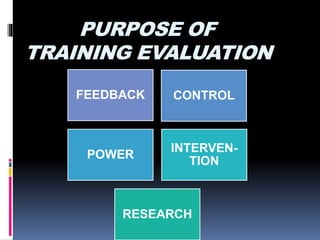
PURPOSE OF
TRAINING EVALUATION
FEEDBACK CONTROL
POWER
INTERVEN-
TION
RESEARCH
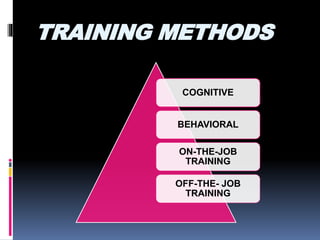
TRAINING METHODS
COGNITIVE
BEHAVIORAL
ON-THE-JOB
TRAINING
OFF-THE- JOB
TRAINING
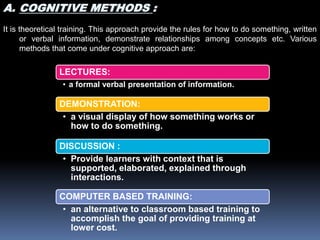
LECTURES:
• a formal verbal presentation of information.
DEMONSTRATION:
• a visual display of how something works or
how to do something.
DISCUSSION :
• Provide learners with context that is
supported, elaborated, explained through
interactions.
COMPUTER BASED TRAINING:
• an alternative to classroom based training to
accomplish the goal of providing training at
lower cost.
A. COGNITIVE METHODS :
It is theoretical training. This approach provide the rules for how to do something, written
or verbal information, demonstrate relationships among concepts etc. Various
methods that come under cognitive approach are:
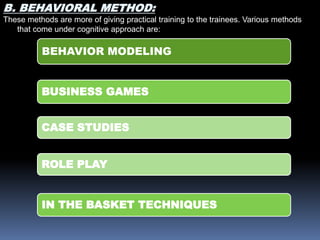
B. BEHAVIORAL METHOD:
These methods are more of giving practical training to the trainees. Various methods
that come under cognitive approach are:
BEHAVIOR MODELING
BUSINESS GAMES
CASE STUDIES
ROLE PLAY
IN THE BASKET TECHNIQUES
OTHER TWO WAYS OF CATEGORIZING
TRAINING METHODS
(1)ON-THE-JOB TRAINING: Under this method, a sales person is instructed
by some experienced sales supervisor. Supervisor demonstrates what he
teaches. He gives oral and written explanations.
 sales person learns job in actual conditions rather than in artificial conditions.
 It is less expensive and less time consuming.
 they learn rules and regulations while learning the job.
(2) OFF-THE-JOB TRAINING: Training is not as a part of every day activity ,
it is conducted by an outsider organization. It is given in artificial conditions
which may just like actual conditions.
 Trainee can learn in short time.
 Trainee can give individual attention as he has no other work assigned to him.
 Trainees can concentrate more on learning.
FROM:
VENU
&
RASU

Sales force training and development 1

  • 1.
  • 2.
    TRAINING  DEFINITION :According to Edward B. Flippo, Training is the act of increasing the knowledge and skill of an employee for doing a particular job.  MEANING : Training is a process of learning sequence of programmed behaviour. It is application of knowledge. It attempts to improve employees performance on the current job ofr prepare them for intended job.
  • 3.
    DEVELOPMENT MEANING: Development is abroad, on going, multi-faceted set of activities to bring some one or an organization upto another threshold of performance, often to perform some job or new role in future.
  • 4.
    DIFFERENCE BETWEEN TRAINING ANDDEVELOPMENT DEVELOPMENT 1. Training can be defined as a systematic procedure for transferring technical know how to the employees . 2. It is a short term process. 3.Training is generally used to train non-managerial personnel. 4.It refers only to instruction in technical and mechanical operations. 1. Development is a broad, on going set of activities to bring some one or an organization up to another threshold of performance. 2. It is a long term process. 3.Development involves managerial personnel. 4.It refers to philosophical and theoretical educational concepts. TRAINING
  • 5.
    5. It focuseson the current job of a sales person. 6. Training focuses on the performance of the individual sales person. 7. A training programme solves the immediate problems of the organization . 5. The development focuses on the current as well as the future job of the sales person. 6. It stresses on the long term goal of organization. 7.Development is concerned with the long-term goal of organization.
  • 6.
    IMPORTANCE OF SALES TRAINING OPTIMUM UTILISATION OF SALES FORCE  DEVELOPMENT OF SALESFORCE  DEVE LOPMENT OF SKILLS OF EMPLOYEES  PRODUCTIVITY  TEAM SPIRIT  ORGANISATION CULTURE  ORGANISATION CLIMATE  HEALTHY WORK ENVIRONMENT  IMPROVES RELATION  REDUCES TURNOVER OF SALES PEOPLE  PROFITABILITY
  • 7.
    LIMITATIONS OF SALES TRAINING 1.• DIFFICULTY IN RETAINING THE TRAINED EMPLOYEE 2. • TRAINING IS A SLOW PROCESS 3. • DIFFICULTY IN ORGANIZING TRAINING PROGRAMME 4. • TIME CONSUMING 5. • SALESMANSHIP IS A MATTER OF PERSONALITY 6. • EXPENSIVE 7. • SHORTAGE OF EFFICIENT TRAINERS
  • 8.
    TRAINING PROCESS TRAINING NEED ANALYSIS DESIGNAND IMPLEMENTATION OF TRAINING PROGRAMME EVALUATION OF A TRAINING PROGRAMME
  • 9.
    A. TRAINING NEED ANALYSIS The purpose of training needs is to determine whether there is a gap between what is required for effective performance and present level of performance of sales people.  It helps to plan the budget of the company, areas where training is needed and also highlights the occasions where training might not be appropriate.
  • 10.
    Training needs arisesat three levels: 1. • ORGANISATIONAL LEVEL 2. • OPERATIONAL LEVEL 3. • INDIVIDUAL LEVEL
  • 11.
    B.TRAINING DESIGN  Thetraining programme can be undertaken only when clear training objectives has been produced. The training objective clears what goal has to be achieved by the end of training programme.  The key areas of training design are: TRAINER TRAINEE TRAINING CLIMATE TRAINING STRATE- GIES TRAINING TOPICS LEARNING STYLE
  • 12.
    TRAINING IMPLEMENTATION  Toput training program into effect according to definite plan or procedure is called training implementation.  Training implementation can be segregated into : i. Practical administrative arrangements ii. Carrying out of the training.
  • 13.
    C. TRAINING EVALUATION  Theprocess of examining a training programme is called training evaluation.  Training evaluation ensures that whether trainees are able to implement their learning in their respective work places or to the regular work routines.
  • 14.
    PURPOSE OF TRAINING EVALUATION FEEDBACKCONTROL POWER INTERVEN- TION RESEARCH
  • 15.
  • 16.
    LECTURES: • a formalverbal presentation of information. DEMONSTRATION: • a visual display of how something works or how to do something. DISCUSSION : • Provide learners with context that is supported, elaborated, explained through interactions. COMPUTER BASED TRAINING: • an alternative to classroom based training to accomplish the goal of providing training at lower cost. A. COGNITIVE METHODS : It is theoretical training. This approach provide the rules for how to do something, written or verbal information, demonstrate relationships among concepts etc. Various methods that come under cognitive approach are:
  • 17.
    B. BEHAVIORAL METHOD: Thesemethods are more of giving practical training to the trainees. Various methods that come under cognitive approach are: BEHAVIOR MODELING BUSINESS GAMES CASE STUDIES ROLE PLAY IN THE BASKET TECHNIQUES
  • 18.
    OTHER TWO WAYSOF CATEGORIZING TRAINING METHODS (1)ON-THE-JOB TRAINING: Under this method, a sales person is instructed by some experienced sales supervisor. Supervisor demonstrates what he teaches. He gives oral and written explanations.  sales person learns job in actual conditions rather than in artificial conditions.  It is less expensive and less time consuming.  they learn rules and regulations while learning the job. (2) OFF-THE-JOB TRAINING: Training is not as a part of every day activity , it is conducted by an outsider organization. It is given in artificial conditions which may just like actual conditions.  Trainee can learn in short time.  Trainee can give individual attention as he has no other work assigned to him.  Trainees can concentrate more on learning.
  • 19.