Operations Management Layout Strategy Chapter 9
Outline Global Company Profile: McDonald’s Strategic Importance of Layout Decisions Types of Layout Fixed-Position Layout Process-Oriented Layout Expert Systems in Layout Work Cells Focused Work Center and the Focused Factory
Outline - continued Office Layout Retail Layout Servicescapes Warehousing and Storage Layouts Cross Docking Random Stocking Customizing Repetitive and Product-Oriented Layout Assembly Line Balancing
Learning Objectives When you complete this chapter, you should be able to : Identify or Define :   Fixed-position layout Process-oriented layout Work cells Focused work center Office layout Retail layout Warehouse layout Product-oriented layout Assembly-line factory
Learning Objectives When you complete this chapter, you should be able to : Describe or explain: How to achieve a good layout for the process facility How to balance production flow in a repetitive or product-oriented facility
McDonald’s - New Kitchen Layout Fifth major innovation - kitchen design No food prepared ahead except patty Elimination of some steps, shortening of others New bun toasting machine (11 seconds vs 30 seconds) Repositioning condiment containers (one motion, not two) Sandwiches assembled in order Production levels controlled by computer Discard only meat when sandwiches do not sell fast enough Savings of $100,000,000 per year in food costs
Objectives of the Layout Strategy Develop an economical layout which will meet the requirements of: product design and volume (product strategy) process equipment and capacity (process strategy) quality of work life (human resource strategy) building and site constraints (location strategy)
Types of Layouts Fixed-position layout Process-oriented layout Office layout Retail layout Warehouse layout Product-oriented layout
What is Facility Layout Location or arrangement of everything within & around buildings Objectives are to maximize Customer satisfaction  Utilization of space, equipment, & people Efficient flow of information, material, & people Employee morale & safety
Strategic Importance of Layout Proper layout enables : Higher utilization of space, equipment,and people Improved flow of information, materials, or people Improved employee morale and safer working conditions Improved customer/client interaction Flexibility
Six Layout Strategies Fixed-position layout large bulky projects such as ships and  buildings Process-oriented layout deals with low-volume, high-variety production (“job shop”, intermittent production) Office layout positions workers, their equipment, and  spaces/offices to provide for movement of information
Six Layout Strategies - continued Retail/service layout allocates shelf space and responds to customer behavior Warehouse layout addresses trade-offs between space and material handling Product-oriented layout seeks the best personnel and machine use in repetitive or continuous production
Layout Strategies Project (fixed-position) Job Shop (Process- oriented) Office Retail Warehouse (storage) Repetitive /Continuous (product- oriented) Examples Pittsburgh Airport Problem Ingal Ship Building Corp. Trump Plaza Shouldice Hospital Olive Garden Allstate Insurance Microsoft Kroger’s Supermarket Walgreens Bloomingdales Federal-Mogul’s Warehouse The Gap’s distribution center Sony’s TV Assembly Line Dodge Caravans Move material to the limited storage areas around the site Manage varied material flow for each product Locate workers requiring frequent contact close to each other Expose customer to high-margin items Balance low-cost storage with low-cost material handling Equalize the task time at each workstation
Layout Example
Requirements of a Good Layout an understanding of capacity and space requirements selection of appropriate material handling equipment decisions regarding environment and aesthetics identification and understanding of the requirements for information flow identification of the cost of moving between the various work areas
Constraints on Layout Objectives Product design & volume Process equipment & capacity Quality of work life Building and site
Layout Strategies, Examples, and Criteria Service/retail Drug store Grocery store Department store Expose customer to high margin items Storage Distributor Warehouse Minimize storage and handling costs Product oriented TV assembly line Minimize line imbalance, delay, and idle time Layout strategy  Example   Criteria
Areas of Concern in Layout Strategy Layout Strategy Material Flow Communication Work Cell Safety Material Attributes Warehousing Service Areas
Fixed-Position Layout Design is for stationary project  Workers and equipment come to site Complicating factors Limited space at site Changing material needs
Factors Complicating a Fixed Position Layout There is limited space at virtually all  sites At different stages in the construction  process, different materials are  needed – therefore, different items  become critical as the project  develops The volume of materials needed is  dynamic
Process-Oriented Layout Design places departments with large flows of material or people together Department areas having similar processes located in close proximity e.g., All x-ray machines in same area Used with process-focused processes
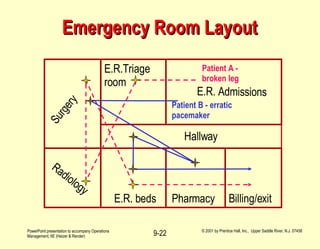
Emergency Room Layout Surgery Radiology E.R. beds Pharmacy Billing/exit E.R.Triage room E.R. Admissions Patient B - erratic pacemaker Patient A - broken leg Hallway
Steps in Developing a  Process-Oriented Layout Construct a “from-to matrix” Determine space requirements for each department Develop an initial schematic diagram Determine the cost of this layout By trial-and-error (or more sophisticated means), try to improve the initial layout Prepare a detailed plan that evaluates factors in addition to transportation cost
Cost of Process-Oriented Layout
Interdepartmental Flow of Parts 1 2 3 4 5 6 1 2 3 4 5 6 50 100 0 0 20 30 50 10 0 20 0 100 50 0 0
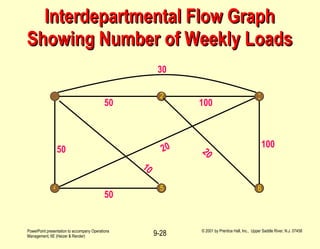
Interdepartmental Flow Graph Showing Number of Weekly Loads 100 50 30 10 20 50 20 100 50 1 2 3 4 5 6
Possible Layout 1 Room 1 Room 2 Room 2 Room 4 Room 5 Room 6 60’ 40’
Interdepartmental Flow Graph Showing Number of Weekly Loads 100 50 30 10 20 50 20 100 50 1 2 3 4 5 6
Possible Layout 2 Room 1 Room 2 Room 2 Room 4 Room 5 Room 6 60’ 40’
Computer Programs to Assist in Layout CRAFT SPACECRAFT CRAFT 3-D MULTIPLE CORELAP ALDEP COFAD FADES -  expert system
Cellular Layout - Work Cells Special case of product-oriented layout - in what is ordinarily a process-oriented facility Consists of  different   machines brought together to make a product Temporary arrangement only Example: Assembly line set up to produce 3000 identical parts in a job shop
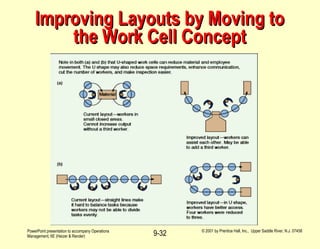
Improving Layouts by Moving to the Work Cell Concept
Work Cells - Some Advantages Reduced work-in-process inventory Less floor space required Reduced raw material and finished goods inventories required Reduced direct labor costs Heightened sense of employee participation Increased utilization of equipment machinery Reduced investment in machinery and equipment Note: Green & Sadowski report increased capital investment and lower machine utilization
Work Cell Advantages Inventory Floor space Direct labor costs Equipment utilization Employee participation Quality
Work Cell Floor Plan Office Tool Room Work Cell Saws Drills
Requirements for Cellular Production Identification of families of products - group technology codes High level of training and flexibility on the part of the employees Either staff support or flexible, imaginative employees to establish the work cells initially
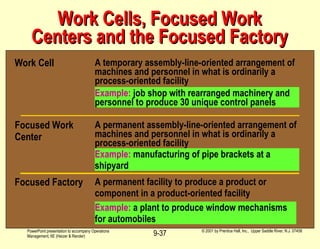
Work Cells, Focused Work Centers and the Focused Factory Work Cell A temporary assembly-line-oriented arrangement of machines and personnel in what is ordinarily a process-oriented facility Example:  job shop with rearranged machinery and personnel to produce 30 unique control panels Focused Work Center A permanent assembly-line-oriented arrangement of machines and personnel in what is ordinarily a process-oriented facility Example:  manufacturing of pipe brackets at a shipyard Focused Factory A permanent facility to produce a product or component in a product-oriented facility Example:  a plant to produce window mechanisms for automobiles
Number of Product Lines and Operating Performance -5 0 5 10 15 Sales ($M) 100 D(6) J(1) I(2) G(1) H(2) K(2) More focused plants E(4) A(6) F(6) C(5) B(5) Less focused plants
Office Layout Design positions people, equipment, & offices for maximum information flow Arranged by process or product Example: Payroll dept. is by process Relationship chart used Examples Insurance company Software company © 1995 Corel Corp.
Office Layout Floor Plan Accounting Manager Brand X Finance Fin. Acct.
Relationship Chart 1 President O 2 Costing U A A 3 Engineering I O 4 President’s Secretary 1 2 3 Ordinary closeness: President (1) & Costing (2) Absolutely necessary: President (1) & Secretary (4)   4 I = Important U = Unimportant
Retail/Service Layout Design maximizes product exposure to customers Decision variables Store flow pattern Allocation of (shelf) space to products  Types Grid design Free-flow design Video
Retail Layouts -  Some Rules of Thumb Locate high-draw items around the periphery of the store Use prominent locations such as the first or last aisle for high-impulse and high margin items Remove crossover aisles that allow customers the opportunity to move between aisles Distribute what are known in the trade as “power items” (items that may dominate a shopping trip) to both sides of an aisle, and disperse them to increase the viewing of other items Use end aisle locations because they have a very high exposure rate
Retail /Service Layout - Grid Design Office Carts Check- out Grocery Store Meat Bread Milk Produce Frozen Foods
Store Layout - with Dairy, Bread, High Drawer Items in Corners
Retail/Service Layout -  Free-Flow Design Feature Display Table Trans. Counter Apparel Store
Retail Store Shelf Space Planogram Computerized tool for shelf-space management Generated from store’s scanner data on sales Often supplied by manufacturer Example: P&G 2 ft . 5   facings VO-5 VO-5 VO-5 SUAVE SUAVE VO-5 PERT PERT PERT PERT PERT VO-5
A Good Service Layout (Servicescape) Considers Ambient conditions  - background characteristics such as lighting, sound, smell, and temperature. Spatial layout and functionality  - which involve customer circulation path planning Signs, Symbols, and Artifacts  - characteristics of building design that carry social significance
Warehouse Layout Design balances space (cube) utilization & handling cost Similar to process layout Items moved between dock  & various storage areas Optimum layout depends on Variety of items  stored Number of items picked
Warehouse Layout Floor Plan Zones Conveyor Truck Order Picker
Cross Docking Transferring goods  from  incoming  trucks at receiving docks  to  outgoing  trucks at shipping docks Avoids placing goods into storage Requires suppliers provide effective addressing (bar codes) and packaging that provides for rapid transhipment In-coming Outgoing © 1984-1994 T/Maker Co. © 1995 Corel Corp.
Random Stocking Systems Often: Maintain a list of “open” locations Maintain accurate records of existing inventory and its locations Sequence items on orders to minimize travel time required to pick orders Combine orders to reduce picking time Assign certain items or classes of items, such as high usage items, to particular warehouse areas so that distance traveled is minimized
Product-Oriented Layout Facility organized around product Design minimizes line imbalance Delay between work stations Types: Fabrication line; assembly line
Product-Oriented Requirements Standardized product High production volume Stable production quantities Uniform quality of raw materials & components
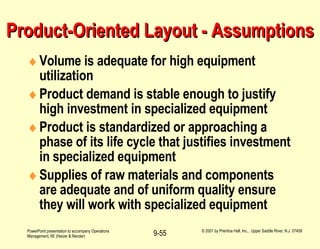
Product-Oriented Layout - Assumptions Volume is adequate for high equipment utilization Product demand is stable enough to justify high investment in specialized equipment Product is standardized or approaching a phase of its life cycle that justifies investment in specialized equipment Supplies of raw materials and components are adequate and of uniform quality ensure they will work with specialized equipment
Product-Oriented Layout Types Assembles fabricated parts Uses workstation Repetitive process Paced by tasks Balanced by moving tasks Builds components Uses series of machines Repetitive process Machine paced Balanced by physical redesign Fabrication Line Assembly Line
Product-Oriented Layout Advantages Lower variable cost per unit Lower material handling costs Lower work-in-process inventories Easier training & supervision
Product-Oriented Layout Disadvantages Higher capital investment Special equipment Any work stoppage stops whole process Lack of flexibility Volume Product
An Assembly Line Layout
Repetitive Layout 1 3 2 4 5 Work Office Belt Conveyor Work Station Note: 5 tasks or operations; 3 work stations Work Station Station
Assembly Line Balancing Analysis of production lines Nearly equally divides work between workstations while meeting required output Objectives Maximize efficiency Minimize number of  work stations
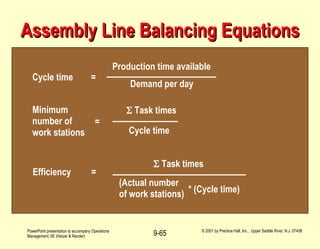
Assembly Line Balancing The General Procedure Determine cycle time by taking the demand (or production rate) per day and dividing it into the productive time available per day Calculate the theoretical minimum number of work stations by dividing total task time by cycle time Perform the line balance and assign specific assembly tasks to each work station
Assembly Line Balancing Steps 1. Determine tasks (operations) 2. Determine sequence 3. Draw precedence diagram 4. Estimate task times 5. Calculate cycle time  6. Calculate number of work stations 7. Assign tasks  8. Calculate efficiency
Precedence Diagram Example A B E H C D F G I 10 Min. 5 11 12 3 7 3 4 11
Assembly Line Balancing Equations Cycle time  =  Production time available Demand per day Minimum number of work stations     Task times Cycle time Efficiency  = =    Task times * (Cycle time) (Actual number of work stations)
Six Station Solution A B C E D F G I H 10 11 5 3 7 3 11 12
Layout Heuristics for Assigning Tasks in Assembly Line Balancing Longest task time  - choose task with longest operation time Most following tasks  - choose task with largest number of following tasks Ranked positional  weight   - choose task where the sum of the times for each following task is longest Shortest task time  - choose task with shortest operation time Least number of following tasks  - choose task with fewest subsequent tasks

Ch09

  • 1.
    Operations Management LayoutStrategy Chapter 9
  • 2.
    Outline Global CompanyProfile: McDonald’s Strategic Importance of Layout Decisions Types of Layout Fixed-Position Layout Process-Oriented Layout Expert Systems in Layout Work Cells Focused Work Center and the Focused Factory
  • 3.
    Outline - continuedOffice Layout Retail Layout Servicescapes Warehousing and Storage Layouts Cross Docking Random Stocking Customizing Repetitive and Product-Oriented Layout Assembly Line Balancing
  • 4.
    Learning Objectives Whenyou complete this chapter, you should be able to : Identify or Define : Fixed-position layout Process-oriented layout Work cells Focused work center Office layout Retail layout Warehouse layout Product-oriented layout Assembly-line factory
  • 5.
    Learning Objectives Whenyou complete this chapter, you should be able to : Describe or explain: How to achieve a good layout for the process facility How to balance production flow in a repetitive or product-oriented facility
  • 6.
    McDonald’s - NewKitchen Layout Fifth major innovation - kitchen design No food prepared ahead except patty Elimination of some steps, shortening of others New bun toasting machine (11 seconds vs 30 seconds) Repositioning condiment containers (one motion, not two) Sandwiches assembled in order Production levels controlled by computer Discard only meat when sandwiches do not sell fast enough Savings of $100,000,000 per year in food costs
  • 7.
    Objectives of theLayout Strategy Develop an economical layout which will meet the requirements of: product design and volume (product strategy) process equipment and capacity (process strategy) quality of work life (human resource strategy) building and site constraints (location strategy)
  • 8.
    Types of LayoutsFixed-position layout Process-oriented layout Office layout Retail layout Warehouse layout Product-oriented layout
  • 9.
    What is FacilityLayout Location or arrangement of everything within & around buildings Objectives are to maximize Customer satisfaction Utilization of space, equipment, & people Efficient flow of information, material, & people Employee morale & safety
  • 10.
    Strategic Importance ofLayout Proper layout enables : Higher utilization of space, equipment,and people Improved flow of information, materials, or people Improved employee morale and safer working conditions Improved customer/client interaction Flexibility
  • 11.
    Six Layout StrategiesFixed-position layout large bulky projects such as ships and buildings Process-oriented layout deals with low-volume, high-variety production (“job shop”, intermittent production) Office layout positions workers, their equipment, and spaces/offices to provide for movement of information
  • 12.
    Six Layout Strategies- continued Retail/service layout allocates shelf space and responds to customer behavior Warehouse layout addresses trade-offs between space and material handling Product-oriented layout seeks the best personnel and machine use in repetitive or continuous production
  • 13.
    Layout Strategies Project(fixed-position) Job Shop (Process- oriented) Office Retail Warehouse (storage) Repetitive /Continuous (product- oriented) Examples Pittsburgh Airport Problem Ingal Ship Building Corp. Trump Plaza Shouldice Hospital Olive Garden Allstate Insurance Microsoft Kroger’s Supermarket Walgreens Bloomingdales Federal-Mogul’s Warehouse The Gap’s distribution center Sony’s TV Assembly Line Dodge Caravans Move material to the limited storage areas around the site Manage varied material flow for each product Locate workers requiring frequent contact close to each other Expose customer to high-margin items Balance low-cost storage with low-cost material handling Equalize the task time at each workstation
  • 14.
  • 15.
    Requirements of aGood Layout an understanding of capacity and space requirements selection of appropriate material handling equipment decisions regarding environment and aesthetics identification and understanding of the requirements for information flow identification of the cost of moving between the various work areas
  • 16.
    Constraints on LayoutObjectives Product design & volume Process equipment & capacity Quality of work life Building and site
  • 17.
    Layout Strategies, Examples,and Criteria Service/retail Drug store Grocery store Department store Expose customer to high margin items Storage Distributor Warehouse Minimize storage and handling costs Product oriented TV assembly line Minimize line imbalance, delay, and idle time Layout strategy Example Criteria
  • 18.
    Areas of Concernin Layout Strategy Layout Strategy Material Flow Communication Work Cell Safety Material Attributes Warehousing Service Areas
  • 19.
    Fixed-Position Layout Designis for stationary project Workers and equipment come to site Complicating factors Limited space at site Changing material needs
  • 20.
    Factors Complicating aFixed Position Layout There is limited space at virtually all sites At different stages in the construction process, different materials are needed – therefore, different items become critical as the project develops The volume of materials needed is dynamic
  • 21.
    Process-Oriented Layout Designplaces departments with large flows of material or people together Department areas having similar processes located in close proximity e.g., All x-ray machines in same area Used with process-focused processes
  • 22.
    Emergency Room LayoutSurgery Radiology E.R. beds Pharmacy Billing/exit E.R.Triage room E.R. Admissions Patient B - erratic pacemaker Patient A - broken leg Hallway
  • 23.
    Steps in Developinga Process-Oriented Layout Construct a “from-to matrix” Determine space requirements for each department Develop an initial schematic diagram Determine the cost of this layout By trial-and-error (or more sophisticated means), try to improve the initial layout Prepare a detailed plan that evaluates factors in addition to transportation cost
  • 24.
  • 25.
    Interdepartmental Flow ofParts 1 2 3 4 5 6 1 2 3 4 5 6 50 100 0 0 20 30 50 10 0 20 0 100 50 0 0
  • 26.
    Interdepartmental Flow GraphShowing Number of Weekly Loads 100 50 30 10 20 50 20 100 50 1 2 3 4 5 6
  • 27.
    Possible Layout 1Room 1 Room 2 Room 2 Room 4 Room 5 Room 6 60’ 40’
  • 28.
    Interdepartmental Flow GraphShowing Number of Weekly Loads 100 50 30 10 20 50 20 100 50 1 2 3 4 5 6
  • 29.
    Possible Layout 2Room 1 Room 2 Room 2 Room 4 Room 5 Room 6 60’ 40’
  • 30.
    Computer Programs toAssist in Layout CRAFT SPACECRAFT CRAFT 3-D MULTIPLE CORELAP ALDEP COFAD FADES - expert system
  • 31.
    Cellular Layout -Work Cells Special case of product-oriented layout - in what is ordinarily a process-oriented facility Consists of different machines brought together to make a product Temporary arrangement only Example: Assembly line set up to produce 3000 identical parts in a job shop
  • 32.
    Improving Layouts byMoving to the Work Cell Concept
  • 33.
    Work Cells -Some Advantages Reduced work-in-process inventory Less floor space required Reduced raw material and finished goods inventories required Reduced direct labor costs Heightened sense of employee participation Increased utilization of equipment machinery Reduced investment in machinery and equipment Note: Green & Sadowski report increased capital investment and lower machine utilization
  • 34.
    Work Cell AdvantagesInventory Floor space Direct labor costs Equipment utilization Employee participation Quality
  • 35.
    Work Cell FloorPlan Office Tool Room Work Cell Saws Drills
  • 36.
    Requirements for CellularProduction Identification of families of products - group technology codes High level of training and flexibility on the part of the employees Either staff support or flexible, imaginative employees to establish the work cells initially
  • 37.
    Work Cells, FocusedWork Centers and the Focused Factory Work Cell A temporary assembly-line-oriented arrangement of machines and personnel in what is ordinarily a process-oriented facility Example: job shop with rearranged machinery and personnel to produce 30 unique control panels Focused Work Center A permanent assembly-line-oriented arrangement of machines and personnel in what is ordinarily a process-oriented facility Example: manufacturing of pipe brackets at a shipyard Focused Factory A permanent facility to produce a product or component in a product-oriented facility Example: a plant to produce window mechanisms for automobiles
  • 38.
    Number of ProductLines and Operating Performance -5 0 5 10 15 Sales ($M) 100 D(6) J(1) I(2) G(1) H(2) K(2) More focused plants E(4) A(6) F(6) C(5) B(5) Less focused plants
  • 39.
    Office Layout Designpositions people, equipment, & offices for maximum information flow Arranged by process or product Example: Payroll dept. is by process Relationship chart used Examples Insurance company Software company © 1995 Corel Corp.
  • 40.
    Office Layout FloorPlan Accounting Manager Brand X Finance Fin. Acct.
  • 41.
    Relationship Chart 1President O 2 Costing U A A 3 Engineering I O 4 President’s Secretary 1 2 3 Ordinary closeness: President (1) & Costing (2) Absolutely necessary: President (1) & Secretary (4) 4 I = Important U = Unimportant
  • 42.
    Retail/Service Layout Designmaximizes product exposure to customers Decision variables Store flow pattern Allocation of (shelf) space to products Types Grid design Free-flow design Video
  • 43.
    Retail Layouts - Some Rules of Thumb Locate high-draw items around the periphery of the store Use prominent locations such as the first or last aisle for high-impulse and high margin items Remove crossover aisles that allow customers the opportunity to move between aisles Distribute what are known in the trade as “power items” (items that may dominate a shopping trip) to both sides of an aisle, and disperse them to increase the viewing of other items Use end aisle locations because they have a very high exposure rate
  • 44.
    Retail /Service Layout- Grid Design Office Carts Check- out Grocery Store Meat Bread Milk Produce Frozen Foods
  • 45.
    Store Layout -with Dairy, Bread, High Drawer Items in Corners
  • 46.
    Retail/Service Layout - Free-Flow Design Feature Display Table Trans. Counter Apparel Store
  • 47.
    Retail Store ShelfSpace Planogram Computerized tool for shelf-space management Generated from store’s scanner data on sales Often supplied by manufacturer Example: P&G 2 ft . 5 facings VO-5 VO-5 VO-5 SUAVE SUAVE VO-5 PERT PERT PERT PERT PERT VO-5
  • 48.
    A Good ServiceLayout (Servicescape) Considers Ambient conditions - background characteristics such as lighting, sound, smell, and temperature. Spatial layout and functionality - which involve customer circulation path planning Signs, Symbols, and Artifacts - characteristics of building design that carry social significance
  • 49.
    Warehouse Layout Designbalances space (cube) utilization & handling cost Similar to process layout Items moved between dock & various storage areas Optimum layout depends on Variety of items stored Number of items picked
  • 50.
    Warehouse Layout FloorPlan Zones Conveyor Truck Order Picker
  • 51.
    Cross Docking Transferringgoods from incoming trucks at receiving docks to outgoing trucks at shipping docks Avoids placing goods into storage Requires suppliers provide effective addressing (bar codes) and packaging that provides for rapid transhipment In-coming Outgoing © 1984-1994 T/Maker Co. © 1995 Corel Corp.
  • 52.
    Random Stocking SystemsOften: Maintain a list of “open” locations Maintain accurate records of existing inventory and its locations Sequence items on orders to minimize travel time required to pick orders Combine orders to reduce picking time Assign certain items or classes of items, such as high usage items, to particular warehouse areas so that distance traveled is minimized
  • 53.
    Product-Oriented Layout Facilityorganized around product Design minimizes line imbalance Delay between work stations Types: Fabrication line; assembly line
  • 54.
    Product-Oriented Requirements Standardizedproduct High production volume Stable production quantities Uniform quality of raw materials & components
  • 55.
    Product-Oriented Layout -Assumptions Volume is adequate for high equipment utilization Product demand is stable enough to justify high investment in specialized equipment Product is standardized or approaching a phase of its life cycle that justifies investment in specialized equipment Supplies of raw materials and components are adequate and of uniform quality ensure they will work with specialized equipment
  • 56.
    Product-Oriented Layout TypesAssembles fabricated parts Uses workstation Repetitive process Paced by tasks Balanced by moving tasks Builds components Uses series of machines Repetitive process Machine paced Balanced by physical redesign Fabrication Line Assembly Line
  • 57.
    Product-Oriented Layout AdvantagesLower variable cost per unit Lower material handling costs Lower work-in-process inventories Easier training & supervision
  • 58.
    Product-Oriented Layout DisadvantagesHigher capital investment Special equipment Any work stoppage stops whole process Lack of flexibility Volume Product
  • 59.
  • 60.
    Repetitive Layout 13 2 4 5 Work Office Belt Conveyor Work Station Note: 5 tasks or operations; 3 work stations Work Station Station
  • 61.
    Assembly Line BalancingAnalysis of production lines Nearly equally divides work between workstations while meeting required output Objectives Maximize efficiency Minimize number of work stations
  • 62.
    Assembly Line BalancingThe General Procedure Determine cycle time by taking the demand (or production rate) per day and dividing it into the productive time available per day Calculate the theoretical minimum number of work stations by dividing total task time by cycle time Perform the line balance and assign specific assembly tasks to each work station
  • 63.
    Assembly Line BalancingSteps 1. Determine tasks (operations) 2. Determine sequence 3. Draw precedence diagram 4. Estimate task times 5. Calculate cycle time 6. Calculate number of work stations 7. Assign tasks 8. Calculate efficiency
  • 64.
    Precedence Diagram ExampleA B E H C D F G I 10 Min. 5 11 12 3 7 3 4 11
  • 65.
    Assembly Line BalancingEquations Cycle time = Production time available Demand per day Minimum number of work stations  Task times Cycle time Efficiency = =  Task times * (Cycle time) (Actual number of work stations)
  • 66.
    Six Station SolutionA B C E D F G I H 10 11 5 3 7 3 11 12
  • 67.
    Layout Heuristics forAssigning Tasks in Assembly Line Balancing Longest task time - choose task with longest operation time Most following tasks - choose task with largest number of following tasks Ranked positional weight - choose task where the sum of the times for each following task is longest Shortest task time - choose task with shortest operation time Least number of following tasks - choose task with fewest subsequent tasks