Chapter 6 Stacks
Chapter Objectives Examine stack processing Define a stack abstract data type Demonstrate how a stack can be used to solve problems Examine various stack implementations Compare stack implementations
Stacks A  stack  is a linear collection whose elements are added and removed from one end A stack is  LIFO  – last in, first out The last element to be put on the stack is the first element to be removed A stack is usually depicted vertically, with additions and deletions occurring at the  top  of the stack
FIGURE 6.1   A conceptual view of a stack
FIGURE 6.2   The operations on a stack
FIGURE 6.3   The StackADT interface in UML
Listing 6.1
Using Stacks Stacks are particularly helpful when solving certain types of problems Consider the  undo  operation in an application keeps track of the most recent operations in reverse order
Postfix Expressions Let's examine a program that uses a stack to evaluate  postfix  expressions In a postfix expression, the operator comes after its two operands We generally use  infix  notation, with parentheses to force precedence: (3 + 4) * 2 In postfix notation, this would be written 3  4  +  2  *
Postfix Expressions To evaluate a postfix expression: scan from left to right, determining if the next token is an operator or operand if it is an operand, push it on the stack if it is an operator, pop the stack twice to get the two operands, perform the operation, and push the result onto the stack At the end, there will be one value on the stack, which is the value of the expression
FIGURE 6.4   Using a stack to evaluate a postfix expression
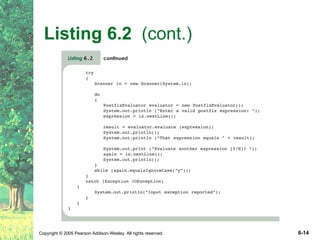
Postfix Expressions To simplify the example, let's assume the operands to the expressions are integer literals Our solution uses an  ArrayStack , though any implementation of a stack would suffice
Listing 6.2
Listing 6.2   (cont.)
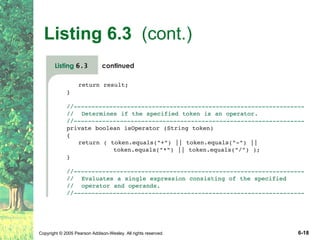
Listing 6.3
Listing 6.3   (cont.)
FIGURE 6.5   A UML class diagram for the postfix expression program
Using Stacks - Traversing a Maze A classic use of a stack is to keep track of alternatives in maze traversal or other trial and error algorithms Using a stack in this way simulates recursion  Recursion is when a method calls itself either directly or indirectly
Using Stacks - Traversing a Maze Run-time environments keep track of method calls by placing an activation record for each called method on the run-time stack When a method completes execution, it is popped from the stack and control returns to the method that called it Which is now the activation record on the top of the stack
Using Stacks - Traversing a Maze In this manner, we can traverse a maze by trial and error by using a stack to keep track of moves that have not yet been tried
Listing 6.4
Listing 6.4   (cont.)
Listing 6.5
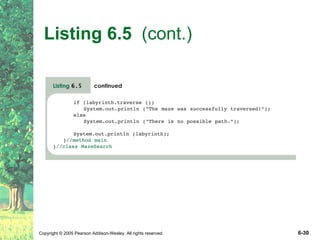
Listing 6.5   (cont.)
The  LinkedStack  Class Now let's examine a linked implementation of a stack We will reuse the  LinearNode  class that we used in Chapter 3 to define the linked implementation of a set collection Internally, a stack is represented as a linked list of nodes, with a reference to the top of the stack and an integer count of the number of nodes in the stack
FIGURE 6.6   A linked implementation of a stack
LinkedStack - the push Operation
FIGURE 6.7  The stack after pushing element E
LinkedStack - the pop Operation
FIGURE 6.8   The stack after a pop operation
The  ArrayStack  Class Now let's examine an array-based implementation of a stack We'll make the following design decisions: maintain an array of  Object  references the bottom of the stack is at index 0 the elements of the stack are in order and contiguous an integer variable  top  stores the index of the next available slot in the array This approach allows the stack to grow and shrink at the higher indexes
FIGURE 6.9   An array implementation of a stack
ArrayStack - the push Operation //----------------------------------------------------------------- //  Adds the specified element to the top of the stack, expanding //  the capacity of the stack array if necessary. //----------------------------------------------------------------- public void push (T element) { if (size() == stack.length)  expandCapacity(); stack[top] = element; top++; }
FIGURE 6.10  The stack after pushing element E
ArrayStack - the pop Operation
FIGURE 6.11   The stack after popping the top element
The  java.util.Stack  Class The Java Collections framework defines a  Stack  class with similar operations It is derived from the  Vector  class and therefore has some characteristics that are not appropriate for a pure stack The  java.util.Stack  class has been around since the original version of Java, and has been retrofitted to meld with the Collections framework
FIGURE 6.12   A UML description  of the java.util.Stack class
Analysis of Stack Operations Because stack operations all work on one end of the collection, they are generally efficient The  push  and  pop  operations, for both linked and array implementations, are O(1) Likewise, the other operations for all implementations are O(1) We'll see that other collections (which don't have that characteristic) aren't as efficient for all operations

Ch06 Stack

  • 1.
  • 2.
    Chapter Objectives Examinestack processing Define a stack abstract data type Demonstrate how a stack can be used to solve problems Examine various stack implementations Compare stack implementations
  • 3.
    Stacks A stack is a linear collection whose elements are added and removed from one end A stack is LIFO – last in, first out The last element to be put on the stack is the first element to be removed A stack is usually depicted vertically, with additions and deletions occurring at the top of the stack
  • 4.
    FIGURE 6.1 A conceptual view of a stack
  • 5.
    FIGURE 6.2 The operations on a stack
  • 6.
    FIGURE 6.3 The StackADT interface in UML
  • 7.
  • 8.
    Using Stacks Stacksare particularly helpful when solving certain types of problems Consider the undo operation in an application keeps track of the most recent operations in reverse order
  • 9.
    Postfix Expressions Let'sexamine a program that uses a stack to evaluate postfix expressions In a postfix expression, the operator comes after its two operands We generally use infix notation, with parentheses to force precedence: (3 + 4) * 2 In postfix notation, this would be written 3 4 + 2 *
  • 10.
    Postfix Expressions Toevaluate a postfix expression: scan from left to right, determining if the next token is an operator or operand if it is an operand, push it on the stack if it is an operator, pop the stack twice to get the two operands, perform the operation, and push the result onto the stack At the end, there will be one value on the stack, which is the value of the expression
  • 11.
    FIGURE 6.4 Using a stack to evaluate a postfix expression
  • 12.
    Postfix Expressions Tosimplify the example, let's assume the operands to the expressions are integer literals Our solution uses an ArrayStack , though any implementation of a stack would suffice
  • 13.
  • 14.
    Listing 6.2 (cont.)
  • 15.
  • 16.
    Listing 6.3 (cont.)
  • 17.
    Listing 6.3 (cont.)
  • 18.
    Listing 6.3 (cont.)
  • 19.
    Listing 6.3 (cont.)
  • 20.
    FIGURE 6.5 A UML class diagram for the postfix expression program
  • 21.
    Using Stacks -Traversing a Maze A classic use of a stack is to keep track of alternatives in maze traversal or other trial and error algorithms Using a stack in this way simulates recursion Recursion is when a method calls itself either directly or indirectly
  • 22.
    Using Stacks -Traversing a Maze Run-time environments keep track of method calls by placing an activation record for each called method on the run-time stack When a method completes execution, it is popped from the stack and control returns to the method that called it Which is now the activation record on the top of the stack
  • 23.
    Using Stacks -Traversing a Maze In this manner, we can traverse a maze by trial and error by using a stack to keep track of moves that have not yet been tried
  • 24.
  • 25.
    Listing 6.4 (cont.)
  • 26.
    Listing 6.4 (cont.)
  • 27.
    Listing 6.4 (cont.)
  • 28.
    Listing 6.4 (cont.)
  • 29.
  • 30.
    Listing 6.5 (cont.)
  • 31.
    The LinkedStack Class Now let's examine a linked implementation of a stack We will reuse the LinearNode class that we used in Chapter 3 to define the linked implementation of a set collection Internally, a stack is represented as a linked list of nodes, with a reference to the top of the stack and an integer count of the number of nodes in the stack
  • 32.
    FIGURE 6.6 A linked implementation of a stack
  • 33.
    LinkedStack - thepush Operation
  • 34.
    FIGURE 6.7 The stack after pushing element E
  • 35.
    LinkedStack - thepop Operation
  • 36.
    FIGURE 6.8 The stack after a pop operation
  • 37.
    The ArrayStack Class Now let's examine an array-based implementation of a stack We'll make the following design decisions: maintain an array of Object references the bottom of the stack is at index 0 the elements of the stack are in order and contiguous an integer variable top stores the index of the next available slot in the array This approach allows the stack to grow and shrink at the higher indexes
  • 38.
    FIGURE 6.9 An array implementation of a stack
  • 39.
    ArrayStack - thepush Operation //----------------------------------------------------------------- // Adds the specified element to the top of the stack, expanding // the capacity of the stack array if necessary. //----------------------------------------------------------------- public void push (T element) { if (size() == stack.length) expandCapacity(); stack[top] = element; top++; }
  • 40.
    FIGURE 6.10 The stack after pushing element E
  • 41.
    ArrayStack - thepop Operation
  • 42.
    FIGURE 6.11 The stack after popping the top element
  • 43.
    The java.util.Stack Class The Java Collections framework defines a Stack class with similar operations It is derived from the Vector class and therefore has some characteristics that are not appropriate for a pure stack The java.util.Stack class has been around since the original version of Java, and has been retrofitted to meld with the Collections framework
  • 44.
    FIGURE 6.12 A UML description of the java.util.Stack class
  • 45.
    Analysis of StackOperations Because stack operations all work on one end of the collection, they are generally efficient The push and pop operations, for both linked and array implementations, are O(1) Likewise, the other operations for all implementations are O(1) We'll see that other collections (which don't have that characteristic) aren't as efficient for all operations