Governmental
Accounting
from
Easy Street to
Life in the Fast
Lane
Agenda
Modified Accrual vs. Full Accrual
• Governmental Funds
• Government Wide
Reconciliations
• Balance Sheet to the Statement of Net Position
• Statement of Revenues and Expenditures to the Statement
of Activities
2
Basis of Accounting
3
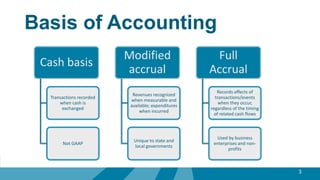
Cash basis
Transactions recorded
when cash is
exchanged
Not GAAP
Modified
accrual
Revenues recognized
when measurable and
available; expenditures
when incurred
Unique to state and
local governments
Full
Accrual
Records effects of
transactions/events
when they occur,
regardless of the timing
of related cash flows
Used by business
enterprises and non-
profits
Overview
4
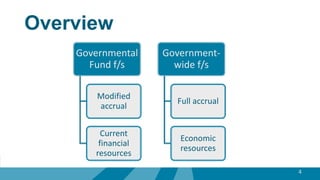
Governmental
Fund f/s
Modified
accrual
Current
financial
resources
Government-
wide f/s
Full accrual
Economic
resources
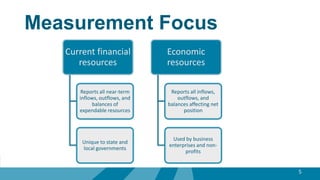
Measurement Focus
5
Current financial
resources
Reports all near-term
inflows, outflows, and
balances of
expendable resources
Unique to state and
local governments
Economic
resources
Reports all inflows,
outflows, and
balances affecting net
position
Used by business
enterprises and non-
profits
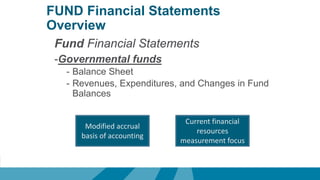
FUND Financial Statements
Overview
Fund Financial Statements
-Governmental funds
- Balance Sheet
- Revenues, Expenditures, and Changes in Fund
Balances
Modified accrual
basis of accounting
Current financial
resources
measurement focus
FUND Financial Statements
Overview
The fund financial statements focus on
near-term inflows of spendable
resources and are useful in evaluating
the government’s near-term financing
requirements.
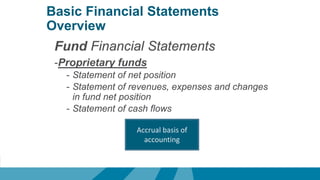
Basic Financial Statements
Overview
Fund Financial Statements
-Proprietary funds
- Statement of net position
- Statement of revenues, expenses and changes
in fund net position
- Statement of cash flows
Accrual basis of
accounting
Statement of Revenues and
Expenditures
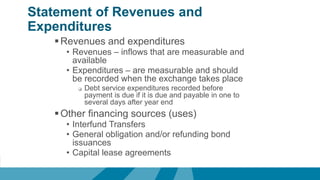
Revenues and expenditures
• Revenues – inflows that are measurable and
available
• Expenditures – are measurable and should
be recorded when the exchange takes place
 Debt service expenditures recorded before
payment is due if it is due and payable in one to
several days after year end
Other financing sources (uses)
• Interfund Transfers
• General obligation and/or refunding bond
issuances
• Capital lease agreements
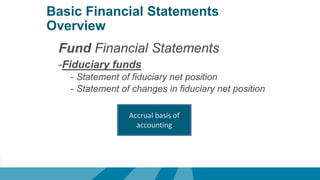
Basic Financial Statements
Overview
Fund Financial Statements
-Fiduciary funds
- Statement of fiduciary net position
- Statement of changes in fiduciary net position
Accrual basis of
accounting
Government-wide Financial
Statements Overview
- Statement of Net Position
- Statement of Activities
Government-wide Financial Statements
Accrual basis of
accounting
Economic resources
measurement focus
GASB Statement No. 34
Government-wide financial statements
help users…
Assess the finances of the government in its
entirety
See the cost of providing services to its
citizenry
Understand the extent to which the
government has invested its capital assets,
including buildings, equipment, and
infrastructure
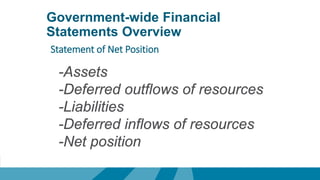
Government-wide Financial
Statements Overview
-Assets
-Deferred outflows of resources
-Liabilities
-Deferred inflows of resources
-Net position
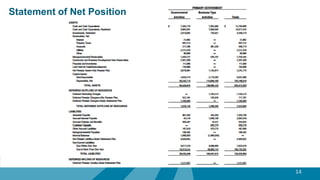
Statement of Net Position
14
Statement of Net Position
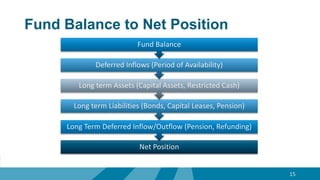
Fund Balance to Net Position
15
Net Position
Long Term Deferred Inflow/Outflow (Pension, Refunding)
Long term Liabilities (Bonds, Capital Leases, Pension)
Long term Assets (Capital Assets, Restricted Cash)
Deferred Inflows (Period of Availability)
Fund Balance
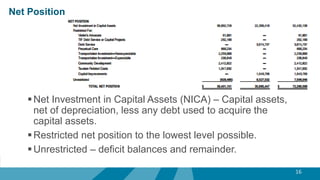
16
Net Investment in Capital Assets (NICA) – Capital assets,
net of depreciation, less any debt used to acquire the
capital assets.
Restricted net position to the lowest level possible.
Unrestricted – deficit balances and remainder.
Net Position
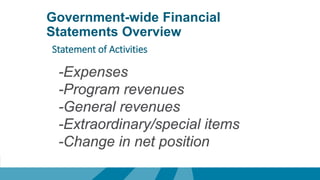
Government-wide Financial
Statements Overview
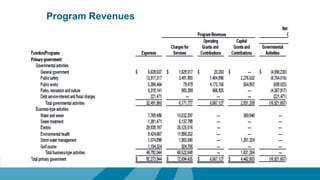
-Expenses
-Program revenues
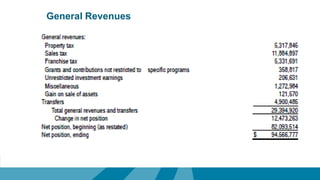
-General revenues
-Extraordinary/special items
-Change in net position
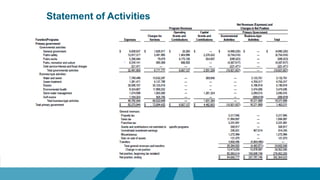
Statement of Activities
Program Revenues
General Revenues
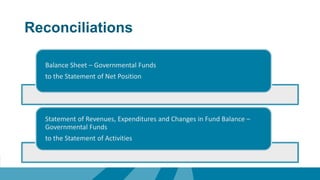
Reconciliations
Balance Sheet – Governmental Funds
to the Statement of Net Position
Statement of Revenues, Expenditures and Changes in Fund Balance –
Governmental Funds
to the Statement of Activities
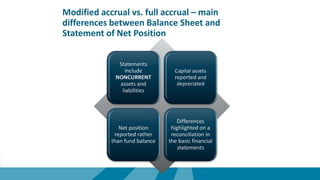
Modified accrual vs. full accrual – main
differences between Balance Sheet and
Statement of Net Position
Statements
include
NONCURRENT
assets and
liabilities
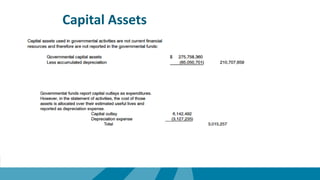
Capital assets
reported and
depreciated
Net position
reported rather
than fund balance
Differences
highlighted on a
reconciliation in
the basic financial
statements
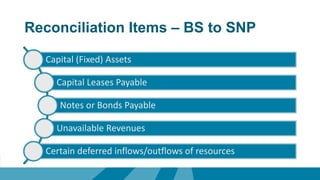
Reconciliation Items – BS to SNP
Capital (Fixed) Assets
Capital Leases Payable
Notes or Bonds Payable
Unavailable Revenues
Certain deferred inflows/outflows of resources
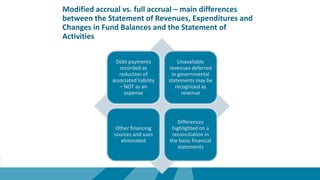
Modified accrual vs. full accrual – main differences
between the Statement of Revenues, Expenditures and
Changes in Fund Balances and the Statement of
Activities
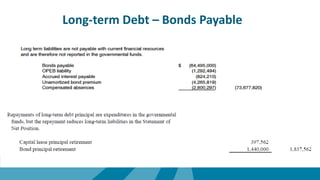
Debt payments
recorded as
reduction of
associated liability
– NOT as an
expense
Unavailable
revenues deferred
in governmental
statements may be
recognized as
revenue
Other financing
sources and uses
eliminated
Differences
highlighted on a
reconciliation in
the basic financial
statements
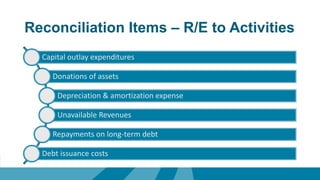
Reconciliation Items – R/E to Activities
Capital outlay expenditures
Donations of assets
Depreciation & amortization expense
Unavailable Revenues
Repayments on long-term debt
Debt issuance costs
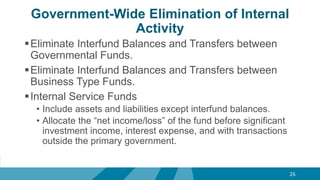
Government-Wide Elimination of Internal
Activity
Eliminate Interfund Balances and Transfers between
Governmental Funds.
Eliminate Interfund Balances and Transfers between
Business Type Funds.
Internal Service Funds
• Include assets and liabilities except interfund balances.
• Allocate the “net income/loss” of the fund before significant
investment income, interest expense, and with transactions
outside the primary government.
26
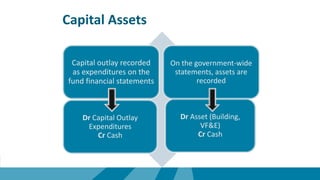
Capital Assets
Capital outlay recorded
as expenditures on the
fund financial statements
On the government-wide
statements, assets are
recorded
Dr Capital Outlay
Expenditures
Cr Cash
Dr Asset (Building,
VF&E)
Cr Cash
Capital Assets
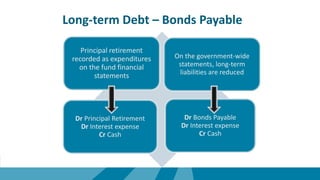
Long-term Debt – Bonds Payable
Principal retirement
recorded as expenditures
on the fund financial
statements
On the government-wide
statements, long-term
liabilities are reduced
Dr Principal Retirement
Dr Interest expense
Cr Cash
Dr Bonds Payable
Dr Interest expense
Cr Cash
Long-term Debt – Bonds Payable
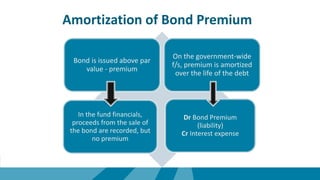
Amortization of Bond Premium
Bond is issued above par
value - premium
On the government-wide
f/s, premium is amortized
over the life of the debt
In the fund financials,
proceeds from the sale of
the bond are recorded, but
no premium
Dr Bond Premium
(liability)
Cr Interest expense
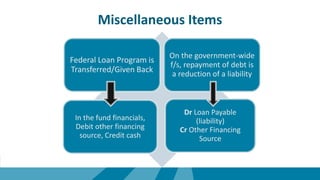
Miscellaneous Items
Federal Loan Program is
Transferred/Given Back
On the government-wide
f/s, repayment of debt is
a reduction of a liability
In the fund financials,
Debit other financing
source, Credit cash
Dr Loan Payable
(liability)
Cr Other Financing
Source
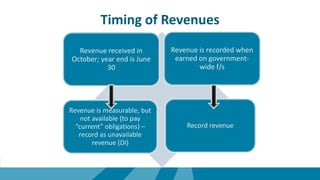
Timing of Revenues
Revenue received in
October; year end is June
30
Revenue is recorded when
earned on government-
wide f/s
Revenue is measurable, but
not available (to pay
“current” obligations) –
record as unavailable
revenue (DI)
Record revenue
Are we done yet?
Not quite……..
Governmental
Accounting:
A Dive Into
Revenues
Agenda
1. Exchange vs. Nonexchange revenues
2. Revenue Recognition
3. Revenue Sources
1. Accounting
2. Financial Statement Presentation
3. Reporting Complexities
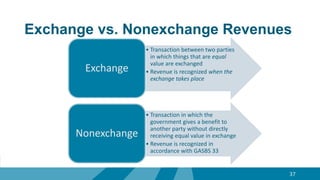
Exchange vs. Nonexchange Revenues
37
• Transaction between two parties
in which things that are equal
value are exchanged
• Revenue is recognized when the
exchange takes place
Exchange
• Transaction in which the
government gives a benefit to
another party without directly
receiving equal value in exchange
• Revenue is recognized in
accordance with GASBS 33
Nonexchange
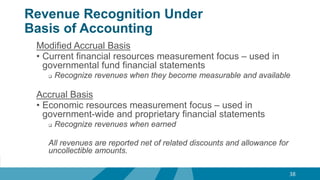
Revenue Recognition Under
Basis of Accounting
Modified Accrual Basis
• Current financial resources measurement focus – used in
governmental fund financial statements
 Recognize revenues when they become measurable and available
Accrual Basis
• Economic resources measurement focus – used in
government-wide and proprietary financial statements
 Recognize revenues when earned
All revenues are reported net of related discounts and allowance for
uncollectible amounts.
38
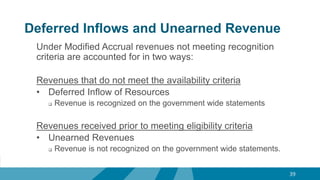
Deferred Inflows and Unearned Revenue
Under Modified Accrual revenues not meeting recognition
criteria are accounted for in two ways:
Revenues that do not meet the availability criteria
• Deferred Inflow of Resources
 Revenue is recognized on the government wide statements
Revenues received prior to meeting eligibility criteria
• Unearned Revenues
 Revenue is not recognized on the government wide statements.
39
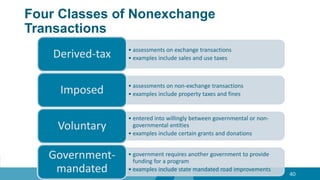
Four Classes of Nonexchange
Transactions
40
• assessments on exchange transactions
• examples include sales and use taxesDerived-tax
• assessments on non-exchange transactions
• examples include property taxes and finesImposed
• entered into willingly between governmental or non-
governmental entities
• examples include certain grants and donations
Voluntary
• government requires another government to provide
funding for a program
• examples include state mandated road improvements
Government-
mandated
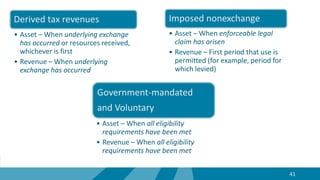
41
Derived tax revenues
• Asset – When underlying exchange
has occurred or resources received,
whichever is first
• Revenue – When underlying
exchange has occurred
Imposed nonexchange
• Asset – When enforceable legal
claim has arisen
• Revenue – First period that use is
permitted (for example, period for
which levied)
Government-mandated
and Voluntary
• Asset – When all eligibility
requirements have been met
• Revenue – When all eligibility
requirements have been met
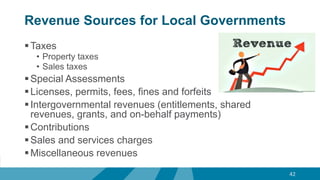
Revenue Sources for Local Governments
Taxes
• Property taxes
• Sales taxes
Special Assessments
Licenses, permits, fees, fines and forfeits
Intergovernmental revenues (entitlements, shared
revenues, grants, and on-behalf payments)
Contributions
Sales and services charges
Miscellaneous revenues
42
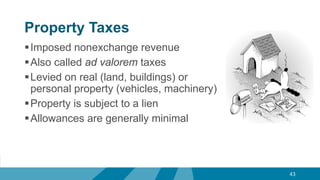
Property Taxes
Imposed nonexchange revenue
Also called ad valorem taxes
Levied on real (land, buildings) or
personal property (vehicles, machinery)
Property is subject to a lien
Allowances are generally minimal
43
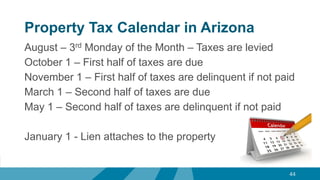
Property Tax Calendar in Arizona
44
August – 3rd Monday of the Month – Taxes are levied
October 1 – First half of taxes are due
November 1 – First half of taxes are delinquent if not paid
March 1 – Second half of taxes are due
May 1 – Second half of taxes are delinquent if not paid
January 1 - Lien attaches to the property
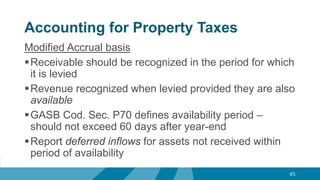
Accounting for Property Taxes
Modified Accrual basis
Receivable should be recognized in the period for which
it is levied
Revenue recognized when levied provided they are also
available
GASB Cod. Sec. P70 defines availability period –
should not exceed 60 days after year-end
Report deferred inflows for assets not received within
period of availability
45
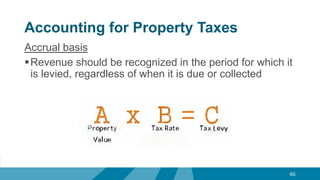
Accounting for Property Taxes
Accrual basis
Revenue should be recognized in the period for which it
is levied, regardless of when it is due or collected
46
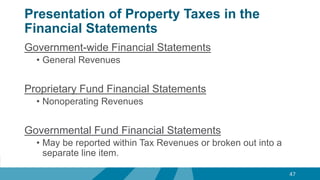
Presentation of Property Taxes in the
Financial Statements
Government-wide Financial Statements
• General Revenues
Proprietary Fund Financial Statements
• Nonoperating Revenues
Governmental Fund Financial Statements
• May be reported within Tax Revenues or broken out into a
separate line item.
47
Property Tax Financial Reporting
Considerations
1. Since property taxes are collected by the County,
there is a lag in receipt of the revenues.
2. Receivable and unavailable should be reported for
revenues not received within the period of availability.
3. Review receivable to ensure it is adjusted when the
County adjusts the levy.
48
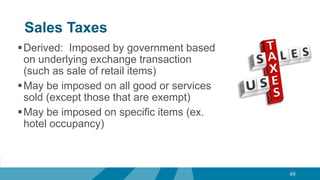
Sales Taxes
Derived: Imposed by government based
on underlying exchange transaction
(such as sale of retail items)
May be imposed on all good or services
sold (except those that are exempt)
May be imposed on specific items (ex.
hotel occupancy)
49
Accounting for Sales Taxes
Modified Accrual basis
Should be recognized when the underlying exchange
(sale of goods) takes place and the resources are
available
Purpose restrictions do not affect revenue recognition,
but may require reporting in a specific fund
Report revenues net of estimated refunds and
uncollectible amounts
50
Accounting for Sales Taxes
Accrual basis
Should be recognized when the underlying exchange
(sale of goods) takes place
51
Presentation of Sales Taxes in the
Financial Statements
Government-wide Financial Statements
• General Revenues
Proprietary Fund Financial Statements
• Nonoperating Revenues
Governmental Fund Financial Statements
• May be reported within Tax Revenues or broken out into a
separate line item
52
Sales Tax Financial Reporting
Considerations
1. Receivable and unavailable should be reported for
revenues not received within the period of availability.
This may require consultation with sales tax
department regarding delinquent accounts/tax audits.
2. Review lag schedule of sales taxes receivable to
determine if allowance is reasonable
53
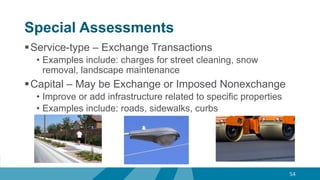
Special Assessments
Service-type – Exchange Transactions
• Examples include: charges for street cleaning, snow
removal, landscape maintenance
Capital – May be Exchange or Imposed Nonexchange
• Improve or add infrastructure related to specific properties
• Examples include: roads, sidewalks, curbs
54
Accounting for Service-Type
Special Assessments
Modified Accrual basis
Report revenue when the service is provided and
amounts are available
Report deferred inflows for revenues not received
during period of availability
55
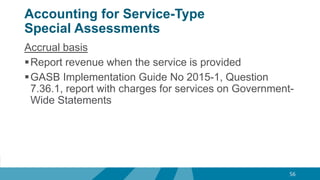
Accounting for Service-Type
Special Assessments
Accrual basis
Report revenue when the service is provided
GASB Implementation Guide No 2015-1, Question
7.36.1, report with charges for services on Government-
Wide Statements
56
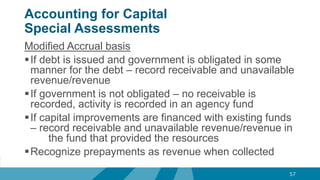
Accounting for Capital
Special Assessments
Modified Accrual basis
If debt is issued and government is obligated in some
manner for the debt – record receivable and unavailable
revenue/revenue
If government is not obligated – no receivable is
recorded, activity is recorded in an agency fund
If capital improvements are financed with existing funds
– record receivable and unavailable revenue/revenue in
the fund that provided the resources
Recognize prepayments as revenue when collected
57
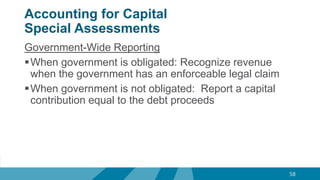
Accounting for Capital
Special Assessments
Government-Wide Reporting
When government is obligated: Recognize revenue
when the government has an enforceable legal claim
When government is not obligated: Report a capital
contribution equal to the debt proceeds
58
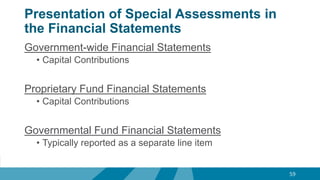
Presentation of Special Assessments in
the Financial Statements
Government-wide Financial Statements
• Capital Contributions
Proprietary Fund Financial Statements
• Capital Contributions
Governmental Fund Financial Statements
• Typically reported as a separate line item
59
Intergovernmental Revenues
Government mandated or voluntary nonexchange
transactions
Revenues should be recognized when all four types of
eligibility requirements specified in GASBS No. 33
• Required characteristics of recipients
• Time requirements
• Reimbursements
• Contingencies
60
Intergovernmental Revenue Types
Shared Revenues
• Example – Highway User Revenues, State Shared Sales Tax
Entitlement
• Payment based on an allocation formula
Grants and Other Financial Assistance
• Usually restricted
• Generally must be applied for
• Example – federal grant for police equipment
61
Shared Revenues
Considered continuing appropriations “once established,
are automatically renewed without further legislative
action, period after period, until altered or revoked”.
• The time eligibility is continuously (automatically) met and
revenues are reported in the period in which the sales take
place.
62
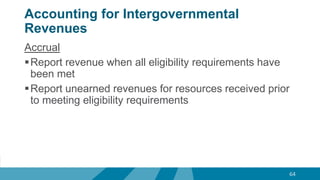
Accounting for Intergovernmental
Revenues
Modified accrual
Report revenue when all eligibility requirements have
been met and amounts are available
Report unearned revenues for resources received prior
to meeting eligibility requirements
GASB No. 33 provides that governments should not
delay revenue recognition pending completion of purely
routine requirements such as filing of claims for
allowable costs for reimbursement-type grants
63
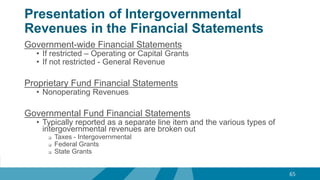
Accounting for Intergovernmental
Revenues
Accrual
Report revenue when all eligibility requirements have
been met
Report unearned revenues for resources received prior
to meeting eligibility requirements
64
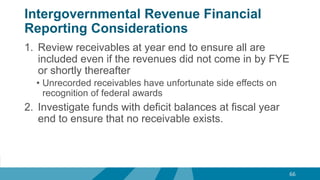
Presentation of Intergovernmental
Revenues in the Financial Statements
Government-wide Financial Statements
• If restricted – Operating or Capital Grants
• If not restricted - General Revenue
Proprietary Fund Financial Statements
• Nonoperating Revenues
Governmental Fund Financial Statements
• Typically reported as a separate line item and the various types of
intergovernmental revenues are broken out
 Taxes - Intergovernmental
 Federal Grants
 State Grants
65
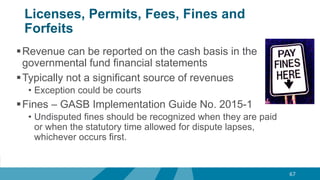
Intergovernmental Revenue Financial
Reporting Considerations
1. Review receivables at year end to ensure all are
included even if the revenues did not come in by FYE
or shortly thereafter
• Unrecorded receivables have unfortunate side effects on
recognition of federal awards
2. Investigate funds with deficit balances at fiscal year
end to ensure that no receivable exists.
66
Licenses, Permits, Fees, Fines and
Forfeits
Revenue can be reported on the cash basis in the
governmental fund financial statements
Typically not a significant source of revenues
• Exception could be courts
Fines – GASB Implementation Guide No. 2015-1
• Undisputed fines should be recognized when they are paid
or when the statutory time allowed for dispute lapses,
whichever occurs first.
67
Presentation of Licenses, Permits, Fines
in the Financial Statements
Government-wide Financial Statements
• Charges for Services
Governmental Fund Financial Statements
• Typically reported as a separate line item
68
Contributions
Most are voluntary nonexchange transactions
Revenues should be recognized when all eligibility
requirements are met (and available in governmental
funds)
69
Presentation of Contribution Revenues in
the Financial Statements
Government-wide Financial Statements
• If restricted – Operating or Capital Grants
• If not restricted - General Revenue
Proprietary Fund Financial Statements
• Nonoperating Revenues
Governmental Fund Financial Statements
• Either miscellaneous line item or separately classified as
contributions, gifts or donations
70
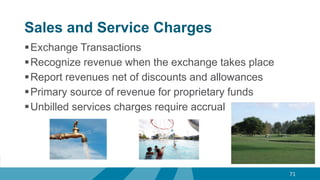
Sales and Service Charges
Exchange Transactions
Recognize revenue when the exchange takes place
Report revenues net of discounts and allowances
Primary source of revenue for proprietary funds
Unbilled services charges require accrual
71
GASB Projects
Financial Reporting Model
• Invitation to Comment issued December 2016
• Presents potential improvements to recognition approaches
(measurement focus and basis of accounting)
Revenue and Expense Recognition
• Currently in Initial Deliberations
• Addresses exchange transactions not specifically addressed
in existing statements
• Post-implementation review of Statements 33 and 36
72
Questions?
Michael L. Lauzon, CPA, MBA
michael.lauzon@heinfeldmeech.com
Jill A. Shaw, CPA
jill.shaw@heinfeldmeech.com
73

Governmental Accounting

  • 1.
  • 2.
    Agenda Modified Accrual vs.Full Accrual • Governmental Funds • Government Wide Reconciliations • Balance Sheet to the Statement of Net Position • Statement of Revenues and Expenditures to the Statement of Activities 2
  • 3.
    Basis of Accounting 3 Cashbasis Transactions recorded when cash is exchanged Not GAAP Modified accrual Revenues recognized when measurable and available; expenditures when incurred Unique to state and local governments Full Accrual Records effects of transactions/events when they occur, regardless of the timing of related cash flows Used by business enterprises and non- profits
  • 4.
  • 5.
    Measurement Focus 5 Current financial resources Reportsall near-term inflows, outflows, and balances of expendable resources Unique to state and local governments Economic resources Reports all inflows, outflows, and balances affecting net position Used by business enterprises and non- profits
  • 6.
    FUND Financial Statements Overview FundFinancial Statements -Governmental funds - Balance Sheet - Revenues, Expenditures, and Changes in Fund Balances Modified accrual basis of accounting Current financial resources measurement focus
  • 7.
    FUND Financial Statements Overview Thefund financial statements focus on near-term inflows of spendable resources and are useful in evaluating the government’s near-term financing requirements.
  • 8.
    Basic Financial Statements Overview FundFinancial Statements -Proprietary funds - Statement of net position - Statement of revenues, expenses and changes in fund net position - Statement of cash flows Accrual basis of accounting
  • 9.
    Statement of Revenuesand Expenditures Revenues and expenditures • Revenues – inflows that are measurable and available • Expenditures – are measurable and should be recorded when the exchange takes place  Debt service expenditures recorded before payment is due if it is due and payable in one to several days after year end Other financing sources (uses) • Interfund Transfers • General obligation and/or refunding bond issuances • Capital lease agreements
  • 10.
    Basic Financial Statements Overview FundFinancial Statements -Fiduciary funds - Statement of fiduciary net position - Statement of changes in fiduciary net position Accrual basis of accounting
  • 11.
    Government-wide Financial Statements Overview -Statement of Net Position - Statement of Activities Government-wide Financial Statements Accrual basis of accounting Economic resources measurement focus
  • 12.
    GASB Statement No.34 Government-wide financial statements help users… Assess the finances of the government in its entirety See the cost of providing services to its citizenry Understand the extent to which the government has invested its capital assets, including buildings, equipment, and infrastructure
  • 13.
    Government-wide Financial Statements Overview -Assets -Deferredoutflows of resources -Liabilities -Deferred inflows of resources -Net position Statement of Net Position
  • 14.
  • 15.
    Fund Balance toNet Position 15 Net Position Long Term Deferred Inflow/Outflow (Pension, Refunding) Long term Liabilities (Bonds, Capital Leases, Pension) Long term Assets (Capital Assets, Restricted Cash) Deferred Inflows (Period of Availability) Fund Balance
  • 16.
    16 Net Investment inCapital Assets (NICA) – Capital assets, net of depreciation, less any debt used to acquire the capital assets. Restricted net position to the lowest level possible. Unrestricted – deficit balances and remainder. Net Position
  • 17.
    Government-wide Financial Statements Overview -Expenses -Programrevenues -General revenues -Extraordinary/special items -Change in net position Statement of Activities
  • 18.
  • 19.
  • 20.
  • 21.
    Reconciliations Balance Sheet –Governmental Funds to the Statement of Net Position Statement of Revenues, Expenditures and Changes in Fund Balance – Governmental Funds to the Statement of Activities
  • 22.
    Modified accrual vs.full accrual – main differences between Balance Sheet and Statement of Net Position Statements include NONCURRENT assets and liabilities Capital assets reported and depreciated Net position reported rather than fund balance Differences highlighted on a reconciliation in the basic financial statements
  • 23.
    Reconciliation Items –BS to SNP Capital (Fixed) Assets Capital Leases Payable Notes or Bonds Payable Unavailable Revenues Certain deferred inflows/outflows of resources
  • 24.
    Modified accrual vs.full accrual – main differences between the Statement of Revenues, Expenditures and Changes in Fund Balances and the Statement of Activities Debt payments recorded as reduction of associated liability – NOT as an expense Unavailable revenues deferred in governmental statements may be recognized as revenue Other financing sources and uses eliminated Differences highlighted on a reconciliation in the basic financial statements
  • 25.
    Reconciliation Items –R/E to Activities Capital outlay expenditures Donations of assets Depreciation & amortization expense Unavailable Revenues Repayments on long-term debt Debt issuance costs
  • 26.
    Government-Wide Elimination ofInternal Activity Eliminate Interfund Balances and Transfers between Governmental Funds. Eliminate Interfund Balances and Transfers between Business Type Funds. Internal Service Funds • Include assets and liabilities except interfund balances. • Allocate the “net income/loss” of the fund before significant investment income, interest expense, and with transactions outside the primary government. 26
  • 27.
    Capital Assets Capital outlayrecorded as expenditures on the fund financial statements On the government-wide statements, assets are recorded Dr Capital Outlay Expenditures Cr Cash Dr Asset (Building, VF&E) Cr Cash
  • 28.
  • 29.
    Long-term Debt –Bonds Payable Principal retirement recorded as expenditures on the fund financial statements On the government-wide statements, long-term liabilities are reduced Dr Principal Retirement Dr Interest expense Cr Cash Dr Bonds Payable Dr Interest expense Cr Cash
  • 30.
    Long-term Debt –Bonds Payable
  • 31.
    Amortization of BondPremium Bond is issued above par value - premium On the government-wide f/s, premium is amortized over the life of the debt In the fund financials, proceeds from the sale of the bond are recorded, but no premium Dr Bond Premium (liability) Cr Interest expense
  • 32.
    Miscellaneous Items Federal LoanProgram is Transferred/Given Back On the government-wide f/s, repayment of debt is a reduction of a liability In the fund financials, Debit other financing source, Credit cash Dr Loan Payable (liability) Cr Other Financing Source
  • 33.
    Timing of Revenues Revenuereceived in October; year end is June 30 Revenue is recorded when earned on government- wide f/s Revenue is measurable, but not available (to pay “current” obligations) – record as unavailable revenue (DI) Record revenue
  • 34.
    Are we doneyet? Not quite……..
  • 35.
  • 36.
    Agenda 1. Exchange vs.Nonexchange revenues 2. Revenue Recognition 3. Revenue Sources 1. Accounting 2. Financial Statement Presentation 3. Reporting Complexities
  • 37.
    Exchange vs. NonexchangeRevenues 37 • Transaction between two parties in which things that are equal value are exchanged • Revenue is recognized when the exchange takes place Exchange • Transaction in which the government gives a benefit to another party without directly receiving equal value in exchange • Revenue is recognized in accordance with GASBS 33 Nonexchange
  • 38.
    Revenue Recognition Under Basisof Accounting Modified Accrual Basis • Current financial resources measurement focus – used in governmental fund financial statements  Recognize revenues when they become measurable and available Accrual Basis • Economic resources measurement focus – used in government-wide and proprietary financial statements  Recognize revenues when earned All revenues are reported net of related discounts and allowance for uncollectible amounts. 38
  • 39.
    Deferred Inflows andUnearned Revenue Under Modified Accrual revenues not meeting recognition criteria are accounted for in two ways: Revenues that do not meet the availability criteria • Deferred Inflow of Resources  Revenue is recognized on the government wide statements Revenues received prior to meeting eligibility criteria • Unearned Revenues  Revenue is not recognized on the government wide statements. 39
  • 40.
    Four Classes ofNonexchange Transactions 40 • assessments on exchange transactions • examples include sales and use taxesDerived-tax • assessments on non-exchange transactions • examples include property taxes and finesImposed • entered into willingly between governmental or non- governmental entities • examples include certain grants and donations Voluntary • government requires another government to provide funding for a program • examples include state mandated road improvements Government- mandated
  • 41.
    41 Derived tax revenues •Asset – When underlying exchange has occurred or resources received, whichever is first • Revenue – When underlying exchange has occurred Imposed nonexchange • Asset – When enforceable legal claim has arisen • Revenue – First period that use is permitted (for example, period for which levied) Government-mandated and Voluntary • Asset – When all eligibility requirements have been met • Revenue – When all eligibility requirements have been met
  • 42.
    Revenue Sources forLocal Governments Taxes • Property taxes • Sales taxes Special Assessments Licenses, permits, fees, fines and forfeits Intergovernmental revenues (entitlements, shared revenues, grants, and on-behalf payments) Contributions Sales and services charges Miscellaneous revenues 42
  • 43.
    Property Taxes Imposed nonexchangerevenue Also called ad valorem taxes Levied on real (land, buildings) or personal property (vehicles, machinery) Property is subject to a lien Allowances are generally minimal 43
  • 44.
    Property Tax Calendarin Arizona 44 August – 3rd Monday of the Month – Taxes are levied October 1 – First half of taxes are due November 1 – First half of taxes are delinquent if not paid March 1 – Second half of taxes are due May 1 – Second half of taxes are delinquent if not paid January 1 - Lien attaches to the property
  • 45.
    Accounting for PropertyTaxes Modified Accrual basis Receivable should be recognized in the period for which it is levied Revenue recognized when levied provided they are also available GASB Cod. Sec. P70 defines availability period – should not exceed 60 days after year-end Report deferred inflows for assets not received within period of availability 45
  • 46.
    Accounting for PropertyTaxes Accrual basis Revenue should be recognized in the period for which it is levied, regardless of when it is due or collected 46
  • 47.
    Presentation of PropertyTaxes in the Financial Statements Government-wide Financial Statements • General Revenues Proprietary Fund Financial Statements • Nonoperating Revenues Governmental Fund Financial Statements • May be reported within Tax Revenues or broken out into a separate line item. 47
  • 48.
    Property Tax FinancialReporting Considerations 1. Since property taxes are collected by the County, there is a lag in receipt of the revenues. 2. Receivable and unavailable should be reported for revenues not received within the period of availability. 3. Review receivable to ensure it is adjusted when the County adjusts the levy. 48
  • 49.
    Sales Taxes Derived: Imposedby government based on underlying exchange transaction (such as sale of retail items) May be imposed on all good or services sold (except those that are exempt) May be imposed on specific items (ex. hotel occupancy) 49
  • 50.
    Accounting for SalesTaxes Modified Accrual basis Should be recognized when the underlying exchange (sale of goods) takes place and the resources are available Purpose restrictions do not affect revenue recognition, but may require reporting in a specific fund Report revenues net of estimated refunds and uncollectible amounts 50
  • 51.
    Accounting for SalesTaxes Accrual basis Should be recognized when the underlying exchange (sale of goods) takes place 51
  • 52.
    Presentation of SalesTaxes in the Financial Statements Government-wide Financial Statements • General Revenues Proprietary Fund Financial Statements • Nonoperating Revenues Governmental Fund Financial Statements • May be reported within Tax Revenues or broken out into a separate line item 52
  • 53.
    Sales Tax FinancialReporting Considerations 1. Receivable and unavailable should be reported for revenues not received within the period of availability. This may require consultation with sales tax department regarding delinquent accounts/tax audits. 2. Review lag schedule of sales taxes receivable to determine if allowance is reasonable 53
  • 54.
    Special Assessments Service-type –Exchange Transactions • Examples include: charges for street cleaning, snow removal, landscape maintenance Capital – May be Exchange or Imposed Nonexchange • Improve or add infrastructure related to specific properties • Examples include: roads, sidewalks, curbs 54
  • 55.
    Accounting for Service-Type SpecialAssessments Modified Accrual basis Report revenue when the service is provided and amounts are available Report deferred inflows for revenues not received during period of availability 55
  • 56.
    Accounting for Service-Type SpecialAssessments Accrual basis Report revenue when the service is provided GASB Implementation Guide No 2015-1, Question 7.36.1, report with charges for services on Government- Wide Statements 56
  • 57.
    Accounting for Capital SpecialAssessments Modified Accrual basis If debt is issued and government is obligated in some manner for the debt – record receivable and unavailable revenue/revenue If government is not obligated – no receivable is recorded, activity is recorded in an agency fund If capital improvements are financed with existing funds – record receivable and unavailable revenue/revenue in the fund that provided the resources Recognize prepayments as revenue when collected 57
  • 58.
    Accounting for Capital SpecialAssessments Government-Wide Reporting When government is obligated: Recognize revenue when the government has an enforceable legal claim When government is not obligated: Report a capital contribution equal to the debt proceeds 58
  • 59.
    Presentation of SpecialAssessments in the Financial Statements Government-wide Financial Statements • Capital Contributions Proprietary Fund Financial Statements • Capital Contributions Governmental Fund Financial Statements • Typically reported as a separate line item 59
  • 60.
    Intergovernmental Revenues Government mandatedor voluntary nonexchange transactions Revenues should be recognized when all four types of eligibility requirements specified in GASBS No. 33 • Required characteristics of recipients • Time requirements • Reimbursements • Contingencies 60
  • 61.
    Intergovernmental Revenue Types SharedRevenues • Example – Highway User Revenues, State Shared Sales Tax Entitlement • Payment based on an allocation formula Grants and Other Financial Assistance • Usually restricted • Generally must be applied for • Example – federal grant for police equipment 61
  • 62.
    Shared Revenues Considered continuingappropriations “once established, are automatically renewed without further legislative action, period after period, until altered or revoked”. • The time eligibility is continuously (automatically) met and revenues are reported in the period in which the sales take place. 62
  • 63.
    Accounting for Intergovernmental Revenues Modifiedaccrual Report revenue when all eligibility requirements have been met and amounts are available Report unearned revenues for resources received prior to meeting eligibility requirements GASB No. 33 provides that governments should not delay revenue recognition pending completion of purely routine requirements such as filing of claims for allowable costs for reimbursement-type grants 63
  • 64.
    Accounting for Intergovernmental Revenues Accrual Reportrevenue when all eligibility requirements have been met Report unearned revenues for resources received prior to meeting eligibility requirements 64
  • 65.
    Presentation of Intergovernmental Revenuesin the Financial Statements Government-wide Financial Statements • If restricted – Operating or Capital Grants • If not restricted - General Revenue Proprietary Fund Financial Statements • Nonoperating Revenues Governmental Fund Financial Statements • Typically reported as a separate line item and the various types of intergovernmental revenues are broken out  Taxes - Intergovernmental  Federal Grants  State Grants 65
  • 66.
    Intergovernmental Revenue Financial ReportingConsiderations 1. Review receivables at year end to ensure all are included even if the revenues did not come in by FYE or shortly thereafter • Unrecorded receivables have unfortunate side effects on recognition of federal awards 2. Investigate funds with deficit balances at fiscal year end to ensure that no receivable exists. 66
  • 67.
    Licenses, Permits, Fees,Fines and Forfeits Revenue can be reported on the cash basis in the governmental fund financial statements Typically not a significant source of revenues • Exception could be courts Fines – GASB Implementation Guide No. 2015-1 • Undisputed fines should be recognized when they are paid or when the statutory time allowed for dispute lapses, whichever occurs first. 67
  • 68.
    Presentation of Licenses,Permits, Fines in the Financial Statements Government-wide Financial Statements • Charges for Services Governmental Fund Financial Statements • Typically reported as a separate line item 68
  • 69.
    Contributions Most are voluntarynonexchange transactions Revenues should be recognized when all eligibility requirements are met (and available in governmental funds) 69
  • 70.
    Presentation of ContributionRevenues in the Financial Statements Government-wide Financial Statements • If restricted – Operating or Capital Grants • If not restricted - General Revenue Proprietary Fund Financial Statements • Nonoperating Revenues Governmental Fund Financial Statements • Either miscellaneous line item or separately classified as contributions, gifts or donations 70
  • 71.
    Sales and ServiceCharges Exchange Transactions Recognize revenue when the exchange takes place Report revenues net of discounts and allowances Primary source of revenue for proprietary funds Unbilled services charges require accrual 71
  • 72.
    GASB Projects Financial ReportingModel • Invitation to Comment issued December 2016 • Presents potential improvements to recognition approaches (measurement focus and basis of accounting) Revenue and Expense Recognition • Currently in Initial Deliberations • Addresses exchange transactions not specifically addressed in existing statements • Post-implementation review of Statements 33 and 36 72
  • 73.
    Questions? Michael L. Lauzon,CPA, MBA michael.lauzon@heinfeldmeech.com Jill A. Shaw, CPA jill.shaw@heinfeldmeech.com 73