November 13, 2012       Today:

                    Khan Academy Extension
                           Warm-Up
                      Ordering Fractions
                          Vocabulary
                      Prime Factorization
                    Greatest Common Factor
                          Class Work
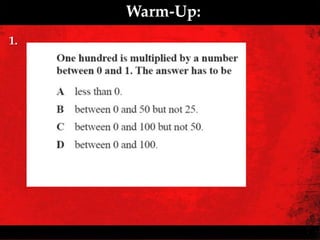
Warm-Up:
1.
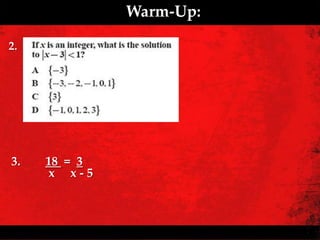
Warm-Up:

2.


3.   18 = 3
     x x-5
Warm-Up:
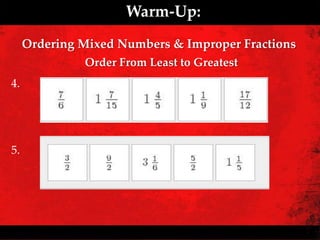
     Ordering Mixed Numbers & Improper Fractions
              Order From Least to Greatest
4.


5.
Warm-Up:
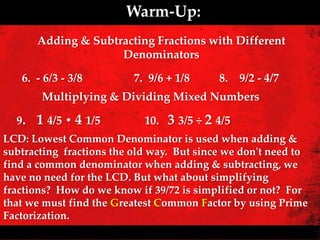
       Adding & Subtracting Fractions with Different
                     Denominators

   6. - 6/3 - 3/8         7. 9/6 + 1/8      8. 9/2 - 4/7
        Multiplying & Dividing Mixed Numbers

  9.   1 4/5 • 4 1/5        10.   3 3/5 ÷ 2 4/5
LCD: Lowest Common Denominator is used when adding &
subtracting fractions the old way. But since we don't need to
find a common denominator when adding & subtracting, we
have no need for the LCD. But what about simplifying
fractions? How do we know if 39/72 is simplified or not? For
that we must find the Greatest Common Factor by using Prime
Factorization.
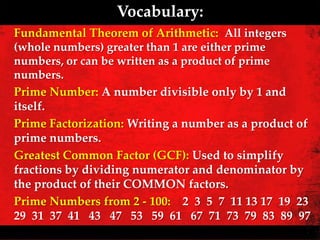
Vocabulary:
Fundamental Theorem of Arithmetic: All integers
(whole numbers) greater than 1 are either prime
numbers, or can be written as a product of prime
numbers.
Prime Number: A number divisible only by 1 and
itself.
Prime Factorization: Writing a number as a product of
prime numbers.
Greatest Common Factor (GCF): Used to simplify
fractions by dividing numerator and denominator by
the product of their COMMON factors.
Prime Numbers from 2 - 100: 2 3 5 7 11 13 17 19 23
29 31 37 41 43 47 53 59 61 67 71 73 79 83 89 97
Practice Problems:
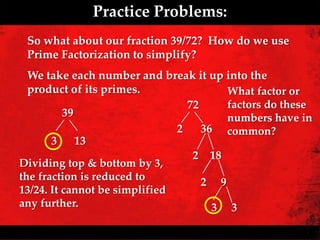
 So what about our fraction 39/72? How do we use
 Prime Factorization to simplify?
  We take each number and break it up into the
  product of its primes.                What factor or
                                 72     factors do these
          39                            numbers have in
                               2    36 common?
       3 13
                                  2 18
Dividing top & bottom by 3,
the fraction is reduced to
                                    2 9
13/24. It cannot be simplified
any further.                          3 3
Practice Problems:
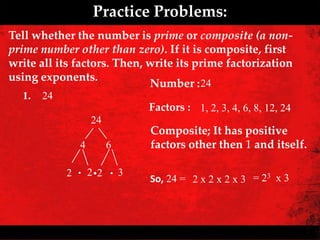
Tell whether the number is prime or composite (a non-
prime number other than zero). If it is composite, first
write all its factors. Then, write its prime factorization
using exponents.
                             Number : 24
  1.   24
                            Factors : 1, 2, 3, 4, 6, 8, 12, 24
                  24
                            Composite; It has positive
              4        6    factors other then 1 and itself.

            2 . 2 .2 . 3
                            So, 24 = 2 x 2 x 2 x 3 = 23 x 3
Practice Problems:
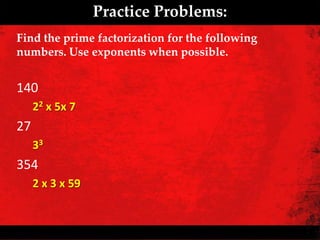
Find the prime factorization for the following
numbers. Use exponents when possible.


140
     22 x 5x 7
27
     33
354
     2 x 3 x 59
Tomorrow:

Decimals: Adding, Subtracting Multiplying &
                 Dividing
Class Work:

November 13

  • 1.
    November 13, 2012 Today: Khan Academy Extension Warm-Up Ordering Fractions Vocabulary Prime Factorization Greatest Common Factor Class Work
  • 2.
  • 3.
    Warm-Up: 2. 3. 18 = 3 x x-5
  • 4.
    Warm-Up: Ordering Mixed Numbers & Improper Fractions Order From Least to Greatest 4. 5.
  • 5.
    Warm-Up: Adding & Subtracting Fractions with Different Denominators 6. - 6/3 - 3/8 7. 9/6 + 1/8 8. 9/2 - 4/7 Multiplying & Dividing Mixed Numbers 9. 1 4/5 • 4 1/5 10. 3 3/5 ÷ 2 4/5 LCD: Lowest Common Denominator is used when adding & subtracting fractions the old way. But since we don't need to find a common denominator when adding & subtracting, we have no need for the LCD. But what about simplifying fractions? How do we know if 39/72 is simplified or not? For that we must find the Greatest Common Factor by using Prime Factorization.
  • 6.
    Vocabulary: Fundamental Theorem ofArithmetic: All integers (whole numbers) greater than 1 are either prime numbers, or can be written as a product of prime numbers. Prime Number: A number divisible only by 1 and itself. Prime Factorization: Writing a number as a product of prime numbers. Greatest Common Factor (GCF): Used to simplify fractions by dividing numerator and denominator by the product of their COMMON factors. Prime Numbers from 2 - 100: 2 3 5 7 11 13 17 19 23 29 31 37 41 43 47 53 59 61 67 71 73 79 83 89 97
  • 7.
    Practice Problems: Sowhat about our fraction 39/72? How do we use Prime Factorization to simplify? We take each number and break it up into the product of its primes. What factor or 72 factors do these 39 numbers have in 2 36 common? 3 13 2 18 Dividing top & bottom by 3, the fraction is reduced to 2 9 13/24. It cannot be simplified any further. 3 3
  • 8.
    Practice Problems: Tell whetherthe number is prime or composite (a non- prime number other than zero). If it is composite, first write all its factors. Then, write its prime factorization using exponents. Number : 24 1. 24 Factors : 1, 2, 3, 4, 6, 8, 12, 24 24 Composite; It has positive 4 6 factors other then 1 and itself. 2 . 2 .2 . 3 So, 24 = 2 x 2 x 2 x 3 = 23 x 3
  • 9.
    Practice Problems: Find theprime factorization for the following numbers. Use exponents when possible. 140 22 x 5x 7 27 33 354 2 x 3 x 59
  • 10.
  • 11.