Culture
 Culture refers to the beliefs, values, behavior and
material objects that, together, form a people's way
of life.
 Culture determines how we view the world around
us
 Culture includes the traditions we inherit and pass
on to the next generation
 Culture: totality of our shared language, knowledge,
material objects, and behavior
Material and Non Material Culture
Material ( tangible) culture reflects a society’s values and a society’s
technology, the knowledge that people apply to the task of living
in their surroundings. Examples include books, buildings, physical
objects that future generations can use to try and understand us.
Material Culture includes every conceivable kind of physical object
produced by Humans from design of dresses , cooking pots, houses
etc. objects reflects the nature of society in which they were made.
Non Material (intangible) Culture includes knowledge and beliefs,
norms and values and signs and language
Knowledge is a collection of relatively objective ideas and facts about
our social and physical world
Beliefs are ideas that are more subjective , unreliable and unverifiable
Culture
Only humans depend on culture rather than instincts
to ensure the survival of their kind.
The concept of culture (a shared way of life) must be
distinguished from those of nation (a political entity)
or society (the organized interaction of people in a
nation or within some other boundary).
Many modern societies are multicultural---their
people follow various ways of life.
Components of Culture
All cultures have five common components:
 symbols,
 language,
 values
 beliefs,
 norms, and
 material culture, including technology.
 Symbols are defined as anything that carries a
particular meaning recognized by people who share
culture. The meaning of the same symbols varies
from society to society, within a single society, and
over time.
Components of Culture
Language is a system of symbols that allows people to
communicate with one another. It can be either
written or spoken or both
Language is the key to cultural transmission, the
process by which one generation passes culture to the
next.
Through most of human history, cultural transmission
has been accomplished through oral tradition
Components of Culture
Values:-
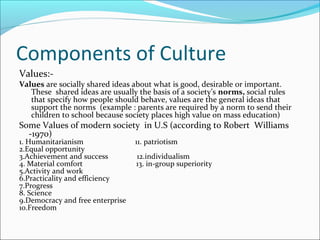
Values are socially shared ideas about what is good, desirable or important.
These shared ideas are usually the basis of a society’s norms, social rules
that specify how people should behave, values are the general ideas that
support the norms (example : parents are required by a norm to send their
children to school because society places high value on mass education)
Some Values of modern society in U.S (according to Robert Williams
-1970)
1. Humanitarianism 11. patriotism
2.Equal opportunity
3.Achievement and success 12.individualism
4. Material comfort 13. in-group superiority
5.Activity and work
6.Practicality and efficiency
7.Progress
8. Science
9.Democracy and free enterprise
10.Freedom
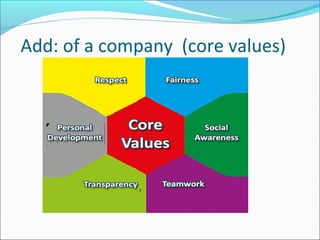
Add: of a company (core values)
Norms
Norms are socially defined rules of behavior. Norms serve
as guidelines for our behavior and for our expectations of
the behavior of others. There are three types of norms:
folkways, laws, and mores.
1.Folkways refer to the customs and manners of society. In
many segments of our society, it is customary to shake
hands when being introduced to a new acquaintance and
to give presents to family and friends on their birthdays.
Although no laws require us to do these things, we are
expected to do them because they are part of the cultural
traditions of the society in which we live.
Norms
2.Mores much stronger norms than folkways are mores (pronounced mor-ayz ) have a
moral basis. Violations of mores may produce shock, horror, and moral offense.
Violation of mores will be severely punished. Vandalism ,beating women or children,
insulting , abusing any one, theft and prostitution are serious violation of mores. In
modern societies most mores are formalized into laws.
3.Laws are norms that are formalized and backed by political authority. A person who eats
food out of a public garbage container is violating a folkway; no law prohibits this
behavior. However, throwing trash onto a public street is considered littering and is
against the law. Laws are norms that are specified formally in writing and backed by
power of state. Violation of these mores is considered as illegal or criminal act. Laws can
effectively control our behavior if they are strongly supported by popular beliefs.
(example: law against child marriage and corporal punishment is exist but not
supported by popular belief)
 All types of norms play an important role in controlling behavior, these enforcement
measures are called Sanctions or social consequences for conforming to or violating
norms. When we conform to a social norm, we may be rewarded by a positive sanction.
Norms… Continue
Which range from an approving smile to a public ceremony
in our honor. When we violate a social norm, we may be
punished by a negative sanction, which may range from a
disapproving look to the death penalty or life in prison.
Most sanctions are spontaneous expressions of approval or
disapproval by groups and individuals--these are referred
to as informal sanctions. Sanctions that are carried out
according to some recognized or formal procedure are
referred to as formal sanctions. Types of sanctions, then,
include positive informal sanctions, positive formal
sanctions, negative informal sanctions, and negative
formal sanctions.
Symbols
 A Symbol is something that represents something
else. Without symbols, we could not communicate
with each other or live as social beings.
The symbol of a culture includes language, gestures,
and objects whose meaning is commonly understood
by the members of society
The Influence of Language
According to many social scientists ,language does
more than enable us to communicate .It also
influences the way we perceive the world around us .
Edward Sapir (1929) was the first to hold this view
.Human beings ,he said , live “at the mercy of the
particular language which has become the medium of
expression for their society”
Some important terms
Patriarchal Influence
Global Reach
Cultural Dynamics
Sub-cultures (gender, age, class, linguistic, religious,
regional and occupational
Deviant sub cultures (professional criminals,
prostitutes etc)
Counter Cultures
How to enhance our Cultural
Competence
Steps to cultural Competence
Keep an open mind
Respect difference among people
Be willing to learn
Learn to communicate effectively

CULTURE PPT

  • 2.
    Culture  Culture refersto the beliefs, values, behavior and material objects that, together, form a people's way of life.  Culture determines how we view the world around us  Culture includes the traditions we inherit and pass on to the next generation  Culture: totality of our shared language, knowledge, material objects, and behavior
  • 3.
    Material and NonMaterial Culture Material ( tangible) culture reflects a society’s values and a society’s technology, the knowledge that people apply to the task of living in their surroundings. Examples include books, buildings, physical objects that future generations can use to try and understand us. Material Culture includes every conceivable kind of physical object produced by Humans from design of dresses , cooking pots, houses etc. objects reflects the nature of society in which they were made. Non Material (intangible) Culture includes knowledge and beliefs, norms and values and signs and language Knowledge is a collection of relatively objective ideas and facts about our social and physical world Beliefs are ideas that are more subjective , unreliable and unverifiable
  • 4.
    Culture Only humans dependon culture rather than instincts to ensure the survival of their kind. The concept of culture (a shared way of life) must be distinguished from those of nation (a political entity) or society (the organized interaction of people in a nation or within some other boundary). Many modern societies are multicultural---their people follow various ways of life.
  • 5.
    Components of Culture Allcultures have five common components:  symbols,  language,  values  beliefs,  norms, and  material culture, including technology.  Symbols are defined as anything that carries a particular meaning recognized by people who share culture. The meaning of the same symbols varies from society to society, within a single society, and over time.
  • 6.
    Components of Culture Languageis a system of symbols that allows people to communicate with one another. It can be either written or spoken or both Language is the key to cultural transmission, the process by which one generation passes culture to the next. Through most of human history, cultural transmission has been accomplished through oral tradition
  • 7.
    Components of Culture Values:- Valuesare socially shared ideas about what is good, desirable or important. These shared ideas are usually the basis of a society’s norms, social rules that specify how people should behave, values are the general ideas that support the norms (example : parents are required by a norm to send their children to school because society places high value on mass education) Some Values of modern society in U.S (according to Robert Williams -1970) 1. Humanitarianism 11. patriotism 2.Equal opportunity 3.Achievement and success 12.individualism 4. Material comfort 13. in-group superiority 5.Activity and work 6.Practicality and efficiency 7.Progress 8. Science 9.Democracy and free enterprise 10.Freedom
  • 8.
    Add: of acompany (core values)
  • 9.
    Norms Norms are sociallydefined rules of behavior. Norms serve as guidelines for our behavior and for our expectations of the behavior of others. There are three types of norms: folkways, laws, and mores. 1.Folkways refer to the customs and manners of society. In many segments of our society, it is customary to shake hands when being introduced to a new acquaintance and to give presents to family and friends on their birthdays. Although no laws require us to do these things, we are expected to do them because they are part of the cultural traditions of the society in which we live.
  • 10.
    Norms 2.Mores much strongernorms than folkways are mores (pronounced mor-ayz ) have a moral basis. Violations of mores may produce shock, horror, and moral offense. Violation of mores will be severely punished. Vandalism ,beating women or children, insulting , abusing any one, theft and prostitution are serious violation of mores. In modern societies most mores are formalized into laws. 3.Laws are norms that are formalized and backed by political authority. A person who eats food out of a public garbage container is violating a folkway; no law prohibits this behavior. However, throwing trash onto a public street is considered littering and is against the law. Laws are norms that are specified formally in writing and backed by power of state. Violation of these mores is considered as illegal or criminal act. Laws can effectively control our behavior if they are strongly supported by popular beliefs. (example: law against child marriage and corporal punishment is exist but not supported by popular belief)  All types of norms play an important role in controlling behavior, these enforcement measures are called Sanctions or social consequences for conforming to or violating norms. When we conform to a social norm, we may be rewarded by a positive sanction.
  • 11.
    Norms… Continue Which rangefrom an approving smile to a public ceremony in our honor. When we violate a social norm, we may be punished by a negative sanction, which may range from a disapproving look to the death penalty or life in prison. Most sanctions are spontaneous expressions of approval or disapproval by groups and individuals--these are referred to as informal sanctions. Sanctions that are carried out according to some recognized or formal procedure are referred to as formal sanctions. Types of sanctions, then, include positive informal sanctions, positive formal sanctions, negative informal sanctions, and negative formal sanctions.
  • 12.
    Symbols  A Symbolis something that represents something else. Without symbols, we could not communicate with each other or live as social beings. The symbol of a culture includes language, gestures, and objects whose meaning is commonly understood by the members of society
  • 13.
    The Influence ofLanguage According to many social scientists ,language does more than enable us to communicate .It also influences the way we perceive the world around us . Edward Sapir (1929) was the first to hold this view .Human beings ,he said , live “at the mercy of the particular language which has become the medium of expression for their society”
  • 14.
    Some important terms PatriarchalInfluence Global Reach Cultural Dynamics Sub-cultures (gender, age, class, linguistic, religious, regional and occupational Deviant sub cultures (professional criminals, prostitutes etc) Counter Cultures
  • 15.
    How to enhanceour Cultural Competence Steps to cultural Competence Keep an open mind Respect difference among people Be willing to learn Learn to communicate effectively