Master of Education
Chapter 2:
What is Language?
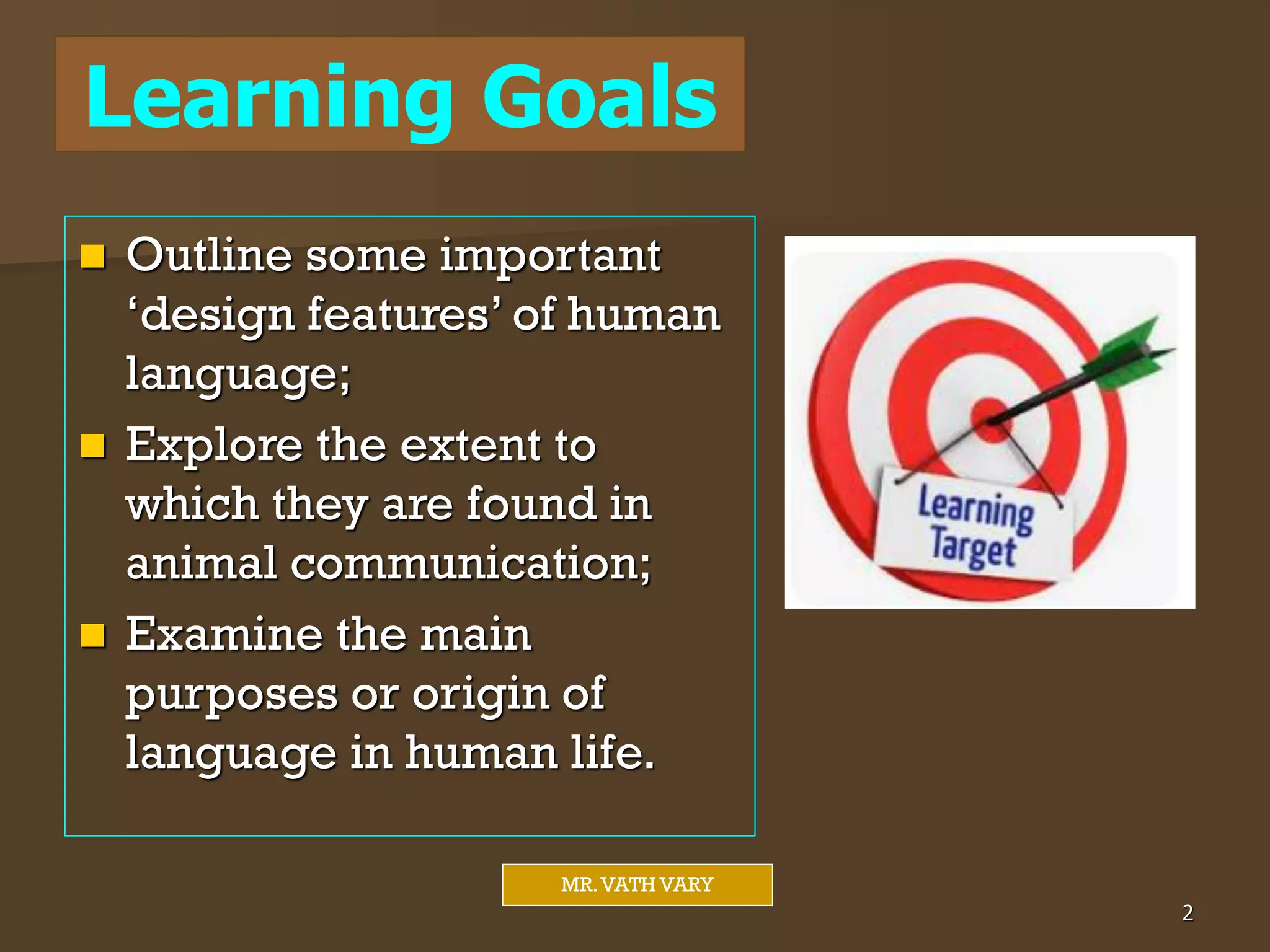
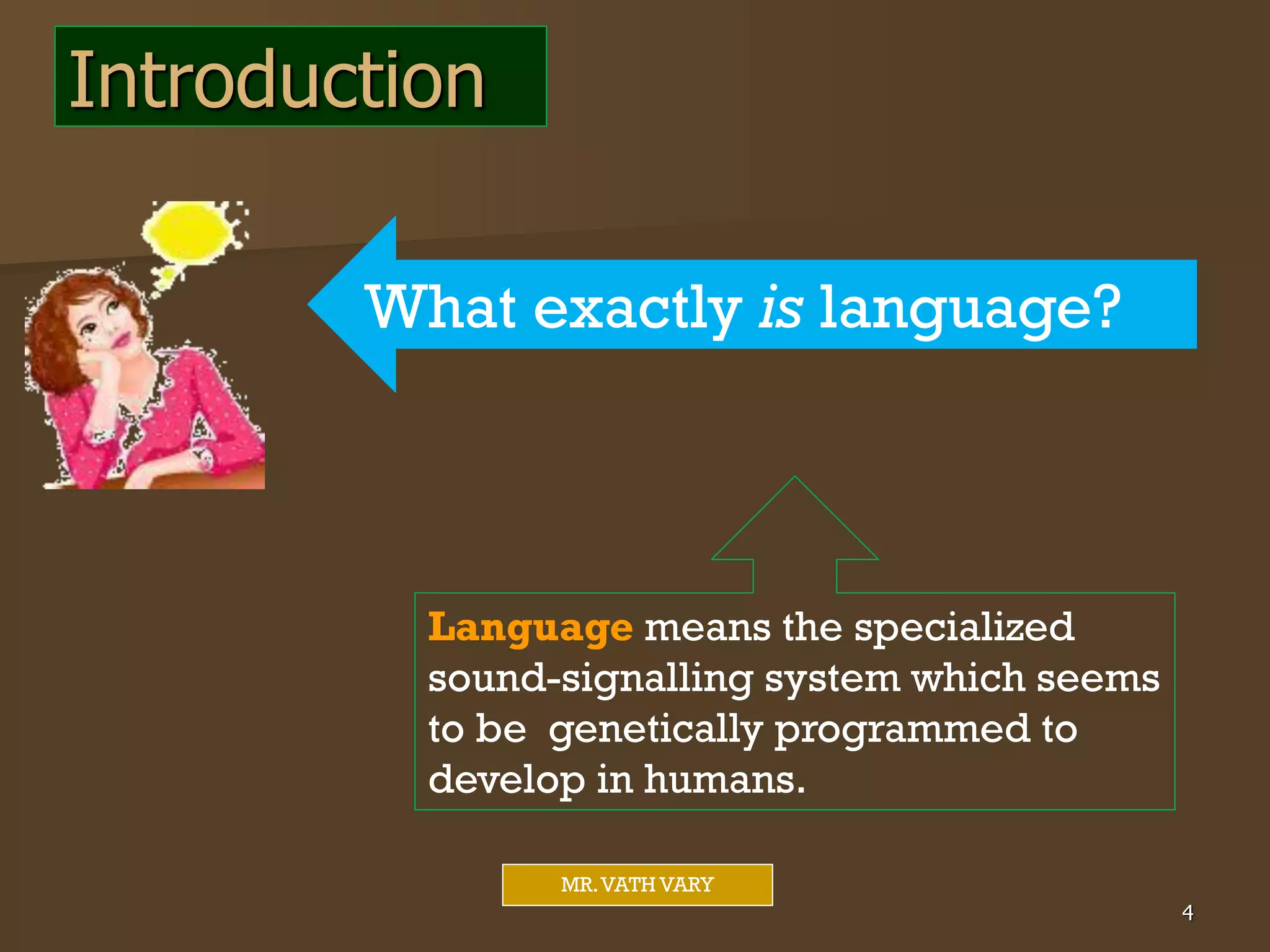
Applied Linguistics for
Language Teachers
Mr. VATH VARY 1
 Outline some important
‘design features’ of human
language;
 Explore the extent to
which they are found in
animal communication;
 Examine the main
purposes or origin of
language in human life.
Learning Goals
MR.VATH VARY
2
 What if there
were no
language?
 What function
does language
play in daily life?
3
MR. VATH VARY
Introduction
4
MR.VATH VARY
What exactly is language?
Language means the specialized
sound-signalling system which seems
to be genetically programmed to
develop in humans.
Introduction
5
MR. VATH VARY
Introduction
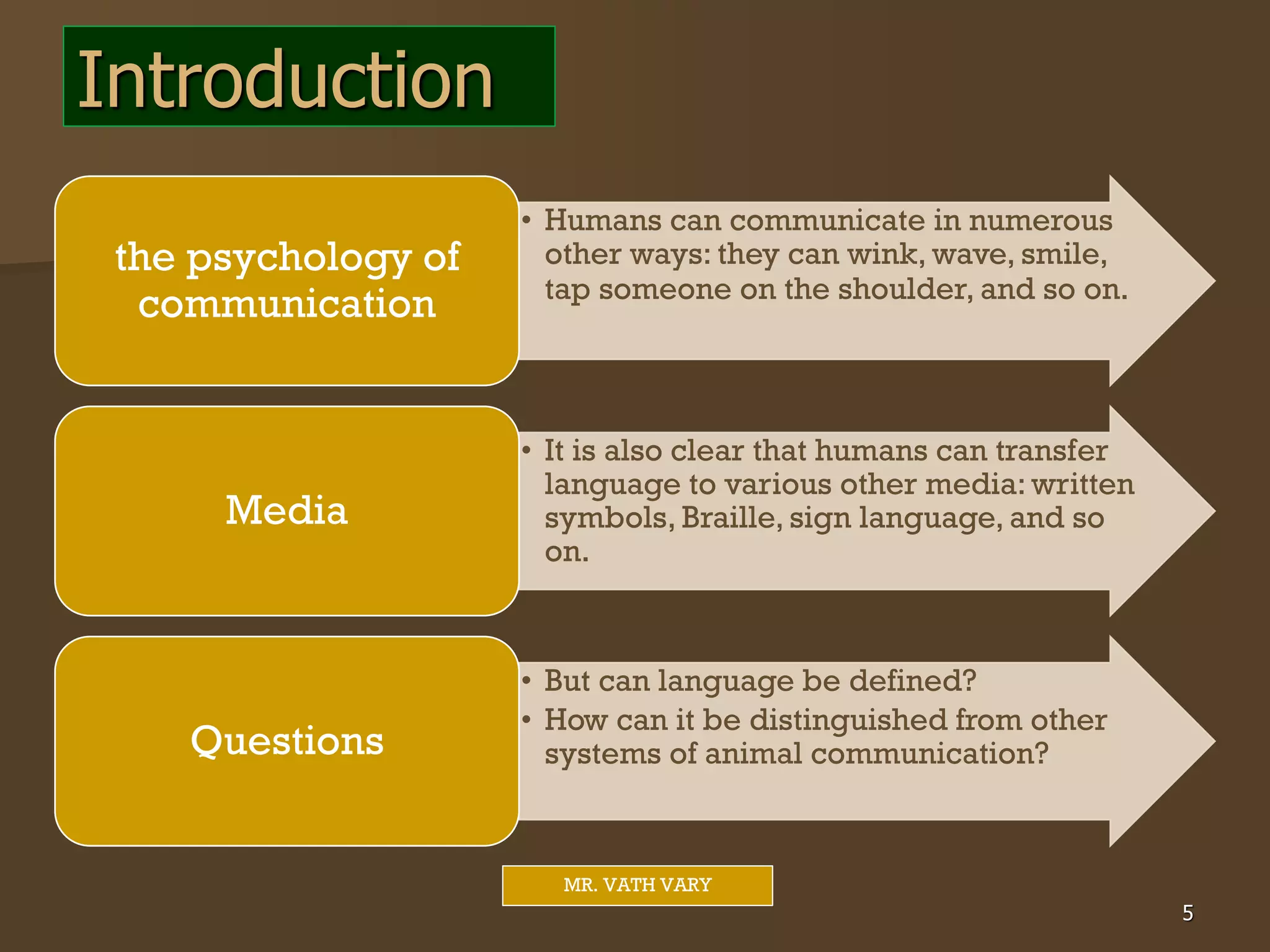
• Humans can communicate in numerous
other ways: they can wink, wave, smile,
tap someone on the shoulder, and so on.
the psychology of
communication
• It is also clear that humans can transfer
language to various other media: written
symbols, Braille, sign language, and so
on.
Media
• But can language be defined?
• How can it be distinguished from other
systems of animal communication?
Questions
Design Features of Language
6
MR.VATH VARY
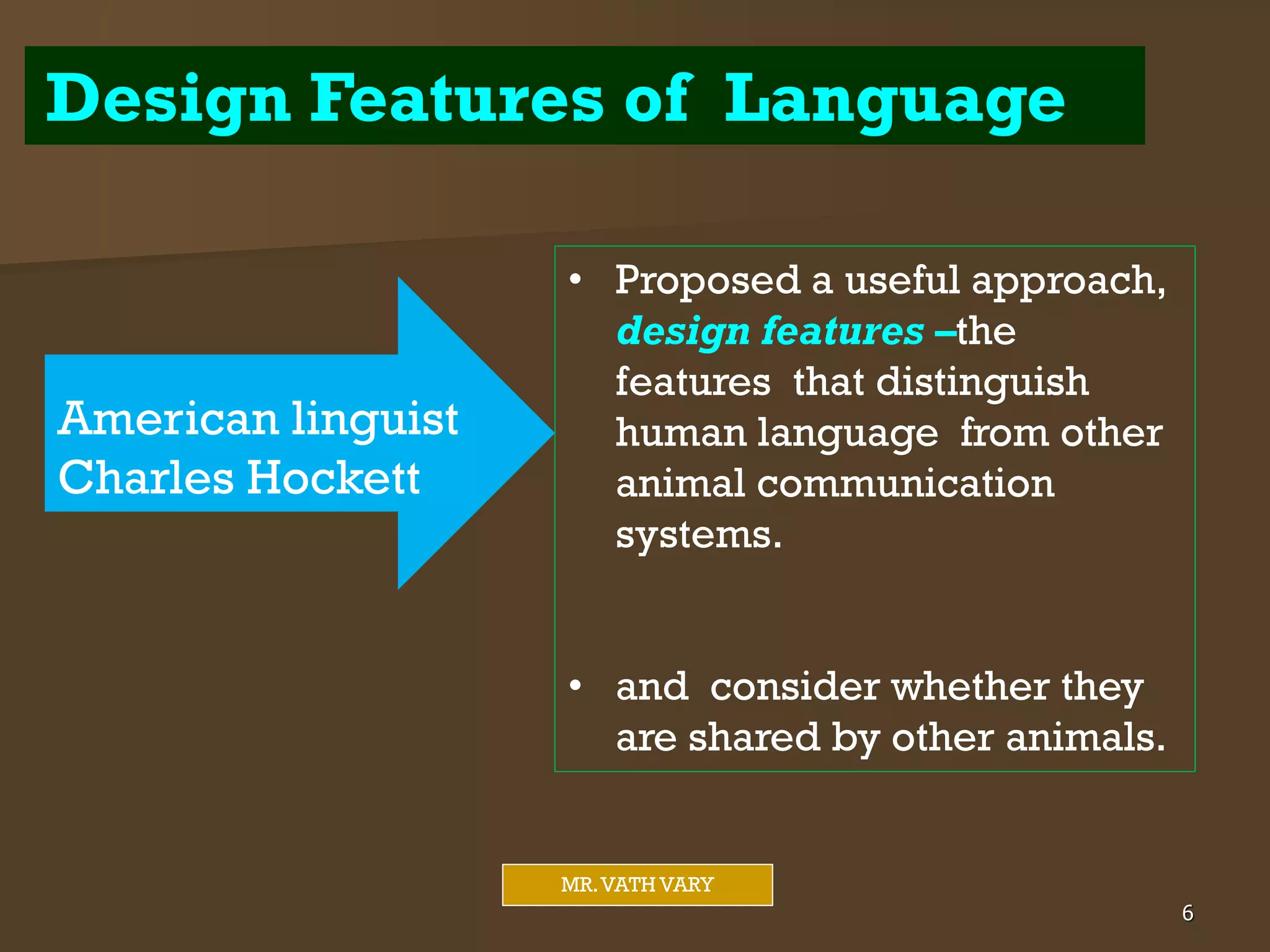
American linguist
Charles Hockett
• Proposed a useful approach,
design features –the
features that distinguish
human language from other
animal communication
systems.
• and consider whether they
are shared by other animals.
Linguistics
 Linguistics:
– can be defined as ‘the
systematic study of language’
– a discipline which describes
language in all its aspects and
formulates theories as to how
it works.
7
MR.VATH VARY
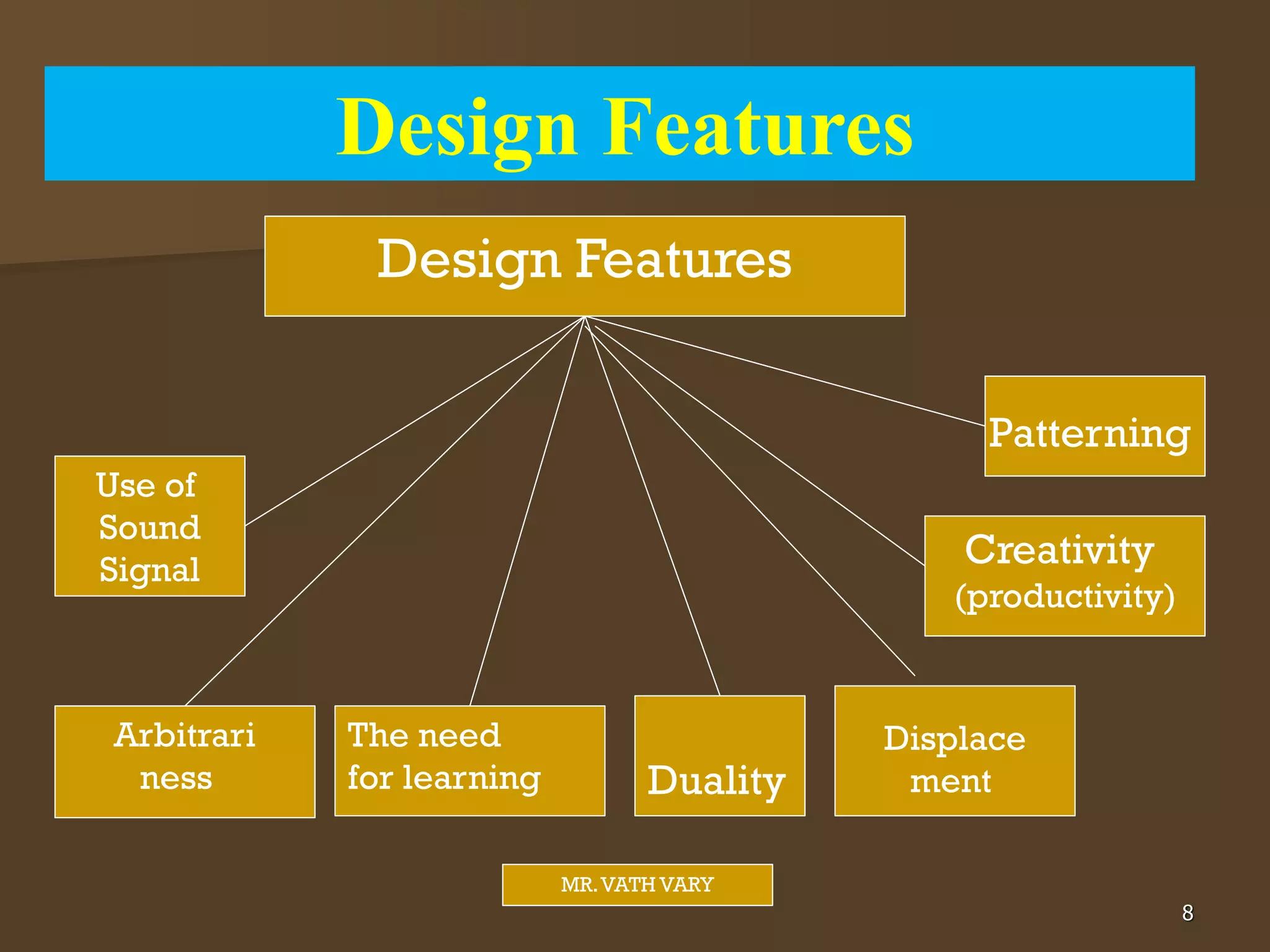
Design Features
Design Features
Use of
Sound
Signal
Arbitrari
ness
Displace
ment
Duality
The need
for learning
Creativity
(productivity)
Patterning
8
MR.VATH VARY
Use of Sound Signals
9
MR. VATH VARY
 Specific signals can be matched with specific
meanings. In short, words have meanings.
• But such methods are
not as widespread as
the use of sounds,
which are employed
by humans.
Sounds can be used in
the dark, and at some
distance, they allow a
wide variety of
messages to be sent, and
they leave the body free
for other activities.
• When animals communicate with one another
through variety of means.
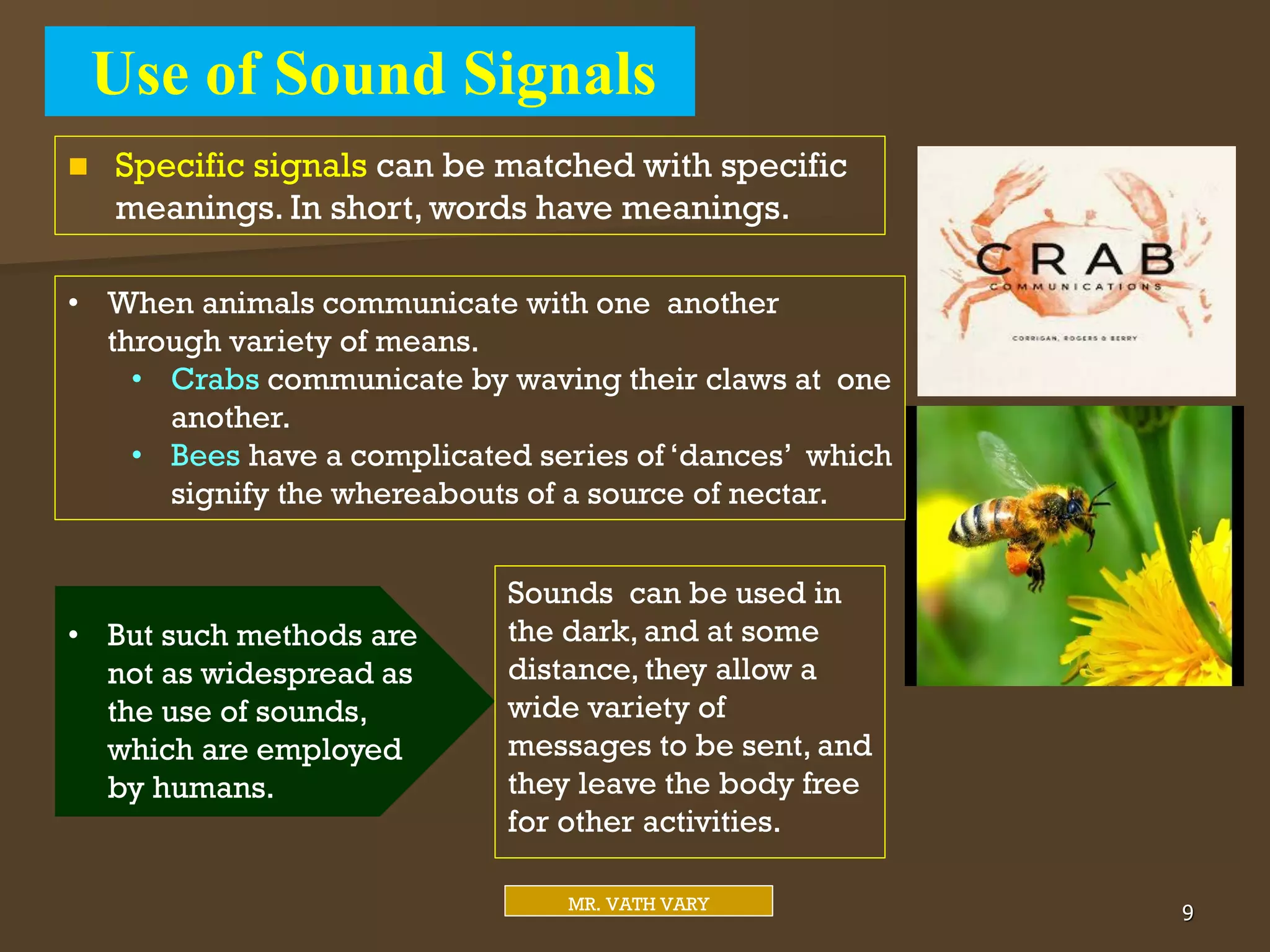
• Crabs communicate by waving their claws at one
another.
• Bees have a complicated series of ‘dances’ which
signify the whereabouts of a source of nectar.
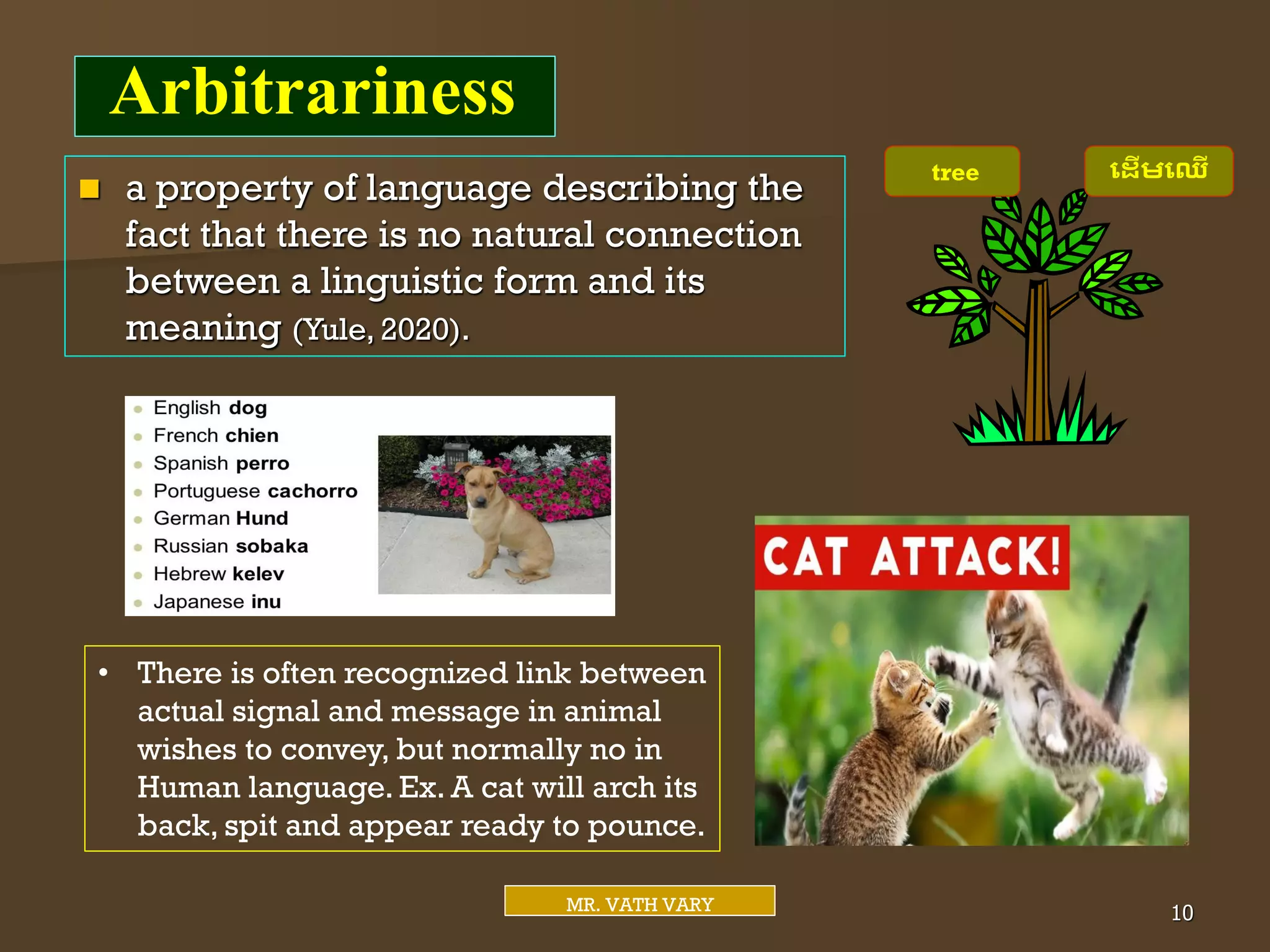
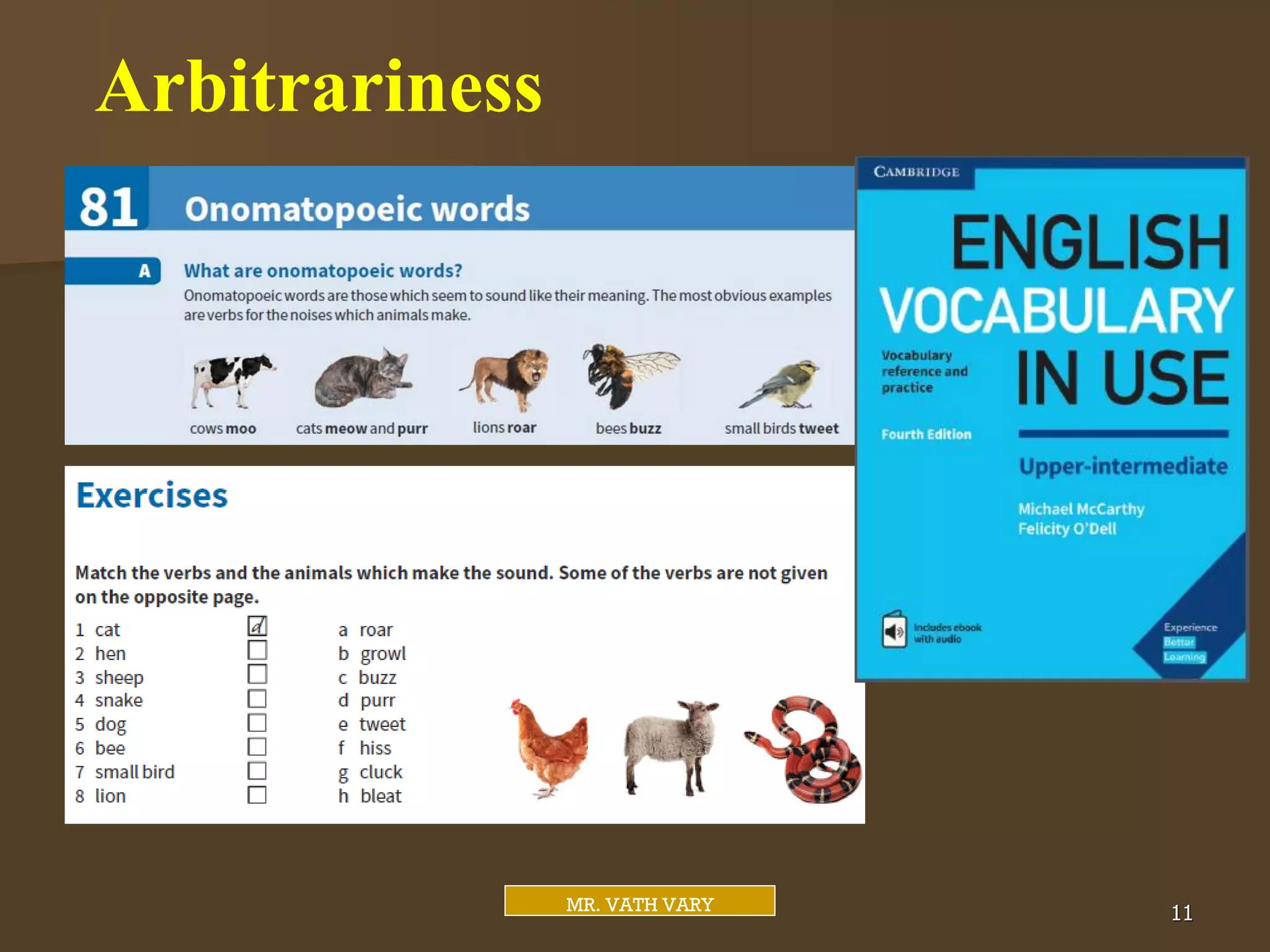
Arbitrariness
 a property of language describing the
fact that there is no natural connection
between a linguistic form and its
meaning (Yule, 2020).
tree ដ ើមដ ើ
10
MR. VATH VARY
• There is often recognized link between
actual signal and message in animal
wishes to convey, but normally no in
Human language. Ex. A cat will arch its
back, spit and appear ready to pounce.
Arbitrariness
11
MR. VATH VARY
The need for learning
12
MR. VATH VARY
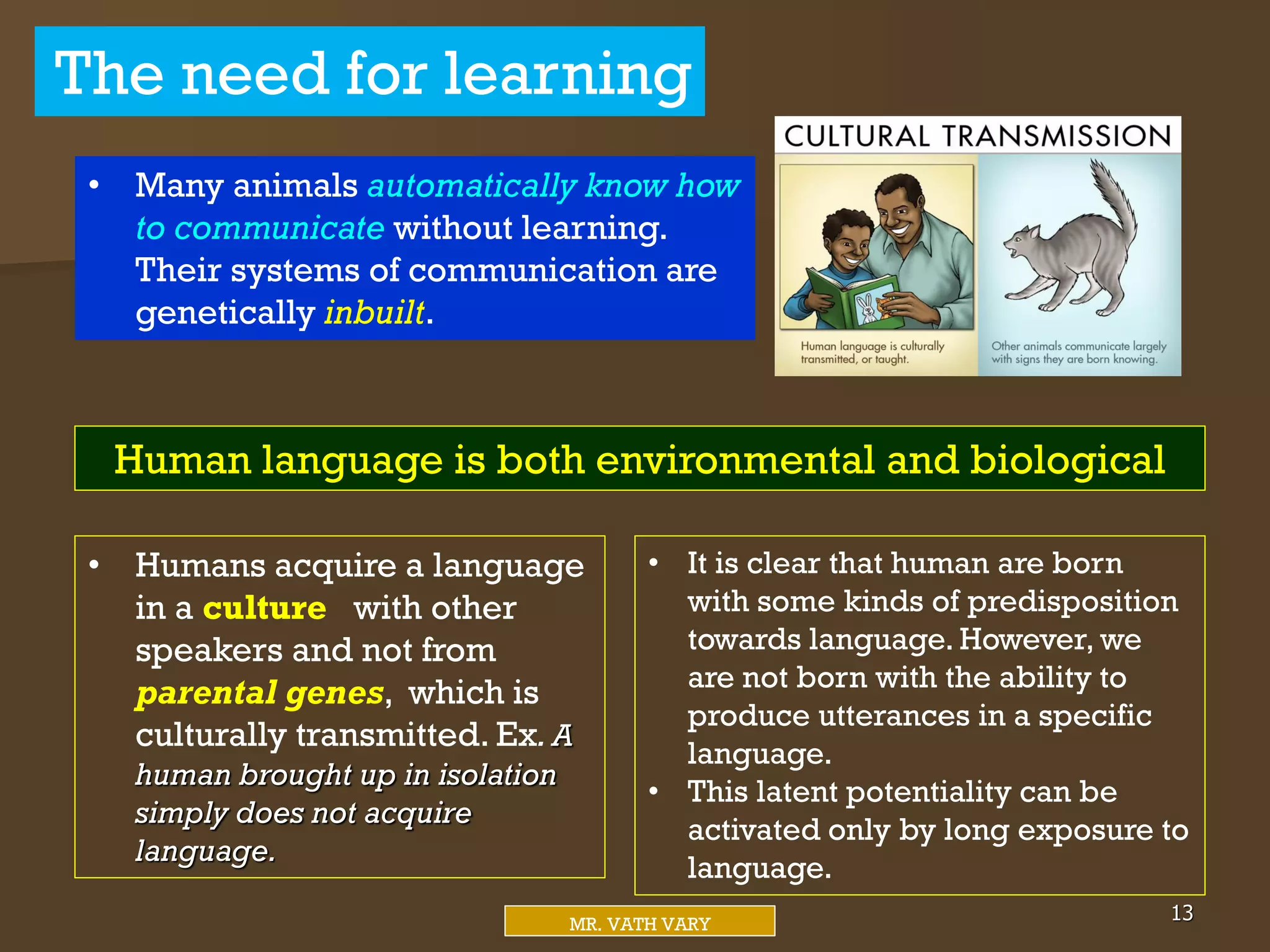
• An infant born to Korean
parents in Korea, but
adopted and brought up
from birth by English
speakers in the United
States, will have physical
characteristics inherited
from his or her natural
parents, but will inevitably
speak English.
The need for learning
13
MR. VATH VARY
• Humans acquire a language
in a culture with other
speakers and not from
parental genes, which is
culturally transmitted. Ex. A
human brought up in isolation
simply does not acquire
language.
• It is clear that human are born
with some kinds of predisposition
towards language. However, we
are not born with the ability to
produce utterances in a specific
language.
• This latent potentiality can be
activated only by long exposure to
language.
• Many animals automatically know how
to communicate without learning.
Their systems of communication are
genetically inbuilt.
Human language is both environmental and biological
Duality
14
MR. VATH VARY
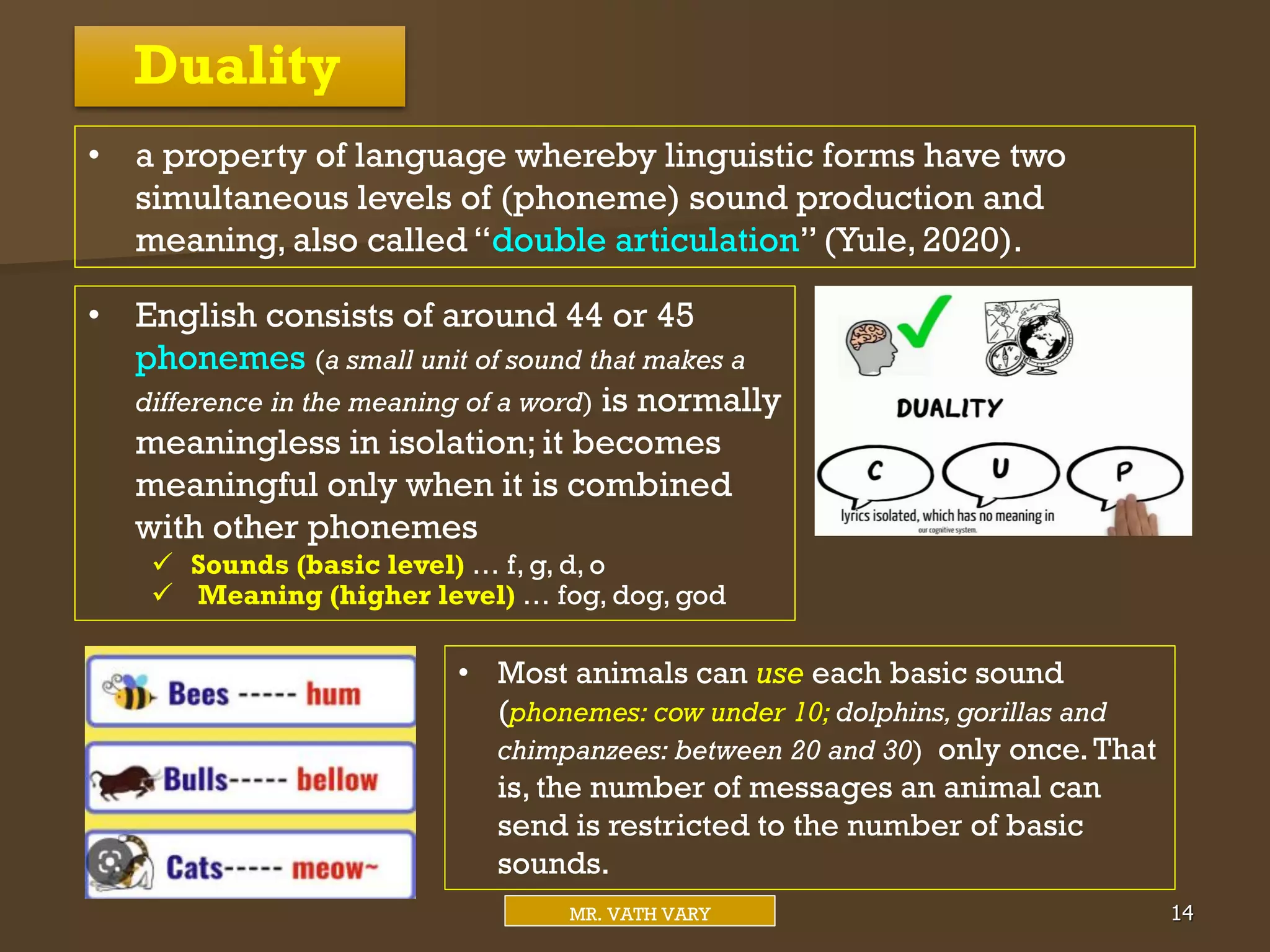
• English consists of around 44 or 45
phonemes (a small unit of sound that makes a
difference in the meaning of a word) is normally
meaningless in isolation; it becomes
meaningful only when it is combined
with other phonemes
 Sounds (basic level) … f, g, d, o
 Meaning (higher level) … fog, dog, god
• a property of language whereby linguistic forms have two
simultaneous levels of (phoneme) sound production and
meaning, also called “double articulation”(Yule, 2020).
• Most animals can use each basic sound
(phonemes: cow under 10; dolphins, gorillas and
chimpanzees: between 20 and 30) only once.That
is, the number of messages an animal can
send is restricted to the number of basic
sounds.
Displacement
 a property of language that allows users to talk about
things and events not present (in time = past or future and space
–here or elsewhere) in the immediate environment (Yule, 2020).
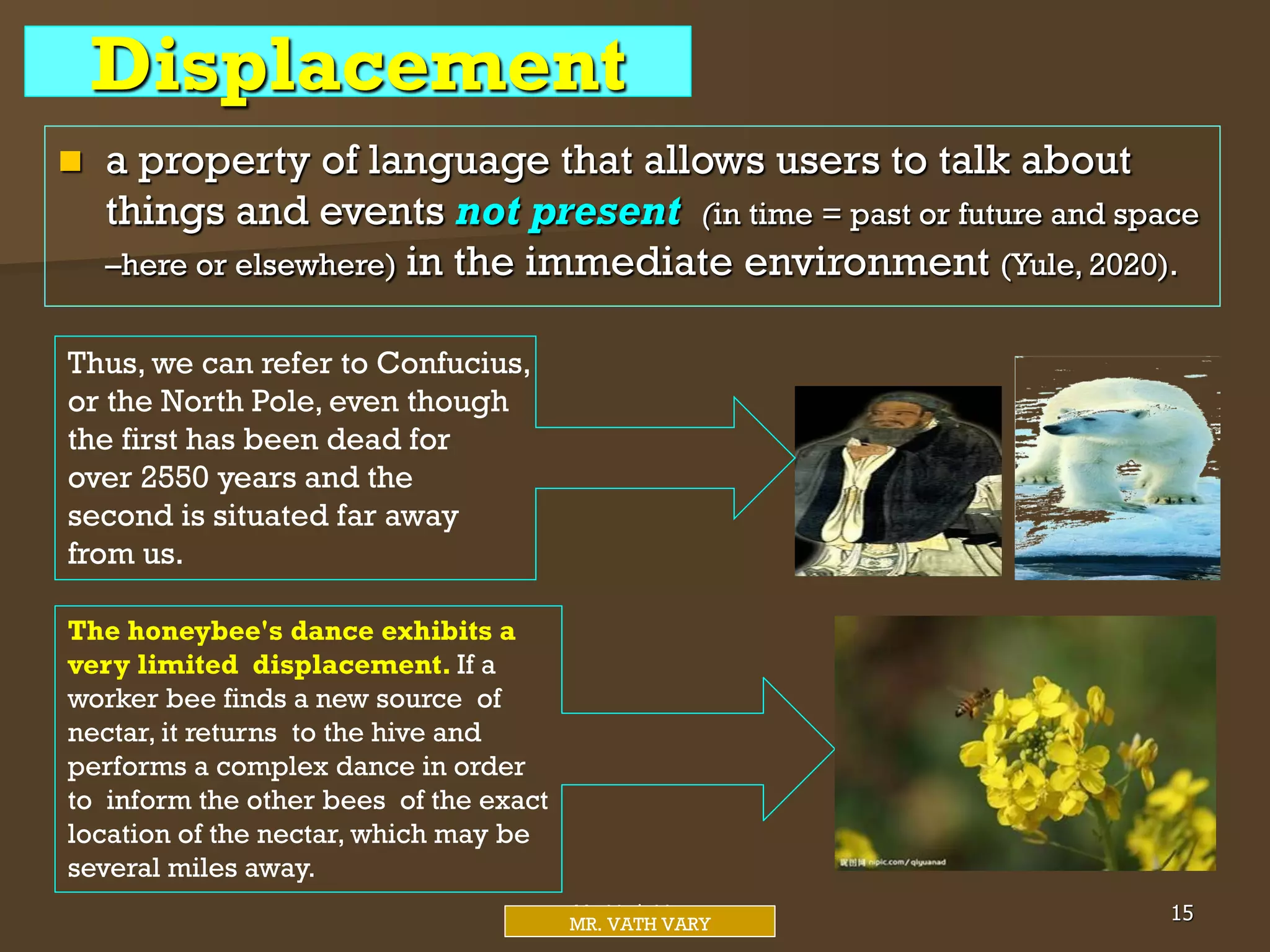
Thus, we can refer to Confucius,
or the North Pole, even though
the first has been dead for
over 2550 years and the
second is situated far away
from us.
Mr. Vath Vary 15
MR. VATH VARY
The honeybee's dance exhibits a
very limited displacement. If a
worker bee finds a new source of
nectar, it returns to the hive and
performs a complex dance in order
to inform the other bees of the exact
location of the nectar, which may be
several miles away.
Creativity (productivity)
Mr. Vath Vary 16
MR. VATH VARY
• A property of language that allows users to understand
and create never-before-heard utterances (Yule, 2020).
 Creativity is unique to human
language.
 Language is creative in that it makes
possible the construction and
interpretation of new signals by its
users.
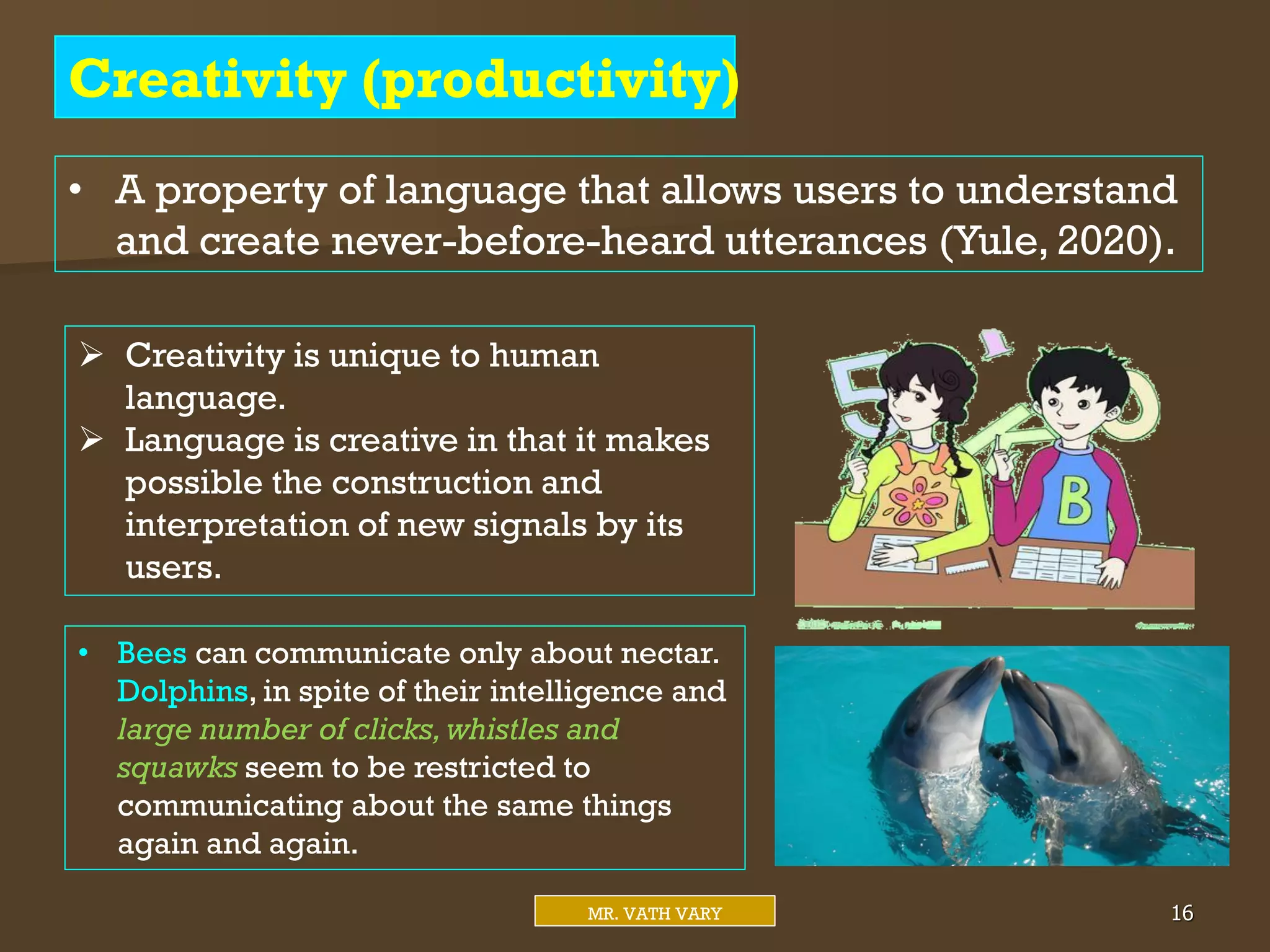
• Bees can communicate only about nectar.
Dolphins, in spite of their intelligence and
large number of clicks,whistles and
squawks seem to be restricted to
communicating about the same things
again and again.
Patterning
Mr. Vath Vary 17
MR. VATH VARY
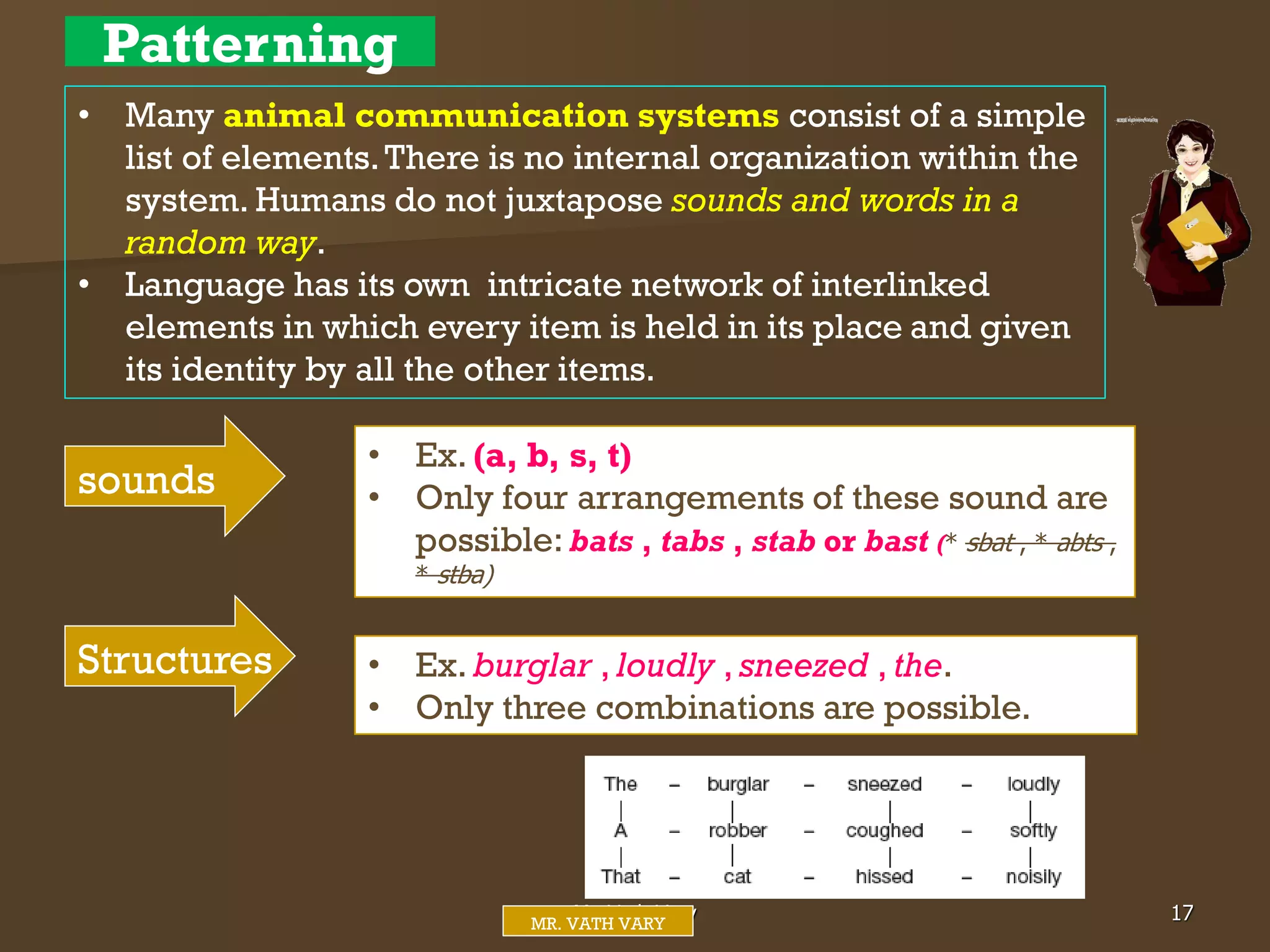
• Many animal communication systems consist of a simple
list of elements.There is no internal organization within the
system. Humans do not juxtapose sounds and words in a
random way.
• Language has its own intricate network of interlinked
elements in which every item is held in its place and given
its identity by all the other items.
sounds
Structures
• Ex. (a, b, s, t)
• Only four arrangements of these sound are
possible: bats , tabs , stab or bast (* sbat , * abts ,
* stba)
• Ex. burglar , loudly , sneezed , the.
• Only three combinations are possible.
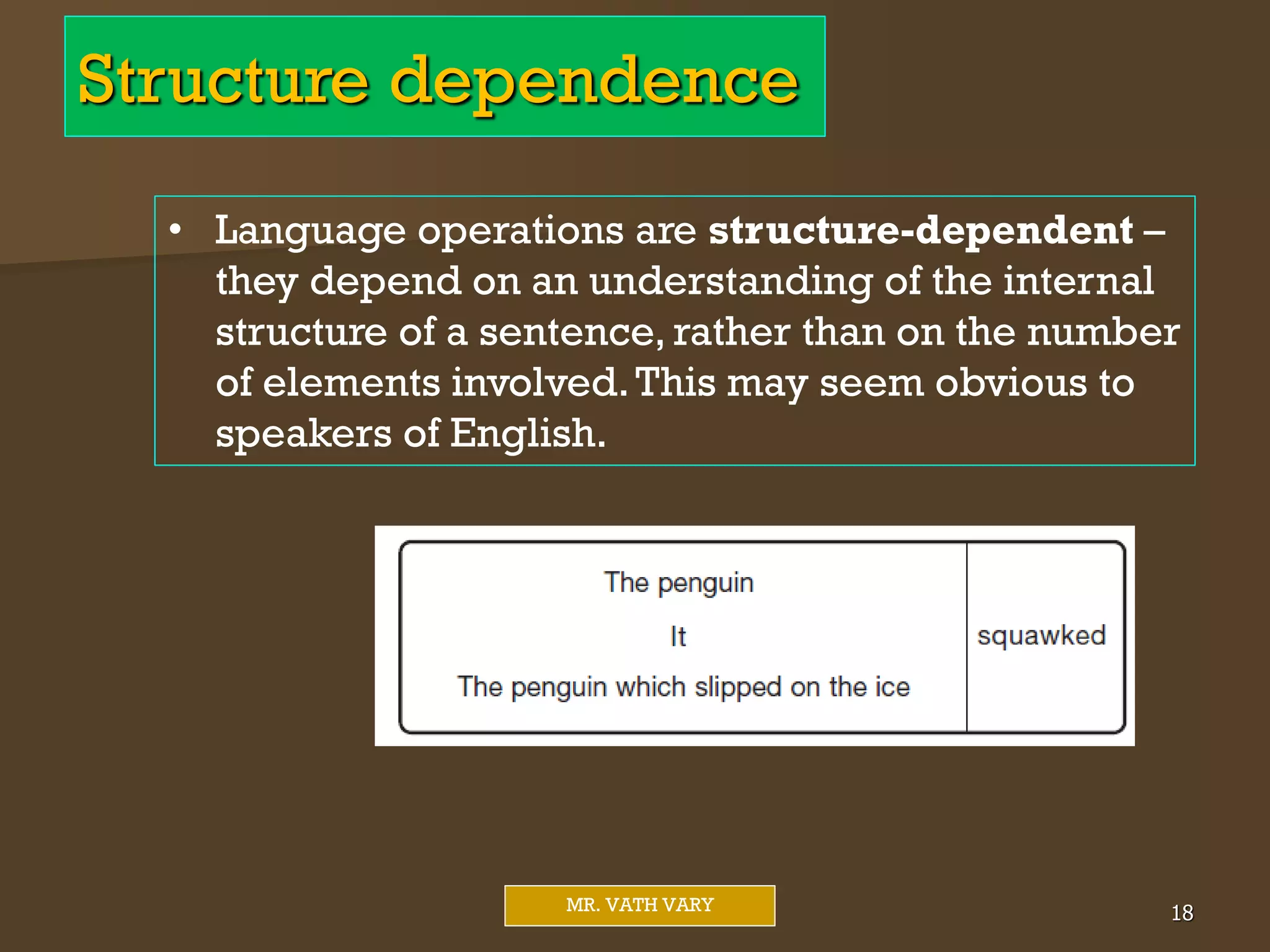
Structure dependence
Mr. Vath Vary 18
MR. VATH VARY
• Language operations are structure-dependent –
they depend on an understanding of the internal
structure of a sentence, rather than on the number
of elements involved.This may seem obvious to
speakers of English.
Mr. Vath Vary 19
MR. VATH VARY
Sounds & Symbols
Human language
• is a signaling
system which uses
sounds, a
characteristic
shared by a large
number of animal
systems;
• is innately guided
Sounds & Symbols
• Animal communication :
frequent connections
between signal and
message are present;
system is mainly
genetically inbuilt.
• Human Language:
symbols are often
arbitrary; system is
culturally transmitted
Duality and
displacement;
creativity
• There are no these
features (Duality &
displacement) in
animal
communication;
• Creativity seems not
to be present in
animal
communication
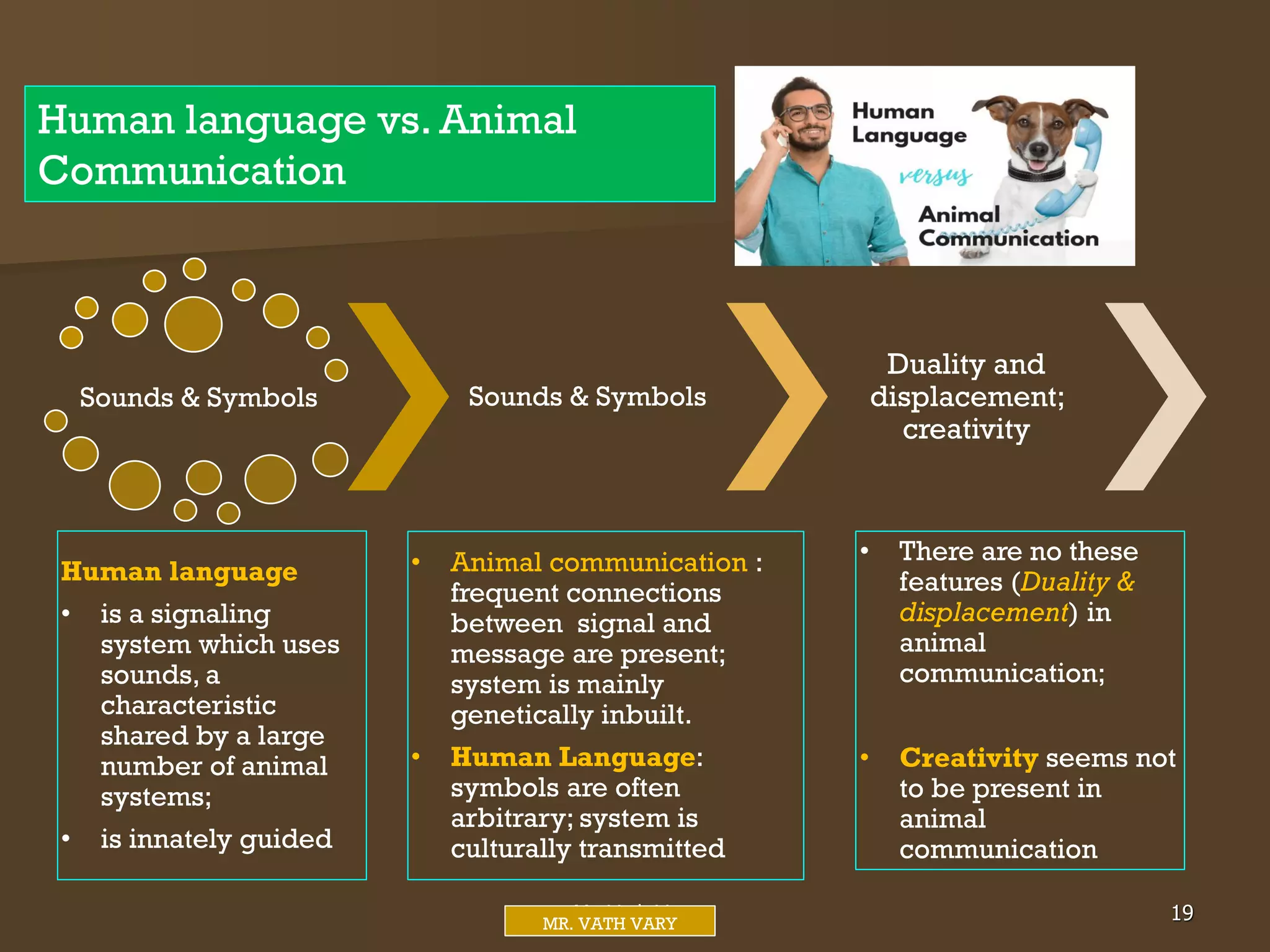
Human language vs. Animal
Communication
 ‘Language’ is a
patterned system of
arbitrary sound
signals,
characterized by
creativity,
displacement,
duality and cultural
transmission.
What is Language?
Mr. Vath Vary 20
MR. VATH VARY
Origin of language
Mr. Vath Vary 21
MR. VATH VARY
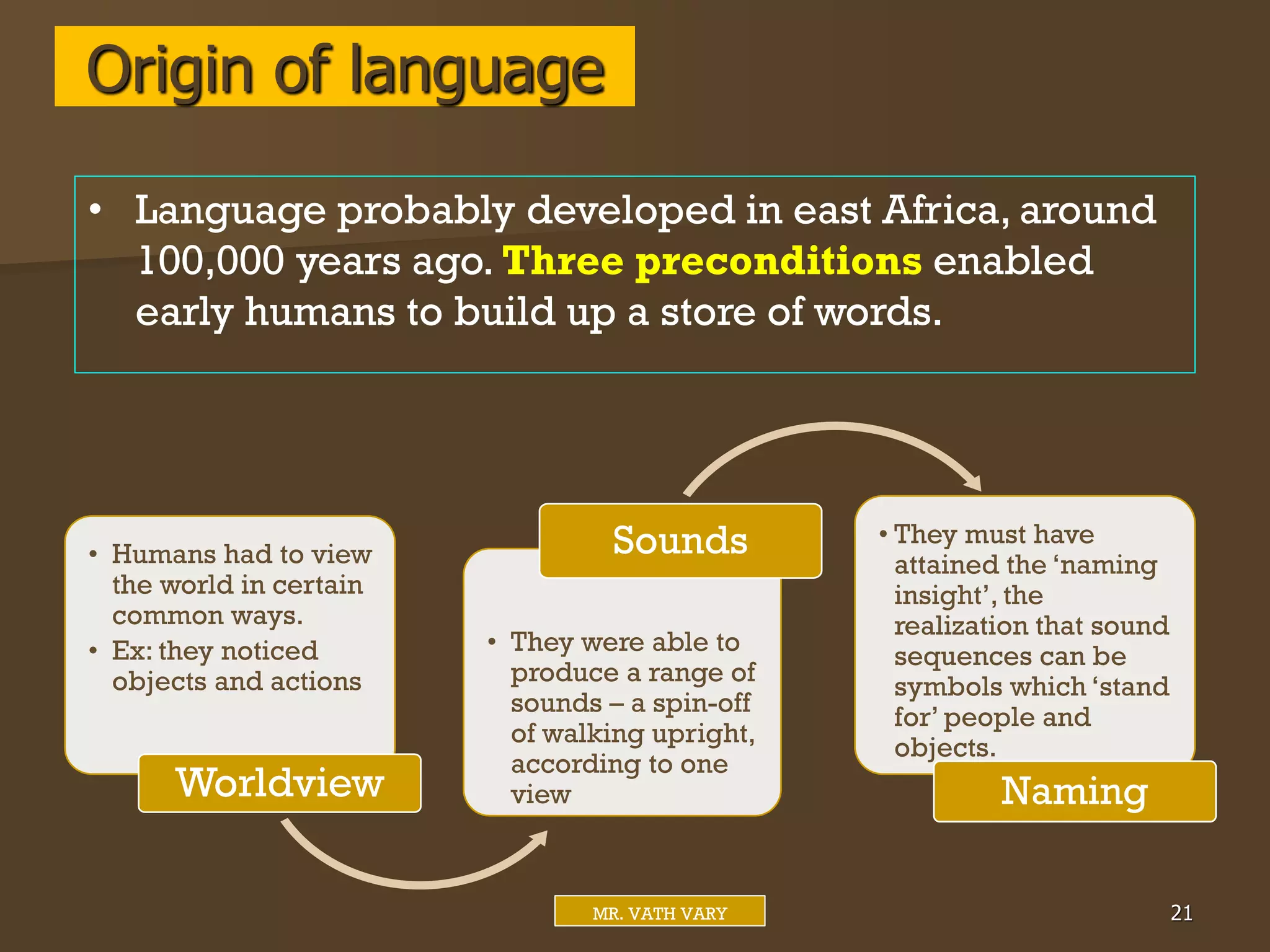
• Language probably developed in east Africa, around
100,000 years ago. Three preconditions enabled
early humans to build up a store of words.
• Humans had to view
the world in certain
common ways.
• Ex: they noticed
objects and actions
Worldview
• They were able to
produce a range of
sounds – a spin-off
of walking upright,
according to one
view
Sounds • They must have
attained the ‘naming
insight’, the
realization that sound
sequences can be
symbols which ‘stand
for’ people and
objects.
Naming
22
MR. VATH VARY
The Role of language
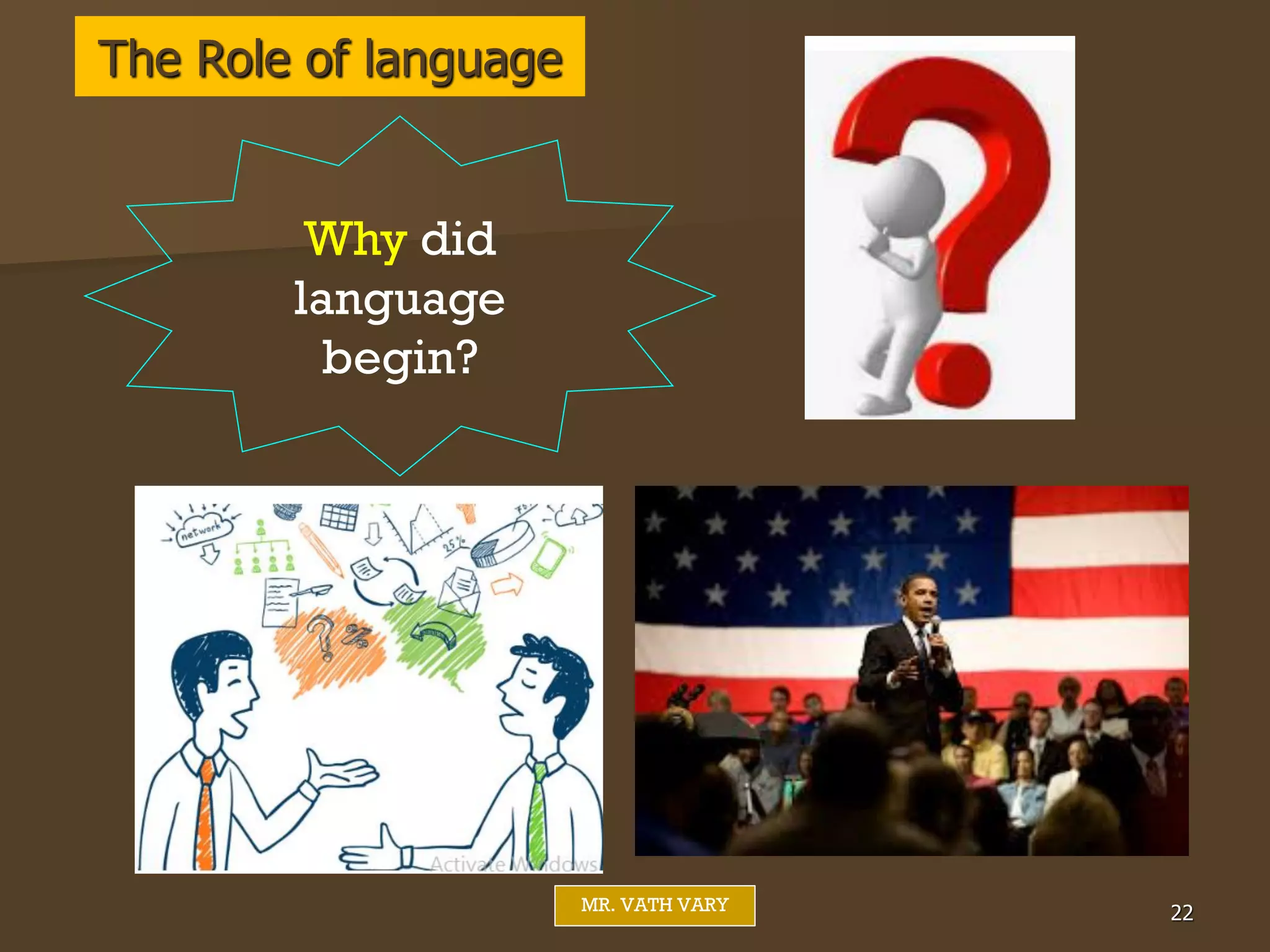
Why did
language
begin?
23
MR. VATH VARY
The Role of language
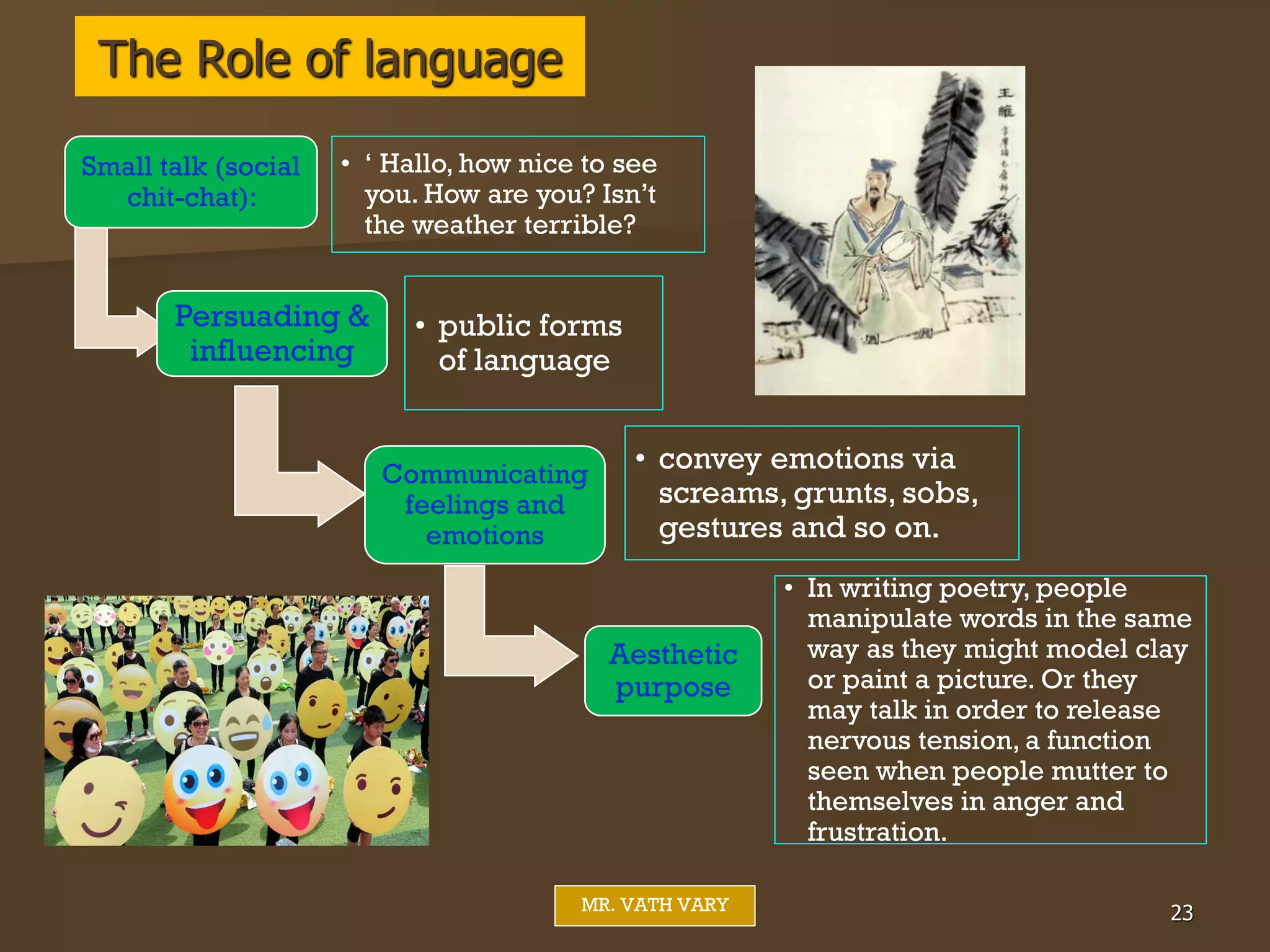
Small talk (social
chit-chat):
• ‘ Hallo, how nice to see
you. How are you? Isn’t
the weather terrible?
Persuading &
influencing
• public forms
of language
Communicating
feelings and
emotions
• convey emotions via
screams, grunts, sobs,
gestures and so on.
Aesthetic
purpose
• In writing poetry, people
manipulate words in the same
way as they might model clay
or paint a picture. Or they
may talk in order to release
nervous tension, a function
seen when people mutter to
themselves in anger and
frustration.
Mr. Vath Vary 24
MR. VATH VARY

CH 2 What is Language PPT.pdf

  • 1.
    Master of Education Chapter2: What is Language? Applied Linguistics for Language Teachers Mr. VATH VARY 1
  • 2.
     Outline someimportant ‘design features’ of human language;  Explore the extent to which they are found in animal communication;  Examine the main purposes or origin of language in human life. Learning Goals MR.VATH VARY 2
  • 3.
     What ifthere were no language?  What function does language play in daily life? 3 MR. VATH VARY Introduction
  • 4.
    4 MR.VATH VARY What exactlyis language? Language means the specialized sound-signalling system which seems to be genetically programmed to develop in humans. Introduction
  • 5.
    5 MR. VATH VARY Introduction •Humans can communicate in numerous other ways: they can wink, wave, smile, tap someone on the shoulder, and so on. the psychology of communication • It is also clear that humans can transfer language to various other media: written symbols, Braille, sign language, and so on. Media • But can language be defined? • How can it be distinguished from other systems of animal communication? Questions
  • 6.
    Design Features ofLanguage 6 MR.VATH VARY American linguist Charles Hockett • Proposed a useful approach, design features –the features that distinguish human language from other animal communication systems. • and consider whether they are shared by other animals.
  • 7.
    Linguistics  Linguistics: – canbe defined as ‘the systematic study of language’ – a discipline which describes language in all its aspects and formulates theories as to how it works. 7 MR.VATH VARY
  • 8.
    Design Features Design Features Useof Sound Signal Arbitrari ness Displace ment Duality The need for learning Creativity (productivity) Patterning 8 MR.VATH VARY
  • 9.
    Use of SoundSignals 9 MR. VATH VARY  Specific signals can be matched with specific meanings. In short, words have meanings. • But such methods are not as widespread as the use of sounds, which are employed by humans. Sounds can be used in the dark, and at some distance, they allow a wide variety of messages to be sent, and they leave the body free for other activities. • When animals communicate with one another through variety of means. • Crabs communicate by waving their claws at one another. • Bees have a complicated series of ‘dances’ which signify the whereabouts of a source of nectar.
  • 10.
    Arbitrariness  a propertyof language describing the fact that there is no natural connection between a linguistic form and its meaning (Yule, 2020). tree ដ ើមដ ើ 10 MR. VATH VARY • There is often recognized link between actual signal and message in animal wishes to convey, but normally no in Human language. Ex. A cat will arch its back, spit and appear ready to pounce.
  • 11.
  • 12.
    The need forlearning 12 MR. VATH VARY • An infant born to Korean parents in Korea, but adopted and brought up from birth by English speakers in the United States, will have physical characteristics inherited from his or her natural parents, but will inevitably speak English.
  • 13.
    The need forlearning 13 MR. VATH VARY • Humans acquire a language in a culture with other speakers and not from parental genes, which is culturally transmitted. Ex. A human brought up in isolation simply does not acquire language. • It is clear that human are born with some kinds of predisposition towards language. However, we are not born with the ability to produce utterances in a specific language. • This latent potentiality can be activated only by long exposure to language. • Many animals automatically know how to communicate without learning. Their systems of communication are genetically inbuilt. Human language is both environmental and biological
  • 14.
    Duality 14 MR. VATH VARY •English consists of around 44 or 45 phonemes (a small unit of sound that makes a difference in the meaning of a word) is normally meaningless in isolation; it becomes meaningful only when it is combined with other phonemes  Sounds (basic level) … f, g, d, o  Meaning (higher level) … fog, dog, god • a property of language whereby linguistic forms have two simultaneous levels of (phoneme) sound production and meaning, also called “double articulation”(Yule, 2020). • Most animals can use each basic sound (phonemes: cow under 10; dolphins, gorillas and chimpanzees: between 20 and 30) only once.That is, the number of messages an animal can send is restricted to the number of basic sounds.
  • 15.
    Displacement  a propertyof language that allows users to talk about things and events not present (in time = past or future and space –here or elsewhere) in the immediate environment (Yule, 2020). Thus, we can refer to Confucius, or the North Pole, even though the first has been dead for over 2550 years and the second is situated far away from us. Mr. Vath Vary 15 MR. VATH VARY The honeybee's dance exhibits a very limited displacement. If a worker bee finds a new source of nectar, it returns to the hive and performs a complex dance in order to inform the other bees of the exact location of the nectar, which may be several miles away.
  • 16.
    Creativity (productivity) Mr. VathVary 16 MR. VATH VARY • A property of language that allows users to understand and create never-before-heard utterances (Yule, 2020).  Creativity is unique to human language.  Language is creative in that it makes possible the construction and interpretation of new signals by its users. • Bees can communicate only about nectar. Dolphins, in spite of their intelligence and large number of clicks,whistles and squawks seem to be restricted to communicating about the same things again and again.
  • 17.
    Patterning Mr. Vath Vary17 MR. VATH VARY • Many animal communication systems consist of a simple list of elements.There is no internal organization within the system. Humans do not juxtapose sounds and words in a random way. • Language has its own intricate network of interlinked elements in which every item is held in its place and given its identity by all the other items. sounds Structures • Ex. (a, b, s, t) • Only four arrangements of these sound are possible: bats , tabs , stab or bast (* sbat , * abts , * stba) • Ex. burglar , loudly , sneezed , the. • Only three combinations are possible.
  • 18.
    Structure dependence Mr. VathVary 18 MR. VATH VARY • Language operations are structure-dependent – they depend on an understanding of the internal structure of a sentence, rather than on the number of elements involved.This may seem obvious to speakers of English.
  • 19.
    Mr. Vath Vary19 MR. VATH VARY Sounds & Symbols Human language • is a signaling system which uses sounds, a characteristic shared by a large number of animal systems; • is innately guided Sounds & Symbols • Animal communication : frequent connections between signal and message are present; system is mainly genetically inbuilt. • Human Language: symbols are often arbitrary; system is culturally transmitted Duality and displacement; creativity • There are no these features (Duality & displacement) in animal communication; • Creativity seems not to be present in animal communication Human language vs. Animal Communication
  • 20.
     ‘Language’ isa patterned system of arbitrary sound signals, characterized by creativity, displacement, duality and cultural transmission. What is Language? Mr. Vath Vary 20 MR. VATH VARY
  • 21.
    Origin of language Mr.Vath Vary 21 MR. VATH VARY • Language probably developed in east Africa, around 100,000 years ago. Three preconditions enabled early humans to build up a store of words. • Humans had to view the world in certain common ways. • Ex: they noticed objects and actions Worldview • They were able to produce a range of sounds – a spin-off of walking upright, according to one view Sounds • They must have attained the ‘naming insight’, the realization that sound sequences can be symbols which ‘stand for’ people and objects. Naming
  • 22.
    22 MR. VATH VARY TheRole of language Why did language begin?
  • 23.
    23 MR. VATH VARY TheRole of language Small talk (social chit-chat): • ‘ Hallo, how nice to see you. How are you? Isn’t the weather terrible? Persuading & influencing • public forms of language Communicating feelings and emotions • convey emotions via screams, grunts, sobs, gestures and so on. Aesthetic purpose • In writing poetry, people manipulate words in the same way as they might model clay or paint a picture. Or they may talk in order to release nervous tension, a function seen when people mutter to themselves in anger and frustration.
  • 24.
    Mr. Vath Vary24 MR. VATH VARY