Chapter 12:
Delivering
Your Speech
• Lecturer: Mr. Vath Vary
• Email: varyvath@gmail.com
• Tel: 017 471 117
Course:
Public Speaking
Content
• Selecting a Delivery Method
• Understanding Factors That Influence
Delivery
• Managing Your Voice During Your
Speech
• Managing Your Body During Your
Speech
• Managing Your Audience During Your
Speech
• Preparing Your Presentation Outline
• Practicing the Delivery of Your Speech
What is Delivery?
• Delivery refers to presenting a
speech in public.
• Effective delivery is the final step that
brings your speech to life, thus
combining:
• Your preparation—planning, research, and
organization
• With vocal strength, body posture, and time
management
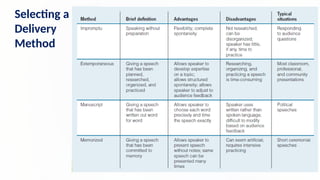
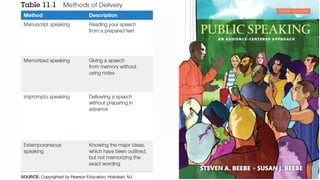
Selecting a
Delivery
Method
Cultural Influences on Delivery
• Cultural norms shape how speakers express
themselves and how audiences interpret
behavior.
• Example: East Asian cultures discourage self-
promotion, which may appear as nervousness in
U.S. contexts.
• Public speaking emphasis varies globally.
• U.S. students often report higher confidence
than students from cultures with less focus on
speech education.
• Adapting to cultural expectations is crucial for
effective communication.
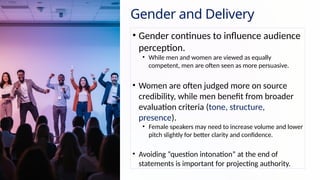
Gender and Delivery
• Gender continues to influence audience
perception.
• While men and women are viewed as equally
competent, men are often seen as more persuasive.
• Women are often judged more on source
credibility, while men benefit from broader
evaluation criteria (tone, structure,
presence).
• Female speakers may need to increase volume and lower
pitch slightly for better clarity and confidence.
• Avoiding “question intonation” at the end of
statements is important for projecting authority.
Voice Challenges for Women
Speakers
1 Pitch
Women generally
speak at a higher
pitch, which can be
harder to hear.
2 Volume
Women often speak
at a lower volume,
making it difficult
for audiences to
hear.
3 Strategies
Speaking more loudly and at a slightly lower
pitch can help women be better heard and
understood.
Language Fluency and Delivery
• Stuttering: Acknowledging it can reduce speaker
anxiety and improve audience reception.
• Focusing on the speech goal and maintaining eye
contact are key strategies.
• Dialect: is the vocabulary, grammar, and
pronunciation used by a group of people. Everyone
speaks in some dialect, even if they don't recognize it.
• While dialects reflect identity and culture, clarity
should be prioritized. Speakers should articulate
clearly and explain unfamiliar terms to ensure
understanding.
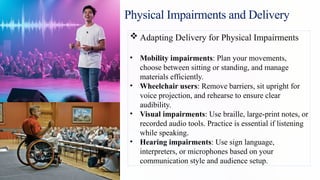
Physical Impairments and Delivery
 Adapting Delivery for Physical Impairments
• Mobility impairments: Plan your movements,
choose between sitting or standing, and manage
materials efficiently.
• Wheelchair users: Remove barriers, sit upright for
voice projection, and rehearse to ensure clear
audibility.
• Visual impairments: Use braille, large-print notes, or
recorded audio tools. Practice is essential if listening
while speaking.
• Hearing impairments: Use sign language,
interpreters, or microphones based on your
communication style and audience setup.
Managing
Your Voice
During Your
Speech
Managing Your Voice During Your Speech
• Speak Loudly Enough
• Speak loud enough for all to hear; practice in a similar space with a
listener at the far end.
• Use Vocal Variety
• Vary rate, pitch, and volume to match the tone and mood of your
message. Avoid monotone speaking.
• Avoid Vocalized Pauses
• Avoid filler words like “uh,” “um,” “you know”; they hurt credibility
and waste time.
• Articulate & Pronounce Words Clearly
• Articulation refers to the clear and precise formation of words when
speaking.
• Poor articulation occurs when speakers drop word endings (e.g., “leavin’”
instead of “leaving”), skip sounds (e.g., “twenny” for “twenty”), or run
words together (e.g., “Waddaya think?”), making speech harder to
understand.
• Pronunciation is the correct way to say a word according to standard
language norms.
• Mispronunciations—such as “pitcher” for “picture” or “reckanize” for
“recognize”—can undermine a speaker’s credibility.
Managing
Your Body
During Your
Speech
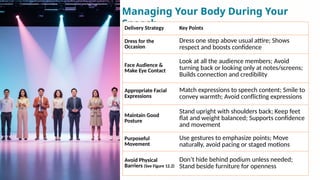
Managing Your Body During Your
Speech
Delivery Strategy Key Points
Dress for the
Occasion
Dress one step above usual attire; Shows
respect and boosts confidence
Face Audience &
Make Eye Contact
Look at all the audience members; Avoid
turning back or looking only at notes/screens;
Builds connection and credibility
Appropriate Facial
Expressions
Match expressions to speech content; Smile to
convey warmth; Avoid conflicting expressions
Maintain Good
Posture
Stand upright with shoulders back; Keep feet
flat and weight balanced; Supports confidence
and movement
Purposeful
Movement
Use gestures to emphasize points; Move
naturally, avoid pacing or staged motions
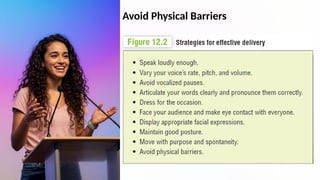
Avoid Physical
Barriers (See Figure 12.2)
Don’t hide behind podium unless needed;
Stand beside furniture for openness
Avoid Physical Barriers
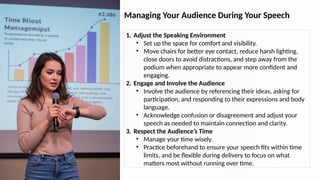
Managing Your Audience During Your Speech
1. Adjust the Speaking Environment
• Set up the space for comfort and visibility.
• Move chairs for better eye contact, reduce harsh lighting,
close doors to avoid distractions, and step away from the
podium when appropriate to appear more confident and
engaging.
2. Engage and Involve the Audience
• Involve the audience by referencing their ideas, asking for
participation, and responding to their expressions and body
language.
• Acknowledge confusion or disagreement and adjust your
speech as needed to maintain connection and clarity.
3. Respect the Audience’s Time
• Manage your time wisely.
• Practice beforehand to ensure your speech fits within time
limits, and be flexible during delivery to focus on what
matters most without running over time.
Managing Your Audience During Your Speech
4. Accommodate Listeners with Impairments
• Ensure accessibility for all. Speak clearly, face your
audience, describe visuals aloud, and check that necessary
aids (e.g., interpreters) are available.
• If unsure how to support someone, ask them directly and
privately.
5. Respond Calmly to Hostility
• If faced with rude or hostile audience members, remain
calm and composed.
• Acknowledge differing opinions respectfully and offer to
continue the discussion after the speech if necessary.
6. Handle Q&A Sessions Professionally
• Be prepared to answer questions thoughtfully. Listen fully,
repeat the question if needed, and answer as clearly as
possible.
• If you don’t know an answer, be honest and offer to follow
up later.
Preparing Your
Presentation
Outline
What is Presentation Outline?
• The presentation outline distills your
complete-sentence outline into a list of words
and phrases to guide you through the main
parts of your speech and the transitions
between them (Table 12.2 summarizes the three types of outlines).
• Knowing how to create and use a presentation outline
is a fundamental skill for extemporaneous public
speaking. The presentation outline allows you to
• Refer comfortably and precisely to the information
you have gathered.
• Present that information in a clear and organized
way.
• Engage your audience personally and professionally
during the speech.
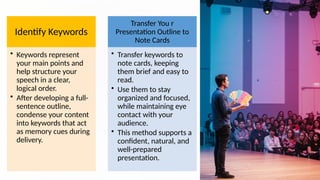
Preparing Your Presentation Outline
Identify Keywords
• Keywords represent
your main points and
help structure your
speech in a clear,
logical order.
• After developing a full-
sentence outline,
condense your content
into keywords that act
as memory cues during
delivery.
Transfer You r
Presentation Outline to
Note Cards
• Transfer keywords to
note cards, keeping
them brief and easy to
read.
• Use them to stay
organized and focused,
while maintaining eye
contact with your
audience.
• This method supports a
confident, natural, and
well-prepared
presentation.
Practicing the
Delivery of
Your Speech
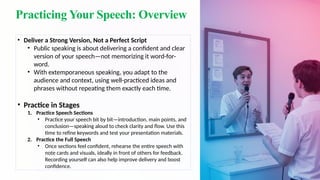
Practicing Your Speech: Overview
• Deliver a Strong Version, Not a Perfect Script
• Public speaking is about delivering a confident and clear
version of your speech—not memorizing it word-for-
word.
• With extemporaneous speaking, you adapt to the
audience and context, using well-practiced ideas and
phrases without repeating them exactly each time.
• Practice in Stages
1. Practice Speech Sections
• Practice your speech bit by bit—introduction, main points, and
conclusion—speaking aloud to check clarity and flow. Use this
time to refine keywords and test your presentation materials.
2. Practice the Full Speech
• Once sections feel confident, rehearse the entire speech with
note cards and visuals, ideally in front of others for feedback.
Recording yourself can also help improve delivery and boost
confidence.
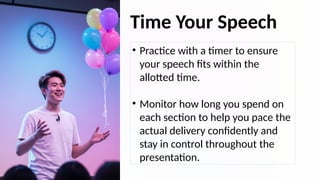
Time Your Speech
• Practice with a timer to ensure
your speech fits within the
allotted time.
• Monitor how long you spend on
each section to help you pace the
actual delivery confidently and
stay in control throughout the
presentation.
Summary
• Effective speech delivery blends careful preparation
with confident execution.
• Extemporaneous speaking is ideal for balancing
planning and spontaneity.
• Delivery is shaped by culture, gender, language, and
physical factors, requiring speakers to adapt
accordingly.
• Success depends on clear voice, body language,
audience engagement, and handling questions
gracefully.
• Thorough practice and organization ensure a polished,
impactful presentation.

Chapter-12-Delivering-Your-Speech (Public speaking).pptx

  • 1.
    Chapter 12: Delivering Your Speech •Lecturer: Mr. Vath Vary • Email: varyvath@gmail.com • Tel: 017 471 117 Course: Public Speaking
  • 2.
    Content • Selecting aDelivery Method • Understanding Factors That Influence Delivery • Managing Your Voice During Your Speech • Managing Your Body During Your Speech • Managing Your Audience During Your Speech • Preparing Your Presentation Outline • Practicing the Delivery of Your Speech
  • 3.
    What is Delivery? •Delivery refers to presenting a speech in public. • Effective delivery is the final step that brings your speech to life, thus combining: • Your preparation—planning, research, and organization • With vocal strength, body posture, and time management
  • 4.
  • 6.
    Cultural Influences onDelivery • Cultural norms shape how speakers express themselves and how audiences interpret behavior. • Example: East Asian cultures discourage self- promotion, which may appear as nervousness in U.S. contexts. • Public speaking emphasis varies globally. • U.S. students often report higher confidence than students from cultures with less focus on speech education. • Adapting to cultural expectations is crucial for effective communication.
  • 7.
    Gender and Delivery •Gender continues to influence audience perception. • While men and women are viewed as equally competent, men are often seen as more persuasive. • Women are often judged more on source credibility, while men benefit from broader evaluation criteria (tone, structure, presence). • Female speakers may need to increase volume and lower pitch slightly for better clarity and confidence. • Avoiding “question intonation” at the end of statements is important for projecting authority.
  • 8.
    Voice Challenges forWomen Speakers 1 Pitch Women generally speak at a higher pitch, which can be harder to hear. 2 Volume Women often speak at a lower volume, making it difficult for audiences to hear. 3 Strategies Speaking more loudly and at a slightly lower pitch can help women be better heard and understood.
  • 9.
    Language Fluency andDelivery • Stuttering: Acknowledging it can reduce speaker anxiety and improve audience reception. • Focusing on the speech goal and maintaining eye contact are key strategies. • Dialect: is the vocabulary, grammar, and pronunciation used by a group of people. Everyone speaks in some dialect, even if they don't recognize it. • While dialects reflect identity and culture, clarity should be prioritized. Speakers should articulate clearly and explain unfamiliar terms to ensure understanding.
  • 10.
    Physical Impairments andDelivery  Adapting Delivery for Physical Impairments • Mobility impairments: Plan your movements, choose between sitting or standing, and manage materials efficiently. • Wheelchair users: Remove barriers, sit upright for voice projection, and rehearse to ensure clear audibility. • Visual impairments: Use braille, large-print notes, or recorded audio tools. Practice is essential if listening while speaking. • Hearing impairments: Use sign language, interpreters, or microphones based on your communication style and audience setup.
  • 11.
  • 12.
    Managing Your VoiceDuring Your Speech • Speak Loudly Enough • Speak loud enough for all to hear; practice in a similar space with a listener at the far end. • Use Vocal Variety • Vary rate, pitch, and volume to match the tone and mood of your message. Avoid monotone speaking. • Avoid Vocalized Pauses • Avoid filler words like “uh,” “um,” “you know”; they hurt credibility and waste time. • Articulate & Pronounce Words Clearly • Articulation refers to the clear and precise formation of words when speaking. • Poor articulation occurs when speakers drop word endings (e.g., “leavin’” instead of “leaving”), skip sounds (e.g., “twenny” for “twenty”), or run words together (e.g., “Waddaya think?”), making speech harder to understand. • Pronunciation is the correct way to say a word according to standard language norms. • Mispronunciations—such as “pitcher” for “picture” or “reckanize” for “recognize”—can undermine a speaker’s credibility.
  • 13.
  • 14.
    Managing Your BodyDuring Your Speech Delivery Strategy Key Points Dress for the Occasion Dress one step above usual attire; Shows respect and boosts confidence Face Audience & Make Eye Contact Look at all the audience members; Avoid turning back or looking only at notes/screens; Builds connection and credibility Appropriate Facial Expressions Match expressions to speech content; Smile to convey warmth; Avoid conflicting expressions Maintain Good Posture Stand upright with shoulders back; Keep feet flat and weight balanced; Supports confidence and movement Purposeful Movement Use gestures to emphasize points; Move naturally, avoid pacing or staged motions Avoid Physical Barriers (See Figure 12.2) Don’t hide behind podium unless needed; Stand beside furniture for openness
  • 15.
  • 16.
    Managing Your AudienceDuring Your Speech 1. Adjust the Speaking Environment • Set up the space for comfort and visibility. • Move chairs for better eye contact, reduce harsh lighting, close doors to avoid distractions, and step away from the podium when appropriate to appear more confident and engaging. 2. Engage and Involve the Audience • Involve the audience by referencing their ideas, asking for participation, and responding to their expressions and body language. • Acknowledge confusion or disagreement and adjust your speech as needed to maintain connection and clarity. 3. Respect the Audience’s Time • Manage your time wisely. • Practice beforehand to ensure your speech fits within time limits, and be flexible during delivery to focus on what matters most without running over time.
  • 17.
    Managing Your AudienceDuring Your Speech 4. Accommodate Listeners with Impairments • Ensure accessibility for all. Speak clearly, face your audience, describe visuals aloud, and check that necessary aids (e.g., interpreters) are available. • If unsure how to support someone, ask them directly and privately. 5. Respond Calmly to Hostility • If faced with rude or hostile audience members, remain calm and composed. • Acknowledge differing opinions respectfully and offer to continue the discussion after the speech if necessary. 6. Handle Q&A Sessions Professionally • Be prepared to answer questions thoughtfully. Listen fully, repeat the question if needed, and answer as clearly as possible. • If you don’t know an answer, be honest and offer to follow up later.
  • 18.
  • 19.
    What is PresentationOutline? • The presentation outline distills your complete-sentence outline into a list of words and phrases to guide you through the main parts of your speech and the transitions between them (Table 12.2 summarizes the three types of outlines). • Knowing how to create and use a presentation outline is a fundamental skill for extemporaneous public speaking. The presentation outline allows you to • Refer comfortably and precisely to the information you have gathered. • Present that information in a clear and organized way. • Engage your audience personally and professionally during the speech.
  • 20.
  • 21.
    Identify Keywords • Keywordsrepresent your main points and help structure your speech in a clear, logical order. • After developing a full- sentence outline, condense your content into keywords that act as memory cues during delivery. Transfer You r Presentation Outline to Note Cards • Transfer keywords to note cards, keeping them brief and easy to read. • Use them to stay organized and focused, while maintaining eye contact with your audience. • This method supports a confident, natural, and well-prepared presentation.
  • 22.
  • 23.
    Practicing Your Speech:Overview • Deliver a Strong Version, Not a Perfect Script • Public speaking is about delivering a confident and clear version of your speech—not memorizing it word-for- word. • With extemporaneous speaking, you adapt to the audience and context, using well-practiced ideas and phrases without repeating them exactly each time. • Practice in Stages 1. Practice Speech Sections • Practice your speech bit by bit—introduction, main points, and conclusion—speaking aloud to check clarity and flow. Use this time to refine keywords and test your presentation materials. 2. Practice the Full Speech • Once sections feel confident, rehearse the entire speech with note cards and visuals, ideally in front of others for feedback. Recording yourself can also help improve delivery and boost confidence.
  • 24.
    Time Your Speech •Practice with a timer to ensure your speech fits within the allotted time. • Monitor how long you spend on each section to help you pace the actual delivery confidently and stay in control throughout the presentation.
  • 25.
    Summary • Effective speechdelivery blends careful preparation with confident execution. • Extemporaneous speaking is ideal for balancing planning and spontaneity. • Delivery is shaped by culture, gender, language, and physical factors, requiring speakers to adapt accordingly. • Success depends on clear voice, body language, audience engagement, and handling questions gracefully. • Thorough practice and organization ensure a polished, impactful presentation.