Human Resource University
Chapter 2:
Cognitive and Language
Development
 Lecturer: Mr. VATH Vary
 Email: varyvath@gmail.com
 Tel: 017471117
MA. in TESOL
Course: Educational Psychology
Contents
An Overview of Child
Development
 Exploring What
Development Is
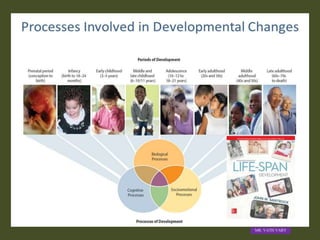
 Processes and
Periods
 Developmental
Issues
 Development and
Education
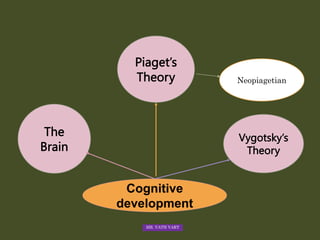
Cognitive
Development
 The Brain
 Piaget’s Theory
 Neo-Piagetian
theory
 Vygotsky’s
Theory
 What Is
Language?
 Biological and
Environmental
Influences
 How Language
Develops
Cognitive
Development
MR. VATH VARY
What is
development
?
Development ….
 is the pattern of biological, cognitive, and
socioemotional changes that begins at
conception and continues through the life
span. Most development involves growth,
but it also eventually includes decay
(dying).
 The more you learn about children’s
development, the better you will
understand the level at which to
appropriately teach them.
 Childhood provides a foundation for the
adult years.
Why study
it?
MR. VATH VARY
Cont
MR. VATH VARY
MR. VATH VARY
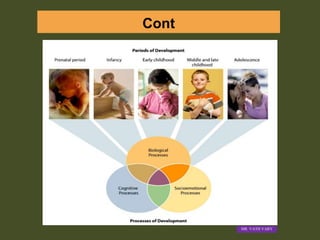
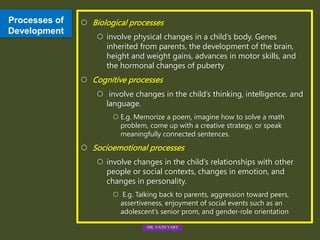
Processes of
Development
 Biological processes
 involve physical changes in a child’s body. Genes
inherited from parents, the development of the brain,
height and weight gains, advances in motor skills, and
the hormonal changes of puberty
 Cognitive processes
 involve changes in the child’s thinking, intelligence, and
language.
 E.g. Memorize a poem, imagine how to solve a math
problem, come up with a creative strategy, or speak
meaningfully connected sentences.
 Socioemotional processes
 involve changes in the child’s relationships with other
people or social contexts, changes in emotion, and
changes in personality.
 E.g. Talking back to parents, aggression toward peers,
assertiveness, enjoyment of social events such as an
adolescent’s senior prom, and gender-role orientation
MR. VATH VARY
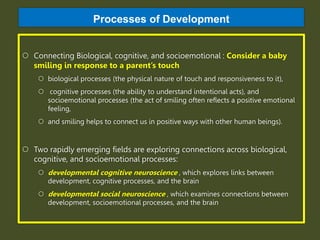
Processes of Development
 Connecting Biological, cognitive, and socioemotional : Consider a baby
smiling in response to a parent’s touch
 biological processes (the physical nature of touch and responsiveness to it),
 cognitive processes (the ability to understand intentional acts), and
socioemotional processes (the act of smiling often reflects a positive emotional
feeling,
 and smiling helps to connect us in positive ways with other human beings).
 Two rapidly emerging fields are exploring connections across biological,
cognitive, and socioemotional processes:
 developmental cognitive neuroscience , which explores links between
development, cognitive processes, and the brain
 developmental social neuroscience , which examines connections between
development, socioemotional processes, and the brain
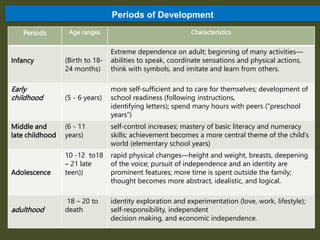
Periods of Development
Periods Age ranges Characteristics
Infancy (Birth to 18-
24 months)
Extreme dependence on adult; beginning of many activities—
abilities to speak, coordinate sensations and physical actions,
think with symbols, and imitate and learn from others.
Early
childhood (5 - 6 years)
more self-sufficient and to care for themselves; development of
school readiness (following instructions,
identifying letters); spend many hours with peers (“preschool
years”)
Middle and
late childhood
(6 - 11
years)
self-control increases; mastery of basic literacy and numeracy
skills; achievement becomes a more central theme of the child’s
world (elementary school years)
Adolescence
10 -12 to18
– 21 late
teen))
rapid physical changes—height and weight, breasts, deepening
of the voice; pursuit of independence and an identity are
prominent features; more time is spent outside the family;
thought becomes more abstract, idealistic, and logical.
adulthood
18 – 20 to
death
identity exploration and experimentation (love, work, lifestyle);
self-responsibility, independent
decision making, and economic independence.
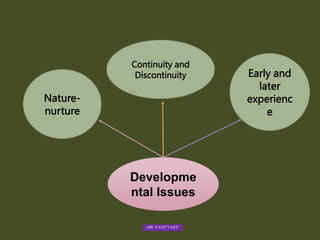
Developme
ntal Issues
Nature-
nurture
Continuity and
Discontinuity Early and
later
experienc
e
MR. VATH VARY
Development
al issues
 The nature-nurture issue focuses on the extent to
which development is mainly influenced by nature
(biological influence) or nurture (environmental
influence).
Although heredity and environment are pervasive
influences on development, humans can author a
unique developmental path by changing the
environment.
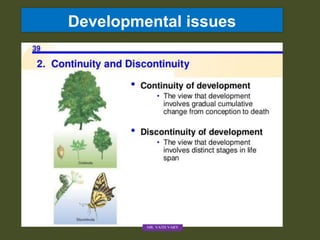
 The continuity-discontinuity issue focuses on the extent
to which development involves gradual, cumulative
change (continuity –NURTURE) or distinct stages
(discontinuity–NATURE)
 The early-later experience issue Involves the degree
to which early experiences (especially infancy) or later
experiences are the key determinants of the child’s
development.
MR. VATH VARY
Developmental issues
MR. VATH VARY
Development
and
Education
 Competent teachers are aware of these
developmental differences, rather than
characterizing students as “advanced,”
“average,” and “slow,”
 Developmentally appropriate teaching
… takes place at a level that is neither
too difficult and stressful nor too easy
and boring for the child’s
developmental level
 Splintered development
… occurs when there is considerable
unevenness in development across
domains.
MR. VATH VARY
Cognitive
development
The
Brain
Piaget’s
Theory
Vygotsky’s
Theory
Neopiagetian
MR. VATH VARY
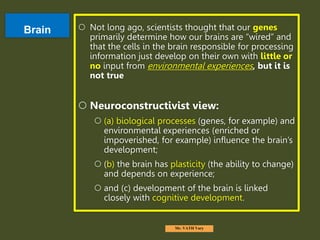
Brain  Not long ago, scientists thought that our genes
primarily determine how our brains are “wired” and
that the cells in the brain responsible for processing
information just develop on their own with little or
no input from environmental experiences, but it is
not true
 Neuroconstructivist view:
 (a) biological processes (genes, for example) and
environmental experiences (enriched or
impoverished, for example) influence the brain’s
development;
 (b) the brain has plasticity (the ability to change)
and depends on experience;
 and (c) development of the brain is linked
closely with cognitive development.
Mr. VATH Vary
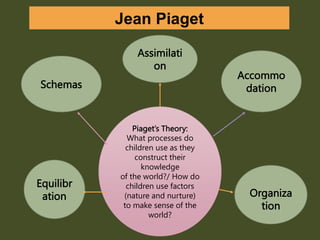
Jean Piaget
Piaget’s Theory:
What processes do
children use as they
construct their
knowledge
of the world?/ How do
children use factors
(nature and nurture)
to make sense of the
world?
Equilibr
ation
Schemas
Assimilati
on
Accommo
dation
Organiza
tion
Jean
Piaget
(swiss_189
6-1980)
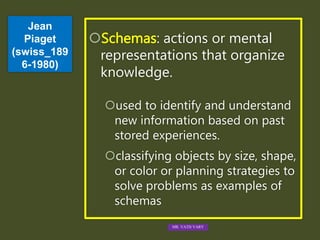
Schemas: actions or mental
representations that organize
knowledge.
used to identify and understand
new information based on past
stored experiences.
classifying objects by size, shape,
or color or planning strategies to
solve problems as examples of
schemas
MR. VATH VARY
Jean Piaget (1896-1980)
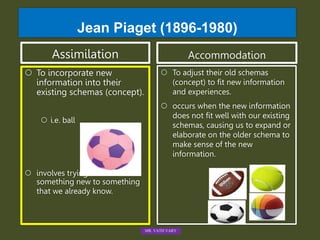
Assimilation
 To incorporate new
information into their
existing schemas (concept).
 i.e. ball
 involves trying to relate
something new to something
that we already know.
Accommodation
 To adjust their old schemas
(concept) to fit new information
and experiences.
 occurs when the new information
does not fit well with our existing
schemas, causing us to expand or
elaborate on the older schema to
make sense of the new
information.
MR. VATH VARY
Jean
Piaget
(1896-
1980)
 Organization
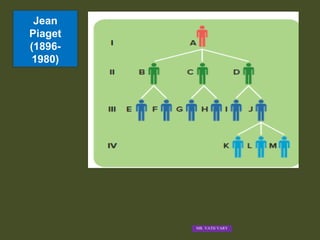
 Involves grouping isolated behaviors into a higher-
order, more smoothly functioning cognitive system;
the grouping or arranging of items into categories.
 Equilibration
 A mechanism that Piaget proposed to explain how
children shift from one stage of thought to the
next. The shift occurs as children experience
cognitive conflict, or disequilibrium, in trying to
understand the world. Eventually, they resolve the
conflict and reach a balance, or equilibrium, of
thought.
 Piaget argued that disequilibrium acts as a force
to drive cognitive growth; therefore, teachers
should find ways to promote cognitive conflict to
help children learn in meaningful ways
MR. VATH VARY
Jean Piaget
MR. VATH VARY
Jean
Piaget
(1896-
1980)
Stages of Development
Sensorimotor, aged from
birth-2:
constructs an understanding of the
world by coordinating their sensory
experiences with their motor actions
Progresses from reflexive, instinctual
action at birth to the beginning of
symbolic thought toward the end of the
stage
Learning by actively exploring the
surrounding environment. Mostly
nonverbal
MR. VATH VARY
Jean
Piaget
(1896-
1980)
Stages of Development
 Preoperational , aged 2-7:
 begins to represent the world with words and
images
 These words and images reflect increased
symbolic and intuitive thinking and go beyond
the connection of sensory information and
physical action.
 Egocentrism and centration are constraints.
 Combining exploration with speech. Reconstruct
concepts by grouping and naming objects
 “Why” questions signal the emergence of the
child’s interest in figuring out why things are the
way they are.
MR. VATH VARY
Jean Piaget
Two substages of Preoperational
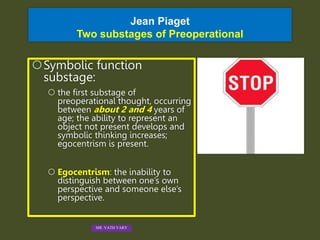
Symbolic function
substage:
 the first substage of
preoperational thought, occurring
between about 2 and 4 years of
age; the ability to represent an
object not present develops and
symbolic thinking increases;
egocentrism is present.
 Egocentrism: the inability to
distinguish between one’s own
perspective and someone else’s
perspective.
MR. VATH VARY
Jean Piaget
Two substages of Preoperational
intuitive thought substage
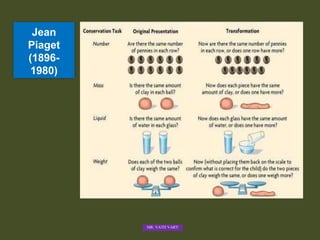
 Centration: involves
focusing (or centering)
attention on one
characteristic to the
exclusion of all others.
 Conservation: the idea that
some characteristic of an
object stays the same even
though the object might
change in appearance.
 The second substage of
preoperational thought,
lasting from about 4 to 7
years of age. Children
begin to use primitive
reasoning and want to
know the answer to all
sorts of questions. They
seem sure about their
knowledge in this
substage but are unaware
of how they know what
they know.
MR. VATH
VARY
Jean
Piaget
(1896-
1980)
MR. VATH VARY
Jean
Piaget
(1896-
1980)
Stages of Development
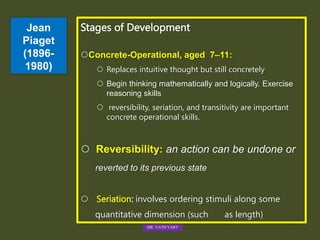
Concrete-Operational, aged 7–11:
 Replaces intuitive thought but still concretely
 Begin thinking mathematically and logically. Exercise
reasoning skills
 reversibility, seriation, and transitivity are important
concrete operational skills.
 Reversibility: an action can be undone or
reverted to its previous state
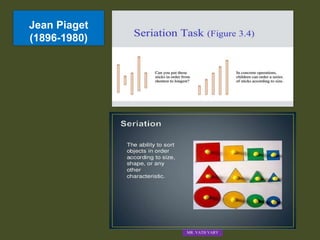
 Seriation: involves ordering stimuli along some
quantitative dimension (such as length)
MR. VATH VARY
Jean Piaget
(1896-1980)
MR. VATH VARY
Jean Piaget
(1896-1980)
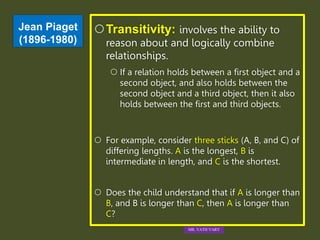
Transitivity: involves the ability to
reason about and logically combine
relationships.
 If a relation holds between a first object and a
second object, and also holds between the
second object and a third object, then it also
holds between the first and third objects.
 For example, consider three sticks (A, B, and C) of
differing lengths. A is the longest, B is
intermediate in length, and C is the shortest.
 Does the child understand that if A is longer than
B, and B is longer than C, then A is longer than
C?
MR. VATH VARY
Jean
Piaget
(1896-
1980)
MR. VATH VARY
Jean
Piaget
(1896-
1980)
 Formal-Operational, aged 11- adulthood:
 thinking is more abstract, idealistic, and logical.
 Learn complex processes. Use multivariate
thinking.
 Hypothetical deductive reasoning develop hypotheses to
solve problems and systematically reach a conclusion.
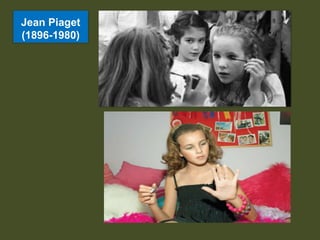
 Adolescent egocentrism characterizes many young
adolescents, which refers to the heightened self-
consciousness reflected in adolescents’ beliefs
that others are as interested in them as they
themselves are. It also includes a sense of
personal uniqueness and the desire to be
noticed, visible, and “on stage.”
MR. VATH VARY
Jean Piaget
(1896-1980)
Cont
Contribution
 owe to him a long list of
masterful concepts including
assimilation and
accommodation, object
permanence, egocentrism,
conservation, and
hypothetical-deductive
reasoning
 Child as an active,
constructivist thinker.
Criticism
 estimates of children’s
competence,
 stages,
 the training of children to
reason at a higher
cognitive level
 Culture and education exert
stronger influences on
children’s development than
Piaget envisioned
MR. VATH VARY
Neo-Piagetians  argue that Piaget got some things right
but that his theory needs considerable
revision.
 emphasize how children process
information through attention,
memory, and strategies
They especially stress that a more
accurate vision of children’s thinking
requires more knowledge of strategies,
how quickly and how automatically
children process information, the
particular cognitive task involved, and
the division of cognitive problems into
smaller, more precise steps
MR. VATH VARY
Vygotsky
(Russian )
 Russian Psychologist
 The West published in 1962
 Proposed sociocultural theory/ Social
constructivist approach
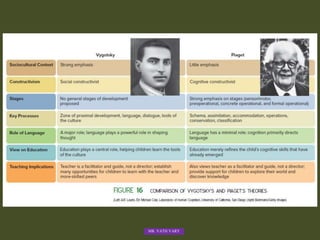
 emphasizes that cognitive skills need to be interpreted
developmentally, are mediated by language, and have
their origins in social relations and culture.
 Culture requires skilled tool use (language, art counting
system) and can determine what skills are important
(such as computer skills, communication skills,
teamwork skills)
 The content of learning is influenced by the culture in
which the student lives, which includes language,
beliefs, and skills
MR. VATH VARY
Vygotsky
(Russian
psychologist)
Developed the theory: Zone
of Proximal Development:
the range of tasks that are too
difficult for children to master
alone but can be mastered with
guidance and assistance from
adults or more-skilled children.
 Teaching in the zone of proximal
development reflects the concept of
developmentally appropriate
teaching
MR. VATH VARY
Zone of Proximal Development
MR. VATH VARY
Vygotsky Scaffolding
… A technique that involves changing
the level of support for learning. A teacher or
more advanced peer adjusts the amount of
guidance to fit the student’s current
performance.
 When the student is learning a new task,
the skilled person may use direct
instruction. As the student’s competence
increases, less guidance is given.
 Asking probing questions is an excellent
way to scaffold students’ learning and
help them develop more sophisticated
thinking skills.
MR. VATH VARY
Vygotsky Language and Thought
 Language was a primary tool invented by humans
that enabled the organization of thinking.
use language not only for social
communication but also to help solve tasks;
to plan, guide, and monitor their behavior–
such a use of language for self-regulation is
called private speech.
Cognition and language are closely
intertwined
For Piaget private speech is egocentric
and immature, but for Vygotsky, it is an
important tool of thought during the
early childhood years
MR. VATH VARY
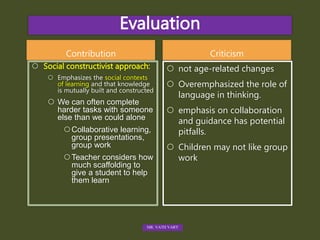
Evaluation
Contribution
 Social constructivist approach:
 Emphasizes the social contexts
of learning and that knowledge
is mutually built and constructed
 We can often complete
harder tasks with someone
else than we could alone
Collaborative learning,
group presentations,
group work
Teacher considers how
much scaffolding to
give a student to help
them learn
Criticism
 not age-related changes
 Overemphasized the role of
language in thinking.
 emphasis on collaboration
and guidance has potential
pitfalls.
 Children may not like group
work
MR. VATH VARY
MR. VATH VARY
Language
Developme
nt
What is Language:
 Language is a form of communication,
whether spoken, written, or signed, that is
based on a system of symbols.
 Human languages are infinitely generative.
 All human languages also have
organizational rules of phonology,
morphology, syntax, semantics, and
pragmatics.
MR. VATH VARY
Language
Development
 Phonology is the sound system of a
language;
 Morphology refers to the units of
meaning involved in word formation;
 Syntax involves the ways that words
must be combined to form acceptable
phrases and sentences;
 Semantics refers to the meaning of
words and sentences;
 Pragmatics describes the appropriate
use of language in different contexts.
MR. VATH VARY
Biological and
Environmental
Influence
 Biology and Experience interact to produce
language development.
 Children are biologically prepared to learn language
as they and their caregivers interact.
 Some language scholars argue that the
strongest evidence for the biological basis
of language is that children all over the
world reach language milestones at about
the same age despite vast differences in
their environmental experiences.
 However, children do not learn language in
a social vacuum. Children benefit when
parents and teachers actively engage them
in conversation, ask them questions, and
talk with—not just to—them.
MR. VATH VARY
How
Language
Develops
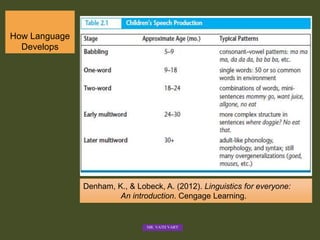
 Language acquisition advances
through stages:
 Babbling occurs at about 3 to 6 months, the
first word at 10 to 13 months, and two-word
utterances at 18 to 24 months.
 As children move beyond two-word utterances,
they can demonstrate that they know some
morphological rules, as documented in Jean
Berko’s study. Children also make advances in
phonology, syntax, semantics, and pragmatics
in early childhood.
 Young children’s early literacy experiences
enhance the likelihood children will have the
language skills necessary to benefit from
schooling.
MR. VATH VARY
How
Language
Develops
 Vocabulary development increases
dramatically during the elementary
school years, and by the end of
elementary school most children can
apply appropriate rules of grammar.
 Metalinguistic awareness–knowledge of the
language–also advances in the elementary
school years.
 In adolescence, language changes include
more effective use of words; improvements in
the ability to understand metaphor, satire, and
adult literary works; and writing.
MR. VATH VARY
How Language
Develops
Denham, K., & Lobeck, A. (2012). Linguistics for everyone:
An introduction. Cengage Learning.
MR. VATH VARY
CH 2 Cognitive and Language Development.ppt

CH 2 Cognitive and Language Development.ppt

  • 1.
    Human Resource University Chapter2: Cognitive and Language Development  Lecturer: Mr. VATH Vary  Email: varyvath@gmail.com  Tel: 017471117 MA. in TESOL Course: Educational Psychology
  • 2.
    Contents An Overview ofChild Development  Exploring What Development Is  Processes and Periods  Developmental Issues  Development and Education Cognitive Development  The Brain  Piaget’s Theory  Neo-Piagetian theory  Vygotsky’s Theory  What Is Language?  Biological and Environmental Influences  How Language Develops Cognitive Development MR. VATH VARY
  • 3.
    What is development ? Development …. is the pattern of biological, cognitive, and socioemotional changes that begins at conception and continues through the life span. Most development involves growth, but it also eventually includes decay (dying).  The more you learn about children’s development, the better you will understand the level at which to appropriately teach them.  Childhood provides a foundation for the adult years. Why study it? MR. VATH VARY
  • 4.
  • 5.
  • 6.
    Processes of Development  Biologicalprocesses  involve physical changes in a child’s body. Genes inherited from parents, the development of the brain, height and weight gains, advances in motor skills, and the hormonal changes of puberty  Cognitive processes  involve changes in the child’s thinking, intelligence, and language.  E.g. Memorize a poem, imagine how to solve a math problem, come up with a creative strategy, or speak meaningfully connected sentences.  Socioemotional processes  involve changes in the child’s relationships with other people or social contexts, changes in emotion, and changes in personality.  E.g. Talking back to parents, aggression toward peers, assertiveness, enjoyment of social events such as an adolescent’s senior prom, and gender-role orientation MR. VATH VARY
  • 7.
    Processes of Development Connecting Biological, cognitive, and socioemotional : Consider a baby smiling in response to a parent’s touch  biological processes (the physical nature of touch and responsiveness to it),  cognitive processes (the ability to understand intentional acts), and socioemotional processes (the act of smiling often reflects a positive emotional feeling,  and smiling helps to connect us in positive ways with other human beings).  Two rapidly emerging fields are exploring connections across biological, cognitive, and socioemotional processes:  developmental cognitive neuroscience , which explores links between development, cognitive processes, and the brain  developmental social neuroscience , which examines connections between development, socioemotional processes, and the brain
  • 8.
    Periods of Development PeriodsAge ranges Characteristics Infancy (Birth to 18- 24 months) Extreme dependence on adult; beginning of many activities— abilities to speak, coordinate sensations and physical actions, think with symbols, and imitate and learn from others. Early childhood (5 - 6 years) more self-sufficient and to care for themselves; development of school readiness (following instructions, identifying letters); spend many hours with peers (“preschool years”) Middle and late childhood (6 - 11 years) self-control increases; mastery of basic literacy and numeracy skills; achievement becomes a more central theme of the child’s world (elementary school years) Adolescence 10 -12 to18 – 21 late teen)) rapid physical changes—height and weight, breasts, deepening of the voice; pursuit of independence and an identity are prominent features; more time is spent outside the family; thought becomes more abstract, idealistic, and logical. adulthood 18 – 20 to death identity exploration and experimentation (love, work, lifestyle); self-responsibility, independent decision making, and economic independence.
  • 9.
  • 10.
    Development al issues  Thenature-nurture issue focuses on the extent to which development is mainly influenced by nature (biological influence) or nurture (environmental influence). Although heredity and environment are pervasive influences on development, humans can author a unique developmental path by changing the environment.  The continuity-discontinuity issue focuses on the extent to which development involves gradual, cumulative change (continuity –NURTURE) or distinct stages (discontinuity–NATURE)  The early-later experience issue Involves the degree to which early experiences (especially infancy) or later experiences are the key determinants of the child’s development. MR. VATH VARY
  • 11.
  • 12.
    Development and Education  Competent teachersare aware of these developmental differences, rather than characterizing students as “advanced,” “average,” and “slow,”  Developmentally appropriate teaching … takes place at a level that is neither too difficult and stressful nor too easy and boring for the child’s developmental level  Splintered development … occurs when there is considerable unevenness in development across domains. MR. VATH VARY
  • 13.
  • 14.
    Brain  Notlong ago, scientists thought that our genes primarily determine how our brains are “wired” and that the cells in the brain responsible for processing information just develop on their own with little or no input from environmental experiences, but it is not true  Neuroconstructivist view:  (a) biological processes (genes, for example) and environmental experiences (enriched or impoverished, for example) influence the brain’s development;  (b) the brain has plasticity (the ability to change) and depends on experience;  and (c) development of the brain is linked closely with cognitive development. Mr. VATH Vary
  • 15.
    Jean Piaget Piaget’s Theory: Whatprocesses do children use as they construct their knowledge of the world?/ How do children use factors (nature and nurture) to make sense of the world? Equilibr ation Schemas Assimilati on Accommo dation Organiza tion
  • 16.
    Jean Piaget (swiss_189 6-1980) Schemas: actions ormental representations that organize knowledge. used to identify and understand new information based on past stored experiences. classifying objects by size, shape, or color or planning strategies to solve problems as examples of schemas MR. VATH VARY
  • 17.
    Jean Piaget (1896-1980) Assimilation To incorporate new information into their existing schemas (concept).  i.e. ball  involves trying to relate something new to something that we already know. Accommodation  To adjust their old schemas (concept) to fit new information and experiences.  occurs when the new information does not fit well with our existing schemas, causing us to expand or elaborate on the older schema to make sense of the new information. MR. VATH VARY
  • 18.
    Jean Piaget (1896- 1980)  Organization  Involvesgrouping isolated behaviors into a higher- order, more smoothly functioning cognitive system; the grouping or arranging of items into categories.  Equilibration  A mechanism that Piaget proposed to explain how children shift from one stage of thought to the next. The shift occurs as children experience cognitive conflict, or disequilibrium, in trying to understand the world. Eventually, they resolve the conflict and reach a balance, or equilibrium, of thought.  Piaget argued that disequilibrium acts as a force to drive cognitive growth; therefore, teachers should find ways to promote cognitive conflict to help children learn in meaningful ways MR. VATH VARY
  • 19.
  • 20.
    Jean Piaget (1896- 1980) Stages of Development Sensorimotor,aged from birth-2: constructs an understanding of the world by coordinating their sensory experiences with their motor actions Progresses from reflexive, instinctual action at birth to the beginning of symbolic thought toward the end of the stage Learning by actively exploring the surrounding environment. Mostly nonverbal MR. VATH VARY
  • 21.
    Jean Piaget (1896- 1980) Stages of Development Preoperational , aged 2-7:  begins to represent the world with words and images  These words and images reflect increased symbolic and intuitive thinking and go beyond the connection of sensory information and physical action.  Egocentrism and centration are constraints.  Combining exploration with speech. Reconstruct concepts by grouping and naming objects  “Why” questions signal the emergence of the child’s interest in figuring out why things are the way they are. MR. VATH VARY
  • 22.
    Jean Piaget Two substagesof Preoperational Symbolic function substage:  the first substage of preoperational thought, occurring between about 2 and 4 years of age; the ability to represent an object not present develops and symbolic thinking increases; egocentrism is present.  Egocentrism: the inability to distinguish between one’s own perspective and someone else’s perspective. MR. VATH VARY
  • 23.
    Jean Piaget Two substagesof Preoperational intuitive thought substage  Centration: involves focusing (or centering) attention on one characteristic to the exclusion of all others.  Conservation: the idea that some characteristic of an object stays the same even though the object might change in appearance.  The second substage of preoperational thought, lasting from about 4 to 7 years of age. Children begin to use primitive reasoning and want to know the answer to all sorts of questions. They seem sure about their knowledge in this substage but are unaware of how they know what they know. MR. VATH VARY
  • 24.
  • 25.
    Jean Piaget (1896- 1980) Stages of Development Concrete-Operational,aged 7–11:  Replaces intuitive thought but still concretely  Begin thinking mathematically and logically. Exercise reasoning skills  reversibility, seriation, and transitivity are important concrete operational skills.  Reversibility: an action can be undone or reverted to its previous state  Seriation: involves ordering stimuli along some quantitative dimension (such as length) MR. VATH VARY
  • 26.
  • 27.
    Jean Piaget (1896-1980) Transitivity: involvesthe ability to reason about and logically combine relationships.  If a relation holds between a first object and a second object, and also holds between the second object and a third object, then it also holds between the first and third objects.  For example, consider three sticks (A, B, and C) of differing lengths. A is the longest, B is intermediate in length, and C is the shortest.  Does the child understand that if A is longer than B, and B is longer than C, then A is longer than C? MR. VATH VARY
  • 28.
  • 29.
    Jean Piaget (1896- 1980)  Formal-Operational, aged11- adulthood:  thinking is more abstract, idealistic, and logical.  Learn complex processes. Use multivariate thinking.  Hypothetical deductive reasoning develop hypotheses to solve problems and systematically reach a conclusion.  Adolescent egocentrism characterizes many young adolescents, which refers to the heightened self- consciousness reflected in adolescents’ beliefs that others are as interested in them as they themselves are. It also includes a sense of personal uniqueness and the desire to be noticed, visible, and “on stage.” MR. VATH VARY
  • 30.
  • 31.
    Cont Contribution  owe tohim a long list of masterful concepts including assimilation and accommodation, object permanence, egocentrism, conservation, and hypothetical-deductive reasoning  Child as an active, constructivist thinker. Criticism  estimates of children’s competence,  stages,  the training of children to reason at a higher cognitive level  Culture and education exert stronger influences on children’s development than Piaget envisioned MR. VATH VARY
  • 32.
    Neo-Piagetians  arguethat Piaget got some things right but that his theory needs considerable revision.  emphasize how children process information through attention, memory, and strategies They especially stress that a more accurate vision of children’s thinking requires more knowledge of strategies, how quickly and how automatically children process information, the particular cognitive task involved, and the division of cognitive problems into smaller, more precise steps MR. VATH VARY
  • 33.
    Vygotsky (Russian )  RussianPsychologist  The West published in 1962  Proposed sociocultural theory/ Social constructivist approach  emphasizes that cognitive skills need to be interpreted developmentally, are mediated by language, and have their origins in social relations and culture.  Culture requires skilled tool use (language, art counting system) and can determine what skills are important (such as computer skills, communication skills, teamwork skills)  The content of learning is influenced by the culture in which the student lives, which includes language, beliefs, and skills MR. VATH VARY
  • 34.
    Vygotsky (Russian psychologist) Developed the theory:Zone of Proximal Development: the range of tasks that are too difficult for children to master alone but can be mastered with guidance and assistance from adults or more-skilled children.  Teaching in the zone of proximal development reflects the concept of developmentally appropriate teaching MR. VATH VARY
  • 35.
    Zone of ProximalDevelopment MR. VATH VARY
  • 36.
    Vygotsky Scaffolding … Atechnique that involves changing the level of support for learning. A teacher or more advanced peer adjusts the amount of guidance to fit the student’s current performance.  When the student is learning a new task, the skilled person may use direct instruction. As the student’s competence increases, less guidance is given.  Asking probing questions is an excellent way to scaffold students’ learning and help them develop more sophisticated thinking skills. MR. VATH VARY
  • 37.
    Vygotsky Language andThought  Language was a primary tool invented by humans that enabled the organization of thinking. use language not only for social communication but also to help solve tasks; to plan, guide, and monitor their behavior– such a use of language for self-regulation is called private speech. Cognition and language are closely intertwined For Piaget private speech is egocentric and immature, but for Vygotsky, it is an important tool of thought during the early childhood years MR. VATH VARY
  • 38.
    Evaluation Contribution  Social constructivistapproach:  Emphasizes the social contexts of learning and that knowledge is mutually built and constructed  We can often complete harder tasks with someone else than we could alone Collaborative learning, group presentations, group work Teacher considers how much scaffolding to give a student to help them learn Criticism  not age-related changes  Overemphasized the role of language in thinking.  emphasis on collaboration and guidance has potential pitfalls.  Children may not like group work MR. VATH VARY
  • 39.
  • 40.
    Language Developme nt What is Language: Language is a form of communication, whether spoken, written, or signed, that is based on a system of symbols.  Human languages are infinitely generative.  All human languages also have organizational rules of phonology, morphology, syntax, semantics, and pragmatics. MR. VATH VARY
  • 41.
    Language Development  Phonology isthe sound system of a language;  Morphology refers to the units of meaning involved in word formation;  Syntax involves the ways that words must be combined to form acceptable phrases and sentences;  Semantics refers to the meaning of words and sentences;  Pragmatics describes the appropriate use of language in different contexts. MR. VATH VARY
  • 42.
    Biological and Environmental Influence  Biologyand Experience interact to produce language development.  Children are biologically prepared to learn language as they and their caregivers interact.  Some language scholars argue that the strongest evidence for the biological basis of language is that children all over the world reach language milestones at about the same age despite vast differences in their environmental experiences.  However, children do not learn language in a social vacuum. Children benefit when parents and teachers actively engage them in conversation, ask them questions, and talk with—not just to—them. MR. VATH VARY
  • 43.
    How Language Develops  Language acquisitionadvances through stages:  Babbling occurs at about 3 to 6 months, the first word at 10 to 13 months, and two-word utterances at 18 to 24 months.  As children move beyond two-word utterances, they can demonstrate that they know some morphological rules, as documented in Jean Berko’s study. Children also make advances in phonology, syntax, semantics, and pragmatics in early childhood.  Young children’s early literacy experiences enhance the likelihood children will have the language skills necessary to benefit from schooling. MR. VATH VARY
  • 44.
    How Language Develops  Vocabulary developmentincreases dramatically during the elementary school years, and by the end of elementary school most children can apply appropriate rules of grammar.  Metalinguistic awareness–knowledge of the language–also advances in the elementary school years.  In adolescence, language changes include more effective use of words; improvements in the ability to understand metaphor, satire, and adult literary works; and writing. MR. VATH VARY
  • 45.
    How Language Develops Denham, K.,& Lobeck, A. (2012). Linguistics for everyone: An introduction. Cengage Learning. MR. VATH VARY