Banking in India
• Banking in India in the modern sense originated in the last decades of the
18th century. The first banks were Bank of Hindustan (1770-1829) and The
General Bank of India, established 1786 and since defunct.
• The largest bank, and the oldest still in existence, is the State Bank of
India, which originated in the Bank of Calcutta in June 1806, which almost
immediately became the Bank of Bengal.
• This was one of the three presidency banks, the other two being the Bank
of Bombay and the Bank of Madras, all three of which were established
under charters from the British East India Company.
• The three banks merged in 1921 to form the Imperial Bank of India, which,
upon India's independence, became the State Bank of India in 1955. For
many years the presidency banks acted as quasi-central banks, as did their
successors, until the Reserve Bank of India was established in 1935.
Banking in India
• In India, commercial banks are the oldest, largest
and fastest growing financial intermediaries. They
have been playing a very important role in the
process of development. In 1949 RBI was
nationalized followed by nationalization of
Imperal Bank Of India (New State Bank Of India)
in 1995. In July 1969, 14 major commercial banks
were nationalized and in April 1980, 6 more were
nationalized. Reforms in banking sector have led
to the setting up of new private sector banks as
well as entry of more foreign banks.
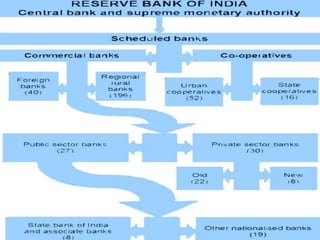
Commercial banks
• Commercial Banks refer to both scheduled and non-
scheduled commercial banks which are regulated
under Banking Regulation Act, 1949.
• (a) Scheduled Commercial Banks are grouped under
following categories:
• 1. State Bank of India and its Associates
• 2. Nationalized Banks
• 3. Foreign Banks
• 4. Regional Rural Banks
• 5. Private Sector Banks.
• (b) Non-Scheduled Commercial Banks
Scheduled Banks
• Scheduled Banks in India constitute those banks which have been
included in the Second Schedule of Reserve Bank of India(RBI) Act,
1934. RBI in turn includes only those banks in this schedule which
satisfy the criteria laid down vide section 42 (6) (a) of the Act.
The banks included in this schedule list should fulfil two conditions.
1. The paid capital and collected funds of bank should not be less
than Rs. 5 lac.
2.Any activity of the bank will not adversely affect the interests of
depositors.
Every Scheduled bank enjoys the following facilities.
1. Such bank becomes eligible for debts/loans on bank rate from
the RBI
2. Such bank automatically acquire the membership of clearing
house.
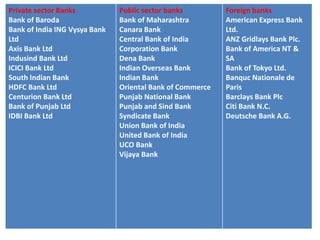
Private sector Banks
Bank of Baroda
Bank of India ING Vysya Bank
Ltd
Axis Bank Ltd
Indusind Bank Ltd
ICICI Bank Ltd
South Indian Bank
HDFC Bank Ltd
Centurion Bank Ltd
Bank of Punjab Ltd
IDBI Bank Ltd
Public sector banks
Bank of Maharashtra
Canara Bank
Central Bank of India
Corporation Bank
Dena Bank
Indian Overseas Bank
Indian Bank
Oriental Bank of Commerce
Punjab National Bank
Punjab and Sind Bank
Syndicate Bank
Union Bank of India
United Bank of India
UCO Bank
Vijaya Bank
Foreign banks
American Express Bank
Ltd.
ANZ Gridlays Bank Plc.
Bank of America NT &
SA
Bank of Tokyo Ltd.
Banquc Nationale de
Paris
Barclays Bank Plc
Citi Bank N.C.
Deutsche Bank A.G.
Public sector banks
• Public Sector Banks (PSBs) are banks where a
majority stake (i.e. more than 50%) is held by
a government. The shares of these banks are
listed on stock exchanges. There are a total of
27 PSBs in India [19 Nationalised banks + 6
State bank group (SBI + 5 associates) + 1 IDBI
bank (Other Public Sector-Indian Bank) = 26
PSBs + 1 recent Bhartiya Mahila Bank].
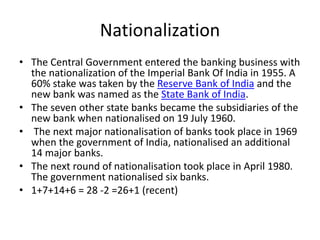
Nationalization
• The Central Government entered the banking business with
the nationalization of the Imperial Bank Of India in 1955. A
60% stake was taken by the Reserve Bank of India and the
new bank was named as the State Bank of India.
• The seven other state banks became the subsidiaries of the
new bank when nationalised on 19 July 1960.
• The next major nationalisation of banks took place in 1969
when the government of India, nationalised an additional
14 major banks.
• The next round of nationalisation took place in April 1980.
The government nationalised six banks.
• 1+7+14+6 = 28 -2 =26+1 (recent)
Private Banks
• Private banks are banks owned by either an
individual or a general partners with limited
partner(s).
• Private banks" can also refer to non-
government owned banks in general, in
contrast to government-owned (or
nationalized) banks
Commercial banks
• A commercial bank is a type of bank that
provides services such as accepting deposits,
making business loans, and offering basic
investment products. Its primary functions are
• Accepting deposits
• Lending loans
• Creating credit (while sanctioning a loan, they
automatically create deposits, known as a
credit creation from commercial banks)
Secondary functions
• The agency functions are the following:
• To collect and clear cheque, dividends and interest warrant.
• To make payments of rent, insurance premium, etc.
• To deal in foreign exchange transactions.
• To purchase and sell securities.
• To act as trustee, attorney, correspondent and executor.
• To accept tax proceeds and tax returns.
• The utility functions are the following:
• To provide safety locker facility to customers.
• To provide money transfer facility.
• To issue traveller's cheque.
• To act as referees.
• To accept various bills for payment: phone bills, gas bills, water bills, etc.
• To provide merchant banking facility.
• To provide various cards: credit cards, debit cards, smart cards, etc.
Foreign banks
• A type of foreign bank that is obligated to follow
the regulations of both the home and host
countries. Because the foreign branch banks' loan
limits are based on the parent bank's capital,
foreign banks can provide more loans than
subsidiary banks.
• Apart from financing of foreign trade, these
banks have performed all functions of
commercial banks and they have an advantage
over Indian banks because of their vast resources
and superior management.
Regional rural banks
• The RRBs came to be set up under the act of
1976. They were set up to save the poor rural
people from the grip of money lenders and
traders.
• A RRB is sponsored by a public sector bank which
also subscribes to its share capital.
• The RRBs meet the credit requirements of weaker
sections, small and marginal farmers , landless
labourers, artisians and small entrepreneurs.
RRBs have been excellent in meeting the credit
needs of rural poor.
BANKING SECTOR REFORMS
• Since nationalization of banks in 1969, the banking
sector had been dominated by the public sector.
• There was financial repression, role of technology was
limited, no risk management etc.
• This resulted in low profitability and poor asset quality.
The country was caught in deep economic crises.
• The Government decided to introduce comprehensive
economic reforms. Banking sector reforms were part of
this package.
• In august 1991, the Government appointed a
committee on financial system under the chairmanship
of M. Narasimhan.
First phase of banking sector reforms
• To promote healthy development of financial sector, the Narasimhan committee
made recommendations.
• I) RECOMMENDATIONS OF NARASIMHAN COMMITTEE :-
• 1. Establishment of 4 tier hierarchy for banking structure with 3 to 4 large banks
(including SBI) at top and at bottom rural banks engaged in agricultural activities.
• 2. The supervisory functions over banks and financial institutions can be assigned
to a quasi-autonomous body sponsored by RBI.
• 3. Phased reduction in statutory liquidity ratio.
• 4. Phased achievement of 8% capital adequacy ratio.
• 5. Abolition of branch licensing policy.
• 6. Proper classification of assets and full disclosure of accounts of banks and
financial institutions.
• 7. Deregulation of Interest rates.
• 8. Delegation of direct lending activity of IDBI to a separate corporate body.
• 9. Competition among financial institutions on participating approach.
• 10. Setting up asset Reconstruction fund to take over a portion of loan portfolio of
banks whose recovery has become difficult.
• A board for Financial Regulation and supervision (BFRS) can be set up to supervise
the activities of banks and financial institutions.
• Foreign banks may be allowed to set up subsidiaries and joint ventures.
Banking Reform Measures Of
Government
• On the recommendations of Narasimhan
Committee, following measures were undertaken
by government since 1991
• 1. Lowering SLR AND CRR
• 2. Prudential norms – proper disclosure of
income, classification of assets and provision for
Bad debts so as to ensure hat the books of
commercial banks reflect the accurate and
correct picture of financial position.
• 3. Capital adequacy norms – 8%
• 4. Deregulation of interest rates
• 5. Recovery Of Debts - passed the “Recovery of debts due to
Banks and Financial Institutions Act 1993 . Six Special
Recovery Tribunals have been set up. An Appellate Tribunal
has also been set up in Mumbai
• 6. Competition From New Private Sector Banks - These new
private sector banks are allowed to raise capital contribution
from foreign institutional investors up to 20% and from NRIs
up to 40%. This has led to increased competition.
• 7.Phasing Out Of Directed Credit - credit target for priority
sector should be reduced to 10% from 40%.
• 8. Access to capital market
• 9.Freedom of operation to open branches
• 10. Supervision of commercial banks - Department of
Supervision as an independent unit for supervision of
commercial banks.
Second phase of Reforms
• 1) New Areas :-
• New areas for bank financing have been opened up, such as :- Insurance,
credit cards, asset management, leasing, gold banking, investment
banking etc.
• 2) New Instruments :-
• For greater flexibility and better risk management new instruments have
been introduced such as :- Interest rate swaps, cross currency forward
contracts, forward rate agreements, liquidity adjustment facility for
meeting day-to-day liquidity mismatch.
• 3) Risk Management :-
• Banks have started specialized committees to measure and monitor
various risks. They are regularly upgrading their skills and systems.
• 4) Strengthening Technology :-
• For payment and settlement system technology infrastructure has been
strengthened with electronic funds transfer, centralized fund management
system, etc.
Second phase of Reforms
• 5) Increase Inflow Of Credit :-
• Measures are taken to increase the flow of credit to priority sector through focus
on Micro Credit and Self Help Groups.
• 6) Increase in FDI Limit :-
• In private banks the limit for FDI has been increased from 49% to 74%.
• 7) Universal banking :-
• Universal banking refers to combination of commercial banking and investment
banking. For evolution of universal banking guidelines have been given.
• 8) Adoption Of Global Standards :-
• RBI has introduced Risk Based Supervision of banks. Best international practices in
accounting systems, corporate governance, payment and settlement systems etc.
are being adopted.
• 9) Information Technology :-
• Banks have introduced online banking, E-banking, internet banking, telephone
banking etc. Measures have been taken facilitate delivery of banking services
through electronic channels.
• 10) Management Of NPAs:-
• RBI and central government have taken measures
for management of non-performing assets
(NPAs), such as corporate Debt Restructuring
(CDR), Debt Recovery Tribunals (DRTs) and Lok
Adalts.
• 11) Mergers And Amalgamation :-
• In May 2005, RBI has issued guidelines for merger
and Amalgamation of private sector banks.
• 12) Guidelines For Anti-Money Laundering :-
• In recent times, prevention of money laundering
has been given importance in international
financial relationships. In 2004, RBI revised the
guidelines on know your customer (KYC)
principles.
• 14) Customer Service:-
• In recent years, to improve customer service, RBI
has taken many steps such as :- Credit Card
Facilities, banking ombudsman, settlement off
claims of deceased depositors etc.
• 15) Base Rate System Of Interest Rates:-
• In 2003 the system of Benchmark Prime Lending
Rate (BPLR) was introduced to serve as a
benchmark rate for banks pricing of their loan
products so as to ensure that it truly reflected the
actual cost. However the BPLR system tell short
of its objective. RBi introduced the system of Base
Rate since 1st July, 2010. The base rate is the
minimum rate for all loans.
New Technology
• Electronic Fund Transfer
• Debit card
• Credit card
• Phone banking
• Online banking
• Tele banking
• Mobile banking
• Door step banking
• Point of sale
• ATM’s
• Virtual Banking
• Electronic clearing system (ECS)

Banking sector-

  • 2.
    Banking in India •Banking in India in the modern sense originated in the last decades of the 18th century. The first banks were Bank of Hindustan (1770-1829) and The General Bank of India, established 1786 and since defunct. • The largest bank, and the oldest still in existence, is the State Bank of India, which originated in the Bank of Calcutta in June 1806, which almost immediately became the Bank of Bengal. • This was one of the three presidency banks, the other two being the Bank of Bombay and the Bank of Madras, all three of which were established under charters from the British East India Company. • The three banks merged in 1921 to form the Imperial Bank of India, which, upon India's independence, became the State Bank of India in 1955. For many years the presidency banks acted as quasi-central banks, as did their successors, until the Reserve Bank of India was established in 1935.
  • 3.
    Banking in India •In India, commercial banks are the oldest, largest and fastest growing financial intermediaries. They have been playing a very important role in the process of development. In 1949 RBI was nationalized followed by nationalization of Imperal Bank Of India (New State Bank Of India) in 1995. In July 1969, 14 major commercial banks were nationalized and in April 1980, 6 more were nationalized. Reforms in banking sector have led to the setting up of new private sector banks as well as entry of more foreign banks.
  • 4.
    Commercial banks • CommercialBanks refer to both scheduled and non- scheduled commercial banks which are regulated under Banking Regulation Act, 1949. • (a) Scheduled Commercial Banks are grouped under following categories: • 1. State Bank of India and its Associates • 2. Nationalized Banks • 3. Foreign Banks • 4. Regional Rural Banks • 5. Private Sector Banks. • (b) Non-Scheduled Commercial Banks
  • 5.
    Scheduled Banks • ScheduledBanks in India constitute those banks which have been included in the Second Schedule of Reserve Bank of India(RBI) Act, 1934. RBI in turn includes only those banks in this schedule which satisfy the criteria laid down vide section 42 (6) (a) of the Act. The banks included in this schedule list should fulfil two conditions. 1. The paid capital and collected funds of bank should not be less than Rs. 5 lac. 2.Any activity of the bank will not adversely affect the interests of depositors. Every Scheduled bank enjoys the following facilities. 1. Such bank becomes eligible for debts/loans on bank rate from the RBI 2. Such bank automatically acquire the membership of clearing house.
  • 6.
    Private sector Banks Bankof Baroda Bank of India ING Vysya Bank Ltd Axis Bank Ltd Indusind Bank Ltd ICICI Bank Ltd South Indian Bank HDFC Bank Ltd Centurion Bank Ltd Bank of Punjab Ltd IDBI Bank Ltd Public sector banks Bank of Maharashtra Canara Bank Central Bank of India Corporation Bank Dena Bank Indian Overseas Bank Indian Bank Oriental Bank of Commerce Punjab National Bank Punjab and Sind Bank Syndicate Bank Union Bank of India United Bank of India UCO Bank Vijaya Bank Foreign banks American Express Bank Ltd. ANZ Gridlays Bank Plc. Bank of America NT & SA Bank of Tokyo Ltd. Banquc Nationale de Paris Barclays Bank Plc Citi Bank N.C. Deutsche Bank A.G.
  • 8.
    Public sector banks •Public Sector Banks (PSBs) are banks where a majority stake (i.e. more than 50%) is held by a government. The shares of these banks are listed on stock exchanges. There are a total of 27 PSBs in India [19 Nationalised banks + 6 State bank group (SBI + 5 associates) + 1 IDBI bank (Other Public Sector-Indian Bank) = 26 PSBs + 1 recent Bhartiya Mahila Bank].
  • 9.
    Nationalization • The CentralGovernment entered the banking business with the nationalization of the Imperial Bank Of India in 1955. A 60% stake was taken by the Reserve Bank of India and the new bank was named as the State Bank of India. • The seven other state banks became the subsidiaries of the new bank when nationalised on 19 July 1960. • The next major nationalisation of banks took place in 1969 when the government of India, nationalised an additional 14 major banks. • The next round of nationalisation took place in April 1980. The government nationalised six banks. • 1+7+14+6 = 28 -2 =26+1 (recent)
  • 10.
    Private Banks • Privatebanks are banks owned by either an individual or a general partners with limited partner(s). • Private banks" can also refer to non- government owned banks in general, in contrast to government-owned (or nationalized) banks
  • 11.
    Commercial banks • Acommercial bank is a type of bank that provides services such as accepting deposits, making business loans, and offering basic investment products. Its primary functions are • Accepting deposits • Lending loans • Creating credit (while sanctioning a loan, they automatically create deposits, known as a credit creation from commercial banks)
  • 12.
    Secondary functions • Theagency functions are the following: • To collect and clear cheque, dividends and interest warrant. • To make payments of rent, insurance premium, etc. • To deal in foreign exchange transactions. • To purchase and sell securities. • To act as trustee, attorney, correspondent and executor. • To accept tax proceeds and tax returns. • The utility functions are the following: • To provide safety locker facility to customers. • To provide money transfer facility. • To issue traveller's cheque. • To act as referees. • To accept various bills for payment: phone bills, gas bills, water bills, etc. • To provide merchant banking facility. • To provide various cards: credit cards, debit cards, smart cards, etc.
  • 13.
    Foreign banks • Atype of foreign bank that is obligated to follow the regulations of both the home and host countries. Because the foreign branch banks' loan limits are based on the parent bank's capital, foreign banks can provide more loans than subsidiary banks. • Apart from financing of foreign trade, these banks have performed all functions of commercial banks and they have an advantage over Indian banks because of their vast resources and superior management.
  • 14.
    Regional rural banks •The RRBs came to be set up under the act of 1976. They were set up to save the poor rural people from the grip of money lenders and traders. • A RRB is sponsored by a public sector bank which also subscribes to its share capital. • The RRBs meet the credit requirements of weaker sections, small and marginal farmers , landless labourers, artisians and small entrepreneurs. RRBs have been excellent in meeting the credit needs of rural poor.
  • 15.
    BANKING SECTOR REFORMS •Since nationalization of banks in 1969, the banking sector had been dominated by the public sector. • There was financial repression, role of technology was limited, no risk management etc. • This resulted in low profitability and poor asset quality. The country was caught in deep economic crises. • The Government decided to introduce comprehensive economic reforms. Banking sector reforms were part of this package. • In august 1991, the Government appointed a committee on financial system under the chairmanship of M. Narasimhan.
  • 16.
    First phase ofbanking sector reforms • To promote healthy development of financial sector, the Narasimhan committee made recommendations. • I) RECOMMENDATIONS OF NARASIMHAN COMMITTEE :- • 1. Establishment of 4 tier hierarchy for banking structure with 3 to 4 large banks (including SBI) at top and at bottom rural banks engaged in agricultural activities. • 2. The supervisory functions over banks and financial institutions can be assigned to a quasi-autonomous body sponsored by RBI. • 3. Phased reduction in statutory liquidity ratio. • 4. Phased achievement of 8% capital adequacy ratio. • 5. Abolition of branch licensing policy. • 6. Proper classification of assets and full disclosure of accounts of banks and financial institutions. • 7. Deregulation of Interest rates. • 8. Delegation of direct lending activity of IDBI to a separate corporate body. • 9. Competition among financial institutions on participating approach. • 10. Setting up asset Reconstruction fund to take over a portion of loan portfolio of banks whose recovery has become difficult. • A board for Financial Regulation and supervision (BFRS) can be set up to supervise the activities of banks and financial institutions. • Foreign banks may be allowed to set up subsidiaries and joint ventures.
  • 17.
    Banking Reform MeasuresOf Government • On the recommendations of Narasimhan Committee, following measures were undertaken by government since 1991 • 1. Lowering SLR AND CRR • 2. Prudential norms – proper disclosure of income, classification of assets and provision for Bad debts so as to ensure hat the books of commercial banks reflect the accurate and correct picture of financial position. • 3. Capital adequacy norms – 8% • 4. Deregulation of interest rates
  • 18.
    • 5. RecoveryOf Debts - passed the “Recovery of debts due to Banks and Financial Institutions Act 1993 . Six Special Recovery Tribunals have been set up. An Appellate Tribunal has also been set up in Mumbai • 6. Competition From New Private Sector Banks - These new private sector banks are allowed to raise capital contribution from foreign institutional investors up to 20% and from NRIs up to 40%. This has led to increased competition. • 7.Phasing Out Of Directed Credit - credit target for priority sector should be reduced to 10% from 40%. • 8. Access to capital market • 9.Freedom of operation to open branches • 10. Supervision of commercial banks - Department of Supervision as an independent unit for supervision of commercial banks.
  • 19.
    Second phase ofReforms • 1) New Areas :- • New areas for bank financing have been opened up, such as :- Insurance, credit cards, asset management, leasing, gold banking, investment banking etc. • 2) New Instruments :- • For greater flexibility and better risk management new instruments have been introduced such as :- Interest rate swaps, cross currency forward contracts, forward rate agreements, liquidity adjustment facility for meeting day-to-day liquidity mismatch. • 3) Risk Management :- • Banks have started specialized committees to measure and monitor various risks. They are regularly upgrading their skills and systems. • 4) Strengthening Technology :- • For payment and settlement system technology infrastructure has been strengthened with electronic funds transfer, centralized fund management system, etc.
  • 20.
    Second phase ofReforms • 5) Increase Inflow Of Credit :- • Measures are taken to increase the flow of credit to priority sector through focus on Micro Credit and Self Help Groups. • 6) Increase in FDI Limit :- • In private banks the limit for FDI has been increased from 49% to 74%. • 7) Universal banking :- • Universal banking refers to combination of commercial banking and investment banking. For evolution of universal banking guidelines have been given. • 8) Adoption Of Global Standards :- • RBI has introduced Risk Based Supervision of banks. Best international practices in accounting systems, corporate governance, payment and settlement systems etc. are being adopted. • 9) Information Technology :- • Banks have introduced online banking, E-banking, internet banking, telephone banking etc. Measures have been taken facilitate delivery of banking services through electronic channels.
  • 21.
    • 10) ManagementOf NPAs:- • RBI and central government have taken measures for management of non-performing assets (NPAs), such as corporate Debt Restructuring (CDR), Debt Recovery Tribunals (DRTs) and Lok Adalts. • 11) Mergers And Amalgamation :- • In May 2005, RBI has issued guidelines for merger and Amalgamation of private sector banks. • 12) Guidelines For Anti-Money Laundering :- • In recent times, prevention of money laundering has been given importance in international financial relationships. In 2004, RBI revised the guidelines on know your customer (KYC) principles.
  • 22.
    • 14) CustomerService:- • In recent years, to improve customer service, RBI has taken many steps such as :- Credit Card Facilities, banking ombudsman, settlement off claims of deceased depositors etc. • 15) Base Rate System Of Interest Rates:- • In 2003 the system of Benchmark Prime Lending Rate (BPLR) was introduced to serve as a benchmark rate for banks pricing of their loan products so as to ensure that it truly reflected the actual cost. However the BPLR system tell short of its objective. RBi introduced the system of Base Rate since 1st July, 2010. The base rate is the minimum rate for all loans.
  • 23.
    New Technology • ElectronicFund Transfer • Debit card • Credit card • Phone banking • Online banking • Tele banking • Mobile banking • Door step banking • Point of sale • ATM’s • Virtual Banking • Electronic clearing system (ECS)