






DIWALI
   HOMEWORK
   PRESENTED BY
GOURAV JANGID
      Std 11
     GIVEN BY
    NEEDHI MAM
BANKING
INTRODUCTION
      Historically before 2000 B.C. temple was used as a bank. In
Exrope were used to sit on bench to exchange their money and
exhibit their coins. They called this banch as ‘Banco’.In
Germany, the word ‘Bank’ is derived from ‘joint fund’.
      A common person knows only that bank means to deposit
money in the bank and withdraw as and when it requires. In fact
bank performs many other function.
      Directly or indirectly bank is connected with all economic
transaction of human-being. Banks have provided contribution is
given to solve the problem of unemployment and economic
development of the country . Bank has provided oxygen in the
form of loan to big and small industries. Banks have also started
to give loan to those educated unemployed who wants self
employment . In import-export trade also the services of bank
become essential.
BANKING
               An institute providing banking services is
known as bank. This institute continuosly tries to maintain
balance balance between profitability and liquidity. For
maintaining this balance the management of the bank
must be of a high level. In modern age, bank become
centres of faith of millions of person, that is why in real
life its meaning has been derived as a place of putting
faith. For expressing faith it is said proverbially, ‘I bank
on you.’ By keeping this concept at heart indian banking
act has defined banking has : “A service to accept deposit
from people with the intention to invest or lead with the
condition of returning it immediately whenever demanded
at any predetermined time. As institute providing this
service is a bank.
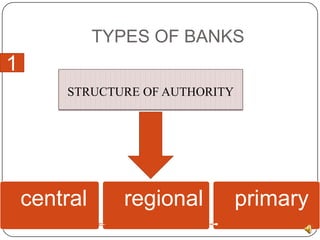
TYPES OF BANKS
1
        STRUCTURE OF AUTHORITY


    central     regional         primary
(1)
      Central bank
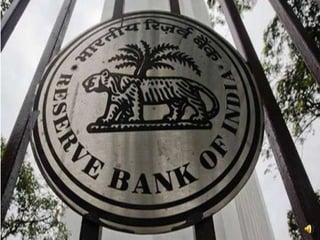
                     Every nation has one central
  bank. It has to control the banking service
  industry of the nation. It is a centre of authority
  of banking service industry. It has to see faith
  of people in bank endures and it has to work
  for taking steps for it. Central bank enlist those
  banks which satisfy the specific condition and
  declares them as scheduled. The name of the
  cantral bank of our nation is Reserve Bank
  of India
Structure of authority

(2)
      Regional/Central Bank
                             By co-ordinating with
  central bank, Regional/ central bank takes steps to
  control directly the banking service industry in
  different regions. It works to take steps for running
  this industry smoothly. State Bank of India is doing
  this work in our nation.
Structure of authority

(3)
      Primary bank
                           Primary banks are
 providing service directly to the people.
 They perform many function of opening
 accounts,accepting,deposits,leading,etc.
 they work under the control of central and
 regional central bank.
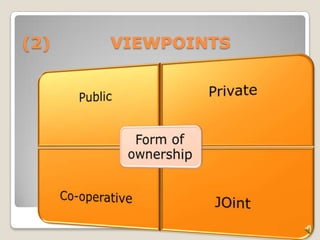
(2)   VIEWPOINTS
The first type of banks from
ownership point of view is public sector banks.
The ownership and management of these banks
are of the government. It is accountable to the
legislative assembly or the parliament like any
other public sector units. Some banks of private
sector were nationlized in independent india.
 NOTE => Public sector banks do not become
insolvent, so deposits and other investment
given to these banks remain safe.
(2)                  Private banks

                         The ownership point of view, if the
 ownership and management of banks remain with certain
 citizen, those banks are as private banks.
Note=> Private banks are registered as companies having
 limited liability. Banking service companies like H.D.F.C
 bank known as shroffs, shahukars and multanis in our
 country are private enterprises. Private banks are regulated
 by central and regional central banks.
(3)             CO-OPERATIVE BANKS

                  Co-operative banks come into existence under
Co-operative Act as a form of organization. Comparatively, it is
easy to start an organizational unit under Co-operative Act. So,
Co-operative banks are established on a big scale in central
areas. Consent of the central banks is required to start this type
of bank. The central Bank regulates its day-to-day operation
also
e.g
Joint sector is run by the
government and private individuals jointly. The
implementation of government programme is done through
joint sector banks as done by any public enterprise.
Besides, they nourish the elements of efficiency and profit
of private enterprise. Some nationalized banks have been
made joint sector banks by offering their shares to public.
(3)                     Viewpoints
                  Organisation


      organized                  unorganized
(1)       ORGNISED SECTOR BANKS

                         Banking service industry is divided in
      organized ad un organized work organisation like any other
      industries. Organised sector bank work according to declared
      rules. They are regulated by the central bank. Their operation
      are kept transparent. The internal set-up is also run according
      to the declared rules . Banks like Bank of india.
(2)                     Unorganized bank
                      People known as ahroffs, shahukar, vaniya,
 multani, Pathan are un organized banks in India. They provide
 banking services. Regulation are negligible for them. Rural areas
 and people having small requirements in India are utilizing banking
 services of unorganized sector on a big scale. Generally, the rate of
 interest of these banks is high and recovery of their lended money is
 very stringent.
FIELD OF WORK
               VIEWPOINTS


COMMERCIAL      AGRICULTURAL   INDUSTRIAL
  BANKS            BANKS         BANKS
(1)               Commercial banks

                    In modern time, special elements are seen in
  the scope of a bank of organised banking services. This type of
  banks are seen in three main sector of economy. (1) Agriculture
  (2) Industry and (3) services, and they have specialised in
  providing the services. Commercial banks take the deposits
  from the public and land the money for a short period and for a
  different activities of different areas. Their aim is to earn profit
  as like trade and hence they, are known as commercial Bank.
  Most of the businessmen want short term finance and it fulfill
  by this banks. Hence, they are also called Mercantile Bank.
Agriculture sector based on nature. Hence, there is
more uncertainty regarding the possibility of crope and quantity
of the crope. In these circumstances, farmer borrow money from
money from unorganised banks at high rate of interest and for the
payment of there debt they become ruined. Considering this fact,
to fulfil the requirement of agriculture sector some organised
banks are established, which are known as Agriculture Banks.
This banks have adopted remarkable specialisation. Some
agriculture banks lead money for development of land. Some
banks lead money on security or mortgage. This type of banks
give guidance to farmer regarding how to increase productivity.
(3)                INDUSTRIAL BANKS
                 To fulfil different requirement of industries, the banks
 came in to existence are known as industrial banks. All industries
 require money to purchase different gear & resources for the
 production. Moreover long-term and short term financial need aries
 to face uncertainty and risk of the market. To pay the different
 expences of factory and office, long-term financial requirement aries.
 To satisfy the financial requirement of the industry, industrial banks
 lead money for medium and long-term. In this type of banks. Also
 bank, specialization is seen. Some banks lead money only small scale
 industries e.g. small scale bank, and some bank lead money to large
 scale industries e.g. Industries Development Bank of India (IDBI)
 and I.C.I.C.I Bank.
(4)               viewpoints

                  registration


      Scheduled                  Non-scheduled
        Banks                       Banks
(1)             Scheduled banks

            Central Bank has declared different measure
  such as capital of the bank, size of bussiness,
  capability of management etc. The banks, which
  possess this are registered and included in the
  scheduled of central bank are called scheduled
  bank. Central Bank and Regional central Bank keep
  watch on such banks. Besides this , when financial
  crisis arise in this banks, central bank immediately
  give them financial and other help. Hence, these
  scheduled banks are more trustworthy e.g.
  Industrial Development Bank of India (IDBI) and
  I.C.I.C.I Bank.
(2)          Non-scheduled banks

         The banks, which do not posses the standards decides
 by Central Bank or due to no desire, are not listed and included
 in the scheduled are called as non-scheduled bank. This bank
 should compulsory declared to their depositor and public that
 this bank is Non-scheduled Bank. The management of this bank
 should be on professional base.
(5)   viewpoint
(1)                   LOCAL BANKS

            This type of bank is formulated by keeping geographical
areas as point of view. Banks which are serving city, block or a district
are known as local bank. The working of this bank is very compact.
Most of the co-operative banks are local.
(2)                 National banks

            Most of the banks are national. As most of the
 economic activities are taking place within the country. These
 national banks, while adapting to the situation, are performing
 their activities at national level. Their branches are in the big
 cities of the country . So, their expected services are provided in
 big economic centres ,i.e. cities, e.g. Dena Bank.
(3)    Global or foreign banks :

         Those banks which are working in
 various countries are known as global banks.
 With the increase in international economic
 operation, the development of these banks
 also take place. International tourism also
 helps greatly in the development of these
 banks. These banks are working as national
 banks in their original nations.
(1)                    Urban banks

       In the city area of the country proportion of industries and
  population is more. The need of the city area is also different
  than rural areas. To satisfy this needs, the banks established in
  cities are called urban banks. These banks work formaly as per
  the rules decided by the government. Their work-load is more.
Rural Banks are established to provide financial help to agriculture
activities run on small scale in rural areas. The administration of such banks
is done by very limited persons. In rural banks the proportion of un
organized bank is more. In this type of banks restrictions regarding time and
formalities is very less and activity oriented concept is is more. Hence, they
make changes in their time requirement. Such banks remain in contact with
their district or taluka’s central bank.
(7)   viewpoint
                    In the beginning of banking
    profession, its administration was run by
    individual or family and it had no any
    branches. Hence, it was called Unit Banks.
    Before many year in Gujarat, people who gave
    Banking services were called ‘Nanavati’. Unit
    Banks were found in Bania caste. With the
    change in time and circumstance existence of
    this banks are not seen.
The bank which posses their own officies in different areas
to provide banking service over above on the place of their
head office, is called Banks with the branches. In this bank high
level skill and management is necessary for recording the
trancation between the branches and between branch and
head office.
        As stated above, different types of bank can be noted at
different viewpoint. Any one type of bank can be included also
in other type e.g Mehsana Nagarik Co-operative Bank is a
primary Bank, also a Co-operative Bank is a primary Bank, also a
Co-operative Bank, Non-scheduled Bank, bank with branches
and at the viewpoint area it is also a Nagarik Bank.
Function of commercial banks
MEANING
               Commercial banks do the function of accepting
deposits and lending funds to trade, industry and other individuals.
Mostly commercial banks do the function of making short term
advances to the businessmen. The intention behind of such activity
of banks is to earn profit, hence they are termed as commercial
banks. Mostly such banks provide service to business class.
Similarly the banks are known as Mercantile Banks. In our country
such banks have development on large scale. Bank of India, Bank
of Baroda, etc
(1)   function
(1)               ACCEPTING DEPOSIT
    Bank accepts the financial saving of the people
 as a deposit. Bank gives interest on the amount of
 the deposit to depositor. The responsibility of bank
 is to return the basic amount of the depositors in
 time and to maintain their trust . Bank recive
 deposit in three ways.


 Saving account       Current account     Fixed deposit account
bank receive deposit mainly through
saving account. The accountholder can do the
transaction in limited number. Accountholder
can withdrow money from their account by his
own sign on the cheque or through withdrawal
slip. He can deposit his own cash, cheque and
draft received, in his account. Account holder
has to keep minimum balance in his account as
decided by the bank. Bank can force to their
accountholder regarding this, and hence mare
deposit can be obtained by this method
In current account there is no
restriction on the number of financial
transaction. Hence, current account become
more popular in businessman. Current
accountholder has also to keep minimum
balance in his account as like saving
accountholder, decide by the bank.
Fixed deposit account

             To use amount of the depositors
for specific period, bank accept the fixed term
deposit and gives the receipt to depositor for
receiving the amount. The bank give
guarantee in writing to return the amount of
deposit with interest to depositor after
finishing decided time i.e date of maturity.
Depositor can not withdraw their amount
before date of maturify and hence bank gives
more interest on the deposit compare to
saving account.
It is also an improtant function of a bank to lend
the money received through saving account and fixed term
deposit to needy person. Bank earn because bank gives
interest at low rate on deposit and charge high rate of
interest on advances. After paying expenses from the
earning bank gets profit. If, after receiving the
deposit, that amount is not landed deposit, that amount is
not landed then bank has to suffer loss. Beside this, if
recovery is not done in time after lending the money then
also lending activity become loss making. Lending of
money done in three ways as like Overdraft, Cash
credit, Loan.
(3)           MAKING INVESTMENT
          If lending is less then the sum of bank’s
 own capital and the total movement of deposit, the
 cash on hand of deposit is without any earning.
 So, third core function of banks is to invest this
 cash. By monitoring the inflow and outflow of
 cash, investment is to be made on the basis of
 flawless calculation. Liquidity is to be maintained
 continously while making investments. Arrangement
 of getting cash immediately from investment is to
 be made inevitably during emergencies and
 contingencies. It seems that it always advisable to
 invest in government securities and in the cent per
 cent sound institutes.
(4) Doing inter banking transaction
         Banks are also executing function of
 transacting with different banks. At times
 certain bank needs money for 24 hours or for
 lesser period than that. On the other side there
 are some banks where unutilized money is lying
 idle. Such banks internally strike an exchange of
 money; and overcome their difficulties. Such
 money when called for are returned
 immediately. Hence’ the same is known as ‘call-
 money’. In fact in such transaction one bank
 lends money and another bank receives the same
 as advances.
COMMERCIAL BANK FUNCTION
         OTHER FUNCTION
1. Financial transaction of customer
2. Doing transaction pertaining to foreign
     exchange
3.   To issue letter of credit
4.   Providing service of draft
5.   Providing information of credit of related
     parties
6.   Become an under-writer
7.   To issue credit card and debit card
8.   To provide teller service
Banks has mainly two types of
customer; (1) depositor and (2) Borrowers. These
customer are having their own financial
transaction. Financial transaction ultimately result
into payement or receipt. Bank provides service at
this last stage. It conduct transaction from the
payement of electricity bill to collecting money of
bills receivable. Customer are having many types
of financial transaction, the list of which always
remain incomplete.
(2) Doing transaction
pertaining to foreign exchange

              Banks provide services of
  bringing money from forign countries
  and of sending it. It provides services
  of receiving and dispatching
  documents connected with foreign
  trade. Only those banks which have
  been permitted by the central bank
  can do this job.
Letter of credit is a letter written by one
bank to another bank regarding the credit of
their accountholder. How much credit is granted
to the accountholder is pointed out in his letter.
Before granting the credit bank collect that
much amount from that person or bank demand
the security of that much amount. This letter of
credit makes the financial transaction very easy
and reliable because in this letter name of that
person, amount granted as credit, payement
period, etc. is pointed out.
(4)    PROVIDING SERVICE OF DRAFT

                    Draft is known as demand draft.
 Bank provide service of pay-order, telegraphic
 transfer, telephone transfer,    E-mail and mail
 transfer also.
(7) To issue credit card and debit card

       Bank perform an important function to give credit card.
Bank study very carefully regarding the credit of a person, who
have applied for credit card. After this study if feel that
applicant is capable and willing to pay the debt of specific
amount, than bank give credit card for that much amount to
applicant. In recent time master card, BOB Card etc. Credit
cards become more popular.
        Debit card is also in the existence. This type of
cardholder has to deposit specific amount in advance as per
their desire, in the bank. Then after while purchasing, he has to
present his debit card and amount of purchased goods is
debited from his account.
The bank come to know
about the financial soundness of many
persons with whom it has frequent financial
transactions. As the bank has to earn faith of
people so related ones also have to earn
faith of the bank. Third party knows that the
bank does know about the financial
soundness of those persons with whom it
deals. Within the limit of law and with no
onus on it, the bank does the work of
providing the information of soundness of the
party.
When a new company enters the
capital market and collect through shares, it is
apprehensive whether it can collect at least the
minimum subscription to start the business. It is afraid
of non-start of business in this situation. So, it request
bank also to give an undertaking that in the absence of
receipt of minimum subscription bank will fill up the
deficiency.
(8)         To provide teller service

                 This service is given by bank is known as ATM.
  When depositors or accountholder by depositing money or by
  investing gives surety of their solvency, then bank issue them
  ATM card. In spacified branches of the bank machine are kept
  for receiving this card. When cardholder wants to withdraw the
  amount of less than the credit balance, then he has to insert the
  card in machine and after indicating the amount by pressing
  the button, he can get money at anytime during 24 hours.
Banking
Banking

Banking

  • 1.
    DIWALI HOMEWORK PRESENTED BY GOURAV JANGID Std 11 GIVEN BY NEEDHI MAM
  • 2.
  • 3.
    INTRODUCTION Historically before 2000 B.C. temple was used as a bank. In Exrope were used to sit on bench to exchange their money and exhibit their coins. They called this banch as ‘Banco’.In Germany, the word ‘Bank’ is derived from ‘joint fund’. A common person knows only that bank means to deposit money in the bank and withdraw as and when it requires. In fact bank performs many other function. Directly or indirectly bank is connected with all economic transaction of human-being. Banks have provided contribution is given to solve the problem of unemployment and economic development of the country . Bank has provided oxygen in the form of loan to big and small industries. Banks have also started to give loan to those educated unemployed who wants self employment . In import-export trade also the services of bank become essential.
  • 4.
    BANKING An institute providing banking services is known as bank. This institute continuosly tries to maintain balance balance between profitability and liquidity. For maintaining this balance the management of the bank must be of a high level. In modern age, bank become centres of faith of millions of person, that is why in real life its meaning has been derived as a place of putting faith. For expressing faith it is said proverbially, ‘I bank on you.’ By keeping this concept at heart indian banking act has defined banking has : “A service to accept deposit from people with the intention to invest or lead with the condition of returning it immediately whenever demanded at any predetermined time. As institute providing this service is a bank.
  • 5.
    TYPES OF BANKS 1 STRUCTURE OF AUTHORITY central regional primary
  • 6.
    (1) Central bank Every nation has one central bank. It has to control the banking service industry of the nation. It is a centre of authority of banking service industry. It has to see faith of people in bank endures and it has to work for taking steps for it. Central bank enlist those banks which satisfy the specific condition and declares them as scheduled. The name of the cantral bank of our nation is Reserve Bank of India
  • 9.
    Structure of authority (2) Regional/Central Bank By co-ordinating with central bank, Regional/ central bank takes steps to control directly the banking service industry in different regions. It works to take steps for running this industry smoothly. State Bank of India is doing this work in our nation.
  • 11.
    Structure of authority (3) Primary bank Primary banks are providing service directly to the people. They perform many function of opening accounts,accepting,deposits,leading,etc. they work under the control of central and regional central bank.
  • 12.
    (2) VIEWPOINTS
  • 13.
    The first typeof banks from ownership point of view is public sector banks. The ownership and management of these banks are of the government. It is accountable to the legislative assembly or the parliament like any other public sector units. Some banks of private sector were nationlized in independent india. NOTE => Public sector banks do not become insolvent, so deposits and other investment given to these banks remain safe.
  • 14.
    (2) Private banks The ownership point of view, if the ownership and management of banks remain with certain citizen, those banks are as private banks. Note=> Private banks are registered as companies having limited liability. Banking service companies like H.D.F.C bank known as shroffs, shahukars and multanis in our country are private enterprises. Private banks are regulated by central and regional central banks.
  • 16.
    (3) CO-OPERATIVE BANKS Co-operative banks come into existence under Co-operative Act as a form of organization. Comparatively, it is easy to start an organizational unit under Co-operative Act. So, Co-operative banks are established on a big scale in central areas. Consent of the central banks is required to start this type of bank. The central Bank regulates its day-to-day operation also e.g
  • 17.
    Joint sector isrun by the government and private individuals jointly. The implementation of government programme is done through joint sector banks as done by any public enterprise. Besides, they nourish the elements of efficiency and profit of private enterprise. Some nationalized banks have been made joint sector banks by offering their shares to public.
  • 19.
    (3) Viewpoints Organisation organized unorganized
  • 20.
    (1) ORGNISED SECTOR BANKS Banking service industry is divided in organized ad un organized work organisation like any other industries. Organised sector bank work according to declared rules. They are regulated by the central bank. Their operation are kept transparent. The internal set-up is also run according to the declared rules . Banks like Bank of india.
  • 21.
    (2) Unorganized bank People known as ahroffs, shahukar, vaniya, multani, Pathan are un organized banks in India. They provide banking services. Regulation are negligible for them. Rural areas and people having small requirements in India are utilizing banking services of unorganized sector on a big scale. Generally, the rate of interest of these banks is high and recovery of their lended money is very stringent.
  • 22.
    FIELD OF WORK VIEWPOINTS COMMERCIAL AGRICULTURAL INDUSTRIAL BANKS BANKS BANKS
  • 23.
    (1) Commercial banks In modern time, special elements are seen in the scope of a bank of organised banking services. This type of banks are seen in three main sector of economy. (1) Agriculture (2) Industry and (3) services, and they have specialised in providing the services. Commercial banks take the deposits from the public and land the money for a short period and for a different activities of different areas. Their aim is to earn profit as like trade and hence they, are known as commercial Bank. Most of the businessmen want short term finance and it fulfill by this banks. Hence, they are also called Mercantile Bank.
  • 25.
    Agriculture sector basedon nature. Hence, there is more uncertainty regarding the possibility of crope and quantity of the crope. In these circumstances, farmer borrow money from money from unorganised banks at high rate of interest and for the payment of there debt they become ruined. Considering this fact, to fulfil the requirement of agriculture sector some organised banks are established, which are known as Agriculture Banks. This banks have adopted remarkable specialisation. Some agriculture banks lead money for development of land. Some banks lead money on security or mortgage. This type of banks give guidance to farmer regarding how to increase productivity.
  • 26.
    (3) INDUSTRIAL BANKS To fulfil different requirement of industries, the banks came in to existence are known as industrial banks. All industries require money to purchase different gear & resources for the production. Moreover long-term and short term financial need aries to face uncertainty and risk of the market. To pay the different expences of factory and office, long-term financial requirement aries. To satisfy the financial requirement of the industry, industrial banks lead money for medium and long-term. In this type of banks. Also bank, specialization is seen. Some banks lead money only small scale industries e.g. small scale bank, and some bank lead money to large scale industries e.g. Industries Development Bank of India (IDBI) and I.C.I.C.I Bank.
  • 28.
    (4) viewpoints registration Scheduled Non-scheduled Banks Banks
  • 29.
    (1) Scheduled banks Central Bank has declared different measure such as capital of the bank, size of bussiness, capability of management etc. The banks, which possess this are registered and included in the scheduled of central bank are called scheduled bank. Central Bank and Regional central Bank keep watch on such banks. Besides this , when financial crisis arise in this banks, central bank immediately give them financial and other help. Hence, these scheduled banks are more trustworthy e.g. Industrial Development Bank of India (IDBI) and I.C.I.C.I Bank.
  • 31.
    (2) Non-scheduled banks The banks, which do not posses the standards decides by Central Bank or due to no desire, are not listed and included in the scheduled are called as non-scheduled bank. This bank should compulsory declared to their depositor and public that this bank is Non-scheduled Bank. The management of this bank should be on professional base.
  • 32.
    (5) viewpoint
  • 33.
    (1) LOCAL BANKS This type of bank is formulated by keeping geographical areas as point of view. Banks which are serving city, block or a district are known as local bank. The working of this bank is very compact. Most of the co-operative banks are local.
  • 34.
    (2) National banks Most of the banks are national. As most of the economic activities are taking place within the country. These national banks, while adapting to the situation, are performing their activities at national level. Their branches are in the big cities of the country . So, their expected services are provided in big economic centres ,i.e. cities, e.g. Dena Bank.
  • 36.
    (3) Global or foreign banks : Those banks which are working in various countries are known as global banks. With the increase in international economic operation, the development of these banks also take place. International tourism also helps greatly in the development of these banks. These banks are working as national banks in their original nations.
  • 38.
    (1) Urban banks In the city area of the country proportion of industries and population is more. The need of the city area is also different than rural areas. To satisfy this needs, the banks established in cities are called urban banks. These banks work formaly as per the rules decided by the government. Their work-load is more.
  • 39.
    Rural Banks areestablished to provide financial help to agriculture activities run on small scale in rural areas. The administration of such banks is done by very limited persons. In rural banks the proportion of un organized bank is more. In this type of banks restrictions regarding time and formalities is very less and activity oriented concept is is more. Hence, they make changes in their time requirement. Such banks remain in contact with their district or taluka’s central bank.
  • 40.
    (7) viewpoint
  • 41.
    In the beginning of banking profession, its administration was run by individual or family and it had no any branches. Hence, it was called Unit Banks. Before many year in Gujarat, people who gave Banking services were called ‘Nanavati’. Unit Banks were found in Bania caste. With the change in time and circumstance existence of this banks are not seen.
  • 42.
    The bank whichposses their own officies in different areas to provide banking service over above on the place of their head office, is called Banks with the branches. In this bank high level skill and management is necessary for recording the trancation between the branches and between branch and head office. As stated above, different types of bank can be noted at different viewpoint. Any one type of bank can be included also in other type e.g Mehsana Nagarik Co-operative Bank is a primary Bank, also a Co-operative Bank is a primary Bank, also a Co-operative Bank, Non-scheduled Bank, bank with branches and at the viewpoint area it is also a Nagarik Bank.
  • 43.
    Function of commercialbanks MEANING Commercial banks do the function of accepting deposits and lending funds to trade, industry and other individuals. Mostly commercial banks do the function of making short term advances to the businessmen. The intention behind of such activity of banks is to earn profit, hence they are termed as commercial banks. Mostly such banks provide service to business class. Similarly the banks are known as Mercantile Banks. In our country such banks have development on large scale. Bank of India, Bank of Baroda, etc
  • 44.
    (1) function
  • 45.
    (1) ACCEPTING DEPOSIT Bank accepts the financial saving of the people as a deposit. Bank gives interest on the amount of the deposit to depositor. The responsibility of bank is to return the basic amount of the depositors in time and to maintain their trust . Bank recive deposit in three ways. Saving account Current account Fixed deposit account
  • 46.
    bank receive depositmainly through saving account. The accountholder can do the transaction in limited number. Accountholder can withdrow money from their account by his own sign on the cheque or through withdrawal slip. He can deposit his own cash, cheque and draft received, in his account. Account holder has to keep minimum balance in his account as decided by the bank. Bank can force to their accountholder regarding this, and hence mare deposit can be obtained by this method
  • 47.
    In current accountthere is no restriction on the number of financial transaction. Hence, current account become more popular in businessman. Current accountholder has also to keep minimum balance in his account as like saving accountholder, decide by the bank.
  • 48.
    Fixed deposit account To use amount of the depositors for specific period, bank accept the fixed term deposit and gives the receipt to depositor for receiving the amount. The bank give guarantee in writing to return the amount of deposit with interest to depositor after finishing decided time i.e date of maturity. Depositor can not withdraw their amount before date of maturify and hence bank gives more interest on the deposit compare to saving account.
  • 49.
    It is alsoan improtant function of a bank to lend the money received through saving account and fixed term deposit to needy person. Bank earn because bank gives interest at low rate on deposit and charge high rate of interest on advances. After paying expenses from the earning bank gets profit. If, after receiving the deposit, that amount is not landed deposit, that amount is not landed then bank has to suffer loss. Beside this, if recovery is not done in time after lending the money then also lending activity become loss making. Lending of money done in three ways as like Overdraft, Cash credit, Loan.
  • 50.
    (3) MAKING INVESTMENT If lending is less then the sum of bank’s own capital and the total movement of deposit, the cash on hand of deposit is without any earning. So, third core function of banks is to invest this cash. By monitoring the inflow and outflow of cash, investment is to be made on the basis of flawless calculation. Liquidity is to be maintained continously while making investments. Arrangement of getting cash immediately from investment is to be made inevitably during emergencies and contingencies. It seems that it always advisable to invest in government securities and in the cent per cent sound institutes.
  • 51.
    (4) Doing interbanking transaction Banks are also executing function of transacting with different banks. At times certain bank needs money for 24 hours or for lesser period than that. On the other side there are some banks where unutilized money is lying idle. Such banks internally strike an exchange of money; and overcome their difficulties. Such money when called for are returned immediately. Hence’ the same is known as ‘call- money’. In fact in such transaction one bank lends money and another bank receives the same as advances.
  • 52.
    COMMERCIAL BANK FUNCTION OTHER FUNCTION 1. Financial transaction of customer 2. Doing transaction pertaining to foreign exchange 3. To issue letter of credit 4. Providing service of draft 5. Providing information of credit of related parties 6. Become an under-writer 7. To issue credit card and debit card 8. To provide teller service
  • 53.
    Banks has mainlytwo types of customer; (1) depositor and (2) Borrowers. These customer are having their own financial transaction. Financial transaction ultimately result into payement or receipt. Bank provides service at this last stage. It conduct transaction from the payement of electricity bill to collecting money of bills receivable. Customer are having many types of financial transaction, the list of which always remain incomplete.
  • 54.
    (2) Doing transaction pertainingto foreign exchange Banks provide services of bringing money from forign countries and of sending it. It provides services of receiving and dispatching documents connected with foreign trade. Only those banks which have been permitted by the central bank can do this job.
  • 55.
    Letter of creditis a letter written by one bank to another bank regarding the credit of their accountholder. How much credit is granted to the accountholder is pointed out in his letter. Before granting the credit bank collect that much amount from that person or bank demand the security of that much amount. This letter of credit makes the financial transaction very easy and reliable because in this letter name of that person, amount granted as credit, payement period, etc. is pointed out.
  • 56.
    (4) PROVIDING SERVICE OF DRAFT Draft is known as demand draft. Bank provide service of pay-order, telegraphic transfer, telephone transfer, E-mail and mail transfer also.
  • 57.
    (7) To issuecredit card and debit card Bank perform an important function to give credit card. Bank study very carefully regarding the credit of a person, who have applied for credit card. After this study if feel that applicant is capable and willing to pay the debt of specific amount, than bank give credit card for that much amount to applicant. In recent time master card, BOB Card etc. Credit cards become more popular. Debit card is also in the existence. This type of cardholder has to deposit specific amount in advance as per their desire, in the bank. Then after while purchasing, he has to present his debit card and amount of purchased goods is debited from his account.
  • 60.
    The bank cometo know about the financial soundness of many persons with whom it has frequent financial transactions. As the bank has to earn faith of people so related ones also have to earn faith of the bank. Third party knows that the bank does know about the financial soundness of those persons with whom it deals. Within the limit of law and with no onus on it, the bank does the work of providing the information of soundness of the party.
  • 61.
    When a newcompany enters the capital market and collect through shares, it is apprehensive whether it can collect at least the minimum subscription to start the business. It is afraid of non-start of business in this situation. So, it request bank also to give an undertaking that in the absence of receipt of minimum subscription bank will fill up the deficiency.
  • 62.
    (8) To provide teller service This service is given by bank is known as ATM. When depositors or accountholder by depositing money or by investing gives surety of their solvency, then bank issue them ATM card. In spacified branches of the bank machine are kept for receiving this card. When cardholder wants to withdraw the amount of less than the credit balance, then he has to insert the card in machine and after indicating the amount by pressing the button, he can get money at anytime during 24 hours.