Bank Management
MBA Term 4
IMNU
CLASS DISCUSSIONS NOTES
ANIL M MENGHRAJANI
DISCLAIMER
THE LECTURE NOTES HAVE BEEN CREATED FOR CLASSROOM / ONLINE DISCUSSION. THE
MATERIAL IS INTENDED FOR EDUCATIONAL PURPOSES ONLY. REPRODUCTION OF THE
MATERIAL FOR ANY PURPOSE OTHER THAN WHAT IS INTENDED IS PROHIBITED. THE
LECTURE NOTES SHOULD NOT BE DISTRIBUTED OUTSIDE OF THE CLASS. ALL THE
INFORMATION PRESENTED IN THESE NOTES ARE PRESENTED IN GOOD FAITH AND FOR
GENERAL INFORMATION PURPOSE ONLY. ALL EFFORTS HAVE BEEN MADE TO ENSURE
THE CONTENT PROVIDED IN THESE NOTES IS NOT IN VIOLATION OF COPYRIGHT. THE
FACULTY DOES NOT CLAIM OWNERSHIP OF ANY MATERIALS OR INTELLECTUAL
PROPERTY PRESENTED IN THE NOTES UNLESS SPECIFIED. THE FACULTY DOES NOT
PROVIDE ANY WARRANTIES ABOUT THE COMPLETENESS, RELIABILITY AND ACCURACY
OF THIS INFORMATION. THE LECTURE NOTES MAY CONTAIN MATERIALS FROM OTHER
SOURCES (BOOKS AND PAPERS). THEY MAY NOT BE PROPERLY REFERENCED, BECAUSE
THEY ARE PREPARED IN A HURRY, AND STRICTLY FOR TEACHING PURPOSES ONLY.
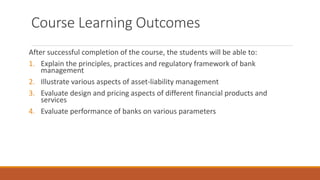
Course Learning Outcomes
After successful completion of the course, the students will be able to:
1. Explain the principles, practices and regulatory framework of bank
management
2. Illustrate various aspects of asset-liability management
3. Evaluate design and pricing aspects of different financial products and
services
4. Evaluate performance of banks on various parameters
Course outline
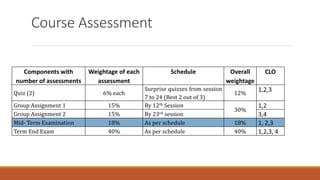
Course Assessment
Components with
number of assessments
Weightage of each
assessment
Schedule Overall
weightage
CLO
Quiz (2) 6% each
Surprise quizzes from session
7 to 24 (Best 2 out of 3)
12%
1,2,3
Group Assignment 1 15% By 12th Session
30%
1,2
Group Assignment 2 15% By 23rd session 3,4
Mid- Term Examination 18% As per schedule 18% 1, 2,3
Term End Exam 40% As per schedule 40% 1,2,3, 4
Support needed from the class
▪Identify 2 coordinators for all communications and facilitation of the course activities
▪2 volunteers every week for compiling all newspaper articles on Banking from ET/BS/FE/Mint
▪ Sharing it with students daily
▪ Summarising it for discussions in the class in the first session of the next week
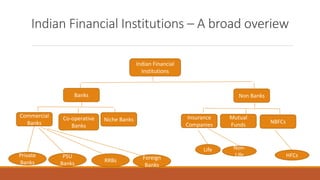
Indian Financial Institutions – A broad overiew
Indian Financial
Institutions
Banks Non Banks
Commercial
Banks
Co-operative
Banks
Niche Banks Insurance
Companies
Mutual
Funds
NBFCs
Private
Banks
PSU
Banks
RRBs Foreign
Banks
Life Non-
Life HFCs
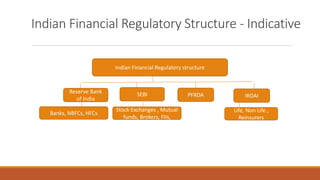
Indian Financial Regulatory Structure - Indicative
Indian Financial Regulatory structure
Reserve Bank
of India
IRDAI
SEBI PFRDA
Banks, NBFCs, HFCs
Stock Exchanges , Mutual
funds, Brokers, FIIs,
Life, Non Life ,
Reinsurers
History of Banking in India
The banking sector development can be divided into three phases:
▪Phase I: The Early Phase which lasted from 1770 to 1969
▪Phase II: The Nationalisation Phase which lasted from 1969 to 1991
▪Phase III: The Liberalisation or the Banking Sector Reforms Phase which began in 1991
▪Pre Independence Period (1786-1947)
▪The first bank of India was the “ Bank of Hindustan ”, established in 1770 and located in the then, Indian capital,
Calcutta. However, this bank ceased operations in 1832.
▪During the Pre Independence period over 600 banks had been registered in the country but only a few managed to
survive.
▪Following the path of Bank of Hindustan, various other banks were established in India.
▪ The General Bank of India (1786-1791)
▪ Oudh Commercial Bank (1881-1958)
▪ Bank of Bengal (1809)
▪ Bank of Bombay (1840)
▪ Bank of Madras (1843)
History of Banking in India
▪During the British rule in India, The East India Company had established three banks: Bank of Bengal,
Bank of Bombay and Bank of Madras and called them the Presidential Banks. These three banks were
later merged into one single bank in 1921 which was called the “ Imperial Bank of India. The Imperial
Bank of India was later nationalised in 1955 and was named The State Bank of India, which is currently
the largest Public sector Bank
▪There were seven subsidiaries of SBI which were nationalised in 1959:
▪ State Bank of Patiala
▪ State Bank of Hyderabad
▪ State Bank of Bikaner & Jaipur
▪ State Bank of Mysore
▪ State Bank of Travancore
▪ State Bank of Saurashtra
▪ State Bank of Indore
1969 Nationalisation
▪In 1969, 14 major Indian Scheduled Commercial Banks with deposits of over Rs 50 crores were
nationalised ' to serve better the needs of development of the economy in conformity with
national policy objectives’ by the then Government
Allahabad Bank
Bank of India
Bank of Baroda
Bank of Maharashtra
Central Bank of India
Canara Bank
Dena Bank
Indian Overseas Bank
Indian Bank
Punjab National Bank
Syndicate Bank
Union Bank of India
United Bank
UCO Bank
Earlier all of them were privately owned
1980 Nationalisation
1980 - Six more private banks nationalised “…in order further control the heights of the
economy, to meet progressively, and serve better, the needs of the development of the
economy and to promote the welfare of the people inconformity with the policy of the State…”
▪Andhra Bank
▪Corporation Bank
▪New Bank of India
▪Oriental Bank of Comm.
▪Punjab & Sind Bank
▪Vijaya Bank
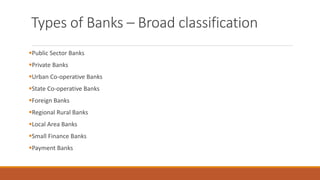
Types of Banks – Broad classification
▪Public Sector Banks
▪Private Banks
▪Urban Co-operative Banks
▪State Co-operative Banks
▪Foreign Banks
▪Regional Rural Banks
▪Local Area Banks
▪Small Finance Banks
▪Payment Banks
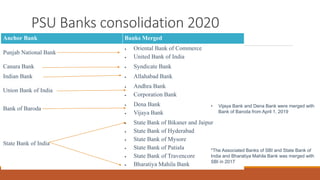
PSU Banks consolidation 2020
Anchor Bank Banks Merged
Punjab National Bank
• Oriental Bank of Commerce
• United Bank of India
Canara Bank • Syndicate Bank
Indian Bank • Allahabad Bank
Union Bank of India
• Andhra Bank
• Corporation Bank
Bank of Baroda
• Dena Bank
• Vijaya Bank
State Bank of India
• State Bank of Bikaner and Jaipur
• State Bank of Hyderabad
• State Bank of Mysore
• State Bank of Patiala
• State Bank of Travencore
• Bharatiya Mahila Bank
• Vijaya Bank and Dena Bank were merged with
Bank of Baroda from April 1, 2019
*The Associated Banks of SBI and State Bank of
India and Bharatiya Mahila Bank was merged with
SBI in 2017
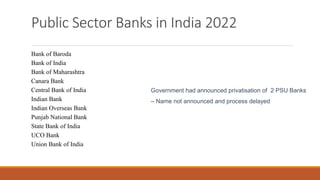
Public Sector Banks in India 2022
Bank of Baroda
Bank of India
Bank of Maharashtra
Canara Bank
Central Bank of India
Indian Bank
Indian Overseas Bank
Punjab National Bank
State Bank of India
UCO Bank
Union Bank of India
Government had announced privatisation of 2 PSU Banks
– Name not announced and process delayed
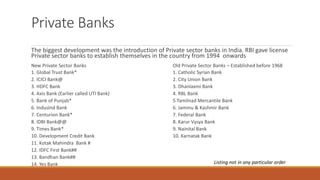
Private Banks
The biggest development was the introduction of Private sector banks in India. RBI gave license
Private sector banks to establish themselves in the country from 1994 onwards
New Private Sector Banks Old Private Sector Banks – Established before 1968
1. Global Trust Bank* 1. Catholic Syrian Bank
2. ICICI Bank@ 2. City Union Bank
3. HDFC Bank 3. Dhanlaxmi Bank
4. Axis Bank (Earlier called UTI Bank) 4. RBL Bank
5. Bank of Punjab* 5 Tamilnad Mercantile Bank
6. IndusInd Bank 6. Jammu & Kashmir Bank
7. Centurion Bank* 7. Federal Bank
8. IDBI Bank@@ 8. Karur Vysya Bank
9. Times Bank* 9. Nainital Bank
10. Development Credit Bank 10. Karnatak Bank
11. Kotak Mahindra Bank #
12. IDFC First Bank##
13. Bandhan Bank##
14. Yes Bank Listing not in any particular order
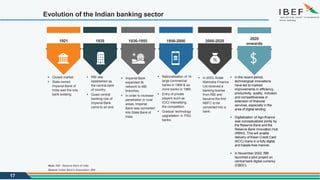
Evolution of the Indian banking sector
1921 1935 1936-1955 1956-2000 2000-2020
2020
onwards
Note: RBI - Reserve Bank of India
Source: Indian Bank’s Association, BMI
17
▪ Closed market.
▪ State-owned
Imperial Bank of
India was the only
bank existing.
▪ RBI was
established as
the central bank
of country.
▪ Quasi central
banking role of
Imperial Bank
came to an end.
▪ Imperial Bank
expanded its
network to 480
branches.
▪ In order to increase
penetration in rural
areas, Imperial
Bank was converted
into State Bank of
India.
▪ Nationalisation of 14
large commercial
banks in 1969 & six
more banks in 1980.
▪ Entry of private
players such as
ICICI intensifying
the competition.
▪ Gradual technology
upgradation in PSU
banks.
▪ In 2003, Kotak
Mahindra Finance
Ltd received a
banking license
from RBI and
became the first
NBFC to be
converted into a
bank.
▪ In the recent period,
technological innovations
have led to marked
improvements in efficiency,
productivity, quality, inclusion
and competitiveness in
extension of financial
services, especially in the
area of digital lending.
▪ Digitalization of Agri-finance
was conceptualized jointly by
the Reserve Bank and the
Reserve Bank Innovation Hub
(RBIH). This will enable
delivery of Kisan Credit Card
(KCC) loans in a fully digital
and hassle-free manner.
▪ In November 2022, RBI
launched a pilot project on
central bank digital currency
(CBDC).
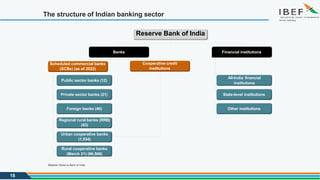
The structure of Indian banking sector
Reserve Bank of India
Cooperative credit
institutions
Public sector banks (12)
Private sector banks (21)
Foreign banks (46)
State-level institutions
Other institutions
Regional rural banks (RRB)
(43)
Urban cooperative banks
(1,534)
Rural cooperative banks
(March 21) (96,508)
Source: Reserve Bank of India,
All-India financial
institutions
Banks Financial institutions
Scheduled commercial banks
(SCBs) (as of 2022)
18
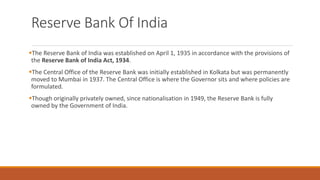
Reserve Bank Of India
▪The Reserve Bank of India was established on April 1, 1935 in accordance with the provisions of
the Reserve Bank of India Act, 1934.
▪The Central Office of the Reserve Bank was initially established in Kolkata but was permanently
moved to Mumbai in 1937. The Central Office is where the Governor sits and where policies are
formulated.
▪Though originally privately owned, since nationalisation in 1949, the Reserve Bank is fully
owned by the Government of India.
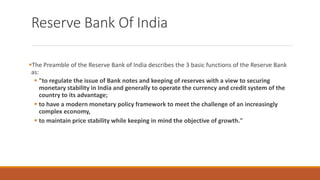
Reserve Bank Of India
▪The Preamble of the Reserve Bank of India describes the 3 basic functions of the Reserve Bank
as:
▪ "to regulate the issue of Bank notes and keeping of reserves with a view to securing
monetary stability in India and generally to operate the currency and credit system of the
country to its advantage;
▪ to have a modern monetary policy framework to meet the challenge of an increasingly
complex economy,
▪ to maintain price stability while keeping in mind the objective of growth."
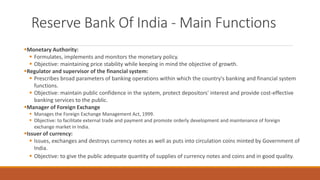
Reserve Bank Of India - Main Functions
▪Monetary Authority:
▪ Formulates, implements and monitors the monetary policy.
▪ Objective: maintaining price stability while keeping in mind the objective of growth.
▪Regulator and supervisor of the financial system:
▪ Prescribes broad parameters of banking operations within which the country's banking and financial system
functions.
▪ Objective: maintain public confidence in the system, protect depositors' interest and provide cost-effective
banking services to the public.
▪Manager of Foreign Exchange
▪ Manages the Foreign Exchange Management Act, 1999.
▪ Objective: to facilitate external trade and payment and promote orderly development and maintenance of foreign
exchange market in India.
▪Issuer of currency:
▪ Issues, exchanges and destroys currency notes as well as puts into circulation coins minted by Government of
India.
▪ Objective: to give the public adequate quantity of supplies of currency notes and coins and in good quality.
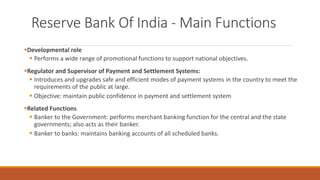
Reserve Bank Of India - Main Functions
▪Developmental role
▪ Performs a wide range of promotional functions to support national objectives.
▪Regulator and Supervisor of Payment and Settlement Systems:
▪ Introduces and upgrades safe and efficient modes of payment systems in the country to meet the
requirements of the public at large.
▪ Objective: maintain public confidence in payment and settlement system
▪Related Functions
▪ Banker to the Government: performs merchant banking function for the central and the state
governments; also acts as their banker.
▪ Banker to banks: maintains banking accounts of all scheduled banks.
Licensing
Licensing of banking companies
▪No company shall carry on banking business in India unless it holds a license issued in that behalf by the Reserve
Bank and any such license may be issued subject of such conditions as the Reserve Bank may think fit to impose
▪Guidelines for ‘on tap’ Licensing of Universal Banks in the Private Sector
▪Eligible Promoters
(i) Individuals/professionals who are ‘residents’ and have 10 years of experience in banking and finance at a
senior level.
(ii) Entities/groups in the private sector that are ‘owned and controlled by residents’ [as defined in FEMA
Regulations, as amended from time to time] and have a successful track record for at least 10 years, provided
that if such entity/group has total assets of ₹ 50 billion or more, the non-financial business of the group does not
account for 40 per cent or more in terms of total assets/in terms of gross income.
(iii) Existing non-banking financial companies (NBFCs) that are ‘controlled by residents’ and have a successful
track record for at least 10 years. For the sake of clarity, it is added here that any NBFC, which is a part of the
group that has total assets of ₹ 50 billion or more and that the non-financial business of the group accounts for
40 per cent or more in terms of total assets/in terms of gross income, is not eligible.
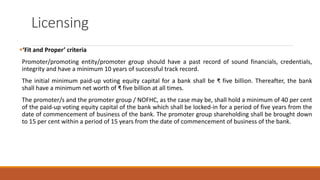
Licensing
▪‘Fit and Proper’ criteria
Promoter/promoting entity/promoter group should have a past record of sound financials, credentials,
integrity and have a minimum 10 years of successful track record.
The initial minimum paid-up voting equity capital for a bank shall be ₹ five billion. Thereafter, the bank
shall have a minimum net worth of ₹ five billion at all times.
The promoter/s and the promoter group / NOFHC, as the case may be, shall hold a minimum of 40 per cent
of the paid-up voting equity capital of the bank which shall be locked-in for a period of five years from the
date of commencement of business of the bank. The promoter group shareholding shall be brought down
to 15 per cent within a period of 15 years from the date of commencement of business of the bank.
Appointment of Directors
In the case of a banking company-
(a) no amendment of any provision relating to
1. The maximum permissible number of directors or
2. Appointment or re-appointment or termination of appointment or remuneration of a chairman,
3. Managing director or any other director, whole-time or otherwise] or of a manager or a chief executive officer
by whatever name called, whether that provision be contained in the company's memorandum or articles of
association, or in an agreement entered into by it, or in any resolution passed by the company in general meeting
or by its Board of directors shall have effect unless approved by the Reserve Bank;
4[(b) no appointment or re-appointment or termination of appointment of a chairman, a managing or whole-
time director, manager or chief executive officer by whatever name called, shall have effect unless such
appointment, re-appointment or termination of appointment is made with the previous approval of the
Reserve Bank
Any person appointed as Chairman, Director or chief executive officer or other officer or employee under this
section shall, -
(a) hold office during the pleasure of the Reserve Bank and subject thereto for a period not exceeding three
years or such further periods not exceeding three years at a time as the Reserve Bank may specify;
Power of Reserve Bank to remove managerial and
other persons from office
Power of Reserve Bank to remove managerial and other persons from office
(1) Where the Reserve Bank is satisfied that in the public interest or for preventing the affairs of
a banking company being conducted in a manner detrimental to the interests of the depositors
or for securing the proper management of any banking company it is necessary so to do, the
Reserve Bank may, for reasons to be recorded in writing, by order, remove from office, with
effect from such date as may be
specified in the order, 1[any chairman, director,] chief executive officer (by whatever name
called) or other officer or employee of the banking company.
Power of the Reserve Bank to give directions
(1) Where the Reserve Bank is satisfied that-
(a) in the public interest; or
(aa) in the interest of banking policy; or]
(b) to prevent the affairs of any banking company being conducted in a manner detrimental to the
interests of the depositors or in a manner prejudicial to the interests of the banking company; or
(c) to secure the proper management of any banking company generally,
it is necessary to issue directions to banking companies generally or to any banking company in
particular, it may, from time to time, issue such directions as it deems fit, and the banking companies
or the banking company, as the case may be, shall be bound to comply with such directions.
(2) The Reserve Bank may, on representation made to it or on its own motion, modify or cancel any
direction issued, and in so modifying or canceling any direction may impose such conditions as it
thinks fit, subject to which the modification or cancellation shall have effect.
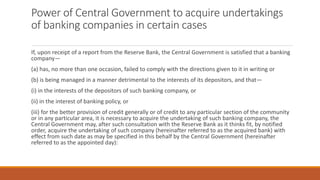
Power of Central Government to acquire undertakings
of banking companies in certain cases
If, upon receipt of a report from the Reserve Bank, the Central Government is satisfied that a banking
company—
(a) has, no more than one occasion, failed to comply with the directions given to it in writing or
(b) is being managed in a manner detrimental to the interests of its depositors, and that—
(i) in the interests of the depositors of such banking company, or
(ii) in the interest of banking policy, or
(iii) for the better provision of credit generally or of credit to any particular section of the community
or in any particular area, it is necessary to acquire the undertaking of such banking company, the
Central Government may, after such consultation with the Reserve Bank as it thinks fit, by notified
order, acquire the undertaking of such company (hereinafter referred to as the acquired bank) with
effect from such date as may be specified in this behalf by the Central Government (hereinafter
referred to as the appointed day):
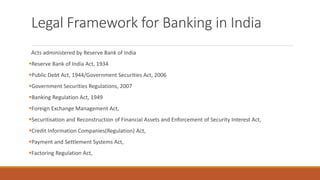
Legal Framework for Banking in India
Acts administered by Reserve Bank of India
▪Reserve Bank of India Act, 1934
▪Public Debt Act, 1944/Government Securities Act, 2006
▪Government Securities Regulations, 2007
▪Banking Regulation Act, 1949
▪Foreign Exchange Management Act,
▪Securitisation and Reconstruction of Financial Assets and Enforcement of Security Interest Act,
▪Credit Information Companies(Regulation) Act,
▪Payment and Settlement Systems Act,
▪Factoring Regulation Act,
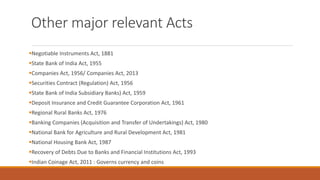
Other major relevant Acts
▪Negotiable Instruments Act, 1881
▪State Bank of India Act, 1955
▪Companies Act, 1956/ Companies Act, 2013
▪Securities Contract (Regulation) Act, 1956
▪State Bank of India Subsidiary Banks) Act, 1959
▪Deposit Insurance and Credit Guarantee Corporation Act, 1961
▪Regional Rural Banks Act, 1976
▪Banking Companies (Acquisition and Transfer of Undertakings) Act, 1980
▪National Bank for Agriculture and Rural Development Act, 1981
▪National Housing Bank Act, 1987
▪Recovery of Debts Due to Banks and Financial Institutions Act, 1993
▪Indian Coinage Act, 2011 : Governs currency and coins
WHAT IS BANKING
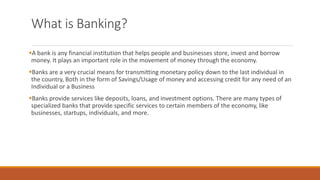
What is Banking?
▪A bank is any financial institution that helps people and businesses store, invest and borrow
money. It plays an important role in the movement of money through the economy.
▪Banks are a very crucial means for transmitting monetary policy down to the last individual in
the country, Both in the form of Savings/Usage of money and accessing credit for any need of an
Individual or a Business
▪Banks provide services like deposits, loans, and investment options. There are many types of
specialized banks that provide specific services to certain members of the economy, like
businesses, startups, individuals, and more.
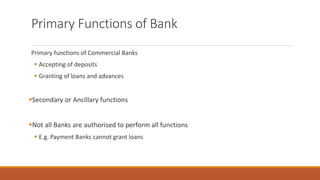
Primary Functions of Bank
Primary functions of Commercial Banks
▪ Accepting of deposits
▪ Granting of loans and advances
▪Secondary or Ancillary functions
▪Not all Banks are authorised to perform all functions
▪ E.g. Payment Banks cannot grant loans
Primary Functions of Bank
▪Accepting of Deposits
A very basic yet important function of all the commercial banks is mobilising public funds, providing safe custody of
savings and interest on the savings to depositors. Bank accepts different types of deposits from the public such as:
▪ Saving Deposits: encourages saving habits among the public. It is suitable for salary and wage earners. The rate
of interest is low. There is no restriction on the number and amount of withdrawals
▪ Fixed Deposits: Also known as Term Deposits. Money is deposited for a fixed tenure. No withdrawal money
during this period allowed. In case depositors withdraw before maturity, banks levy a penalty for premature
withdrawal. As a lump-sum amount is paid at one time for a specific period, the rate of interest is high but
varies with the period of deposit
▪ Current Accounts - They are opened by businessmen/traders
▪ Recurring Deposits: A certain sum of money is deposited in the bank at a regular interval. Money can be
withdrawn only after the expiry of a certain period
The above form most of what is known as Time and Demand Liabilities
Primary Functions of Bank
Granting of Loans & Advances
▪Bank Overdraft: This facility is for current account holders. It allows holders to withdraw money anytime
more than available in bank balance but up to the provided limit. An overdraft facility is granted against
collateral security. The interest for overdraft is paid only on the borrowed amount for the period for which
the loan is taken.
▪Cash Credits: a short term loan facility up to a specific limit fixed in advance. Banks allow the customer to
take a loan against a mortgage of certain property (tangible assets and / guarantees). Cash credit is given to
any type of account holders and also to those who do not have an account with a bank.
▪Loans: Banks lend money to the customer for short term or medium periods of say 1 to 5 years against
tangible assets. Nowadays, banks do lend money for the long term. The borrower repays the money either
in a lump-sum amount or in the form of instalments spread over a pre-decided time period. Bank charges
interest on the actual amount of loan sanctioned, whether withdrawn or not
▪Discounting the Bill of Exchange: It is a type of short term loan, where the seller discounts the bill from the
bank for some fees. The bank advances money by discounting or purchasing the bills of exchange. It pays
the bill amount to the drawer(seller) on behalf of the drawee (buyer) by deducting usual discount charges.
On maturity, the bank presents the bill to the drawee or acceptor to collect the bill amount
Secondary functions
Agency Functions of Bank
Banks are the agents for their customers, hence it has to perform various agency functions as
mentioned below:
Transfer of Funds: Transferring of funds from one branch/place to another.
Periodic Collections: Collecting dividend, salary, pension, and similar periodic collections on the
clients’ behalf
Periodic Payments: Making periodic payments of rents, electricity bills, etc on behalf of the
client
Collection of Cheques: Like collecting money from the bills of exchanges, the bank collects the
money of the cheques through the clearing section of its customers
Other Agency Functions: Under this bank act as a representative of its clients for other
institutions. It acts as an executor, trustee, administrators, advisers, etc. of the client
Secondary Functions of Bank - Indicative
•Issuing letters of credit, traveler's cheque, etc.
•Undertaking safe custody of valuables, important documents, and securities by providing safe
deposit vaults or lockers.
•Providing customers with facilities of foreign exchange dealings
•Underwriting of shares and debentures
•Dealing in foreign exchanges
•Social Welfare programs
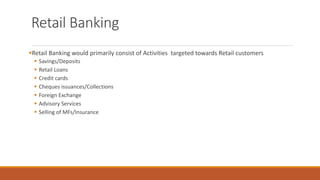
Retail Banking
▪Retail Banking would primarily consist of Activities targeted towards Retail customers
▪ Savings/Deposits
▪ Retail Loans
▪ Credit cards
▪ Cheques issuances/Collections
▪ Foreign Exchange
▪ Advisory Services
▪ Selling of MFs/Insurance
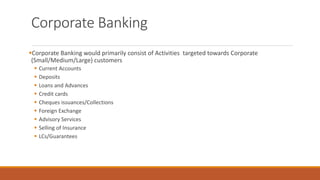
Corporate Banking
▪Corporate Banking would primarily consist of Activities targeted towards Corporate
(Small/Medium/Large) customers
▪ Current Accounts
▪ Deposits
▪ Loans and Advances
▪ Credit cards
▪ Cheques issuances/Collections
▪ Foreign Exchange
▪ Advisory Services
▪ Selling of Insurance
▪ LCs/Guarantees
Types of Banks
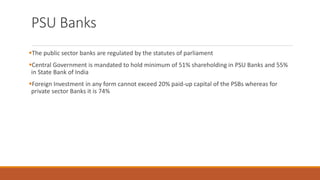
PSU Banks
▪The public sector banks are regulated by the statutes of parliament
▪Central Government is mandated to hold minimum of 51% shareholding in PSU Banks and 55%
in State Bank of India
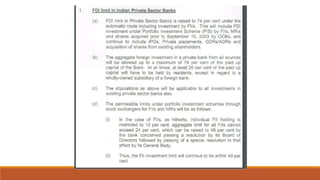
▪Foreign Investment in any form cannot exceed 20% paid-up capital of the PSBs whereas for
private sector Banks it is 74%
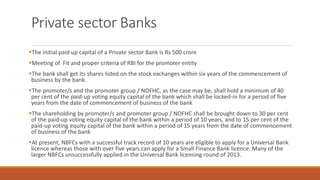
Private sector Banks
▪The initial paid up capital of a Private sector Bank is Rs 500 crore
▪Meeting of Fit and proper criteria of RBI for the promoter entity
▪The bank shall get its shares listed on the stock exchanges within six years of the commencement of
business by the bank.
▪The promoter/s and the promoter group / NOFHC, as the case may be, shall hold a minimum of 40
per cent of the paid-up voting equity capital of the bank which shall be locked-in for a period of five
years from the date of commencement of business of the bank
▪The shareholding by promoter/s and promoter group / NOFHC shall be brought down to 30 per cent
of the paid-up voting equity capital of the bank within a period of 10 years, and to 15 per cent of the
paid-up voting equity capital of the bank within a period of 15 years from the date of commencement
of business of the bank
▪At present, NBFCs with a successful track record of 10 years are eligible to apply for a Universal Bank
licence whereas those with over five years can apply for a Small Finance Bank licence. Many of the
larger NBFCs unsuccessfully applied in the Universal Bank licensing round of 2013.
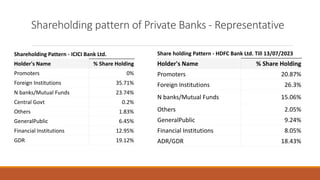
Shareholding pattern of Private Banks - Representative
Shareholding Pattern - ICICI Bank Ltd.
Holder's Name % Share Holding
Promoters 0%
Foreign Institutions 35.71%
N banks/Mutual Funds 23.74%
Central Govt 0.2%
Others 1.83%
GeneralPublic 6.45%
Financial Institutions 12.95%
GDR 19.12%
Share holding Pattern - HDFC Bank Ltd. Till 13/07/2023
Holder's Name % Share Holding
Promoters 20.87%
Foreign Institutions 26.3%
N banks/Mutual Funds 15.06%
Others 2.05%
GeneralPublic 9.24%
Financial Institutions 8.05%
ADR/GDR 18.43%
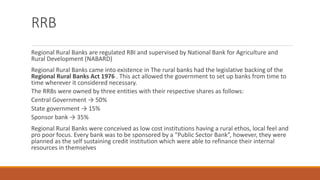
RRB
Regional Rural Banks are regulated RBI and supervised by National Bank for Agriculture and
Rural Development (NABARD)
Regional Rural Banks came into existence in The rural banks had the legislative backing of the
Regional Rural Banks Act 1976 . This act allowed the government to set up banks from time to
time wherever it considered necessary.
The RRBs were owned by three entities with their respective shares as follows:
Central Government → 50%
State government → 15%
Sponsor bank → 35%
Regional Rural Banks were conceived as low cost institutions having a rural ethos, local feel and
pro poor focus. Every bank was to be sponsored by a “Public Sector Bank”, however, they were
planned as the self sustaining credit institution which were able to refinance their internal
resources in themselves
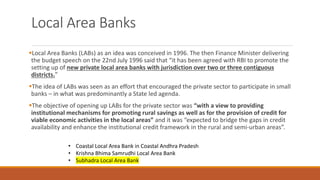
Local Area Banks
▪Local Area Banks (LABs) as an idea was conceived in 1996. The then Finance Minister delivering
the budget speech on the 22nd July 1996 said that “it has been agreed with RBI to promote the
setting up of new private local area banks with jurisdiction over two or three contiguous
districts.”
▪The idea of LABs was seen as an effort that encouraged the private sector to participate in small
banks – in what was predominantly a State led agenda.
▪The objective of opening up LABs for the private sector was “with a view to providing
institutional mechanisms for promoting rural savings as well as for the provision of credit for
viable economic activities in the local areas” and it was “expected to bridge the gaps in credit
availability and enhance the institutional credit framework in the rural and semi-urban areas”.
• Coastal Local Area Bank in Coastal Andhra Pradesh
• Krishna Bhima Samrudhi Local Area Bank
• Subhadra Local Area Bank
Small Finance Banks:-
▪ The small finance banks are specifically present to look into the needs and financial assistance of small and micro
industries, farmers, and the unorganized sector in India.
▪The small finance bank, in furtherance of the objectives for which it is set up, shall primarily undertake basic
banking activities of acceptance of deposits and lending to unserved and underserved sections including small
business units, small and marginal farmers, micro and small industries and unorganised sector entities.
▪It can also undertake other non-risk sharing simple financial services activities, not requiring any commitment of
own fund, such as distribution of mutual fund units, insurance products, pension products, etc. with the prior
approval of the RBI and after complying with the requirements of the sectoral regulator for such products. After
three years from the date of commencement of operations of the bank, requirement for prior approval from the
Reserve Bank will no longer apply and the bank will be governed by the extant norms as applicable to scheduled
commercial banks
▪There will not be any restriction in the area of operations of Small Finance banks
Small Finance Banks
▪Capital requirement
The minimum paid-up voting equity capital for small finance banks shall be Rs.200 crore, except for such small
finance banks which are converted from UCBs for which the capital requirement is Rs 100 crore
In view of the inherent risk of a small finance bank, it shall be required to maintain a minimum capital adequacy
ratio of 15 per cent of its risk weighted assets (RWA) on a continuous basis, subject to any higher percentage
as may be prescribed by RBI from time to time
▪Lending
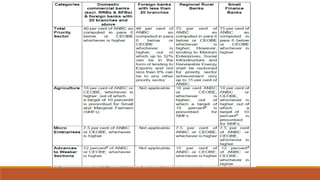
In view of the objectives for which small finance banks are set up, the bank will be required to extend 75 per
cent of its Adjusted Net Bank Credit (ANBC) to the sectors eligible for classification as priority sector lending
(PSL) by RBI. While 40 per cent of its ANBC should be allocated to different sub-sectors under PSL as per the
extant PSL prescriptions, the bank can allocate the balance 35 per cent to any one or more sub-sectors under
the PSL where it has competitive advantage
▪At least 50 per cent of its loan portfolio should constitute loans and advances of up to Rs.25 lakh on an
ongoing basis. The criteria of upper limit of Rs.25 lakh shall be borrower wise.
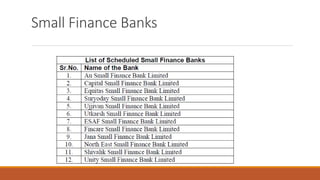
Small Finance Banks
Payments Bank:-
▪ These payment banks are banks where individuals/companies can deposit a maximum of the
amount up to Rs. 1,00,000.
▪These banks, cannot grant loans, lending as well as credit cards. However, one can have access
to online and mobile banking under the Payments bank.
▪Some of India’s most popular Payments banks are Airtel Payments Bank, Paytm Payments Bank,
Jio Payment Bank, India Post Payment Bank, NSDL Payment bank, etc
Credit card issuance
Regarding the issuance of Credit Cards, RBI has laid down certain rules:
• RBI has permitted Scheduled Commercial Banks with a net worth of INR 100 crore to issue
Credit Cards independently or in collaboration with other card issuing banks or NBFCs
after taking the required approval.
• Scheduled Commercial Banks can set up a separate subsidiary for undertaking Credit Card
business.
• This is not allowed for small finance banks & regional rural banks.
• RRBs are allowed to issue credit cards in partnership with their sponsor or other banks.
Co-operative Banks
▪Cooperative banks serve an important role in the Indian economy, especially in rural areas. In
urban areas, they mainly serve to small industry and self-employed workers. They are registered
under the Cooperative Societies Act, 1912. They are regulated by the Reserve Bank of
India under the Banking Regulation Act, 1949 and Banking Laws (Application to Cooperative
Societies) Act, 1965.
▪The State Cooperative Banks and Central Cooperative Banks are licensed by Reserve Bank of
India under the Banking Regulation Act. While the StCBs and DCCBs function like a normal Bank
they focus mainly on agricultural credit. While Reserve Bank of India is the Regulating
Authority, National Bank for Agriculture and Rural Development (NABARD) provides refinance
support and takes care of inspection of StCBs and DCCBs
▪Primary Cooperative Banks which are otherwise known as Urban Cooperative Banks are
registered as Cooperative Societies under the Cooperative Societies Acts of the concerned
States or the Multi-State Cooperative Societies Act function in urban areas and their business is
similar to that of Commercial Banks
▪They are licensed by RBI to do banking business. Reserve Bank of India is both the controlling
and inspecting authority for the Primary Cooperative Banks
Co-operative Banks
▪The 2022 notification specifies that UCBs can raise capital through three broad methods, viz:-
issuance of equity shares, preference shares, and debt instruments
▪First, UCBs can raise funds by issue of equity to enrolled members within the area of operation
or through additional equity shares to existing members
▪Second, UCBs can augment Tier – I & Tier – II capital by issuing Perpetual Cumulative & Non-
Cumulative Preference Shares, and, Redeemable Cumulative & Non-Cumulative Preference
Shares
▪Third, UCBs can issue Perpetual Debt Instruments (PDIs) for Tier – I Capital and Long Term
Subordinated Bonds as Tier – II Capital. It can be issued to institutional investors also, with the
consent of the depositors
▪Co-operative Banks can accept deposits from any person including Non member of the
Cooperative.
▪Loans can be granted to a member shareholder only
Investment Banks
▪These banks are well-known in western countries. The banks such as Morgan Stanley, Goldman
Sachs, etc., are popular investment banks.
▪In India, many Banks have Investment Banking Business conducted through a division or a
separate subsidiary (SBI Capital Markets)
▪These banks have the function of assisting and aiding individuals and institutions to raise capital,
issue securities, and invest the income.
▪ They also provide services for trading securities. stocks, and other instruments
▪Provides financial consultancy, equity research,
▪Main source of Income is Commissions and fees
Specialized Banks:-
▪As the name suggests, few banks have come into existence only for specialized purposes. They
have different specific roles and objectives to develop the particular cause financially.
▪The examples under Specialized banks include Small Industries Development Bank of India
(SIDBI) to give loans for small scale industries and units, in order to encourage them,
▪EXIM bank for financial assistance to give for exports and imports to other countries,
▪NABARD to help assist and provide finance in agricultural development, village and rural
concerns
BANKING REGULATIONS
Cash Reserve Ratio
Under cash reserve ratio (CRR), the commercial banks have to hold a certain
minimum amount of deposit as reserves with the central bank. The percentage
of cash required to be kept in reserves as against the bank's total deposits, is
called the Cash Reserve Ratio.
The cash reserve is either stored in the bank’s vault or is sent to the RBI. Banks
can’t lend the CRR money to corporates or individual borrowers, banks can’t use
that money for investment purposes. And Banks don’t earn any interest on that
money.
Statutory Liquidity Ratio
▪Statutory Liquidity Ratio or SLR is a minimum percentage of deposits(NDTL) that a commercial
bank has to maintain in the form of liquid cash, gold or other securities. It is basically the
reserve requirement that banks are expected to keep before offering credit to customers.
These are not reserved with the Reserve Bank of India (RBI), but with banks themselves.
▪The RBI also uses the SLR to regulate inflation and liquidity. Increasing the SLR could help in
controlling inflation in the economy while decreasing it will cause growth in the economy.
▪Although, the SLR is a monetary policy instrument of RBI, it is important for the government to
make its debt management program successful. SLR has helped the government to sell its
securities or debt instruments to banks.
▪Most of the banks prefer keeping their SLR in the form of government securities as it earns them
interest income.
Statutory Liquidity Ratio
▪In order to protect the risk of each bank and to reduce their risk rate, the Reserve Bank of India makes it
mandatory that each and every bank deploys at least one small part of its funds with the RBI so that its funds
are safe in the hands of the most secure entity in the form of the most secure assets
All banks must compulsorily provide a report or an update to the Reserve Bank of India every alternate Friday
regarding their SLR status. In case any bank has not been successful in maintaining the specified SLR (as
prescribed by the RBI), then the bank will be required to pay certain penalties.
The highest limit of SLR in India was 40%. On the other hand, the minimum limit of SLR is 0.
As of now, the SLR is 18% of NDTL
Components of SLR - Indicative
▪ Cash
▪ Gold
▪ Treasury bills.
▪ Government bonds.
▪ Other approved securities.
Difference between SLR and CRR
▪Cash Reserve Ratio is the percentage of the deposit (NDTL) that a bank has to keep with the RBI.
CRR is kept in the form of cash and that also with the RBI. No interest is paid on such reserves.
▪On the other hand, SLR is the percentage of deposit that the banks have to keep as liquid assets
in their own vault. Banks earn interest on the money invested in Government securities
▪ In case of default in maintenance of CRR requirement on a daily basis which is presently 70 per
cent of the total CRR requirement, penal interest will be recovered for that day at the rate of
three per cent per annum above the Bank Rate on the amount by which the amount actually
maintained falls short of the prescribed minimum on that day and if the shortfall continues on
the next succeeding day/s, penal interest will be recovered at the rate of five per cent per
annum above the Bank Rate
▪If any commercial bank fails to maintain the SLR, RBI will levy a 3% penalty annually over the
bank rate. Defaulting on the next working day too will lead to a 5% fine.
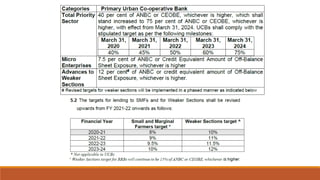
Priority Sector lending
Priority Sector means those sectors which the Government of India and Reserve Bank of India
consider as important for the development of the basic needs of the country and are to be given
priority over other sectors. The banks are mandated to encourage the growth of such sectors
with adequate and timely credit.
Limits for various categories of Banks
1. Small finance banks: 75% of net credit
2. Regional rural banks: 75% of net credit
3. Commercial banks (both public and private): 40% of net credit
4. Foreign banks: 40% of net credit (banks with less than 20 branches)
5. Urban cooperatives: 60% of net credit.
This target is compulsory for the banks
Priority Sector Lending
These sectors for PSL are:
1. Agriculture
2. Export Credit
3. Social Infrastructure like (Health care facilities, Schools, Drinking water facilities, sanitation facilities,
construction and redevelopment of household toilets and household water quality improvements in Tier II
and Tier IV centres)
4. Renewable energy
5. Microcredit
6. Educational loans
7. Housing loans and others
The revised guidelines also aim to encourage and support environment friendly lending policies to help
achieve Sustainable Development Goals (SDGs).
▪ The Government has a discretion to add sectors for PSL by Bank.
▪ Recently, Niti Aayog recommended to Government to include financing of EVs to be included as a
priority sector for lending by Banks
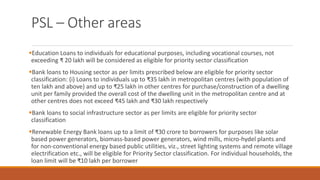
PSL – Other areas
▪Education Loans to individuals for educational purposes, including vocational courses, not
exceeding ₹ 20 lakh will be considered as eligible for priority sector classification
▪Bank loans to Housing sector as per limits prescribed below are eligible for priority sector
classification: (i) Loans to individuals up to ₹35 lakh in metropolitan centres (with population of
ten lakh and above) and up to ₹25 lakh in other centres for purchase/construction of a dwelling
unit per family provided the overall cost of the dwelling unit in the metropolitan centre and at
other centres does not exceed ₹45 lakh and ₹30 lakh respectively
▪Bank loans to social infrastructure sector as per limits are eligible for priority sector
classification
▪Renewable Energy Bank loans up to a limit of ₹30 crore to borrowers for purposes like solar
based power generators, biomass-based power generators, wind mills, micro-hydel plants and
for non-conventional energy based public utilities, viz., street lighting systems and remote village
electrification etc., will be eligible for Priority Sector classification. For individual households, the
loan limit will be ₹10 lakh per borrower
Priority Sector Lending
▪Bank loans to NBFCs for on-lending (not applicable to RRBs, UCBs, SFBs and LABs)
▪Bank credit to registered NBFCs (other than MFIs) for on-lending will be eligible for classification as priority sector under
respective categories subject to the following conditions:
▪(i) Agriculture: On-lending by NBFCs for ‘Term lending’ component under Agriculture will be allowed up to ₹ 10 lakh per
borrower.
▪(ii) Micro & Small enterprises: On-lending by NBFC will be allowed up to ₹ 20 lakh per borrower.
▪Bank loans to HFCs for on-lending (not applicable to RRBs, SFBs and LABs)
▪Bank credit to Housing Finance Companies (HFCs), approved by NHB for their refinance, for on-lending for the purpose of
purchase/construction/ reconstruction of individual dwelling units or for slum clearance and rehabilitation of slum dwellers,
subject to an aggregate loan limit of ₹20 lakh per borrower. Banks should maintain necessary borrower-wise details of the
underlying portfolio.
▪Cap on On-lending
▪Bank credit to NBFCs (including HFCs) for on-lending will be allowed up to an overall limit of five percent of individual bank’s
total priority sector lending
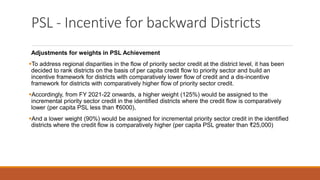
PSL - Incentive for backward Districts
Adjustments for weights in PSL Achievement
▪To address regional disparities in the flow of priority sector credit at the district level, it has been
decided to rank districts on the basis of per capita credit flow to priority sector and build an
incentive framework for districts with comparatively lower flow of credit and a dis-incentive
framework for districts with comparatively higher flow of priority sector credit.
▪Accordingly, from FY 2021-22 onwards, a higher weight (125%) would be assigned to the
incremental priority sector credit in the identified districts where the credit flow is comparatively
lower (per capita PSL less than ₹6000),
▪And a lower weight (90%) would be assigned for incremental priority sector credit in the identified
districts where the credit flow is comparatively higher (per capita PSL greater than ₹25,000)
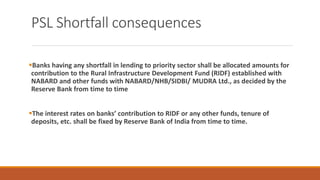
PSL Shortfall consequences
▪Banks having any shortfall in lending to priority sector shall be allocated amounts for
contribution to the Rural Infrastructure Development Fund (RIDF) established with
NABARD and other funds with NABARD/NHB/SIDBI/ MUDRA Ltd., as decided by the
Reserve Bank from time to time
▪The interest rates on banks’ contribution to RIDF or any other funds, tenure of
deposits, etc. shall be fixed by Reserve Bank of India from time to time.
Priority Sector Lending Certificates - Scheme
▪Purpose: To enable banks to achieve the priority sector lending target and sub-targets by purchase of these
instruments in the event of shortfall and at the same time incentivize the surplus banks; thereby enhancing lending
to the categories under priority sector.
▪Nature of the Instruments: The seller will be selling fulfillment of priority sector obligation and the buyer would be
buying the same. There will be no transfer of risks or loan assets.
▪Modalities: The PSLCs will be traded through the CBS portal (e-Kuber) of RBI. The detailed operational instructions
for carrying out the trades are available through the e-Kuber portal.
▪Sellers/Buyers: Scheduled Commercial Banks (SCBs), Regional Rural Banks (RRBs), Local Area Banks (LABs), Small
Finance Banks and Urban Co-operative Banks who have originated PSL eligible category loans subject to such
regulations as may be issued by the Bank.
▪Types of PSLCs: There would be four kinds of PSLCs :–
▪i) PSLC Agriculture: Counting for achievement towards the total agriculture lending target.
▪ii) PSLC SF/MF: Counting for achievement towards the sub-target for lending to Small and Marginal Farmers.
▪iii) PSLC Micro Enterprises: Counting for achievement towards the sub target for lending to Micro Enterprises.
▪iv) PSLC General: Counting for achievement towards the overall priority sector target.
Common guidelines for priority sector loans
▪Rate of interest: The rates of interest on bank loans will be as per directives issued by
Department of Regulation (DoR), RBI from time to time.
▪Service charges: No loan related and ad hoc service charges/inspection charges should be levied
on priority sector loans up to ₹25,000. In the case of eligible priority sector loans to SHGs/ JLGs,
this limit will be applicable per member and not to the group as a whole.
▪Receipt, Sanction/Rejection/Disbursement Register: A register/ electronic record should be
maintained by the bank wherein the date of receipt, sanction/rejection/disbursement with
reasons thereof, etc. should be recorded. The register/electronic record should be made
available to all inspecting agencies.
▪Issue of acknowledgement of loan applications: Banks should provide acknowledgement for
loan applications received under priority sector loans. Bank Boards should prescribe a time limit
within which the bank communicates its decision in writing to the applicants.
MUDRA
▪Micro Units Development & Refinance Agency Ltd (MUDRA) was set up by the Government of
India (GoI). MUDRA has been initially formed as a wholly owned subsidiary of Small Industries
Development bank of India (SIDBI) with 100% capital being contributed by it.
▪MUDRA was set up for providing loans up to 10 lakh to the non-corporate, non-farm
small/micro enterprises. These loans are classified as MUDRA loans under PMMY. These loans
are given by Commercial Banks, RRBs, Small Finance Banks, MFIs and NBFCs
▪This Agency would be responsible for developing and refinancing all Micro-enterprises sector by
supporting the finance Institutions which are in the business of lending to micro / small business
entities engaged in manufacturing, trading and service activities. Micro Finance is an economic
development tool whose objective is to provide income generating opportunities to the people
at the bottom of the pyramid. It covers a range of services which include, in addition to the
provision of credit, many other credit plus services , financial literacy and other social support
services
BASEL
BASEL Norms
Harmonisation of bank capital standards by the Basel Committee on Banking Supervision (BCBS)
viz., the Basel Accord of 1988 was the starting point for Basel Norms
BCBS was founded in 1974 as a forum for regular cooperation between its member countries on
banking supervisory matters. The BCBS describes its original aim as the enhancement of
"financial stability by improving supervisory knowhow and the quality of banking supervision
worldwide."
The two fundamental objectives of the Committee’s work on regulatory convergence are:
(i) the framework should serve to strengthen the soundness and stability of the international
banking system; and
(ii) the framework should be fair and have a high degree of consistency in its application to
banks in different countries with a view to diminishing an existing source of competitive
inequality among international banks
Basel I, II, III
The Basel Accords are a series of three sequential banking regulation agreements (Basel I, II, and
III) set by the Basel Committee on Bank Supervision (BCBS)
Basel I – 1988
Basel II – 2004
Basel III – 2010 with phased implementation
Basel III Capital Regulations are being implemented in India with effect from April 1, 2013 in a
phased manner
BASEL Norms
The Basel Core Principles, as a framework of minimum standards for sound supervisory practices
considered universally applicable, emphasise capital adequacy and risk management process as
one of the significant prudential regulation and requirements. These are also referred at 3
Pillars of Basel framework
According to the BCBS core principles, supervisors must set prudent and appropriate minimum
capital adequacy requirements for banks that reflect the risks that the bank undertakes, and
must define the components of capital, bearing in mind its ability to absorb losses
Supervisors must be satisfied that banks and banking groups have in place a comprehensive
risk management process (including Board and senior management oversight) to identify,
evaluate, monitor and control or mitigate all material risks and to assess their overall capital
adequacy in relation to their risk profile
BASEL III Norms
Basel III reforms are the response of Basel Committee on Banking Supervision (BCBS) to improve
the banking sector’s ability to absorb shocks arising from financial and economic stress,
whatever the source, thus reducing the risk of spill over from the financial sector to the real
economy.
During Pittsburgh summit in September 2009, the G20 leaders committed to strengthen the
regulatory system for banks and other financial firms and also act together to raise capital
standards, to implement strong international compensation standards aimed at ending practices
that lead to excessive risk-taking, to improve the over-the-counter derivatives market and to
create more powerful tools to hold large global firms to account for the risks they take
Consequently, the Basel Committee on Banking Supervision (BCBS) released comprehensive
reform package entitled “Basel III: A global regulatory framework for more resilient banks and
banking systems” (known as Basel III capital regulations) in December 2010
Capital Adequacy Ratio
No. Regulatory Capital As % to RWAs
(i) Minimum Common Equity Tier 1 Ratio 5.5
(ii) Capital Conservation Buffer (comprised of Common Equity) 2.5
(iii) Minimum Common Equity Tier 1 Ratio plus
Capital Conservation Buffer [(i)+(ii)] – Total CET 8.0
(iv) Additional Tier 1 Capital 1.5
(v) Minimum Tier 1 Capital Ratio [(i) +(iv)] 7.0
(vi) Tier 2 Capital 2.0
(vii) Minimum Total Capital Ratio (MTC) [(v)+(vi)] 9.0
(viii) Minimum Total Capital Ratio plus Capital Conservation Buffer [(vii)+(ii)] 11.5
Capital Conservation Buffer
▪The capital conservation buffer (CCB) is designed to ensure that banks build up capital buffers
during normal times (i.e., outside periods of stress) which can be drawn down as losses are
incurred during a stressed period. The requirement is based on simple capital conservation rules
designed to avoid breaches of minimum capital requirements
▪Banks are required to maintain a capital conservation buffer of 2.5%, comprised of Common
Equity Tier 1 capital, above the regulatory minimum capital requirement of 9%
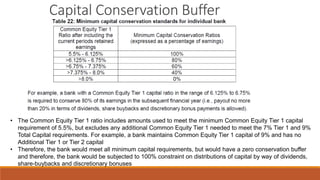
Capital Conservation Buffer
• The Common Equity Tier 1 ratio includes amounts used to meet the minimum Common Equity Tier 1 capital
requirement of 5.5%, but excludes any additional Common Equity Tier 1 needed to meet the 7% Tier 1 and 9%
Total Capital requirements. For example, a bank maintains Common Equity Tier 1 capital of 9% and has no
Additional Tier 1 or Tier 2 capital
• Therefore, the bank would meet all minimum capital requirements, but would have a zero conservation buffer
and therefore, the bank would be subjected to 100% constraint on distributions of capital by way of dividends,
share-buybacks and discretionary bonuses
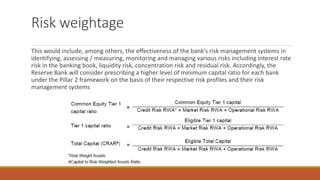
Risk weightage
This would include, among others, the effectiveness of the bank’s risk management systems in
identifying, assessing / measuring, monitoring and managing various risks including interest rate
risk in the banking book, liquidity risk, concentration risk and residual risk. Accordingly, the
Reserve Bank will consider prescribing a higher level of minimum capital ratio for each bank
under the Pillar 2 framework on the basis of their respective risk profiles and their risk
management systems
Operational and Market Risk
▪Operational risk is defined as the risk of loss resulting from inadequate or failed internal
processes, people and systems or from external events. This definition includes legal risk, but
excludes strategic and reputational risk. Legal risk includes, but is not limited to, exposure to
fines, penalties, or punitive damages resulting from supervisory actions, as well as private
settlements
▪Market risk is defined as the risk of losses in on-balance sheet and off-balance sheet positions
arising from movements in market prices. The market risk positions subject to capital
charge requirement are:
(i) The risks pertaining to interest rate related instruments and equities in the trading book; and
(ii) Foreign exchange risk (including open position in precious metals) throughout the bank (both
banking and trading books).
Tier 1 Capital
(i)Common shares (paid-up equity capital) issued by the bank which meet the criteria for
classification as common shares for regulatory purposes
(ii) Stock surplus (share premium) resulting from the issue of common shares;
(iii) Statutory reserves;
(iv) Capital reserves representing surplus arising out of sale proceeds of assets;
Additional Tier 1 Capital
A. Elements of Additional Tier 1 Capital
Additional Tier 1 capital will consist of the sum of the following elements:
(i) Perpetual Non-Cumulative Preference Shares (PNCPS)
(ii) Stock surplus (share premium) resulting from the issue of instruments included in Additional
Tier 1 capital;
(iii) Debt capital instruments eligible for inclusion in Additional Tier 1 capital,
(iv) Any other type of instrument generally notified by the Reserve Bank from time to time for
inclusion in Additional Tier 1 capital;
Criteria for Inclusion of Perpetual Debt
Instruments (PDI) in Additional Tier 1 Capital
▪The interest payable to the investors may be either at a fixed rate or at a floating rate referenced to a market
determined rupee interest benchmark rate.
▪PDIs shall not have any ‘put option’. However, banks may issue the instruments with a call option at a
particular date subject to following conditions:
◦ a. The call option on the instrument is permissible after the instrument has run for at least five years;
◦ b. To exercise a call option a bank must receive prior approval of RBI (Department of Regulation);
◦ c. A bank must not do anything which creates an expectation that the call will be exercised. For example, to
preclude such expectation of the instrument being called, the dividend / coupon reset date need not be co-
terminus with the call date. Banks may, at their discretion, consider having an appropriate gap between dividend /
coupon reset date and call date; and
◦ d. Banks must not exercise a call unless:
◦ (i) They replace the called instrument with capital of the same or better quality and the replacement of this capital
is done at conditions which are sustainable for the income capacity of the bank168; or
◦ (ii) The bank demonstrates that its capital position is well above the minimum capital requirements after the call
option is exercised
Criteria for Inclusion of Perpetual Debt
Instruments (PDI) in Additional Tier 1 Capital
▪However, payment of coupons on PDIs from the reserves is subject to the issuing bank
meeting minimum regulatory requirements for CET1, Tier 1 and Total Capital ratios including
the additional capital requirements for Domestic Systemically Important Banks at all times and
subject to the restrictions under the capital buffer frameworks (i.e. capital conservation buffer
and counter cyclical capital buffer).
▪In order to meet the eligibility criteria for perpetual debt instruments, banks must ensure and
indicate in their offer documents that they have full discretion at all times to cancel
distributions / payments.
Tier 2 Capital
Tier 2 Capital - Indian Banks
A. Elements of Tier 2 Capital
▪General Provisions and Loss Reserves
▪Debt Capital Instruments issued by the banks;
▪Preference Share Capital Instruments [Perpetual Cumulative Preference Shares (PCPS) /
Redeemable Non-Cumulative Preference Shares (RNCPS) / Redeemable Cumulative Preference
Shares (RCPS)] issued by the banks;
▪Stock surplus (share premium) resulting from the issue of instruments included in Tier 2 capital;
Criteria for Inclusion of Debt Capital
Instruments as Tier 2 Capital
The Tier 2 debt capital instruments that may be issued as bonds / debentures by Indian banks should meet the following
terms and conditions to qualify for inclusion as Tier 2 Capital for capital adequacy purposes176:
176 The criteria relating to loss absorbency through conversion / write-down / write-off at the point of non-viability are
furnished in Annex 16.
1. Terms of Issue of Instruments Denominated in Indian Rupees
1.1 Paid-in Status
The instruments should be issued by the bank (i.e., not by any ‘SPV’ etc. set up by the bank for this purpose) and fully
paid-in.
1.2 Amount
The amount of these debt instruments to be raised may be decided by the Board of Directors of banks.
1.3 Maturity Period
The debt instruments should have a minimum maturity of five years and there are no step-ups or other
incentives to redeem.
Criteria for Inclusion of Debt Capital
Instruments as Tier 2 Capital
1.4 Discount
The debt instruments shall be subjected to a progressive discount for capital adequacy purposes. As they approach
maturity these instruments should be subjected to progressive discount as indicated in the table below for being eligible
for inclusion in Tier 2 capital.
Optionality
The debt instruments shall not have any ‘put option’. However, it may be callable at the initiative of the issuer only
after a minimum of five years:
(a) To exercise a call option a bank must receive prior approval of RBI (Department of Regulation); and
(b) A bank must not do anything which creates an expectation that the call will be exercised. For example, to preclude
such expectation of the instrument being called, the dividend / coupon reset date need not be co-terminus with the
call date. Banks may, at their discretion, consider having an appropriate gap between dividend / coupon reset date
and call date; and
(c) Banks must not exercise a call unless:
(i) They replace the called instrument with capital of the same or better quality and the replacement of this capital is
done at conditions which are sustainable for the income capacity of the bank; or
(ii) The bank demonstrates that its capital position is well above the minimum capital requirements after the call
option is exercised
Tier 1 Capital
(i)Common shares (paid-up equity capital) issued by the bank which meet the criteria for
classification as common shares for regulatory purposes
(ii) Stock surplus (share premium) resulting from the issue of common shares;
(iii) Statutory reserves;
(iv) Capital reserves representing surplus arising out of sale proceeds of assets;
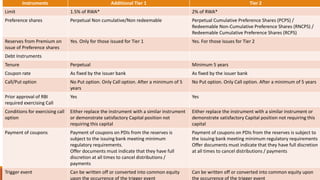
Instruments Additional Tier 1 Tier 2
Limit 1.5% of RWA* 2% of RWA*
Preference shares Perpetual Non cumulative/Non redeemable Perpetual Cumulative Preference Shares (PCPS) /
Redeemable Non-Cumulative Preference Shares (RNCPS) /
Redeemable Cumulative Preference Shares (RCPS)
Reserves from Premium on
issue of Preference shares
Yes. Only for those issued for Tier 1 Yes. For those issues for Tier 2
Debt Instruments
Tenure Perpetual Minimum 5 years
Coupon rate As fixed by the issuer bank As fixed by the issuer bank
Call/Put option No Put option. Only Call option. After a minimum of 5
years
No Put option. Only Call option. After a minimum of 5 years
Prior approval of RBI
required exercising Call
Yes Yes
Conditions for exercising call
option
Either replace the instrument with a similar instrument
or demonstrate satisfactory Capital position not
requiring this capital
Either replace the instrument with a similar instrument or
demonstrate satisfactory Capital position not requiring this
capital
Payment of coupons Payment of coupons on PDIs from the reserves is
subject to the issuing bank meeting minimum
regulatory requirements.
Offer documents must indicate that they have full
discretion at all times to cancel distributions /
payments
Payment of coupons on PDIs from the reserves is subject to
the issuing bank meeting minimum regulatory requirements
Offer documents must indicate that they have full discretion
at all times to cancel distributions / payments
Trigger event Can be written off or converted into common equity
upon the occurrence of the trigger event
Can be written off or converted into common equity upon
the occurrence of the trigger event
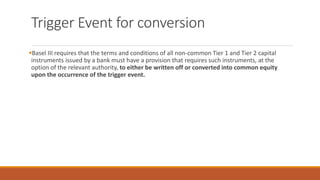
Trigger Event for conversion
▪Basel III requires that the terms and conditions of all non-common Tier 1 and Tier 2 capital
instruments issued by a bank must have a provision that requires such instruments, at the
option of the relevant authority, to either be written off or converted into common equity
upon the occurrence of the trigger event.
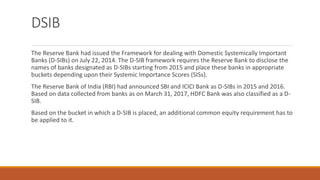
DSIB
The Reserve Bank had issued the Framework for dealing with Domestic Systemically Important
Banks (D-SIBs) on July 22, 2014. The D-SIB framework requires the Reserve Bank to disclose the
names of banks designated as D-SIBs starting from 2015 and place these banks in appropriate
buckets depending upon their Systemic Importance Scores (SISs).
The Reserve Bank of India (RBI) had announced SBI and ICICI Bank as D-SIBs in 2015 and 2016.
Based on data collected from banks as on March 31, 2017, HDFC Bank was also classified as a D-
SIB.
Based on the bucket in which a D-SIB is placed, an additional common equity requirement has to
be applied to it.
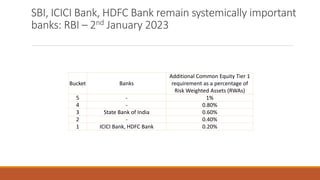
SBI, ICICI Bank, HDFC Bank remain systemically important
banks: RBI – 2nd January 2023
Bucket Banks
Additional Common Equity Tier 1
requirement as a percentage of
Risk Weighted Assets (RWAs)
5 - 1%
4 - 0.80%
3 State Bank of India 0.60%
2 - 0.40%
1 ICICI Bank, HDFC Bank 0.20%
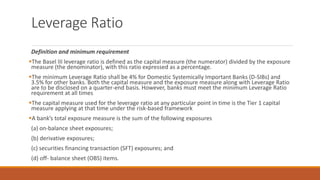
Leverage Ratio
Definition and minimum requirement
▪The Basel III leverage ratio is defined as the capital measure (the numerator) divided by the exposure
measure (the denominator), with this ratio expressed as a percentage.
▪The minimum Leverage Ratio shall be 4% for Domestic Systemically Important Banks (D-SIBs) and
3.5% for other banks. Both the capital measure and the exposure measure along with Leverage Ratio
are to be disclosed on a quarter-end basis. However, banks must meet the minimum Leverage Ratio
requirement at all times
▪The capital measure used for the leverage ratio at any particular point in time is the Tier 1 capital
measure applying at that time under the risk-based framework
▪A bank’s total exposure measure is the sum of the following exposures
(a) on-balance sheet exposures;
(b) derivative exposures;
(c) securities financing transaction (SFT) exposures; and
(d) off- balance sheet (OBS) items.
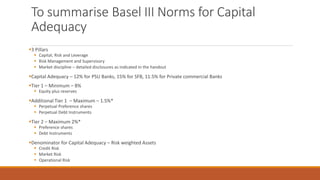
To summarise Basel III Norms for Capital
Adequacy
▪3 Pillars
▪ Capital, Risk and Leverage
▪ Risk Management and Supervisory
▪ Market discipline – detailed disclosures as indicated in the handout
▪Capital Adequacy – 12% for PSU Banks, 15% for SFB, 11.5% for Private commercial Banks
▪Tier 1 – Minimum – 8%
▪ Equity plus reserves
▪Additional Tier 1 – Maximum – 1.5%*
▪ Perpetual Preference shares
▪ Perpetual Debt Instruments
▪Tier 2 – Maximum 2%*
▪ Preference shares
▪ Debt Instruments
▪Denominator for Capital Adequacy – Risk weighted Assets
▪ Credit Risk
▪ Market Risk
▪ Operational Risk
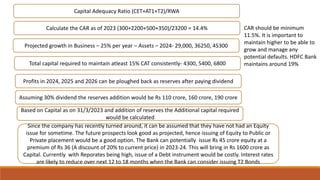
CASE LET FOR DISCUSSIONS
Calculate the CAR as of 2023 (300+2200+500+350)/23200 = 14.4%
Capital Adequacy Ratio (CET+AT1+T2)/RWA
Projected growth in Business – 25% per year – Assets – 2024- 29,000, 36250, 45300
Total capital required to maintain atleast 15% CAT consistently- 4300, 5400, 6800
CAR should be minimum
11.5%. It is important to
maintain higher to be able to
grow and manage any
potential defaults. HDFC Bank
maintains around 19%
Profits in 2024, 2025 and 2026 can be ploughed back as reserves after paying dividend
Assuming 30% dividend the reserves addition would be Rs 110 crore, 160 crore, 190 crore
Based on Capital as on 31/3/2023 and addition of reserves the Additional capital required
would be calculated
Since the company has recently turned around, it can be assumed that they have not had an Equity
issue for sometime. The future prospects look good as projected, hence issuing of Equity to Public or
Private placement would be a good option. The Bank can potentially issue Rs 45 crore equity at a
premium of Rs 36 (A discount of 20% to current price) in 2023-24. This will bring in Rs 1600 crore as
Capital. Currently with Reporates being high, issue of a Debt instrument would be costly. Interest rates
are likely to reduce over next 12 to 18 months when the Bank can consider issuing T2 Bonds
BASEL NORMS FOR LIQUIDITY COVERAGE
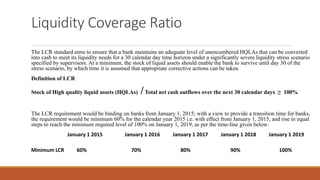
Liquidity Coverage Ratio
The LCR standard aims to ensure that a bank maintains an adequate level of unencumbered HQLAs that can be converted
into cash to meet its liquidity needs for a 30 calendar day time horizon under a significantly severe liquidity stress scenario
specified by supervisors. At a minimum, the stock of liquid assets should enable the bank to survive until day 30 of the
stress scenario, by which time it is assumed that appropriate corrective actions can be taken
Definition of LCR
Stock of High quality liquid assets (HQLAs) /Total net cash outflows over the next 30 calendar days ≥ 100%
The LCR requirement would be binding on banks from January 1, 2015; with a view to provide a transition time for banks,
the requirement would be minimum 60% for the calendar year 2015 i.e. with effect from January 1, 2015, and rise in equal
steps to reach the minimum required level of 100% on January 1, 2019, as per the time-line given below:
January 1 2015 January 1 2016 January 1 2017 January 1 2018 January 1 2019
Minimum LCR 60% 70% 80% 90% 100%
Liquidity Coverage Ratio
Calculation of Total net cash outflows
The total net cash outflows is defined as the total expected cash outflows minus total expected cash inflows
for the subsequent 30 calendar days.
Total expected cash outflows are calculated by multiplying the outstanding balances of various categories or
types of liabilities and off-balance sheet commitments by the rates at which they are expected to run off or
be drawn down.
Total expected cash inflows are calculated by multiplying the outstanding balances of various categories of
contractual receivables by the rates at which they are expected to flow in up to an aggregate cap of 75% of
total expected cash outflows.
High Quality Liquid Assets
▪Liquid assets comprise of high quality assets that can be readily sold or used as collateral to
obtain funds in a range of stress scenarios. They should be unencumbered i.e. without legal,
regulatory or operational impediments. Assets are considered to be high quality liquid assets if
they can be easily and immediately converted into cash at little or no loss of value.
▪The liquidity of an asset depends on the underlying stress scenario, the volume to be monetized
and the timeframe considered. Nevertheless, there are certain assets that are more likely to
generate funds without incurring large discounts due to fire-sales even in times of stress
▪There are two categories of assets which can be included in the stock of HQLAs, viz. Level 1 and
Level 2 assets. Level 2 assets are sub-divided into Level 2A and Level 2B assets on the basis of
their price-volatility
High Quality Liquid Assets – Level 1
Level 1 assets of banks would comprise of the following and these assets can be included in the stock of
liquid assets without any limit as also without applying any haircut:
i. Cash including cash reserves in excess of required CRR.
ii. Government securities in excess of the minimum SLR requirement.
iii. Within the mandatory SLR requirement, Government securities to the extent allowed by RBI, under
Marginal Standing Facility (MSF).
iv. Marketable securities issued or guaranteed by foreign sovereigns satisfying all the following conditions:
◦ a) assigned a 0% risk weight under the Basel III standardized approach for credit risk;
◦ (b) Traded in large, deep and active repo or cash markets characterised by a low level of concentration;
and proven record as a reliable source of liquidity in the markets (repo or sale) even during stressed
market conditions.
◦ (c) not issued by a bank/financial institution/NBFC or any of its affiliated entities.
High Quality Liquid Assets – Level 2
Level 2 assets (comprising Level 2A assets and Level 2B assets) can be included in the stock of liquid
assets, subject to the requirement that they comprise no more than 40% of the overall stock of HQLAs
after haircuts have been applied.
▪Level 2AAssets
A minimum 15% haircut should be applied to the current market value of each Level 2A asset held in
the stock. Level 2A assets are limited to the following:
i. Marketable securities representing claims on or claims guaranteed by sovereigns, Public Sector Entities
(PSEs) or multilateral development banks that are assigned a 20% risk weight under the Basel III
Standardised Approach for credit risk and provided that they are not issued by a bank/financial
institution/NBFC or any of its affiliated entities.
ii. Corporate bonds, not issued by a bank/financial institution/NBFC or any of its affiliated entities, which
have been rated AA- or above by an Eligible Credit Rating Agency
ii. Commercial Papers not issued by a bank/PD/financial institution or any of its affiliated entities, which
have a short-term rating equivalent to the long-term rating of AA- or above by an Eligible Credit
Rating Agency
High Quality Liquid Assets – Level 2B
A minimum 50% haircut should be applied to the current market value of each Level 2B asset held in
the stock. Further, Level 2B assets should comprise no more than 15% of the total stock of HQLA.
They must also be included within the overall Level 2 assets.
Level 2B assets are limited to the following:
i. Marketable securities representing claims on or claims guaranteed by sovereigns having risk weights
higher than 20% but not higher than 50%, i.e., they should have a credit rating not lower than BBB- as per
our Master Circular on ‘Basel III – Capital Regulations’.
ii. Common Equity Shares which satisfy all of the following conditions:
a) not issued by a bank/financial institution/NBFC or any of its affiliated entities;
b) included in NSE CNX Nifty index and/or S&P BSE Sensex index.
HQLA
All assets in the stock of liquid assets must be managed as part of that pool by the bank and shall be subject
to the following operational requirements:
▪ must be available at all times to be converted into cash,
▪ should be unencumbered,
▪should not be co-mingled / used as hedges on trading position; designated as collateral or credit
enhancement in structured transactions; designated to cover operational costs,
▪should be managed with sole intent for use as a source of contingent funds,
▪should be under the control of specific function/s charged with managing liquidity risk of the bank, e.g.
ALCO.
Amendment in April 2020
As part of post Global Financial Crisis (GFC) reforms, Basel Committee on Banking Supervision
(BCBS) had introduced Liquidity Coverage Ratio (LCR), which requires banks to maintain High
Quality Liquid Assets (HQLAs) to meet 30 days net outgo under stressed conditions. Further, as
per Banking Regulation Act, 1949, the banks in India are required to hold liquid assets to
maintain Statutory Liquidity Ratio (SLR).
In view of the fact that liquid assets under SLR and HQLAs under LCR are largely the same, we
have been allowing banks to use a progressively increasing proportion of the SLR securities for
being considered as HQLAs for LCR so that the need to maintain liquid assets for both the
requirements is optimised.
Given that SLR has now been reduced to 18 per cent of NDTL from April 11, 2020, entire SLR-
eligible assets held by banks are now permitted to be reckoned as HQLAs for meeting LCR.
Asset Liability Management
▪ Interest Rate
▪Tenure
▪Liquidity Management
Deposit Insurance and Credit Guarantee Corporation of India
(DICGC)
▪DICGC insures all deposits such as savings, fixed, current, recurring, etc. Deposits
▪Each depositor is insured for Rs. 5 lacs( maximum) towards principal and interest in case of the
failure of a Bank
▪All accounts in the same Bank including same or other branches of the same Bank are clubbed
to calculate the liability in the same type of ownership
▪ deposits with more than one bank, deposit insurance coverage limit is applied separately to the
deposits in each bank.
▪All commercial Banks including foreign Banks functioning in India, RRBs, All co-operative Banks
are insured by DICGC
▪Banks have the right to set off their dues from the amount of deposits as on cut off date. The
deposit insurance is available after netting of such dues
▪Deposit insurance premium is borne entirely by the insured bank
MONETARY POLICY FRAMEWORK
Monetary policy framework
•In May 2016, the RBI Act, 1934 was amended to provide a statutory basis for the implementation of the
flexible inflation targeting framework.
•Inflation Target: Under Section 45ZA, the Central Government, in consultation with the RBI, determines
the inflation target in terms of the Consumer Price Index (CPI), once in five years and notifies it in the
Official Gazette. Accordingly, on August 5, 2016, the Central Government notified in the Official Gazette 4
per cent Consumer Price Index (CPI) inflation as the target for the period from August 5, 2016 to March 31,
2021 with the upper tolerance limit of 6 per cent and the lower tolerance limit of 2 per cent. On March 31,
2021, the Central Government retained the inflation target and the tolerance band for the next 5-year
period – April 1, 2021 to March 31, 2026.
•Failure to Maintain Inflation Target: The Central Government has notified the following as the factors that
constitute failure to achieve the inflation target: (a) the average inflation is more than the upper tolerance
level of the inflation target for any three consecutive quarters; or (b) the average inflation is less than the
lower tolerance level for any three consecutive quarters
Instruments of Monetary Policy
•Repo Rate: The interest rate at which the Reserve Bank provides liquidity under the liquidity adjustment
facility (LAF) to all LAF participants against the collateral of government and other approved securities
•Reverse Repo Rate: The interest rate at which the Reserve Bank absorbs liquidity from banks against the
collateral of eligible government securities under the LAF
•Standing Deposit Facility (SDF) Rate: The rate at which the Reserve Bank accepts uncollateralised deposits,
on an overnight basis, from all LAF participants. The SDF is also a financial stability tool in addition to its role
in liquidity management
Instruments of Monetary Policy
•Bank Rate: The Bank Rate acts as the penal rate charged on banks for shortfalls in meeting their reserve
requirements (cash reserve ratio and statutory liquidity ratio). This rate has been aligned with the MSF rate and,
changes automatically as and when the MSF rate changes alongside policy repo rate changes.
•Marginal Standing Facility (MSF) Rate: The penal rate at which banks can borrow, on an overnight basis, from the
Reserve Bank by dipping into their Statutory Liquidity Ratio (SLR) portfolio up to a predefined limit (2 per cent).
This provides a safety valve against unanticipated liquidity shocks to the banking system. The MSF rate is placed at
25 basis points above the policy repo rate.
•Open Market Operations (OMOs): These include outright purchase/sale of government securities by the Reserve Bank
for injection/absorption of durable liquidity in the banking system
•Cash Reserve Ratio (CRR):
•Statutory Liquidity Ratio (SLR):
Monetary Policy
Inflation Management – CPI
Inject Liquidity/Increase Money
supply in the Economy
Absorb Liquidity/Decrease Money
supply in the Economy
Could affect Overall activity
in the Economy
To provide stimulus to
Economic activity
Instruments of Monetary
Policy
▪ Repo Rate Reduction
▪ Lowering of CRR
▪ Lowering of SLR
▪ OMO – Purchase
Transmission
▪ Through Lower lending rates and lower cost of Borrowings
▪ Increase in Money supply and hence increase in credit flow
▪ Repo Rate Increase
▪ Increase of CRR
▪ Increase of SLR
▪ OMO - Sales
▪ Transmission through
▪ Lower Higher lending rates and Higher cost of Borrowings
▪ Reduction in Money supply and hence decrease in credit flow
But without negatively impacting the
Economy too much
For Illustrative purposes
Call Money
▪The money market primarily facilitates lending and borrowing of funds between banks and entities
like Primary Dealers (PDs). Banks and PDs borrow and lend overnight or for the short period to meet
their short term mismatches in fund positions.
▪This borrowing and lending is on unsecured basis. ‘Call Money’ is the borrowing or lending of funds
for 1day. Where money is borrowed or lend for period between 2 days and 14 days it is known as
‘Notice Money’. And ‘Term Money’ refers to borrowing/lending of funds for period exceeding 14
days.
▪An inter-bank call money market is a short-term money market which allows large financial
institutions to borrow and lend money at interbank rates.
▪The call money rate is the rate at which funds are borrowed and lent by banks overnight. It caters to
the day-to-day cash needs of banks, especially to meet cash reserve ratio (CRR) and statutory liquidity
ratio (SLR) requirements, and to fulfil sudden demands for funds.
▪The prevalent liquidity condition in the banking system and the monetary policy influence the call
money rate
LIABILITIES MANAGEMENT
SOURCES OF FUNDS FOR BANKS
Sources of funds for Banks
▪Shareholder Funds - Equity Capital + Reserves (Retained Earning, Share premium Reserves, Capital reserves)
▪Additional Tier 1 instruments
▪Preference shares
▪Bonds
▪T2 Instruments
▪Preference shares
▪Bonds
▪Current Account deposits – No interest is paid
▪Savings Account deposits – Low interest is paid – Normally fixed rate. Variable rate offered is for very high value Rs 100 cr
▪Fixed Deposits – Retail/Corporate of varying tenure from 7 days to 10 years – Normally fixed
▪Certificate of Deposits
▪Call Money
▪Infrastructure Bonds
▪Refinance from NABARD/MUDRA/SIDBI etc.
▪Securitisation of receivables
▪Short term Emergency Liquidity from RBI/Call Money Market
10% 33% 57%
Total deposits – Rs 187.42 lac crore
Total credit – Rs 142 lac crore
RETAIL LIABILITY STRATEGY
Balances less than Rs.
10 Crore
2.70% p.a.
Balances Rs. 10 Crore
& Above
3.00%p.a.
State Bank of India savings interest
ICICI Savings
Account
ICICI Bank
Interest Rates
Minimum
Balance
ICICI Insta
Save Account
3% – 3.50% Rs. 10,000
ICICI Savings Account Interest Rates 2023
Savings Bank A/c – Kotak Mahindra Bank
Nature Rate of Interest
For balances upto Rs. 50
lakhs
For balances above
Rs. 50 lakhs
A. Domestic
(W.e.f. June
13, 2022)
3.50% p.a. 4% p.a.
Slabs
Applicable Rate of Interest
w.e.f. 1st Jun, 2022
Less than Rs. 50 Lacs 3.00% p.a.
Rs. 50 Lacs and up to less
than Rs. 800 Crs
3.50% p.a.
Axis Bank
Savings Balance (Rs) Interest Rate p.a
Less than Rs. 50 Lakh 3.00%
Of and above Rs 50 Lakh 3.50%
Effective 6th April 2022, Rate of Interest for Savings Bank deposits Accounts
HDFC Bank
Rate of Interest
Up to Rs.10 lakh 2.75%
More than Rs.10 lakh to less than Rs.200 Cr 2.80%
Indian Bank
Highest Savings Account Interest rates < Rs 1 lac
Bank Interest Rate
Fincare Small Finance Bank Limited 4.11%
Jana Small Finance Bank Limited 3.50%
RBL Bank Limited 4.25%
Utkarsh Small Finance Bank Limited 4.25%
Suryoday Small Finance Bank Limited 4.00%
YES Bank 4.00%
ESAF Small Finance Bank Limited 4.00%
IDFC First Bank Limited 4.00%
North East Small Finance Bank Limited 4.00%
IndusInd Bank 4.00%
*Interests rates are updated as on 5th July 2023.
Highest Savings Account Interest rates Rs 1 lac to Rs 5 lac
Bank Interest Rate
DBS Bank 7% (for Rs 4 to 5 lacs)
Jana Small Finance Bank Limited 7.00%
Utkarsh Small Finance Bank Limited 6.50%
Suryoday Small Finance Bank Limited 6.25%
Bandhan Bank Ltd. 6.00%
Equitas Small Finance Bank Limited 5.25%
Ujjivan Small Finance Bank Limited 6.00%
Fincare Small Finance Bank Limited 6.11%
RBL Bank Ltd. 5.50%
YES Bank Ltd. 4.25%
*Interests rates are updated on 5th July 2023.
Historic FD rates and Repo Rates - Indicative
FD Rates 1 year
HDFC Bank
FD Rates HDFC Bank 5
Years
Repo Rates
2023 6.6% 7.25% 6.5%
2022 5.75% 7% 6.25%
2021 4.9% 5.35% 4.4%
2020 5.1% 5.5% 4.4%
2019 6.45% 7.25% 5.4%
2018 7.3% 6.5% 6.5%
2017 6.9% 6% 6%
2016 6.9% 7.5% 6.25%
HDFC Bank
SBI
Tenor Bucket < 2 Crore
Interest Rate (per
annum)
**Senior Citizen Rates (per
annum)
7 - 14 days 3.00% 3.50%
15 - 29 days 3.00% 3.50%
30 - 45 days 3.50% 4.00%
46 - 60 days 4.50% 5.00%
61 - 89 days 4.50% 5.00%
90 days < = 6 months 4.50% 5.00%
6 months 1 days < = 9 months 5.75% 6.25%
9 months 1 day to < 1 year 6.00% 6.50%
1 year to < 15 months 6.60% 7.10%
15 months to < 18 months 7.10% 7.60%
18 months to < 21 months 7.00% 7.50%
21 months - 2 years 7.00% 7.50%
2 Years 1 day to < 2 Year 11 Months 7.00% 7.50%
2 Years 11 Months - 35 Months 7.20% 7.70%
2 Years 11 Months 1 day < = 3 Year 7.00% 7.50%
3 Years 1 day to < 4 Years 7 Months 7.00% 7.50%
4 Year 7 Months - 55 months 7.25% 7.75%
4 Year 7 Months 1 day < = 5 Years 7.00% 7.50%
5 Years 1 day - 10 Years 7.00% 7.75%*
General Public
Senior citizens
Tenors Rates w.e.f. 15/02/2023 Rates w.e.f. 15/02/2023
7 days to 45 days 3.00 3.50
46 days to 179 days 4.50 5.00
180 days to 210 days 5.25 5.75
211 days to less than 1
year
5.75 6.25
1 Year to less than 2
years
6.80 7.30
2 years to less than 3
years
7.00 7.50
3 years to less than 5
years
6.50 7.00
5 years and up to 10
years
6.50 7.50@
400 days (Special
Scheme i.e. “ Amrit
Kalash”)
7.10 7.60
Bandhan Bank IDFC First Bank
Tenure
FD rates for Non-
Senior Citizens
FD rates for Senior
Citizens
7 – 14 days 3.50% 4.00%
15 – 29 days 3.50% 4.00%
30 – 45 days 4.00% 4.50%
46 – 90 days 4.50% 5.00%
91 – 180 days 5.00% 5.50%
181 days – 1 year 6.50% 7.00%
1 year 1 day– 550
days
7.50% 8.00%
551 days – 2 years 7.25% 7.75%
2 years-1 day – 749
days
7.25% 7.75%
750 days 7.25% 7.75%
751 days – 3 years 7.25% 7.75%
3 years 1 day – 5
years
7.00% 7.50%
5 year 1 day - 10 years 7.00% 7.50%
Maturity Bucket
Interest Rates
for Non-Senior
Citizens
Interest Rates
for Senior
Citizens
7 days to 14 days 3.00% 3.75%
15 days to 30 days 3.00% 3.75%
31 days to less than 2 months 3.50% 4.25%
2 months to less than 3 months 4.50% 5.25%
3 months to less than 6 months 4.50% 5.25%
6 months to less than 1 year 4.50% 5.25%
1 year to 499 days 7.25% 7.75%
500 days (1 year, 4 months, 11 days) 7.85% 8.35%
501 days to less than 2 years 7.25% 7.75%
2 years to less than 3 years 7.25% 7.75%
3 years to less than 5 years 7.25% 7.75%
5 years to up to 10 years 5.85% 6.60%
HDFC Bank March 2023
Balance Sheet:
Total balance sheet size as of March 31, 2023 was ₹ 2,466,081 crore as against ₹2,068,535 crore
as of March 31, 2022, a growth of 19.2%.
Total Deposits showed a healthy growth and were at ₹ 1,883,395 crore as of March 31, 2023, an
increase of 20.8% over March 31, 2022.
CASA deposits grew by 11.3% with savings account deposits at ₹ 562,493 crore and current
account deposits at ₹ 273,496 crore.
Time deposits were at ₹ 1,047,406 crore, an increase of 29.6% over the corresponding quarter of
the previous year, resulting in CASA deposits comprising 44.4% of total deposits as of March 31,
2023.
Big or small, CASA eludes all banks in Q3 but deposits hold up
▪Ten banks have released early business updates for the October-December quarter, showing a
decline in low-cost current and savings account deposits. Despite this, lenders have managed to
shore up overall deposit growth as the sharp hikes in deposit rates seem to have paid off.
▪India’s most valuable private sector bank HDFC Bank reported a stellar 20 percent deposit
growth, which was faster than its loan book expansion. A strong retail franchise along with hikes
in deposit rates helped it bring in funds. But the bank disappointed with the share of its CASA in
overall deposits. The lender’s CASA ratio has consistently declined for four quarters to 44
percent as of December.
▪A part of this decline could be a shift from CASA deposits to term deposits after the bank began
hiking interest rates on them. The bank has hiked its deposit rates thrice during the last quarter.
▪Most lenders have followed through with deposit rate hikes of varying degrees during the
period.
Extracts from News article January 2023
Pricing of Liabilities – General Guidelines
▪Repo rates
▪Liquidity in the Economy
▪Liquidity in the Bank
▪Demand for Credit in the Economy
▪Tenure of Assets which these would be put to use
▪Overall Mix of liability from Tenor perspective
▪Pricing of similar liabilities by other Banks
▪Alternative Instruments and rates available for the customers of the liabilities
▪Type of Instruments/Liabilities – TL/DL/ATI/T2/Infra/Equity- QIP/Public/ECB
▪Strategy of the Banks – Current liability mix and hence which would be the focus areas
▪Cost of Acquisition – Manpower and other costs
▪Cost of Losing on current base (Especially for CASA and TD)
▪Statutory requirements and current status
▪ CRR
▪ SLR
▪ PSL
HDFC Bank- Retail liabilities strategy
Retail liabilities Strategy
Detailed document already shared separately
ICICI BANK CASE ON LONG TERM INFRASTRUCTURE BONDS ISSUE
Key Questions
▪What was the Indian Banks exposure to Infrastructure and how did it perform?
▪What were the recent changes by RBI on Infrastructure Bonds? How does this change help ICICI Bank?
▪What was ICICI Bank 5 C strategy?
▪What has been ICICI Bank Priority Sector lending performance
▪How has ICICI Bank been financing long term Projects ( Exhibit 5)
▪Why was ICICI Bank planning to issue Long term Bonds
▪What has been ICICI Bank Growth of Loan Book for Infrastructure Bonds
▪What is the interest rate scenario currently?
▪What is it likely to be in the next 1-2 years?
▪What is the likely appetite for Long term Infrastructure Bonds?
▪ Tenure
▪ Rate of Interest
▪ Type of Interest – Floating or Fixed Rate
▪Any other points?
▪What is the recommendation? Why?
▪ Fixed vs Floating Rate?
▪ Interest Rate?
▪ Taxable or Non Taxable?
▪ Size?
FEE BASED SERVICES FOR INCOME
Different types of fees income sources- Indicative
▪Savings Accounts
▪Current Accounts
▪Credit cards – Fees for issuance, Annual(based on type of card) and Merchants
▪Lockers – Annual based in type of lockers. @
▪Bank guarantees – Non fund based, but risk related
▪LCs
▪Foreign Exchange
▪Wealth Management/Advisory services – Advisory/Commissions earned from IPO placement/various
investment instruments
▪Insurance and Mutual funds cross selling
▪Asset based Fees– Linked to Lending
▪Investment Banking – IPO Management/M&A/Private placement of Debt/Equity – To be discussed
separately
▪Depository services
▪Loan syndication – Partly linked to Lending
▪Government Business
Breakup of Fee & Other Income – FY23
• During FY23, the Fee and Other Income of
the Bank increased by 54% YoY.
• The Bank has launched and scaled up many
fee-based products in the last 4 years.
• Many of these products are in the early stage
of their lifecycle and have the potential to
grow significantlygoing forward.
• 91% of the fee income & other income is
from retail banking operations which is
granular and sustainable.
Loan Origination
fees
33%
Credit Card & Toll
15%
Trade & Client Fx
11%
WM / Third Party
Distribution, 11%
General Banking
Fees
25%
Others
5%
b. Fee & Other Income Section 9: Profitability & Capital
Impact of fee income on bottom line- Indicative
All figures in Rs
crore unless stated
otherwise
Fee Income FY 2023 Operating profit Fee Income as a %
of PBT
Total Income
Axis Bank 16216 32048 74% 101000
SBI 26245 83713 52%* 360000
IDFC 4142 4932 126% 27000
BOB 6000 26864 33% 99000
HDFC Bank 33900* 75300 55% 126890
CROSS SELLING
Banks Cross selling
▪Mutual Fund products
▪Life Insurance
▪Non Life Insurance
▪Corporate Debentures
▪GOI Savings Bonds for Retail
▪Advisory Services for Wealth Management
▪IPO selling
Why Cross Sell?
▪To increase Share of Wallet of Customers
▪ More product per Customer
▪To earn Fee based Income
▪To support its existing Retail/Corporate Loans
▪ Home Loan
▪ Life Insurance Policy against Home Loan for protection
▪ Fire and Burglary Insurance for Home
▪ Automobile Loan
▪ Auto Insurance
▪ Corporate Loans for Plant
▪ Non Life Insurance
Life Insurance Industry Distribution Mix
Industry incl LIC Private Sector
New Business Market share Life Insurance – Approx.
Dec 2022 - YTD Dec 2021 - YTD Market share Pvt
sector
Promoter
SBI General 10683 8790 25% Bank
HDFC Life 6197 5283 15% Bank
Tata AIA 4136 2748 9.8%
ICICI 3860 3984 9.2% Bank
Max 3432 3532 8% Bank
Bajaj 3180 2320 7.6%
Kotak 1352 1112 3.2% Bank
PNB 1360 1042 3.2% Bank
LIC 21571 19154 Government
63% of the New Business is by Bank sponsored Life Insurance companies
New Business Market share Non Life Insurance –
Approx.
Dec 2022 – YTD Dec 2021 - YTD Market share Pvt
sector
Promoter
Bajaj Allianz 11600 10400 10.2%
HDFC Ergo 11933 9547 10.5% Bank
ICICI Lombard 16000 13300 14.15 Bank
IFFCO Tokio 7100 6300 6.2%
Reliance 8100 7200 7.1%
SBI General 6900 6000 6% Bank
Tata AIG 9400 7000 8.2%
Star Health Insurance 8500 7700 7.7%
Kotak 786 500 0.7% Bank
New India 26000 25000 Government
32% the Business is by Bank sponsored Non Life Insurance Private companies
Top 10 Fund Houses (79% of total AUM)
AMC Sponsor AAUM – Apr to June 2023 Market share
SBI Mutual Fund State Bank of India 7,62,347 17%
ICICI Prudential Mutual Fund ICICI Bank and Prudential 5,31,327 12%
HDFC Mutual Fund HDFC Bank* 4,85,748 11%
Nippon India Mutual Fund Nippon 3,13,598 7%
Kotak Mahindra Mutual Fund Kotak Mahindra Bank 3,09,861 7%
Aditya Birla Sun Life Mutual Fund Aditya Birla Capital 2,96,937 6.8%
Axis Mutual Fund Axis Bank 2,48,160 5.7%
UTI Mutual Fund
Banks, Mutual funds,
Insurance companies, Public
2,48,087 5.7%
Mirae Asset Mutual Fund Mirae 1,22,802 2.8%
Bandhan Mutual Fund Bandhan Bank 1,18,167 2.7%
Figures in Rs crore
62% of the total Industry AUM is by Bank sponsored AMC (Does not include UTI which is 35% owned by Banks)
In Debt/Money Market/Liquid, the largest investor base in Institutions who invest directly
Why Do Banks
sell Mutual
Funds?
Indicative Commission paid by MFs
Cross sell strategy
▪The focus at State Bank of India (SBI), too, is to ensure that the products being sold
are aligned with the appetites of customers. SBI Chairman Dinesh Khara explains:
“The income from cross-selling has grown 30 per cent year-on-year for the last
three years. There is a separate customer value enhancement unit for this activity.
The potential is huge and the ramp-up is significant.”
▪More than 80 per cent of Axis Bank’s retail assets are sourced from existing
customers. And yet, last year, the bank made a fresh start with “Aarambh”, to
enhance product personalisation and cross-selling.
The case of Wells Fargo
▪Wells Fargo is the world-leader in cross-selling among banks, with a ratio consistently
near six.
▪Its business model was sought to be emulated by banks around the world.
▪One pitfall of the desire to hike cross-selling is greed.
▪In 2016, Wells Fargo was involved in the alleged creation of over two million fake bank
accounts by thousands of Wells Fargo employees. It was asked to pay $185 million in
fines for creating over 1.5 million accounts and 500,000 credit cards that its customers
never authorised.
▪The American Consumer Protection Bureau levied $100 million in fines, while $50
million in fines were imposed by the City and County of Los Angeles, and $35 million in
fines by the Office of Comptroller of the Currency. Additional civil and criminal suits had
reached $2.7 billion by the end of 2018.
Mis-selling in India
▪If you have been to a bank branch to open a
bank locker, nine out of 10 times at least
one bank employee would have asked you
to either open a fixed deposit with the bank
or take an insurance policy.
▪If you make a physical visit to the bank to
deposit money into your Public Provident
Fund (PPF) account, it is probable that a
pushy bank official has tried to wean you
away to an insurance product, claiming the
latter to be better than PPF
LENDING PRODUCTS
Retail lending vs Corporate Lending - Indicative
▪Retail/Small Business
▪ Higher rate of Interest except Retail Housing loans
▪ Mostly Standard rate structures except for large value
borrowings for each product
▪ Normally has a processing fees as an additional revenue
stream
▪ Higher Net Interest Margin (NIM)
▪ Faster Speed of sanction and disbursement
▪ Documentation Standardised
▪ Scorecard driven appraisals
▪ Loan tenures typically 2 to 5 years except for LAP and HL
▪ Type of repayment – Normally EMIs
▪ High volumes of transactions
▪ Lower ticket sizes – Rs 1 lacs to Rs 5 crore(typical)
▪ Collection process – Exhaustive and process driven through
large field force(Feet on street)
▪ Relatively lower NPAs
▪ Settlement process for NPAs – Involves repossession
specially for Vehicles/Construction Equipments/Office
Equipment
▪Corporate
▪ Standard rate structures for Small Businesses,
Customised and flexible for Medium and Larger
borrowers
▪ NIMs are relatively lower
▪ Customised appraisals, hence process longer, can
even be few weeks for large borrowings
▪ Documentation – Can be customised
▪ Loan tenures 3 months to 10+ years
▪ Type of repayment – Customised
▪ Continuous monitoring of each borrower especially
for larger value loans
▪ Volumes – relatively smaller
▪ Ticket sizes larger can go to over Rs 1000 crore
▪ Collection process – More personalized and
involving Bank officials
▪ Relatively higher NPAs
▪ Settlement process for NPAs – Long and tedious
Secured vs Unsecured lending
▪Secured lending is typically one where there is a collateral/Asset which is hypothecated /Mortgaged to the Bank
▪ Home Loans
▪ Auto Loan
▪ Loan against property
▪ Loan for Plant and Machinery
▪ Loan against shares
▪ Gold Loans
▪In secured lending typically the lender provides the loan for a % of the Asset value with the balance as margin
▪ This varies for different type of Assets//Products
▪In case of Secured lending, the ownership of the asset remains with the borrower and the lender has the asset
only as a security against the Loan
▪ Only in case of Leasing which is done by NBFCs, the ownership is with the Lessor(aka lender) and the Lessee(aka borrower) is
the user of the Asset on lease(rent)
▪Unsecured lending is one where there is no asset or collateral for the Loan. It is pure risk based lending
▪ Personal Loans
▪ Business Loans
▪ Working Capital Loans
▪ Credit Cards
▪ BNPL
Lending process – Retail - Indicative
▪Bureau data – CIBIL/Experian
▪Income Tax Returns
▪Type of Income
▪Cash flows of the Individual /Business
▪Type of Industry
▪Asset type – Income generating
▪Loan to value of the Asset
▪Scorecard driven
▪Bank Statement analysis
The Bank has a 10 Step Stringent Underwriting Process (1/2)
No-Go Criteria
The Bank evaluates certain quick no-go criteria such as deduplication against existing records, bank validation and minimum
credit parameter rules.
Credit Bureau Check
Fraud Check
Credit Scorecard
Field Verification
The Bank pings the Credit Bureaus to check the customer’s credit behavior history, number of credit inquiries, age in
bureau,limit utilization, recency of inquiries, level of unsecured debt, etc.
The Bank uses certain file screening techniques, banking transaction checks and industry fraud databases to weed out
possible fraudulent applications. The bank also uses Fraud Scorecards and real-time video-based checks to identify
fraudulent applications
The application is then put through scorecards which have been developed based on experience with similar cohort of
customers in the past. It includes criteria such as leverage, volatility of average balances, cheque bounces in bank account,
profitabilityratios, liquidity ratios and study of working capital, etc.
The Bank conducts field level verifications, including residence checks, office address checks, reference verification, lifestyle
checks (to see if the product / quantum of loan correlates with lifestyle profile) and business activity checks.
1
2
3
4
5
Personal Discussion
Based on inputs received, from our processes, a personal discussion is conducted with the customer which includes
establishment of business credentials, understandingfinancials, seeking clarifications on financials, queries on banking
habits, queries on the credit bureau report, clarification on banking entries if any, and understanding the requirement and
end use of funds.
6
b. Retail & Commercial Loans Section 8: Risk Management & Asset Quality
37
Note: The underwriting process mentioned above, changes depending on product to product.
The Bank has a 10 Step Stringent Underwriting Process (2/2)
Industry Check
Cash Flow Analysis
Ratio Analysis
Title Deeds Verification
The Bank checks for further credit history and industry level exposure by doing CRILC checks and checks by external entities,
where required, to study financials, access to group companies whether legal cases have been filed against the company,
disqualification of directors, etc.
The bank statement of account is analyzed for business credits, transaction velocity, average balances at different periods of
the month, EMI debits, account churning, interest servicing, etc. This helps us understand the cash flow on the basis of
which we calculate the permissible EMI, loan amount, etc.
Detailed financial analysis is performed covering, Ratio analysis, debt to net-worth, turnover, working capital cycle,
leverage, etc.
Evaluation of title deeds of the property and collateral, legality validity, enforceability etc.,
7
8
9
10
Repayment : Bank takes standing instructions to debit the bank account of the customers on a monthly basis and thus pulls the EMI from the customers naturally operated account. The
cheque returns are low, but the returned cheques are subsequently followed up for collections.
Through this stringent underwriting process, the Bank rejects nearly 40% - 60% of the Loan Applications depending on the
product category.
b. Retail & Commercial Loans Section 8: Risk Management & Asset Quality
38
Note: The underwriting process mentioned above, changes depending on product to product.
Account Aggregator
▪With the launch of the Account Aggregation framework in India, the Reserve Bank of India (RBI) has
successfully bridged the gulf between the demand and supply of retail lending. Credit can now percolate
to a large volume of borrowers without a significant credit history
▪Over the years, the framework has been refined, with better definition and understanding of AAs, leading
to a public launch in September 2021. Account Aggregators (AA) are RBI-approved and regulated
entities that help customers access their financial data securely and digitally from their banks and share
it – if they so desire – with other participating financial institutions.
There are four parties in the account aggregation ecosystem –
▪The End customer – who holds an account with a bank, AMC, Insurance provider, etc.
▪A financial institution where the customer holds an account. These are the FIPs.
▪A regulated institution which comes under the supervision of the Reserve Bank of India (RBI), Securities
Exchange Board of India (SEBI), Insurance Regulatory and Development Authority of India (IRDAI), PFRDA,
can be an FIU. Where relevant, FIUs also participate as FIPs
▪Account aggregators (AAs) are licensed entities that help Data Principals in safely accessing their data
held by FIPs and share these data with FIUs of her choice. AAs are essentially consent managers
The AA cannot “see” the data for themselves, which gives customers the peace of mind that only
they are in control of their data.
Financial Information Providers
(FIPs)
Financial Information Users (FIUs)
1.Axis Bank
2.HDFC Bank
3.ICICI Bank
4.IndusInd Bank
5.Bajaj Finserv
6.Federal Bank
7.Karur Vysya Bank
1.Axis Bank
2.HDFC Bank
3.ICICI Bank
4.IndusInd Bank
5.Bajaj Finance
6.Federal Bank
7.Karur Vysya Bank
8.Lending kart
9.DMI Finance
10.Epifi
11.Goal teller
12.IIFL Finance
13.Kotak Mahindra
14.Kairos Capital
15.Neo Growth
AA ecosystem of Anumati - Illustrative
First Loss Default Guarantee
Why banks and non-bank financial companies (NBFCs), known as 'regulated entities' (REs), and
fintechs, known as 'loan service providers' (LSPs), came together?
▪ While banks have the capital and licence to lend, fintechs have the technology and client
reach
▪ Banks are hesitant to extend loans to categories they consider as carrying high risks (bad loan
probability) and having asymmetric financial information. These include MSMEs, agriculture
companies, the blue-collar segment, and borrowers with limited credit history.
▪ In an FLDG arrangement, fintechs, which cannot lend directly, can get banks clients, perform
certain services (such as sourcing loans, monitoring, pricing, and recovery), and—if the loan
goes bad—guarantee a part of the loss up to a certain percentage.
▪The idea of sharing the risk with a fintech partner encourages banks to extend loans to the
unserved from a larger customer pool
FLDG
•Who is accountable for NPAs?
REs are accountable for identifying individual loan assets as non-performing assets (NPAs) or loans that
are not paid on time, irrespective of the DLG cover.
•Who does the underwriting?
As per the guidelines, the RE has to ensure it has a robust credit underwriting framework
•How long does the agreement last?
The duration should be at least as long as the longest tenor of the loans in the underlying loan
portfolio
•What guarantees do fintechs cover?
The default guarantee by fintechs has been capped at 5% of the portfolio amount. Second, fintechs
will have to give hard guarantees to banks. The exposure will have to be secured by the fintech
through a cash deposit—a fixed deposit (FD) maintained with a scheduled commercial bank with a lien
(security interest over a property) or a bank guarantee marked in favour of the RE
LENDING RATES
Lending – Floating Rates
▪ Base rate
The Base Rate was the minimum interest rate at which Indian banks could lend. They were not permitted to resort to any
lending below this rate The base rate was determined significantly on the average cost of funds. As per RBI policies,
lenders were required to review their base rate at least once every quarter. MCLR was introduced in April 2016 by RBI in
place of base rate.
▪ MCLR
The Marginal Cost Lending rate is the minimum rate below which banks cannot lend. It is an internal rate fixed by
individual banks for floating loans. The MCLR is linked to the marginal cost of funds, operating costs, cost of carrying in
cash reserve ratio and tenure premium. It is determined based on the current cost of funds as opposed to the base rate
which is based on the average cost of funds. MCLR is also more responsive to changes in policy rates. However, there
was still a lack of transparency in the home loan interest rates for customers.
▪Repo rate
Lastly, the RBI introduced a new method of external benchmark-based lending rates to increase transparency. Under
this, banks were instructed to link their lending rates on an external benchmark such as the repo rate, three-month
treasury bill or six-month treasury bill. Most of the lenders opted for repo rate to link their lending rates. It offers more
transparency in the system and borrowers know that whenever RBI raises or lowers the repo rate, their interest rate will
also change
Banks/NBFCs lending rates would be MCLR or Repo rate + x%
Current MCLR Rates 8th August 2023 - Indicative
Source Bankbazaar.com
Banks 3 years 2 years 1 years 6 months 3 months 1 months Overnight
SBI MCLR 8.70% 8.60% 8.50% 8.40% 8.10% 8.10% 7.95%
HDFC MCLR 9.05% 8.95% 8.85% 8.70% 8.60% 8.55% 8.50%
Axis MCLR 8.95% 8.90% 8.80% 8.75% 8.70% 8.60% 8.60%
PNB MCLR 8.80% NA 8.50% 8.40% 8.20% 8.10% 8.00%
IndusInd MCLR 10.15% 10.10% 10.05% 9.75% 9.35% 9.00% 8.95%
Canara MCLR NA NA 8.50% 8.30% 7.90% 7.55% 7.55%
IDFC First Bank MCLR NA NA 9.60% 9.25% 8.85% 8.50% 8.50%
Bank of India MCLR 8.00% NA 7.80% 7.55% 7.35% 7.30% 6.95%
Central Bank of India
MCLR
NA NA 8.15% 8.05% 7.85% 7.50% 7.50%
Bandhan Bank MCLR 10.96% 10.96% 10.96% 8.21% 8.21% 6.71% 6.71%
UBI MCLR 9.00% 8.85% 8.65% 8.45% 8.25% 8.05% 7.90%
UCO Bank MCLR NA NA 8.35% 8.25% 8.00% 7.80% 7.60%
Punjab and Sind Bank
MCLR
NA NA 8.50% 8.25% 8.10% 7.60% 7.50%
Bank of Baroda MCLR NA NA 8.55% 8.40% 8.30% 8.20% 7.90%
Federal Bank MCLR NA NA 9.20% 9.15% 9.05% 9.00% 8.95%
Enclosed below are HDFC Bank Loan Against Property Interest Rates & Charges
SBI
SBI new car loan
Fee Amount to be paid
Rack Interest Rate Salaried- 11.00% to 21.00%
Processing fee /
Loan Processing Charges
Up to Rs 4999/-
Stamp Duty & Other Statutory Charges As per applicable laws of the state
Senior Citizen Customers are eligible for discount of 10% on all service charges
Government taxes and other levies as applicable will be charged over and above the Fee and Charges.
Loan disbursal at the sole discretion of HDFC Bank Ltd.
Personal Loan – HDFC Bank
Pricing of Loans – Retail/Small Business
▪Type of borrower – Individual or Corporate
▪Type of Asset – Auto/Home/Unsecured
▪Usage – Private or Commercial
▪Loan to Value of the Asset
▪Tenure of Loans
▪Processing fees and other charges for the Loan
▪Other fee based Income along with the
Loan(Insurance)
▪Business whether Direct or through
Dealer/DSA/TPP
▪Cost of Acquisition – Manpower/Admin/Infra
▪CIC Score
▪Default Risk based on past performance of the
product of the Bank and/or in the Industry
▪Geographical location of the Borrower
▪Alternative source of Borrowing available for the
customer – Competition( Direct and Adjacent)
▪Number and type of competitors
▪Demand for the product in the market
▪Strategy of the Bank to grow the portfolio
▪Product profitability
CORPORATE LENDING
Lending process – Corporate - Indicative
▪Industry of the Borrower entity
▪Current Exposure to Borrower
▪Credit Rating of the Borrower – Better the credit rating of the Borrower, lower the rate that Bank
charges - This is from RBI approved credit rating agency
▪Financial Appraisal
▪ Past Financial statements
▪ Cash Flow Statements
▪ Financial Ratio Analysis
▪ Liquidity
▪ Profitability
▪ Leverage
▪ Operating
▪ Projections
▪ Debt servicing capability
▪ Assumptions for the Projections – This is the most important part. This varies for every Industry
▪ IRR of the project/equipment being financed
▪ Tenure of the project to become viable
Lending process – Corporate - Indicative
▪Qualitative Analysis
▪ Industry experience of the Company
▪ Managerial depth and qualifications
▪ Managerial depth and turnover rate
▪ Past project experience
▪ Caliber and structure of the Board
▪ Management Reputation
▪ Borrower’s personal Equity
▪ Breadth of Ownership
▪ Reputation/Stature of the Audit firm
▪ Accounting practices
▪ Letter of Comfort from the main holding company ?
Lending process – Corporate - Indicative
▪Due Diligence
▪ Checking on New Borrower’s address
▪ Visit to Borrower work place
▪ Interview with Borrower
suppliers/Customers
▪ Industrial relations
▪ Detailed disclosures of contingent
liabilities
▪ Detailed Risk Assessment of the
Borrower/Project/Loan
▪ Loan
▪ Interest rate
▪ Asset Liability
▪ Credit Risk
▪ Borrower/Project
▪ Government Polices Risk
▪ Cash flow risk
▪ Project Execution Risk
▪ Default Risk
▪ External trade factors
Stringent Underwriting Process in Wholesale Business
Customer Selection
• All New-To-Bank potential borrowers (incl. promoter/ directors) are checked including CIBIL, Suit filed, CFR, CRILC, etc.
• Further, bank has also defined minimum internal rating thresholds for onboarding any borrower,which acts as a
guiding factor for loan originations.
Due Diligence with
focus on Cash Flows
Smell Check
Risk based approvals
• The Bank follows a conservative underwriting approach wherein primary assessment of debt servicing ability is
based on underlying cash flows of the borrower.
• The Bank conducts detailed due diligence of the borrower including objective financial assessment, assessment of
borrower’s business profile, industry, ownership & management, key risks and customer’s past track record, which in
turn helps determining the Bank’s appetite for the exposure.
• As part of underwriting process market feedback is obtained from borrower’s peers, customers, suppliers,
external rating agencies, banks, etc.
• The Bank follows a ‘risk-based’ approach for credit sanctions wherein higher risk exposures (basis internal
rating, quantum and tenure) require approval from higher approval authority.
1
2
3
5
Note: The underwriting process mentioned above, may change depending on product to product. 44
Granular Exposure
• Focusing on granular small to medium ticket size credit exposures with average ticket size of New to Bank exposure at
Rs. 60 Cr.
4
c. Wholesale Financing Section 8: Risk Management & Asset Quality
Pricing of Loans - Corporate
▪Credit Rating of the Borrower
▪Total Exposure to the Borrower
▪Industry of Exposure
▪Type of Asset – Machinery/Real
Estate/Vehicles/Infrastructure
▪ Tenure of Loans
▪Type of Interest – Fixed or Variable
▪Other fee based Income from the Borrower –
BG/LC/Loan Syndication
▪Default Risk
▪Alternative source of Borrowing available for the
customer – Competition( Direct and Adjacent)
▪Number and type of competitors
▪Strategy of the Bank to grow the portfolio
▪Product profitability
TRADE FINANCE
Trade Finance
▪‘Letters of Credit’ also known as ‘Documentary Credits’ is the most commonly accepted
instrument of settling international trade payments. A Letter of Credit is an arrangement
whereby Bank acting at the request of a customer (Importer / Buyer), undertakes to pay for the
goods / services, to a third party (Exporter / Beneficiary) by a given date, on documents being
presented in compliance with the conditions laid down
Bank guarantee vs letter of credit
▪A Bank guarantee is a commercial instrument. It is an assurance given by the bank for a non-
performing activity. If any activity fails, the bank guarantees to pay the dues. There are 3 parties
involved in the bank guarantee process i.e the applicant, the beneficiary and the banker.
▪Whereas, a Letter of Credit is a commitment document. It is an assurance given by the bank or
any other financial institution for a performing activity. It guarantees that the payment will be
made by the importer subjected to conditions mentioned in the LC. There are 4 parties involved
in the letter of credit i.e the exporter, the importer, issuing bank and the advising bank
(confirming bank)
Parties involved in an LC
Applicant An applicant (buyer) is a person who requests his bank to issue a letter of credit.
Beneficiary A beneficiary is basically the seller who receives his payment under the process.
Issuing bank The issuing bank (also called an opening bank) is responsible for issuing the letter of credit at
the request of the buyer.
Advising bank The advising bank is responsible for the transfer of documents to the issuing bank on behalf
of the exporter and is generally located in the country of the exporter.
TYPES OF LC
▪Revocable Letter of Credit - A revocable letter of credit is one which can be cancelled or
amended by the issuing bank at any time and without prior notice to or consent of the
beneficiary. From the exporter’s point of view such LCs are not safe. The LC should clearly state
that the same is revocable.
▪Irrevocable – This cannot be amended or revoked without the consent of all parties
▪Revolving – This can be revolving in terms of time or Value
▪Transferable LC - A Transferable Credit is one that can be transferred by the original (first)
beneficiary to one or more second beneficiaries. When the sellers of goods are not the actual
suppliers or manufacturers, but are dealers/middlemen, such credits may be opened, giving the
sellers the right to instruct the advising bank to make the credit available in whole or in part to
one or more second beneficiaries.
LOAN PROPOSAL – SAMPLE FOR CLASS ILLUSTRATION ONLY
Questions and analysis - Suggested
▪New capacity being created
▪Capacity utilization in FY 24-28
▪Which products/New or Existing
▪Details of the Capital Expenditure?
▪Accounts payables
▪ Raw Material Expenses
▪Accounts receivables
▪Current Exposure to your Bank for loans
▪Impact of lower R&D on Market share
▪How is the refurbishment in FY 27 expected to be
financed?
▪Projections for FY 29 to FY 31
▪Why is the company wanting to fund the entire
capital expansion through Debt
▪ Why not use part of Internal Accruals
▪ Infusion of Equity?
▪Whether all will be required for Capex or will there be an
increase in WC requirements also?
▪Care A- Issuers with this rating are considered to offer
adequate degree of safety regarding timely servicing of
financial obligations. Such issuers carry relatively low credit
risk, though it is higher than those with A or A+ ratings
Analysis
▪Debt Equity Ratio trend
▪EBIDTA Margins
▪PBT Margins
▪RONW
▪Interest coverage ratio
▪Market Share
Industry size 32500 37375 42981 49428 56843 65369 75174
Rs in crore 19-20 20-21 21-22 22-23 23-24 24-25 25-26 26-27 27-28
Revenues 3200 3550 3900 4400 4800 5400 6600 7400 8300
EBIDTA 450 500 575 625 700 830 925 935 980
Interest 150 165 160 180 200 270 350 400 500
Current loans 2500 2300 2200 2100 2000 3600 3400 3700 4000
PBT 220 270 335 345 380 400 430 510 580
Equity 250 250 250 250 250 250 250 250 250
Reserves 850 900 975 1125 1239 1359 1531 1735 1909
AP 688 702 953 792 897 1240 1518 1700 1950
AR 800 994 1194 928 1196 1400 1960 2200 2400
Days receivables 91 102 112 77 91 95 108 109 106
D/E 2.27 2.00 1.80 1.53 1.34 2.24 1.91 1.86 1.85
EBIDTA % 14.1% 14.1% 14.7% 14.2% 14.6% 15.4% 14.0% 12.6% 11.8%
PBT% 6.9% 7.6% 8.6% 7.8% 7.9% 7.4% 6.5% 6.9% 7.0%
RONW 20.0% 23.5% 27.3% 25.1% 25.5% 24.9% 24.1% 25.7% 26.9%
Market share 12% 11.8% 11.2% 10.9% 11.6% 11.3% 11.0%
Interest as a % of
EBIDTA or EBIT 3 3 4 3 4 3 3 2 2
CA/CL 1.2 1.4 1.3 1.2 1.3 1.1 1.3 1.3 1.2
Recommendation
▪You can give the loan in-principle
▪Suggest Rs 300 to 400 crore capital infusion by the promoters or private placement
▪ This will reduce the D/E
▪ Reduce Interest burden
▪Loan for Rs 1400-Rs 1500 crore @ MCLR + 2%-2.5%
▪Rework the projections for FY 24 to FY 30?
▪Risk factors to watch out for
▪ Project Execution
▪ Internal Accruals
Union Bank of India
ACCOUNTING NORMS FOR BANKS
Some important Accounting Guidelines
▪Of the EMI paid by the Borrower, Only Interest is recognized as Income.
▪The principal component repaid is not recognized as Income and is deducted from the Asset value.
▪Interest income is recognised on an accrual basis, except in the case of interest income on non-performing
assets where it is recognised on receipt basis
▪Commission on guarantees and LCs is recognized on a pro-rata basis over the period of the guarantee/LC.
▪Locker rent is recognized on a straight-line basis over the period of contract.
▪Annual fee for credit cards and debit cards is recognised on a straight-line basis over the period of service.
▪Other fees and commission income are recognised when due, where the Bank is reasonably certain of
ultimate collection
▪Interest paid on Fixed Deposits/Savings Accounts/Loans is recognized as Expenses on Accrual basis
Loan 10000
Interest 10%
EMI 750
Month Interest Principal repaid
Principal
outstanding
1 83 667 9333
2 78 672 8661
3 72 678 7983
4 67 683 7300
5 61 689 6611
6 55 695 5916
7 49 701 5215
8 43 707 4508
9 38 712 3796
10 32 718 3078
11 26 724 2353
12 20 730 1623
13 14 736 886
14 7 743 144
15 0 144 0
Interest 644 10000
Key Accounting guidelines for Banks
▪Indian Accounting Standard also known as Ind AS has been applicable for most Industries in India
from April 2015. For NBFCs it was applicable from April 2019.
▪The implementation of Ind AS for Banks and Insurance Companies has been deferred by the
respective regulators RBI/IRDAI
▪RBI has recently floated a discussion paper on the adoption of Ind AS for Banks and the same in likely
to be applicable from 2024-25
▪The key change for Banks would be recognition of NPAs. Currently Banks recognize NPAs based on
actual default and provide for the same as per the RBI guidelines. As per Ind AS, the Banks will have
make provision based on Expected credit losses(ECL). This calculation of ECL will be based on various
data analytics for the individual products. The algorithm used for ECL will be verified by the External
Auditors.
▪As per RBI estimates, this shift to ECL is likely to result into high levels of provisioning in the initial
period, which could lead to significant reduction in the Capital Adequacy ratio of Banks. This will
necessitate significant infusion of capital. RBI has been delaying this implementation by allowing
them time to prepare for it.
▪Banks have been preparing separate books of Accounts as per Ind AS and sharing it with their Boards
and RBI.
NON PERFORMING ASSETS MANAGEMENT
DISCLAIMER
▪This slides are for classroom discussions and are not intended to be a comprehensive
information on Prudential norms for Asset Classification, Income recognition and provisioning.
▪The objective of the slides is to provide a broad overview of some of the terms used in Banking
Industry for the purpose of classroom learning
▪For a complete understanding of the same, please access the following document from
https://www.rbi.org.in/scripts/NotificationUser.aspx?Id=12281&Mode=0
1. Master Circular - Prudential norms on Income Recognition, Asset Classification and Provisioning
pertaining to Advances
RBI/2022-23/15 DOR.STR.REC.4/21.04.048/2022-23 April 1, 2022
2. Prompt Corrective Action (PCA) Framework for Scheduled Commercial Banks
RBI/2021-22/118 DOS.CO.PPG.SEC.No.4/11.01.005/2021-22 November 02, 2021
Non-performing Assets
▪‘Overdue’ - Any amount due to the bank under any credit facility is ‘overdue’ if it is not paid on the
due date fixed by the bank
▪An asset, including a leased asset, becomes non performing when it ceases to generate income for the
bank. A non performing asset (NPA) is a loan or an advance where;
▪ Interest and/ or instalment of principal remains overdue for a period of more than 90 days in
respect of a term loan,
▪ the account remains ‘out of order’ in respect of an Overdraft/Cash Credit (OD/CC). An account
should be treated as 'out of order' if the outstanding balance remains continuously in excess of the
sanctioned limit/drawing power for 90 days
▪ The bill remains overdue for a period of more than 90 days in the case of bills purchased and
discounted,
▪Asset Classification to be borrower-wise and not facility-wise
Income recognition
Reversal of income
If any advance, including bills purchased and discounted, becomes NPA, the entire interest
accrued and credited to income account in the past periods, should be reversed if the same is
not realised
In respect of NPAs, fees, commission and similar income that have accrued should cease to
accrue in the current period and should be reversed with respect to past periods, if uncollected
On an account turning NPA, banks should reverse the interest already charged and not collected
by debiting Profit and Loss account and stop further application of interest
Classification of NPAs
Substandard Assets
A substandard asset would be one, which has remained NPA for a period less than or equal to 12
months.
◦ Such an asset will have well defined credit weaknesses that jeopardise the liquidation of the debt and
are characterised by the distinct possibility that the banks will sustain some loss, if deficiencies are not
corrected.
Doubtful Assets
◦ An asset would be classified as doubtful if it has remained in the substandard category for a period of
12 months. A loan classified as doubtful has all the weaknesses inherent in assets that were classified as
substandard, with the added characteristic that the weaknesses make collection or liquidation in full, –
on the basis of currently known facts, conditions and values – highly questionable and improbable.
Loss Asset
◦ A loss asset is one where loss has been identified by the bank or internal or external auditors or the RBI
inspection but the amount has not been written off wholly. In other words, such an asset is considered
uncollectible and of such little value that its continuance as a bankable asset is not warranted although
there may be some salvage or recovery value.
Provisioning
▪Loss assets should be written off. If loss assets are permitted to remain in the books for any reason,
100 percent of the outstanding should be provided for.
▪Doubtful assets - 100 percent of the extent to which the advance is not covered by the realisable
value of the security to which the bank has a valid recourse and the realisable value is estimated on a
realistic basis.
▪ In regard to the secured portion, provision may be made on the following basis, at the rates ranging from 25
percent to 100 percent of the secured portion depending upon the period for which the asset has remained
doubtful
▪Substandard assets - A general provision of 15 percent on total outstanding should be made
▪The ‘unsecured exposures’ which are identified as ‘substandard’ would attract additional provision of
10 per cent, i.e., a total of 25 per cent on the outstanding balance
▪Standard Assets – 5% ( vary depending upon type of advances)
▪The provisions on standard assets should not be reckoned for arriving at Net NPAs.
▪Provisioning Coverage Ratio - Provisioning Coverage Ratio (PCR) is essentially the ratio of
provisioning to gross non-performing assets and indicates the extent of funds a bank has kept aside to
cover loan losses
Representative Simple calculation
Activity Status
Loan origination date 5th April 2020
Loan Amount Rs 100 lac
Repayment due dates 1st July, 1st Oct, 1st Jan, 1st April
Principal Amount repaid till 31st March’ 22 Rs 35 lac
Principal outstanding as of 31/3/2022 Rs 65 lac
No repayment on 1st July 2022 Not classified as NPA
No repayment on 1st October 2022 Classified as NPA
Income accrued for Qtr A-J and J to S Rs 4 lac
On 1st October, reversal of Income Rs 4 lac
NPA Rs 65 lac
Income recognized after 1st October as it is NPA Nil
Provision for Sub standard Asset 15% of 65=Rs 10 lac
Gross NPA Rs 65 lac
Net NPA 65-10=Rs 55 lac
Bank 2022 2023
HDFC BANK 1.17 1.12%
ICICI BANK 3.6% 2.8%
AXIS BANK 2.8% 2.02%
YES BANK 13.93% 2.17%@
IndusInd Bank 2.27% 1.98%
SBI 3.97% 2.76%
UBI 11.11% 7.53%
Central Bank 14.84% 8.44%
What is a good NPA?
Which is a good indicator of Bank portfolio quality?
2023 3.9%
@The gross NPA ratio was down from 13.93% a year earlier.
In December Yes Bank completed the transfer of bad loans
worth Rs 4800 crore to private equity firm J.C. Flowers in a
deal aimed at cleaning up its balance sheet.
Total credit – Rs 142 lac crore
NPAs in Indian system
▪ NPA % is a combination of Numerator, which is GNPA and denominator which is Total Asset
base
▪If the denominator increases due to credit growth and the numerator decreases due to higher
write-offs, NPA% can look very attractive
▪Banks have written off bad loans worth Rs 14.56 lakh crore in the last nine financial years
starting 2014-15, Parliament was informed on 7th August 2023
▪Net write-off as percentage of opening gross loans and advances in private sector banks was
1.25 per cent and 1.57 per cent in FY 2017-18 and FY 2022-23 respectively,
▪Scheduled Commercial Banks (SCBs) have recovered an aggregate amount of Rs 2,04,668 crore
in written-off loans, including corporate loans, since April, 2014 and up to March, 2023
NPA MANAGEMENT
NPA Management – Early warning signals
▪From RBI circular April 2022
▪Asset quality of banks is one of the most important indicators of their financial health. Banks
should, therefore put in place a robust MIS mechanism for early detection of signs of distress
▪ At Individual account level
▪At Segment level (asset class, industry, geographic, size, etc.)
▪ Such early warning signals should be used for putting in place an effective preventive asset
quality management framework, including a transparent restructuring mechanism for viable
accounts under distress within the prevailing regulatory framework, for preserving the economic
value of those entities in all segments.
NPA Management – Early warning signals
▪From RBI circular April 2022
▪The banks' IT and MIS system should be robust and able to generate reliable and quality
information with regard to their asset quality for effective decision making.
▪There should be no inconsistencies between information furnished under regulatory /
statutory reporting and the banks' own MIS reporting. Banks should also have system
generated segment wise information on non-performing assets and restructured assets which
may include data on the opening balances, additions, reductions (upgradations, actual
recoveries, write-offs etc.), closing balances, provisions held, technical write-offs, etc.
Most common reasons for default/NPAs in the
Banking sector - Retail
▪Retail Loans
▪ Cars/CVs/Personal Loans/Business Loans/Loan against property/CD Loans/2 Wheeler loans
▪Defaults/NPAs in the Retail segment
▪ Job losses
▪ Natural calamity
▪ Over leverage as compared to Income
▪ Seasonal impact on some sectors
▪ Accidents/Thefts of vehicles
▪ Wilful defaults
▪ Business challenges due to wrong decisions
▪ Business challenges due to structural issues in the sector
▪ In this segment, the main recourse is to repossess the vehicle (for Auto loans) and put pressure through
multiple means to recover the money
▪ Large field force is involved in recovery and mostly outsourced entities
Most common reasons for default/NPAs in the
Banking sector - Corporate
▪Defaults/NPAs in the Corporate segment
1. Natural calamity
2. Seasonal impact on some sectors
3. Business challenges due to decisions by the company going wrong
4. Delays in project execution
5. Business challenges due to structural issues in the sector
6. Wilful defaults
▪Under each of the above category the resolution plan that would need to be worked out would be
different
▪ Under 1,2 4 and 5 the bank would try to work closely with the customer to try and restructure/provide
additional support etc.
▪ Under 3 the bank would try to support in partial divestment/sale of the business/Company to make it viable
▪ If however the resolution plans do not succeed the Bank can either liquidate the company or refer then to IBC
Source : TOI 28/12/2022 RBI report on progress and trends in Banking 2021-22
Securitisation and Reconstruction of Financial Assets and
Enforcement of Security Interest Act (SARFAESI Act )
▪The SARFAESI Act allows banks and other financial institutions for auctioning commercial or residential
properties to recover a loan when a borrower fails to repay the loan amount. Thus, the SARFAESI Act,
2002 enables banks to reduce their non-performing assets through recovery methods and
reconstruction
▪The SARFAESI Act provides that banks can seize the property of a borrower without going to court
except for agricultural land. SARFAESI Act, 2002 is applicable only in the cases of secured loans where
banks can enforce underlying securities such as hypothecation, mortgage, pledge etc. An order from
the court is not required unless the security is invalid or fraudulent. In the case of unsecured assets, the
bank would have to go to court and file a civil case against the defaulters.
▪As per the SARFAESI Act procedure, the banks issue notices to the defaulting borrowers to discharge
their liabilities within 60 days period. When the defaulting borrower fails to comply with the bank
notice, then the SARFAESI Act gives for the following recourse to a bank:
▪ Take possession of the loan security
▪ Lease, sell or assign the right to the security
▪ Manage the same or appoint any person to manage the same.
Resolution Plan
From RBI Circular April 2022
▪All lenders must put in place Board-approved policies for resolution of stressed assets, including
the timelines for resolution. Since default with any lender is a lagging indicator of financial
stress faced by the borrower, it is expected that the lenders initiate the process of
implementing a resolution plan (RP) even before a default.
▪In any case, once a borrower is reported to be in default by any of the lenders, lenders shall
undertake a prima facie review of the borrower account within thirty days from such default
(“Review Period”)
▪During this Review Period of thirty days, lenders may decide on the resolution strategy, including
the nature of the RP, the approach for implementation of the RP, etc. The lenders may also
choose to initiate legal proceedings for insolvency or recovery.
Delayed Implementation of Resolution Plan
▪Where a viable RP in respect of a borrower is not implemented within the timelines given below, all lenders
shall make additional provisions as under:
Timeline for implementation of viable RP
180 days from the end of Review Period 20%
365 days from the commencement of Review Period 15% (i.e. total additional
provisioning of 35%)
The additional provisions shall be made over and above the higher of the following, subject to the total
provisions held being capped at 100% of total outstanding:
a) The provisions already held; or,
b) The provisions required to be made as per the asset classification status of the borrower account.
Additional provisions to be made as a % of total outstanding
(funded + non-funded), if RP not implemented within the timeline
ASSET RECONSTRUCTION COMPANY
Asset Reconstruction Company(Also known as
Bad Banks)
▪ It is a specialized financial institution that buys the Non Performing Assets (NPAs) from
banks and financial institutions so that they can clean up their balance sheets.
▪ An asset reconstruction company is a special type of financial institution that buys the
debtors of the bank at a mutually agreed value and attempts to recover the debts or
associated securities by itself.
▪ The asset reconstruction companies or ARCs are registered under the RBI as an NBFC and
regulated under the Securitisation and Reconstruction of Financial Assets and Enforcement
of Securities Interest Act, 2002 (SARFAESI Act, 2002).
▪ The ARCs take over a portion of the debts of the bank that qualify to be recognised as Non-
Performing Assets
▪ The business of these companies is to buy bad loans from banks at a steep discount. These
companies then take special measures to recover the money owed. If they are able to
recover the money, they make a profit, if not they lose the money
ARC
ARCs can acquire assets either through participation in auctions of NPAs conducted by the
banks/financial institutions or through bilateral negotiations.
In case of auctions, the following is the process:
◦ Submission of expression of interest for acquisition of NPAs
◦ Due Diligence of the financial asset to be acquired,
◦ Submission of bids Negotiation with the selling bank/FI and finalisation of purchase consideration
Working of the ARC
The working of the ARC can be summarized by the following diagram:
Qualified Buyers
▪Qualified Buyers include Financial Institutions, Insurance companies, Banks, State Financial
Corporations, State Industrial Development Corporations, trustee or
▪ARCs registered under SARFAESI and
▪Asset Management Companies registered under SEBI that invest on behalf of mutual funds,
pension funds, FIIs, etc.
▪The Qualified Buyers (QBs) are the only persons from whom the ARC can raise funds.
Process of Asset Reconstruction by ARC
The main intention of acquiring debts / NPAs is to ultimately realise the debts owed by them.
The ARCs have the following options in this regard:
•Change or takeover of the management of the business of the borrower
•Sale or lease of such business
•Rescheduling the payment of debts – offering alternative schemes, arrangements for the
payment of the same
•Enforcing the security interest offered in accordance with the law
•Taking possession of the assets offered as security
•Converting a portion of the debt into shares
SECURITISATION
Securitisation
▪Securitisation is the process of pooling and repackaging various types of financial assets into
marketable securities that can be sold to investors.
▪Asset Based Securities or Securitised debt instruments (SDI) are financial instruments that are backed
by a pool of assets, such as loans, leases, or receivables.
▪The income generated by these assets is used to make regular interest and principal payments to the
investors in the ABS/SDI
▪SDI are typically issued by financial institutions, such as banks and non-banking financial companies
(NBFCs), and are used as a means of raising funds and diversifying risk
▪ They can be issued by any organization also
▪In the financial sector, The assets underlying SDI can be categorised into various types, such as
mortgage-backed securities (MBS), auto loan-backed securities (ALBS), and credit card receivables-
backed securities (CCRBS). MBS are backed by home loans, ALBS are backed by auto loans, and CCRBS
are backed by credit card receivables
▪These securities are rated by Credit Rating agencies and have a symbol of “SO” along with the rating
Originator – (e.g.
Bank/NBFC)
Borrowers
1. Loans
SPV
2. Repayments over the tenure
3. Bank pools receivables
Credit Rating
Agency
5. Securitised Debt
instrument/s
Investors
4. Rates the pool
6. Investors pay for the
certificates.
7. Banks get the payment
Service provider(Mostly
the originator
8. Pays the instalments over
the tenure
Trust
9. Deposits the collections
10. Payments to the certificate
holder
Securitisation
▪Securitisation can be done for Standard Assets or for Sub-standard Assets
▪The term “Securitisation" is defined true sale of financial assets (or a pool of such assets) in return for
immediate cash payment.
▪The assets move from the balance sheet of the originator to the balance sheet of a special purpose
vehicle ("SPV") or asset reconstruction company, and are pooled, sub-divided, repackaged as tradeable
securities backed by such pooled assets and sold to investors either as pass through certificates ("PTCs") or
security receipts ("SRs"), which represent claims on incoming cash flows from such pooled assets.
▪Banks and financial institutions in India also often enter into direct assignments of non-stressed financial
assets under the provisions of the RBI Guidelines. Such direct assignment structures would not involve an
SPV, the pooling of assets or the issuance of PTCs, and are often preferred in the Indian market by banks
and financial institutions when selling down to other banks or financial institutions.
The regular payments of interest and return of principal that borrowers make on the original loan
repayments are passed through to investors of these securities; hence, the name “pass-through securities.”
INSOLVENCY AND BANKRUPTCY CODE
IBC
▪Insolvency and Bankruptcy Code (IBC) 2016 was implemented through an act of Parliament. It got
Presidential assent in May 2016. The bankruptcy code is a one stop solution for resolving insolvencies,
which previously was a long process that did not offer an economically viable arrangement.
▪IBC is intended to tackle the bad loan problems that were affecting the banking system.
▪It provides for a time-bound process to resolve insolvency. When a default in repayment occurs,
creditors gain control over debtor’s assets and must take decisions to resolve insolvency
▪ Companies have to complete the entire insolvency exercise within 180 days under IBC. The deadline
may be extended if the creditors do not raise objections on the extension.
▪If debt resolution doesn't happen the company goes for liquidation
Resolution under IBC
▪A Resolution Professional(RP) is appointed by National Company Law Tribunal for resolving the case
▪The RP and the Committee of the Creditors “takeover” the operations of the company and try to run it as a going
concern till the issue is resolved
▪There is a defined time frame for resolution which is 180 days and is extendable by another 180 days
▪The RP manages the entire process of sell of the company
▪The total claims on the company are first finalized - This includes Banks/NBFCs/MFs and operational creditors
▪The most common method of Resolution is to Sell the Company to another company through a bidding process
and thus revive the company which has been defaulting
▪The sale of the Company can be either the entire company to one buyer or individual Businesses to different
borrowers
▪The committee of creditors (Banks/NBFCs/MFs) has to approve the sale after the bidding process is completed
▪The sale price of the Company/business should normally be higher than the Liquidation value of the company
▪The buyer may offer Upfront Cash payment for the company or a combination of part Upfront cash and/or part
deferred payment and/or equity stake in the company
IBC
Bhushan Steel
◦ Bhushan Steel’s admitted financial debt stood at Rs56,051.16 crore as on 1 February 2018. Tata Steel Ltd
has offered an upfront payment of Rs35,200 crore to lenders, along with a 12.27% stake in the debt-
laden steel maker, according to its resolution plan.
DHFL
▪ The total consideration paid by the Piramal Group of approximately Rs 34,250 crore at the completion
of the acquisition, includes an upfront cash component of approximately Rs 14,700 crore and issuance
of debt instruments of approximately Rs 19,550 crore (10-year NCDs at 6.75% p.a. on a half-yearly
basis). DHFL has been in the bankruptcy court since December 2019, after defaulting on Rs 90,000
crores of debt
▪As per The Hindu Data Team’s analysis in December 2022, in close to 33 of 85 companies so far that owed
more than ₹1,000 crore, lenders had to take above 90% haircuts. In case of the resolution of the Videocon
Group for instance, creditors bore a haircut of 95.3%
▪Over 47% of IBC cases resolution have exceeded the 270 days time frame( 180 days extended by 90 days)
Corporate Debtor Acquirer Date of
Commenceme
nt of
Insolvency
Date of NCLT
Order
approving
Resolution
Total
Admitted
Claims
Liquidation
Value
Total
Realisation
(FC+OC)
Total
Realisation
in % of
Admitted
Claim
Dewan Housing Finance Corporation Ltd. Piramal Finance 03-12-2019 07-06-2021 87247.68 26850.03 37167.00 42.60%
Bhushan Steel Ltd. Tata Steel 26-07-2017 15-05-2018 57505.05 14541.00 36771.32 63.94%
Essar Steel India Ltd. AMNS 02-08-2017 08-03-2019 54565.22 15838.00 42231.78 77.40%
Bhushan Power & Steel Ltd. JSW 26-07-2017 05-09-2019 47901.61 9513.63 19894.86 41.53%
Reliance Infratel Ltd. RIL 17-05-2018 03-12-2020 42394.16 4339.58 4267.44 10.07%
Aircel Ltd. Dishnet Wireless Ltd. & Aircel
Cellular Ltd.
UV Asset Recon Ltd. 12-03-2018 09-06-2020 36101.92 2649.23 6677.38 18.50%
Lanco Thermal Power Ltd. 09-05-2019 26-04-2021 33331.13 131.85 136.25 0.41%
Alok Industries Ltd. RIL 18-07-2017 08-03-2019 30706.69 4433.00 5115.20 16.66%
Jaypee Infratech Ltd. Suraksha Realty 09-08-2017 07-03-2023 23083.27 17766.76 20363.22 88.22%
Jet Airways (India) Ltd. Jalan Kalrock cons 20-06-2019 22-06-2021 15432.33 2555.21 1133.46 7.34%
Electrosteel Steels Ltd. Vedanta 21-07-2017 17-04-2018 13958.36 2899.98 5320.00 38.11%
Reliance Naval & Engineering Ltd. Swan Energy 15-01-2020 23-12-2022 12883.81 1350.82 2043.08 15.86%
Amtek Auto Ltd. DVIL ( Hedge fund) 24-07-2017 09-07-2020 12847.69 1543.49 2618.56 20.38%
Essar Power M P Ltd. Adani Power 03-10-2020 01-11-2021 12723.60 1733.40 2500.00 19.65%
Ruchi Soya Industries Ltd. Patanjali 15-12-2017 24-07-2019 12146.33 2391.16 4223.11 34.77%
List of Top 15 Companies Resolution Plan approved till Mar’2023
UTTAM GALVA - CASE STUDY OF IBC RESOLUTION
PROMPT CORRECTIVE ACTION BY RBI ON BANKS
PCA
PCA Framework for Scheduled Commercial Banks
PCA is enforced by RBI when banks breach certain regulatory requirements such as return on asset,
minimum capital, and quantum of non-performing assets
A. Capital, Asset Quality and Leverage will be the key areas for monitoring in the revised framework.
B. Indicators to be tracked for Capital, Asset Quality and Leverage would be
▪ CRAR/ Common Equity Tier I Ratio,
▪ Net NPA Ratio and
▪ Tier I Leverage Ratio respectively.
PCA
▪Banks under PCA face restrictions like
▪ dividend distribution,
▪ branch expansion,
▪ No lending
▪ and management compensation or
▪ may require promoters to infuse capital in the bank
Once a bank is placed under PCA, taking the bank out of PCA Framework and/or withdrawal of restrictions
imposed under the PCA Framework will be considered:
▪ if no breaches in risk thresholds in any of the parameters are observed as per four continuous quarterly
financial statements, one of which should be Audited Annual Financial Statement (subject to assessment by
RBI); and
▪ based on Supervisory comfort of the RBI, including an assessment on sustainability of profitability of the
bank
▪ UCO Bank on PCA from 2015 till 2021
▪ IOB on PCA from 2017 to 2021
▪ CBI on PCA from 2017 to 2022
Credit Risk related Actions by RBI
▪Preparation of time bound plan and commitment for reduction of stock of NPAs
▪Preparation of and commitment to plan for containing generation of fresh NPAs
▪Higher provisions for NPAs/NPIs and as part of the coverage regime
▪Strengthening of loan review mechanism
▪Restrictions/reduction in total credit risk weight density (example: restriction/reduction in credit for
borrowers below certain rating grades, restriction/reduction in unsecured exposures, etc.)
▪Reduction in loan concentrations; in identified sectors, industries or borrowers
▪Sale of assets
▪Action plan for recovery of assets through identification of areas (geography wise, industry
segment-wise, borrower-wise, etc.) and setting up of dedicated Recovery Task Forces, etc.
▪Prohibition on expansion of credit/ investment portfolios other than investment in
government securities / other High-Quality Liquid Investments
FINANCIAL PERFORMANCE OF BANKS - INDICATIVE
Key performance Indicators for financial
performance
▪Disbursement across different type of Loans
▪ This is the actual credit financed in a particular period. The figure is normally compared for each product
category and across different time periods. This is measured in value terms
▪Total Advances in value
▪ This is the cumulative loans outstanding as on a particular date. This is all loans disbursed less repaid as on a
particular date. This is used to determine the size of the Banking Business. This figure is used to arrive at
GNPA%, NNPA%
▪Interest Income - Value
▪ This is the income accrued during a particular period from various loans. This can include penal interest rate
charges
▪Cost of Funds%
▪Net Interest Margins
▪ This is the difference between Lending rate and Borrowing rate for a Bank. This is measured for a product and
also at an overall level. This is normally used to arrive at the pricing for a loan. This is measured as a %. This is
similar to Gross Margin % for products.
▪Net Interest Income
▪ This is the Income accrued less Interest paid/accrued in a particular period. This is measured in value terms.
Key performance Indicators for financial
health
▪Other Income
▪ This is the Income recognized on accrual basis for various fee based services, Income on Investments, Treasury
Income etc. Unlike in most Industries, Other Income for a Bank is part of Operational Income. Banks look for
opportunities for maximizing this as this is non-fund based income.
▪Cost to Income Ratio
▪ This is an important parameter which reflects operational efficiency of a Bank. Lower the Cost to Income
Ratio, The better is the Bank performance
▪ The cost income ratio reflects the extent to which non-interest expenses of a bank make a charge on the net
total income (total income - interest expense). The lower the ratio, the more efficient is the bank. Formula:
Non interest expenditure / Net Total Income * 100.
▪Defaults by value in different buckets like Non Starter/30 days overdue/60 days overdue etc.
▪Gross Non Performing Assets(GNPA)
▪ This is the total value of Loans which have been classified as Non Performing As on a date.
▪GNPA%
▪ This is the ratio of Gross Non Performing Assets to total Assets. This is the main indicator of credit
performance. Lower the ratio the better is the performance. The measurement is Gross Non Performing
Assets/Total Advances
Key performance Indicators for financial
health
▪Provisions for defaults
▪ This is a figure as on a particular date of total provisions made after reversals due to payments received on
NPAs.
▪ This is a dynamic figure. The figure in the Balance sheet is the cumulative provisions available as of a
particular date for all Assets.
▪ The figure in the P&L is the additional provisions required in a particular period
▪ Provisions required as of 31/3/2022 – A
▪ Provisions as of 31/12/2021 – B
▪ Additional provisions required A-B =C
▪ Provisions for the quarter ending 31/3/2022 – C
▪ P&L figure – C
▪ BS figure - A
▪ Credit Costs – These are normally expressed as a % of total advances. This is the provision
during the period.
Key performance Indicators for financial
health
▪Provision Coverage Ratio(PCR)
▪ This is the ratio of Total provisions and Gross Non Performing Assets. For each category of Assets, there is a
minimum statutory requirements. Banks can have higher provision coverage ratio than the minimum
mandatory. A higher PCR indicates that the Bank is in a good position and has factored in higher defaults
than what may happen and hence the P&L impact in future could be positive and not negative
▪Net Non Performing Assets
▪ Net NPA
▪ Gross NPA - Total provisions held
▪ NNPA % This is Net Non performing Assets divided by Total Advances. This is a reflection of the health of
the portfolio. Lower the better
Sample for illustration only
Is this possible?
Rs in crore 19-20 20-21 21-22 22-23
Disbursement 6000 6900 8000 8800
YoY growth 12% 15% 16% 10%
Total Advances 23000 25900 29400 32600
YoY growth 10% 13% 14% 11%
Interest Income 2185 2460 2935 3500
YoY growth 13% 13% 19% 20%
Income follows with a lag to disbursements
Income in a particular year consists of interests of all loans outstanding as of that period
Income also depends upon the type of loans disbursed. Higher NIMs/Higher tenure products etc.
The kind of Business a Bank does in a year determines its income in the future years
Unlike a manufacturing or service business, where revenue is directly proportional to the sales/efforts in
a year, In lending business the revenue in a year is reflection of the previous years
Questions
▪How do you interpret the relation between NNPA% and RoA%?
▪Is high Provision Coverage Ratio(PCR) good or not good?
▪Can Banks maintain lower than mandatory provision for Standard/Sub-standard/Doubtful
Assets?
▪If a Bank has introduced a High NIM product in Q1 2023-24 and the product is also doing well.
Will the profitability of the Bank improve immediately or after a lag?
Key performance Indicators for financial
health
▪Return on Asset (ROA)- After Tax
◦ Return on Assets (ROA) is a profitability ratio which indicates the net profit (net income) generated on
total assets. It is computed by dividing net income by average total assets. (Profit after tax/Av. Total
assets)*100
▪Return on Equity
▪ This is also called Return on Shareholder funds. In Indian context 12% to 14% or higher is considered
good.
▪ Return on Equity (ROE) is a ratio relating net profit (net income) to shareholders' equity. Here the equity
refers to share capital reserves and surplus of the bank. Formula- Profit after tax/(Total equity + Total
equity at the end of previous year)/2}*100
▪Profitability of individual products
▪Profitability of Segments
Key performance Indicators for financial
performance
▪Capital Adequacy Ratio
▪Liquidity Coverage Ratio
▪Leverage Ratio
▪Liabilities - Deposits Mix
▪ Current Accounts
▪ Savings Accounts
▪ Fixed Deposits
▪ Duration Mix
Some Non Financial indicators
▪Turn around time - TAT – For multiple transactions
▪First time Right
▪% applications Rejected – By product and Geography
▪% Loan transactions done digitally
▪Number of Accounts opened digitally
▪Number of vehicles repossessed
▪Time for disposal of repossessed Vehicles
▪% Loans with 100% documentation – Especially for Auto/Home - RC Book, Insurance, Title deeds
▪And Many more
RISK MANAGEMENT
Key Risks
▪Credit Risk
▪Asset Liability Risk
▪ Interest Rate Risk
▪ Liquidity Risk
▪ Tenure Risk
▪Credit Concentration Risk
▪Asset Risk
▪Documentation Risk
▪Market Risk
Credit Risk
▪Credit Risk is defined as the probability that a borrower will fail to meet its obligations in accordance
with the agreed terms
▪In Banking Business, Credit Risk cannot be Avoided or be Zero. The goal has to be how to minimize it
within acceptable parameters for a product
▪The acceptable parameters can be different for different products
▪The level of acceptable credit risk is factored into the pricing of the products and also in the
sanctioning of loans to a set of individuals or companies or firms
▪The credit risk can be at a individual transaction or borrower level or it can be at a portfolio level for a
product or at a Geographical level
▪In simple terms it can be defined as
▪ Credit Risk = PBT as a % of Total Assets/Net NPAs as a % of Total Assets
▪ Ideally this ratio should be > 1 atleast
Credit Risk
Managing Credit Risk
▪Usage of Data Analytics to generate Early Warning indicators
▪ Defaults analysis by Product/location/Type of Customer
▪ Prediction of Likely losses based on past patterns
▪ Prediction of Likely losses based on changes in certain Economic parameters
▪ Freight rates reduction in a state or in a sector or increase in fuel prices and many other similar indicators can potentially
lead to cash flow challenges for Commercial Vehicle Loans
▪Factoring in likely losses into the pricing of products
▪Transfer of Credit Risk by Securitisation or selling to ARCs
▪Increasing Collaterals
▪Adjusting Loan to Value
▪Improving Collection processes
▪Repossession and resale of Assets
Asset Liability Risk
▪Bank Boards mandatorily have a committee responsible for Managing this risk – Asset Liability
Committee
▪There are 3 components which are addressed:
▪ Interest Rate Risk
▪ Liquidity Risk
▪ Tenure Risk – This can also be considered to be a subset of Interest or Liquidity Risk, though there are
differing characteristics
Interest Rate Risk
▪Interest rate risk, which potentially can have a significant earnings impact, arises because
▪ Assets and Liabilities may reprice at different times,
▪ Assets and Liabilities may reprice at the same time but by different amounts,
▪ Short-term and long-term market interest rates may change by different amounts
▪ The remaining maturity of various assets or liabilities may shorten or lengthen as interest rates change
▪ Interest rates may also have a direct or indirect effect on loan demand, collateral values, credit losses,
mortgage origination volume, etc.
▪Bank assesses interest rate risk by comparing outcomes under various net interest income
simulations using many interest rate scenarios that differ in the direction of interest rate
changes, the degree of change over time, the speed of change and the projected shape of the
yield curve(for Investments)
Liquidity Risk
▪The objective of effective liquidity management is to ensure that the Bank can meet
▪ Customer loan requests,
▪ Customer deposit maturities/withdrawals and
▪ Other cash commitments efficiently
▪Under both normal operating conditions and under periods of Bank-specific and/or market
stress.
▪To achieve this objective, the Board establishes liquidity guidelines that require sufficient asset
based liquidity to cover potential funding requirements and to avoid over-dependence on
volatile, less reliable funding markets. Bank have to maintain healthy Liquidity Coverage Ratio
(‘LCR’), above the regulatory minimum LCR requirement by having significant HQLA
Tenure Risk
▪This essentially refers to the mismatch between the tenure of Assets and Liabilities
▪In the Banking Business, it is not possible to have perfect matching tenure of Assets and
Liabilities
▪Banks try to diversify the mis of Assets and Liabilities so that the tenure mismatch is reduced
▪The effect of Tenure mismatch can result into Interest rate risk and/or Liquidity risks
Some other Risks
▪Market Risks – For Investments
▪Concentration Risks – For an Industry sector or geography or a company or a Group of
Companies
▪Asset Risk
▪Documentation Risk
Risk Management
▪Stress testing is a key risk management tool and a fundamental component of a Bank’s approach
to capital management. It is used to quantify and evaluate the potential impact of specified
changes to individual risk factors on the financial strength of the Bank, including its capital.
▪Bank’s Stress testing includes Scenario testing, which examines the impact of a hypothetical
future state to define changes in individual or a combination of risk factors as also Sensitivity
testing, which examines the impact of an incremental change to one or more risk factors.
▪These are reviewed and agreed by Management through senior committees, including the
Executive Risk Committees, the Board Risk Committee (i.e., RMCB) and the Board
▪ RMCB also oversees the Risk Management Department (‘RMD’) and the performance of the
Chief Risk Officer (‘CRO’), who reports functionally to the RMCB and administratively to the MD
& CEO.
CAMELS
• CAMELS rating system assesses the strength of
a bank through six categories. CAMELS is an
acronym for capital adequacy, assets,
management capability, earnings, liquidity,
sensitivity.
•The rating system is on a scale of one to five,
with one being the best rating and five being the
worst rating.
CAMELS =1 Institution that isbasically soundin every respect.
CAMELS =2 Institution that isfundamentallysoundbut has modestweaknesses.
CAMELS =3 Institution with financial, operational, or compliance weaknessesthat give cause
for supervisoryconcern.
CAMELS = 4 Institution with seriousfinancial weaknessesthat could impairfutureviability.
CAMELS =5 Institution with criticalfinancial weaknessesthat render the probabilityof
failure extremelyhighin the near term.
CAMELS Ratings
CAMELS
Asset Quality
Asset quality covers an institutional loan's quality, which reflects the earnings of the institution.
Assessing asset quality involves rating investment risk factors the bank may face and balance
those factors against the bank's capital earnings. This shows the stability of the bank when faced
with particular risks. Examiners also check how companies are affected by the fair market value
of investments when mirrored with the bank's book value of investments. Lastly, asset quality is
reflected by the efficiency of an institution's investment policies and practices.
Management
Management assessment determines whether an institution is able to properly react to financial
stress. This component rating is reflected by the management's capability to point out, measure,
look after and control risks of the institution's daily activities. It covers management's ability to
ensure the safe operation of the institution as they comply with the necessary and applicable
internal and external regulations.
CAMELS
Earnings
A bank's ability to produce earnings to be able to sustain its activities, expand, remain competitive are
a key factor in rating its continued viability. Examiners determine this by assessing the bank's
earnings, earnings' growth, stability, valuation allowances, net margins, net worth level, and the
quality of the bank's existing assets.
Liquidity
To assess a bank's liquidity, examiners look at interest rate risk sensitivity, availability of assets that
can easily be converted to cash, dependence on short-term volatile financial resources and ALM
technical competence.
Sensitivity
Sensitivity covers how particular risk exposures can affect institutions. Examiners assess an
institution's sensitivity to market risk by monitoring the management of credit concentrations. In this
way, examiners are able to see how lending to specific industries affects an institution. These loans
include agricultural lending, medical lending, credit card lending, and energy sector lending. Exposure
to foreign exchange, commodities, equities, and derivatives are also included in rating the sensitivity
of a company to market risk.
Banking stability indicator - RBI
Banking stability map and indicator
▪The banking stability map and indicator present an overall assessment of changes in underlying
conditions and risk factors that have a bearing on the stability of the banking sector during a
period. The five composite indices used in the banking stability map and indicator represent the
five dimensions of soundness, asset-quality, profitability, liquidity and efficiency.
▪Each composite index, representing a dimension of bank functioning, takes values between zero
and one. Each index is a relative measure during the sample period used for its construction,
where a higher value means the risk in that dimension is high. Therefore, an increase in the
value of the index in any particular dimension indicates an increase in risk in that dimension for
that period as compared to other periods.
Ratios used for constructing the banking stability
map and indicator - RBI
Ratios used for constructing the banking stability map and indicator
Dimension Ratios
Soundness CRAR # Tier-I Capital to Tier-II
Capital #
Leverage Ratio as Total Assets to Capital and
Reserves
Asset-Quality Net NPAs to Total
Advances
Gross NPAs to Total
Advances
Sub-Standard
Advances to Gross
NPAs #
Restructured Standard
Advances to Standard
Advances
Profitability Return on Assets # Net Interest Margin # Growth in Profit #
Liquidity Liquid Assets to
Total Assets #
Customer Deposits to
Total Assets #
Non-Bank Advances
to Customer-
Deposits
Deposits maturing within
1-year to Total Deposits
Efficiency Cost to Income Business (Credit + Deposits) to Staff
Expenses #
Staff Expenses to Total
Expenses
Note: # Negatively related to risk.
YES BANK AND GTB
KYC AND AML
PMLA
▪The Financial Action Task Force (“FATF”) is the global money laundering and terrorist financing
watchdog.
▪The inter-governmental body sets international standards that aim to prevent these illegal
activities(illicit funds linked to drugs trafficking, the illicit arms trade, cyber fraud and other
serious crimes.) and the harm they cause to society.
▪In total, more than 200 countries and jurisdictions have committed to implement the FATF’s
Standards as part of a co-ordinated global response to preventing organised crime, corruption
and terrorism.
▪The FATF was established in 1989
▪FATF recommendations are recognised as the global anti-money laundering and counterterrorist
financing standard. India is a member of the FATF since 2010.
▪The Government of India has enacted specific legislations, rules and regulations with the object
of preventing money laundering issues and maintaining integrity & governance standards largely
based on the standards prescribed by FATF.
PMLA
What are the key laws governing the anti-money laundering activities in India?
▪The Prevention of Money Laundering Act, 2002 (“PMLA”)along with the Prevention of Money
Laundering (Maintenance of Records) Rules, 2005 (“Rules”) are the principal laws enacted to prevent
money laundering activities in India. There are specialised authorities dealing with money laundering
issues such as the Reserve Bank of India / Securities and Exchange Board of India(“SEBI”)/Insurance
Regulatory and Development Authority of India which also prescribe guidelines on anti-money
laundering standards based on PMLA and Rules
Which Authorities Regulate the PMLA?
▪The Directorate of Enforcement in the Department of Revenue, Ministry of Finance is responsible for
investigating offences of money laundering.
What are the compliances / obligations prescribed under PMLA and the Rules?
▪Every banking company, financial institution, intermediary or a person carrying on a designated
business or profession (“Reporting Entity”) is required to verify the identity of their clients and the
beneficial owner, maintain records of all transactions and documents evidencing identity of its
clients as well as beneficial owners and periodical furnishing of information related to certain
transactions
KYC
There shall be a Know Your Customer (KYC) policy duly approved by the Board of Directors of REs
or any committee of the Board to which power has been delegated.
The KYC policy shall include following four key elements:
▪ Customer Acceptance Policy;
▪ Risk Management;
▪ Customer Identification Procedures (CIP); and
▪ Monitoring of Transactions
Customer Acceptance Policy
▪No account is opened in anonymous or fictitious/benami name.
▪No account is opened where the RE is unable to apply appropriate CDD measures, either due to non-
cooperation of the customer or non-reliability of the documents/information furnished by the
customer.
▪The mandatory information to be sought for KYC purpose while opening an account and during the
periodic updation, is specified.
▪‘Optional’/additional information, is obtained with the explicit consent of the customer after the
account is opened.
▪REs shall apply the CDD procedure at the UCIC (Unique Customer Identification Code) level. Thus, if an
existing KYC compliant customer of a RE desires to open another account with the same RE, there
shall be no need for a fresh CDD exercise.
▪CDD Procedure is followed for all the joint account holders, while opening a joint account.
▪Suitable system is put in place to ensure that the identity of the customer does not match with any
person or entity, whose name appears in the sanctions lists circulated by Reserve Bank of India.
▪Where Permanent Account Number (PAN) is obtained, the same shall be verified from the
verification facility of the issuing authority
Risk Management
▪For Risk Management, REs shall have a risk based approach which includes the
following.
▪ Customers shall be categorised as low, medium and high risk category, based on the
assessment and risk perception of the RE.
◦ Risk categorisation shall be undertaken based on parameters such as customer’s identity,
social/financial status, nature of business activity, and information about the customer’s
business and their location etc. While considering customer’s identity, the ability to confirm
identity documents through online or other services offered by issuing authorities may also
be factored in.
◦ Provided that various other information collected from different categories of customers
relating to the perceived risk, is non-intrusive and the same is specified in the KYC policy.
Customer Identification Procedure (CIP)
REs shall undertake identification of customers in the following cases:
▪Commencement of an account-based relationship with the customer.
▪Carrying out any international money transfer operations for a person who is not an account
holder of the bank.
▪When there is a doubt about the authenticity or adequacy of the customer identification data it
has obtained.
▪Carrying out transactions for a non-account-based customer, that is a walk-in customer, where
the amount involved is equal to or exceeds rupees fifty thousand, whether conducted as a single
transaction or several transactions that appear to be connected
▪When a RE has reason to believe that a customer (account- based or walk-in) is intentionally
structuring a transaction into a series of transactions below the threshold of rupees fifty
thousand
Customer Identification Procedure (CIP)
▪For the purpose of verifying the identity of customers at the time of commencement of an
account-based relationship, REs, shall at their option, rely on customer due diligence done by a
third party, subject to the following conditions:
▪Records or the information of the customer due diligence carried out by the third party is
obtained within two days from the third party or from the Central KYC Records Registry.
▪The third party is regulated, supervised or monitored for, and has measures in place for,
compliance with customer due diligence and record-keeping requirements in line with the
requirements and obligations under the PML Act.
▪The third party shall not be based in a country or jurisdiction assessed as high risk.
▪The ultimate responsibility for customer due diligence and undertaking enhanced due
diligence measures, as applicable, will be with the RE.
On-going Due Diligence
▪REs shall undertake on-going due diligence of customers to ensure that their transactions are
consistent with their knowledge about the customers, customers’ business and risk profile;
and the source of funds.
▪The following types of transactions shall necessarily be monitored:
▪ Large and complex transactions including RTGS transactions, and those with unusual patterns,
inconsistent with the normal and expected activity of the customer, which have no apparent
economic rationale or legitimate purpose
▪ Transactions which exceed the thresholds prescribed for specific categories of accounts.
▪ High account turnover inconsistent with the size of the balance maintained.
▪ Deposit of third party cheques, drafts, etc. in the existing and newly opened accounts followed by
cash withdrawals for large amounts.
▪ The extent of monitoring shall be aligned with the risk category of the customer. High risk accounts
have to be subjected to more intensified monitoring.
▪ A system of periodic review of risk categorisation of accounts, with such periodicity being at
least once in six months, and the need for applying enhanced due diligence measures shall
be put in place.
Periodic Updation of KYC
REs shall adopt a risk-based approach for periodic updation of KYC. However, periodic updation
shall be carried out
▪at least once in every two years for high risk customers,
▪once in every eight years for medium risk customers and
▪once in every ten years for low risk customers from the date of opening of the account / last KYC
updation
▪Policy in this regard shall be documented as part of REs’ internal KYC policy duly approved by
the Board of Directors of REs or any committee of the Board to which power has been
delegated.
AML
(a) REs shall carry out ‘Money Laundering (ML) and Terrorist Financing (TF) Risk Assessment’
exercise periodically to identify, assess and take effective measures to mitigate its money
laundering and terrorist financing risk for clients, countries or geographic areas, products, services,
transactions or delivery channels, etc.
While preparing the internal risk assessment, REs shall take cognizance of the overall sector-specific
vulnerabilities, if any, that the regulator/supervisor may share with REs from time to time.
(b) The risk assessment by the RE shall be properly documented and be proportionate to the nature,
size, geographical presence, complexity of activities/structure, etc. of the RE.
Further, the periodicity of risk assessment exercise shall be determined by the Board of the RE, in
alignment with the outcome of the risk assessment exercise. However, it should be reviewed at least
annually.
(c) The outcome of the exercise shall be put up to the Board or any committee of the Board to which
power in this regard has been delegated, and should be available to competent authorities and self-
regulating bodies.
(d) REs shall apply a Risk Based Approach (RBA) for mitigation and management of the identified risk
and should have Board approved policies, controls and procedures in this regard. Further, REs shall
monitor the implementation of the controls and enhance them if necessary.
FIU
▪Under the provisions of the PML Act, the Financial Intelligence Unit of India (FIU-IND) was
established in 2004 as the apex body for coordinating India’s AML efforts.
▪Banks, financial institutions and financial intermediaries have to submit Cash Transaction
Reports (CTR) and Suspicious Transaction Reports (STR) to FIU-IND.
▪Similarly, there are various other regulatory bodies for different businesses in the financial
sector, which lay down guidelines with regards to AML
▪FIU-IND is the central national agency responsible for receiving, processing, analysing and
disseminating information relating to suspect financial transactions to enforcement agencies
and foreign FIUs
FIU
▪Under the PML Act, financial institutions and intermediaries, reference to which includes, non-
banking financial companies (NBFCs), stockbrokers and payment system operators, are required
to maintain records of transactions of a prescribed nature and above certain thresholds.
▪The procedure and manner for providing such information is prescribed by the RBI in
consultation with the central government. To assist financial institutions in their fight against
money laundering and terrorist financing; regulators, Government agencies and regulatory
associations have developed guidelines and recommendations that outline key controls and
elements of an effective program.
NON BANKING FINANCE COMPANIES
Types of NBFCs
▪Vehicle Finance Companies
▪ This includes Passenger/Commercial/Tractors
▪ They could be captive NBFCs(primarily owned by Auto OEMs) like Tata Motors Finance, Hinduja Leyland Finance,
Mahindra and Mahindra Financial Services. They would mostly finance the vehicles of their parent OEMs
▪ They can provide Non vehicle finance also, if they choose
▪ Many Auto companies have dedicated OEMs – BMW, Daimler Benz, Ford, General Motors
▪ Maruti also had a captive finance company in tie-up with GE Finance many years ago.
▪ Non Captive Vehicle Finance companies like Sundaram Finance, Cholamandalam Finance, Shriram Transport
Finance to name a few. They are not owned by Auto OEMs, but their focus is only on vehicle finance of all OEMs
▪Diversified NBFCs – Tata Capital, Bajaj Finance, Aditya Birla Capital
▪ They finance a range of products
▪Housing Finance Companies – Primarily in Residential Real Estate financing and Builder
finance
Types of NBFCs - Regulatory
▪Deposit taking NBFCs
▪ These NBFCs are permitted to accept Fixed Deposits from Public as a source of funds
▪ The NBFCs have to get the Fixed Deposit issue, rated from one of the approved credit
rating agencies
▪Non Deposit taking NBFCs
▪ These are not permitted to accept Fixed Deposits from Public
▪ This category was introduced in 1997. Since then, all new NBFCs are under this category only
Types of NBFCs – Scale based Regulations
Base Layer
The Base Layer shall comprise of (a) non-deposit taking NBFCs below the asset size of ₹1000 crore and (b) NBFCs undertaking the
following activities- (i) NBFC-Peer to Peer Lending Platform (NBFC-P2P), (ii) NBFC-Account Aggregator (NBFC-AA), (iii) Non-Operative
Financial Holding Company (NOFHC) and (iv) NBFCs not availing public funds and not having any customer interface1.
Middle Layer
The Middle Layer shall consist of (a) all deposit taking NBFCs (NBFC-Ds), irrespective of asset size, (b) non-deposit taking NBFCs with
asset size of ₹1000 crore and above and (c) NBFCs undertaking the following activities (i) Standalone Primary Dealers (SPDs), (ii)
Infrastructure Debt Fund - Non-Banking Financial Companies (IDF-NBFCs), (iii) Core Investment Companies (CICs), (iv) Housing Finance
Companies (HFCs) and (v) Infrastructure Finance Companies (NBFC-IFCs).
Upper Layer
The Upper Layer shall comprise of those NBFCs which are specifically identified by the Reserve Bank as warranting enhanced
regulatory requirement based on a set of parameters and scoring methodology. The top ten eligible NBFCs in terms of their asset size
shall always reside in the upper layer, irrespective of any other factor.
Top Layer
The Top Layer will ideally remain empty. This layer can get populated if the Reserve Bank is of the opinion that there is a substantial
increase in the potential systemic risk from specific NBFCs in the Upper Layer. Such NBFCs shall move to the Top Layer from the Upper
Layer
Upper Layer NBFCs
. No. Name of the NBFC Category of the NBFC
1 LIC Housing Finance Limited Deposit taking HFC
2 Bajaj Finance Limited Deposit taking NBFC-ICC
3
Shriram Transport Finance Company
Limited
Deposit taking NBFC-ICC
4 Tata Sons Private Limited CIC
5 L & T Finance Limited Non-deposit taking NBFC-ICC
6 Indiabulls Housing Finance Limited Non-deposit taking HFC
7 Piramal Capital & Housing Finance Limited Non-deposit taking HFC
8
Cholamandalam Investment and Finance
Company Limited
Non-deposit taking NBFC-ICC
9 Shanghvi Finance Private Limited Non-deposit taking NBFC-ICC
10
Mahindra & Mahindra Financial Services
Limited
Deposit taking NBFC-ICC
11 PNB Housing Finance Limited Deposit taking HFC
12 Tata Capital Financial Services Limited Non-deposit taking NBFC-ICC
13 Aditya Birla Finance Limited Non-deposit taking NBFC-ICC
14 HDB Financial Services Limited Non-deposit taking NBFC-ICC
15 Muthoot Finance Limited Non-deposit taking NBFC-ICC
16 Bajaj Housing Finance Limited Non-deposit taking HFC
ICC – Investment and Credit company
HFC – Housing Finance Company
CIC – Core Investment Company
Regulations for NBFCs
Capital adequacy
▪Every applicable NBFC shall maintain a minimum capital ratio consisting of Tier I and Tier II
capital which shall not be less than 15 percent of its aggregate risk weighted assets on-balance
sheet and of risk adjusted value of off-balance sheet items. The Tier I capital in respect of
applicable NBFCs (other than NBFC-MFI and IDF-NBFC), at any point of time, shall not be less 10
per cent
▪Applicable NBFCs primarily engaged in lending against gold jewellery (such loans comprising 50
percent or more of their financial assets) shall maintain a minimum Tier l capital of 12 percent.
▪NBFC-MFIs shall maintain a capital adequacy ratio consisting of Tier I and Tier II Capital which
shall not be less than 15 percent of its aggregate risk weighted assets.
▪Every housing finance company shall, maintain a minimum capital ratio on an ongoing basis
consisting of Tier-I and Tier-II capital which shall not be less than 15 per cent on or before March
31, 2022 and thereafter of its aggregate risk weighted assets and of risk adjusted value of off-
balance sheet items.
Regulations for NBFCs
▪Regulations regarding Income recognition and NPA
▪NBFCs like all Industries have to recognize Income on an accrual basis
▪ The recognition and provisioning for Non Performing Assets has to be based on Expected Credit Losses
and not based on Actual Losses. This is based on Ind AS guidelines. This was applicable for NBFCs w.e.f
2019-20.
▪ As of now, Banks are not expected to follow Ind AS as per RBI
Key differences between Bank and NBFC
▪NBFCs can provide all types of lending to Individuals and Companies similar to Banks. For most
lending products, NBFCs compete with Banks
▪NBFCs cannot open any Savings Account/Current Account for any entity
▪NBFCs cannot issue cheques or ATM cards
▪NBFCs cannot issue credit cards on their own names. They can issue credit cards only as co-
branded with Banks
▪NBFCs have to maintain minimum 15% capital adequacy ratio as compared to 11.5%/12% for
Commercial Banks(SFBs need 15% capital adequacy ratio)
▪Foreign Investment in NBFC can be 100%
Key differences between Bank and NBFC
▪NBFCs cannot issue Bank Guarantees or Letter of credits
▪NBFC FDs are not covered under DICGC
▪NBFC FDs have to be mandatorily rated by a Credit rating agency, whereas Bank does not need a
credit rating for deposits
▪NBFCs do not have any Priority sector lending targets
▪NBFCs do not need to maintain any CRR or SLR
▪NBFCs have to adhere to Ind AS for Asset classification, where as it is not applicable for Banks as
yet
Sources of funds for NBFCs
▪Equity
▪Retained earnings
▪Bank limits
▪Non Convertible debentures both Public and private placement
▪Hybrid Equity( for capital adequacy)
▪External commercial Borrowings
▪Fixed Deposits – Only for those permitted by RBI
▪NHB – Refinance for Housing Finance Companies subject to certain norms
Products - Illustrative
▪Retail
▪ New Passenger Vehicle Finance
▪ Pre-owned Passenger Vehicle
▪ New Commercial Vehicle
▪ Pre-owned Commercial Vehicle
▪ Consumer Durables Loan
▪ 2 Wheeler Finance
▪ Personal Loans
▪ Business Loans for traders
▪ Loan against property
▪ Office Equipment Finance
▪ Education Loan
▪ Wealth Management Advisory Services
▪ Agency for Insurance
Products - Illustrative
▪Corporate - This is normally not above Rs 150 to 200 crore per borrower – Indicative and can be
higher
▪ Supply Channel Finance
▪ Dealer Finance for Vehicles
▪ Equipment Finance
▪ Loans against Equity/Promoter Finance
▪ Investment Banking
NBFC uniqueness
▪Since the NBFCs have relatively higher cost of funds as compared to Banks, the normal lending rates
are on the higher side
▪NBFCs target customers who may be comparatively higher riskier as compared to Banks
▪They could include those who may not have Income documents and can be financed based on cash
flows
▪NBFCs are more flexible in structuring the tenure and repayments as compared to Banks
▪The speed of sanction and disbursement is also a differentiator(Housing Loans), though many Banks
today sanction very fast
▪Door step service
▪Usage of Intermediaries for sourcing of Loans
▪For Vehicle financing, financing dealers for purchase of vehicles and taking their help for Retail loans
▪ Similarly for Housing FinanceCompanies
TO SUMMARISE
Key Topics covered
▪Various types of Banks
▪Banking Regulations and RBI
▪Basel III - Capital Adequacy – AT1/T2Liquidity Coverage
▪Priority Sector Lending
▪Sources of Funds for Banks
▪Retail Liabilities Strategy
▪Pricing of Liabilities – Savings/Fixed Deposits/Bonds
▪Lending products- Retail
▪Lending products - Corporate
▪Process of evaluation of a Lending proposal – Retail and Corporate
▪Pricing of Loans
▪Fee based Income
▪Cross selling in Banking
▪Non Performing Assets – SARFAESI/RP/ARC/IBC/PCA
▪Yes Bank/GTB
▪Key financial Indicators
▪Financial Performance analysis of Banks – Group Assignment
▪Risk Management
▪KYC/AML
▪NBFCs
Thank you
ALL THE VERY BEST

Bank Management - Class discussions (1).pdf

  • 1.
    Bank Management MBA Term4 IMNU CLASS DISCUSSIONS NOTES ANIL M MENGHRAJANI
  • 2.
    DISCLAIMER THE LECTURE NOTESHAVE BEEN CREATED FOR CLASSROOM / ONLINE DISCUSSION. THE MATERIAL IS INTENDED FOR EDUCATIONAL PURPOSES ONLY. REPRODUCTION OF THE MATERIAL FOR ANY PURPOSE OTHER THAN WHAT IS INTENDED IS PROHIBITED. THE LECTURE NOTES SHOULD NOT BE DISTRIBUTED OUTSIDE OF THE CLASS. ALL THE INFORMATION PRESENTED IN THESE NOTES ARE PRESENTED IN GOOD FAITH AND FOR GENERAL INFORMATION PURPOSE ONLY. ALL EFFORTS HAVE BEEN MADE TO ENSURE THE CONTENT PROVIDED IN THESE NOTES IS NOT IN VIOLATION OF COPYRIGHT. THE FACULTY DOES NOT CLAIM OWNERSHIP OF ANY MATERIALS OR INTELLECTUAL PROPERTY PRESENTED IN THE NOTES UNLESS SPECIFIED. THE FACULTY DOES NOT PROVIDE ANY WARRANTIES ABOUT THE COMPLETENESS, RELIABILITY AND ACCURACY OF THIS INFORMATION. THE LECTURE NOTES MAY CONTAIN MATERIALS FROM OTHER SOURCES (BOOKS AND PAPERS). THEY MAY NOT BE PROPERLY REFERENCED, BECAUSE THEY ARE PREPARED IN A HURRY, AND STRICTLY FOR TEACHING PURPOSES ONLY.
  • 3.
    Course Learning Outcomes Aftersuccessful completion of the course, the students will be able to: 1. Explain the principles, practices and regulatory framework of bank management 2. Illustrate various aspects of asset-liability management 3. Evaluate design and pricing aspects of different financial products and services 4. Evaluate performance of banks on various parameters
  • 4.
  • 5.
    Course Assessment Components with numberof assessments Weightage of each assessment Schedule Overall weightage CLO Quiz (2) 6% each Surprise quizzes from session 7 to 24 (Best 2 out of 3) 12% 1,2,3 Group Assignment 1 15% By 12th Session 30% 1,2 Group Assignment 2 15% By 23rd session 3,4 Mid- Term Examination 18% As per schedule 18% 1, 2,3 Term End Exam 40% As per schedule 40% 1,2,3, 4
  • 6.
    Support needed fromthe class ▪Identify 2 coordinators for all communications and facilitation of the course activities ▪2 volunteers every week for compiling all newspaper articles on Banking from ET/BS/FE/Mint ▪ Sharing it with students daily ▪ Summarising it for discussions in the class in the first session of the next week
  • 7.
    Indian Financial Institutions– A broad overiew Indian Financial Institutions Banks Non Banks Commercial Banks Co-operative Banks Niche Banks Insurance Companies Mutual Funds NBFCs Private Banks PSU Banks RRBs Foreign Banks Life Non- Life HFCs
  • 8.
    Indian Financial RegulatoryStructure - Indicative Indian Financial Regulatory structure Reserve Bank of India IRDAI SEBI PFRDA Banks, NBFCs, HFCs Stock Exchanges , Mutual funds, Brokers, FIIs, Life, Non Life , Reinsurers
  • 9.
    History of Bankingin India The banking sector development can be divided into three phases: ▪Phase I: The Early Phase which lasted from 1770 to 1969 ▪Phase II: The Nationalisation Phase which lasted from 1969 to 1991 ▪Phase III: The Liberalisation or the Banking Sector Reforms Phase which began in 1991 ▪Pre Independence Period (1786-1947) ▪The first bank of India was the “ Bank of Hindustan ”, established in 1770 and located in the then, Indian capital, Calcutta. However, this bank ceased operations in 1832. ▪During the Pre Independence period over 600 banks had been registered in the country but only a few managed to survive. ▪Following the path of Bank of Hindustan, various other banks were established in India. ▪ The General Bank of India (1786-1791) ▪ Oudh Commercial Bank (1881-1958) ▪ Bank of Bengal (1809) ▪ Bank of Bombay (1840) ▪ Bank of Madras (1843)
  • 10.
    History of Bankingin India ▪During the British rule in India, The East India Company had established three banks: Bank of Bengal, Bank of Bombay and Bank of Madras and called them the Presidential Banks. These three banks were later merged into one single bank in 1921 which was called the “ Imperial Bank of India. The Imperial Bank of India was later nationalised in 1955 and was named The State Bank of India, which is currently the largest Public sector Bank ▪There were seven subsidiaries of SBI which were nationalised in 1959: ▪ State Bank of Patiala ▪ State Bank of Hyderabad ▪ State Bank of Bikaner & Jaipur ▪ State Bank of Mysore ▪ State Bank of Travancore ▪ State Bank of Saurashtra ▪ State Bank of Indore
  • 11.
    1969 Nationalisation ▪In 1969,14 major Indian Scheduled Commercial Banks with deposits of over Rs 50 crores were nationalised ' to serve better the needs of development of the economy in conformity with national policy objectives’ by the then Government Allahabad Bank Bank of India Bank of Baroda Bank of Maharashtra Central Bank of India Canara Bank Dena Bank Indian Overseas Bank Indian Bank Punjab National Bank Syndicate Bank Union Bank of India United Bank UCO Bank Earlier all of them were privately owned
  • 12.
    1980 Nationalisation 1980 -Six more private banks nationalised “…in order further control the heights of the economy, to meet progressively, and serve better, the needs of the development of the economy and to promote the welfare of the people inconformity with the policy of the State…” ▪Andhra Bank ▪Corporation Bank ▪New Bank of India ▪Oriental Bank of Comm. ▪Punjab & Sind Bank ▪Vijaya Bank
  • 13.
    Types of Banks– Broad classification ▪Public Sector Banks ▪Private Banks ▪Urban Co-operative Banks ▪State Co-operative Banks ▪Foreign Banks ▪Regional Rural Banks ▪Local Area Banks ▪Small Finance Banks ▪Payment Banks
  • 14.
    PSU Banks consolidation2020 Anchor Bank Banks Merged Punjab National Bank • Oriental Bank of Commerce • United Bank of India Canara Bank • Syndicate Bank Indian Bank • Allahabad Bank Union Bank of India • Andhra Bank • Corporation Bank Bank of Baroda • Dena Bank • Vijaya Bank State Bank of India • State Bank of Bikaner and Jaipur • State Bank of Hyderabad • State Bank of Mysore • State Bank of Patiala • State Bank of Travencore • Bharatiya Mahila Bank • Vijaya Bank and Dena Bank were merged with Bank of Baroda from April 1, 2019 *The Associated Banks of SBI and State Bank of India and Bharatiya Mahila Bank was merged with SBI in 2017
  • 15.
    Public Sector Banksin India 2022 Bank of Baroda Bank of India Bank of Maharashtra Canara Bank Central Bank of India Indian Bank Indian Overseas Bank Punjab National Bank State Bank of India UCO Bank Union Bank of India Government had announced privatisation of 2 PSU Banks – Name not announced and process delayed
  • 16.
    Private Banks The biggestdevelopment was the introduction of Private sector banks in India. RBI gave license Private sector banks to establish themselves in the country from 1994 onwards New Private Sector Banks Old Private Sector Banks – Established before 1968 1. Global Trust Bank* 1. Catholic Syrian Bank 2. ICICI Bank@ 2. City Union Bank 3. HDFC Bank 3. Dhanlaxmi Bank 4. Axis Bank (Earlier called UTI Bank) 4. RBL Bank 5. Bank of Punjab* 5 Tamilnad Mercantile Bank 6. IndusInd Bank 6. Jammu & Kashmir Bank 7. Centurion Bank* 7. Federal Bank 8. IDBI Bank@@ 8. Karur Vysya Bank 9. Times Bank* 9. Nainital Bank 10. Development Credit Bank 10. Karnatak Bank 11. Kotak Mahindra Bank # 12. IDFC First Bank## 13. Bandhan Bank## 14. Yes Bank Listing not in any particular order
  • 17.
    Evolution of theIndian banking sector 1921 1935 1936-1955 1956-2000 2000-2020 2020 onwards Note: RBI - Reserve Bank of India Source: Indian Bank’s Association, BMI 17 ▪ Closed market. ▪ State-owned Imperial Bank of India was the only bank existing. ▪ RBI was established as the central bank of country. ▪ Quasi central banking role of Imperial Bank came to an end. ▪ Imperial Bank expanded its network to 480 branches. ▪ In order to increase penetration in rural areas, Imperial Bank was converted into State Bank of India. ▪ Nationalisation of 14 large commercial banks in 1969 & six more banks in 1980. ▪ Entry of private players such as ICICI intensifying the competition. ▪ Gradual technology upgradation in PSU banks. ▪ In 2003, Kotak Mahindra Finance Ltd received a banking license from RBI and became the first NBFC to be converted into a bank. ▪ In the recent period, technological innovations have led to marked improvements in efficiency, productivity, quality, inclusion and competitiveness in extension of financial services, especially in the area of digital lending. ▪ Digitalization of Agri-finance was conceptualized jointly by the Reserve Bank and the Reserve Bank Innovation Hub (RBIH). This will enable delivery of Kisan Credit Card (KCC) loans in a fully digital and hassle-free manner. ▪ In November 2022, RBI launched a pilot project on central bank digital currency (CBDC).
  • 18.
    The structure ofIndian banking sector Reserve Bank of India Cooperative credit institutions Public sector banks (12) Private sector banks (21) Foreign banks (46) State-level institutions Other institutions Regional rural banks (RRB) (43) Urban cooperative banks (1,534) Rural cooperative banks (March 21) (96,508) Source: Reserve Bank of India, All-India financial institutions Banks Financial institutions Scheduled commercial banks (SCBs) (as of 2022) 18
  • 19.
    Reserve Bank OfIndia ▪The Reserve Bank of India was established on April 1, 1935 in accordance with the provisions of the Reserve Bank of India Act, 1934. ▪The Central Office of the Reserve Bank was initially established in Kolkata but was permanently moved to Mumbai in 1937. The Central Office is where the Governor sits and where policies are formulated. ▪Though originally privately owned, since nationalisation in 1949, the Reserve Bank is fully owned by the Government of India.
  • 20.
    Reserve Bank OfIndia ▪The Preamble of the Reserve Bank of India describes the 3 basic functions of the Reserve Bank as: ▪ "to regulate the issue of Bank notes and keeping of reserves with a view to securing monetary stability in India and generally to operate the currency and credit system of the country to its advantage; ▪ to have a modern monetary policy framework to meet the challenge of an increasingly complex economy, ▪ to maintain price stability while keeping in mind the objective of growth."
  • 21.
    Reserve Bank OfIndia - Main Functions ▪Monetary Authority: ▪ Formulates, implements and monitors the monetary policy. ▪ Objective: maintaining price stability while keeping in mind the objective of growth. ▪Regulator and supervisor of the financial system: ▪ Prescribes broad parameters of banking operations within which the country's banking and financial system functions. ▪ Objective: maintain public confidence in the system, protect depositors' interest and provide cost-effective banking services to the public. ▪Manager of Foreign Exchange ▪ Manages the Foreign Exchange Management Act, 1999. ▪ Objective: to facilitate external trade and payment and promote orderly development and maintenance of foreign exchange market in India. ▪Issuer of currency: ▪ Issues, exchanges and destroys currency notes as well as puts into circulation coins minted by Government of India. ▪ Objective: to give the public adequate quantity of supplies of currency notes and coins and in good quality.
  • 22.
    Reserve Bank OfIndia - Main Functions ▪Developmental role ▪ Performs a wide range of promotional functions to support national objectives. ▪Regulator and Supervisor of Payment and Settlement Systems: ▪ Introduces and upgrades safe and efficient modes of payment systems in the country to meet the requirements of the public at large. ▪ Objective: maintain public confidence in payment and settlement system ▪Related Functions ▪ Banker to the Government: performs merchant banking function for the central and the state governments; also acts as their banker. ▪ Banker to banks: maintains banking accounts of all scheduled banks.
  • 23.
    Licensing Licensing of bankingcompanies ▪No company shall carry on banking business in India unless it holds a license issued in that behalf by the Reserve Bank and any such license may be issued subject of such conditions as the Reserve Bank may think fit to impose ▪Guidelines for ‘on tap’ Licensing of Universal Banks in the Private Sector ▪Eligible Promoters (i) Individuals/professionals who are ‘residents’ and have 10 years of experience in banking and finance at a senior level. (ii) Entities/groups in the private sector that are ‘owned and controlled by residents’ [as defined in FEMA Regulations, as amended from time to time] and have a successful track record for at least 10 years, provided that if such entity/group has total assets of ₹ 50 billion or more, the non-financial business of the group does not account for 40 per cent or more in terms of total assets/in terms of gross income. (iii) Existing non-banking financial companies (NBFCs) that are ‘controlled by residents’ and have a successful track record for at least 10 years. For the sake of clarity, it is added here that any NBFC, which is a part of the group that has total assets of ₹ 50 billion or more and that the non-financial business of the group accounts for 40 per cent or more in terms of total assets/in terms of gross income, is not eligible.
  • 24.
    Licensing ▪‘Fit and Proper’criteria Promoter/promoting entity/promoter group should have a past record of sound financials, credentials, integrity and have a minimum 10 years of successful track record. The initial minimum paid-up voting equity capital for a bank shall be ₹ five billion. Thereafter, the bank shall have a minimum net worth of ₹ five billion at all times. The promoter/s and the promoter group / NOFHC, as the case may be, shall hold a minimum of 40 per cent of the paid-up voting equity capital of the bank which shall be locked-in for a period of five years from the date of commencement of business of the bank. The promoter group shareholding shall be brought down to 15 per cent within a period of 15 years from the date of commencement of business of the bank.
  • 25.
    Appointment of Directors Inthe case of a banking company- (a) no amendment of any provision relating to 1. The maximum permissible number of directors or 2. Appointment or re-appointment or termination of appointment or remuneration of a chairman, 3. Managing director or any other director, whole-time or otherwise] or of a manager or a chief executive officer by whatever name called, whether that provision be contained in the company's memorandum or articles of association, or in an agreement entered into by it, or in any resolution passed by the company in general meeting or by its Board of directors shall have effect unless approved by the Reserve Bank; 4[(b) no appointment or re-appointment or termination of appointment of a chairman, a managing or whole- time director, manager or chief executive officer by whatever name called, shall have effect unless such appointment, re-appointment or termination of appointment is made with the previous approval of the Reserve Bank Any person appointed as Chairman, Director or chief executive officer or other officer or employee under this section shall, - (a) hold office during the pleasure of the Reserve Bank and subject thereto for a period not exceeding three years or such further periods not exceeding three years at a time as the Reserve Bank may specify;
  • 26.
    Power of ReserveBank to remove managerial and other persons from office Power of Reserve Bank to remove managerial and other persons from office (1) Where the Reserve Bank is satisfied that in the public interest or for preventing the affairs of a banking company being conducted in a manner detrimental to the interests of the depositors or for securing the proper management of any banking company it is necessary so to do, the Reserve Bank may, for reasons to be recorded in writing, by order, remove from office, with effect from such date as may be specified in the order, 1[any chairman, director,] chief executive officer (by whatever name called) or other officer or employee of the banking company.
  • 27.
    Power of theReserve Bank to give directions (1) Where the Reserve Bank is satisfied that- (a) in the public interest; or (aa) in the interest of banking policy; or] (b) to prevent the affairs of any banking company being conducted in a manner detrimental to the interests of the depositors or in a manner prejudicial to the interests of the banking company; or (c) to secure the proper management of any banking company generally, it is necessary to issue directions to banking companies generally or to any banking company in particular, it may, from time to time, issue such directions as it deems fit, and the banking companies or the banking company, as the case may be, shall be bound to comply with such directions. (2) The Reserve Bank may, on representation made to it or on its own motion, modify or cancel any direction issued, and in so modifying or canceling any direction may impose such conditions as it thinks fit, subject to which the modification or cancellation shall have effect.
  • 28.
    Power of CentralGovernment to acquire undertakings of banking companies in certain cases If, upon receipt of a report from the Reserve Bank, the Central Government is satisfied that a banking company— (a) has, no more than one occasion, failed to comply with the directions given to it in writing or (b) is being managed in a manner detrimental to the interests of its depositors, and that— (i) in the interests of the depositors of such banking company, or (ii) in the interest of banking policy, or (iii) for the better provision of credit generally or of credit to any particular section of the community or in any particular area, it is necessary to acquire the undertaking of such banking company, the Central Government may, after such consultation with the Reserve Bank as it thinks fit, by notified order, acquire the undertaking of such company (hereinafter referred to as the acquired bank) with effect from such date as may be specified in this behalf by the Central Government (hereinafter referred to as the appointed day):
  • 29.
    Legal Framework forBanking in India Acts administered by Reserve Bank of India ▪Reserve Bank of India Act, 1934 ▪Public Debt Act, 1944/Government Securities Act, 2006 ▪Government Securities Regulations, 2007 ▪Banking Regulation Act, 1949 ▪Foreign Exchange Management Act, ▪Securitisation and Reconstruction of Financial Assets and Enforcement of Security Interest Act, ▪Credit Information Companies(Regulation) Act, ▪Payment and Settlement Systems Act, ▪Factoring Regulation Act,
  • 30.
    Other major relevantActs ▪Negotiable Instruments Act, 1881 ▪State Bank of India Act, 1955 ▪Companies Act, 1956/ Companies Act, 2013 ▪Securities Contract (Regulation) Act, 1956 ▪State Bank of India Subsidiary Banks) Act, 1959 ▪Deposit Insurance and Credit Guarantee Corporation Act, 1961 ▪Regional Rural Banks Act, 1976 ▪Banking Companies (Acquisition and Transfer of Undertakings) Act, 1980 ▪National Bank for Agriculture and Rural Development Act, 1981 ▪National Housing Bank Act, 1987 ▪Recovery of Debts Due to Banks and Financial Institutions Act, 1993 ▪Indian Coinage Act, 2011 : Governs currency and coins
  • 31.
  • 32.
    What is Banking? ▪Abank is any financial institution that helps people and businesses store, invest and borrow money. It plays an important role in the movement of money through the economy. ▪Banks are a very crucial means for transmitting monetary policy down to the last individual in the country, Both in the form of Savings/Usage of money and accessing credit for any need of an Individual or a Business ▪Banks provide services like deposits, loans, and investment options. There are many types of specialized banks that provide specific services to certain members of the economy, like businesses, startups, individuals, and more.
  • 33.
    Primary Functions ofBank Primary functions of Commercial Banks ▪ Accepting of deposits ▪ Granting of loans and advances ▪Secondary or Ancillary functions ▪Not all Banks are authorised to perform all functions ▪ E.g. Payment Banks cannot grant loans
  • 34.
    Primary Functions ofBank ▪Accepting of Deposits A very basic yet important function of all the commercial banks is mobilising public funds, providing safe custody of savings and interest on the savings to depositors. Bank accepts different types of deposits from the public such as: ▪ Saving Deposits: encourages saving habits among the public. It is suitable for salary and wage earners. The rate of interest is low. There is no restriction on the number and amount of withdrawals ▪ Fixed Deposits: Also known as Term Deposits. Money is deposited for a fixed tenure. No withdrawal money during this period allowed. In case depositors withdraw before maturity, banks levy a penalty for premature withdrawal. As a lump-sum amount is paid at one time for a specific period, the rate of interest is high but varies with the period of deposit ▪ Current Accounts - They are opened by businessmen/traders ▪ Recurring Deposits: A certain sum of money is deposited in the bank at a regular interval. Money can be withdrawn only after the expiry of a certain period The above form most of what is known as Time and Demand Liabilities
  • 35.
    Primary Functions ofBank Granting of Loans & Advances ▪Bank Overdraft: This facility is for current account holders. It allows holders to withdraw money anytime more than available in bank balance but up to the provided limit. An overdraft facility is granted against collateral security. The interest for overdraft is paid only on the borrowed amount for the period for which the loan is taken. ▪Cash Credits: a short term loan facility up to a specific limit fixed in advance. Banks allow the customer to take a loan against a mortgage of certain property (tangible assets and / guarantees). Cash credit is given to any type of account holders and also to those who do not have an account with a bank. ▪Loans: Banks lend money to the customer for short term or medium periods of say 1 to 5 years against tangible assets. Nowadays, banks do lend money for the long term. The borrower repays the money either in a lump-sum amount or in the form of instalments spread over a pre-decided time period. Bank charges interest on the actual amount of loan sanctioned, whether withdrawn or not ▪Discounting the Bill of Exchange: It is a type of short term loan, where the seller discounts the bill from the bank for some fees. The bank advances money by discounting or purchasing the bills of exchange. It pays the bill amount to the drawer(seller) on behalf of the drawee (buyer) by deducting usual discount charges. On maturity, the bank presents the bill to the drawee or acceptor to collect the bill amount
  • 36.
    Secondary functions Agency Functionsof Bank Banks are the agents for their customers, hence it has to perform various agency functions as mentioned below: Transfer of Funds: Transferring of funds from one branch/place to another. Periodic Collections: Collecting dividend, salary, pension, and similar periodic collections on the clients’ behalf Periodic Payments: Making periodic payments of rents, electricity bills, etc on behalf of the client Collection of Cheques: Like collecting money from the bills of exchanges, the bank collects the money of the cheques through the clearing section of its customers Other Agency Functions: Under this bank act as a representative of its clients for other institutions. It acts as an executor, trustee, administrators, advisers, etc. of the client
  • 37.
    Secondary Functions ofBank - Indicative •Issuing letters of credit, traveler's cheque, etc. •Undertaking safe custody of valuables, important documents, and securities by providing safe deposit vaults or lockers. •Providing customers with facilities of foreign exchange dealings •Underwriting of shares and debentures •Dealing in foreign exchanges •Social Welfare programs
  • 38.
    Retail Banking ▪Retail Bankingwould primarily consist of Activities targeted towards Retail customers ▪ Savings/Deposits ▪ Retail Loans ▪ Credit cards ▪ Cheques issuances/Collections ▪ Foreign Exchange ▪ Advisory Services ▪ Selling of MFs/Insurance
  • 39.
    Corporate Banking ▪Corporate Bankingwould primarily consist of Activities targeted towards Corporate (Small/Medium/Large) customers ▪ Current Accounts ▪ Deposits ▪ Loans and Advances ▪ Credit cards ▪ Cheques issuances/Collections ▪ Foreign Exchange ▪ Advisory Services ▪ Selling of Insurance ▪ LCs/Guarantees
  • 40.
  • 41.
    PSU Banks ▪The publicsector banks are regulated by the statutes of parliament ▪Central Government is mandated to hold minimum of 51% shareholding in PSU Banks and 55% in State Bank of India ▪Foreign Investment in any form cannot exceed 20% paid-up capital of the PSBs whereas for private sector Banks it is 74%
  • 42.
    Private sector Banks ▪Theinitial paid up capital of a Private sector Bank is Rs 500 crore ▪Meeting of Fit and proper criteria of RBI for the promoter entity ▪The bank shall get its shares listed on the stock exchanges within six years of the commencement of business by the bank. ▪The promoter/s and the promoter group / NOFHC, as the case may be, shall hold a minimum of 40 per cent of the paid-up voting equity capital of the bank which shall be locked-in for a period of five years from the date of commencement of business of the bank ▪The shareholding by promoter/s and promoter group / NOFHC shall be brought down to 30 per cent of the paid-up voting equity capital of the bank within a period of 10 years, and to 15 per cent of the paid-up voting equity capital of the bank within a period of 15 years from the date of commencement of business of the bank ▪At present, NBFCs with a successful track record of 10 years are eligible to apply for a Universal Bank licence whereas those with over five years can apply for a Small Finance Bank licence. Many of the larger NBFCs unsuccessfully applied in the Universal Bank licensing round of 2013.
  • 44.
    Shareholding pattern ofPrivate Banks - Representative Shareholding Pattern - ICICI Bank Ltd. Holder's Name % Share Holding Promoters 0% Foreign Institutions 35.71% N banks/Mutual Funds 23.74% Central Govt 0.2% Others 1.83% GeneralPublic 6.45% Financial Institutions 12.95% GDR 19.12% Share holding Pattern - HDFC Bank Ltd. Till 13/07/2023 Holder's Name % Share Holding Promoters 20.87% Foreign Institutions 26.3% N banks/Mutual Funds 15.06% Others 2.05% GeneralPublic 9.24% Financial Institutions 8.05% ADR/GDR 18.43%
  • 45.
    RRB Regional Rural Banksare regulated RBI and supervised by National Bank for Agriculture and Rural Development (NABARD) Regional Rural Banks came into existence in The rural banks had the legislative backing of the Regional Rural Banks Act 1976 . This act allowed the government to set up banks from time to time wherever it considered necessary. The RRBs were owned by three entities with their respective shares as follows: Central Government → 50% State government → 15% Sponsor bank → 35% Regional Rural Banks were conceived as low cost institutions having a rural ethos, local feel and pro poor focus. Every bank was to be sponsored by a “Public Sector Bank”, however, they were planned as the self sustaining credit institution which were able to refinance their internal resources in themselves
  • 46.
    Local Area Banks ▪LocalArea Banks (LABs) as an idea was conceived in 1996. The then Finance Minister delivering the budget speech on the 22nd July 1996 said that “it has been agreed with RBI to promote the setting up of new private local area banks with jurisdiction over two or three contiguous districts.” ▪The idea of LABs was seen as an effort that encouraged the private sector to participate in small banks – in what was predominantly a State led agenda. ▪The objective of opening up LABs for the private sector was “with a view to providing institutional mechanisms for promoting rural savings as well as for the provision of credit for viable economic activities in the local areas” and it was “expected to bridge the gaps in credit availability and enhance the institutional credit framework in the rural and semi-urban areas”. • Coastal Local Area Bank in Coastal Andhra Pradesh • Krishna Bhima Samrudhi Local Area Bank • Subhadra Local Area Bank
  • 47.
    Small Finance Banks:- ▪The small finance banks are specifically present to look into the needs and financial assistance of small and micro industries, farmers, and the unorganized sector in India. ▪The small finance bank, in furtherance of the objectives for which it is set up, shall primarily undertake basic banking activities of acceptance of deposits and lending to unserved and underserved sections including small business units, small and marginal farmers, micro and small industries and unorganised sector entities. ▪It can also undertake other non-risk sharing simple financial services activities, not requiring any commitment of own fund, such as distribution of mutual fund units, insurance products, pension products, etc. with the prior approval of the RBI and after complying with the requirements of the sectoral regulator for such products. After three years from the date of commencement of operations of the bank, requirement for prior approval from the Reserve Bank will no longer apply and the bank will be governed by the extant norms as applicable to scheduled commercial banks ▪There will not be any restriction in the area of operations of Small Finance banks
  • 48.
    Small Finance Banks ▪Capitalrequirement The minimum paid-up voting equity capital for small finance banks shall be Rs.200 crore, except for such small finance banks which are converted from UCBs for which the capital requirement is Rs 100 crore In view of the inherent risk of a small finance bank, it shall be required to maintain a minimum capital adequacy ratio of 15 per cent of its risk weighted assets (RWA) on a continuous basis, subject to any higher percentage as may be prescribed by RBI from time to time ▪Lending In view of the objectives for which small finance banks are set up, the bank will be required to extend 75 per cent of its Adjusted Net Bank Credit (ANBC) to the sectors eligible for classification as priority sector lending (PSL) by RBI. While 40 per cent of its ANBC should be allocated to different sub-sectors under PSL as per the extant PSL prescriptions, the bank can allocate the balance 35 per cent to any one or more sub-sectors under the PSL where it has competitive advantage ▪At least 50 per cent of its loan portfolio should constitute loans and advances of up to Rs.25 lakh on an ongoing basis. The criteria of upper limit of Rs.25 lakh shall be borrower wise.
  • 49.
  • 50.
    Payments Bank:- ▪ Thesepayment banks are banks where individuals/companies can deposit a maximum of the amount up to Rs. 1,00,000. ▪These banks, cannot grant loans, lending as well as credit cards. However, one can have access to online and mobile banking under the Payments bank. ▪Some of India’s most popular Payments banks are Airtel Payments Bank, Paytm Payments Bank, Jio Payment Bank, India Post Payment Bank, NSDL Payment bank, etc
  • 51.
    Credit card issuance Regardingthe issuance of Credit Cards, RBI has laid down certain rules: • RBI has permitted Scheduled Commercial Banks with a net worth of INR 100 crore to issue Credit Cards independently or in collaboration with other card issuing banks or NBFCs after taking the required approval. • Scheduled Commercial Banks can set up a separate subsidiary for undertaking Credit Card business. • This is not allowed for small finance banks & regional rural banks. • RRBs are allowed to issue credit cards in partnership with their sponsor or other banks.
  • 52.
    Co-operative Banks ▪Cooperative banksserve an important role in the Indian economy, especially in rural areas. In urban areas, they mainly serve to small industry and self-employed workers. They are registered under the Cooperative Societies Act, 1912. They are regulated by the Reserve Bank of India under the Banking Regulation Act, 1949 and Banking Laws (Application to Cooperative Societies) Act, 1965. ▪The State Cooperative Banks and Central Cooperative Banks are licensed by Reserve Bank of India under the Banking Regulation Act. While the StCBs and DCCBs function like a normal Bank they focus mainly on agricultural credit. While Reserve Bank of India is the Regulating Authority, National Bank for Agriculture and Rural Development (NABARD) provides refinance support and takes care of inspection of StCBs and DCCBs ▪Primary Cooperative Banks which are otherwise known as Urban Cooperative Banks are registered as Cooperative Societies under the Cooperative Societies Acts of the concerned States or the Multi-State Cooperative Societies Act function in urban areas and their business is similar to that of Commercial Banks ▪They are licensed by RBI to do banking business. Reserve Bank of India is both the controlling and inspecting authority for the Primary Cooperative Banks
  • 53.
    Co-operative Banks ▪The 2022notification specifies that UCBs can raise capital through three broad methods, viz:- issuance of equity shares, preference shares, and debt instruments ▪First, UCBs can raise funds by issue of equity to enrolled members within the area of operation or through additional equity shares to existing members ▪Second, UCBs can augment Tier – I & Tier – II capital by issuing Perpetual Cumulative & Non- Cumulative Preference Shares, and, Redeemable Cumulative & Non-Cumulative Preference Shares ▪Third, UCBs can issue Perpetual Debt Instruments (PDIs) for Tier – I Capital and Long Term Subordinated Bonds as Tier – II Capital. It can be issued to institutional investors also, with the consent of the depositors ▪Co-operative Banks can accept deposits from any person including Non member of the Cooperative. ▪Loans can be granted to a member shareholder only
  • 54.
    Investment Banks ▪These banksare well-known in western countries. The banks such as Morgan Stanley, Goldman Sachs, etc., are popular investment banks. ▪In India, many Banks have Investment Banking Business conducted through a division or a separate subsidiary (SBI Capital Markets) ▪These banks have the function of assisting and aiding individuals and institutions to raise capital, issue securities, and invest the income. ▪ They also provide services for trading securities. stocks, and other instruments ▪Provides financial consultancy, equity research, ▪Main source of Income is Commissions and fees
  • 55.
    Specialized Banks:- ▪As thename suggests, few banks have come into existence only for specialized purposes. They have different specific roles and objectives to develop the particular cause financially. ▪The examples under Specialized banks include Small Industries Development Bank of India (SIDBI) to give loans for small scale industries and units, in order to encourage them, ▪EXIM bank for financial assistance to give for exports and imports to other countries, ▪NABARD to help assist and provide finance in agricultural development, village and rural concerns
  • 56.
  • 57.
    Cash Reserve Ratio Undercash reserve ratio (CRR), the commercial banks have to hold a certain minimum amount of deposit as reserves with the central bank. The percentage of cash required to be kept in reserves as against the bank's total deposits, is called the Cash Reserve Ratio. The cash reserve is either stored in the bank’s vault or is sent to the RBI. Banks can’t lend the CRR money to corporates or individual borrowers, banks can’t use that money for investment purposes. And Banks don’t earn any interest on that money.
  • 58.
    Statutory Liquidity Ratio ▪StatutoryLiquidity Ratio or SLR is a minimum percentage of deposits(NDTL) that a commercial bank has to maintain in the form of liquid cash, gold or other securities. It is basically the reserve requirement that banks are expected to keep before offering credit to customers. These are not reserved with the Reserve Bank of India (RBI), but with banks themselves. ▪The RBI also uses the SLR to regulate inflation and liquidity. Increasing the SLR could help in controlling inflation in the economy while decreasing it will cause growth in the economy. ▪Although, the SLR is a monetary policy instrument of RBI, it is important for the government to make its debt management program successful. SLR has helped the government to sell its securities or debt instruments to banks. ▪Most of the banks prefer keeping their SLR in the form of government securities as it earns them interest income.
  • 59.
    Statutory Liquidity Ratio ▪Inorder to protect the risk of each bank and to reduce their risk rate, the Reserve Bank of India makes it mandatory that each and every bank deploys at least one small part of its funds with the RBI so that its funds are safe in the hands of the most secure entity in the form of the most secure assets All banks must compulsorily provide a report or an update to the Reserve Bank of India every alternate Friday regarding their SLR status. In case any bank has not been successful in maintaining the specified SLR (as prescribed by the RBI), then the bank will be required to pay certain penalties. The highest limit of SLR in India was 40%. On the other hand, the minimum limit of SLR is 0. As of now, the SLR is 18% of NDTL Components of SLR - Indicative ▪ Cash ▪ Gold ▪ Treasury bills. ▪ Government bonds. ▪ Other approved securities.
  • 60.
    Difference between SLRand CRR ▪Cash Reserve Ratio is the percentage of the deposit (NDTL) that a bank has to keep with the RBI. CRR is kept in the form of cash and that also with the RBI. No interest is paid on such reserves. ▪On the other hand, SLR is the percentage of deposit that the banks have to keep as liquid assets in their own vault. Banks earn interest on the money invested in Government securities ▪ In case of default in maintenance of CRR requirement on a daily basis which is presently 70 per cent of the total CRR requirement, penal interest will be recovered for that day at the rate of three per cent per annum above the Bank Rate on the amount by which the amount actually maintained falls short of the prescribed minimum on that day and if the shortfall continues on the next succeeding day/s, penal interest will be recovered at the rate of five per cent per annum above the Bank Rate ▪If any commercial bank fails to maintain the SLR, RBI will levy a 3% penalty annually over the bank rate. Defaulting on the next working day too will lead to a 5% fine.
  • 61.
    Priority Sector lending PrioritySector means those sectors which the Government of India and Reserve Bank of India consider as important for the development of the basic needs of the country and are to be given priority over other sectors. The banks are mandated to encourage the growth of such sectors with adequate and timely credit. Limits for various categories of Banks 1. Small finance banks: 75% of net credit 2. Regional rural banks: 75% of net credit 3. Commercial banks (both public and private): 40% of net credit 4. Foreign banks: 40% of net credit (banks with less than 20 branches) 5. Urban cooperatives: 60% of net credit. This target is compulsory for the banks
  • 62.
    Priority Sector Lending Thesesectors for PSL are: 1. Agriculture 2. Export Credit 3. Social Infrastructure like (Health care facilities, Schools, Drinking water facilities, sanitation facilities, construction and redevelopment of household toilets and household water quality improvements in Tier II and Tier IV centres) 4. Renewable energy 5. Microcredit 6. Educational loans 7. Housing loans and others The revised guidelines also aim to encourage and support environment friendly lending policies to help achieve Sustainable Development Goals (SDGs). ▪ The Government has a discretion to add sectors for PSL by Bank. ▪ Recently, Niti Aayog recommended to Government to include financing of EVs to be included as a priority sector for lending by Banks
  • 65.
    PSL – Otherareas ▪Education Loans to individuals for educational purposes, including vocational courses, not exceeding ₹ 20 lakh will be considered as eligible for priority sector classification ▪Bank loans to Housing sector as per limits prescribed below are eligible for priority sector classification: (i) Loans to individuals up to ₹35 lakh in metropolitan centres (with population of ten lakh and above) and up to ₹25 lakh in other centres for purchase/construction of a dwelling unit per family provided the overall cost of the dwelling unit in the metropolitan centre and at other centres does not exceed ₹45 lakh and ₹30 lakh respectively ▪Bank loans to social infrastructure sector as per limits are eligible for priority sector classification ▪Renewable Energy Bank loans up to a limit of ₹30 crore to borrowers for purposes like solar based power generators, biomass-based power generators, wind mills, micro-hydel plants and for non-conventional energy based public utilities, viz., street lighting systems and remote village electrification etc., will be eligible for Priority Sector classification. For individual households, the loan limit will be ₹10 lakh per borrower
  • 66.
    Priority Sector Lending ▪Bankloans to NBFCs for on-lending (not applicable to RRBs, UCBs, SFBs and LABs) ▪Bank credit to registered NBFCs (other than MFIs) for on-lending will be eligible for classification as priority sector under respective categories subject to the following conditions: ▪(i) Agriculture: On-lending by NBFCs for ‘Term lending’ component under Agriculture will be allowed up to ₹ 10 lakh per borrower. ▪(ii) Micro & Small enterprises: On-lending by NBFC will be allowed up to ₹ 20 lakh per borrower. ▪Bank loans to HFCs for on-lending (not applicable to RRBs, SFBs and LABs) ▪Bank credit to Housing Finance Companies (HFCs), approved by NHB for their refinance, for on-lending for the purpose of purchase/construction/ reconstruction of individual dwelling units or for slum clearance and rehabilitation of slum dwellers, subject to an aggregate loan limit of ₹20 lakh per borrower. Banks should maintain necessary borrower-wise details of the underlying portfolio. ▪Cap on On-lending ▪Bank credit to NBFCs (including HFCs) for on-lending will be allowed up to an overall limit of five percent of individual bank’s total priority sector lending
  • 67.
    PSL - Incentivefor backward Districts Adjustments for weights in PSL Achievement ▪To address regional disparities in the flow of priority sector credit at the district level, it has been decided to rank districts on the basis of per capita credit flow to priority sector and build an incentive framework for districts with comparatively lower flow of credit and a dis-incentive framework for districts with comparatively higher flow of priority sector credit. ▪Accordingly, from FY 2021-22 onwards, a higher weight (125%) would be assigned to the incremental priority sector credit in the identified districts where the credit flow is comparatively lower (per capita PSL less than ₹6000), ▪And a lower weight (90%) would be assigned for incremental priority sector credit in the identified districts where the credit flow is comparatively higher (per capita PSL greater than ₹25,000)
  • 68.
    PSL Shortfall consequences ▪Bankshaving any shortfall in lending to priority sector shall be allocated amounts for contribution to the Rural Infrastructure Development Fund (RIDF) established with NABARD and other funds with NABARD/NHB/SIDBI/ MUDRA Ltd., as decided by the Reserve Bank from time to time ▪The interest rates on banks’ contribution to RIDF or any other funds, tenure of deposits, etc. shall be fixed by Reserve Bank of India from time to time.
  • 69.
    Priority Sector LendingCertificates - Scheme ▪Purpose: To enable banks to achieve the priority sector lending target and sub-targets by purchase of these instruments in the event of shortfall and at the same time incentivize the surplus banks; thereby enhancing lending to the categories under priority sector. ▪Nature of the Instruments: The seller will be selling fulfillment of priority sector obligation and the buyer would be buying the same. There will be no transfer of risks or loan assets. ▪Modalities: The PSLCs will be traded through the CBS portal (e-Kuber) of RBI. The detailed operational instructions for carrying out the trades are available through the e-Kuber portal. ▪Sellers/Buyers: Scheduled Commercial Banks (SCBs), Regional Rural Banks (RRBs), Local Area Banks (LABs), Small Finance Banks and Urban Co-operative Banks who have originated PSL eligible category loans subject to such regulations as may be issued by the Bank. ▪Types of PSLCs: There would be four kinds of PSLCs :– ▪i) PSLC Agriculture: Counting for achievement towards the total agriculture lending target. ▪ii) PSLC SF/MF: Counting for achievement towards the sub-target for lending to Small and Marginal Farmers. ▪iii) PSLC Micro Enterprises: Counting for achievement towards the sub target for lending to Micro Enterprises. ▪iv) PSLC General: Counting for achievement towards the overall priority sector target.
  • 70.
    Common guidelines forpriority sector loans ▪Rate of interest: The rates of interest on bank loans will be as per directives issued by Department of Regulation (DoR), RBI from time to time. ▪Service charges: No loan related and ad hoc service charges/inspection charges should be levied on priority sector loans up to ₹25,000. In the case of eligible priority sector loans to SHGs/ JLGs, this limit will be applicable per member and not to the group as a whole. ▪Receipt, Sanction/Rejection/Disbursement Register: A register/ electronic record should be maintained by the bank wherein the date of receipt, sanction/rejection/disbursement with reasons thereof, etc. should be recorded. The register/electronic record should be made available to all inspecting agencies. ▪Issue of acknowledgement of loan applications: Banks should provide acknowledgement for loan applications received under priority sector loans. Bank Boards should prescribe a time limit within which the bank communicates its decision in writing to the applicants.
  • 71.
    MUDRA ▪Micro Units Development& Refinance Agency Ltd (MUDRA) was set up by the Government of India (GoI). MUDRA has been initially formed as a wholly owned subsidiary of Small Industries Development bank of India (SIDBI) with 100% capital being contributed by it. ▪MUDRA was set up for providing loans up to 10 lakh to the non-corporate, non-farm small/micro enterprises. These loans are classified as MUDRA loans under PMMY. These loans are given by Commercial Banks, RRBs, Small Finance Banks, MFIs and NBFCs ▪This Agency would be responsible for developing and refinancing all Micro-enterprises sector by supporting the finance Institutions which are in the business of lending to micro / small business entities engaged in manufacturing, trading and service activities. Micro Finance is an economic development tool whose objective is to provide income generating opportunities to the people at the bottom of the pyramid. It covers a range of services which include, in addition to the provision of credit, many other credit plus services , financial literacy and other social support services
  • 72.
  • 73.
    BASEL Norms Harmonisation ofbank capital standards by the Basel Committee on Banking Supervision (BCBS) viz., the Basel Accord of 1988 was the starting point for Basel Norms BCBS was founded in 1974 as a forum for regular cooperation between its member countries on banking supervisory matters. The BCBS describes its original aim as the enhancement of "financial stability by improving supervisory knowhow and the quality of banking supervision worldwide." The two fundamental objectives of the Committee’s work on regulatory convergence are: (i) the framework should serve to strengthen the soundness and stability of the international banking system; and (ii) the framework should be fair and have a high degree of consistency in its application to banks in different countries with a view to diminishing an existing source of competitive inequality among international banks
  • 74.
    Basel I, II,III The Basel Accords are a series of three sequential banking regulation agreements (Basel I, II, and III) set by the Basel Committee on Bank Supervision (BCBS) Basel I – 1988 Basel II – 2004 Basel III – 2010 with phased implementation Basel III Capital Regulations are being implemented in India with effect from April 1, 2013 in a phased manner
  • 75.
    BASEL Norms The BaselCore Principles, as a framework of minimum standards for sound supervisory practices considered universally applicable, emphasise capital adequacy and risk management process as one of the significant prudential regulation and requirements. These are also referred at 3 Pillars of Basel framework According to the BCBS core principles, supervisors must set prudent and appropriate minimum capital adequacy requirements for banks that reflect the risks that the bank undertakes, and must define the components of capital, bearing in mind its ability to absorb losses Supervisors must be satisfied that banks and banking groups have in place a comprehensive risk management process (including Board and senior management oversight) to identify, evaluate, monitor and control or mitigate all material risks and to assess their overall capital adequacy in relation to their risk profile
  • 76.
    BASEL III Norms BaselIII reforms are the response of Basel Committee on Banking Supervision (BCBS) to improve the banking sector’s ability to absorb shocks arising from financial and economic stress, whatever the source, thus reducing the risk of spill over from the financial sector to the real economy. During Pittsburgh summit in September 2009, the G20 leaders committed to strengthen the regulatory system for banks and other financial firms and also act together to raise capital standards, to implement strong international compensation standards aimed at ending practices that lead to excessive risk-taking, to improve the over-the-counter derivatives market and to create more powerful tools to hold large global firms to account for the risks they take Consequently, the Basel Committee on Banking Supervision (BCBS) released comprehensive reform package entitled “Basel III: A global regulatory framework for more resilient banks and banking systems” (known as Basel III capital regulations) in December 2010
  • 78.
    Capital Adequacy Ratio No.Regulatory Capital As % to RWAs (i) Minimum Common Equity Tier 1 Ratio 5.5 (ii) Capital Conservation Buffer (comprised of Common Equity) 2.5 (iii) Minimum Common Equity Tier 1 Ratio plus Capital Conservation Buffer [(i)+(ii)] – Total CET 8.0 (iv) Additional Tier 1 Capital 1.5 (v) Minimum Tier 1 Capital Ratio [(i) +(iv)] 7.0 (vi) Tier 2 Capital 2.0 (vii) Minimum Total Capital Ratio (MTC) [(v)+(vi)] 9.0 (viii) Minimum Total Capital Ratio plus Capital Conservation Buffer [(vii)+(ii)] 11.5
  • 79.
    Capital Conservation Buffer ▪Thecapital conservation buffer (CCB) is designed to ensure that banks build up capital buffers during normal times (i.e., outside periods of stress) which can be drawn down as losses are incurred during a stressed period. The requirement is based on simple capital conservation rules designed to avoid breaches of minimum capital requirements ▪Banks are required to maintain a capital conservation buffer of 2.5%, comprised of Common Equity Tier 1 capital, above the regulatory minimum capital requirement of 9%
  • 80.
    Capital Conservation Buffer •The Common Equity Tier 1 ratio includes amounts used to meet the minimum Common Equity Tier 1 capital requirement of 5.5%, but excludes any additional Common Equity Tier 1 needed to meet the 7% Tier 1 and 9% Total Capital requirements. For example, a bank maintains Common Equity Tier 1 capital of 9% and has no Additional Tier 1 or Tier 2 capital • Therefore, the bank would meet all minimum capital requirements, but would have a zero conservation buffer and therefore, the bank would be subjected to 100% constraint on distributions of capital by way of dividends, share-buybacks and discretionary bonuses
  • 81.
    Risk weightage This wouldinclude, among others, the effectiveness of the bank’s risk management systems in identifying, assessing / measuring, monitoring and managing various risks including interest rate risk in the banking book, liquidity risk, concentration risk and residual risk. Accordingly, the Reserve Bank will consider prescribing a higher level of minimum capital ratio for each bank under the Pillar 2 framework on the basis of their respective risk profiles and their risk management systems
  • 83.
    Operational and MarketRisk ▪Operational risk is defined as the risk of loss resulting from inadequate or failed internal processes, people and systems or from external events. This definition includes legal risk, but excludes strategic and reputational risk. Legal risk includes, but is not limited to, exposure to fines, penalties, or punitive damages resulting from supervisory actions, as well as private settlements ▪Market risk is defined as the risk of losses in on-balance sheet and off-balance sheet positions arising from movements in market prices. The market risk positions subject to capital charge requirement are: (i) The risks pertaining to interest rate related instruments and equities in the trading book; and (ii) Foreign exchange risk (including open position in precious metals) throughout the bank (both banking and trading books).
  • 84.
    Tier 1 Capital (i)Commonshares (paid-up equity capital) issued by the bank which meet the criteria for classification as common shares for regulatory purposes (ii) Stock surplus (share premium) resulting from the issue of common shares; (iii) Statutory reserves; (iv) Capital reserves representing surplus arising out of sale proceeds of assets;
  • 85.
    Additional Tier 1Capital A. Elements of Additional Tier 1 Capital Additional Tier 1 capital will consist of the sum of the following elements: (i) Perpetual Non-Cumulative Preference Shares (PNCPS) (ii) Stock surplus (share premium) resulting from the issue of instruments included in Additional Tier 1 capital; (iii) Debt capital instruments eligible for inclusion in Additional Tier 1 capital, (iv) Any other type of instrument generally notified by the Reserve Bank from time to time for inclusion in Additional Tier 1 capital;
  • 86.
    Criteria for Inclusionof Perpetual Debt Instruments (PDI) in Additional Tier 1 Capital ▪The interest payable to the investors may be either at a fixed rate or at a floating rate referenced to a market determined rupee interest benchmark rate. ▪PDIs shall not have any ‘put option’. However, banks may issue the instruments with a call option at a particular date subject to following conditions: ◦ a. The call option on the instrument is permissible after the instrument has run for at least five years; ◦ b. To exercise a call option a bank must receive prior approval of RBI (Department of Regulation); ◦ c. A bank must not do anything which creates an expectation that the call will be exercised. For example, to preclude such expectation of the instrument being called, the dividend / coupon reset date need not be co- terminus with the call date. Banks may, at their discretion, consider having an appropriate gap between dividend / coupon reset date and call date; and ◦ d. Banks must not exercise a call unless: ◦ (i) They replace the called instrument with capital of the same or better quality and the replacement of this capital is done at conditions which are sustainable for the income capacity of the bank168; or ◦ (ii) The bank demonstrates that its capital position is well above the minimum capital requirements after the call option is exercised
  • 87.
    Criteria for Inclusionof Perpetual Debt Instruments (PDI) in Additional Tier 1 Capital ▪However, payment of coupons on PDIs from the reserves is subject to the issuing bank meeting minimum regulatory requirements for CET1, Tier 1 and Total Capital ratios including the additional capital requirements for Domestic Systemically Important Banks at all times and subject to the restrictions under the capital buffer frameworks (i.e. capital conservation buffer and counter cyclical capital buffer). ▪In order to meet the eligibility criteria for perpetual debt instruments, banks must ensure and indicate in their offer documents that they have full discretion at all times to cancel distributions / payments.
  • 88.
    Tier 2 Capital Tier2 Capital - Indian Banks A. Elements of Tier 2 Capital ▪General Provisions and Loss Reserves ▪Debt Capital Instruments issued by the banks; ▪Preference Share Capital Instruments [Perpetual Cumulative Preference Shares (PCPS) / Redeemable Non-Cumulative Preference Shares (RNCPS) / Redeemable Cumulative Preference Shares (RCPS)] issued by the banks; ▪Stock surplus (share premium) resulting from the issue of instruments included in Tier 2 capital;
  • 89.
    Criteria for Inclusionof Debt Capital Instruments as Tier 2 Capital The Tier 2 debt capital instruments that may be issued as bonds / debentures by Indian banks should meet the following terms and conditions to qualify for inclusion as Tier 2 Capital for capital adequacy purposes176: 176 The criteria relating to loss absorbency through conversion / write-down / write-off at the point of non-viability are furnished in Annex 16. 1. Terms of Issue of Instruments Denominated in Indian Rupees 1.1 Paid-in Status The instruments should be issued by the bank (i.e., not by any ‘SPV’ etc. set up by the bank for this purpose) and fully paid-in. 1.2 Amount The amount of these debt instruments to be raised may be decided by the Board of Directors of banks. 1.3 Maturity Period The debt instruments should have a minimum maturity of five years and there are no step-ups or other incentives to redeem.
  • 90.
    Criteria for Inclusionof Debt Capital Instruments as Tier 2 Capital 1.4 Discount The debt instruments shall be subjected to a progressive discount for capital adequacy purposes. As they approach maturity these instruments should be subjected to progressive discount as indicated in the table below for being eligible for inclusion in Tier 2 capital. Optionality The debt instruments shall not have any ‘put option’. However, it may be callable at the initiative of the issuer only after a minimum of five years: (a) To exercise a call option a bank must receive prior approval of RBI (Department of Regulation); and (b) A bank must not do anything which creates an expectation that the call will be exercised. For example, to preclude such expectation of the instrument being called, the dividend / coupon reset date need not be co-terminus with the call date. Banks may, at their discretion, consider having an appropriate gap between dividend / coupon reset date and call date; and (c) Banks must not exercise a call unless: (i) They replace the called instrument with capital of the same or better quality and the replacement of this capital is done at conditions which are sustainable for the income capacity of the bank; or (ii) The bank demonstrates that its capital position is well above the minimum capital requirements after the call option is exercised
  • 91.
    Tier 1 Capital (i)Commonshares (paid-up equity capital) issued by the bank which meet the criteria for classification as common shares for regulatory purposes (ii) Stock surplus (share premium) resulting from the issue of common shares; (iii) Statutory reserves; (iv) Capital reserves representing surplus arising out of sale proceeds of assets;
  • 92.
    Instruments Additional Tier1 Tier 2 Limit 1.5% of RWA* 2% of RWA* Preference shares Perpetual Non cumulative/Non redeemable Perpetual Cumulative Preference Shares (PCPS) / Redeemable Non-Cumulative Preference Shares (RNCPS) / Redeemable Cumulative Preference Shares (RCPS) Reserves from Premium on issue of Preference shares Yes. Only for those issued for Tier 1 Yes. For those issues for Tier 2 Debt Instruments Tenure Perpetual Minimum 5 years Coupon rate As fixed by the issuer bank As fixed by the issuer bank Call/Put option No Put option. Only Call option. After a minimum of 5 years No Put option. Only Call option. After a minimum of 5 years Prior approval of RBI required exercising Call Yes Yes Conditions for exercising call option Either replace the instrument with a similar instrument or demonstrate satisfactory Capital position not requiring this capital Either replace the instrument with a similar instrument or demonstrate satisfactory Capital position not requiring this capital Payment of coupons Payment of coupons on PDIs from the reserves is subject to the issuing bank meeting minimum regulatory requirements. Offer documents must indicate that they have full discretion at all times to cancel distributions / payments Payment of coupons on PDIs from the reserves is subject to the issuing bank meeting minimum regulatory requirements Offer documents must indicate that they have full discretion at all times to cancel distributions / payments Trigger event Can be written off or converted into common equity upon the occurrence of the trigger event Can be written off or converted into common equity upon the occurrence of the trigger event
  • 93.
    Trigger Event forconversion ▪Basel III requires that the terms and conditions of all non-common Tier 1 and Tier 2 capital instruments issued by a bank must have a provision that requires such instruments, at the option of the relevant authority, to either be written off or converted into common equity upon the occurrence of the trigger event.
  • 94.
    DSIB The Reserve Bankhad issued the Framework for dealing with Domestic Systemically Important Banks (D-SIBs) on July 22, 2014. The D-SIB framework requires the Reserve Bank to disclose the names of banks designated as D-SIBs starting from 2015 and place these banks in appropriate buckets depending upon their Systemic Importance Scores (SISs). The Reserve Bank of India (RBI) had announced SBI and ICICI Bank as D-SIBs in 2015 and 2016. Based on data collected from banks as on March 31, 2017, HDFC Bank was also classified as a D- SIB. Based on the bucket in which a D-SIB is placed, an additional common equity requirement has to be applied to it.
  • 95.
    SBI, ICICI Bank,HDFC Bank remain systemically important banks: RBI – 2nd January 2023 Bucket Banks Additional Common Equity Tier 1 requirement as a percentage of Risk Weighted Assets (RWAs) 5 - 1% 4 - 0.80% 3 State Bank of India 0.60% 2 - 0.40% 1 ICICI Bank, HDFC Bank 0.20%
  • 96.
    Leverage Ratio Definition andminimum requirement ▪The Basel III leverage ratio is defined as the capital measure (the numerator) divided by the exposure measure (the denominator), with this ratio expressed as a percentage. ▪The minimum Leverage Ratio shall be 4% for Domestic Systemically Important Banks (D-SIBs) and 3.5% for other banks. Both the capital measure and the exposure measure along with Leverage Ratio are to be disclosed on a quarter-end basis. However, banks must meet the minimum Leverage Ratio requirement at all times ▪The capital measure used for the leverage ratio at any particular point in time is the Tier 1 capital measure applying at that time under the risk-based framework ▪A bank’s total exposure measure is the sum of the following exposures (a) on-balance sheet exposures; (b) derivative exposures; (c) securities financing transaction (SFT) exposures; and (d) off- balance sheet (OBS) items.
  • 97.
    To summarise BaselIII Norms for Capital Adequacy ▪3 Pillars ▪ Capital, Risk and Leverage ▪ Risk Management and Supervisory ▪ Market discipline – detailed disclosures as indicated in the handout ▪Capital Adequacy – 12% for PSU Banks, 15% for SFB, 11.5% for Private commercial Banks ▪Tier 1 – Minimum – 8% ▪ Equity plus reserves ▪Additional Tier 1 – Maximum – 1.5%* ▪ Perpetual Preference shares ▪ Perpetual Debt Instruments ▪Tier 2 – Maximum 2%* ▪ Preference shares ▪ Debt Instruments ▪Denominator for Capital Adequacy – Risk weighted Assets ▪ Credit Risk ▪ Market Risk ▪ Operational Risk
  • 98.
    CASE LET FORDISCUSSIONS
  • 99.
    Calculate the CARas of 2023 (300+2200+500+350)/23200 = 14.4% Capital Adequacy Ratio (CET+AT1+T2)/RWA Projected growth in Business – 25% per year – Assets – 2024- 29,000, 36250, 45300 Total capital required to maintain atleast 15% CAT consistently- 4300, 5400, 6800 CAR should be minimum 11.5%. It is important to maintain higher to be able to grow and manage any potential defaults. HDFC Bank maintains around 19% Profits in 2024, 2025 and 2026 can be ploughed back as reserves after paying dividend Assuming 30% dividend the reserves addition would be Rs 110 crore, 160 crore, 190 crore Based on Capital as on 31/3/2023 and addition of reserves the Additional capital required would be calculated Since the company has recently turned around, it can be assumed that they have not had an Equity issue for sometime. The future prospects look good as projected, hence issuing of Equity to Public or Private placement would be a good option. The Bank can potentially issue Rs 45 crore equity at a premium of Rs 36 (A discount of 20% to current price) in 2023-24. This will bring in Rs 1600 crore as Capital. Currently with Reporates being high, issue of a Debt instrument would be costly. Interest rates are likely to reduce over next 12 to 18 months when the Bank can consider issuing T2 Bonds
  • 100.
    BASEL NORMS FORLIQUIDITY COVERAGE
  • 101.
    Liquidity Coverage Ratio TheLCR standard aims to ensure that a bank maintains an adequate level of unencumbered HQLAs that can be converted into cash to meet its liquidity needs for a 30 calendar day time horizon under a significantly severe liquidity stress scenario specified by supervisors. At a minimum, the stock of liquid assets should enable the bank to survive until day 30 of the stress scenario, by which time it is assumed that appropriate corrective actions can be taken Definition of LCR Stock of High quality liquid assets (HQLAs) /Total net cash outflows over the next 30 calendar days ≥ 100% The LCR requirement would be binding on banks from January 1, 2015; with a view to provide a transition time for banks, the requirement would be minimum 60% for the calendar year 2015 i.e. with effect from January 1, 2015, and rise in equal steps to reach the minimum required level of 100% on January 1, 2019, as per the time-line given below: January 1 2015 January 1 2016 January 1 2017 January 1 2018 January 1 2019 Minimum LCR 60% 70% 80% 90% 100%
  • 102.
    Liquidity Coverage Ratio Calculationof Total net cash outflows The total net cash outflows is defined as the total expected cash outflows minus total expected cash inflows for the subsequent 30 calendar days. Total expected cash outflows are calculated by multiplying the outstanding balances of various categories or types of liabilities and off-balance sheet commitments by the rates at which they are expected to run off or be drawn down. Total expected cash inflows are calculated by multiplying the outstanding balances of various categories of contractual receivables by the rates at which they are expected to flow in up to an aggregate cap of 75% of total expected cash outflows.
  • 103.
    High Quality LiquidAssets ▪Liquid assets comprise of high quality assets that can be readily sold or used as collateral to obtain funds in a range of stress scenarios. They should be unencumbered i.e. without legal, regulatory or operational impediments. Assets are considered to be high quality liquid assets if they can be easily and immediately converted into cash at little or no loss of value. ▪The liquidity of an asset depends on the underlying stress scenario, the volume to be monetized and the timeframe considered. Nevertheless, there are certain assets that are more likely to generate funds without incurring large discounts due to fire-sales even in times of stress ▪There are two categories of assets which can be included in the stock of HQLAs, viz. Level 1 and Level 2 assets. Level 2 assets are sub-divided into Level 2A and Level 2B assets on the basis of their price-volatility
  • 104.
    High Quality LiquidAssets – Level 1 Level 1 assets of banks would comprise of the following and these assets can be included in the stock of liquid assets without any limit as also without applying any haircut: i. Cash including cash reserves in excess of required CRR. ii. Government securities in excess of the minimum SLR requirement. iii. Within the mandatory SLR requirement, Government securities to the extent allowed by RBI, under Marginal Standing Facility (MSF). iv. Marketable securities issued or guaranteed by foreign sovereigns satisfying all the following conditions: ◦ a) assigned a 0% risk weight under the Basel III standardized approach for credit risk; ◦ (b) Traded in large, deep and active repo or cash markets characterised by a low level of concentration; and proven record as a reliable source of liquidity in the markets (repo or sale) even during stressed market conditions. ◦ (c) not issued by a bank/financial institution/NBFC or any of its affiliated entities.
  • 105.
    High Quality LiquidAssets – Level 2 Level 2 assets (comprising Level 2A assets and Level 2B assets) can be included in the stock of liquid assets, subject to the requirement that they comprise no more than 40% of the overall stock of HQLAs after haircuts have been applied. ▪Level 2AAssets A minimum 15% haircut should be applied to the current market value of each Level 2A asset held in the stock. Level 2A assets are limited to the following: i. Marketable securities representing claims on or claims guaranteed by sovereigns, Public Sector Entities (PSEs) or multilateral development banks that are assigned a 20% risk weight under the Basel III Standardised Approach for credit risk and provided that they are not issued by a bank/financial institution/NBFC or any of its affiliated entities. ii. Corporate bonds, not issued by a bank/financial institution/NBFC or any of its affiliated entities, which have been rated AA- or above by an Eligible Credit Rating Agency ii. Commercial Papers not issued by a bank/PD/financial institution or any of its affiliated entities, which have a short-term rating equivalent to the long-term rating of AA- or above by an Eligible Credit Rating Agency
  • 106.
    High Quality LiquidAssets – Level 2B A minimum 50% haircut should be applied to the current market value of each Level 2B asset held in the stock. Further, Level 2B assets should comprise no more than 15% of the total stock of HQLA. They must also be included within the overall Level 2 assets. Level 2B assets are limited to the following: i. Marketable securities representing claims on or claims guaranteed by sovereigns having risk weights higher than 20% but not higher than 50%, i.e., they should have a credit rating not lower than BBB- as per our Master Circular on ‘Basel III – Capital Regulations’. ii. Common Equity Shares which satisfy all of the following conditions: a) not issued by a bank/financial institution/NBFC or any of its affiliated entities; b) included in NSE CNX Nifty index and/or S&P BSE Sensex index.
  • 107.
    HQLA All assets inthe stock of liquid assets must be managed as part of that pool by the bank and shall be subject to the following operational requirements: ▪ must be available at all times to be converted into cash, ▪ should be unencumbered, ▪should not be co-mingled / used as hedges on trading position; designated as collateral or credit enhancement in structured transactions; designated to cover operational costs, ▪should be managed with sole intent for use as a source of contingent funds, ▪should be under the control of specific function/s charged with managing liquidity risk of the bank, e.g. ALCO.
  • 108.
    Amendment in April2020 As part of post Global Financial Crisis (GFC) reforms, Basel Committee on Banking Supervision (BCBS) had introduced Liquidity Coverage Ratio (LCR), which requires banks to maintain High Quality Liquid Assets (HQLAs) to meet 30 days net outgo under stressed conditions. Further, as per Banking Regulation Act, 1949, the banks in India are required to hold liquid assets to maintain Statutory Liquidity Ratio (SLR). In view of the fact that liquid assets under SLR and HQLAs under LCR are largely the same, we have been allowing banks to use a progressively increasing proportion of the SLR securities for being considered as HQLAs for LCR so that the need to maintain liquid assets for both the requirements is optimised. Given that SLR has now been reduced to 18 per cent of NDTL from April 11, 2020, entire SLR- eligible assets held by banks are now permitted to be reckoned as HQLAs for meeting LCR.
  • 109.
    Asset Liability Management ▪Interest Rate ▪Tenure ▪Liquidity Management
  • 110.
    Deposit Insurance andCredit Guarantee Corporation of India (DICGC) ▪DICGC insures all deposits such as savings, fixed, current, recurring, etc. Deposits ▪Each depositor is insured for Rs. 5 lacs( maximum) towards principal and interest in case of the failure of a Bank ▪All accounts in the same Bank including same or other branches of the same Bank are clubbed to calculate the liability in the same type of ownership ▪ deposits with more than one bank, deposit insurance coverage limit is applied separately to the deposits in each bank. ▪All commercial Banks including foreign Banks functioning in India, RRBs, All co-operative Banks are insured by DICGC ▪Banks have the right to set off their dues from the amount of deposits as on cut off date. The deposit insurance is available after netting of such dues ▪Deposit insurance premium is borne entirely by the insured bank
  • 111.
  • 112.
    Monetary policy framework •InMay 2016, the RBI Act, 1934 was amended to provide a statutory basis for the implementation of the flexible inflation targeting framework. •Inflation Target: Under Section 45ZA, the Central Government, in consultation with the RBI, determines the inflation target in terms of the Consumer Price Index (CPI), once in five years and notifies it in the Official Gazette. Accordingly, on August 5, 2016, the Central Government notified in the Official Gazette 4 per cent Consumer Price Index (CPI) inflation as the target for the period from August 5, 2016 to March 31, 2021 with the upper tolerance limit of 6 per cent and the lower tolerance limit of 2 per cent. On March 31, 2021, the Central Government retained the inflation target and the tolerance band for the next 5-year period – April 1, 2021 to March 31, 2026. •Failure to Maintain Inflation Target: The Central Government has notified the following as the factors that constitute failure to achieve the inflation target: (a) the average inflation is more than the upper tolerance level of the inflation target for any three consecutive quarters; or (b) the average inflation is less than the lower tolerance level for any three consecutive quarters
  • 113.
    Instruments of MonetaryPolicy •Repo Rate: The interest rate at which the Reserve Bank provides liquidity under the liquidity adjustment facility (LAF) to all LAF participants against the collateral of government and other approved securities •Reverse Repo Rate: The interest rate at which the Reserve Bank absorbs liquidity from banks against the collateral of eligible government securities under the LAF •Standing Deposit Facility (SDF) Rate: The rate at which the Reserve Bank accepts uncollateralised deposits, on an overnight basis, from all LAF participants. The SDF is also a financial stability tool in addition to its role in liquidity management
  • 114.
    Instruments of MonetaryPolicy •Bank Rate: The Bank Rate acts as the penal rate charged on banks for shortfalls in meeting their reserve requirements (cash reserve ratio and statutory liquidity ratio). This rate has been aligned with the MSF rate and, changes automatically as and when the MSF rate changes alongside policy repo rate changes. •Marginal Standing Facility (MSF) Rate: The penal rate at which banks can borrow, on an overnight basis, from the Reserve Bank by dipping into their Statutory Liquidity Ratio (SLR) portfolio up to a predefined limit (2 per cent). This provides a safety valve against unanticipated liquidity shocks to the banking system. The MSF rate is placed at 25 basis points above the policy repo rate. •Open Market Operations (OMOs): These include outright purchase/sale of government securities by the Reserve Bank for injection/absorption of durable liquidity in the banking system •Cash Reserve Ratio (CRR): •Statutory Liquidity Ratio (SLR):
  • 115.
    Monetary Policy Inflation Management– CPI Inject Liquidity/Increase Money supply in the Economy Absorb Liquidity/Decrease Money supply in the Economy Could affect Overall activity in the Economy To provide stimulus to Economic activity Instruments of Monetary Policy ▪ Repo Rate Reduction ▪ Lowering of CRR ▪ Lowering of SLR ▪ OMO – Purchase Transmission ▪ Through Lower lending rates and lower cost of Borrowings ▪ Increase in Money supply and hence increase in credit flow ▪ Repo Rate Increase ▪ Increase of CRR ▪ Increase of SLR ▪ OMO - Sales ▪ Transmission through ▪ Lower Higher lending rates and Higher cost of Borrowings ▪ Reduction in Money supply and hence decrease in credit flow But without negatively impacting the Economy too much For Illustrative purposes
  • 116.
    Call Money ▪The moneymarket primarily facilitates lending and borrowing of funds between banks and entities like Primary Dealers (PDs). Banks and PDs borrow and lend overnight or for the short period to meet their short term mismatches in fund positions. ▪This borrowing and lending is on unsecured basis. ‘Call Money’ is the borrowing or lending of funds for 1day. Where money is borrowed or lend for period between 2 days and 14 days it is known as ‘Notice Money’. And ‘Term Money’ refers to borrowing/lending of funds for period exceeding 14 days. ▪An inter-bank call money market is a short-term money market which allows large financial institutions to borrow and lend money at interbank rates. ▪The call money rate is the rate at which funds are borrowed and lent by banks overnight. It caters to the day-to-day cash needs of banks, especially to meet cash reserve ratio (CRR) and statutory liquidity ratio (SLR) requirements, and to fulfil sudden demands for funds. ▪The prevalent liquidity condition in the banking system and the monetary policy influence the call money rate
  • 117.
  • 118.
  • 119.
    Sources of fundsfor Banks ▪Shareholder Funds - Equity Capital + Reserves (Retained Earning, Share premium Reserves, Capital reserves) ▪Additional Tier 1 instruments ▪Preference shares ▪Bonds ▪T2 Instruments ▪Preference shares ▪Bonds ▪Current Account deposits – No interest is paid ▪Savings Account deposits – Low interest is paid – Normally fixed rate. Variable rate offered is for very high value Rs 100 cr ▪Fixed Deposits – Retail/Corporate of varying tenure from 7 days to 10 years – Normally fixed ▪Certificate of Deposits ▪Call Money ▪Infrastructure Bonds ▪Refinance from NABARD/MUDRA/SIDBI etc. ▪Securitisation of receivables ▪Short term Emergency Liquidity from RBI/Call Money Market
  • 120.
    10% 33% 57% Totaldeposits – Rs 187.42 lac crore
  • 121.
    Total credit –Rs 142 lac crore
  • 122.
  • 123.
    Balances less thanRs. 10 Crore 2.70% p.a. Balances Rs. 10 Crore & Above 3.00%p.a. State Bank of India savings interest ICICI Savings Account ICICI Bank Interest Rates Minimum Balance ICICI Insta Save Account 3% – 3.50% Rs. 10,000 ICICI Savings Account Interest Rates 2023 Savings Bank A/c – Kotak Mahindra Bank Nature Rate of Interest For balances upto Rs. 50 lakhs For balances above Rs. 50 lakhs A. Domestic (W.e.f. June 13, 2022) 3.50% p.a. 4% p.a. Slabs Applicable Rate of Interest w.e.f. 1st Jun, 2022 Less than Rs. 50 Lacs 3.00% p.a. Rs. 50 Lacs and up to less than Rs. 800 Crs 3.50% p.a. Axis Bank Savings Balance (Rs) Interest Rate p.a Less than Rs. 50 Lakh 3.00% Of and above Rs 50 Lakh 3.50% Effective 6th April 2022, Rate of Interest for Savings Bank deposits Accounts HDFC Bank Rate of Interest Up to Rs.10 lakh 2.75% More than Rs.10 lakh to less than Rs.200 Cr 2.80% Indian Bank
  • 124.
    Highest Savings AccountInterest rates < Rs 1 lac Bank Interest Rate Fincare Small Finance Bank Limited 4.11% Jana Small Finance Bank Limited 3.50% RBL Bank Limited 4.25% Utkarsh Small Finance Bank Limited 4.25% Suryoday Small Finance Bank Limited 4.00% YES Bank 4.00% ESAF Small Finance Bank Limited 4.00% IDFC First Bank Limited 4.00% North East Small Finance Bank Limited 4.00% IndusInd Bank 4.00% *Interests rates are updated as on 5th July 2023.
  • 125.
    Highest Savings AccountInterest rates Rs 1 lac to Rs 5 lac Bank Interest Rate DBS Bank 7% (for Rs 4 to 5 lacs) Jana Small Finance Bank Limited 7.00% Utkarsh Small Finance Bank Limited 6.50% Suryoday Small Finance Bank Limited 6.25% Bandhan Bank Ltd. 6.00% Equitas Small Finance Bank Limited 5.25% Ujjivan Small Finance Bank Limited 6.00% Fincare Small Finance Bank Limited 6.11% RBL Bank Ltd. 5.50% YES Bank Ltd. 4.25% *Interests rates are updated on 5th July 2023.
  • 127.
    Historic FD ratesand Repo Rates - Indicative FD Rates 1 year HDFC Bank FD Rates HDFC Bank 5 Years Repo Rates 2023 6.6% 7.25% 6.5% 2022 5.75% 7% 6.25% 2021 4.9% 5.35% 4.4% 2020 5.1% 5.5% 4.4% 2019 6.45% 7.25% 5.4% 2018 7.3% 6.5% 6.5% 2017 6.9% 6% 6% 2016 6.9% 7.5% 6.25%
  • 128.
    HDFC Bank SBI Tenor Bucket< 2 Crore Interest Rate (per annum) **Senior Citizen Rates (per annum) 7 - 14 days 3.00% 3.50% 15 - 29 days 3.00% 3.50% 30 - 45 days 3.50% 4.00% 46 - 60 days 4.50% 5.00% 61 - 89 days 4.50% 5.00% 90 days < = 6 months 4.50% 5.00% 6 months 1 days < = 9 months 5.75% 6.25% 9 months 1 day to < 1 year 6.00% 6.50% 1 year to < 15 months 6.60% 7.10% 15 months to < 18 months 7.10% 7.60% 18 months to < 21 months 7.00% 7.50% 21 months - 2 years 7.00% 7.50% 2 Years 1 day to < 2 Year 11 Months 7.00% 7.50% 2 Years 11 Months - 35 Months 7.20% 7.70% 2 Years 11 Months 1 day < = 3 Year 7.00% 7.50% 3 Years 1 day to < 4 Years 7 Months 7.00% 7.50% 4 Year 7 Months - 55 months 7.25% 7.75% 4 Year 7 Months 1 day < = 5 Years 7.00% 7.50% 5 Years 1 day - 10 Years 7.00% 7.75%* General Public Senior citizens Tenors Rates w.e.f. 15/02/2023 Rates w.e.f. 15/02/2023 7 days to 45 days 3.00 3.50 46 days to 179 days 4.50 5.00 180 days to 210 days 5.25 5.75 211 days to less than 1 year 5.75 6.25 1 Year to less than 2 years 6.80 7.30 2 years to less than 3 years 7.00 7.50 3 years to less than 5 years 6.50 7.00 5 years and up to 10 years 6.50 7.50@ 400 days (Special Scheme i.e. “ Amrit Kalash”) 7.10 7.60
  • 129.
    Bandhan Bank IDFCFirst Bank Tenure FD rates for Non- Senior Citizens FD rates for Senior Citizens 7 – 14 days 3.50% 4.00% 15 – 29 days 3.50% 4.00% 30 – 45 days 4.00% 4.50% 46 – 90 days 4.50% 5.00% 91 – 180 days 5.00% 5.50% 181 days – 1 year 6.50% 7.00% 1 year 1 day– 550 days 7.50% 8.00% 551 days – 2 years 7.25% 7.75% 2 years-1 day – 749 days 7.25% 7.75% 750 days 7.25% 7.75% 751 days – 3 years 7.25% 7.75% 3 years 1 day – 5 years 7.00% 7.50% 5 year 1 day - 10 years 7.00% 7.50% Maturity Bucket Interest Rates for Non-Senior Citizens Interest Rates for Senior Citizens 7 days to 14 days 3.00% 3.75% 15 days to 30 days 3.00% 3.75% 31 days to less than 2 months 3.50% 4.25% 2 months to less than 3 months 4.50% 5.25% 3 months to less than 6 months 4.50% 5.25% 6 months to less than 1 year 4.50% 5.25% 1 year to 499 days 7.25% 7.75% 500 days (1 year, 4 months, 11 days) 7.85% 8.35% 501 days to less than 2 years 7.25% 7.75% 2 years to less than 3 years 7.25% 7.75% 3 years to less than 5 years 7.25% 7.75% 5 years to up to 10 years 5.85% 6.60%
  • 130.
    HDFC Bank March2023 Balance Sheet: Total balance sheet size as of March 31, 2023 was ₹ 2,466,081 crore as against ₹2,068,535 crore as of March 31, 2022, a growth of 19.2%. Total Deposits showed a healthy growth and were at ₹ 1,883,395 crore as of March 31, 2023, an increase of 20.8% over March 31, 2022. CASA deposits grew by 11.3% with savings account deposits at ₹ 562,493 crore and current account deposits at ₹ 273,496 crore. Time deposits were at ₹ 1,047,406 crore, an increase of 29.6% over the corresponding quarter of the previous year, resulting in CASA deposits comprising 44.4% of total deposits as of March 31, 2023.
  • 131.
    Big or small,CASA eludes all banks in Q3 but deposits hold up ▪Ten banks have released early business updates for the October-December quarter, showing a decline in low-cost current and savings account deposits. Despite this, lenders have managed to shore up overall deposit growth as the sharp hikes in deposit rates seem to have paid off. ▪India’s most valuable private sector bank HDFC Bank reported a stellar 20 percent deposit growth, which was faster than its loan book expansion. A strong retail franchise along with hikes in deposit rates helped it bring in funds. But the bank disappointed with the share of its CASA in overall deposits. The lender’s CASA ratio has consistently declined for four quarters to 44 percent as of December. ▪A part of this decline could be a shift from CASA deposits to term deposits after the bank began hiking interest rates on them. The bank has hiked its deposit rates thrice during the last quarter. ▪Most lenders have followed through with deposit rate hikes of varying degrees during the period. Extracts from News article January 2023
  • 132.
    Pricing of Liabilities– General Guidelines ▪Repo rates ▪Liquidity in the Economy ▪Liquidity in the Bank ▪Demand for Credit in the Economy ▪Tenure of Assets which these would be put to use ▪Overall Mix of liability from Tenor perspective ▪Pricing of similar liabilities by other Banks ▪Alternative Instruments and rates available for the customers of the liabilities ▪Type of Instruments/Liabilities – TL/DL/ATI/T2/Infra/Equity- QIP/Public/ECB ▪Strategy of the Banks – Current liability mix and hence which would be the focus areas ▪Cost of Acquisition – Manpower and other costs ▪Cost of Losing on current base (Especially for CASA and TD) ▪Statutory requirements and current status ▪ CRR ▪ SLR ▪ PSL
  • 133.
    HDFC Bank- Retailliabilities strategy Retail liabilities Strategy Detailed document already shared separately
  • 134.
    ICICI BANK CASEON LONG TERM INFRASTRUCTURE BONDS ISSUE
  • 135.
    Key Questions ▪What wasthe Indian Banks exposure to Infrastructure and how did it perform? ▪What were the recent changes by RBI on Infrastructure Bonds? How does this change help ICICI Bank? ▪What was ICICI Bank 5 C strategy? ▪What has been ICICI Bank Priority Sector lending performance ▪How has ICICI Bank been financing long term Projects ( Exhibit 5) ▪Why was ICICI Bank planning to issue Long term Bonds ▪What has been ICICI Bank Growth of Loan Book for Infrastructure Bonds ▪What is the interest rate scenario currently? ▪What is it likely to be in the next 1-2 years? ▪What is the likely appetite for Long term Infrastructure Bonds? ▪ Tenure ▪ Rate of Interest ▪ Type of Interest – Floating or Fixed Rate ▪Any other points? ▪What is the recommendation? Why? ▪ Fixed vs Floating Rate? ▪ Interest Rate? ▪ Taxable or Non Taxable? ▪ Size?
  • 136.
  • 137.
    Different types offees income sources- Indicative ▪Savings Accounts ▪Current Accounts ▪Credit cards – Fees for issuance, Annual(based on type of card) and Merchants ▪Lockers – Annual based in type of lockers. @ ▪Bank guarantees – Non fund based, but risk related ▪LCs ▪Foreign Exchange ▪Wealth Management/Advisory services – Advisory/Commissions earned from IPO placement/various investment instruments ▪Insurance and Mutual funds cross selling ▪Asset based Fees– Linked to Lending ▪Investment Banking – IPO Management/M&A/Private placement of Debt/Equity – To be discussed separately ▪Depository services ▪Loan syndication – Partly linked to Lending ▪Government Business
  • 144.
    Breakup of Fee& Other Income – FY23 • During FY23, the Fee and Other Income of the Bank increased by 54% YoY. • The Bank has launched and scaled up many fee-based products in the last 4 years. • Many of these products are in the early stage of their lifecycle and have the potential to grow significantlygoing forward. • 91% of the fee income & other income is from retail banking operations which is granular and sustainable. Loan Origination fees 33% Credit Card & Toll 15% Trade & Client Fx 11% WM / Third Party Distribution, 11% General Banking Fees 25% Others 5% b. Fee & Other Income Section 9: Profitability & Capital
  • 145.
    Impact of feeincome on bottom line- Indicative All figures in Rs crore unless stated otherwise Fee Income FY 2023 Operating profit Fee Income as a % of PBT Total Income Axis Bank 16216 32048 74% 101000 SBI 26245 83713 52%* 360000 IDFC 4142 4932 126% 27000 BOB 6000 26864 33% 99000 HDFC Bank 33900* 75300 55% 126890
  • 146.
  • 147.
    Banks Cross selling ▪MutualFund products ▪Life Insurance ▪Non Life Insurance ▪Corporate Debentures ▪GOI Savings Bonds for Retail ▪Advisory Services for Wealth Management ▪IPO selling
  • 148.
    Why Cross Sell? ▪Toincrease Share of Wallet of Customers ▪ More product per Customer ▪To earn Fee based Income ▪To support its existing Retail/Corporate Loans ▪ Home Loan ▪ Life Insurance Policy against Home Loan for protection ▪ Fire and Burglary Insurance for Home ▪ Automobile Loan ▪ Auto Insurance ▪ Corporate Loans for Plant ▪ Non Life Insurance
  • 149.
    Life Insurance IndustryDistribution Mix Industry incl LIC Private Sector
  • 150.
    New Business Marketshare Life Insurance – Approx. Dec 2022 - YTD Dec 2021 - YTD Market share Pvt sector Promoter SBI General 10683 8790 25% Bank HDFC Life 6197 5283 15% Bank Tata AIA 4136 2748 9.8% ICICI 3860 3984 9.2% Bank Max 3432 3532 8% Bank Bajaj 3180 2320 7.6% Kotak 1352 1112 3.2% Bank PNB 1360 1042 3.2% Bank LIC 21571 19154 Government 63% of the New Business is by Bank sponsored Life Insurance companies
  • 152.
    New Business Marketshare Non Life Insurance – Approx. Dec 2022 – YTD Dec 2021 - YTD Market share Pvt sector Promoter Bajaj Allianz 11600 10400 10.2% HDFC Ergo 11933 9547 10.5% Bank ICICI Lombard 16000 13300 14.15 Bank IFFCO Tokio 7100 6300 6.2% Reliance 8100 7200 7.1% SBI General 6900 6000 6% Bank Tata AIG 9400 7000 8.2% Star Health Insurance 8500 7700 7.7% Kotak 786 500 0.7% Bank New India 26000 25000 Government 32% the Business is by Bank sponsored Non Life Insurance Private companies
  • 154.
    Top 10 FundHouses (79% of total AUM) AMC Sponsor AAUM – Apr to June 2023 Market share SBI Mutual Fund State Bank of India 7,62,347 17% ICICI Prudential Mutual Fund ICICI Bank and Prudential 5,31,327 12% HDFC Mutual Fund HDFC Bank* 4,85,748 11% Nippon India Mutual Fund Nippon 3,13,598 7% Kotak Mahindra Mutual Fund Kotak Mahindra Bank 3,09,861 7% Aditya Birla Sun Life Mutual Fund Aditya Birla Capital 2,96,937 6.8% Axis Mutual Fund Axis Bank 2,48,160 5.7% UTI Mutual Fund Banks, Mutual funds, Insurance companies, Public 2,48,087 5.7% Mirae Asset Mutual Fund Mirae 1,22,802 2.8% Bandhan Mutual Fund Bandhan Bank 1,18,167 2.7% Figures in Rs crore 62% of the total Industry AUM is by Bank sponsored AMC (Does not include UTI which is 35% owned by Banks)
  • 155.
    In Debt/Money Market/Liquid,the largest investor base in Institutions who invest directly Why Do Banks sell Mutual Funds?
  • 156.
  • 158.
    Cross sell strategy ▪Thefocus at State Bank of India (SBI), too, is to ensure that the products being sold are aligned with the appetites of customers. SBI Chairman Dinesh Khara explains: “The income from cross-selling has grown 30 per cent year-on-year for the last three years. There is a separate customer value enhancement unit for this activity. The potential is huge and the ramp-up is significant.” ▪More than 80 per cent of Axis Bank’s retail assets are sourced from existing customers. And yet, last year, the bank made a fresh start with “Aarambh”, to enhance product personalisation and cross-selling.
  • 159.
    The case ofWells Fargo ▪Wells Fargo is the world-leader in cross-selling among banks, with a ratio consistently near six. ▪Its business model was sought to be emulated by banks around the world. ▪One pitfall of the desire to hike cross-selling is greed. ▪In 2016, Wells Fargo was involved in the alleged creation of over two million fake bank accounts by thousands of Wells Fargo employees. It was asked to pay $185 million in fines for creating over 1.5 million accounts and 500,000 credit cards that its customers never authorised. ▪The American Consumer Protection Bureau levied $100 million in fines, while $50 million in fines were imposed by the City and County of Los Angeles, and $35 million in fines by the Office of Comptroller of the Currency. Additional civil and criminal suits had reached $2.7 billion by the end of 2018.
  • 160.
    Mis-selling in India ▪Ifyou have been to a bank branch to open a bank locker, nine out of 10 times at least one bank employee would have asked you to either open a fixed deposit with the bank or take an insurance policy. ▪If you make a physical visit to the bank to deposit money into your Public Provident Fund (PPF) account, it is probable that a pushy bank official has tried to wean you away to an insurance product, claiming the latter to be better than PPF
  • 161.
  • 162.
    Retail lending vsCorporate Lending - Indicative ▪Retail/Small Business ▪ Higher rate of Interest except Retail Housing loans ▪ Mostly Standard rate structures except for large value borrowings for each product ▪ Normally has a processing fees as an additional revenue stream ▪ Higher Net Interest Margin (NIM) ▪ Faster Speed of sanction and disbursement ▪ Documentation Standardised ▪ Scorecard driven appraisals ▪ Loan tenures typically 2 to 5 years except for LAP and HL ▪ Type of repayment – Normally EMIs ▪ High volumes of transactions ▪ Lower ticket sizes – Rs 1 lacs to Rs 5 crore(typical) ▪ Collection process – Exhaustive and process driven through large field force(Feet on street) ▪ Relatively lower NPAs ▪ Settlement process for NPAs – Involves repossession specially for Vehicles/Construction Equipments/Office Equipment ▪Corporate ▪ Standard rate structures for Small Businesses, Customised and flexible for Medium and Larger borrowers ▪ NIMs are relatively lower ▪ Customised appraisals, hence process longer, can even be few weeks for large borrowings ▪ Documentation – Can be customised ▪ Loan tenures 3 months to 10+ years ▪ Type of repayment – Customised ▪ Continuous monitoring of each borrower especially for larger value loans ▪ Volumes – relatively smaller ▪ Ticket sizes larger can go to over Rs 1000 crore ▪ Collection process – More personalized and involving Bank officials ▪ Relatively higher NPAs ▪ Settlement process for NPAs – Long and tedious
  • 163.
    Secured vs Unsecuredlending ▪Secured lending is typically one where there is a collateral/Asset which is hypothecated /Mortgaged to the Bank ▪ Home Loans ▪ Auto Loan ▪ Loan against property ▪ Loan for Plant and Machinery ▪ Loan against shares ▪ Gold Loans ▪In secured lending typically the lender provides the loan for a % of the Asset value with the balance as margin ▪ This varies for different type of Assets//Products ▪In case of Secured lending, the ownership of the asset remains with the borrower and the lender has the asset only as a security against the Loan ▪ Only in case of Leasing which is done by NBFCs, the ownership is with the Lessor(aka lender) and the Lessee(aka borrower) is the user of the Asset on lease(rent) ▪Unsecured lending is one where there is no asset or collateral for the Loan. It is pure risk based lending ▪ Personal Loans ▪ Business Loans ▪ Working Capital Loans ▪ Credit Cards ▪ BNPL
  • 165.
    Lending process –Retail - Indicative ▪Bureau data – CIBIL/Experian ▪Income Tax Returns ▪Type of Income ▪Cash flows of the Individual /Business ▪Type of Industry ▪Asset type – Income generating ▪Loan to value of the Asset ▪Scorecard driven ▪Bank Statement analysis
  • 167.
    The Bank hasa 10 Step Stringent Underwriting Process (1/2) No-Go Criteria The Bank evaluates certain quick no-go criteria such as deduplication against existing records, bank validation and minimum credit parameter rules. Credit Bureau Check Fraud Check Credit Scorecard Field Verification The Bank pings the Credit Bureaus to check the customer’s credit behavior history, number of credit inquiries, age in bureau,limit utilization, recency of inquiries, level of unsecured debt, etc. The Bank uses certain file screening techniques, banking transaction checks and industry fraud databases to weed out possible fraudulent applications. The bank also uses Fraud Scorecards and real-time video-based checks to identify fraudulent applications The application is then put through scorecards which have been developed based on experience with similar cohort of customers in the past. It includes criteria such as leverage, volatility of average balances, cheque bounces in bank account, profitabilityratios, liquidity ratios and study of working capital, etc. The Bank conducts field level verifications, including residence checks, office address checks, reference verification, lifestyle checks (to see if the product / quantum of loan correlates with lifestyle profile) and business activity checks. 1 2 3 4 5 Personal Discussion Based on inputs received, from our processes, a personal discussion is conducted with the customer which includes establishment of business credentials, understandingfinancials, seeking clarifications on financials, queries on banking habits, queries on the credit bureau report, clarification on banking entries if any, and understanding the requirement and end use of funds. 6 b. Retail & Commercial Loans Section 8: Risk Management & Asset Quality 37 Note: The underwriting process mentioned above, changes depending on product to product.
  • 168.
    The Bank hasa 10 Step Stringent Underwriting Process (2/2) Industry Check Cash Flow Analysis Ratio Analysis Title Deeds Verification The Bank checks for further credit history and industry level exposure by doing CRILC checks and checks by external entities, where required, to study financials, access to group companies whether legal cases have been filed against the company, disqualification of directors, etc. The bank statement of account is analyzed for business credits, transaction velocity, average balances at different periods of the month, EMI debits, account churning, interest servicing, etc. This helps us understand the cash flow on the basis of which we calculate the permissible EMI, loan amount, etc. Detailed financial analysis is performed covering, Ratio analysis, debt to net-worth, turnover, working capital cycle, leverage, etc. Evaluation of title deeds of the property and collateral, legality validity, enforceability etc., 7 8 9 10 Repayment : Bank takes standing instructions to debit the bank account of the customers on a monthly basis and thus pulls the EMI from the customers naturally operated account. The cheque returns are low, but the returned cheques are subsequently followed up for collections. Through this stringent underwriting process, the Bank rejects nearly 40% - 60% of the Loan Applications depending on the product category. b. Retail & Commercial Loans Section 8: Risk Management & Asset Quality 38 Note: The underwriting process mentioned above, changes depending on product to product.
  • 169.
    Account Aggregator ▪With thelaunch of the Account Aggregation framework in India, the Reserve Bank of India (RBI) has successfully bridged the gulf between the demand and supply of retail lending. Credit can now percolate to a large volume of borrowers without a significant credit history ▪Over the years, the framework has been refined, with better definition and understanding of AAs, leading to a public launch in September 2021. Account Aggregators (AA) are RBI-approved and regulated entities that help customers access their financial data securely and digitally from their banks and share it – if they so desire – with other participating financial institutions. There are four parties in the account aggregation ecosystem – ▪The End customer – who holds an account with a bank, AMC, Insurance provider, etc. ▪A financial institution where the customer holds an account. These are the FIPs. ▪A regulated institution which comes under the supervision of the Reserve Bank of India (RBI), Securities Exchange Board of India (SEBI), Insurance Regulatory and Development Authority of India (IRDAI), PFRDA, can be an FIU. Where relevant, FIUs also participate as FIPs ▪Account aggregators (AAs) are licensed entities that help Data Principals in safely accessing their data held by FIPs and share these data with FIUs of her choice. AAs are essentially consent managers
  • 170.
    The AA cannot“see” the data for themselves, which gives customers the peace of mind that only they are in control of their data.
  • 171.
    Financial Information Providers (FIPs) FinancialInformation Users (FIUs) 1.Axis Bank 2.HDFC Bank 3.ICICI Bank 4.IndusInd Bank 5.Bajaj Finserv 6.Federal Bank 7.Karur Vysya Bank 1.Axis Bank 2.HDFC Bank 3.ICICI Bank 4.IndusInd Bank 5.Bajaj Finance 6.Federal Bank 7.Karur Vysya Bank 8.Lending kart 9.DMI Finance 10.Epifi 11.Goal teller 12.IIFL Finance 13.Kotak Mahindra 14.Kairos Capital 15.Neo Growth AA ecosystem of Anumati - Illustrative
  • 172.
    First Loss DefaultGuarantee Why banks and non-bank financial companies (NBFCs), known as 'regulated entities' (REs), and fintechs, known as 'loan service providers' (LSPs), came together? ▪ While banks have the capital and licence to lend, fintechs have the technology and client reach ▪ Banks are hesitant to extend loans to categories they consider as carrying high risks (bad loan probability) and having asymmetric financial information. These include MSMEs, agriculture companies, the blue-collar segment, and borrowers with limited credit history. ▪ In an FLDG arrangement, fintechs, which cannot lend directly, can get banks clients, perform certain services (such as sourcing loans, monitoring, pricing, and recovery), and—if the loan goes bad—guarantee a part of the loss up to a certain percentage. ▪The idea of sharing the risk with a fintech partner encourages banks to extend loans to the unserved from a larger customer pool
  • 175.
    FLDG •Who is accountablefor NPAs? REs are accountable for identifying individual loan assets as non-performing assets (NPAs) or loans that are not paid on time, irrespective of the DLG cover. •Who does the underwriting? As per the guidelines, the RE has to ensure it has a robust credit underwriting framework •How long does the agreement last? The duration should be at least as long as the longest tenor of the loans in the underlying loan portfolio •What guarantees do fintechs cover? The default guarantee by fintechs has been capped at 5% of the portfolio amount. Second, fintechs will have to give hard guarantees to banks. The exposure will have to be secured by the fintech through a cash deposit—a fixed deposit (FD) maintained with a scheduled commercial bank with a lien (security interest over a property) or a bank guarantee marked in favour of the RE
  • 176.
  • 177.
    Lending – FloatingRates ▪ Base rate The Base Rate was the minimum interest rate at which Indian banks could lend. They were not permitted to resort to any lending below this rate The base rate was determined significantly on the average cost of funds. As per RBI policies, lenders were required to review their base rate at least once every quarter. MCLR was introduced in April 2016 by RBI in place of base rate. ▪ MCLR The Marginal Cost Lending rate is the minimum rate below which banks cannot lend. It is an internal rate fixed by individual banks for floating loans. The MCLR is linked to the marginal cost of funds, operating costs, cost of carrying in cash reserve ratio and tenure premium. It is determined based on the current cost of funds as opposed to the base rate which is based on the average cost of funds. MCLR is also more responsive to changes in policy rates. However, there was still a lack of transparency in the home loan interest rates for customers. ▪Repo rate Lastly, the RBI introduced a new method of external benchmark-based lending rates to increase transparency. Under this, banks were instructed to link their lending rates on an external benchmark such as the repo rate, three-month treasury bill or six-month treasury bill. Most of the lenders opted for repo rate to link their lending rates. It offers more transparency in the system and borrowers know that whenever RBI raises or lowers the repo rate, their interest rate will also change Banks/NBFCs lending rates would be MCLR or Repo rate + x%
  • 178.
    Current MCLR Rates8th August 2023 - Indicative Source Bankbazaar.com Banks 3 years 2 years 1 years 6 months 3 months 1 months Overnight SBI MCLR 8.70% 8.60% 8.50% 8.40% 8.10% 8.10% 7.95% HDFC MCLR 9.05% 8.95% 8.85% 8.70% 8.60% 8.55% 8.50% Axis MCLR 8.95% 8.90% 8.80% 8.75% 8.70% 8.60% 8.60% PNB MCLR 8.80% NA 8.50% 8.40% 8.20% 8.10% 8.00% IndusInd MCLR 10.15% 10.10% 10.05% 9.75% 9.35% 9.00% 8.95% Canara MCLR NA NA 8.50% 8.30% 7.90% 7.55% 7.55% IDFC First Bank MCLR NA NA 9.60% 9.25% 8.85% 8.50% 8.50% Bank of India MCLR 8.00% NA 7.80% 7.55% 7.35% 7.30% 6.95% Central Bank of India MCLR NA NA 8.15% 8.05% 7.85% 7.50% 7.50% Bandhan Bank MCLR 10.96% 10.96% 10.96% 8.21% 8.21% 6.71% 6.71% UBI MCLR 9.00% 8.85% 8.65% 8.45% 8.25% 8.05% 7.90% UCO Bank MCLR NA NA 8.35% 8.25% 8.00% 7.80% 7.60% Punjab and Sind Bank MCLR NA NA 8.50% 8.25% 8.10% 7.60% 7.50% Bank of Baroda MCLR NA NA 8.55% 8.40% 8.30% 8.20% 7.90% Federal Bank MCLR NA NA 9.20% 9.15% 9.05% 9.00% 8.95%
  • 179.
    Enclosed below areHDFC Bank Loan Against Property Interest Rates & Charges
  • 181.
  • 183.
  • 184.
    Fee Amount tobe paid Rack Interest Rate Salaried- 11.00% to 21.00% Processing fee / Loan Processing Charges Up to Rs 4999/- Stamp Duty & Other Statutory Charges As per applicable laws of the state Senior Citizen Customers are eligible for discount of 10% on all service charges Government taxes and other levies as applicable will be charged over and above the Fee and Charges. Loan disbursal at the sole discretion of HDFC Bank Ltd. Personal Loan – HDFC Bank
  • 185.
    Pricing of Loans– Retail/Small Business ▪Type of borrower – Individual or Corporate ▪Type of Asset – Auto/Home/Unsecured ▪Usage – Private or Commercial ▪Loan to Value of the Asset ▪Tenure of Loans ▪Processing fees and other charges for the Loan ▪Other fee based Income along with the Loan(Insurance) ▪Business whether Direct or through Dealer/DSA/TPP ▪Cost of Acquisition – Manpower/Admin/Infra ▪CIC Score ▪Default Risk based on past performance of the product of the Bank and/or in the Industry ▪Geographical location of the Borrower ▪Alternative source of Borrowing available for the customer – Competition( Direct and Adjacent) ▪Number and type of competitors ▪Demand for the product in the market ▪Strategy of the Bank to grow the portfolio ▪Product profitability
  • 186.
  • 190.
    Lending process –Corporate - Indicative ▪Industry of the Borrower entity ▪Current Exposure to Borrower ▪Credit Rating of the Borrower – Better the credit rating of the Borrower, lower the rate that Bank charges - This is from RBI approved credit rating agency ▪Financial Appraisal ▪ Past Financial statements ▪ Cash Flow Statements ▪ Financial Ratio Analysis ▪ Liquidity ▪ Profitability ▪ Leverage ▪ Operating ▪ Projections ▪ Debt servicing capability ▪ Assumptions for the Projections – This is the most important part. This varies for every Industry ▪ IRR of the project/equipment being financed ▪ Tenure of the project to become viable
  • 192.
    Lending process –Corporate - Indicative ▪Qualitative Analysis ▪ Industry experience of the Company ▪ Managerial depth and qualifications ▪ Managerial depth and turnover rate ▪ Past project experience ▪ Caliber and structure of the Board ▪ Management Reputation ▪ Borrower’s personal Equity ▪ Breadth of Ownership ▪ Reputation/Stature of the Audit firm ▪ Accounting practices ▪ Letter of Comfort from the main holding company ?
  • 193.
    Lending process –Corporate - Indicative ▪Due Diligence ▪ Checking on New Borrower’s address ▪ Visit to Borrower work place ▪ Interview with Borrower suppliers/Customers ▪ Industrial relations ▪ Detailed disclosures of contingent liabilities ▪ Detailed Risk Assessment of the Borrower/Project/Loan ▪ Loan ▪ Interest rate ▪ Asset Liability ▪ Credit Risk ▪ Borrower/Project ▪ Government Polices Risk ▪ Cash flow risk ▪ Project Execution Risk ▪ Default Risk ▪ External trade factors
  • 194.
    Stringent Underwriting Processin Wholesale Business Customer Selection • All New-To-Bank potential borrowers (incl. promoter/ directors) are checked including CIBIL, Suit filed, CFR, CRILC, etc. • Further, bank has also defined minimum internal rating thresholds for onboarding any borrower,which acts as a guiding factor for loan originations. Due Diligence with focus on Cash Flows Smell Check Risk based approvals • The Bank follows a conservative underwriting approach wherein primary assessment of debt servicing ability is based on underlying cash flows of the borrower. • The Bank conducts detailed due diligence of the borrower including objective financial assessment, assessment of borrower’s business profile, industry, ownership & management, key risks and customer’s past track record, which in turn helps determining the Bank’s appetite for the exposure. • As part of underwriting process market feedback is obtained from borrower’s peers, customers, suppliers, external rating agencies, banks, etc. • The Bank follows a ‘risk-based’ approach for credit sanctions wherein higher risk exposures (basis internal rating, quantum and tenure) require approval from higher approval authority. 1 2 3 5 Note: The underwriting process mentioned above, may change depending on product to product. 44 Granular Exposure • Focusing on granular small to medium ticket size credit exposures with average ticket size of New to Bank exposure at Rs. 60 Cr. 4 c. Wholesale Financing Section 8: Risk Management & Asset Quality
  • 195.
    Pricing of Loans- Corporate ▪Credit Rating of the Borrower ▪Total Exposure to the Borrower ▪Industry of Exposure ▪Type of Asset – Machinery/Real Estate/Vehicles/Infrastructure ▪ Tenure of Loans ▪Type of Interest – Fixed or Variable ▪Other fee based Income from the Borrower – BG/LC/Loan Syndication ▪Default Risk ▪Alternative source of Borrowing available for the customer – Competition( Direct and Adjacent) ▪Number and type of competitors ▪Strategy of the Bank to grow the portfolio ▪Product profitability
  • 196.
  • 197.
    Trade Finance ▪‘Letters ofCredit’ also known as ‘Documentary Credits’ is the most commonly accepted instrument of settling international trade payments. A Letter of Credit is an arrangement whereby Bank acting at the request of a customer (Importer / Buyer), undertakes to pay for the goods / services, to a third party (Exporter / Beneficiary) by a given date, on documents being presented in compliance with the conditions laid down Bank guarantee vs letter of credit ▪A Bank guarantee is a commercial instrument. It is an assurance given by the bank for a non- performing activity. If any activity fails, the bank guarantees to pay the dues. There are 3 parties involved in the bank guarantee process i.e the applicant, the beneficiary and the banker. ▪Whereas, a Letter of Credit is a commitment document. It is an assurance given by the bank or any other financial institution for a performing activity. It guarantees that the payment will be made by the importer subjected to conditions mentioned in the LC. There are 4 parties involved in the letter of credit i.e the exporter, the importer, issuing bank and the advising bank (confirming bank)
  • 198.
    Parties involved inan LC Applicant An applicant (buyer) is a person who requests his bank to issue a letter of credit. Beneficiary A beneficiary is basically the seller who receives his payment under the process. Issuing bank The issuing bank (also called an opening bank) is responsible for issuing the letter of credit at the request of the buyer. Advising bank The advising bank is responsible for the transfer of documents to the issuing bank on behalf of the exporter and is generally located in the country of the exporter.
  • 200.
    TYPES OF LC ▪RevocableLetter of Credit - A revocable letter of credit is one which can be cancelled or amended by the issuing bank at any time and without prior notice to or consent of the beneficiary. From the exporter’s point of view such LCs are not safe. The LC should clearly state that the same is revocable. ▪Irrevocable – This cannot be amended or revoked without the consent of all parties ▪Revolving – This can be revolving in terms of time or Value ▪Transferable LC - A Transferable Credit is one that can be transferred by the original (first) beneficiary to one or more second beneficiaries. When the sellers of goods are not the actual suppliers or manufacturers, but are dealers/middlemen, such credits may be opened, giving the sellers the right to instruct the advising bank to make the credit available in whole or in part to one or more second beneficiaries.
  • 201.
    LOAN PROPOSAL –SAMPLE FOR CLASS ILLUSTRATION ONLY
  • 202.
    Questions and analysis- Suggested ▪New capacity being created ▪Capacity utilization in FY 24-28 ▪Which products/New or Existing ▪Details of the Capital Expenditure? ▪Accounts payables ▪ Raw Material Expenses ▪Accounts receivables ▪Current Exposure to your Bank for loans ▪Impact of lower R&D on Market share ▪How is the refurbishment in FY 27 expected to be financed? ▪Projections for FY 29 to FY 31 ▪Why is the company wanting to fund the entire capital expansion through Debt ▪ Why not use part of Internal Accruals ▪ Infusion of Equity? ▪Whether all will be required for Capex or will there be an increase in WC requirements also? ▪Care A- Issuers with this rating are considered to offer adequate degree of safety regarding timely servicing of financial obligations. Such issuers carry relatively low credit risk, though it is higher than those with A or A+ ratings Analysis ▪Debt Equity Ratio trend ▪EBIDTA Margins ▪PBT Margins ▪RONW ▪Interest coverage ratio ▪Market Share
  • 203.
    Industry size 3250037375 42981 49428 56843 65369 75174 Rs in crore 19-20 20-21 21-22 22-23 23-24 24-25 25-26 26-27 27-28 Revenues 3200 3550 3900 4400 4800 5400 6600 7400 8300 EBIDTA 450 500 575 625 700 830 925 935 980 Interest 150 165 160 180 200 270 350 400 500 Current loans 2500 2300 2200 2100 2000 3600 3400 3700 4000 PBT 220 270 335 345 380 400 430 510 580 Equity 250 250 250 250 250 250 250 250 250 Reserves 850 900 975 1125 1239 1359 1531 1735 1909 AP 688 702 953 792 897 1240 1518 1700 1950 AR 800 994 1194 928 1196 1400 1960 2200 2400 Days receivables 91 102 112 77 91 95 108 109 106 D/E 2.27 2.00 1.80 1.53 1.34 2.24 1.91 1.86 1.85 EBIDTA % 14.1% 14.1% 14.7% 14.2% 14.6% 15.4% 14.0% 12.6% 11.8% PBT% 6.9% 7.6% 8.6% 7.8% 7.9% 7.4% 6.5% 6.9% 7.0% RONW 20.0% 23.5% 27.3% 25.1% 25.5% 24.9% 24.1% 25.7% 26.9% Market share 12% 11.8% 11.2% 10.9% 11.6% 11.3% 11.0% Interest as a % of EBIDTA or EBIT 3 3 4 3 4 3 3 2 2 CA/CL 1.2 1.4 1.3 1.2 1.3 1.1 1.3 1.3 1.2
  • 204.
    Recommendation ▪You can givethe loan in-principle ▪Suggest Rs 300 to 400 crore capital infusion by the promoters or private placement ▪ This will reduce the D/E ▪ Reduce Interest burden ▪Loan for Rs 1400-Rs 1500 crore @ MCLR + 2%-2.5% ▪Rework the projections for FY 24 to FY 30? ▪Risk factors to watch out for ▪ Project Execution ▪ Internal Accruals
  • 206.
  • 207.
  • 208.
    Some important AccountingGuidelines ▪Of the EMI paid by the Borrower, Only Interest is recognized as Income. ▪The principal component repaid is not recognized as Income and is deducted from the Asset value. ▪Interest income is recognised on an accrual basis, except in the case of interest income on non-performing assets where it is recognised on receipt basis ▪Commission on guarantees and LCs is recognized on a pro-rata basis over the period of the guarantee/LC. ▪Locker rent is recognized on a straight-line basis over the period of contract. ▪Annual fee for credit cards and debit cards is recognised on a straight-line basis over the period of service. ▪Other fees and commission income are recognised when due, where the Bank is reasonably certain of ultimate collection ▪Interest paid on Fixed Deposits/Savings Accounts/Loans is recognized as Expenses on Accrual basis
  • 209.
    Loan 10000 Interest 10% EMI750 Month Interest Principal repaid Principal outstanding 1 83 667 9333 2 78 672 8661 3 72 678 7983 4 67 683 7300 5 61 689 6611 6 55 695 5916 7 49 701 5215 8 43 707 4508 9 38 712 3796 10 32 718 3078 11 26 724 2353 12 20 730 1623 13 14 736 886 14 7 743 144 15 0 144 0 Interest 644 10000
  • 210.
    Key Accounting guidelinesfor Banks ▪Indian Accounting Standard also known as Ind AS has been applicable for most Industries in India from April 2015. For NBFCs it was applicable from April 2019. ▪The implementation of Ind AS for Banks and Insurance Companies has been deferred by the respective regulators RBI/IRDAI ▪RBI has recently floated a discussion paper on the adoption of Ind AS for Banks and the same in likely to be applicable from 2024-25 ▪The key change for Banks would be recognition of NPAs. Currently Banks recognize NPAs based on actual default and provide for the same as per the RBI guidelines. As per Ind AS, the Banks will have make provision based on Expected credit losses(ECL). This calculation of ECL will be based on various data analytics for the individual products. The algorithm used for ECL will be verified by the External Auditors. ▪As per RBI estimates, this shift to ECL is likely to result into high levels of provisioning in the initial period, which could lead to significant reduction in the Capital Adequacy ratio of Banks. This will necessitate significant infusion of capital. RBI has been delaying this implementation by allowing them time to prepare for it. ▪Banks have been preparing separate books of Accounts as per Ind AS and sharing it with their Boards and RBI.
  • 211.
  • 212.
    DISCLAIMER ▪This slides arefor classroom discussions and are not intended to be a comprehensive information on Prudential norms for Asset Classification, Income recognition and provisioning. ▪The objective of the slides is to provide a broad overview of some of the terms used in Banking Industry for the purpose of classroom learning ▪For a complete understanding of the same, please access the following document from https://www.rbi.org.in/scripts/NotificationUser.aspx?Id=12281&Mode=0 1. Master Circular - Prudential norms on Income Recognition, Asset Classification and Provisioning pertaining to Advances RBI/2022-23/15 DOR.STR.REC.4/21.04.048/2022-23 April 1, 2022 2. Prompt Corrective Action (PCA) Framework for Scheduled Commercial Banks RBI/2021-22/118 DOS.CO.PPG.SEC.No.4/11.01.005/2021-22 November 02, 2021
  • 213.
    Non-performing Assets ▪‘Overdue’ -Any amount due to the bank under any credit facility is ‘overdue’ if it is not paid on the due date fixed by the bank ▪An asset, including a leased asset, becomes non performing when it ceases to generate income for the bank. A non performing asset (NPA) is a loan or an advance where; ▪ Interest and/ or instalment of principal remains overdue for a period of more than 90 days in respect of a term loan, ▪ the account remains ‘out of order’ in respect of an Overdraft/Cash Credit (OD/CC). An account should be treated as 'out of order' if the outstanding balance remains continuously in excess of the sanctioned limit/drawing power for 90 days ▪ The bill remains overdue for a period of more than 90 days in the case of bills purchased and discounted, ▪Asset Classification to be borrower-wise and not facility-wise
  • 214.
    Income recognition Reversal ofincome If any advance, including bills purchased and discounted, becomes NPA, the entire interest accrued and credited to income account in the past periods, should be reversed if the same is not realised In respect of NPAs, fees, commission and similar income that have accrued should cease to accrue in the current period and should be reversed with respect to past periods, if uncollected On an account turning NPA, banks should reverse the interest already charged and not collected by debiting Profit and Loss account and stop further application of interest
  • 215.
    Classification of NPAs SubstandardAssets A substandard asset would be one, which has remained NPA for a period less than or equal to 12 months. ◦ Such an asset will have well defined credit weaknesses that jeopardise the liquidation of the debt and are characterised by the distinct possibility that the banks will sustain some loss, if deficiencies are not corrected. Doubtful Assets ◦ An asset would be classified as doubtful if it has remained in the substandard category for a period of 12 months. A loan classified as doubtful has all the weaknesses inherent in assets that were classified as substandard, with the added characteristic that the weaknesses make collection or liquidation in full, – on the basis of currently known facts, conditions and values – highly questionable and improbable. Loss Asset ◦ A loss asset is one where loss has been identified by the bank or internal or external auditors or the RBI inspection but the amount has not been written off wholly. In other words, such an asset is considered uncollectible and of such little value that its continuance as a bankable asset is not warranted although there may be some salvage or recovery value.
  • 216.
    Provisioning ▪Loss assets shouldbe written off. If loss assets are permitted to remain in the books for any reason, 100 percent of the outstanding should be provided for. ▪Doubtful assets - 100 percent of the extent to which the advance is not covered by the realisable value of the security to which the bank has a valid recourse and the realisable value is estimated on a realistic basis. ▪ In regard to the secured portion, provision may be made on the following basis, at the rates ranging from 25 percent to 100 percent of the secured portion depending upon the period for which the asset has remained doubtful ▪Substandard assets - A general provision of 15 percent on total outstanding should be made ▪The ‘unsecured exposures’ which are identified as ‘substandard’ would attract additional provision of 10 per cent, i.e., a total of 25 per cent on the outstanding balance ▪Standard Assets – 5% ( vary depending upon type of advances) ▪The provisions on standard assets should not be reckoned for arriving at Net NPAs. ▪Provisioning Coverage Ratio - Provisioning Coverage Ratio (PCR) is essentially the ratio of provisioning to gross non-performing assets and indicates the extent of funds a bank has kept aside to cover loan losses
  • 217.
    Representative Simple calculation ActivityStatus Loan origination date 5th April 2020 Loan Amount Rs 100 lac Repayment due dates 1st July, 1st Oct, 1st Jan, 1st April Principal Amount repaid till 31st March’ 22 Rs 35 lac Principal outstanding as of 31/3/2022 Rs 65 lac No repayment on 1st July 2022 Not classified as NPA No repayment on 1st October 2022 Classified as NPA Income accrued for Qtr A-J and J to S Rs 4 lac On 1st October, reversal of Income Rs 4 lac NPA Rs 65 lac Income recognized after 1st October as it is NPA Nil Provision for Sub standard Asset 15% of 65=Rs 10 lac Gross NPA Rs 65 lac Net NPA 65-10=Rs 55 lac
  • 218.
    Bank 2022 2023 HDFCBANK 1.17 1.12% ICICI BANK 3.6% 2.8% AXIS BANK 2.8% 2.02% YES BANK 13.93% 2.17%@ IndusInd Bank 2.27% 1.98% SBI 3.97% 2.76% UBI 11.11% 7.53% Central Bank 14.84% 8.44% What is a good NPA? Which is a good indicator of Bank portfolio quality? 2023 3.9% @The gross NPA ratio was down from 13.93% a year earlier. In December Yes Bank completed the transfer of bad loans worth Rs 4800 crore to private equity firm J.C. Flowers in a deal aimed at cleaning up its balance sheet.
  • 219.
    Total credit –Rs 142 lac crore
  • 220.
    NPAs in Indiansystem ▪ NPA % is a combination of Numerator, which is GNPA and denominator which is Total Asset base ▪If the denominator increases due to credit growth and the numerator decreases due to higher write-offs, NPA% can look very attractive ▪Banks have written off bad loans worth Rs 14.56 lakh crore in the last nine financial years starting 2014-15, Parliament was informed on 7th August 2023 ▪Net write-off as percentage of opening gross loans and advances in private sector banks was 1.25 per cent and 1.57 per cent in FY 2017-18 and FY 2022-23 respectively, ▪Scheduled Commercial Banks (SCBs) have recovered an aggregate amount of Rs 2,04,668 crore in written-off loans, including corporate loans, since April, 2014 and up to March, 2023
  • 221.
  • 222.
    NPA Management –Early warning signals ▪From RBI circular April 2022 ▪Asset quality of banks is one of the most important indicators of their financial health. Banks should, therefore put in place a robust MIS mechanism for early detection of signs of distress ▪ At Individual account level ▪At Segment level (asset class, industry, geographic, size, etc.) ▪ Such early warning signals should be used for putting in place an effective preventive asset quality management framework, including a transparent restructuring mechanism for viable accounts under distress within the prevailing regulatory framework, for preserving the economic value of those entities in all segments.
  • 223.
    NPA Management –Early warning signals ▪From RBI circular April 2022 ▪The banks' IT and MIS system should be robust and able to generate reliable and quality information with regard to their asset quality for effective decision making. ▪There should be no inconsistencies between information furnished under regulatory / statutory reporting and the banks' own MIS reporting. Banks should also have system generated segment wise information on non-performing assets and restructured assets which may include data on the opening balances, additions, reductions (upgradations, actual recoveries, write-offs etc.), closing balances, provisions held, technical write-offs, etc.
  • 224.
    Most common reasonsfor default/NPAs in the Banking sector - Retail ▪Retail Loans ▪ Cars/CVs/Personal Loans/Business Loans/Loan against property/CD Loans/2 Wheeler loans ▪Defaults/NPAs in the Retail segment ▪ Job losses ▪ Natural calamity ▪ Over leverage as compared to Income ▪ Seasonal impact on some sectors ▪ Accidents/Thefts of vehicles ▪ Wilful defaults ▪ Business challenges due to wrong decisions ▪ Business challenges due to structural issues in the sector ▪ In this segment, the main recourse is to repossess the vehicle (for Auto loans) and put pressure through multiple means to recover the money ▪ Large field force is involved in recovery and mostly outsourced entities
  • 225.
    Most common reasonsfor default/NPAs in the Banking sector - Corporate ▪Defaults/NPAs in the Corporate segment 1. Natural calamity 2. Seasonal impact on some sectors 3. Business challenges due to decisions by the company going wrong 4. Delays in project execution 5. Business challenges due to structural issues in the sector 6. Wilful defaults ▪Under each of the above category the resolution plan that would need to be worked out would be different ▪ Under 1,2 4 and 5 the bank would try to work closely with the customer to try and restructure/provide additional support etc. ▪ Under 3 the bank would try to support in partial divestment/sale of the business/Company to make it viable ▪ If however the resolution plans do not succeed the Bank can either liquidate the company or refer then to IBC
  • 226.
    Source : TOI28/12/2022 RBI report on progress and trends in Banking 2021-22
  • 227.
    Securitisation and Reconstructionof Financial Assets and Enforcement of Security Interest Act (SARFAESI Act ) ▪The SARFAESI Act allows banks and other financial institutions for auctioning commercial or residential properties to recover a loan when a borrower fails to repay the loan amount. Thus, the SARFAESI Act, 2002 enables banks to reduce their non-performing assets through recovery methods and reconstruction ▪The SARFAESI Act provides that banks can seize the property of a borrower without going to court except for agricultural land. SARFAESI Act, 2002 is applicable only in the cases of secured loans where banks can enforce underlying securities such as hypothecation, mortgage, pledge etc. An order from the court is not required unless the security is invalid or fraudulent. In the case of unsecured assets, the bank would have to go to court and file a civil case against the defaulters. ▪As per the SARFAESI Act procedure, the banks issue notices to the defaulting borrowers to discharge their liabilities within 60 days period. When the defaulting borrower fails to comply with the bank notice, then the SARFAESI Act gives for the following recourse to a bank: ▪ Take possession of the loan security ▪ Lease, sell or assign the right to the security ▪ Manage the same or appoint any person to manage the same.
  • 228.
    Resolution Plan From RBICircular April 2022 ▪All lenders must put in place Board-approved policies for resolution of stressed assets, including the timelines for resolution. Since default with any lender is a lagging indicator of financial stress faced by the borrower, it is expected that the lenders initiate the process of implementing a resolution plan (RP) even before a default. ▪In any case, once a borrower is reported to be in default by any of the lenders, lenders shall undertake a prima facie review of the borrower account within thirty days from such default (“Review Period”) ▪During this Review Period of thirty days, lenders may decide on the resolution strategy, including the nature of the RP, the approach for implementation of the RP, etc. The lenders may also choose to initiate legal proceedings for insolvency or recovery.
  • 229.
    Delayed Implementation ofResolution Plan ▪Where a viable RP in respect of a borrower is not implemented within the timelines given below, all lenders shall make additional provisions as under: Timeline for implementation of viable RP 180 days from the end of Review Period 20% 365 days from the commencement of Review Period 15% (i.e. total additional provisioning of 35%) The additional provisions shall be made over and above the higher of the following, subject to the total provisions held being capped at 100% of total outstanding: a) The provisions already held; or, b) The provisions required to be made as per the asset classification status of the borrower account. Additional provisions to be made as a % of total outstanding (funded + non-funded), if RP not implemented within the timeline
  • 230.
  • 231.
    Asset Reconstruction Company(Alsoknown as Bad Banks) ▪ It is a specialized financial institution that buys the Non Performing Assets (NPAs) from banks and financial institutions so that they can clean up their balance sheets. ▪ An asset reconstruction company is a special type of financial institution that buys the debtors of the bank at a mutually agreed value and attempts to recover the debts or associated securities by itself. ▪ The asset reconstruction companies or ARCs are registered under the RBI as an NBFC and regulated under the Securitisation and Reconstruction of Financial Assets and Enforcement of Securities Interest Act, 2002 (SARFAESI Act, 2002). ▪ The ARCs take over a portion of the debts of the bank that qualify to be recognised as Non- Performing Assets ▪ The business of these companies is to buy bad loans from banks at a steep discount. These companies then take special measures to recover the money owed. If they are able to recover the money, they make a profit, if not they lose the money
  • 232.
    ARC ARCs can acquireassets either through participation in auctions of NPAs conducted by the banks/financial institutions or through bilateral negotiations. In case of auctions, the following is the process: ◦ Submission of expression of interest for acquisition of NPAs ◦ Due Diligence of the financial asset to be acquired, ◦ Submission of bids Negotiation with the selling bank/FI and finalisation of purchase consideration
  • 233.
    Working of theARC The working of the ARC can be summarized by the following diagram:
  • 234.
    Qualified Buyers ▪Qualified Buyersinclude Financial Institutions, Insurance companies, Banks, State Financial Corporations, State Industrial Development Corporations, trustee or ▪ARCs registered under SARFAESI and ▪Asset Management Companies registered under SEBI that invest on behalf of mutual funds, pension funds, FIIs, etc. ▪The Qualified Buyers (QBs) are the only persons from whom the ARC can raise funds.
  • 235.
    Process of AssetReconstruction by ARC The main intention of acquiring debts / NPAs is to ultimately realise the debts owed by them. The ARCs have the following options in this regard: •Change or takeover of the management of the business of the borrower •Sale or lease of such business •Rescheduling the payment of debts – offering alternative schemes, arrangements for the payment of the same •Enforcing the security interest offered in accordance with the law •Taking possession of the assets offered as security •Converting a portion of the debt into shares
  • 236.
  • 237.
    Securitisation ▪Securitisation is theprocess of pooling and repackaging various types of financial assets into marketable securities that can be sold to investors. ▪Asset Based Securities or Securitised debt instruments (SDI) are financial instruments that are backed by a pool of assets, such as loans, leases, or receivables. ▪The income generated by these assets is used to make regular interest and principal payments to the investors in the ABS/SDI ▪SDI are typically issued by financial institutions, such as banks and non-banking financial companies (NBFCs), and are used as a means of raising funds and diversifying risk ▪ They can be issued by any organization also ▪In the financial sector, The assets underlying SDI can be categorised into various types, such as mortgage-backed securities (MBS), auto loan-backed securities (ALBS), and credit card receivables- backed securities (CCRBS). MBS are backed by home loans, ALBS are backed by auto loans, and CCRBS are backed by credit card receivables ▪These securities are rated by Credit Rating agencies and have a symbol of “SO” along with the rating
  • 238.
    Originator – (e.g. Bank/NBFC) Borrowers 1.Loans SPV 2. Repayments over the tenure 3. Bank pools receivables Credit Rating Agency 5. Securitised Debt instrument/s Investors 4. Rates the pool 6. Investors pay for the certificates. 7. Banks get the payment Service provider(Mostly the originator 8. Pays the instalments over the tenure Trust 9. Deposits the collections 10. Payments to the certificate holder
  • 239.
    Securitisation ▪Securitisation can bedone for Standard Assets or for Sub-standard Assets ▪The term “Securitisation" is defined true sale of financial assets (or a pool of such assets) in return for immediate cash payment. ▪The assets move from the balance sheet of the originator to the balance sheet of a special purpose vehicle ("SPV") or asset reconstruction company, and are pooled, sub-divided, repackaged as tradeable securities backed by such pooled assets and sold to investors either as pass through certificates ("PTCs") or security receipts ("SRs"), which represent claims on incoming cash flows from such pooled assets. ▪Banks and financial institutions in India also often enter into direct assignments of non-stressed financial assets under the provisions of the RBI Guidelines. Such direct assignment structures would not involve an SPV, the pooling of assets or the issuance of PTCs, and are often preferred in the Indian market by banks and financial institutions when selling down to other banks or financial institutions. The regular payments of interest and return of principal that borrowers make on the original loan repayments are passed through to investors of these securities; hence, the name “pass-through securities.”
  • 240.
  • 241.
    IBC ▪Insolvency and BankruptcyCode (IBC) 2016 was implemented through an act of Parliament. It got Presidential assent in May 2016. The bankruptcy code is a one stop solution for resolving insolvencies, which previously was a long process that did not offer an economically viable arrangement. ▪IBC is intended to tackle the bad loan problems that were affecting the banking system. ▪It provides for a time-bound process to resolve insolvency. When a default in repayment occurs, creditors gain control over debtor’s assets and must take decisions to resolve insolvency ▪ Companies have to complete the entire insolvency exercise within 180 days under IBC. The deadline may be extended if the creditors do not raise objections on the extension. ▪If debt resolution doesn't happen the company goes for liquidation
  • 242.
    Resolution under IBC ▪AResolution Professional(RP) is appointed by National Company Law Tribunal for resolving the case ▪The RP and the Committee of the Creditors “takeover” the operations of the company and try to run it as a going concern till the issue is resolved ▪There is a defined time frame for resolution which is 180 days and is extendable by another 180 days ▪The RP manages the entire process of sell of the company ▪The total claims on the company are first finalized - This includes Banks/NBFCs/MFs and operational creditors ▪The most common method of Resolution is to Sell the Company to another company through a bidding process and thus revive the company which has been defaulting ▪The sale of the Company can be either the entire company to one buyer or individual Businesses to different borrowers ▪The committee of creditors (Banks/NBFCs/MFs) has to approve the sale after the bidding process is completed ▪The sale price of the Company/business should normally be higher than the Liquidation value of the company ▪The buyer may offer Upfront Cash payment for the company or a combination of part Upfront cash and/or part deferred payment and/or equity stake in the company
  • 243.
    IBC Bhushan Steel ◦ BhushanSteel’s admitted financial debt stood at Rs56,051.16 crore as on 1 February 2018. Tata Steel Ltd has offered an upfront payment of Rs35,200 crore to lenders, along with a 12.27% stake in the debt- laden steel maker, according to its resolution plan. DHFL ▪ The total consideration paid by the Piramal Group of approximately Rs 34,250 crore at the completion of the acquisition, includes an upfront cash component of approximately Rs 14,700 crore and issuance of debt instruments of approximately Rs 19,550 crore (10-year NCDs at 6.75% p.a. on a half-yearly basis). DHFL has been in the bankruptcy court since December 2019, after defaulting on Rs 90,000 crores of debt ▪As per The Hindu Data Team’s analysis in December 2022, in close to 33 of 85 companies so far that owed more than ₹1,000 crore, lenders had to take above 90% haircuts. In case of the resolution of the Videocon Group for instance, creditors bore a haircut of 95.3% ▪Over 47% of IBC cases resolution have exceeded the 270 days time frame( 180 days extended by 90 days)
  • 244.
    Corporate Debtor AcquirerDate of Commenceme nt of Insolvency Date of NCLT Order approving Resolution Total Admitted Claims Liquidation Value Total Realisation (FC+OC) Total Realisation in % of Admitted Claim Dewan Housing Finance Corporation Ltd. Piramal Finance 03-12-2019 07-06-2021 87247.68 26850.03 37167.00 42.60% Bhushan Steel Ltd. Tata Steel 26-07-2017 15-05-2018 57505.05 14541.00 36771.32 63.94% Essar Steel India Ltd. AMNS 02-08-2017 08-03-2019 54565.22 15838.00 42231.78 77.40% Bhushan Power & Steel Ltd. JSW 26-07-2017 05-09-2019 47901.61 9513.63 19894.86 41.53% Reliance Infratel Ltd. RIL 17-05-2018 03-12-2020 42394.16 4339.58 4267.44 10.07% Aircel Ltd. Dishnet Wireless Ltd. & Aircel Cellular Ltd. UV Asset Recon Ltd. 12-03-2018 09-06-2020 36101.92 2649.23 6677.38 18.50% Lanco Thermal Power Ltd. 09-05-2019 26-04-2021 33331.13 131.85 136.25 0.41% Alok Industries Ltd. RIL 18-07-2017 08-03-2019 30706.69 4433.00 5115.20 16.66% Jaypee Infratech Ltd. Suraksha Realty 09-08-2017 07-03-2023 23083.27 17766.76 20363.22 88.22% Jet Airways (India) Ltd. Jalan Kalrock cons 20-06-2019 22-06-2021 15432.33 2555.21 1133.46 7.34% Electrosteel Steels Ltd. Vedanta 21-07-2017 17-04-2018 13958.36 2899.98 5320.00 38.11% Reliance Naval & Engineering Ltd. Swan Energy 15-01-2020 23-12-2022 12883.81 1350.82 2043.08 15.86% Amtek Auto Ltd. DVIL ( Hedge fund) 24-07-2017 09-07-2020 12847.69 1543.49 2618.56 20.38% Essar Power M P Ltd. Adani Power 03-10-2020 01-11-2021 12723.60 1733.40 2500.00 19.65% Ruchi Soya Industries Ltd. Patanjali 15-12-2017 24-07-2019 12146.33 2391.16 4223.11 34.77% List of Top 15 Companies Resolution Plan approved till Mar’2023
  • 245.
    UTTAM GALVA -CASE STUDY OF IBC RESOLUTION
  • 246.
    PROMPT CORRECTIVE ACTIONBY RBI ON BANKS
  • 247.
    PCA PCA Framework forScheduled Commercial Banks PCA is enforced by RBI when banks breach certain regulatory requirements such as return on asset, minimum capital, and quantum of non-performing assets A. Capital, Asset Quality and Leverage will be the key areas for monitoring in the revised framework. B. Indicators to be tracked for Capital, Asset Quality and Leverage would be ▪ CRAR/ Common Equity Tier I Ratio, ▪ Net NPA Ratio and ▪ Tier I Leverage Ratio respectively.
  • 248.
    PCA ▪Banks under PCAface restrictions like ▪ dividend distribution, ▪ branch expansion, ▪ No lending ▪ and management compensation or ▪ may require promoters to infuse capital in the bank Once a bank is placed under PCA, taking the bank out of PCA Framework and/or withdrawal of restrictions imposed under the PCA Framework will be considered: ▪ if no breaches in risk thresholds in any of the parameters are observed as per four continuous quarterly financial statements, one of which should be Audited Annual Financial Statement (subject to assessment by RBI); and ▪ based on Supervisory comfort of the RBI, including an assessment on sustainability of profitability of the bank ▪ UCO Bank on PCA from 2015 till 2021 ▪ IOB on PCA from 2017 to 2021 ▪ CBI on PCA from 2017 to 2022
  • 249.
    Credit Risk relatedActions by RBI ▪Preparation of time bound plan and commitment for reduction of stock of NPAs ▪Preparation of and commitment to plan for containing generation of fresh NPAs ▪Higher provisions for NPAs/NPIs and as part of the coverage regime ▪Strengthening of loan review mechanism ▪Restrictions/reduction in total credit risk weight density (example: restriction/reduction in credit for borrowers below certain rating grades, restriction/reduction in unsecured exposures, etc.) ▪Reduction in loan concentrations; in identified sectors, industries or borrowers ▪Sale of assets ▪Action plan for recovery of assets through identification of areas (geography wise, industry segment-wise, borrower-wise, etc.) and setting up of dedicated Recovery Task Forces, etc. ▪Prohibition on expansion of credit/ investment portfolios other than investment in government securities / other High-Quality Liquid Investments
  • 250.
    FINANCIAL PERFORMANCE OFBANKS - INDICATIVE
  • 251.
    Key performance Indicatorsfor financial performance ▪Disbursement across different type of Loans ▪ This is the actual credit financed in a particular period. The figure is normally compared for each product category and across different time periods. This is measured in value terms ▪Total Advances in value ▪ This is the cumulative loans outstanding as on a particular date. This is all loans disbursed less repaid as on a particular date. This is used to determine the size of the Banking Business. This figure is used to arrive at GNPA%, NNPA% ▪Interest Income - Value ▪ This is the income accrued during a particular period from various loans. This can include penal interest rate charges ▪Cost of Funds% ▪Net Interest Margins ▪ This is the difference between Lending rate and Borrowing rate for a Bank. This is measured for a product and also at an overall level. This is normally used to arrive at the pricing for a loan. This is measured as a %. This is similar to Gross Margin % for products. ▪Net Interest Income ▪ This is the Income accrued less Interest paid/accrued in a particular period. This is measured in value terms.
  • 252.
    Key performance Indicatorsfor financial health ▪Other Income ▪ This is the Income recognized on accrual basis for various fee based services, Income on Investments, Treasury Income etc. Unlike in most Industries, Other Income for a Bank is part of Operational Income. Banks look for opportunities for maximizing this as this is non-fund based income. ▪Cost to Income Ratio ▪ This is an important parameter which reflects operational efficiency of a Bank. Lower the Cost to Income Ratio, The better is the Bank performance ▪ The cost income ratio reflects the extent to which non-interest expenses of a bank make a charge on the net total income (total income - interest expense). The lower the ratio, the more efficient is the bank. Formula: Non interest expenditure / Net Total Income * 100. ▪Defaults by value in different buckets like Non Starter/30 days overdue/60 days overdue etc. ▪Gross Non Performing Assets(GNPA) ▪ This is the total value of Loans which have been classified as Non Performing As on a date. ▪GNPA% ▪ This is the ratio of Gross Non Performing Assets to total Assets. This is the main indicator of credit performance. Lower the ratio the better is the performance. The measurement is Gross Non Performing Assets/Total Advances
  • 253.
    Key performance Indicatorsfor financial health ▪Provisions for defaults ▪ This is a figure as on a particular date of total provisions made after reversals due to payments received on NPAs. ▪ This is a dynamic figure. The figure in the Balance sheet is the cumulative provisions available as of a particular date for all Assets. ▪ The figure in the P&L is the additional provisions required in a particular period ▪ Provisions required as of 31/3/2022 – A ▪ Provisions as of 31/12/2021 – B ▪ Additional provisions required A-B =C ▪ Provisions for the quarter ending 31/3/2022 – C ▪ P&L figure – C ▪ BS figure - A ▪ Credit Costs – These are normally expressed as a % of total advances. This is the provision during the period.
  • 254.
    Key performance Indicatorsfor financial health ▪Provision Coverage Ratio(PCR) ▪ This is the ratio of Total provisions and Gross Non Performing Assets. For each category of Assets, there is a minimum statutory requirements. Banks can have higher provision coverage ratio than the minimum mandatory. A higher PCR indicates that the Bank is in a good position and has factored in higher defaults than what may happen and hence the P&L impact in future could be positive and not negative ▪Net Non Performing Assets ▪ Net NPA ▪ Gross NPA - Total provisions held ▪ NNPA % This is Net Non performing Assets divided by Total Advances. This is a reflection of the health of the portfolio. Lower the better
  • 255.
    Sample for illustrationonly Is this possible? Rs in crore 19-20 20-21 21-22 22-23 Disbursement 6000 6900 8000 8800 YoY growth 12% 15% 16% 10% Total Advances 23000 25900 29400 32600 YoY growth 10% 13% 14% 11% Interest Income 2185 2460 2935 3500 YoY growth 13% 13% 19% 20% Income follows with a lag to disbursements Income in a particular year consists of interests of all loans outstanding as of that period Income also depends upon the type of loans disbursed. Higher NIMs/Higher tenure products etc. The kind of Business a Bank does in a year determines its income in the future years Unlike a manufacturing or service business, where revenue is directly proportional to the sales/efforts in a year, In lending business the revenue in a year is reflection of the previous years
  • 256.
    Questions ▪How do youinterpret the relation between NNPA% and RoA%? ▪Is high Provision Coverage Ratio(PCR) good or not good? ▪Can Banks maintain lower than mandatory provision for Standard/Sub-standard/Doubtful Assets? ▪If a Bank has introduced a High NIM product in Q1 2023-24 and the product is also doing well. Will the profitability of the Bank improve immediately or after a lag?
  • 257.
    Key performance Indicatorsfor financial health ▪Return on Asset (ROA)- After Tax ◦ Return on Assets (ROA) is a profitability ratio which indicates the net profit (net income) generated on total assets. It is computed by dividing net income by average total assets. (Profit after tax/Av. Total assets)*100 ▪Return on Equity ▪ This is also called Return on Shareholder funds. In Indian context 12% to 14% or higher is considered good. ▪ Return on Equity (ROE) is a ratio relating net profit (net income) to shareholders' equity. Here the equity refers to share capital reserves and surplus of the bank. Formula- Profit after tax/(Total equity + Total equity at the end of previous year)/2}*100 ▪Profitability of individual products ▪Profitability of Segments
  • 258.
    Key performance Indicatorsfor financial performance ▪Capital Adequacy Ratio ▪Liquidity Coverage Ratio ▪Leverage Ratio ▪Liabilities - Deposits Mix ▪ Current Accounts ▪ Savings Accounts ▪ Fixed Deposits ▪ Duration Mix
  • 259.
    Some Non Financialindicators ▪Turn around time - TAT – For multiple transactions ▪First time Right ▪% applications Rejected – By product and Geography ▪% Loan transactions done digitally ▪Number of Accounts opened digitally ▪Number of vehicles repossessed ▪Time for disposal of repossessed Vehicles ▪% Loans with 100% documentation – Especially for Auto/Home - RC Book, Insurance, Title deeds ▪And Many more
  • 260.
  • 261.
    Key Risks ▪Credit Risk ▪AssetLiability Risk ▪ Interest Rate Risk ▪ Liquidity Risk ▪ Tenure Risk ▪Credit Concentration Risk ▪Asset Risk ▪Documentation Risk ▪Market Risk
  • 262.
    Credit Risk ▪Credit Riskis defined as the probability that a borrower will fail to meet its obligations in accordance with the agreed terms ▪In Banking Business, Credit Risk cannot be Avoided or be Zero. The goal has to be how to minimize it within acceptable parameters for a product ▪The acceptable parameters can be different for different products ▪The level of acceptable credit risk is factored into the pricing of the products and also in the sanctioning of loans to a set of individuals or companies or firms ▪The credit risk can be at a individual transaction or borrower level or it can be at a portfolio level for a product or at a Geographical level ▪In simple terms it can be defined as ▪ Credit Risk = PBT as a % of Total Assets/Net NPAs as a % of Total Assets ▪ Ideally this ratio should be > 1 atleast
  • 263.
    Credit Risk Managing CreditRisk ▪Usage of Data Analytics to generate Early Warning indicators ▪ Defaults analysis by Product/location/Type of Customer ▪ Prediction of Likely losses based on past patterns ▪ Prediction of Likely losses based on changes in certain Economic parameters ▪ Freight rates reduction in a state or in a sector or increase in fuel prices and many other similar indicators can potentially lead to cash flow challenges for Commercial Vehicle Loans ▪Factoring in likely losses into the pricing of products ▪Transfer of Credit Risk by Securitisation or selling to ARCs ▪Increasing Collaterals ▪Adjusting Loan to Value ▪Improving Collection processes ▪Repossession and resale of Assets
  • 264.
    Asset Liability Risk ▪BankBoards mandatorily have a committee responsible for Managing this risk – Asset Liability Committee ▪There are 3 components which are addressed: ▪ Interest Rate Risk ▪ Liquidity Risk ▪ Tenure Risk – This can also be considered to be a subset of Interest or Liquidity Risk, though there are differing characteristics
  • 265.
    Interest Rate Risk ▪Interestrate risk, which potentially can have a significant earnings impact, arises because ▪ Assets and Liabilities may reprice at different times, ▪ Assets and Liabilities may reprice at the same time but by different amounts, ▪ Short-term and long-term market interest rates may change by different amounts ▪ The remaining maturity of various assets or liabilities may shorten or lengthen as interest rates change ▪ Interest rates may also have a direct or indirect effect on loan demand, collateral values, credit losses, mortgage origination volume, etc. ▪Bank assesses interest rate risk by comparing outcomes under various net interest income simulations using many interest rate scenarios that differ in the direction of interest rate changes, the degree of change over time, the speed of change and the projected shape of the yield curve(for Investments)
  • 266.
    Liquidity Risk ▪The objectiveof effective liquidity management is to ensure that the Bank can meet ▪ Customer loan requests, ▪ Customer deposit maturities/withdrawals and ▪ Other cash commitments efficiently ▪Under both normal operating conditions and under periods of Bank-specific and/or market stress. ▪To achieve this objective, the Board establishes liquidity guidelines that require sufficient asset based liquidity to cover potential funding requirements and to avoid over-dependence on volatile, less reliable funding markets. Bank have to maintain healthy Liquidity Coverage Ratio (‘LCR’), above the regulatory minimum LCR requirement by having significant HQLA
  • 267.
    Tenure Risk ▪This essentiallyrefers to the mismatch between the tenure of Assets and Liabilities ▪In the Banking Business, it is not possible to have perfect matching tenure of Assets and Liabilities ▪Banks try to diversify the mis of Assets and Liabilities so that the tenure mismatch is reduced ▪The effect of Tenure mismatch can result into Interest rate risk and/or Liquidity risks
  • 269.
    Some other Risks ▪MarketRisks – For Investments ▪Concentration Risks – For an Industry sector or geography or a company or a Group of Companies ▪Asset Risk ▪Documentation Risk
  • 270.
    Risk Management ▪Stress testingis a key risk management tool and a fundamental component of a Bank’s approach to capital management. It is used to quantify and evaluate the potential impact of specified changes to individual risk factors on the financial strength of the Bank, including its capital. ▪Bank’s Stress testing includes Scenario testing, which examines the impact of a hypothetical future state to define changes in individual or a combination of risk factors as also Sensitivity testing, which examines the impact of an incremental change to one or more risk factors. ▪These are reviewed and agreed by Management through senior committees, including the Executive Risk Committees, the Board Risk Committee (i.e., RMCB) and the Board ▪ RMCB also oversees the Risk Management Department (‘RMD’) and the performance of the Chief Risk Officer (‘CRO’), who reports functionally to the RMCB and administratively to the MD & CEO.
  • 271.
    CAMELS • CAMELS ratingsystem assesses the strength of a bank through six categories. CAMELS is an acronym for capital adequacy, assets, management capability, earnings, liquidity, sensitivity. •The rating system is on a scale of one to five, with one being the best rating and five being the worst rating.
  • 272.
    CAMELS =1 Institutionthat isbasically soundin every respect. CAMELS =2 Institution that isfundamentallysoundbut has modestweaknesses. CAMELS =3 Institution with financial, operational, or compliance weaknessesthat give cause for supervisoryconcern. CAMELS = 4 Institution with seriousfinancial weaknessesthat could impairfutureviability. CAMELS =5 Institution with criticalfinancial weaknessesthat render the probabilityof failure extremelyhighin the near term. CAMELS Ratings
  • 273.
    CAMELS Asset Quality Asset qualitycovers an institutional loan's quality, which reflects the earnings of the institution. Assessing asset quality involves rating investment risk factors the bank may face and balance those factors against the bank's capital earnings. This shows the stability of the bank when faced with particular risks. Examiners also check how companies are affected by the fair market value of investments when mirrored with the bank's book value of investments. Lastly, asset quality is reflected by the efficiency of an institution's investment policies and practices. Management Management assessment determines whether an institution is able to properly react to financial stress. This component rating is reflected by the management's capability to point out, measure, look after and control risks of the institution's daily activities. It covers management's ability to ensure the safe operation of the institution as they comply with the necessary and applicable internal and external regulations.
  • 274.
    CAMELS Earnings A bank's abilityto produce earnings to be able to sustain its activities, expand, remain competitive are a key factor in rating its continued viability. Examiners determine this by assessing the bank's earnings, earnings' growth, stability, valuation allowances, net margins, net worth level, and the quality of the bank's existing assets. Liquidity To assess a bank's liquidity, examiners look at interest rate risk sensitivity, availability of assets that can easily be converted to cash, dependence on short-term volatile financial resources and ALM technical competence. Sensitivity Sensitivity covers how particular risk exposures can affect institutions. Examiners assess an institution's sensitivity to market risk by monitoring the management of credit concentrations. In this way, examiners are able to see how lending to specific industries affects an institution. These loans include agricultural lending, medical lending, credit card lending, and energy sector lending. Exposure to foreign exchange, commodities, equities, and derivatives are also included in rating the sensitivity of a company to market risk.
  • 275.
    Banking stability indicator- RBI Banking stability map and indicator ▪The banking stability map and indicator present an overall assessment of changes in underlying conditions and risk factors that have a bearing on the stability of the banking sector during a period. The five composite indices used in the banking stability map and indicator represent the five dimensions of soundness, asset-quality, profitability, liquidity and efficiency. ▪Each composite index, representing a dimension of bank functioning, takes values between zero and one. Each index is a relative measure during the sample period used for its construction, where a higher value means the risk in that dimension is high. Therefore, an increase in the value of the index in any particular dimension indicates an increase in risk in that dimension for that period as compared to other periods.
  • 276.
    Ratios used forconstructing the banking stability map and indicator - RBI Ratios used for constructing the banking stability map and indicator Dimension Ratios Soundness CRAR # Tier-I Capital to Tier-II Capital # Leverage Ratio as Total Assets to Capital and Reserves Asset-Quality Net NPAs to Total Advances Gross NPAs to Total Advances Sub-Standard Advances to Gross NPAs # Restructured Standard Advances to Standard Advances Profitability Return on Assets # Net Interest Margin # Growth in Profit # Liquidity Liquid Assets to Total Assets # Customer Deposits to Total Assets # Non-Bank Advances to Customer- Deposits Deposits maturing within 1-year to Total Deposits Efficiency Cost to Income Business (Credit + Deposits) to Staff Expenses # Staff Expenses to Total Expenses Note: # Negatively related to risk.
  • 277.
  • 278.
  • 279.
    PMLA ▪The Financial ActionTask Force (“FATF”) is the global money laundering and terrorist financing watchdog. ▪The inter-governmental body sets international standards that aim to prevent these illegal activities(illicit funds linked to drugs trafficking, the illicit arms trade, cyber fraud and other serious crimes.) and the harm they cause to society. ▪In total, more than 200 countries and jurisdictions have committed to implement the FATF’s Standards as part of a co-ordinated global response to preventing organised crime, corruption and terrorism. ▪The FATF was established in 1989 ▪FATF recommendations are recognised as the global anti-money laundering and counterterrorist financing standard. India is a member of the FATF since 2010. ▪The Government of India has enacted specific legislations, rules and regulations with the object of preventing money laundering issues and maintaining integrity & governance standards largely based on the standards prescribed by FATF.
  • 280.
    PMLA What are thekey laws governing the anti-money laundering activities in India? ▪The Prevention of Money Laundering Act, 2002 (“PMLA”)along with the Prevention of Money Laundering (Maintenance of Records) Rules, 2005 (“Rules”) are the principal laws enacted to prevent money laundering activities in India. There are specialised authorities dealing with money laundering issues such as the Reserve Bank of India / Securities and Exchange Board of India(“SEBI”)/Insurance Regulatory and Development Authority of India which also prescribe guidelines on anti-money laundering standards based on PMLA and Rules Which Authorities Regulate the PMLA? ▪The Directorate of Enforcement in the Department of Revenue, Ministry of Finance is responsible for investigating offences of money laundering. What are the compliances / obligations prescribed under PMLA and the Rules? ▪Every banking company, financial institution, intermediary or a person carrying on a designated business or profession (“Reporting Entity”) is required to verify the identity of their clients and the beneficial owner, maintain records of all transactions and documents evidencing identity of its clients as well as beneficial owners and periodical furnishing of information related to certain transactions
  • 281.
    KYC There shall bea Know Your Customer (KYC) policy duly approved by the Board of Directors of REs or any committee of the Board to which power has been delegated. The KYC policy shall include following four key elements: ▪ Customer Acceptance Policy; ▪ Risk Management; ▪ Customer Identification Procedures (CIP); and ▪ Monitoring of Transactions
  • 282.
    Customer Acceptance Policy ▪Noaccount is opened in anonymous or fictitious/benami name. ▪No account is opened where the RE is unable to apply appropriate CDD measures, either due to non- cooperation of the customer or non-reliability of the documents/information furnished by the customer. ▪The mandatory information to be sought for KYC purpose while opening an account and during the periodic updation, is specified. ▪‘Optional’/additional information, is obtained with the explicit consent of the customer after the account is opened. ▪REs shall apply the CDD procedure at the UCIC (Unique Customer Identification Code) level. Thus, if an existing KYC compliant customer of a RE desires to open another account with the same RE, there shall be no need for a fresh CDD exercise. ▪CDD Procedure is followed for all the joint account holders, while opening a joint account. ▪Suitable system is put in place to ensure that the identity of the customer does not match with any person or entity, whose name appears in the sanctions lists circulated by Reserve Bank of India. ▪Where Permanent Account Number (PAN) is obtained, the same shall be verified from the verification facility of the issuing authority
  • 283.
    Risk Management ▪For RiskManagement, REs shall have a risk based approach which includes the following. ▪ Customers shall be categorised as low, medium and high risk category, based on the assessment and risk perception of the RE. ◦ Risk categorisation shall be undertaken based on parameters such as customer’s identity, social/financial status, nature of business activity, and information about the customer’s business and their location etc. While considering customer’s identity, the ability to confirm identity documents through online or other services offered by issuing authorities may also be factored in. ◦ Provided that various other information collected from different categories of customers relating to the perceived risk, is non-intrusive and the same is specified in the KYC policy.
  • 284.
    Customer Identification Procedure(CIP) REs shall undertake identification of customers in the following cases: ▪Commencement of an account-based relationship with the customer. ▪Carrying out any international money transfer operations for a person who is not an account holder of the bank. ▪When there is a doubt about the authenticity or adequacy of the customer identification data it has obtained. ▪Carrying out transactions for a non-account-based customer, that is a walk-in customer, where the amount involved is equal to or exceeds rupees fifty thousand, whether conducted as a single transaction or several transactions that appear to be connected ▪When a RE has reason to believe that a customer (account- based or walk-in) is intentionally structuring a transaction into a series of transactions below the threshold of rupees fifty thousand
  • 285.
    Customer Identification Procedure(CIP) ▪For the purpose of verifying the identity of customers at the time of commencement of an account-based relationship, REs, shall at their option, rely on customer due diligence done by a third party, subject to the following conditions: ▪Records or the information of the customer due diligence carried out by the third party is obtained within two days from the third party or from the Central KYC Records Registry. ▪The third party is regulated, supervised or monitored for, and has measures in place for, compliance with customer due diligence and record-keeping requirements in line with the requirements and obligations under the PML Act. ▪The third party shall not be based in a country or jurisdiction assessed as high risk. ▪The ultimate responsibility for customer due diligence and undertaking enhanced due diligence measures, as applicable, will be with the RE.
  • 286.
    On-going Due Diligence ▪REsshall undertake on-going due diligence of customers to ensure that their transactions are consistent with their knowledge about the customers, customers’ business and risk profile; and the source of funds. ▪The following types of transactions shall necessarily be monitored: ▪ Large and complex transactions including RTGS transactions, and those with unusual patterns, inconsistent with the normal and expected activity of the customer, which have no apparent economic rationale or legitimate purpose ▪ Transactions which exceed the thresholds prescribed for specific categories of accounts. ▪ High account turnover inconsistent with the size of the balance maintained. ▪ Deposit of third party cheques, drafts, etc. in the existing and newly opened accounts followed by cash withdrawals for large amounts. ▪ The extent of monitoring shall be aligned with the risk category of the customer. High risk accounts have to be subjected to more intensified monitoring. ▪ A system of periodic review of risk categorisation of accounts, with such periodicity being at least once in six months, and the need for applying enhanced due diligence measures shall be put in place.
  • 287.
    Periodic Updation ofKYC REs shall adopt a risk-based approach for periodic updation of KYC. However, periodic updation shall be carried out ▪at least once in every two years for high risk customers, ▪once in every eight years for medium risk customers and ▪once in every ten years for low risk customers from the date of opening of the account / last KYC updation ▪Policy in this regard shall be documented as part of REs’ internal KYC policy duly approved by the Board of Directors of REs or any committee of the Board to which power has been delegated.
  • 288.
    AML (a) REs shallcarry out ‘Money Laundering (ML) and Terrorist Financing (TF) Risk Assessment’ exercise periodically to identify, assess and take effective measures to mitigate its money laundering and terrorist financing risk for clients, countries or geographic areas, products, services, transactions or delivery channels, etc. While preparing the internal risk assessment, REs shall take cognizance of the overall sector-specific vulnerabilities, if any, that the regulator/supervisor may share with REs from time to time. (b) The risk assessment by the RE shall be properly documented and be proportionate to the nature, size, geographical presence, complexity of activities/structure, etc. of the RE. Further, the periodicity of risk assessment exercise shall be determined by the Board of the RE, in alignment with the outcome of the risk assessment exercise. However, it should be reviewed at least annually. (c) The outcome of the exercise shall be put up to the Board or any committee of the Board to which power in this regard has been delegated, and should be available to competent authorities and self- regulating bodies. (d) REs shall apply a Risk Based Approach (RBA) for mitigation and management of the identified risk and should have Board approved policies, controls and procedures in this regard. Further, REs shall monitor the implementation of the controls and enhance them if necessary.
  • 289.
    FIU ▪Under the provisionsof the PML Act, the Financial Intelligence Unit of India (FIU-IND) was established in 2004 as the apex body for coordinating India’s AML efforts. ▪Banks, financial institutions and financial intermediaries have to submit Cash Transaction Reports (CTR) and Suspicious Transaction Reports (STR) to FIU-IND. ▪Similarly, there are various other regulatory bodies for different businesses in the financial sector, which lay down guidelines with regards to AML ▪FIU-IND is the central national agency responsible for receiving, processing, analysing and disseminating information relating to suspect financial transactions to enforcement agencies and foreign FIUs
  • 290.
    FIU ▪Under the PMLAct, financial institutions and intermediaries, reference to which includes, non- banking financial companies (NBFCs), stockbrokers and payment system operators, are required to maintain records of transactions of a prescribed nature and above certain thresholds. ▪The procedure and manner for providing such information is prescribed by the RBI in consultation with the central government. To assist financial institutions in their fight against money laundering and terrorist financing; regulators, Government agencies and regulatory associations have developed guidelines and recommendations that outline key controls and elements of an effective program.
  • 291.
  • 292.
    Types of NBFCs ▪VehicleFinance Companies ▪ This includes Passenger/Commercial/Tractors ▪ They could be captive NBFCs(primarily owned by Auto OEMs) like Tata Motors Finance, Hinduja Leyland Finance, Mahindra and Mahindra Financial Services. They would mostly finance the vehicles of their parent OEMs ▪ They can provide Non vehicle finance also, if they choose ▪ Many Auto companies have dedicated OEMs – BMW, Daimler Benz, Ford, General Motors ▪ Maruti also had a captive finance company in tie-up with GE Finance many years ago. ▪ Non Captive Vehicle Finance companies like Sundaram Finance, Cholamandalam Finance, Shriram Transport Finance to name a few. They are not owned by Auto OEMs, but their focus is only on vehicle finance of all OEMs ▪Diversified NBFCs – Tata Capital, Bajaj Finance, Aditya Birla Capital ▪ They finance a range of products ▪Housing Finance Companies – Primarily in Residential Real Estate financing and Builder finance
  • 293.
    Types of NBFCs- Regulatory ▪Deposit taking NBFCs ▪ These NBFCs are permitted to accept Fixed Deposits from Public as a source of funds ▪ The NBFCs have to get the Fixed Deposit issue, rated from one of the approved credit rating agencies ▪Non Deposit taking NBFCs ▪ These are not permitted to accept Fixed Deposits from Public ▪ This category was introduced in 1997. Since then, all new NBFCs are under this category only
  • 294.
    Types of NBFCs– Scale based Regulations Base Layer The Base Layer shall comprise of (a) non-deposit taking NBFCs below the asset size of ₹1000 crore and (b) NBFCs undertaking the following activities- (i) NBFC-Peer to Peer Lending Platform (NBFC-P2P), (ii) NBFC-Account Aggregator (NBFC-AA), (iii) Non-Operative Financial Holding Company (NOFHC) and (iv) NBFCs not availing public funds and not having any customer interface1. Middle Layer The Middle Layer shall consist of (a) all deposit taking NBFCs (NBFC-Ds), irrespective of asset size, (b) non-deposit taking NBFCs with asset size of ₹1000 crore and above and (c) NBFCs undertaking the following activities (i) Standalone Primary Dealers (SPDs), (ii) Infrastructure Debt Fund - Non-Banking Financial Companies (IDF-NBFCs), (iii) Core Investment Companies (CICs), (iv) Housing Finance Companies (HFCs) and (v) Infrastructure Finance Companies (NBFC-IFCs). Upper Layer The Upper Layer shall comprise of those NBFCs which are specifically identified by the Reserve Bank as warranting enhanced regulatory requirement based on a set of parameters and scoring methodology. The top ten eligible NBFCs in terms of their asset size shall always reside in the upper layer, irrespective of any other factor. Top Layer The Top Layer will ideally remain empty. This layer can get populated if the Reserve Bank is of the opinion that there is a substantial increase in the potential systemic risk from specific NBFCs in the Upper Layer. Such NBFCs shall move to the Top Layer from the Upper Layer
  • 295.
    Upper Layer NBFCs .No. Name of the NBFC Category of the NBFC 1 LIC Housing Finance Limited Deposit taking HFC 2 Bajaj Finance Limited Deposit taking NBFC-ICC 3 Shriram Transport Finance Company Limited Deposit taking NBFC-ICC 4 Tata Sons Private Limited CIC 5 L & T Finance Limited Non-deposit taking NBFC-ICC 6 Indiabulls Housing Finance Limited Non-deposit taking HFC 7 Piramal Capital & Housing Finance Limited Non-deposit taking HFC 8 Cholamandalam Investment and Finance Company Limited Non-deposit taking NBFC-ICC 9 Shanghvi Finance Private Limited Non-deposit taking NBFC-ICC 10 Mahindra & Mahindra Financial Services Limited Deposit taking NBFC-ICC 11 PNB Housing Finance Limited Deposit taking HFC 12 Tata Capital Financial Services Limited Non-deposit taking NBFC-ICC 13 Aditya Birla Finance Limited Non-deposit taking NBFC-ICC 14 HDB Financial Services Limited Non-deposit taking NBFC-ICC 15 Muthoot Finance Limited Non-deposit taking NBFC-ICC 16 Bajaj Housing Finance Limited Non-deposit taking HFC ICC – Investment and Credit company HFC – Housing Finance Company CIC – Core Investment Company
  • 296.
    Regulations for NBFCs Capitaladequacy ▪Every applicable NBFC shall maintain a minimum capital ratio consisting of Tier I and Tier II capital which shall not be less than 15 percent of its aggregate risk weighted assets on-balance sheet and of risk adjusted value of off-balance sheet items. The Tier I capital in respect of applicable NBFCs (other than NBFC-MFI and IDF-NBFC), at any point of time, shall not be less 10 per cent ▪Applicable NBFCs primarily engaged in lending against gold jewellery (such loans comprising 50 percent or more of their financial assets) shall maintain a minimum Tier l capital of 12 percent. ▪NBFC-MFIs shall maintain a capital adequacy ratio consisting of Tier I and Tier II Capital which shall not be less than 15 percent of its aggregate risk weighted assets. ▪Every housing finance company shall, maintain a minimum capital ratio on an ongoing basis consisting of Tier-I and Tier-II capital which shall not be less than 15 per cent on or before March 31, 2022 and thereafter of its aggregate risk weighted assets and of risk adjusted value of off- balance sheet items.
  • 297.
    Regulations for NBFCs ▪Regulationsregarding Income recognition and NPA ▪NBFCs like all Industries have to recognize Income on an accrual basis ▪ The recognition and provisioning for Non Performing Assets has to be based on Expected Credit Losses and not based on Actual Losses. This is based on Ind AS guidelines. This was applicable for NBFCs w.e.f 2019-20. ▪ As of now, Banks are not expected to follow Ind AS as per RBI
  • 298.
    Key differences betweenBank and NBFC ▪NBFCs can provide all types of lending to Individuals and Companies similar to Banks. For most lending products, NBFCs compete with Banks ▪NBFCs cannot open any Savings Account/Current Account for any entity ▪NBFCs cannot issue cheques or ATM cards ▪NBFCs cannot issue credit cards on their own names. They can issue credit cards only as co- branded with Banks ▪NBFCs have to maintain minimum 15% capital adequacy ratio as compared to 11.5%/12% for Commercial Banks(SFBs need 15% capital adequacy ratio) ▪Foreign Investment in NBFC can be 100%
  • 299.
    Key differences betweenBank and NBFC ▪NBFCs cannot issue Bank Guarantees or Letter of credits ▪NBFC FDs are not covered under DICGC ▪NBFC FDs have to be mandatorily rated by a Credit rating agency, whereas Bank does not need a credit rating for deposits ▪NBFCs do not have any Priority sector lending targets ▪NBFCs do not need to maintain any CRR or SLR ▪NBFCs have to adhere to Ind AS for Asset classification, where as it is not applicable for Banks as yet
  • 300.
    Sources of fundsfor NBFCs ▪Equity ▪Retained earnings ▪Bank limits ▪Non Convertible debentures both Public and private placement ▪Hybrid Equity( for capital adequacy) ▪External commercial Borrowings ▪Fixed Deposits – Only for those permitted by RBI ▪NHB – Refinance for Housing Finance Companies subject to certain norms
  • 301.
    Products - Illustrative ▪Retail ▪New Passenger Vehicle Finance ▪ Pre-owned Passenger Vehicle ▪ New Commercial Vehicle ▪ Pre-owned Commercial Vehicle ▪ Consumer Durables Loan ▪ 2 Wheeler Finance ▪ Personal Loans ▪ Business Loans for traders ▪ Loan against property ▪ Office Equipment Finance ▪ Education Loan ▪ Wealth Management Advisory Services ▪ Agency for Insurance
  • 302.
    Products - Illustrative ▪Corporate- This is normally not above Rs 150 to 200 crore per borrower – Indicative and can be higher ▪ Supply Channel Finance ▪ Dealer Finance for Vehicles ▪ Equipment Finance ▪ Loans against Equity/Promoter Finance ▪ Investment Banking
  • 303.
    NBFC uniqueness ▪Since theNBFCs have relatively higher cost of funds as compared to Banks, the normal lending rates are on the higher side ▪NBFCs target customers who may be comparatively higher riskier as compared to Banks ▪They could include those who may not have Income documents and can be financed based on cash flows ▪NBFCs are more flexible in structuring the tenure and repayments as compared to Banks ▪The speed of sanction and disbursement is also a differentiator(Housing Loans), though many Banks today sanction very fast ▪Door step service ▪Usage of Intermediaries for sourcing of Loans ▪For Vehicle financing, financing dealers for purchase of vehicles and taking their help for Retail loans ▪ Similarly for Housing FinanceCompanies
  • 305.
  • 306.
    Key Topics covered ▪Varioustypes of Banks ▪Banking Regulations and RBI ▪Basel III - Capital Adequacy – AT1/T2Liquidity Coverage ▪Priority Sector Lending ▪Sources of Funds for Banks ▪Retail Liabilities Strategy ▪Pricing of Liabilities – Savings/Fixed Deposits/Bonds ▪Lending products- Retail ▪Lending products - Corporate ▪Process of evaluation of a Lending proposal – Retail and Corporate ▪Pricing of Loans ▪Fee based Income ▪Cross selling in Banking ▪Non Performing Assets – SARFAESI/RP/ARC/IBC/PCA ▪Yes Bank/GTB ▪Key financial Indicators ▪Financial Performance analysis of Banks – Group Assignment ▪Risk Management ▪KYC/AML ▪NBFCs
  • 307.