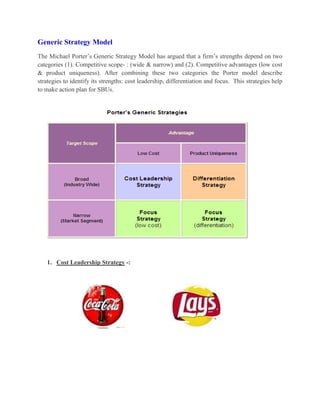
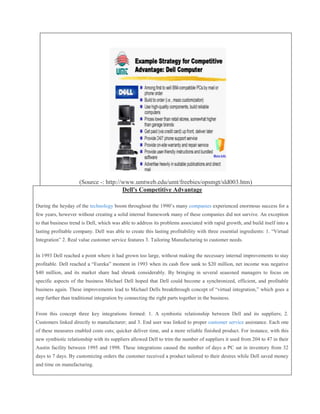
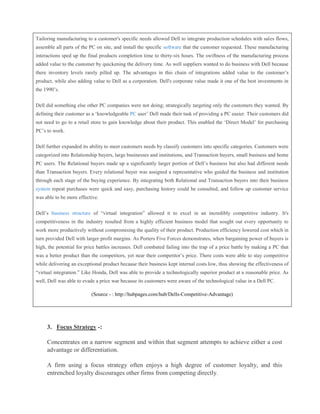
Generic Strategy Model<br />The Michael Porter’s Generic Strategy Model has argued that a firm’s strengths depend on two categories (1). Competitive scope- : (wide & narrow) and (2). Competitive advantages (low cost & product uniqueness). After combining these two categories the Porter model describe strategies to identify its strengths: cost leadership, differentiation and focus.  This strategies help to make action plan for SBUs.<br />Cost Leadership Strategy -:
Under the cost leadership strategy, the corporation produces products at large quantity for mass at a lower cost. Either firm sells its product at average price to get more profit or at below average price (at minimum profit margin) to gain market share.
Even without price war, as the industry is mature and price decline, a firm can produce product more economically for being more profitable at longer period of time (economy of scale). It is usually targeted broad market.
Firms that succeed in cost leadership often have the following internal strengths:
Access to the capital required making a significant investment in production assets; this investment represents a barrier to entry that many firms may not overcome.

Poter's generic strategy model

  • 1.
    Generic Strategy Model<br/>The Michael Porter’s Generic Strategy Model has argued that a firm’s strengths depend on two categories (1). Competitive scope- : (wide & narrow) and (2). Competitive advantages (low cost & product uniqueness). After combining these two categories the Porter model describe strategies to identify its strengths: cost leadership, differentiation and focus. This strategies help to make action plan for SBUs.<br />Cost Leadership Strategy -:
  • 2.
  • 3.
    Under the costleadership strategy, the corporation produces products at large quantity for mass at a lower cost. Either firm sells its product at average price to get more profit or at below average price (at minimum profit margin) to gain market share.
  • 4.
    Even without pricewar, as the industry is mature and price decline, a firm can produce product more economically for being more profitable at longer period of time (economy of scale). It is usually targeted broad market.
  • 5.
    Firms that succeedin cost leadership often have the following internal strengths:
  • 6.
    Access to thecapital required making a significant investment in production assets; this investment represents a barrier to entry that many firms may not overcome.