Presented to: Sir Asad Aziz
Presented by:19011504-023
19011504-042
19011504-049
19011504-052
19011504-057
19011504-061
Course: Fundamentals of Geography GEO-103
Semester: (B.S)2nd
Department: Islamic studies
WHAT IS GEOGRAPHY?
The study of the physical features of the
earth and its atmosphere, and of human
activity as it affects and is affected by
these, including the distribution of
populations and resources and political
and economic activities.
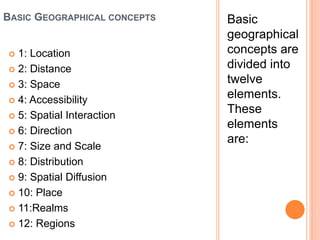
BASIC GEOGRAPHICAL CONCEPTS Basic
geographical
concepts are
divided into
twelve
elements.
These
elements
are:
 1: Location
 2: Distance
 3: Space
 4: Accessibility
 5: Spatial Interaction
 6: Direction
 7: Size and Scale
 8: Distribution
 9: Spatial Diffusion
 10: Place
 11:Realms
 12: Regions
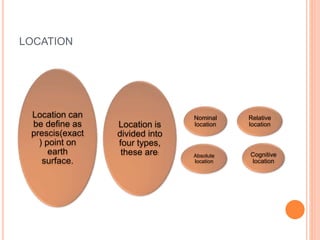
LOCATION
Location can
be define as
prescis(exact
) point on
earth
surface.
Location is
divided into
four types,
these are:
Nominal
location
Relative
location
Absolute
location
Cognitive
location
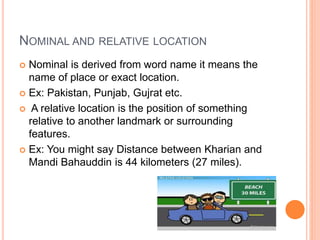
NOMINAL AND RELATIVE LOCATION
 Nominal is derived from word name it means the
name of place or exact location.
 Ex: Pakistan, Punjab, Gujrat etc.
 A relative location is the position of something
relative to another landmark or surrounding
features.
 Ex: You might say Distance between Kharian and
Mandi Bahauddin is 44 kilometers (27 miles).
ABSOLUTE AND LOCATION
 Absolute describes the position of a feature or
event in space, using some form of geographic
coordinates.
 Ex: Absolute location of Pakistan:
 30.3753° N, 69.3451° E
 Absolute location of Dinga city.
 32.6386° N, 73.7184° E
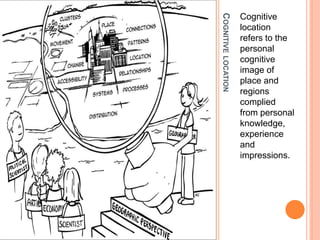
COGNITIVELOCATION
Cognitive
location
refers to the
personal
cognitive
image of
place and
regions
complied
from personal
knowledge,
experience
and
impressions.
DISTANCE
Distance
refers to the
degree or
amount of
separation
between
locations
and can be
measured in
relative or
absolute
terms.
Absolute
Distance:
Absolute
Distance.
The
distance
that can be
measured
with a
standard
unit of
length such
as a mile or
kilometer.
Relative
Distance:
Relative
distance is
a measure
of the
social,
cultural and
economic
relatedness
or
connectivity
between
two places.
SPACE
The concept of “space” is one of the most
fundamental of geographical concepts.
There is no work in geography that does
not certain it. Space is container of our
activities and or extent of area usually
express in term of earth surface.
ACCESSIBILITY
 Accessibility is defined as the ability to reach a
place with respect to another place. In this context,
accessibility refers to the ease of reaching
destinations.
 Accessibility in regards to geography is an
important element in mobility for people, freight, or
information. Mobility is determined by people and
affects infrastructure, transport policies, and
regional development. Transportation systems that
offer better opportunities of accessibility are
considered well-developed and efficient and have a
cause and effect relationship to various social and
economic options.
SPATIAL INTERACTION
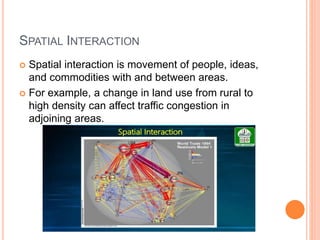
 Spatial interaction is movement of people, ideas,
and commodities with and between areas.
 For example, a change in land use from rural to
high density can affect traffic congestion in
adjoining areas.
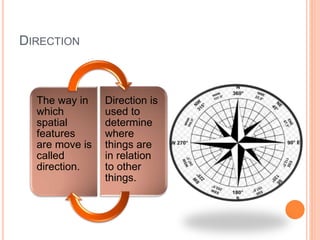
DIRECTION
The way in
which
spatial
features
are move is
called
direction.
Direction is
used to
determine
where
things are
in relation
to other
things.
TYPES OF DIRECTIONS
The four cardinal
directions: north,
south, east, and
west.
The four
diagonal
directions:
northwest,
northeast,
southwest, and
southeast.
The two vertical
directions: up
and down.
The two relative
directions: in
and out.
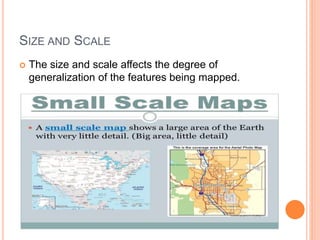
SIZE AND SCALE
 The size and scale affects the degree of
generalization of the features being mapped.
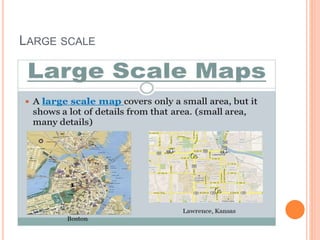
LARGE SCALE
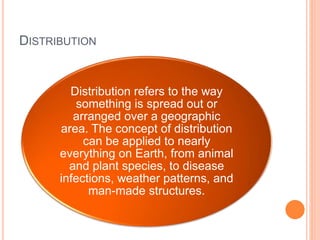
DISTRIBUTION
Distribution refers to the way
something is spread out or
arranged over a geographic
area. The concept of distribution
can be applied to nearly
everything on Earth, from animal
and plant species, to disease
infections, weather patterns, and
man-made structures.
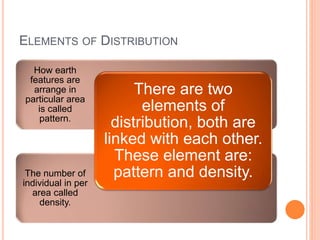
ELEMENTS OF DISTRIBUTION
The number of
individual in per
area called
density.
How earth
features are
arrange in
particular area
is called
pattern.
There are two
elements of
distribution, both are
linked with each other.
These element are:
pattern and density.
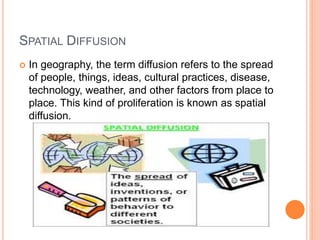
SPATIAL DIFFUSION
 In geography, the term diffusion refers to the spread
of people, things, ideas, cultural practices, disease,
technology, weather, and other factors from place to
place. This kind of proliferation is known as spatial
diffusion.
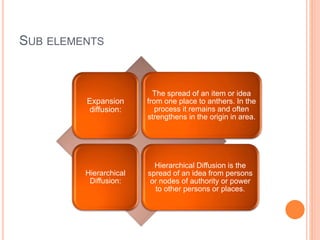
SUB ELEMENTS
Expansion
diffusion:
The spread of an item or idea
from one place to anthers. In the
process it remains and often
strengthens in the origin in area.
Hierarchical
Diffusion:
Hierarchical Diffusion is the
spread of an idea from persons
or nodes of authority or power
to other persons or places.
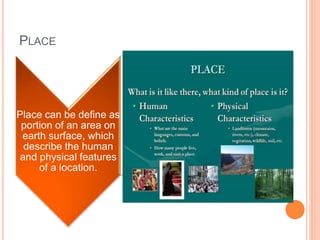
PLACE
Place can be define as
portion of an area on
earth surface, which
describe the human
and physical features
of a location.
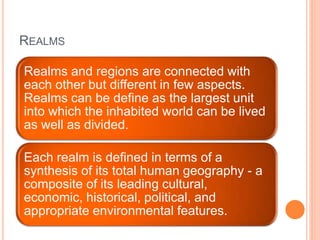
REALMS
Realms and regions are connected with
each other but different in few aspects.
Realms can be define as the largest unit
into which the inhabited world can be lived
as well as divided.
Each realm is defined in terms of a
synthesis of its total human geography - a
composite of its leading cultural,
economic, historical, political, and
appropriate environmental features.
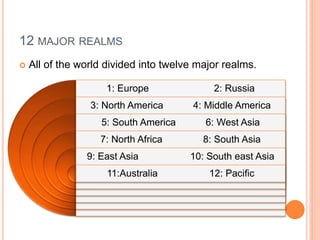
12 MAJOR REALMS
 All of the world divided into twelve major realms.
1: Europe 2: Russia
3: North America 4: Middle America
5: South America 6: West Asia
7: North Africa 8: South Asia
9: East Asia 10: South east Asia
11:Australia 12: Pacific
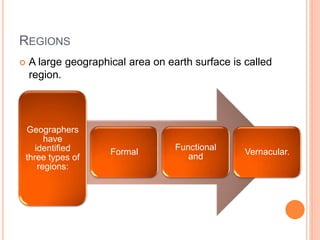
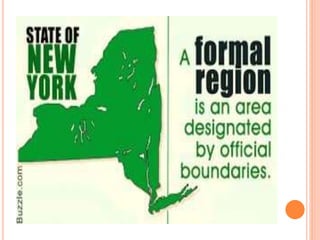
REGIONS
 A large geographical area on earth surface is called
region.
Geographers
have
identified
three types of
regions:
Formal
Functional
and
Vernacular.
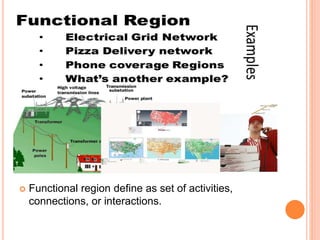
 Functional region define as set of activities,
connections, or interactions.
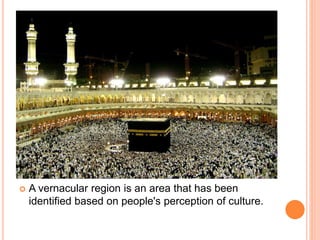
 A vernacular region is an area that has been
identified based on people's perception of culture.

Basic concept of geography

  • 2.
    Presented to: SirAsad Aziz Presented by:19011504-023 19011504-042 19011504-049 19011504-052 19011504-057 19011504-061 Course: Fundamentals of Geography GEO-103 Semester: (B.S)2nd Department: Islamic studies
  • 4.
    WHAT IS GEOGRAPHY? Thestudy of the physical features of the earth and its atmosphere, and of human activity as it affects and is affected by these, including the distribution of populations and resources and political and economic activities.
  • 5.
    BASIC GEOGRAPHICAL CONCEPTSBasic geographical concepts are divided into twelve elements. These elements are:  1: Location  2: Distance  3: Space  4: Accessibility  5: Spatial Interaction  6: Direction  7: Size and Scale  8: Distribution  9: Spatial Diffusion  10: Place  11:Realms  12: Regions
  • 6.
    LOCATION Location can be defineas prescis(exact ) point on earth surface. Location is divided into four types, these are: Nominal location Relative location Absolute location Cognitive location
  • 7.
    NOMINAL AND RELATIVELOCATION  Nominal is derived from word name it means the name of place or exact location.  Ex: Pakistan, Punjab, Gujrat etc.  A relative location is the position of something relative to another landmark or surrounding features.  Ex: You might say Distance between Kharian and Mandi Bahauddin is 44 kilometers (27 miles).
  • 8.
    ABSOLUTE AND LOCATION Absolute describes the position of a feature or event in space, using some form of geographic coordinates.  Ex: Absolute location of Pakistan:  30.3753° N, 69.3451° E  Absolute location of Dinga city.  32.6386° N, 73.7184° E
  • 9.
    COGNITIVELOCATION Cognitive location refers to the personal cognitive imageof place and regions complied from personal knowledge, experience and impressions.
  • 10.
    DISTANCE Distance refers to the degreeor amount of separation between locations and can be measured in relative or absolute terms. Absolute Distance: Absolute Distance. The distance that can be measured with a standard unit of length such as a mile or kilometer. Relative Distance: Relative distance is a measure of the social, cultural and economic relatedness or connectivity between two places.
  • 11.
    SPACE The concept of“space” is one of the most fundamental of geographical concepts. There is no work in geography that does not certain it. Space is container of our activities and or extent of area usually express in term of earth surface.
  • 12.
    ACCESSIBILITY  Accessibility isdefined as the ability to reach a place with respect to another place. In this context, accessibility refers to the ease of reaching destinations.  Accessibility in regards to geography is an important element in mobility for people, freight, or information. Mobility is determined by people and affects infrastructure, transport policies, and regional development. Transportation systems that offer better opportunities of accessibility are considered well-developed and efficient and have a cause and effect relationship to various social and economic options.
  • 13.
    SPATIAL INTERACTION  Spatialinteraction is movement of people, ideas, and commodities with and between areas.  For example, a change in land use from rural to high density can affect traffic congestion in adjoining areas.
  • 14.
    DIRECTION The way in which spatial features aremove is called direction. Direction is used to determine where things are in relation to other things.
  • 15.
    TYPES OF DIRECTIONS Thefour cardinal directions: north, south, east, and west. The four diagonal directions: northwest, northeast, southwest, and southeast. The two vertical directions: up and down. The two relative directions: in and out.
  • 16.
    SIZE AND SCALE The size and scale affects the degree of generalization of the features being mapped.
  • 17.
  • 18.
    DISTRIBUTION Distribution refers tothe way something is spread out or arranged over a geographic area. The concept of distribution can be applied to nearly everything on Earth, from animal and plant species, to disease infections, weather patterns, and man-made structures.
  • 19.
    ELEMENTS OF DISTRIBUTION Thenumber of individual in per area called density. How earth features are arrange in particular area is called pattern. There are two elements of distribution, both are linked with each other. These element are: pattern and density.
  • 20.
    SPATIAL DIFFUSION  Ingeography, the term diffusion refers to the spread of people, things, ideas, cultural practices, disease, technology, weather, and other factors from place to place. This kind of proliferation is known as spatial diffusion.
  • 21.
    SUB ELEMENTS Expansion diffusion: The spreadof an item or idea from one place to anthers. In the process it remains and often strengthens in the origin in area. Hierarchical Diffusion: Hierarchical Diffusion is the spread of an idea from persons or nodes of authority or power to other persons or places.
  • 22.
    PLACE Place can bedefine as portion of an area on earth surface, which describe the human and physical features of a location.
  • 23.
    REALMS Realms and regionsare connected with each other but different in few aspects. Realms can be define as the largest unit into which the inhabited world can be lived as well as divided. Each realm is defined in terms of a synthesis of its total human geography - a composite of its leading cultural, economic, historical, political, and appropriate environmental features.
  • 24.
    12 MAJOR REALMS All of the world divided into twelve major realms. 1: Europe 2: Russia 3: North America 4: Middle America 5: South America 6: West Asia 7: North Africa 8: South Asia 9: East Asia 10: South east Asia 11:Australia 12: Pacific
  • 25.
    REGIONS  A largegeographical area on earth surface is called region. Geographers have identified three types of regions: Formal Functional and Vernacular.
  • 27.
     Functional regiondefine as set of activities, connections, or interactions.
  • 28.
     A vernacularregion is an area that has been identified based on people's perception of culture.