1
EARLY CHILDHOOD AND
CHILD DEVELOPMENT
Lesson Plan Handbook
Developed by Kristina Bodamer and Jennifer Zaur
September 2014
2
TABLE OF CONTENTS
About This Handbook 3
Lesson Plan Template 4
Goals 5
Objectives 6
Standards 7
Materials 11
Introduction 12
Lesson Development 14
Differentiation 16
Assessment 18
Closing 20
Sample Academic Lesson 21
Sample Developmental Lesson 23
Lesson Planning Resources 25
References 27
3
ABOUT THIS HANDBOOK
Purpose of the Handbook
This handbook was developed to provide Ashford University
Early Childhood Education and
Child Development students with a resource to utilize when
creating effective lesson plans.
Educators must be able to create an effective lesson plan so they
can successfully teach
children the developmental and academic skills they need to
grow, develop, and learn. As
Kostelnik, Rupiper, Soderman, & Whiren (2014) explain,
“Planning is a mental process, and a
lesson plan is the written record of that process” (p. 81).
Design of the Handbook
“A lesson plan is the instructor’s road map of what students
need to learn and how it will be
done effectively” (Milkova, 2014, para. 1). This handbook is
your “road map” to creating
effective lesson plans. Each section of the handbook will serve
as a different stop along your
journey. With each stop you make, you will gain important
information about a component
of a lesson plan: what it is, its purpose, how to effectively
develop each section of the lesson
plan, and concrete examples that model the individual sections.
By the end of your trip, you
will be able to create effective lesson plans that will allow your
students to learn the
developmental and academic skills they need to master. So,
pack your bags and come along
for a fun and informative ride.
4
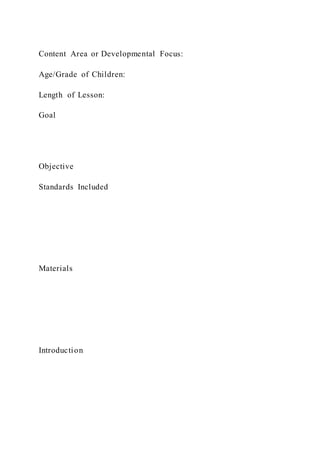
LESSON PLAN TEMPLATE
Content Area or Developmental Focus:
Age/Grade of Children:
Length of Lesson:
Goal
Objective
Standards Included
Materials
Introduction
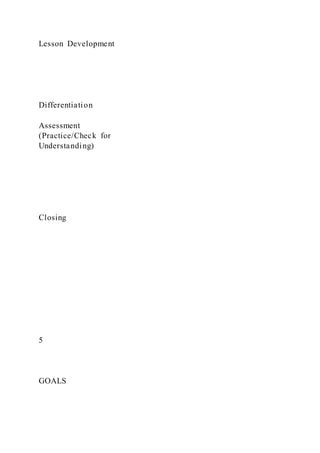
Lesson Development
Differentiation
Assessment
(Practice/Check for
Understanding)
Closing
5
GOALS
What is a lesson goal?
A lesson goal guides the direction of the lesson. “Goals come
from an outside source [such
as] a text, program goals, or state standards”(Kostelnik et al.,
2014, p. 85 ). The goal is a
broad, general statement that tells you what you want your
students to do when the lesson
is complete. Think of the goal of the lesson as a target that you
are trying to reach. The goal
of the lesson should provide the framework for you to create a
more detailed and
measurable learning objective.
Why are lesson goals important?
Lesson goals are important for several reasons. First, lesson
goals help provide structure for
planning a lesson. Lesson goals also help students know where
the lesson is going and what
they will be learning. Finally, lesson goals help you
communicate with parents about what
you are teaching.
How do you create a lesson goal?
To create a lesson goal, ask yourself “What do I want my
students to know at the end of the
lesson?” The answer to this question will become your lesson
goal. Often lesson goals will
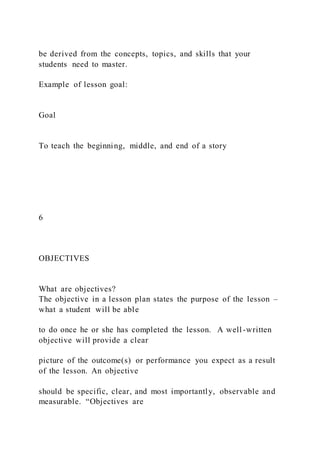
be derived from the concepts, topics, and skills that your
students need to master.
Example of lesson goal:
Goal
To teach the beginning, middle, and end of a story
6
OBJECTIVES
What are objectives?
The objective in a lesson plan states the purpose of the lesson –
what a student will be able
to do once he or she has completed the lesson. A well -written
objective will provide a clear
picture of the outcome(s) or performance you expect as a result
of the lesson. An objective
should be specific, clear, and most importantly, observable and
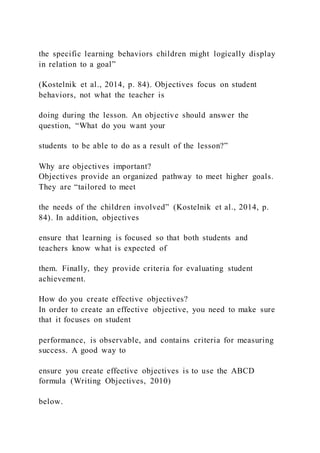
measurable. “Objectives are
the specific learning behaviors children might logically display
in relation to a goal”
(Kostelnik et al., 2014, p. 84). Objectives focus on student
behaviors, not what the teacher is
doing during the lesson. An objective should answer the
question, “What do you want your
students to be able to do as a result of the lesson?”
Why are objectives important?
Objectives provide an organized pathway to meet higher goals.
They are “tailored to meet
the needs of the children involved” (Kostelnik et al., 2014, p.
84). In addition, objectives
ensure that learning is focused so that both students and
teachers know what is expected of
them. Finally, they provide criteria for evaluating student
achievement.
How do you create effective objectives?
In order to create an effective objective, you need to make sure
that it focuses on student
performance, is observable, and contains criteria for measuring
success. A good way to
ensure you create effective objectives is to use the ABCD
formula (Writing Objectives, 2010)
below.
Effective Learning Objective = Audience + Behavior +
Conditions + Degree
Audience: Who are you writing the learning objective for?
Behavior: What should your students be able to do? Typically
you want to use a Bloom’s
verb for your behavior. You can find some examples of
Bloom’s verbs HERE.
Conditions: How will students achieve the behavior?
Degree: How well must it be done? What is considered mastery?
Example of an objective:
Objective The students will be able to recall the beginning,
middle, and end of a
story using a story map with no more than one detail in the
wrong
location.
http://agsci.psu.edu/elearning/pdf/objective-verbs.pdf
7
STANDARDS
What are standards?
Standards are clear written descriptions that explain what
teachers are supposed to teach,
both developmentally and academically, to children at each age.
Educators use these
standards as a guide when creating developmental and
educational learning objectives. The
standards define what children need to know or be able to do,
but not how teachers go
about teaching.
Why are standards important?
Standards are important because they guide what you are
supposed to teach and what your
students are supposed to learn. In other words, they help you to
get your students from
point A to point B. Standards help students to develop their
skills and increase their
knowledge. Finally, standards help to clarify the developmental
and educational goals for
parents and teachers.
What are the different types of standards?
There are many different types of standards that are used when
working with young
children. Below are some of the most common types of
standards that you will use to guide
your instruction of young children.
Developmental Milestones: Developmental milestones are a
type of standard that will
guide your instruction depending on the age of the children you
are working with. You will
use this set of standards most often when working with children
from birth to age 3, but
they can also be used to guide your instruction for children from
ages 3 to 5. To locate these
standards, view the Developmental Checklists: Birth to Five
handout.
Early Learning Guidelines: Early Learning Guidelines are
developed by each state. Typically,
early learning standards are broken down into two groups, birth
to three and three to five,
but they can also be combined. You can view the State/Territory
Early Learning Guidelines
document or the State-by-State interactive map to locate the
standards you will use.
Head Start Early Learning Framework: Sometimes different
organizations or centers will
have their own standards they utilize. Please view The Head
Start Child Development and
Early Learning Framework if you will be using these standards.
http://www.ou.edu/cwtraining/assets/pdf/handouts/2010/Develo
pmental%20Checklists%20from%20syracuse%20university.pdf
https://childcareta.acf.hhs.gov/sites/default/files/state_elgs_web
_final.pdf
http://ceelo.org/state-information/state-map/
https://eclkc.ohs.acf.hhs.gov/hslc/tta-
system/teaching/eecd/Assessment/Child%20Outcomes/HS_Revis
ed_Child_Outcomes_Framework(rev-Sept2011).pdf
https://eclkc.ohs.acf.hhs.gov/hslc/tta-
system/teaching/eecd/Assessment/Child%20Outcomes/HS_Revis
ed_Child_Outcomes_Framework(rev-Sept2011).pdf
8
K-3 Standards: Each state is responsible for developing their
own set of academic learning
standards. Many states have adopted the Common Core
Standards as their academic
standards, but not all states utilize them. You will need to
locate your State's Academic
Standards to plan your lesson.
How do I identify the standard to include in my lesson plan?
The standard you include must directly relate to your lesson
objective. Therefore, you need
to find a standard that aligns with your objective. For example,
if your objective is “The
students will be able to recall the beginning, middle, and end of
a story using a story map
with no more than one detail in the wrong location,” you will
want to locate a standard that
focuses on the beginning, middle, and end of a story.
How do I write the standard in my lesson plan?
To identify the standard that you are using, you will need to
write a standard statement.
Generally, each type of standard shared above will have a
standard section title, domain
(which may include a standard number), and a performance
indicator that needs to be
included in order to identify the standard that you are using.
Please see the examples below
to assist you with this.
Examples of standards written in lesson plans:
Developmental Milestones:
Standards Included
Developmental Checklist- 4 to 7 Months, Visual: Grasp objects
dangling
in front of him
http://www.corestandards.org/
http://www.educationworld.com/standards/state/
9
Early Learning Guidelines:
Standards Included
Kansas Early Learning Standards-Communications and Literacy
Standards-Toddler-CL.L.t.1- With prompting and support, asks
and
answers simple questions about story content using pictures.
Head Start Early Learning Framework:
Standards Included
The Head Start Child Development and Early Learning
Framework-
Number Concepts & Quantities: Recognizes numbers and
quantities in
the everyday environment.
10
K-3 Standards:
Standards Included
Arizona’s College and Career Ready Standards-English
Language Arts-
Speaking and Listening Standards K-2- 1.SL.4- Describe
people, places,
things and events with relevant details, expressing ideas and
feelings
clearly
11
MATERIALS
What is the materials section of a lesson plan?
The materials section of a lesson plan is a place to list all of the
resources needed to
successfully teach the lesson. The materials listed should
include both the resources the
teacher needs to teach as well as the materials the students will
use throughout the lesson.
Your materials section should also identify “any concerns for
safety or adaptations for
children with special needs” (Kostelnik et al., 2014, p. 81).
Think about the materials section
as a checklist of everything you need to teach the lesson.
Why is it important to list the materials you will need?
The materials section of a lesson plan is important because it
allows you to be prepared with
everything you will need to teach a lesson. If you do not have
all of the materials, then you
will not be prepared to help your students meet the lesson
objective.
How do you create a materials list?
A good way to start creating your materials list is by writing
down the items you will need as
you develop the lesson that you will teach. Each time you
complete an additional section of
your lesson plan, read back through it and check to see if there
are any more materials that
you need to teach the lesson. If there are, add them to the
materials section of the lesson
plan. Some guiding questions you can use as you write your
materials list are noted below.
lesson?
lesson?
camera, etc.) when
teaching the lesson?
Example of a materials list:
Materials
Beginning, Middle, and End Story Map (copy for each child)
Lon Po Po by Ed Young
Chart Paper with the Story Map drawn on it
12
INTRODUCTION
What is the introduction?
The introduction, or anticipatory set, focuses students' attention
on the lesson and why you
are doing the lesson. The introduction should be directly related
to the lesson objective. In
the introduction, you want to build your students’ interest and
excitement about the lesson
so that they will be engaged. The introduction is also used to
activate your students’ prior
knowledge and introduce key vocabulary relating to the lesson.
Why is the introduction important?
The introduction is important because it prepares and motivates
students for learning. By
including an introduction that is connected to what will be
learned you are able to shift your
students’ attention to the learning that is about to take place. As
a result, students will be
more likely to master the learning objective for the lesson.
How do you create an effective lesson introduction?
The key to creating an effective introduction is to keep the
purpose of the introduction in
mind. Remember the purpose of the introduction is to engage
your students in the lesson,
activate prior knowledge, introduce key vocabulary, and prepare
students to master the
learning objective. Some guiding questions you can use as you
write your lesson
introduction are noted below.
interested and excited?
lesson?
the topic of my lesson?
ntroduce the learning objective to my students?
the lesson?
order to master the
learning objective for this lesson?
13
Example of an introduction:
Introduction
“Hi class! This week we are reading many different versions of
Little Red
Riding Hood from all over the world. Who can tell us about
some of the
Little Red Riding Stories we have heard this week? “Wait for
student
responses. “Today, I am going to share a new version of Little
Red
Riding Hood with you. This version is the story that they tell in
China.
Does anybody know where China is?” Wait for responses and
show
them on a map. “When we are reading the story today, I want
you to
listen for what happens at the beginning of the story, the middle
of the
story, and the end of the story.”
14
LESSON DEVELOPMENT
What is the lesson development section?
The lesson development section is the heart of the lesson plan.
Sometimes this section of
the lesson plan is referred to as the procedures. In this section
you describe, often with
step-by-step directions, what you will do to teach the main
objective of the lesson. These
steps do not list every little thing that the teacher will do, but it
should list the sequence of
the activities you will use to teach the objective of your lesson
to mastery. This section
should “incorporate strategies for teaching that are appropriate
for the age of the children,
that are flexible enough to meet individual needs, and that will
enable you to document the
learning that takes place” (Kostelnik et al., 2014, p. 81).
Why is the lesson development section important?
The lesson development section provides a structured
framework to help your students
master the learning objective. By having a clear plan in place
before starting, you will be able
to more effectively help your students master the learning
objective.
How do you create the lesson development section?
In order to create a clear lesson development section, you need
to consider all of the
necessary steps you will need to take when teaching a lesson. It
is important to think about
how you will have the students learn the information (whole
group lesson, modeling, small
group lesson, learning centers, etc.) so that you can think about
the best way to present the
information. Once you know how you want to present the
information, you will want to
write out step-by-step directions about how you will use this
method to teach your students
the lesson objective. Some guiding questions you can use as you
write your lesson
development section are noted below.
rst, second, third, fourth, etc. thing that I need
to do to teach my
students the objective of the lesson?
objective?
15
Example of lesson development:
Lesson Development
1. Read Lon Po Po to the students. As you are reading, stop at
the
beginning, middle, and end of the story and discuss what
happened
in each section.
2. Explain to the students that every story has a beginning,
middle, and
an end.
3. Show students the chart paper that has a picture of the story
map
drawn on it.
4. Start with the “Beginning” section on the Story Map. Explain
what
the beginning of a story is. Do a think-pair-share to come up
with
ideas for what happened in the beginning of the story. Record
the
students; ideas on the chart paper Story Map.
5. Next, explain what the middle of a story is. Do a think-pair-
share for
the “Middle” section on the Story Map. Record the students’
ideas
on the chart paper Story Map.
6. Explain what the end of a story is. Do a think-pair-share for
the
“End” section on the Story Map. Record the students’ ideas on
the
chart paper for the Story Map.
16
DIFFERENTIATION
What is the differentiation section?
In this section of the lesson plan, you will want to explain how
you will differentiate, or
modify, your instruction based on the needs of your students.
This does not mean creating a
second lesson plan; it refers to changing or providing
alternative options for how you will
present your lesson, the materials you will use, the way you will
arrange your classroom for
teaching the lesson, or with how you will assess student
learning. Often you will need to
differentiate your instruction for English language learners,
children with special needs, or
gifted learners. In other words, this section provides a place for
you to include how you will
meet the varying needs of the students you will be working
with.
Why is the differentiation section important?
As classrooms have become more diverse, it is more common to
have ELL students, students
with special needs, high achievers, underachievers, and average
students all in the same
class. In order to meet the needs of all of these students,
differentiation is essential.
Providing differentiation in a lesson allows each student to
experience success and
maximizes growth.
How do you create the differentiation section?
In order to determine how you may need to differentiate your
lesson, you will need to
consider all of the types of learners that you will be working
with. You will want to think
about if there any specific needs that you will have to address
or an individual child who
may need more support or to challenge their learning. Once you
have identified these
potential areas of need, you will want to determine how you can
differentiate your
instruction to meet these needs. Some guiding questions you can
use as you write the
differentiation section of your lesson plan are noted below.
enrichment) in order to
ensure all students will be successful?
environment in order to ensure
all can master the learning objective?
master the learning
objective?
17
delivery of instruction
or teaching style?
ort in order to master the
learning objective?
the student or small
group of peers?
Example of differentiation:
Differentiation ELL Learners: Along with writing the students’
responses on the story
map, I will draw a picture
Gifted Leaners: During guided practice, I will have the students
draw a
picture of the beginning, middle, and end of the story and write
what
happened underneath their picture
Remediation: I will have students who typically struggle sit in
the front
of the group and choose an example off of the chart to fill in on
their
story map
18
ASSESSMENT
(Practice/Check for Understanding)
What is the assessment section?
In the assessment section of the lesson plan, you are providing
your students with an
opportunity to apply what they have learned while you, the
teacher, assess their learning in
a formal or informal way. In other words, you are allowing an
opportunity for your students
to practice the skill or concept that you just taught in the lesson
development section. This
practice can be done through either guided or independent
practice. Guided practice allows
students to show their understanding of the material that you
just presented while working
with the teacher. Independent practice, on the other hand, is
done without the teacher. You
will assess by checking for understanding through observing the
students performing the
skill, asking questions, or collecting work samples.
Why is the assessment section important?
The purpose of assessment is to inform your instruction.
According to Kostelnik et al. (2014),
lesson plans “should have provisions to assess child learning
and a plan for recording
progress towards goals” (p. 81). They “should also include
provisions to assess the
effectiveness of the plan as a whole and to identify areas where
improvements could be
made” (p. 81). By including a section in your lesson plan that
allows your students to
demonstrate their understanding of the content or skill you have
taught, you will be able
assess their learning and make informed decisions about the
next steps you need to take.
When we take the time to assess, we are more likely to notice
the need for remediation or
enrichment early on and can better plan subsequent lessons or
activities.
How do you create an assessment section?
In order to effectively assess student learning, you must start by
thinking about how you
want your students to practice the skill or concept that you have
just taught. A good way to
do this is to list the different ways in which your students can
practice the skill or concept
you have taught. Next, for each way to practice, list a way you
could check for
understanding while they are completing the practice
opportunity. Then, choose one of the
methods of practice and checking for understanding to use
together in order to ensure that
you are able to assess student learning of the lesson objective.
Some guiding questions you
can use as you write your practice and check for understanding
section are noted below.
19
understand the concept or
skill? (practice)
ther they
have mastered the
learning objective? (practice)
understanding? (check for
understanding)
provide me with the
information I need in order to check for mastering of the
learning objective? (check
for understanding)
Example of a practice/check for understanding:
Assessment
(Practice/Check for
Understanding)
1. Explain to the students that they are going to have the chance
to
complete a Story Map to show that they understand what
happened
in the beginning, middle, and end of Lon Po Po.
2. Pass out a copy of the Story Map to each child.
3. Tell your students that in the beginning box, they need to
draw a
picture of what happened in the beginning of Lon Po Po, in the
middle box they need to draw a picture of what happened in the
middle, and in the end box, they need to draw a picture of what
happened at the end. (practice)
4. While students are working, walk around and record on a
clipboard
which students were able to successfully complete their story
map
and which students did not. As needed, provide support students
who are struggling to complete their story map. (check for
understanding)
20
CLOSING
What is the lesson closing?
The closing of a lesson wraps up the lesson that you have just
taught. In the lesson closing
you want to come back to the lesson objective and to reinforce
the most important
concepts from the lesson. Typically, the lesson closing
summarizes the learning that took
place. The closure of a lesson should be meaningful by
reviewing the key points of a lesson
and allowing students the chance to show what they know.
Why is the closing important?
The closing of a lesson brings together all of the learning that
has taken place. The closing
helps the students to reflect on what they learned and to make
sure they understand the
key ideas they should have taken away from the lesson. Finally,
the closing ensures the
effectiveness of the learning that took place during the lesson.
How do you create an effective closing?
An effective closing should only take between five and ten
minutes. To create an effective
closing you want to emphasize the objective of the lesson and
its importance, as well as
assess student mastery of the lesson objective. Some guiding
questions you can use as you
write your lesson closing are noted below.
orce the lesson objective?
objective?
Example of a closing:
Closing
Bring the students together as a whole group. Students share
their
story maps to show the beginning, middle, and end of the story.
Ask the
students who can tell you the three parts of a story. Summarize
what
the students share and make sure to restate what the beginning,
middle, and end of a story are.
21
SAMPLE ACADEMIC LESSON PLAN
Content Area or Developmental Focus: Beginning, Middle and
End of a story
Age/Grade of Children: 2
nd
grade
Length of Lesson: 30 minutes
Goal To teach the beginning, middle, and end of a story
Objective The students will be able to recall the beginning,
middle, and end of
a story using a story map with no more than one detail in the
wrong
location.
Standards Included
Arizona’s College and Career Ready Standards-English
Language
Arts- Literature K-2- 1.SL.4- Retell stories, including key
details, and
demonstrate understanding of their central message or lesson.
Materials
Beginning, Middle, and End Story Map (copy for each child)
Lon Po Po by Ed Young
Chart Paper with the Story Map drawn on it
Markers
Introduction
“Hi class! This week we are reading many different versions of
Little
Red Riding Hood from all over the world. Who can tell us about
some of the Little Red Riding Stories we have heard this week?
“Wait for student responses. “Today, I am going to share a new
version of Little Red Riding Hood with you. This version is the
story
that they tell in China. Does anybody know where China is?”
Wait
for responses and show them on a map. “When we are reading
the
story today, I want you to listen for what happens at the
beginning
of the story, the middle of the story, and the end of the story.”
Lesson Development
1. Read Lon Po Po to the students. As you are reading, stop at
the
beginning, middle, and end of the story and discuss what
happened
in each section.
2. Explain to the students that every story has a beginning,
middle, and
an end.
3. Show students the chart paper that has a picture of the story
map
drawn on it.
4. Start with the “Beginning” section on the Story Map. Explain
what
the beginning of a story is. Do a think-pair-share to come up
with
ideas for what happened in the beginning of the story. Record
the …

1 EARLY C

  • 1.
    1 EARLY CHILDHOOD AND CHILDDEVELOPMENT Lesson Plan Handbook
  • 2.
    Developed by KristinaBodamer and Jennifer Zaur September 2014 2 TABLE OF CONTENTS About This Handbook 3 Lesson Plan Template 4 Goals 5 Objectives 6 Standards 7 Materials 11 Introduction 12 Lesson Development 14 Differentiation 16 Assessment 18 Closing 20 Sample Academic Lesson 21
  • 3.
    Sample Developmental Lesson23 Lesson Planning Resources 25 References 27 3 ABOUT THIS HANDBOOK Purpose of the Handbook This handbook was developed to provide Ashford University Early Childhood Education and Child Development students with a resource to utilize when creating effective lesson plans. Educators must be able to create an effective lesson plan so they can successfully teach children the developmental and academic skills they need to grow, develop, and learn. As Kostelnik, Rupiper, Soderman, & Whiren (2014) explain, “Planning is a mental process, and a lesson plan is the written record of that process” (p. 81). Design of the Handbook
  • 4.
    “A lesson planis the instructor’s road map of what students need to learn and how it will be done effectively” (Milkova, 2014, para. 1). This handbook is your “road map” to creating effective lesson plans. Each section of the handbook will serve as a different stop along your journey. With each stop you make, you will gain important information about a component of a lesson plan: what it is, its purpose, how to effectively develop each section of the lesson plan, and concrete examples that model the individual sections. By the end of your trip, you will be able to create effective lesson plans that will allow your students to learn the developmental and academic skills they need to master. So, pack your bags and come along for a fun and informative ride. 4 LESSON PLAN TEMPLATE
  • 5.
    Content Area orDevelopmental Focus: Age/Grade of Children: Length of Lesson: Goal Objective Standards Included Materials Introduction
  • 6.
  • 7.
    What is alesson goal? A lesson goal guides the direction of the lesson. “Goals come from an outside source [such as] a text, program goals, or state standards”(Kostelnik et al., 2014, p. 85 ). The goal is a broad, general statement that tells you what you want your students to do when the lesson is complete. Think of the goal of the lesson as a target that you are trying to reach. The goal of the lesson should provide the framework for you to create a more detailed and measurable learning objective. Why are lesson goals important? Lesson goals are important for several reasons. First, lesson goals help provide structure for planning a lesson. Lesson goals also help students know where the lesson is going and what they will be learning. Finally, lesson goals help you communicate with parents about what you are teaching. How do you create a lesson goal? To create a lesson goal, ask yourself “What do I want my students to know at the end of the lesson?” The answer to this question will become your lesson goal. Often lesson goals will
  • 8.
    be derived fromthe concepts, topics, and skills that your students need to master. Example of lesson goal: Goal To teach the beginning, middle, and end of a story 6 OBJECTIVES What are objectives? The objective in a lesson plan states the purpose of the lesson – what a student will be able to do once he or she has completed the lesson. A well -written objective will provide a clear picture of the outcome(s) or performance you expect as a result of the lesson. An objective should be specific, clear, and most importantly, observable and measurable. “Objectives are
  • 9.
    the specific learningbehaviors children might logically display in relation to a goal” (Kostelnik et al., 2014, p. 84). Objectives focus on student behaviors, not what the teacher is doing during the lesson. An objective should answer the question, “What do you want your students to be able to do as a result of the lesson?” Why are objectives important? Objectives provide an organized pathway to meet higher goals. They are “tailored to meet the needs of the children involved” (Kostelnik et al., 2014, p. 84). In addition, objectives ensure that learning is focused so that both students and teachers know what is expected of them. Finally, they provide criteria for evaluating student achievement. How do you create effective objectives? In order to create an effective objective, you need to make sure that it focuses on student performance, is observable, and contains criteria for measuring success. A good way to ensure you create effective objectives is to use the ABCD formula (Writing Objectives, 2010) below.
  • 10.
    Effective Learning Objective= Audience + Behavior + Conditions + Degree Audience: Who are you writing the learning objective for? Behavior: What should your students be able to do? Typically you want to use a Bloom’s verb for your behavior. You can find some examples of Bloom’s verbs HERE. Conditions: How will students achieve the behavior? Degree: How well must it be done? What is considered mastery? Example of an objective: Objective The students will be able to recall the beginning, middle, and end of a story using a story map with no more than one detail in the wrong location. http://agsci.psu.edu/elearning/pdf/objective-verbs.pdf 7 STANDARDS What are standards? Standards are clear written descriptions that explain what teachers are supposed to teach,
  • 11.
    both developmentally andacademically, to children at each age. Educators use these standards as a guide when creating developmental and educational learning objectives. The standards define what children need to know or be able to do, but not how teachers go about teaching. Why are standards important? Standards are important because they guide what you are supposed to teach and what your students are supposed to learn. In other words, they help you to get your students from point A to point B. Standards help students to develop their skills and increase their knowledge. Finally, standards help to clarify the developmental and educational goals for parents and teachers. What are the different types of standards? There are many different types of standards that are used when working with young children. Below are some of the most common types of standards that you will use to guide your instruction of young children.
  • 12.
    Developmental Milestones: Developmentalmilestones are a type of standard that will guide your instruction depending on the age of the children you are working with. You will use this set of standards most often when working with children from birth to age 3, but they can also be used to guide your instruction for children from ages 3 to 5. To locate these standards, view the Developmental Checklists: Birth to Five handout. Early Learning Guidelines: Early Learning Guidelines are developed by each state. Typically, early learning standards are broken down into two groups, birth to three and three to five, but they can also be combined. You can view the State/Territory Early Learning Guidelines document or the State-by-State interactive map to locate the standards you will use. Head Start Early Learning Framework: Sometimes different organizations or centers will have their own standards they utilize. Please view The Head Start Child Development and Early Learning Framework if you will be using these standards. http://www.ou.edu/cwtraining/assets/pdf/handouts/2010/Develo
  • 13.
    pmental%20Checklists%20from%20syracuse%20university.pdf https://childcareta.acf.hhs.gov/sites/default/files/state_elgs_web _final.pdf http://ceelo.org/state-information/state-map/ https://eclkc.ohs.acf.hhs.gov/hslc/tta- system/teaching/eecd/Assessment/Child%20Outcomes/HS_Revis ed_Child_Outcomes_Framework(rev-Sept2011).pdf https://eclkc.ohs.acf.hhs.gov/hslc/tta- system/teaching/eecd/Assessment/Child%20Outcomes/HS_Revis ed_Child_Outcomes_Framework(rev-Sept2011).pdf 8 K-3 Standards: Eachstate is responsible for developing their own set of academic learning standards. Many states have adopted the Common Core Standards as their academic standards, but not all states utilize them. You will need to locate your State's Academic Standards to plan your lesson. How do I identify the standard to include in my lesson plan? The standard you include must directly relate to your lesson objective. Therefore, you need to find a standard that aligns with your objective. For example, if your objective is “The students will be able to recall the beginning, middle, and end of
  • 14.
    a story usinga story map with no more than one detail in the wrong location,” you will want to locate a standard that focuses on the beginning, middle, and end of a story. How do I write the standard in my lesson plan? To identify the standard that you are using, you will need to write a standard statement. Generally, each type of standard shared above will have a standard section title, domain (which may include a standard number), and a performance indicator that needs to be included in order to identify the standard that you are using. Please see the examples below to assist you with this. Examples of standards written in lesson plans: Developmental Milestones: Standards Included
  • 15.
    Developmental Checklist- 4to 7 Months, Visual: Grasp objects dangling in front of him http://www.corestandards.org/ http://www.educationworld.com/standards/state/ http://www.educationworld.com/standards/state/ 9 Early Learning Guidelines: Standards Included Kansas Early Learning Standards-Communications and Literacy Standards-Toddler-CL.L.t.1- With prompting and support, asks and answers simple questions about story content using pictures.
  • 16.
    Head Start EarlyLearning Framework: Standards Included The Head Start Child Development and Early Learning Framework- Number Concepts & Quantities: Recognizes numbers and quantities in the everyday environment. 10 K-3 Standards:
  • 17.
    Standards Included Arizona’s Collegeand Career Ready Standards-English Language Arts- Speaking and Listening Standards K-2- 1.SL.4- Describe people, places, things and events with relevant details, expressing ideas and feelings clearly 11 MATERIALS What is the materials section of a lesson plan? The materials section of a lesson plan is a place to list all of the resources needed to successfully teach the lesson. The materials listed should include both the resources the teacher needs to teach as well as the materials the students will use throughout the lesson. Your materials section should also identify “any concerns for safety or adaptations for
  • 18.
    children with specialneeds” (Kostelnik et al., 2014, p. 81). Think about the materials section as a checklist of everything you need to teach the lesson. Why is it important to list the materials you will need? The materials section of a lesson plan is important because it allows you to be prepared with everything you will need to teach a lesson. If you do not have all of the materials, then you will not be prepared to help your students meet the lesson objective. How do you create a materials list? A good way to start creating your materials list is by writing down the items you will need as you develop the lesson that you will teach. Each time you complete an additional section of your lesson plan, read back through it and check to see if there are any more materials that you need to teach the lesson. If there are, add them to the materials section of the lesson plan. Some guiding questions you can use as you write your materials list are noted below. lesson?
  • 19.
    lesson? camera, etc.) when teachingthe lesson? Example of a materials list: Materials Beginning, Middle, and End Story Map (copy for each child) Lon Po Po by Ed Young Chart Paper with the Story Map drawn on it 12 INTRODUCTION What is the introduction? The introduction, or anticipatory set, focuses students' attention on the lesson and why you are doing the lesson. The introduction should be directly related to the lesson objective. In
  • 20.
    the introduction, youwant to build your students’ interest and excitement about the lesson so that they will be engaged. The introduction is also used to activate your students’ prior knowledge and introduce key vocabulary relating to the lesson. Why is the introduction important? The introduction is important because it prepares and motivates students for learning. By including an introduction that is connected to what will be learned you are able to shift your students’ attention to the learning that is about to take place. As a result, students will be more likely to master the learning objective for the lesson. How do you create an effective lesson introduction? The key to creating an effective introduction is to keep the purpose of the introduction in mind. Remember the purpose of the introduction is to engage your students in the lesson, activate prior knowledge, introduce key vocabulary, and prepare students to master the learning objective. Some guiding questions you can use as you write your lesson introduction are noted below.
  • 21.
    interested and excited? lesson? thetopic of my lesson? ntroduce the learning objective to my students? the lesson? order to master the learning objective for this lesson? 13 Example of an introduction: Introduction “Hi class! This week we are reading many different versions of Little Red
  • 22.
    Riding Hood fromall over the world. Who can tell us about some of the Little Red Riding Stories we have heard this week? “Wait for student responses. “Today, I am going to share a new version of Little Red Riding Hood with you. This version is the story that they tell in China. Does anybody know where China is?” Wait for responses and show them on a map. “When we are reading the story today, I want you to listen for what happens at the beginning of the story, the middle of the story, and the end of the story.” 14 LESSON DEVELOPMENT
  • 23.
    What is thelesson development section? The lesson development section is the heart of the lesson plan. Sometimes this section of the lesson plan is referred to as the procedures. In this section you describe, often with step-by-step directions, what you will do to teach the main objective of the lesson. These steps do not list every little thing that the teacher will do, but it should list the sequence of the activities you will use to teach the objective of your lesson to mastery. This section should “incorporate strategies for teaching that are appropriate for the age of the children, that are flexible enough to meet individual needs, and that will enable you to document the learning that takes place” (Kostelnik et al., 2014, p. 81). Why is the lesson development section important? The lesson development section provides a structured framework to help your students master the learning objective. By having a clear plan in place before starting, you will be able to more effectively help your students master the learning objective. How do you create the lesson development section? In order to create a clear lesson development section, you need
  • 24.
    to consider allof the necessary steps you will need to take when teaching a lesson. It is important to think about how you will have the students learn the information (whole group lesson, modeling, small group lesson, learning centers, etc.) so that you can think about the best way to present the information. Once you know how you want to present the information, you will want to write out step-by-step directions about how you will use this method to teach your students the lesson objective. Some guiding questions you can use as you write your lesson development section are noted below. rst, second, third, fourth, etc. thing that I need to do to teach my students the objective of the lesson? objective?
  • 25.
    15 Example of lessondevelopment: Lesson Development 1. Read Lon Po Po to the students. As you are reading, stop at the beginning, middle, and end of the story and discuss what happened in each section. 2. Explain to the students that every story has a beginning, middle, and an end. 3. Show students the chart paper that has a picture of the story map drawn on it. 4. Start with the “Beginning” section on the Story Map. Explain what the beginning of a story is. Do a think-pair-share to come up with ideas for what happened in the beginning of the story. Record the students; ideas on the chart paper Story Map. 5. Next, explain what the middle of a story is. Do a think-pair- share for
  • 26.
    the “Middle” sectionon the Story Map. Record the students’ ideas on the chart paper Story Map. 6. Explain what the end of a story is. Do a think-pair-share for the “End” section on the Story Map. Record the students’ ideas on the chart paper for the Story Map. 16 DIFFERENTIATION What is the differentiation section? In this section of the lesson plan, you will want to explain how you will differentiate, or modify, your instruction based on the needs of your students.
  • 27.
    This does notmean creating a second lesson plan; it refers to changing or providing alternative options for how you will present your lesson, the materials you will use, the way you will arrange your classroom for teaching the lesson, or with how you will assess student learning. Often you will need to differentiate your instruction for English language learners, children with special needs, or gifted learners. In other words, this section provides a place for you to include how you will meet the varying needs of the students you will be working with. Why is the differentiation section important? As classrooms have become more diverse, it is more common to have ELL students, students with special needs, high achievers, underachievers, and average students all in the same class. In order to meet the needs of all of these students, differentiation is essential. Providing differentiation in a lesson allows each student to experience success and maximizes growth. How do you create the differentiation section?
  • 28.
    In order todetermine how you may need to differentiate your lesson, you will need to consider all of the types of learners that you will be working with. You will want to think about if there any specific needs that you will have to address or an individual child who may need more support or to challenge their learning. Once you have identified these potential areas of need, you will want to determine how you can differentiate your instruction to meet these needs. Some guiding questions you can use as you write the differentiation section of your lesson plan are noted below. enrichment) in order to ensure all students will be successful? environment in order to ensure all can master the learning objective? master the learning objective?
  • 29.
    17 delivery of instruction orteaching style? ort in order to master the learning objective? the student or small group of peers? Example of differentiation: Differentiation ELL Learners: Along with writing the students’ responses on the story map, I will draw a picture Gifted Leaners: During guided practice, I will have the students draw a picture of the beginning, middle, and end of the story and write what happened underneath their picture Remediation: I will have students who typically struggle sit in the front of the group and choose an example off of the chart to fill in on their story map
  • 30.
    18 ASSESSMENT (Practice/Check for Understanding) Whatis the assessment section? In the assessment section of the lesson plan, you are providing your students with an opportunity to apply what they have learned while you, the teacher, assess their learning in a formal or informal way. In other words, you are allowing an opportunity for your students to practice the skill or concept that you just taught in the lesson development section. This practice can be done through either guided or independent practice. Guided practice allows students to show their understanding of the material that you just presented while working with the teacher. Independent practice, on the other hand, is
  • 31.
    done without theteacher. You will assess by checking for understanding through observing the students performing the skill, asking questions, or collecting work samples. Why is the assessment section important? The purpose of assessment is to inform your instruction. According to Kostelnik et al. (2014), lesson plans “should have provisions to assess child learning and a plan for recording progress towards goals” (p. 81). They “should also include provisions to assess the effectiveness of the plan as a whole and to identify areas where improvements could be made” (p. 81). By including a section in your lesson plan that allows your students to demonstrate their understanding of the content or skill you have taught, you will be able assess their learning and make informed decisions about the next steps you need to take. When we take the time to assess, we are more likely to notice the need for remediation or enrichment early on and can better plan subsequent lessons or activities. How do you create an assessment section?
  • 32.
    In order toeffectively assess student learning, you must start by thinking about how you want your students to practice the skill or concept that you have just taught. A good way to do this is to list the different ways in which your students can practice the skill or concept you have taught. Next, for each way to practice, list a way you could check for understanding while they are completing the practice opportunity. Then, choose one of the methods of practice and checking for understanding to use together in order to ensure that you are able to assess student learning of the lesson objective. Some guiding questions you can use as you write your practice and check for understanding section are noted below. 19 understand the concept or skill? (practice) ther they have mastered the
  • 33.
    learning objective? (practice) understanding?(check for understanding) provide me with the information I need in order to check for mastering of the learning objective? (check for understanding) Example of a practice/check for understanding: Assessment (Practice/Check for Understanding) 1. Explain to the students that they are going to have the chance to complete a Story Map to show that they understand what happened in the beginning, middle, and end of Lon Po Po. 2. Pass out a copy of the Story Map to each child. 3. Tell your students that in the beginning box, they need to draw a
  • 34.
    picture of whathappened in the beginning of Lon Po Po, in the middle box they need to draw a picture of what happened in the middle, and in the end box, they need to draw a picture of what happened at the end. (practice) 4. While students are working, walk around and record on a clipboard which students were able to successfully complete their story map and which students did not. As needed, provide support students who are struggling to complete their story map. (check for understanding) 20 CLOSING What is the lesson closing? The closing of a lesson wraps up the lesson that you have just taught. In the lesson closing
  • 35.
    you want tocome back to the lesson objective and to reinforce the most important concepts from the lesson. Typically, the lesson closing summarizes the learning that took place. The closure of a lesson should be meaningful by reviewing the key points of a lesson and allowing students the chance to show what they know. Why is the closing important? The closing of a lesson brings together all of the learning that has taken place. The closing helps the students to reflect on what they learned and to make sure they understand the key ideas they should have taken away from the lesson. Finally, the closing ensures the effectiveness of the learning that took place during the lesson. How do you create an effective closing? An effective closing should only take between five and ten minutes. To create an effective closing you want to emphasize the objective of the lesson and its importance, as well as assess student mastery of the lesson objective. Some guiding questions you can use as you write your lesson closing are noted below.
  • 36.
    orce the lessonobjective? objective? Example of a closing: Closing Bring the students together as a whole group. Students share their story maps to show the beginning, middle, and end of the story. Ask the students who can tell you the three parts of a story. Summarize what the students share and make sure to restate what the beginning, middle, and end of a story are. 21 SAMPLE ACADEMIC LESSON PLAN
  • 37.
    Content Area orDevelopmental Focus: Beginning, Middle and End of a story Age/Grade of Children: 2 nd grade Length of Lesson: 30 minutes Goal To teach the beginning, middle, and end of a story Objective The students will be able to recall the beginning, middle, and end of a story using a story map with no more than one detail in the wrong location. Standards Included Arizona’s College and Career Ready Standards-English Language Arts- Literature K-2- 1.SL.4- Retell stories, including key details, and demonstrate understanding of their central message or lesson. Materials Beginning, Middle, and End Story Map (copy for each child) Lon Po Po by Ed Young Chart Paper with the Story Map drawn on it Markers
  • 38.
    Introduction “Hi class! Thisweek we are reading many different versions of Little Red Riding Hood from all over the world. Who can tell us about some of the Little Red Riding Stories we have heard this week? “Wait for student responses. “Today, I am going to share a new version of Little Red Riding Hood with you. This version is the story that they tell in China. Does anybody know where China is?” Wait for responses and show them on a map. “When we are reading the story today, I want you to listen for what happens at the beginning of the story, the middle of the story, and the end of the story.” Lesson Development 1. Read Lon Po Po to the students. As you are reading, stop at the beginning, middle, and end of the story and discuss what happened in each section. 2. Explain to the students that every story has a beginning, middle, and an end.
  • 39.
    3. Show studentsthe chart paper that has a picture of the story map drawn on it. 4. Start with the “Beginning” section on the Story Map. Explain what the beginning of a story is. Do a think-pair-share to come up with ideas for what happened in the beginning of the story. Record the …