CALLA
Cognitive Academic Language Learning
Approach
To learn, we have to become
aware.
Cognitive methods share many of the same
characteristics as the communicative methods,
but they take instruction a step further to
include components that stem from recent
research on second language acquisition and
cognitive development. p.315
In language learning classrooms, students must
develop the metacognitive skills needed for selecting
and using effectively the strategies that will best
support them in meeting their learning needs and
accomplishing specific language learning tasks. p.318
Click on the link, or copy and paste it into your web browser
https://www.facebook.com/voalearningenglish/videos/interview-with-dr-anna-uhl-
chamot/1017979528237655/
Watch a short interview with Dr. Chamot, one of the founders of CALLA.
She discusses how she developed CALLA.
I apologize for the video being hosted on Facebook. Voice of America took it off of
their YouTube channel. However you should be able to watch it without an account.
5 phases of CALLA
1. Preparation
2. Presentation
3. Practice
4. Evaluation
5. Expansion
Preparation phase
- Content objectives
- Language Objectives
- Learning Strategy Objectives (cognitive, metacognitive,
social/affective)
“...it is important that the language of the objectives reflects the
higher-order thinking that is a targeted outcome of the lesson.”
p.324
“...bilingual students who understand that
reading in all languages is a similar process and
that the strategies they use to negotiate
meaning in one language can be applied to
negotiating meaning in the second language
tend to be more successful language learners.”
p.319
“Finding authentic texts and academic
content that is already familiar to the
learner, while explicitly teaching cross-
linguistics strategies, sets the stage for
the acceleration of English language
development.” p.319
Presentation
- Use of Guarded vocabulary (uncomplicated language)
- Use of visual or hands-on materials
- Throughout - demonstrates how new information related to
and builds on students’ prior knowledge and experiences.
- Discusses how, why, and when to use the skills and apply the
strategies.
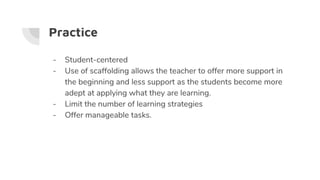
Practice
- Student-centered
- Use of scaffolding allows the teacher to offer more support in
the beginning and less support as the students become more
adept at applying what they are learning.
- Limit the number of learning strategies
- Offer manageable tasks.
“A CALLA teacher will use this time to work with
collaborative groups to provide additional modeling when
necessary, use questioning to guide students into deeper
understandings, and clarify misunderstandings. Teachers
can use this time to tailor small-group instruction to the
individual needs of the students.” p.334
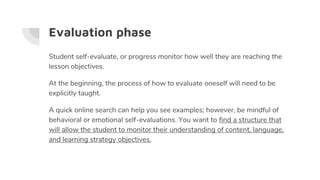
Evaluation phase
Student self-evaluate, or progress monitor how well they are reaching the
lesson objectives.
At the beginning, the process of how to evaluate oneself will need to be
explicitly taught.
A quick online search can help you see examples; however, be mindful of
behavioral or emotional self-evaluations. You want to find a structure that
will allow the student to monitor their understanding of content, language,
and learning strategy objectives.
“If students are to understand themselves as learners and
take responsibility for their own learning, then they must
learn to examine the quality of their own work and
determine whether they are achieving lesson objectives.
This process of self-assessment is critical to becoming a
lifelong, self-directed learner.” p. 336
p.347 - 351, tips for practice
p. 350, example of student
learning log

Calla

  • 1.
  • 2.
    To learn, wehave to become aware.
  • 3.
    Cognitive methods sharemany of the same characteristics as the communicative methods, but they take instruction a step further to include components that stem from recent research on second language acquisition and cognitive development. p.315
  • 4.
    In language learningclassrooms, students must develop the metacognitive skills needed for selecting and using effectively the strategies that will best support them in meeting their learning needs and accomplishing specific language learning tasks. p.318
  • 5.
    Click on thelink, or copy and paste it into your web browser https://www.facebook.com/voalearningenglish/videos/interview-with-dr-anna-uhl- chamot/1017979528237655/ Watch a short interview with Dr. Chamot, one of the founders of CALLA. She discusses how she developed CALLA. I apologize for the video being hosted on Facebook. Voice of America took it off of their YouTube channel. However you should be able to watch it without an account.
  • 6.
    5 phases ofCALLA 1. Preparation 2. Presentation 3. Practice 4. Evaluation 5. Expansion
  • 7.
    Preparation phase - Contentobjectives - Language Objectives - Learning Strategy Objectives (cognitive, metacognitive, social/affective) “...it is important that the language of the objectives reflects the higher-order thinking that is a targeted outcome of the lesson.” p.324
  • 8.
    “...bilingual students whounderstand that reading in all languages is a similar process and that the strategies they use to negotiate meaning in one language can be applied to negotiating meaning in the second language tend to be more successful language learners.” p.319
  • 9.
    “Finding authentic textsand academic content that is already familiar to the learner, while explicitly teaching cross- linguistics strategies, sets the stage for the acceleration of English language development.” p.319
  • 10.
    Presentation - Use ofGuarded vocabulary (uncomplicated language) - Use of visual or hands-on materials - Throughout - demonstrates how new information related to and builds on students’ prior knowledge and experiences. - Discusses how, why, and when to use the skills and apply the strategies.
  • 11.
    Practice - Student-centered - Useof scaffolding allows the teacher to offer more support in the beginning and less support as the students become more adept at applying what they are learning. - Limit the number of learning strategies - Offer manageable tasks.
  • 12.
    “A CALLA teacherwill use this time to work with collaborative groups to provide additional modeling when necessary, use questioning to guide students into deeper understandings, and clarify misunderstandings. Teachers can use this time to tailor small-group instruction to the individual needs of the students.” p.334
  • 13.
    Evaluation phase Student self-evaluate,or progress monitor how well they are reaching the lesson objectives. At the beginning, the process of how to evaluate oneself will need to be explicitly taught. A quick online search can help you see examples; however, be mindful of behavioral or emotional self-evaluations. You want to find a structure that will allow the student to monitor their understanding of content, language, and learning strategy objectives.
  • 14.
    “If students areto understand themselves as learners and take responsibility for their own learning, then they must learn to examine the quality of their own work and determine whether they are achieving lesson objectives. This process of self-assessment is critical to becoming a lifelong, self-directed learner.” p. 336
  • 15.
    p.347 - 351,tips for practice p. 350, example of student learning log