Developing a Common
Language about Curriculum
Academy 2012
Agenda
   Developing a Common Language about
    Curriculum
   Activity: Working with Curriculum
    Standards
   Reading: A Guaranteed and Viable
    Curriculum
   Activity: Using Curriculum to Guide
    Instruction
   Reflection
   Tools for Facilitating Discussions
                                          2
Activity
    With your table groups, discuss the
     following question:


          WHAT IS CURRICULUM?


                                           3
Differences Between
Curriculum and Instruction
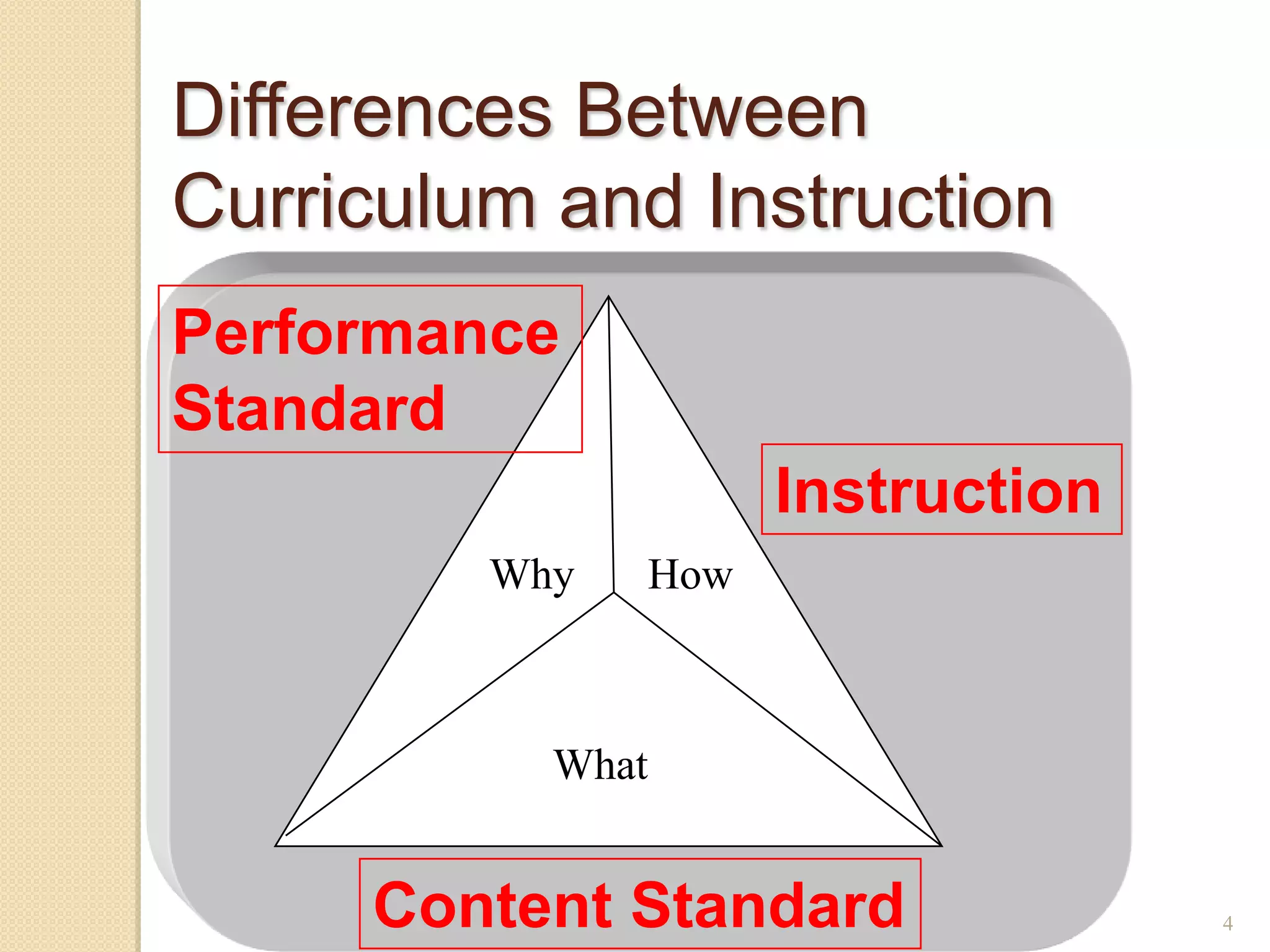
Performance
Standard
                     Instruction
         Why   How


           What


     Content Standard              4
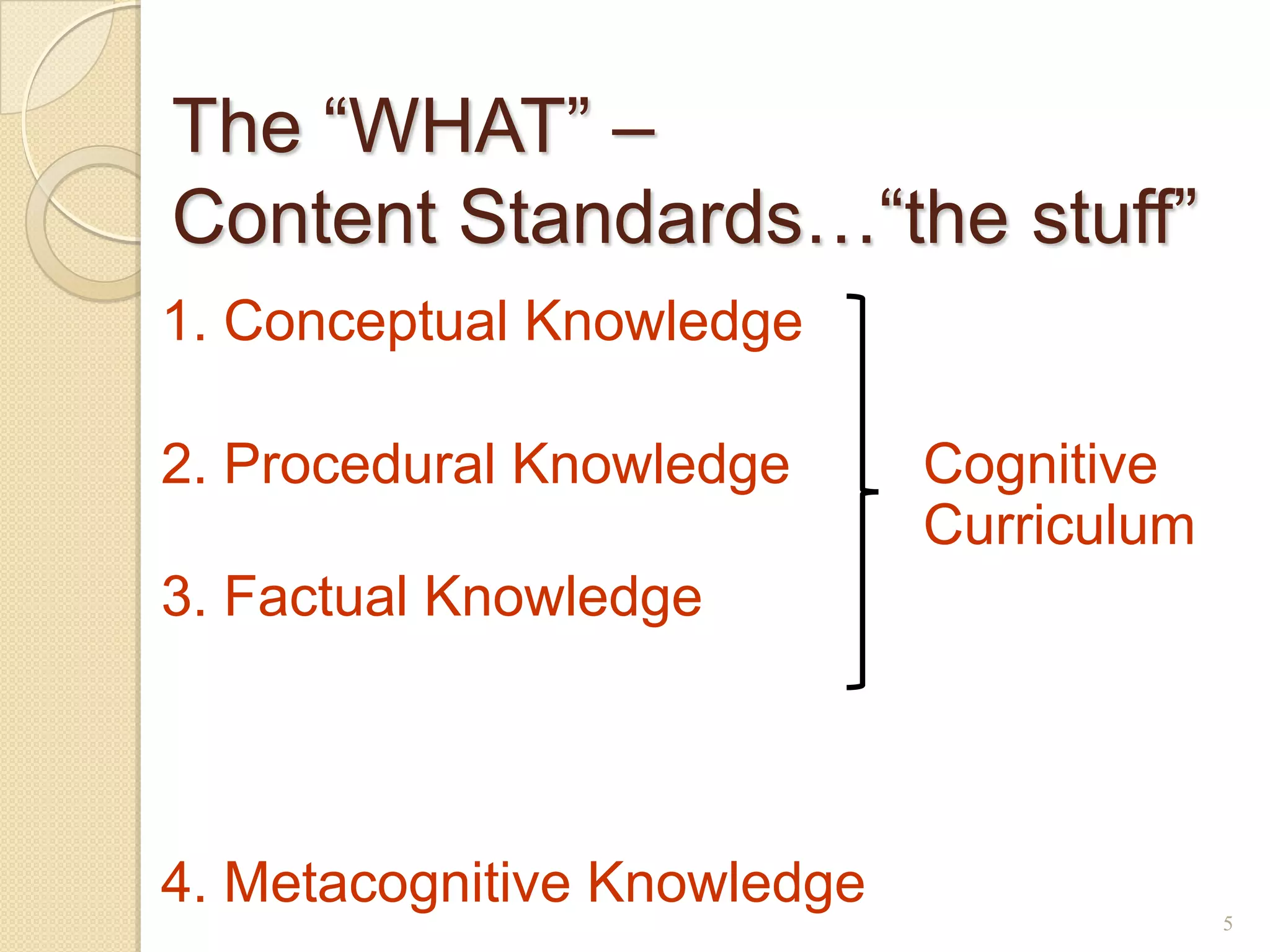
The ―WHAT‖ –
Content Standards…―the stuff‖
1. Conceptual Knowledge

2. Procedural Knowledge      Cognitive
                             Curriculum
3. Factual Knowledge


4. Metacognitive Knowledge
                                          5
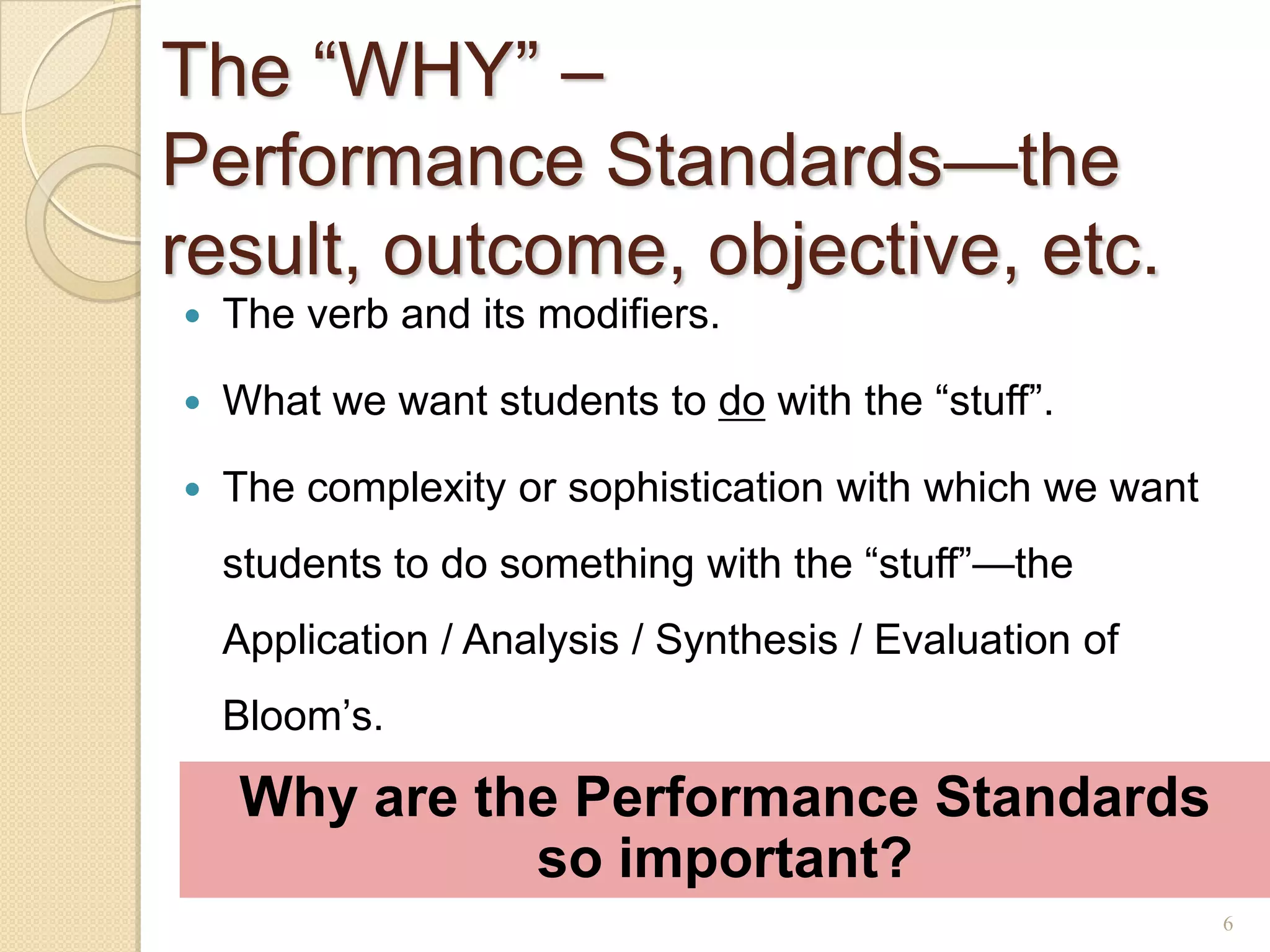
The ―WHY‖ –
Performance Standards—the
result, outcome, objective, etc.
   The verb and its modifiers.

   What we want students to do with the ―stuff‖.

   The complexity or sophistication with which we want
    students to do something with the ―stuff‖—the
    Application / Analysis / Synthesis / Evaluation of
    Bloom’s.

    Why are the Performance Standards
              so important?
                                                          6
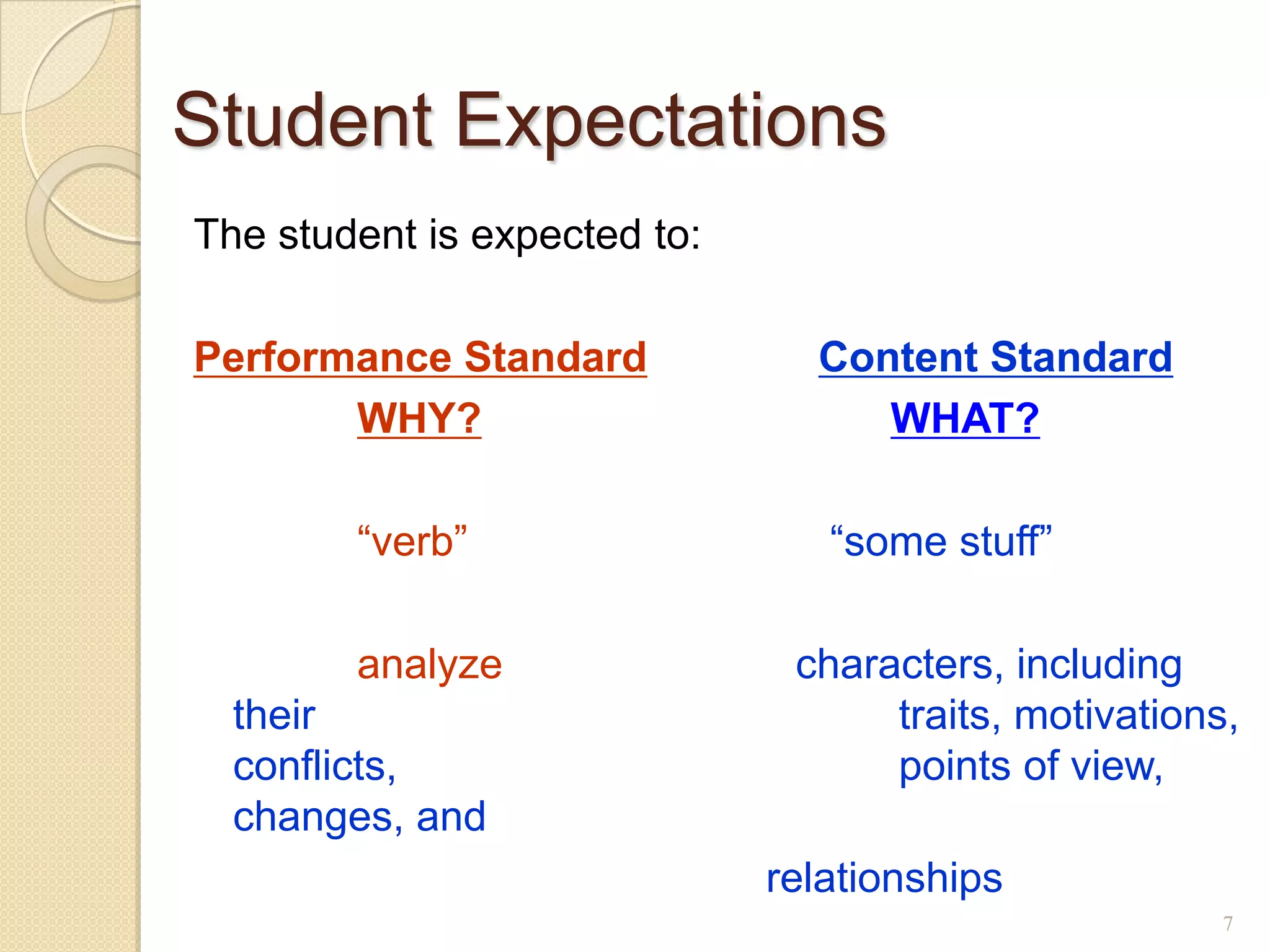
Student Expectations
The student is expected to:

Performance Standard            Content Standard
       WHY?                        WHAT?

        ―verb‖                   ―some stuff‖

        analyze                characters, including
  their                             traits, motivations,
  conflicts,                        points of view,
  changes, and
                              relationships
                                                       7
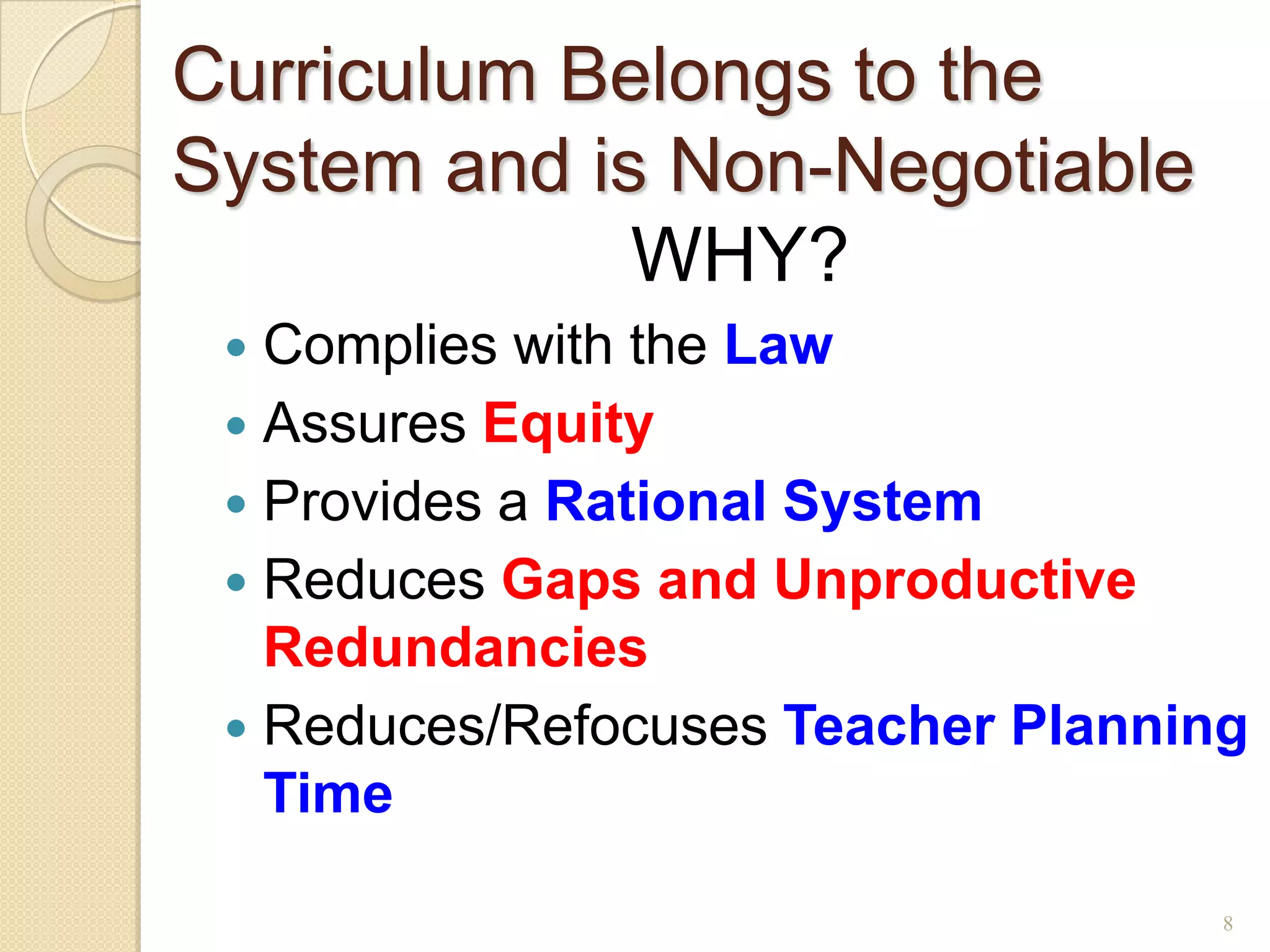
Curriculum Belongs to the
System and is Non-Negotiable
             WHY?
  Complies with the Law
  Assures Equity
  Provides a Rational System
  Reduces Gaps and Unproductive
   Redundancies
  Reduces/Refocuses Teacher Planning
   Time

                                    8
Working with the
Curriculum Standards

  Circlethe Performance
   Standard
  Underline the “including”
   and “such as” clarifications.
  The remaining text will be the
   Content Standard
                                    9
Working with the
Curriculum Standards
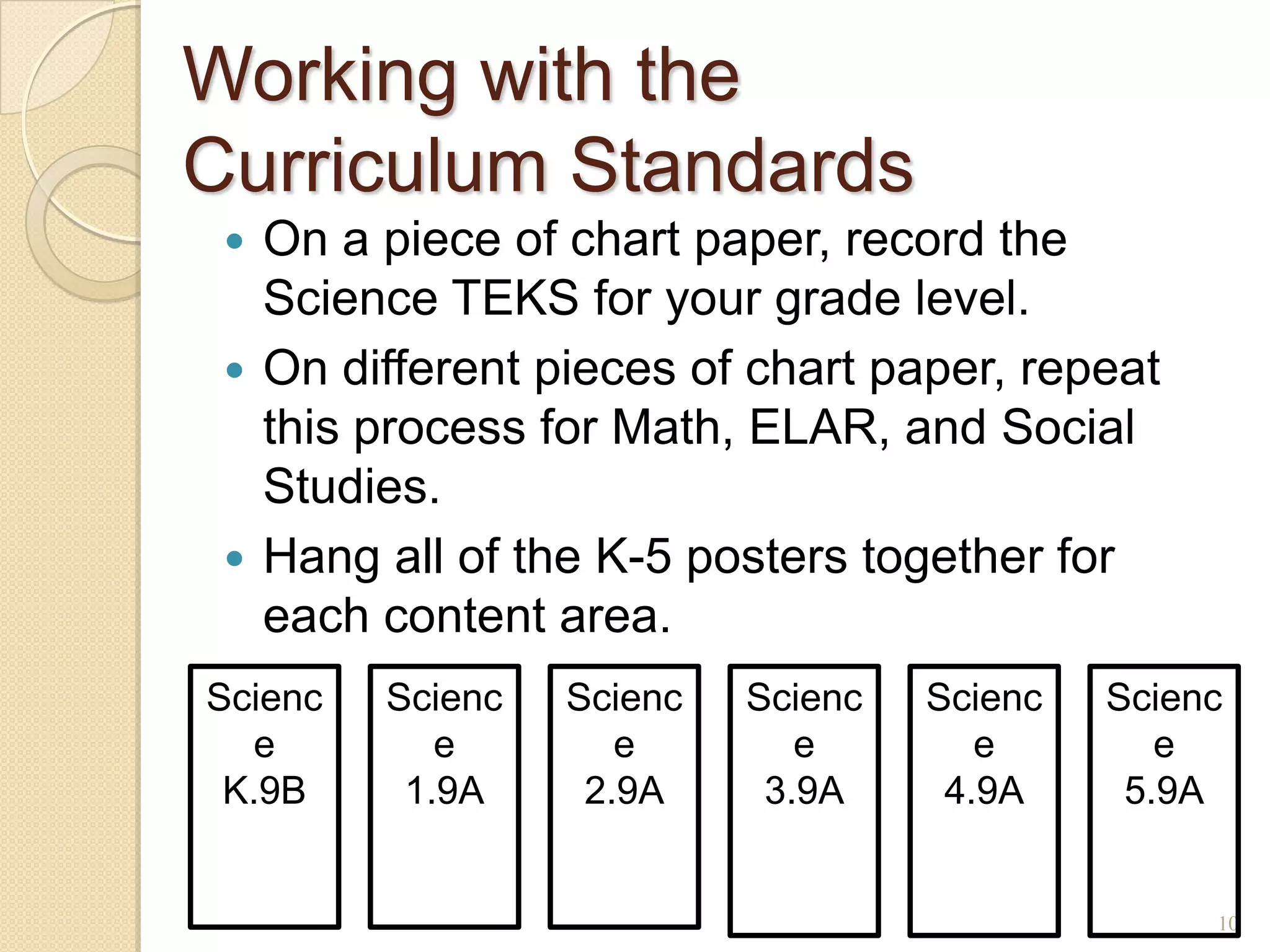
  On a piece of chart paper, record the
   Science TEKS for your grade level.
  On different pieces of chart paper, repeat
   this process for Math, ELAR, and Social
   Studies.
  Hang all of the K-5 posters together for
   each content area.
Scienc   Scienc   Scienc   Scienc   Scienc   Scienc
  e         e        e        e        e        e
 K.9B     1.9A     2.9A     3.9A     4.9A     5.9A


                                                  10
Working with the
Curriculum Standards
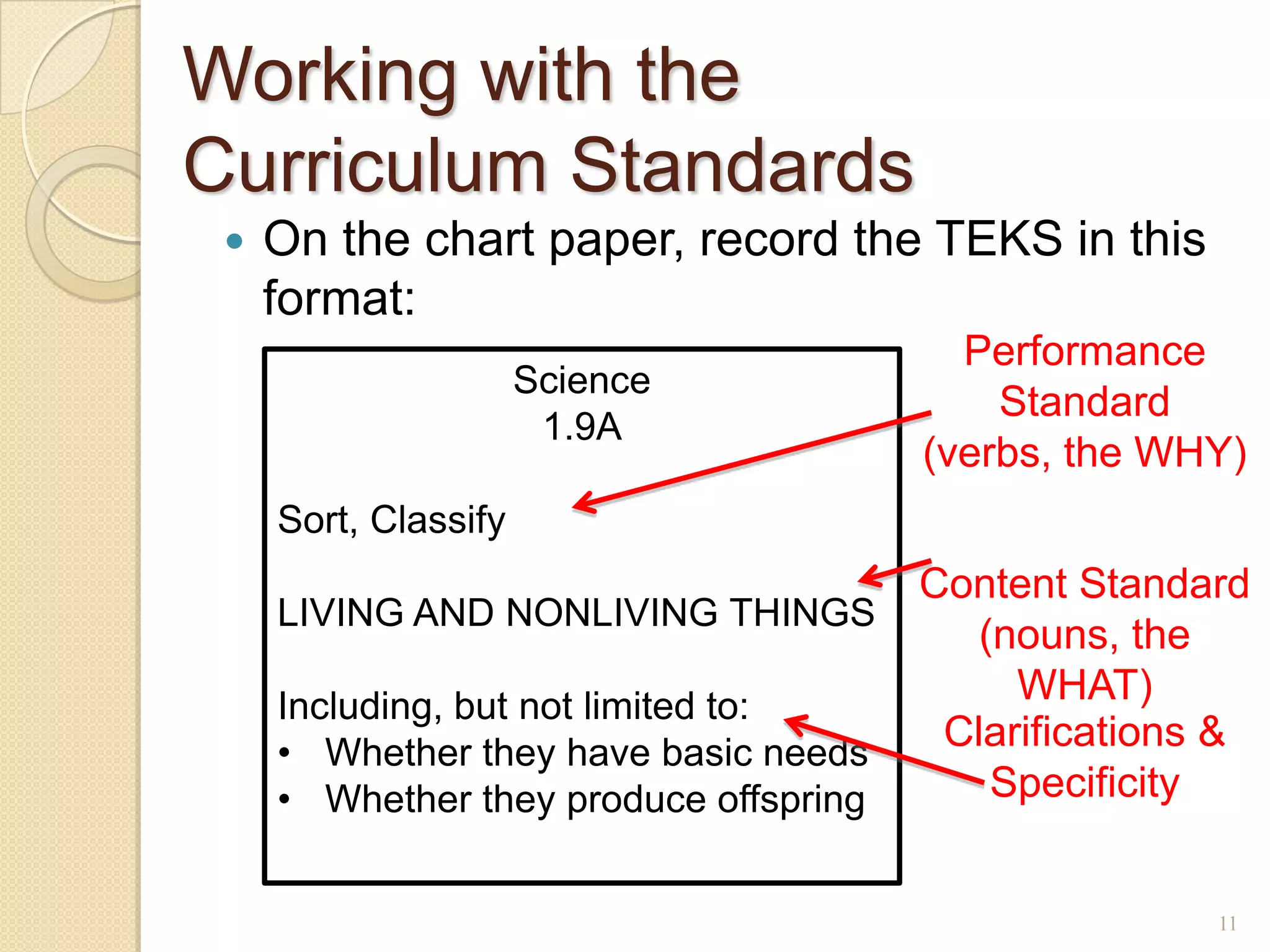
    On the chart paper, record the TEKS in this
     format:
                                          Performance
                      Science
                                            Standard
                       1.9A
                                        (verbs, the WHY)
     Sort, Classify
                                        Content Standard
     LIVING AND NONLIVING THINGS
                                           (nouns, the
     Including, but not limited to:
                                             WHAT)
     • Whether they have basic needs
                                         Clarifications &
     • Whether they produce offspring       Specificity


                                                       11
What’s Wrong With
The Texas Essential Knowledge and
Skills
As A Curriculum Document?
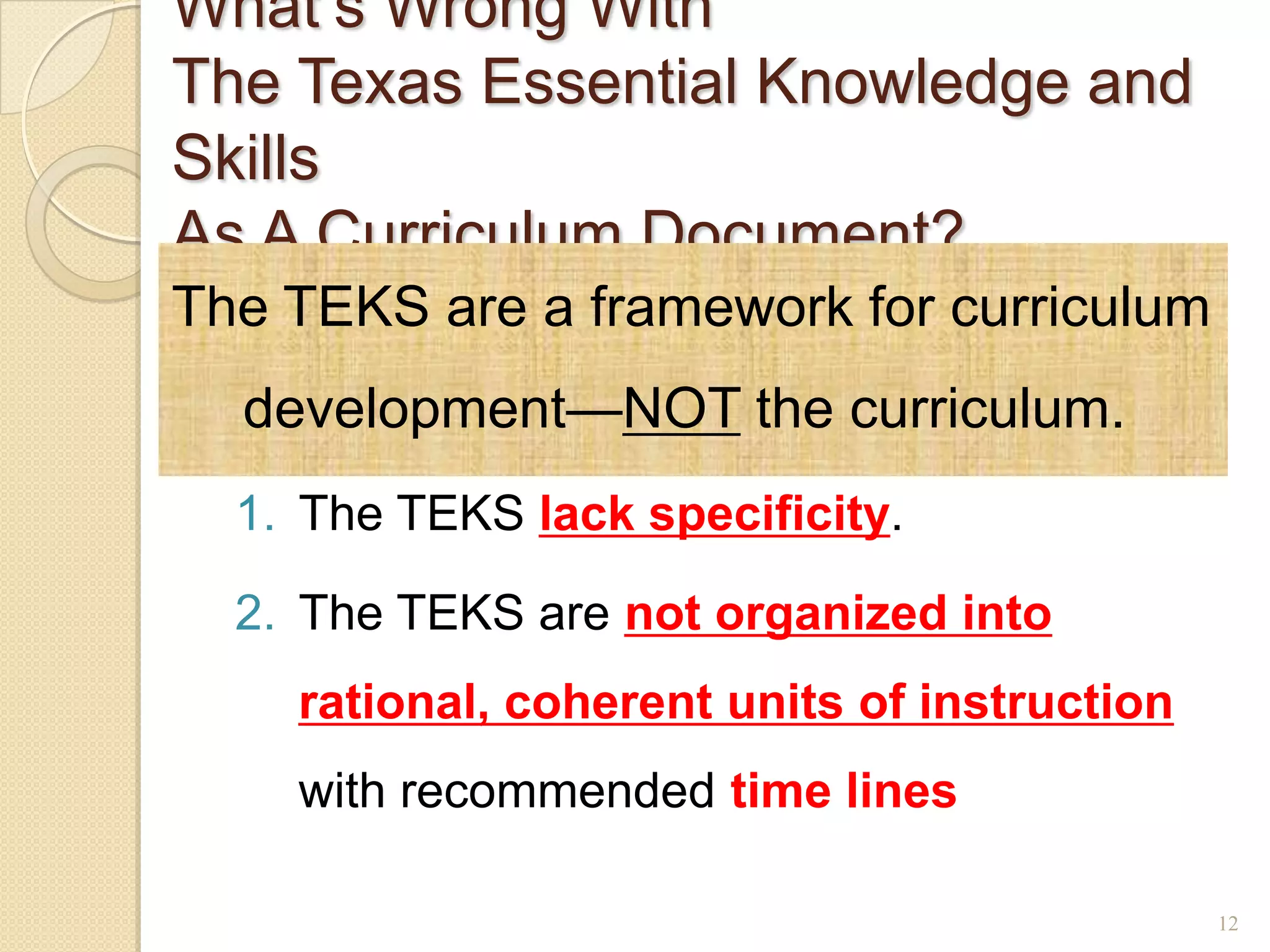
The TEKS are a framework for curriculum
  development—NOT the curriculum.
  1. The TEKS lack specificity.

  2. The TEKS are not organized into
    rational, coherent units of instruction
    with recommended time lines

                                              12
Specificity in the TEKS
    The content standard for student
     expectations is articulated in the
     ―such as…‖ and ―including…‖
     statements
     ◦ This clarifies the specific academic
       content (the ―What‖) that students will
       learn.
  “Such as…” means that the given
   content is negotiable.
  “Including…” means that the given
   content is non-negotiable.
                                                 13
Next Steps:
Develop Specificity in all TEKS
and Vertical Alignment
   Define/give specific examples of the TEKS
    content standards, sufficient that a teacher
    new to the profession or to your school district
    would know precisely what to teach and a test
    item writer would know what to test.

   Ensure that content is vertically aligned
    without gaps and unnecessary overlaps.

                                                   14
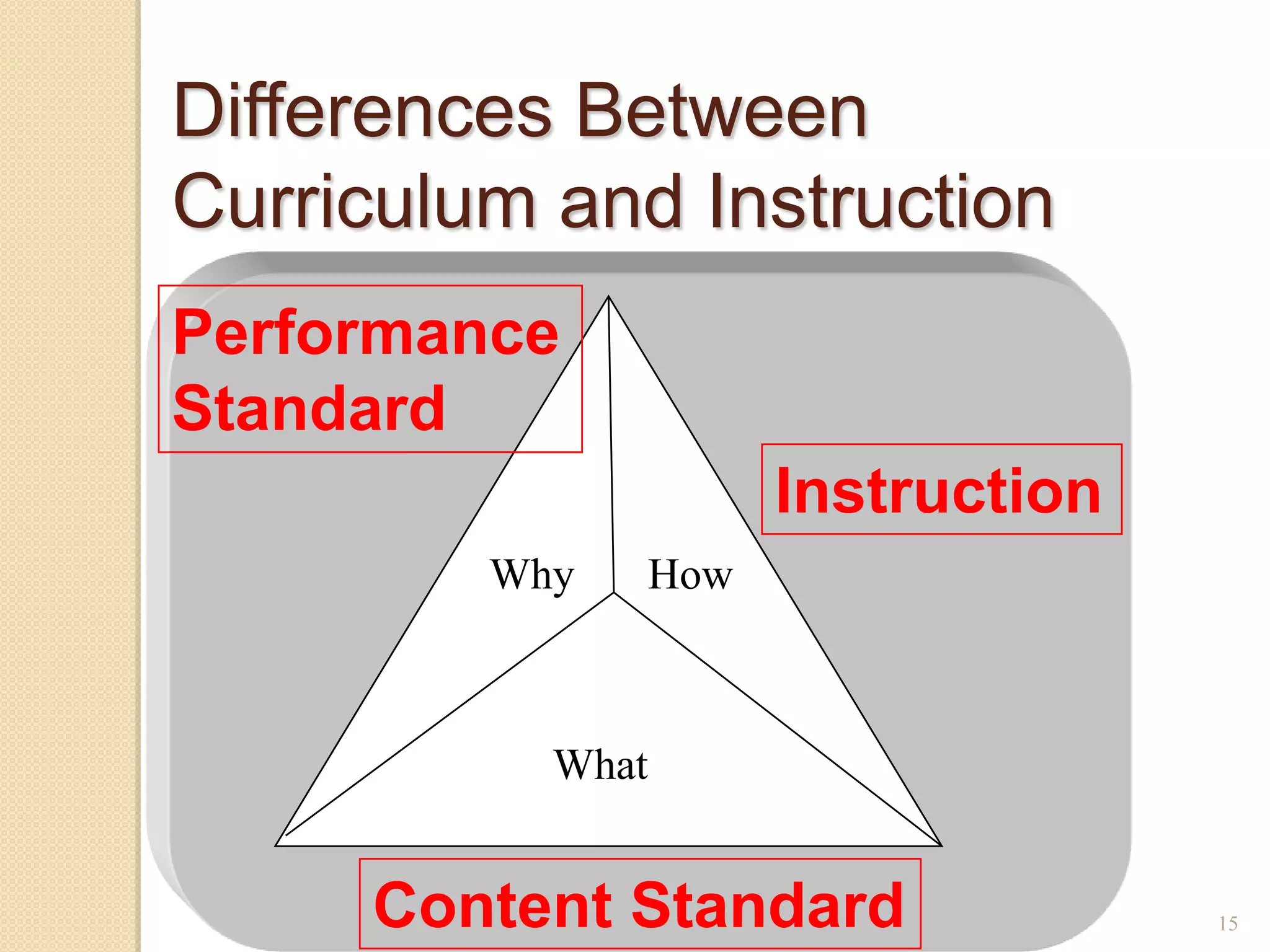
Differences Between
Curriculum and Instruction
Performance
Standard
                     Instruction
         Why   How


           What


     Content Standard              15
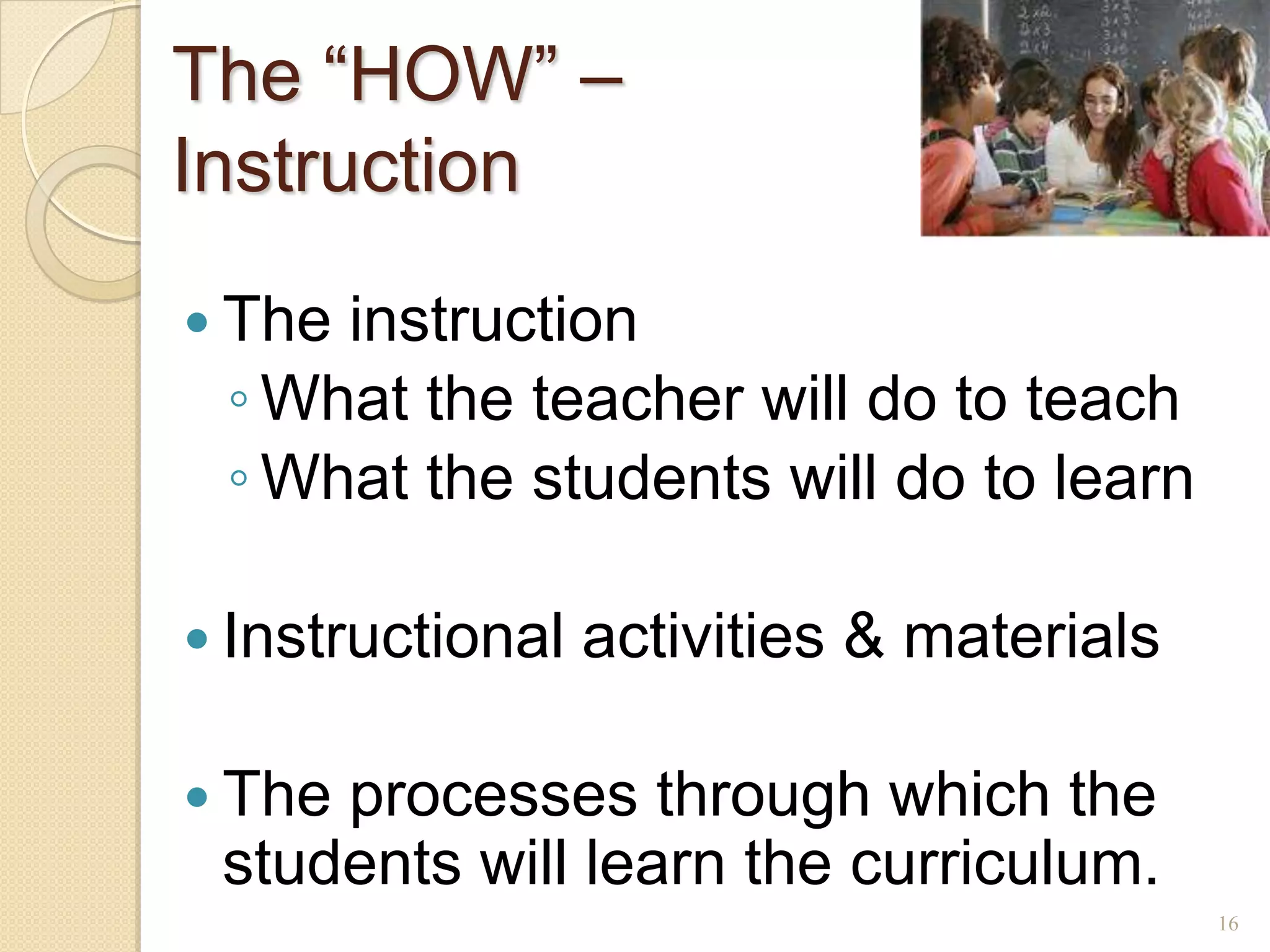
The ―HOW‖ –
Instruction
 Theinstruction
 ◦ What the teacher will do to teach
 ◦ What the students will do to learn

 Instructional   activities & materials

 Theprocesses through which the
 students will learn the curriculum.
                                           16
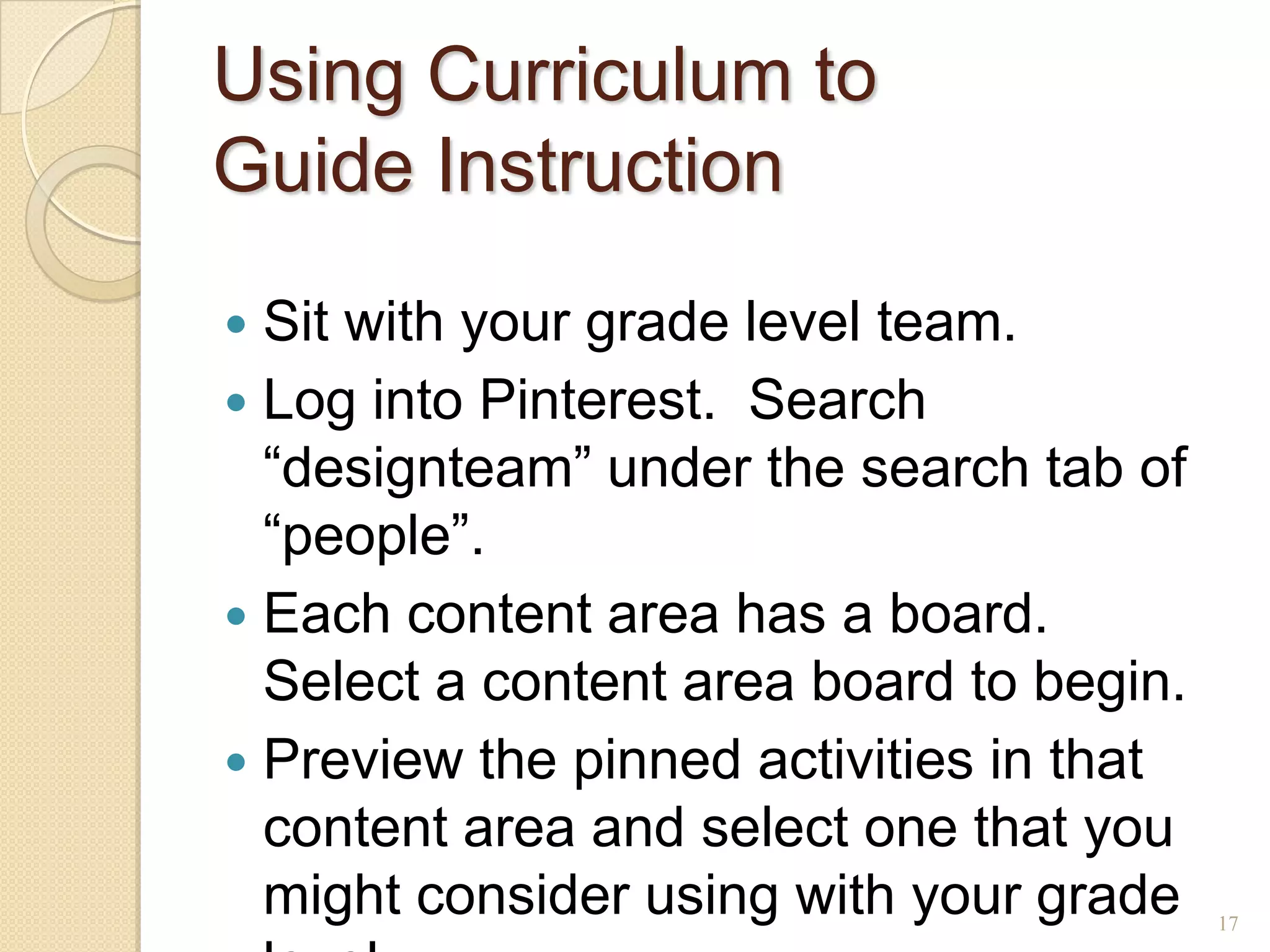
Using Curriculum to
Guide Instruction
 Sit with your grade level team.
 Log into Pinterest. Search
  ―designteam‖ under the search tab of
  ―people‖.
 Each content area has a board.
  Select a content area board to begin.
 Preview the pinned activities in that
  content area and select one that you
  might consider using with your grade    17
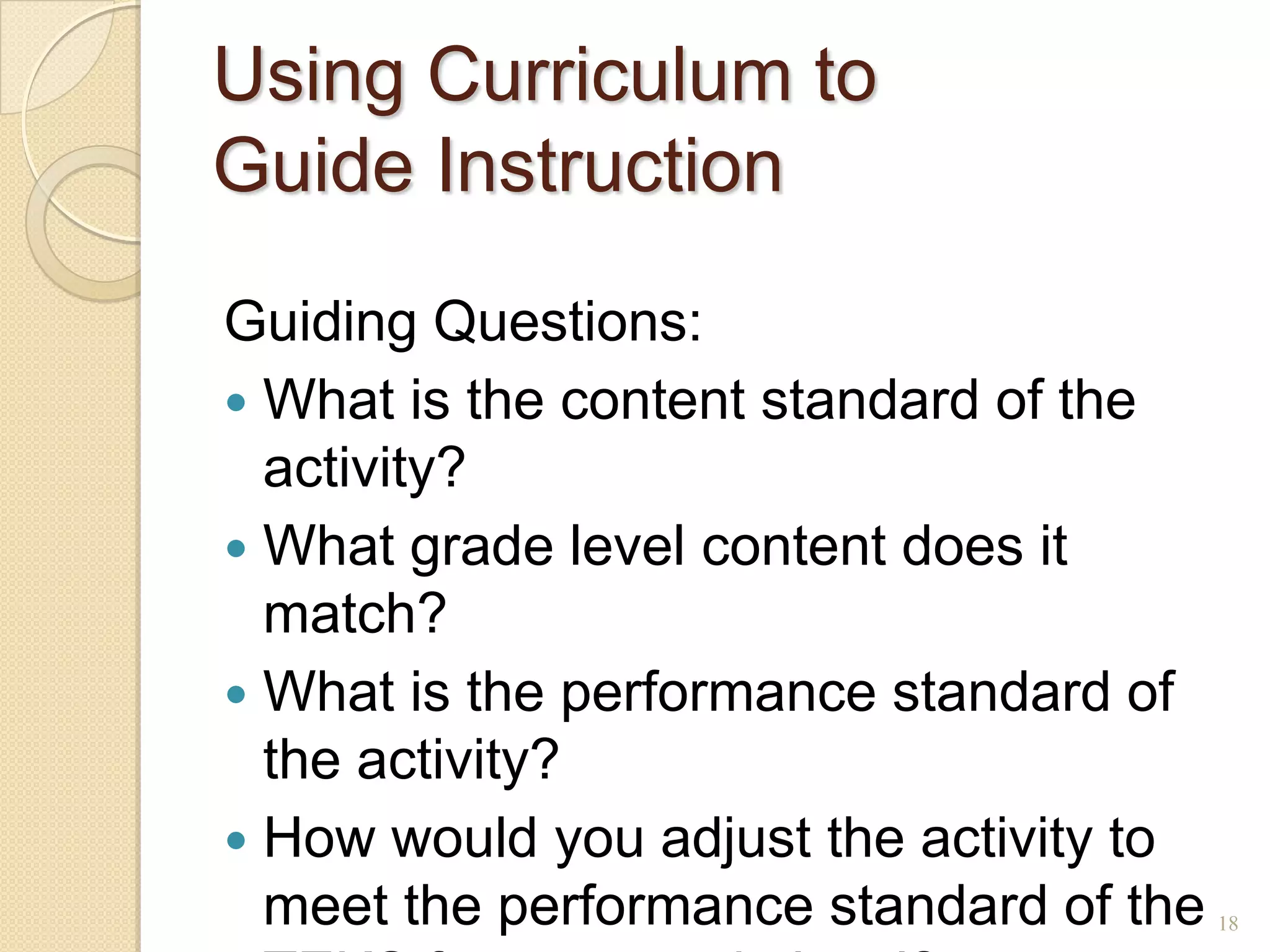
Using Curriculum to
Guide Instruction
Guiding Questions:
 What is the content standard of the
  activity?
 What grade level content does it
  match?
 What is the performance standard of
  the activity?
 How would you adjust the activity to
  meet the performance standard of the   18
Reflections

   What were the big aha’s during this
    process?

   What implications does this have for
    your grade level planning sessions?


                                           19
Tools for Facilitating
Discussion
   What are some phrases you can use
    to promote alignment of activities to
    the curriculum?


                                            20
Assessing our Learning
Target


                         21

Developing a common language about curriculum

  • 1.
    Developing a Common Languageabout Curriculum Academy 2012
  • 2.
    Agenda  Developing a Common Language about Curriculum  Activity: Working with Curriculum Standards  Reading: A Guaranteed and Viable Curriculum  Activity: Using Curriculum to Guide Instruction  Reflection  Tools for Facilitating Discussions 2
  • 3.
    Activity  With your table groups, discuss the following question: WHAT IS CURRICULUM? 3
  • 4.
    Differences Between Curriculum andInstruction Performance Standard Instruction Why How What Content Standard 4
  • 5.
    The ―WHAT‖ – ContentStandards…―the stuff‖ 1. Conceptual Knowledge 2. Procedural Knowledge Cognitive Curriculum 3. Factual Knowledge 4. Metacognitive Knowledge 5
  • 6.
    The ―WHY‖ – PerformanceStandards—the result, outcome, objective, etc.  The verb and its modifiers.  What we want students to do with the ―stuff‖.  The complexity or sophistication with which we want students to do something with the ―stuff‖—the Application / Analysis / Synthesis / Evaluation of Bloom’s. Why are the Performance Standards so important? 6
  • 7.
    Student Expectations The studentis expected to: Performance Standard Content Standard WHY? WHAT? ―verb‖ ―some stuff‖ analyze characters, including their traits, motivations, conflicts, points of view, changes, and relationships 7
  • 8.
    Curriculum Belongs tothe System and is Non-Negotiable WHY?  Complies with the Law  Assures Equity  Provides a Rational System  Reduces Gaps and Unproductive Redundancies  Reduces/Refocuses Teacher Planning Time 8
  • 9.
    Working with the CurriculumStandards  Circlethe Performance Standard  Underline the “including” and “such as” clarifications.  The remaining text will be the Content Standard 9
  • 10.
    Working with the CurriculumStandards  On a piece of chart paper, record the Science TEKS for your grade level.  On different pieces of chart paper, repeat this process for Math, ELAR, and Social Studies.  Hang all of the K-5 posters together for each content area. Scienc Scienc Scienc Scienc Scienc Scienc e e e e e e K.9B 1.9A 2.9A 3.9A 4.9A 5.9A 10
  • 11.
    Working with the CurriculumStandards  On the chart paper, record the TEKS in this format: Performance Science Standard 1.9A (verbs, the WHY) Sort, Classify Content Standard LIVING AND NONLIVING THINGS (nouns, the Including, but not limited to: WHAT) • Whether they have basic needs Clarifications & • Whether they produce offspring Specificity 11
  • 12.
    What’s Wrong With TheTexas Essential Knowledge and Skills As A Curriculum Document? The TEKS are a framework for curriculum development—NOT the curriculum. 1. The TEKS lack specificity. 2. The TEKS are not organized into rational, coherent units of instruction with recommended time lines 12
  • 13.
    Specificity in theTEKS  The content standard for student expectations is articulated in the ―such as…‖ and ―including…‖ statements ◦ This clarifies the specific academic content (the ―What‖) that students will learn.  “Such as…” means that the given content is negotiable.  “Including…” means that the given content is non-negotiable. 13
  • 14.
    Next Steps: Develop Specificityin all TEKS and Vertical Alignment  Define/give specific examples of the TEKS content standards, sufficient that a teacher new to the profession or to your school district would know precisely what to teach and a test item writer would know what to test.  Ensure that content is vertically aligned without gaps and unnecessary overlaps. 14
  • 15.
    Differences Between Curriculum andInstruction Performance Standard Instruction Why How What Content Standard 15
  • 16.
    The ―HOW‖ – Instruction Theinstruction ◦ What the teacher will do to teach ◦ What the students will do to learn  Instructional activities & materials  Theprocesses through which the students will learn the curriculum. 16
  • 17.
    Using Curriculum to GuideInstruction  Sit with your grade level team.  Log into Pinterest. Search ―designteam‖ under the search tab of ―people‖.  Each content area has a board. Select a content area board to begin.  Preview the pinned activities in that content area and select one that you might consider using with your grade 17
  • 18.
    Using Curriculum to GuideInstruction Guiding Questions:  What is the content standard of the activity?  What grade level content does it match?  What is the performance standard of the activity?  How would you adjust the activity to meet the performance standard of the 18
  • 19.
    Reflections  What were the big aha’s during this process?  What implications does this have for your grade level planning sessions? 19
  • 20.
    Tools for Facilitating Discussion  What are some phrases you can use to promote alignment of activities to the curriculum? 20
  • 21.