OBSTETRICS & GYNECOLOGY
Index
 Introduction
 Anatomy of Cervix
 Etiology & Pathogenesis
 Risk factors
 Symptoms
 Examination & Diagnosis
 Treatment
 Prophylaxis
Introduction
Cervical cancer is a type of cancer that occurs in the
cells of the cervix.
The cervix is the lower most part of the uterus and is
made up of strong muscles.
It provides support to the uterus due to attachment
of muscles from the pelvic bone. The cervix
protrudes and opens through a canal into the
vagina. It allows the flow of menstrual blood from
the uterus into the vagina and direct the sperms into
the uterus during intercourse.
Normally the opening of the cervical canal is very
narrow, but it can widen to about 10 cm during
labor.
Anatomy of Cervix
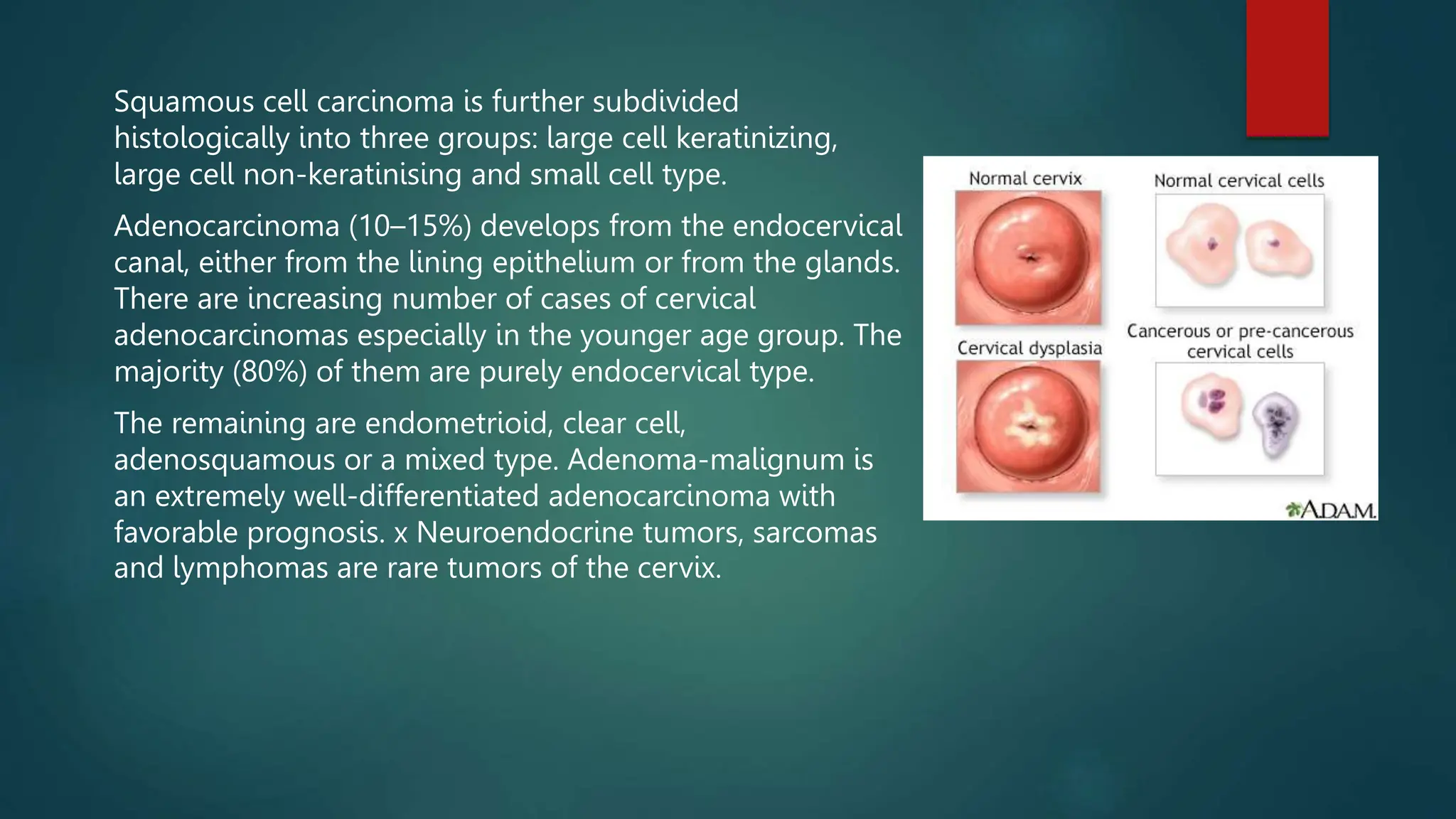
A normal cervix is pink-colored, round
shaped, has a smooth surface and does
not bleed on touch.
Etiology & Pathogenesis
Types of HIV fall into two groups:
 Low-risk HPVs: mostly cause no disease, but a few can cause warts on or around the
genitals, anus, mouth, or throat.
 High-risk HPVs: can cause several types of cancer. There are about 14 high-risk HPV types,
two of which (HPV16 and HPV18) are responsible for most HPV-related cancers.
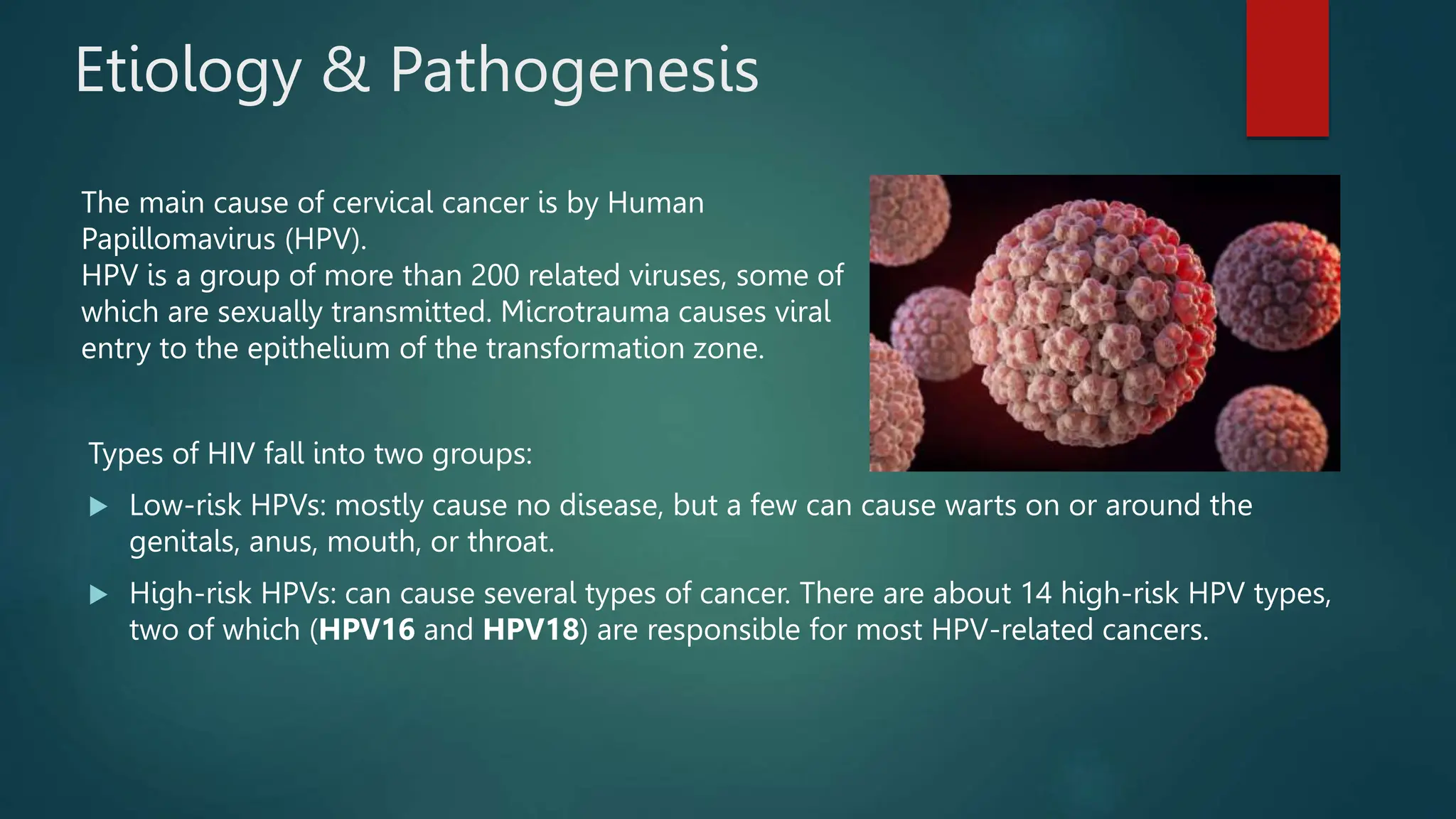
The main cause of cervical cancer is by Human
Papillomavirus (HPV).
HPV is a group of more than 200 related viruses, some of
which are sexually transmitted. Microtrauma causes viral
entry to the epithelium of the transformation zone.
The Squamocolumnar junction (SCJ) is the meeting point of columnar epithelium (lines
the endocervix) and squamous epithelium (lines the ectocervix). It is in a dynamic state
and is defined as the transformation zone (TZ), where the process of carcinogenesis
starts.
There are two mechanisms involved in the process of replacement of endocervical
columnar epithelium by squamous epithelium:
 Squamous metaplasia of the sub columnar reserve cells
 Squamous epidermalization by ingrowth of the squamous epithelium of the
ectocervix under the columnar epithelium
This metaplastic process is very active at the time of menarche and during and after
first pregnancy when there is high estrogenic phase, which lowers the vaginal pH.
Acidic pH triggers the metaplastic process. This metaplastic cells have got the
potentiality to undergo atypical transformation by trauma or infection. The prolonged
effect of carcinogens can produce continuous changes in the immature cells which may
lead to malignancy.
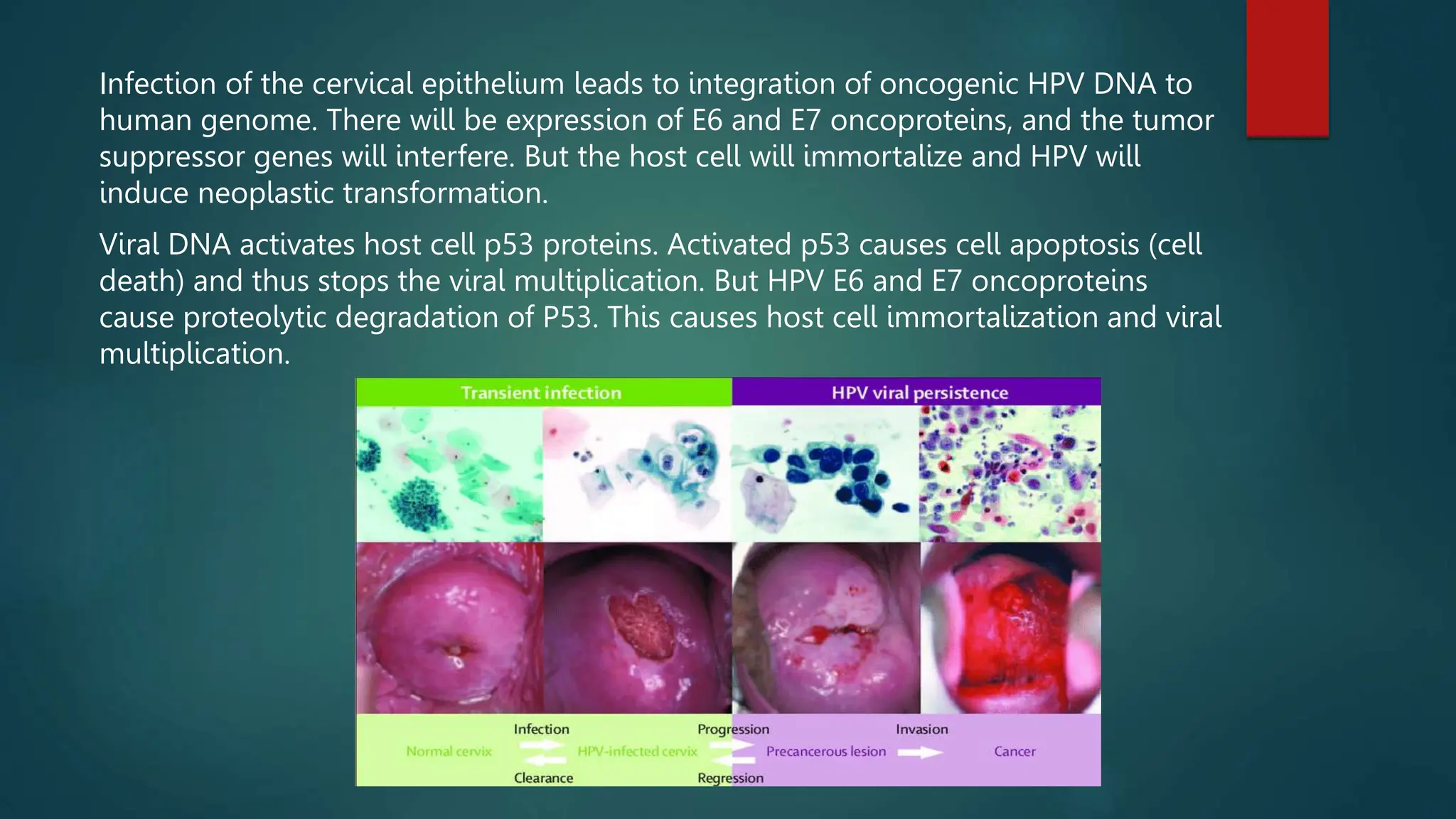
Infection of the cervical epithelium leads to integration of oncogenic HPV DNA to
human genome. There will be expression of E6 and E7 oncoproteins, and the tumor
suppressor genes will interfere. But the host cell will immortalize and HPV will
induce neoplastic transformation.
Viral DNA activates host cell p53 proteins. Activated p53 causes cell apoptosis (cell
death) and thus stops the viral multiplication. But HPV E6 and E7 oncoproteins
cause proteolytic degradation of P53. This causes host cell immortalization and viral
multiplication.
Squamous cell carcinoma is further subdivided
histologically into three groups: large cell keratinizing,
large cell non-keratinising and small cell type.
Adenocarcinoma (10–15%) develops from the endocervical
canal, either from the lining epithelium or from the glands.
There are increasing number of cases of cervical
adenocarcinomas especially in the younger age group. The
majority (80%) of them are purely endocervical type.
The remaining are endometrioid, clear cell,
adenosquamous or a mixed type. Adenoma-malignum is
an extremely well-differentiated adenocarcinoma with
favorable prognosis. x Neuroendocrine tumors, sarcomas
and lymphomas are rare tumors of the cervix.
Risk factors
•Multiple sexual partners
•Sexual activity at an early age
•Infection with high-risk HPV or multiple types of HPV
•Having other STIs such as chlamydia, gonorrhea, syphilis and HIV/AIDS
•Compromised host immunodefense
•Smoking
•Exposure to miscarriage prevention drug diethylstilbestrol (DES) (increased risk of clear cell
adenocarcinoma)
Symptoms
 Irregular or continued vaginal bleeding which may at times be brisk.
 Offensive vaginal discharge.
 Pelvic pain: backache due to involvement of uterosacral ligament or deep-seated pain
due to involvement of sacral plexus.
 Leg edema due to progressive obstruction of lymphatics and/or iliofemoral veins by
the tumor.
 Bladder symptoms: frequency of micturition, dysuria, hematuria or true incontinence
due to fistula formation.
 Rectal involvement: diarrhea, rectal pain, bleeding per rectum or rectovaginal fistula
 Ureteral obstruction due to progressive growth of tumor laterally.
Examination & Diagnosis
Speculum examination
 Ulcerative: The lesion excavates the cervix and
often involves the vaginal fornixes.
 Exophytic: arise from the ectocervix and form
friable masses almost filling up the upper
vagina in late cases.
 Infiltrative: These are found in endocervical
growth. They cause expansion of the cervix, so
that it becomes barrel-shaped.
 Bleeding on touch
The site of the lesion is predominantly in the ectocervix (80%) and the rest
(20%) are in the endocervix.
 Bimanual examination reveals the induration and extent of the growth to the
vagina and to the sides. The induration of the bladder base may be felt through
the anterior fornix in advanced cases.
 Rectal examination is invaluable to note the involvement of the parametrium
and its extent in relation to the lateral pelvic wall. Nature of induration is to be
noted carefully. If it is smooth, the possibility of inflammation has to be excluded
excluded and antibiotics has to be given prior to final assessment for staging. In
malignancy, the induration is nodular. Incidental involvement of the rectum has
to be noted.
 The Papanicolaou test (papsmear) is a method of cervical screening used to
detect potentially precancerous and cancerous processes in the cervix or colon.
 Biopsy for confirmation of diagnosis. If the lesion is small, wedge biopsy is taken
which should include a portion of the healthy tissue as well. If it is big, a bit may
be taken from a comparative noninfective area. There may be brisk hemorrhage
which can be effectively controlled by plugging
Differential Diagnosis:
 The growth needs to be differentiated from:
 Cervical tuberculosis
 Syphilitic ulcer
 Cervical ectopy
 Products of conception in incomplete abortion.
 Fibroid polyp
Complications:
 Hemorrhage
 Frequent attacks of ureteric pain, due to pyelitis and pyelonephritis and
hydronephrosis.
 Pyometra — specially with endocervical variety
 Vesicovaginal fistula, Rectovaginal fistula (rare)
Causes of Death: Uremia, Hemorrhage, Sepsis, Cachexia
Treatment
 Primary surgery: Simple hysterectomy, radical hysterectomy, pelvic exenteration (It is preferred
for cases of adenocarcinoma or adenosquamous carcinoma)
 Primary radiotherapy: Brachy therapy, Intensity modulated radiation therapy
 Chemotherapy: Postoperative adjuvant chemoradiation therapy, LARVT, Neoadjuvant
chemotherapy, Concurrent chemoradiation. The drugs used are in combination of Cisplatin,
Ifosfamide or Paclitaxel
 Combination therapy
 Serum Marker: SCC (Squamous Cell Carcinoma) antigen. The antigen is not specific, but it is
useful to monitor treatment response and predict tumor recurrence.
Pretreatment preparations:
Irrespective of the methods of treatment, general health of the patient must be improved. Due
attention is to be paid to correct anemia and malnutrition. This not only makes the patient
sufficiently fit to withstand surgery but rise in hemoglobin percentage improves the tissue
oxygenation needed for effective ionizing effect of irradiation.
Prophylaxis
Primary:
•Practice safe sex- use condoms, maintain hygiene
•Don’t smoke
•HPV Vaccine- It is approved to teenage girls (12–18 years) and women
(16–25 years)
•Pap smear tests- It is recommended to begin routine tests at age 21 and
repeat them every few years.
•Removal of cervix during hysterectomy- to prevent stump carcinoma
Secondary:
•Downstaging screening (Who 1986)- “The detection of the disease at an earlier stage when it
is still curable. Detection is done by nurses and other paramedical health workers using a
simple speculum for visual inspection of the cervix.” The strategy is not expected to lower the
incidence of cancer cervix, but it can certainly minimize cancer death through early detection.
THANK YOU!

Cervical Cancer ppt (1).pptx

  • 1.
  • 2.
    Index  Introduction  Anatomyof Cervix  Etiology & Pathogenesis  Risk factors  Symptoms  Examination & Diagnosis  Treatment  Prophylaxis
  • 3.
    Introduction Cervical cancer isa type of cancer that occurs in the cells of the cervix. The cervix is the lower most part of the uterus and is made up of strong muscles. It provides support to the uterus due to attachment of muscles from the pelvic bone. The cervix protrudes and opens through a canal into the vagina. It allows the flow of menstrual blood from the uterus into the vagina and direct the sperms into the uterus during intercourse. Normally the opening of the cervical canal is very narrow, but it can widen to about 10 cm during labor.
  • 4.
    Anatomy of Cervix Anormal cervix is pink-colored, round shaped, has a smooth surface and does not bleed on touch.
  • 5.
    Etiology & Pathogenesis Typesof HIV fall into two groups:  Low-risk HPVs: mostly cause no disease, but a few can cause warts on or around the genitals, anus, mouth, or throat.  High-risk HPVs: can cause several types of cancer. There are about 14 high-risk HPV types, two of which (HPV16 and HPV18) are responsible for most HPV-related cancers. The main cause of cervical cancer is by Human Papillomavirus (HPV). HPV is a group of more than 200 related viruses, some of which are sexually transmitted. Microtrauma causes viral entry to the epithelium of the transformation zone.
  • 6.
    The Squamocolumnar junction(SCJ) is the meeting point of columnar epithelium (lines the endocervix) and squamous epithelium (lines the ectocervix). It is in a dynamic state and is defined as the transformation zone (TZ), where the process of carcinogenesis starts. There are two mechanisms involved in the process of replacement of endocervical columnar epithelium by squamous epithelium:  Squamous metaplasia of the sub columnar reserve cells  Squamous epidermalization by ingrowth of the squamous epithelium of the ectocervix under the columnar epithelium This metaplastic process is very active at the time of menarche and during and after first pregnancy when there is high estrogenic phase, which lowers the vaginal pH. Acidic pH triggers the metaplastic process. This metaplastic cells have got the potentiality to undergo atypical transformation by trauma or infection. The prolonged effect of carcinogens can produce continuous changes in the immature cells which may lead to malignancy.
  • 7.
    Infection of thecervical epithelium leads to integration of oncogenic HPV DNA to human genome. There will be expression of E6 and E7 oncoproteins, and the tumor suppressor genes will interfere. But the host cell will immortalize and HPV will induce neoplastic transformation. Viral DNA activates host cell p53 proteins. Activated p53 causes cell apoptosis (cell death) and thus stops the viral multiplication. But HPV E6 and E7 oncoproteins cause proteolytic degradation of P53. This causes host cell immortalization and viral multiplication.
  • 8.
    Squamous cell carcinomais further subdivided histologically into three groups: large cell keratinizing, large cell non-keratinising and small cell type. Adenocarcinoma (10–15%) develops from the endocervical canal, either from the lining epithelium or from the glands. There are increasing number of cases of cervical adenocarcinomas especially in the younger age group. The majority (80%) of them are purely endocervical type. The remaining are endometrioid, clear cell, adenosquamous or a mixed type. Adenoma-malignum is an extremely well-differentiated adenocarcinoma with favorable prognosis. x Neuroendocrine tumors, sarcomas and lymphomas are rare tumors of the cervix.
  • 9.
    Risk factors •Multiple sexualpartners •Sexual activity at an early age •Infection with high-risk HPV or multiple types of HPV •Having other STIs such as chlamydia, gonorrhea, syphilis and HIV/AIDS •Compromised host immunodefense •Smoking •Exposure to miscarriage prevention drug diethylstilbestrol (DES) (increased risk of clear cell adenocarcinoma)
  • 10.
    Symptoms  Irregular orcontinued vaginal bleeding which may at times be brisk.  Offensive vaginal discharge.  Pelvic pain: backache due to involvement of uterosacral ligament or deep-seated pain due to involvement of sacral plexus.  Leg edema due to progressive obstruction of lymphatics and/or iliofemoral veins by the tumor.  Bladder symptoms: frequency of micturition, dysuria, hematuria or true incontinence due to fistula formation.  Rectal involvement: diarrhea, rectal pain, bleeding per rectum or rectovaginal fistula  Ureteral obstruction due to progressive growth of tumor laterally.
  • 11.
    Examination & Diagnosis Speculumexamination  Ulcerative: The lesion excavates the cervix and often involves the vaginal fornixes.  Exophytic: arise from the ectocervix and form friable masses almost filling up the upper vagina in late cases.  Infiltrative: These are found in endocervical growth. They cause expansion of the cervix, so that it becomes barrel-shaped.  Bleeding on touch The site of the lesion is predominantly in the ectocervix (80%) and the rest (20%) are in the endocervix.
  • 12.
     Bimanual examinationreveals the induration and extent of the growth to the vagina and to the sides. The induration of the bladder base may be felt through the anterior fornix in advanced cases.  Rectal examination is invaluable to note the involvement of the parametrium and its extent in relation to the lateral pelvic wall. Nature of induration is to be noted carefully. If it is smooth, the possibility of inflammation has to be excluded excluded and antibiotics has to be given prior to final assessment for staging. In malignancy, the induration is nodular. Incidental involvement of the rectum has to be noted.  The Papanicolaou test (papsmear) is a method of cervical screening used to detect potentially precancerous and cancerous processes in the cervix or colon.  Biopsy for confirmation of diagnosis. If the lesion is small, wedge biopsy is taken which should include a portion of the healthy tissue as well. If it is big, a bit may be taken from a comparative noninfective area. There may be brisk hemorrhage which can be effectively controlled by plugging
  • 14.
    Differential Diagnosis:  Thegrowth needs to be differentiated from:  Cervical tuberculosis  Syphilitic ulcer  Cervical ectopy  Products of conception in incomplete abortion.  Fibroid polyp Complications:  Hemorrhage  Frequent attacks of ureteric pain, due to pyelitis and pyelonephritis and hydronephrosis.  Pyometra — specially with endocervical variety  Vesicovaginal fistula, Rectovaginal fistula (rare) Causes of Death: Uremia, Hemorrhage, Sepsis, Cachexia
  • 15.
    Treatment  Primary surgery:Simple hysterectomy, radical hysterectomy, pelvic exenteration (It is preferred for cases of adenocarcinoma or adenosquamous carcinoma)  Primary radiotherapy: Brachy therapy, Intensity modulated radiation therapy  Chemotherapy: Postoperative adjuvant chemoradiation therapy, LARVT, Neoadjuvant chemotherapy, Concurrent chemoradiation. The drugs used are in combination of Cisplatin, Ifosfamide or Paclitaxel  Combination therapy  Serum Marker: SCC (Squamous Cell Carcinoma) antigen. The antigen is not specific, but it is useful to monitor treatment response and predict tumor recurrence. Pretreatment preparations: Irrespective of the methods of treatment, general health of the patient must be improved. Due attention is to be paid to correct anemia and malnutrition. This not only makes the patient sufficiently fit to withstand surgery but rise in hemoglobin percentage improves the tissue oxygenation needed for effective ionizing effect of irradiation.
  • 16.
    Prophylaxis Primary: •Practice safe sex-use condoms, maintain hygiene •Don’t smoke •HPV Vaccine- It is approved to teenage girls (12–18 years) and women (16–25 years) •Pap smear tests- It is recommended to begin routine tests at age 21 and repeat them every few years. •Removal of cervix during hysterectomy- to prevent stump carcinoma Secondary: •Downstaging screening (Who 1986)- “The detection of the disease at an earlier stage when it is still curable. Detection is done by nurses and other paramedical health workers using a simple speculum for visual inspection of the cervix.” The strategy is not expected to lower the incidence of cancer cervix, but it can certainly minimize cancer death through early detection.
  • 17.