Dr. Aeysha Begum
MBBS, FCPS, MCPS
Trained in Palliative Care
Assistant Professor
Department of Obstetrics & Gynaecology
Khwaja Yunus Ali Medical College
• Incidence of cervical cancer is steadily declining in the developed
world.
• Pap smear has reduced the incidence of cervical cancer by nearly
80 percent and death by 70 percent.
• Cervical cancer is an entirely preventable disease as the
different screening, diagnostic and therapeutic procedures are
effective.
• At present throughout the globe, there are nearly 1 million
women each year having cervical cancer.
• Cancer cervix is the most common cancer in women of the
developing countries where screening facilities are inadequate.
• According to the GLOBOCAN 2020 database, the crude incidence and
mortality rate estimates for cervical cancer in Bangladesh are 10.2
and 6.1 per 100 000, respectively.
• Bangladesh has a high burden of cervical cancer due to
1. the lack of screening,
2. high prevalence of risk factors like early marriage,
3. early initiation of sexual activity,
4. multiparity,
5. sexually transmitted diseases (STDs),
6. low socio-economic condition.
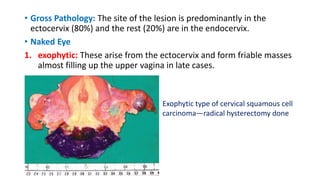
• Gross Pathology: The site of the lesion is predominantly in the
ectocervix (80%) and the rest (20%) are in the endocervix.
• Naked Eye
1. exophytic: These arise from the ectocervix and form friable masses
almost filling up the upper vagina in late cases.
Exophytic type of cervical squamous cell
carcinoma—radical hysterectomy done
• Naked Eye (Gross Pathology)
2. Ulcerative: The lesion excavates the cervix and often involves the
vaginal fornices.
Ulcerative type of cervical malignancy
with a friable growth on the posterior
lip. Radical hysterectomy done.
Uterine arteries are ligated at origin.
• Naked Eye (Gross Pathology)
3. Infiltrative: These are found in endocervical growth. They cause
expansion of the cervix, so that it becomes barrel-shaped.
Histopathology
• The commonest variety is squamous cell carcinoma (85-90%) either
well-differentiated or moderately or poorly differentiated.
• These arise from the ectocervix.
• The sources of the squamous epithelium which turn into malignancy
are—squamocolumnar junction, squamous metaplasia of the
columnar epithelium.
• Squamous cell carcinoma is further subdivided histologically into
three groups:
(i) large cell keratinizing,
(ii) large cell non-keratinizing,
(iii) small cell type.
• Patients with small cell type have got poor prognosis compared to
the large cell types.
• Adenocarcinoma (10–15%) develops from the endocervical canal,
either from the lining epithelium or from the glands.
• Currently increased number of cervical adenocarcinomas are observed
specially in the younger age group.
• The majority (80%) of them are purely endocervical type. The remainders
are endometrioid, clear cell, adenosquamous or a mixed type.
• Adenoma-malignum is an extremely well-differentiated adenocarcinoma
with favorable prognosis.
• Neuroendocrine tumors, sarcomas and lymphomas are rare tumors of
the cervix.
Histology of squamous cell
carcinoma of the cervix (small
cell type).
Keratin pearls are seen.
• Mode of spread
1. Direct extension: The growth spreads directly to the adjacent structures, to
the vagina and to the body of the uterus. It extends laterally to the
parametrium, paracervical and paravaginal tissues. It may spread backwards
along the uterosacral ligament, to involve the rectum or forwards to involve
the base of the bladder, specially in endocervical growth.
2. Lymphatic:
The primary group involved are — parametrial nodes, internal iliac nodes,
obturator, external iliac nodes and sacral nodes.
The secondary nodes involved are — common iliac group, the inguinal
nodes and paraaortic nodes.
# Sentinel lymph node (SLN) is the first node that drains a primary tumor.
In most cases (85%) there is a single sentinel lymph node.
This node can be detected by intraoperative lymphatic
mapping injecting methylene blue dye into the tumor or lymphoscintigraphy
using technetium.
• Mode of spread
3. Hematogenous: Blood borne metastasis is late and usually by veins
rather than the arteries.
Lungs, liver or bone are usually involved.
4. Direct implantation: Direct implantation of the cancer cells at operation
on the vault of the vagina or abdominal or perineal wound is very rare.
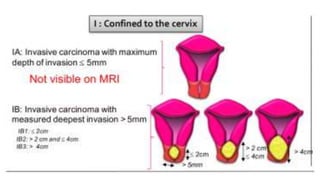
Revised FIGO Staging for Cervical Cancer
Diagrammatic representation of
staging of carcinoma cervix
according to FIGO
• Staging of cervical cancer is based principally on clinical
examination.
• Pelvic examination (speculum, bimanual and rectal examination)
should be done under anesthesia.
• The routine supplementary investigations include X-ray chest,
intravenous pyelography, cystoscopy and proctoscopy.
• In cases of suspected pelvic inflammation, a course of antibiotic
should be given prior to clinical staging.
• Final staging cannot be changed once therapy has begun.
• If any doubt exists as to which stage should be assigned, the lower
stage should be chosen.
• CT scan, MRI, Positron Emission Tomography (PET), Lymphangiography
can detect involvement of the pelvic or periaortic lymph nodes and
parametrium.
• MRI is helpful to detect parametrial extension and to define the tumor
volume.
• But these findings do not change FIGO stage of disease.
• Surgical staging of cancer cervix:
• There are often discrepancies between clinical staging and
surgicopathological findings.
• Surgical staging can minimize this by identifying the occult tumor
spread and also the extra pelvic disease.
• Assessment of the pelvic and paraaortic nodes are done by surgical
approach. This is done either by extraperitoneal approach or by
laparoscopy.
Diagnosis
• Early carcinoma
• Advanced carcinoma/Late carcinoma.
• As the presentation of the case differs, these are grouped as:
♦ Preclinical ♦ Clinical
Differential Diagnosis
• Cervical tuberculosis.
• Syphilitic ulcer.
• Cervical ectopy.
• Products of conception in incomplete abortion.
• Fibroid polyp.
Management of carcinoma cervix
♦ Preventive ♦ Curative
Preventive
• Primary Prevention
1. Identifying ‘high-risk’ female
2. Identifying ‘high-risk’ males
3. Prophylactic HPV vaccine
4. Use of condom
5. Removal of cervix during hysterectomy
• Secondary prevention
It involves identifying and treating the disease earlier in the more
treatable stage.
Treatment Modalities of carcinoma cervix
• Primary surgery
• Primary radiotherapy
• Chemotherapy
• Combination therapy
Prognosis
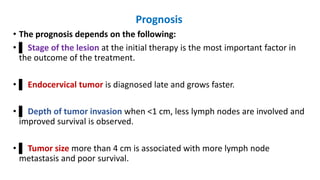
• The prognosis depends on the following:
• ▌ Stage of the lesion at the initial therapy is the most important factor in
the outcome of the treatment.
• ▌ Endocervical tumor is diagnosed late and grows faster.
• ▌ Depth of tumor invasion when <1 cm, less lymph nodes are involved and
improved survival is observed.
• ▌ Tumor size more than 4 cm is associated with more lymph node
metastasis and poor survival.
Prognosis
• The prognosis depends on the following:
• ▌ Well-differentiated squamous cell carcinoma grows slowly and
metastases late than the anaplastic type.
• ▌ Young age is usually associated with poorly differentiated squamous cell
carcinoma or adenocarcinoma and is prognostically poor.
• ▌ Lymph node involvement (pelvic and paraaortic) reduces the survival
rate by 50 percent.
• ▌ HPV positive younger patients have better prognosis.
Carcinoma Cervix.pptx

Carcinoma Cervix.pptx

  • 1.
    Dr. Aeysha Begum MBBS,FCPS, MCPS Trained in Palliative Care Assistant Professor Department of Obstetrics & Gynaecology Khwaja Yunus Ali Medical College
  • 2.
    • Incidence ofcervical cancer is steadily declining in the developed world. • Pap smear has reduced the incidence of cervical cancer by nearly 80 percent and death by 70 percent. • Cervical cancer is an entirely preventable disease as the different screening, diagnostic and therapeutic procedures are effective. • At present throughout the globe, there are nearly 1 million women each year having cervical cancer. • Cancer cervix is the most common cancer in women of the developing countries where screening facilities are inadequate.
  • 4.
    • According tothe GLOBOCAN 2020 database, the crude incidence and mortality rate estimates for cervical cancer in Bangladesh are 10.2 and 6.1 per 100 000, respectively. • Bangladesh has a high burden of cervical cancer due to 1. the lack of screening, 2. high prevalence of risk factors like early marriage, 3. early initiation of sexual activity, 4. multiparity, 5. sexually transmitted diseases (STDs), 6. low socio-economic condition.
  • 5.
    • Gross Pathology:The site of the lesion is predominantly in the ectocervix (80%) and the rest (20%) are in the endocervix. • Naked Eye 1. exophytic: These arise from the ectocervix and form friable masses almost filling up the upper vagina in late cases. Exophytic type of cervical squamous cell carcinoma—radical hysterectomy done
  • 6.
    • Naked Eye(Gross Pathology) 2. Ulcerative: The lesion excavates the cervix and often involves the vaginal fornices. Ulcerative type of cervical malignancy with a friable growth on the posterior lip. Radical hysterectomy done. Uterine arteries are ligated at origin.
  • 7.
    • Naked Eye(Gross Pathology) 3. Infiltrative: These are found in endocervical growth. They cause expansion of the cervix, so that it becomes barrel-shaped.
  • 8.
    Histopathology • The commonestvariety is squamous cell carcinoma (85-90%) either well-differentiated or moderately or poorly differentiated. • These arise from the ectocervix. • The sources of the squamous epithelium which turn into malignancy are—squamocolumnar junction, squamous metaplasia of the columnar epithelium.
  • 9.
    • Squamous cellcarcinoma is further subdivided histologically into three groups: (i) large cell keratinizing, (ii) large cell non-keratinizing, (iii) small cell type. • Patients with small cell type have got poor prognosis compared to the large cell types.
  • 10.
    • Adenocarcinoma (10–15%)develops from the endocervical canal, either from the lining epithelium or from the glands.
  • 11.
    • Currently increasednumber of cervical adenocarcinomas are observed specially in the younger age group. • The majority (80%) of them are purely endocervical type. The remainders are endometrioid, clear cell, adenosquamous or a mixed type. • Adenoma-malignum is an extremely well-differentiated adenocarcinoma with favorable prognosis.
  • 12.
    • Neuroendocrine tumors,sarcomas and lymphomas are rare tumors of the cervix.
  • 13.
    Histology of squamouscell carcinoma of the cervix (small cell type). Keratin pearls are seen.
  • 14.
    • Mode ofspread 1. Direct extension: The growth spreads directly to the adjacent structures, to the vagina and to the body of the uterus. It extends laterally to the parametrium, paracervical and paravaginal tissues. It may spread backwards along the uterosacral ligament, to involve the rectum or forwards to involve the base of the bladder, specially in endocervical growth. 2. Lymphatic: The primary group involved are — parametrial nodes, internal iliac nodes, obturator, external iliac nodes and sacral nodes. The secondary nodes involved are — common iliac group, the inguinal nodes and paraaortic nodes. # Sentinel lymph node (SLN) is the first node that drains a primary tumor. In most cases (85%) there is a single sentinel lymph node. This node can be detected by intraoperative lymphatic mapping injecting methylene blue dye into the tumor or lymphoscintigraphy using technetium.
  • 15.
    • Mode ofspread 3. Hematogenous: Blood borne metastasis is late and usually by veins rather than the arteries. Lungs, liver or bone are usually involved. 4. Direct implantation: Direct implantation of the cancer cells at operation on the vault of the vagina or abdominal or perineal wound is very rare.
  • 17.
    Revised FIGO Stagingfor Cervical Cancer
  • 23.
    Diagrammatic representation of stagingof carcinoma cervix according to FIGO
  • 24.
    • Staging ofcervical cancer is based principally on clinical examination. • Pelvic examination (speculum, bimanual and rectal examination) should be done under anesthesia. • The routine supplementary investigations include X-ray chest, intravenous pyelography, cystoscopy and proctoscopy. • In cases of suspected pelvic inflammation, a course of antibiotic should be given prior to clinical staging. • Final staging cannot be changed once therapy has begun. • If any doubt exists as to which stage should be assigned, the lower stage should be chosen.
  • 25.
    • CT scan,MRI, Positron Emission Tomography (PET), Lymphangiography can detect involvement of the pelvic or periaortic lymph nodes and parametrium. • MRI is helpful to detect parametrial extension and to define the tumor volume. • But these findings do not change FIGO stage of disease.
  • 26.
    • Surgical stagingof cancer cervix: • There are often discrepancies between clinical staging and surgicopathological findings. • Surgical staging can minimize this by identifying the occult tumor spread and also the extra pelvic disease. • Assessment of the pelvic and paraaortic nodes are done by surgical approach. This is done either by extraperitoneal approach or by laparoscopy.
  • 27.
    Diagnosis • Early carcinoma •Advanced carcinoma/Late carcinoma.
  • 28.
    • As thepresentation of the case differs, these are grouped as: ♦ Preclinical ♦ Clinical
  • 29.
    Differential Diagnosis • Cervicaltuberculosis. • Syphilitic ulcer. • Cervical ectopy. • Products of conception in incomplete abortion. • Fibroid polyp.
  • 30.
    Management of carcinomacervix ♦ Preventive ♦ Curative
  • 31.
    Preventive • Primary Prevention 1.Identifying ‘high-risk’ female 2. Identifying ‘high-risk’ males 3. Prophylactic HPV vaccine 4. Use of condom 5. Removal of cervix during hysterectomy • Secondary prevention It involves identifying and treating the disease earlier in the more treatable stage.
  • 32.
    Treatment Modalities ofcarcinoma cervix • Primary surgery • Primary radiotherapy • Chemotherapy • Combination therapy
  • 38.
    Prognosis • The prognosisdepends on the following: • ▌ Stage of the lesion at the initial therapy is the most important factor in the outcome of the treatment. • ▌ Endocervical tumor is diagnosed late and grows faster. • ▌ Depth of tumor invasion when <1 cm, less lymph nodes are involved and improved survival is observed. • ▌ Tumor size more than 4 cm is associated with more lymph node metastasis and poor survival.
  • 39.
    Prognosis • The prognosisdepends on the following: • ▌ Well-differentiated squamous cell carcinoma grows slowly and metastases late than the anaplastic type. • ▌ Young age is usually associated with poorly differentiated squamous cell carcinoma or adenocarcinoma and is prognostically poor. • ▌ Lymph node involvement (pelvic and paraaortic) reduces the survival rate by 50 percent. • ▌ HPV positive younger patients have better prognosis.