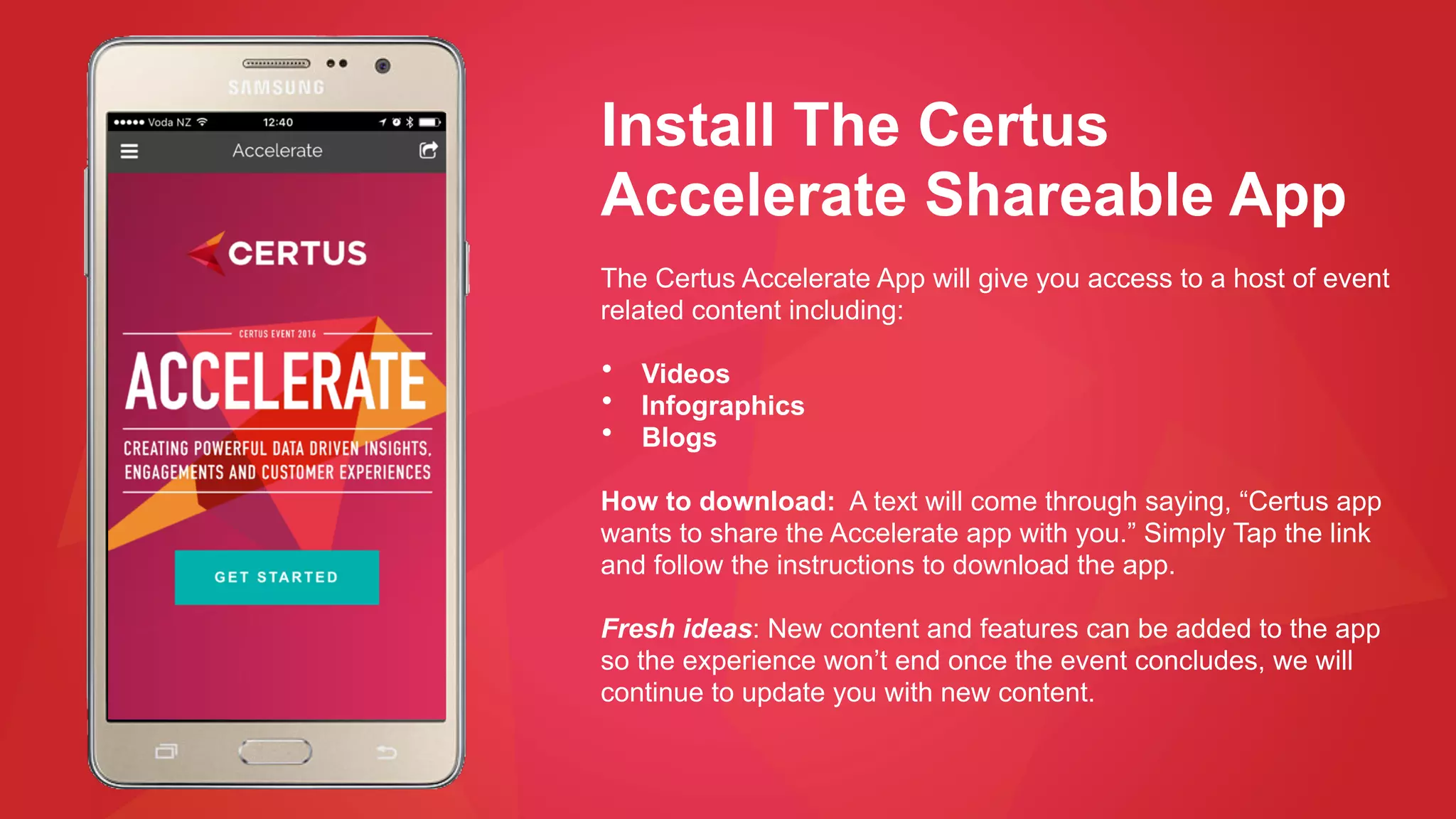


Install The Certus
Accelerate Shareable App
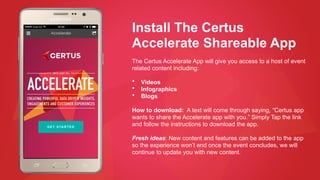
The Certus Accelerate App will give you access to a host of event
related content including:
• Videos
• Infographics
• Blogs
How to download: A text will come through saying, “Certus app
wants to share the Accelerate app with you.” Simply Tap the link
and follow the instructions to download the app.
Fresh ideas: New content and features can be added to the app
so the experience won’t end once the event concludes, we will
continue to update you with new content.
aamplify.co.nz ŒŠˇẂ‹#œš‘“›⁸
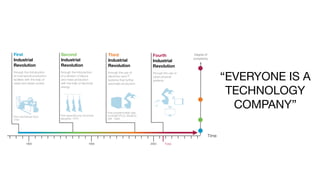
First

Industrial

Revolution
through the introduction
of mechanical production
facilities with the help of
water and steam power
Second

Industrial

Revolution
through the introduction
of a division of labour
and mass production
with the help of electrical
energy
Third

Industrial

Revolution
through the use of
electronic and IT
systems that further
automate production
Fourth

Industrial

Revolution
through the use of
cyber-physical
systems
Degree of

complexity
1800 1900 2000 Today
First mechanical loom,
1784
First assembly line Cincinnati
slaughter, 1970
First programmable logic
controller (PLC), Modicon
084, 1969
Time
“EVERYONE IS A
TECHNOLOGY
COMPANY”
DIGITAL

DISRUPTION
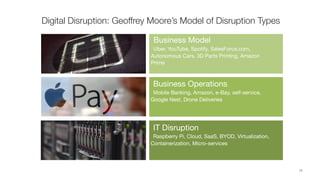
Digital Disruption: Geoffrey Moore’s Model of Disruption Types
18
IT Disruption

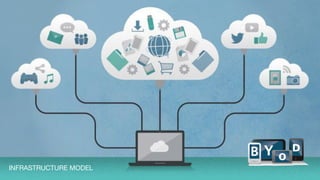
Raspberry Pi, Cloud, SaaS, BYOD, Virtualization,
Containerization, Micro-services
Business Model 

Uber, YouTube, Spotify, SalesForce.com,
Autonomous Cars, 3D Parts Printing, Amazon
Prime
Business Operations

Mobile Banking, Amazon, e-Bay, self-service, 

Google Nest, Drone Deliveries
BUSINESS MODEL
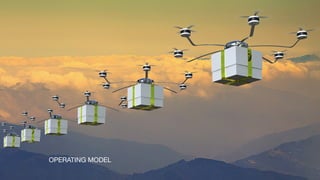
OPERATING MODEL
INFRASTRUCTURE MODEL
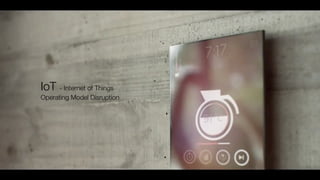
IoT - Internet of Things
Operating Model Disruption
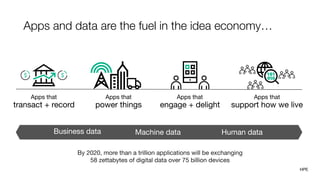
Apps and data are the fuel in the idea economy…
Machine data Human dataBusiness data
Apps that 

transact + record
Apps that 

power things
Apps that 

engage + delight
Apps that 

support how we live
By 2020, more than a trillion applications will be exchanging
58 zettabytes of digital data over 75 billion devices
HPE
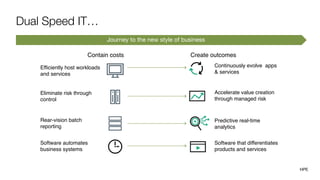
Journey to the new style of business
Efficiently host workloads
and services
Eliminate risk through
control
Rear-vision batch 

reporting
Software automates
business systems
Contain costs Create outcomes
Predictive real-time
analytics
Software that differentiates
products and services
Continuously evolve apps
& services
Accelerate value creation 

through managed risk
Dual Speed IT…
HPE
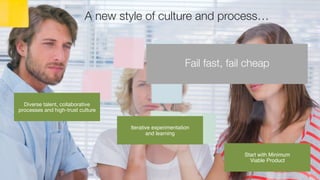
A new style of culture and process…
Start with Minimum

Viable Product
Iterative experimentation 

and learning
Diverse talent, collaborative
processes and high-trust culture
Fail fast, fail cheap
“Our concept of what is to be human
is evolving rapidly.”
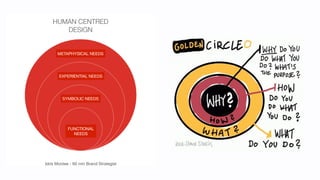
METAPHYSICAL NEEDS
EXPERIENTIAL NEEDS
SYMBOLIC NEEDS
FUNCTIONAL

NEEDS
HUMAN CENTRED

DESIGN
Idris Mootee - 60 min Brand Strategist
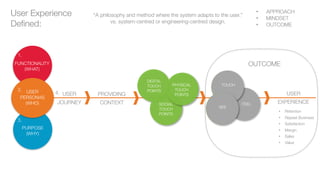
PROVIDING
CONTEXT
FUNCTIONALITY
(WHAT)
User Experience
Defined:
PURPOSE
(WHY)
USER
PERSONAS
(WHO)
USER
EXPERIENCE
• Retention
• Repeat Business
• Satisfaction
• Margin
• Sales
• Value
• APPROACH
• MINDSET
• OUTCOME
1.
2.
3.
USER
JOURNEY
4.
OUTCOME
TOUCH
SEE
FEEL
DIGITAL

TOUCH

POINTS
SOCIAL
TOUCH

POINTS
PHYSICAL
TOUCH

POINTS
“A philosophy and method where the system adapts to the user.”
vs. system-centred or engineering-centred design.
UX APPLIES
IN…
1. Capturing your
market
2. Delivering Products
+ Services to
customers
3. Empowering your
people (B2E)
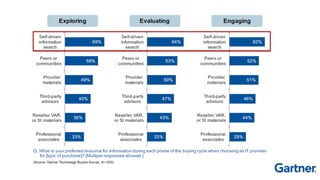
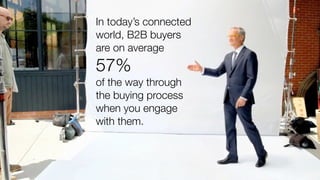
In today’s connected
world, B2B buyers
are on average
57%
of the way through
the buying process
when you engage
with them.
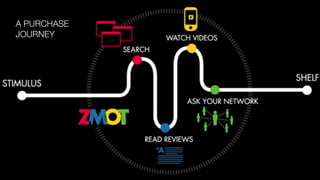
A PURCHASE
JOURNEY
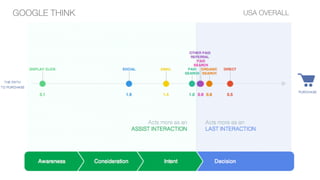
GOOGLE THINK USA OVERALL
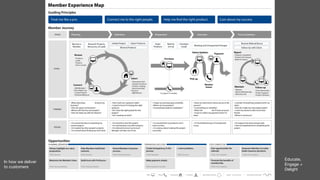
In how we deliver
to customers
Educate,
Engage +
Delight
In how you

empower
your people
“Inside our own
heads is the
most complex
arrangement of
matter in the
known universe”
UX Principles…
1. Early focus on users, tasks and environment
Structured and systematic information gathering (interviews, observations, etc).

Users are involved throughout design and development.
2. Empirical measurement and testing
Testing with real users. Focus on ease of learning and ease of use.
3. Iterative design
Design, test with users, refine, test with users again, refine… until it’s right.
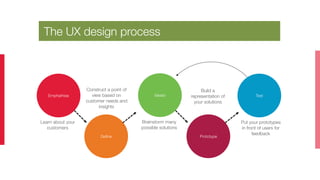
The UX design process
Construct a point of
view based on
customer needs and
insights
Learn about your
customers
Brainstorm many
possible solutions
Build a
representation of
your solutions
Put your prototypes
in front of users for
feedback
Emphathise
Define
Ideate
Prototype
Test
What?
Archetype or set of common characteristics
With all characteristics of the user 

(of the primary stakeholder group. Also secondary
and anti-persona). Not a profile or demographics.
Based on…
Field research process 

(Observation, stakeholders info, interviews,
behaviours etc).
Why to use them?
Useful…
To create a common shared understanding of the user
group for which the design process is built around.
To prioritise the design considerations by providing a
context of what the user needs and what functions are
simply nice to add and have.
PERSONAS
What?
User scenarios, situations, journeys, events, problems.
About the “daily life of” or a sequence of events where
personas are the main character of the story.
The story should be specific of the events happening
that relate to the problems of the primary stakeholder
group.
Based on on problem statements using assumptions
and data.
Why to use it?
Create a social context to which the personas exist in (an
actual physical world).
The story-form helps because is easy to understand for
everyone.
USER JOURNEYS | SCENARIOS
What?
Describe the interaction between an individual and
the rest of the world (a short event) normally includes
details about an interaction represented with a series
of simple steps to achieve a goal (based on the
persona. May include cause-effect analysis).
Normally expressed in a 2 column table.
Other special type of Use case are: essential use
case (abstract form, describes the essence of the
problem)
Why to use them?
Helps to:

Make problem easier to handle for designers
(to break problems or complicated tasks into smaller bits)
Help identify useful levels of design work
(the actual low level processes can be solved as simply as
possible)
Better understanding of the
problem splitting it
into small parts
USE CASES
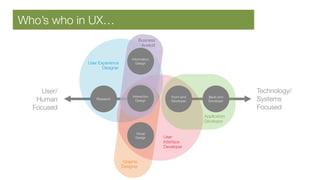
Graphic

Designer
User Experience
Designer
User

Interface
Developer
Application
Developer
Technology/
Systems

Focused
User/
Human
Focused
Who’s who in UX…
Visual

Design
Research
Back-end

Developer
Business
Analyst
Information
Design
Interaction
Design
Front-end

Developer
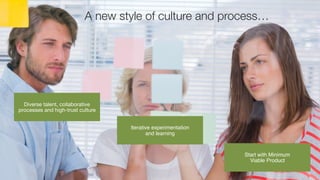
A new style of culture and process…
Start with Minimum

Viable Product
Iterative experimentation 

and learning
Diverse talent, collaborative
processes and high-trust culture
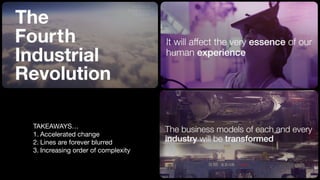
TAKEAWAYS…

1. Accelerated change

2. Lines are forever blurred

3. Increasing order of complexity
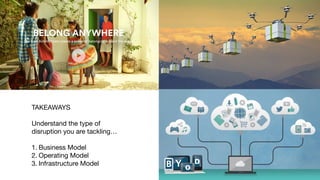
TAKEAWAYS

Understand the type of
disruption you are tackling…

1. Business Model

2. Operating Model

3. Infrastructure Model
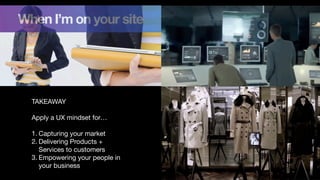
TAKEAWAY

Apply a UX mindset for…

1. Capturing your market

2. Delivering Products +
Services to customers

3. Empowering your people in
your business
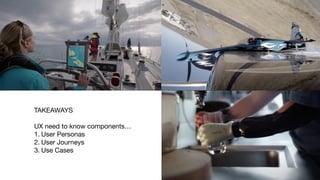
TAKEAWAYS

UX need to know components…

1. User Personas

2. User Journeys

3. Use Cases
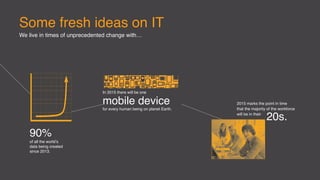
90%
of all the world’s

data being created

since 2013.
Some fresh ideas on IT
We live in times of unprecedented change with…
In 2015 there will be one
mobile device
for every human being on planet Earth.
2015 marks the point in time

that the majority of the workforce 

will be in their
20s.
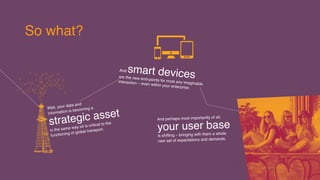
Well, your data and
information is becoming a
strategic asset
in the same way oil is critical to the
functioning of global transport.
So what?
And smart devices
are the new end-points for most any imaginable 

interaction – even within your enterprise.
And perhaps most importantly of all,
your user base
is shifting – bringing with them a whole 

new set of expectations and demands.
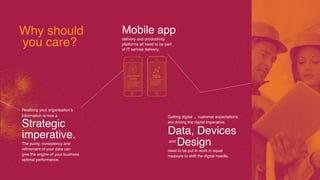
Realising your organisation’s
information is now a
Strategic

imperative.
The purity, consistency and 

refinement of your data can

give the engine of your business

optimal performance.
Why should

you care?
Mobile app
delivery and productivity
platforms all need to be part
of IT service delivery.
Getting digital ... customer expectations 

are driving the digital imperative.
Data, Devices
Design
need to be put to work in equal

measure to shift the digital needle.
and
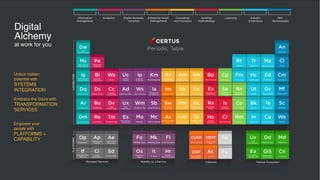
Digital
Alchemy
at work for you
Unlock hidden

potential with
SYSTEMS

INTEGRATION
Embrace the future with
TRANSFORMATION

SERVICES
Empower your

people with
PLATFORMS +

CAPABILITY
THANK YOU

Certus Accelerate - User Centred Everything by Sam Williams

  • 1.
    Install The Certus AccelerateShareable App The Certus Accelerate App will give you access to a host of event related content including: • Videos • Infographics • Blogs How to download: A text will come through saying, “Certus app wants to share the Accelerate app with you.” Simply Tap the link and follow the instructions to download the app. Fresh ideas: New content and features can be added to the app so the experience won’t end once the event concludes, we will continue to update you with new content.
  • 8.
  • 16.
    First
 Industrial
 Revolution through the introduction ofmechanical production facilities with the help of water and steam power Second
 Industrial
 Revolution through the introduction of a division of labour and mass production with the help of electrical energy Third
 Industrial
 Revolution through the use of electronic and IT systems that further automate production Fourth
 Industrial
 Revolution through the use of cyber-physical systems Degree of
 complexity 1800 1900 2000 Today First mechanical loom, 1784 First assembly line Cincinnati slaughter, 1970 First programmable logic controller (PLC), Modicon 084, 1969 Time “EVERYONE IS A TECHNOLOGY COMPANY”
  • 17.
  • 18.
    Digital Disruption: GeoffreyMoore’s Model of Disruption Types 18 IT Disruption Raspberry Pi, Cloud, SaaS, BYOD, Virtualization, Containerization, Micro-services Business Model Uber, YouTube, Spotify, SalesForce.com, Autonomous Cars, 3D Parts Printing, Amazon Prime Business Operations Mobile Banking, Amazon, e-Bay, self-service, 
 Google Nest, Drone Deliveries
  • 19.
  • 20.
  • 21.
  • 22.
    IoT - Internetof Things Operating Model Disruption
  • 23.
    Apps and dataare the fuel in the idea economy… Machine data Human dataBusiness data Apps that 
 transact + record Apps that 
 power things Apps that 
 engage + delight Apps that 
 support how we live By 2020, more than a trillion applications will be exchanging 58 zettabytes of digital data over 75 billion devices HPE
  • 24.
    Journey to thenew style of business Efficiently host workloads and services Eliminate risk through control Rear-vision batch 
 reporting Software automates business systems Contain costs Create outcomes Predictive real-time analytics Software that differentiates products and services Continuously evolve apps & services Accelerate value creation 
 through managed risk Dual Speed IT… HPE
  • 25.
    A new styleof culture and process… Start with Minimum
 Viable Product Iterative experimentation 
 and learning Diverse talent, collaborative processes and high-trust culture Fail fast, fail cheap
  • 27.
    “Our concept ofwhat is to be human is evolving rapidly.”
  • 28.
    METAPHYSICAL NEEDS EXPERIENTIAL NEEDS SYMBOLICNEEDS FUNCTIONAL NEEDS HUMAN CENTRED
 DESIGN Idris Mootee - 60 min Brand Strategist
  • 29.
    PROVIDING CONTEXT FUNCTIONALITY (WHAT) User Experience Defined: PURPOSE (WHY) USER PERSONAS (WHO) USER EXPERIENCE • Retention •Repeat Business • Satisfaction • Margin • Sales • Value • APPROACH • MINDSET • OUTCOME 1. 2. 3. USER JOURNEY 4. OUTCOME TOUCH SEE FEEL DIGITAL
 TOUCH
 POINTS SOCIAL TOUCH
 POINTS PHYSICAL TOUCH
 POINTS “A philosophy and method where the system adapts to the user.” vs. system-centred or engineering-centred design.
  • 30.
    UX APPLIES IN… 1. Capturingyour market 2. Delivering Products + Services to customers 3. Empowering your people (B2E)
  • 32.
    In today’s connected world,B2B buyers are on average 57% of the way through the buying process when you engage with them.
  • 33.
  • 34.
  • 36.
    In how wedeliver to customers Educate, Engage + Delight
  • 37.
  • 38.
    “Inside our own headsis the most complex arrangement of matter in the known universe”
  • 39.
    UX Principles… 1. Earlyfocus on users, tasks and environment Structured and systematic information gathering (interviews, observations, etc).
 Users are involved throughout design and development. 2. Empirical measurement and testing Testing with real users. Focus on ease of learning and ease of use. 3. Iterative design Design, test with users, refine, test with users again, refine… until it’s right.
  • 40.
    The UX designprocess Construct a point of view based on customer needs and insights Learn about your customers Brainstorm many possible solutions Build a representation of your solutions Put your prototypes in front of users for feedback Emphathise Define Ideate Prototype Test
  • 41.
    What? Archetype or setof common characteristics With all characteristics of the user 
 (of the primary stakeholder group. Also secondary and anti-persona). Not a profile or demographics. Based on… Field research process 
 (Observation, stakeholders info, interviews, behaviours etc). Why to use them? Useful… To create a common shared understanding of the user group for which the design process is built around. To prioritise the design considerations by providing a context of what the user needs and what functions are simply nice to add and have. PERSONAS
  • 42.
    What? User scenarios, situations,journeys, events, problems. About the “daily life of” or a sequence of events where personas are the main character of the story. The story should be specific of the events happening that relate to the problems of the primary stakeholder group. Based on on problem statements using assumptions and data. Why to use it? Create a social context to which the personas exist in (an actual physical world). The story-form helps because is easy to understand for everyone. USER JOURNEYS | SCENARIOS
  • 43.
    What? Describe the interactionbetween an individual and the rest of the world (a short event) normally includes details about an interaction represented with a series of simple steps to achieve a goal (based on the persona. May include cause-effect analysis). Normally expressed in a 2 column table. Other special type of Use case are: essential use case (abstract form, describes the essence of the problem) Why to use them? Helps to:
 Make problem easier to handle for designers (to break problems or complicated tasks into smaller bits) Help identify useful levels of design work (the actual low level processes can be solved as simply as possible) Better understanding of the problem splitting it into small parts USE CASES
  • 44.
    Graphic
 Designer User Experience Designer User
 Interface Developer Application Developer Technology/ Systems
 Focused User/ Human Focused Who’s whoin UX… Visual
 Design Research Back-end
 Developer Business Analyst Information Design Interaction Design Front-end
 Developer
  • 45.
    A new styleof culture and process… Start with Minimum
 Viable Product Iterative experimentation 
 and learning Diverse talent, collaborative processes and high-trust culture
  • 47.
    TAKEAWAYS… 1. Accelerated change 2.Lines are forever blurred 3. Increasing order of complexity
  • 48.
    TAKEAWAYS Understand the typeof disruption you are tackling… 1. Business Model 2. Operating Model 3. Infrastructure Model
  • 49.
    TAKEAWAY Apply a UXmindset for… 1. Capturing your market 2. Delivering Products + Services to customers 3. Empowering your people in your business
  • 50.
    TAKEAWAYS UX need toknow components… 1. User Personas 2. User Journeys 3. Use Cases
  • 53.
    90% of all theworld’s
 data being created
 since 2013. Some fresh ideas on IT We live in times of unprecedented change with… In 2015 there will be one mobile device for every human being on planet Earth. 2015 marks the point in time
 that the majority of the workforce 
 will be in their 20s.
  • 54.
    Well, your dataand information is becoming a strategic asset in the same way oil is critical to the functioning of global transport. So what? And smart devices
are the new end-points for most any imaginable 
 interaction – even within your enterprise. And perhaps most importantly of all, your user base is shifting – bringing with them a whole 
 new set of expectations and demands.
  • 55.
    Realising your organisation’s informationis now a Strategic
 imperative. The purity, consistency and 
 refinement of your data can
 give the engine of your business
 optimal performance. Why should
 you care? Mobile app delivery and productivity platforms all need to be part of IT service delivery. Getting digital ... customer expectations 
 are driving the digital imperative. Data, Devices Design need to be put to work in equal
 measure to shift the digital needle. and
  • 56.
    Digital Alchemy at work foryou Unlock hidden
 potential with SYSTEMS
 INTEGRATION Embrace the future with TRANSFORMATION
 SERVICES Empower your
 people with PLATFORMS +
 CAPABILITY
  • 58.