What is a digital
workspace?
Source: https://www.invotra.com/blogs/defining-digital-workspace
Authored by: Fintan Galvin
A definition for Digital workspaces
Noun: Digital Workspace
❖ Digital - Involving or relating to the use of computer technology
❖ Workspace - A place or environment where people work
The unified interface where users engage with people, knowledge & their
environment with the sole purpose of getting their job done.
Digital Workspace V Digital Workplace
One of the key areas of confusion is the difference between workplace and
workspace.
We see the key difference being that the ‘Digital Workspace’ spans any part of / or
multiple workplaces and frequently will not be physically connected.
History & Evolution
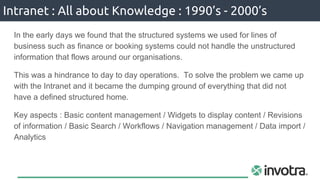
In the early days we found that the structured systems we used for lines of
business such as finance or booking systems could not handle the unstructured
information that flows around our organisations.
This was a hindrance to day to day operations. To solve the problem we came up
with the Intranet and it became the dumping ground of everything that did not
have a defined structured home.
Key aspects : Basic content management / Widgets to display content / Revisions
of information / Basic Search / Workflows / Navigation management / Data import /
Analytics
Intranet : All about Knowledge : 1990’s - 2000’s
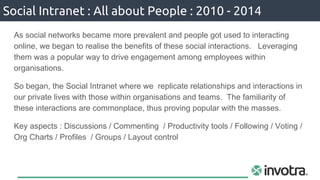
As social networks became more prevalent and people got used to interacting
online, we began to realise the benefits of these social interactions. Leveraging
them was a popular way to drive engagement among employees within
organisations.
So began, the Social Intranet where we replicate relationships and interactions in
our private lives with those within organisations and teams. The familiarity of
these interactions are commonplace, thus proving popular with the masses.
Key aspects : Discussions / Commenting / Productivity tools / Following / Voting /
Org Charts / Profiles / Groups / Layout control
Social Intranet : All about People : 2010 - 2014
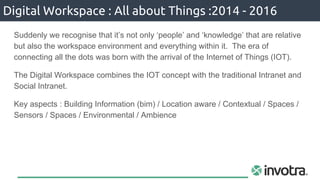
Suddenly we recognise that it’s not only ‘people’ and ‘knowledge’ that are relative
but also the workspace environment and everything within it. The era of
connecting all the dots was born with the arrival of the Internet of Things (IOT).
The Digital Workspace combines the IOT concept with the traditional Intranet and
Social Intranet.
Key aspects : Building Information (bim) / Location aware / Contextual / Spaces /
Sensors / Spaces / Environmental / Ambience
Digital Workspace : All about Things :2014 - 2016
What are the key drivers of Digital
Workspace evolution?
A need to instantly engage and communicate with everyone in your organisational
network has intensified over recent years with the use of multiple communication
channels.
Enabling and consolidating the channels is a key driver for the development of the
digital workspace.
There is an increasing drain on everyones attention with a constant flow of new
inputs from social and environmental sources, that is making it ever more difficult
to engage and then maintain people's engagement with organisations.
Organisational Engagement
Smartphones with GPS are helping people be more efficient in their travel. We
are gaining additional ways to make sure our work environments are not only
more supportive but safer and more efficient.
We can now support our employees by leveraging the ‘things’ in their environment
in countless ways.
New opportunities are available to organisations that believe in early adoption of
innovative workplace technologies. Your digital workspace is the nervous system
for your organisation.
Ambient work environments
The relatively recent explosion in smaller communications & notifications has
proven to be a significant driver in the way we ingest information and how we
expect to send and receive information.
The move from complex infrequently changed communications that had long life
spans to smaller more frequently updated communications has proven to be
dramatic driver of our working environments.
Micronisation of communications
Organisations are now being designed for a state of constant change, rather than
a steady state.
Increased complexity in existing organisational models driven by external social
and technical market forces making changing business models the norm.
We are seeing organisations rapidly change direction and doing so in timescales
that were previously not possible.
Accelerated velocity
Organisational resources are now more often temporal and fungible. We have
always had an element of this in organisations, with short term leases on
equipment or hiring contractors. Now we are seeing this becoming micronised in
every area of the business.
Organisations are hiring people and resources for minutes rather than days or
weeks.
As more and more things and people become connected this just becomes more
ubiquitous.
Time as a commodity
What are the key enablers of a digital
workplace?
People
At the core is the need to engage people with each other, ‘knowledge’ and
‘environment’ at the time they need it. To this end you have to ensure that the
system provides them with the ambient support they need to find each other, as
well as comprehensive ways in which to surface ‘knowledge’ in a contextually
intelligent manner based on the patterns of operation within the organisation.
To do this successfully we must leverage every opportunity to consume
knowledge into the system from all available resources and understand if that
‘knowledge’ is temporary or lasting. From this we can then apply context, patterns
and governance to orchestrate the interactions to best effect.
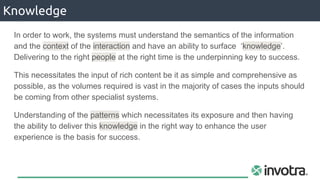
Knowledge
In order to work, the systems must understand the semantics of the information
and the context of the interaction and have an ability to surface ‘knowledge’.
Delivering to the right people at the right time is the underpinning key to success.
This necessitates the input of rich content be it as simple and comprehensive as
possible, as the volumes required is vast in the majority of cases the inputs should
be coming from other specialist systems.
Understanding of the patterns which necessitates its exposure and then having
the ability to deliver this knowledge in the right way to enhance the user
experience is the basis for success.
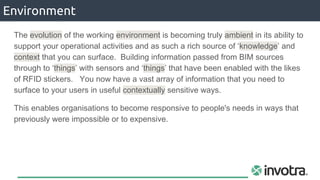
Environment
The evolution of the working environment is becoming truly ambient in its ability to
support your operational activities and as such a rich source of ‘knowledge’ and
context that you can surface. Building information passed from BIM sources
through to ‘things’ with sensors and ‘things’ that have been enabled with the likes
of RFID stickers. You now have a vast array of information that you need to
surface to your users in useful contextually sensitive ways.
This enables organisations to become responsive to people's needs in ways that
previously were impossible or to expensive.
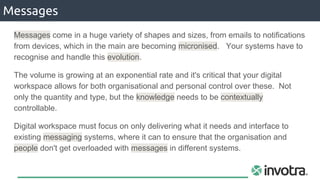
Messages
Messages come in a huge variety of shapes and sizes, from emails to notifications
from devices, which in the main are becoming micronised. Your systems have to
recognise and handle this evolution.
The volume is growing at an exponential rate and it's critical that your digital
workspace allows for both organisational and personal control over these. Not
only the quantity and type, but the knowledge needs to be contextually
controllable.
Digital workspace must focus on only delivering what it needs and interface to
existing messaging systems, where it can to ensure that the organisation and
people don't get overloaded with messages in different systems.
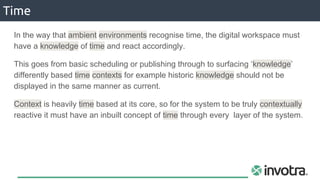
Time
In the way that ambient environments recognise time, the digital workspace must
have a knowledge of time and react accordingly.
This goes from basic scheduling or publishing through to surfacing ‘knowledge’
differently based time contexts for example historic knowledge should not be
displayed in the same manner as current.
Context is heavily time based at its core, so for the system to be truly contextually
reactive it must have an inbuilt concept of time through every layer of the system.
Relationships
Everything within the system needs to relate to something else in order for the
system to make sense. If they don't have any relationships then they don't belong
in the same system. The digital workspace needs to overlay a layer of
relationships over different systems. Sometimes these relationships can be
obvious, like a user is the author of a policy or responsible for a fire extinguisher or
manager of a building. Other relationships can be more nebulous like sender or
receiver. It's critical that the workspace understands and handles this broad set of
relationship types and reacts accordingly.
Governance
Enabling rapid evolution and application of governance models sits at the core of
the concept of the digital workspace. The application of governance is critical to
operational success and ensures risk reduction during ever evolving
organisational structures.
You must ensure implementation of governance across a wide range of areas
including : Legal / Standards / policies / rights / commercial obligations /
Auditability / regulatory / transparency.
These can be implemented in a variety of ways and frequently will need to be a
combination of areas where relationships are a major factor.
Patterns
The necessity to leverage all an organisation's resources means understanding
what's happening all the time across the entire organisation, its connected
resources is absolutely critical to overall success. The full meaning of an
interaction in its totality (context) can only be achieved through extensive use of
analytics.
Feedback loops driven by statistical analysis should be used to develop the overall
mechanical surfacing of interactions. These patterns become the lifeblood of the
organisation and rapidly identifying them and reacting accordingly is critical to
attaining the levels of velocity needed by modern organisations.
Establishing the full meaning of an interaction in its totality in order to deliver back
the right interaction is key to making the system truly efficient and usable.
Targeting responses based on context in a personalised manner is at the core of
the digital workspace concept. Statistical interactions can also be used to drive
contextual reactions in order to become truly responsive to the greater
organisational context.
Context should take as many inputs as is feasible, but as an absolute minimum
you should consider time, relationship, interaction model, location and personal
attributes.
Context
Orchestration
Organisations need to be able to orchestrate what's happening, when and by who
with significant velocity . This orchestration of all available resources needs to be
fluid and responsive while adhering to the governance set out. Both centralised
and decentralised orchestration are necessary to allow your organisation to
respond to the individual user needs.
Centralised orchestration allows you to rapidly evolve by deploying new major
resources, while decentralised orchestration allows you to respond at a local or
user level to their personal context.
Polymorphism
Facilitating interactions between ‘people’, ‘knowledge’ and ‘environment’ enable
your organisation to be contextually optimised. From simplistic messages telling
you a plant needs water to complex knowledge based reactions, like changing a
organisational alert status based on inputs from internal and external systems, all
need to be handled.
Fundamentally you need to have a system that recognises and handles different
multiway actions based on a variety of inputs from different sources, probably the
most important of these being actions based on knowledge based variable
analysis combined with contextual filters. With this volume of actions it's critical
that you have established patterns that can be leveraged.
User Experience
In order for the digital workspace to work its must allow you to react to your
organisational user needs. As organisations evolve the system must support this
from simply changing the branding to restructuring the IA / UI.
What really matters is that this control is in the hands of the organisation rather
than being dictated to by an agent.
To be truly useful the system must give a unified user experience over disunified
disparate systems, always giving the user a sense of the overall organisational
context.

What is a digital workspace

  • 1.
    What is adigital workspace? Source: https://www.invotra.com/blogs/defining-digital-workspace Authored by: Fintan Galvin
  • 2.
    A definition forDigital workspaces Noun: Digital Workspace ❖ Digital - Involving or relating to the use of computer technology ❖ Workspace - A place or environment where people work The unified interface where users engage with people, knowledge & their environment with the sole purpose of getting their job done.
  • 3.
    Digital Workspace VDigital Workplace One of the key areas of confusion is the difference between workplace and workspace. We see the key difference being that the ‘Digital Workspace’ spans any part of / or multiple workplaces and frequently will not be physically connected.
  • 4.
  • 5.
    In the earlydays we found that the structured systems we used for lines of business such as finance or booking systems could not handle the unstructured information that flows around our organisations. This was a hindrance to day to day operations. To solve the problem we came up with the Intranet and it became the dumping ground of everything that did not have a defined structured home. Key aspects : Basic content management / Widgets to display content / Revisions of information / Basic Search / Workflows / Navigation management / Data import / Analytics Intranet : All about Knowledge : 1990’s - 2000’s
  • 6.
    As social networksbecame more prevalent and people got used to interacting online, we began to realise the benefits of these social interactions. Leveraging them was a popular way to drive engagement among employees within organisations. So began, the Social Intranet where we replicate relationships and interactions in our private lives with those within organisations and teams. The familiarity of these interactions are commonplace, thus proving popular with the masses. Key aspects : Discussions / Commenting / Productivity tools / Following / Voting / Org Charts / Profiles / Groups / Layout control Social Intranet : All about People : 2010 - 2014
  • 7.
    Suddenly we recognisethat it’s not only ‘people’ and ‘knowledge’ that are relative but also the workspace environment and everything within it. The era of connecting all the dots was born with the arrival of the Internet of Things (IOT). The Digital Workspace combines the IOT concept with the traditional Intranet and Social Intranet. Key aspects : Building Information (bim) / Location aware / Contextual / Spaces / Sensors / Spaces / Environmental / Ambience Digital Workspace : All about Things :2014 - 2016
  • 8.
    What are thekey drivers of Digital Workspace evolution?
  • 9.
    A need toinstantly engage and communicate with everyone in your organisational network has intensified over recent years with the use of multiple communication channels. Enabling and consolidating the channels is a key driver for the development of the digital workspace. There is an increasing drain on everyones attention with a constant flow of new inputs from social and environmental sources, that is making it ever more difficult to engage and then maintain people's engagement with organisations. Organisational Engagement
  • 10.
    Smartphones with GPSare helping people be more efficient in their travel. We are gaining additional ways to make sure our work environments are not only more supportive but safer and more efficient. We can now support our employees by leveraging the ‘things’ in their environment in countless ways. New opportunities are available to organisations that believe in early adoption of innovative workplace technologies. Your digital workspace is the nervous system for your organisation. Ambient work environments
  • 11.
    The relatively recentexplosion in smaller communications & notifications has proven to be a significant driver in the way we ingest information and how we expect to send and receive information. The move from complex infrequently changed communications that had long life spans to smaller more frequently updated communications has proven to be dramatic driver of our working environments. Micronisation of communications
  • 12.
    Organisations are nowbeing designed for a state of constant change, rather than a steady state. Increased complexity in existing organisational models driven by external social and technical market forces making changing business models the norm. We are seeing organisations rapidly change direction and doing so in timescales that were previously not possible. Accelerated velocity
  • 13.
    Organisational resources arenow more often temporal and fungible. We have always had an element of this in organisations, with short term leases on equipment or hiring contractors. Now we are seeing this becoming micronised in every area of the business. Organisations are hiring people and resources for minutes rather than days or weeks. As more and more things and people become connected this just becomes more ubiquitous. Time as a commodity
  • 14.
    What are thekey enablers of a digital workplace?
  • 15.
    People At the coreis the need to engage people with each other, ‘knowledge’ and ‘environment’ at the time they need it. To this end you have to ensure that the system provides them with the ambient support they need to find each other, as well as comprehensive ways in which to surface ‘knowledge’ in a contextually intelligent manner based on the patterns of operation within the organisation. To do this successfully we must leverage every opportunity to consume knowledge into the system from all available resources and understand if that ‘knowledge’ is temporary or lasting. From this we can then apply context, patterns and governance to orchestrate the interactions to best effect.
  • 16.
    Knowledge In order towork, the systems must understand the semantics of the information and the context of the interaction and have an ability to surface ‘knowledge’. Delivering to the right people at the right time is the underpinning key to success. This necessitates the input of rich content be it as simple and comprehensive as possible, as the volumes required is vast in the majority of cases the inputs should be coming from other specialist systems. Understanding of the patterns which necessitates its exposure and then having the ability to deliver this knowledge in the right way to enhance the user experience is the basis for success.
  • 17.
    Environment The evolution ofthe working environment is becoming truly ambient in its ability to support your operational activities and as such a rich source of ‘knowledge’ and context that you can surface. Building information passed from BIM sources through to ‘things’ with sensors and ‘things’ that have been enabled with the likes of RFID stickers. You now have a vast array of information that you need to surface to your users in useful contextually sensitive ways. This enables organisations to become responsive to people's needs in ways that previously were impossible or to expensive.
  • 18.
    Messages Messages come ina huge variety of shapes and sizes, from emails to notifications from devices, which in the main are becoming micronised. Your systems have to recognise and handle this evolution. The volume is growing at an exponential rate and it's critical that your digital workspace allows for both organisational and personal control over these. Not only the quantity and type, but the knowledge needs to be contextually controllable. Digital workspace must focus on only delivering what it needs and interface to existing messaging systems, where it can to ensure that the organisation and people don't get overloaded with messages in different systems.
  • 19.
    Time In the waythat ambient environments recognise time, the digital workspace must have a knowledge of time and react accordingly. This goes from basic scheduling or publishing through to surfacing ‘knowledge’ differently based time contexts for example historic knowledge should not be displayed in the same manner as current. Context is heavily time based at its core, so for the system to be truly contextually reactive it must have an inbuilt concept of time through every layer of the system.
  • 20.
    Relationships Everything within thesystem needs to relate to something else in order for the system to make sense. If they don't have any relationships then they don't belong in the same system. The digital workspace needs to overlay a layer of relationships over different systems. Sometimes these relationships can be obvious, like a user is the author of a policy or responsible for a fire extinguisher or manager of a building. Other relationships can be more nebulous like sender or receiver. It's critical that the workspace understands and handles this broad set of relationship types and reacts accordingly.
  • 21.
    Governance Enabling rapid evolutionand application of governance models sits at the core of the concept of the digital workspace. The application of governance is critical to operational success and ensures risk reduction during ever evolving organisational structures. You must ensure implementation of governance across a wide range of areas including : Legal / Standards / policies / rights / commercial obligations / Auditability / regulatory / transparency. These can be implemented in a variety of ways and frequently will need to be a combination of areas where relationships are a major factor.
  • 22.
    Patterns The necessity toleverage all an organisation's resources means understanding what's happening all the time across the entire organisation, its connected resources is absolutely critical to overall success. The full meaning of an interaction in its totality (context) can only be achieved through extensive use of analytics. Feedback loops driven by statistical analysis should be used to develop the overall mechanical surfacing of interactions. These patterns become the lifeblood of the organisation and rapidly identifying them and reacting accordingly is critical to attaining the levels of velocity needed by modern organisations.
  • 23.
    Establishing the fullmeaning of an interaction in its totality in order to deliver back the right interaction is key to making the system truly efficient and usable. Targeting responses based on context in a personalised manner is at the core of the digital workspace concept. Statistical interactions can also be used to drive contextual reactions in order to become truly responsive to the greater organisational context. Context should take as many inputs as is feasible, but as an absolute minimum you should consider time, relationship, interaction model, location and personal attributes. Context
  • 24.
    Orchestration Organisations need tobe able to orchestrate what's happening, when and by who with significant velocity . This orchestration of all available resources needs to be fluid and responsive while adhering to the governance set out. Both centralised and decentralised orchestration are necessary to allow your organisation to respond to the individual user needs. Centralised orchestration allows you to rapidly evolve by deploying new major resources, while decentralised orchestration allows you to respond at a local or user level to their personal context.
  • 25.
    Polymorphism Facilitating interactions between‘people’, ‘knowledge’ and ‘environment’ enable your organisation to be contextually optimised. From simplistic messages telling you a plant needs water to complex knowledge based reactions, like changing a organisational alert status based on inputs from internal and external systems, all need to be handled. Fundamentally you need to have a system that recognises and handles different multiway actions based on a variety of inputs from different sources, probably the most important of these being actions based on knowledge based variable analysis combined with contextual filters. With this volume of actions it's critical that you have established patterns that can be leveraged.
  • 26.
    User Experience In orderfor the digital workspace to work its must allow you to react to your organisational user needs. As organisations evolve the system must support this from simply changing the branding to restructuring the IA / UI. What really matters is that this control is in the hands of the organisation rather than being dictated to by an agent. To be truly useful the system must give a unified user experience over disunified disparate systems, always giving the user a sense of the overall organisational context.