AGILITY THROUGH DESIGN
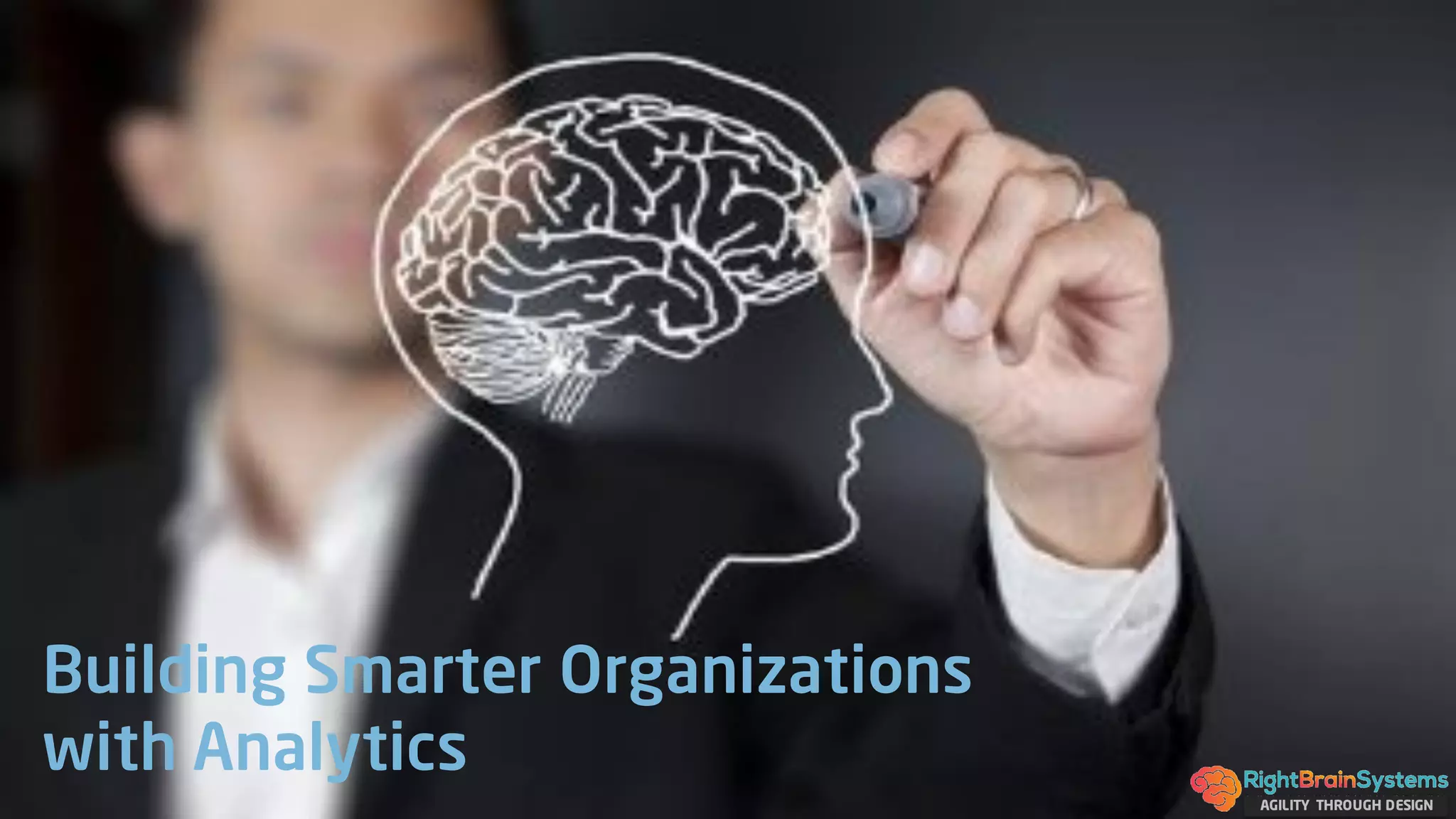
Building Smarter Organizations
with Analytics
AGILITY THROUGH DESIGN
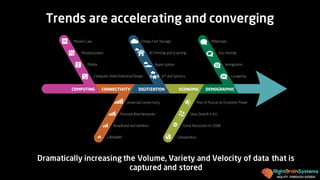
Trends are accelerating and converging
Dramatically increasing the Volume, Variety and Velocity of data that is
captured and stored
AGILITY THROUGH DESIGN
“What information consumes is rather obvious: it consumes the attention of its
recipients. Hence a wealth of information creates a poverty of attention, and a need to
allocate that attention efficiently among the overabundance of information sources
that might consume it.”
Herbert Simon
It is key to find the right balance between human intuition, analytics and
organizational capability
Raising the question – Can humans and
organizations keep up?
“Avoidable failures are common and persistent, not to mention demoralizing and frustrating
across many fields – from medicine to finance, business to government. And the reason is
increasingly evident: the volume and complexity of what we know has exceeded our
individual ability to deliver its benefits correctly, safely, or reliably. “
Dr. Atul Gawande, The Checklist Manifesto
AGILITY THROUGH DESIGN
We want to build Smarter Organizations that deliver meaningful business
results through secure, seamless context-aware experiences in a data
driven world
Our approach to Analytics is focused on
building the organizational capability for
Business Agility that can sense changes,
understand them, respond to them
through business actions and refine these
actions continuously to deliver better
business results
Our approach to Analytics
AGILITY THROUGH DESIGN
Analytics is a competitive differentiator
These patterns lead to
business insights
which can be translated
into specific actions to
drive meaningful
business outcomes.
Analytics is the discovery
and communication of
meaningful patterns in
data.
AGILITY THROUGH DESIGN
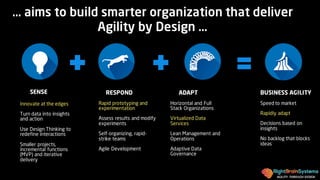
… aims to build smarter organization that deliver
Agility by Design …
• Innovate at the edges
• Turn data into insights
and action
• Use Design Thinking to
redefine interactions
• Smaller projects,
incremental functions
(MVP) and iterative
delivery
SENSE
• Rapid prototyping and
experimentation
• Assess results and modify
experiments
• Self-organizing, rapid-
strike teams
• Agile Development
RESPOND
• Horizontal and Full
Stack Organizations
• Virtualized Data
Services
• Lean Management and
Operations
• Adaptive Data
Governance
ADAPT
• Speed to market
• Rapidly adapt
• Decisions based on
insights
• No backlog that blocks
ideas
BUSINESS AGILITY
AGILITY THROUGH DESIGN
CUSTOMER OPERATIONAL ANALYTICS
MARKETING SALES SUPPLY CHAIN
FINANCIAL WORKFORCE
CUSTOMER ANALYTICS
Help determine Next Best
Action or Next BestOffer
CUSTOMER
INTERACTION
ANALYTICS
Improve Customer
Experience and reduce cost
of service
SOCIAL ANALYTICS
Drive brand loyalty and
service recovery actions
based on sentiment
analysis on social media
CUSTOMER
INTELLIGENCE
Improve customer share of
wallet through target
marketing
MARKET INTELLIGENCE
Provide insights into
market trends and
customer behavior
MARKETING
EFFECTIVENESS
Drive returns from better
marketing spend allocation
PRICING ANALYTICS
Provide price / discount
insights for specific sales
SALES FORCE
ALLOCATION
Drive sales coverage across
addressable segments
SALES EFFECTIVENESS
Enable effectiveness of
sales pursuit and
conversion
SALES COMPENSATION
Design and track sales
compensation for
optimization
PRODUCT SALES
PERFORMANCE
Monitor sales performance
by product/ solution
DEMAND-SUPPLY
PLANNING
Reduce demand-supply
mismatch through better
forecasting
INVENTORY
OPTIMIZATION
Reduce own and channel
inventory costs
PROCUREMENT
ANALYTICS
Drive savings from spend
forecasting and
consolidation
FINANCIAL REPORTING
& ANALYTICS
(Budget and forecasting,
P&L / Balance Sheet
review)
COMPLIANCE & RISK
Continuous monitoring,
better audit sampling to
test controls and enable
revenue hedging
CUSTOMER
PROFITABILITY
Continuous monitoring and
optimizing of customer and
product profitability
WORKFORCE
OPTIMIZATION
Allocation / matching of
workforce for efficient
usage
ATTRITION MODELING
Identify attrition
propensitybased on
characteristics & drivers
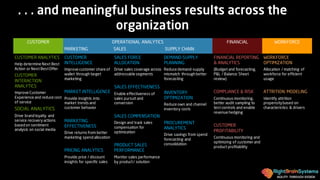
. . . and meaningful business results across the
organization
AGILITY THROUGH DESIGN
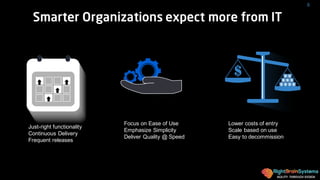
Smarter Organizations expect more from IT
8
• Just-right functionality
• Continuous Delivery
• Frequent releases
• Lower costs of entry
• Scale based on use
• Easy to decommission
• Focus on Ease of Use
• Emphasize Simplicity
• Deliver Quality @ Speed
AGILITY THROUGH DESIGN
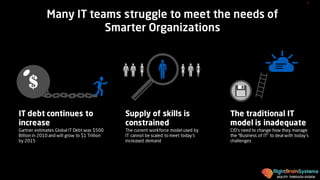
Many IT teams struggle to meet the needs of
Smarter Organizations
9
IT debt continues to
increase
Gartner estimates Global IT Debt was $500
Billion in 2010 and will grow to $1 Trillion
by 2015
The traditional IT
model is inadequate
CIO’s need to change how they manage
the “Business of IT” to deal with today’s
challenges
Supply of skills is
constrained
The current workforce model used by
IT cannot be scaled to meet today’s
increased demand
AGILITY THROUGH DESIGN
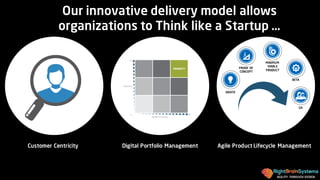
Our innovative delivery model allows
organizations to Think like a Startup …
Digital Portfolio Management Agile Product Lifecycle ManagementCustomer Centricity
IDEATE
PROOF OF
CONCEPT
MINIMUM
VIABLE
PRODUCT
BETA
GA
AGILITY THROUGH DESIGN
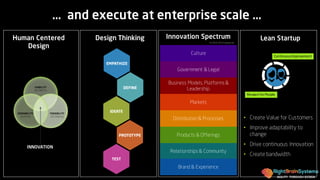
Culture
Government & Legal
Business Models, Platforms &
Leadership
Markets
Distribution& Processes
Products & Offerings
Relationships & Community
Brand & Experience
© 2014-2015 Causeit, inc.
Innovation SpectrumDesign Thinking
VIABILITY
(BUSINESS)
FEASIBILITY
(TECHNICAL)
DESRABILITY
(HUMAN)
Human Centered
Design
INNOVATION
Lean Startup
Respect for People
ContinuousImprovement
• Create Value for Customers
• Improve adaptability to
change
• Drive continuous Innovation
• Create bandwidth
… and execute at enterprise scale …
AGILITY THROUGH DESIGN
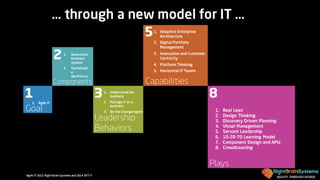
… through a new model for IT …
1. Adaptive Enterprise
Architecture
2. Digital Portfolio
Management
3. Innovation and Customer
Centricity
4. Platform Thinking
5. Horizontal IT Teams
1. Understand the
business
2. Manage IT as a
business
3. Be the Change Agent
1. Innovative
business
system
2. Sustainabl
e
Workforce
1. Agile IT
1. Real Lean
2. Design Thinking
3. Discovery Driven Planning
4. Visual Management
5. Servant Leadership
6. 10-20-70 Learning Model
7. Component Design and APIs
8. Crowdsourcing
* Agile IT 2012 Right Brain Systems and 2014 NTT i3
AGILITY THROUGH DESIGN
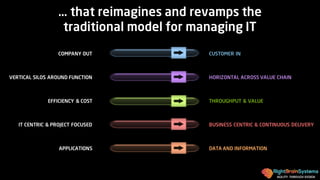
… that reimagines and revamps the
traditional model for managing IT
COMPANY OUT
VERTICAL SILOS AROUND FUNCTION
EFFICIENCY & COST
IT CENTRIC & PROJECT FOCUSED
CUSTOMER IN
HORIZONTAL ACROSS VALUE CHAIN
THROUGHPUT & VALUE
BUSINESS CENTRIC & CONTINUOUS DELIVERY
APPLICATIONS DATA AND INFORMATION
AGILITY THROUGH DESIGN
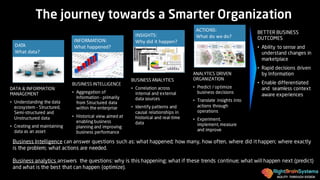
ACTIONS:
What	do	we	do?
DATA & INFORMATION
MANAGEMENT
• Understanding the data
ecosystem – Structured,
Semi-structured and
Unstructured data
• Creating and maintaining
data as an asset
BUSINESS INTELLIGENCE
• Aggregation of
Information – primarily
from Structured data
within the enterprise
• Historical view aimed at
enabling business
planning and improving
business performance
BUSINESS ANALYTICS
• Correlation across
internal and external
data sources
• Identify patterns and
causal relationships in
historical and real-time
data
ANALYTICS DRIVEN
ORGANIZATION
• Predict / optimize
business decisions
• Translate insights into
actions through
operations
• Experiment,
implement, measure
and improve
DATA
What	data?
INFORMATION:
What	happened?
INSIGHTS:
Why	did	it	happen?
BETTER BUSINESS
OUTCOMES
• Ability to sense and
understand changes in
marketplace
• Rapid decisions driven
by Information
• Enable differentiated
and seamless context
aware experiences
The journey towards a Smarter Organization
Business Intelligence can answer questions such as: what happened; how many, how often, where did it happen; where exactly
is the problem; what actions are needed.
Business analytics answers the questions: why is this happening; what if these trends continue; what will happen next (predict)
and what is the best that can happen (optimize).
AGILITY THROUGH DESIGN
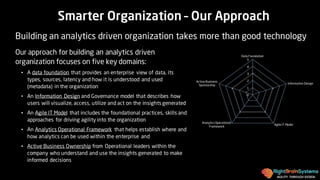
Our approach for building an analytics driven
organization focuses on five key domains:
• A data foundation that provides an enterprise view of data, its
types, sources, latency and how it is understood and used
(metadata) in the organization
• An Information Design and Governance model that describes how
users will visualize, access, utilize and act on the insights generated
• An Agile IT Model that includes the foundational practices, skills and
approaches for driving agility into the organization
• An Analytics Operational Framework that helps establish where and
how analytics can be used within the enterprise and
• Active Business Ownership from Operational leaders within the
company who understand and use the insights generated to make
informed decisions
Building an analytics driven organization takes more than good technology
0
1
2
3
4
5
Data Foundation
Information Design
Agile IT Model
Analytics Operational
Framework
Active Business
Sponsorship
Smarter Organization – Our Approach
AGILITY THROUGH DESIGN
Data Foundation
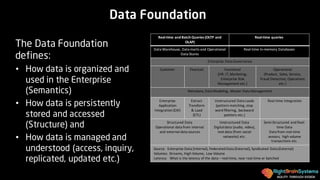
The Data Foundation
defines:
• How data is organized and
used in the Enterprise
(Semantics)
• How data is persistently
stored and accessed
(Structure) and
• How data is managed and
understood (access, inquiry,
replicated, updated etc.)
Real-time and	Batch	Queries	(OLTP	and	
OLAP)
Real-time	queries
Data	Warehouse, Data	marts	and	Operational	
Data	Stores
Real-time	In-memory Databases
Enterprise	Data	Governance
Customer Financial Functional
(HR,	IT,	Marketing,	
Enterprise Risk	
Management	etc.)
Operational	
(Product,	Sales,	Service,	
Fraud	Detection,	Operations	
etc.)
Metadata,Data	Modeling,	Master	Data	Management
Enterprise
Application	
Integration	(EAI)
Extract	
Transform	
&	Load	
(ETL)
Unstructured	Data	Loads
(pattern matching,	stop	
word	filtering,	backward	
pointers	etc.)
Real-time	Integration
Structured	Data
Operational data	from	internal	
and	external	data	sources
Unstructured	Data
Digitaldata	(audio,	video),	
text	data	(from	social	
networks)	etc.
Semi-Structured and	Real-
time	Data
Data	from	real-time	
sensors,	 high	volume	
transactions	etc.
Source: Enterprise	Data	(Internal),	Federated	Data	(External),	Syndicated	Data	(External)
Volumes:	Streams,	High	Volume,	Low	Volume
Latency:			What	is	the	latency	of	the	data	– real-time,	near real-time	or	batched
AGILITY THROUGH DESIGN
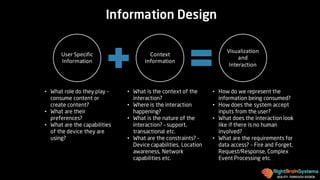
Information Design
User	Specific	
Information
Context	
Information
Visualization	
and	
Interaction
• What role do they play –
consume content or
create content?
• What are their
preferences?
• What are the capabilities
of the device they are
using?
• What is the context of the
interaction?
• Where is the interaction
happening?
• What is the nature of the
interaction? – support,
transactional etc.
• What are the constraints? –
Device capabilities, Location
awareness, Network
capabilities etc.
• How do we represent the
information being consumed?
• How does the system accept
inputs from the user?
• What does the interaction look
like if there is no human
involved?
• What are the requirements for
data access? – Fire and Forget,
Request/Response, Complex
Event Processing etc.
AGILITY THROUGH DESIGN
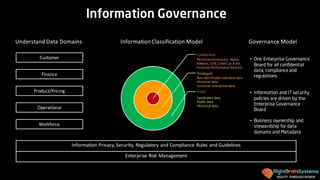
Information Governance
Understand	Data	Domains Information	Classification	Model Governance	Model
Information	Privacy,	Security,	Regulatory	and	Compliance	Rules	and	Guidelines
Enterprise	Risk	Management
Confidential	
Privileged
Public
Customer
Finance
Product/Pricing
Operational
Workforce
Personal Information – Name,
Address, SSN, Credit Car # etc.
Financial Performance Dataetc.
Non-identifiable individual data
Historical data
Customer interactiondata
Syndicated data
Public data
Historical data
• One Enterprise Governance
Board for all confidential
data, compliance and
regulations
• Information and IT security
policies are driven by the
Enterprise Governance
Board
• Business ownership and
stewardship for data
domains and Metadata
AGILITY THROUGH DESIGN
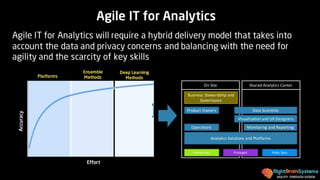
Agile IT for Analytics
Agile IT for Analytics will require a hybrid delivery model that takes into
account the data and privacy concerns and balancing with the need for
agility and the scarcity of key skills
Shared	Analytics	CenterOn	Site
Private	Data Privileged Public	Data
Product	Owners Data	Scientists
Visualization	and	UX	Designers
Operations Monitoring	and	Reporting
Analytics	Solutions	and	Platforms
Business	Stewardship	and
Governance
Accuracy
Effort
Platforms
Ensemble
Methods
Deep Learning
Methods
AGILITY THROUGH DESIGN
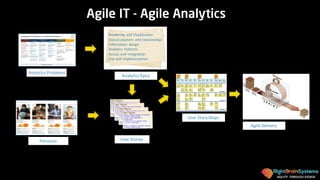
Agile IT - Agile Analytics
User	Story	Maps
User	Stories
Analytics	Epics
Personas
Analytics	Problems
Agile	Delivery
Rendering	and	Visualization
Data	Ecosystem	 and	relationships
Information	 design	
Analytics	 Patterns
Access	and	Integration
Use	and	Implementation
AGILITY THROUGH DESIGN
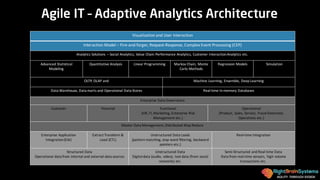
Agile IT – Adaptive Analytics Architecture
Visualization	and	User	Interaction
Interaction	Model	– Fire-and-forger, Request-Response,	Complex	Event	Processing	(CEP)
Analytics	Solutions – Social	Analytics,	Value	Chain	Performance	Analytics,	Customer	Interaction	Analytics	etc.
Advanced	Statistical	
Modeling
Quantitative	Analysis Linear	Programming Markov Chain,	Monte	
Carlo	Methods
Regression	Models Simulation
OLTP,	OLAP	and	 Machine	Learning,	Ensemble,	Deep	Learning
Data	Warehouse, Data	marts	and	Operational	Data	Stores Real-time	In-memory Databases
Enterprise	Data	Governance
Customer Financial Functional
(HR,	IT,	Marketing,	Enterprise Risk	
Management	etc.)
Operational	
(Product,	Sales,	Service,	Fraud	Detection,	
Operations	etc.)
Master	Data	Management,	Distributed	Map	Reduce
Enterprise Application	
Integration	(EAI)
Extract Transform	&	
Load	(ETL)
Unstructured	Data	Loads
(pattern matching,	stop	word	filtering,	backward	
pointers	etc.)
Real-time	Integration
Structured	Data
Operational data	from	internal	and	external	data	sources
Unstructured	Data
Digitaldata	(audio,	video),	text	data	(from	social	
networks)	etc.
Semi-Structured and	Real-time	Data
Data	from	real-time	sensors,	 high	volume	
transactions	etc.
AGILITY THROUGH DESIGN
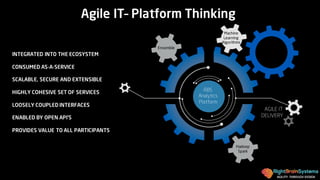
INTEGRATED INTO THE ECOSYSTEM
CONSUMED AS-A-SERVICE
SCALABLE, SECURE AND EXTENSIBLE
HIGHLY COHESIVE SET OF SERVICES
LOOSELY COUPLED INTERFACES
ENABLED BY OPEN API’S
PROVIDES VALUE TO ALL PARTICIPANTS
Agile IT– Platform Thinking
AGILE IT
DELIVERY
Ensemble
Hadoop
Spark
Machine
Learning
Algorithms
RBS
Analytics
Platform
AGILITY THROUGH DESIGN
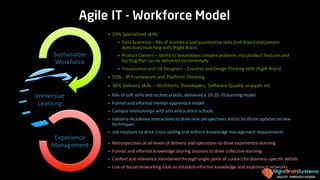
Agile IT - Workforce Model
• 20%	Specialized	skills
• Data	Scientists	– Mix	of	statistical	and	quantitative	skills	(Left	Brain)	and	pattern	
detection/matching	skills	(Right	Brain)
• Product	Owners	– Ability	to	breakdown	complex	problems	into	product	features	and	
backlog	that	can	be	delivered	incrementally
• Visualization	and	UX	Designers	– Creative	and	Design	Thinking	skills	(Right	Brain)
• 50%	- IP,	Framework	and	Platform	Thinking
• 30%	Delivery	skills	– Architects,	Developers,	Software	Quality	analysts	etc.
• Mix	of	soft	skills	and	technical	skills,	delivered	a	10-20-70	learning	model
• Formal	and	informal	mentor-apprentice	model
• Campus	relationships	with	arts	and	science	schools
• Industry-Academia	interactions	to	drive	new	perspectives	and	to	facilitate	updates	on	new	
techniques
• Job	rotations	to	drive	cross-skilling	and	enforce	knowledge	management	requirements
• Retrospectives	at	all	levels	of	delivery	and	operations	to	drive	experiential	learning
• Formal	and	informal	knowledge	sharing	sessions	to	drive	collective	learning
• Context	and	relevance	maintained	through	single-point	of	contact	for	business-specific	details
• Use	of	Social	networking	tools	to	establish	informal	knowledge	and	experience	networks
Sustainable	
Workforce
Immersive	
Learning
Experience	
Management
AGILITY THROUGH DESIGN
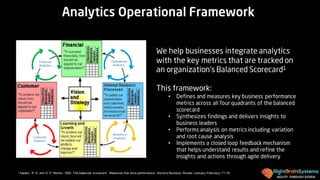
Analytics Operational Framework
Workforce
Analytics
Operational
Analytics
Customer
Analytics
Financial
Analytics
We help businesses integrate analytics
with the key metrics that are tracked on
an organization’s Balanced Scorecard1
This framework:
• Defines and measures key business performance
metrics across all four quadrants of the balanced
scorecard
• Synthesizes findings and delivers insights to
business leaders
• Performs analysis on metrics including variation
and root cause analysis
• Implements a closed loop feedback mechanism
that helps understand results and refine the
insights and actions through agile delivery
1 Kaplan, R. S. and D. P. Norton. 1992. The balanced scorecard - Measures that drive performance. Harvard Business Review (January-February): 71-79.
AGILITY THROUGH DESIGN
• Business Agility is a core capability of today’s Smart Organizations
• Smart Organizations are powered by analytics and require a new and
comprehensive set of capabilities
• Traditional IT and Service provider models are inadequate to support Smart
Organizations
• Our innovative platform enabled delivery model provides Agility, Speed and
Quality @ Scale
Conclusion
AGILITY THROUGH DESIGN
About the presenter
Srini Koushik is President and CEOof Right Brain Systems, a SiliconValley-based think tank focused
on Digital Business and Business Agility . Srini was 30 years of experience as Programmer,
Architect, CTO, CIO and P&L owner at Fortune 100 Companies including IBM, HP and Nationwide.
Srini was most recently President and CEOof NTT Innovation Institute Inc. (NTT i3) the global R&D
lab established by NTT the Japanese Telecom company.
Srini is an Open Group Distinguished Certified Architecture profession leader. He has published
several articles, holds three patents, and co-authored a best-selling book, Patterns for e-business,
in 2001. He was elected to the IBM Academy of Technology, and was named an IBM Distinguished
Engineer in1996. He was alsonamed an Elite 8 CIO by Insurance and Technology, a Top 25 CIO by
Infoworld, a Top 10 All-Star inthe financial services industry by TechDecisions, and a
Computerworld Premier 100 Technology Leader in 2014.
Srini holds a bachelor’s degree in physics from the University of Madras, a master’s degree in
computer science from the University of Bombay, a master’s degree in business administration
from Ohio State University, and has completed executive education courses from both the MIT
Sloan School of Management and Duke University.
Srini enjoys skydiving, hang gliding and other extreme sports. He is currently working towards his
private pilot license. He enjoys traveling and has been to 55 countries and wants to visit the other
140 countries in his lifetime. He lives with his wife, daughter in Monte Sereno, California.
AGILITY THROUGH DESIGN
http://www.rightbrainsystems.com
https://twitter.com/skoushik
https://www.linkedin.com/in/srinikoushik
https://www.facebook.com/srinikoushik
https://www.slideshare.net/rightbrainsystems

Building a Smarter Organization

  • 1.
    AGILITY THROUGH DESIGN BuildingSmarter Organizations with Analytics AGILITY THROUGH DESIGN
  • 2.
    AGILITY THROUGH DESIGN Trendsare accelerating and converging Dramatically increasing the Volume, Variety and Velocity of data that is captured and stored
  • 3.
    AGILITY THROUGH DESIGN “Whatinformation consumes is rather obvious: it consumes the attention of its recipients. Hence a wealth of information creates a poverty of attention, and a need to allocate that attention efficiently among the overabundance of information sources that might consume it.” Herbert Simon It is key to find the right balance between human intuition, analytics and organizational capability Raising the question – Can humans and organizations keep up? “Avoidable failures are common and persistent, not to mention demoralizing and frustrating across many fields – from medicine to finance, business to government. And the reason is increasingly evident: the volume and complexity of what we know has exceeded our individual ability to deliver its benefits correctly, safely, or reliably. “ Dr. Atul Gawande, The Checklist Manifesto
  • 4.
    AGILITY THROUGH DESIGN Wewant to build Smarter Organizations that deliver meaningful business results through secure, seamless context-aware experiences in a data driven world Our approach to Analytics is focused on building the organizational capability for Business Agility that can sense changes, understand them, respond to them through business actions and refine these actions continuously to deliver better business results Our approach to Analytics
  • 5.
    AGILITY THROUGH DESIGN Analyticsis a competitive differentiator These patterns lead to business insights which can be translated into specific actions to drive meaningful business outcomes. Analytics is the discovery and communication of meaningful patterns in data.
  • 6.
    AGILITY THROUGH DESIGN …aims to build smarter organization that deliver Agility by Design … • Innovate at the edges • Turn data into insights and action • Use Design Thinking to redefine interactions • Smaller projects, incremental functions (MVP) and iterative delivery SENSE • Rapid prototyping and experimentation • Assess results and modify experiments • Self-organizing, rapid- strike teams • Agile Development RESPOND • Horizontal and Full Stack Organizations • Virtualized Data Services • Lean Management and Operations • Adaptive Data Governance ADAPT • Speed to market • Rapidly adapt • Decisions based on insights • No backlog that blocks ideas BUSINESS AGILITY
  • 7.
    AGILITY THROUGH DESIGN CUSTOMEROPERATIONAL ANALYTICS MARKETING SALES SUPPLY CHAIN FINANCIAL WORKFORCE CUSTOMER ANALYTICS Help determine Next Best Action or Next BestOffer CUSTOMER INTERACTION ANALYTICS Improve Customer Experience and reduce cost of service SOCIAL ANALYTICS Drive brand loyalty and service recovery actions based on sentiment analysis on social media CUSTOMER INTELLIGENCE Improve customer share of wallet through target marketing MARKET INTELLIGENCE Provide insights into market trends and customer behavior MARKETING EFFECTIVENESS Drive returns from better marketing spend allocation PRICING ANALYTICS Provide price / discount insights for specific sales SALES FORCE ALLOCATION Drive sales coverage across addressable segments SALES EFFECTIVENESS Enable effectiveness of sales pursuit and conversion SALES COMPENSATION Design and track sales compensation for optimization PRODUCT SALES PERFORMANCE Monitor sales performance by product/ solution DEMAND-SUPPLY PLANNING Reduce demand-supply mismatch through better forecasting INVENTORY OPTIMIZATION Reduce own and channel inventory costs PROCUREMENT ANALYTICS Drive savings from spend forecasting and consolidation FINANCIAL REPORTING & ANALYTICS (Budget and forecasting, P&L / Balance Sheet review) COMPLIANCE & RISK Continuous monitoring, better audit sampling to test controls and enable revenue hedging CUSTOMER PROFITABILITY Continuous monitoring and optimizing of customer and product profitability WORKFORCE OPTIMIZATION Allocation / matching of workforce for efficient usage ATTRITION MODELING Identify attrition propensitybased on characteristics & drivers . . . and meaningful business results across the organization
  • 8.
    AGILITY THROUGH DESIGN SmarterOrganizations expect more from IT 8 • Just-right functionality • Continuous Delivery • Frequent releases • Lower costs of entry • Scale based on use • Easy to decommission • Focus on Ease of Use • Emphasize Simplicity • Deliver Quality @ Speed
  • 9.
    AGILITY THROUGH DESIGN ManyIT teams struggle to meet the needs of Smarter Organizations 9 IT debt continues to increase Gartner estimates Global IT Debt was $500 Billion in 2010 and will grow to $1 Trillion by 2015 The traditional IT model is inadequate CIO’s need to change how they manage the “Business of IT” to deal with today’s challenges Supply of skills is constrained The current workforce model used by IT cannot be scaled to meet today’s increased demand
  • 10.
    AGILITY THROUGH DESIGN Ourinnovative delivery model allows organizations to Think like a Startup … Digital Portfolio Management Agile Product Lifecycle ManagementCustomer Centricity IDEATE PROOF OF CONCEPT MINIMUM VIABLE PRODUCT BETA GA
  • 11.
    AGILITY THROUGH DESIGN Culture Government& Legal Business Models, Platforms & Leadership Markets Distribution& Processes Products & Offerings Relationships & Community Brand & Experience © 2014-2015 Causeit, inc. Innovation SpectrumDesign Thinking VIABILITY (BUSINESS) FEASIBILITY (TECHNICAL) DESRABILITY (HUMAN) Human Centered Design INNOVATION Lean Startup Respect for People ContinuousImprovement • Create Value for Customers • Improve adaptability to change • Drive continuous Innovation • Create bandwidth … and execute at enterprise scale …
  • 12.
    AGILITY THROUGH DESIGN …through a new model for IT … 1. Adaptive Enterprise Architecture 2. Digital Portfolio Management 3. Innovation and Customer Centricity 4. Platform Thinking 5. Horizontal IT Teams 1. Understand the business 2. Manage IT as a business 3. Be the Change Agent 1. Innovative business system 2. Sustainabl e Workforce 1. Agile IT 1. Real Lean 2. Design Thinking 3. Discovery Driven Planning 4. Visual Management 5. Servant Leadership 6. 10-20-70 Learning Model 7. Component Design and APIs 8. Crowdsourcing * Agile IT 2012 Right Brain Systems and 2014 NTT i3
  • 13.
    AGILITY THROUGH DESIGN …that reimagines and revamps the traditional model for managing IT COMPANY OUT VERTICAL SILOS AROUND FUNCTION EFFICIENCY & COST IT CENTRIC & PROJECT FOCUSED CUSTOMER IN HORIZONTAL ACROSS VALUE CHAIN THROUGHPUT & VALUE BUSINESS CENTRIC & CONTINUOUS DELIVERY APPLICATIONS DATA AND INFORMATION
  • 14.
    AGILITY THROUGH DESIGN ACTIONS: What do we do? DATA& INFORMATION MANAGEMENT • Understanding the data ecosystem – Structured, Semi-structured and Unstructured data • Creating and maintaining data as an asset BUSINESS INTELLIGENCE • Aggregation of Information – primarily from Structured data within the enterprise • Historical view aimed at enabling business planning and improving business performance BUSINESS ANALYTICS • Correlation across internal and external data sources • Identify patterns and causal relationships in historical and real-time data ANALYTICS DRIVEN ORGANIZATION • Predict / optimize business decisions • Translate insights into actions through operations • Experiment, implement, measure and improve DATA What data? INFORMATION: What happened? INSIGHTS: Why did it happen? BETTER BUSINESS OUTCOMES • Ability to sense and understand changes in marketplace • Rapid decisions driven by Information • Enable differentiated and seamless context aware experiences The journey towards a Smarter Organization Business Intelligence can answer questions such as: what happened; how many, how often, where did it happen; where exactly is the problem; what actions are needed. Business analytics answers the questions: why is this happening; what if these trends continue; what will happen next (predict) and what is the best that can happen (optimize).
  • 15.
    AGILITY THROUGH DESIGN Ourapproach for building an analytics driven organization focuses on five key domains: • A data foundation that provides an enterprise view of data, its types, sources, latency and how it is understood and used (metadata) in the organization • An Information Design and Governance model that describes how users will visualize, access, utilize and act on the insights generated • An Agile IT Model that includes the foundational practices, skills and approaches for driving agility into the organization • An Analytics Operational Framework that helps establish where and how analytics can be used within the enterprise and • Active Business Ownership from Operational leaders within the company who understand and use the insights generated to make informed decisions Building an analytics driven organization takes more than good technology 0 1 2 3 4 5 Data Foundation Information Design Agile IT Model Analytics Operational Framework Active Business Sponsorship Smarter Organization – Our Approach
  • 16.
    AGILITY THROUGH DESIGN DataFoundation The Data Foundation defines: • How data is organized and used in the Enterprise (Semantics) • How data is persistently stored and accessed (Structure) and • How data is managed and understood (access, inquiry, replicated, updated etc.) Real-time and Batch Queries (OLTP and OLAP) Real-time queries Data Warehouse, Data marts and Operational Data Stores Real-time In-memory Databases Enterprise Data Governance Customer Financial Functional (HR, IT, Marketing, Enterprise Risk Management etc.) Operational (Product, Sales, Service, Fraud Detection, Operations etc.) Metadata,Data Modeling, Master Data Management Enterprise Application Integration (EAI) Extract Transform & Load (ETL) Unstructured Data Loads (pattern matching, stop word filtering, backward pointers etc.) Real-time Integration Structured Data Operational data from internal and external data sources Unstructured Data Digitaldata (audio, video), text data (from social networks) etc. Semi-Structured and Real- time Data Data from real-time sensors, high volume transactions etc. Source: Enterprise Data (Internal), Federated Data (External), Syndicated Data (External) Volumes: Streams, High Volume, Low Volume Latency: What is the latency of the data – real-time, near real-time or batched
  • 17.
    AGILITY THROUGH DESIGN InformationDesign User Specific Information Context Information Visualization and Interaction • What role do they play – consume content or create content? • What are their preferences? • What are the capabilities of the device they are using? • What is the context of the interaction? • Where is the interaction happening? • What is the nature of the interaction? – support, transactional etc. • What are the constraints? – Device capabilities, Location awareness, Network capabilities etc. • How do we represent the information being consumed? • How does the system accept inputs from the user? • What does the interaction look like if there is no human involved? • What are the requirements for data access? – Fire and Forget, Request/Response, Complex Event Processing etc.
  • 18.
    AGILITY THROUGH DESIGN InformationGovernance Understand Data Domains Information Classification Model Governance Model Information Privacy, Security, Regulatory and Compliance Rules and Guidelines Enterprise Risk Management Confidential Privileged Public Customer Finance Product/Pricing Operational Workforce Personal Information – Name, Address, SSN, Credit Car # etc. Financial Performance Dataetc. Non-identifiable individual data Historical data Customer interactiondata Syndicated data Public data Historical data • One Enterprise Governance Board for all confidential data, compliance and regulations • Information and IT security policies are driven by the Enterprise Governance Board • Business ownership and stewardship for data domains and Metadata
  • 19.
    AGILITY THROUGH DESIGN AgileIT for Analytics Agile IT for Analytics will require a hybrid delivery model that takes into account the data and privacy concerns and balancing with the need for agility and the scarcity of key skills Shared Analytics CenterOn Site Private Data Privileged Public Data Product Owners Data Scientists Visualization and UX Designers Operations Monitoring and Reporting Analytics Solutions and Platforms Business Stewardship and Governance Accuracy Effort Platforms Ensemble Methods Deep Learning Methods
  • 20.
    AGILITY THROUGH DESIGN AgileIT - Agile Analytics User Story Maps User Stories Analytics Epics Personas Analytics Problems Agile Delivery Rendering and Visualization Data Ecosystem and relationships Information design Analytics Patterns Access and Integration Use and Implementation
  • 21.
    AGILITY THROUGH DESIGN AgileIT – Adaptive Analytics Architecture Visualization and User Interaction Interaction Model – Fire-and-forger, Request-Response, Complex Event Processing (CEP) Analytics Solutions – Social Analytics, Value Chain Performance Analytics, Customer Interaction Analytics etc. Advanced Statistical Modeling Quantitative Analysis Linear Programming Markov Chain, Monte Carlo Methods Regression Models Simulation OLTP, OLAP and Machine Learning, Ensemble, Deep Learning Data Warehouse, Data marts and Operational Data Stores Real-time In-memory Databases Enterprise Data Governance Customer Financial Functional (HR, IT, Marketing, Enterprise Risk Management etc.) Operational (Product, Sales, Service, Fraud Detection, Operations etc.) Master Data Management, Distributed Map Reduce Enterprise Application Integration (EAI) Extract Transform & Load (ETL) Unstructured Data Loads (pattern matching, stop word filtering, backward pointers etc.) Real-time Integration Structured Data Operational data from internal and external data sources Unstructured Data Digitaldata (audio, video), text data (from social networks) etc. Semi-Structured and Real-time Data Data from real-time sensors, high volume transactions etc.
  • 22.
    AGILITY THROUGH DESIGN INTEGRATEDINTO THE ECOSYSTEM CONSUMED AS-A-SERVICE SCALABLE, SECURE AND EXTENSIBLE HIGHLY COHESIVE SET OF SERVICES LOOSELY COUPLED INTERFACES ENABLED BY OPEN API’S PROVIDES VALUE TO ALL PARTICIPANTS Agile IT– Platform Thinking AGILE IT DELIVERY Ensemble Hadoop Spark Machine Learning Algorithms RBS Analytics Platform
  • 23.
    AGILITY THROUGH DESIGN AgileIT - Workforce Model • 20% Specialized skills • Data Scientists – Mix of statistical and quantitative skills (Left Brain) and pattern detection/matching skills (Right Brain) • Product Owners – Ability to breakdown complex problems into product features and backlog that can be delivered incrementally • Visualization and UX Designers – Creative and Design Thinking skills (Right Brain) • 50% - IP, Framework and Platform Thinking • 30% Delivery skills – Architects, Developers, Software Quality analysts etc. • Mix of soft skills and technical skills, delivered a 10-20-70 learning model • Formal and informal mentor-apprentice model • Campus relationships with arts and science schools • Industry-Academia interactions to drive new perspectives and to facilitate updates on new techniques • Job rotations to drive cross-skilling and enforce knowledge management requirements • Retrospectives at all levels of delivery and operations to drive experiential learning • Formal and informal knowledge sharing sessions to drive collective learning • Context and relevance maintained through single-point of contact for business-specific details • Use of Social networking tools to establish informal knowledge and experience networks Sustainable Workforce Immersive Learning Experience Management
  • 24.
    AGILITY THROUGH DESIGN AnalyticsOperational Framework Workforce Analytics Operational Analytics Customer Analytics Financial Analytics We help businesses integrate analytics with the key metrics that are tracked on an organization’s Balanced Scorecard1 This framework: • Defines and measures key business performance metrics across all four quadrants of the balanced scorecard • Synthesizes findings and delivers insights to business leaders • Performs analysis on metrics including variation and root cause analysis • Implements a closed loop feedback mechanism that helps understand results and refine the insights and actions through agile delivery 1 Kaplan, R. S. and D. P. Norton. 1992. The balanced scorecard - Measures that drive performance. Harvard Business Review (January-February): 71-79.
  • 25.
    AGILITY THROUGH DESIGN •Business Agility is a core capability of today’s Smart Organizations • Smart Organizations are powered by analytics and require a new and comprehensive set of capabilities • Traditional IT and Service provider models are inadequate to support Smart Organizations • Our innovative platform enabled delivery model provides Agility, Speed and Quality @ Scale Conclusion
  • 26.
    AGILITY THROUGH DESIGN Aboutthe presenter Srini Koushik is President and CEOof Right Brain Systems, a SiliconValley-based think tank focused on Digital Business and Business Agility . Srini was 30 years of experience as Programmer, Architect, CTO, CIO and P&L owner at Fortune 100 Companies including IBM, HP and Nationwide. Srini was most recently President and CEOof NTT Innovation Institute Inc. (NTT i3) the global R&D lab established by NTT the Japanese Telecom company. Srini is an Open Group Distinguished Certified Architecture profession leader. He has published several articles, holds three patents, and co-authored a best-selling book, Patterns for e-business, in 2001. He was elected to the IBM Academy of Technology, and was named an IBM Distinguished Engineer in1996. He was alsonamed an Elite 8 CIO by Insurance and Technology, a Top 25 CIO by Infoworld, a Top 10 All-Star inthe financial services industry by TechDecisions, and a Computerworld Premier 100 Technology Leader in 2014. Srini holds a bachelor’s degree in physics from the University of Madras, a master’s degree in computer science from the University of Bombay, a master’s degree in business administration from Ohio State University, and has completed executive education courses from both the MIT Sloan School of Management and Duke University. Srini enjoys skydiving, hang gliding and other extreme sports. He is currently working towards his private pilot license. He enjoys traveling and has been to 55 countries and wants to visit the other 140 countries in his lifetime. He lives with his wife, daughter in Monte Sereno, California.
  • 27.