ENT OPD INSTRUMENTS AND
PROCEDURES
Dinesh Lamichhane
OPD Instruments
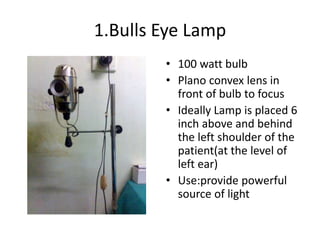
1.Bulls Eye Lamp
• 100 watt bulb
• Plano convex lens in
front of bulb to focus
• Ideally Lamp is placed 6
inch above and behind
the left shoulder of the
patient(at the level of
left ear)
• Use:provide powerful
source of light
Mobile Source of light
• Bulls eye lamp is semi mobile source of light
as it can be twisted, rotated , raised and
lowered.
• Clairs Head Light is the mobile source.
• 9 volt bulb and a adjustable concave mirror is
placed in front of the bulb.
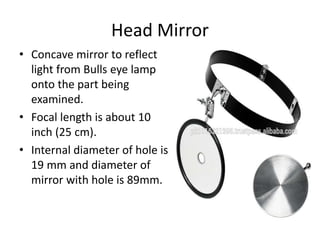
Head Mirror
• Concave mirror to reflect
light from Bulls eye lamp
onto the part being
examined.
• Focal length is about 10
inch (25 cm).
• Internal diameter of hole is
19 mm and diameter of
mirror with hole is 89mm.
Focusing of light with Head Mirror
Steps
Patient sitting on stool must be at same level
of doctor.
Patient legs must be placed to one side of
doctor.
Distance between patient and doctor must
not be more thab 8 inches
Mirror is fixed over the right eye in such a way
that part of the mirror touches the nose.
The mirror is adjusted in such a way that the
right eye sees through the hole in the mirror.
Mirror is adjusted while keeping the left eye
closed and right eye open. Then both eye are
opened.
Lacks Metallic Tongue Depressor
• Use to examine the oral
cavity and oropharynx.
• And also use to check
the patency of nostrils
by observing fogging.
Nasal Speculum
Viennas Nasal Speculum Thudicum Nasal Speculum
Use of Nasal Speculum
• To visualise the nasal cavity.
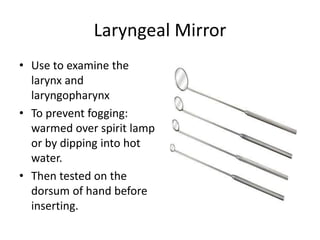
Laryngeal Mirror
• Use to examine the
larynx and
laryngopharynx
• To prevent fogging:
warmed over spirit lamp
or by dipping into hot
water.
• Then tested on the
dorsum of hand before
inserting.
Post Nasal Mirror/Rhinoscopy Mirror
• To examine
nasopharynx and
posterior part of nasal
cavity.
Ear Speculum
• Various size available
according to the size of ear
canal.
• Largest size that can be
inserted conveniently should
be used.
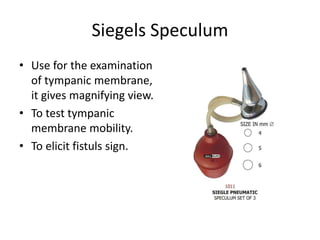
Siegels Speculum
• Use for the examination
of tympanic membrane,
it gives magnifying view.
• To test tympanic
membrane mobility.
• To elicit fistuls sign.
Tuning Fork
• 256 Hz, 512 Hz, 1024 Hz
• Commonly used 512 Hz
• 256 Hz produces more of
vibration sense
• 1024 Hz shorter decay
time
• Site of striking: olecranon,
radial styloid, patella or
soft tissues like thenar
hypothenar eminences,
soft rubber strip
• Use tuning fork tests.
Jobsons Horne Probe with Ring
Curette
• Ring curette: to remove
wax
• Probe: use to form a
cotton bud to clean the
discharge.
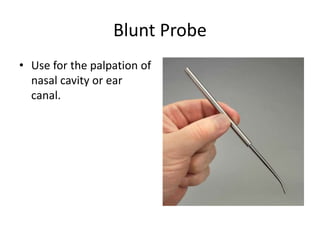
Blunt Probe
• Use for the palpation of
nasal cavity or ear
canal.
Forceps
Tilleys Forcep Hartmans Forceps
Wildes Forceps
Use of Forceps
• Packing of ear canal and nasal cavity.
Eustachian Tube Catheter
• To check the patency of
eustachian tube.
• To remove foreign body
from nose.
Method of insertion of eustachian
tube catheter
• Nose anaesthetize
• Catheter pass along the floor of nose
• Turn medially and slightly withdraw such that
it fix to the posterior free border of nasal
septum.
• Turn laterally by 180 degree
• Catheter lie against the opening of eustachian
tube.
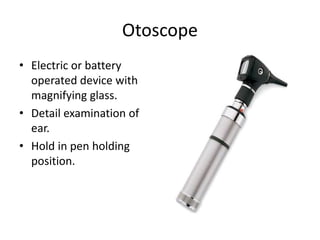
Otoscope
• Electric or battery
operated device with
magnifying glass.
• Detail examination of
ear.
• Hold in pen holding
position.
Spirit lamp
• Use to warm laryngeal
and post nasal mirror.
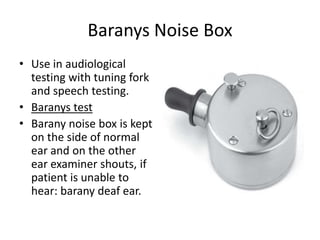
Baranys Noise Box
• Use in audiological
testing with tuning fork
and speech testing.
• Baranys test
• Barany noise box is kept
on the side of normal
ear and on the other
ear examiner shouts, if
patient is unable to
hear: barany deaf ear.
•Thank you

Ent instrument

  • 1.
    ENT OPD INSTRUMENTSAND PROCEDURES Dinesh Lamichhane
  • 2.
  • 3.
    1.Bulls Eye Lamp •100 watt bulb • Plano convex lens in front of bulb to focus • Ideally Lamp is placed 6 inch above and behind the left shoulder of the patient(at the level of left ear) • Use:provide powerful source of light
  • 4.
    Mobile Source oflight • Bulls eye lamp is semi mobile source of light as it can be twisted, rotated , raised and lowered. • Clairs Head Light is the mobile source. • 9 volt bulb and a adjustable concave mirror is placed in front of the bulb.
  • 5.
    Head Mirror • Concavemirror to reflect light from Bulls eye lamp onto the part being examined. • Focal length is about 10 inch (25 cm). • Internal diameter of hole is 19 mm and diameter of mirror with hole is 89mm.
  • 6.
    Focusing of lightwith Head Mirror Steps Patient sitting on stool must be at same level of doctor. Patient legs must be placed to one side of doctor. Distance between patient and doctor must not be more thab 8 inches Mirror is fixed over the right eye in such a way that part of the mirror touches the nose.
  • 7.
    The mirror isadjusted in such a way that the right eye sees through the hole in the mirror. Mirror is adjusted while keeping the left eye closed and right eye open. Then both eye are opened.
  • 8.
    Lacks Metallic TongueDepressor • Use to examine the oral cavity and oropharynx. • And also use to check the patency of nostrils by observing fogging.
  • 9.
    Nasal Speculum Viennas NasalSpeculum Thudicum Nasal Speculum
  • 10.
    Use of NasalSpeculum • To visualise the nasal cavity.
  • 11.
    Laryngeal Mirror • Useto examine the larynx and laryngopharynx • To prevent fogging: warmed over spirit lamp or by dipping into hot water. • Then tested on the dorsum of hand before inserting.
  • 12.
    Post Nasal Mirror/RhinoscopyMirror • To examine nasopharynx and posterior part of nasal cavity.
  • 13.
    Ear Speculum • Varioussize available according to the size of ear canal. • Largest size that can be inserted conveniently should be used.
  • 14.
    Siegels Speculum • Usefor the examination of tympanic membrane, it gives magnifying view. • To test tympanic membrane mobility. • To elicit fistuls sign.
  • 15.
    Tuning Fork • 256Hz, 512 Hz, 1024 Hz • Commonly used 512 Hz • 256 Hz produces more of vibration sense • 1024 Hz shorter decay time • Site of striking: olecranon, radial styloid, patella or soft tissues like thenar hypothenar eminences, soft rubber strip • Use tuning fork tests.
  • 16.
    Jobsons Horne Probewith Ring Curette • Ring curette: to remove wax • Probe: use to form a cotton bud to clean the discharge.
  • 17.
    Blunt Probe • Usefor the palpation of nasal cavity or ear canal.
  • 18.
  • 19.
  • 20.
    Use of Forceps •Packing of ear canal and nasal cavity.
  • 21.
    Eustachian Tube Catheter •To check the patency of eustachian tube. • To remove foreign body from nose.
  • 22.
    Method of insertionof eustachian tube catheter • Nose anaesthetize • Catheter pass along the floor of nose • Turn medially and slightly withdraw such that it fix to the posterior free border of nasal septum. • Turn laterally by 180 degree • Catheter lie against the opening of eustachian tube.
  • 23.
    Otoscope • Electric orbattery operated device with magnifying glass. • Detail examination of ear. • Hold in pen holding position.
  • 24.
    Spirit lamp • Useto warm laryngeal and post nasal mirror.
  • 25.
    Baranys Noise Box •Use in audiological testing with tuning fork and speech testing. • Baranys test • Barany noise box is kept on the side of normal ear and on the other ear examiner shouts, if patient is unable to hear: barany deaf ear.
  • 26.